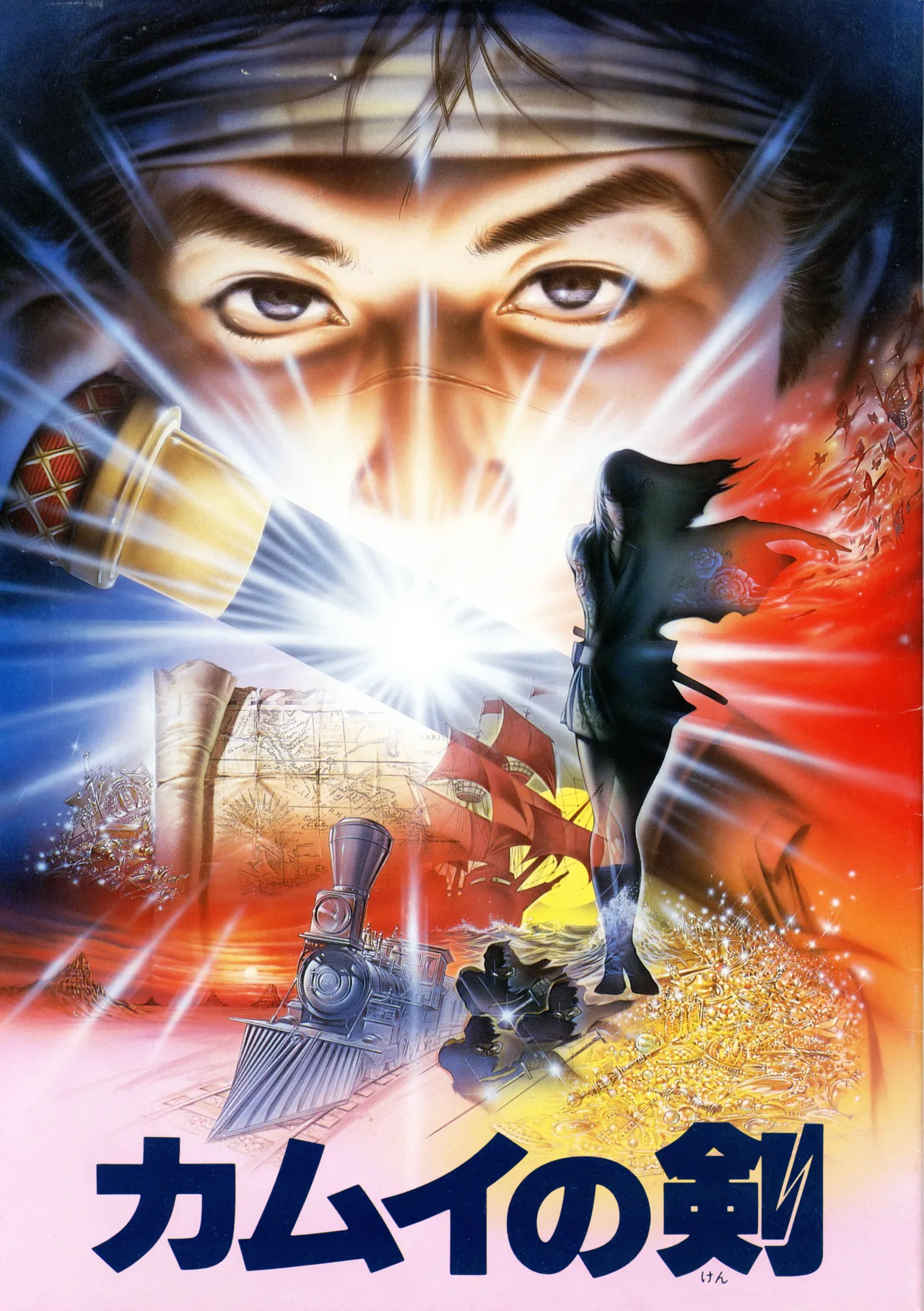
This pamphlet was sold at Japanese cinema lobbies starting March 9, 1985. You bought it alongside your ticket for カムイの剣 (The Dagger of Kamui) — りんたろう's second film for 角川春樹, animated by Madhouse and distributed by Toei. Twenty-eight pages. The same apparatus that had made 幻魔大戦 in 1983, two years later, with a larger story: a half-Ainu young man named Jiro who follows a dagger from late Edo-period Hokkaido across the Pacific Ocean to Gold Rush-era San Francisco. 132 minutes. Mark Twain as a supporting character.
The pamphlet documents the film as it existed at release — before any review, any reputation, any subsequent release. Staff messages from りんたろう, Haruki Kadokawa, Tōru Yano, and music director Ryudo Uzaki. A character chart with every voice actor named. A 3,000km journey map. Four spreads of production stills, act by act. Full crew credits. And on the back cover: the launch advertisement for 月刊ニュータイプ, March 1985, ¥400.
What the Theater Sold You
カムイの剣 opened at Japanese cinemas on March 9, 1985. This 28-page pamphlet was the standard theatrical program — the object the theater sold at the lobby counter alongside your ticket. Director りんたろう (Rintaro). Producer 角川春樹 (Haruki Kadokawa). Original story 矢野徹 (Tōru Yano). Animation by Madhouse. Distributed by Toei. 132 minutes.
The film was Rintaro and Kadokawa's second collaboration in two years — the same apparatus that made 幻魔大戦 (Harmagedon) in 1983, rebuilt around a different story. Where Harmagedon was a psychic apocalypse manga scaled into a cultural event, Dagger of Kamui was a historical adventure novel about a half-Ainu young man who follows a dagger from Hokkaido to San Francisco. The pamphlet documented the film at the moment before its reputation had any shape at all.
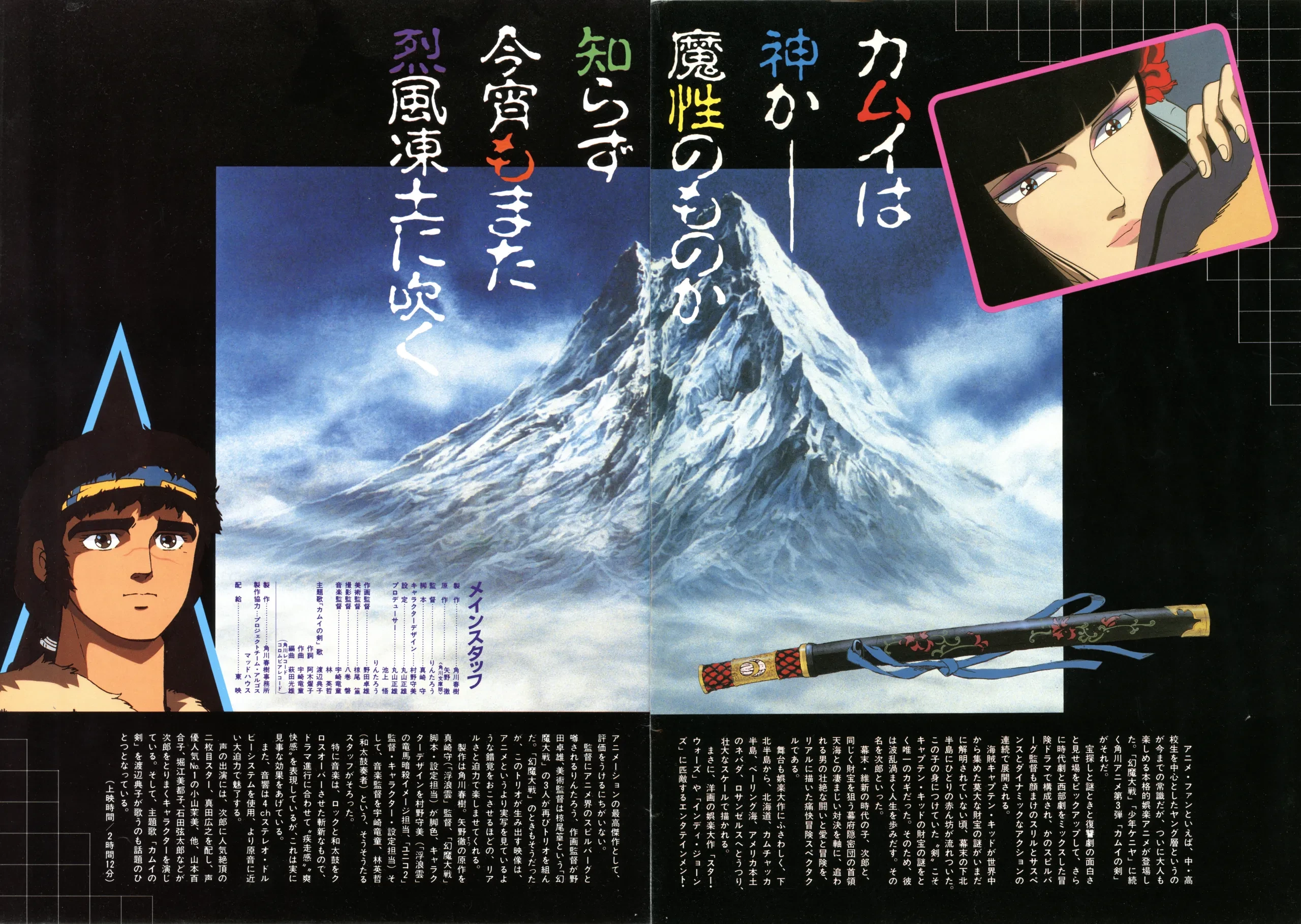 Story introduction spread (pp. 2–3) — mountain vista with the Kamui dagger and scattered sakura petals. Text: 「カムイは神か、魔性のものが知らず、今宵もまた、烈風凍土に吹く」 (Is Kamui a god, or something demonic — even tonight, the wind blows across frozen earth). Character portrait of Jiro, top right. Synopsis columns at base.
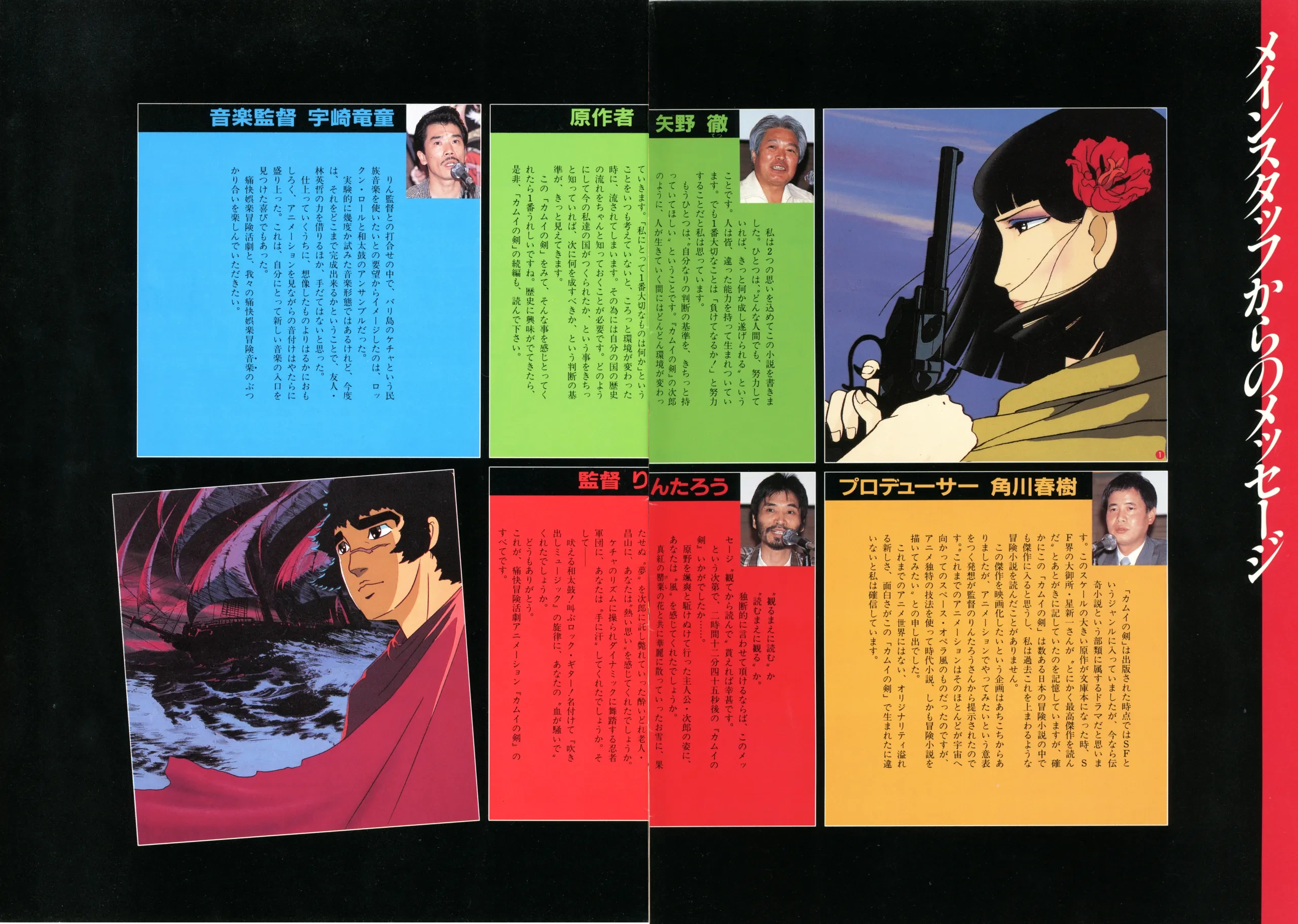 Staff messages spread (pp. 4–5) — six colored panels: music director 宇崎竜童 (Ryudo Uzaki, cyan), original author 矢野徹 (Tōru Yano, green), director りんたろう (Rintaro, red), producer 角川春樹 (Haruki Kadokawa, yellow). Each with portrait photo and production statement.
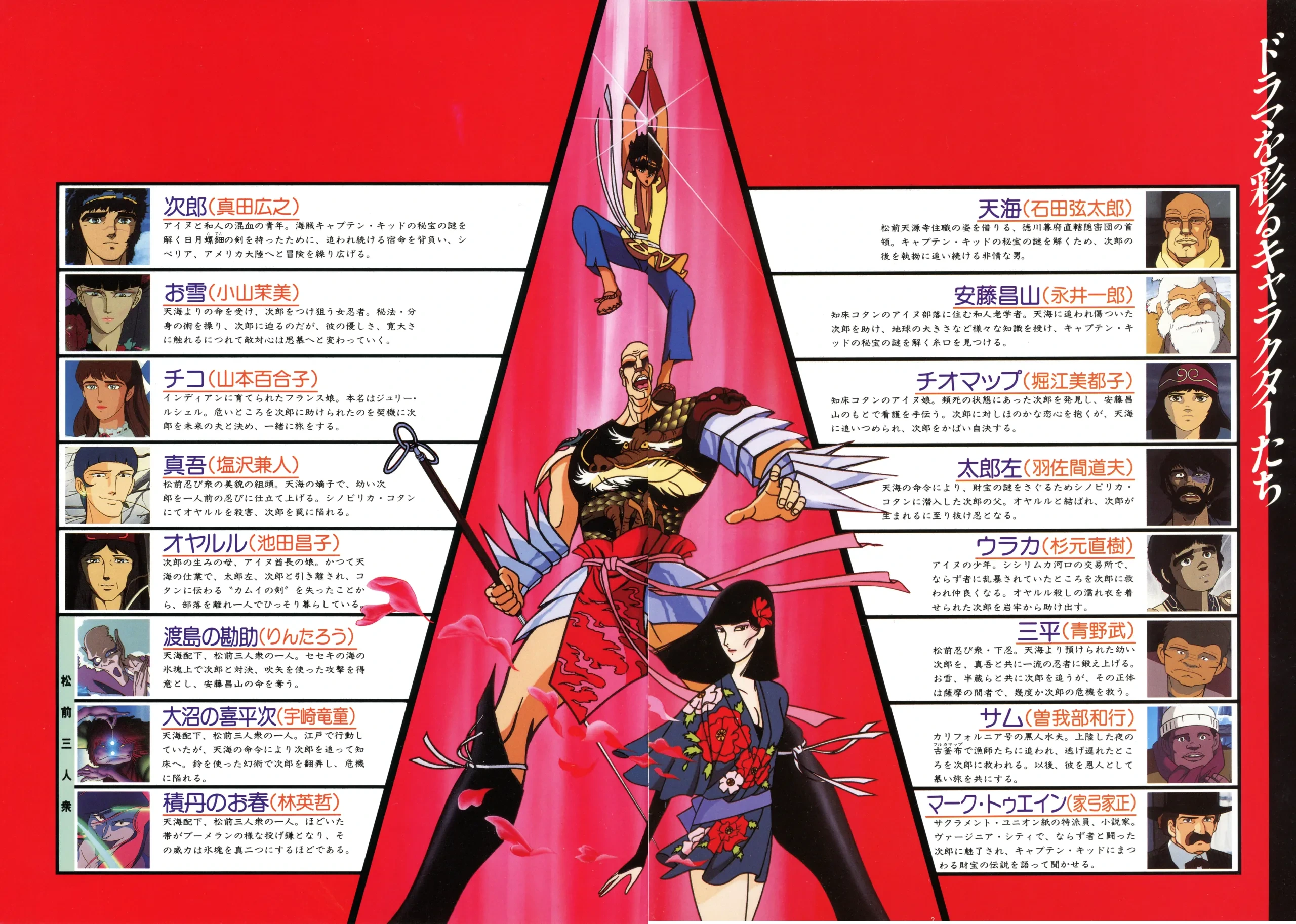 Character chart spread (pp. 6–7) — Tenkai, the antagonist monk, armed and central against red. All named characters listed left and right with voice actor credits. Title text: 「ドラマを彩るキャラクターたち」 (The Characters Who Color the Drama). Full cast visible.
The Voice Cast
主人公 Jiro (次郎) was voiced by 真田広之 (Sanada Hiroyuki). At the time, Sanada was one of Japan's biggest live-action stars — known to audiences from 里見八犬伝 (1983) and 麻雀放浪記 (1984). His anime voice debut was treated as an event. The pamphlet devotes a dedicated section to it, with recording-session photographs and commentary. The character chart names the full supporting cast: 小山茉美 (Koyama Mami) as Oyuki, 山本百合子 as Chiko, 石田弦之郎 as Tenkai.
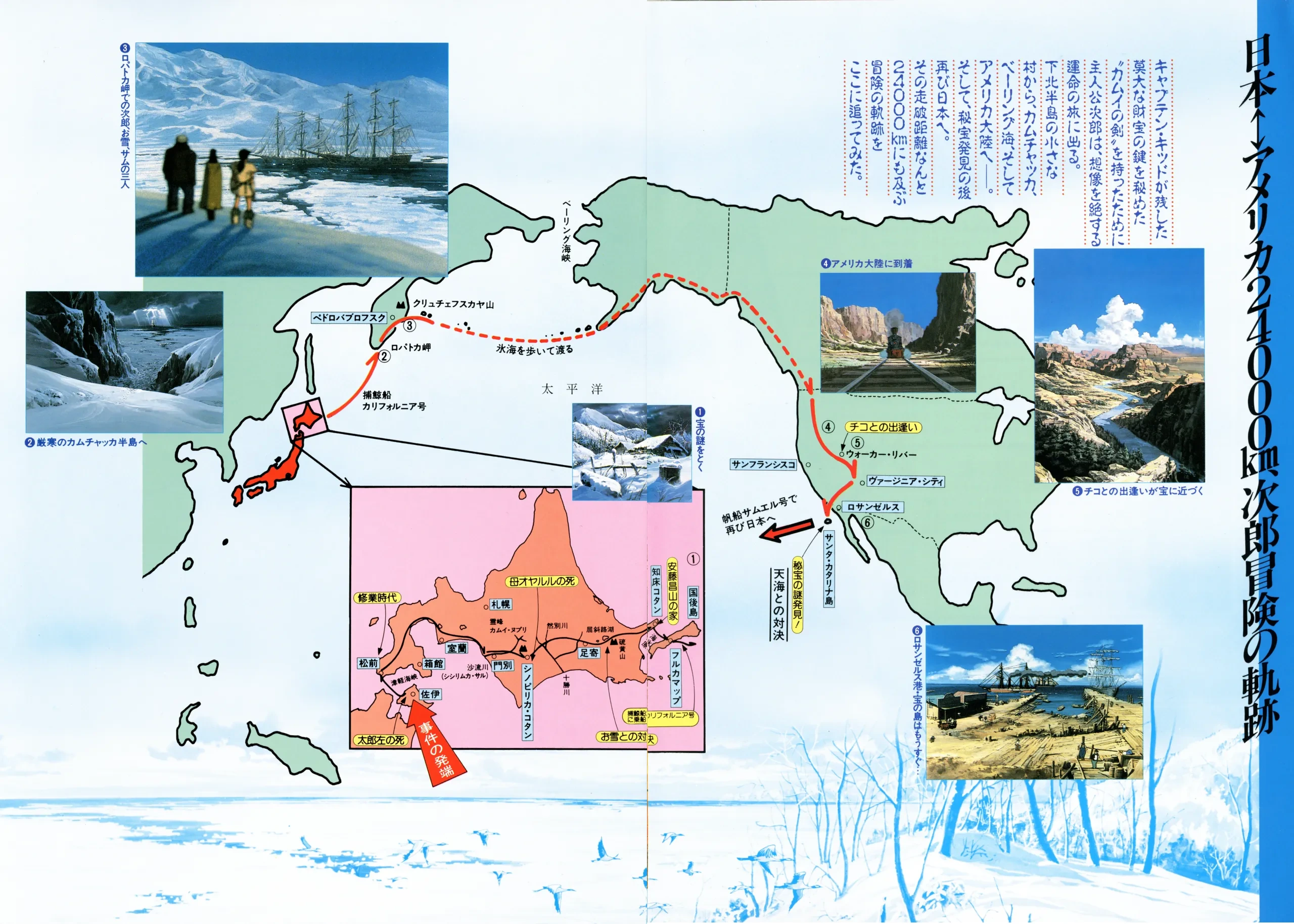 Journey map spread (pp. 8–9) — 「日本からアメリカへ3000kmの次郎冒険の軌跡」 (The Trail of Jiro's 3,000km Adventure from Japan to America). Illustrated map showing the route: Hokkaido → Pacific Ocean → San Francisco. Location photographs overlaid at each stop.
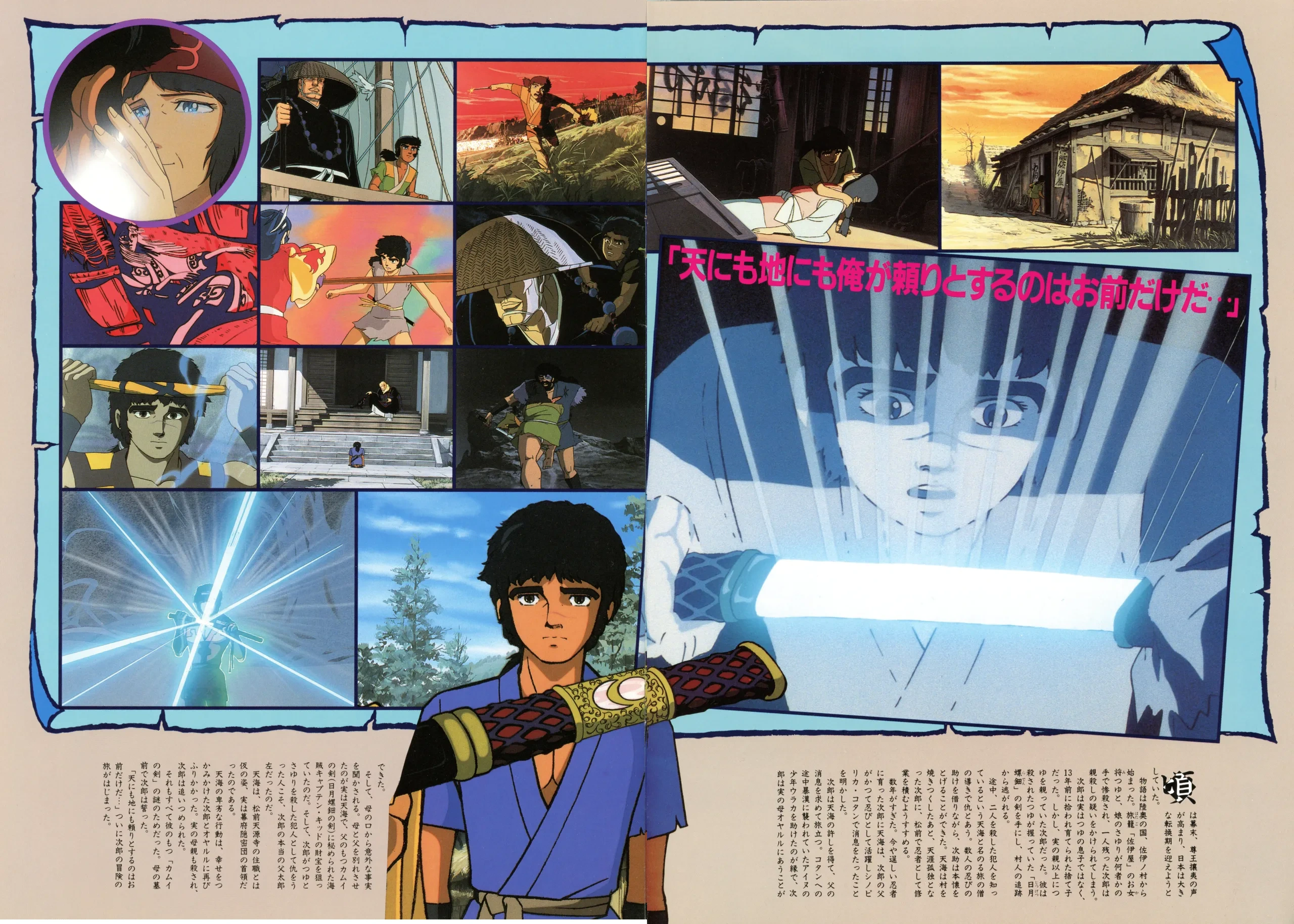 Scene stills, Act 1 (pp. 10–11) — Japan sequences. Jiro in the late Edo period: forest, temple, duel, imprisonment. Quote: 「天にも地にも俺が頼りとするのはお前だけだ」 (In heaven and on earth, you are the only one I can rely on). Character art of young Jiro holding the glowing dagger.
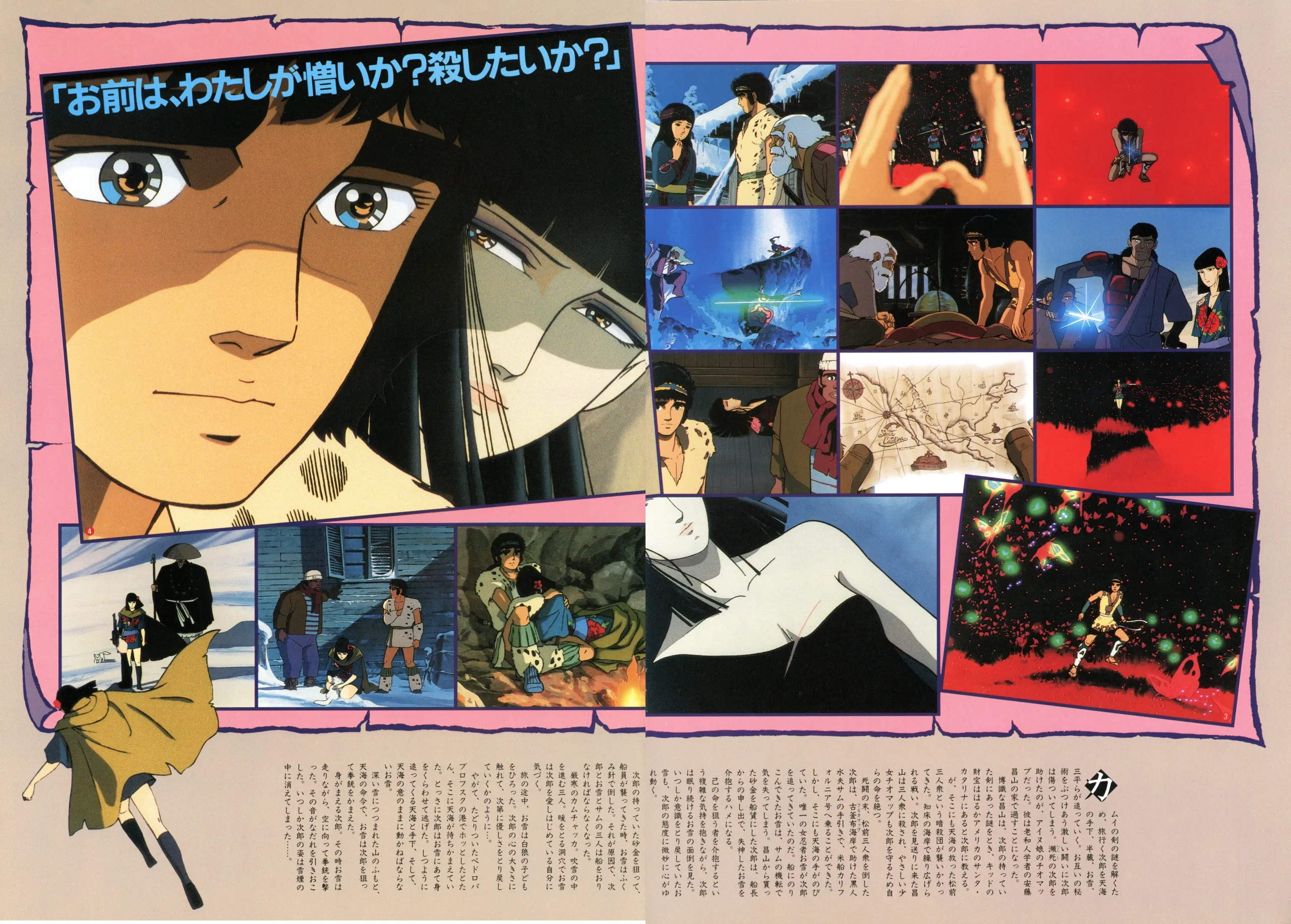 Scene stills, Act 2 (pp. 12–13) — confrontation sequences. Female lead in large format, left. Quote: 「お前は、わたしが憎いか?殺したいか?」 (Do you hate me? Do you want to kill me?). Production stills grid showing emotional pivots — betrayal, revelation, the shift from Japan to open ocean.
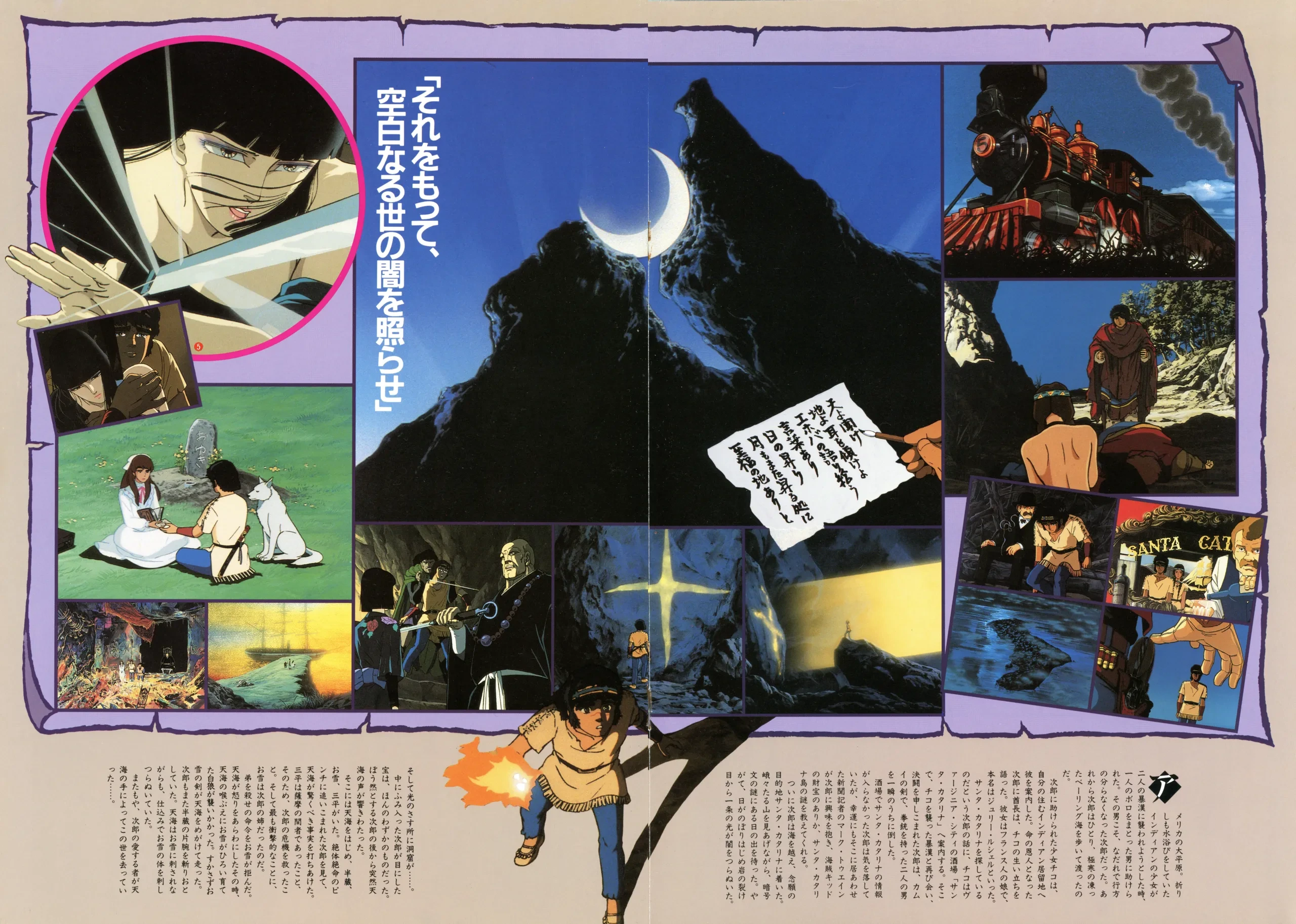 Scene stills, Act 3 (pp. 14–15) — American sequences. Steam train against crescent moon, frontier monuments, Western landscapes, a letter held under starlight. Jiro with flame. The pamphlet maps the film's genre shift: from period ninja action to American frontier adventure.
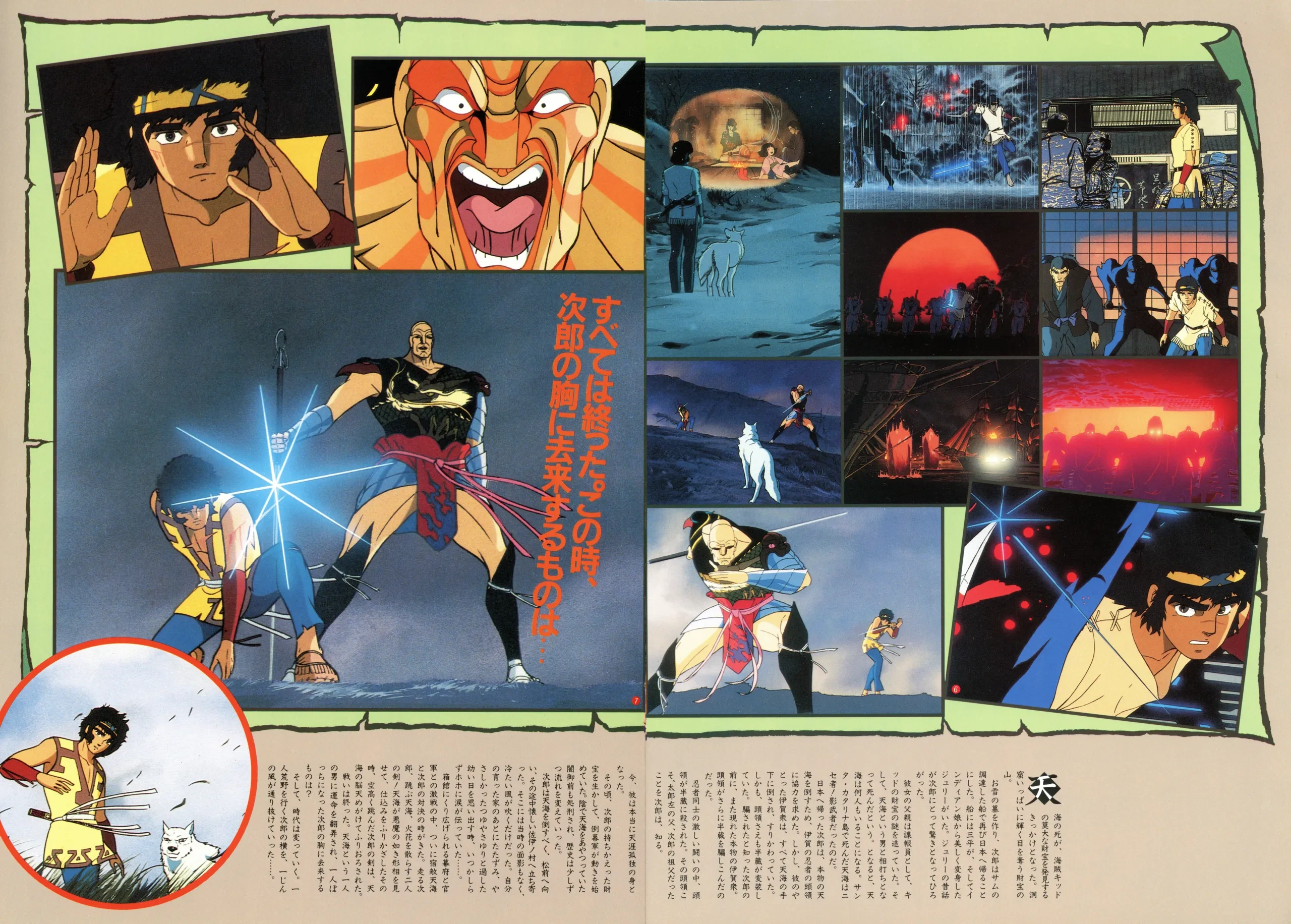 Scene stills, Act 4 (pp. 16–17) — final sequences. Tenkai battle. The production's full visual range compressed into one spread: supernatural combat, white wolf, sunset silhouette, two figures parting.
The Music
Music direction: 宇崎竜童 (Ryudo Uzaki), a pop-rock musician known for his work with Yamaguchi Momoe — an unusual choice for a period anime film. Live taiko performance: 林英哲 (Eitetsu Hayashi), the percussionist who would later collaborate with Seiji Ozawa and the Boston Symphony Orchestra. The pamphlet's production feature (pp. 22–23) documents the recording sessions with photographs: Hayashi at the drums, the full session orchestra, Rintaro at the storyboard table. The combination of pop production sensibility and classical Japanese percussion gives the score its specific texture — neither conventional period music nor contemporary pop, but something in between that matched the film's geographic ambition.
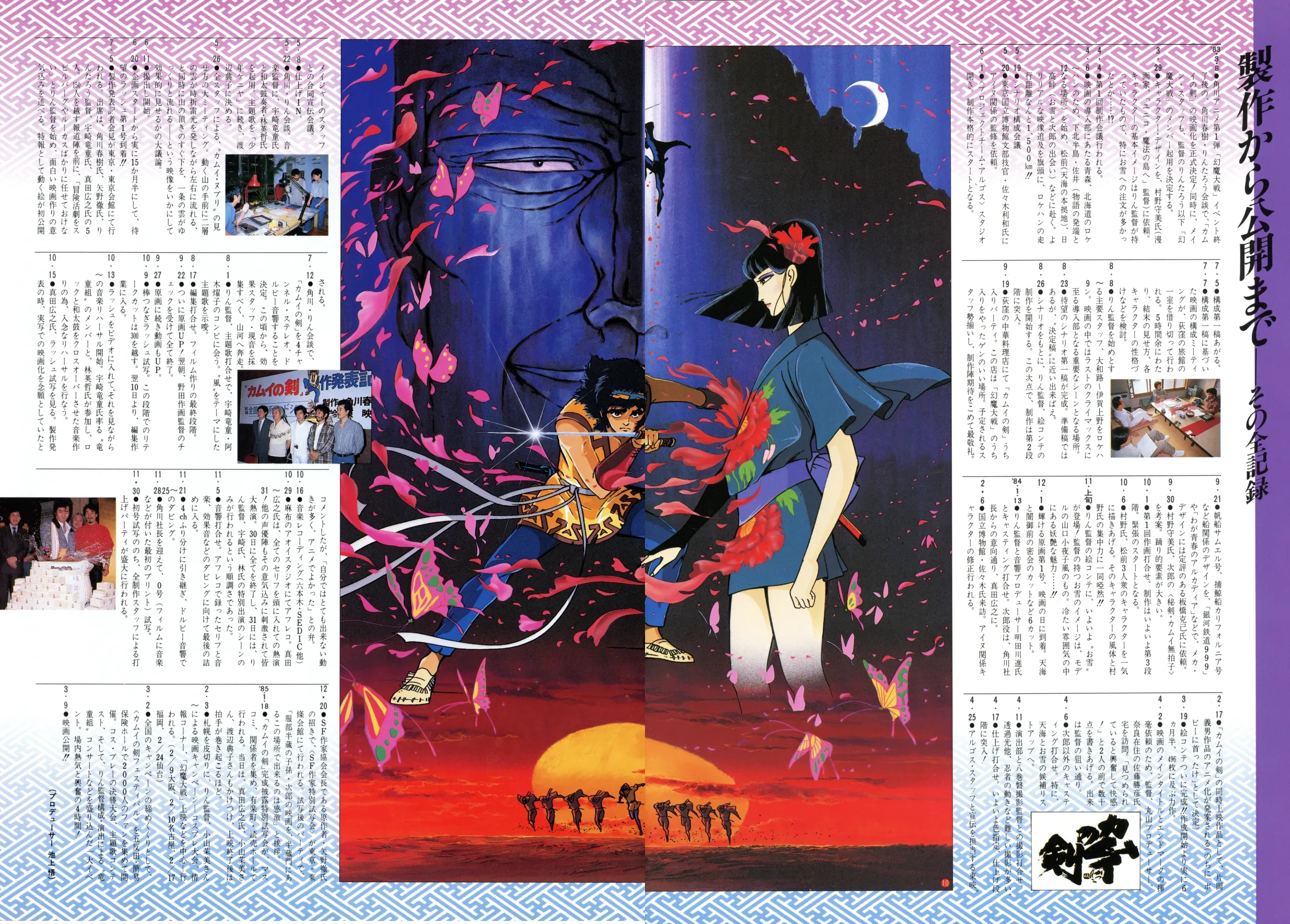 Key visual spread (pp. 20–21) — production chronicle center: Jiro and female lead against a deep red sunset, ninja silhouettes processing below. Production diary photographs at margins. 「製作から公開まで — さびしんぼの記録」 (From Production to Release — Record of a Lonely Boy). The key visual that ran in press materials.
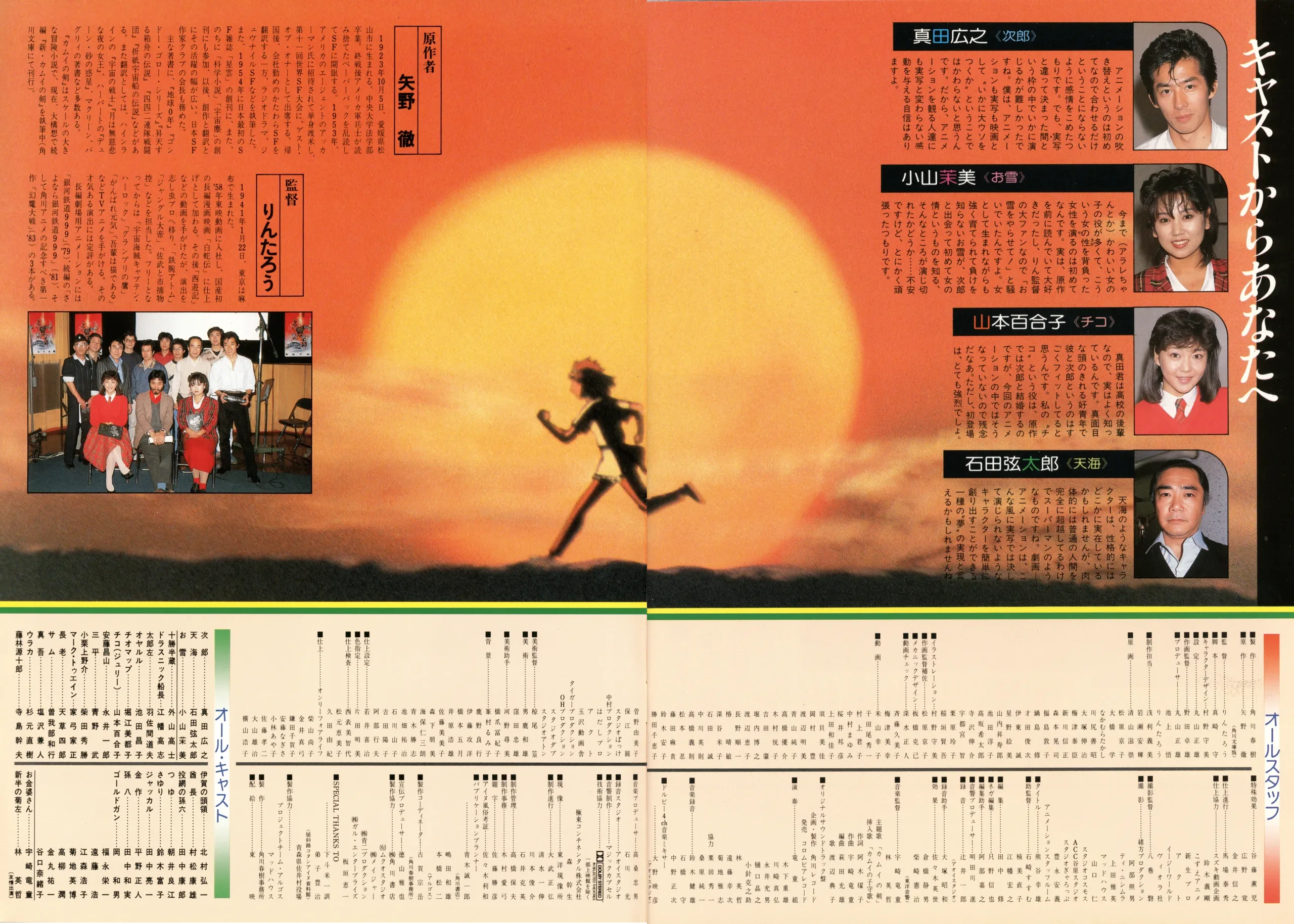 Cast profiles and credits spread (pp. 24–25) — dramatic sunset silhouette center. Cast photographs with profiles: 真田広之 (Jiro), 小山茉美 (Oyuki), 山本百合子 (Chiko), 石田弦之郎 (Tenkai). Full crew credits at bottom in two columns: all staff, all cast, all contractors.
The Back Page
Page 28 carries two advertisements. The top half promotes Kadokawa's カムイの剣 novel series — original text by Tōru Yano, film adaptation books, manga editions. The bottom half is the launch advertisement for 月刊ニュータイプ (Monthly Newtype): 「3月刊!¥400」 (March issue! ¥400). Newtype and The Dagger of Kamui arrived in Japanese culture at the same moment. The magazine that would spend the next four decades documenting anime's visual culture launched the same month as this film. The pamphlet — sold at cinema lobbies, pocketed by theater audiences — holds the evidence on its back cover.
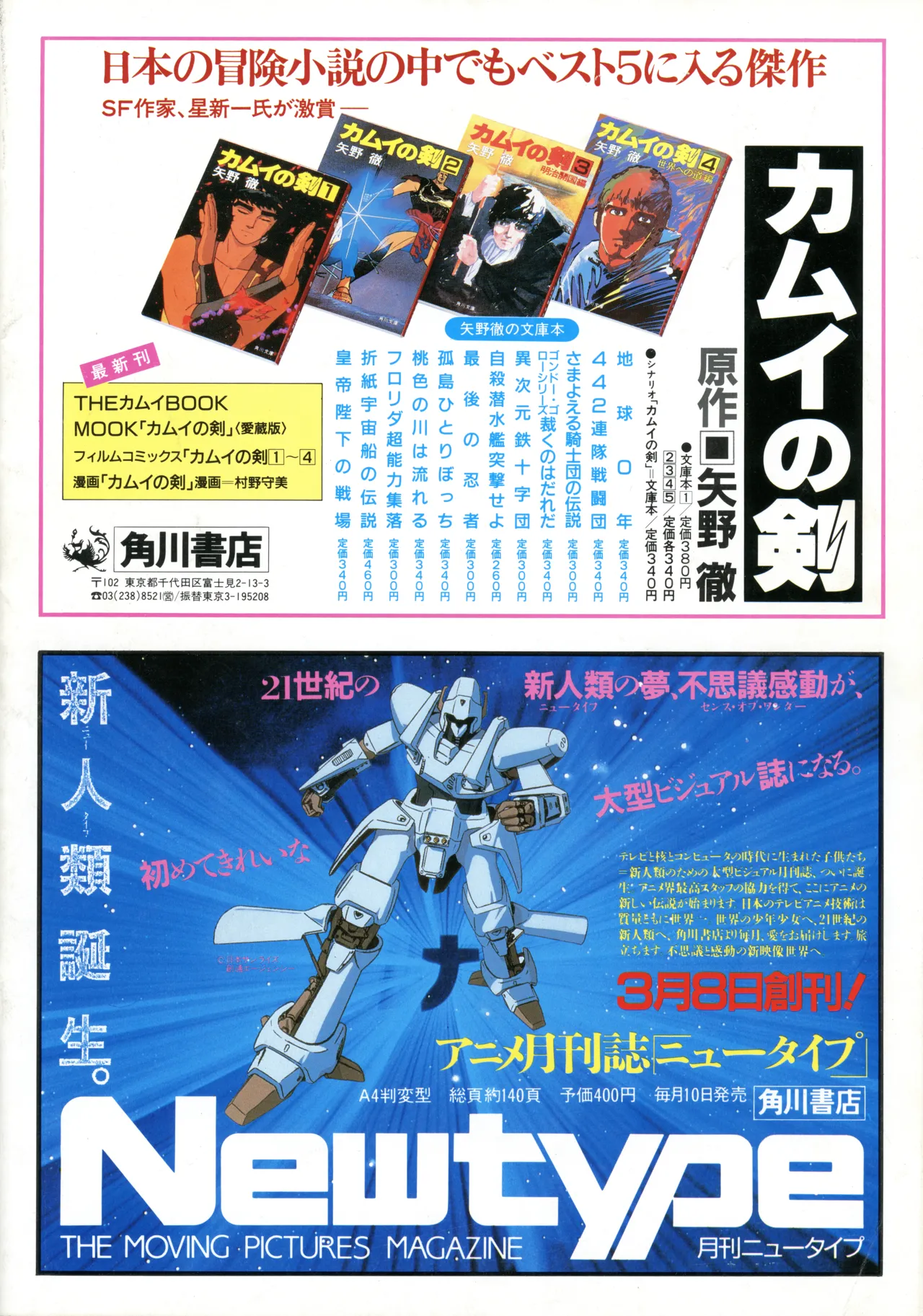 Back page (p. 28) — launch advertisement for 月刊ニュータイプ (Monthly Newtype), March 1985, ¥400, Kadokawa. Above it: Kadokawa's カムイの剣 novel and manga publication list. The magazine that would define anime media coverage launched the same month as the film.
The theater pamphlet is the film's first document — the object that existed before any review, any reputation, any subsequent release. This one is unusually rich for its format: four act-by-act spread sequences that function as a visual synopsis, a journey map that diagrams the film's ambition, staff messages that capture Rintaro and Kadokawa before the film was received. The back cover's Newtype launch ad is incidental but precise — an accident of March 1985 that locates the film exactly in the moment when the infrastructure for discussing anime was being built. Whatever happens to Dagger of Kamui's reputation over the next decades, this pamphlet is what March 1985 thought it was: a major production, a Kadokawa event, a story large enough to cross an ocean.
Loading...