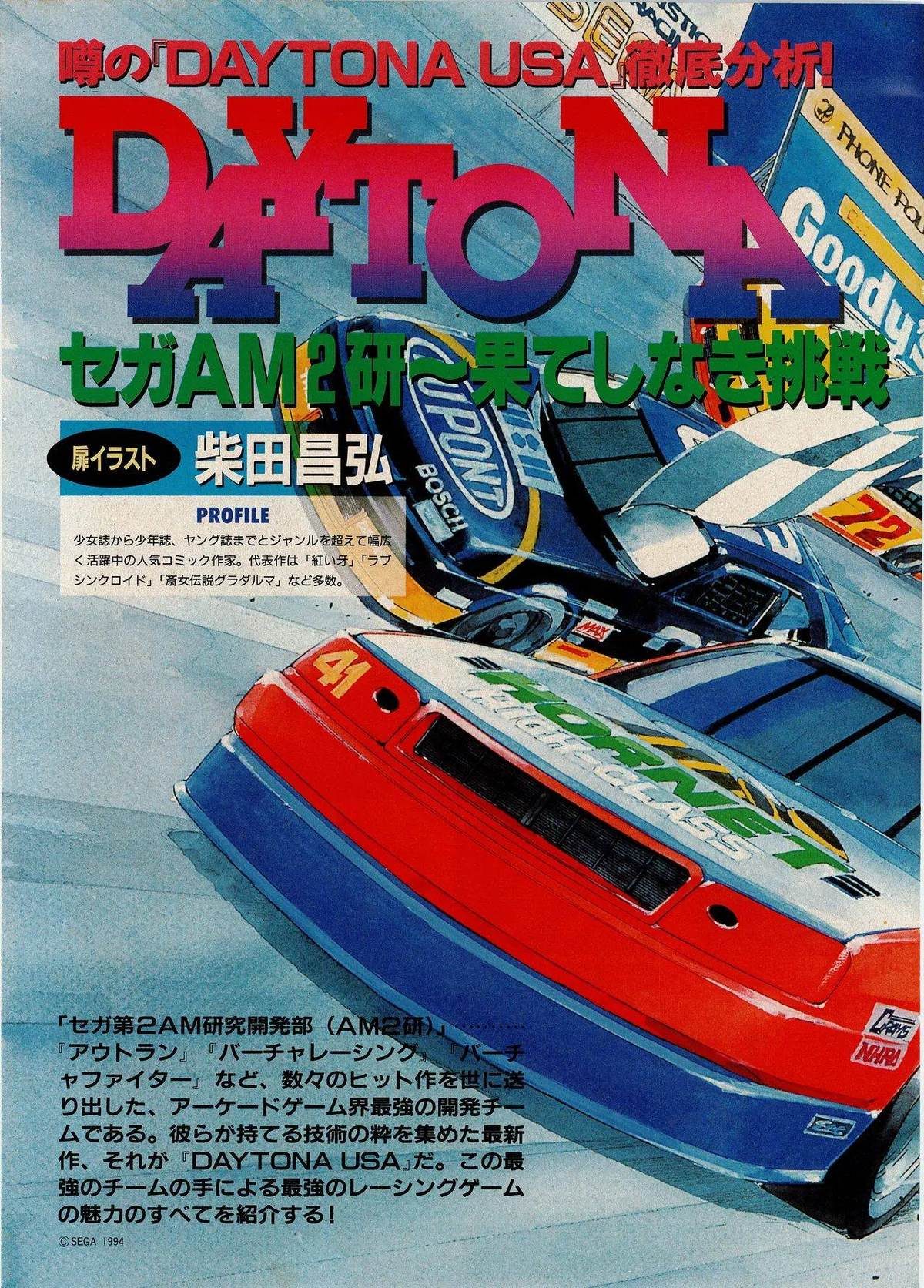
Dengeki Oh! Vol. 16 (May 1994) · 10 pages, pp. 30–39 · Game status: newly released arcade title · Hardware: Sega Model 2 · Developer: Sega AM2 (Yu Suzuki) · Coverage: preview + strategy guide + hardware breakdown + developer interview
Ten pages on Sega AM2's Daytona USA — the arcade racer running on the new Model 2 board that could render textured polygons at a scale no previous hardware had achieved. The coverage opens with a commissioned manga illustration, moves through a NASCAR primer for Japanese readers, delivers corner-by-corner strategy for all three courses, and closes with a texture mapping diagram that explains 3D rendering to a readership that had spent the previous decade looking at sprites.
This spread captures a moment when the arcade industry was teaching its own audience what the future looked like. The magazine isn't reviewing a game — it's introducing a technology through the lens of a game. When the feature explains what texture mapping is using a diagram of a cube gaining surface detail, it's not being condescending. It's being necessary. In May 1994, textured 3D was not common knowledge. A magazine page that needed to teach it is itself a record of how fast the ground was shifting.
The Goddess of Victory
The second page is not from the magazine's editorial team. It's AM2's own promotional illustration — a race queen in a Daytona SEGA swimsuit, checkered flag overhead, pit crew and stock cars behind her. The AM2 palm tree logo sits in the upper right. '勝利の女神は果たして誰に微笑むのか!?' (Who will the goddess of victory smile upon!?). This is arcade marketing as pop art — a development studio producing a pin-up illustration for a racing game. The image has no connection to gameplay — it's AM2 positioning itself as a brand with its own visual identity, not just a development studio.
![Page 31. AM2 promotional illustration. Race queen in Daytona SEGA swimsuit, stock cars, pit crew, checkered flag. AM2 R&D DEPT. #2 logo with palm tree. [PROMOTIONAL ART] — produced by the development studio, not the magazine.](/images/posts/dengeki-oh-daytona-usa-page-02.jpg) Page 31. AM2 promotional illustration. Race queen in Daytona SEGA swimsuit, stock cars, pit crew, checkered flag. AM2 R&D DEPT. #2 logo with palm tree. [PROMOTIONAL ART] — produced by the development studio, not the magazine.
Page 31. AM2 promotional illustration. Race queen in Daytona SEGA swimsuit, stock cars, pit crew, checkered flag. AM2 R&D DEPT. #2 logo with palm tree. [PROMOTIONAL ART] — produced by the development studio, not the magazine.
![Page 32. 'セガAM2研の最新作 登場!' (Sega AM2's latest work arrives!). 'SPEED KING CUP FROM SEGA.' Screenshots of the game in motion. Bottom right: '本物の「デイトナ」とは?' (What is the real 'Daytona'?) — a sidebar explaining NASCAR and the Daytona International Speedway to Japanese readers. [SCREENSHOT]](/images/posts/dengeki-oh-daytona-usa-page-03.jpg) Page 32. 'セガAM2研の最新作 登場!' (Sega AM2's latest work arrives!). 'SPEED KING CUP FROM SEGA.' Screenshots of the game in motion. Bottom right: '本物の「デイトナ」とは?' (What is the real 'Daytona'?) — a sidebar explaining NASCAR and the Daytona International Speedway to Japanese readers. [SCREENSHOT]
Page 32. 'セガAM2研の最新作 登場!' (Sega AM2's latest work arrives!). 'SPEED KING CUP FROM SEGA.' Screenshots of the game in motion. Bottom right: '本物の「デイトナ」とは?' (What is the real 'Daytona'?) — a sidebar explaining NASCAR and the Daytona International Speedway to Japanese readers. [SCREENSHOT]
What Is the Real Daytona?
The bottom of page 32 pauses the game coverage to explain what NASCAR is. The sidebar describes the Daytona International Speedway in Florida, American stock car racing, and what the magazine calls 'アメリカンスピリットあふれるモータースポーツ' — a motorsport overflowing with American spirit. This is cultural translation: the magazine cannot assume its readers know what a stock car is, what oval racing means, or why the game is named after a city in Florida. The explanation tells you as much about the Japanese readership of 1994 as it does about NASCAR. Stock car racing was exotic enough to require a sidebar.
¥100 Per Attempt
Page 33 opens with a photo of the twin-seat deluxe cabinet — the physical machine that players would encounter in arcades. Two strategy points follow. POINT 1: three courses are available, start with the beginner oval. POINT 2: automatic or manual transmission? The magazine recommends AT for beginners. The phrasing is practical and specific because every tip is calibrated to a ¥100 coin drop. When the magazine advises starting with the beginner course, it's telling you how to get the most play time for your money.
![Page 33. 'DAYTONA USAの基本操作' (Basic controls). Photo of the twin-seat deluxe cabinet. POINT 1: three courses, start with beginner. POINT 2: AT or MT — start with AT. Multiple gameplay screenshots including rolling start. [CABINET/HARDWARE] + [SCREENSHOT]](/images/posts/dengeki-oh-daytona-usa-page-04.jpg) Page 33. 'DAYTONA USAの基本操作' (Basic controls). Photo of the twin-seat deluxe cabinet. POINT 1: three courses, start with beginner. POINT 2: AT or MT — start with AT. Multiple gameplay screenshots including rolling start. [CABINET/HARDWARE] + [SCREENSHOT]
Page 33. 'DAYTONA USAの基本操作' (Basic controls). Photo of the twin-seat deluxe cabinet. POINT 1: three courses, start with beginner. POINT 2: AT or MT — start with AT. Multiple gameplay screenshots including rolling start. [CABINET/HARDWARE] + [SCREENSHOT]
![Page 34. Short Oval 777 — beginner course. Hand-drawn course map with three corners annotated. Corner-by-corner driving advice with gameplay screenshots. Target lap: 17 seconds. 'インに付いて、他車をうまくかわせ!' (Stick to the inside and dodge the other cars!) [COURSE MAP / STRATEGY]](/images/posts/dengeki-oh-daytona-usa-page-05.jpg) Page 34. Short Oval 777 — beginner course. Hand-drawn course map with three corners annotated. Corner-by-corner driving advice with gameplay screenshots. Target lap: 17 seconds. 'インに付いて、他車をうまくかわせ!' (Stick to the inside and dodge the other cars!) [COURSE MAP / STRATEGY]
Page 34. Short Oval 777 — beginner course. Hand-drawn course map with three corners annotated. Corner-by-corner driving advice with gameplay screenshots. Target lap: 17 seconds. 'インに付いて、他車をうまくかわせ!' (Stick to the inside and dodge the other cars!) [COURSE MAP / STRATEGY]
![Page 35. '全コース攻略ガイド' (Complete course strategy guide). Short Oval continued — corners 3 through 5 plus main stand straight. '観客の声援に応えながら感動のチェッカーを受ける' (Receive the emotional checkered flag while the crowd cheers). '開発からのアドバイス' (Developer advice) box at bottom. [COURSE MAP / STRATEGY]](/images/posts/dengeki-oh-daytona-usa-page-06.jpg) Page 35. '全コース攻略ガイド' (Complete course strategy guide). Short Oval continued — corners 3 through 5 plus main stand straight. '観客の声援に応えながら感動のチェッカーを受ける' (Receive the emotional checkered flag while the crowd cheers). '開発からのアドバイス' (Developer advice) box at bottom. [COURSE MAP / STRATEGY]
Page 35. '全コース攻略ガイド' (Complete course strategy guide). Short Oval continued — corners 3 through 5 plus main stand straight. '観客の声援に応えながら感動のチェッカーを受ける' (Receive the emotional checkered flag while the crowd cheers). '開発からのアドバイス' (Developer advice) box at bottom. [COURSE MAP / STRATEGY]
![Page 36. Canyon Course — intermediate. 'バランスの取れた、コースレイアウト' (A balanced course layout). Target lap: 46 seconds. Five corners detailed with screenshots. '開発からのアドバイス' box notes the technical nature of the high-speed corners. [COURSE MAP / STRATEGY]](/images/posts/dengeki-oh-daytona-usa-page-07.jpg) Page 36. Canyon Course — intermediate. 'バランスの取れた、コースレイアウト' (A balanced course layout). Target lap: 46 seconds. Five corners detailed with screenshots. '開発からのアドバイス' box notes the technical nature of the high-speed corners. [COURSE MAP / STRATEGY]
Page 36. Canyon Course — intermediate. 'バランスの取れた、コースレイアウト' (A balanced course layout). Target lap: 46 seconds. Five corners detailed with screenshots. '開発からのアドバイス' box notes the technical nature of the high-speed corners. [COURSE MAP / STRATEGY]
![Page 37. Sea Side Course — advanced. 'レースゲーム史上最も長いテクニカルコース' (The longest technical course in racing game history). Target lap: 1 minute 45 seconds. Five sections detailed. The magazine calls it 'HOW TO 上級 DAYTONA' — the advanced class. [COURSE MAP / STRATEGY]](/images/posts/dengeki-oh-daytona-usa-page-08.jpg) Page 37. Sea Side Course — advanced. 'レースゲーム史上最も長いテクニカルコース' (The longest technical course in racing game history). Target lap: 1 minute 45 seconds. Five sections detailed. The magazine calls it 'HOW TO 上級 DAYTONA' — the advanced class. [COURSE MAP / STRATEGY]
Page 37. Sea Side Course — advanced. 'レースゲーム史上最も長いテクニカルコース' (The longest technical course in racing game history). Target lap: 1 minute 45 seconds. Five sections detailed. The magazine calls it 'HOW TO 上級 DAYTONA' — the advanced class. [COURSE MAP / STRATEGY]
Developer Advice
Each course page carries a '開発からのアドバイス' box — developer advice, printed in a distinct callout. The AM2 team is speaking directly to players through the magazine, offering corner-specific tips: where to brake, when to drift, how to read the course. The Canyon Course advice notes that high-speed corners require committing to a line early. The Sea Side advice warns that the course punishes hesitation. These aren't marketing quotes. They're the development team coaching players on how their physics system works — and in an arcade context where each attempt costs money, the coaching is practical charity.
The Short Oval's final instruction captures something about how the magazine framed arcade racing:
「観客の声援に応えながら感動のチェッカーを受ける」
Receive the emotional checkered flag while the crowd cheers.
The language treats a ¥100 arcade race like a stadium event. That framing — racing as performance, not just play — runs through the entire spread. The target lap times assume competent but not expert play. The recommended transmission is automatic. The beginner course is positioned as genuinely enjoyable, not a tutorial to rush through. The game was designed to be satisfying at every skill level — because an arcade game that frustrates beginners doesn't earn coins.
![Page 38. 'WHAT'S DAYTONA USA?' — deeper context. '最新MODEL 2ボード搭載の威力' (The power of the latest MODEL 2 board). '目の前に出現する超リアルな世界' (An ultra-realistic world appearing before your eyes). Comparison screenshots: Virtua Racing (flat-shaded polygons) vs. Daytona USA (textured). Bottom section: '「DAYTONA USA」制作までの舞台裏!' (Behind the scenes of Daytona USA production) with developer photo. [SCREENSHOT] + [DEVELOPER PHOTO]](/images/posts/dengeki-oh-daytona-usa-page-09.jpg) Page 38. 'WHAT'S DAYTONA USA?' — deeper context. '最新MODEL 2ボード搭載の威力' (The power of the latest MODEL 2 board). '目の前に出現する超リアルな世界' (An ultra-realistic world appearing before your eyes). Comparison screenshots: Virtua Racing (flat-shaded polygons) vs. Daytona USA (textured). Bottom section: '「DAYTONA USA」制作までの舞台裏!' (Behind the scenes of Daytona USA production) with developer photo. [SCREENSHOT] + [DEVELOPER PHOTO]
Page 38. 'WHAT'S DAYTONA USA?' — deeper context. '最新MODEL 2ボード搭載の威力' (The power of the latest MODEL 2 board). '目の前に出現する超リアルな世界' (An ultra-realistic world appearing before your eyes). Comparison screenshots: Virtua Racing (flat-shaded polygons) vs. Daytona USA (textured). Bottom section: '「DAYTONA USA」制作までの舞台裏!' (Behind the scenes of Daytona USA production) with developer photo. [SCREENSHOT] + [DEVELOPER PHOTO]
Model 2
Page 38 steps back from strategy to explain why the game looks the way it does. The Model 2 board — Sega's newest arcade hardware, announced at the February 1994 AOU Show — is presented as a generational leap. The magazine runs comparison screenshots: Virtua Racing's flat-shaded polygons next to Daytona USA's textured surfaces. The difference is visible and dramatic. The header reads:
「目の前に出現する超リアルな世界」
An ultra-realistic world appearing before your eyes.
Language that sounds like hype — but was, in context, a reasonable description of the jump from untextured to textured 3D. Below the hardware section, a developer interview begins. The feature identifies AM2 and notes this is the studio behind Virtua Racing and Virtua Fighter — framing Daytona USA as the latest output from what the magazine treats as an elite engineering team. In 1994, arcade development studios had the cultural status that console studios would later inherit.
Teaching 3D
The final page is the most historically revealing. Under the heading '駆使される最先端技術の数々!' (Numerous cutting-edge technologies being utilized!), the magazine explains texture mapping from first principles. A diagram shows it step by step: a polygon cube plus a texture pattern equals a realistic textured object. The label reads 'テクスチャーマッピング' — the English term transliterated into katakana, because there was no established Japanese word for it yet. The magazine was introducing vocabulary. A full page devoted to explaining that polygons can have surface images applied to them — not as a technical aside, but as the central revelation of the feature's closing page. In hindsight, the diagram reads like a timestamp. It marks the exact moment when a general-audience game magazine needed to teach its readers what would, within two years, become the baseline visual standard for every 3D game.
![Page 39. '駆使される最先端技術の数々!' (Cutting-edge technologies!). 'テクスチャーマッピングを駆使したリアルで迫力ある映像に注目!' (Pay attention to the realistic, powerful visuals utilizing texture mapping!). Center: texture mapping diagram — polygon + texture = textured object. Bottom: '緊急 CAUTION' — Daytona USA official guidebook ad, release date April 22, 1994. [DIAGRAM] + [ADVERTISEMENT]](/images/posts/dengeki-oh-daytona-usa-page-10.jpg) Page 39. '駆使される最先端技術の数々!' (Cutting-edge technologies!). 'テクスチャーマッピングを駆使したリアルで迫力ある映像に注目!' (Pay attention to the realistic, powerful visuals utilizing texture mapping!). Center: texture mapping diagram — polygon + texture = textured object. Bottom: '緊急 CAUTION' — Daytona USA official guidebook ad, release date April 22, 1994. [DIAGRAM] + [ADVERTISEMENT]
Page 39. '駆使される最先端技術の数々!' (Cutting-edge technologies!). 'テクスチャーマッピングを駆使したリアルで迫力ある映像に注目!' (Pay attention to the realistic, powerful visuals utilizing texture mapping!). Center: texture mapping diagram — polygon + texture = textured object. Bottom: '緊急 CAUTION' — Daytona USA official guidebook ad, release date April 22, 1994. [DIAGRAM] + [ADVERTISEMENT]
Daytona USA launched in arcades in March 1994. By the time this issue reached newsstands, the game was already in the wild. But the magazine treats it as a revelation — ten pages of hardware explanation, strategy coaching, and commissioned artwork for a single racing game. That allocation of space tells you what the arcade industry looked like in 1994: a new board from Sega was an event, and the magazine's job was not just to cover it but to prepare its readers to understand what they were seeing.
The texture mapping diagram on the final page is the artifact that matters most. Within two years, every 3D game would use texture mapping. No magazine would need to explain it. But in May 1994, Dengeki Oh! dedicated a full page to a diagram showing a cube gaining a surface. The technology was so new that the Japanese term was a transliteration of the English — テクスチャーマッピング — because the concept hadn't existed long enough to generate its own word.
The guidebook advertised on the same page was scheduled for April 22, 1994. It promised developer "secret talk." The secrets were about polygons.
Loading...