Dengeki Oh! Vol. 44 (January 1996) · 3 pages, pp. 133–134, 259 · Game status: pre-launch (March 9, 1996) · Hardware: Super Famicom · Developer: Nintendo / Square · Coverage: feature preview
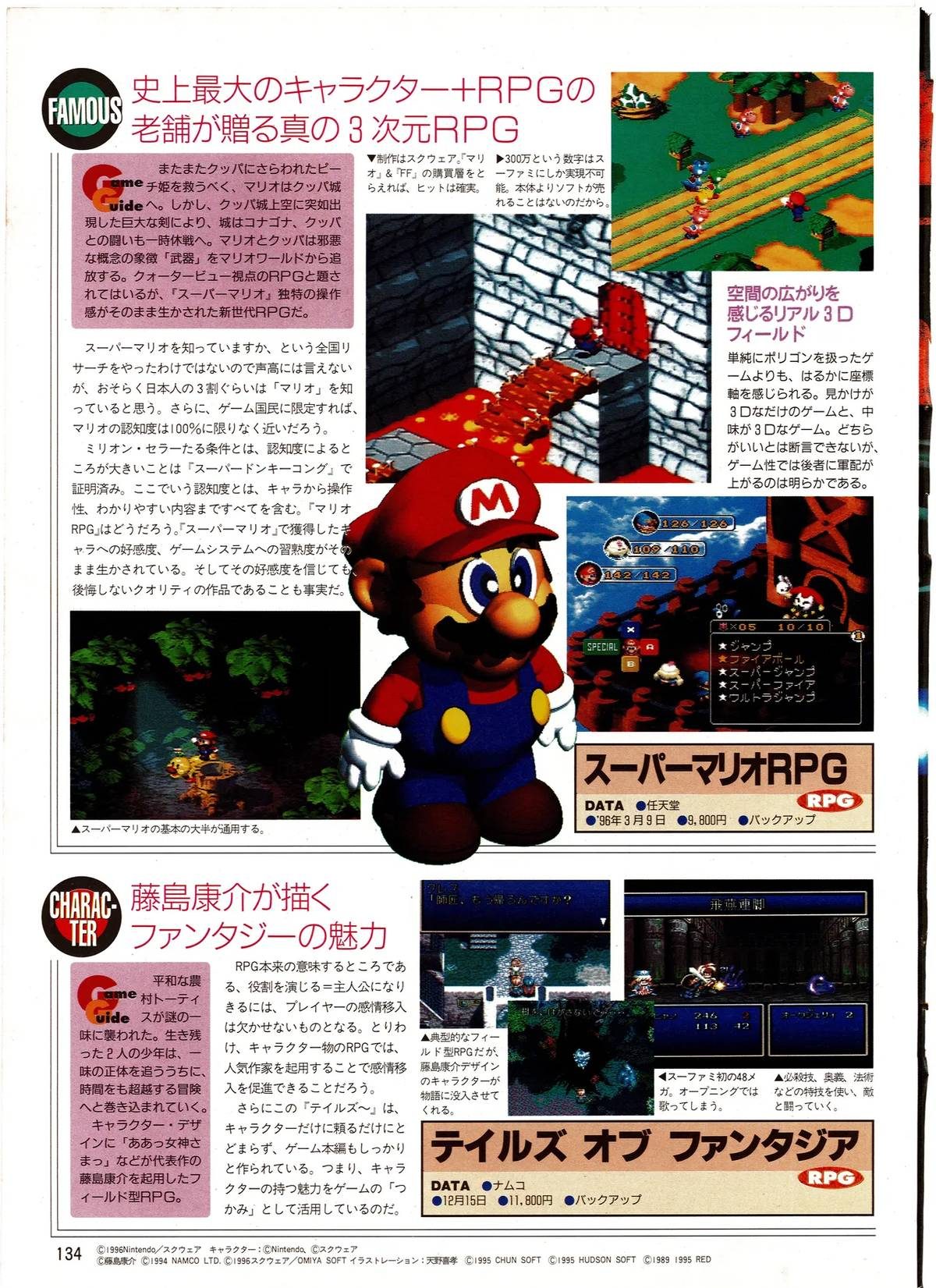
The January 1996 issue reaches Super Mario RPG twice. Page 133 places it at the top of a six-keyword RPG taxonomy under the label FAMOUS — the highest category in a grid that files Dragon Quest VI under CONSTACY and Tales of Phantasia under CHARACTER. Page 134 delivers the feature preview under the headline 史上最大のキャラクター+RPGの老舗が贈る真の3次元RPG — the veteran RPG maker's genuine 3D RPG, featuring the largest character in history. Page 259 provides the standalone full-page preview with party member introductions, the timed-hit battle system, and platformer-style event sequences built into the RPG structure.
Together the three pages document the Nintendo-Square collaboration at the point when the magazine had no reason to treat it as remarkable. The dream pairing had produced a game. The game was two months from release. The coverage is straightforward. What it captures, without trying to, is an alliance the industry took for granted in January 1996 and would not take for granted again.
Famous
Page 133 organizes the late SFC RPG landscape into six editorial categories. FAMOUS: Super Mario RPG. CONSTACY: Dragon Quest VI. AMAZING: Fuurai no Shiren. TIME: Tengai Makyou Zero. CHARACTER: Tales of Phantasia. WORLD VIEW: Front Mission: Gun Hazard. The categories are not review scores or sales projections — they are characterizations of what each RPG is selling. Mario is in the FAMOUS category because the character is the most recognizable property on the platform — the editorial act is measuring name recognition, not quality. The editorial act is a measurement of name recognition, and in January 1996, Nintendo's mascot wins on that metric without contest.
The taxonomy also documents what the SFC RPG scene looked like at the end of its dominant era. The six keywords cover the full range: legacy franchises (DQ VI), genre experiments (Shiren's roguelike), historical epics (Tengai Makyou), character-driven fantasy (ToP), world-building strategy-RPG hybrids (Front Mission). Mario RPG sits above all of them not by depth but by reach.
![Vol. 44, p.133. The 1995 SFC Data File and RPG keyword spread. Left column: six keyword categories with game thumbnails. Right: SUPER FAMICOM 1995 DATA FILE — 367 titles released, 176 publishers, average retail ¥25,000, discount price ¥13,330, 98 titles scheduled for 1996. Bottom: extended Dragon Quest VI preview under the CONSTACY keyword. [DIAGRAM]](/images/posts/dengeki-oh-super-mario-rpg-page-01.jpg) Vol. 44, p.133. The 1995 SFC Data File and RPG keyword spread. Left column: six keyword categories with game thumbnails. Right: SUPER FAMICOM 1995 DATA FILE — 367 titles released, 176 publishers, average retail ¥25,000, discount price ¥13,330, 98 titles scheduled for 1996. Bottom: extended Dragon Quest VI preview under the CONSTACY keyword. [DIAGRAM]
Vol. 44, p.133. The 1995 SFC Data File and RPG keyword spread. Left column: six keyword categories with game thumbnails. Right: SUPER FAMICOM 1995 DATA FILE — 367 titles released, 176 publishers, average retail ¥25,000, discount price ¥13,330, 98 titles scheduled for 1996. Bottom: extended Dragon Quest VI preview under the CONSTACY keyword. [DIAGRAM]
![Vol. 44, p.259. Full preview page. Header: '国民的人気のマリオがさらなる飛躍を目指して、いよいよRPGに!' Party member section: Koopa (Bowser), Geno, Yoshi with brief character notes. Bottom: 'マリオにアクションは欠かせない!' with EVENT 1 and EVENT 2 screenshots showing platformer sequences inside the RPG. Release March 9, ¥6,800. おすすめ stamp. [SCREENSHOT]](/images/posts/dengeki-oh-super-mario-rpg-page-03.jpg) Vol. 44, p.259. Full preview page. Header: '国民的人気のマリオがさらなる飛躍を目指して、いよいよRPGに!' Party member section: Koopa (Bowser), Geno, Yoshi with brief character notes. Bottom: 'マリオにアクションは欠かせない!' with EVENT 1 and EVENT 2 screenshots showing platformer sequences inside the RPG. Release March 9, ¥6,800. おすすめ stamp. [SCREENSHOT]
Vol. 44, p.259. Full preview page. Header: '国民的人気のマリオがさらなる飛躍を目指して、いよいよRPGに!' Party member section: Koopa (Bowser), Geno, Yoshi with brief character notes. Bottom: 'マリオにアクションは欠かせない!' with EVENT 1 and EVENT 2 screenshots showing platformer sequences inside the RPG. Release March 9, ¥6,800. おすすめ stamp. [SCREENSHOT]
The Dream RPG
Page 259 opens:
任天堂とスクウェアが共同開発した夢のRPG。クォータービュー画面による立体感いっぱいのマリオワールド。
The dream RPG co-developed by Nintendo and Square. A Mario World full of three-dimensional depth through quarter-view perspective. The word 夢 (dream) is not hyperbole — it names the thing accurately. Nintendo had the franchise with the deepest reach. Square had built the RPG genre on this hardware across Dragon Quest and Final Fantasy. They had coexisted for years without collaborating. When they finally did, the magazine's opening sentence reached for the word that fit.
The subhead '国民的人気のマリオが' — the nationally popular Mario — positions the character differently from any other RPG property. Dragon Quest has franchise loyalty. Final Fantasy has genre prestige. Mario has something prior to both: he is assumed known by everyone, not just players. The preview does not explain who Mario is.
The party member section on p.259 introduces Koopa (Bowser), Geno, and Yoshi alongside Mario. The magazine notes under Koopa's entry that he is normally in the business of kidnapping Princess Peach — framing his presence as an alliance of necessity. The editorial tone is lightly amused by the premise. Traveling with your villain is a joke the game commits to entirely.
Action Is Essential for Mario
The page 134 headline calls this a 真の3次元RPG — a genuine or true 3D RPG — from the 老舗 (veteran craft institution) of the RPG world. The caption under the central screenshot: 空間の広がりを感じるリアル3Dフィールド — a real 3D field with a sense of spatial depth. This is explaining pre-rendered isometric perspective to readers who knew Dragon Quest's flat overworld and Final Fantasy's mode-7 field. The magazine is not condescending. In January 1996, a Mario game with depth cues and rotatable camera angles was worth explaining.
Page 259 devotes its lower third to a section headed マリオにアクションは欠かせない! — Action is essential for Mario! Two event screenshots show platformer-style sequences embedded in the RPG structure: a rope swing, a cart ride. The magazine treats these not as interruptions but as the design argument for why the collaboration makes sense. If Nintendo is bringing Mario, then Mario has to behave like Mario — jumping, running, timing. Square's contribution was building a command RPG around that requirement rather than replacing it.
The timed-hit battle system is mentioned once, briefly, as part of the battle section overview. In hindsight, it is the game's most durable invention. The mechanic appeared in various forms across Paper Mario, Mario & Luigi, and echoes in UNDERTALE and Sea of Stars decades later. The magazine does not flag it as a breakthrough. It gets one sentence in the battle section overview, listed alongside the party system and the command menu.
The magazine assigns Super Mario RPG its six-letter editorial keyword in January 1996: FAMOUS. Not CHARACTER, which went to Tales of Phantasia and its Kosuke Fujishima designs. Not CONSTACY — the magazine's invented portmanteau for Dragon Quest VI's franchise reliability. FAMOUS, unqualified, because the property needed no other description.
The collaboration framing — 夢のRPG, the dream RPG — treats Nintendo and Square as institutions that had never worked this way before, which was accurate. They shared a platform and a market for years without sharing a project. Super Mario RPG required Square to subordinate its visual vocabulary to Nintendo's IP and Nintendo to accept a battle system built from the Final Fantasy framework. The result is visible in the coverage: the magazine leads with the character and explains the system, in that order, because the character was the event and the system was the method.
Final Fantasy VII shipped for PlayStation on January 31, 1997. Square's development priorities were already reorienting when this issue was printed. The dream label, applied in good faith to a joint SFC title in January 1996, acquired a different kind of accuracy within the year. The Vol. 44 preview is covering a game two months from release, using the vocabulary available — dream, famous, genuine, veteran — with no reason to suspect the collaboration had an expiration date.
Loading...