The original 聖戦士ダンバイン (Aura Battler Dunbine) ran 49 television episodes in 1983–84 and ended by killing almost everyone. Yoshiyuki Tomino directed it. A Japanese motorcycle racer named Show Zama is pulled into Byston Well — a medieval fantasy realm layered between the human world and the sea — and handed a war he didn't ask for. He fights in it anyway. The mecha he pilots and fights against are called Aura Battlers: organic, carapaced, insect-derived machines that felt grown rather than built. In the final arc the war breaks through from Byston Well into modern Tokyo, fighter jets scrambling against fantasy mecha over actual landmarks, before the series ended with the bleak completeness that earned Tomino his reputation.
The 1988 OVA sequel — officially 聖戦士ダンバイン 新章, New Story of Aura Battler Dunbine — begins 700 years after those events. New pilots, new Aura Battlers, the same Byston Well. Show Zama is now mythology. The new main Aura Battler is the Serbine (サーバイン): a swept, calligraphic machine with none of the original series' aggressive angularity. Six episodes across three volumes, each titled as its own chapter. Volume 2's second episode is called 七百年の孤独 — Seven Hundred Years of Solitude. The reference to Gabriel García Márquez was intentional.
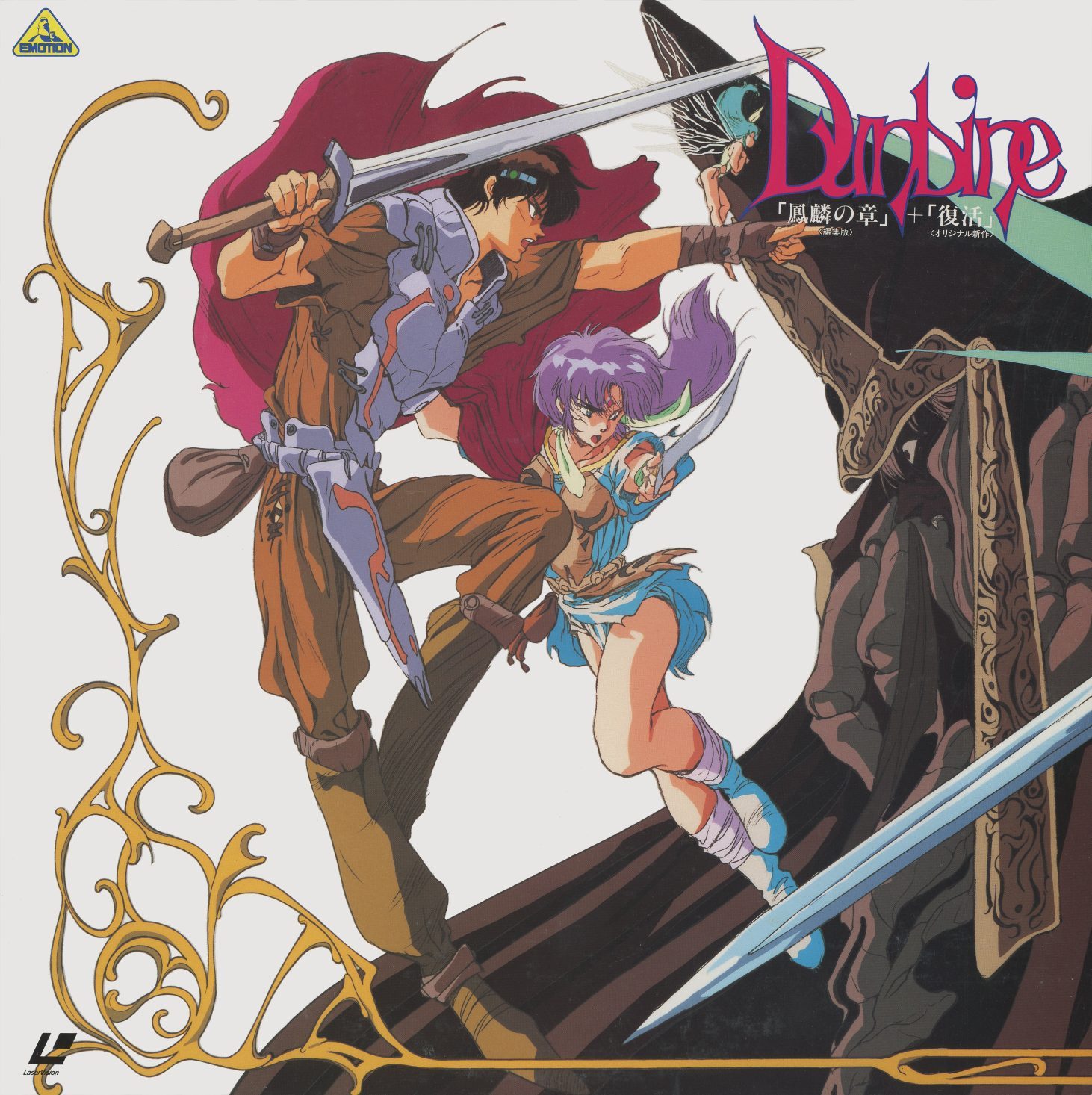
What Emotion/Bandai gave these discs: a gold filigree border on every cover. Ornate scrollwork that references illuminated manuscripts, medieval Books of Hours, the kind of decoration that belongs on an object of significance rather than a product. Nothing else in Tomino's catalogue was packaged this way. The covers say: this is not a robot show. It is a fantasy epic. The mecha live here because the world contains them.
BELL-177
The first volume carries two episodes under different designations: 「鳳麟の章」is labeled 劇場版 (theatrical version), 「復活」is labeled オリジナル新作 (original new work). The distinction matters — the OVA series was released in mixed exhibition modes, some episodes screened theatrically before LaserDisc release, others going directly to home video. BELL-177 preserves both modes on one CLV disc. Digital Sound. The chapter index on the back lists the Tokyo location referenced in the story text, a reminder that the breach between Byston Well and the human world is the franchise's defining structural move — the fantasy war arriving in a recognizable real-world space.
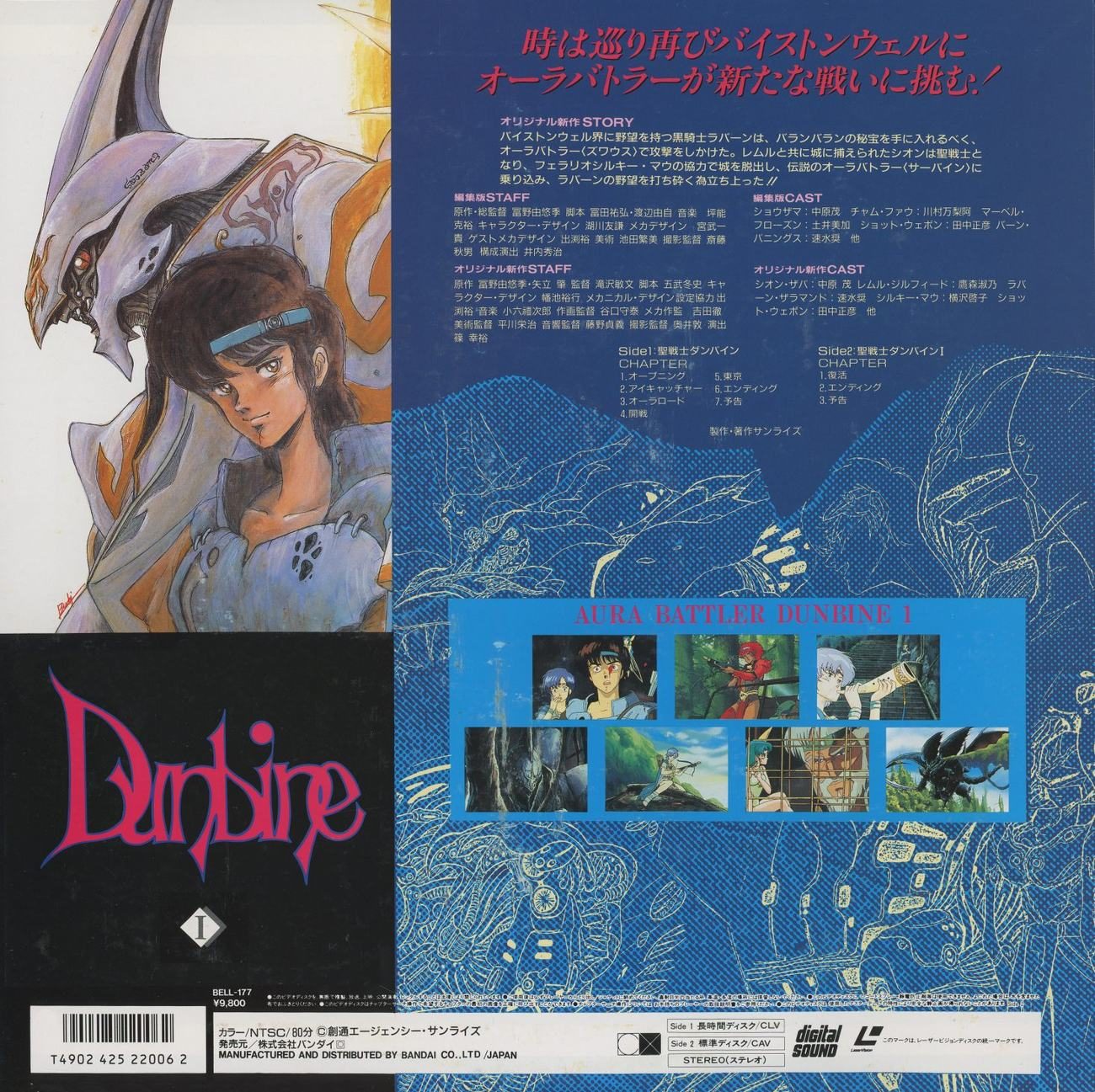 BELL-177 back jacket — story synopsis, full staff credits (director, character design, mecha design), cast listing, chapter/track index for both sides, AURA BATTLER DUNBINE episode photo strip. CLV, Digital Sound, NTSC/COLOR. Manufactured and distributed by Bandai Co., Ltd. ¥9,800.
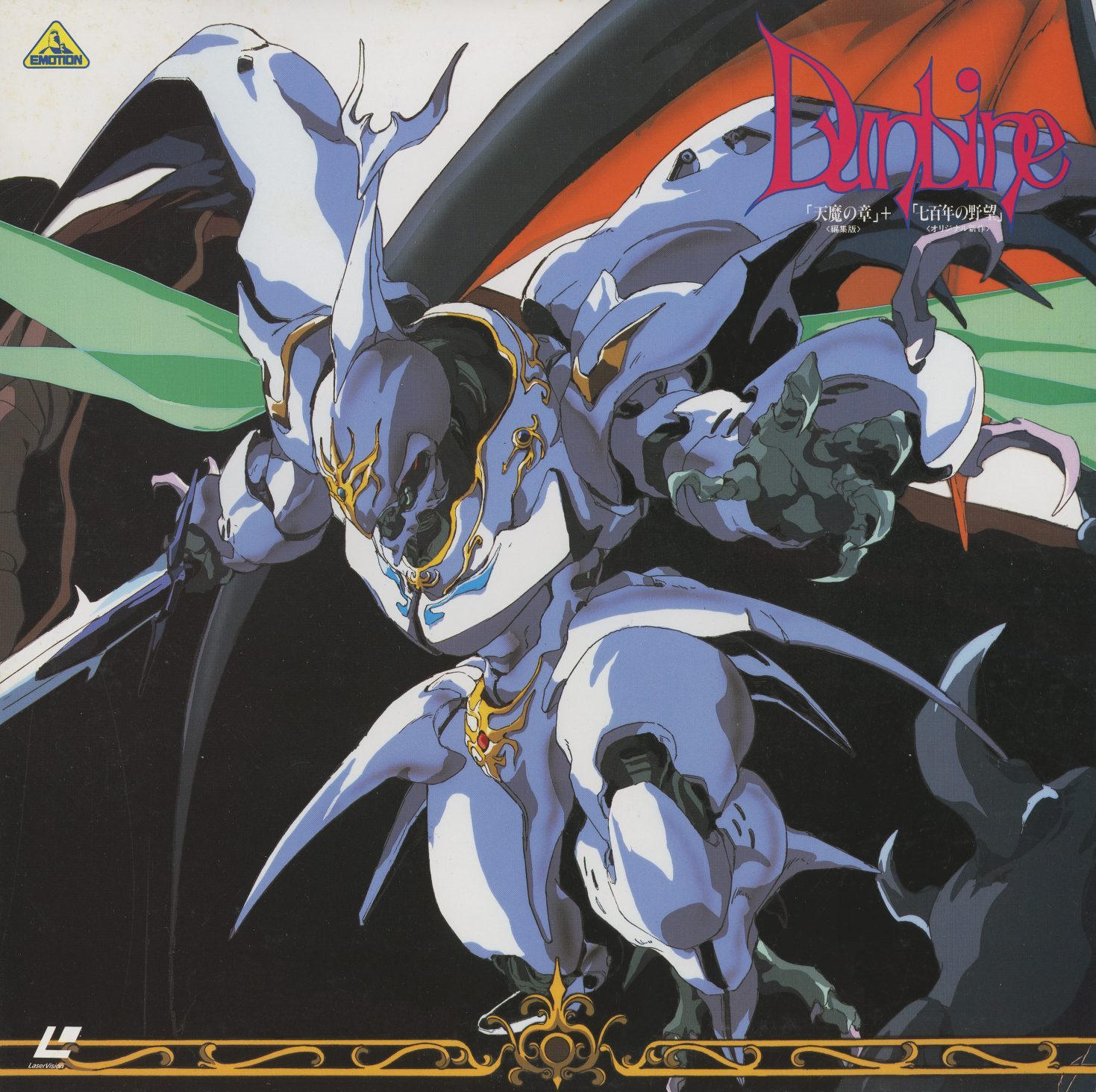 New Story of Aura Battler Dunbine Vol. 2 — BELL-178. The Serbine (サーバイン), the OVA's primary Aura Battler, in full-frame close-up: white-blue carapace, organic swept joints, gold decorative inlay at the chest. No characters visible — the mecha alone, against pure dark. Gold filigree at the bottom. ¥9,300.
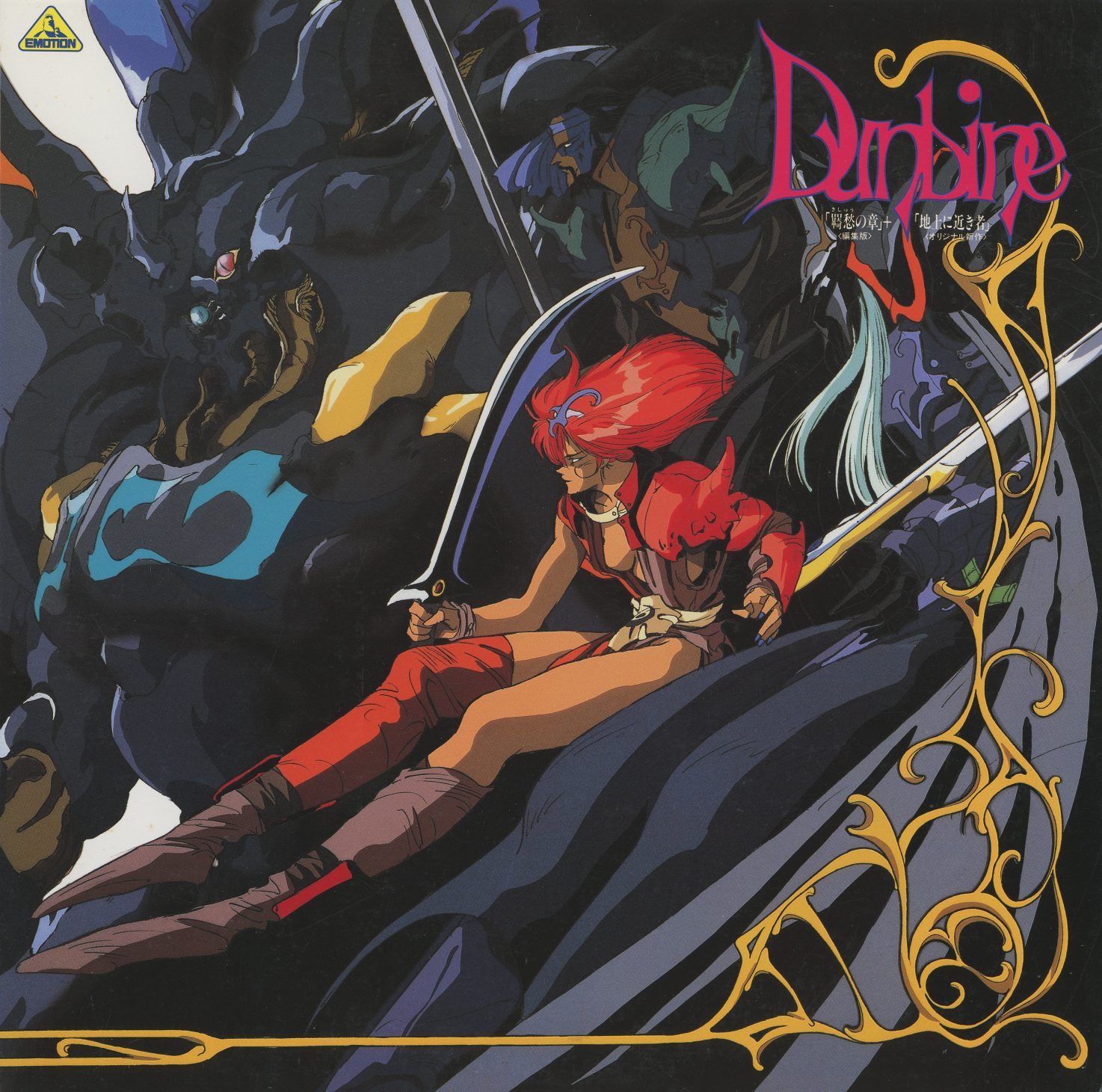 New Story of Aura Battler Dunbine Vol. 3 — BELL-181. A red-haired girl in red armor sliding down a dark rock face, a teal-haired figure behind her; dark Aura Battler looming in the upper left. Gold filigree scrollwork on the right side. Episodes: 「彩悠の章」+ 「地上に遠き者」(Those Far from the Surface World). ¥9,300.
What Dunbine Was
Dunbine is obscure partly because it arrived at the wrong moment. The 1983 TV series ran directly before Zeta Gundam (1985), which pulled most of the critical and cultural attention. But the original series was doing something that wouldn't find its genre name for another thirty years: it was isekai. A Japanese person pulled into a different world, handed a war, forced to choose sides. Tomino used the structure not for adventure but for moral weight — Show Zama's capability makes him immediately useful to whoever grabbed him, and the series is largely about what it costs to be useful in someone else's war. The Aura Battlers were the formal embodiment of that: Kazutaka Miyatake designed them to feel alive and animal rather than mechanical, because a world that generated biological war-machines had different rules than the Gundam universe. The 1988 OVA inherited all of this and placed it 700 years further along. The new characters move through a world where the original series is legend. The cover art's gold borders acknowledge what the OVA understood about its own position: it was handling inherited material. You frame inherited material like a manuscript.
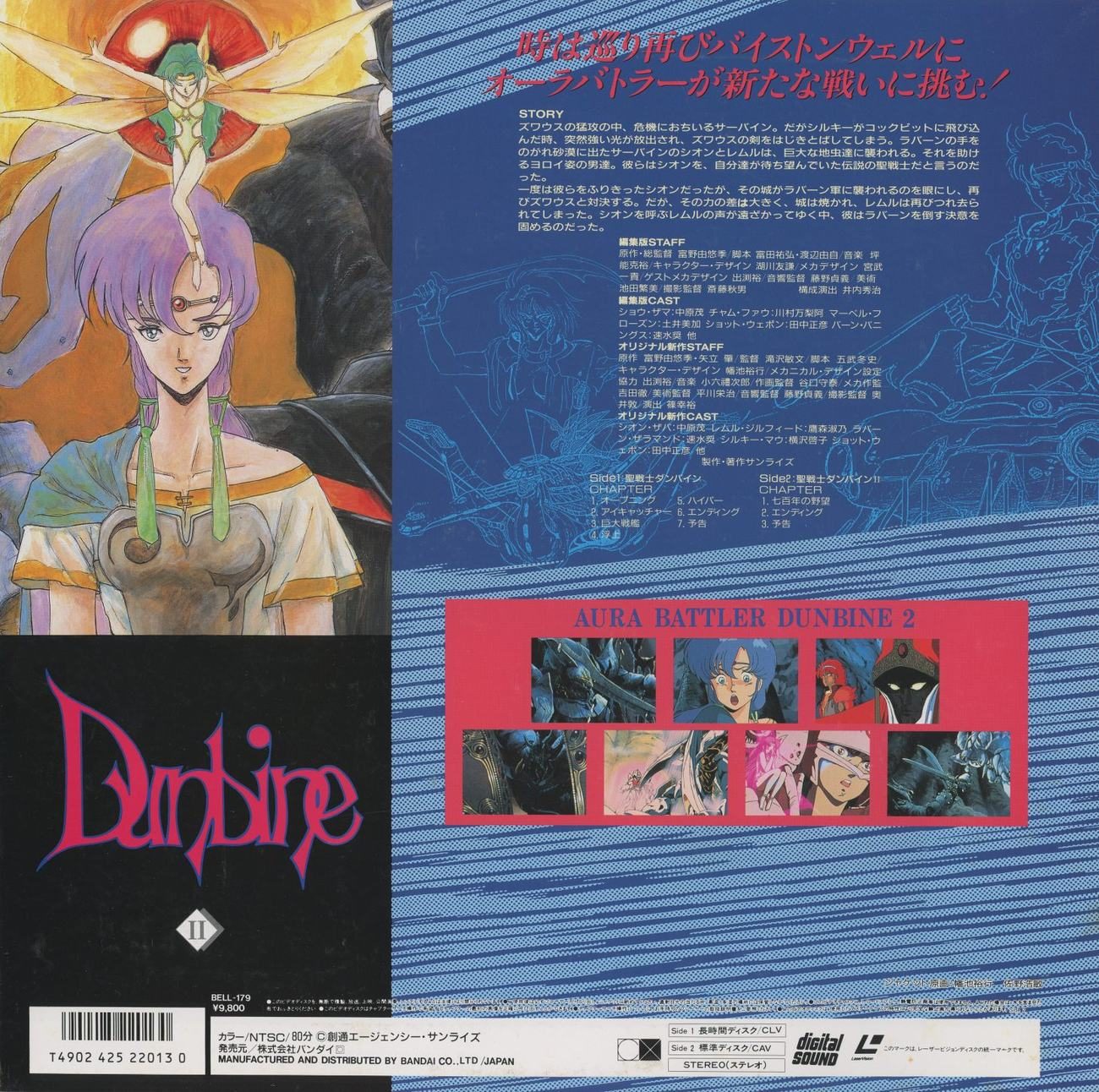 BELL-178 back jacket — story synopsis for 「天魔の章」and 「七百年の孤独」. Staff and original staff credits. Cast listing for both episodes. AURA BATTLER DUNBINE 2 episode photo strip. CLV, Digital Sound. The episode title 七百年の孤独 — Seven Hundred Years of Solitude — printed in the chapter index.
Seven Hundred Years of Solitude
The title is the tell. García Márquez's novel spans generations, treating a family's history as myth accumulating over time until it collapses under its own weight. The OVA episode borrows that frame: the 700-year interval between the TV series and the sequel is not just a plot device — it positions the original Dunbine as founding mythology. Show Zama and the events of the TV series exist in the new story the way the Buendía family's origins exist in Macondo: as something that shaped the world, not something that can be revisited. The LaserDisc preserves that title alongside the mecha cover art. The Vol. 2 disc gives you the most dramatic mecha painting in the set — the Serbine alone, almost heraldic — and names the episode after magical realist literature. Both choices were intentional. Neither was accidental packaging.
「地上に遠き者」
Vol. 3's second episode title — 地上に遠き者, Those Far from the Surface World — closes the OVA with the franchise's fundamental premise named directly. Byston Well's inhabitants live below the surface world, separated from the human realm by the same dimensional membrane that makes the isekai transport possible. The title is both literal (the characters are underground, in a realm beneath the earth) and thematic: everyone in Byston Well is permanently displaced from a world they can see but cannot reach. The original TV series' Tokyo arc was the moment that membrane failed. The OVA, set seven centuries later, doesn't breach that membrane again. It lives with the distance.
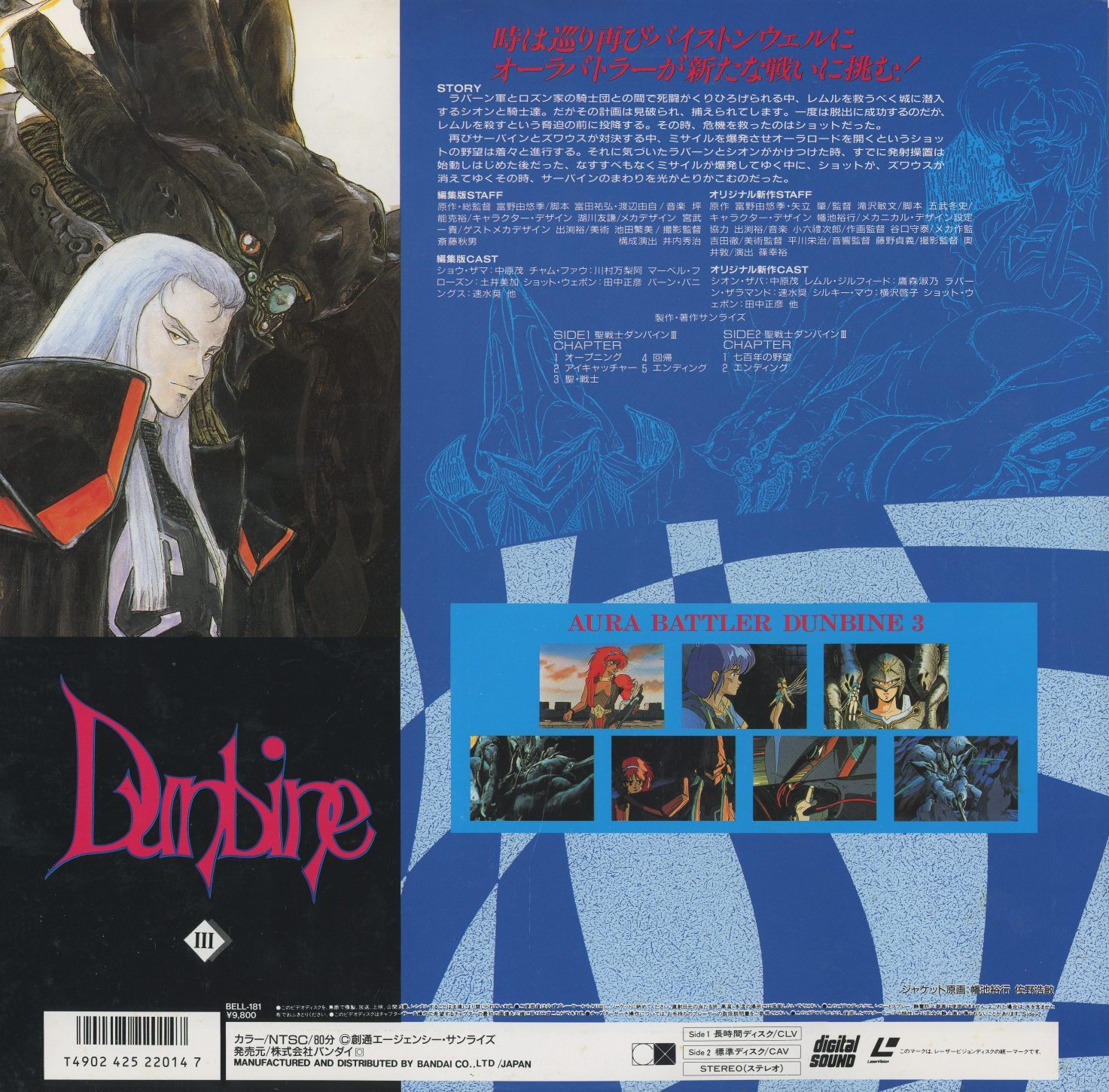 BELL-181 back jacket — story synopsis, staff and cast for 「彩悠の章」and 「地上に遠き者」. The Serbine visible in the right-panel illustration. AURA BATTLER DUNBINE 3 episode photo strip. CLV, Digital Sound. The final volume in the OVA series.
The 1983 Dunbine TV series has never received an English-language home video release. The OVA is accessible through Japanese streaming. Neither delivery mode includes the gold-bordered jackets, the chapter indices, the episode photo strips, or the production staff credits printed on the backs of these three CLV discs.
What the LaserDiscs hold that the streams don't: the visual argument that this franchise belonged in a different category from the mecha shows it was shelved beside. The covers were designed to look like artifacts from Byston Well itself — something old, something found, something whose ornament signals that it was made by people who understood what they were documenting.
The OVA ran six episodes. The TV series ran 49 and ended with Tokyo on fire. Both are harder to find than they should be.
Loading...