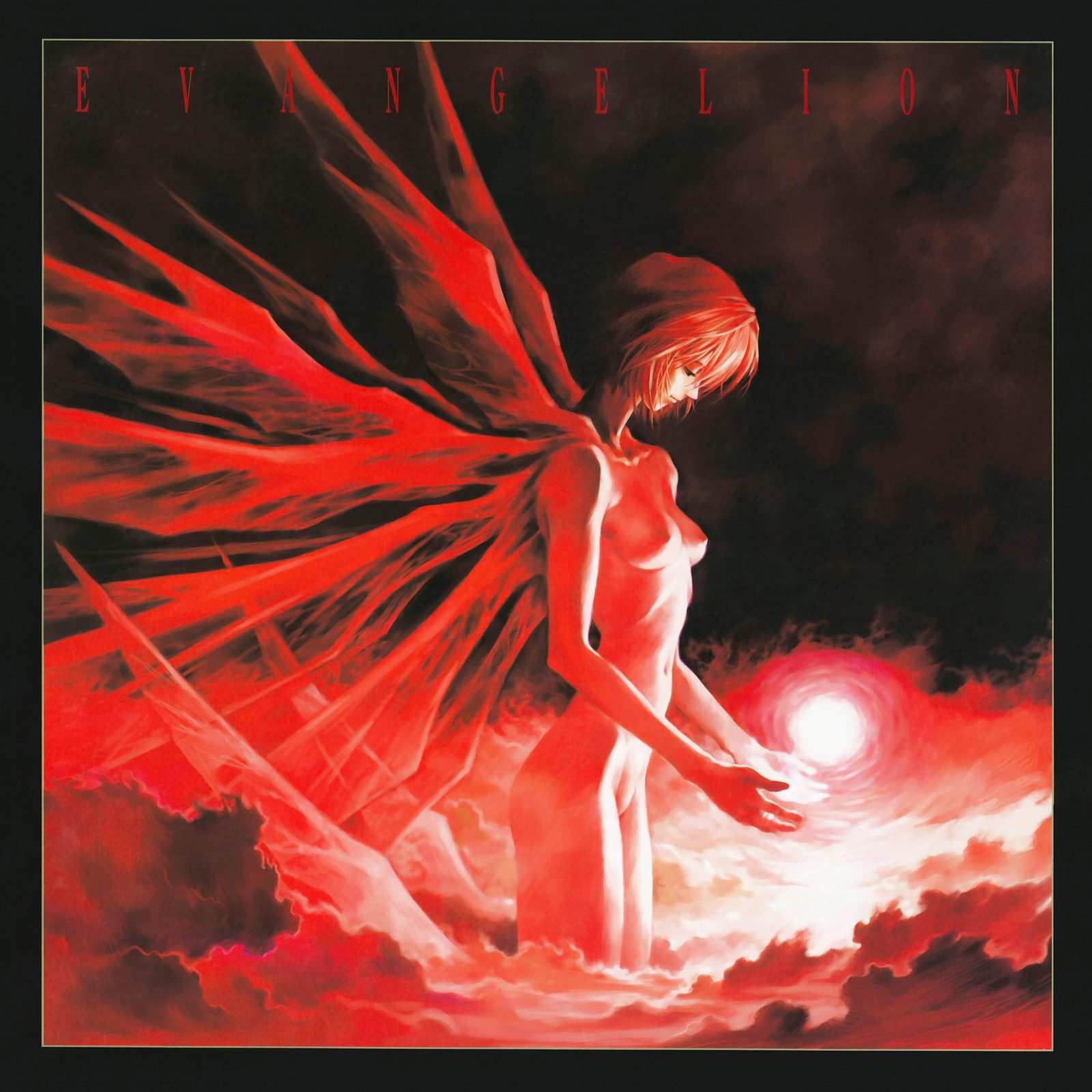
A fourteen-year-old boy is summoned by his estranged father to pilot a biomechanical weapon against apocalyptic beings called Angels. It starts as a mecha show. It ends somewhere else entirely. Neon Genesis Evangelion aired twenty-six episodes on TV Tokyo in 1995–96, then Gainax released two theatrical films—Death & Rebirth and The End of Evangelion—that replaced the series finale with something nobody was prepared for.
The Neon Genesis Evangelion Movie Box (新世紀エヴァンゲリオン劇場版BOX, KILA-9401~4) arrived on December 23, 1998—Christmas Eve eve—at a retail price of ¥23,809. Both theatrical films in CAV format across four LaserDiscs. Eight sides. 196 minutes. No subtitles, no English dub, no concessions to anyone outside the domestic market.
But the discs were almost beside the point. King Records and Starchild packed this box with an 848-page storyboard book, a 12-page production art booklet, eighteen Carddass Masters trading cards, three illustrated telephone cards in a custom holder, an LMHG Eva-01 crystal version model kit, a glow-in-the-dark Rei Ayanami gashapon figure, and a Mass Production Eva Series UFO plushie. This wasn’t a home video release. It was an inventory of everything Gainax had poured into two films that nearly destroyed the studio.
This is packaging as emotional theater. Shipping The End of Evangelion as a Christmas LaserDisc box is one of the most quietly unhinged decisions in anime distribution history—and that’s exactly why it matters. The box doesn’t soften the blow. It contains it. The weight. The density of materials. The 848 pages of handwritten storyboards. The refusal to editorialize or comfort. You weren’t meant to binge this. You were meant to sit with it. Possibly for years.
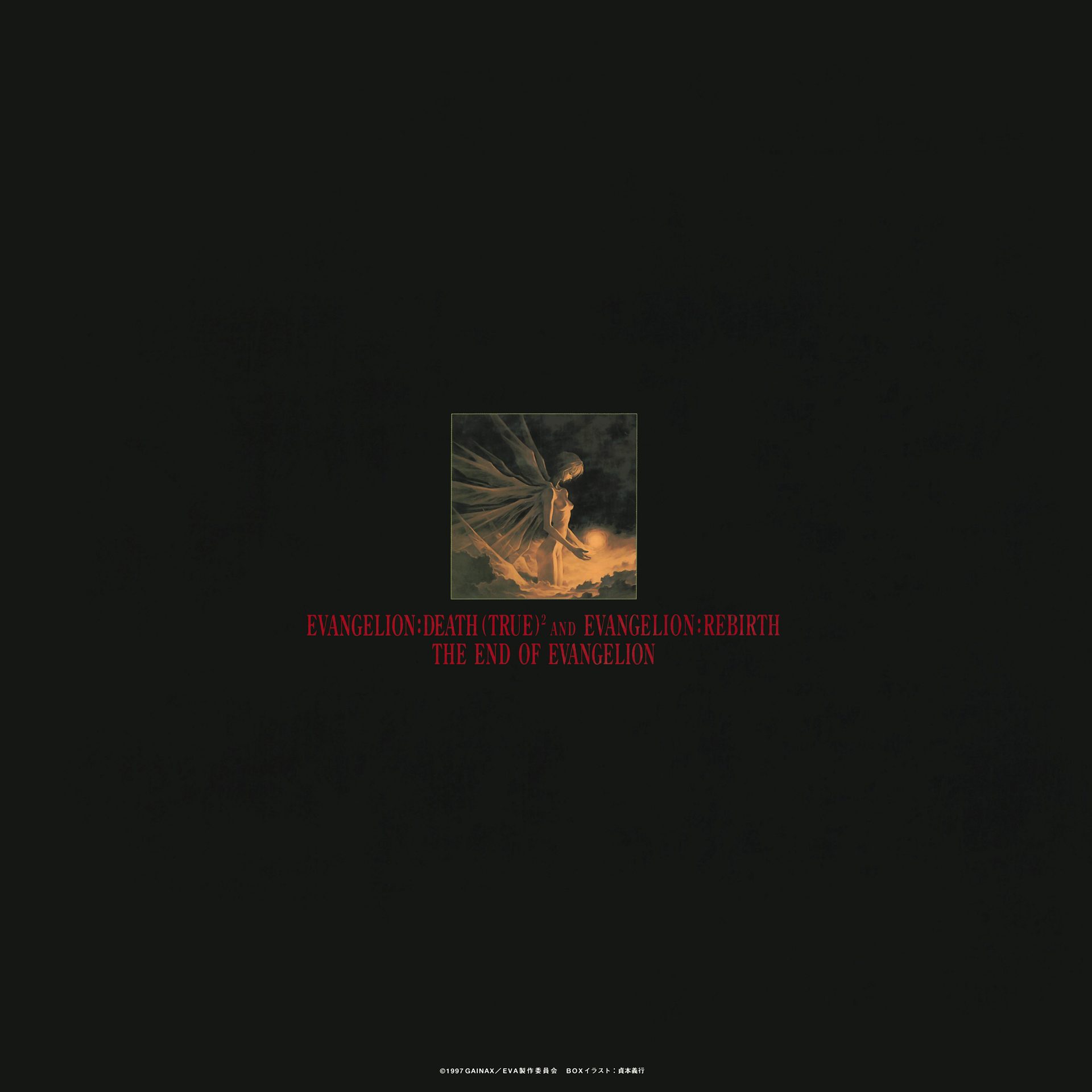 Box rear panel — Morimoto Yoshiyuki's painting of a winged Rei against darkness. The text reads EVANGELION:DEATH(TRUE)² AND EVANGELION:REBIRTH / THE END OF EVANGELION. ©1997 GAINAX/EVA Production Committee.
The Gatefold Jackets
Each film ships in its own gatefold jacket—the kind of packaging LaserDisc collectors called deluxe before the word lost all meaning. The Death(True)² gatefold opens to reveal a split layout: key art on the left, chapter/track listing and staff credits on the right. Full cast. Full production committee credits. The jacket assumes you care who the color designer was.
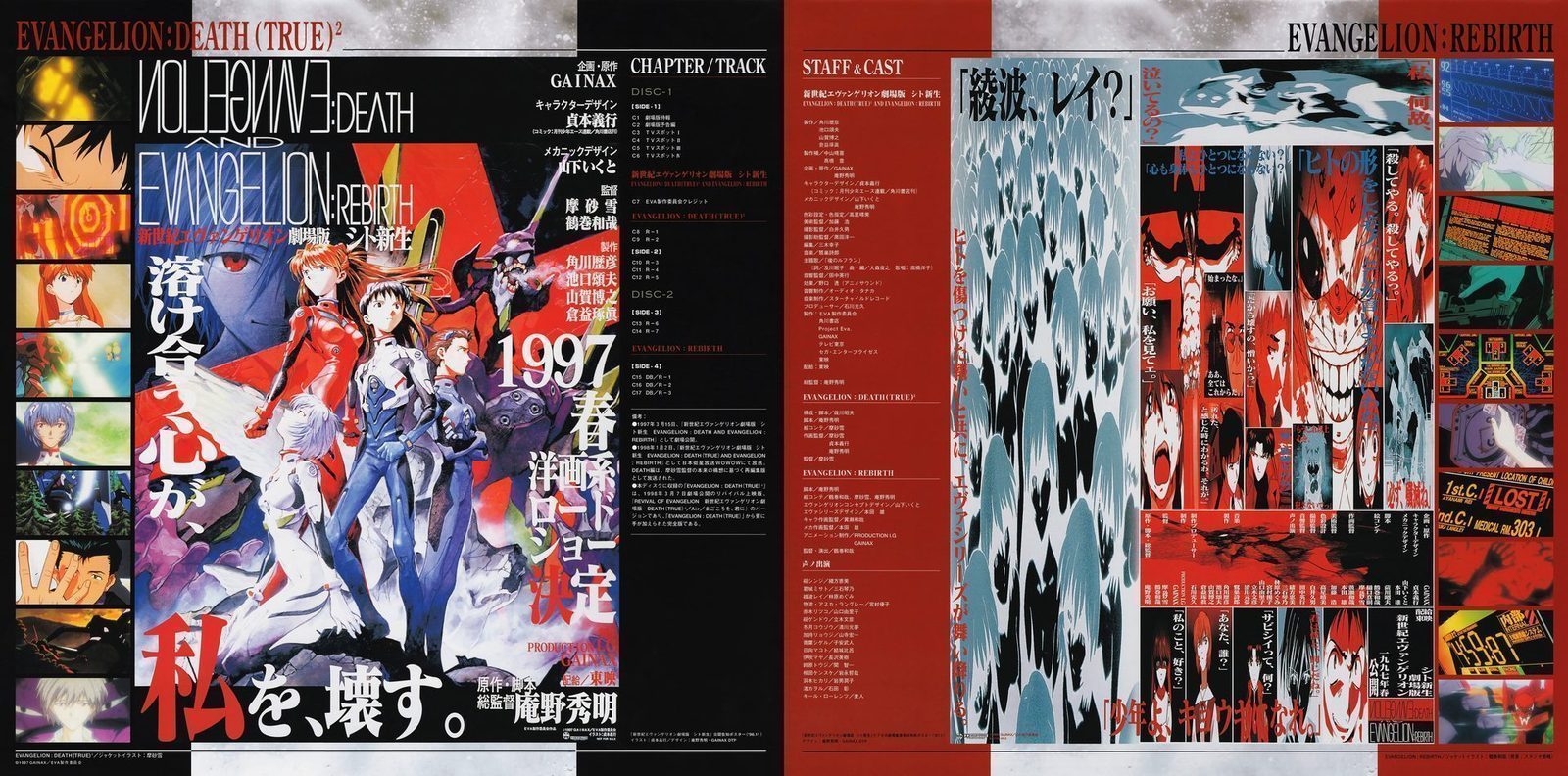 Death(True)² / Rebirth gatefold interior — chapter breakdown, staff credits, and key art. The layout treats a home video insert like a theatrical program.
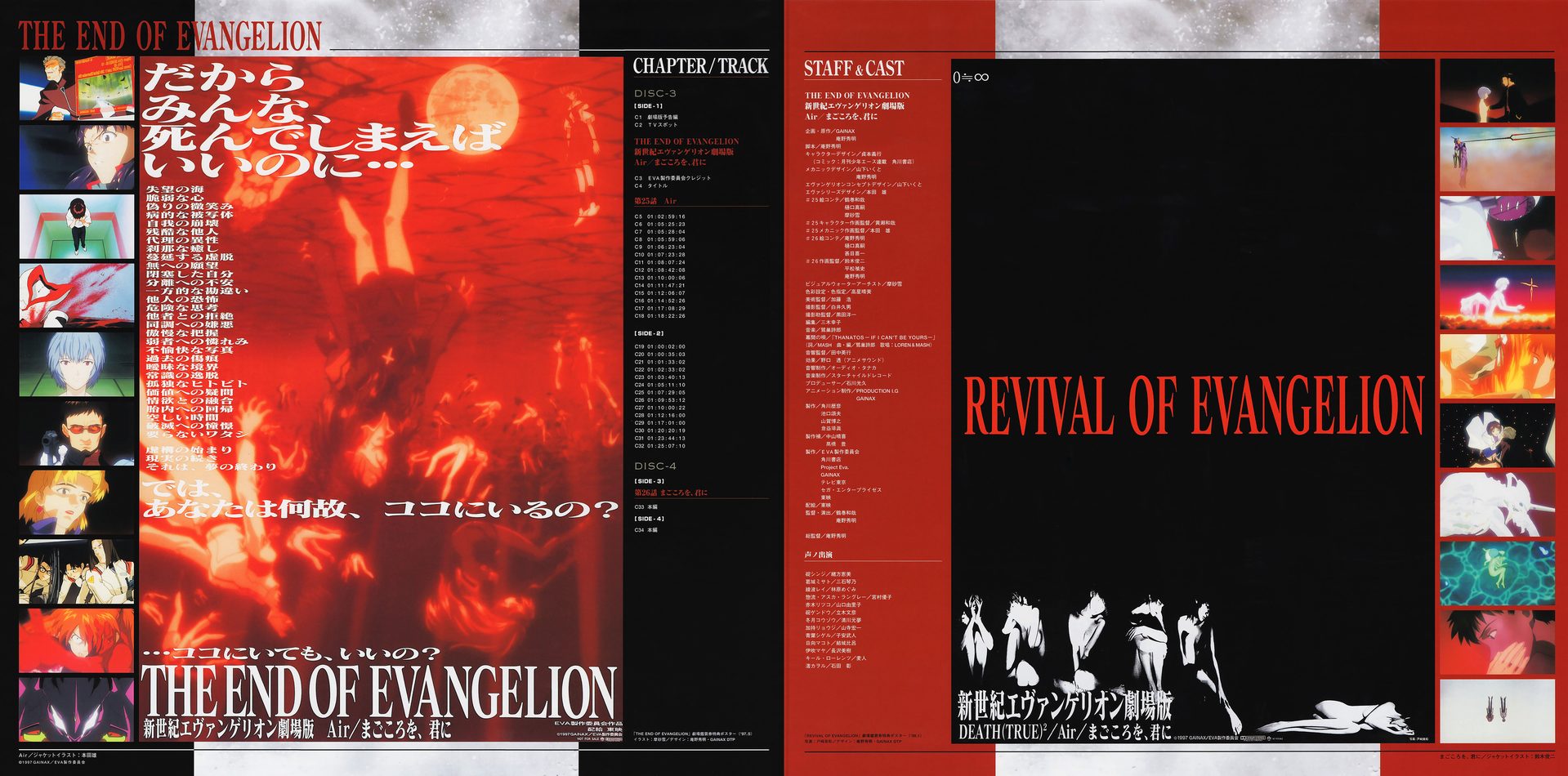 The End of Evangelion gatefold interior — 'THE END OF EVANGELION' and 'REVIVAL OF EVANGELION' presented side by side. Scene stills from both Episode 25' (Air) and Episode 26' (Sincerely Yours). The red-and-black palette mirrors the film's visual identity.
 Episode 25' 'Love is destructive.' — disc label art depicting Eva-02's final battle against the Mass Production Evangelions. The image captures the moment before Asuka's defeat in the forest, trees splintering under mechanical violence.
The Discs
Four discs, all CAV format—Constant Angular Velocity, the specification that preserves individual animation frames without compression artifacts. The picture transfers carry a trace of chroma noise but are noticeably sharper than the later American DVD editions, which crushed detail under MPEG-2 compression. Each disc label is an original illustration numbered by episode: 25′ and 26′, maintaining Anno's theatrical numbering. No subtitles. No translation. Original Japanese audio only.
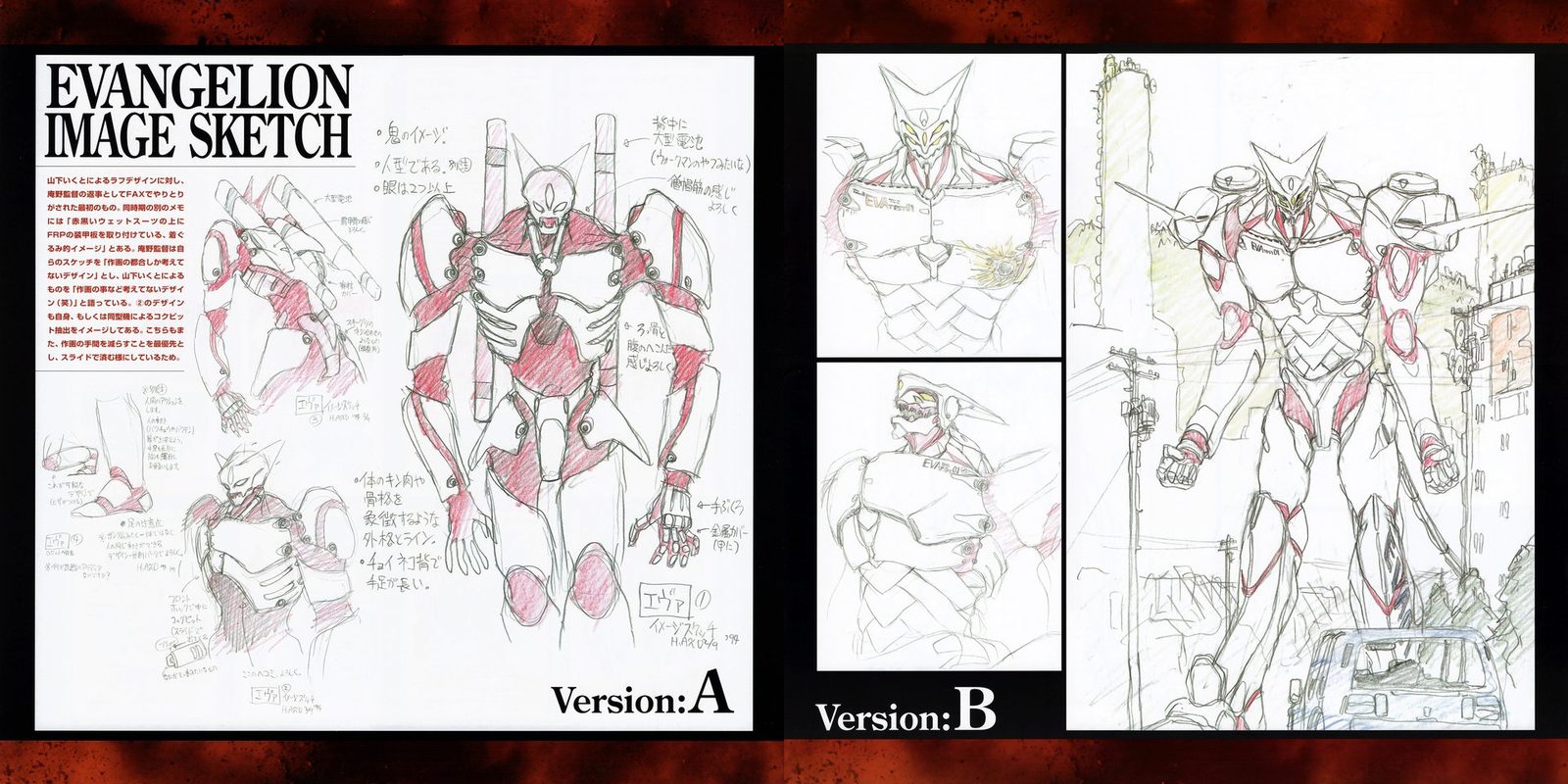 EVANGELION IMAGE SKETCH — early production designs for Eva-01 from the liner notes booklet. Version A (left) and Version B (right) show the mechanical design evolving from rough anatomical sketches to the final biomechanical silhouette. Pen and marker on paper, annotations in Anno's hand.
The Format as Preservation
The CAV format is the critical specification. Pause on any frame and you see the painted cel exactly as it reached the film gate. The optical transfer maintains resolution that DVD’s MPEG-2 and Blu-ray’s H.264 actively discard. This is not nostalgia. This is a higher-fidelity archive than anything that replaced it.
848 Pages of Conte
The centerpiece of the Movie Box isn't the discs. It's the storyboard book—conte in Japanese production terminology—covering both theatrical films in their entirety. 848 pages of Anno Hideaki's shot-by-shot direction: camera angles, timing notations, dialogue placement, effects instructions. Every cut in both films, from Shinji's cello performance in Death to the beach in Episode 26′, exists here as handwritten intent. This is the director's brain before the animation department translated it into cels.
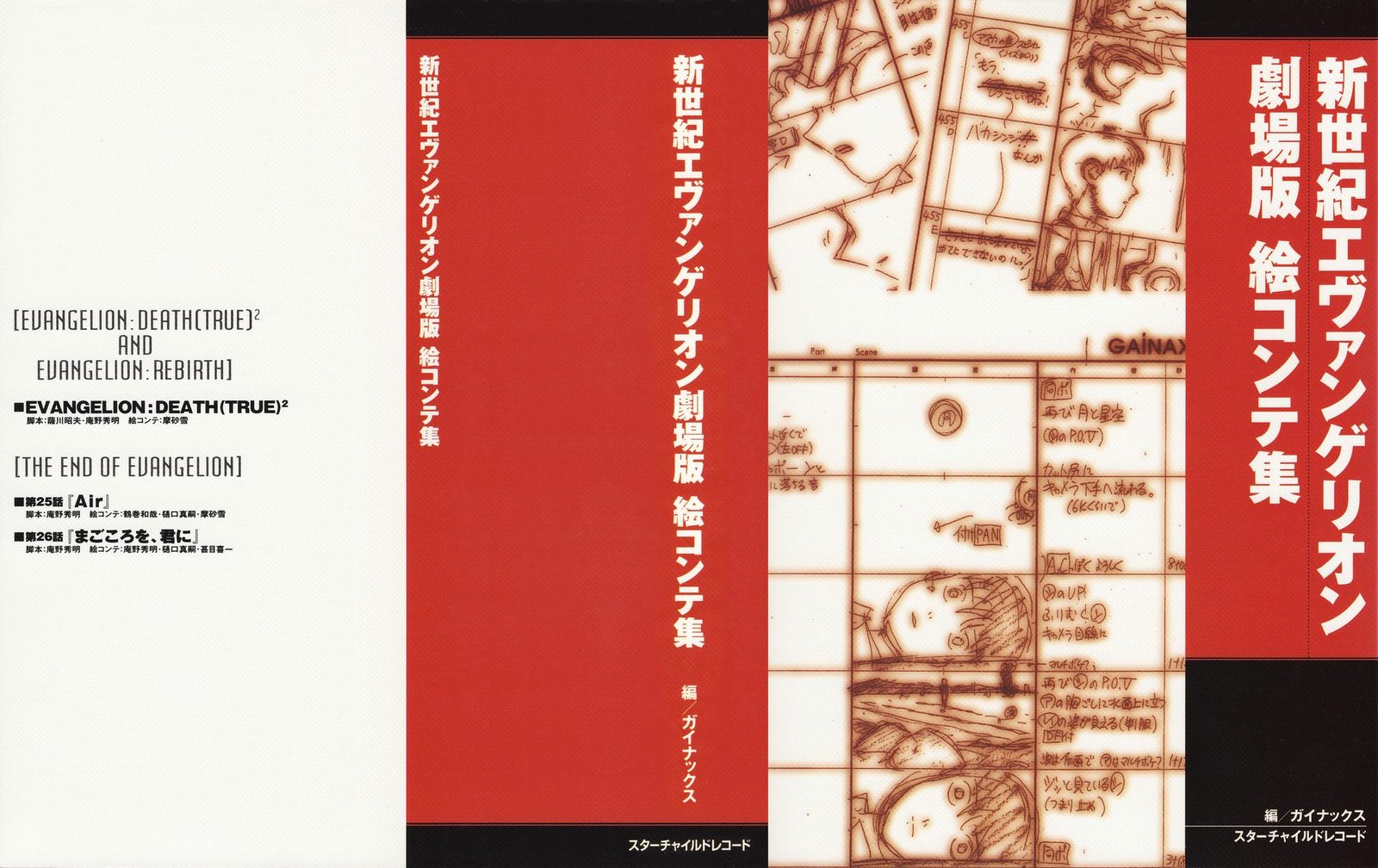 The 848-page storyboard book (劇場版コンテ) in its slipcase — covering every cut of both Death(True)² and The End of Evangelion. The cover reproduces Anno's storyboard panels at actual production size.
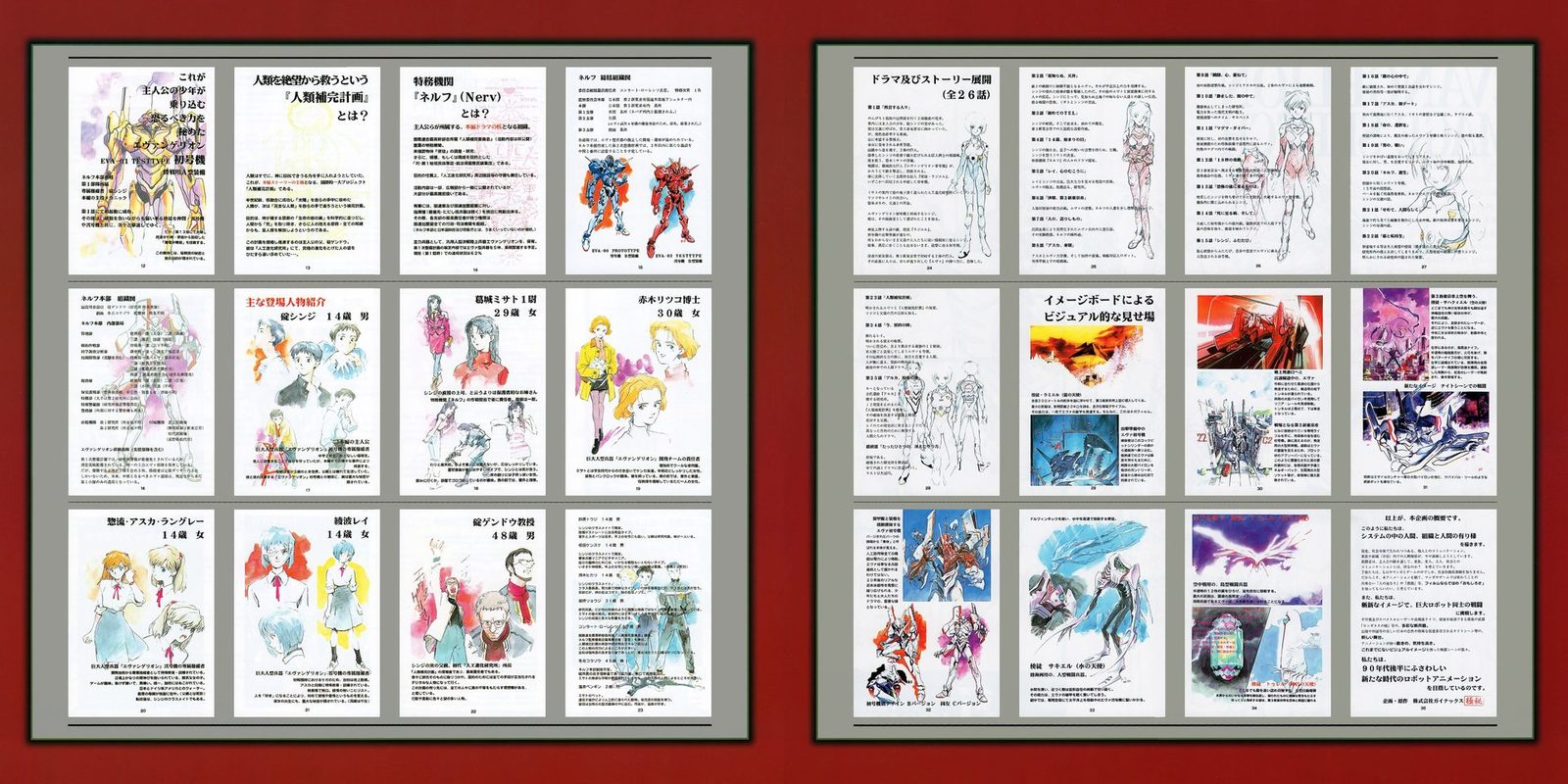 Liner notes spread — 12 production art panels covering character design lineage, Angel concepts, image boards, and mecha drafts. Each panel pairs rough sketches with finished key art, documenting how Evangelion's visual language was constructed from first principles.
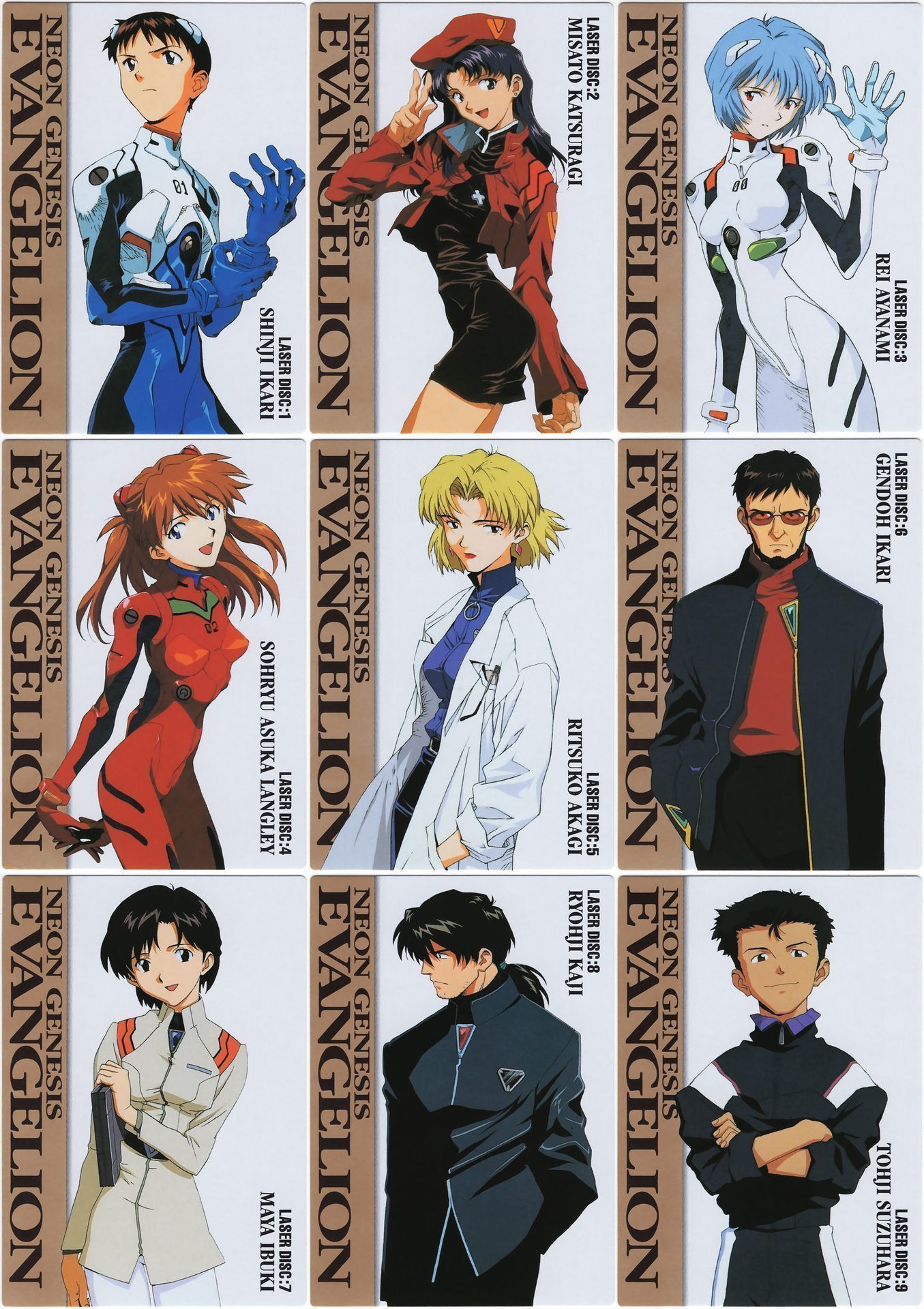 Carddass Masters character portrait cards (9 of 18) — Shinji, Misato, Rei, Asuka, Ritsuko, Gendoh, Maya, Kaji, and Toji. Each card reproduces art from the original TV series LaserDisc jacket covers (Laser Disc:1 through Laser Disc:9). Bandai, 1998.
Eighteen Cards, One Puzzle
The eighteen Carddass Masters trading cards split into two sets. Cards 1–9 feature character portraits reproduced from the individual TV series LaserDisc jacket covers—one character per disc, from Shinji (Disc 1) through Toji (Disc 9). Cards 10–14 reproduce additional jacket art. Flip the first nine cards over and they assemble into a single panoramic image of Eva-01, each card a puzzle piece in a mosaic that only completes if you own the full set. Bandai understood collector psychology.
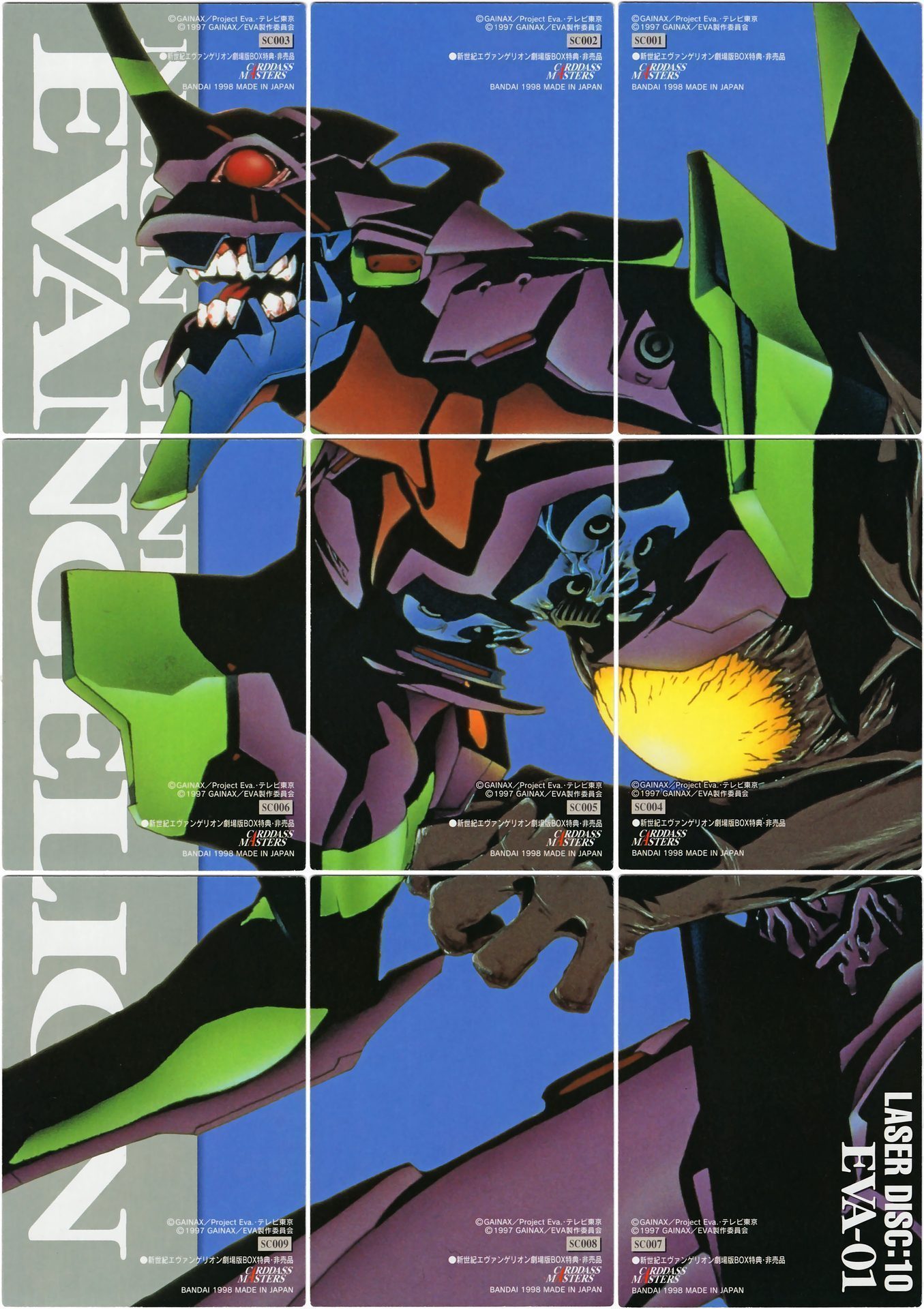 The reverse side of cards SC001-SC009 — assembled into a complete Eva-01 mosaic. 'LASER DISC:10 EVA-01' reads the bottom-right corner. Each card is a fragment; only the complete set reveals the image.
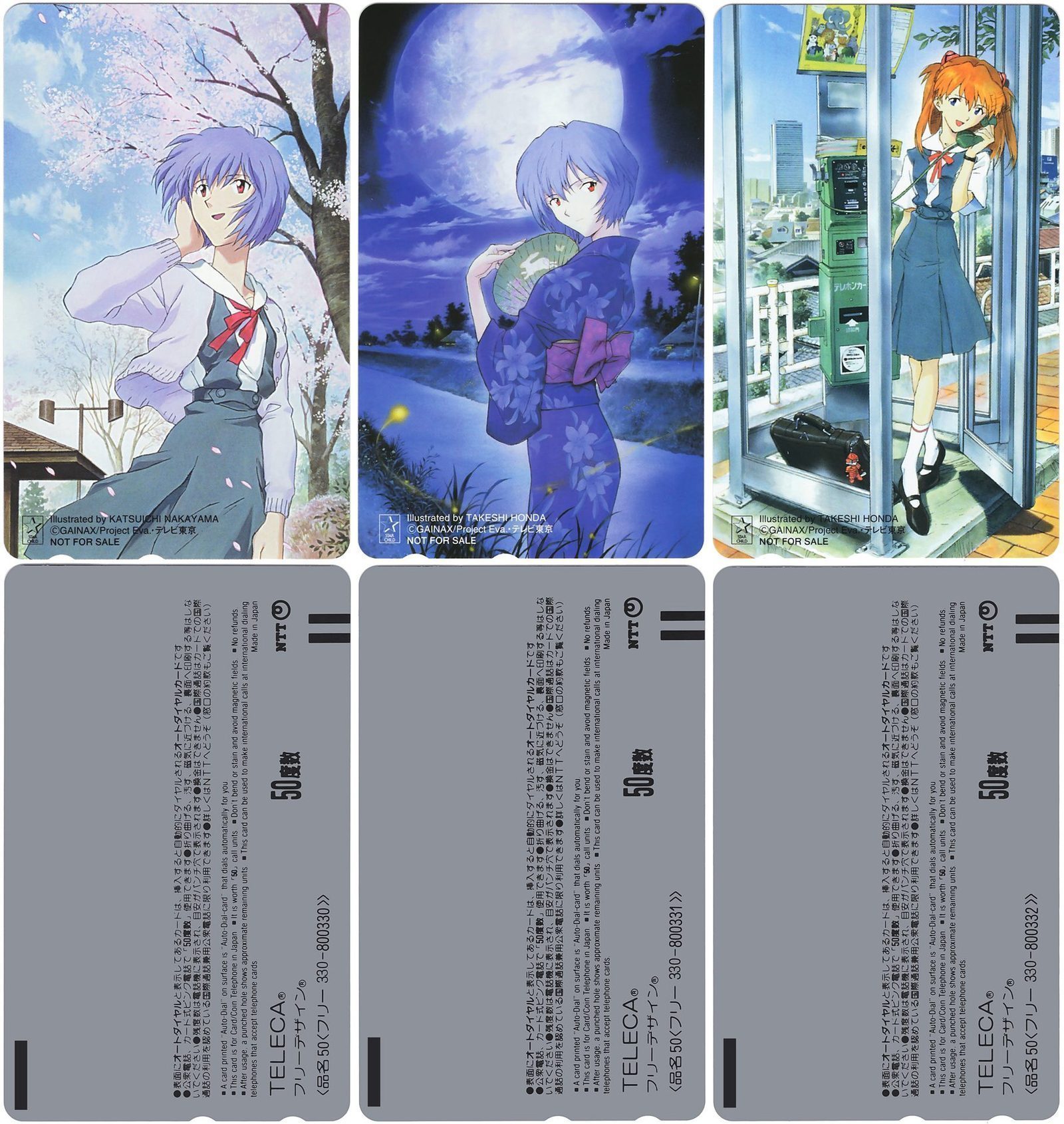 Three exclusive Teleca telephone cards with custom holder — Rei Ayanami under cherry blossoms (spring), Rei in yukata under moonlight (summer), and Asuka Langley at a phone booth (urban). NTT 50-unit prepaid cards. Illustrated by Takeshi Honda and Shuichi Shimamura. Not for sale separately.
Christmas 1998
King Records released this box three days before Christmas 1998—seventeen months after The End of Evangelion premiered in theaters. By then, the cultural hysteria had cooled enough for Gainax to look back at what they'd made and package it as an object rather than an event. The ¥23,809 price point was steep even by LaserDisc standards. But it bought you something no streaming service will ever replicate: a physical record of everything that went into ending the world twice.
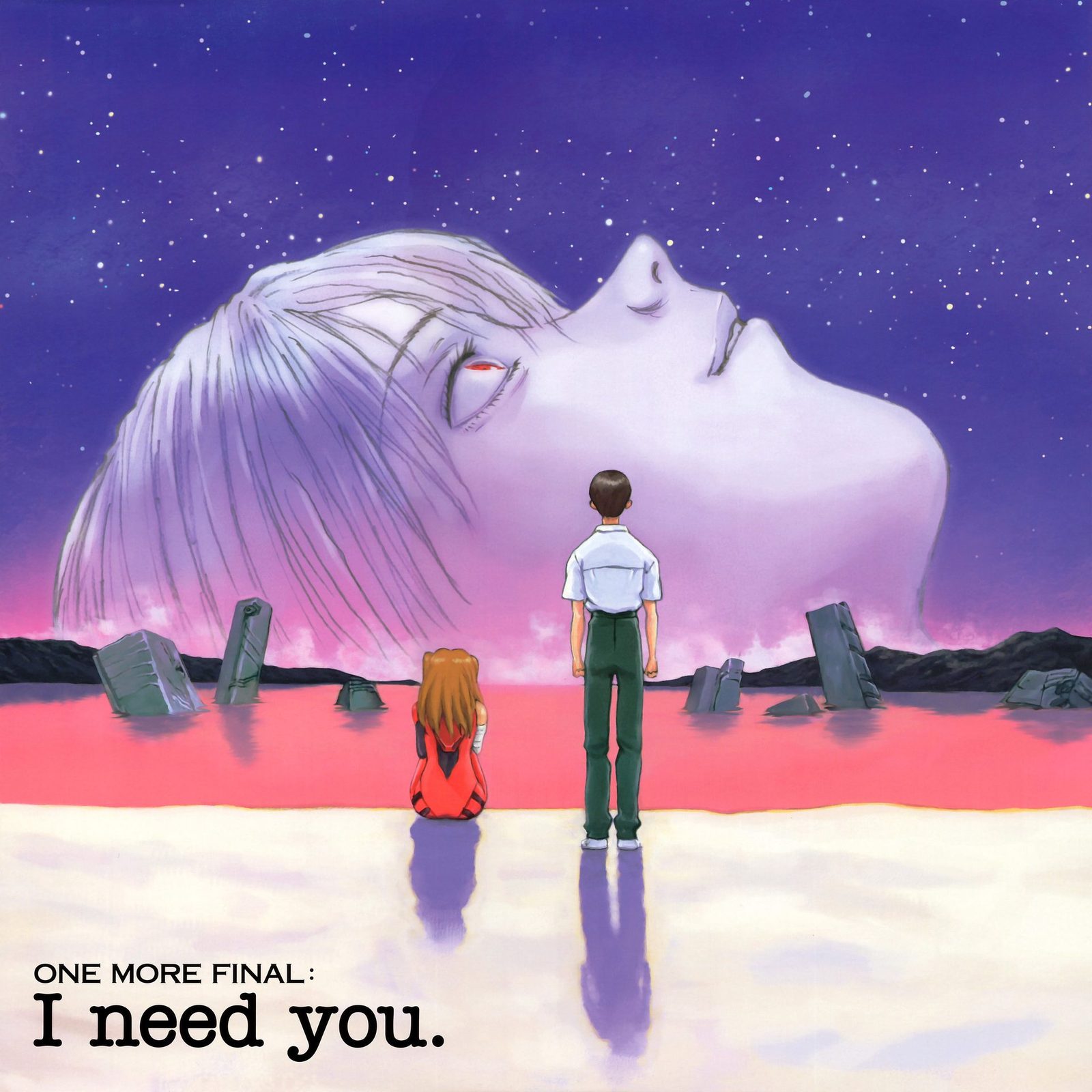 Episode 26' 'ONE MORE FINAL: I need you.' — Shinji and Asuka on the beach at the end of everything. Giant Rei's face fills the sky above a red ocean. The final image of Neon Genesis Evangelion, rendered as a LaserDisc label.
The Evangelion Movie Box is not a collector’s edition in the way the industry uses that phrase now. It is a ritual object—anime’s most traumatic text deliberately framed as something you owned, not escaped. Every item in the box serves a purpose: the storyboard book preserves directorial intent, the liner notes preserve production process, the trading cards preserve the visual identity of the original LaserDisc release campaign. Even the telephone cards and gashapon figure function as time capsules of late-1990s Japanese collector culture—formats that no longer exist, carrying art that was never reprinted.
Complete sets in near-mint condition appear at Japanese auction sites in the ¥200,000–400,000 range. The storyboard book alone commands ¥30,000–50,000 when separated. The object has not depreciated because the alternative—streaming Evangelion and reading production notes online—does not include the 848-page storyboard book, the production liner notes, or the trading cards from the original LD campaign.
Loading...