ガサラキ, Bandai Visual BELL-1334 through BELL-1342. Nine volumes, released on the 25th of each month from January through September 1999. Vol.1 (BELL-1334) is a single-sided CLV disc covering episodes 1 and 2, ¥5,000. Vols.2 through 8 (BELL-1335 through BELL-1341) are two-sided CLV discs, three episodes each, ¥6,000. Vol.9 (BELL-1342) returns to two episodes and ¥5,000 to close out the 25-episode run. Each volume came packaged with a companion booklet. Over the course of the nine volumes, those booklets accumulated into something close to a complete production record.
ガサラキ is a 1998 Sunrise mecha series from director Ryōsuke Takahashi — the creator of Armored Trooper Votoms, Galient, and Gasaraki's direct spiritual predecessor in the hard-real-robot line. The show runs a military thriller alongside a supernatural inheritance plot: the Yushahara family has been bonding with an entity called Gasaraki across generations, and now a private military corporation and shadowy government factions are converging on that power while Tactical Armored Fighters — mechanized infantry suits, not giant robots — engage across the Middle East and Japanese soil. It aired Sunday mornings on TV Osaka starting October 4, 1998. The first LD volume shipped while the series was still broadcasting.
Parallel to the retail release, Bandai Visual distributed advance screeners — NOT FOR SALE discs in plain white sleeves, each carrying the same brush-calligraphy ガサラキ logo printed in a different color: green for BELL-1335, purple for BELL-1336, red for BELL-1337, continuing through blue for BELL-1340. Six screeners, six colors. The retail jackets have anime cel art and graduated color fields. The screener sleeves have nothing but the logo and the catalog number.
Six Colors
Each NOT FOR SALE screener carries the same white sleeve and the same ガサラキ calligraphy logo — only the ink color changes from volume to volume. The color is the only signal: green is the second volume, purple the third, red the fourth. There's no episode listing on the front, no production art, no marking beyond the catalog number and NOT FOR SALE in the corner.
The back of each screener follows a consistent template: three episode stills in a grid, the kanji 舞 / 竜 / 伝 / 時 (one character per volume, drawn in the same brush style as the title), episode synopses, and the full main staff block. The retail equivalents have the same back-cover template with colored backgrounds and EMOTION branding. The screeners strip it to white.
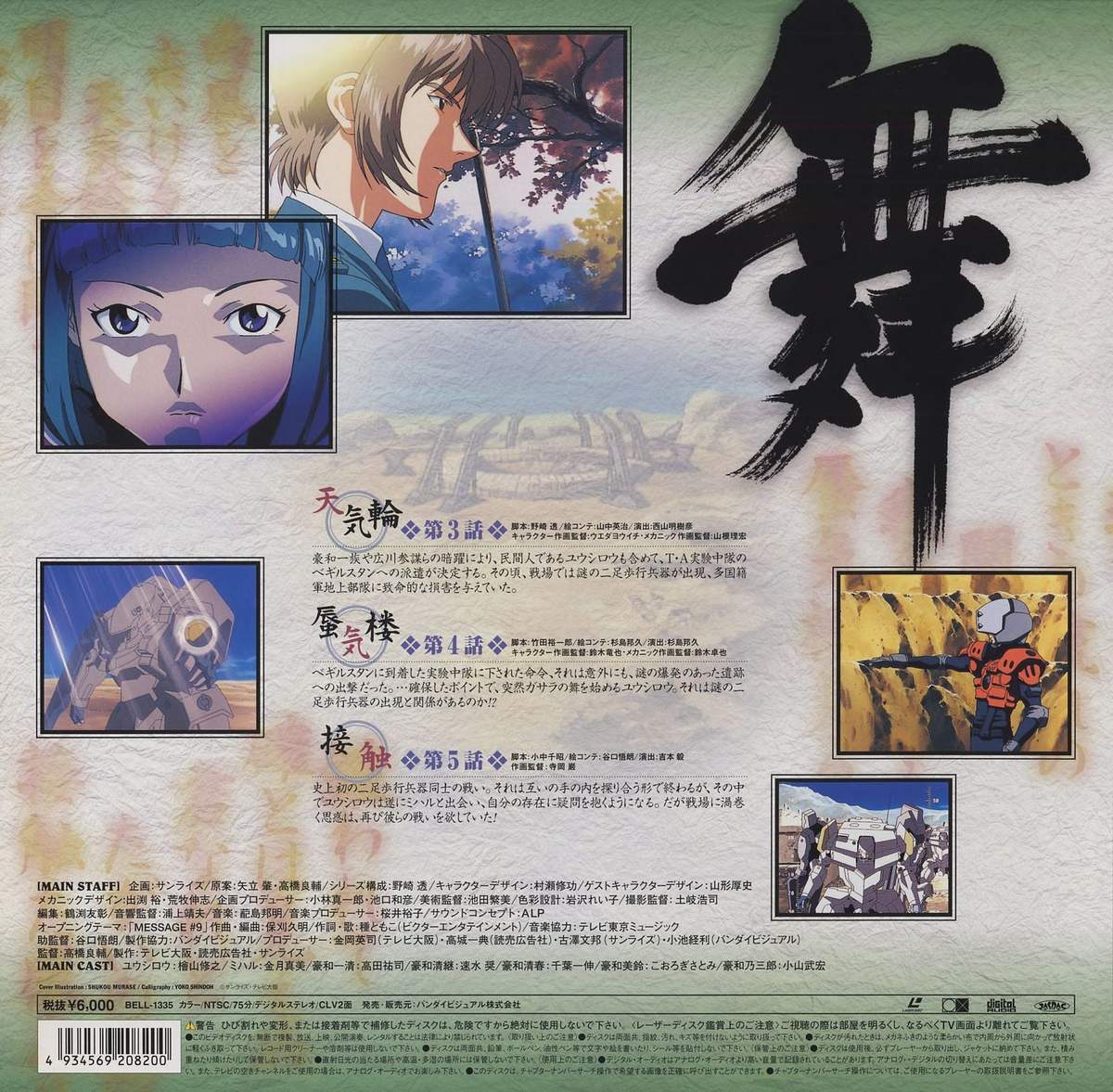 BELL-1335 back — episodes 第3話「天気輪」, 第4話「撃矢楼」, 第5話「接続」. Kanji 舞. Three screenshot stills, main staff block. Standard screener template for the series.
 BELL-1336 NOT FOR SALE — purple. Vol.3 (episodes 6–8).
 BELL-1337 NOT FOR SALE — red. Vol.4 (episodes 9–11).
 BELL-1338 NOT FOR SALE — gold. Vol.5 (episodes 12–14).
 BELL-1339 NOT FOR SALE — dark brown. Vol.6 (episodes 15–17).
 BELL-1340 NOT FOR SALE — blue. Vol.7 (episodes 18–20).
Six screener discs visible in this scan set, covering Vols.2 through 7. The series ran nine retail volumes; screeners for Vols.8 and 9 (BELL-1341, BELL-1342, covering episodes 21–25) would extend the color sequence beyond blue.
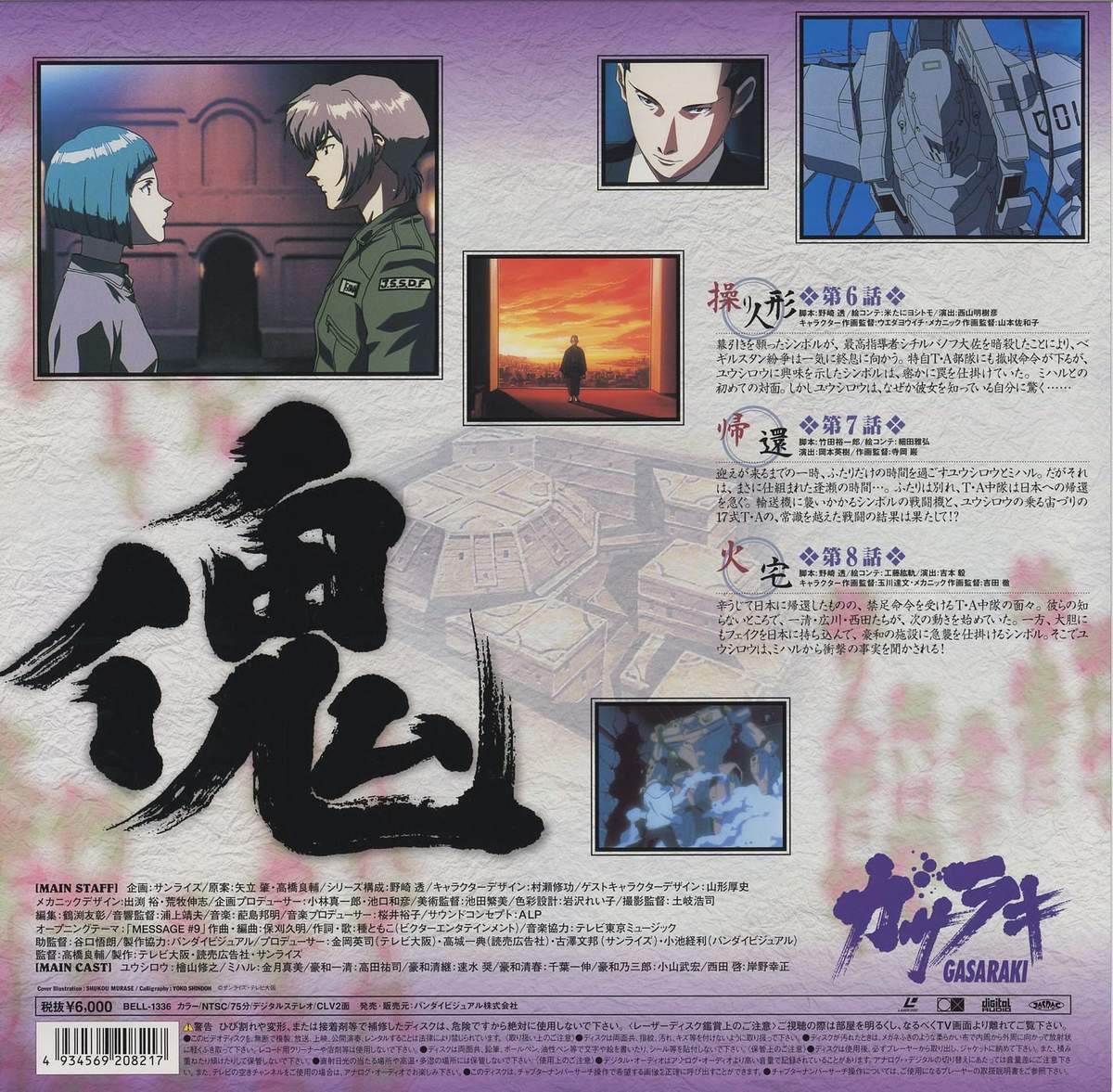 BELL-1336 back — episodes 第6話「操り人形」, 第7話「帰還」, 第8話「火宅」. Kanji 竜.
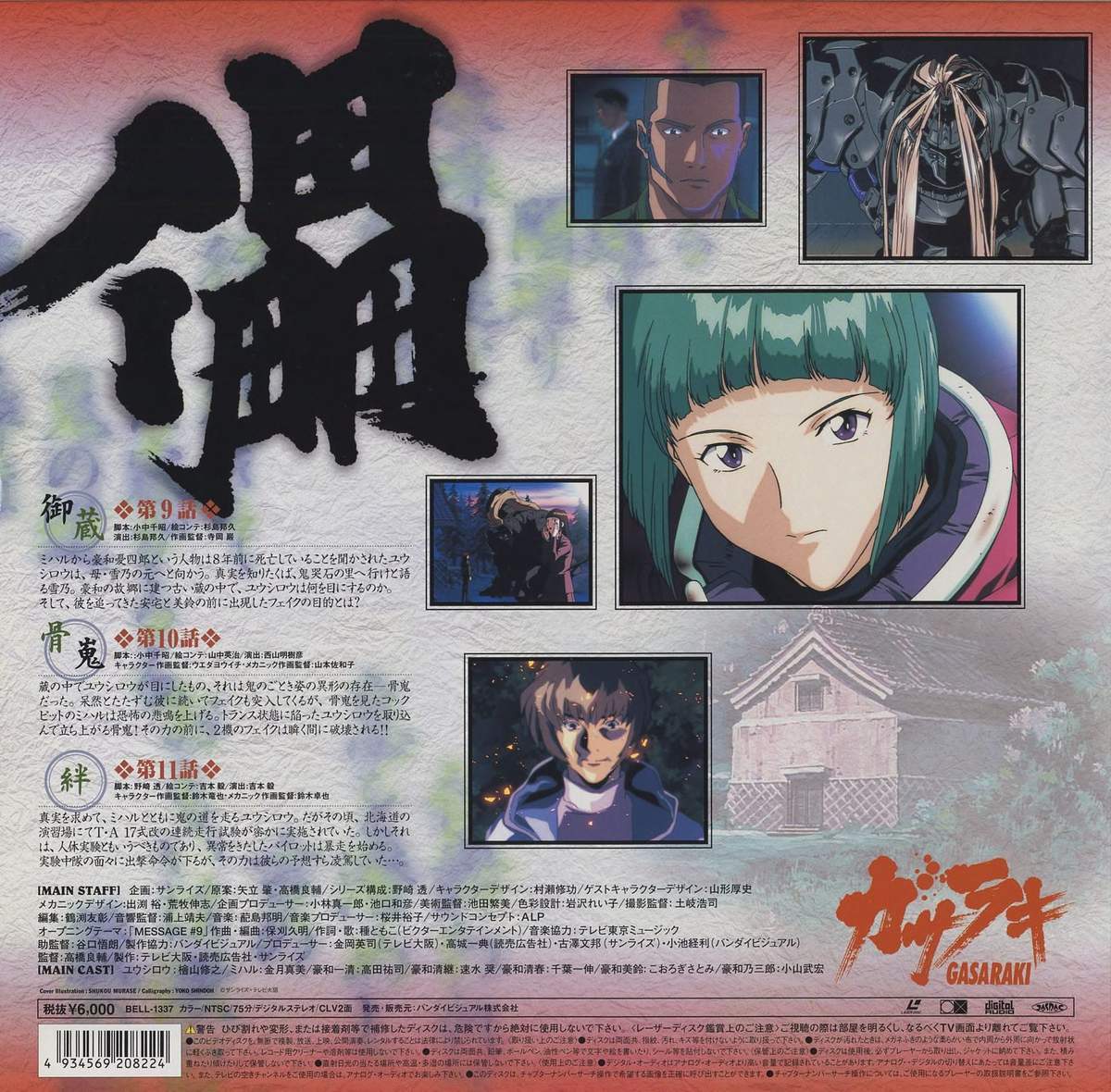 BELL-1337 back — episodes 第9話「御蔵」, 第10話「骨鬼」, 第11話「絆」. Kanji 伝.
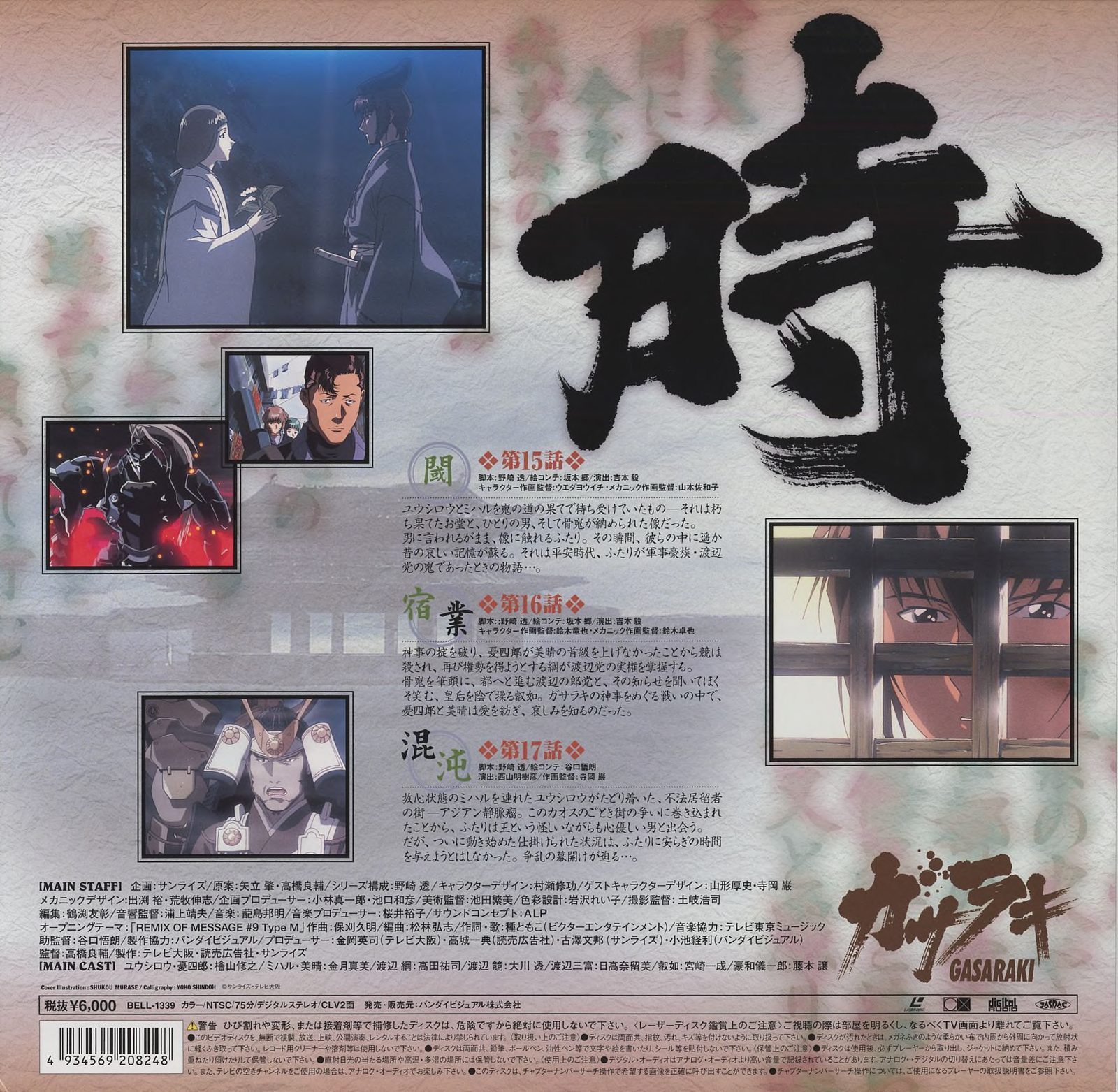 BELL-1339 back — episodes 第15話「闘」, 第16話「宿業」, 第17話「混沌」. Kanji 時.
Nine Volumes
BELL-1334, January 25, 1999 — episodes 1 and 2, one CLV side, 55 minutes, ¥5,000. The series was three months into its broadcast run. Vol.1's first pressing included a 特製LD-BOX: a storage case with new illustration by character designer 村瀬修功 (Shūkō Murase), labeled NOT FOR SALE. The box was included at no additional cost, not sold separately.
From BELL-1335 onward, each volume is two CLV sides carrying three episodes — roughly 75 minutes — at ¥6,000. Monthly, on the 25th, through September 1999. Vol.9 (BELL-1342, September 25) closes with the final two episodes at ¥5,000, mirroring the opener. The last disc arrived six months after the broadcast concluded.
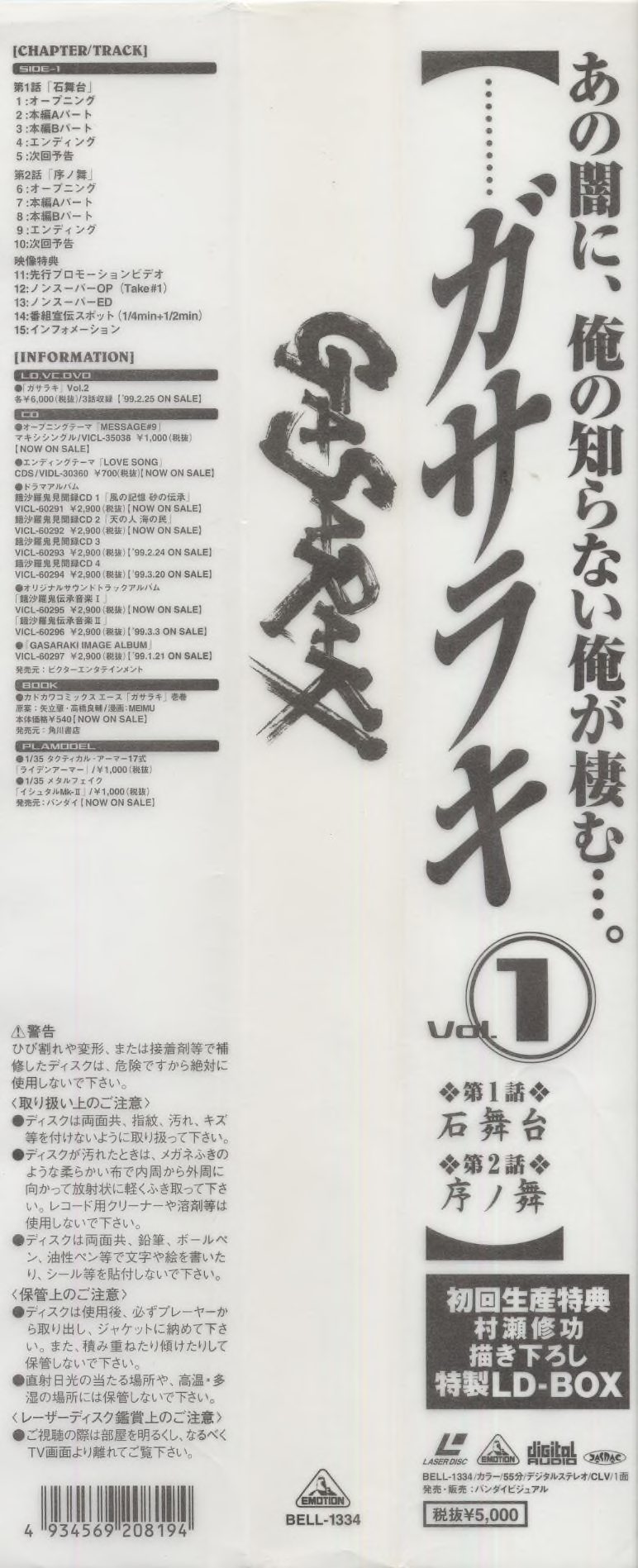 Vol.1 obi strip — BELL-1334, CLV/1面, ¥5,000 (税抜). 'あの闇に、俺の知らない俺が棲む。' Chapter/track listing: SIDE-1 carries episodes 1–2 plus映像特典 — pre-air promotional video, non-super OP (Take #1), non-super ED, station spots. 初回生産特典: 村瀬修功 描き下ろし 特製LD-BOX.
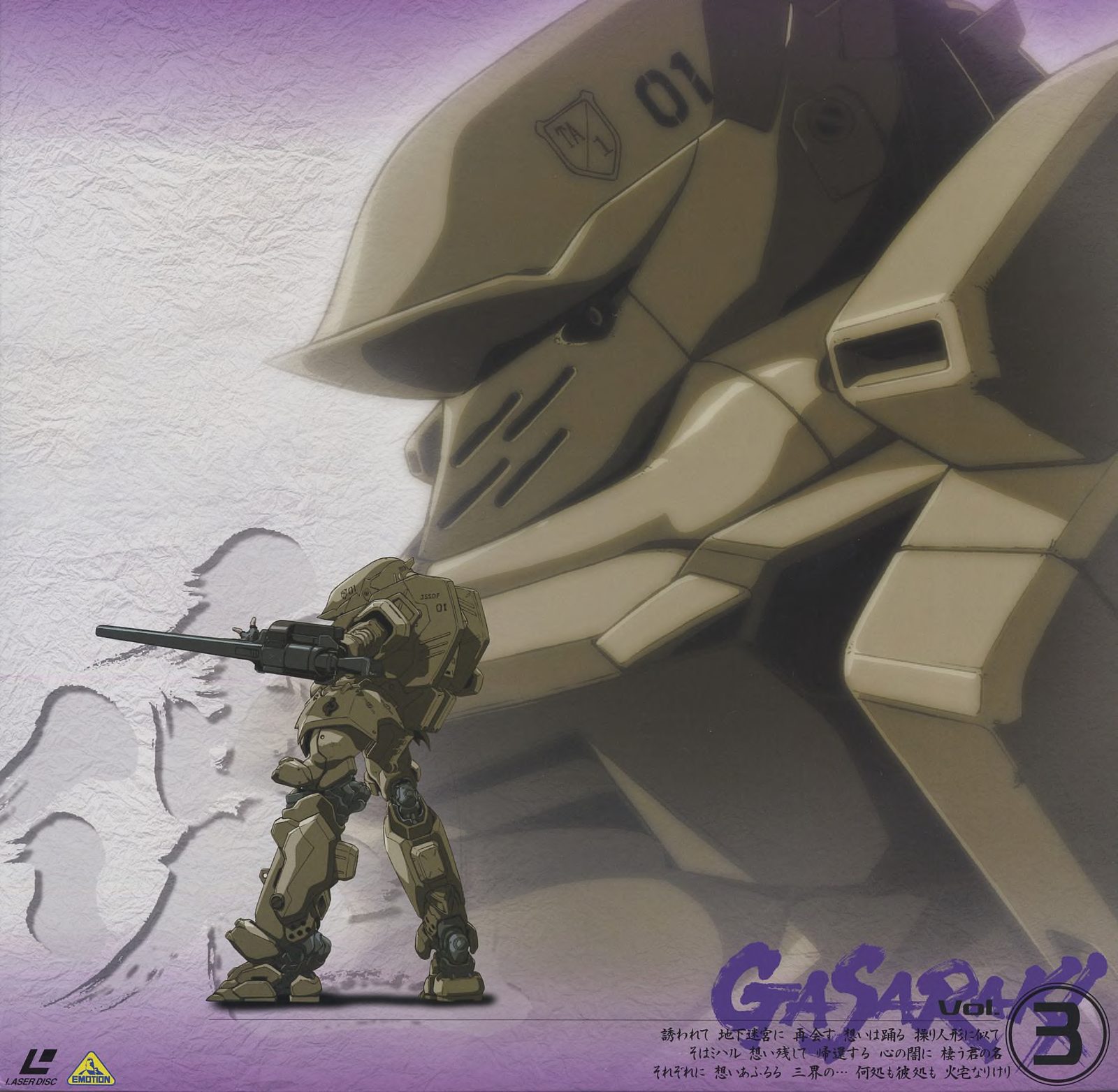 Vol.3 jacket (BELL-1336) — TAF unit 01 in lavender field. Small-scale figure with assault rifle standing against the enormous head of a damaged unit. GASARAKI Vol.3 logo lower right. LaserDisc / EMOTION marks.
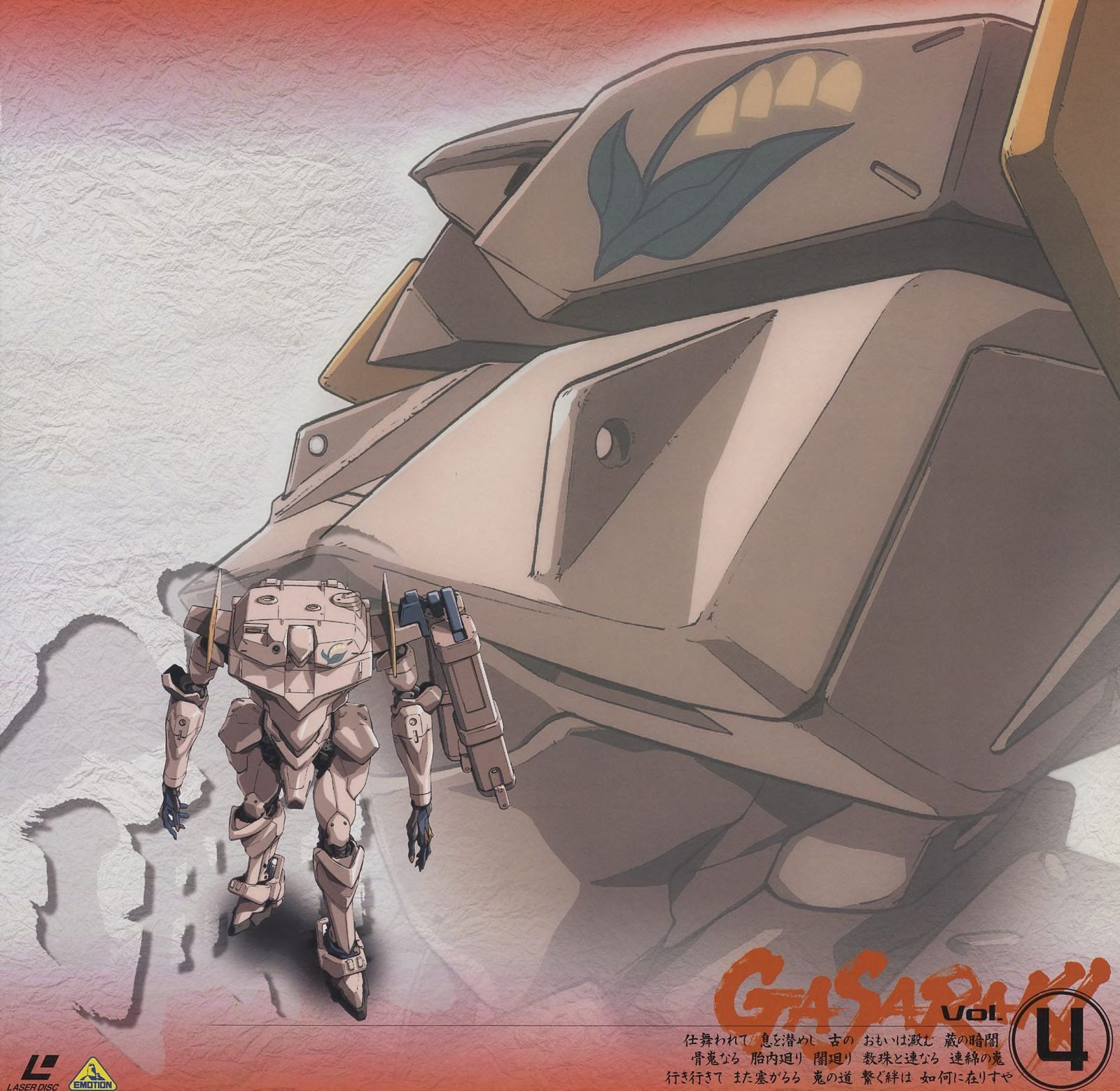 Vol.4 jacket (BELL-1337) — red-orange field, different TAF configuration. Same compositional logic: small standing unit, massive fallen form behind it. GASARAKI Vol.4.
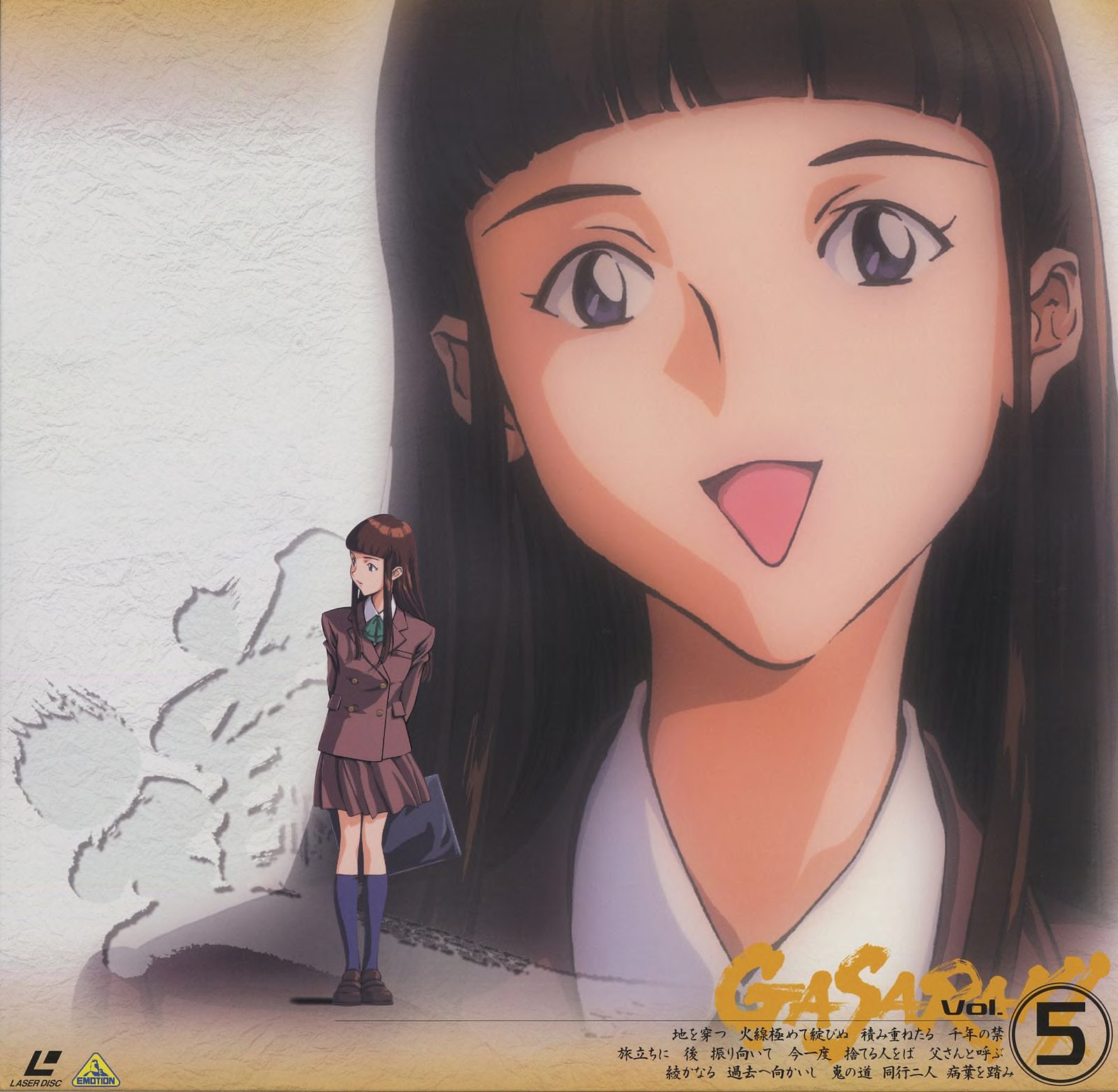 Vol.5 jacket (BELL-1338) — Miharu (雅, the female lead) at small scale in her school uniform against a monumental close-up of her own face. The jacket shift from mecha-focused to character-focused begins here.
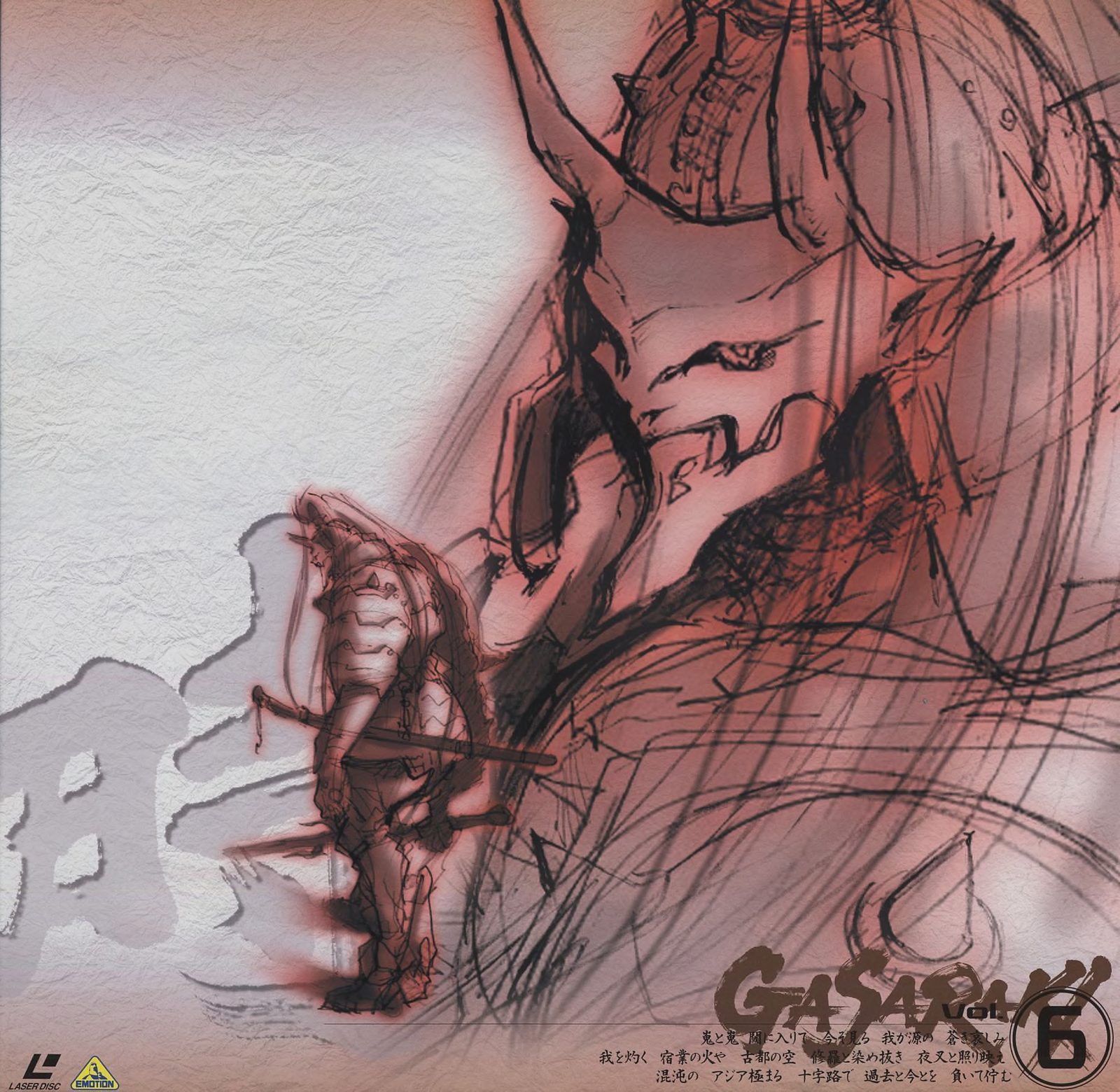 Vol.6 jacket (BELL-1339) — rough ink sketch of a supernatural entity, warm red tone wash. The GASARAKI Vol.6 logo lower right. The roughest visual register in the series jacket sequence — no clean cel art.
The Jacket Sequence
Vols.3 and 4 run the TAF mecha at two scales in a single composition — small soldier, enormous machine head — using the visual logic of the series' own scale disparity. Vol.5 switches to the female lead, Miharu, with the same double-scale framing. Vol.6 abandons the cel-art style entirely for rough ink-wash imagery of the series' supernatural element. Vol.7 is a character portrait of the antagonist — a large face close-up with the figure standing below.
No cover across the nine volumes uses a conventional key visual or promotional poster image. Each was apparently designed specifically for the disc release.
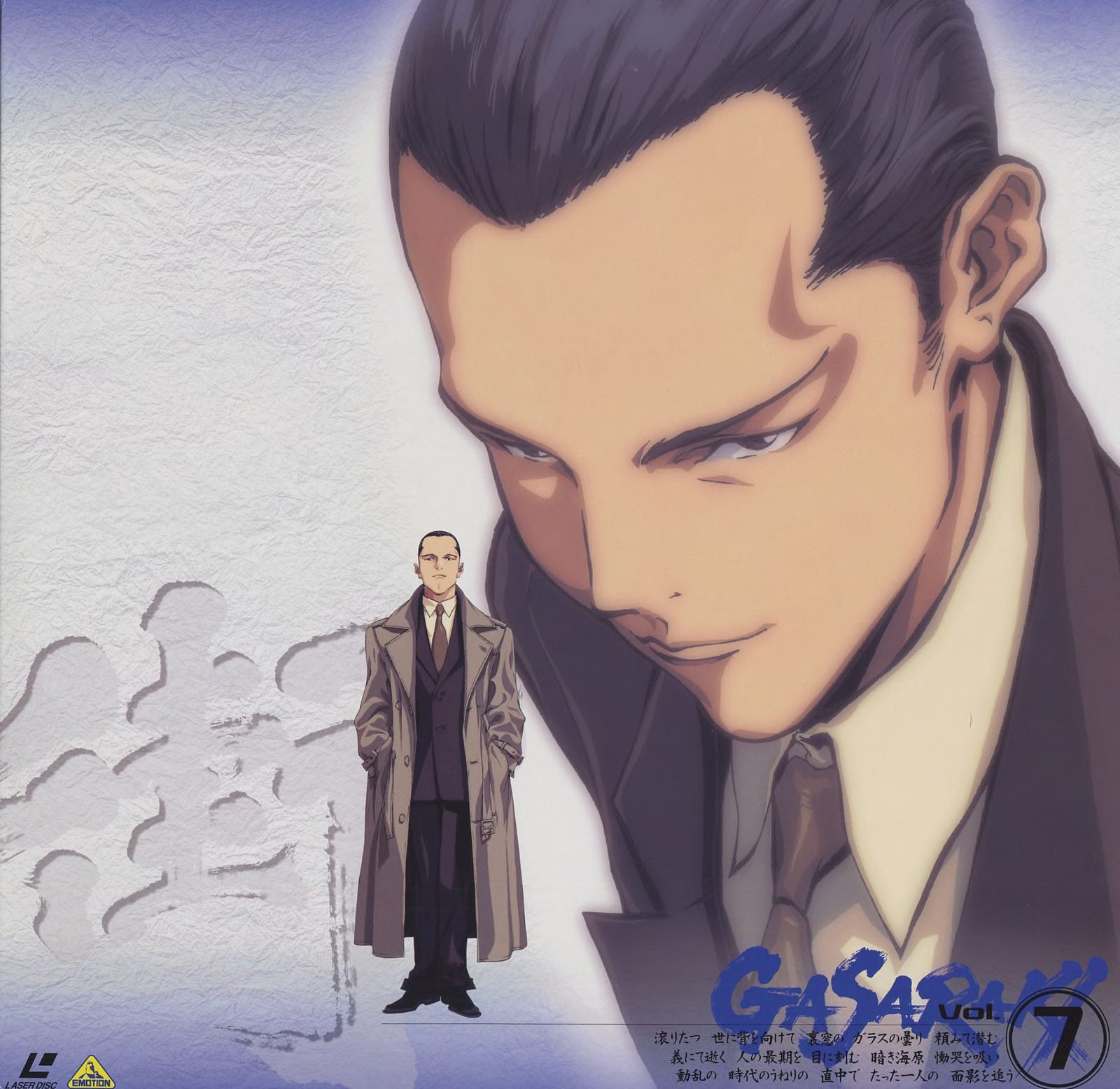 Vol.7 jacket (BELL-1340) — antagonist Gōda in overcoat, small figure below his own magnified face. Gray-blue field. GASARAKI Vol.7. The most politically-coded cover in the sequence; Gōda is the series' ideological center of gravity.
Vol.5 obi tagline: 「僕たちだけが…昨日へと向かう」. Vol.6: 「千年前、我は闇に心を埋めた…」. Vol.7: 「この気持ちを…止められない」. The taglines track the series' emotional register across volumes. Each is a line of in-world dialogue printed across the obi spine in large type.
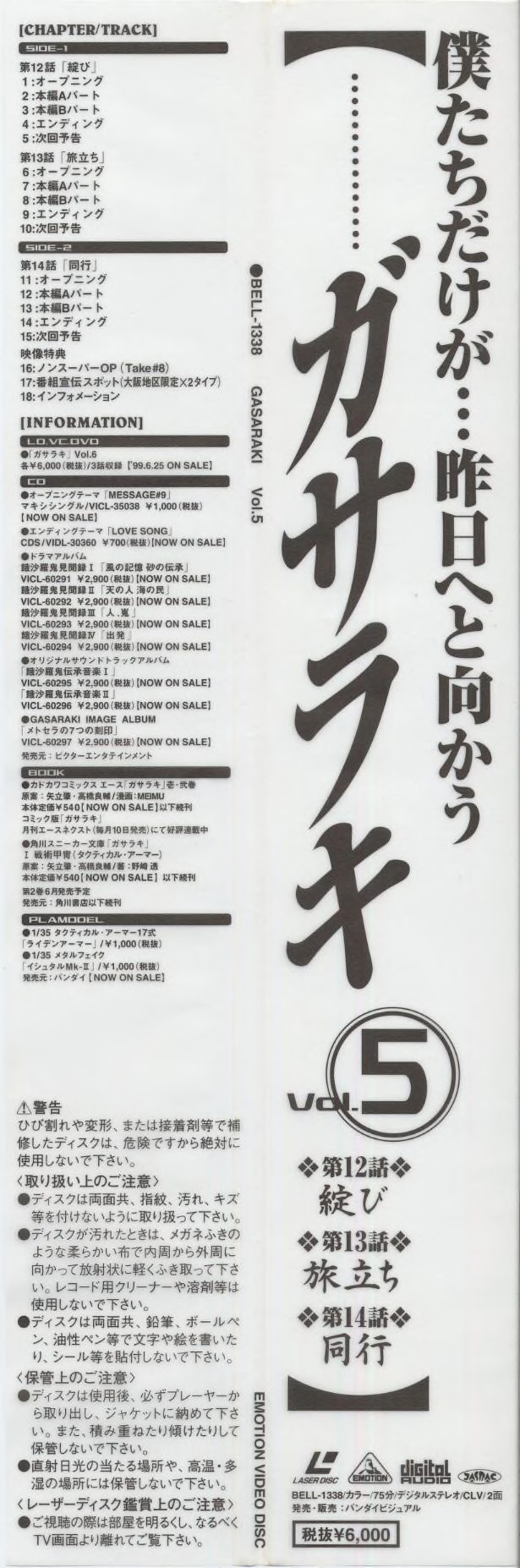 Vol.5 obi (BELL-1338) — CLV/2面, ¥6,000 (税抜). Episodes 第12話「綴び」, 第13話「旅立ち」, 第14話「同行」. Chapter/track listing across both sides. 初回特典: 番組宣伝スポット 大阪地区限定 x2タイプ — two regional TV spot variants.
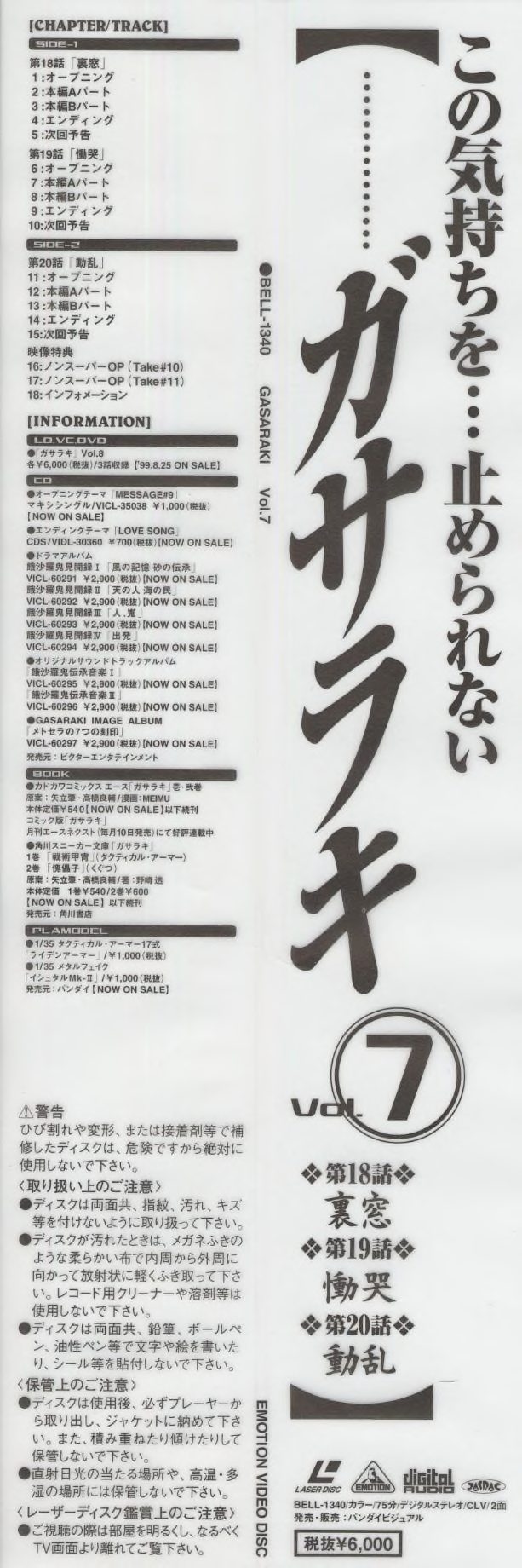 Vol.7 obi (BELL-1340) — CLV/2面, ¥6,000. Episodes 第18話「裏窓」, 第19話「慟哭」, 第20話「動乱」. INFORMATION block lists upcoming Vol.8 (¥6,000, 3話収録, '99.8.25 ON SALE), CD releases, drama albums, OST, image album, and plastic model kits for both T·A and Metal Fake イシュタル Mk-II (Bandai, ¥1,000).
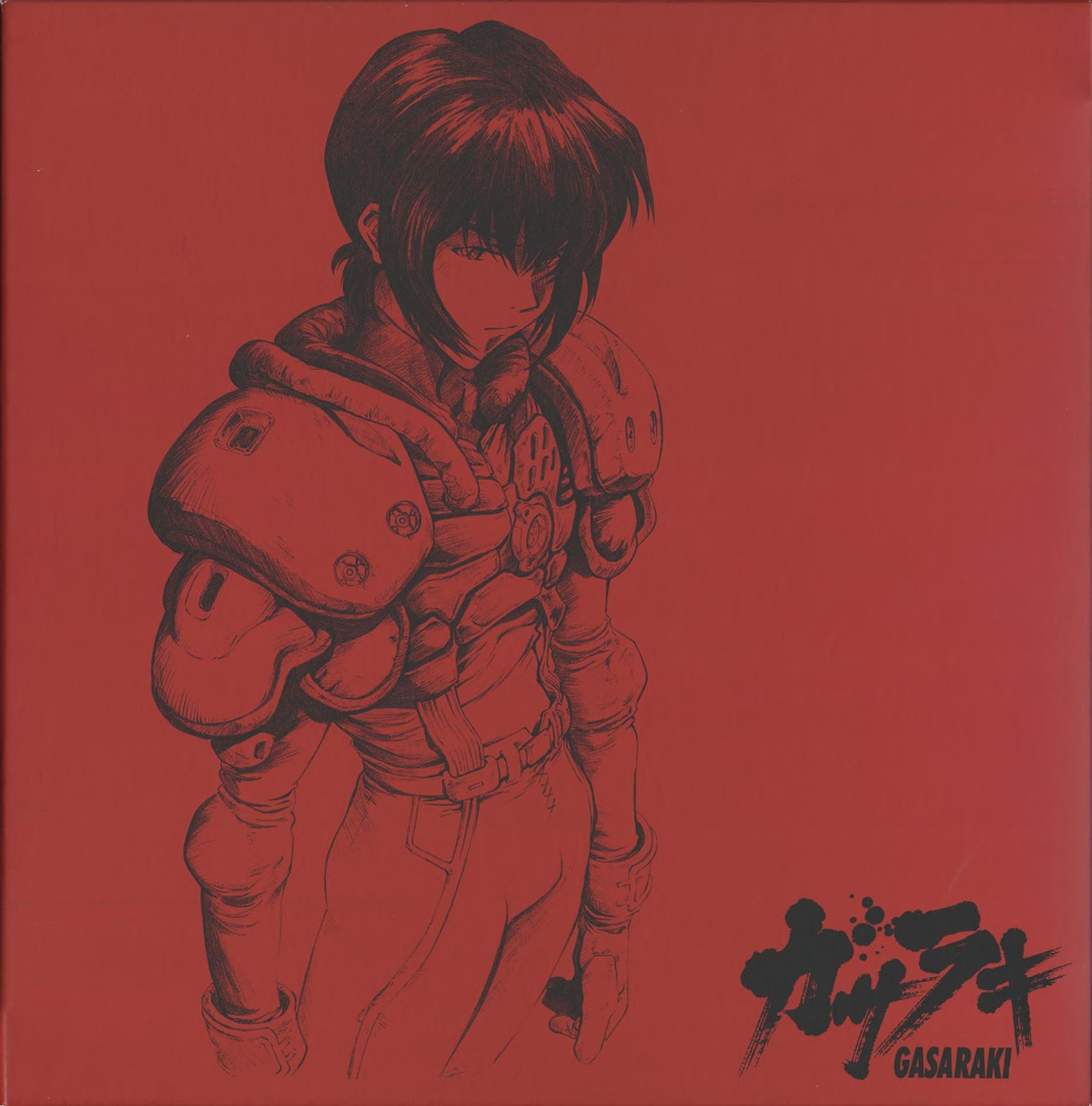 特製LD-BOX panel — Miharu (雅) in her SSDF pilot suit. Deep red field. New illustration by Shūkō Murase, drawn specifically for the Vol.1 first-pressing bonus. Labeled BELL-1334 NOT FOR SALE.
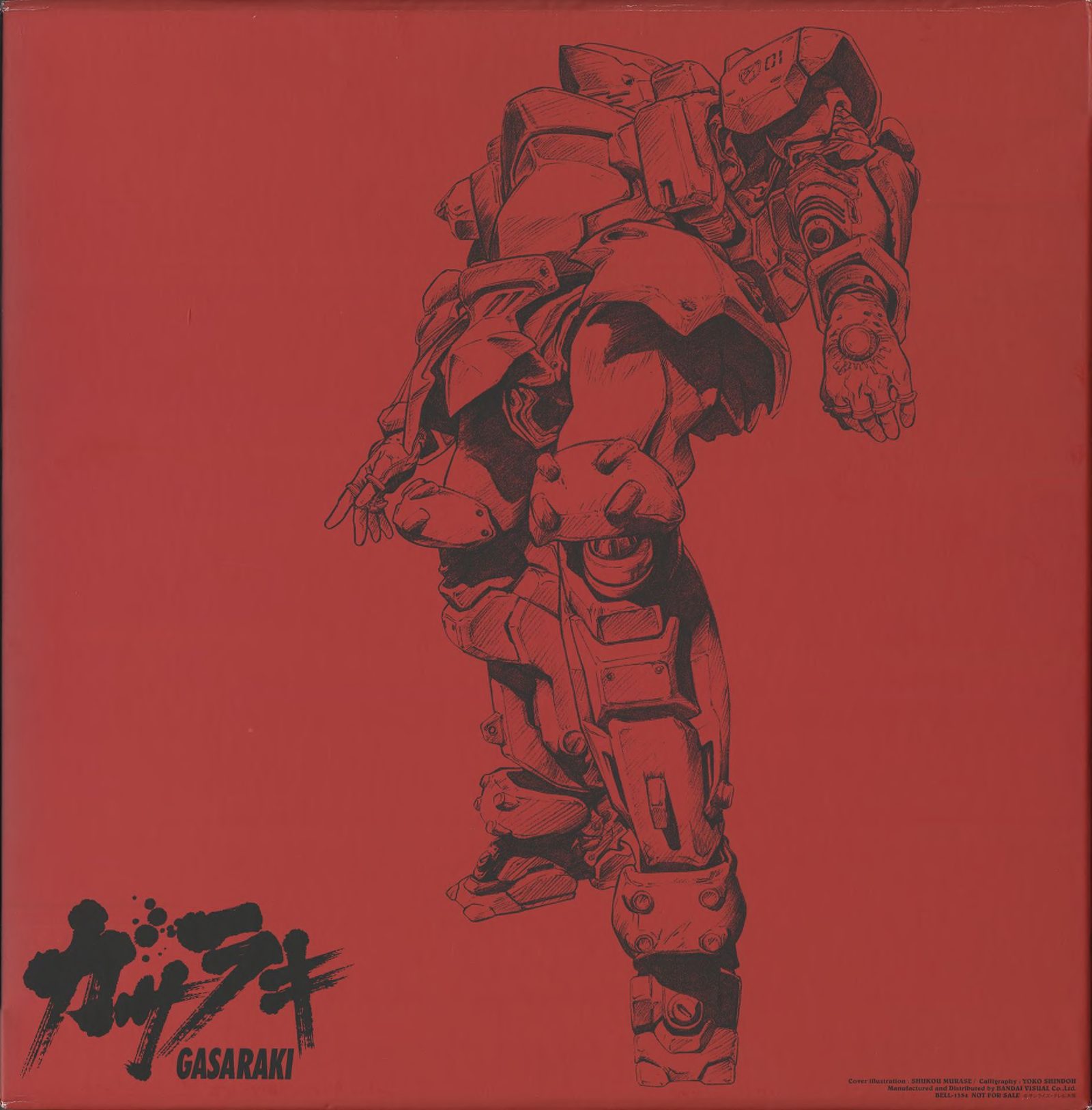 Special LD-BOX panel, reverse — T·A unit (Tactical Armored Fighter) in the same deep red monochrome. Cover Illustration: SHUHOU MURASE. Calligraphy: SOKO KODMON. Manufactured and Distributed by BANDAI VISUAL CO.,LTD.
The First-Pressing Box
The 特製LD-BOX is a storage case for the complete series — first buyers of Vol.1 received it as a free bonus (初回生産特典), with no additional cost. Murase drew both panels: the character side (Miharu, combat suit, standing three-quarter) and the mecha side (T·A unit, same color and weight). The calligraphy credit identifies the brush-written ガサラキ title as Soko Kodmon's — the same hand printed on every advance screener sleeve.
The series eventually produced two storage boxes: one for Vols.1–4 and a second for Vols.5–9. Both carry the BELL-1334 catalog number and NOT FOR SALE designation, consistent with the screener disc system's use of the same catalog number for non-retail materials.
各話設定 — Per-Episode Production Design
Each retail volume came with a companion booklet. The booklet's anchoring section is 各話設定 — per-episode production design documentation, one triple-fold spread per disc (covering that volume's three episodes). Each panel carries: an episode-specific key image board or genga sample at center, surrounding it the named settei for every major character and mecha appearing in those episodes, plus annotations on locations and newly introduced hardware.
Across nine volumes, the 各話設定 spreads document the complete visual design library for all 25 episodes — every named character, every T·A variant, every support vehicle, every supernatural entity introduced in the series. The spreads are working production reference in print form.
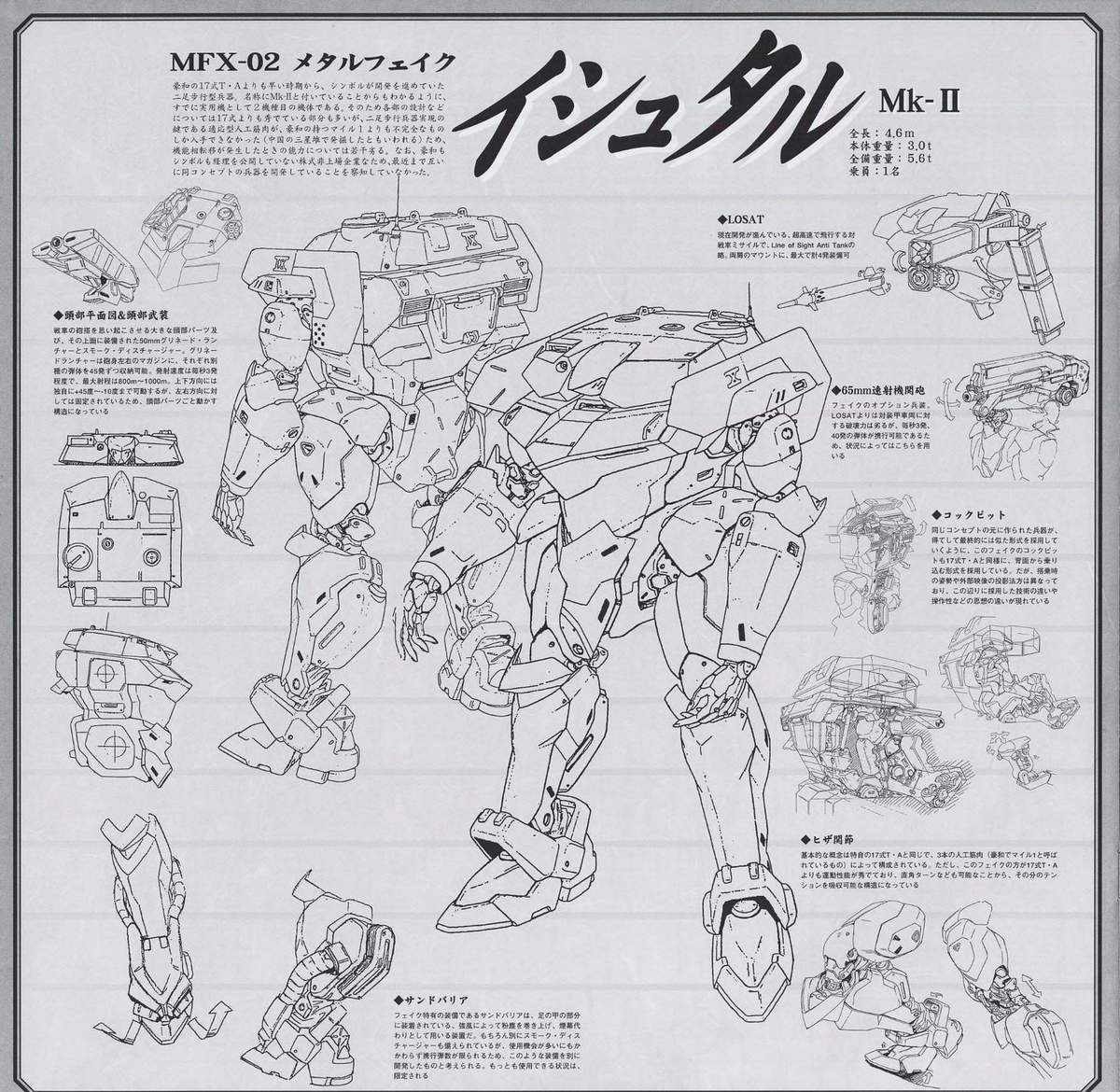 MFX-02 メタルフェイク イシュタル Mk-II — full design sheet from the Vol.3 companion booklet. Orthographic views, detail callouts, component breakdowns. Design: 出渕裕 (Izubuchi Yutaka). The Mk-II is the opposing faction's answer to the T·A series — same bipedal mechanized-infantry concept, different state-actor origin.
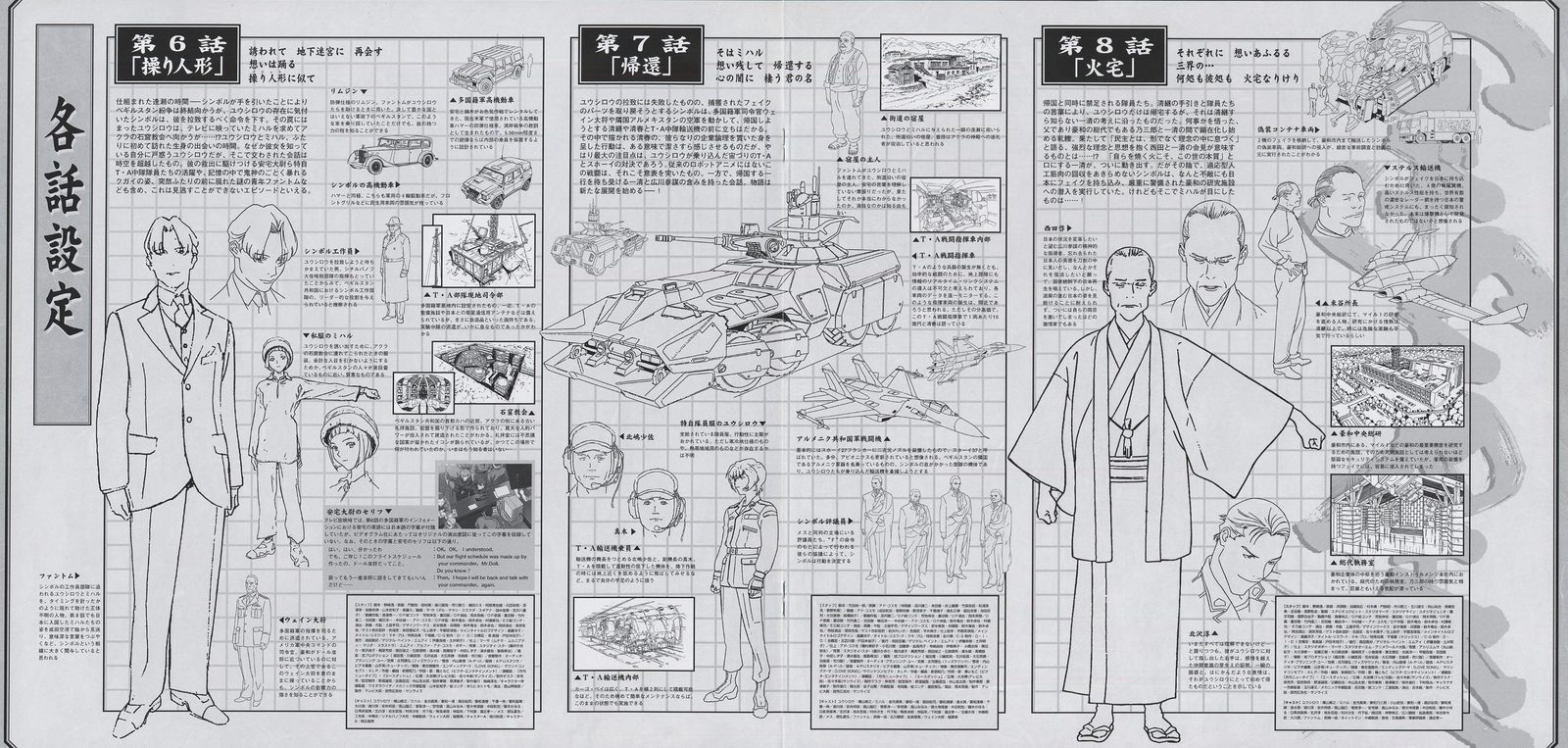 各話設定 spread — episodes 第6話「操り人形」, 第7話「帰還」, 第8話「火宅」. Three-panel fold from the Vol.3 booklet. Character settei (full figure + costume breakdown), mecha reference, location design notes. Episode titles and haiku-line text blocks above each panel.
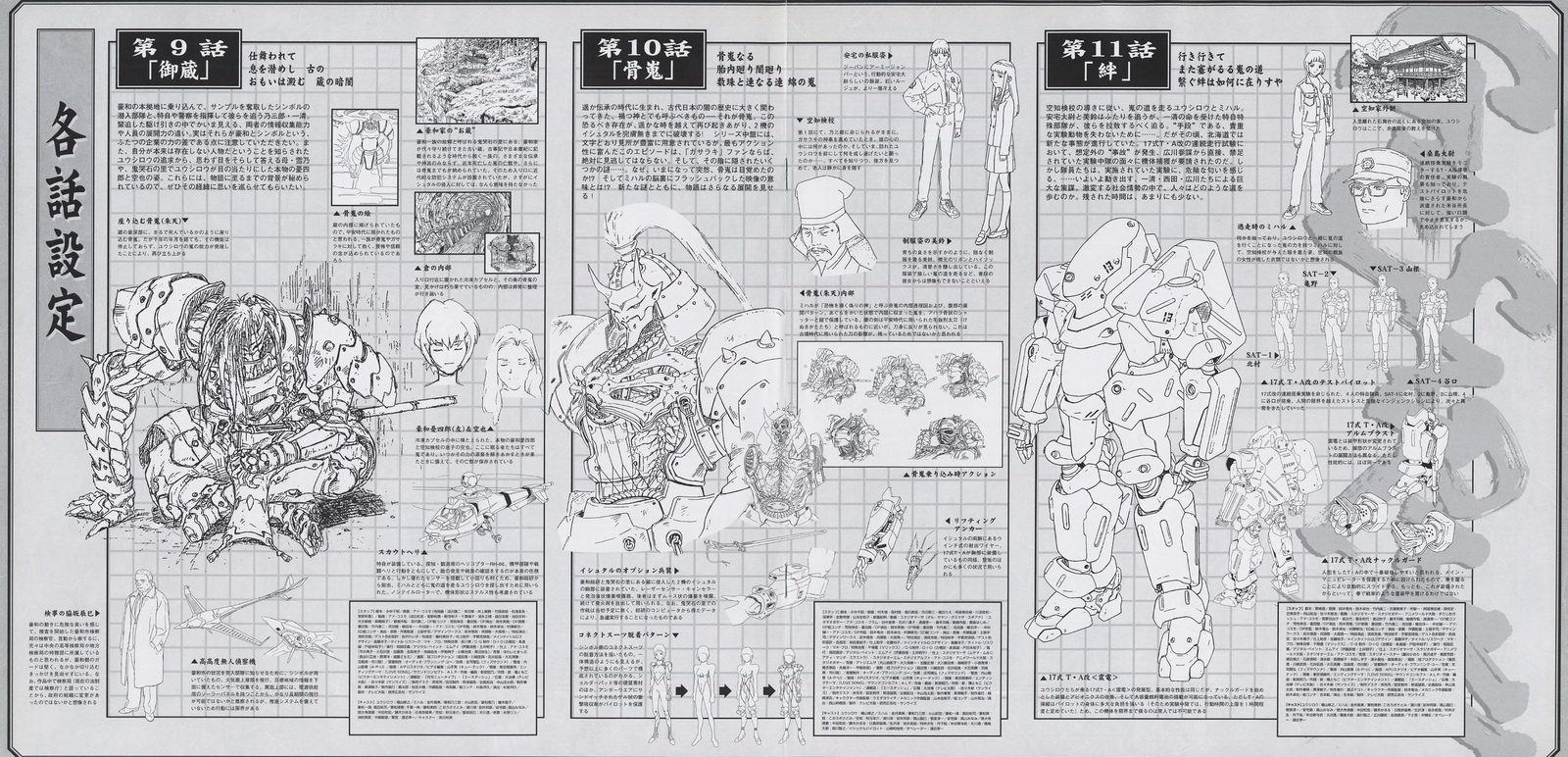 各話設定 spread — episodes 第9話「御蔵」, 第10話「骨鬼」, 第11話「絆」. The central panel for 第10話 leads with 骨鬼 — the series' primary supernatural entity, a skeletal armored figure that becomes increasingly important as the Yushahara plot overtakes the military thriller. Full settei with annotation.
The 各話設定 format is the same across all volumes — a consistent visual grammar across nine months of releases. Each spread was apparently produced by the series' settei department and reproduced at reduced scale for the booklets. The originals would have been the A3+ reference sheets circulated to animation subcontractors; the booklet versions are approximately half-size.
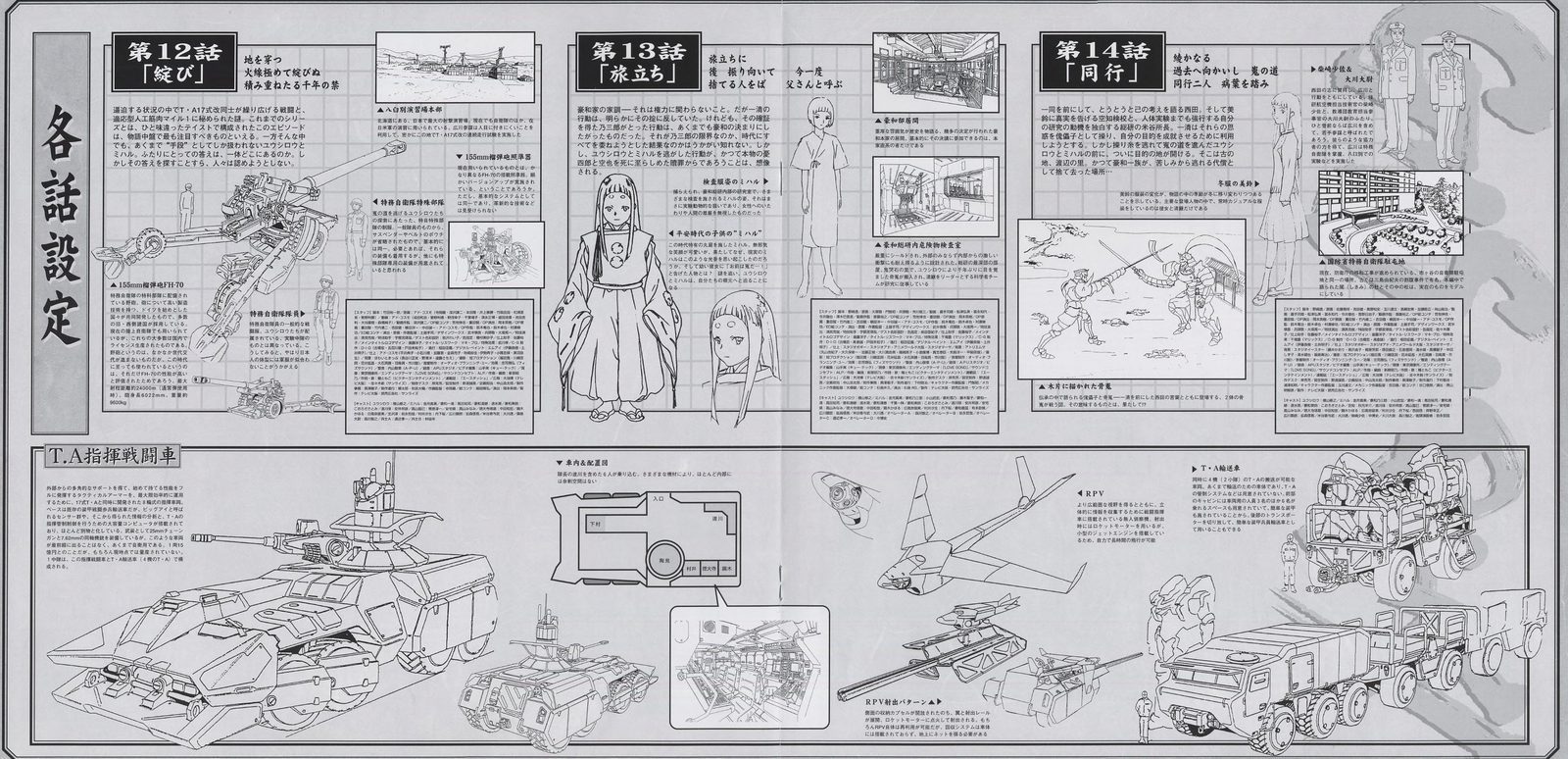 各話設定 spread — episodes 第12話「綴び」, 第13話「旅立ち」, 第14話「同行」. Bottom section: T·A指揮戦闘車 — the T·A command-and-control vehicle, shown in plan view and elevation. Vehicle design documentation alongside character sheets on the same spread.
The Vol.5 spread (episodes 12–14) adds a T·A support vehicle sheet below the character panels — the documentation expanding beyond characters as the series' military hardware becomes more central to the plot.
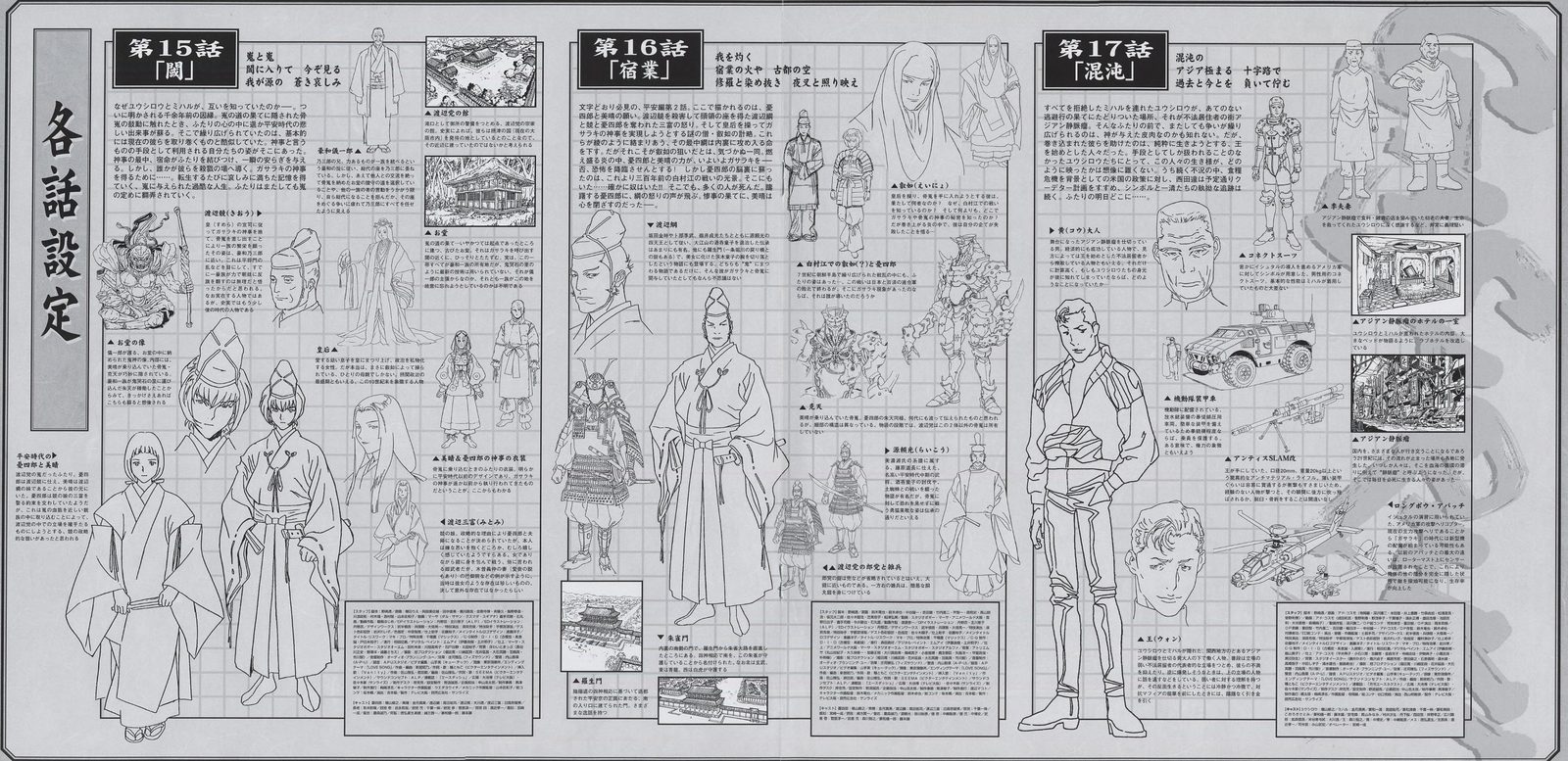 各話設定 spread — episodes 第15話「闘」, 第16話「宿業」, 第17話「混沌」. Character settei shifts toward traditional Japanese costume — robes, formal dress — as the Yushahara family's ritual arc dominates these episodes.
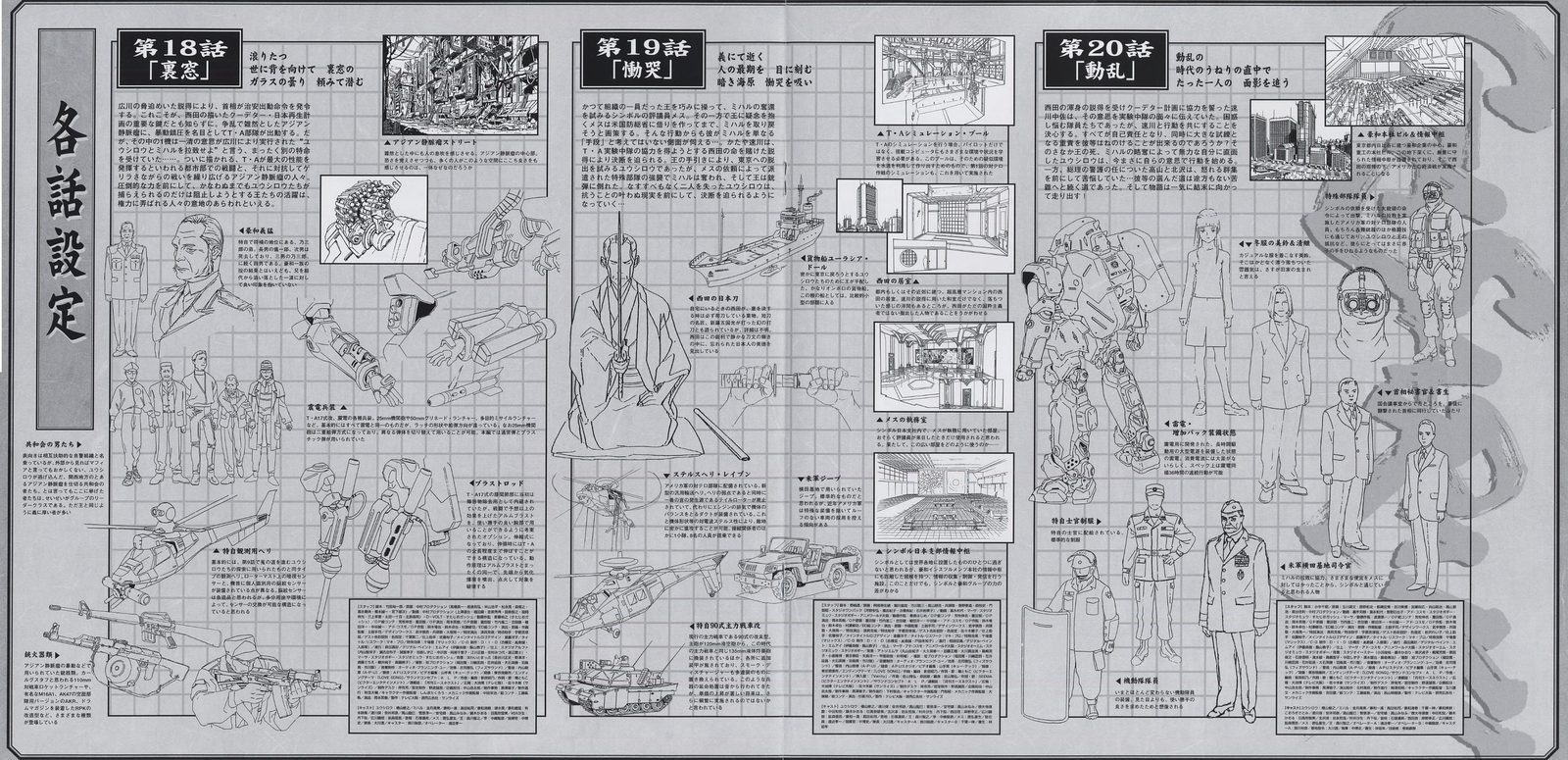 各話設定 spread — episodes 第18話「裏窓」, 第19話「慟哭」, 第20話「動乱」. The 第18話 panel leads with military personnel settei alongside the 骨鬼 entity and support mecha. 第20話 adds CIA analysts, foreign military advisors, and the series' international cast of guest characters.
The 各話設定 format runs consistently from Vol.3 through Vol.7 in this scan set — five spreads, covering episodes 6 through 20. The earlier volumes (Vols.1–2, episodes 1–5) and the closing volumes (Vols.8–9, episodes 21–25) are not present. Each spread was produced at full settei scale for circulation to animation subcontractors; the booklet versions are reductions for documentation.
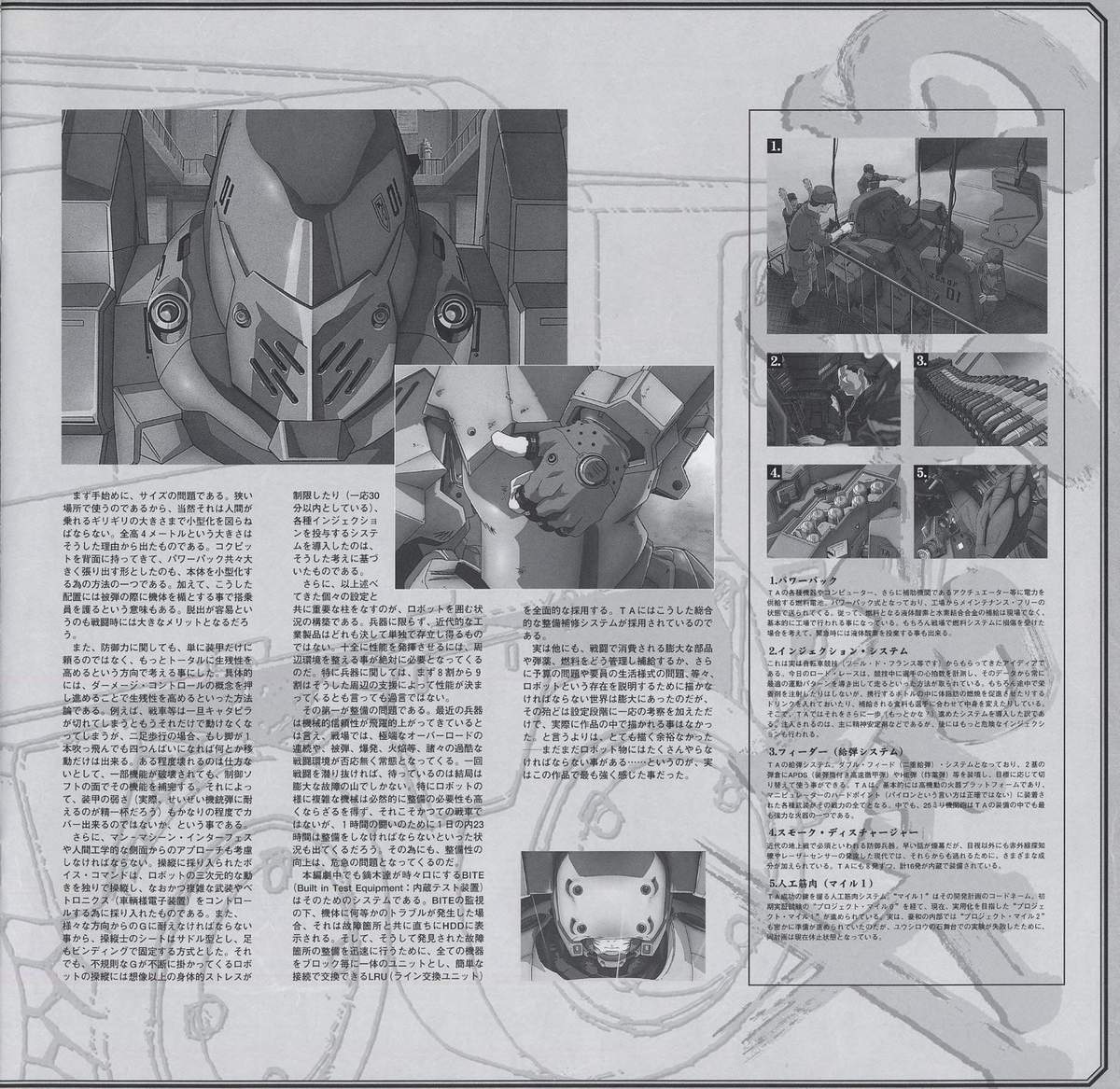 Mechanical analysis page — T·A detail analysis with annotated component drawings. Overlay sketches show T·A frame construction and joint detail at the head unit. From the Vol.3 companion booklet.
出渕裕 — モチーフは「武具」
The Vol.4 booklet dedicated its staff interview to mechanical designer 出渕裕 (Yutaka Izubuchi). The interview is titled モチーフは「武具」 — 'The motif is weapons and armor.' Izubuchi explains: the T·A design is grounded in the visual language of ancient Japanese armor and bladed weapons, not conventional science-fiction mecha. The supernatural entities 朱天 and 克天 appear in the booklet spread as full-page reference drawings, placed alongside the interview — the same hand that designed the T·A also designed the Gasaraki entities.
Izubuchi mentions working alongside director Takahashi on Votoms (1983) and Galient (1984) as the creative context. His approach to the T·A: a bipedal mechanized infantry suit that reads as tool rather than weapon — the opposite of the super robot visual vocabulary.
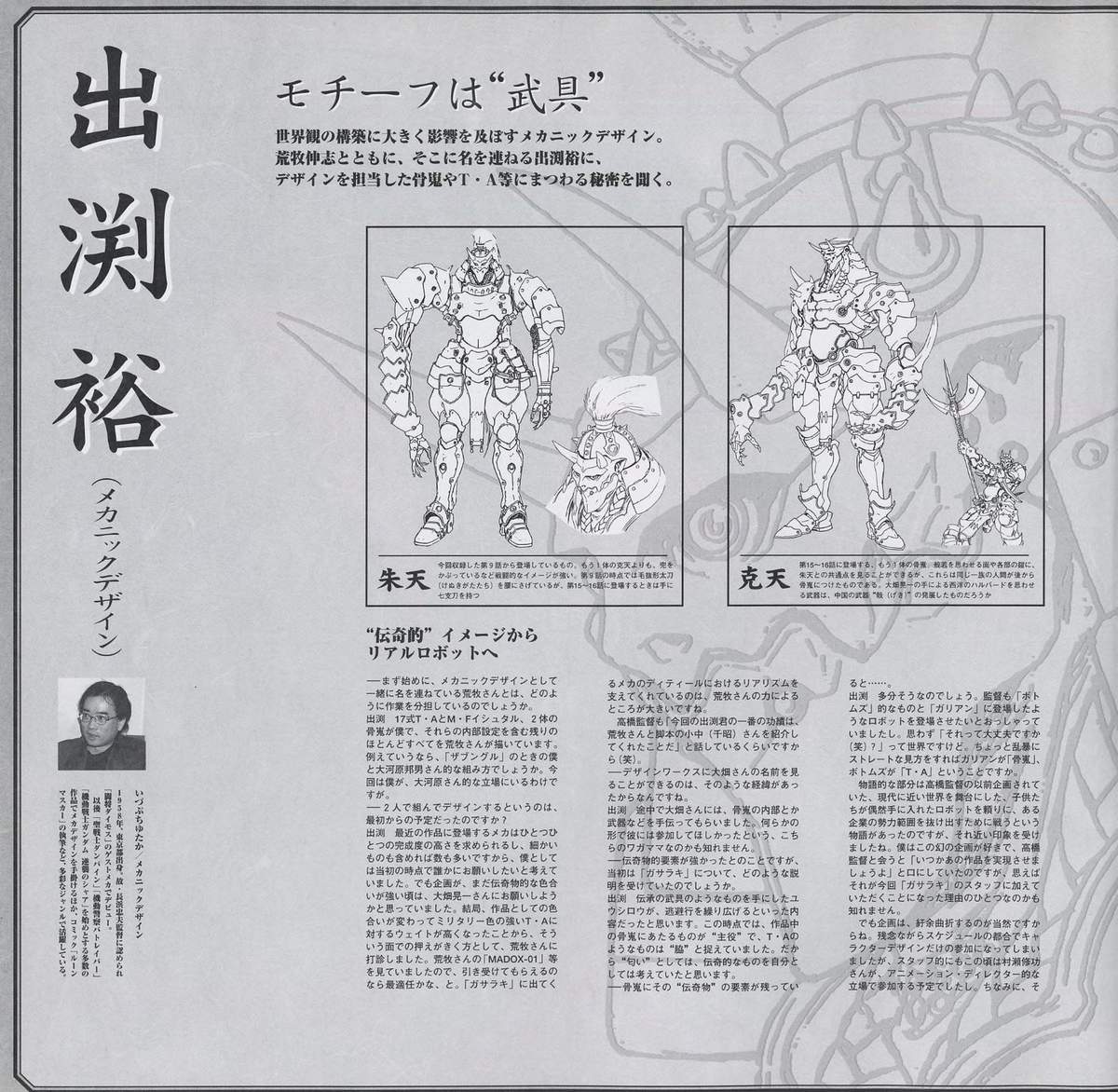 出渕裕 (メカニックデザイン) interview — 'モチーフは武具.' Vol.4 companion booklet. Full-page layout with designer photo, 朱天 and 克天 reference illustrations. Discussion of T·A design rationale, Votoms lineage, and the tension between cinematic mecha silhouette and production realism.
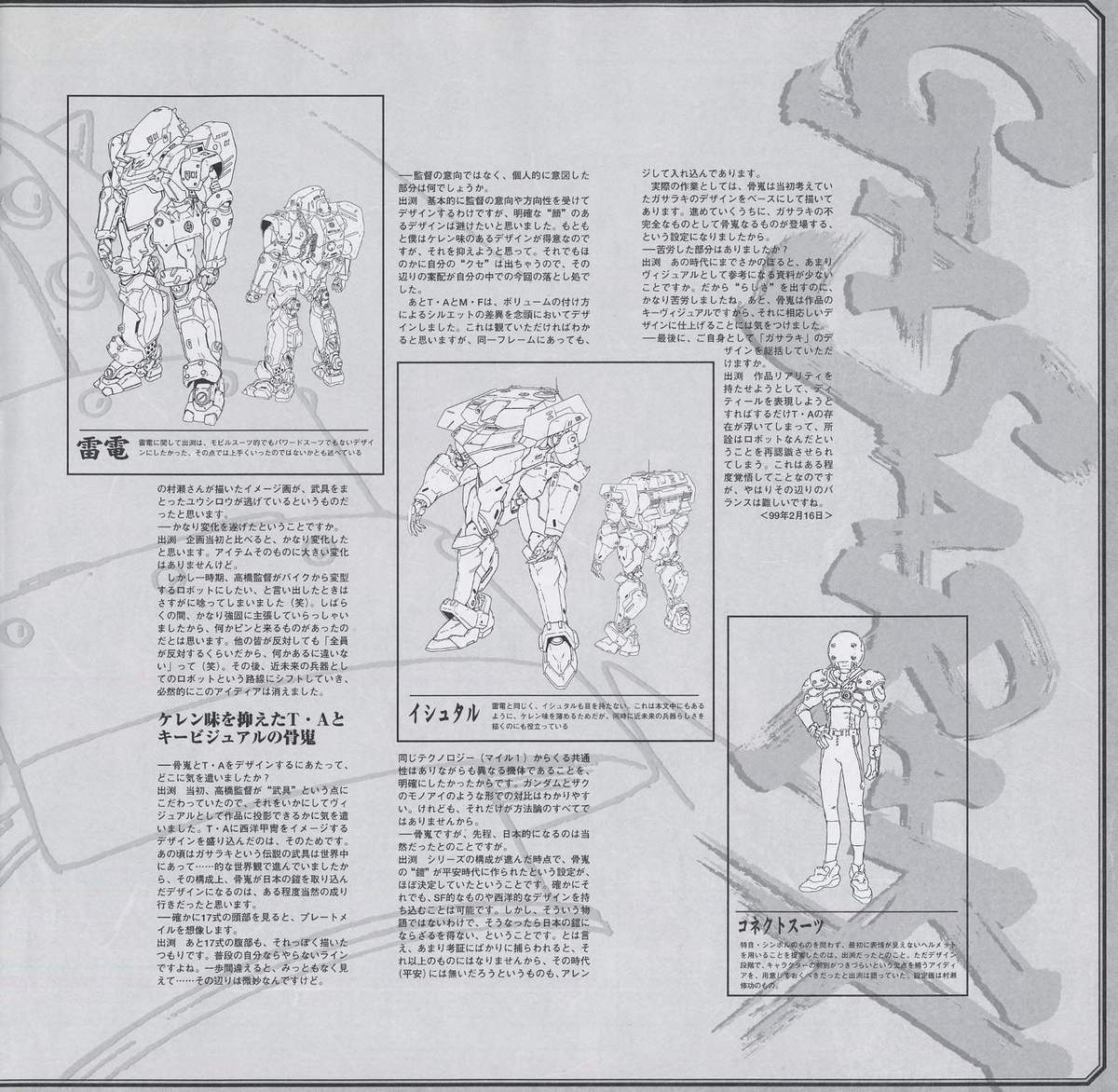 出渕裕 interview continued — 雷電 sketch (lower left), ゴネクトスーツ design (lower right), T·A and イシュタル detail comparison. Interview text covers T·A's 'weapon' proportions versus the イシュタル's different design logic, both within the same diegetic technology.
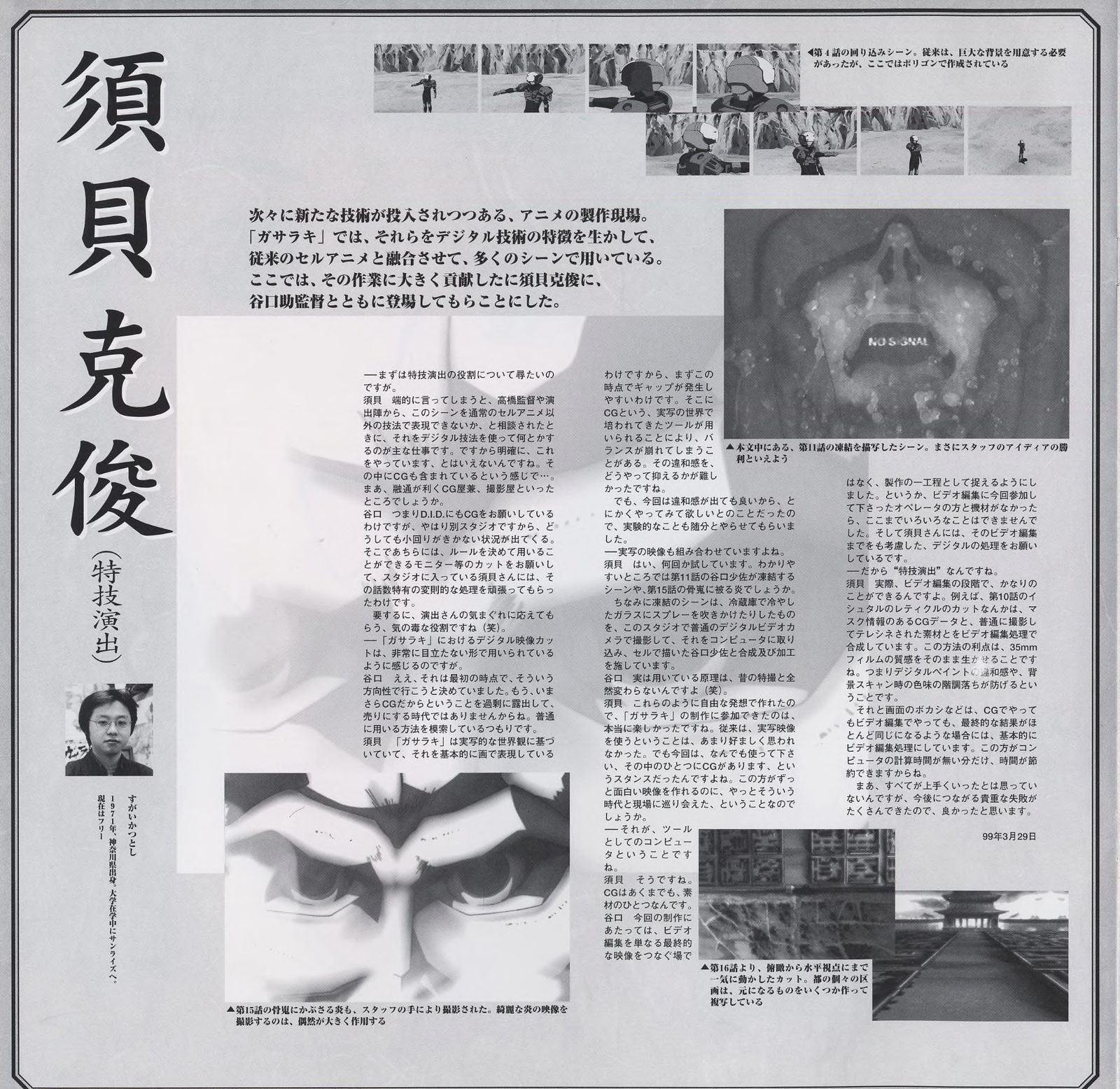 須貝克俊 (特技演出 — special effects director) interview — date 1999年3月29日. Discussion of digital techniques used across the series: video compositing, CGI integration for the SSDF monitors and tactical displays. Notes on ep.15–16 location footage incorporated into the broadcast edit.
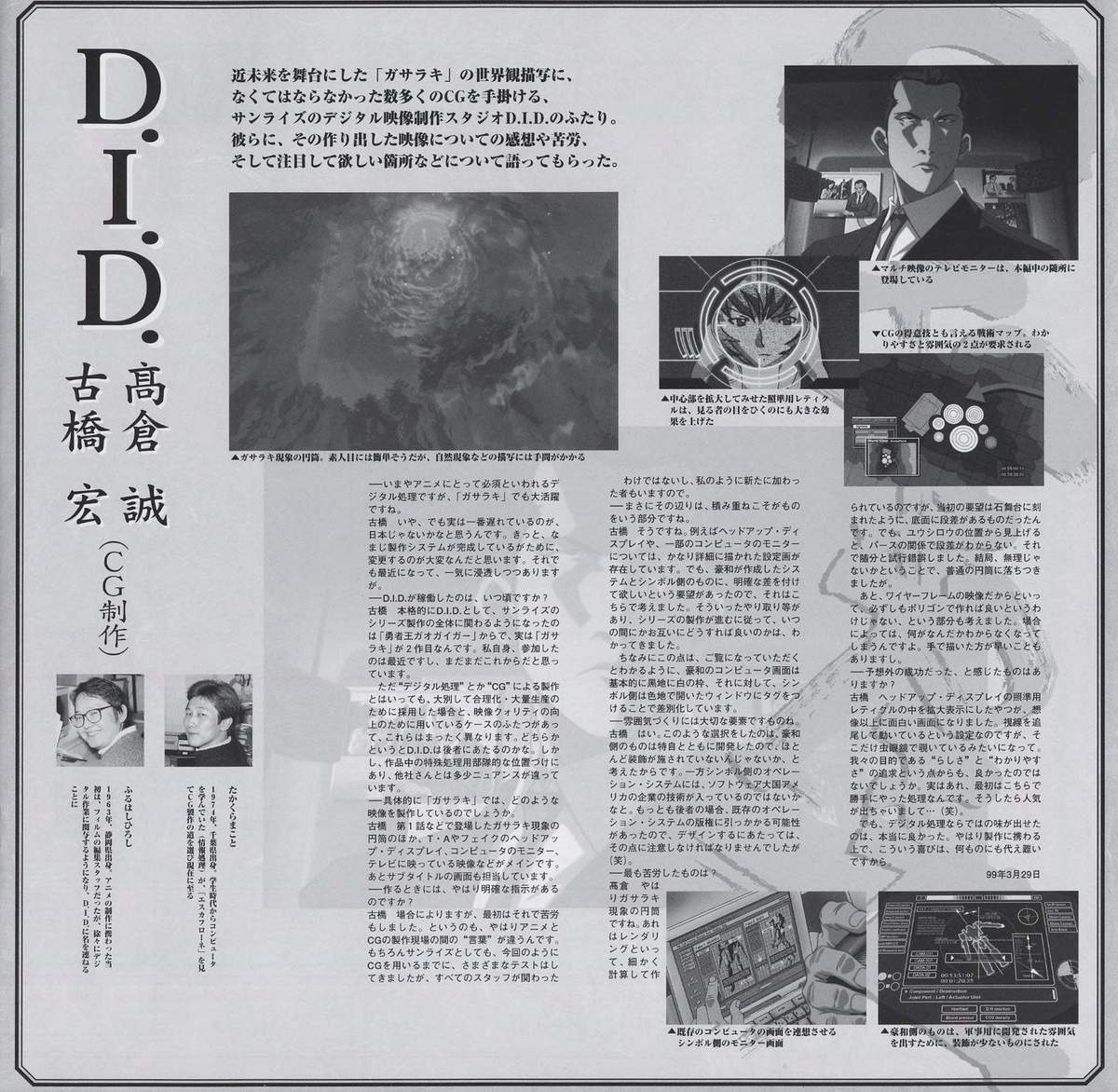 D.I.D. studio interview — 高倉誠 and 古橋誠 (Sunrise digital visual production), dated 1999年3月29日. Discussion of digital matte work, the tactical map displays, and the recurring computer monitor imagery. Sunrise's in-house digital unit contributed CG work across the series.
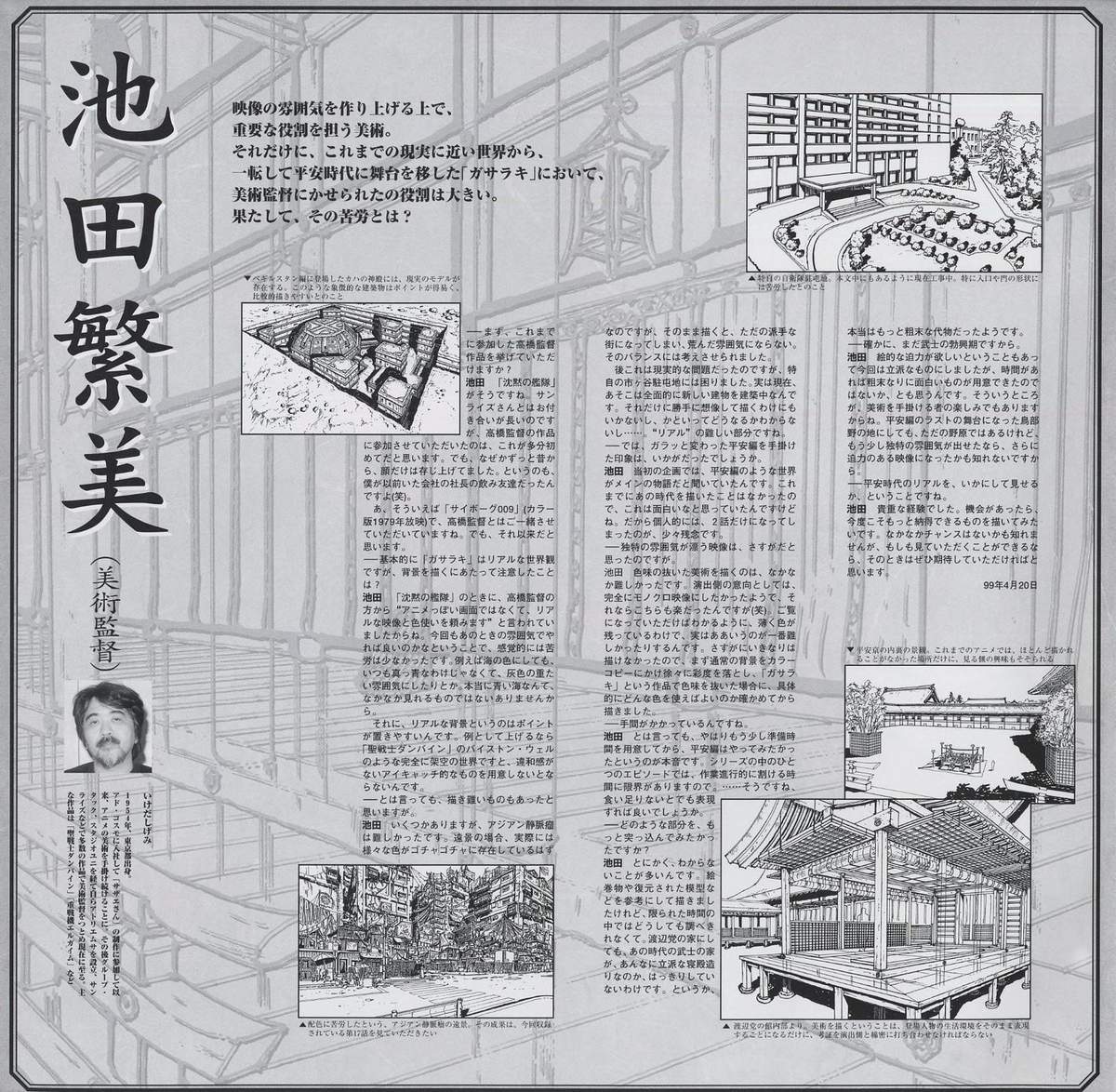 池田繁美 (美術監督 — art director) interview. Discussion of background art reference gathering and the challenge of representing real military infrastructure and traditional Japanese architecture across the same series. Location reference photography discussed.
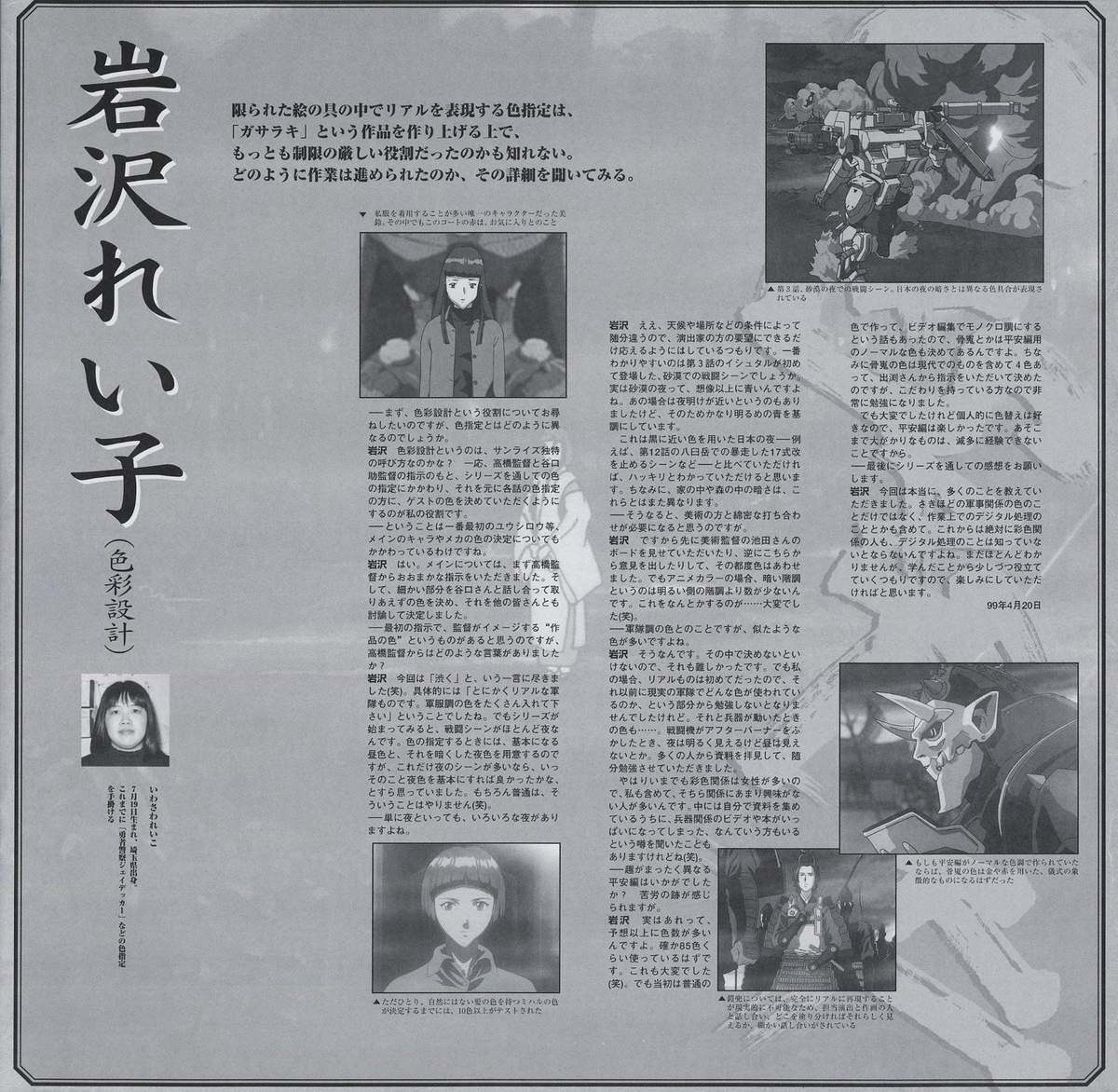 岩沢れい子 (色彩設計 — color designer) interview, dated 1999年4月20日. 'Gasaraki' as a color design problem: subdued military palette for the TAF and urban combat sequences versus traditional Japanese palette for the ritual scenes. Color decisions documented with reference stills. Interview opens: '限られた絵の具の中でリアルを表現する色指定は、ガサラキという作品を作り上げる上で、もっとも制限の厳しい役割だったのかも知れない。'
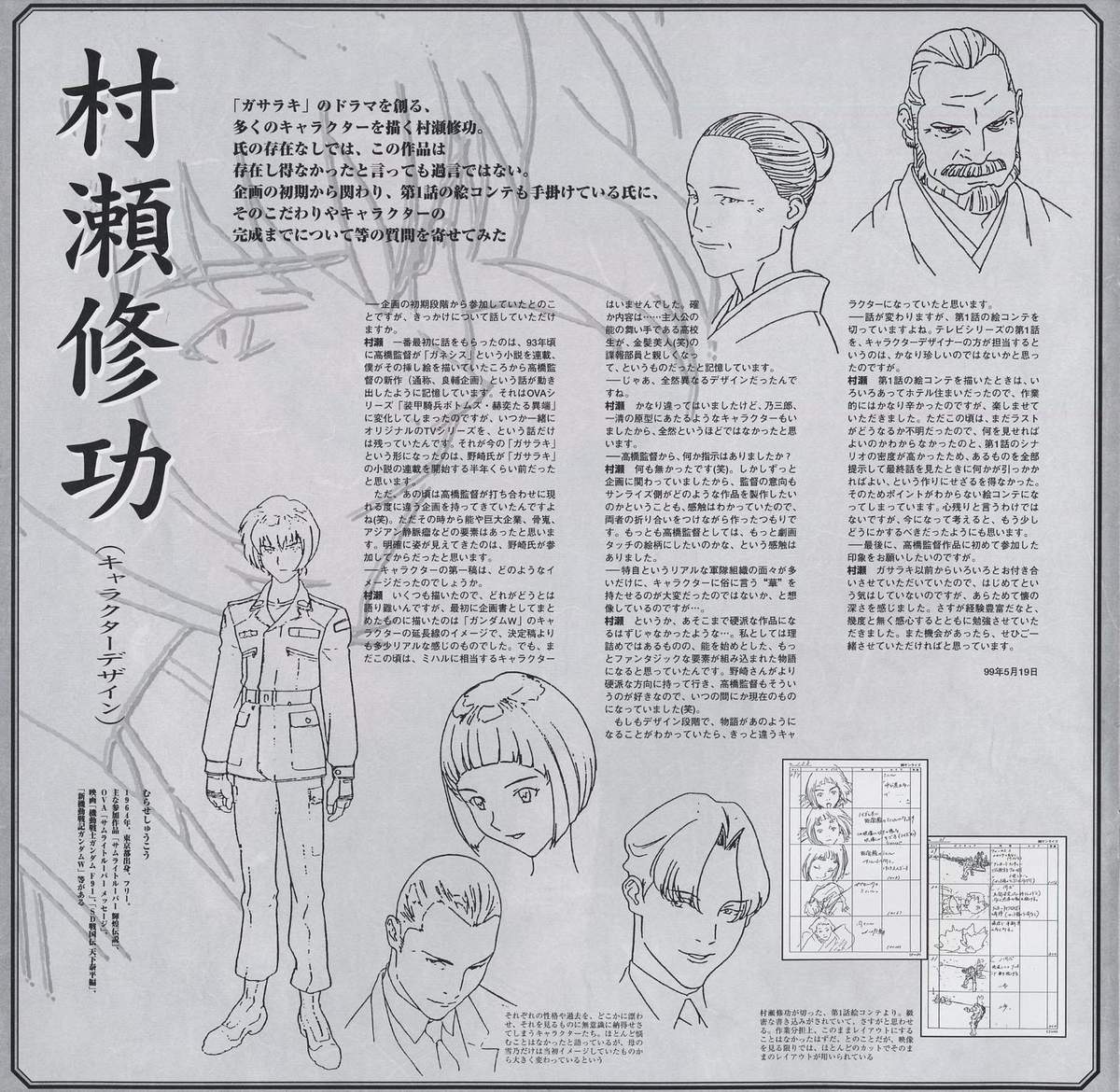 村瀬修功 (キャラクターデザイン — character designer) interview. Character design philosophy for a series with 'no clear protagonist' — the ensemble of Yūshirō, Miharu, Gōda, and the Yushahara family members are weighted more evenly than a conventional mecha series. Murase discusses how the design system reflects that distribution.
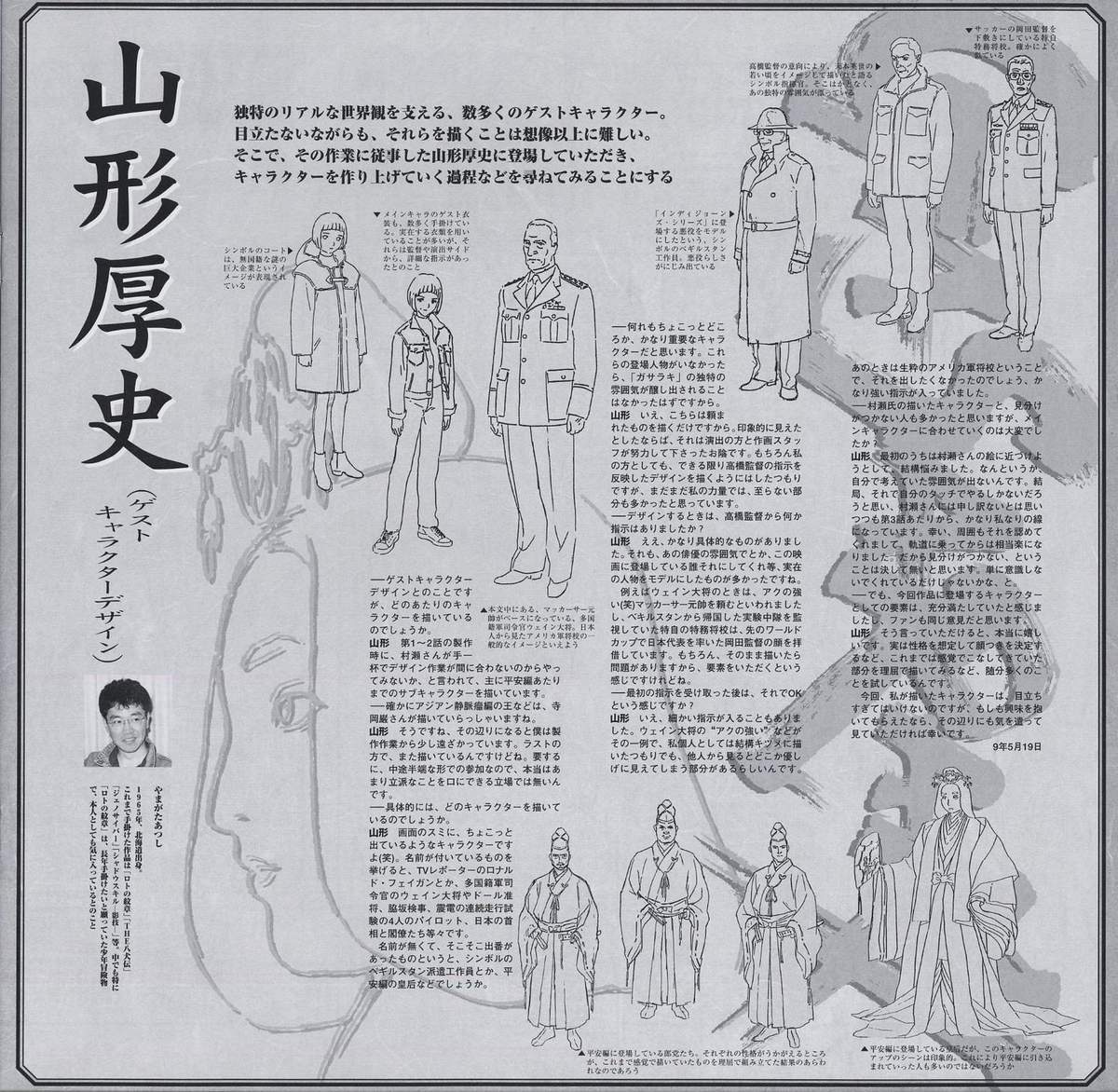 山形厚史 (ゲスト キャラクターデザイン — guest character designer) interview. Yamagata designed the series' recurring support characters — military officials, foreign advisors, government figures — that populate the political thriller layer. Discussion of how guest character design must be visually distinct from Murase's main cast without competing with it.
Eight Staff Interviews Across Nine Volumes
The companion booklet's interview series documented: mechanical designer, character designer, guest character designer, art director, color designer, special effects director, and the Sunrise digital visual studio — eight production roles, one per volume. Each interview was conducted during or just after production wrapped on that volume's episodes; dates range from February through April 1999. The complete interview set assembles a staff directory with annotated positions, not just promotional quotes.
高橋良輔 — アニメーション作法とその隠し味
Director Ryōsuke Takahashi contributed a running essay to each booklet volume: 高橋良輔に於けるアニメーション作法とその隠し味 — 'Ryōsuke Takahashi on the Craft of Animation and Its Hidden Flavors.' The essay ran at least six installments across the series. Each installment addressed a different dimension of Takahashi's working method: storyboarding approach, use of location reference, the relationship between dialogue and motion, the staging of scenes in narrow interior spaces. The essays are written in the first person and reference specific episodes of ガサラキ as the examples under discussion.
They were written while the series was in production. The installments from Vols.3–5 reference episodes 6–14, with production notes that are contemporary to the broadcast schedule — not retrospective.
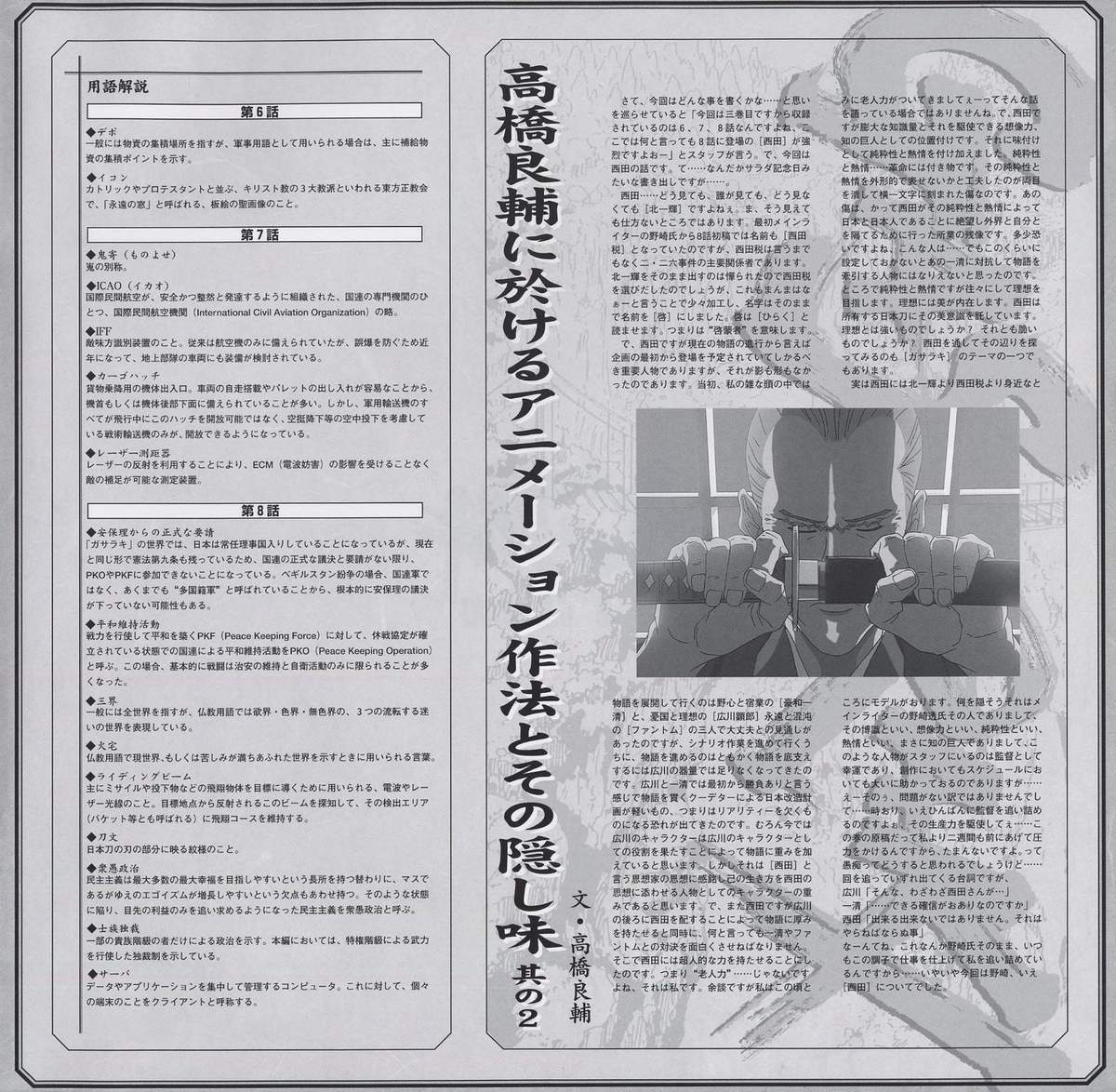 高橋良輔 essay installment 2 (Vol.3 booklet). Left column: 用語解説 (technical glossary) for the specific production terms discussed. Right: main essay body. Episode 7 and 8 production notes annotated in the margins. Photo of the director.
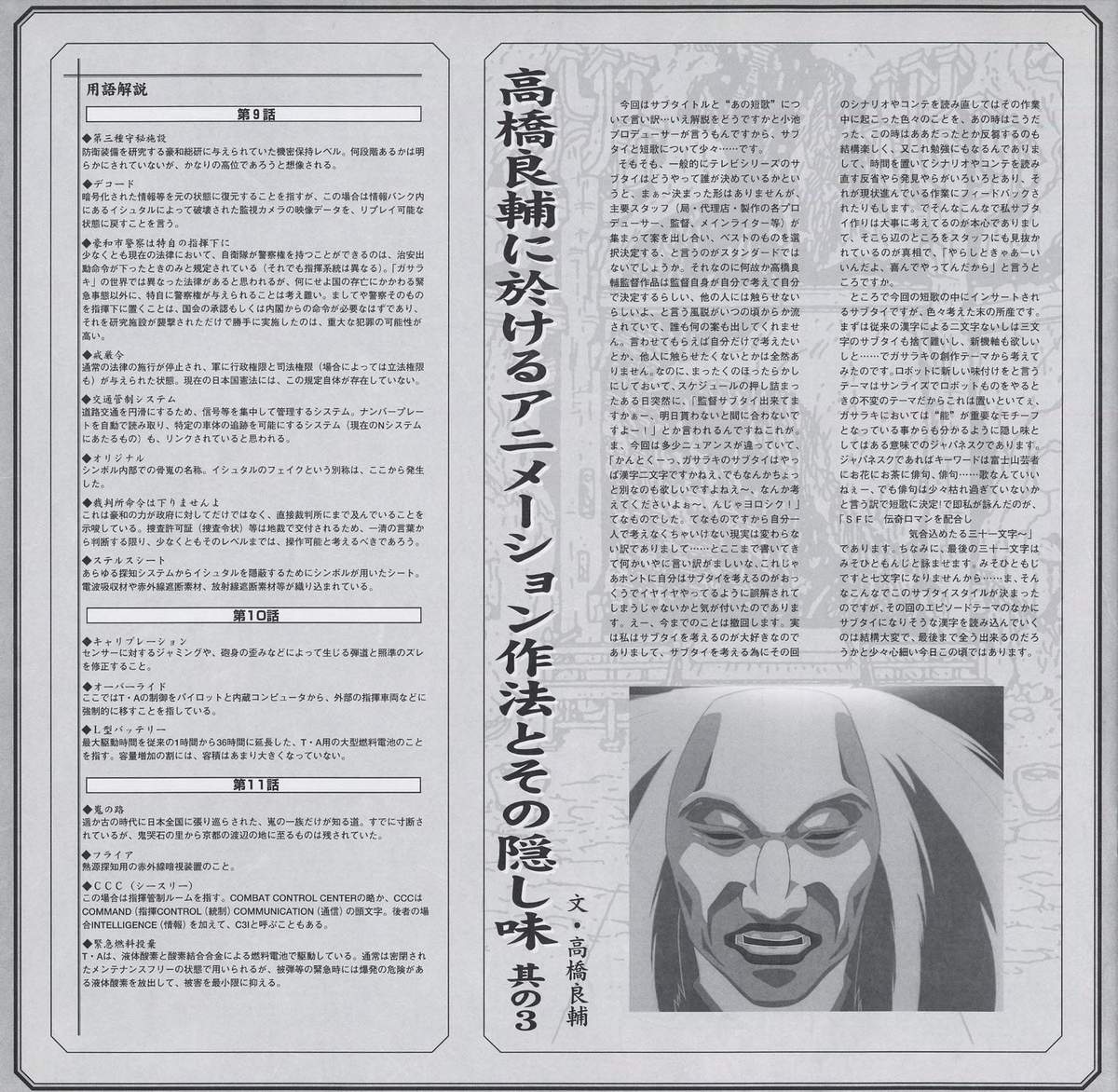 Installment 3 (Vol.4 booklet). A Noh mask photograph appears in the right column — the essay is discussing the relationship between Noh performance structure and the rhythm of the series' ritual sequences.
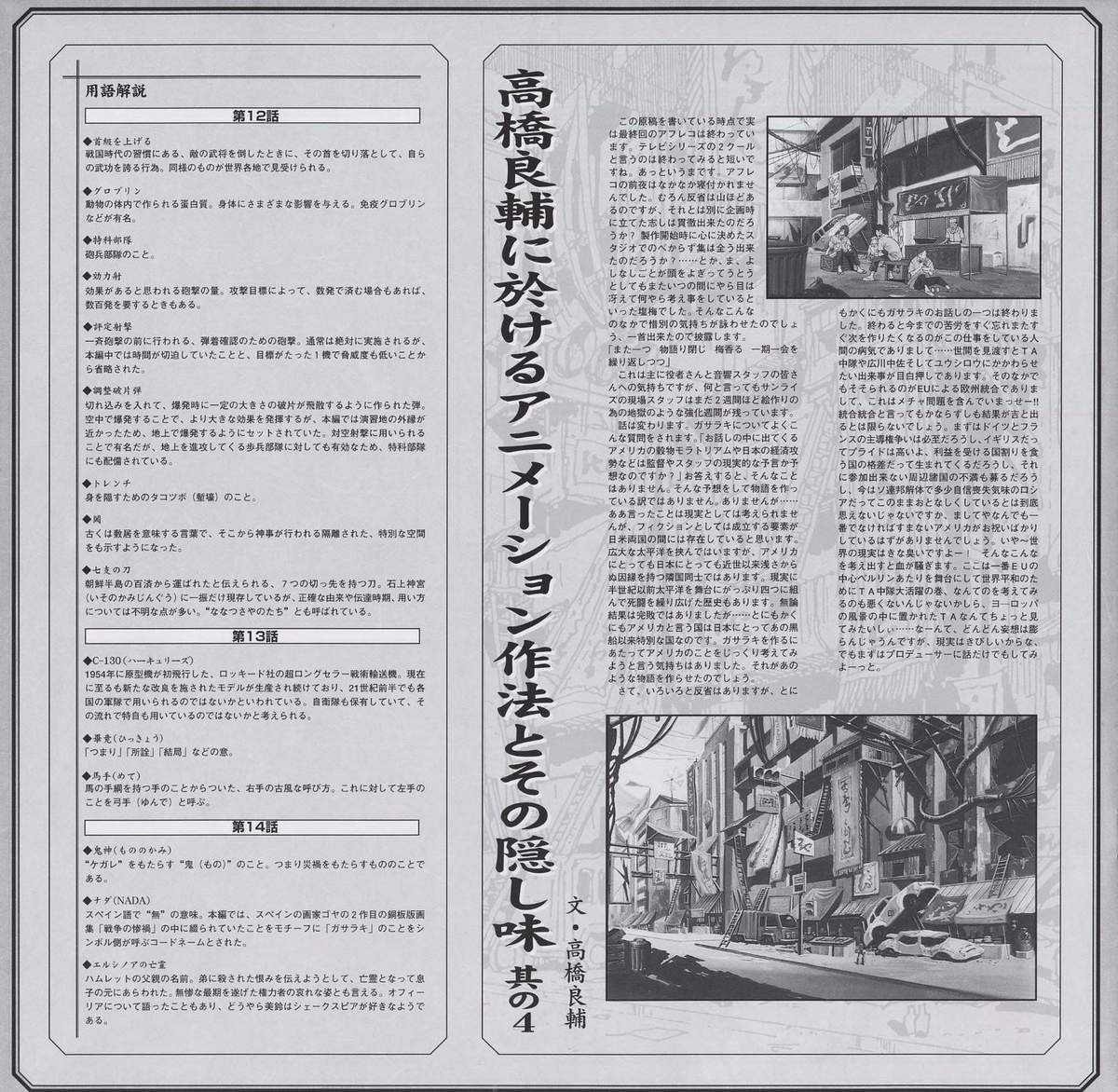 Installment 4 (Vol.5 booklet). Episode 12 and 13 location stills in the left margin — urban Shibuya street scenes used as background reference. The essay discusses background art's role in establishing geographic specificity.
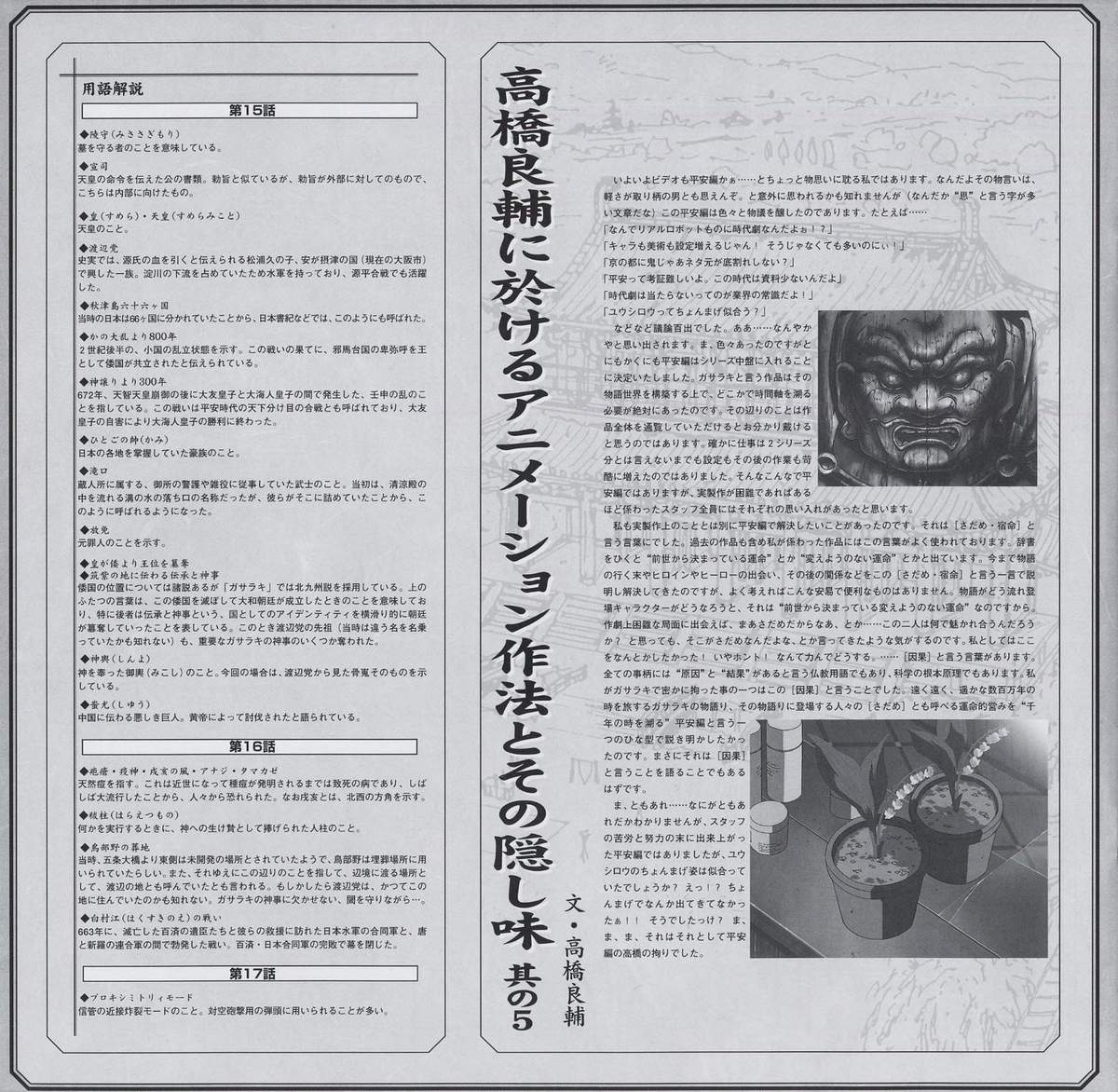 Installment 5 (Vol.6 booklet). Screen captures from episodes 15–17. The essay appears to be addressing the pacing of dialogue-heavy scenes, referencing specific scripted exchanges.
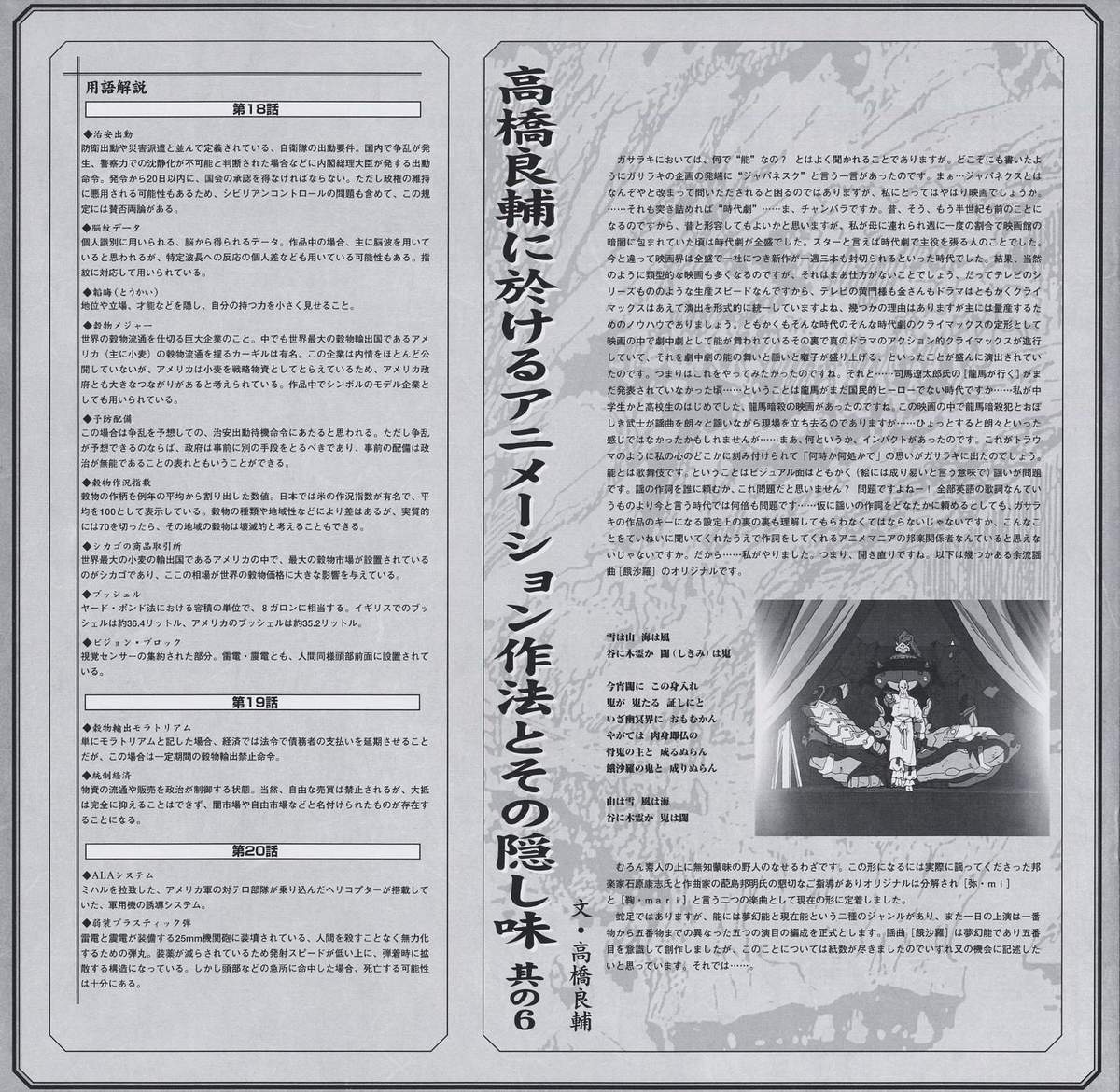 Installment 6 (Vol.7 booklet). Final visible installment in this scan set. References episodes 18–20.
野崎透 — 「ガサラキ」類苑
Series writer 野崎透 (Tōru Nozaki) contributed a parallel running series: 「ガサラキ」類苑 (Ruien — a compendium or thesaurus of the world). Where Takahashi's essays discuss craft, Nozaki's installments are episode analysis from the perspective of the screenwriter responsible for them. Each installment addresses the three episodes covered by that volume, examining the world-building decisions and dramatic architecture behind specific scenes.
The 類苑 essays include detailed diagrams — in later installments, tactical maps and T·A combat deployment schemas, drawn specifically for the booklet to clarify military movements that the series presented obliquely.
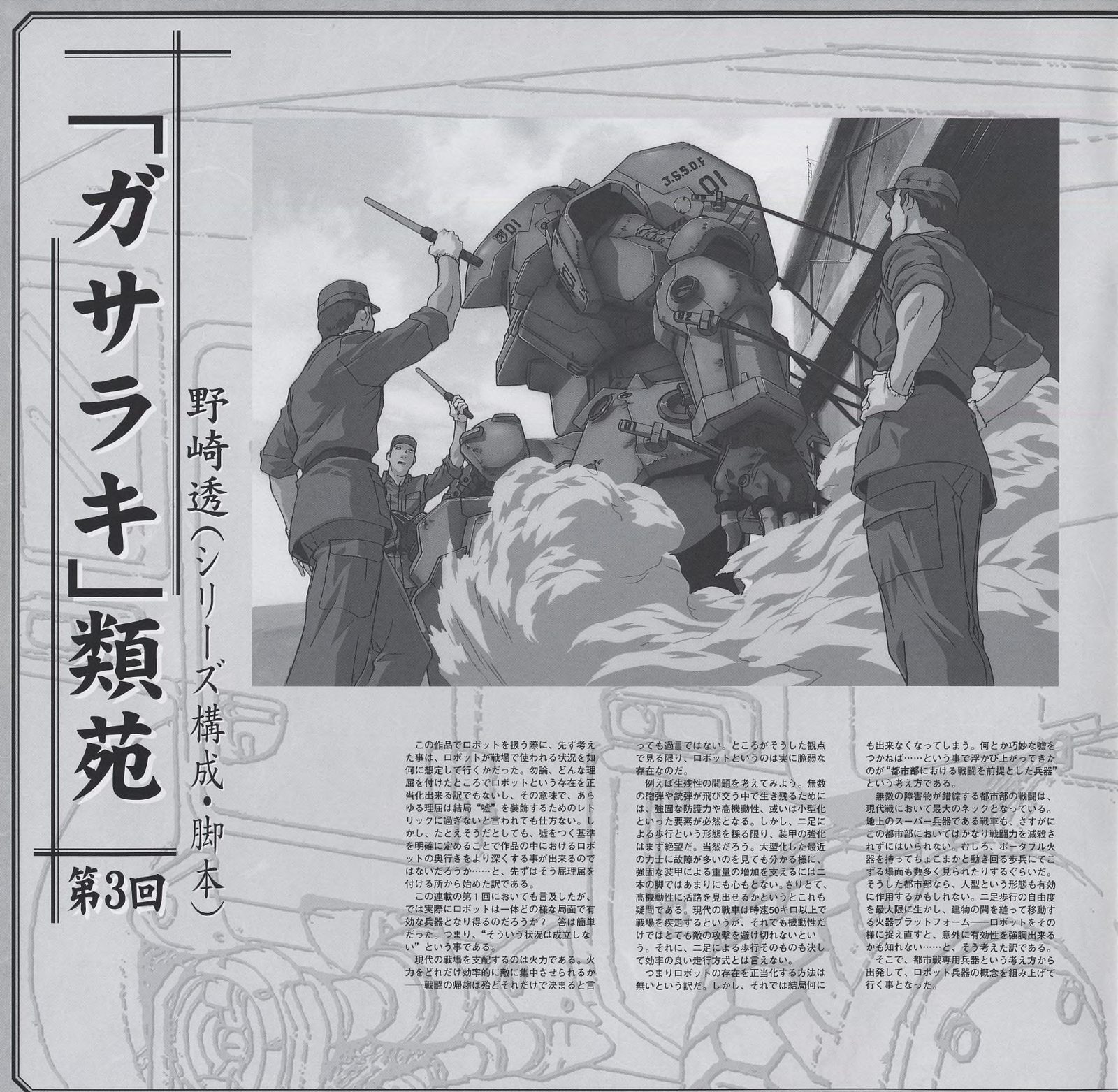 「ガサラキ」類苑 第3回 (Vol.3 booklet) — 野崎透 (シリーズ構成・脚本). Analysis of episodes 6–8. Central image shows the T·A unit in a combat scenario with ground crew visible, establishing the scale hierarchy the series returns to repeatedly.
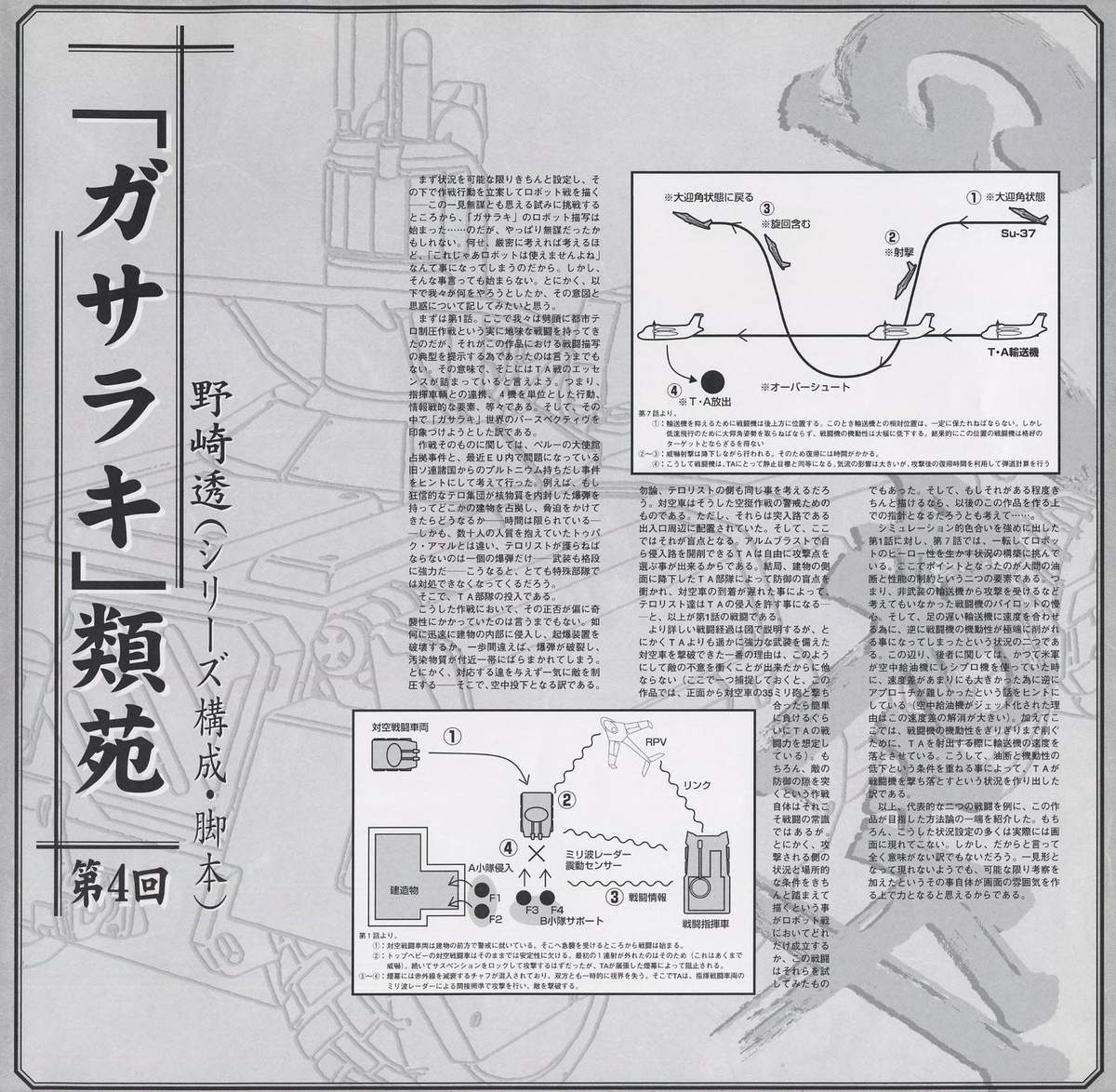 類苑 第4回 — episodes 9–11. The essay accompanies its text with combat diagrams — flight path mapping and tactical deployment charts drawn in the booklet's technical illustration style.
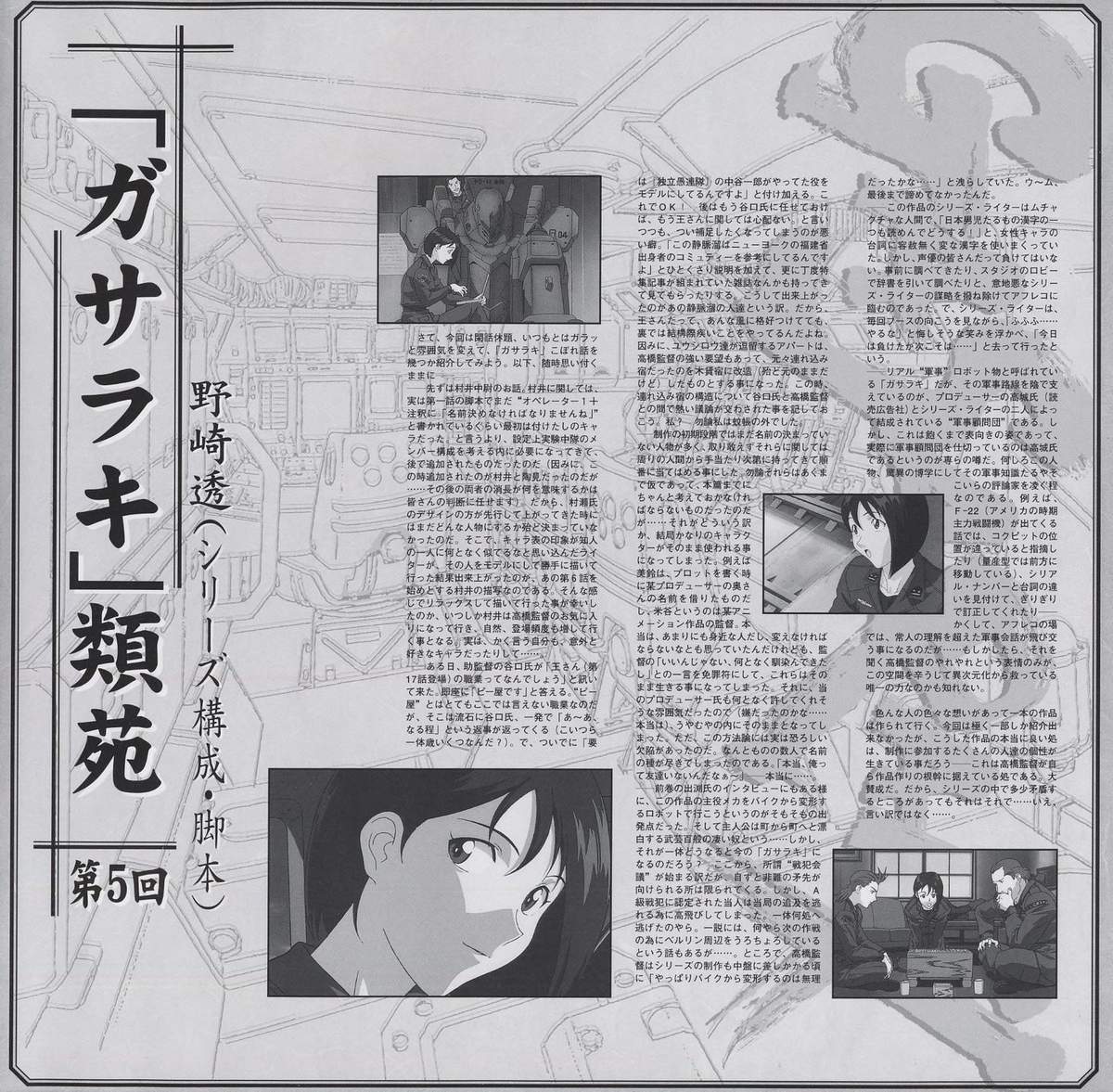 類苑 第5回 — episodes 12–14. Character stills alongside the text analysis — Miharu and the male lead in civilian and military contexts.
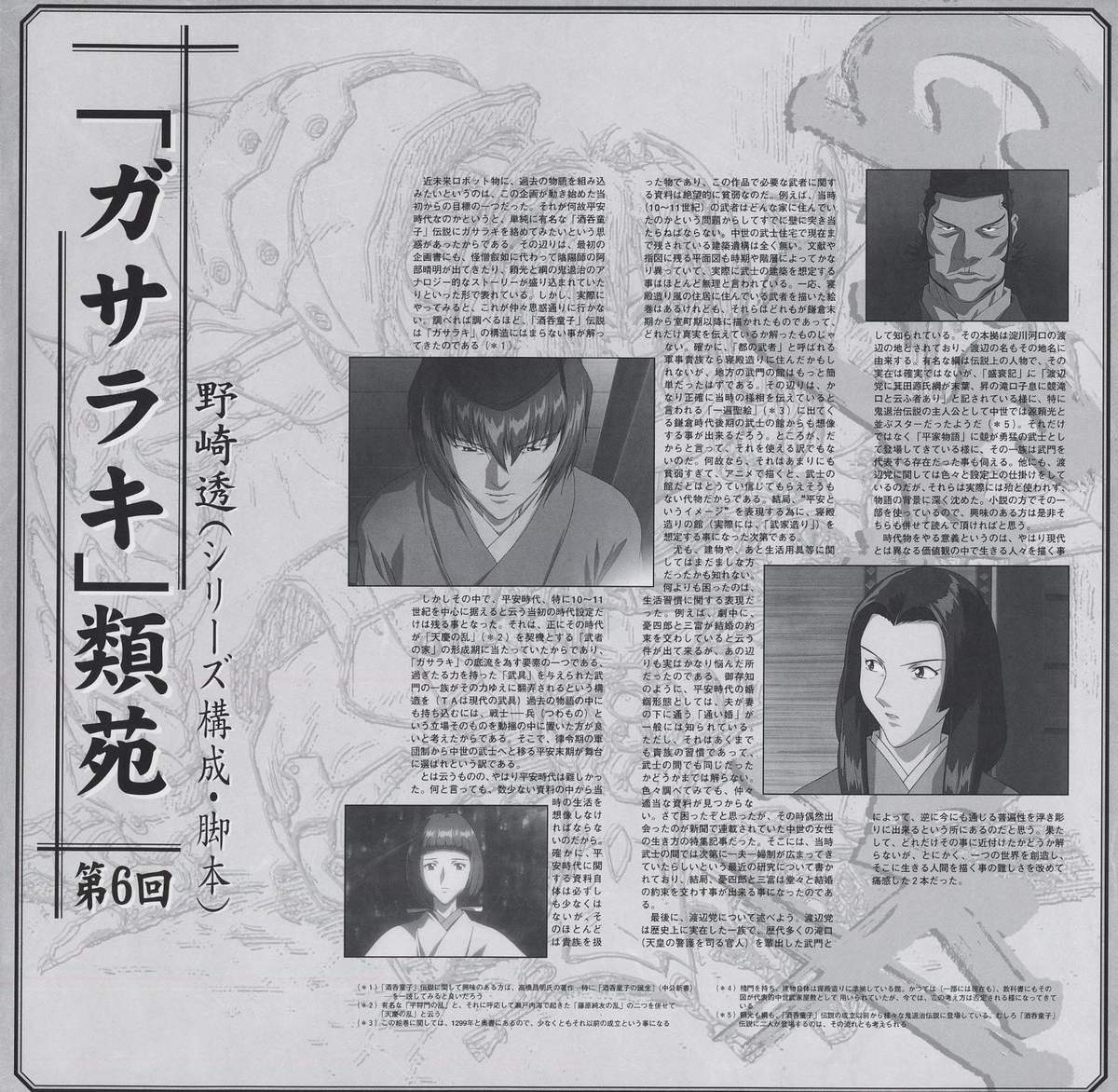 類苑 第6回 — episodes 15–17. The essay's format remains consistent: two columns of dense text, screencapture stills for visual reference, the writer's photo inset.
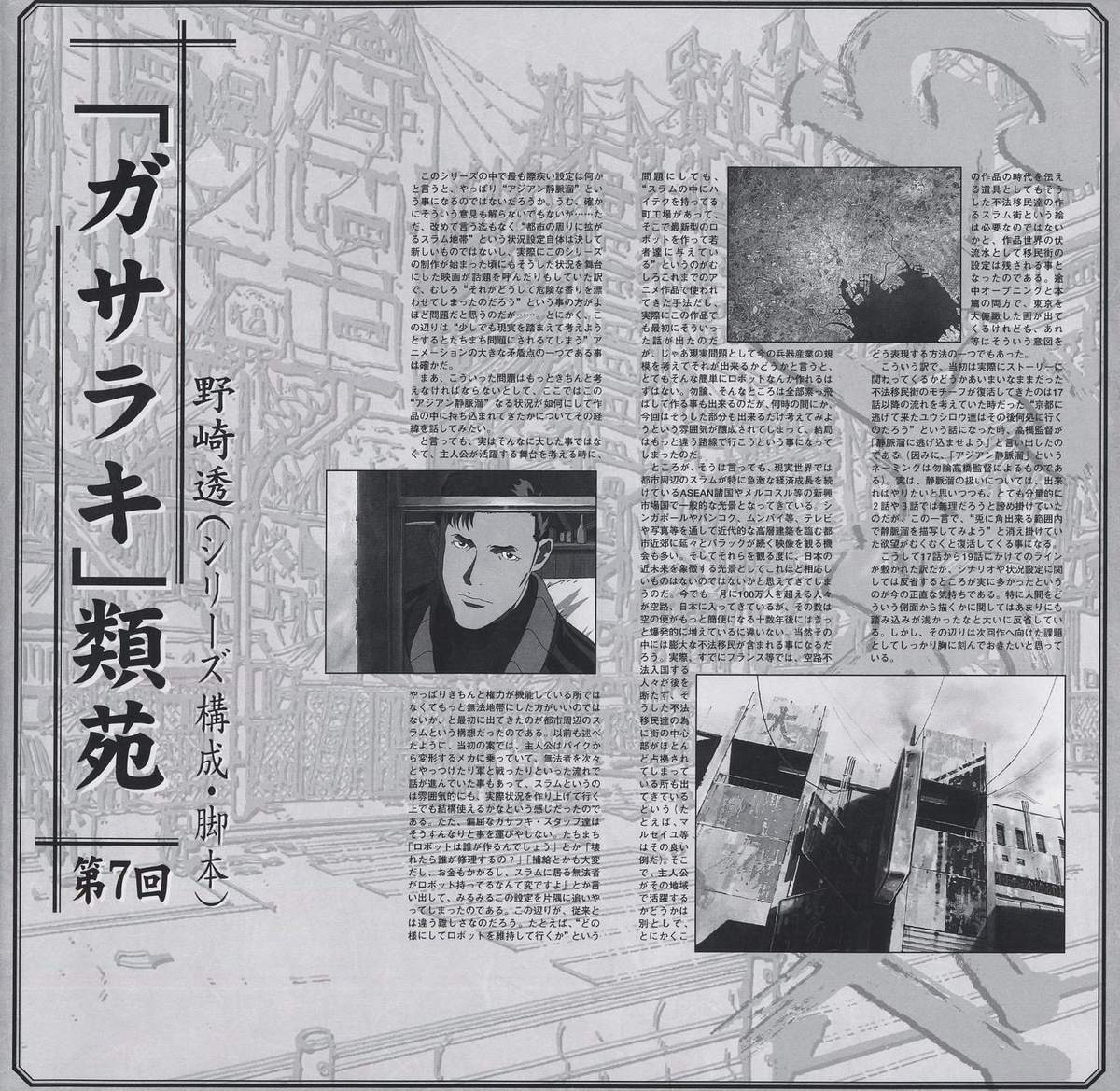 類苑 第7回 — episodes 18–20. Screencaptures from the political thriller arc — government officials, the SSDF command structure. Location shots from the contemporary Tokyo settings.
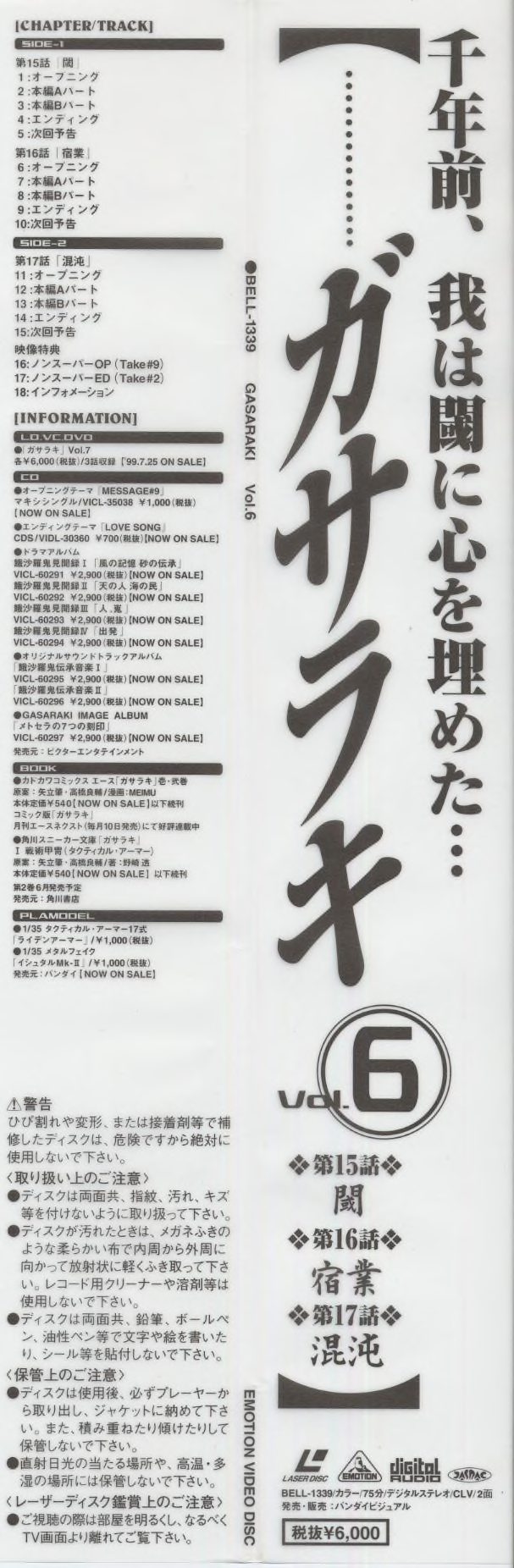 Vol.6 obi (BELL-1339) — 「千年前、我は闇に心を埋めた…」. CLV/2面, ¥6,000. Episodes 第15話–第17話. Chapter/track listing for both sides.
The LD series ran concurrent with the broadcast — the first volume shipped January 25 while the series was airing; Vol.8 (episodes 21–23) shipped August 25, nearly five months after the finale. The booklet documentation moved in real time with the production: Takahashi's essays, Nozaki's analyses, and the staff interview dates are spread across the same months the episodes were being made and aired.
The EMOTION the Best DVD-BOX (BCBA-3981, December 22, 2010) consolidates all 25 episodes into a single package. None of the companion booklet content — the 各話設定 spreads, the director essay series, the staff interviews, the series writer's episode analyses — was reprinted or included. No Blu-ray edition has been produced. The booklet documentation from 1999 exists in the LD packaging and nowhere else.
Loading...