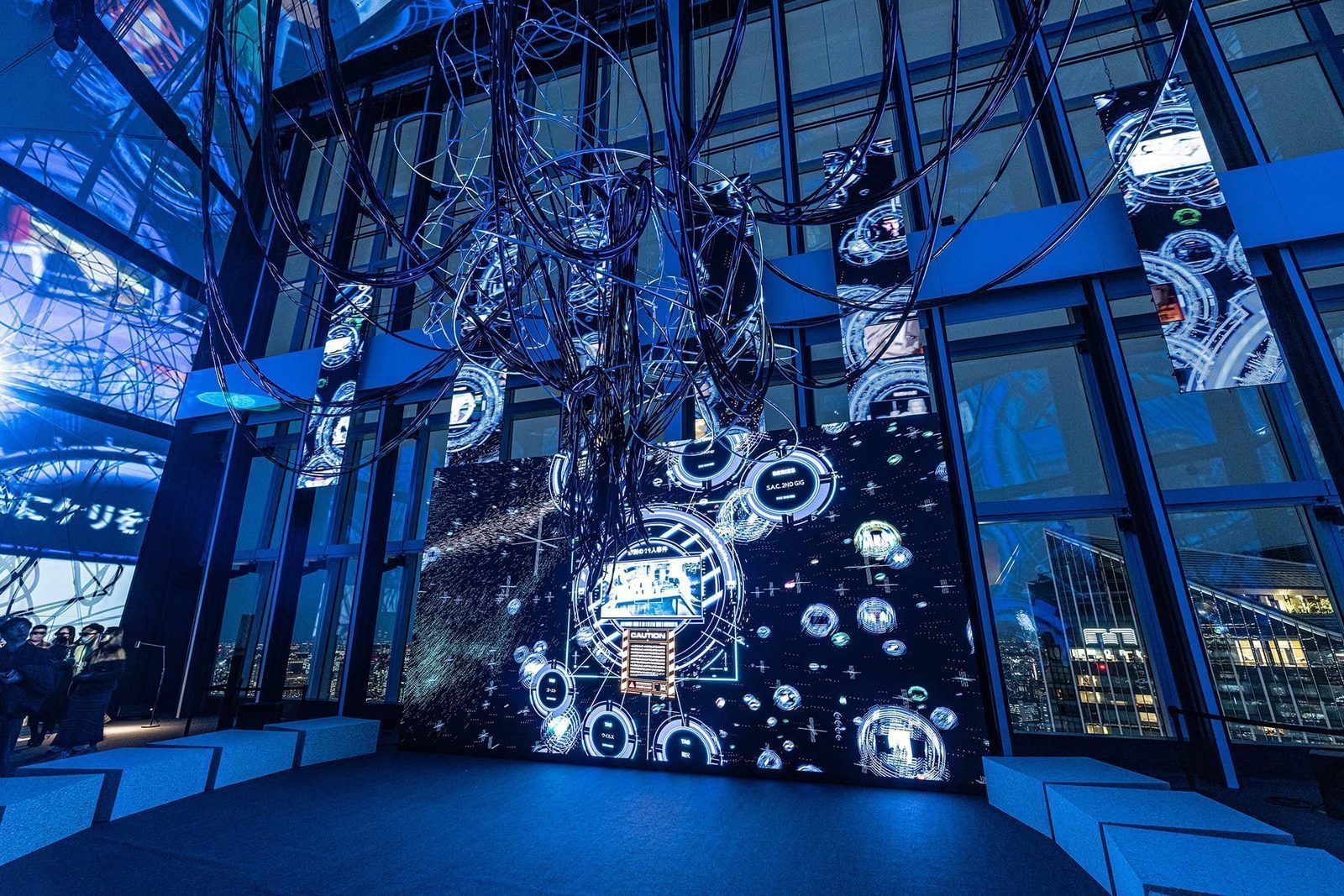
Most anime exhibitions are merchandise events with art on the walls. This one isn't. Ghost in the Shell The Exhibition at TOKYO NODE in Toranomon Hills is the first large-scale exhibition to span the entire anime lineage — from Mamoru Oshii's 1995 film through Stand Alone Complex, Arise, and into the new 2026 series produced by Science SARU. Over 600 production materials in the main galleries. A dedicated Gallery B (Dig) section housing 1,600+ items total. This is the production paper trail of one of the most influential anime properties ever made, laid out so you can trace how the visual language evolved — and turned physical at exhibition scale.
Gallery A: NODE — Immersive Cyberspace
The exhibition opens with scale. Gallery A houses the Nerve Net visualizer and World Tree — a 15-meter installation of cascading cables and projected data streams that turns visitors into network nodes. Interactive terminals respond to presence. The space functions as a physical rendering of the Ghost in the Shell information-space aesthetic: high ceilings, blue-lit immersion, the sensation of being inside a cyberbrain rather than looking at drawings on a wall. This is the exhibition's thesis statement — the franchise as navigable architecture, not passive viewing.
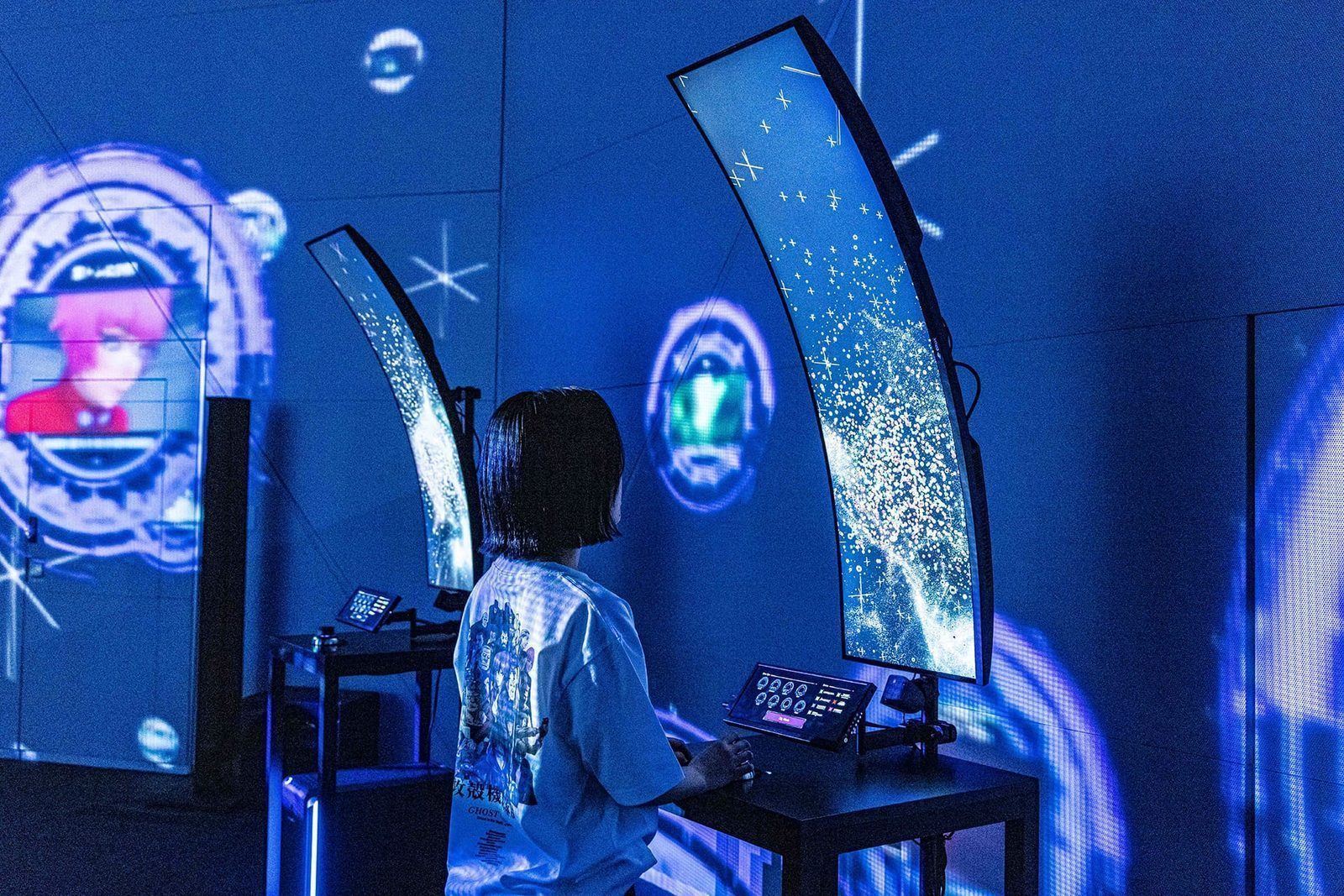 Visitor navigating the Nerve Net installation — curved screens display cascading network data, hands-on terminals allow exploration of Ghost in the Shell's information-space concepts
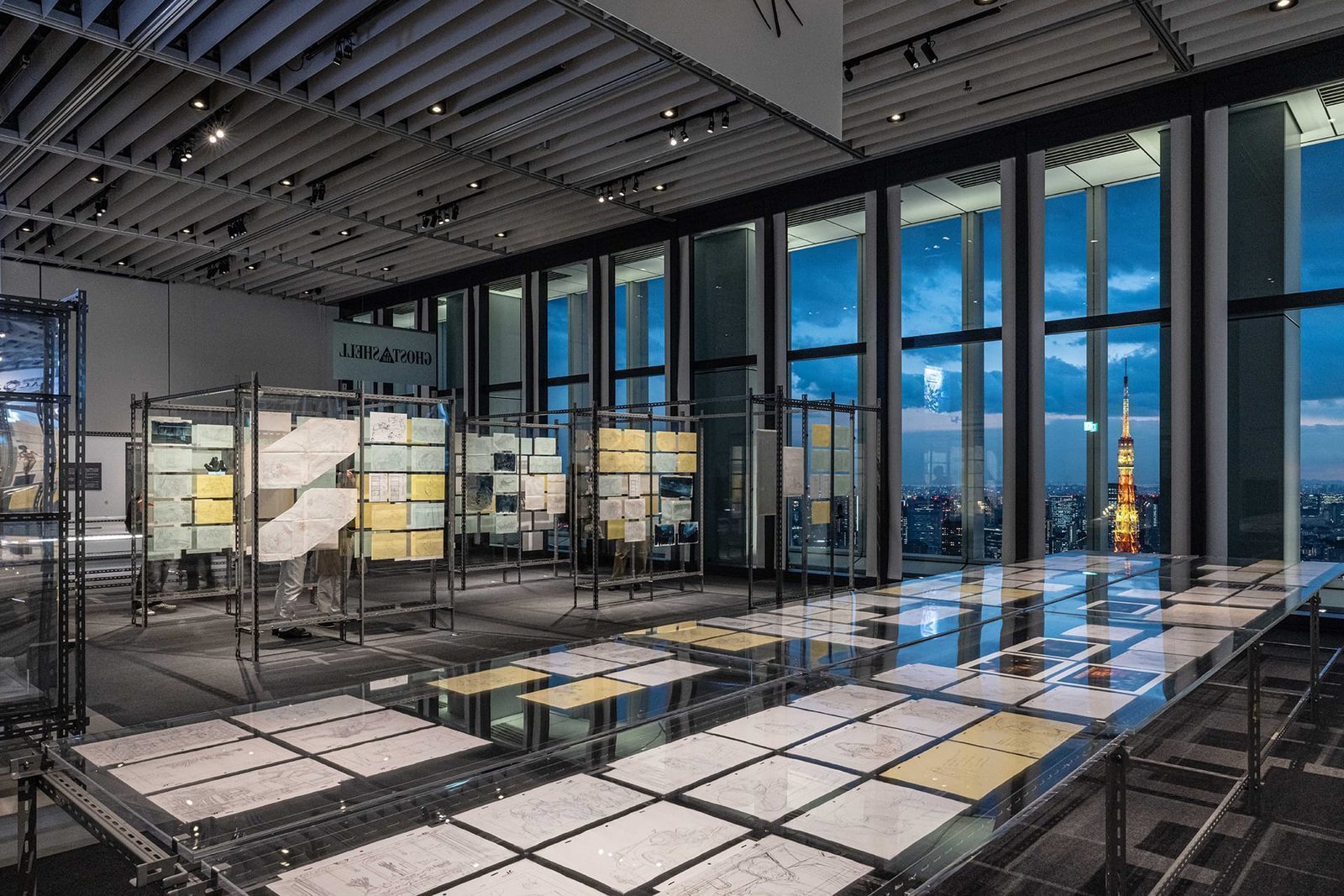 Gallery B (Dig) — 1,600+ production materials displayed on metal racks with Tokyo Tower visible through floor-to-ceiling windows. Original drawings, storyboards, layouts, cels spanning Oshii, Kamiyama, and the 2026 Science SARU series.
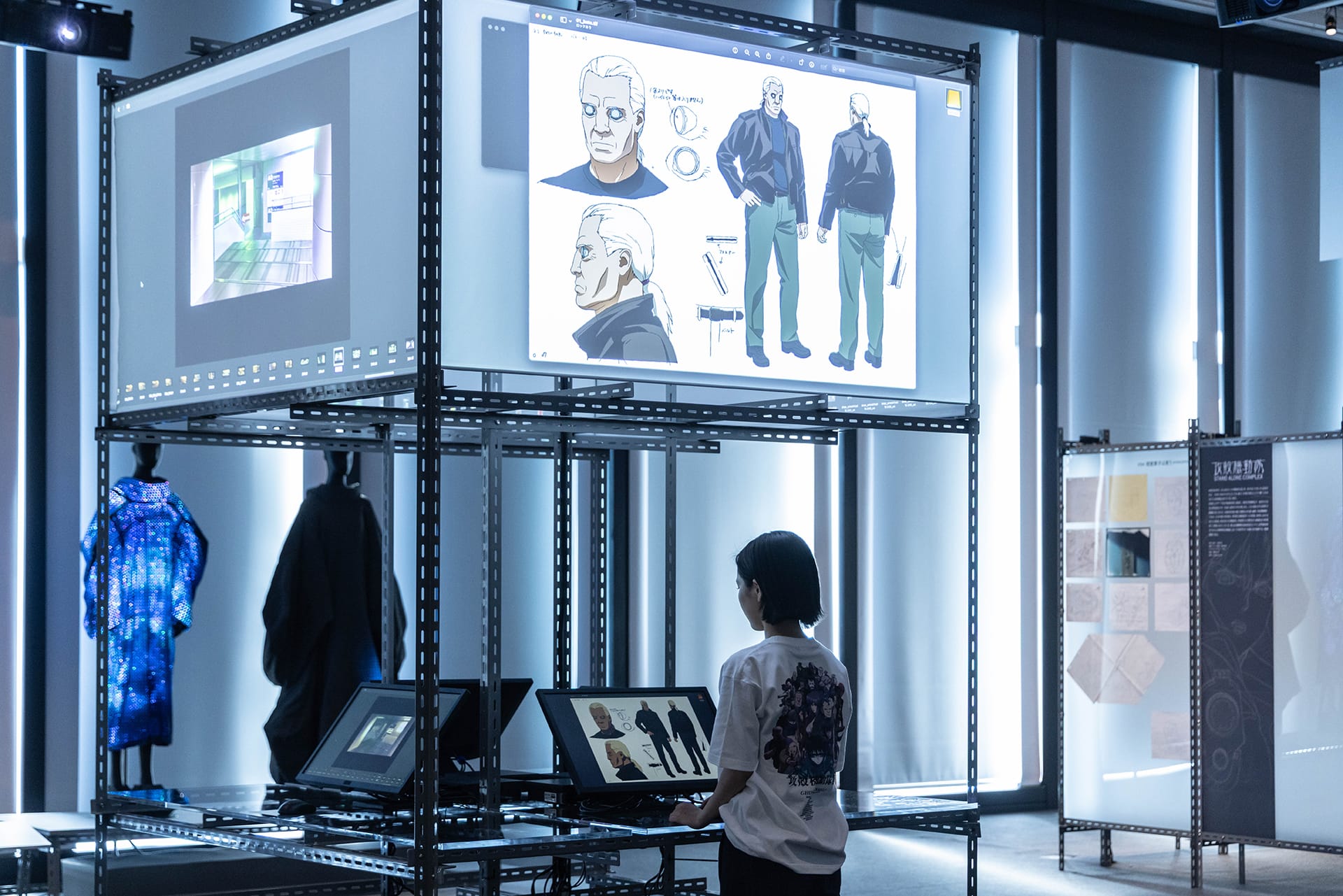 Digital archive terminals displaying character designs and production notes — four computer stations provide access to additional materials not physically exhibited, with ANREALAGE's thermochromic camouflage wearables visible in background
Gallery B is where the archive lives. 1,600 production materials means this isn't a curated highlight reel — it's studio storage made temporarily public. Original drawings, storyboards, concept art, animation cels. The kind of material that normally stays with the people who made it. Oshii's original storyboard pages. Kamiyama's Stand Alone Complex production documents. Concept art from directors across three decades. The materials are displayed chronologically on industrial metal racks, respecting their function as working documents rather than elevating them to gallery-wall preciousness. The view through the windows frames Tokyo Tower — the exhibition as a bridge between drawn futures and the city that hosts them.
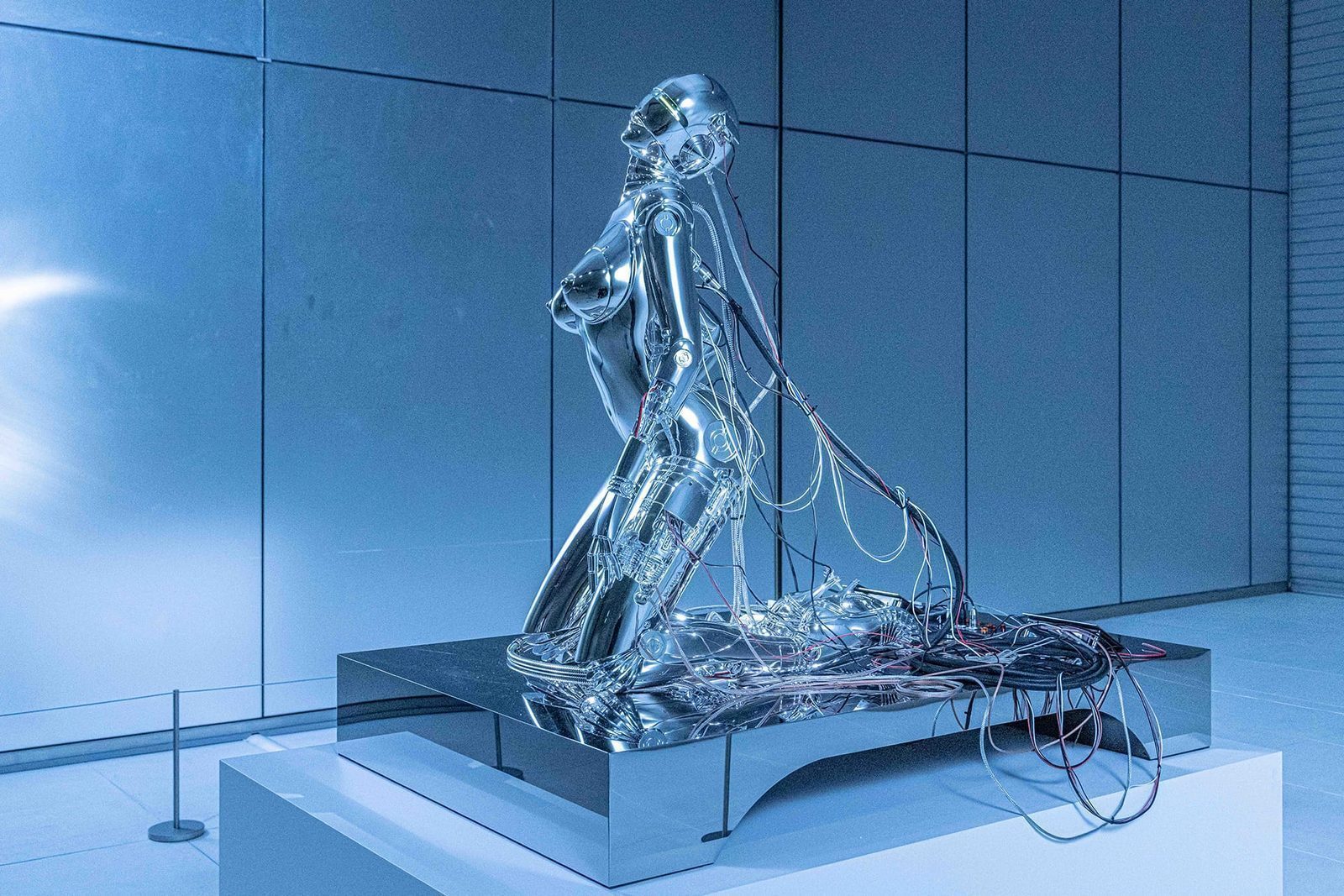 Hajime Sorayama's Sexy Robot_The Ghost in the Shell type 1 (2026) — chrome-finish sculpture making its world premiere before Sorayama's retrospective at CREATIVE MUSEUM TOKYO. Limited to 50 units at ¥1,320,000.
“Sorayama's chrome-finish aesthetic against Shirow's cybernetic design philosophy is a collision that makes more sense the longer you think about it. Both artists have spent careers exploring where the human body ends and the machine begins.”
— The exhibition's bridge between production archive and contemporary art object
The exhibition includes contemporary collaborations that extend Ghost in the Shell's thematic reach beyond animation production. ANREALAGE's thermochromic camouflage wearables parallel Major Kusanagi's optical camouflage — fabrics that shift opacity with temperature, wearable versions of the franchise's core visual metaphor. AR experiences via XREAL glasses overlay Tachikoma-guided tours onto the physical space. The exhibition catalogue contains over 1,000 original drawings — not a gift shop booklet, a reference volume. The SAINT Mxxxxxx collaboration T-shirt is limited to 100 units, small enough to function as a genuine collector signal rather than a marketing exercise.
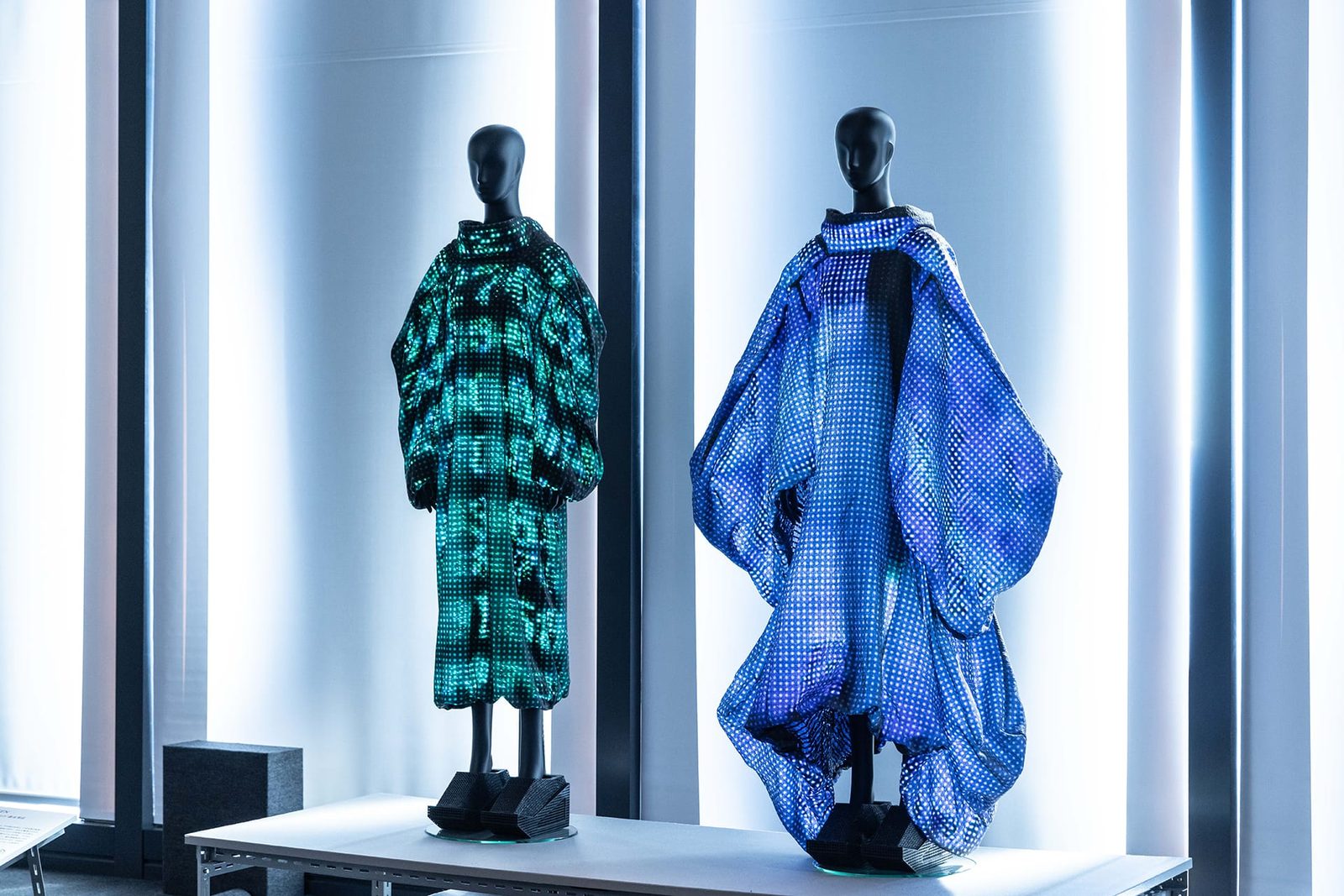 ANREALAGE's thermochromic camouflage wearables on display — fashion collaboration that translates Major Kusanagi's optical camouflage into wearable temperature-reactive fabrics
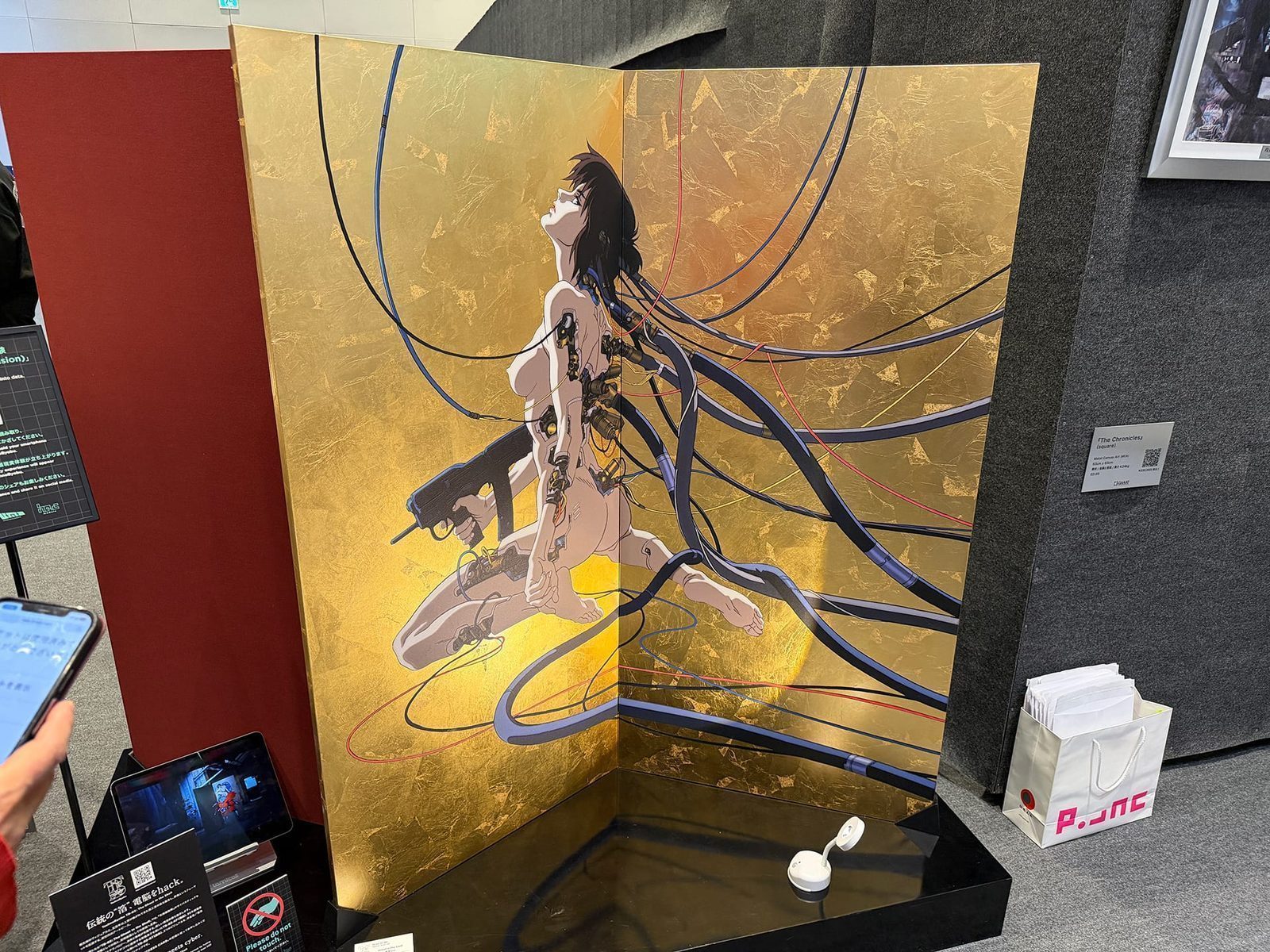 Techno Byobu — traditional gold-leaf folding screen with Major Kusanagi illustration, AR-enabled to overlay animated elements when scanned. Traditional craft meets franchise iconography.
Making Of
Ghost in the Shell has been adapted, rebooted, and reimagined so many times that the original production craft can get lost in the discourse. What Oshii did in 1995 — and what Kamiyama extended through SAC — was fundamentally a drawing achievement. The cityscapes. The network-dive sequences. The mechanical design. All of it started as lines on paper. The timing is deliberate. Science SARU's new series means the franchise is active again, and the exhibition functions as both retrospective and context-setting: here's where this came from, here's the craft tradition any new adaptation inherits. A franchise taking its own production history seriously enough to make it physical, at scale, with 1,600 documents as evidence.
An archive made physical. 1,600 production materials spanning three decades of Ghost in the Shell anime — from Oshii's 1995 drawings through Kamiyama's Stand Alone Complex to Science SARU's 2026 series — displayed on industrial racks with Tokyo Tower visible through the windows. Sorayama's chrome Kusanagi sculptures premiered here before his retrospective. ANREALAGE's thermochromic wearables translate optical camouflage into fashion. AR-enabled byobu screens blend Edo craft with cyberpunk iconography. This is what it looks like when a franchise takes its own production history seriously: not a merchandise event, but studio storage made temporarily public, at exhibition scale, with the craft tradition laid bare for anyone willing to look at the drawings that became cinema.
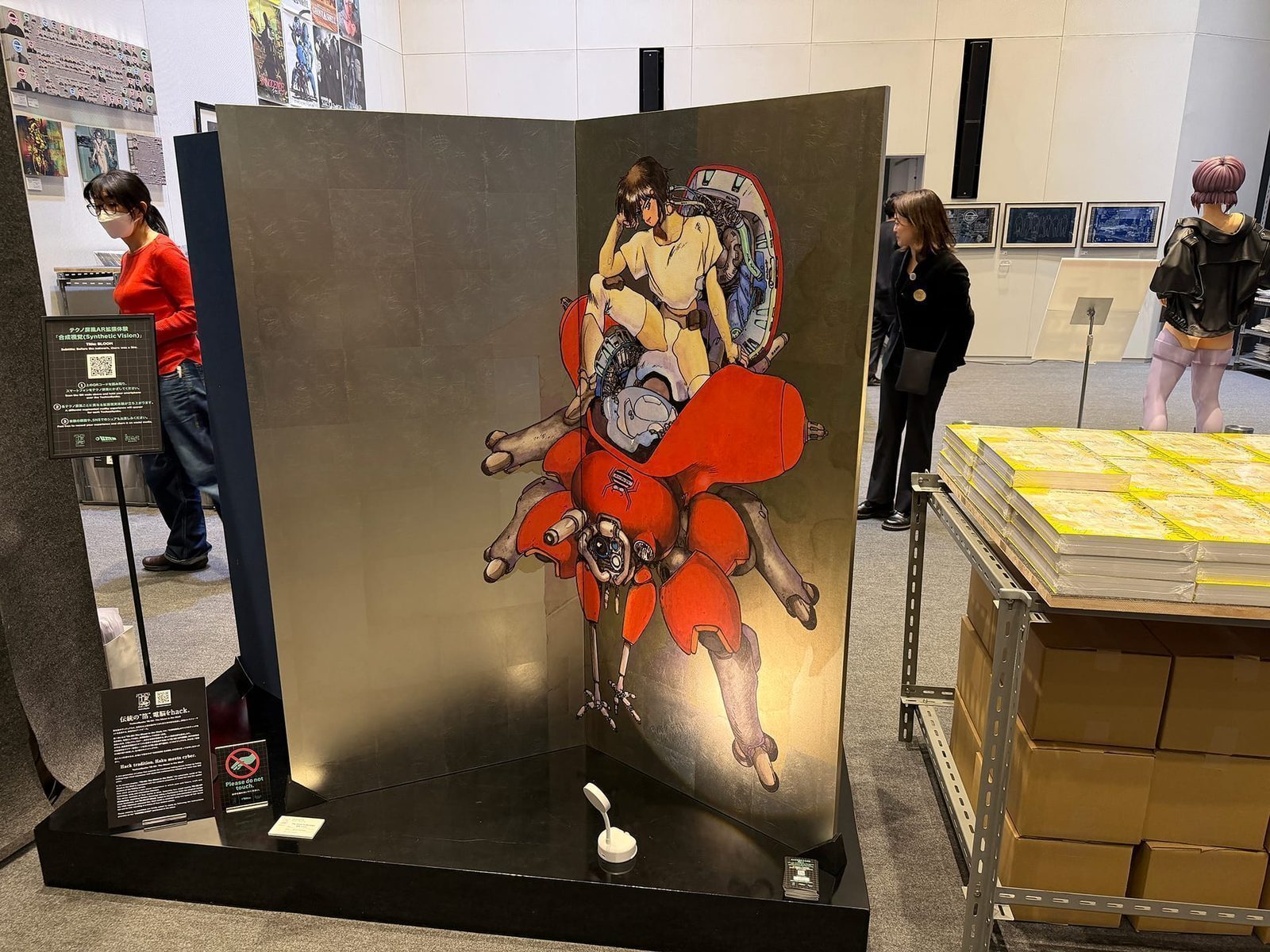 Techno Byobu screen — Kusanagi and Tachikoma rendered on traditional Japanese byobu with AR integration. The screens were created specifically for the exhibition, blending Edo-period craft with cyberpunk subject matter.
Loading...