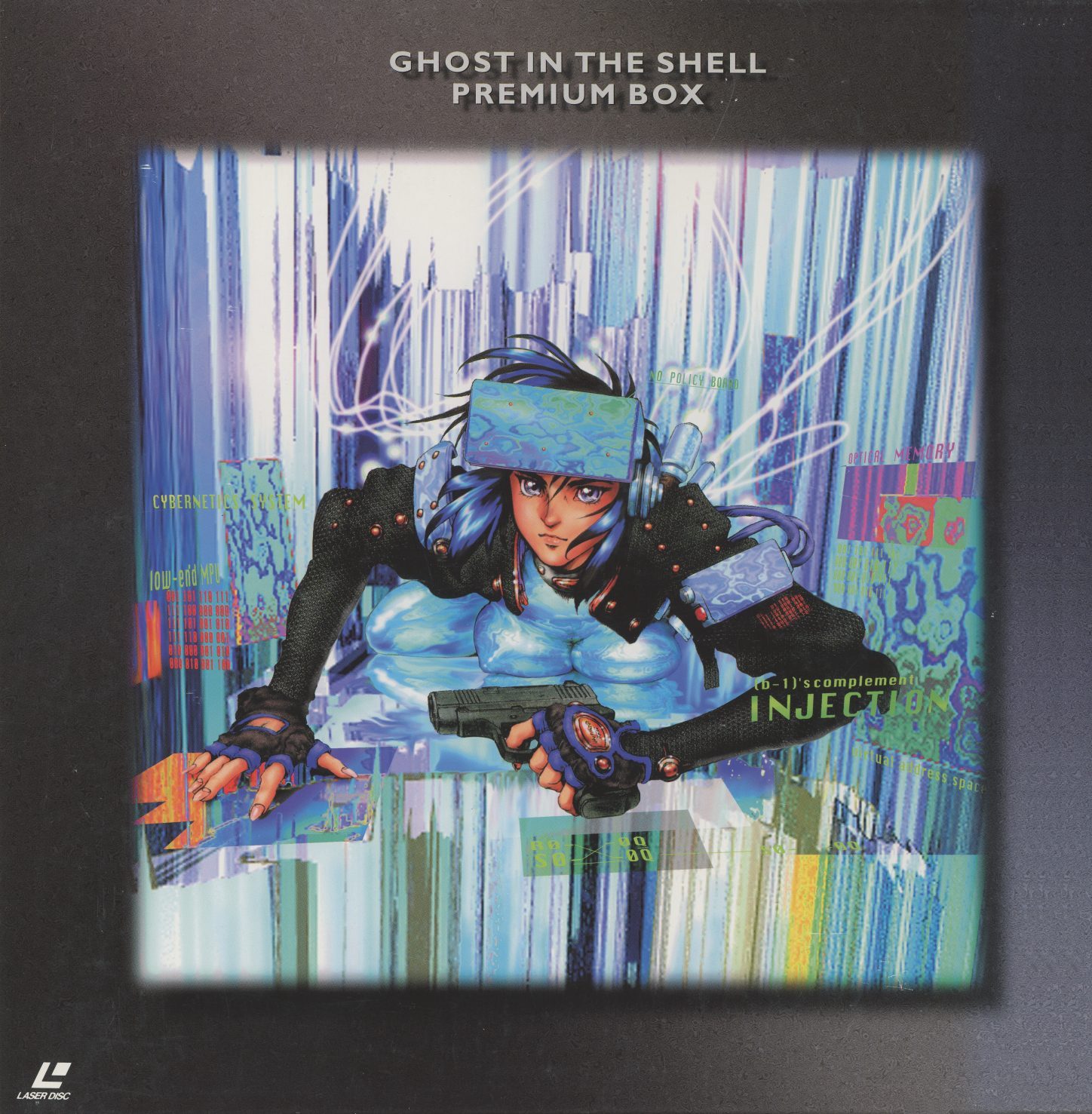
BEAL-921. Three discs, five sides. ¥14,800. Released July 25, 1996 — eight months after Mamoru Oshii's film opened in Japanese theaters, the same month it reached #1 on the Billboard home video sales chart in the United States. Bandai Visual pressed the entire film across four CAV sides with bilingual audio — Japanese on the digital tracks, English dub on the analog — and added a fifth CLV side containing the Digital Works production documentary. Inside the box: an Explanatory booklet analyzing the film scene by scene, and a handwritten endorsement letter from James Cameron.
A cyborg federal agent in 2029 Hong Kong hunts a hacker called the Puppet Master who can infiltrate human minds through the network. What she finds instead is an artificial intelligence born inside the net — an entity with no body that wants to merge with her, a being with no mortality that wants to reproduce. Oshii and screenwriter Kazunori Ito took Masamune Shirow's dense, playful manga and distilled it into something slower, heavier, and more philosophically committed — a film that asks what consciousness is and refuses to answer.
The Premium Box was not assembled as a commemorative edition. It was assembled as a study object. The chapter stops are indexed by animation cut number. The booklet dissects the film's visual effects pipeline. The third disc documents the digital compositing process that was, in 1995, still experimental. Bandai Visual built a box that assumed its buyer would want to stop the film, advance frame by frame, and understand how each image was constructed.
The Discs
Three jacket illustrations, three registers. Disc I: Kusanagi's prosthetic body in anatomical cutaway — a cybernetic blueprint rendered in blue and silver, mechanical joints visible through transparent skin, the body as engineering document. Disc II: a tactical scene in sepia — Section 9 operatives with heavy weapons in an industrial environment, the tone shifted from science fiction to military procedural. Disc III: a Fuchikoma think-tank in neutral gray, isolated against white, presented as industrial design rather than narrative subject. Hiroyuki Okiura designed the characters. The jacket art treats them as objects of study before they become characters in a story.
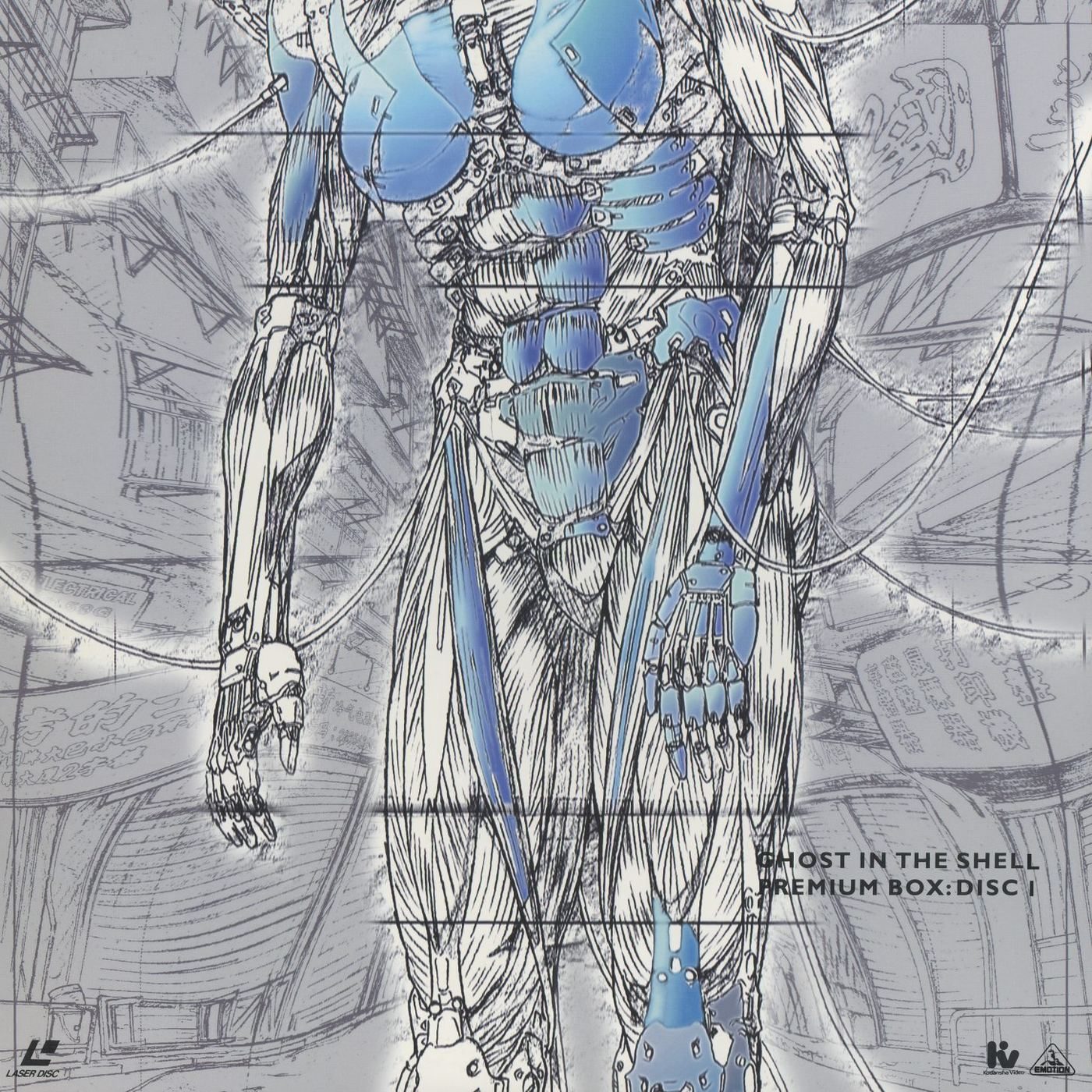 Disc I jacket front. Kusanagi's full-body cybernetic blueprint — prosthetic anatomy visible through translucent skin, blue-tinted mechanical illustration with architectural background detail. 'GHOST IN THE SHELL PREMIUM BOX: DISC I.' Okiura design reference.
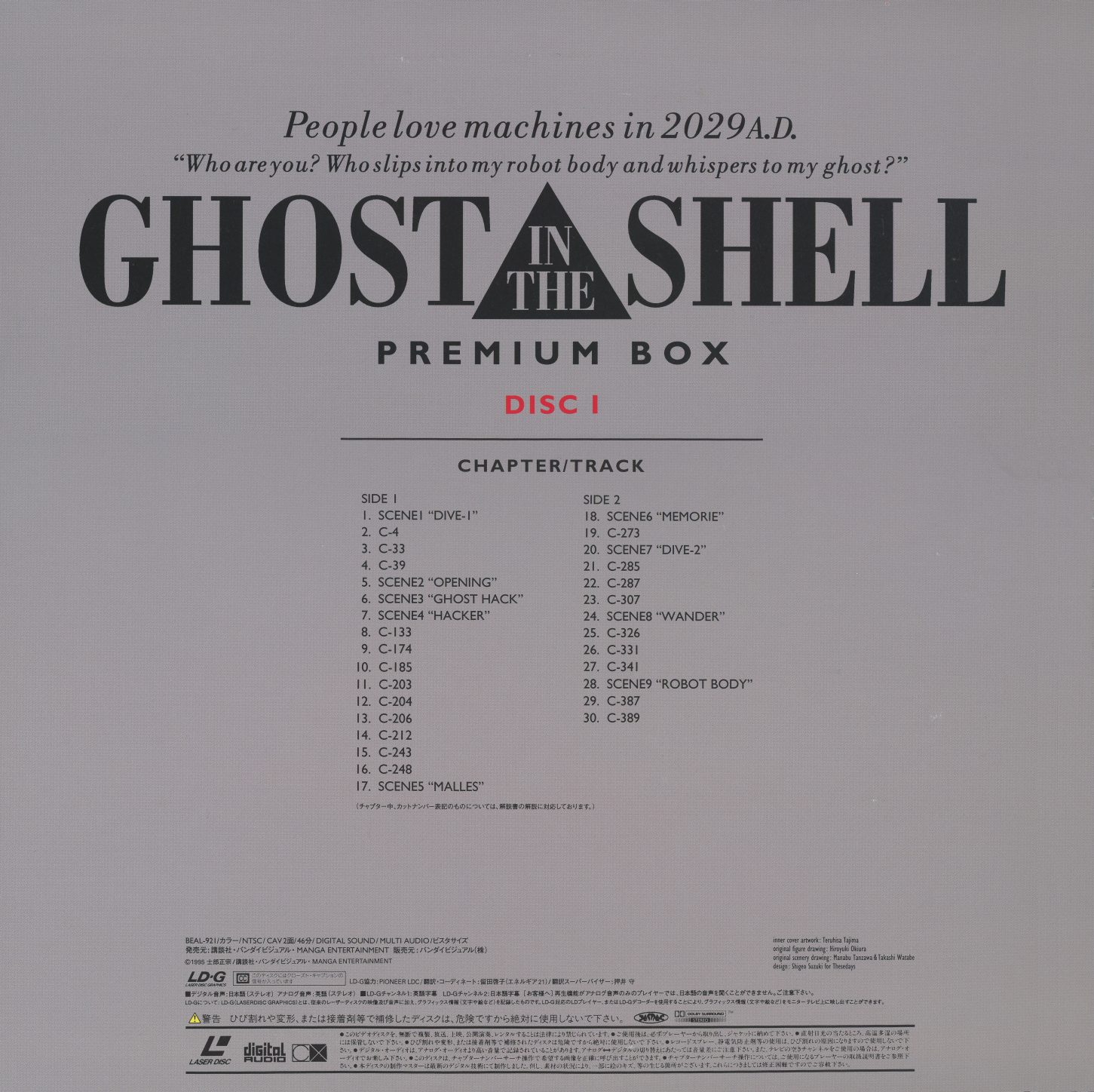 Disc I jacket back. Chapter/track listing for Sides 1 and 2 — nine named scenes ('DIVE-1,' 'OPENING,' 'GHOST HACK,' 'HACKER,' 'MALLES,' 'MEMORIE,' 'DIVE-2,' 'WANDER,' 'ROBOT BODY') with chapter stops at production cut numbers: C-4, C-19, C-131, C-174, C-203, C-284, C-324, C-331, C-387. CAV format. Digital sound.
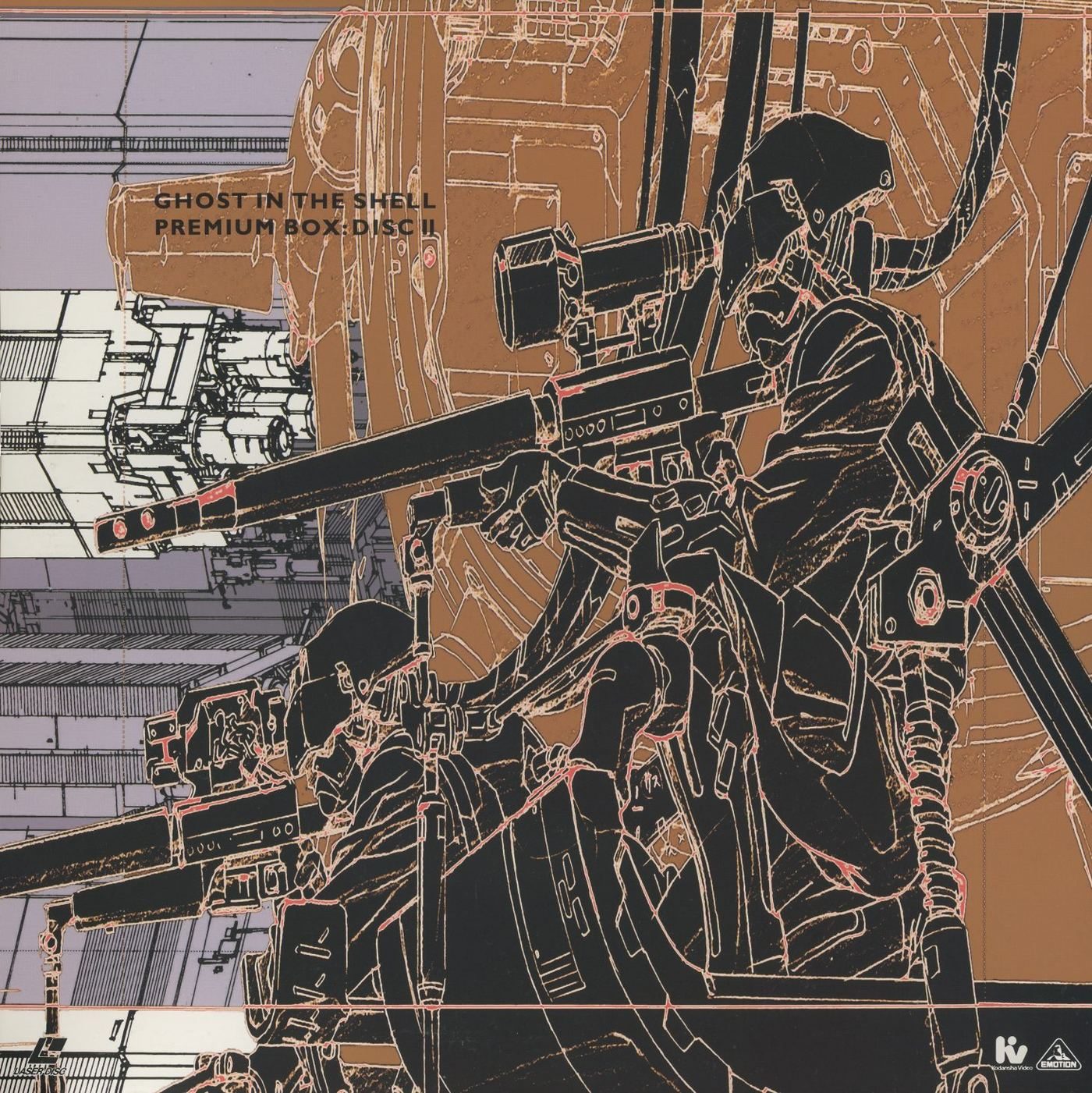 Disc II jacket front. Sepia and ochre — tactical operatives with mounted weapons in an industrial corridor, rendered in a military-illustration register closer to Shirow's original manga hardware obsession than Oshii's contemplative film. 'PREMIUM BOX: DISC II.'
Side Four
Disc II carries the film's second half on Side 3, then gives Side 4 over entirely to supplemental material. The video bonuses include a promotional video, theatrical trailer, TV spot, and the international version end title. After that: four still-frame reference galleries — mecha settei, background paintings, original art, and layouts — each indexed as a separate chapter, each accessible frame by frame because the disc is CAV. A still-frame gallery on a CLV disc degrades into noise. On CAV, every animation drawing and every background painting holds stable and sharp. The format choice is the access method.
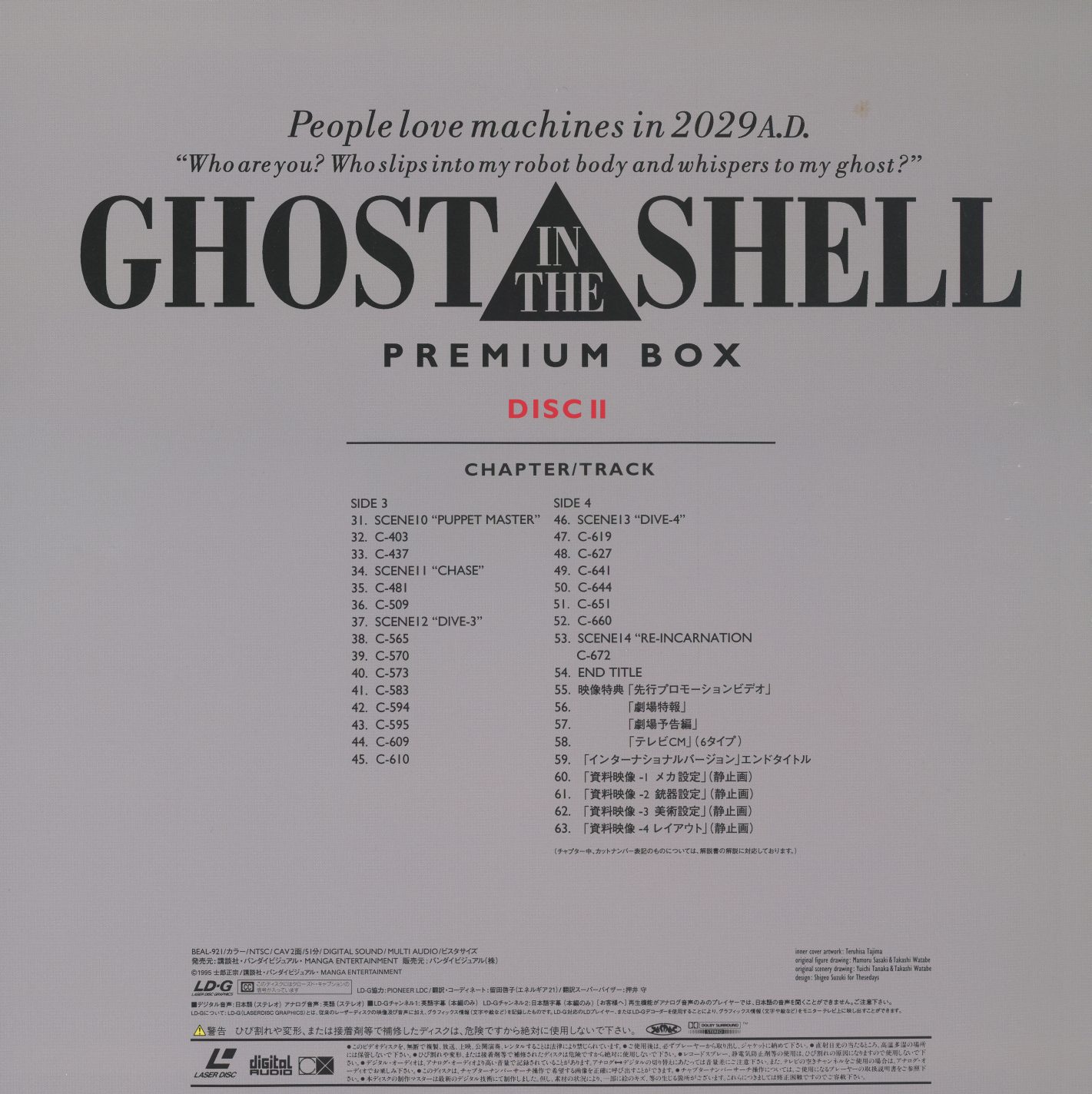 Disc II jacket back. Side 3 continues the film — Scenes 10 through 14 ('PUPPET MASTER,' 'CHASE,' 'DIVE-3,' 'DIVE-4,' 'RE-INCARNATION') through END TITLE. Side 4: 映像特典 (video bonuses) plus four 資料映像 (reference material) galleries: mecha settei, backgrounds, original paintings, and layouts — all still-frame, all frame-steppable.
The Third Disc
Ghost in the Shell - Digital Works occupies all of Side 5. This is not a promotional featurette — it is a production documentary examining the digital compositing techniques that Production I.G developed for the film. In 1995, combining hand-painted cel animation with CG elements was experimental in Japan. The documentary walks through the pipeline: conventional animation production, the transition points where digital techniques intervene, Digitally Generated Animation (what the disc calls 'CGA — Digitally Computer Generated Animation'), and the specific digital processes that shaped the film's visual identity. Seven chapters on a single CLV side. The third disc is the only one in the box that isn't CAV — because this content is meant to be watched, not stopped and studied frame by frame.
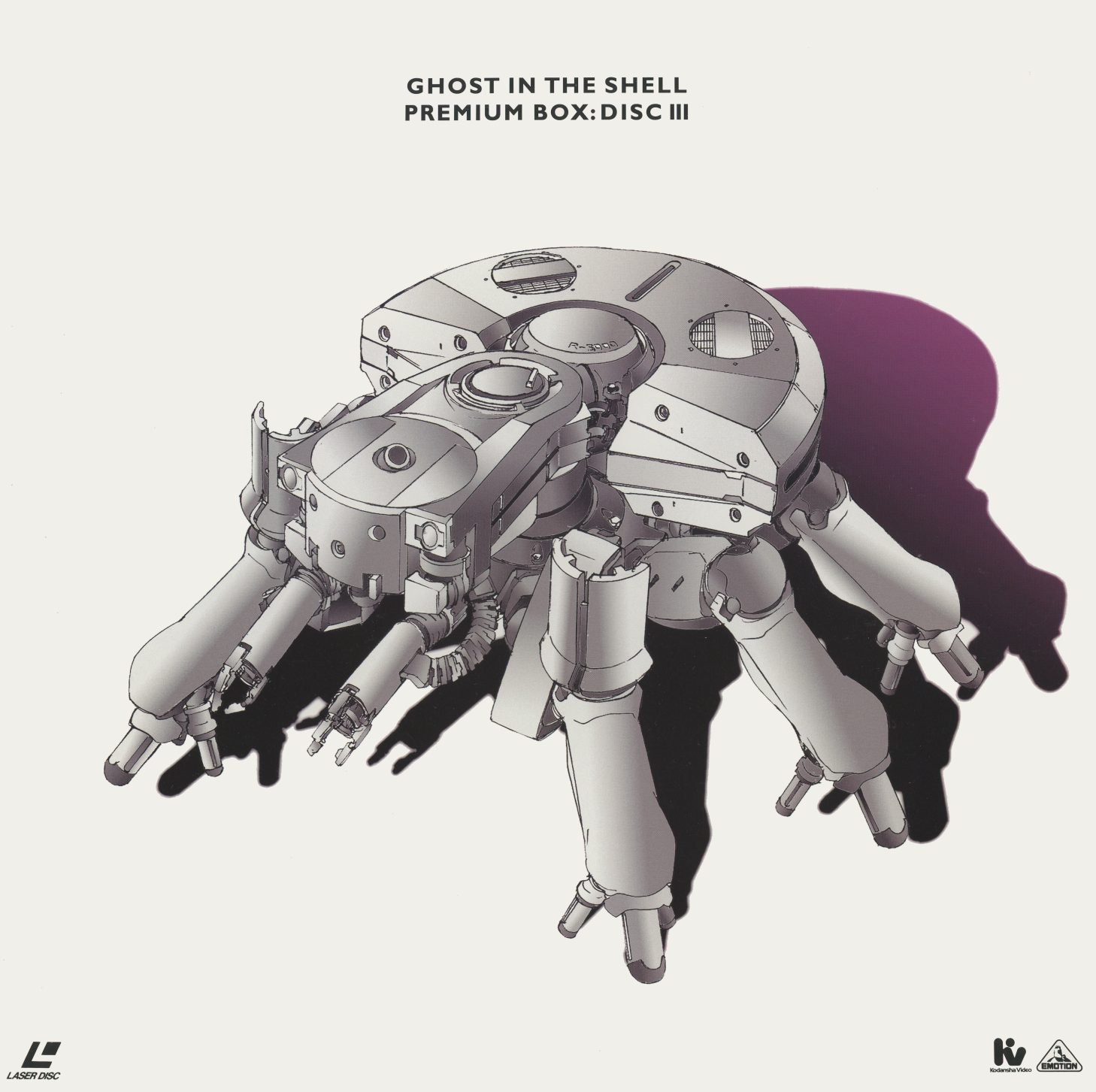 Disc III jacket front. A Fuchikoma think-tank — the multi-legged tactical unit from Shirow's manga, rendered in neutral gray against white. Industrial design illustration. 'PREMIUM BOX: DISC III.'
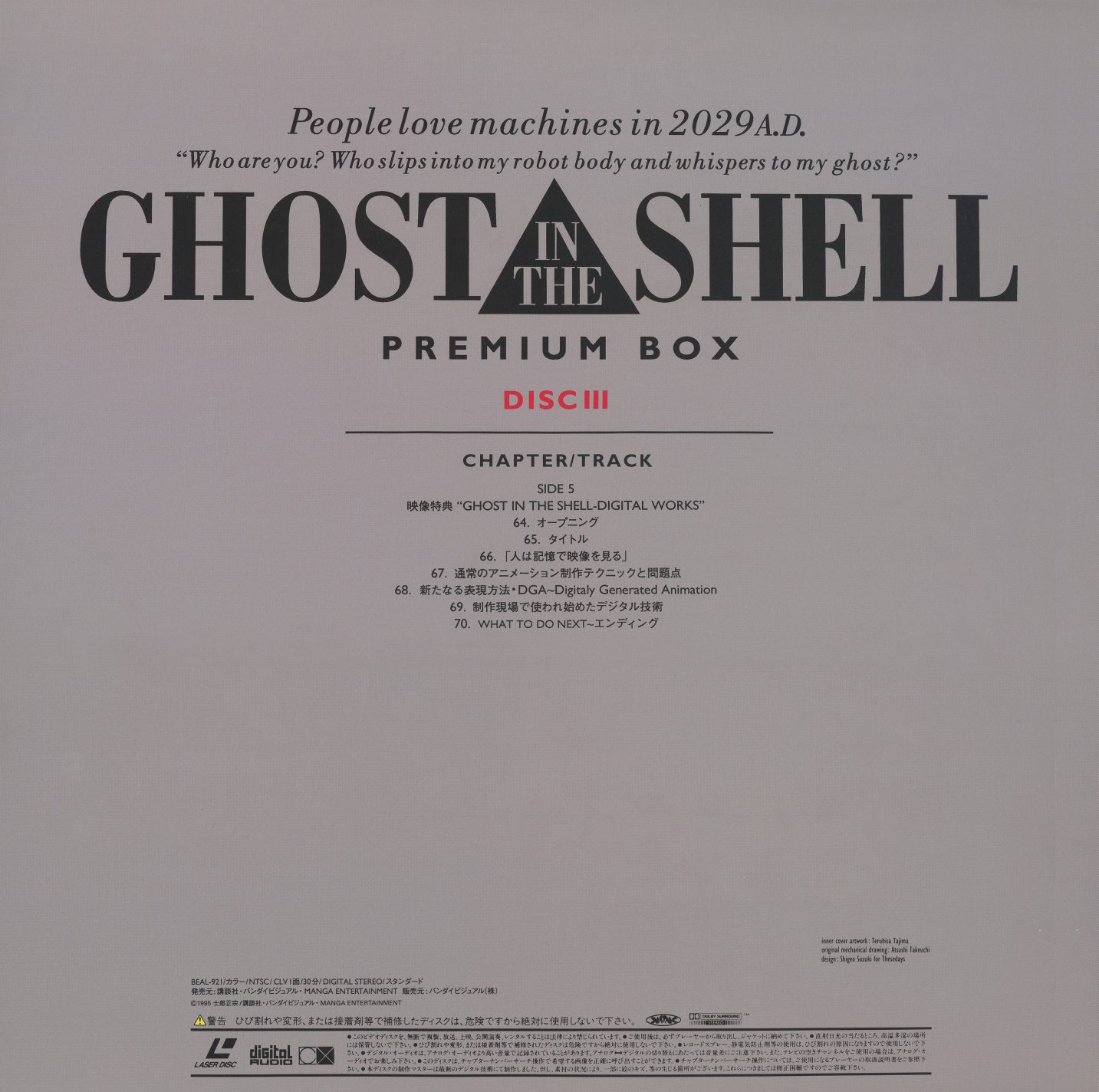 Disc III jacket back. Side 5 chapter listing for Digital Works: Opening, Title, 'A Glimpse of the Future Through Images' (人は未来で映像を見る), conventional animation techniques and challenges, CGA — Digitally Computer Generated Animation, digital techniques born from production needs, and 'WHAT TO DO NEXT' closing. CLV format — the only non-CAV side in the box.
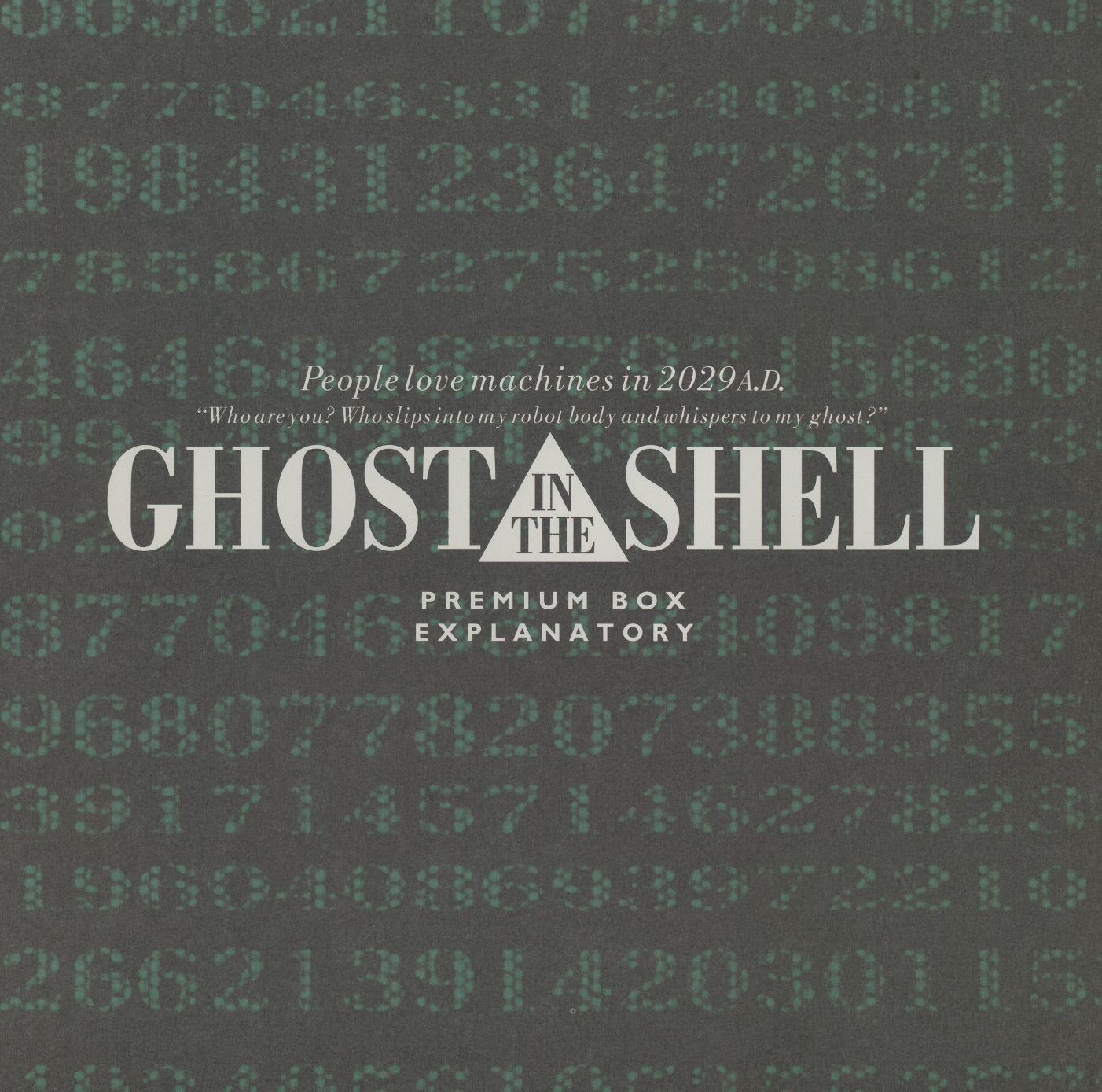 Explanatory booklet cover (BEAL-151). 'GHOST IN THE SHELL PREMIUM BOX EXPLANATORY' — cascading green numerals on dark field, the same visual language the film uses to render network data. Not for sale. Produced by Kodansha, Bandai Visual, and Manga Entertainment.
The Explanatory
The booklet is titled Explanatory, not Companion or Guide. The distinction matters. Its first major section, 'Scene Analysis,' breaks the film into observable phenomena and names them: 熱光学迷彩 (thermoptic camouflage), 銃撃 (gunfire), 情報の流れ (information flow), 人工生命体 (artificial life form), サイボーグの眼 (cyborg's eye), 狙撃 (sniping). Each entry isolates a visual effect or narrative mechanism, pairs frame captures with technical description, and explains the production method behind the screen image. The booklet reads the film the way the CAV format lets you watch it — one observable detail at a time.
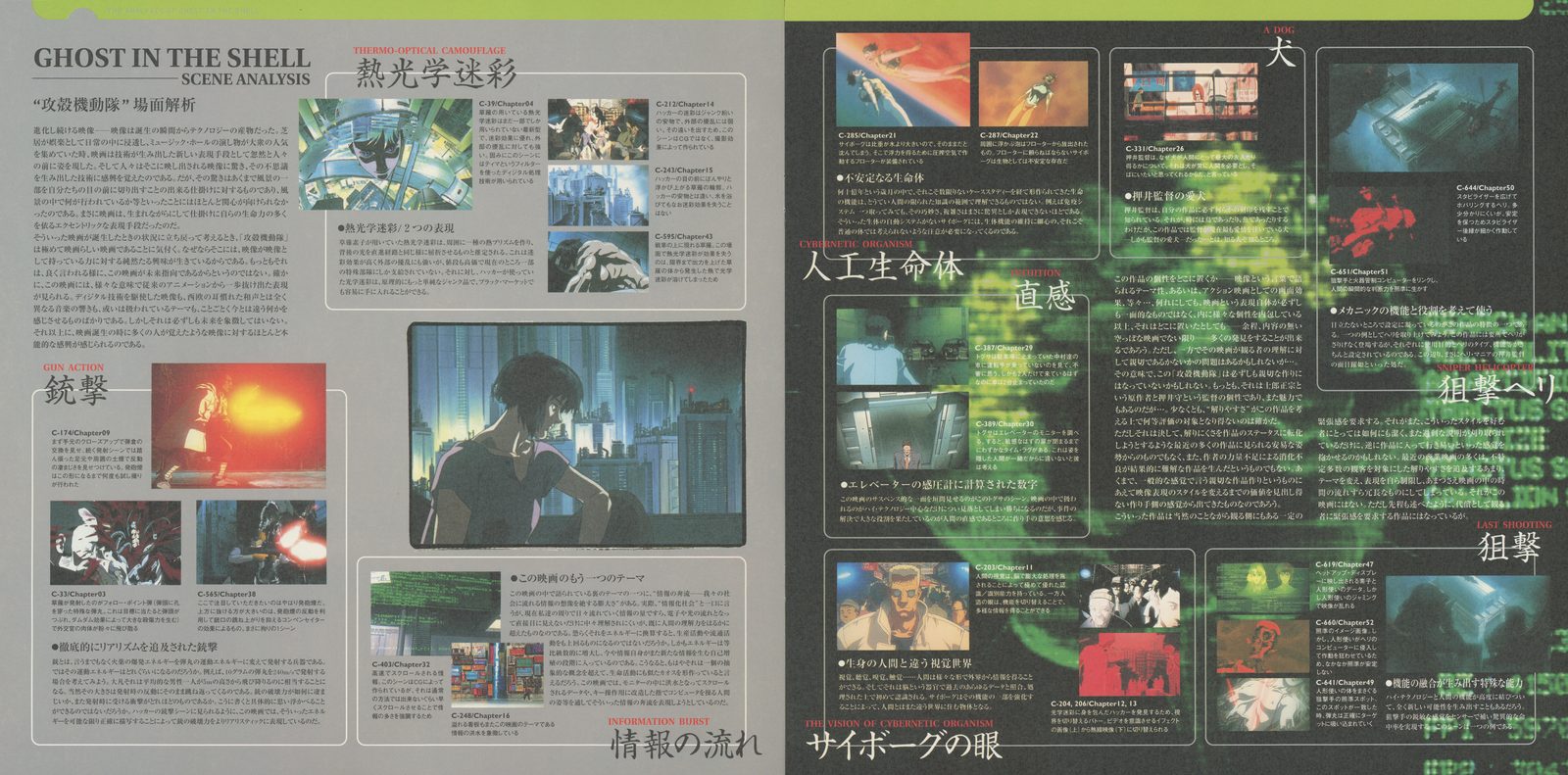 Explanatory booklet — Scene Analysis spread. Frame captures with Japanese annotation: 熱光学迷彩 (thermoptic camouflage), 銃撃 (gunfire), 情報の流れ (information flow), 人工生命体 (artificial life form), 犬 (dog), 狙撃 (sniping), サイボーグの眼 (cyborg's eye). Each entry pairs screen captures with production-level explanation.
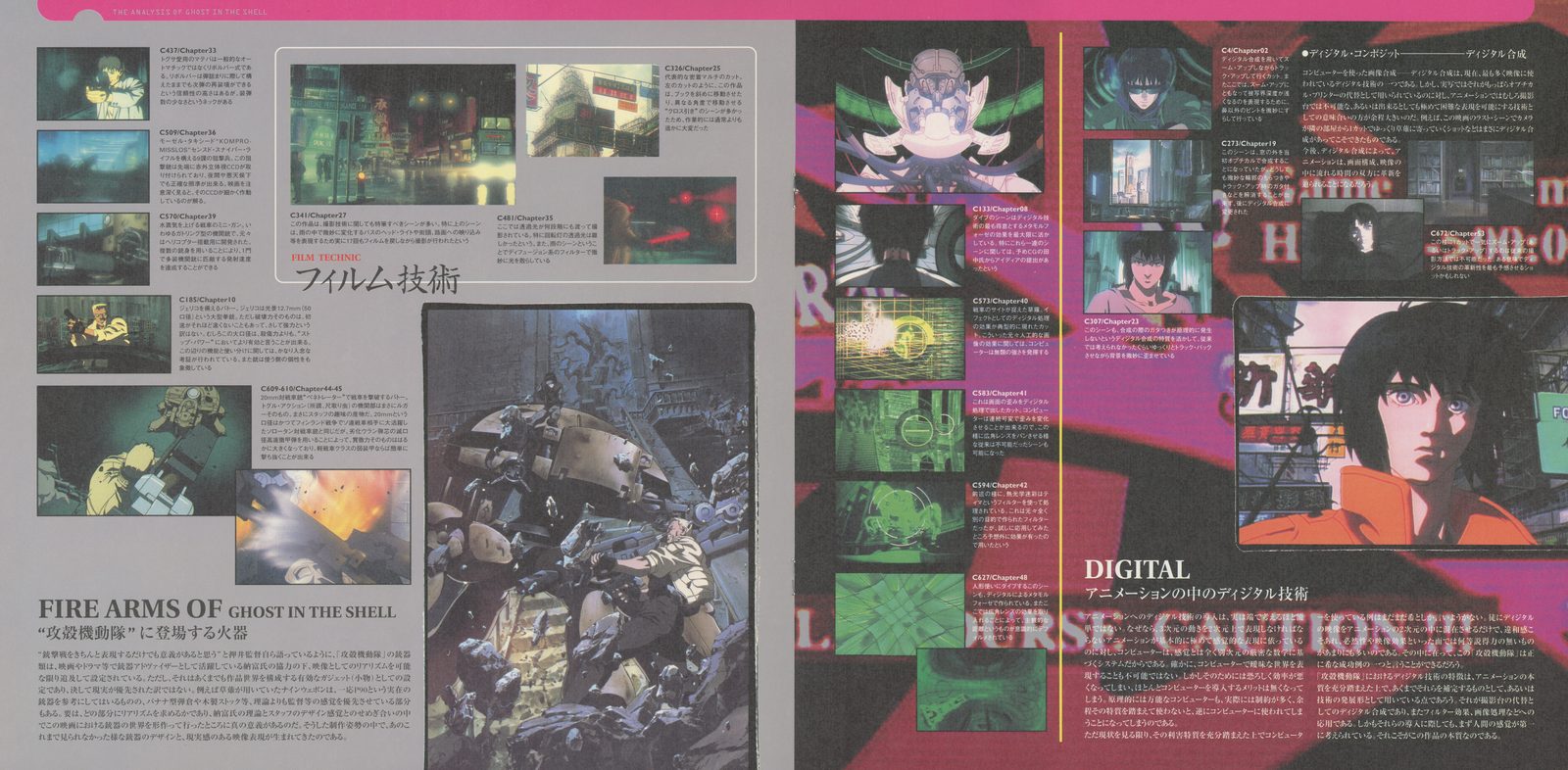 Explanatory booklet — Film Techniques and Firearms spreads. Left page: フィルム技術 (film techniques) with Ogura's background art analysis and 'FIRE ARMS OF GHOST IN THE SHELL' weapons catalog. Right page: DIGITAL section documenting the animation pipeline's digital integration, with 'CAUTION' graphics.
Firearms and Film Technique
The booklet's second half splits into parallel tracks. 'FIRE ARMS OF GHOST IN THE SHELL' catalogs the weapons that appear in the film — the Seburo series, the sniper rifle, the anti-tank platform — treating Shirow's fictional armory with the specificity of a military reference. The facing pages cover フィルム技術 (film techniques), analyzing Hiromasa Ogura's background paintings and the compositing processes that layered cel animation over them. A separate DIGITAL section documents the pipeline junction where hand-drawn frames met computer-generated elements. The booklet refuses to separate the film's narrative from its production method. It treats them as the same subject.
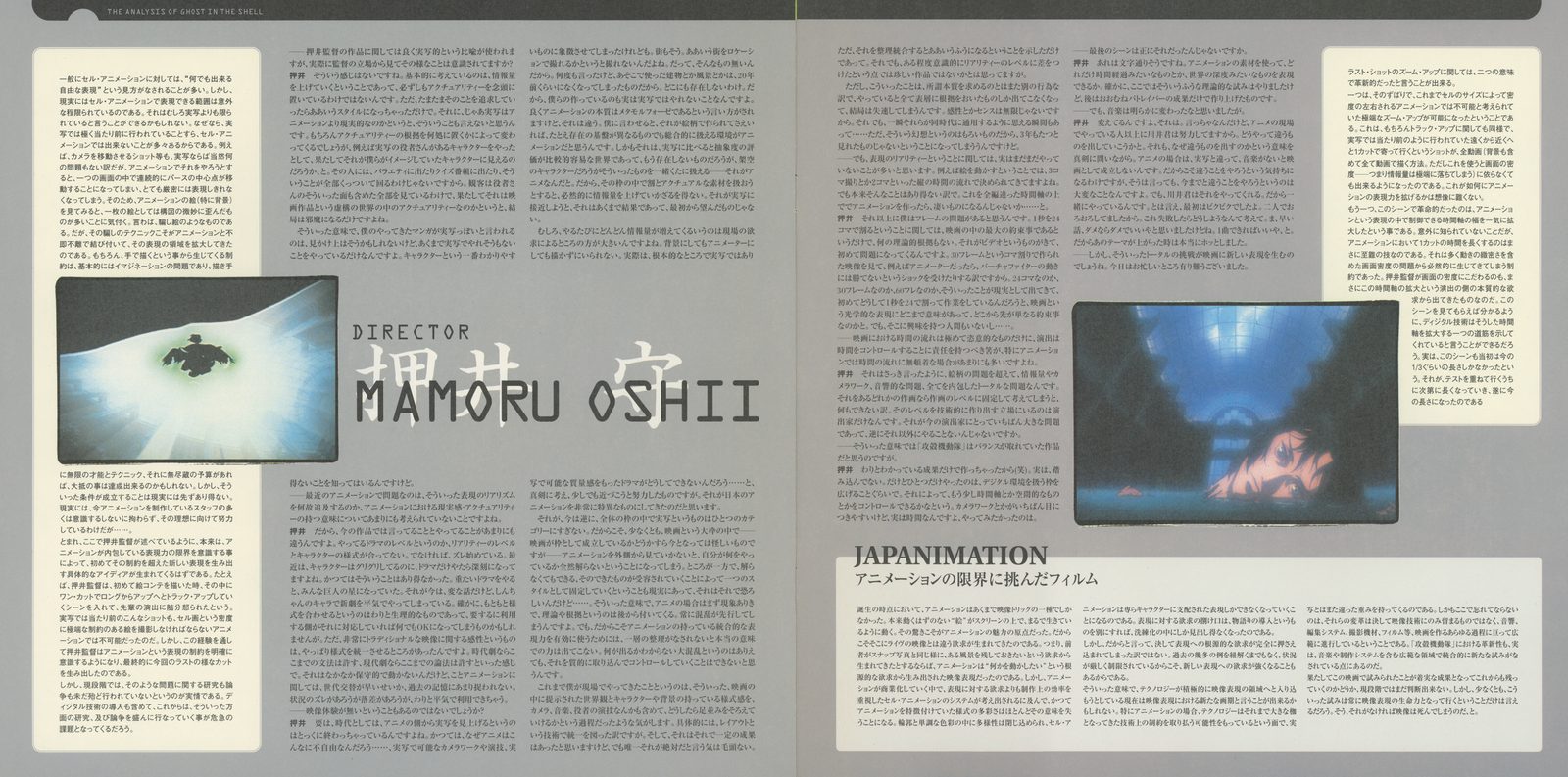 Explanatory booklet — Director feature. 'DIRECTOR 押井 守 MAMORU OSHII' — full-spread interview with Oshii's signature floating eye illustration. Adjacent section: 'JAPANIMATION — アニメーションの限界に挑んだフィルム' (A Film That Challenged the Limits of Animation).
The Letter
'Ghost in the Shell is a stunning work of speculative fiction, the first truly adult animation film to reach a level of literary and visual excellence. It's design, the poetry of its visuals, and the depth of its themes set it apart among science fiction films. My compliments to Oshii-san — an important visionary work.'
— James Cameron, handwritten endorsement included in the Premium Box
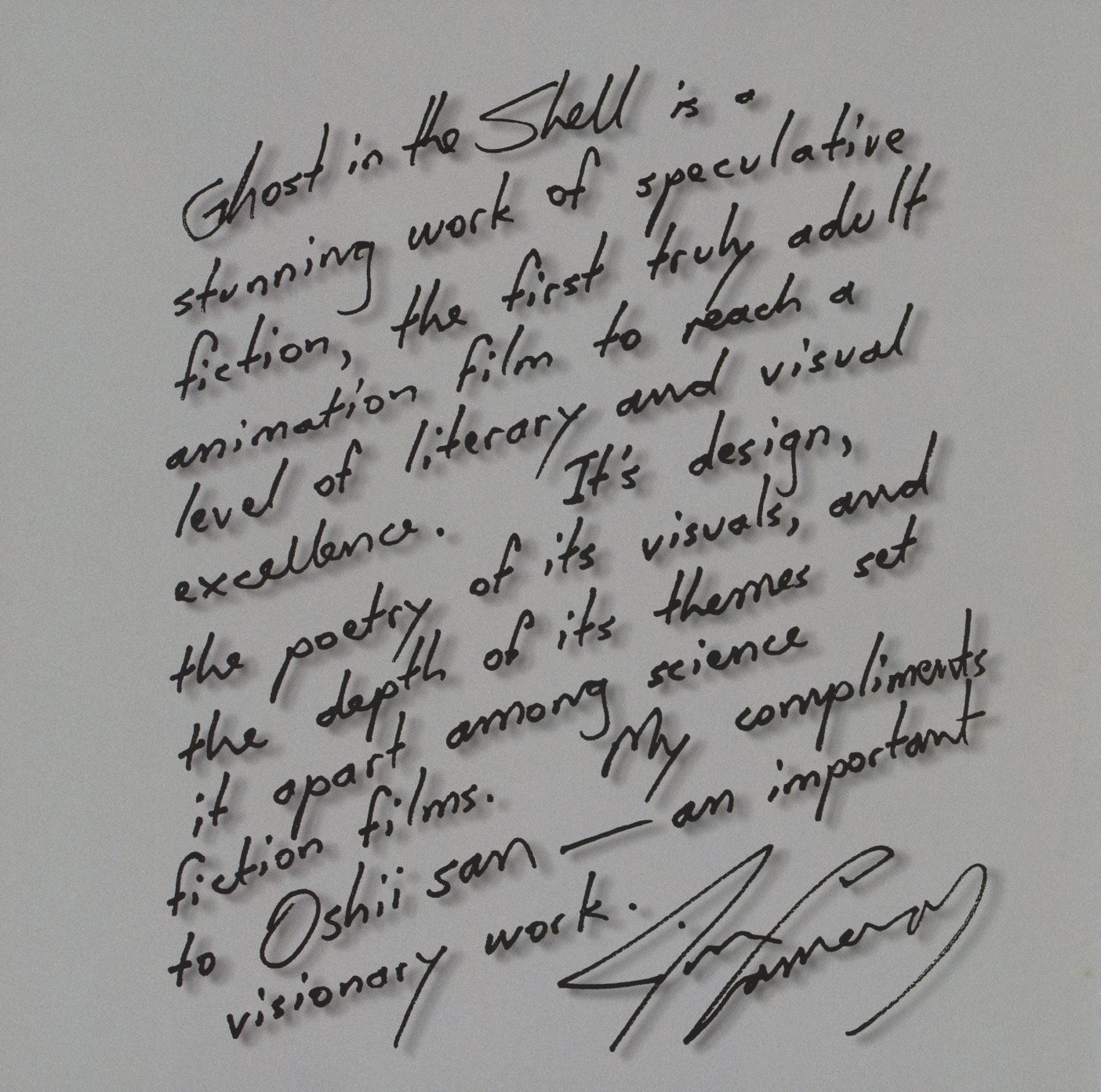 James Cameron's handwritten endorsement — original English. 'The first truly adult animation film to reach a level of literary and visual excellence.' Signed. Included loose in the Premium Box as a single sheet.
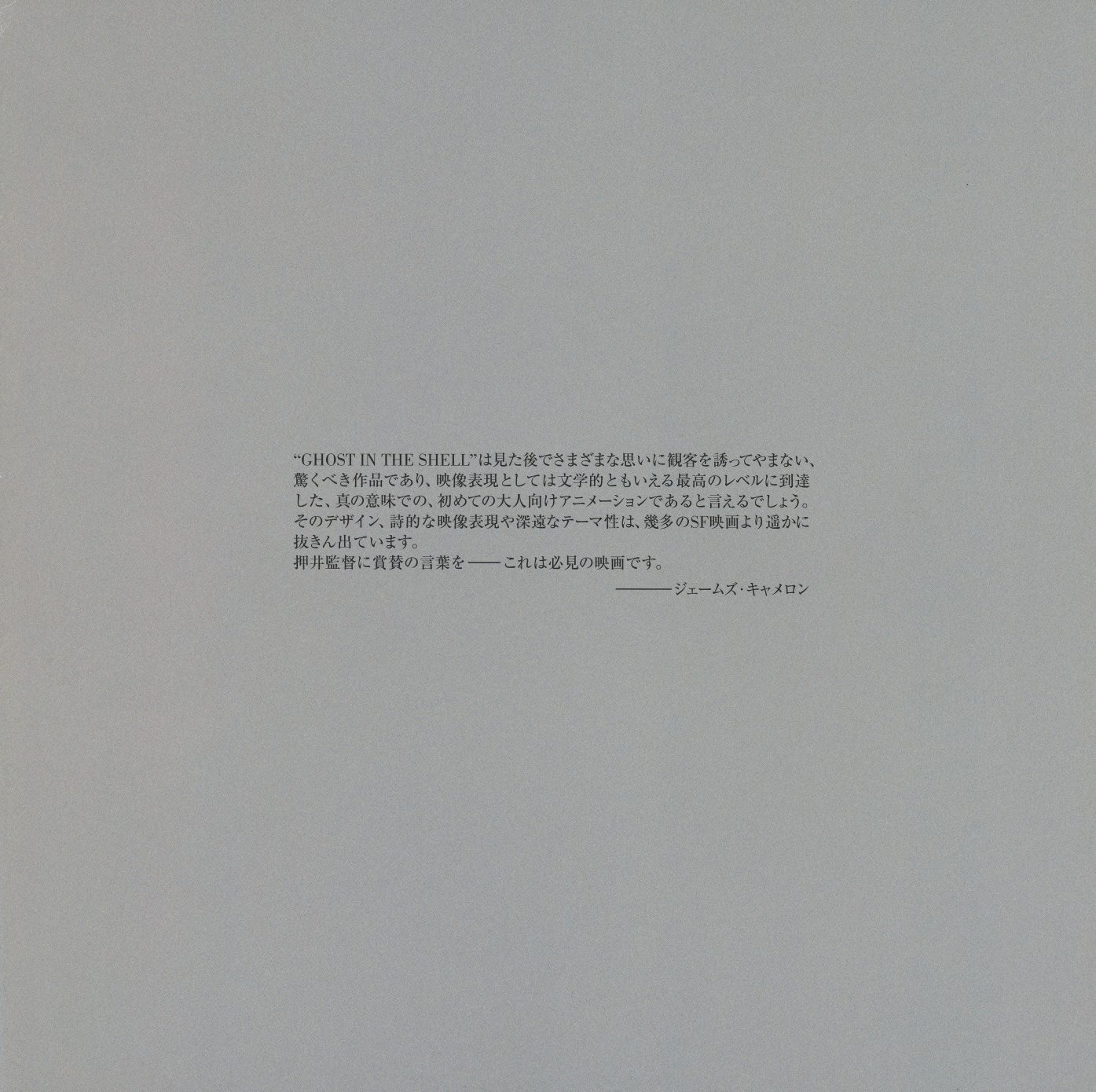 Cameron endorsement — Japanese translation. Credited to ジェームズ・キャメロン. The translation adds Bandai Visual's production notes at bottom.
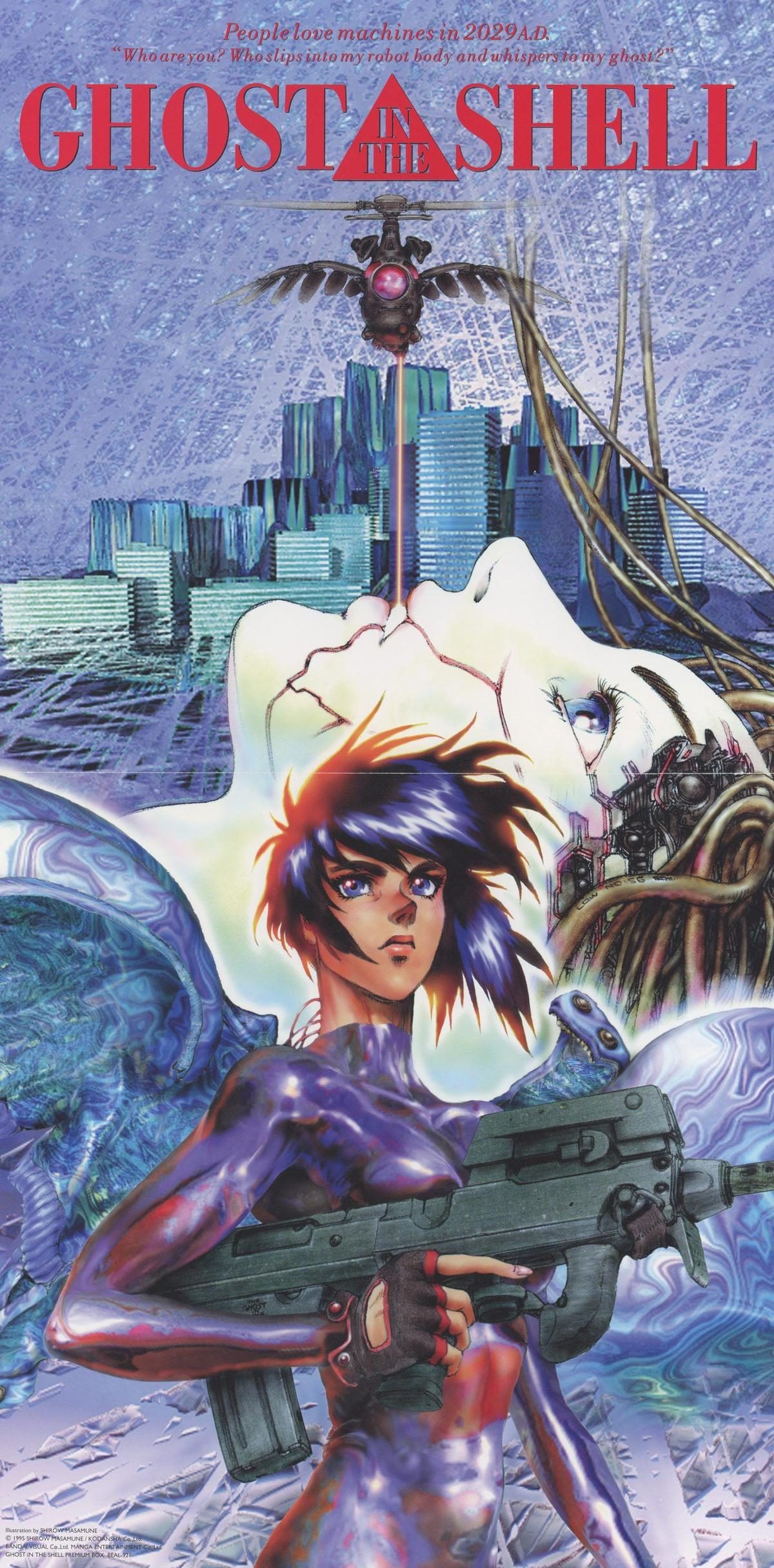 Theatrical key visual — Kusanagi against the Hong Kong-inspired cityscape, the Puppet Master's translucent form rising behind her. The tagline at top: 'People love machines in 2029 A.D.' Included in the box as a fold-out poster.
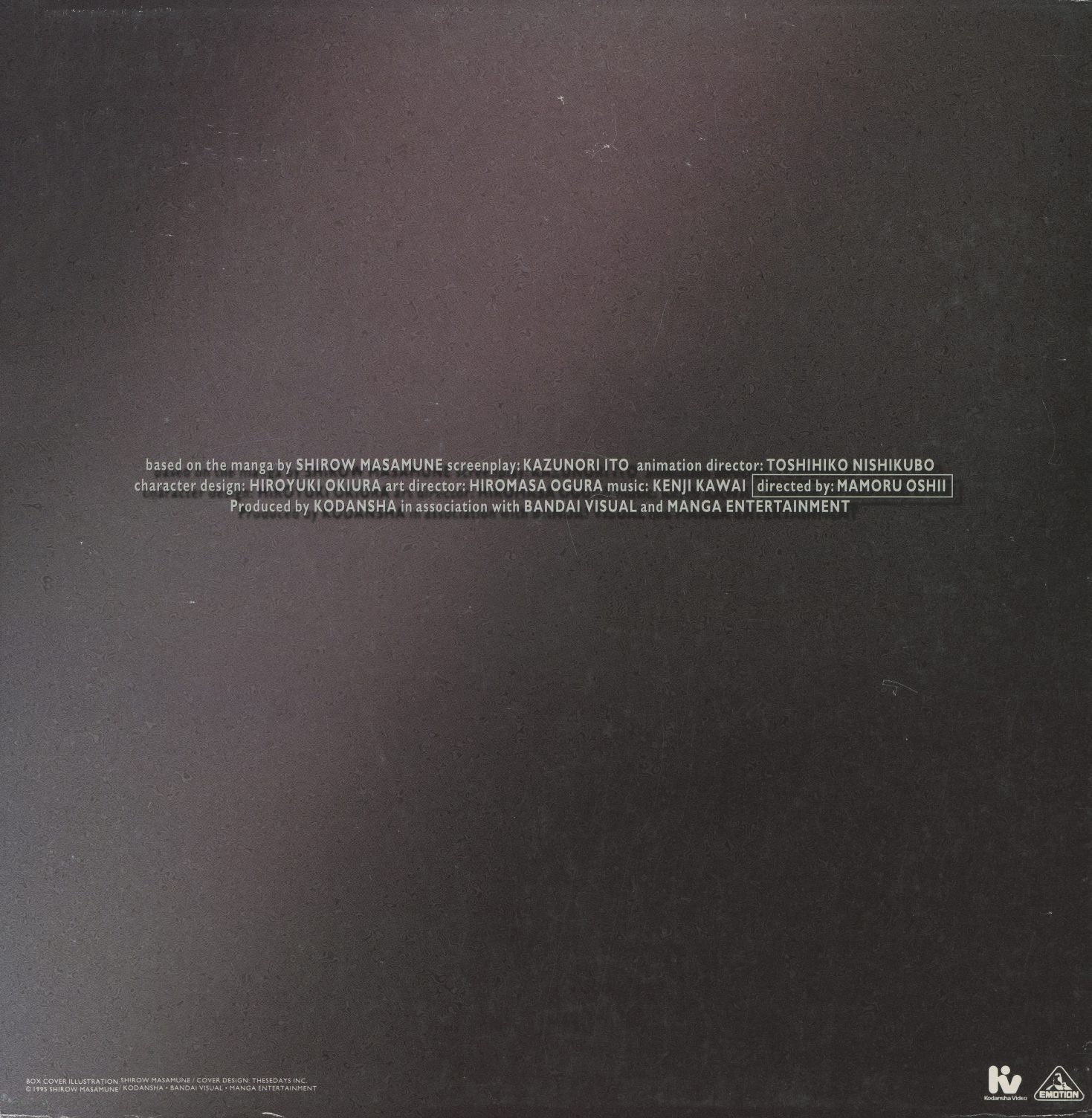 Premium Box back. Full production credits — manga: Shirow Masamune, screenplay: Kazunori Ito, animation director: Toshihiko Nishikubo, character design: Hiroyuki Okiura, art director: Hiromasa Ogura, music: Kenji Kawai, director: Mamoru Oshii. Produced by Kodansha with Bandai Visual and Manga Entertainment.
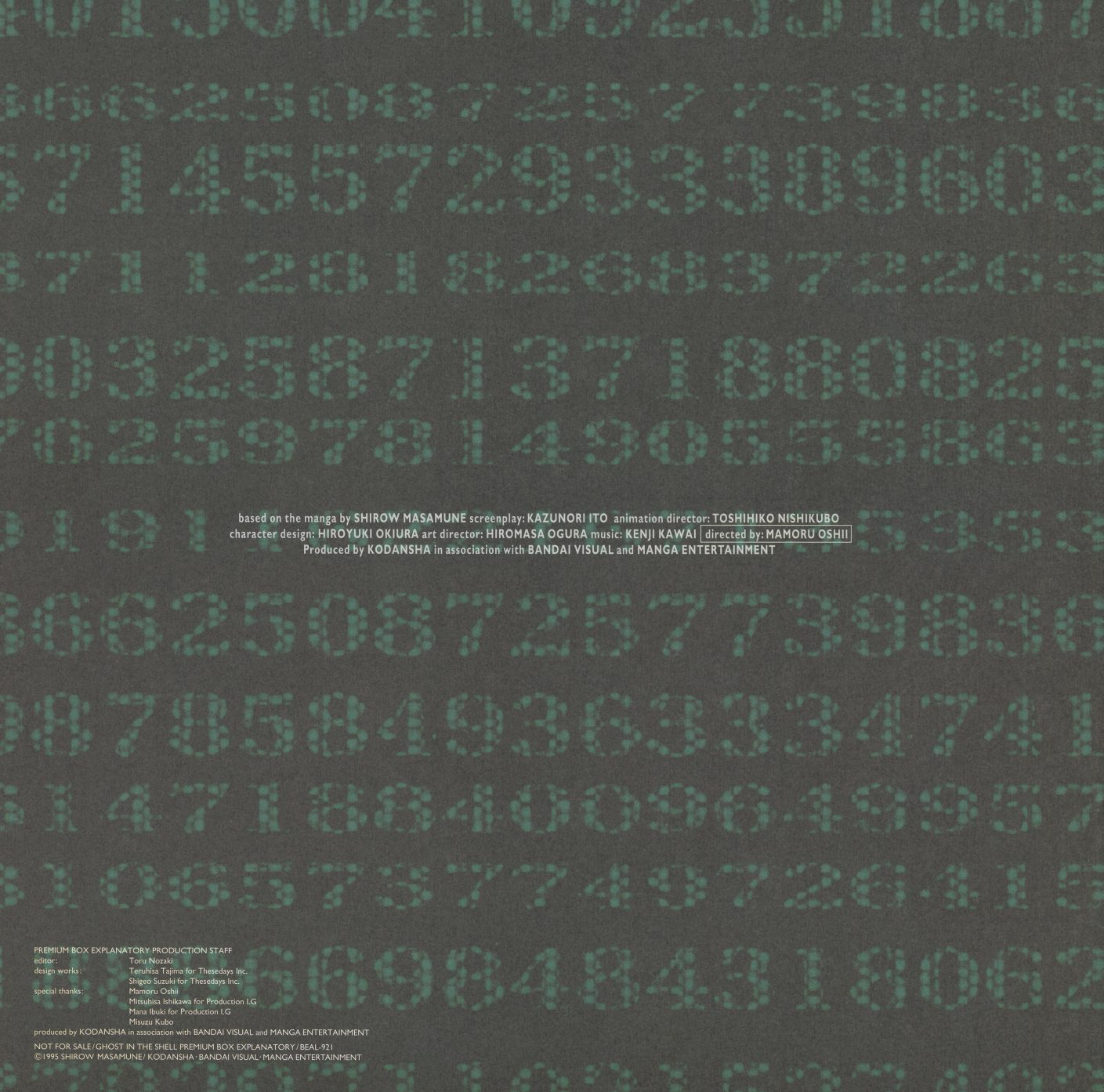 Explanatory booklet back cover. Green number cascade continues — the production credits for the booklet itself listed at bottom left. 'NOT FOR SALE: GHOST IN THE SHELL PREMIUM BOX EXPLANATORY (BEAL-151).' Produced by Kodansha, Bandai Visual, Manga Entertainment.
The chapter stops on this box are not indexed by scene or time code. They're indexed by cut number — C-131, C-174, C-203, C-387. The production's own internal numbering system, printed on the jacket backs as if the buyer were a member of the animation team checking footage. Combined with CAV's frame-by-frame capability, the Premium Box turns the film into a searchable production database. Advance to C-284. Step forward. Watch Ogura's background painting hold still behind Okiura's character animation. Step again.
Neither the 2004 DVD special edition nor any subsequent Blu-ray release uses cut-number indexing. They chapter by scene. The Premium Box chapters by the production's own language — and assumes you speak it.
Loading...