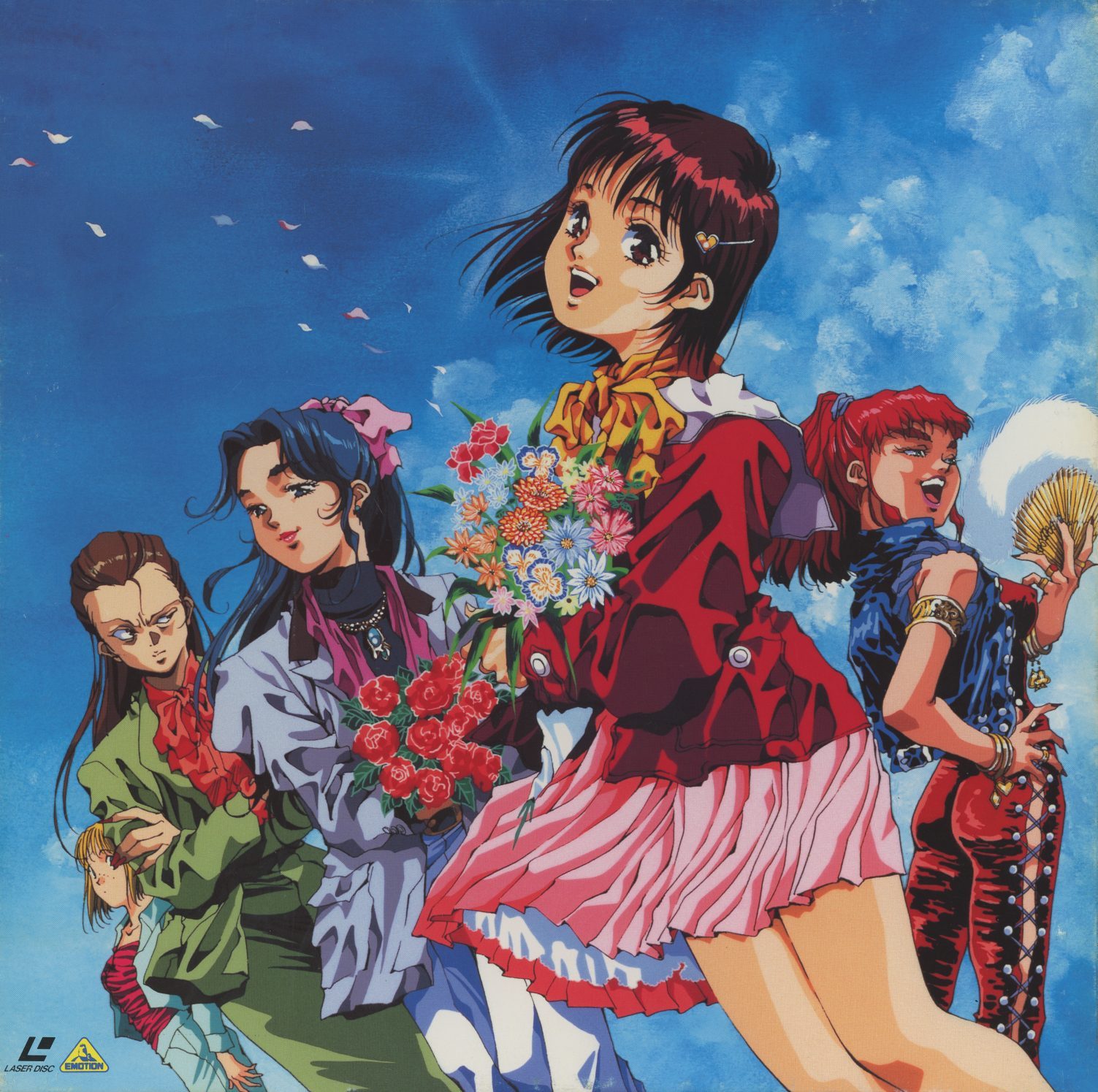
BEAL-623. Three CAV discs, six sides. ¥18,540. Released March 22, 1994 — five years after Episode 6 shipped, five years after Noriko Takaya crossed 12,000 years of relativistic time dilation and saw オカエリナサイ burning across the surface of a dark Earth. Bandai Visual's EMOTION label named the box after that moment. Inside: all six OVA episodes with digital stereo, six Science Lessons including two new shorts directed by Kazuya Tsurumaki, a 12-page liner booklet containing Anno's reflective essay lost paradigm, and an 8-page kirinuki papercraft book.
Top wo Nerae! GunBuster was GAINAX's second production and Hideaki Anno's first directorial credit. A high school girl named Noriko trains as a combat pilot at Okinawa Space Force Girls' High School, and what begins as a sports-anime parody — modeled explicitly on Aim for the Ace! and Top Gun — becomes hard science fiction about relativistic time, sacrifice, and the cost of fighting something humanity can barely comprehend. Six OVA episodes, October 1988 through July 1989. Character design by Haruhiko Mikimoto. Animation direction split across Toshiyuki Kubooka, Yuji Moriyama, and Yoshiyuki Sadamoto. The final episode was produced entirely in black and white — not a budget decision, but because Anno and writer Toshio Okada believed color would undermine the cosmic scale.
The Okaerinasai Box adds no footage to the six episodes. What it changes is the packaging posture — replacing the original volumes' playful, action-forward jacket art with contemplative character portraits on white backgrounds, pop-art halftone backs that treat animation frames as print objects, and a booklet where Anno writes not about Gunbuster's production but about the shared language anime was losing.
The Box
The name is the argument. オカエリナサイ — Welcome Back. The same word the Earth's survivors carved in light across the planet's surface at the end of Episode 6, the word Noriko reads through tears after 12,000 years of relativistic absence. Bandai Visual printed it across the spine of a LaserDisc box set in 1994 and asked buyers to feel the return. The front panel shows the female cast in casual clothes — school uniforms, summer dresses, a fan — holding flowers. No mecha. No space. No combat. The back panel mirrors it with the male cast: Coach Ohta in sunglasses, Captain Tashiro, the bridge crew in suits. Both sides share the same blue sky. This is the cast at rest, in a packaging posture the original volumes never attempted.
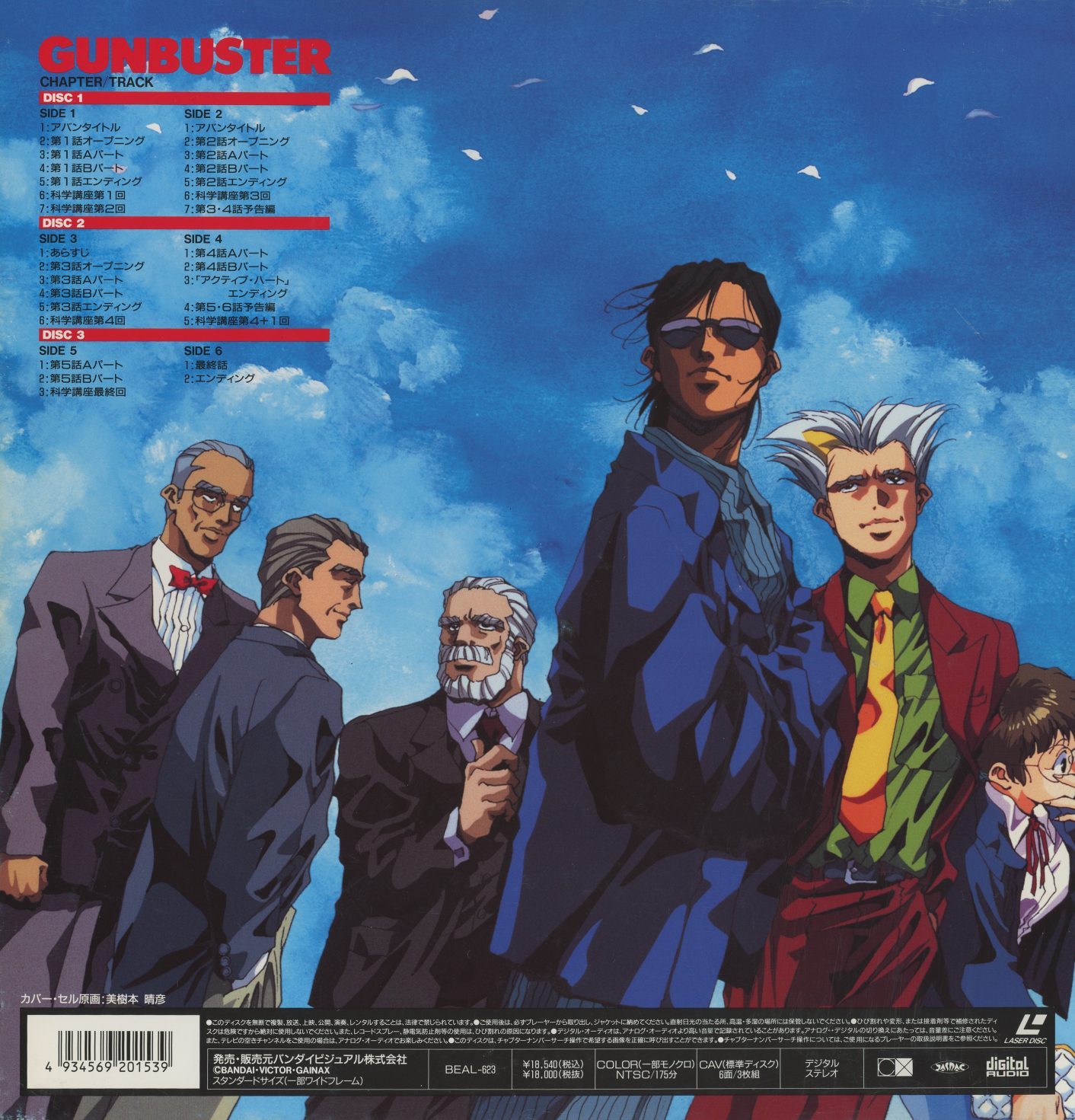 Okaerinasai Box back. Male cast — Coach Ohta, Captain Tashiro, Admiral, bridge officers — against the same sky. Full chapter track listings for all three discs (six sides). BEAL-623, 175 minutes, CAV, NTSC, digital stereo. ¥18,540. Bandai / Victor / GAINAX copyright.
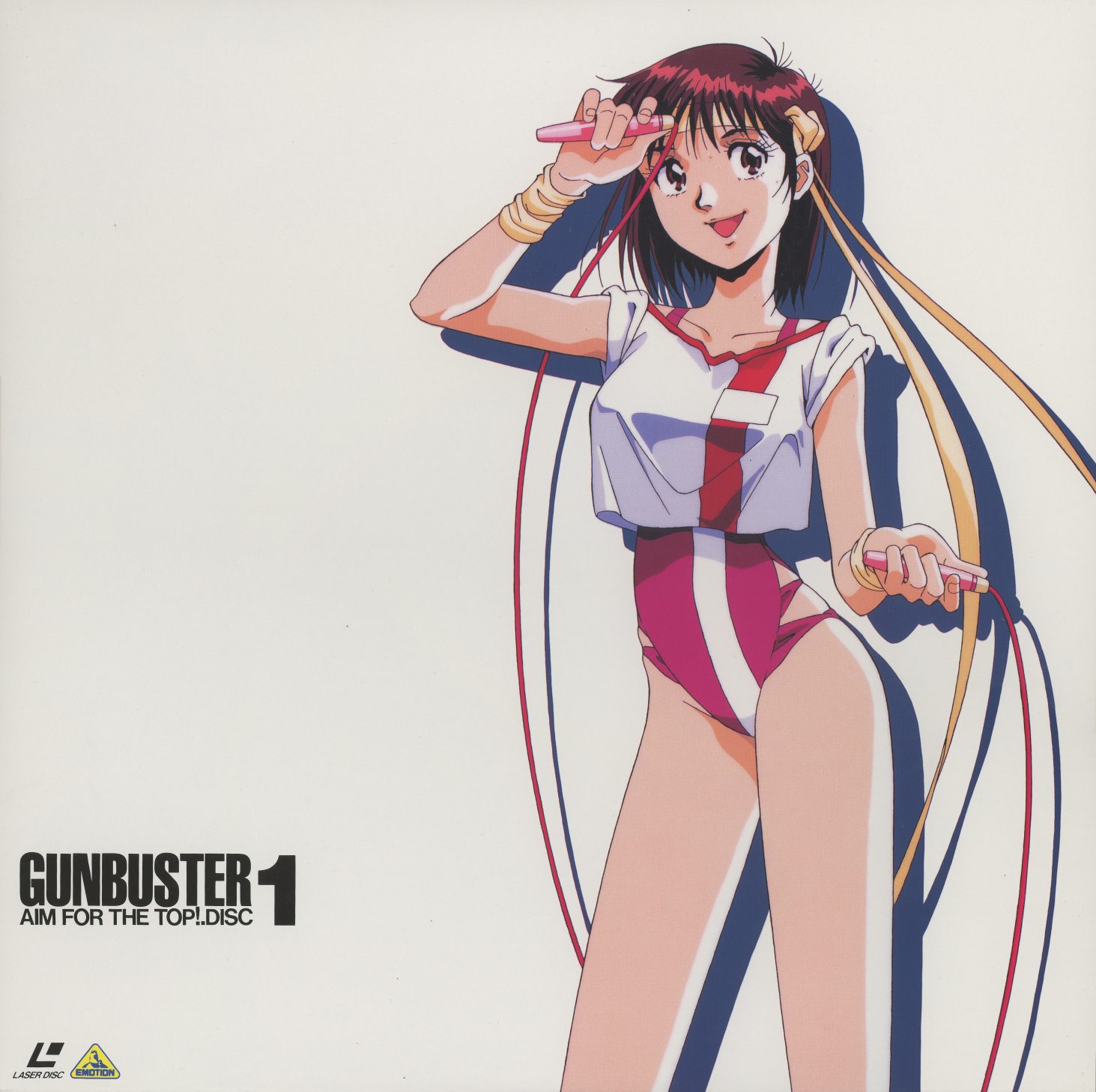 Disc 1 jacket front. Noriko in school training leotard — jump rope in hand, saluting. Clean white background, no scene context. 'GUNBUSTER 1 AIM FOR THE TOP! DISC.' Character illustration by Toshiyuki Kubooka.
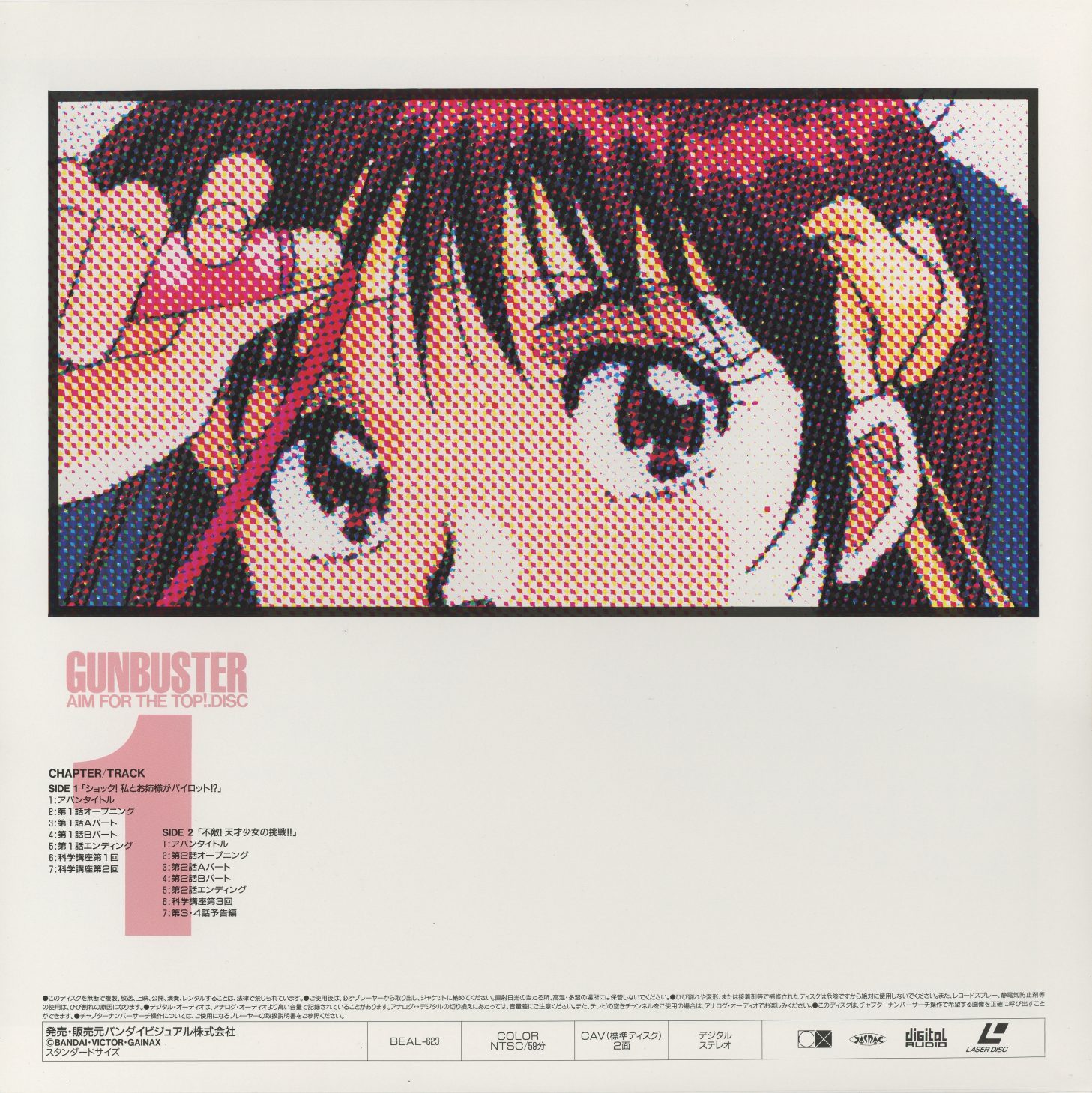 Disc 1 jacket back. A frame of Noriko processed through halftone dot screening — animation cel turned pop art. Chapter track listing below. CAV, NTSC, digital stereo. Side 1: Episode 1 + Science Lesson. Side 2: Episode 2 + Science Lesson.
The Disc Jackets
Three jackets, three character portraits on white. Disc 1: Noriko alone in her school leotard. Disc 2: Kazumi Amano, pensive, hair cascading past the frame. Disc 3: Noriko, Kazumi, and Jung together — the three pilots who fly the Gunbuster — but in school uniforms, not cockpits. The illustrations are credited to Kubooka, who served as both original animation character designer and chief animation director. Each portrait isolates its subject against negative space, letting the character carry the entire jacket. The original 1988-89 volumes did the opposite — filling every inch with action, cast ensembles, and the ORIGINAL VIDEO ANIMATION SERIES banner. Five years later, Bandai Visual decided the characters didn't need the context anymore.
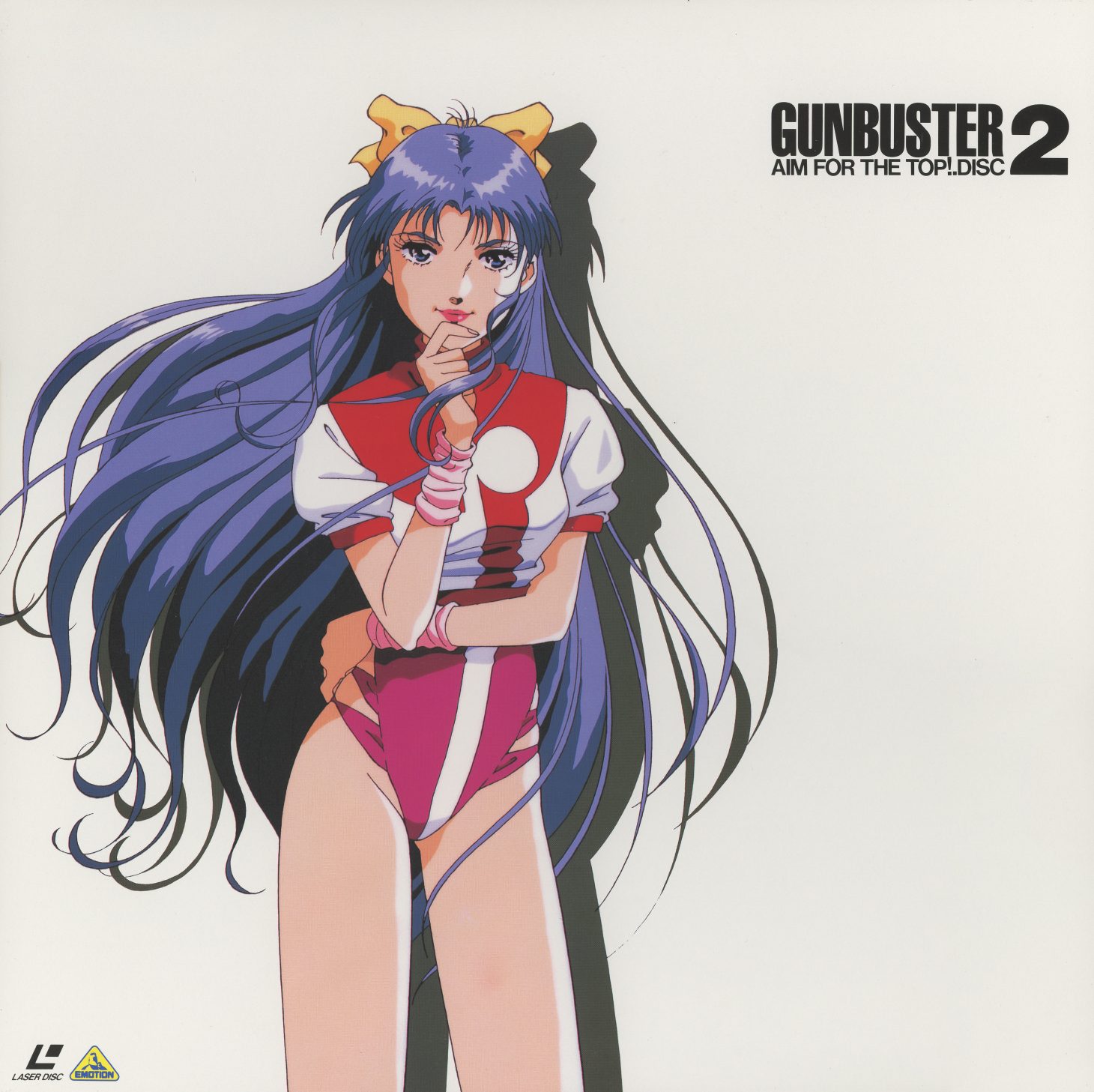 Disc 2 jacket front. Kazumi Amano — hair flowing past the jacket edge, finger to her chin. 'GUNBUSTER 2 AIM FOR THE TOP! DISC.' The same white background, the same clean isolation. Kubooka illustration.
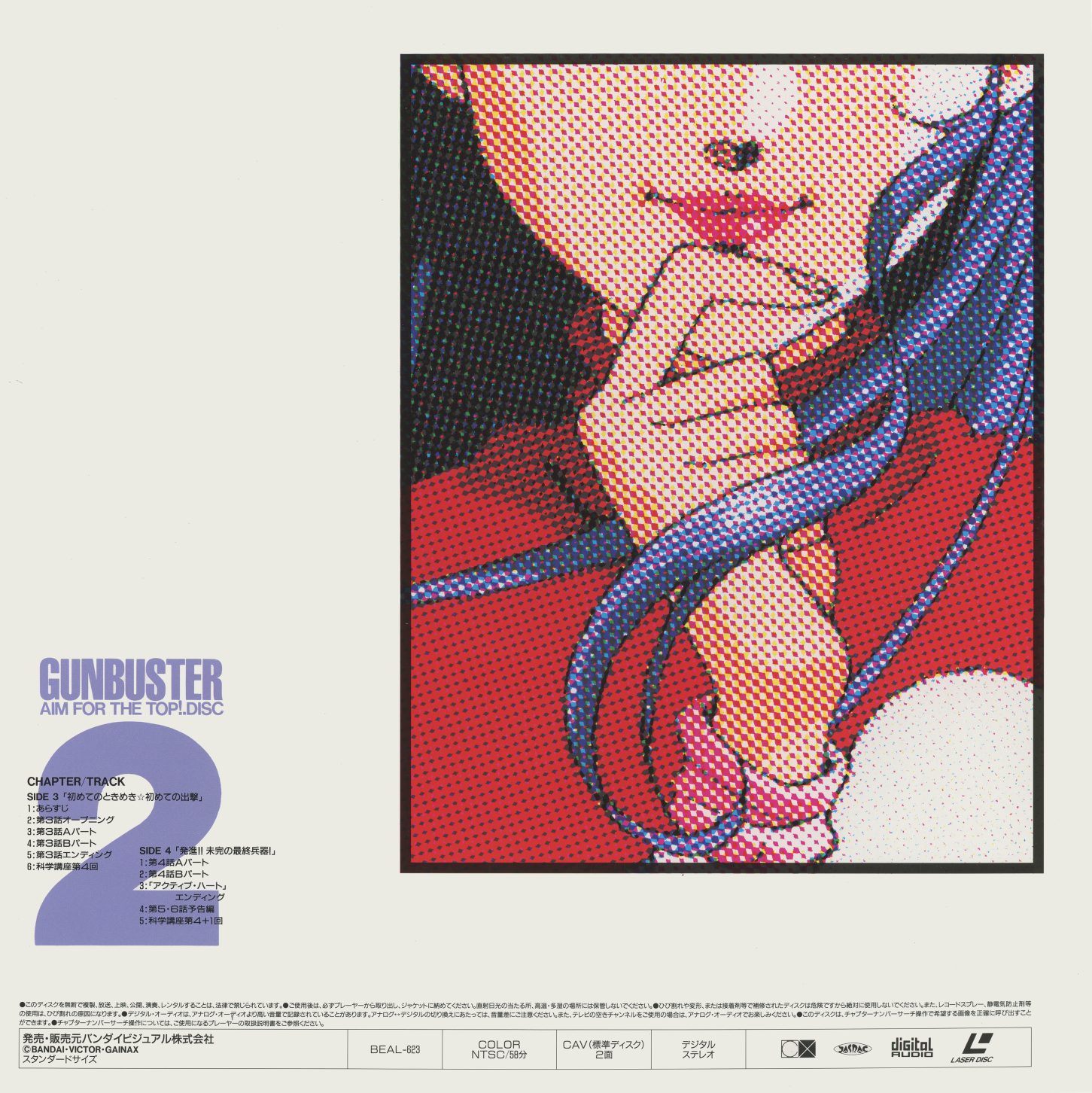 Disc 2 jacket back. Kazumi in halftone — a closeup from the animation, her hand touching her face, processed into colored dot-screen printing. Side 3: Episode 3 + Science Lesson. Side 4: Episode 4 + Science Lesson.
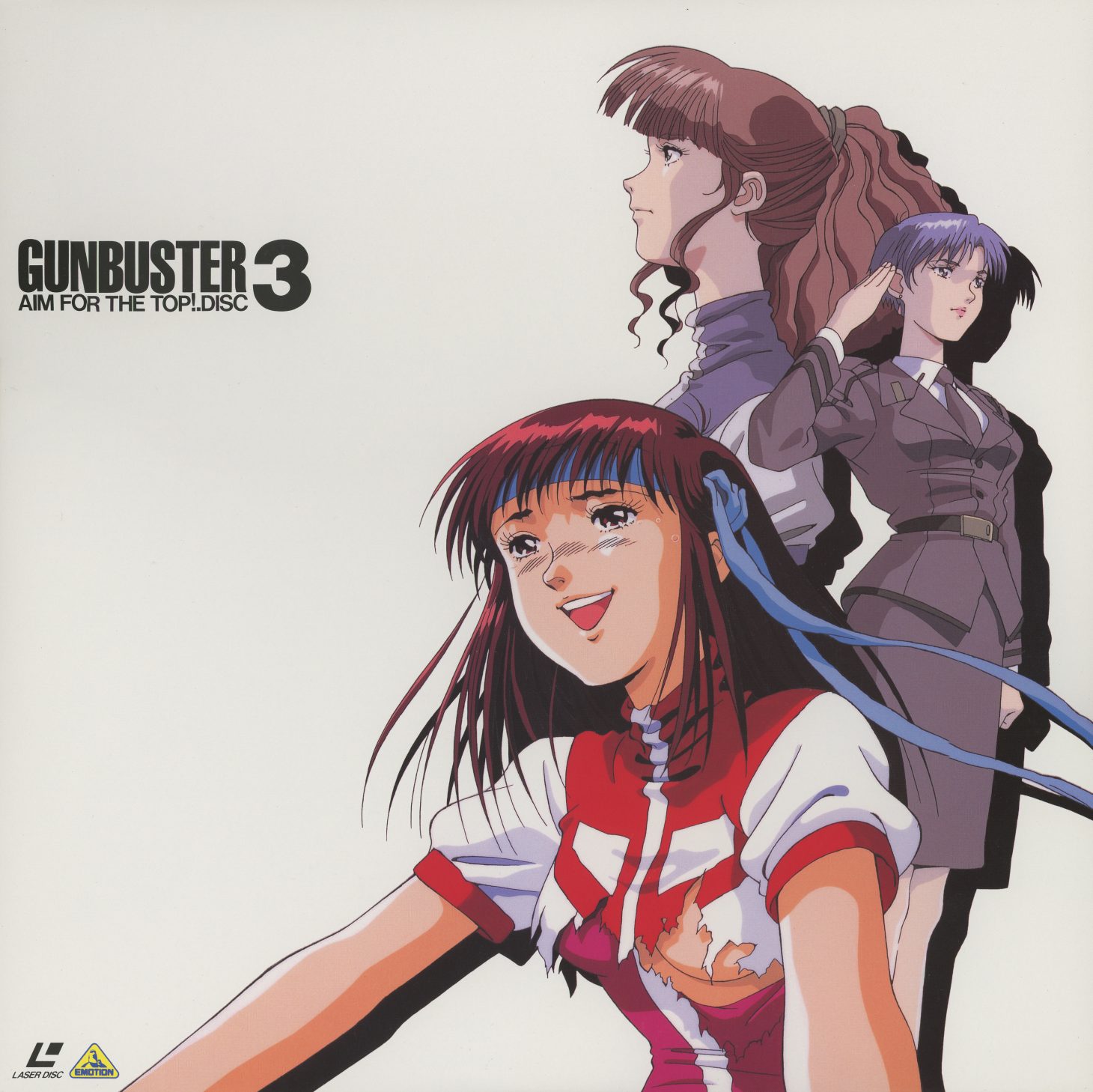 Disc 3 jacket front. Noriko, Kazumi, and Jung — the three Gunbuster pilots together, but in school uniforms, not cockpits. Noriko reaches forward. 'GUNBUSTER 3 AIM FOR THE TOP! DISC.'
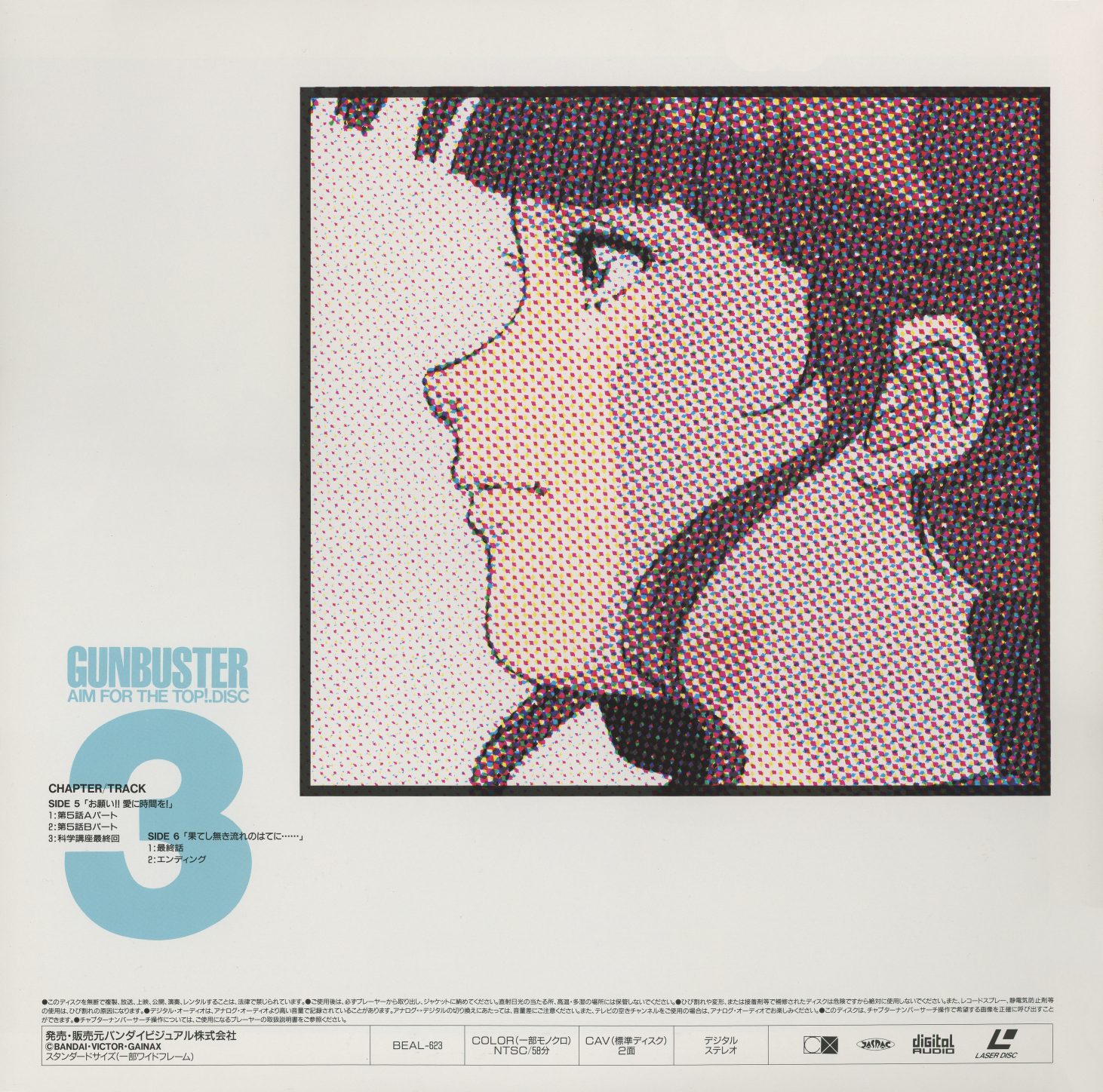 Disc 3 jacket back. Noriko in profile — the halftone rendering at its most minimal, almost dissolving into the dot pattern. Side 5: Episode 5 + Science Lesson. Side 6: Episode 6 + Ending. The final episode's black-and-white imagery, screened through colored dots.
The Halftone Backs
Every disc jacket back processes a frame from the animation through halftone dot screening — the same printing technique Roy Lichtenstein extracted from comic panels. Noriko in extreme closeup on Disc 1. Kazumi's hand against her cheek on Disc 2. Noriko's silhouette in profile on Disc 3 — nearly abstract, the figure dissolving into the dot pattern as the series itself moves toward abstraction. The technique treats cel animation frames as graphic design objects. Below each halftone image, chapter track listings in clean typography. It's a packaging decision that declares: these animation frames are worth looking at as still images, outside their narrative context, processed through a different medium entirely.
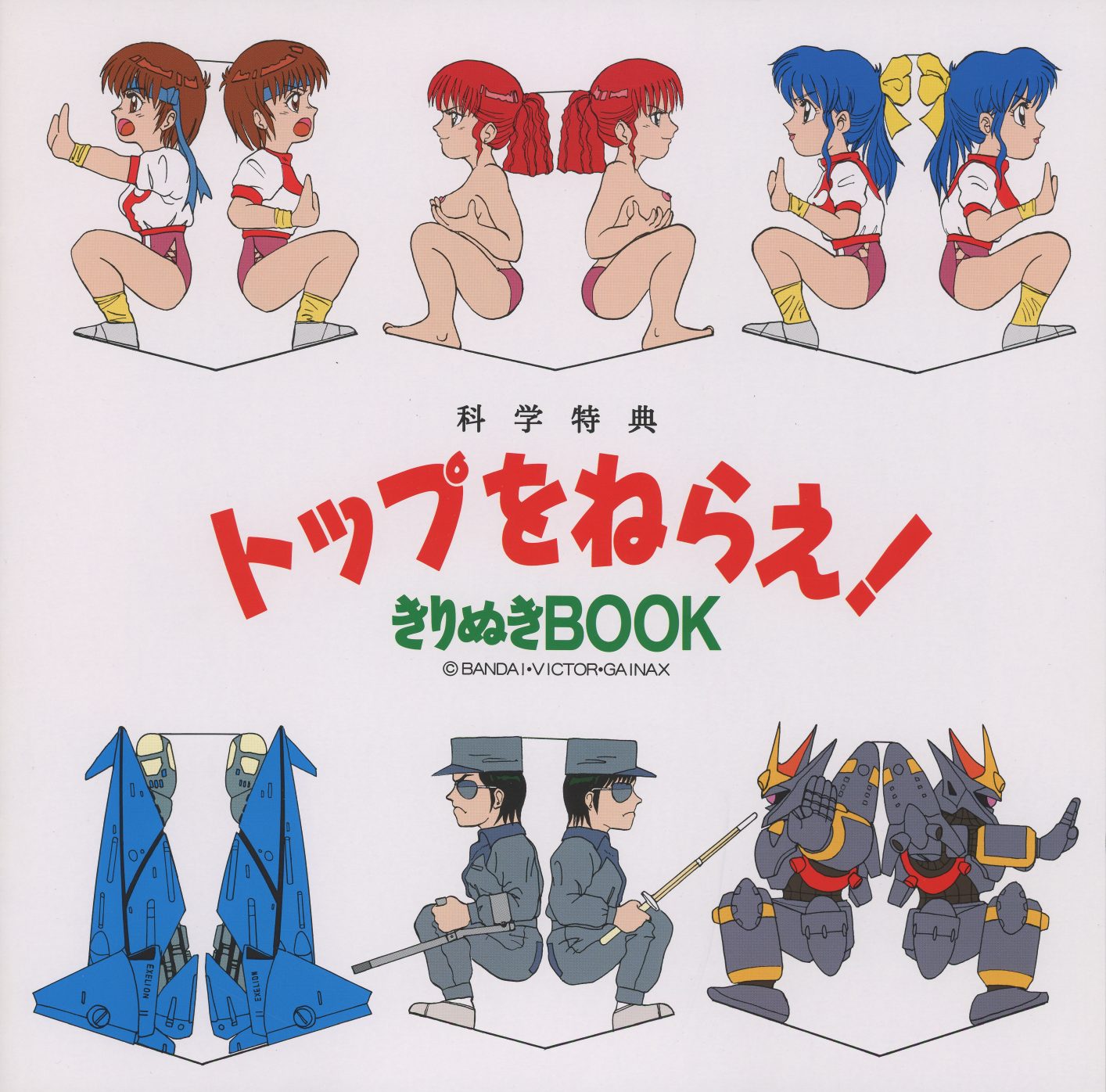 Kirinuki Book cover. '科学特典 トップをねらえ! きりぬきBOOK' — Science Bonus: Aim for the Top! Cutout Book. SD versions of Noriko, Kazumi, Jung, and Kimiko as paper standees. Below: foldable RX-7 Machine Weapon, Coach Ohta and Noriko in training suits, and a buildable Gunbuster mecha. © BANDAI / VICTOR / GAINAX.
The Kirinuki Book
Eight pages of papercraft cutouts. An 8-page insert labeled 科学特典 — Science Bonus — continuing the joke of the Science Lesson shorts that follow each episode. The cover promises SD character standees and a foldable Gunbuster mecha. Inside: a top-down papercraft of the Exelion's bridge, complete with fold-out command stations and the ship's four-pointed star insignia. A full Gunbuster mecha cutout — arms, legs, torso, Noriko figure for scale. And a Captain Tashiro mask, oversized, next to papercraft sushi pieces — ebi, tamago, maguro, and a fold-up milk carton. Packaging that refuses to choose between reverence and play. The same box that holds Anno's philosophical essay about anime's dying shared language includes instructions for building a paper Captain and feeding him paper sushi.
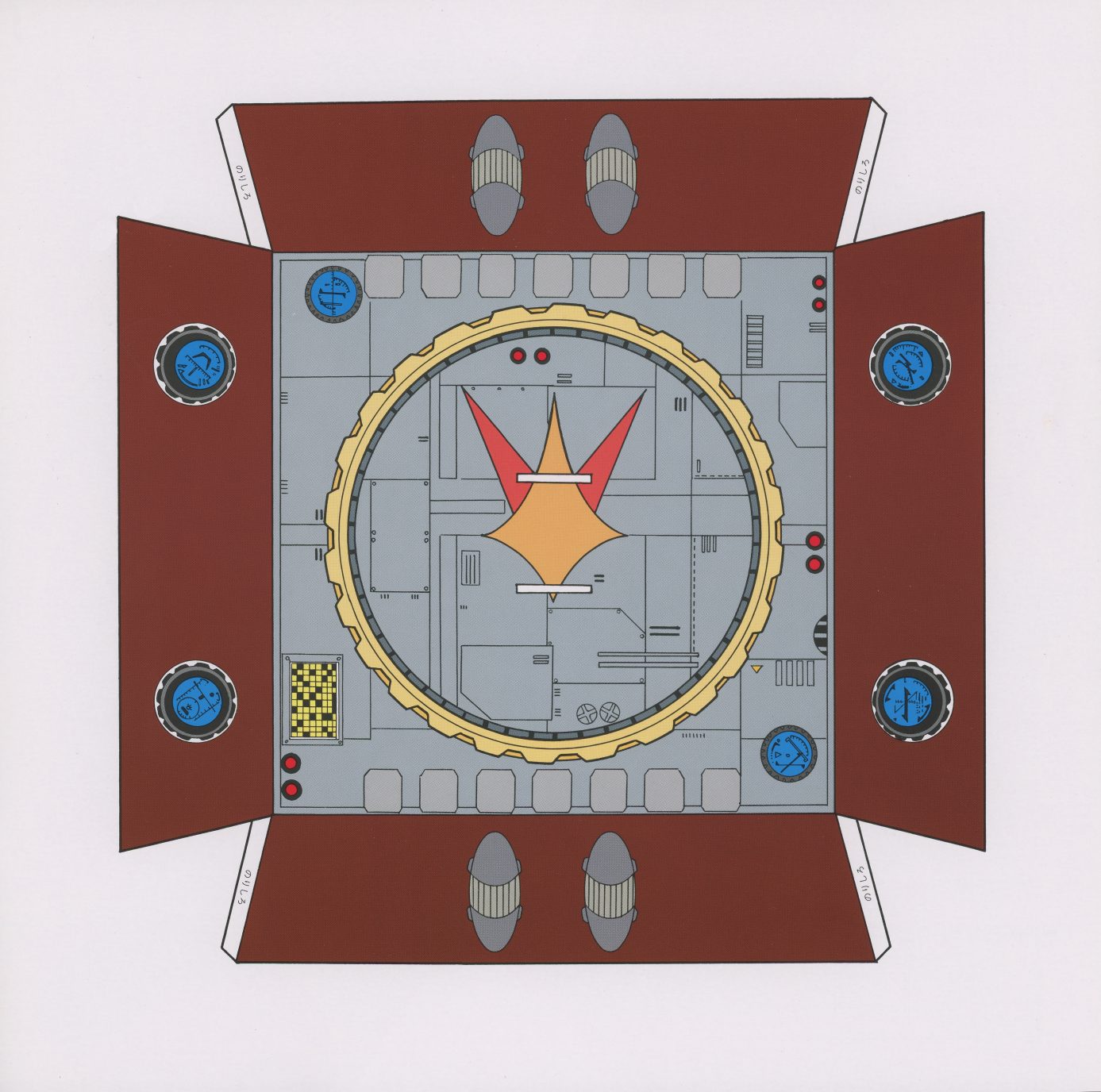 Kirinuki Book interior. Top-down papercraft of the Exelion command bridge — fold-out stations, circular main console with the four-pointed star insignia, thruster pods at the cardinal positions. Designed to be cut out and assembled.
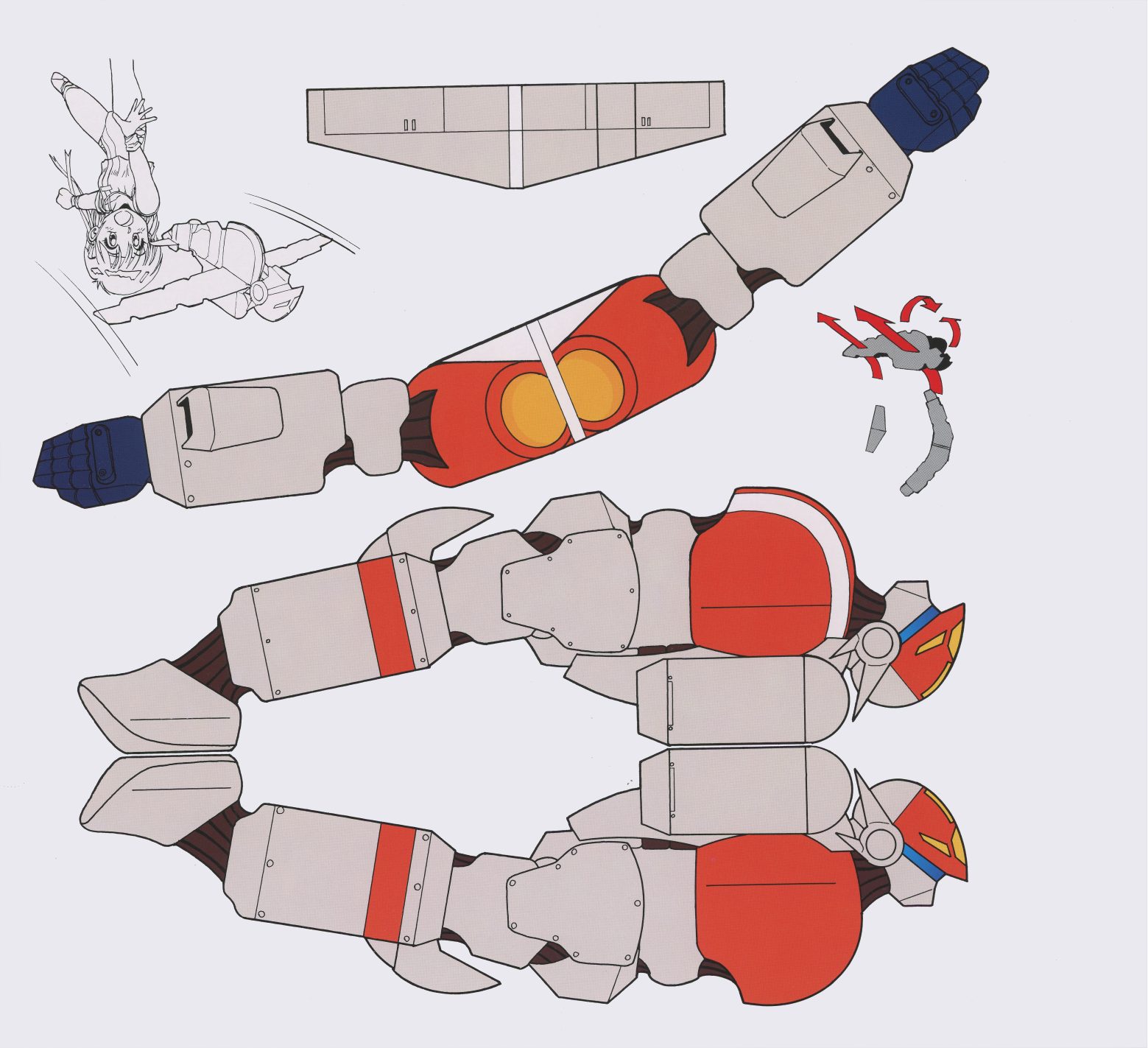 Kirinuki Book interior. Gunbuster mecha cutout — the full super robot in foldable form, with Noriko figure for scale. Arms, legs, torso panels designed for paper assembly.
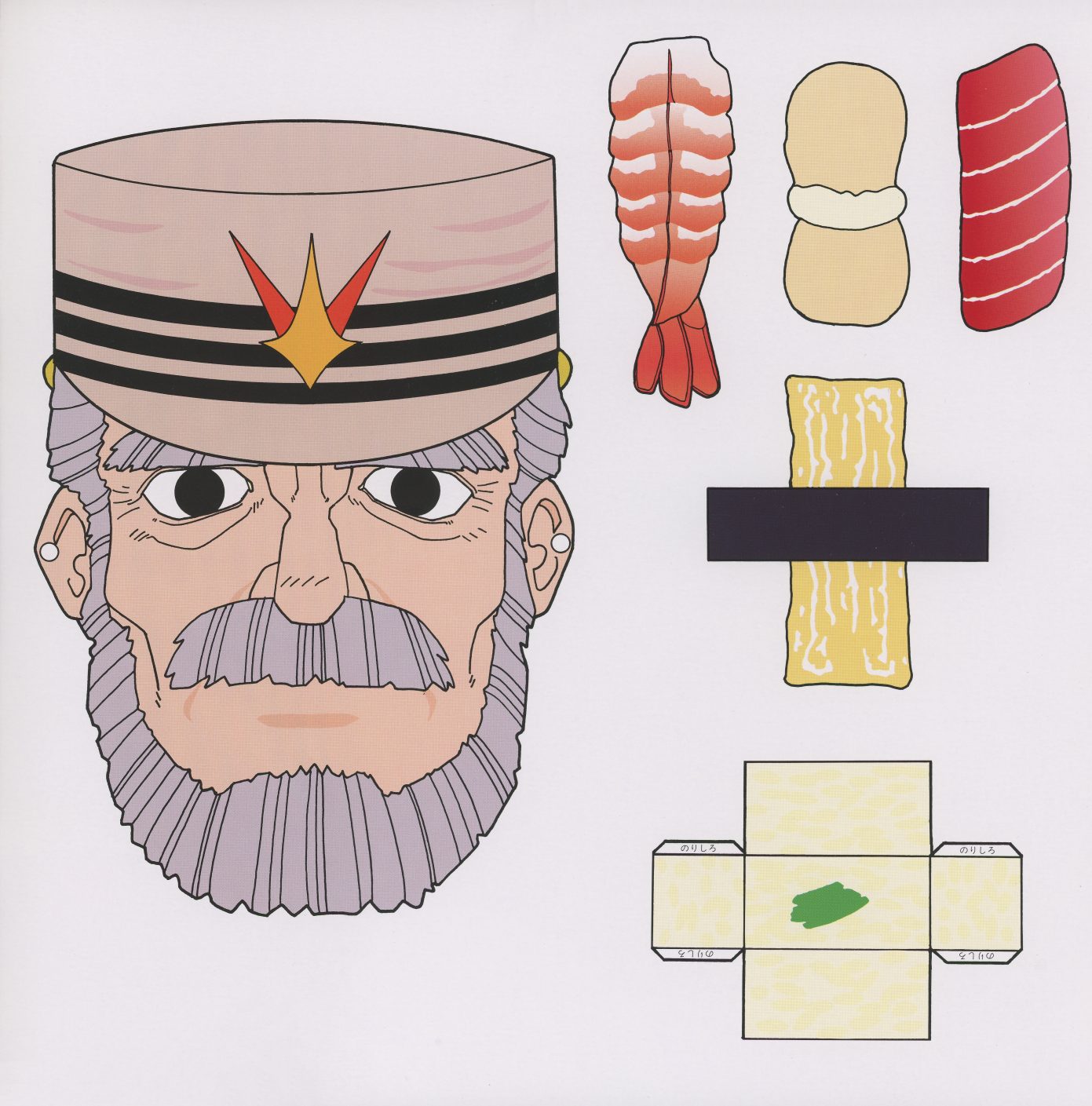 Kirinuki Book interior. Captain Tashiro mask — oversized paper face with his admiral's cap and star insignia. Beside it: papercraft sushi (ebi, tamago, maguro), a tamagoyaki nori roll, and a fold-up milk carton. The box's most deliberately absurd page.
Between the Joke and the Elegy
The Okaerinasai Box holds two registers at once. The kirinuki book is the frequency of Gainax circa Otaku no Video — self-aware, affectionate, comfortable enough with its audience to include paper sushi next to a super robot. The booklet is a different register entirely.
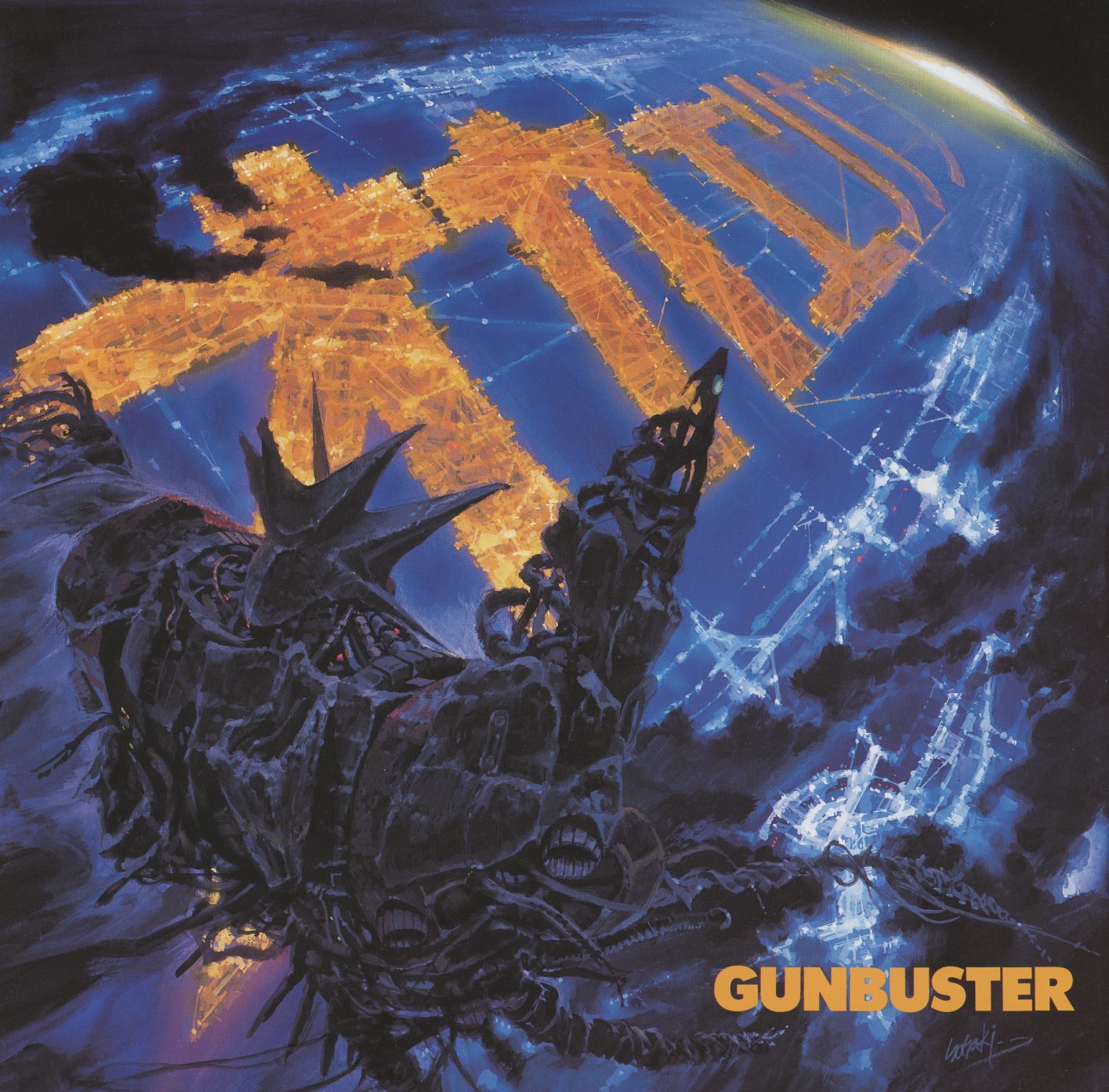 Liner booklet opening spread. Painted illustration — space monsters swarming above Earth's atmosphere, the kanji 本気 (honki — 'dead serious') blazing in orange across the frame. 'GUNBUSTER' in gold. No credits, no context. Pure image board energy.
The Booklet
Twelve pages. The booklet opens with a full-bleed painted spread — space monsters above Earth's atmosphere with 本気 burning across the frame in orange — then drops into a purple-toned page titled ILLUSION, overlaying Noriko's face against a city nightscape with the line: その時、夢は限りなく現実だった — At that moment, the dream was as close to reality as it could get. The page serves as a threshold between the imagery and what follows: six dense pages of Anno's text.
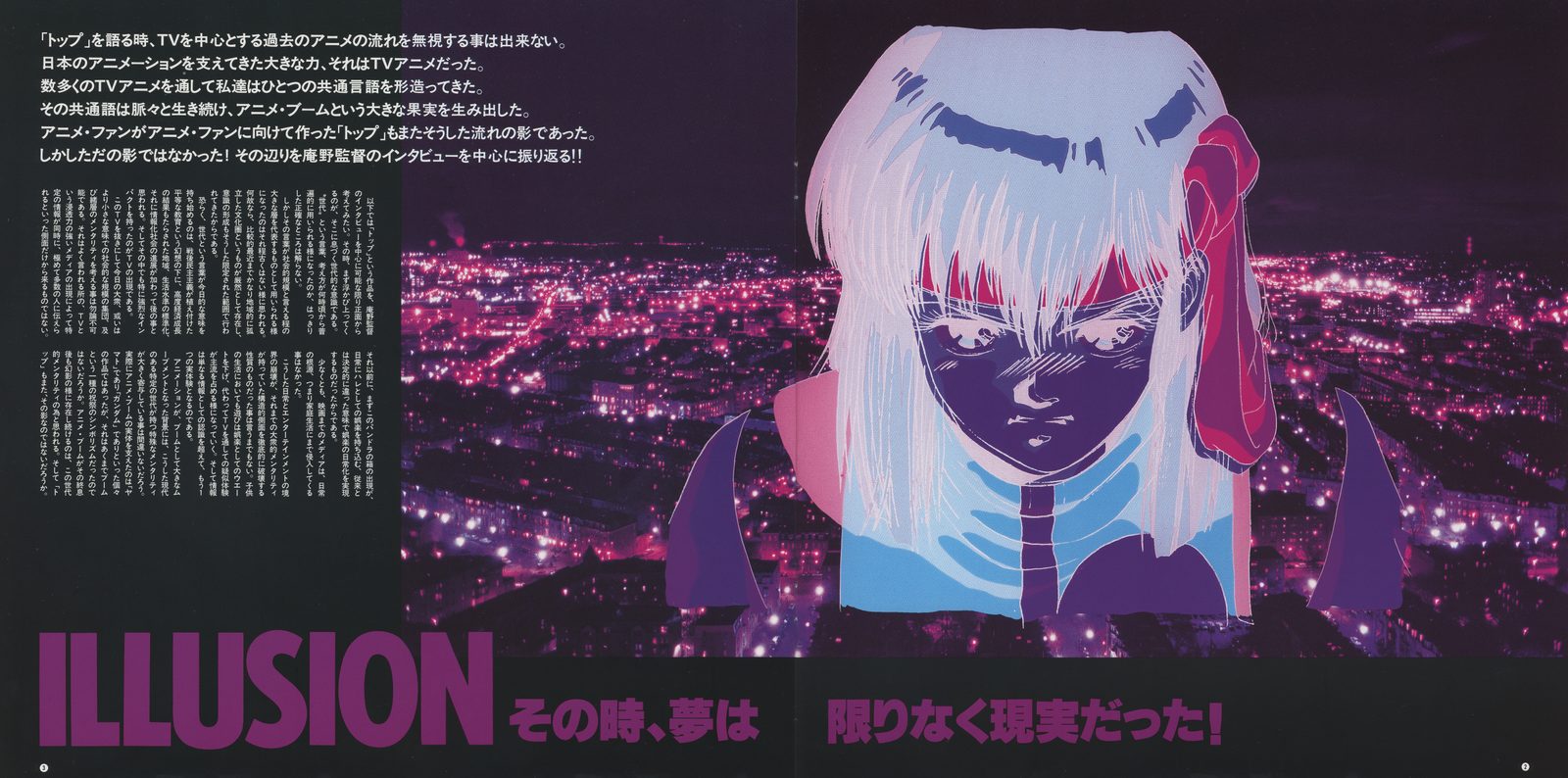 Booklet spread: 'ILLUSION — その時、夢は限りなく現実だった!' Noriko's face composited against a city nightscape in deep purple. The transition page between the booklet's image section and Anno's essay.
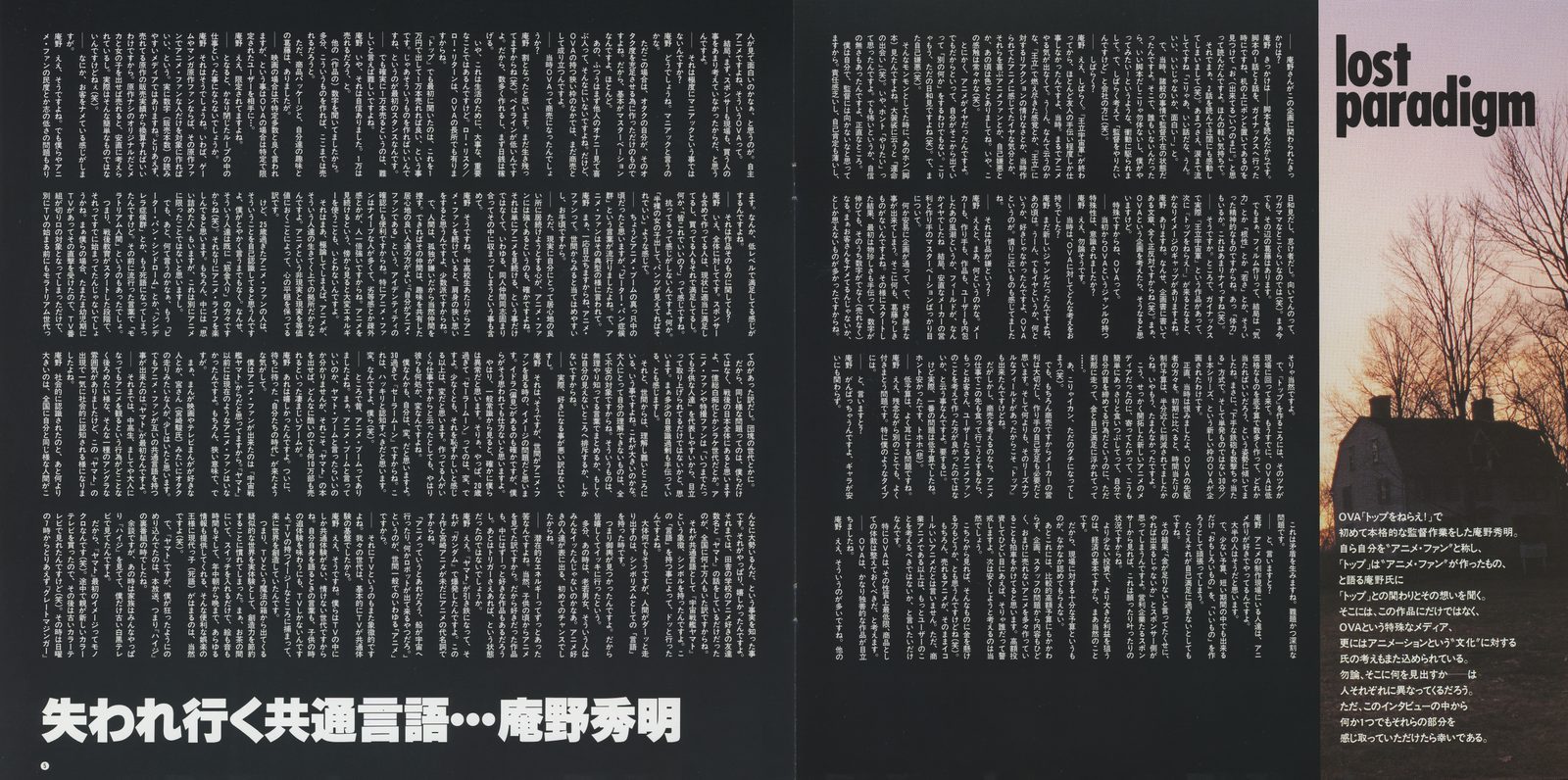 Anno's essay, pages 1-2. 'lost paradigm — 失われ行く共通言語…庵野秀明.' Dense vertical Japanese text against a black background. A sunset photograph on the right margin. The title in English: 'lost paradigm.' The subtitle: 'The shared language being lost... Hideaki Anno.'
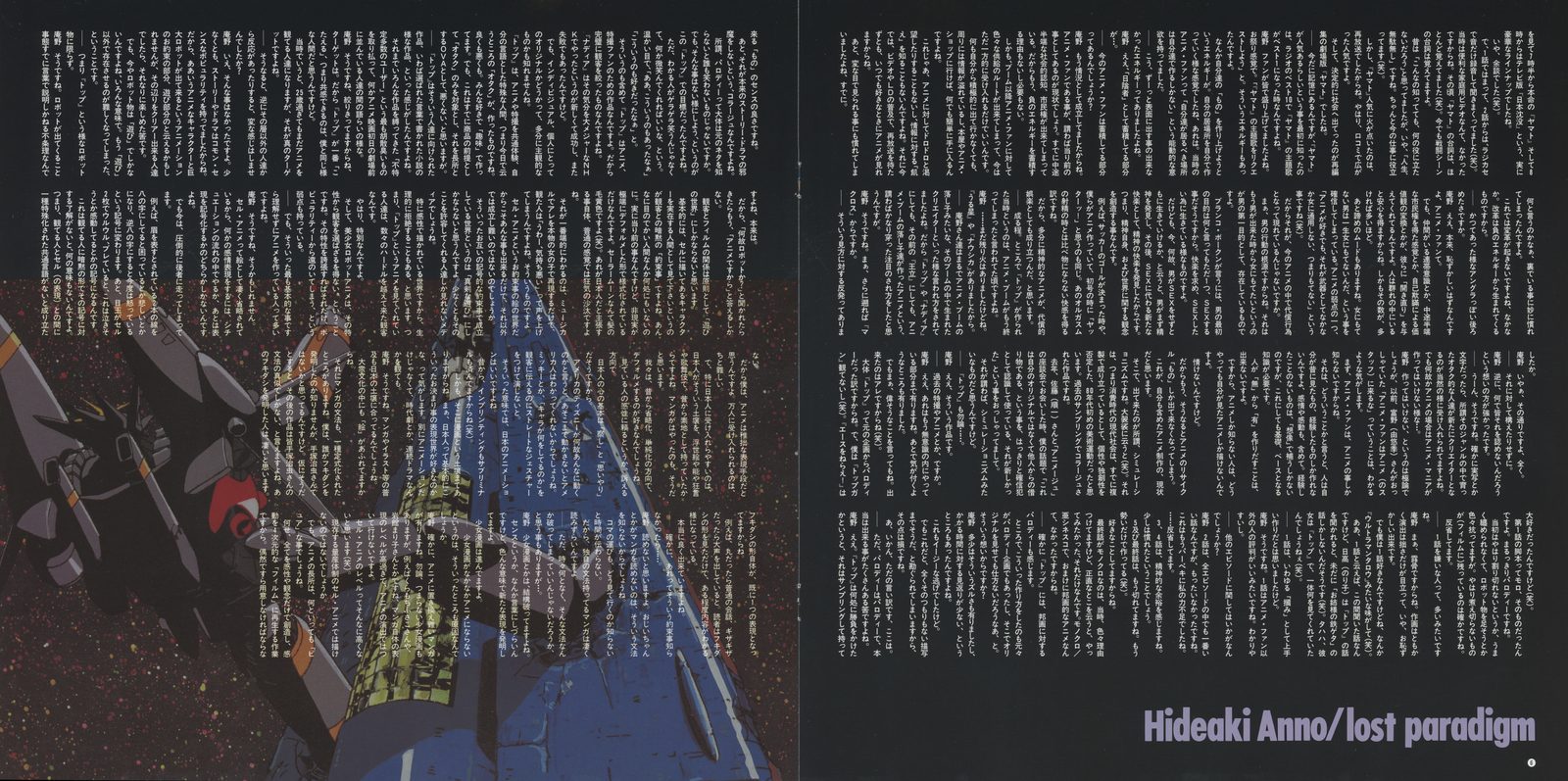 Anno's essay, pages 3-4. 'Hideaki Anno / lost paradigm.' The text continues against black, a space battle frame from the series visible beneath the columns. Six pages total of Anno writing not about Gunbuster's production, but about what anime was losing.
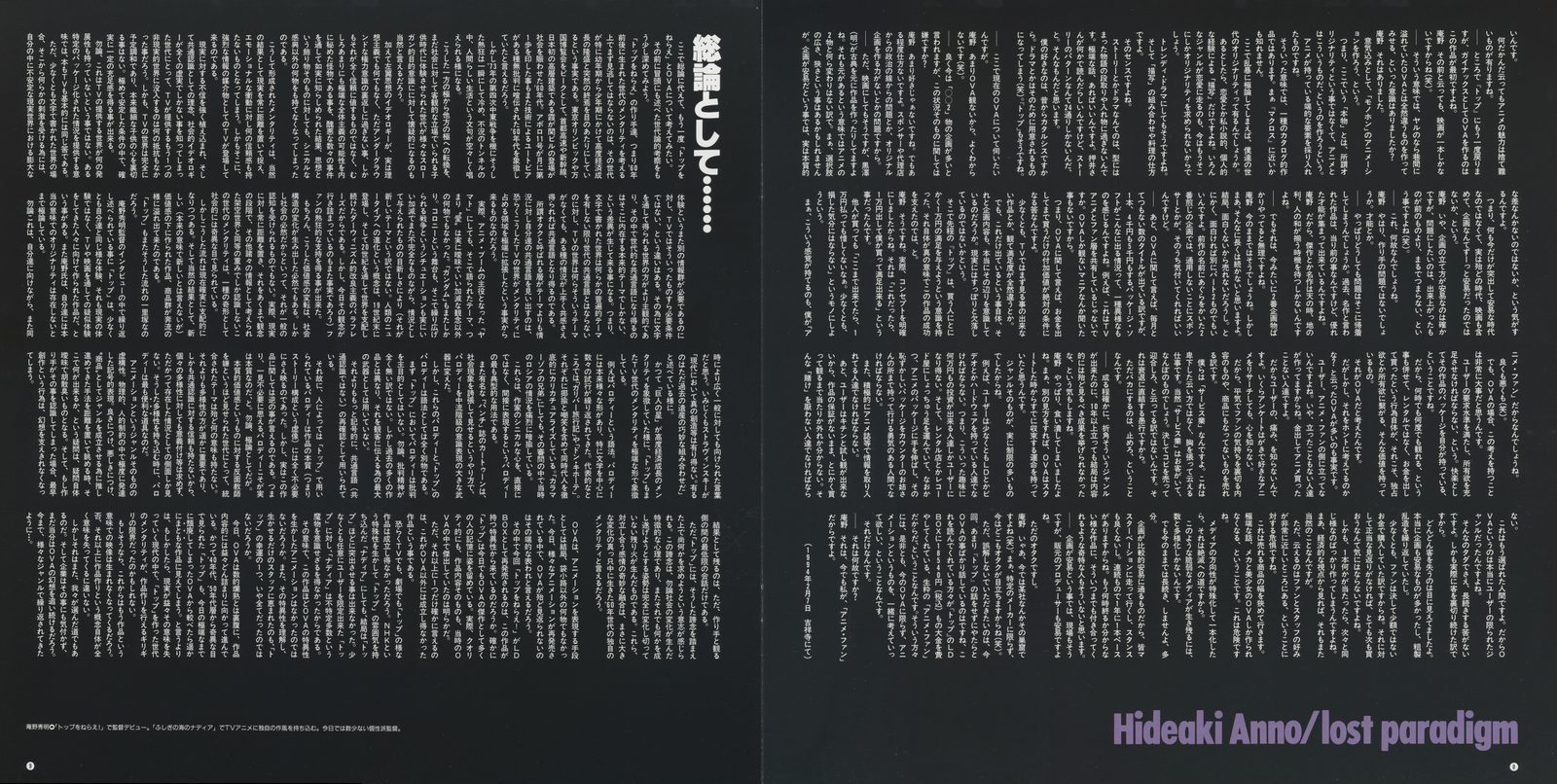 Anno's essay, pages 5-6. '総括として……' — 'In summary...' The final pages. 'Hideaki Anno / lost paradigm.' By 1994, Anno was deep in Evangelion pre-production. This essay sits at the hinge between two eras of his career.
<em>lost paradigm</em>
The essay is titled in English. Six pages of vertical Japanese text on black backgrounds. Anno writes about the shared language — 共通言語 — that once connected anime creators and their audience. A common vocabulary of visual references, narrative structures, character archetypes that both sides understood without explanation. He argues it was disappearing. The essay is not about Gunbuster. It is about what made Gunbuster possible — the OVA ecosystem where a director could parody Aim for the Ace! and Top Gun simultaneously, confident the audience would catch both references, then pivot to hard science fiction confident the same audience would follow. By March 1994, Anno was eighteen months from the first broadcast of Evangelion. This is the last thing he published before that series changed everything.
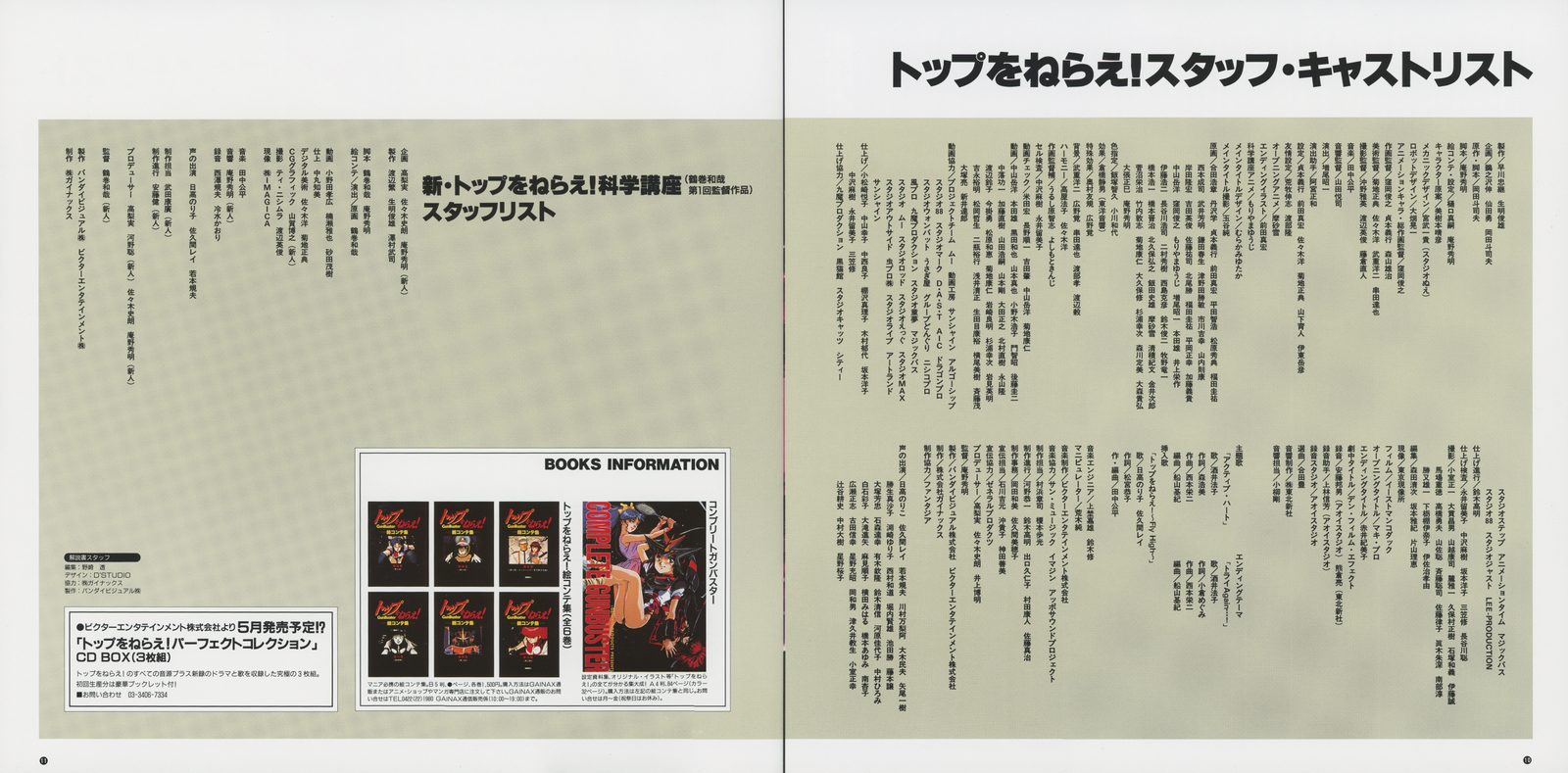 Booklet final spread. 'トップをねらえ! スタッフ・キャストリスト' — full staff and cast credits for all six episodes. Science Lesson staff credits for the two new Tsurumaki-directed shorts. Books Information section with published merchandise thumbnails, including the 'Perfect Collection' CD box.
The Original Volumes
BEAL-207, 209, 211. October 1988 through July 1989. Three individual CAV discs released alongside VHS, two episodes per disc, ¥7,370 each. These are the jackets that sold Gunbuster to its first audience — and they sold a different show. Vol. 1's jacket tumbles the cast through zero gravity in a tangle of snacks, loose shoes, and open laughter. The banner reads ORIGINAL VIDEO ANIMATION SERIES. Vol. 2 assembles the full ensemble against a starfield — mecha, crew, supporting cast, everyone in frame. Vol. 3 closes on Noriko's face in tears, the jacket art finally catching up to what the series had become by its final episodes. Each back carried staff credits, a story digest, and the theme song credit: Noriko Sakai, 'Active Heart.'
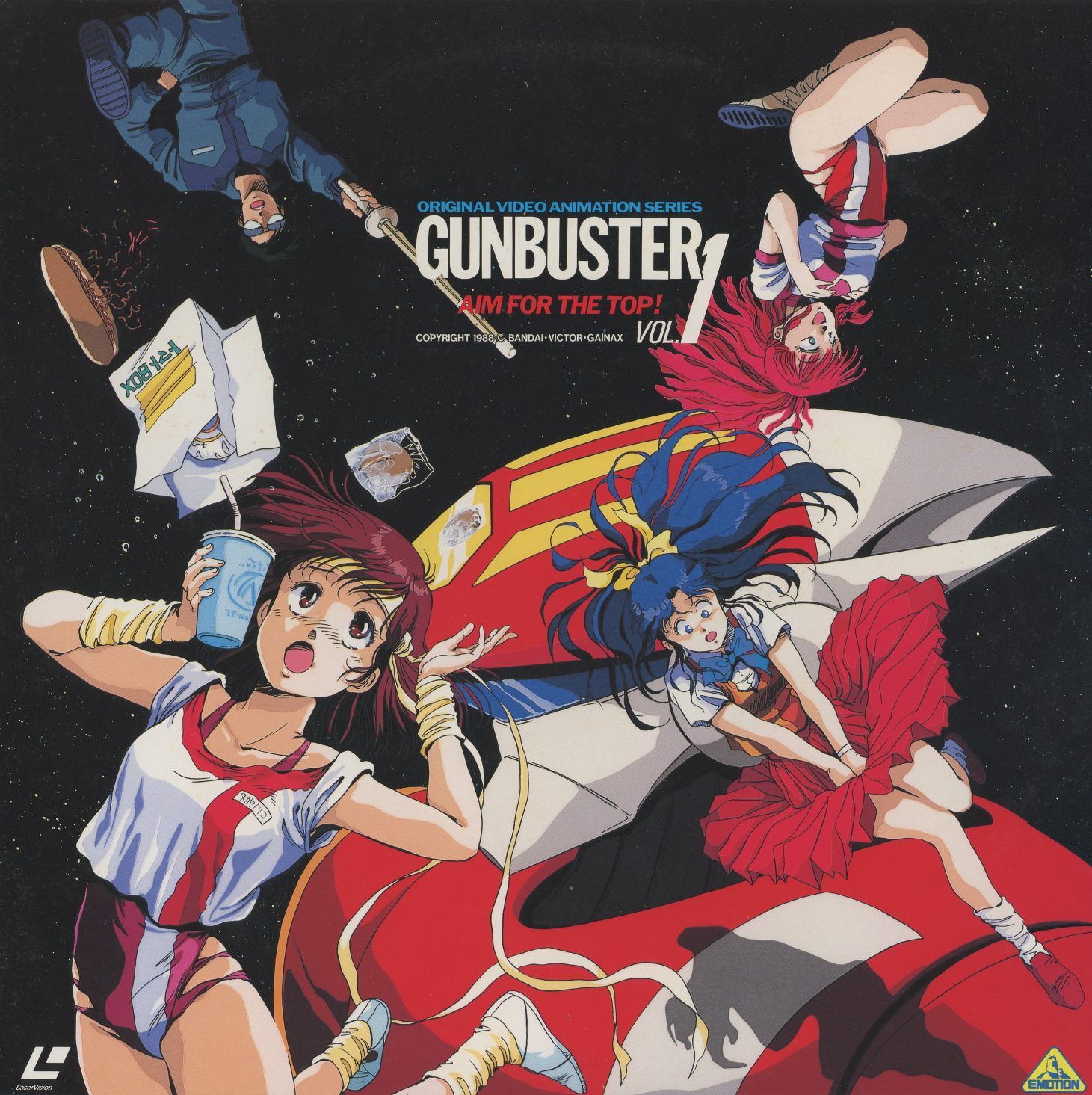 Original Vol. 1 jacket front (BEAL-207, October 1988). Zero-gravity comedy — the cast tumbling through space with snacks and loose shoes. 'ORIGINAL VIDEO ANIMATION SERIES / GUNBUSTER AIM FOR THE TOP! VOL.1.' The jacket that introduced Gunbuster as a comedy.
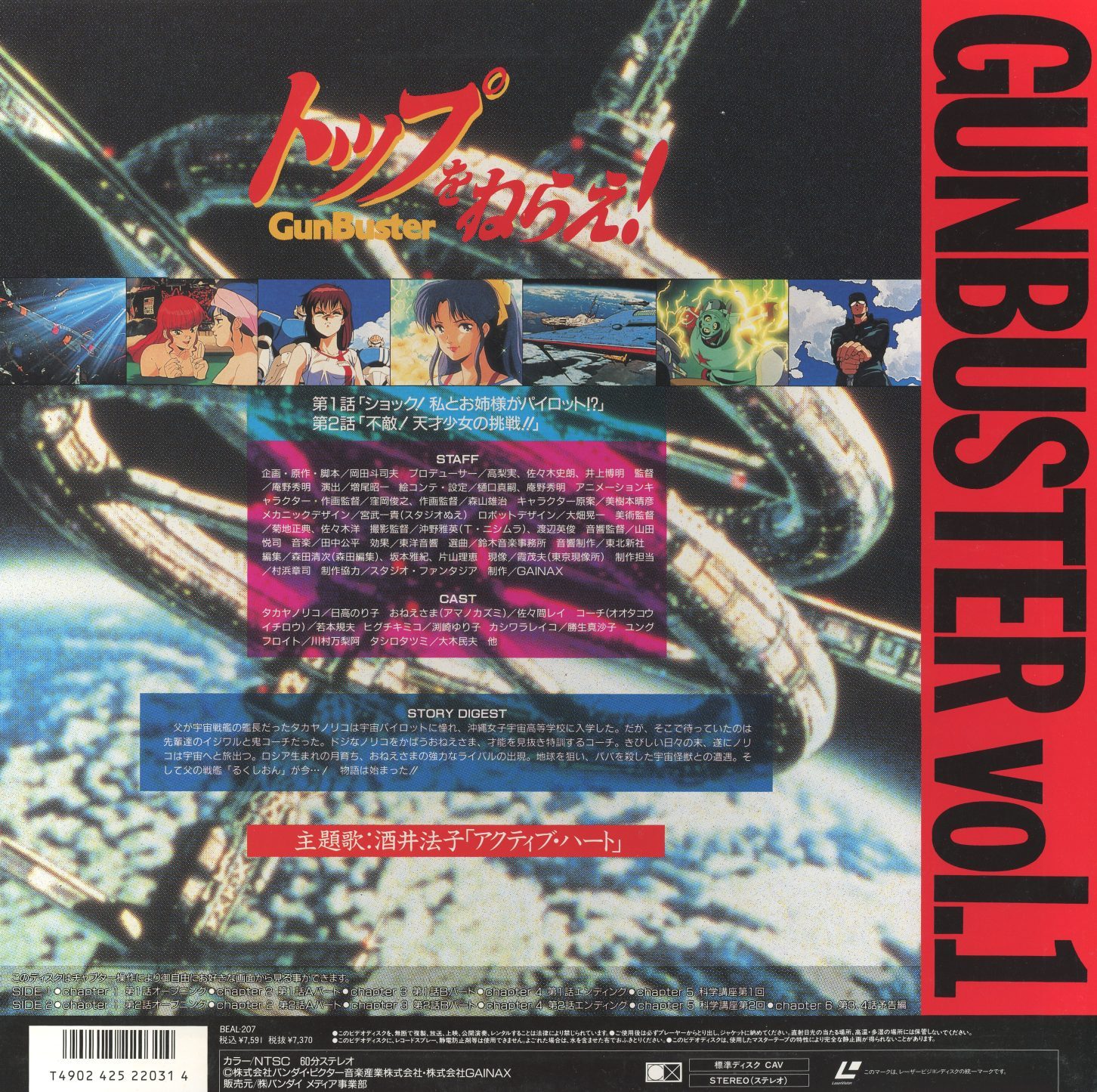 Original Vol. 1 jacket back. Production stills from episodes 1-2. Staff and cast credits. Story digest. 'GUNBUSTER VOL.1' in vertical type. Theme song: 酒井法子「アクティブ・ハート」— Noriko Sakai, 'Active Heart.' CAV, NTSC, digital stereo.
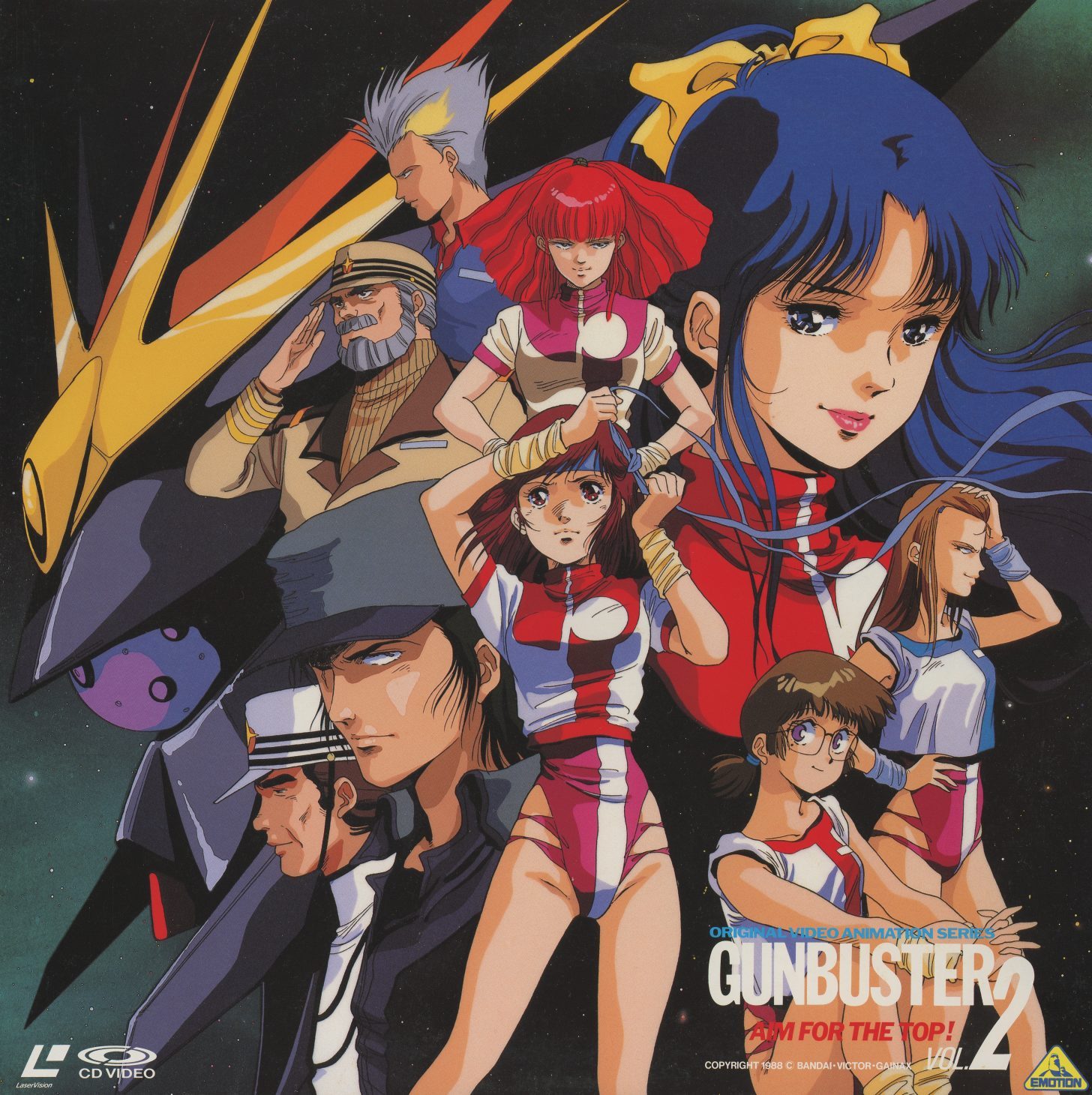 Original Vol. 2 jacket front (BEAL-209, January 1989). Full ensemble cast against a starfield — Noriko, Kazumi, Jung, Coach Ohta, Captain Tashiro, Gunbuster mecha, RX-7 units. Everyone in frame. 'GUNBUSTER AIM FOR THE TOP! VOL.2.' The mid-series jacket that tried to fit the whole show on one cover.
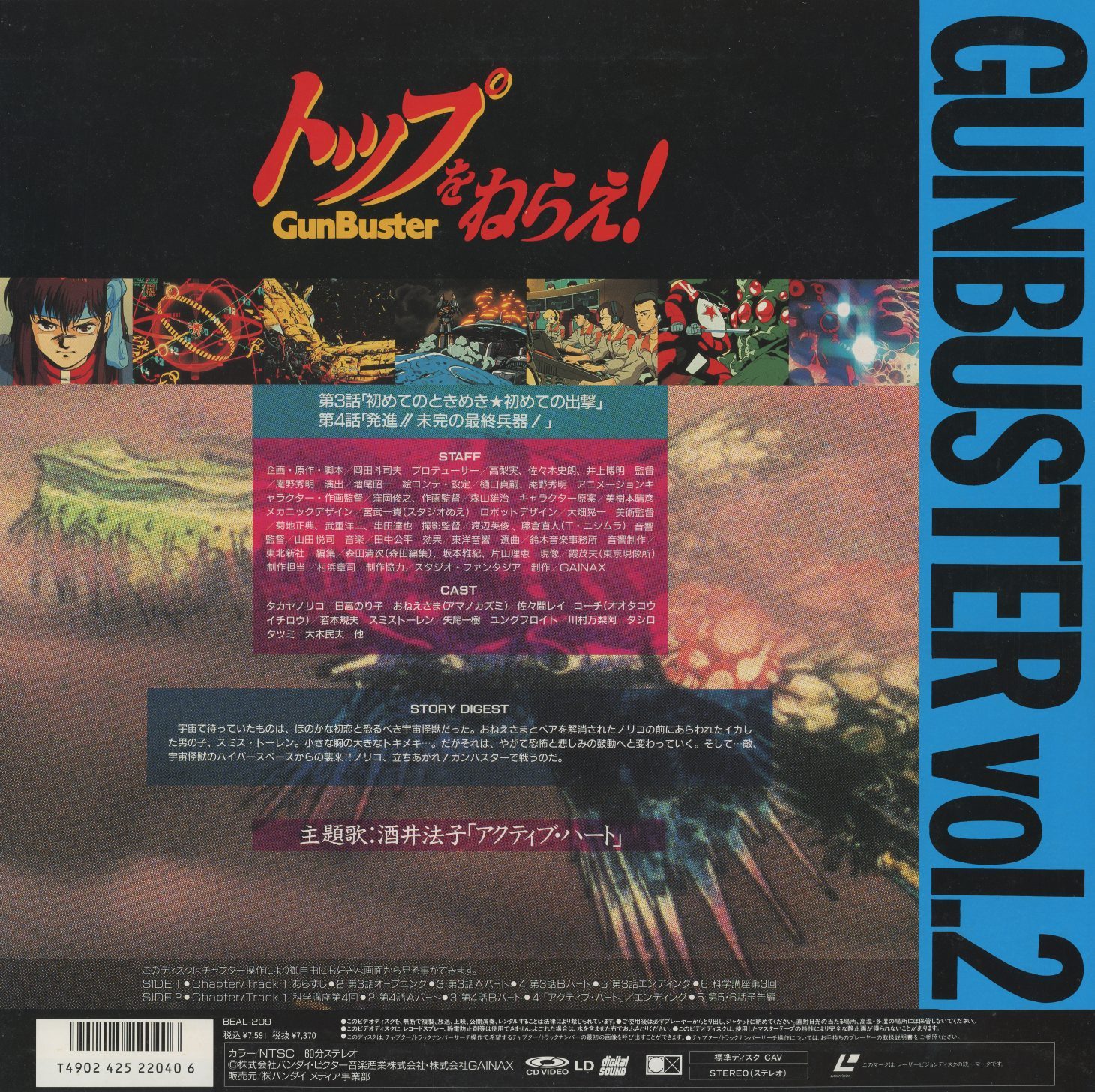 Original Vol. 2 jacket back. Production stills from episodes 3-4. The same layout — credits, story digest, theme song credit. 'GUNBUSTER VOL.2.' CAV, NTSC.
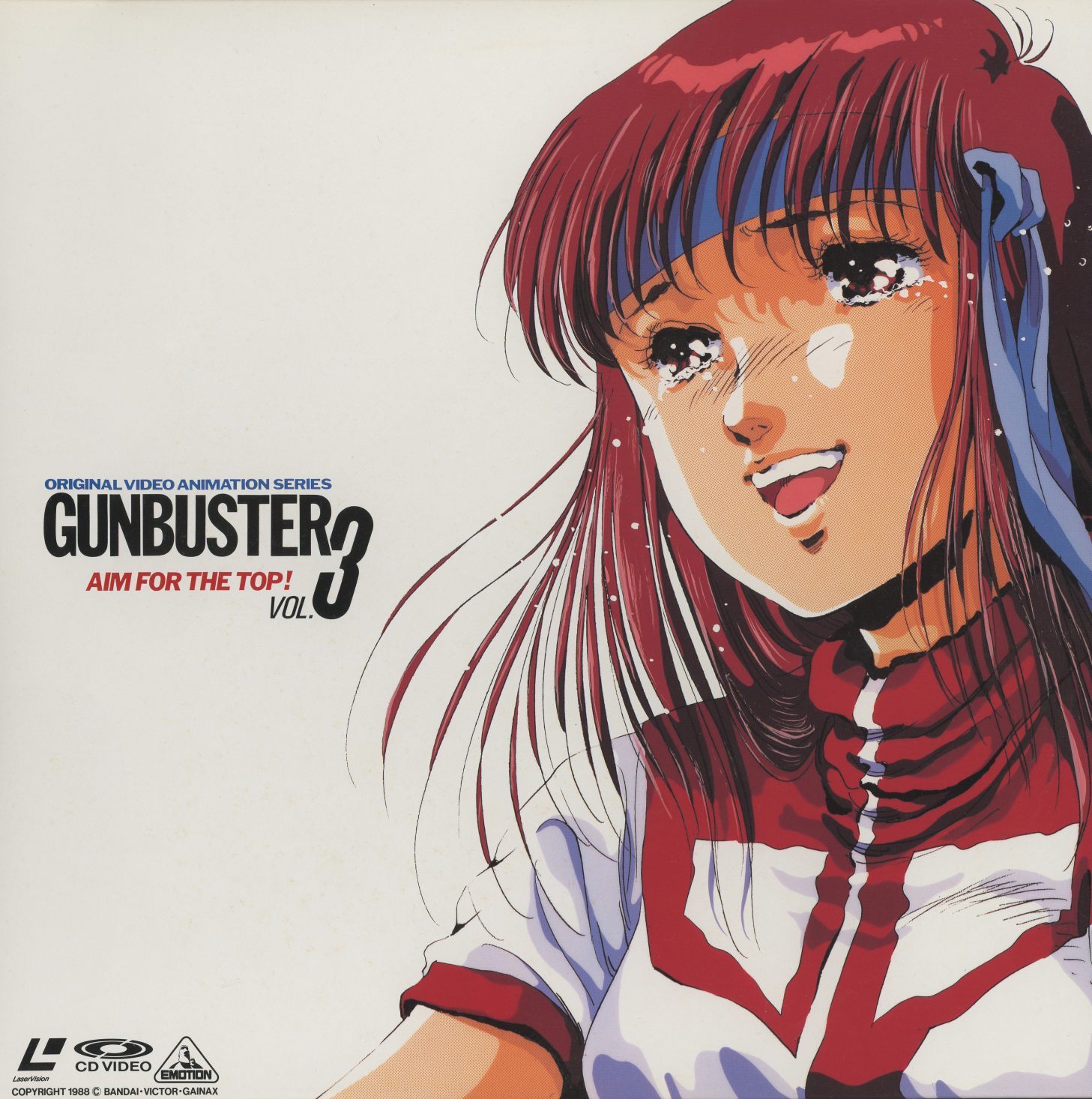 Original Vol. 3 jacket front (BEAL-211, July 1989). Noriko's face in closeup — eyes bright with tears, stars reflected. 'GUNBUSTER AIM FOR THE TOP! VOL.3.' The jacket art finally matches what the series became. No comedy. No ensemble. Just the weight.
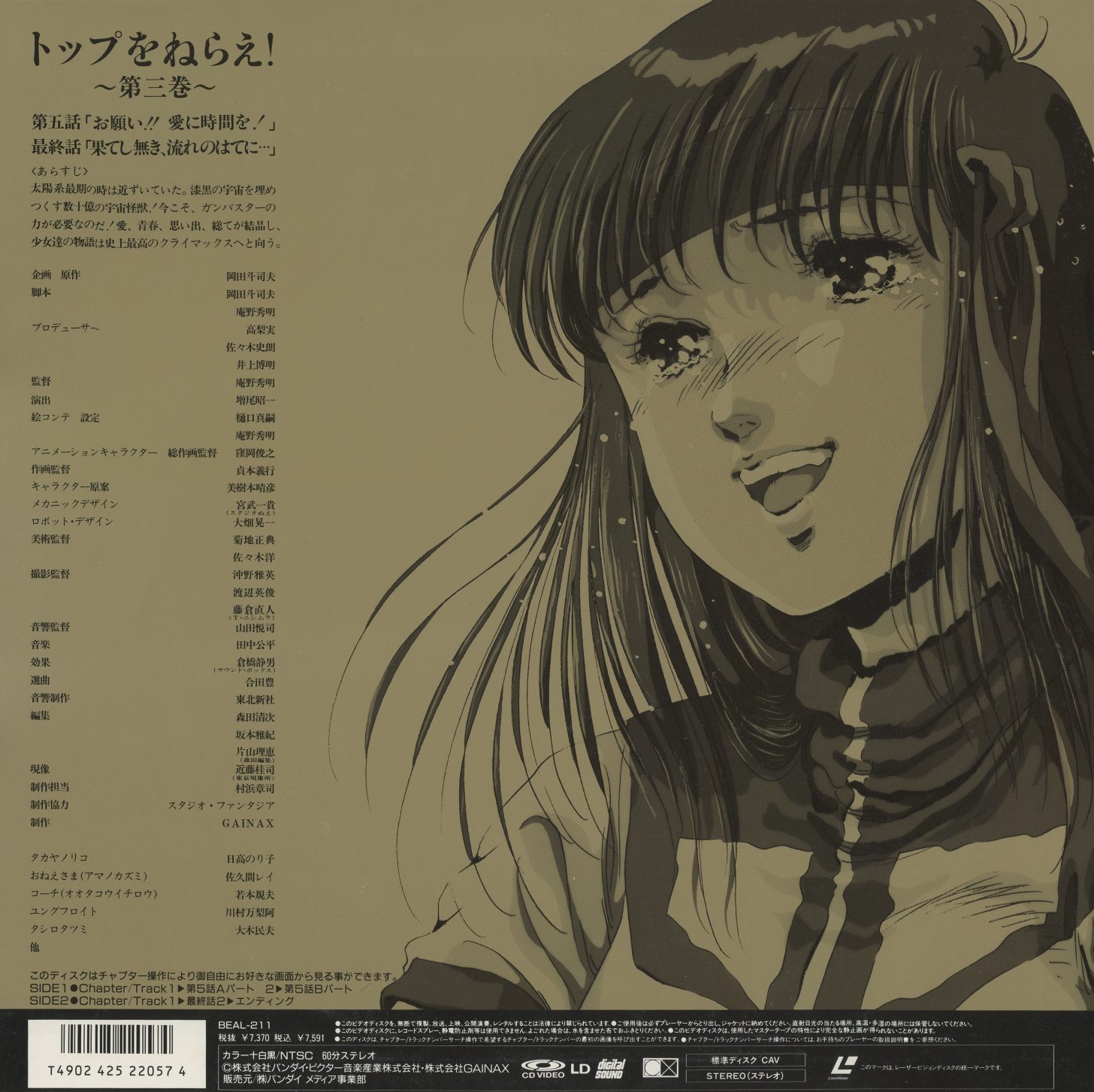 Original Vol. 3 jacket back. Kazumi Amano in sepia — a portrait more intimate than any other jacket in the set. Full staff credits for episodes 5-6: directed by Hideaki Anno, animation direction by Yoshiyuki Sadamoto. The credits for the final episode, the black-and-white one, printed on a jacket that chose warmth over gravity.
The Okaerinasai Box was released in March 1994. Evangelion would begin airing in October 1995. Between those dates, Anno wrote "lost paradigm" — an essay about the shared language that made OVA anime possible, published inside a LaserDisc box set for the show that proved he could direct. The original volumes sold Gunbuster as what it started as: a comedy about a girl and her robot. The Okaerinasai Box sells it as what it became. Neither the 2004 DVD remaster nor the 2012 Blu-ray includes the kirinuki book, the halftone jacket backs, or the essay.
Loading...