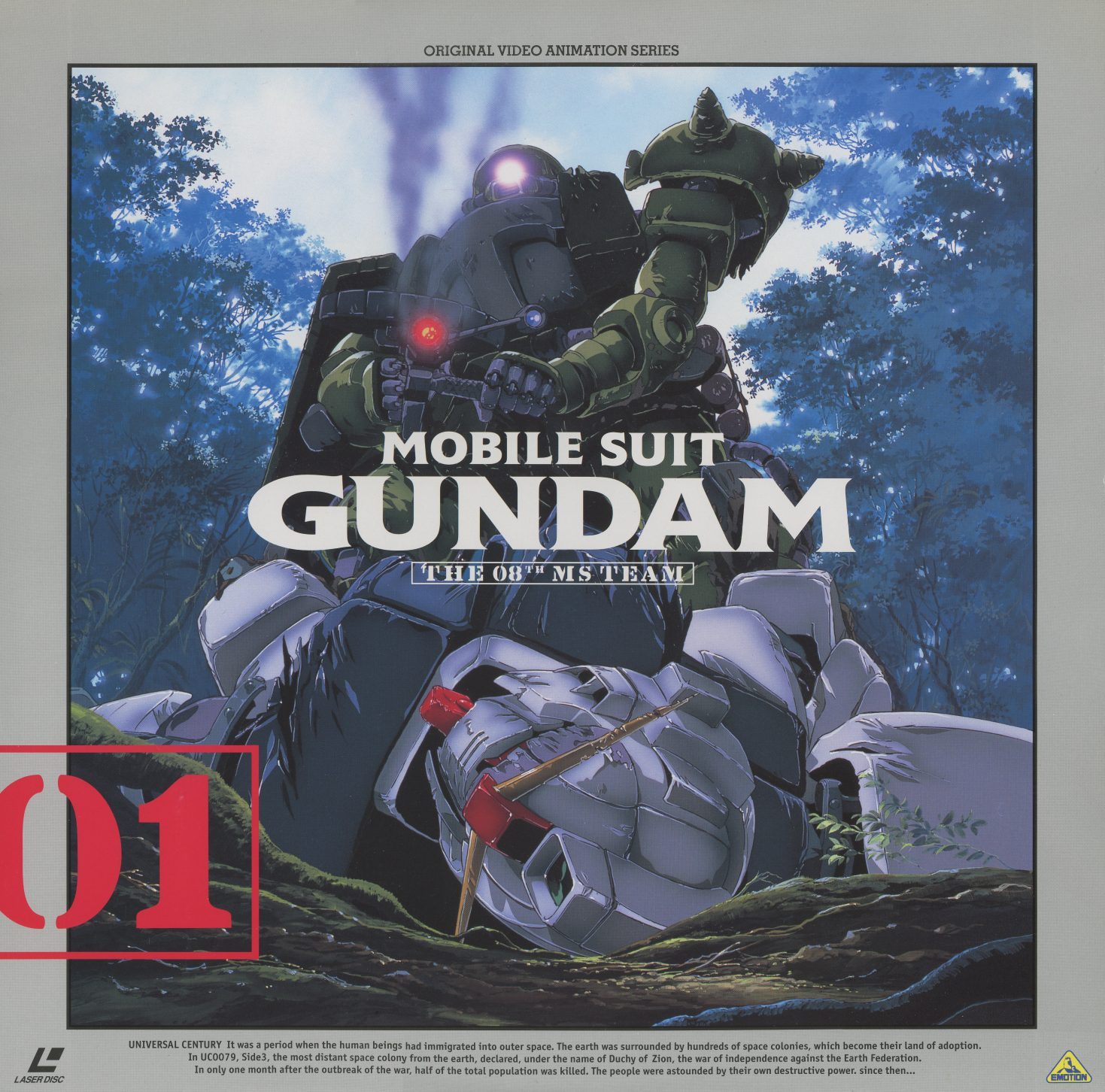
BEAL-859 through BEAL-868. Eleven individual CAV discs. ¥4,660 each. The first volume shipped January 25, 1996. The last — an epilogue called Last Resort, cataloged separately as BEAL-1412 — shipped July 25, 1999, carrying the Gundam 20th Anniversary logo on its jacket. Three and a half years between the first disc and the last. Two directors. One death. And a production schedule that fractured so visibly that Bandai Visual included a handwritten apology in the second volume's packaging.
A Federation ground forces lieutenant named Shiro Amada takes command of the 08th Mobile Suit Team on the Southeast Asian front during the final months of the One Year War. He encounters Aina Sahalin, a Zeon test pilot — and what begins as a military procedural about infantry-scale mecha combat becomes a love story between two soldiers on opposite sides of a war neither of them started. Director Takeyuki Kanda, a Sunrise veteran whose childhood evacuation from postwar Korea shaped his preoccupation with civilians in conflict, built the series around the weight of ground combat — mobile suits that overheat, sink in mud, and break down. Kanda died in a car accident on July 27, 1996, six episodes into production. Umanosuke Iida completed the remaining six.
The LaserDisc release doesn't narrate this story. But it documents it. The gaps between volumes — monthly cadence for the first two, then a seven-month silence, then irregular bursts, then another nine-month gap before the final stretch — map directly onto Kanda's death and the production's recovery. Each volume includes a color-coded CHARACTER FILE settei insert, building a complete design archive across ten numbered sheets. Buyers who collected all ten volumes received a bonus booklet (BEAL-009) containing a One Year War timeline, full character and mecha profiles, staff and cast commentary, and guest illustration pages. The release is a production diary in the shape of an OVA series.
Volume 01
BEAL-859, January 25, 1996. The only volume with two episodes — 'War for Two' and 'Gundams in the Jungle' — running 50 minutes across two CAV sides. Every subsequent volume carries a single episode per disc. The jacket back lists staff credits vertically down the left spine: planning Sunrise, original story Hajime Yatate and Yoshiyuki Tomino, screenplay Akira Okeya, director Takeyuki Kanda. The cover illustration credit reads 'Cover illustration by KOICHI KUBOOKA' — Toshiyuki Kubooka, the animator and illustrator who painted all eleven jacket fronts, each one a different compositional register. Character design is credited to Toshihiro Kawamoto. Mechanical design to Hajime Katoki, Kunio Okawara, and Kimitoshi Yamane. Music by Kohei Tanaka. ¥4,660.
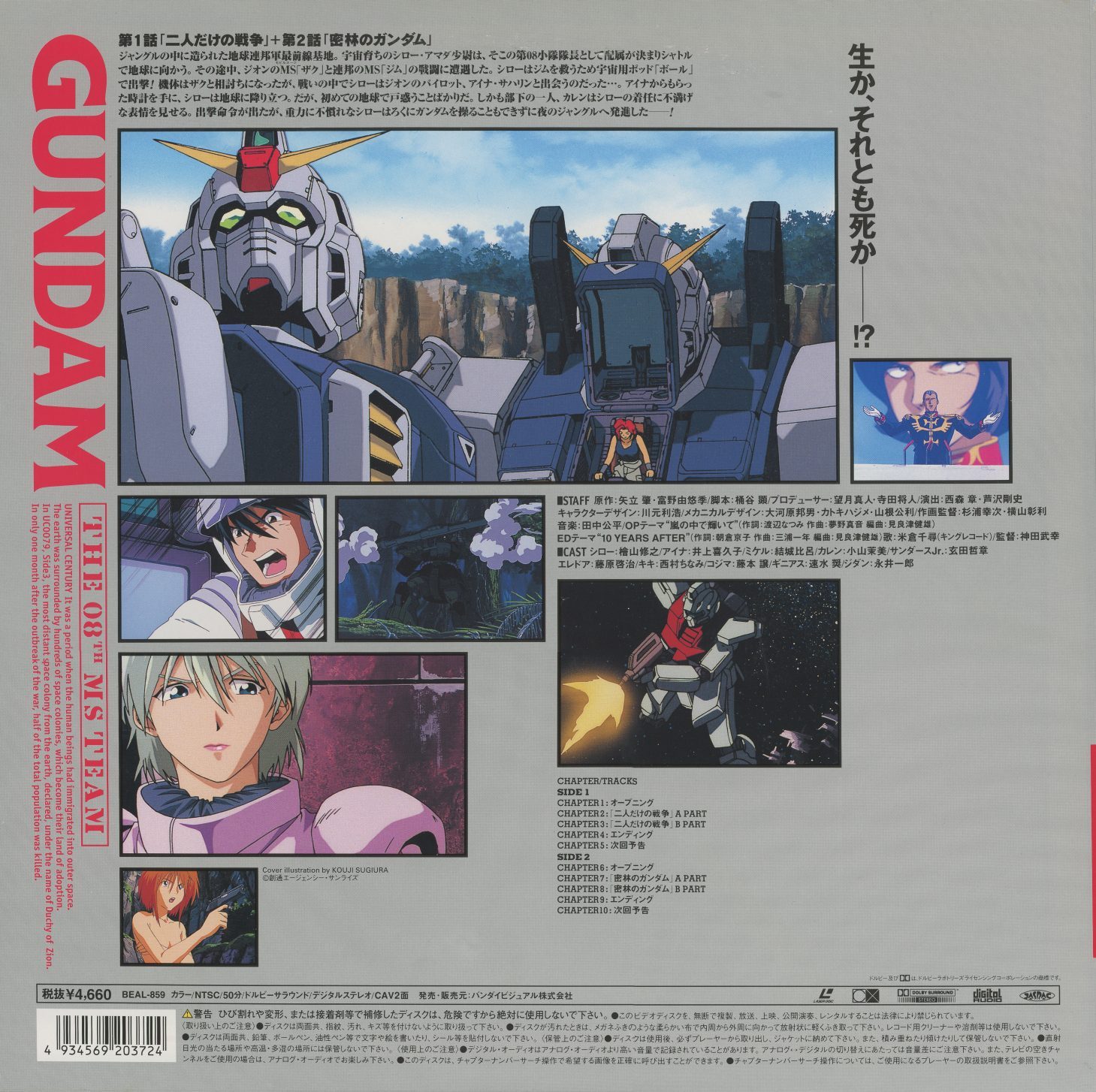 Volume 01 jacket back. Episodes 1-2 synopsis with scene captures. Chapter/track listing for Sides 1 and 2. Staff credits, price ¥4,660, CAV format, NTSC, digital sound. The tagline: 生か、それとも死か――!? (Life, or death...!?)
![CHARACTER FILE VOL.1 — blue ink. The first settei insert: full-body character designs for Shiro Amada, Karen Joshua, Eledore Massis, Michel Ninorich, Terry Sanders Jr., plus RX-79[G] Gundam Ground Type three-view and the 08th Team's Hover Truck. Kawamoto character designs and Katoki mechanical designs. This is the first page of an archive that builds across ten volumes.](/images/posts/gundam-08th-ms-team-laserdisc-vol01-settei-character-file.jpg) CHARACTER FILE VOL.1 — blue ink. The first settei insert: full-body character designs for Shiro Amada, Karen Joshua, Eledore Massis, Michel Ninorich, Terry Sanders Jr., plus RX-79[G] Gundam Ground Type three-view and the 08th Team's Hover Truck. Kawamoto character designs and Katoki mechanical designs. This is the first page of an archive that builds across ten volumes.
CHARACTER FILE VOL.1 — blue ink. The first settei insert: full-body character designs for Shiro Amada, Karen Joshua, Eledore Massis, Michel Ninorich, Terry Sanders Jr., plus RX-79[G] Gundam Ground Type three-view and the 08th Team's Hover Truck. Kawamoto character designs and Katoki mechanical designs. This is the first page of an archive that builds across ten volumes.
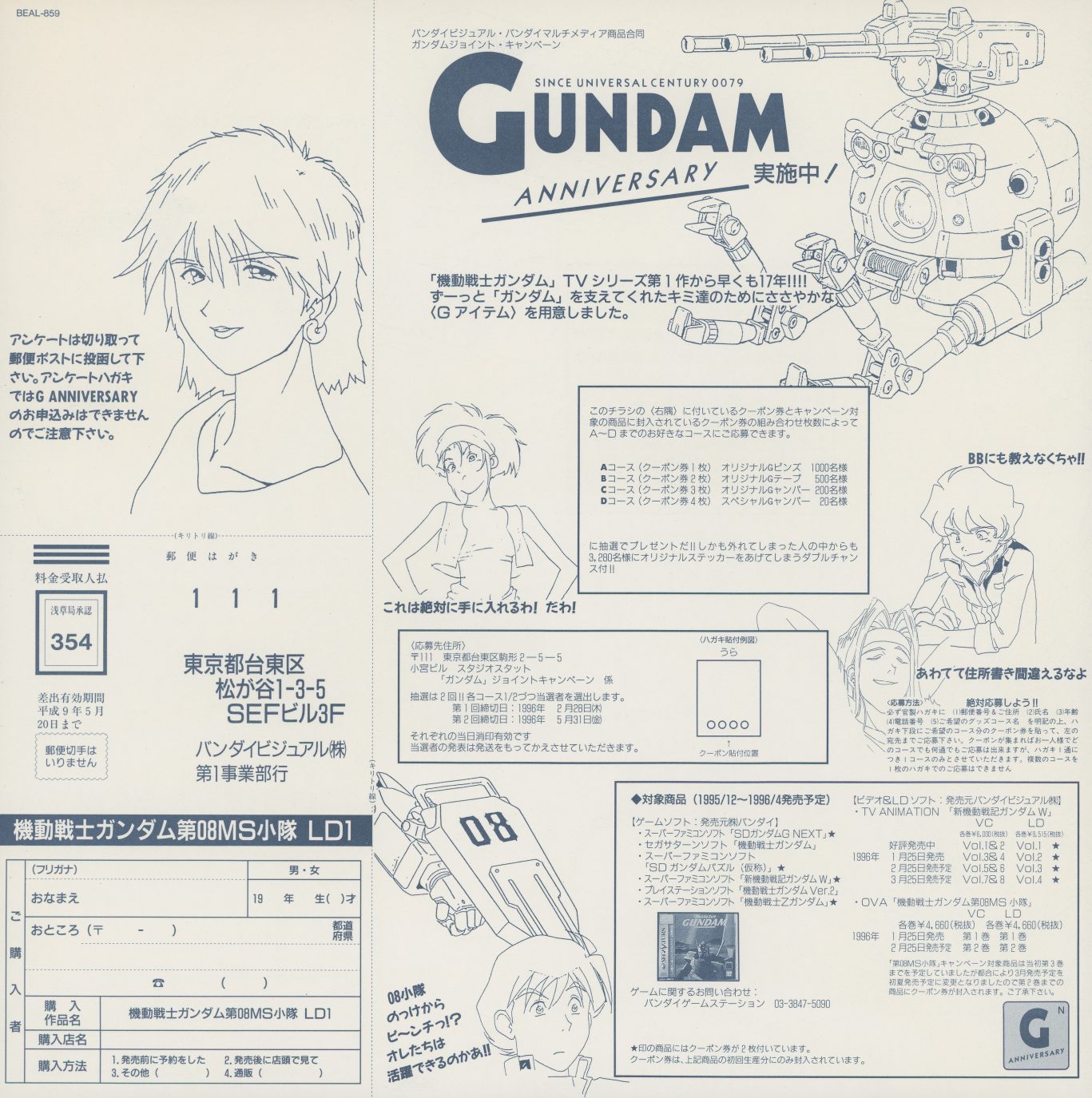 Gundam Anniversary campaign insert — front. Mail-in postcard for the 'G Anniversary' promotion celebrating 17 years of Mobile Suit Gundam. Character sketches of Shiro and the 08th Team. Addressed to Bandai Visual, Matsugaya 1-3-5, SEF Building 3F, Taito-ku, Tokyo.
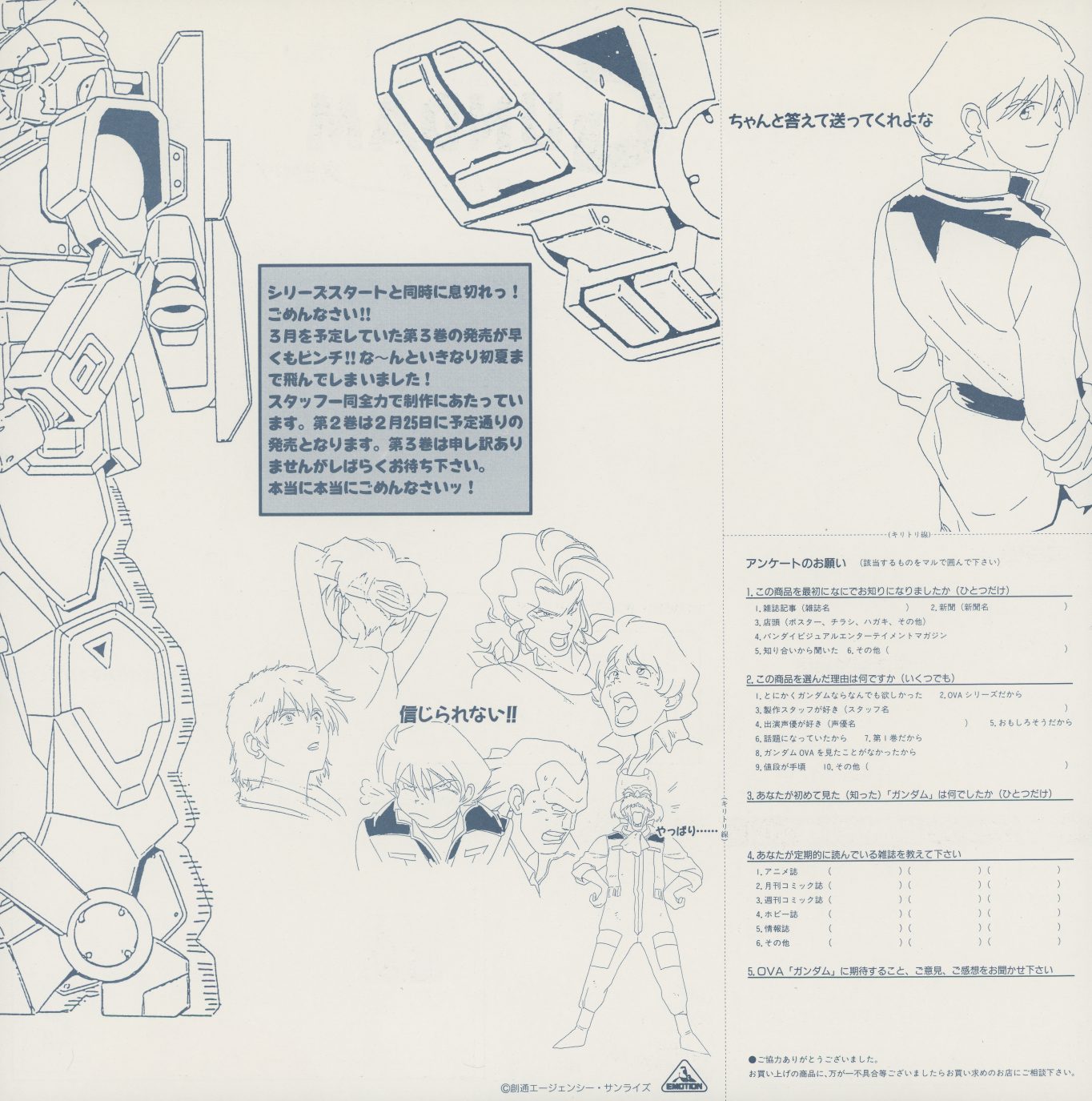 Anniversary campaign insert — back. Survey questionnaire and apology note from the production staff: 'The deadline hit at the same time as the series start! Sorry!! Volume 3, which we planned for March, has been pushed all the way to early summer...' The delays had already begun.
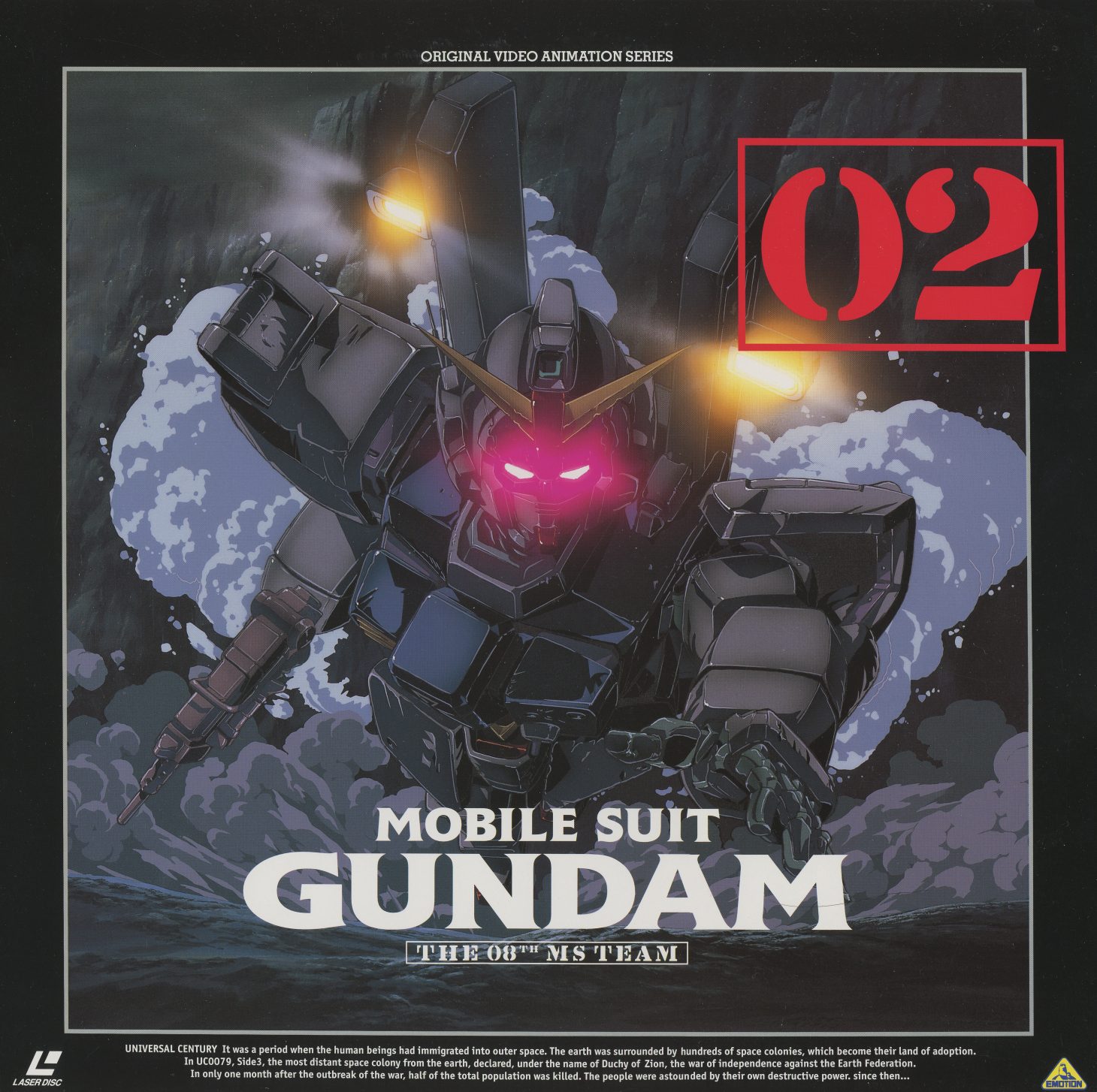 Volume 02 jacket front (BEAL-860). The Ez-8 Gundam emerging from darkness, monoeye glowing red — the only jacket where the protagonist's machine is rendered as a threat. March 1996.
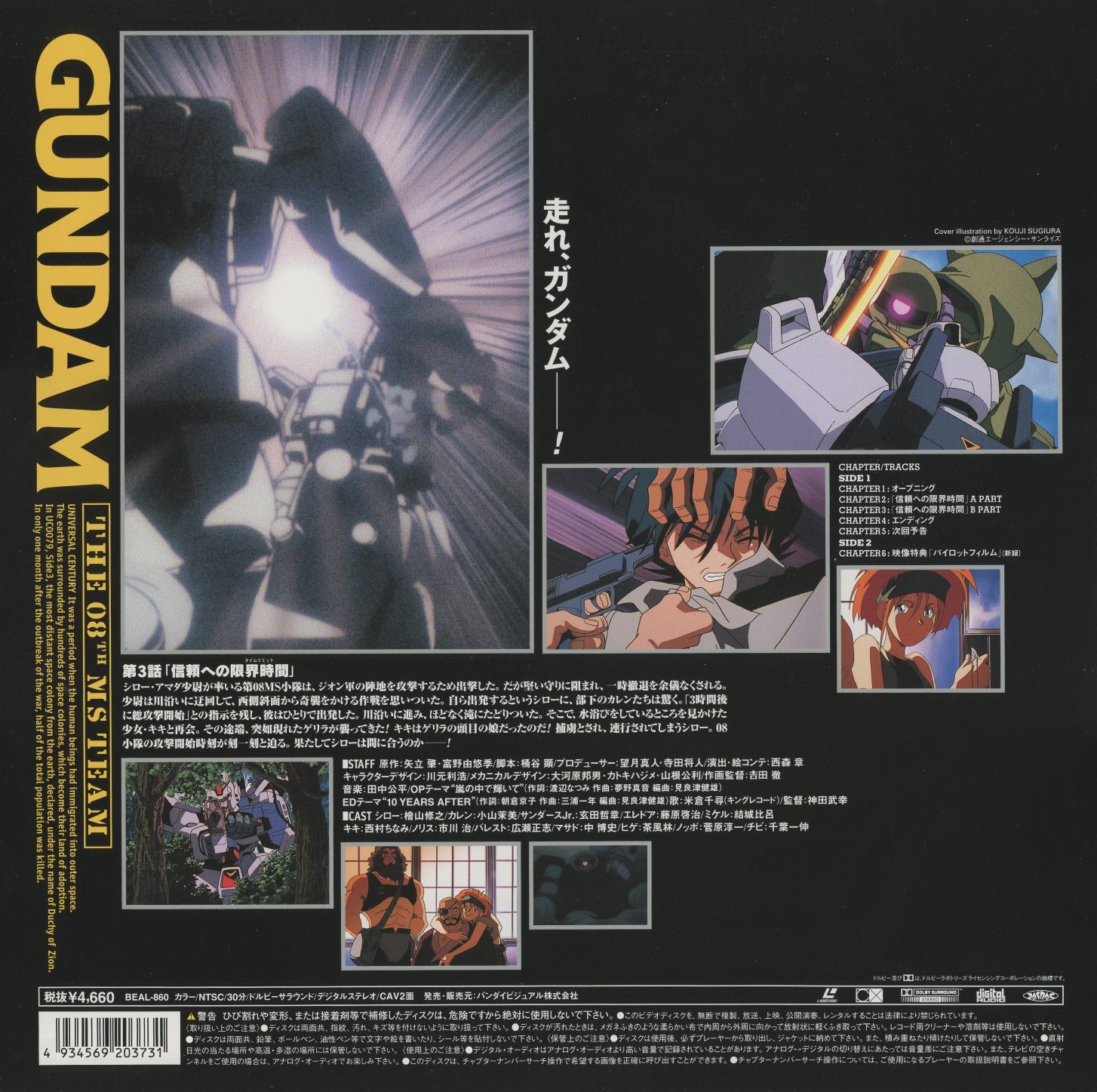 Volume 02 jacket back. Episode 3: 信頼への限界時間 ('The Time Limit on Trust'). Tagline: 走れ、ガンダム――! ('Run, Gundam!') Chapter/track listing plus Side 2 pilot film bonus. ¥4,660.
ごめんなさい!!
Volume 02 includes an insert that no other Gundam LaserDisc release contains: a full-page apology. The header reads ごめんなさい!! in large brush-style text — 'We're sorry!!' Below it, in handwritten production staff notes surrounded by chibi character sketches: 'The deadline hit at the same time as the series start, and again we've made you wait! We're truly sorry for this second volume too!! The staff are putting everything into production. Volume 2 will release February 25 as planned. Volume 3, we're sorry to say, will be a bit longer — please wait a little more. We really are truly sorry!!' The insert is illustrated with deformed versions of the cast — Shiro bowing, the Ez-8 slumped in embarrassment, Sanders looking exasperated. Four months later, Takeyuki Kanda would be dead. The delays the staff was apologizing for had not yet acquired their real cause.
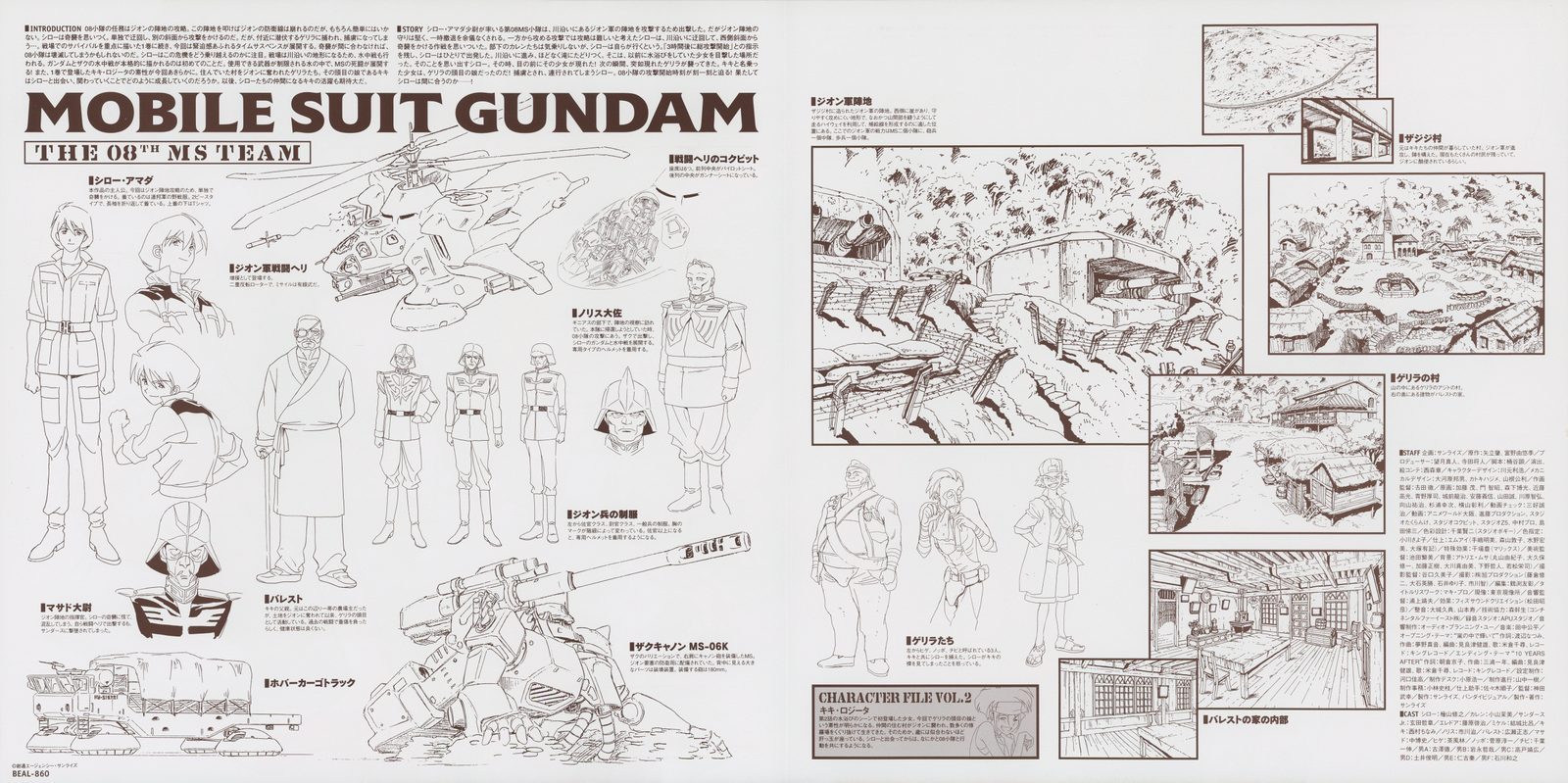 CHARACTER FILE VOL.2 — brown ink. Second settei insert: new characters introduced in Episode 3, Zeon forces and mobile suits including the MS-06J Zaku II Ground Type, background architecture, and military vehicle designs.
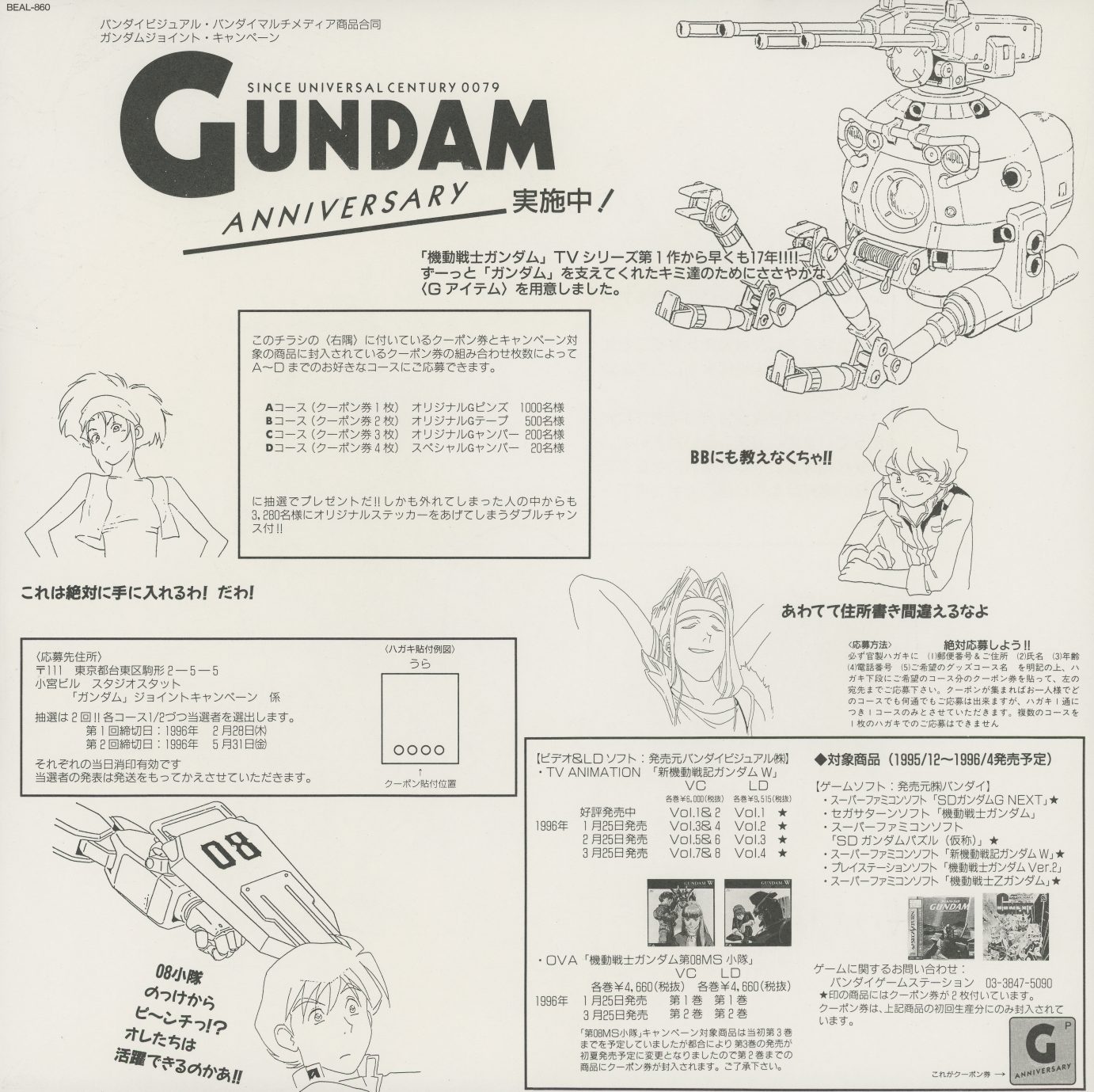 Gundam Anniversary campaign insert — Volume 02 variant. Updated release schedule listing: Vol 1 (January), Vol 2 (February 25), Vol 3 (delayed). Prize tiers for the G Anniversary mail-in campaign. Target products listed through 1996/4 (April 1996 projected).
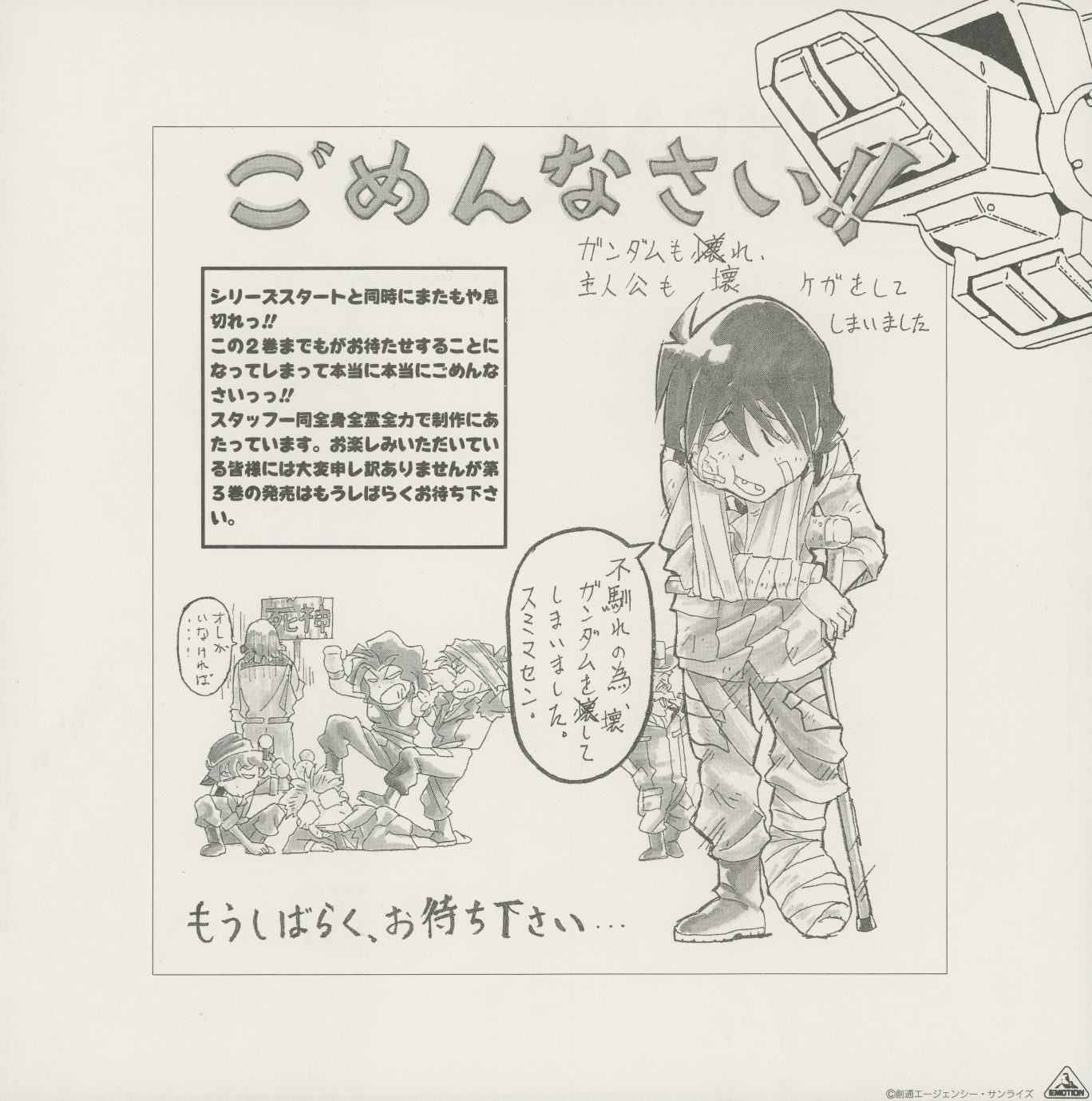 The apology insert — back side. ごめんなさい!! header with chibi Shiro bowing. Staff message: もうしばらく、お待ち下さい… ('Please wait a little longer...'). Production survey form at right. The Gundam is broken; the protagonist is bowing; the staff are drawn scrambling.
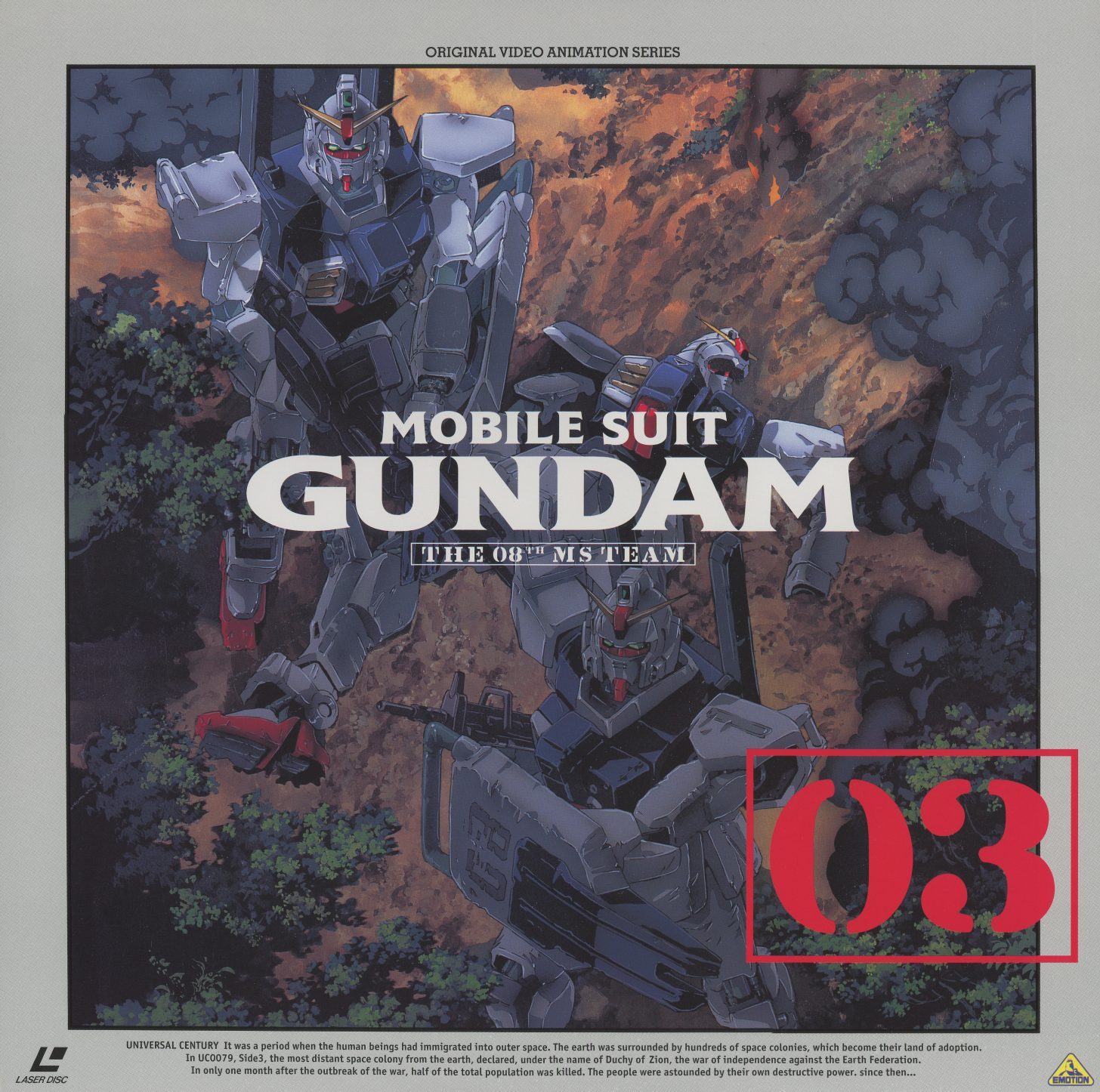 Volume 03 jacket front (BEAL-861). Ez-8 in jungle combat, the most kinetic composition in the series — the mobile suit mid-stride through jungle canopy with beam saber drawn. October 1996. The seven-month gap from Volume 02 (March) to Volume 03 (October) is the first visible scar.
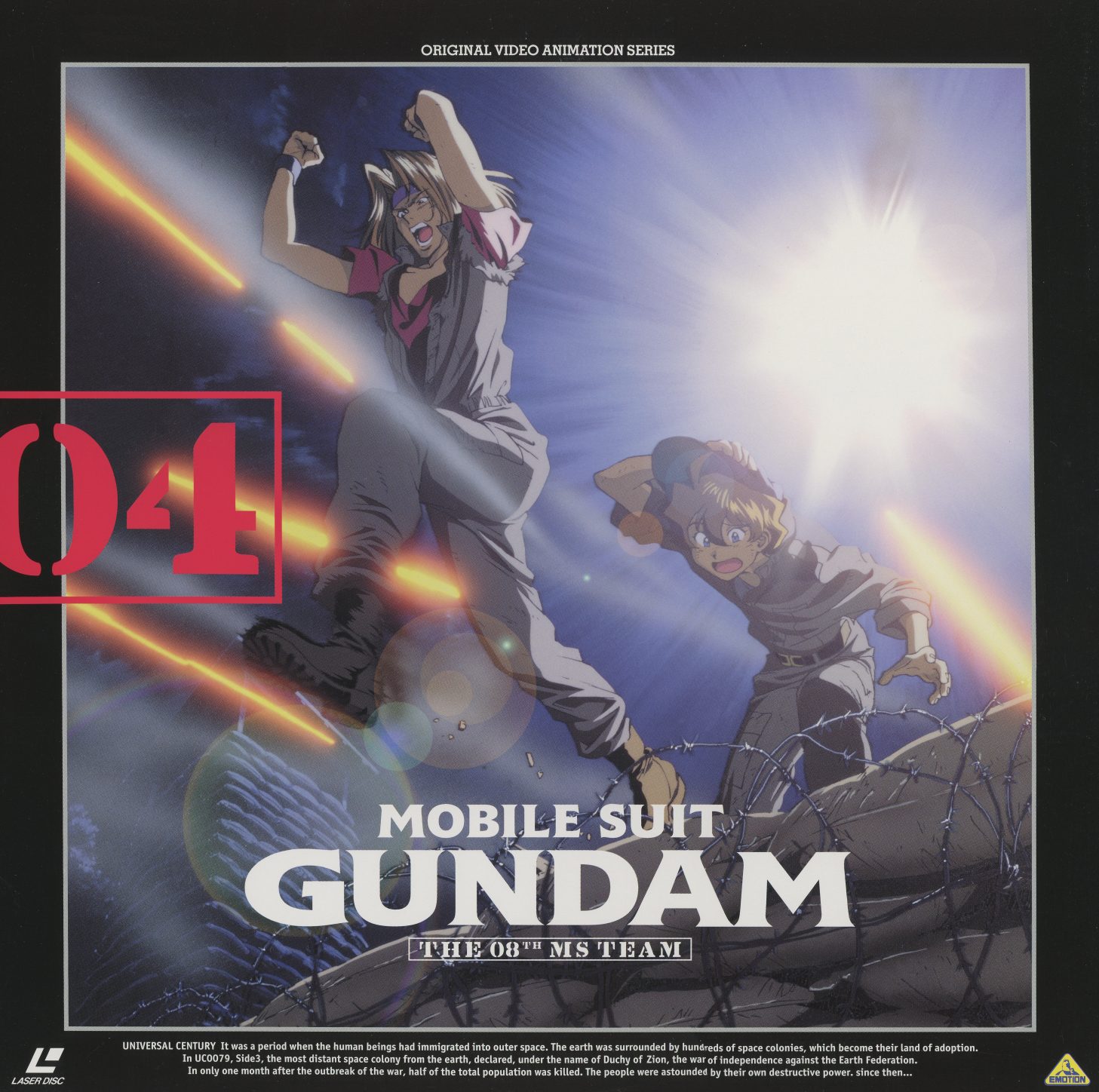 Volume 04 jacket front (BEAL-862). Shiro and Aina in freefall — the only jacket in the first half that leads with human figures instead of mobile suits. November 1996. Kubooka's composition shifts from military illustration to character drama.
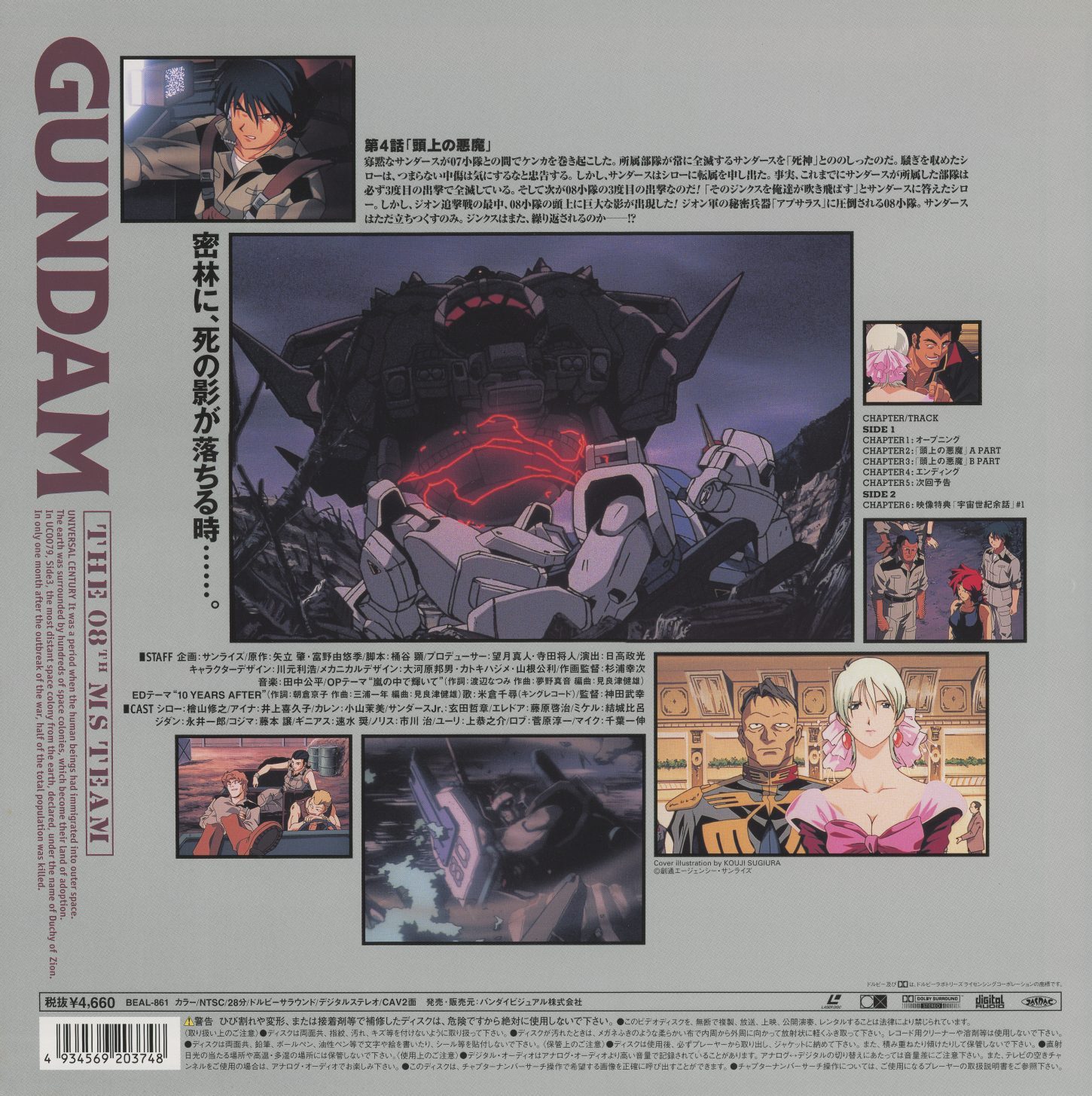 Volume 03 jacket back. Episode 4: 頭上の悪魔 ('The Demon Overhead'). Tagline: 密林に、死の影が落ちる時…… ('When the shadow of death falls on the jungle...'). ¥4,660.
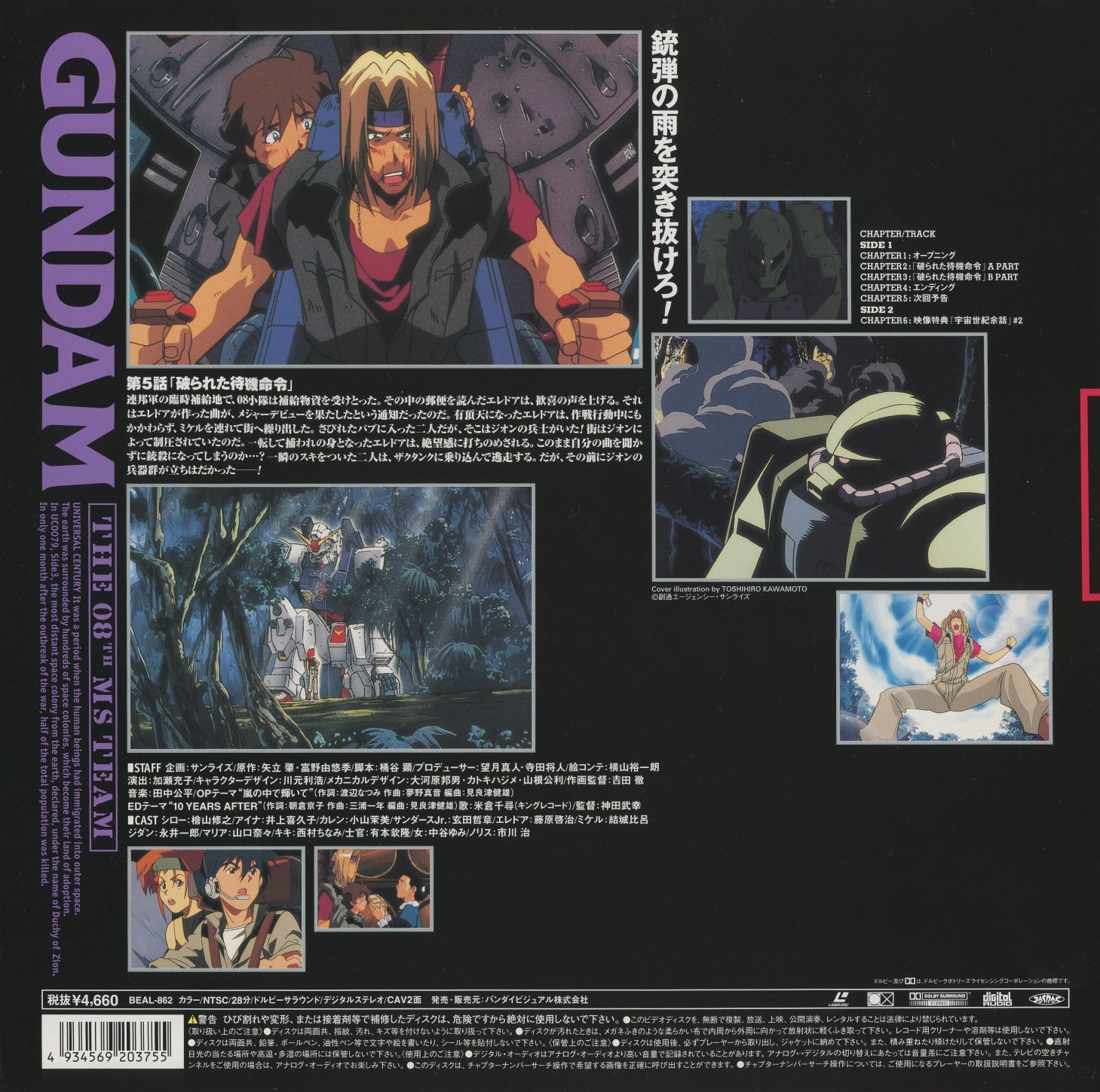 Volume 04 jacket back. Episode 5: 破られた待機命令 ('The Broken Order to Stand By'). Tagline: 銃弾の雨を突き抜けろ! ('Break through the rain of bullets!'). ¥4,660.
The Character Files
Every volume includes a double-sided settei insert titled CHARACTER FILE, printed in a single ink color that changes with each volume. The progression — blue, brown, red, blue, green, green, gold, teal, red-brown, gold — is not decorative. It's functional: a buyer collecting all ten can identify any sheet by its color from across a room. Each insert covers the new characters, mobile suits, vehicles, weapons, and background architecture introduced in that volume's episode. Kawamoto's character designs are drawn at model-sheet scale with turnarounds and expression notes. Katoki's mechanical designs include multi-view orthographics, cockpit layouts, and weapon specifications. Across ten sheets, the CHARACTER FILE assembles a complete production design reference for the entire series — settei that would otherwise exist only in the studio's internal documentation.
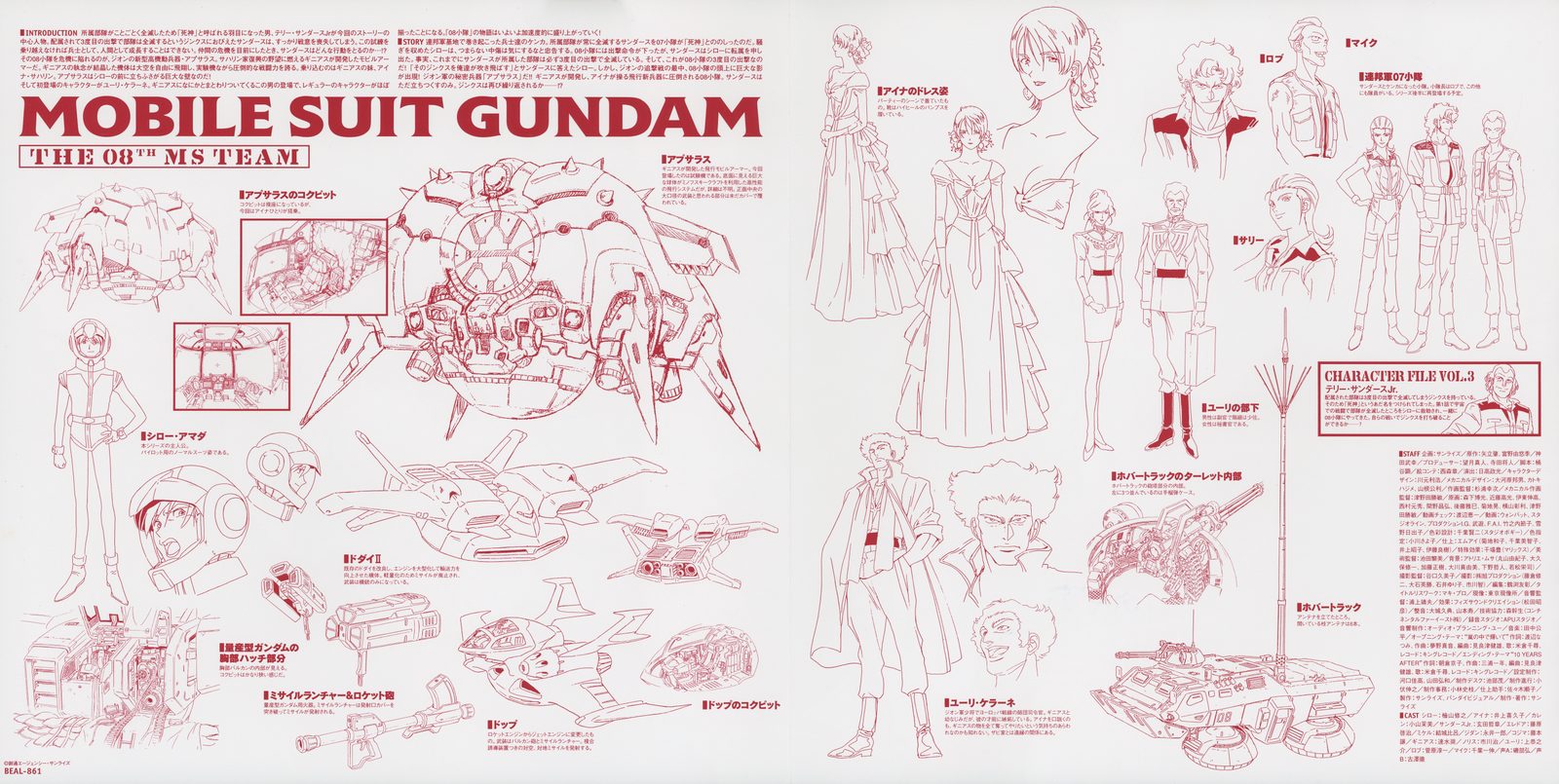 CHARACTER FILE VOL.3 — red ink. Apsaras mobile armor three-view, Aina Sahalin full-body designs, Norris Packard character sheet, jungle terrain background layouts, and Zeon ground vehicles. The red ink distinguishes this sheet immediately from the blue (Vol.1) and brown (Vol.2).
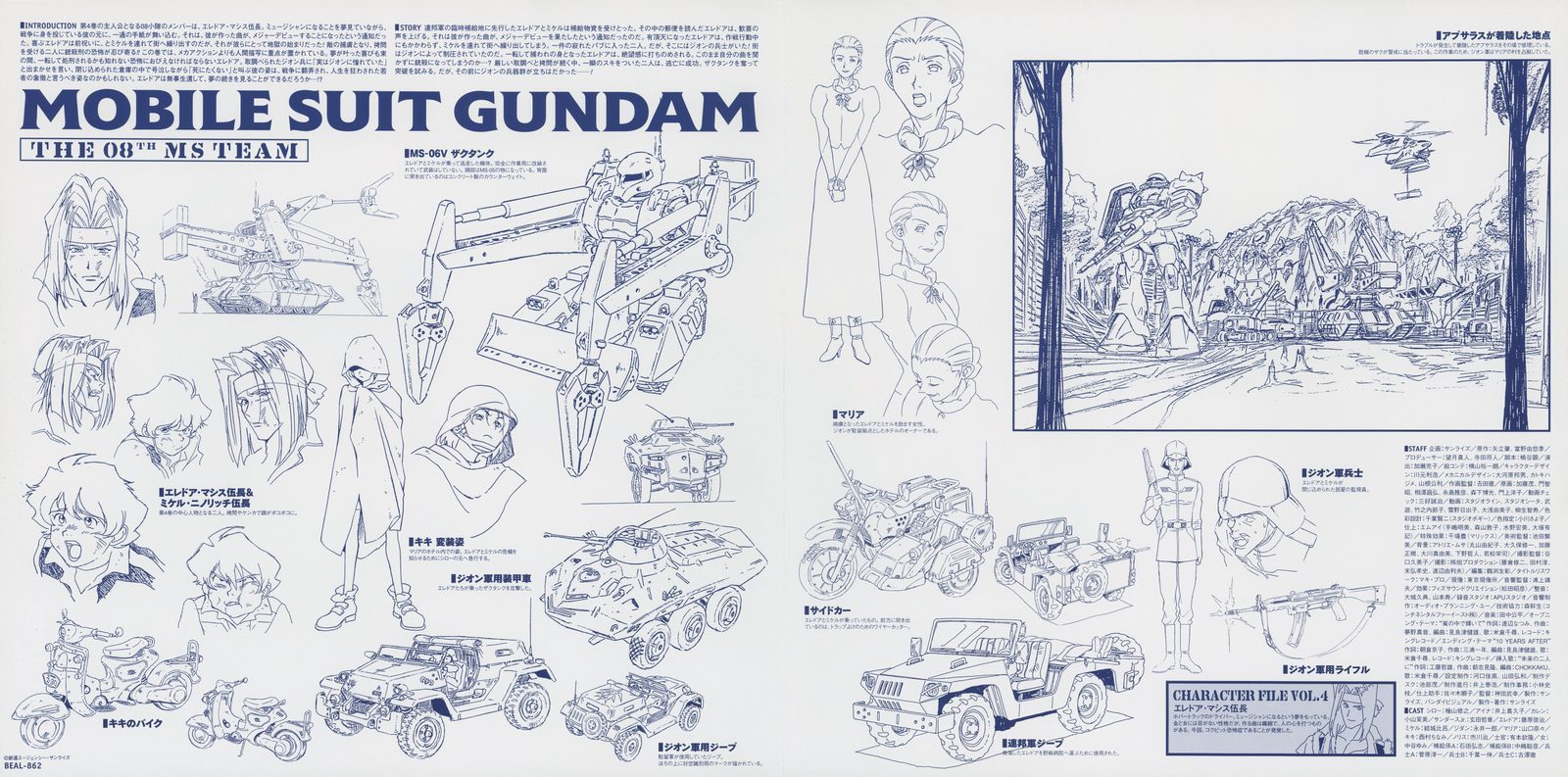 CHARACTER FILE VOL.4 — blue ink (second use, distinguished from Vol.1 by content). New mobile suit variants, additional Zeon ground forces, civilian character designs, and expanded vehicle settei.
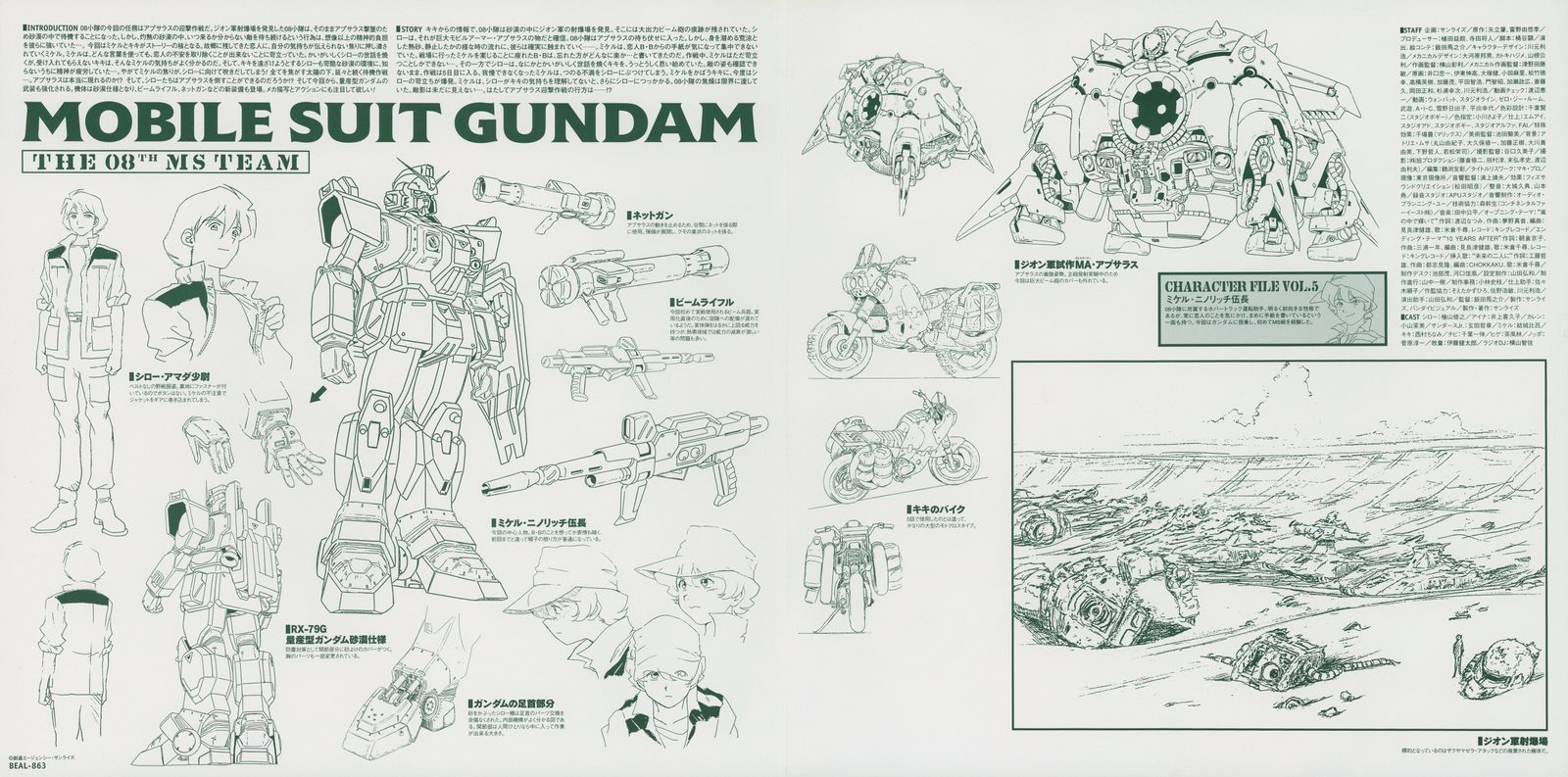 CHARACTER FILE VOL.5 — green ink. Military vehicles, ground-combat mobile suit accessories, Apsaras development variants, and battlefield environment designs including ruined structures and fortifications.
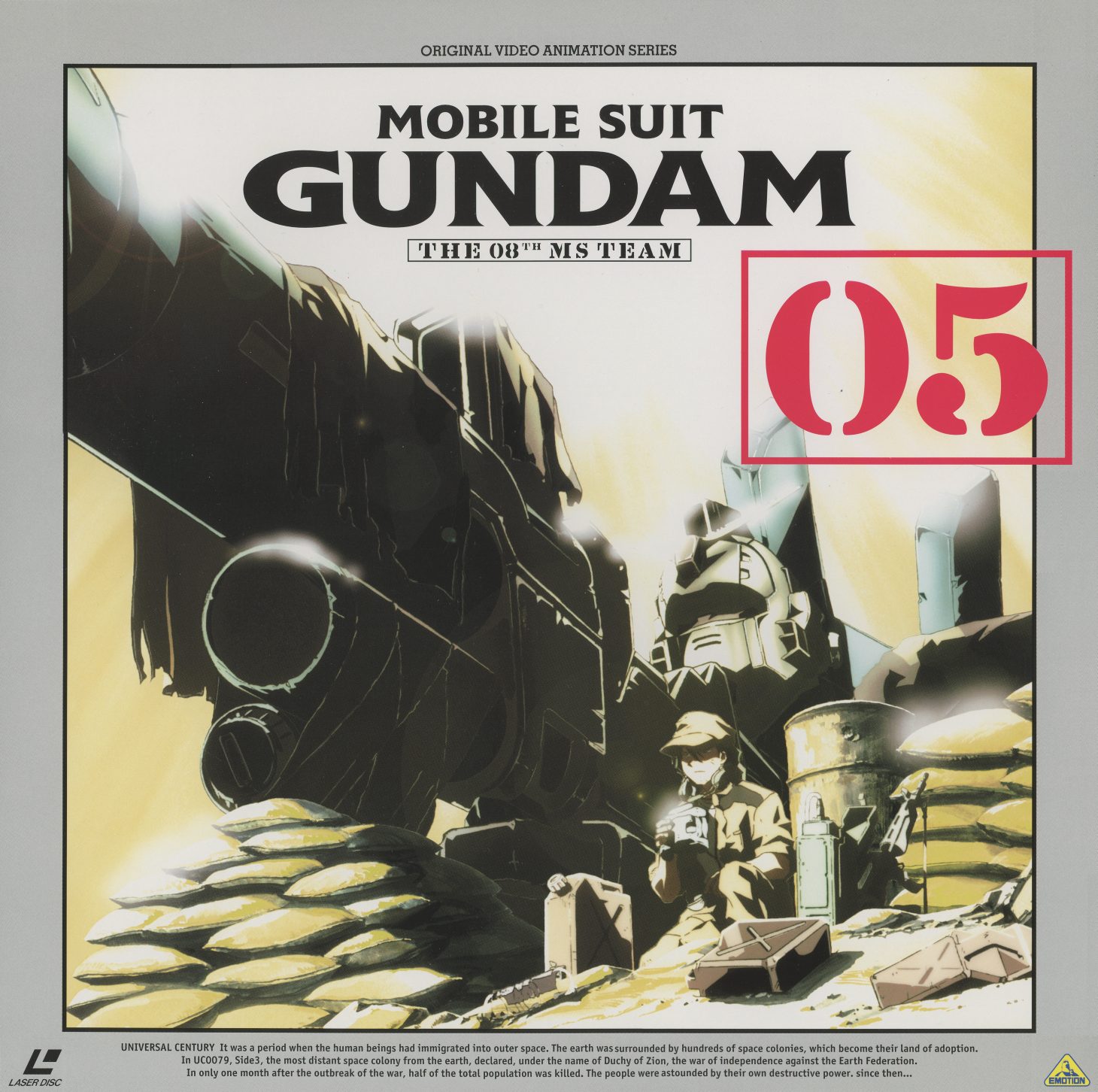 Volume 05 jacket front (BEAL-863). Federation soldiers with sandbags and supply train — the most restrained composition, pulling the camera back from the mobile suit to show the war's human-scale infrastructure. December 1996. The last volume Kanda directed.
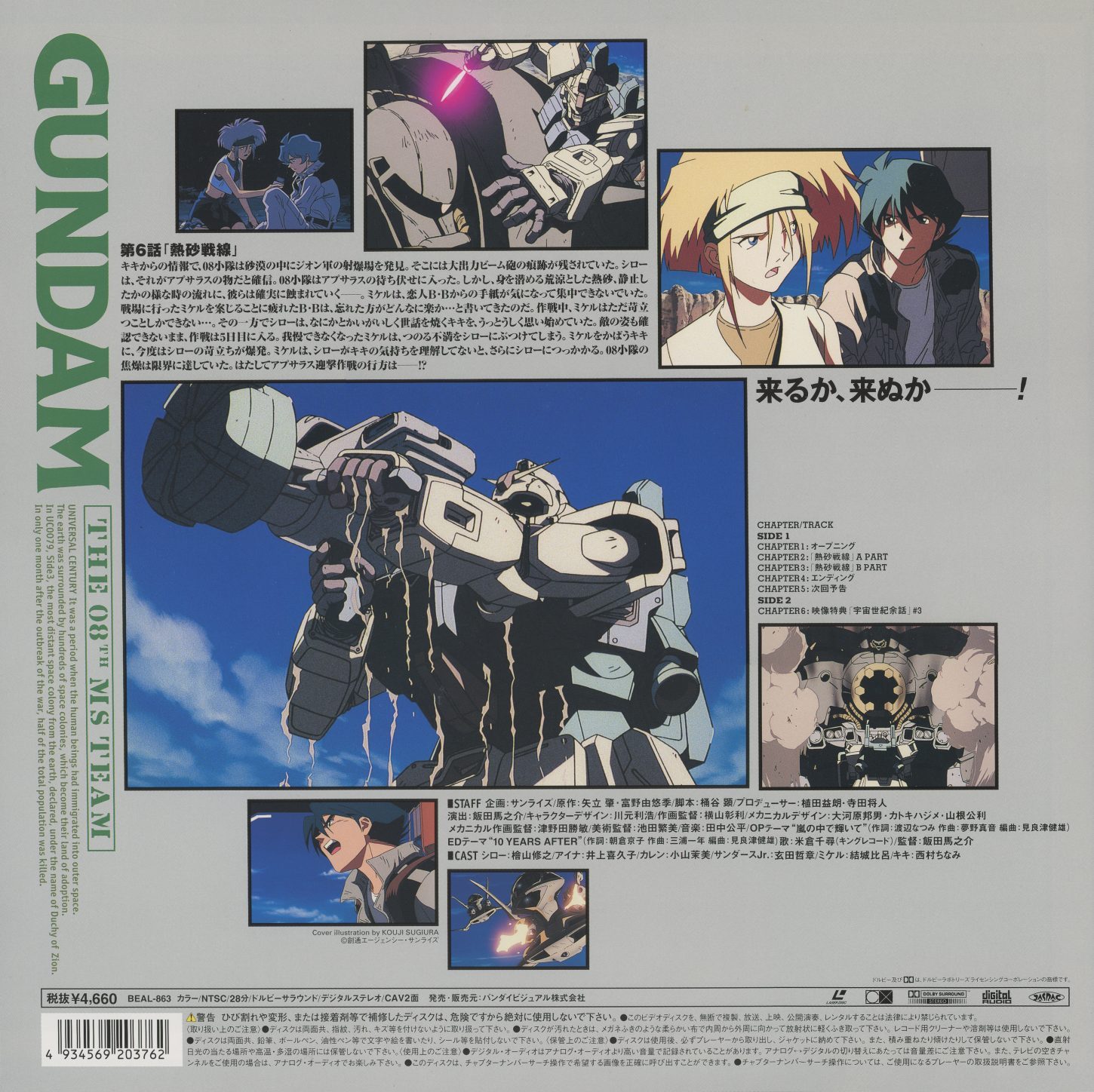 Volume 05 jacket back. Episode 6: 熱砂戦線 ('Battle Line on Burning Sand'). Tagline: 来るか、来ぬか――! ('Will they come, or won't they!') The final episode completed under Kanda's direction.
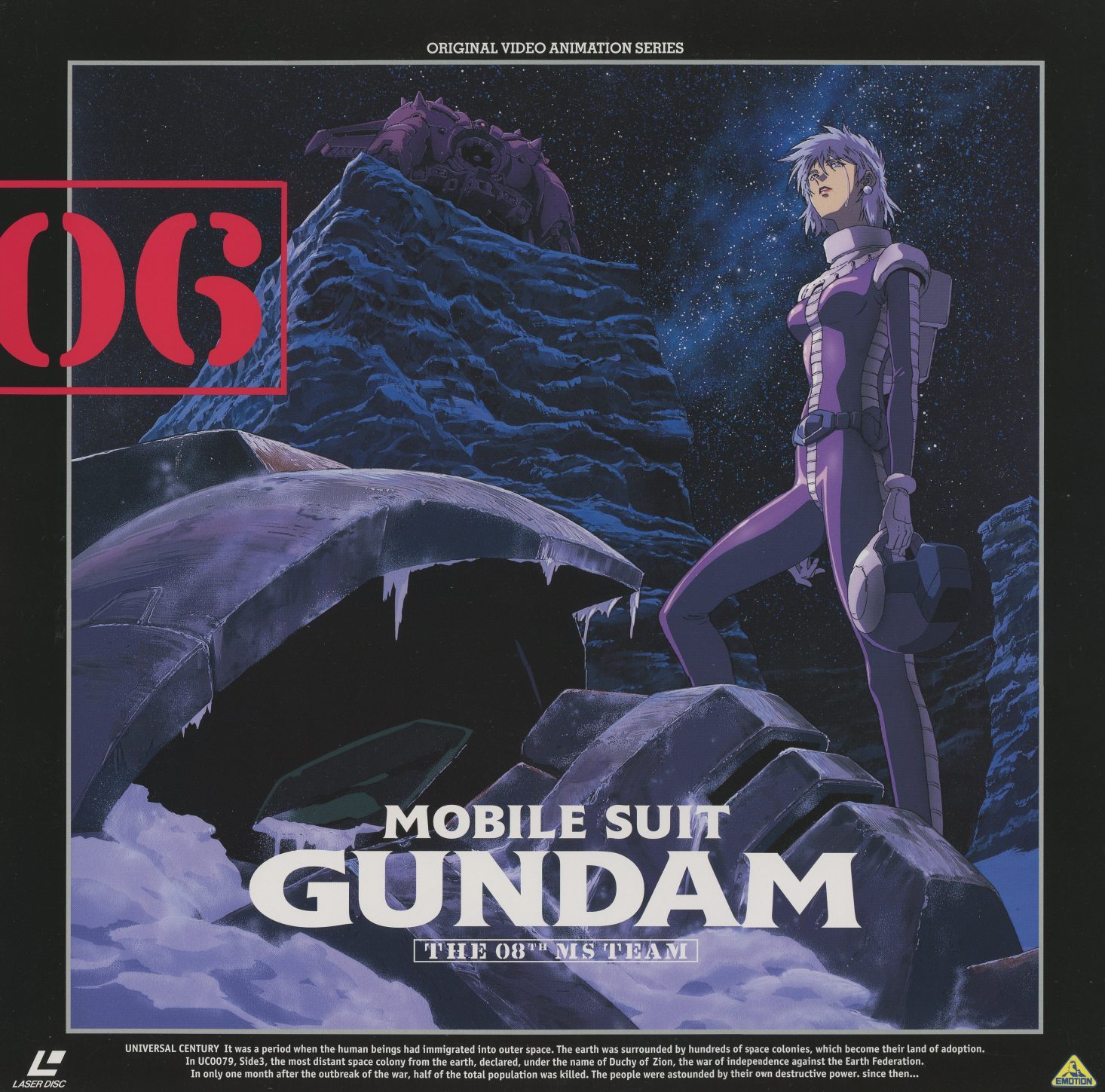 Volume 06 jacket front (BEAL-864). Aina Sahalin standing alone on wreckage under a night sky — the emotional midpoint of the series and the first jacket to place a single character in contemplative isolation. October 1997. Ten months after Volume 05. The longest gap in the release schedule.
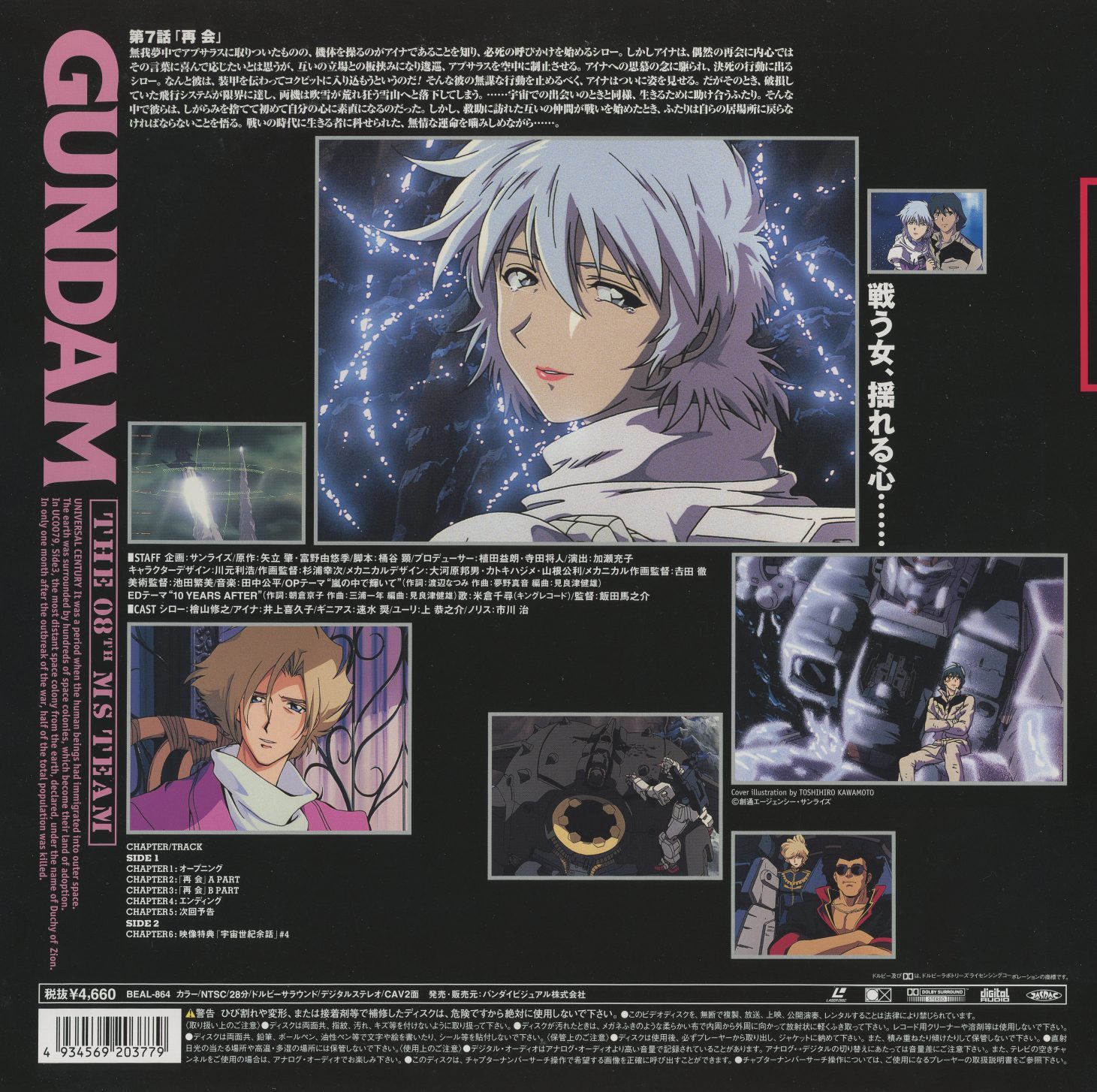 Volume 06 jacket back. Episode 7: 再会 ('Reunion'). Tagline: 戦う女、揺れる心…… ('A woman who fights, a heart that wavers...'). The director credit now reads Umanosuke Iida. Kanda's name appears nowhere on this jacket.
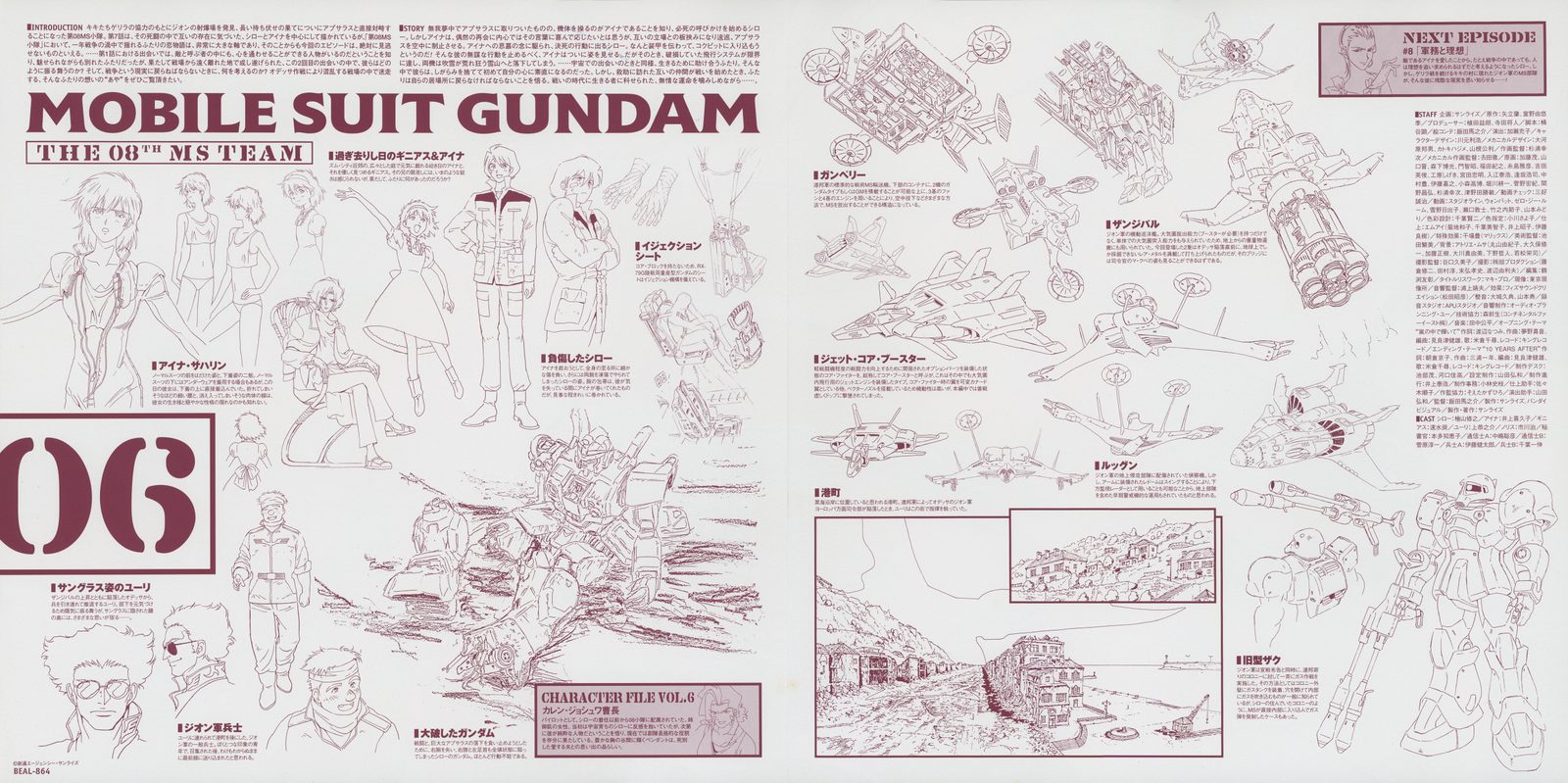 CHARACTER FILE VOL.6 — rose/maroon ink. Aina's civilian and pilot costumes, Apsaras II mobile armor redesign, ground combat vehicles, and battlefield environment designs for the new director's episodes.
After July 1996
Takeyuki Kanda died on July 27, 1996, four weeks after Volume 03 shipped. He had completed direction on episodes 1 through 6. Volumes 03 through 05 — containing episodes 4, 5, and 6 — released on schedule between October and December 1996 because the episodes were already finished. Then silence. Ten months passed before Volume 06 appeared in October 1997, carrying episode 7 and a new director credit: Umanosuke Iida. Iida described the finished work as 'Kanda's own' and attempted to honor the original vision. The jacket backs reflect the transition in the only way packaging can — a different name in the same credit position. The episodes themselves shift toward tighter character drama. The jacket art, still painted by Kubooka, grows quieter.
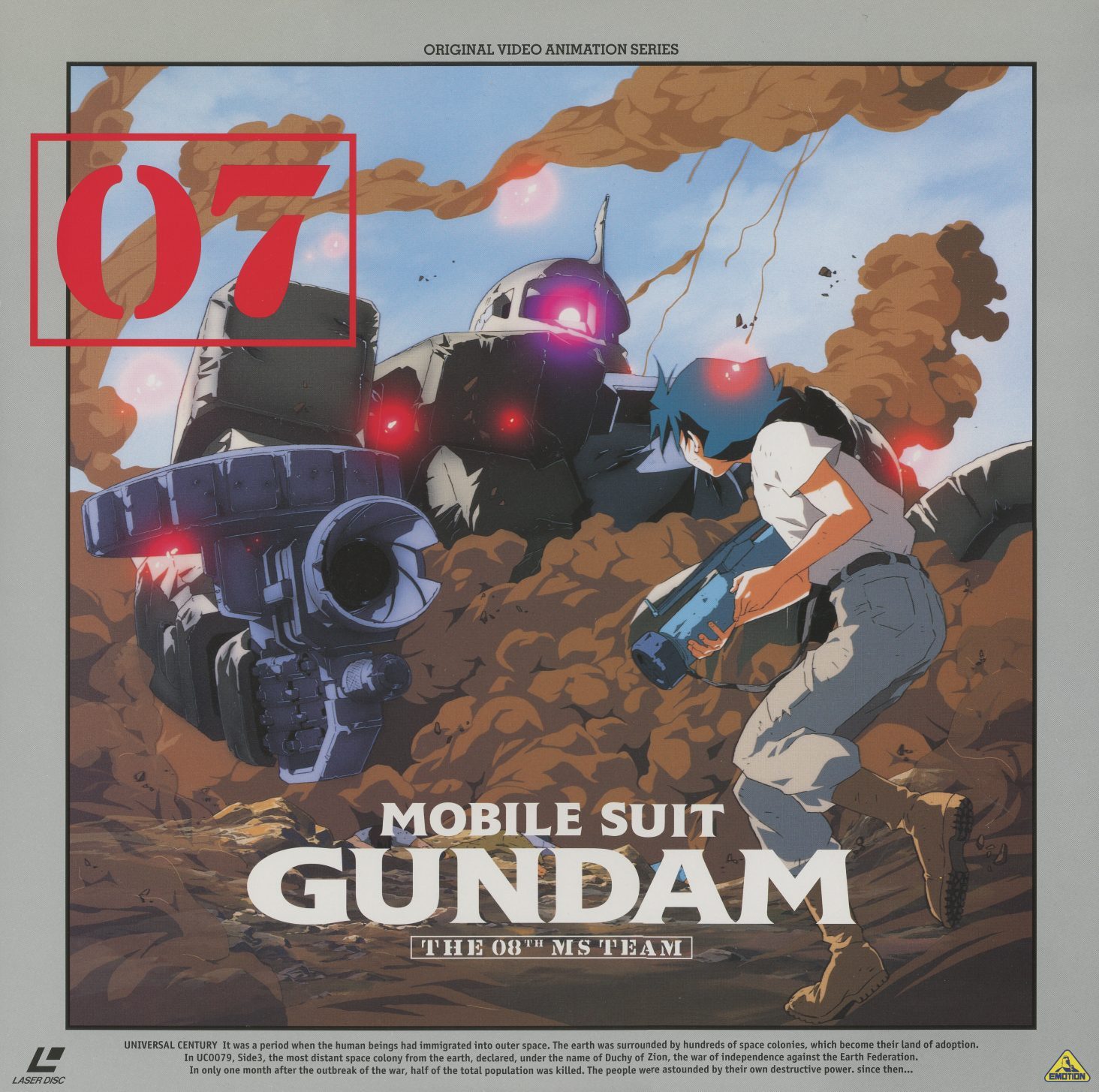 Volume 07 jacket front (BEAL-865). Shiro fighting Zaku IIs at ground level — the most visceral combat composition, viewed from below with dust and debris. December 1997.
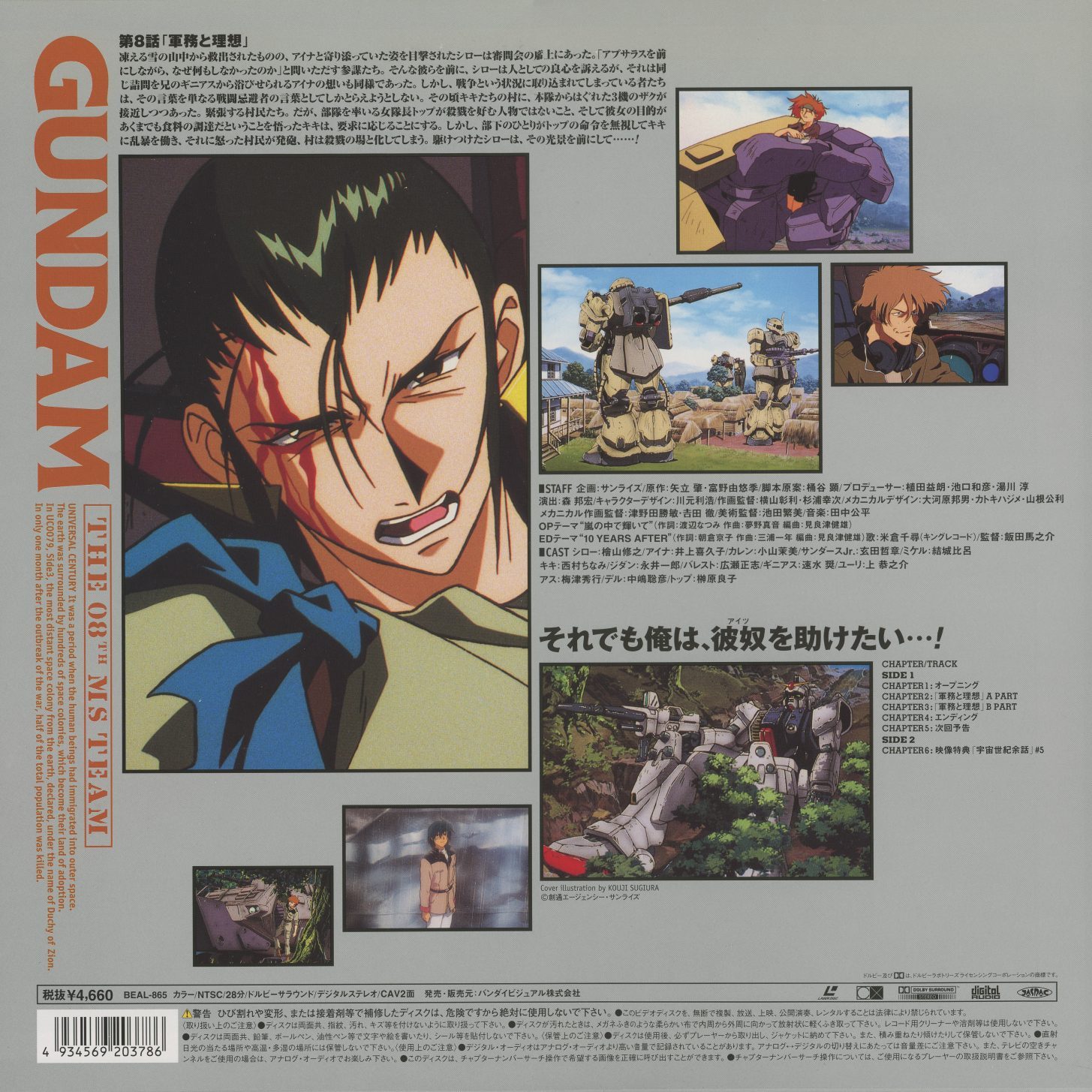 Volume 07 jacket back. Episode 8: 軍務と理想 ('Duty and Ideals'). Tagline: それでも俺は、彼奴を助けたい…! ('Even so, I want to save her...!')
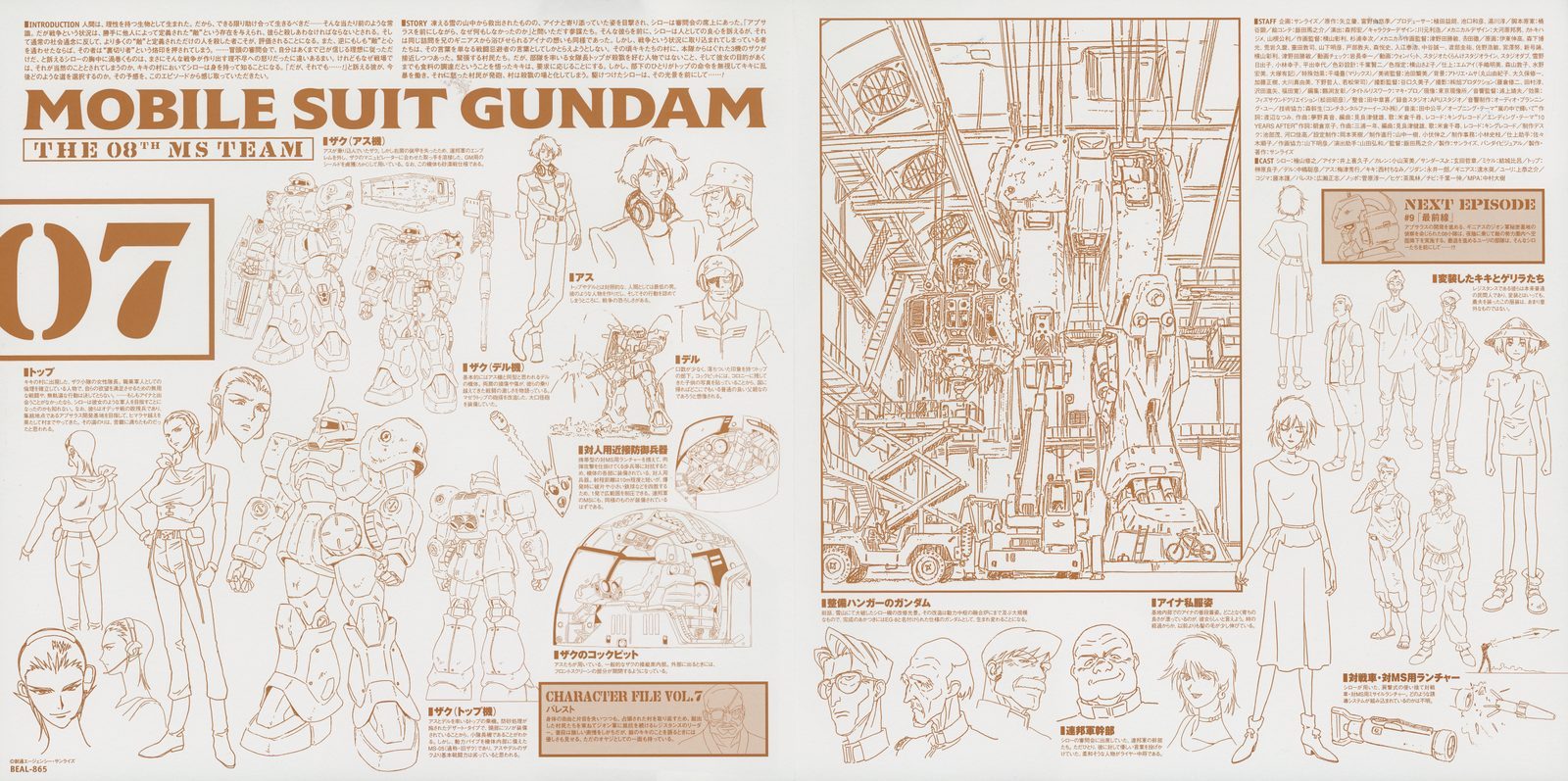 CHARACTER FILE VOL.7 — gold/ochre ink. New civilian characters, interior architecture settei including detailed room layouts, vehicle maintenance designs. The gold ink marks the second half of the archive.
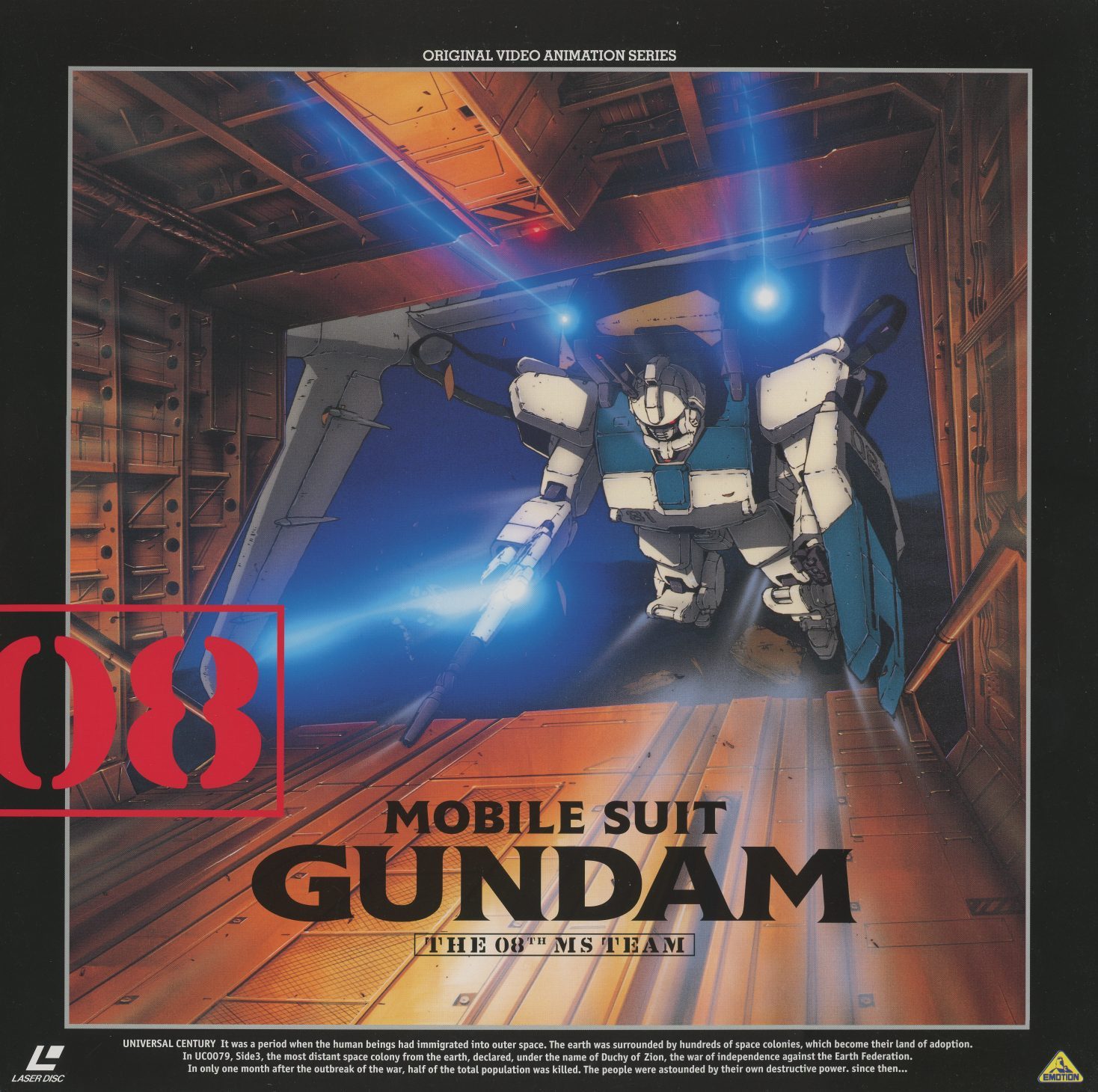 Volume 08 jacket front (BEAL-866). Ez-8 Gundam in hangar bay, blue mechanical lighting — the most industrial composition. February 1998.
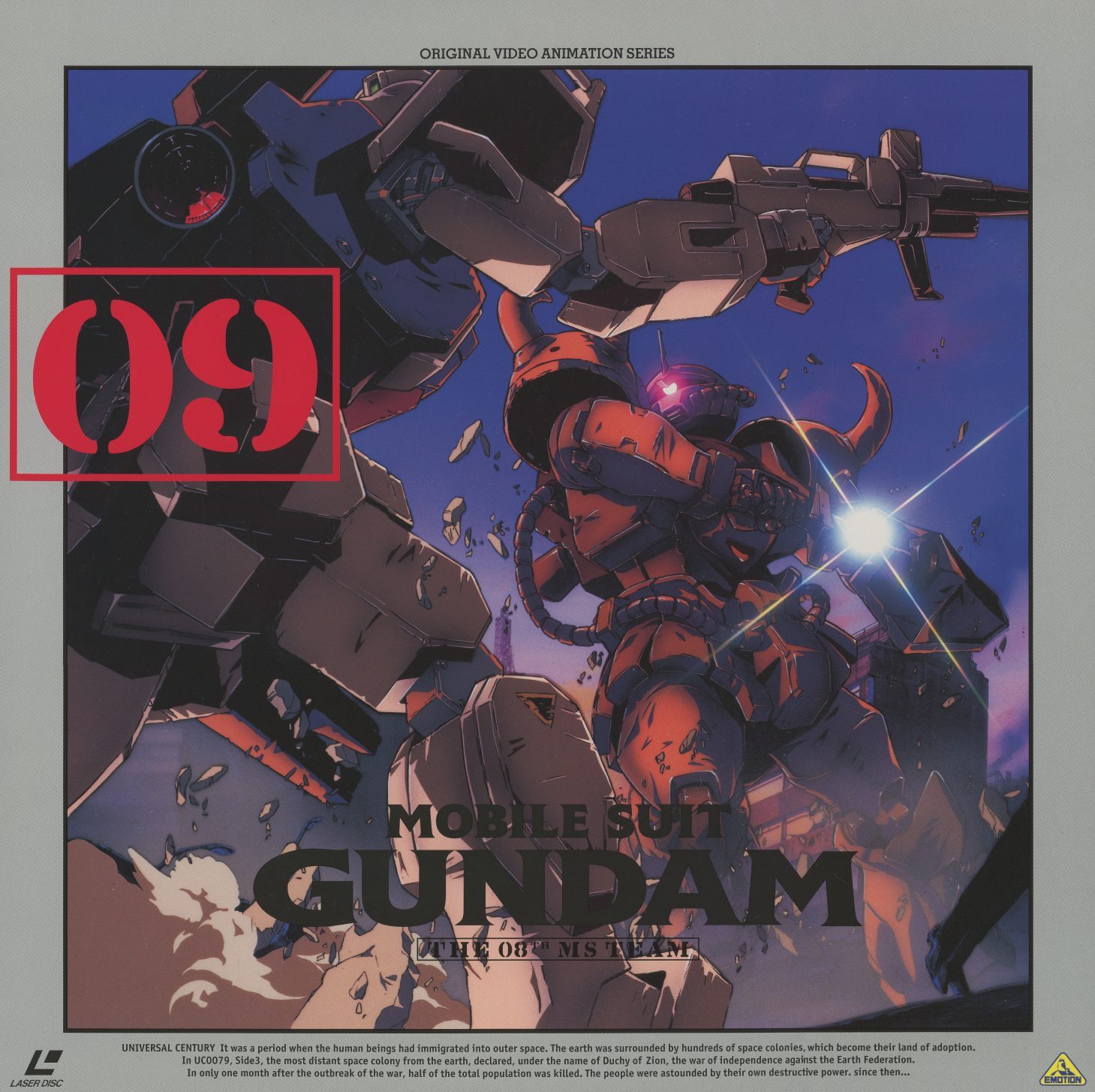 Volume 09 jacket front (BEAL-867). Aerial mobile suit combat — Gouf Custom and mass-production GMs in mid-air engagement. The most dynamic mecha action of the entire jacket series. July 1998.
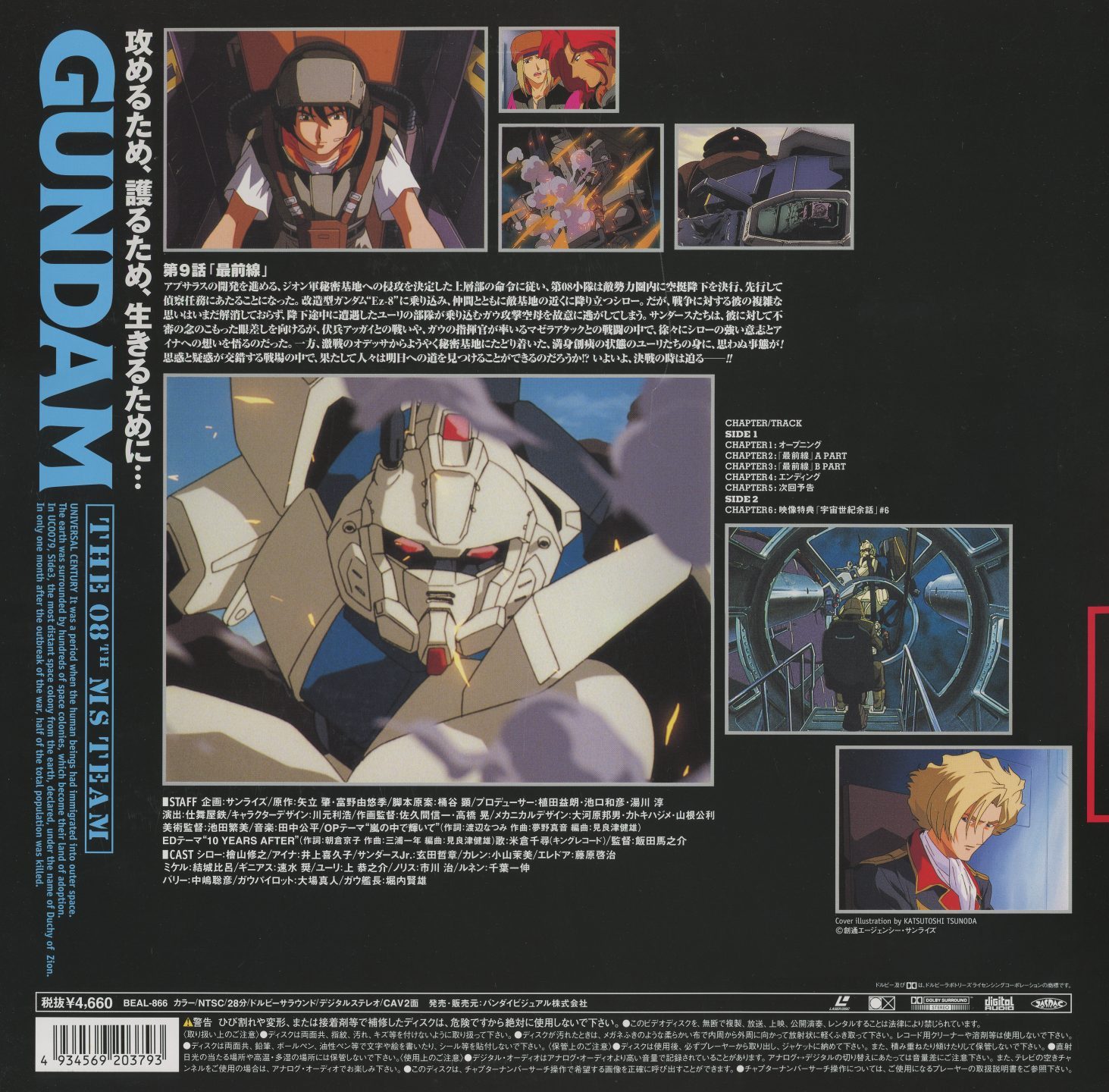 Volume 08 jacket back. Episode 9: 最前線 ('Front Line'). Tagline: 攻めるため、護るため、生きるために… ('To attack, to protect, to survive...')
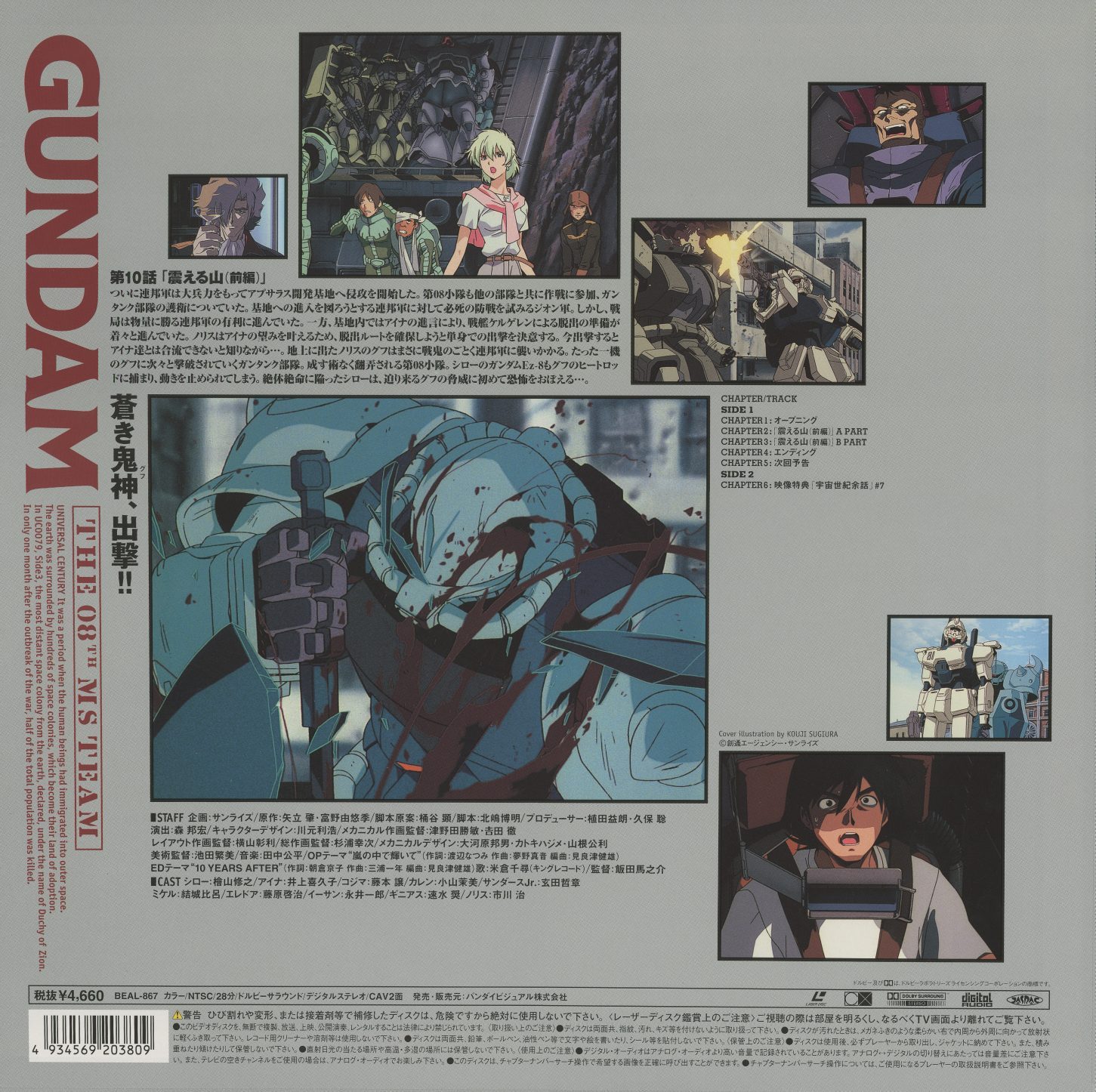 Volume 09 jacket back. Episode 10: 震える山(前編)('The Shuddering Mountain Part I'). Tagline: 蒼き鬼神、出撃!! ('The blue war-god, sorties!!')
![CHARACTER FILE VOL.8 — teal/green ink. Gundam Ez-8 redesign three-view (the field-modified RX-79[G]), Apsaras III development, Shiro and Aina in late-series costumes, parachute deployment settei.](/images/posts/gundam-08th-ms-team-laserdisc-vol08-settei-character-file.jpg) CHARACTER FILE VOL.8 — teal/green ink. Gundam Ez-8 redesign three-view (the field-modified RX-79[G]), Apsaras III development, Shiro and Aina in late-series costumes, parachute deployment settei.
CHARACTER FILE VOL.8 — teal/green ink. Gundam Ez-8 redesign three-view (the field-modified RX-79[G]), Apsaras III development, Shiro and Aina in late-series costumes, parachute deployment settei.
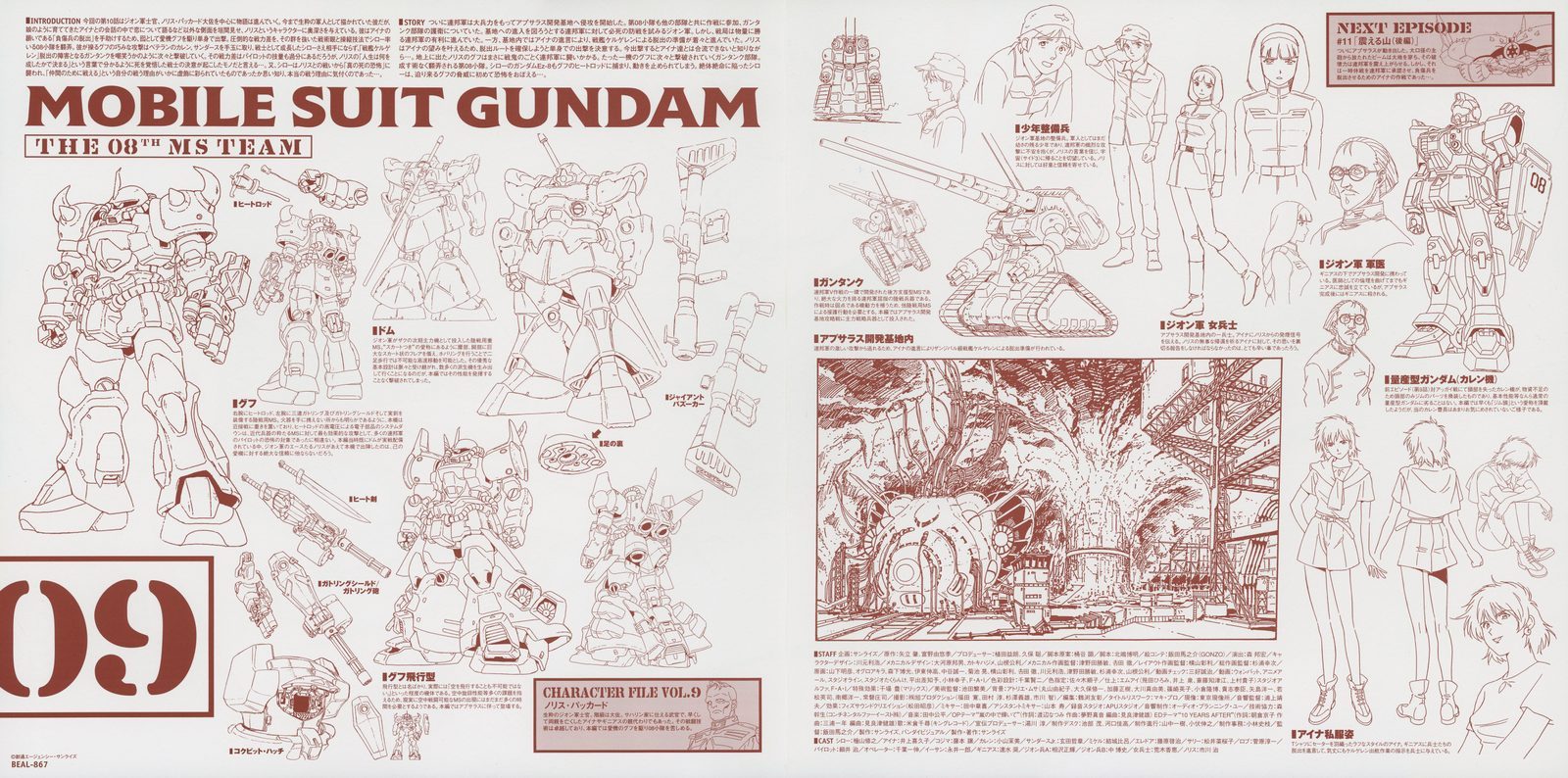 CHARACTER FILE VOL.9 — red-brown ink. Zeon mobile armor final form, mountain terrain environment designs, military encampment backgrounds, and late-series character design updates.
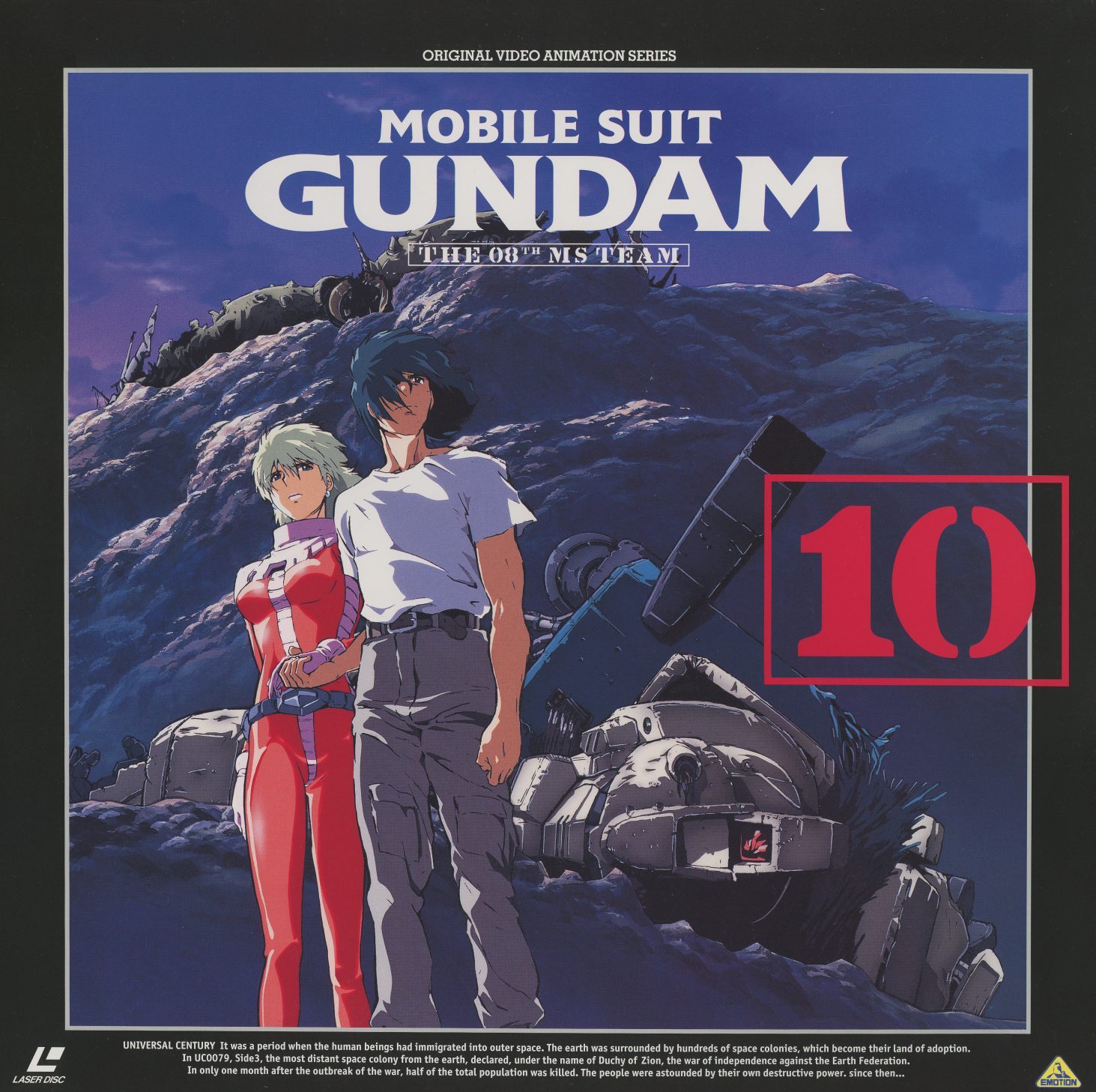 Volume 10 jacket front (BEAL-868). Shiro and Aina standing together — the only romantic composition in the entire jacket series. Behind them, a downed Gouf Custom. April 1999. Nine months after Volume 09.
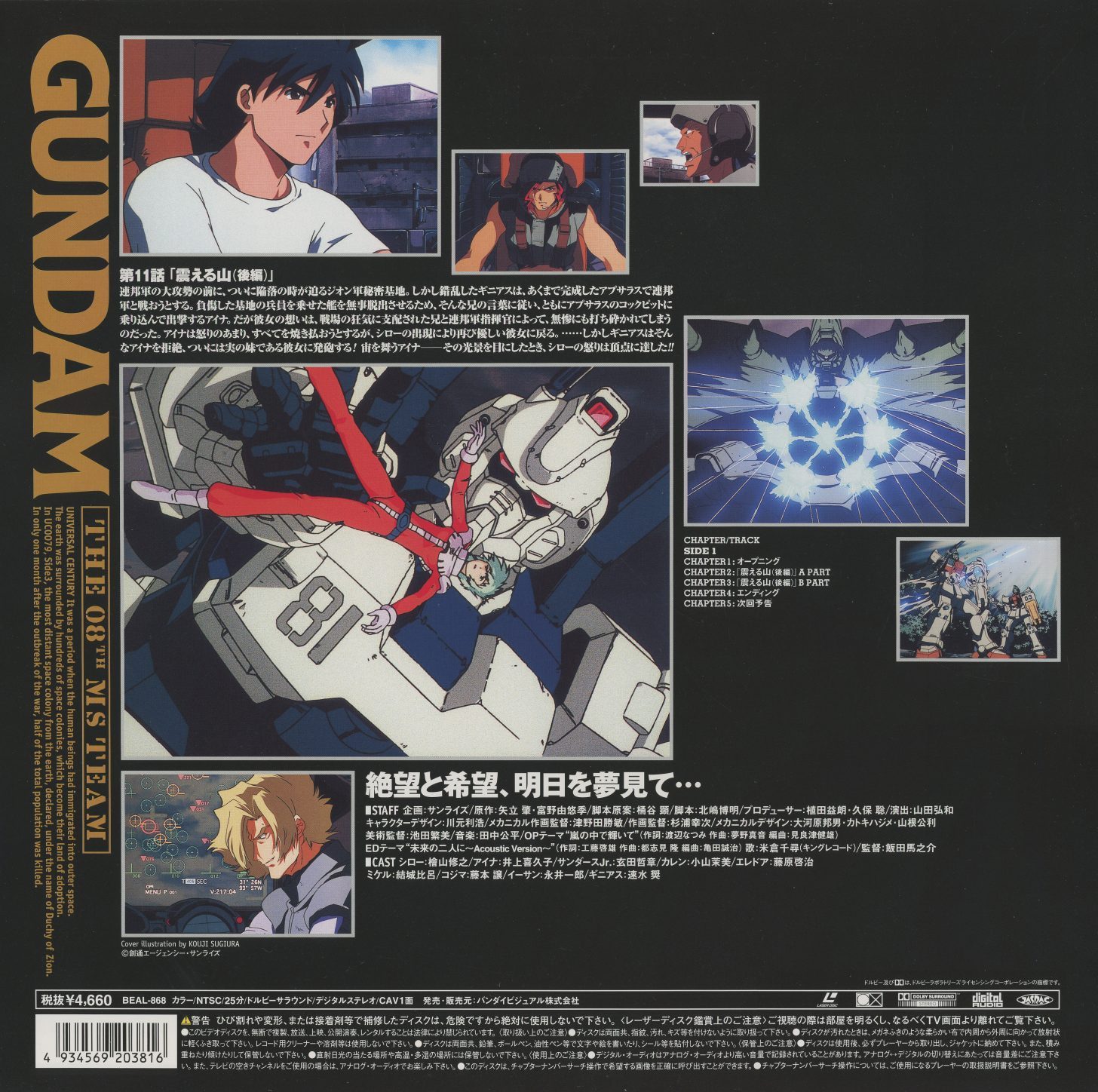 Volume 10 jacket back. Episode 11: 震える山(後編)('The Shuddering Mountain Part II'). Tagline: 絶望と希望、明日を夢見て… ('Despair and hope, dreaming of tomorrow...')
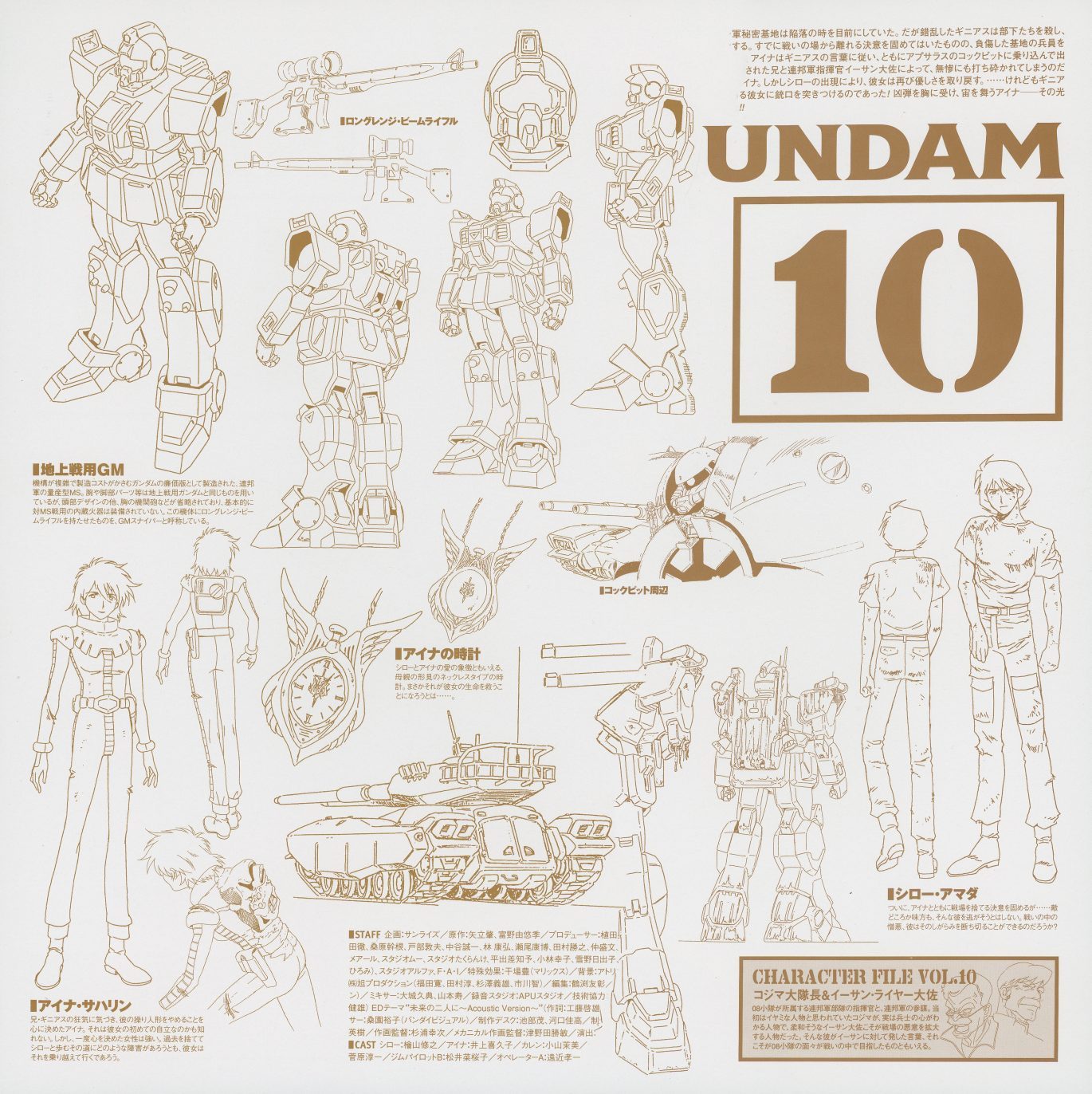 CHARACTER FILE VOL.10 — gold ink. Ground-type GM variants with long-range beam rifle, Aina's locket detail, Type 61 tank, cockpit instrumentation. The final numbered settei sheet.
Last Resort
BEAL-1412. July 25, 1999 — the eleventh disc, cataloged outside the BEAL-859~868 sequence. The Gundam 20th Anniversary logo sits in the corner of the jacket back. The episode runs 33 minutes, slightly longer than the standard 25. Kubooka's jacket shows Shiro standing beside a decommissioned Gouf under moonlight — the mobile suit is no longer a weapon, just wreckage reclaimed by the landscape. The liner notes are illustrated in a storyboard-style wash, narrating the post-war lives of the cast under the kanji 終戦 — end of war. A second settei sheet, labeled EPILOGUE SPECIAL, provides character designs for the children, civilians, and post-war settlement that appear only in this episode. The war is over. The archive is complete.
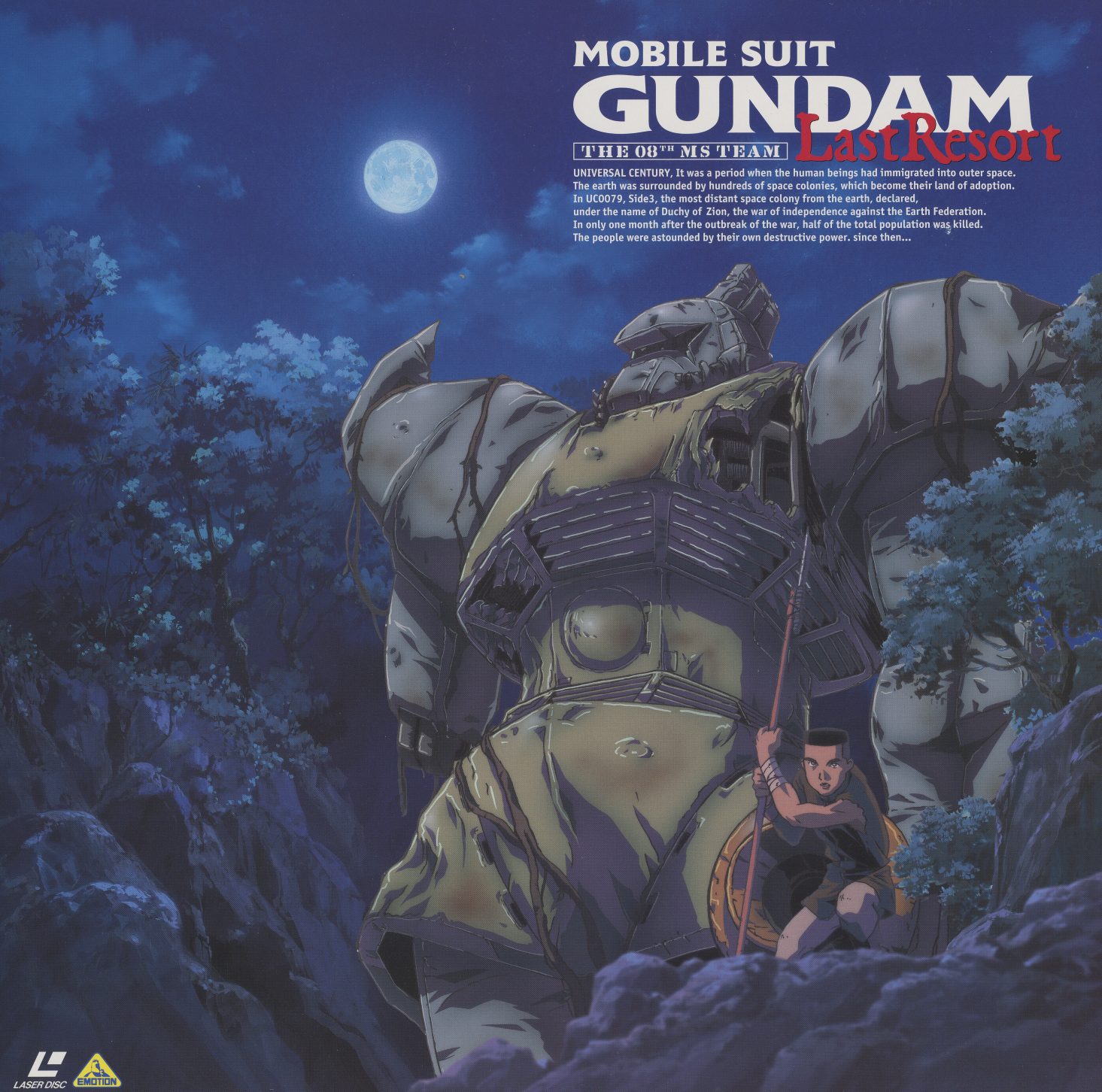 Last Resort jacket front (BEAL-1412). Shiro standing at the foot of a decommissioned Gouf Custom under moonlight. No weapons, no combat. Kubooka's final jacket illustration for the series. Gundam 20th Anniversary year. July 1999.
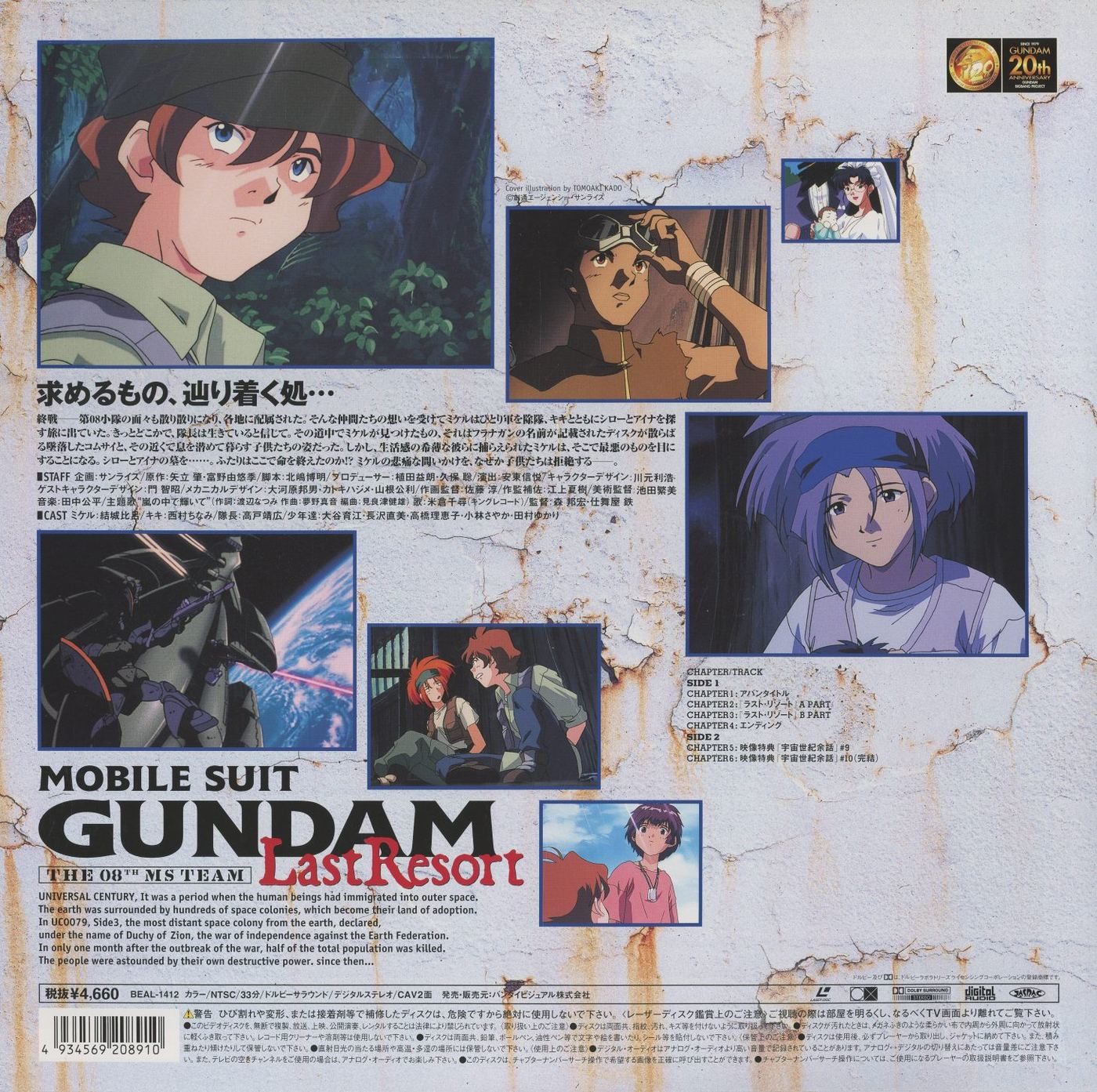 Last Resort jacket back. Episode 12 (epilogue). Tagline: 求めるもの、辿り着く処… ('What you seek, where you arrive...'). Gundam 20th Anniversary logo at top right. Directors: Kunihiro Mori, Tetsu Shimamura. ¥4,660.
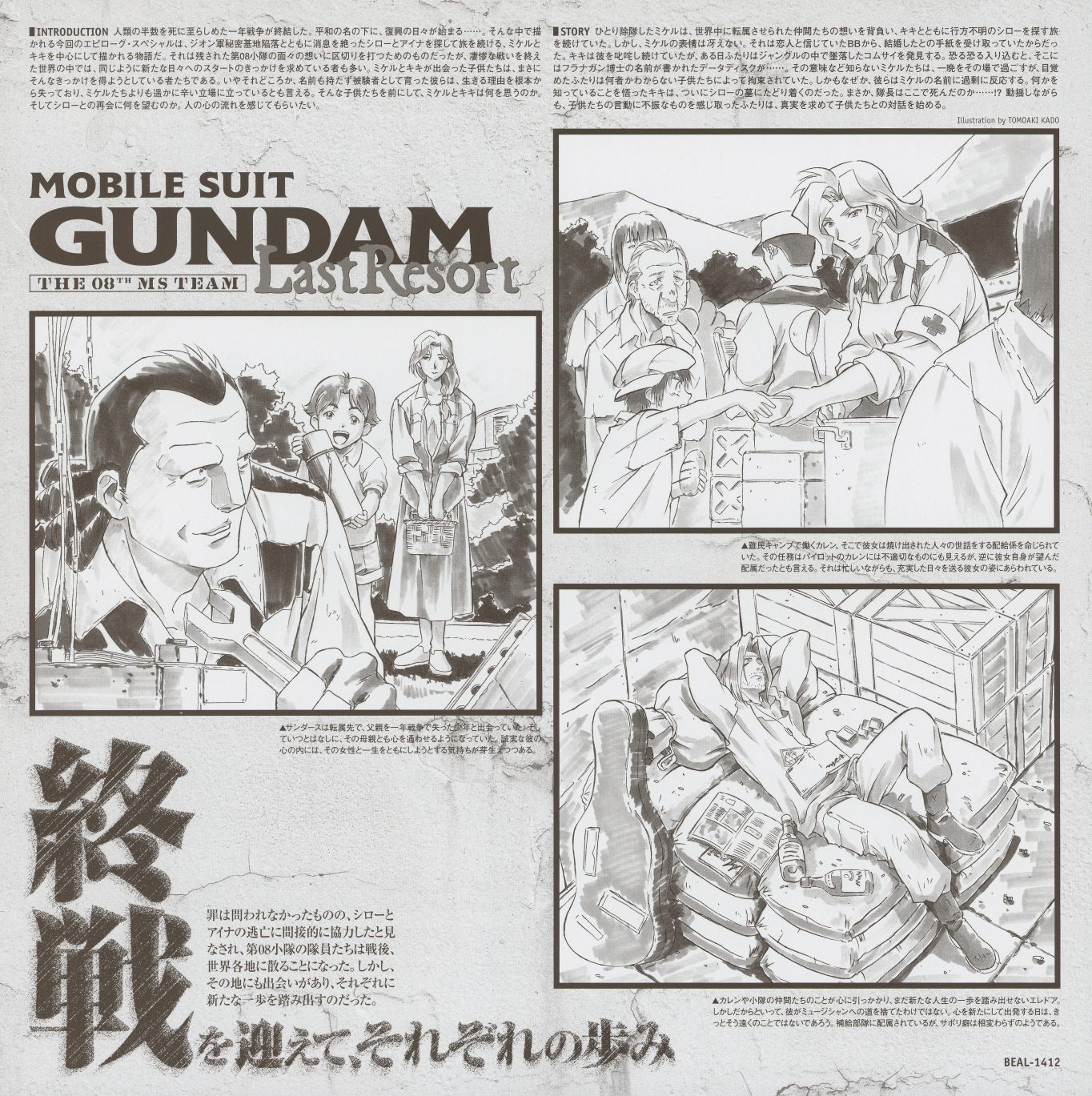 Last Resort liner notes (BEAL-1412). 終戦 (end of war) — storyboard-style wash illustrations narrating the post-war aftermath. Shiro and Aina's life after the conflict. Character vignettes of the surviving 08th Team members. Scene descriptions and staff/cast credits.
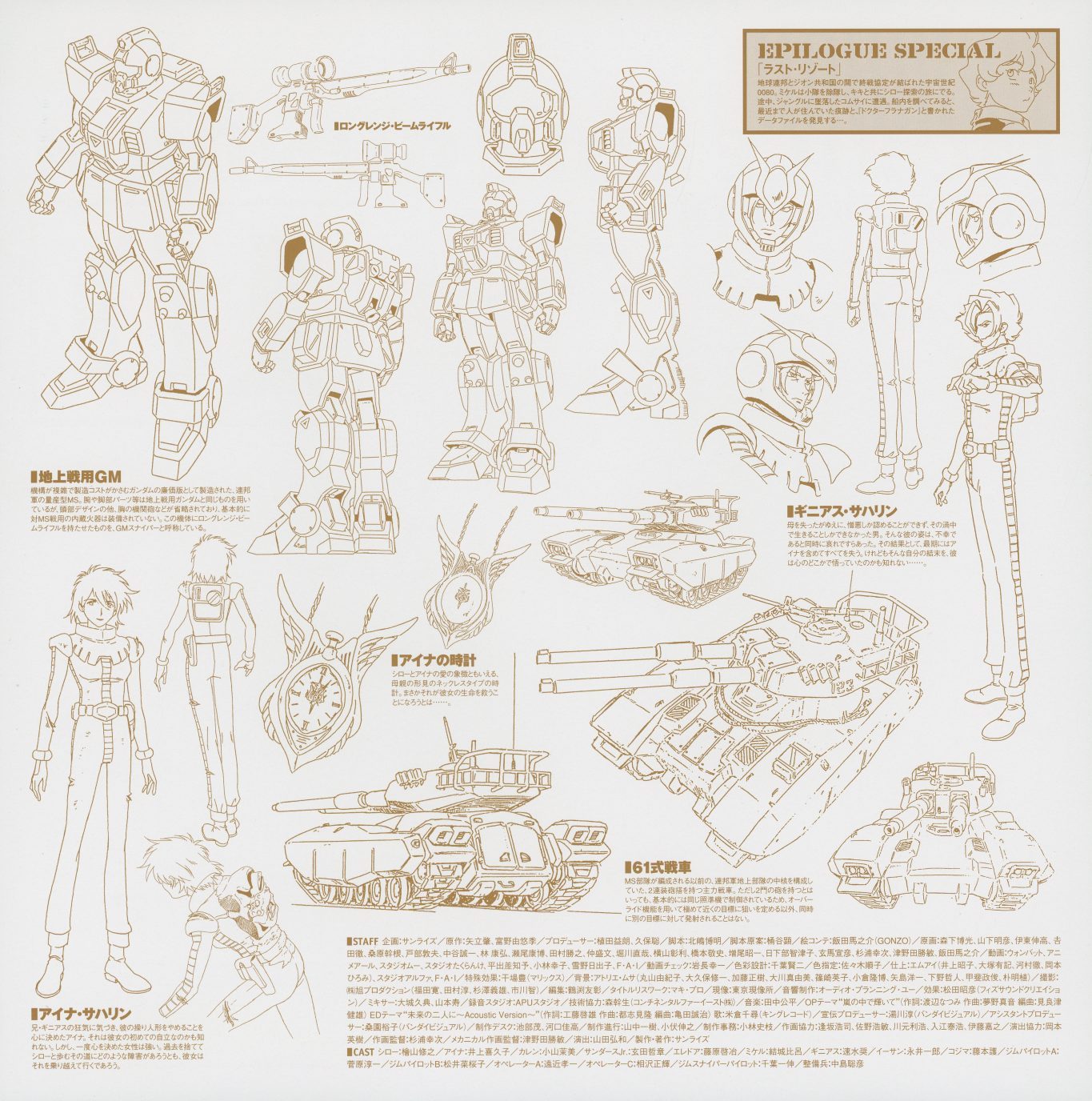 EPILOGUE SPECIAL settei sheet — gold ink, packaged with Volume 10. Character designs for the post-war settlement: children, civilians, Ginias Sahalin, Flanagan, and the 08th MS Team's decommissioned equipment. Battlefield landscape backgrounds showing war damage and reconstruction.
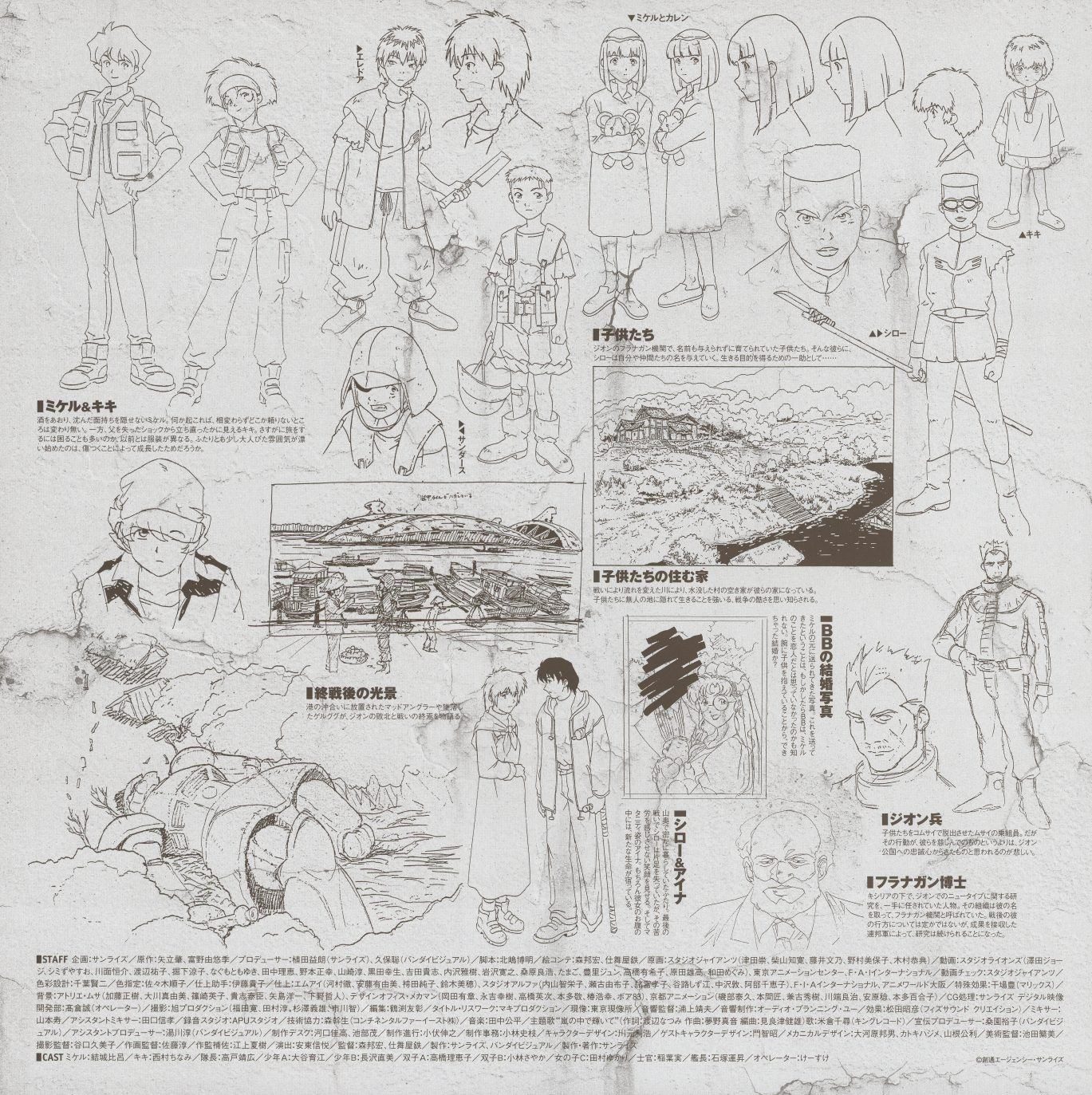 Last Resort settei sheet — gold ink. Post-war character designs: Michel and Kiki as adults, children of the settlement, war-damaged landscapes, and the coastal village where Shiro and Aina settled. Environmental settei for a world no longer at war.
![GM Sniper model kit advertisement insert. RGM-79[G] GM Sniper — 1/144 scale, ¥1,000. The mobile suit designed specifically for this series, marketed directly to LD buyers through packaging inserts. Bandai's model division and Bandai Visual's home video division sharing the same customer.](/images/posts/gundam-08th-ms-team-laserdisc-gm-sniper-model-ad.jpg) GM Sniper model kit advertisement insert. RGM-79[G] GM Sniper — 1/144 scale, ¥1,000. The mobile suit designed specifically for this series, marketed directly to LD buyers through packaging inserts. Bandai's model division and Bandai Visual's home video division sharing the same customer.
GM Sniper model kit advertisement insert. RGM-79[G] GM Sniper — 1/144 scale, ¥1,000. The mobile suit designed specifically for this series, marketed directly to LD buyers through packaging inserts. Bandai's model division and Bandai Visual's home video division sharing the same customer.
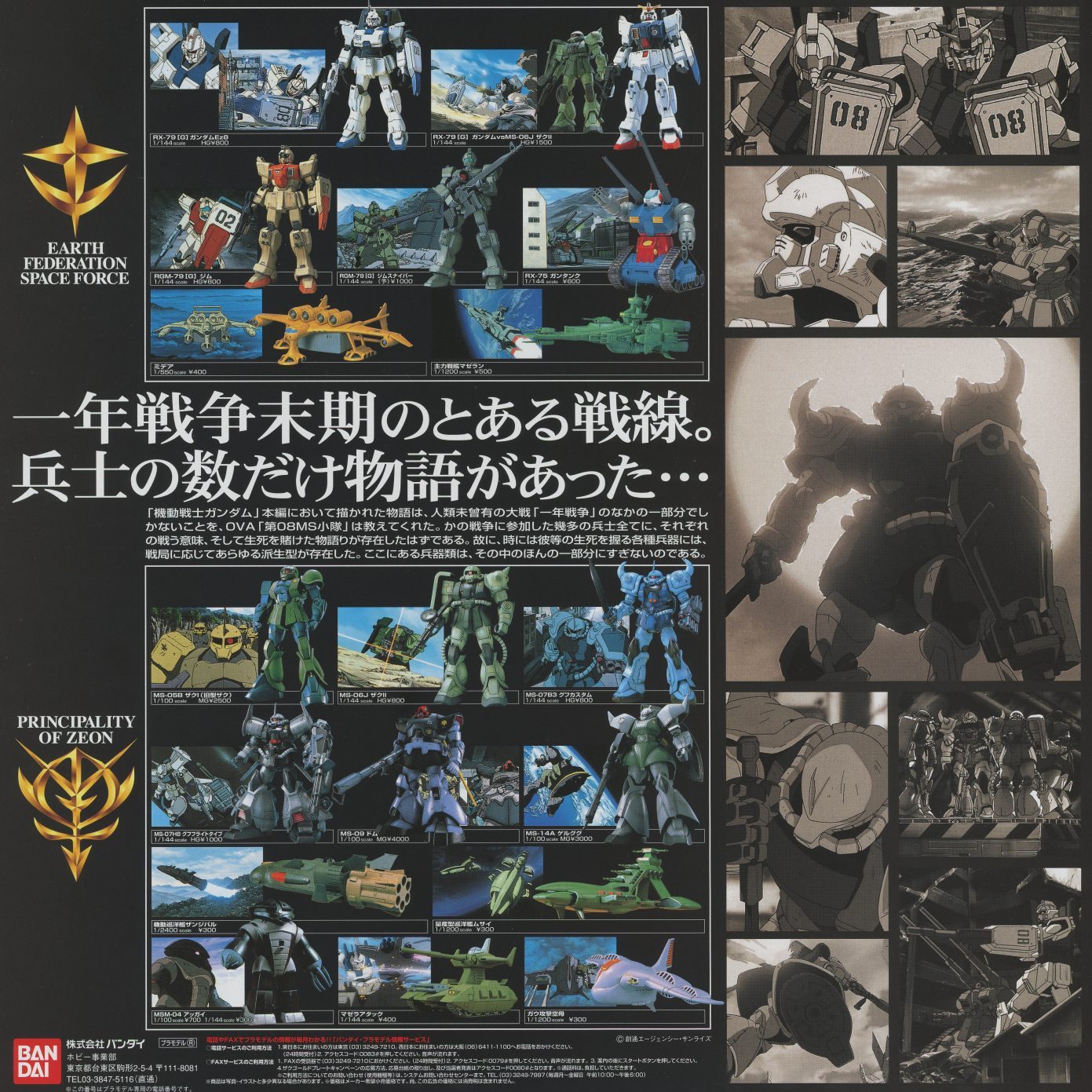 Bandai model catalog insert. Earth Federation Space Force and Principality of Zeon factions — every mobile suit, vehicle, and aircraft from the series available as model kits. Tagline: 一年戦争末期のとある戦線。兵士の数だけ物語があった… ('On a certain frontline near the end of the One Year War. There were as many stories as there were soldiers...')
The Complete-Purchase Booklet
BEAL-009. Not for sale. The reward for buying all ten volumes — a booklet containing everything the settei inserts couldn't fit. It opens with 'A YEAR OF WAR GUIDE,' a timeline of the One Year War from UC 0079 through the post-war period, placing the 08th MS Team's Southeast Asian campaign within the larger conflict. The center spreads provide full CHARACTER and MECHANICS introductions at larger scale than the inserts, with descriptive text for every named character and mobile suit. Staff and cast commentary pages include photographs of the voice actors alongside their characters — a production record that exists only in this booklet. Guest illustration pages feature tribute art. The final spreads reproduce key frames from the Opening Film, the Pilot Film (which predates the series), and the Ending Film.
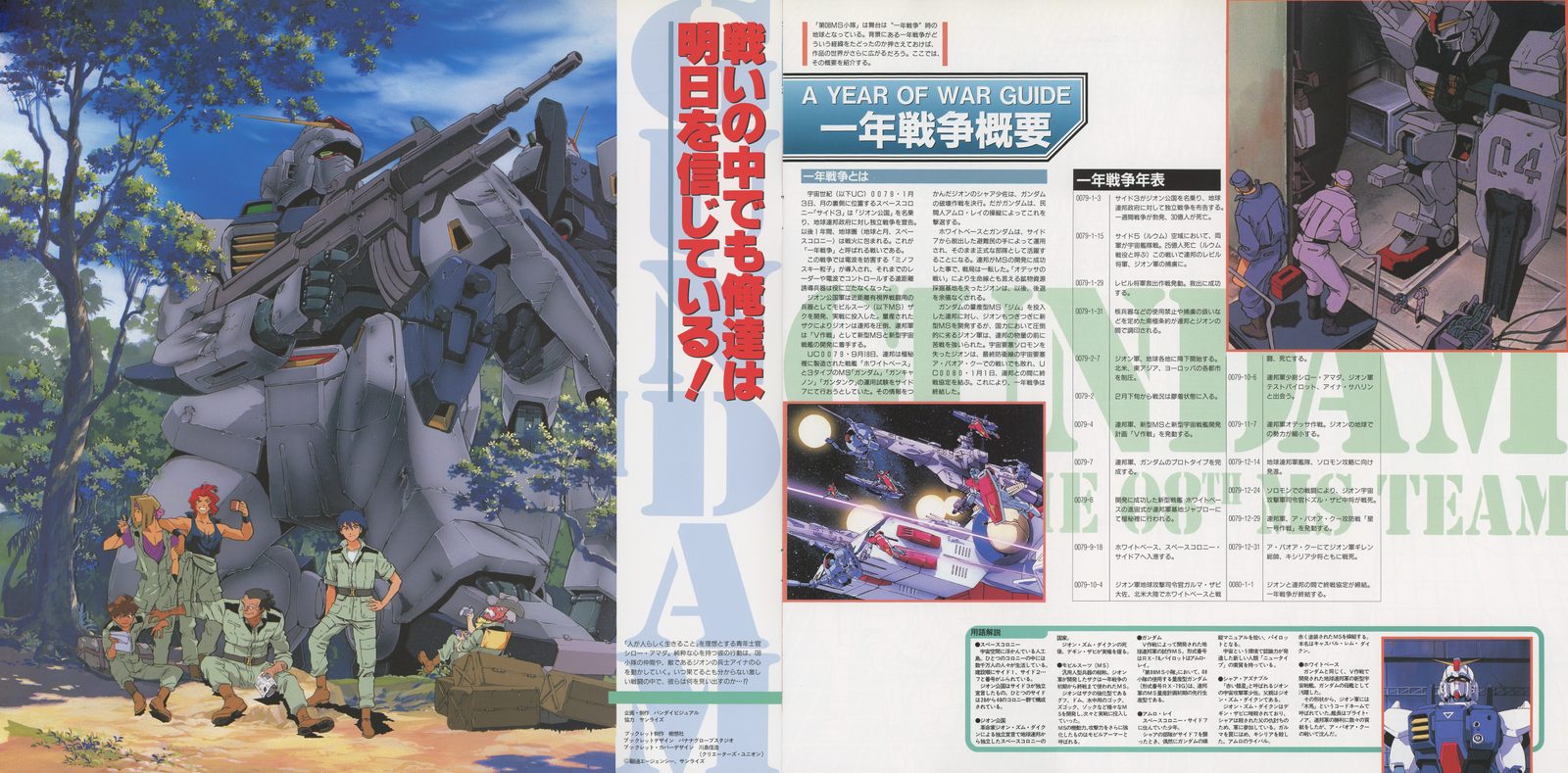 Booklet spread: 'A YEAR OF WAR GUIDE' — 一年戦争概要. One Year War timeline placing the 08th MS Team's campaign in context. Key visual of the team at rest beside their Gundam, with the tagline 戦いの中でも俺達は明日を信じている ('Even in battle, we believe in tomorrow').
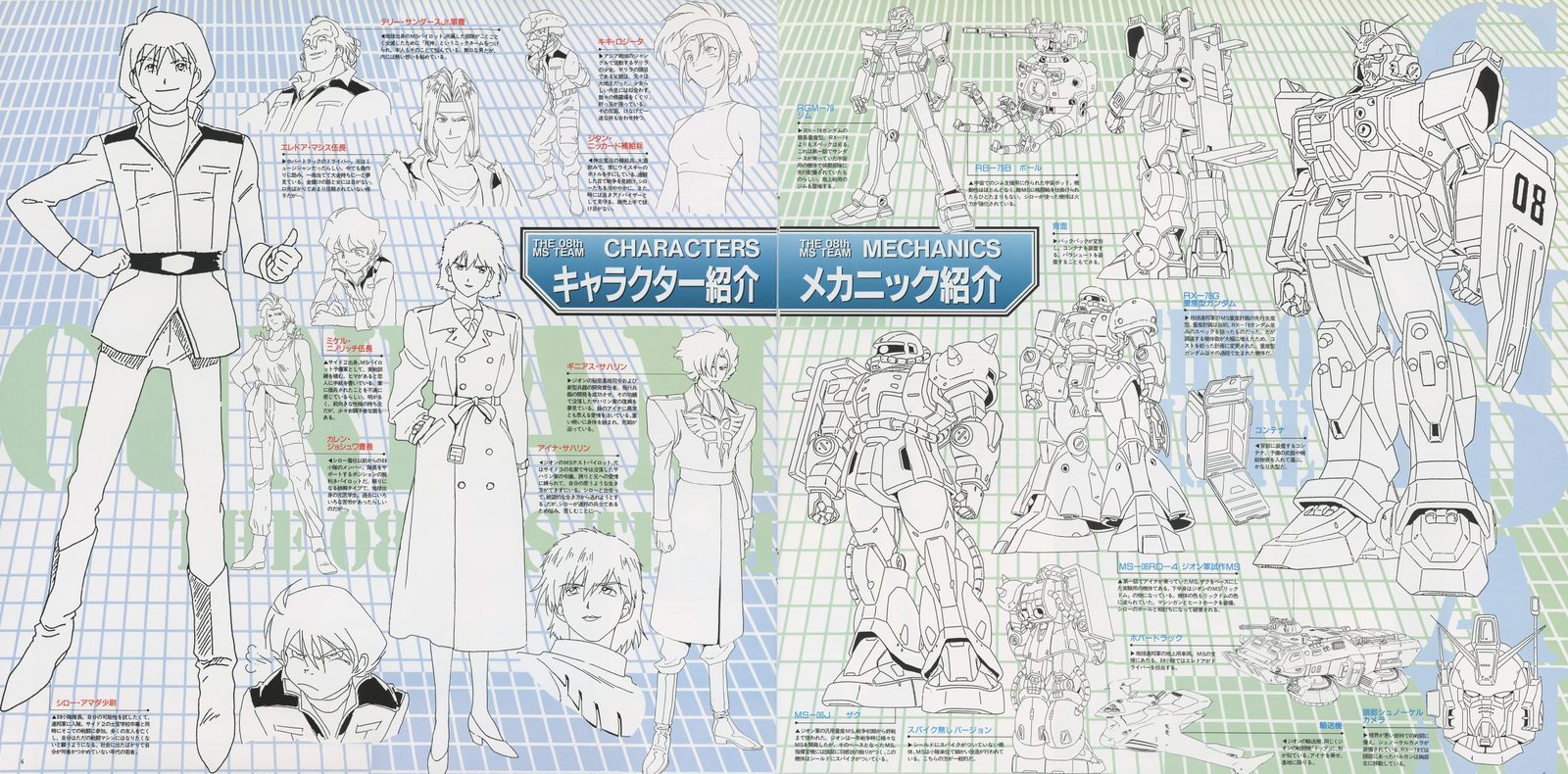 Booklet spread: キャラクター紹介 / メカニック紹介 (Characters Introduction / Mechanics Introduction). Full-body character lineup at model-sheet scale alongside mobile suit three-views. Kawamoto's character designs and Katoki's mechanical designs presented as a unified reference.
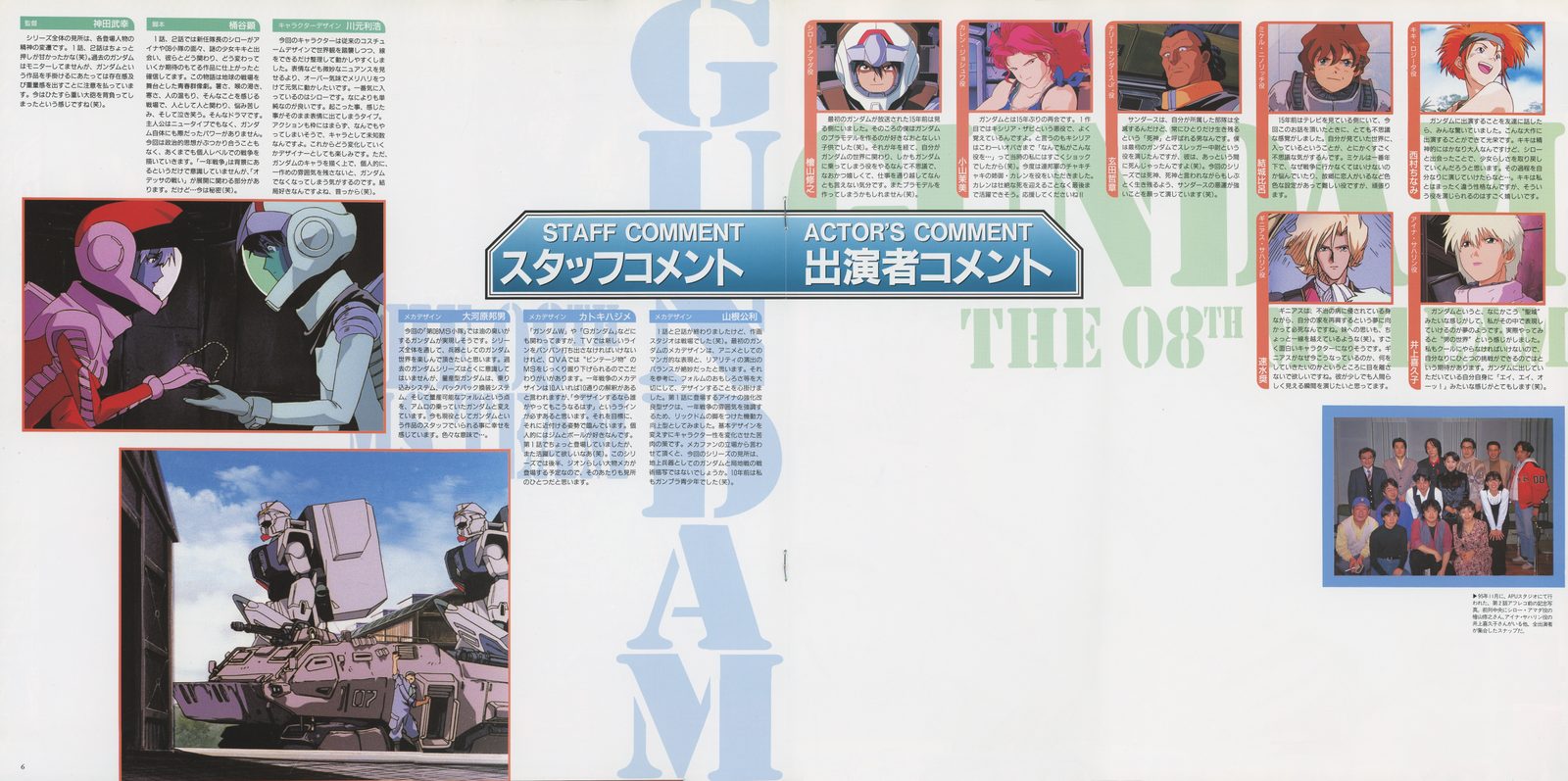 Booklet spread: スタッフコメント / 出演者コメント (Staff Comment / Actor's Comment). Production staff reflections alongside voice cast photographs matched to their characters. The only place the full cast appears in both animated and physical form within the release materials.
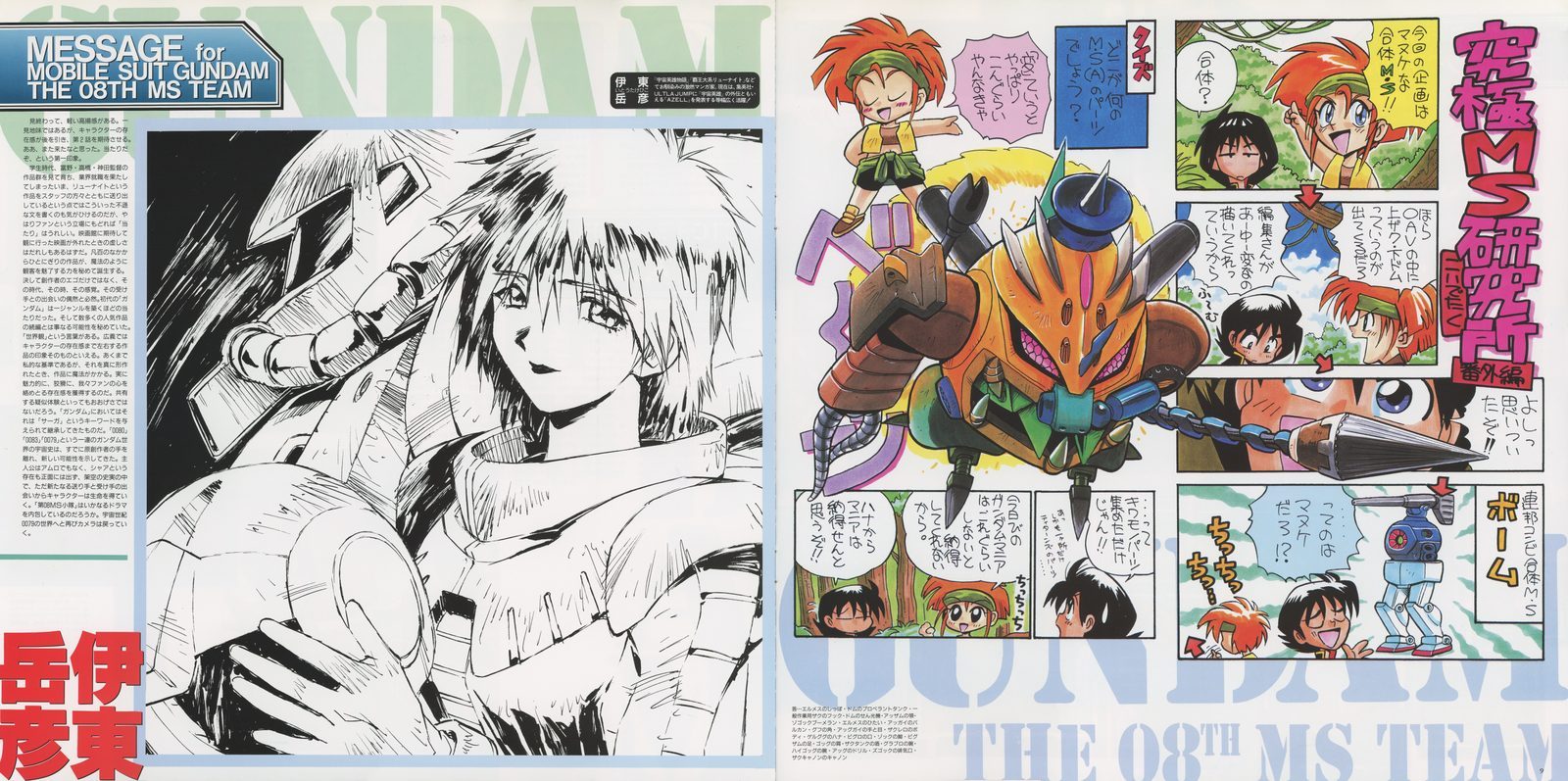 Booklet spread: MESSAGE — guest tribute illustration of Shiro and Aina, plus a chibi manga page drawn in a comedic super-deformed style. The tonal range of the booklet in a single spread: reverent illustration on the left, affectionate parody on the right.
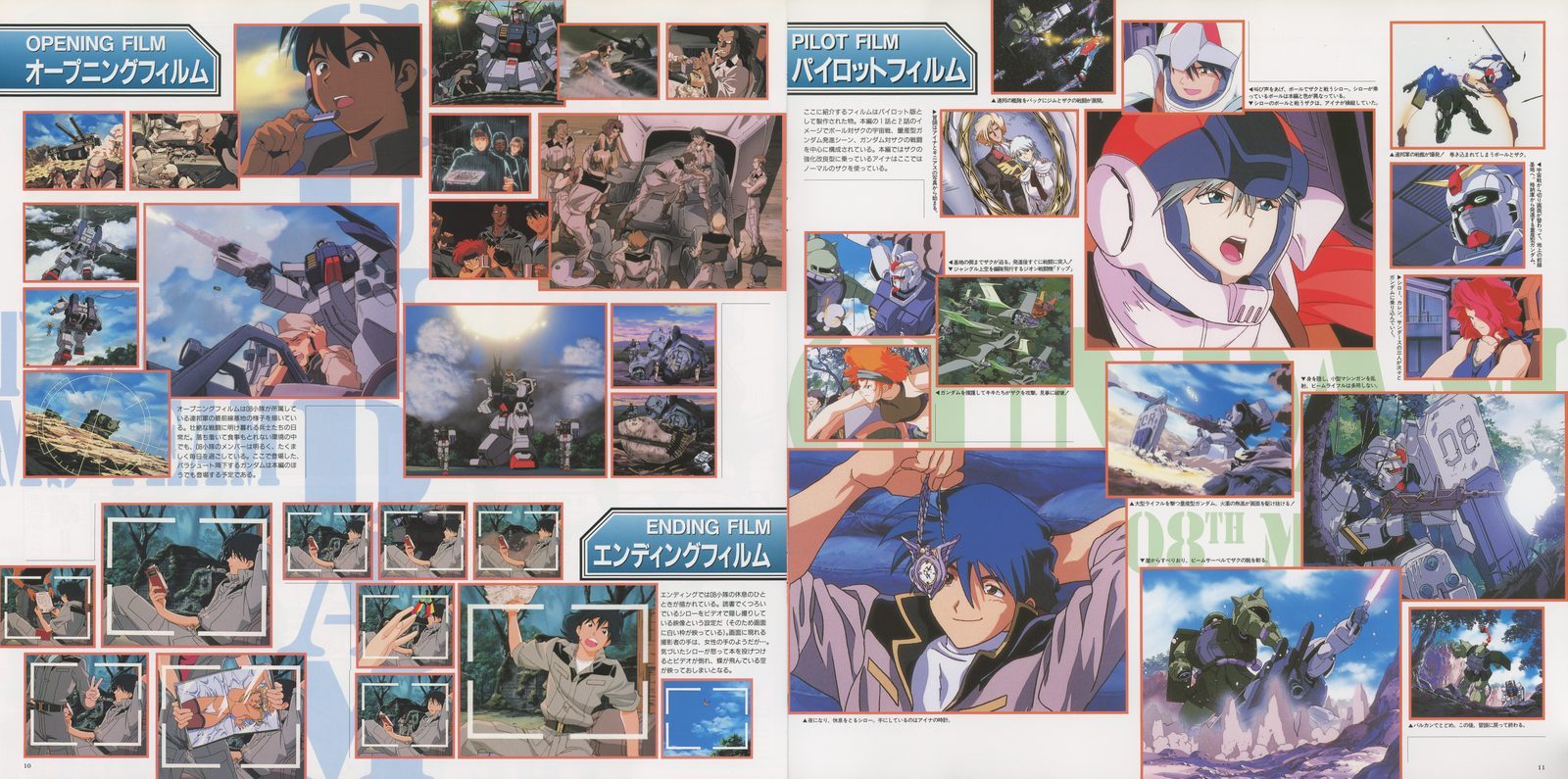 Booklet spread: OPENING FILM / PILOT FILM / ENDING FILM — key frame galleries from all three sequences. The Pilot Film frames predate the series itself, showing early production-stage animation that the LD buyer could compare against the finished episodes.
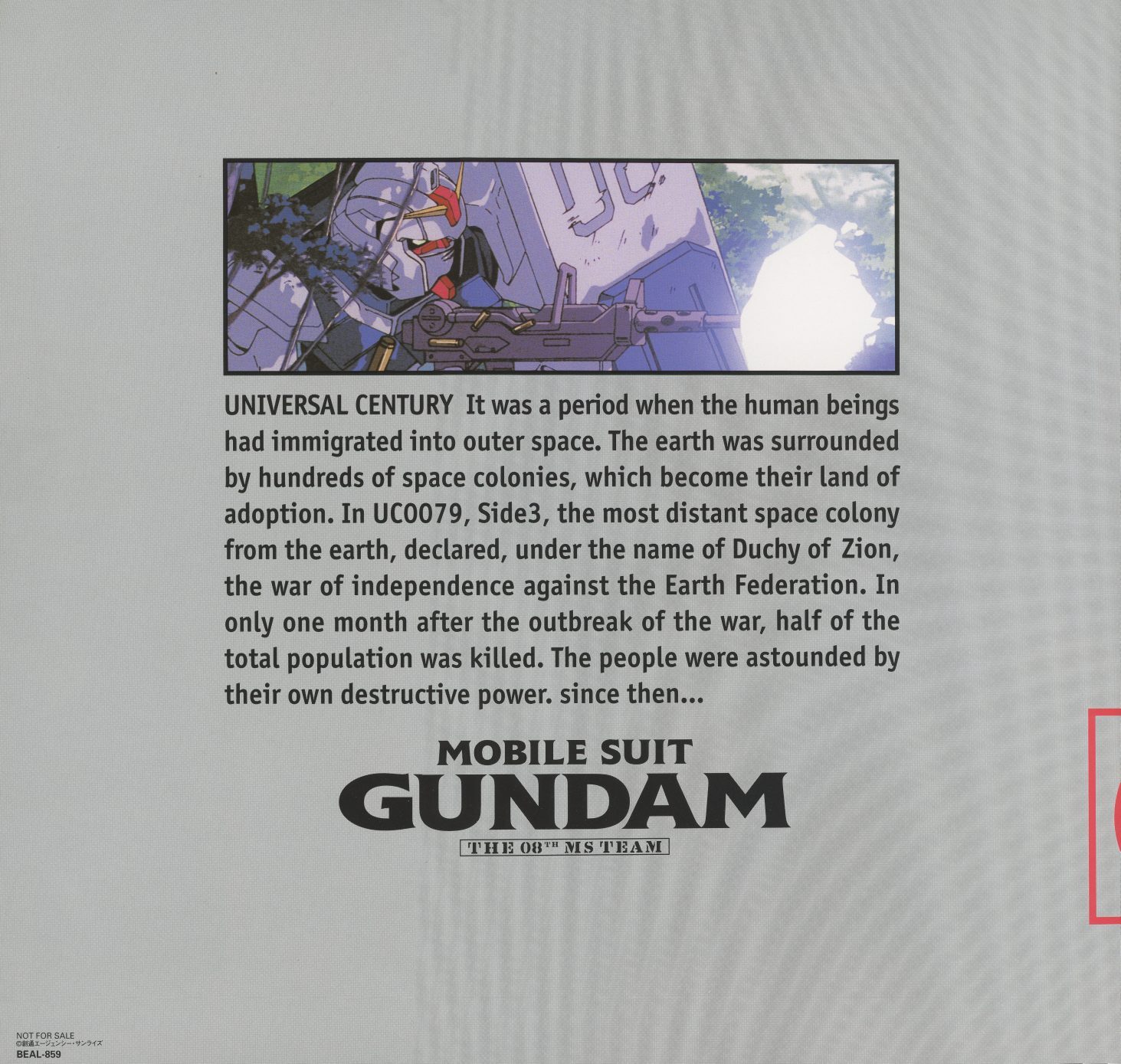 Booklet back cover (BEAL-009). The Universal Century opening text in English: 'It was a period when the human beings had immigrated into outer space...' NOT FOR SALE. The complete-purchase bonus that only exists for buyers who followed the release through all ten volumes.
January 1996 to July 1999. Eleven volumes. The release dates tell the production's story more precisely than any retrospective: monthly through March 1996, then nothing until October. Three volumes in quick succession through December — episodes Kanda had already finished. Then ten months of silence while Iida took over. Then irregular releases through 1998. Then nine more months before the final two volumes in 1999.
The LD buyer experienced this in real time. ¥4,660 per volume, CAV, one episode per disc. The settei inserts accumulated in a stack. The color-coded CHARACTER FILE sheets turned from blue to brown to red to gold. The director credit changed between Volumes 05 and 06 and nobody on the packaging explained why. The complete-purchase booklet arrived after Volume 10 — a retrospective on a production that had outlived its original director by three years.
Loading...