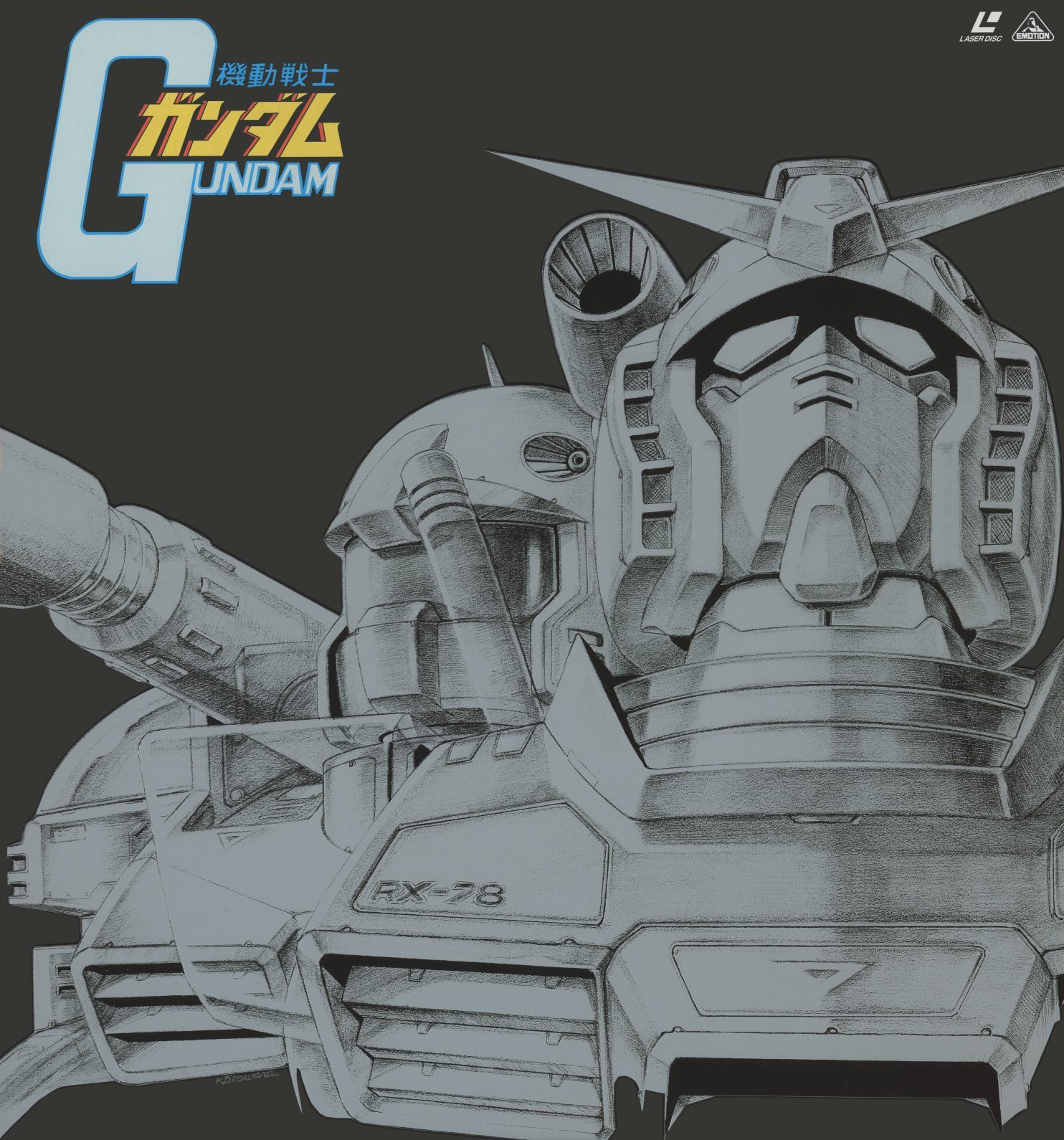
Twelve discs. Twenty-two sides. All forty-three episodes of the series that redefined what television animation could argue about. Bandai Visual's EMOTION label split the original 1979 Mobile Suit Gundam across two boxes — Part 1 covering episodes 1 through 22, Part 2 covering 23 through 43 — and housed each pair of discs in a gatefold sleeve with newly commissioned painted jacket art. CLV format, two episodes per side, digital stereo. The outer slipcases carry Kunio Okawara graphite illustrations — the RX-78-2 Gundam for Part 1, the Zeon mobile suit arsenal for Part 2. Inside each box: a painted portrait on the inner lid, a planetary panel on the facing surface, and three gatefold sleeves with scene-indexed backs covering every episode.
A teenage civilian named Amuro Ray stumbles into the cockpit of an experimental Federation mobile suit during a Zeon attack on his space colony. He becomes the pilot of the RX-78-2 Gundam, the weapon that shifts the balance of a war between Earth's government and the separatist Principality of Zeon. Director Yoshiyuki Tomino used the framework of a toy-sponsored robot show to tell a war story with no heroes on either side — where the enemy commander is more charismatic than the protagonist, where the civilian refugees are more sympathetic than the soldiers protecting them, and where the final battle ends not with triumph but with exhaustion. The series was canceled after 43 episodes. It became the most commercially consequential anime franchise in history.
The Memorial Box treats this material not as a catalog reissue but as a subject for documentation. A companion booklet interviews all three principal creators — Tomino, Yasuhiko, Okawara — and reproduces the original planning document that conceived the series in 1979. The twelve jacket paintings reframe each story arc through a different visual register. The gatefold backs function as episode guides. The box is an archive.
Two Boxes, Twelve Paintings
The Memorial Box's organizing logic separates the series at its structural midpoint. Part 1 covers the Earth arc — the White Base's journey from Side 7 through atmospheric reentry, across Earth's battlefields, and back into orbit. Part 2 covers the space arc — the escalation from Solomon to A Baoa Qu to the final confrontation between Amuro and Char. Each box opens with a painted portrait on the inner lid: Amuro seated before the RX-78-2 head in contemplative blue for Part 1, Char leaning on a fencing sword before his Rick Dom in imperial red for Part 2. The facing panels show Earth and Mars — the war's geography rendered as astronomy. The disc jackets themselves are not production art. They are twelve new paintings, each by a different illustrator, each treating a different arc's cast and concerns as its subject.
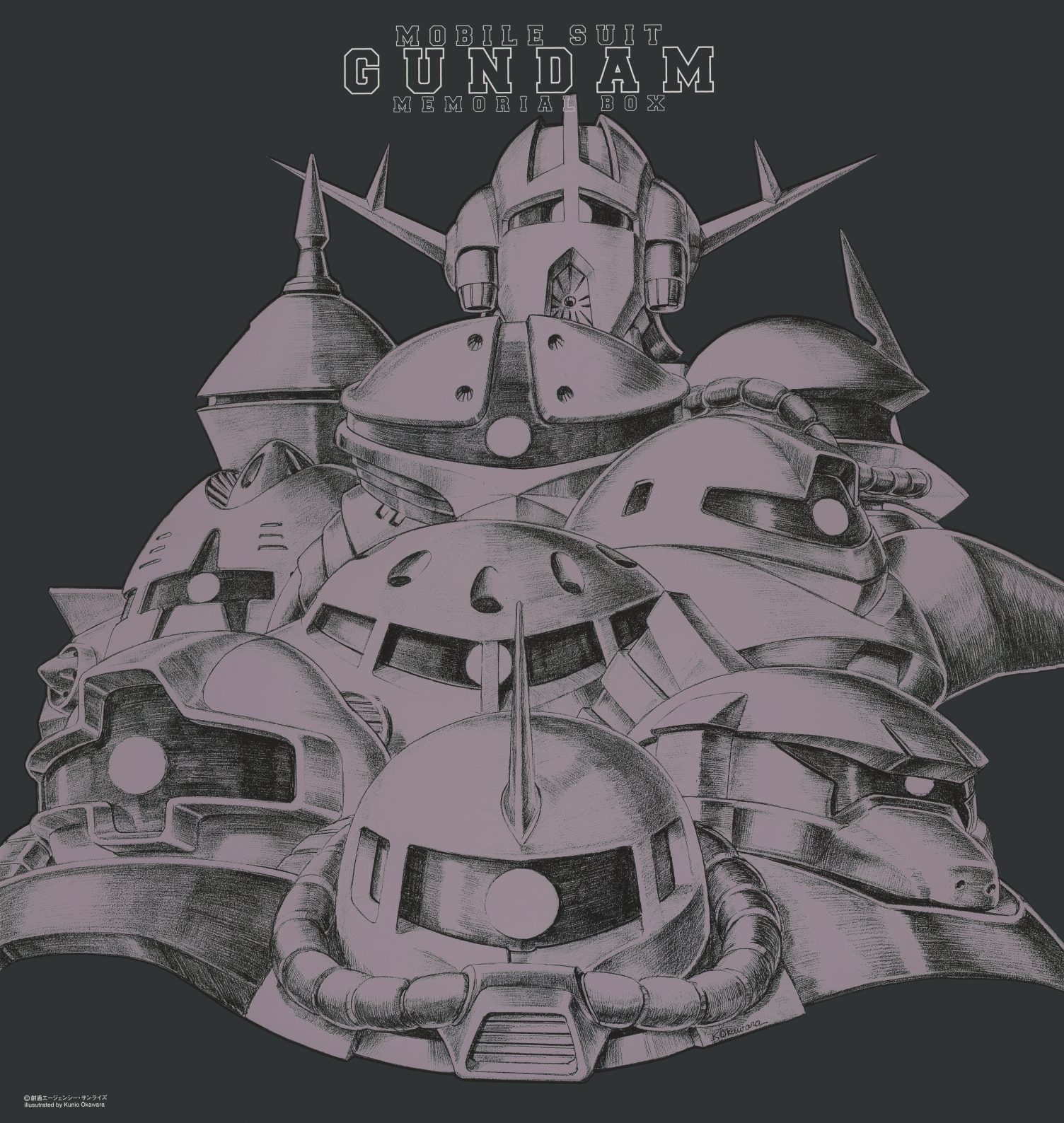 Part 1 slipcase back. Okawara graphite illustration — Zeon mobile suit ensemble: Zaku II, Gouf, Dom, Gelgoog, Zeong, and Gyan rendered as a military formation. 'MOBILE SUIT GUNDAM MEMORIAL BOX. Illustrated by Kunio Okawara.'
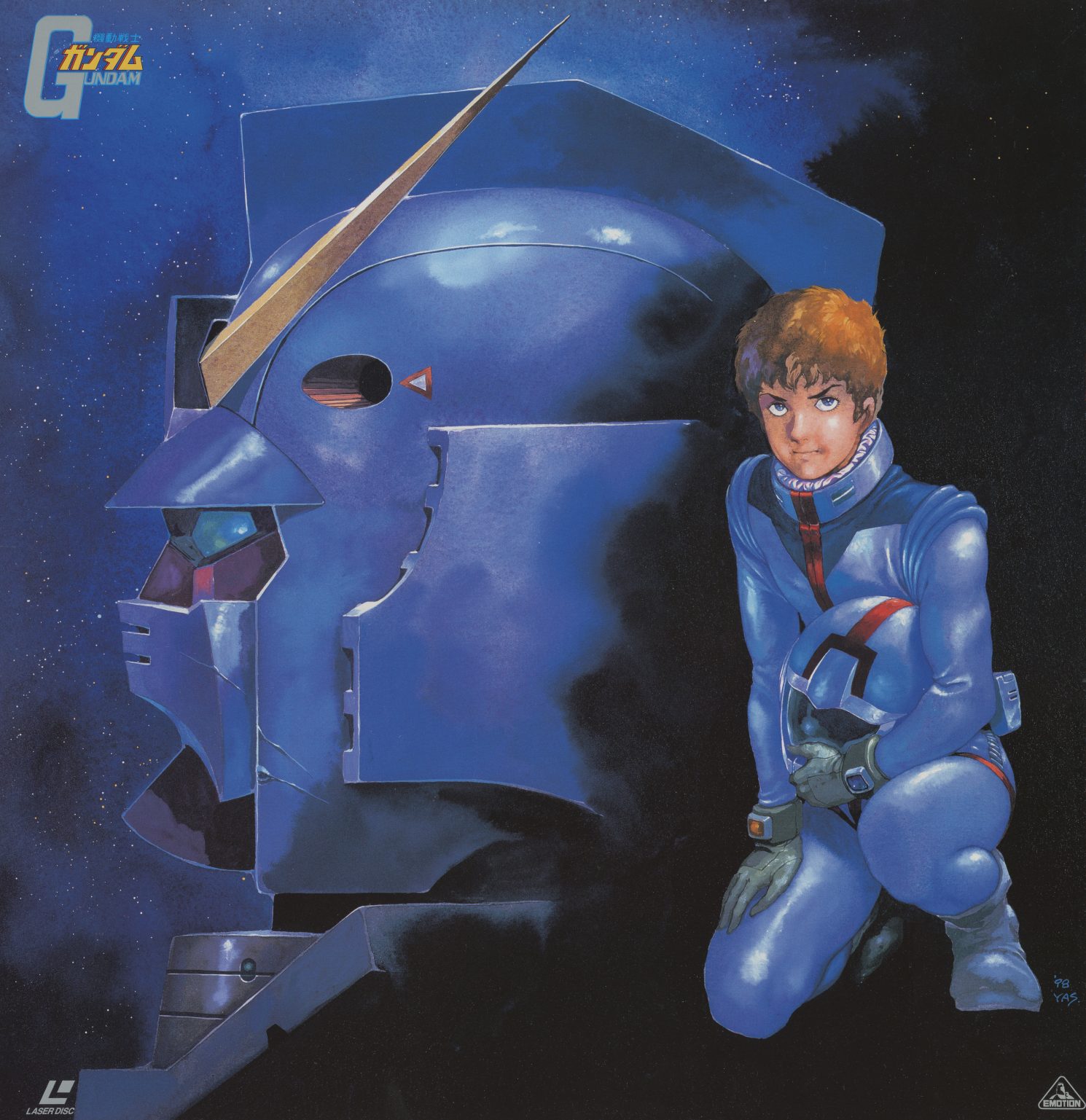 Part 1 inner lid. Amuro Ray seated before the RX-78-2 Gundam head — painted in deep blue, contemplative, a pilot who hasn't yet understood what the war will cost. The portrait mirrors the booklet cover.
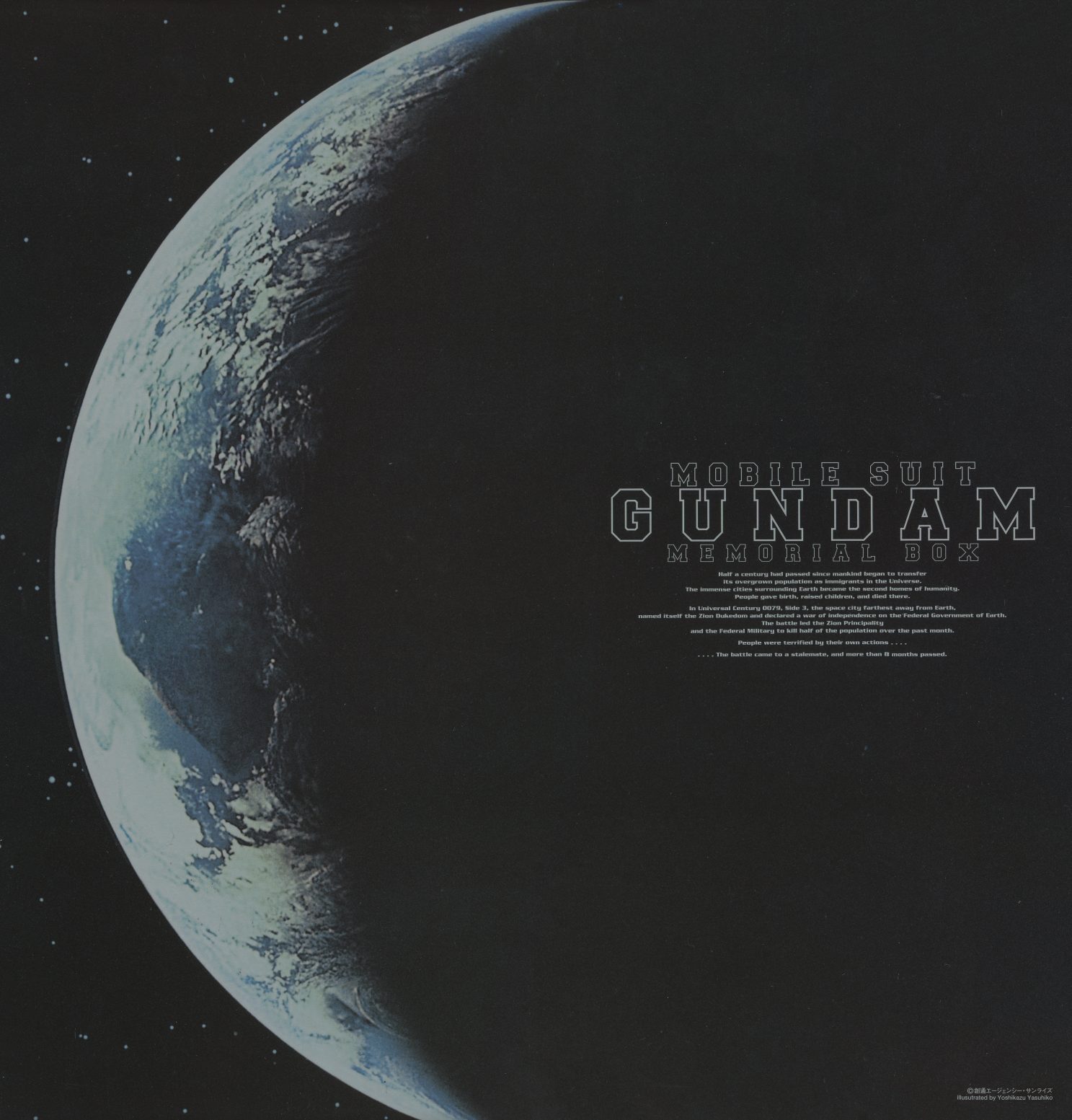 Part 1 inner panel. Earth from space — the Universal Century opening narration in English: 'In Universal Century 0079, Side 3, the most distant space colony from the Earth, declared under the name of Duchy of Zion, the war of independence against the Earth Federation...' MOBILE SUIT GUNDAM MEMORIAL BOX.
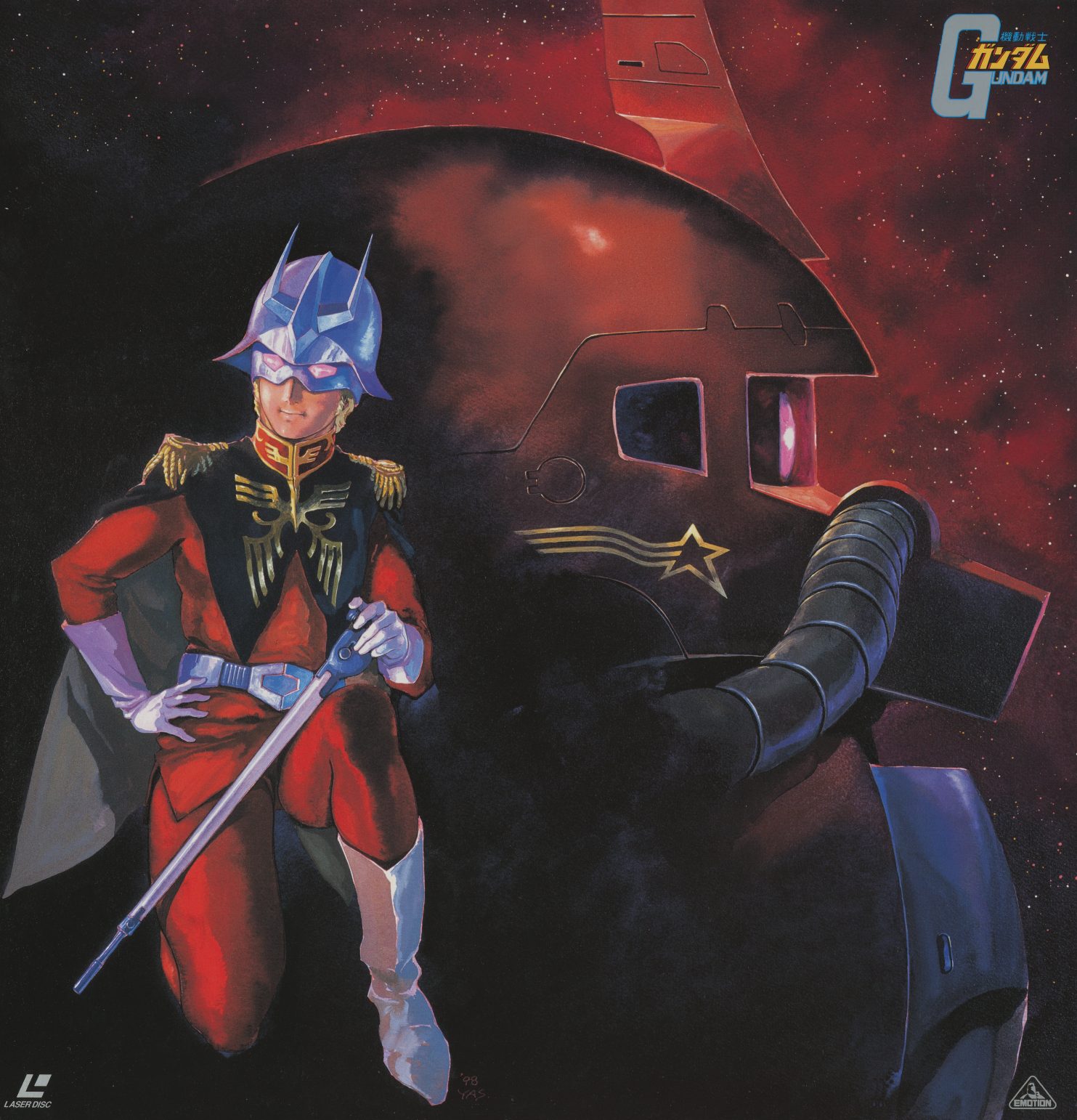 Part 2 inner lid. Char Aznable in full dress uniform, fencing sword in hand, seated before the MS-09R Rick Dom — painted in crimson and black. The Red Comet as aristocrat, not soldier. The compositional mirror of Amuro's Part 1 portrait.
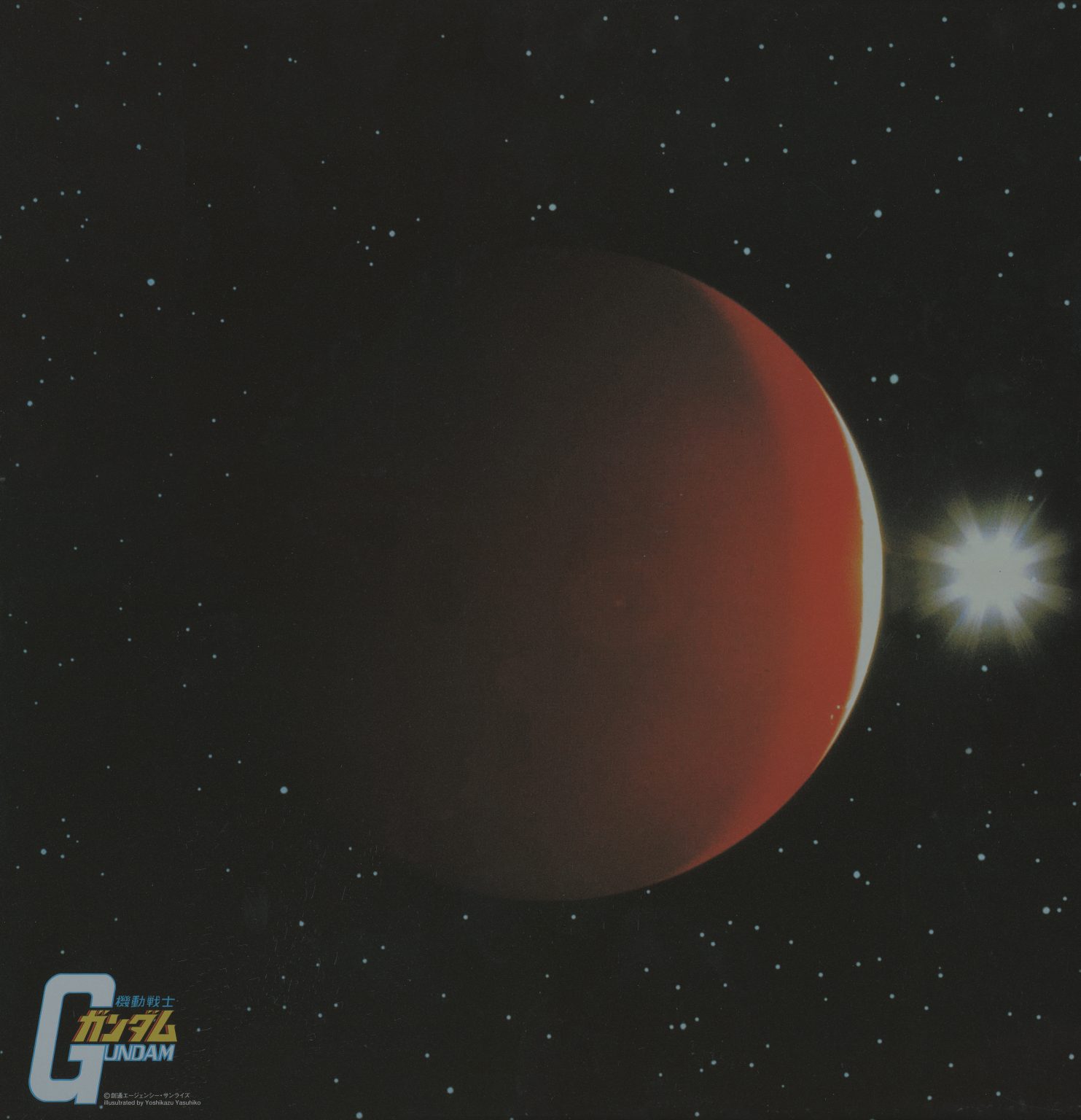 Part 2 inner panel. Mars from space — the war has moved off Earth. The facing planetary panels trace the conflict's trajectory: Earth in Part 1, Mars in Part 2. The void between them is where the final battles take place.
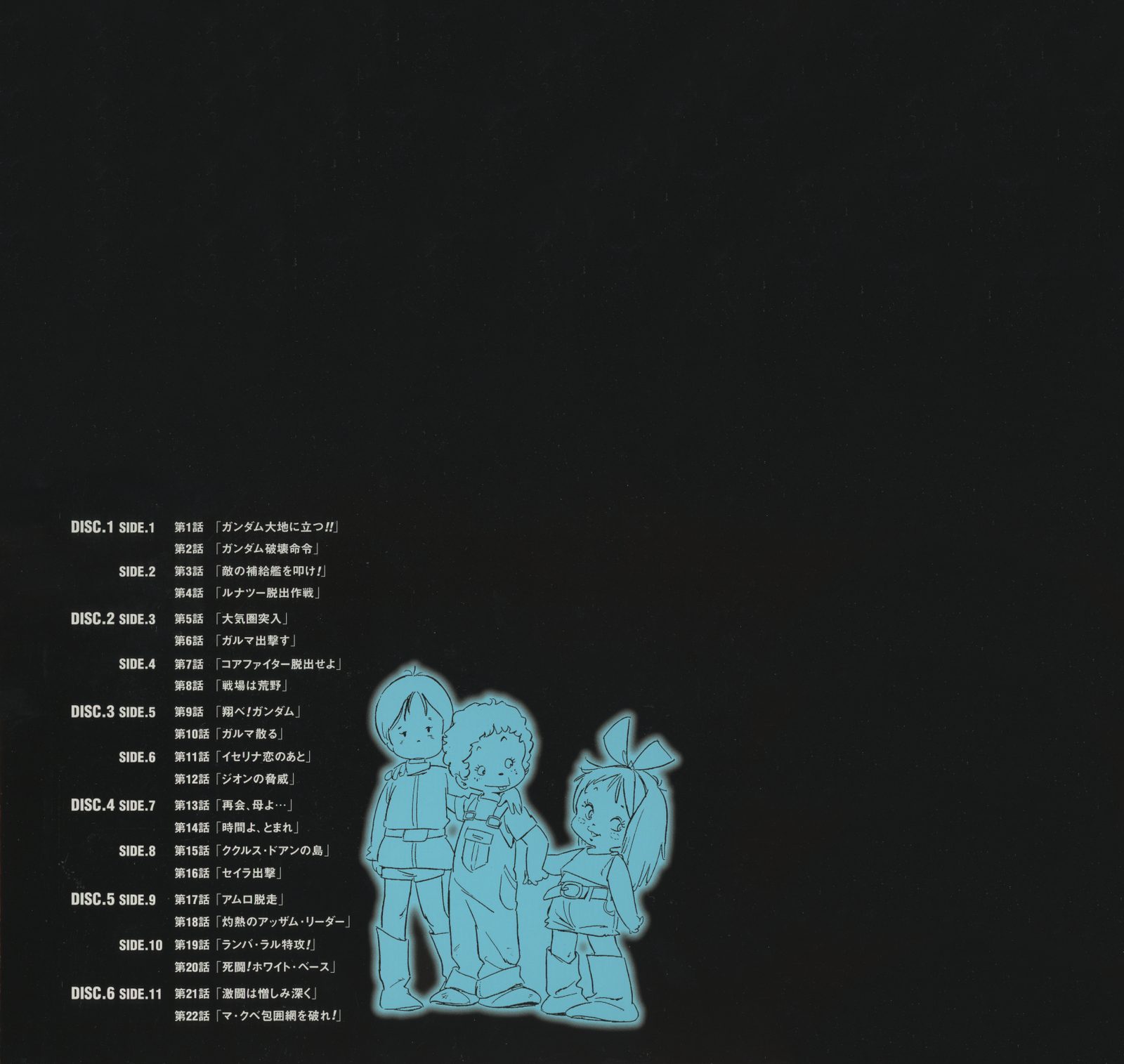 Part 1 episode index. DISC 1 through DISC 6, SIDE 1 through SIDE 11 — episodes 1-22 listed with Japanese titles. Chibi Amuro, Fraw Bow, and Haro in cyan outline. Two episodes per side, CLV format.
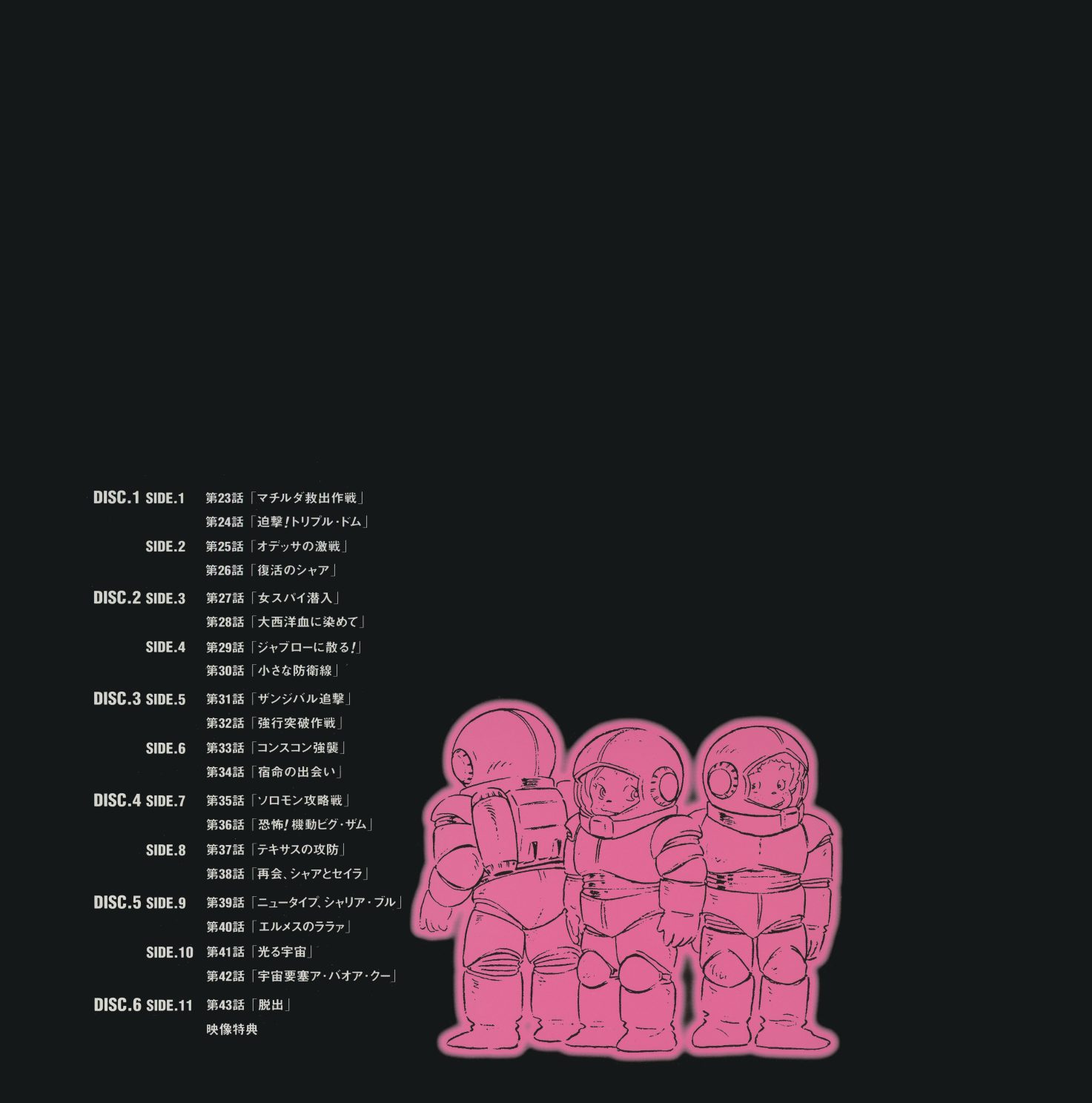 Part 2 episode index. DISC 1 through DISC 6, SIDE 1 through SIDE 11 — episodes 23-43. Chibi characters in pink. The final side carries only episode 43: 脱出 (Escape).
The Jacket Paintings
Each disc jacket is a newly commissioned painting, not production art reuse. The illustrators rotate across the twelve discs — Hiroshi Sano, Koji Sugino, Toshihiro Kawamoto, and others — and each painting takes a different compositional approach to the episodes it covers. Part 1's jackets progress from mecha combat (Disc 1: RX-78 vs Zaku II) through character portraiture (Disc 2: Char and his machines) to romance (Disc 3: Garma and Icelina), ensemble cast study (Disc 4: Sayla and the women of Gundam), military drama (Disc 5: Ramba Ral's unit), and finally a full crew assembly (Disc 6: the entire White Base complement). The progression mirrors the series' own drift from robot action toward human drama. Each gatefold back reverses to reveal a scene montage — episode-indexed frame captures with character quotes — functioning as a visual episode guide.
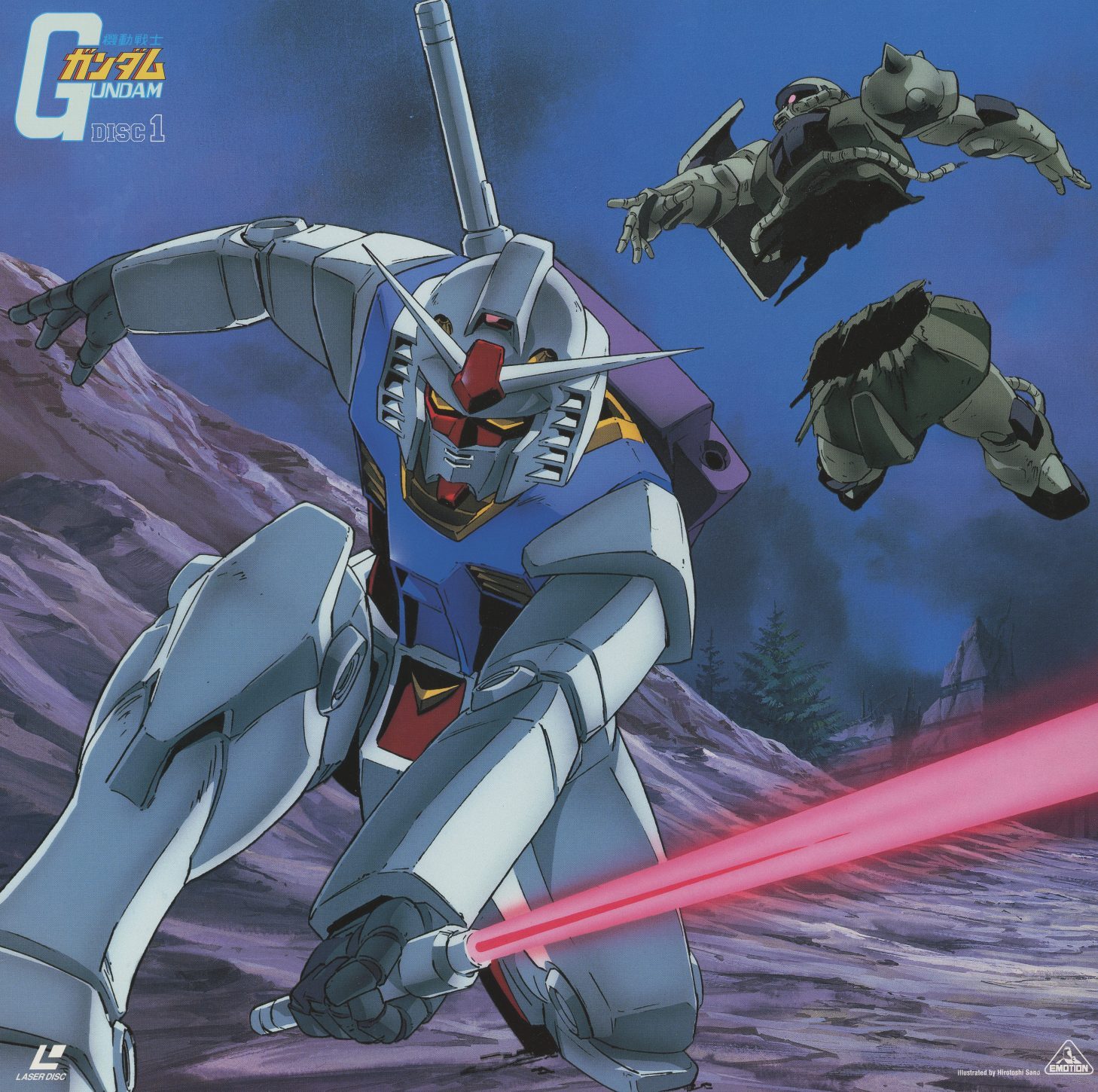 Part 1 Disc 1. RX-78-2 Gundam vs MS-06F Zaku II — beam saber combat in forest terrain. The first jacket establishes the series' visual signature: Federation white against Zeon green. Illustrated by Hiroshi Sano. Episodes 1-4.
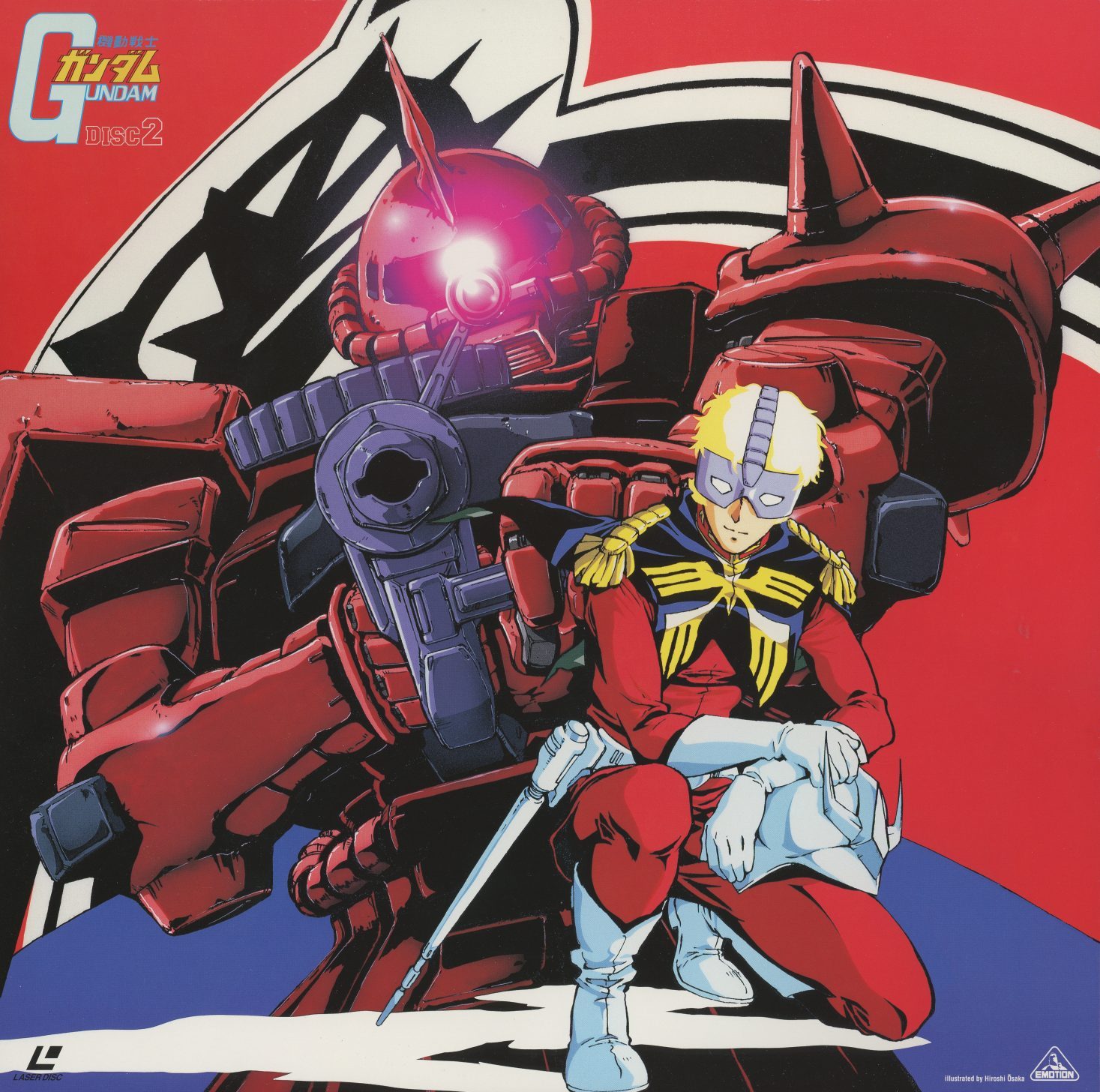 Part 1 Disc 2. Char Aznable in red pilot suit, seated before his MS-06S Commander Zaku II and MS-14S Gelgoog, the Zeon crest behind. Red on red on red. The antagonist as cover subject. Episodes 5-8.
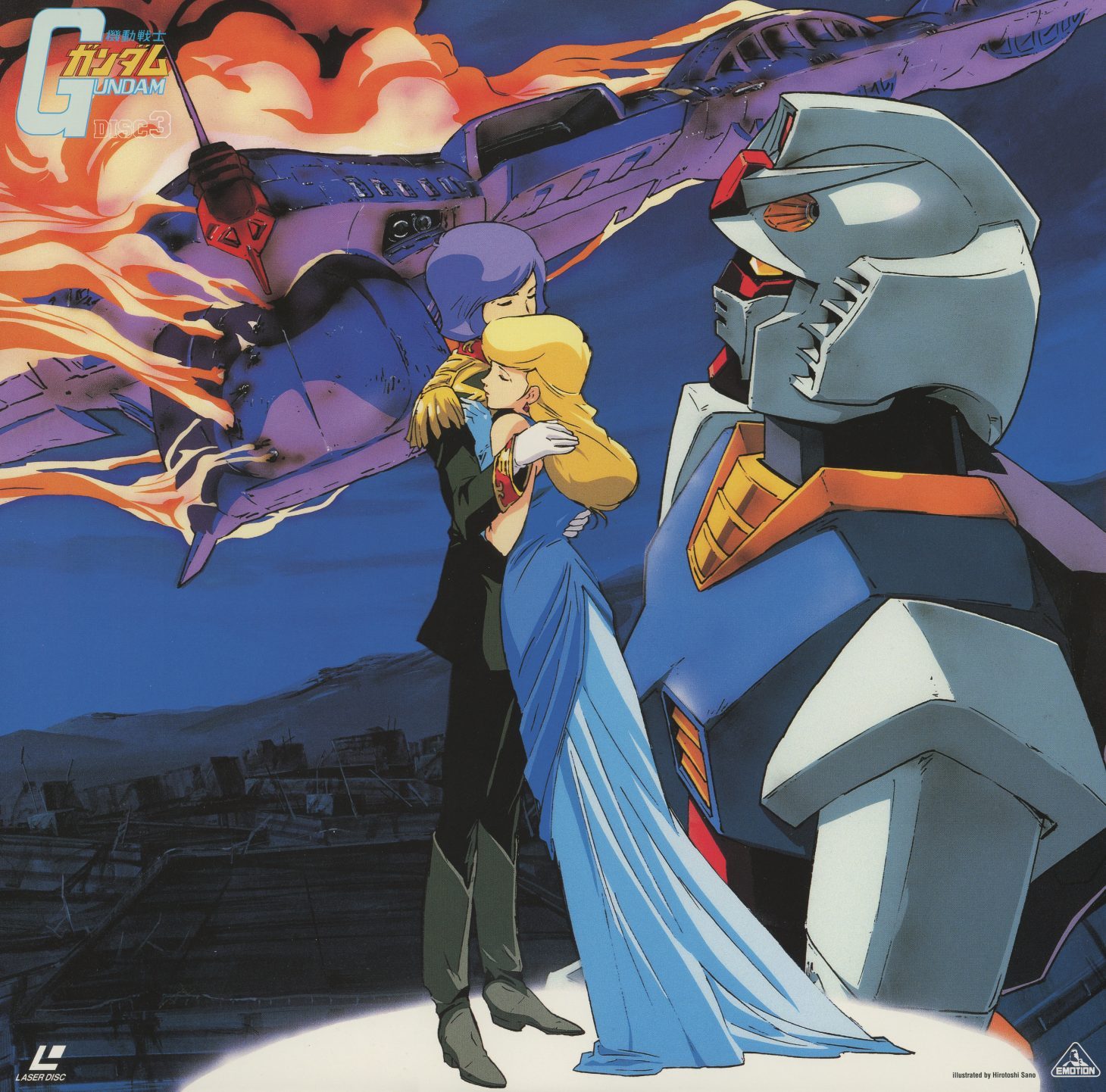 Part 1 Disc 3. Garma Zabi and Icelina Eschonbach in embrace, the Gundam looming behind — romance painted as tragedy, the couple foregrounded against the machine that kills one of them. Episodes 9-12.
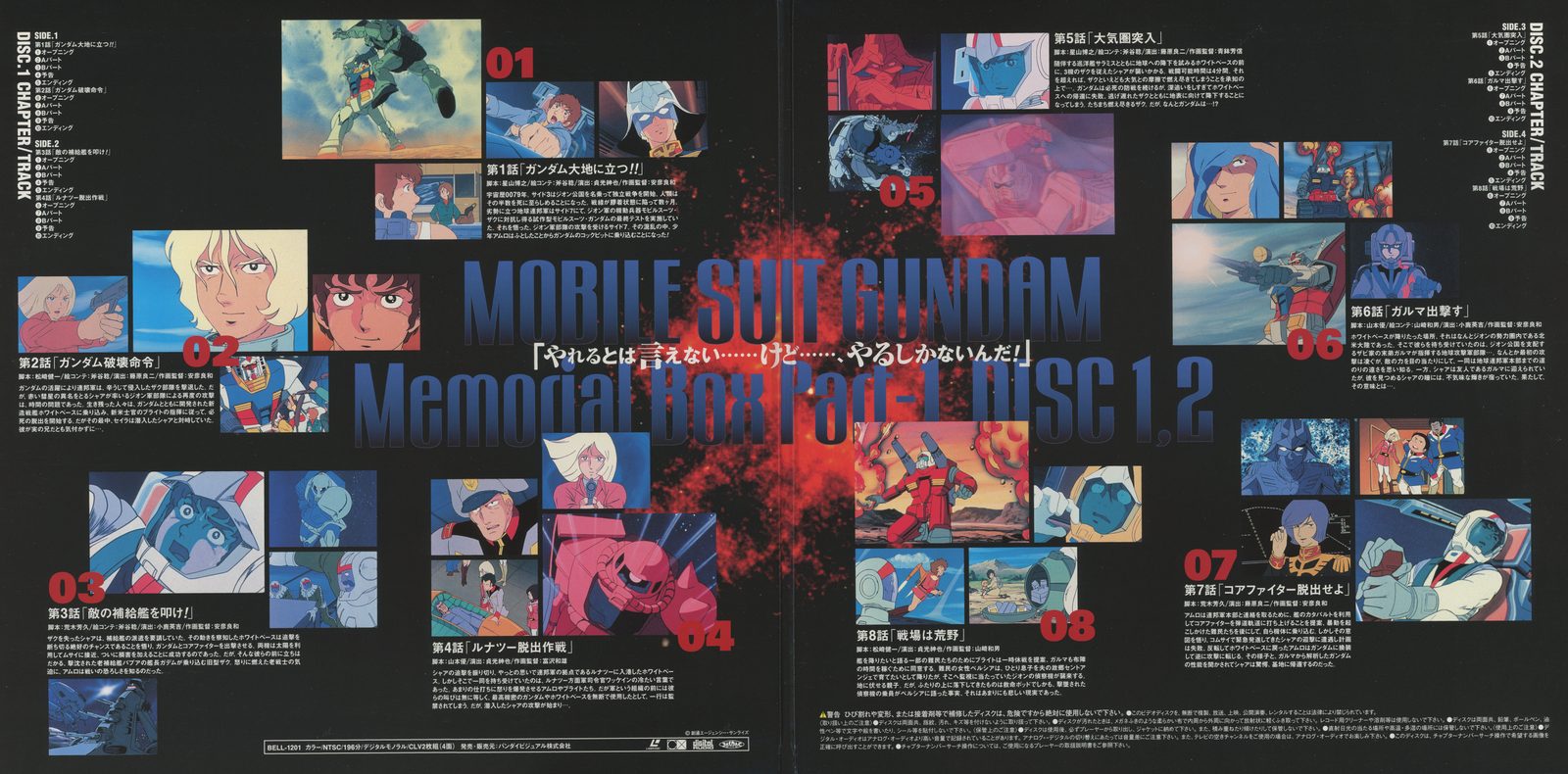 Part 1 Disc 1-2 gatefold back. Scene montage for episodes 1-8 with frame captures indexed by episode number. Center quote: 「見てろよ、ガンダムの力を…こいつの性能を活かせるのは僕だけなんだ!!」— Amuro's declaration of ownership over the Gundam.
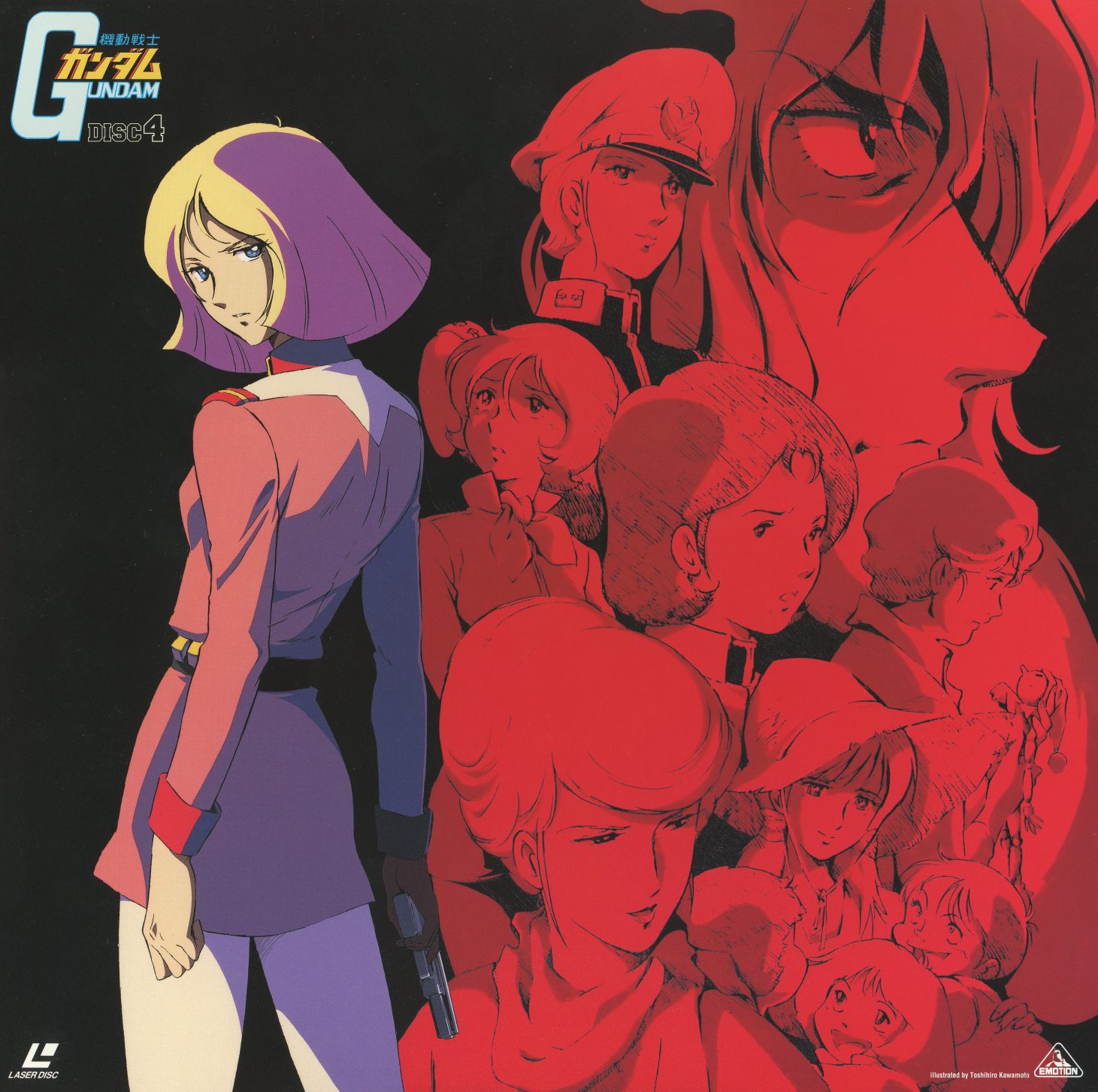 Part 1 Disc 4. Sayla Mass in full color against the women of Gundam rendered in red silhouette — Fraw Bow, Mirai, Matilda, Kycilia, Icelina, Hamon, Lalah. A portrait of the series' female cast as ensemble. Illustrated by Toshihiro Kawamoto. Episodes 13-16.
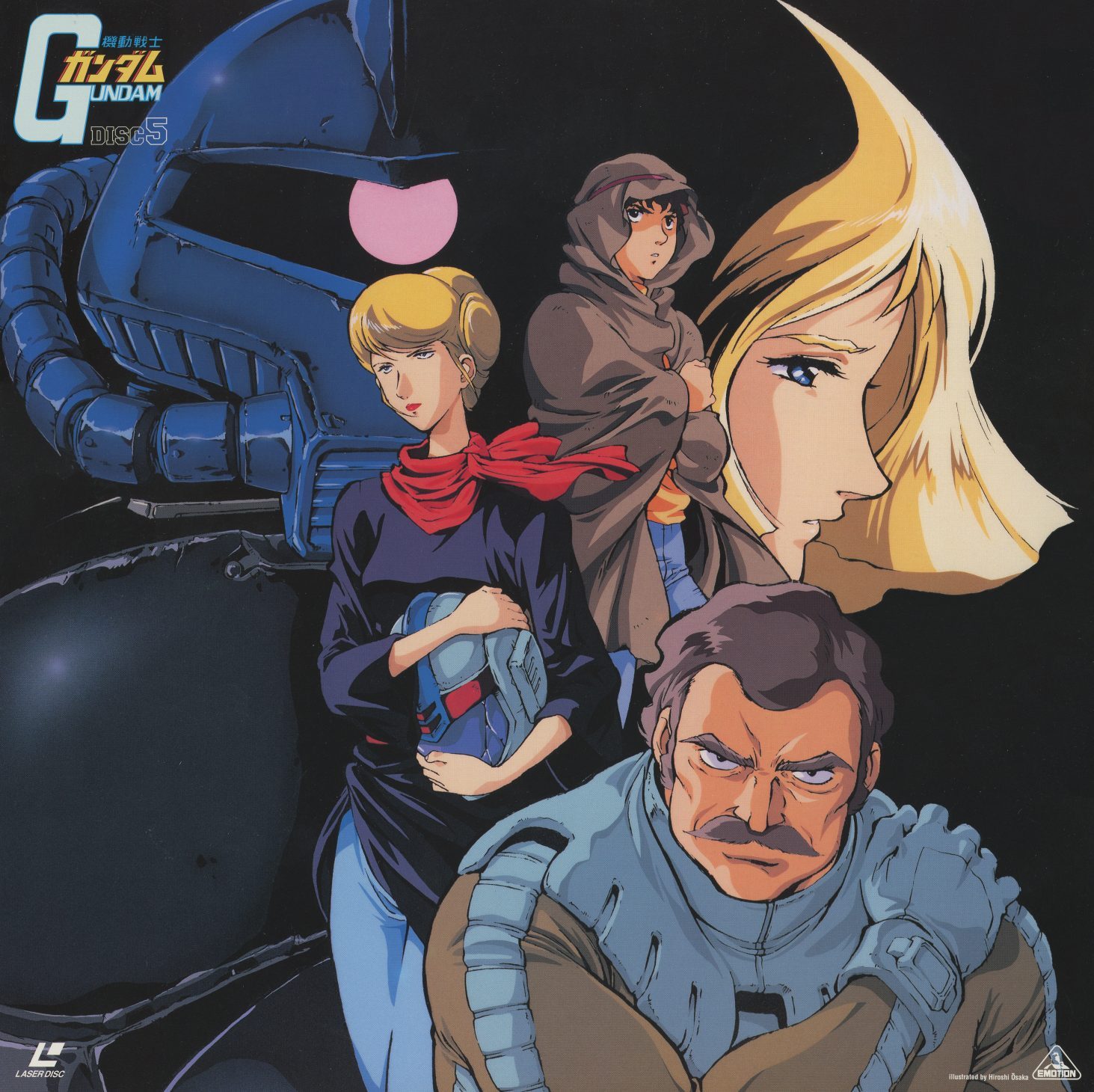 Part 1 Disc 5. Ramba Ral, Crowley Hamon, and their unit with the MS-07B Gouf — the Zeon soldiers who are more sympathetic than many Federation characters. Dark composition, the blue giant behind. Episodes 17-20.
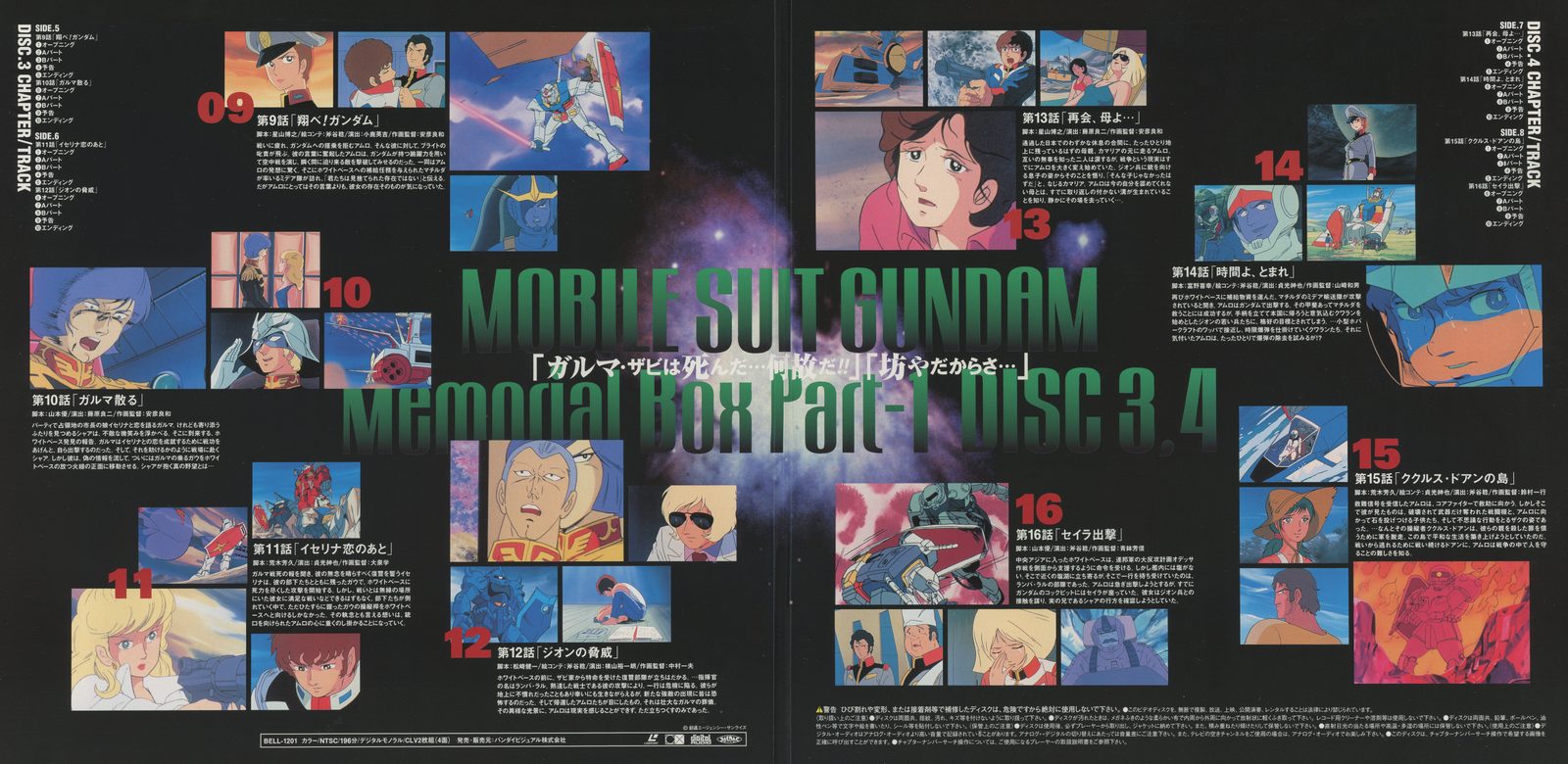 Part 1 Disc 3-4 gatefold back. Scene montage for episodes 9-16. The Garma arc through the Ramba Ral arc — the series' first major character deaths captured in frame selections.
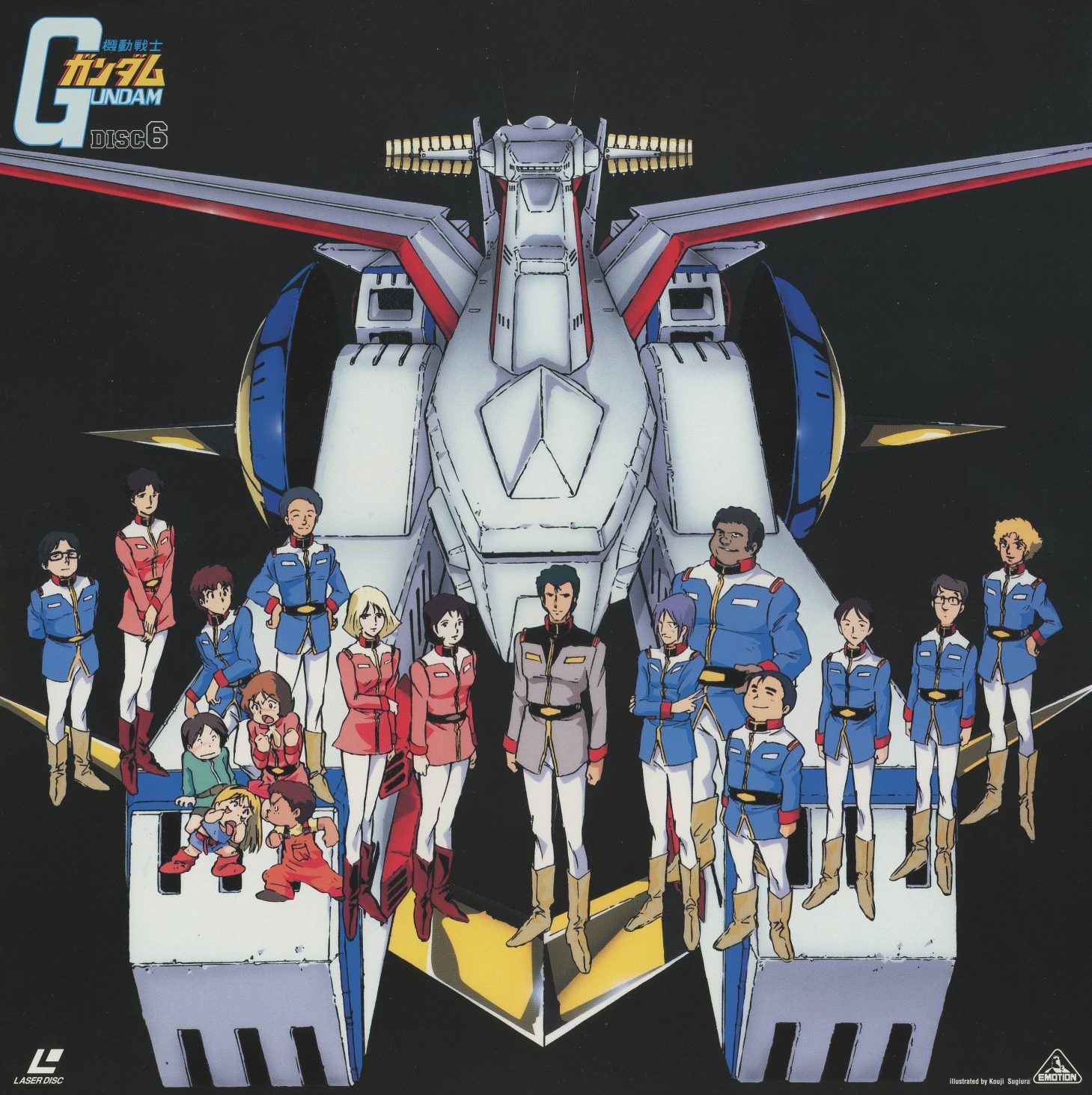 Part 1 Disc 6. The full White Base crew assembled before their ship — every named crew member present, from Bright Noa in the center to the refugee children at the edges. The Part 1 closer presents the ensemble as the subject. Illustrated by Koji Sugino. Episodes 21-22.
Part 2: Into Space
Part 2's jackets shift register. The ground war is over. The paintings move from atmospheric landscapes to the black void of space — and from ensemble compositions to increasingly isolated figures. The final two jackets, Discs 5 and 6, are the most striking paintings in either box. Disc 5 splits the frame between Amuro rendered in graphite monochrome and Lalah Sune burning in color — the Newtype connection visualized as a literal break in the image's visual language. Disc 6 shows Amuro floating alone in space with Lalah's spirit, the war reduced to two people and the silence between them.
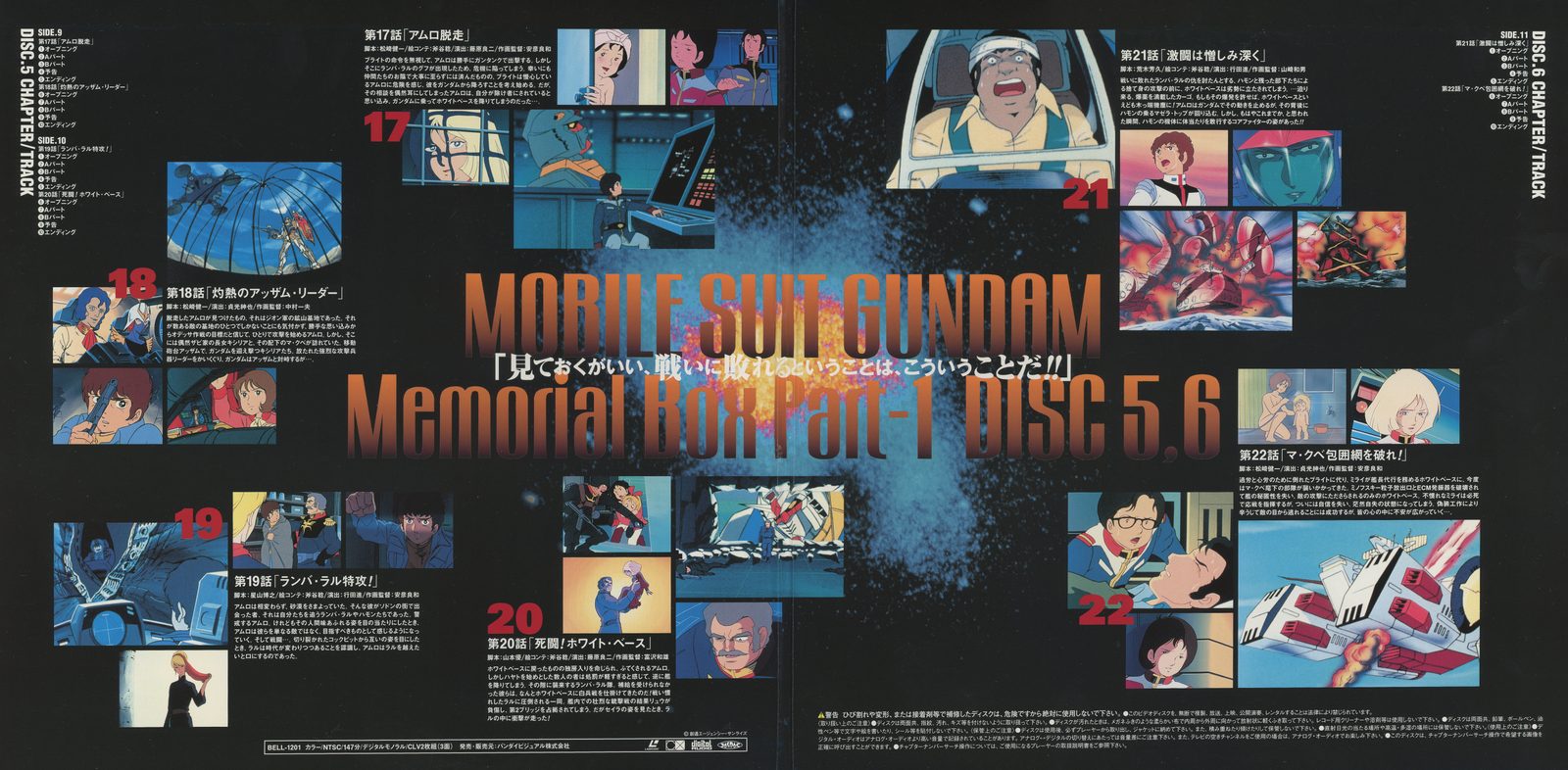 Part 1 Disc 5-6 gatefold back. Scene montage for episodes 17-22 — the Jaburo arc, Amuro's desertion, the White Base's launch back into space. Bright Noa quote at center.
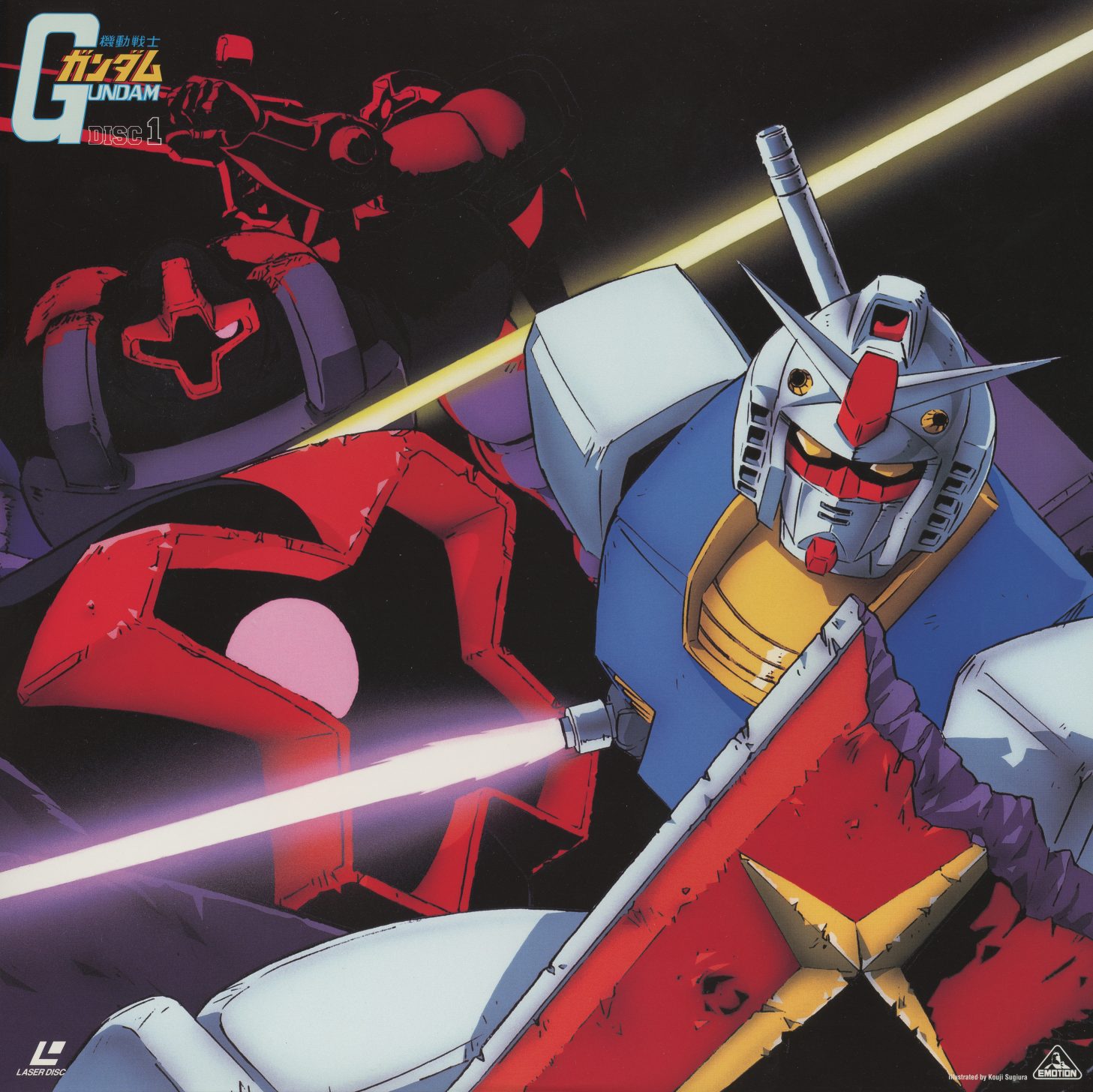 Part 2 Disc 1. RX-78-2 vs Char's red mobile suit — beam saber duel in space, cross-guard lock. The rivalry moves from Earth to orbit. Episodes 23-26.
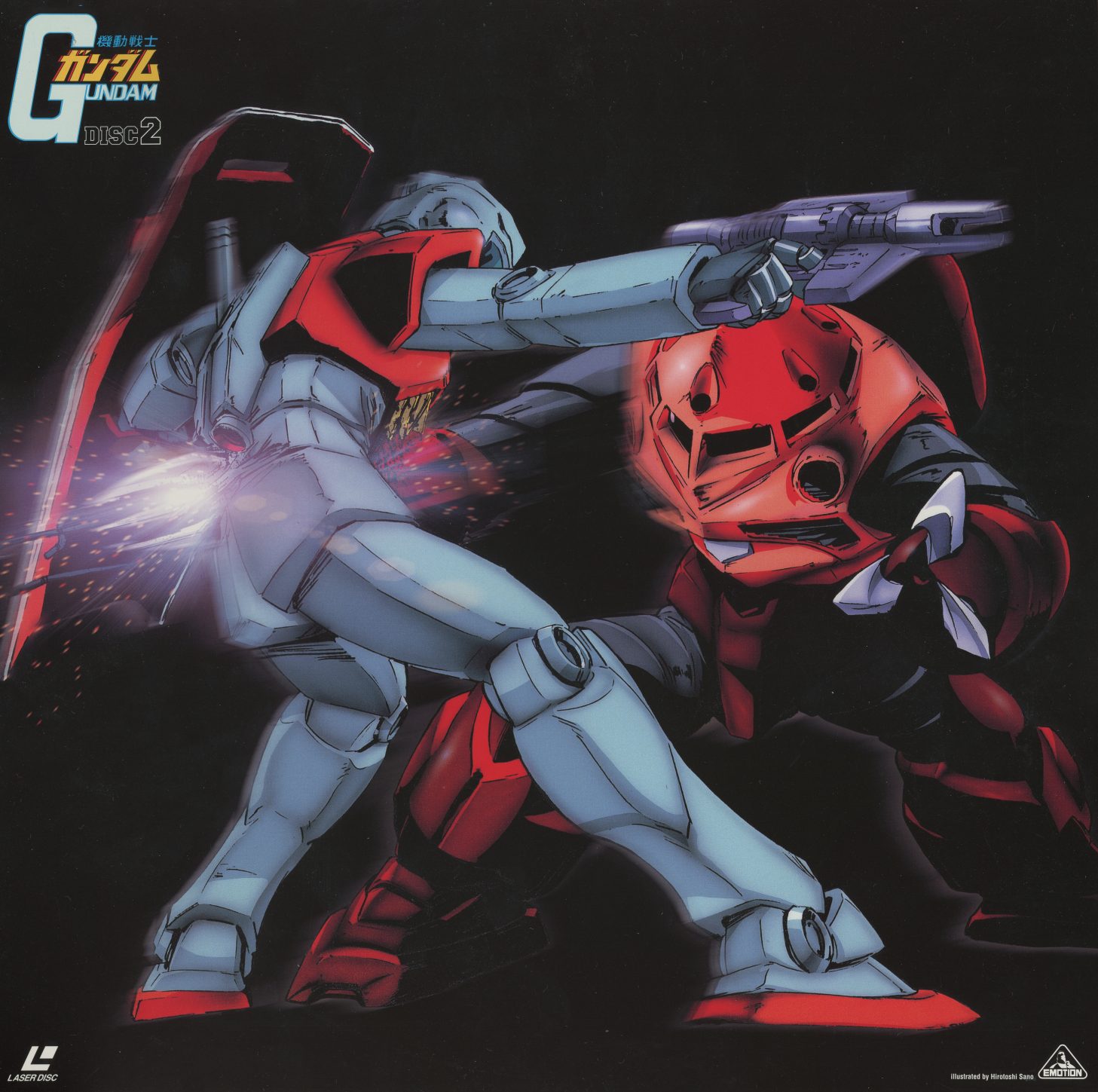 Part 2 Disc 2. RX-78-2 grappling a red mobile suit at contact range — hand-to-hand mecha combat, the most physically violent composition in the set. Episodes 27-30.
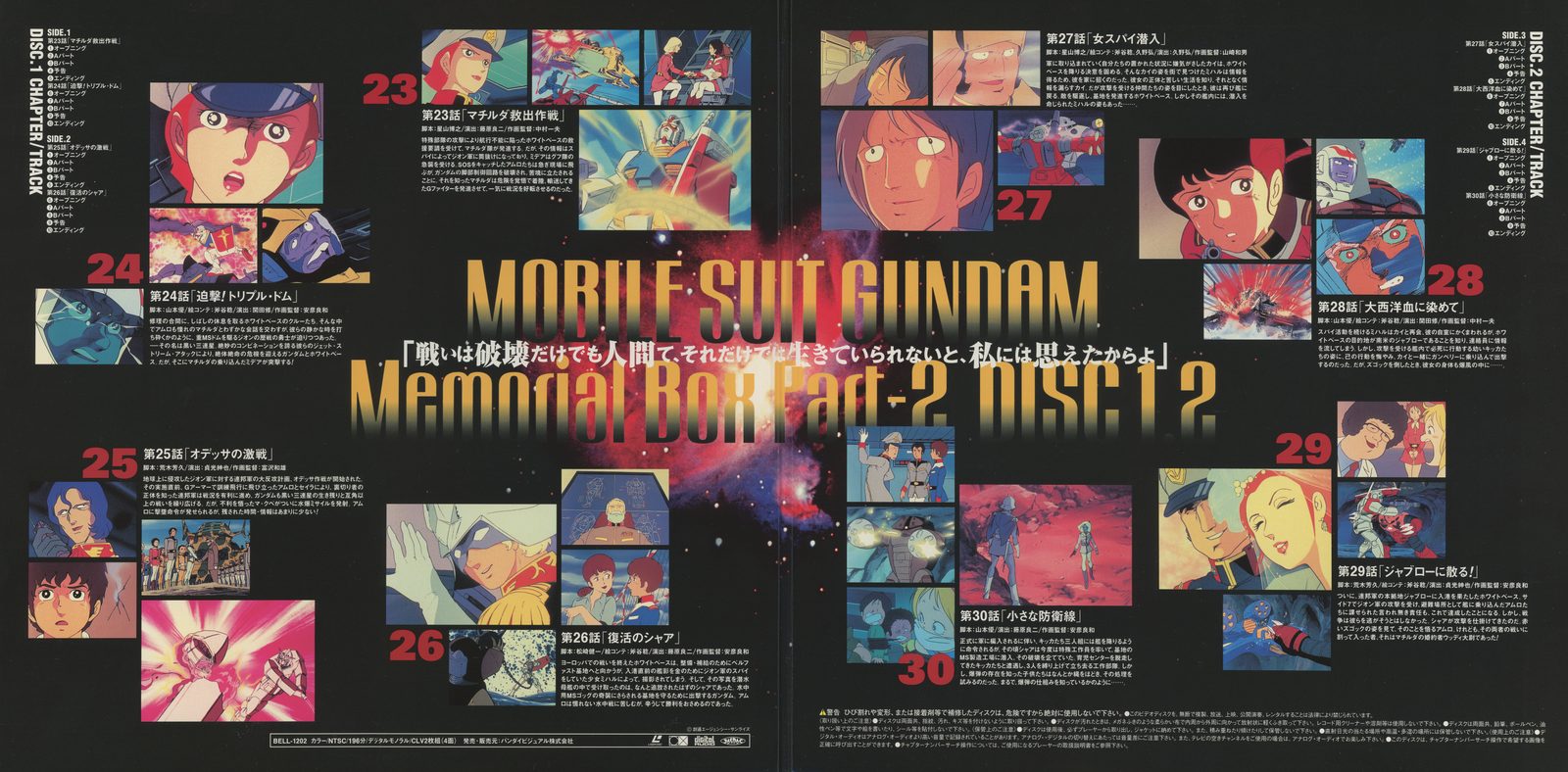 Part 2 Disc 1-2 gatefold back. Scene montage for episodes 23-30. The space campaign begins — Solomon, Texas Colony, the escalation toward A Baoa Qu.
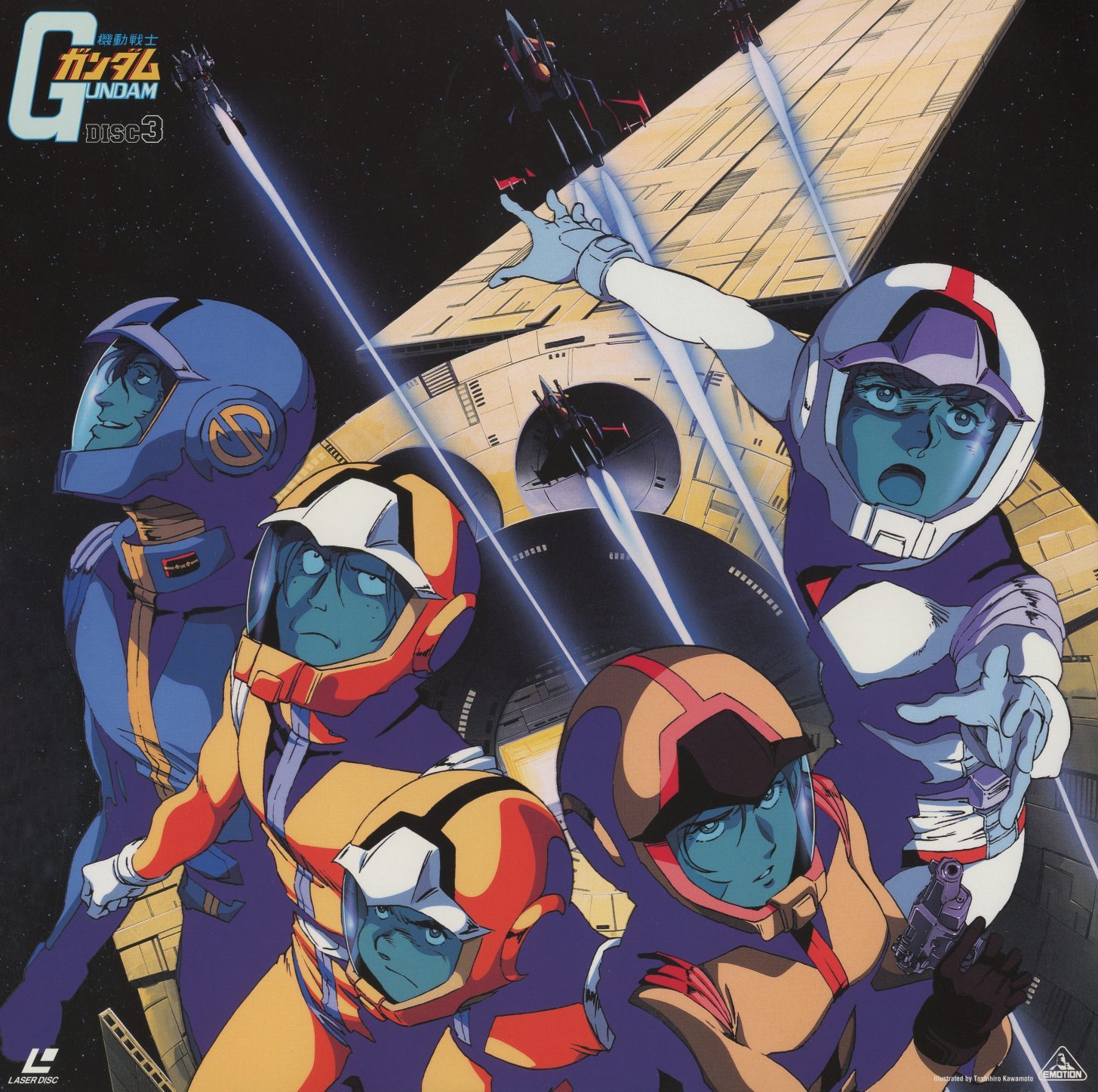 Part 2 Disc 3. White Base crew in space suits before the Solomon fortress — the crew as soldiers rather than refugees, helmets on, weapons drawn. Episodes 31-34.
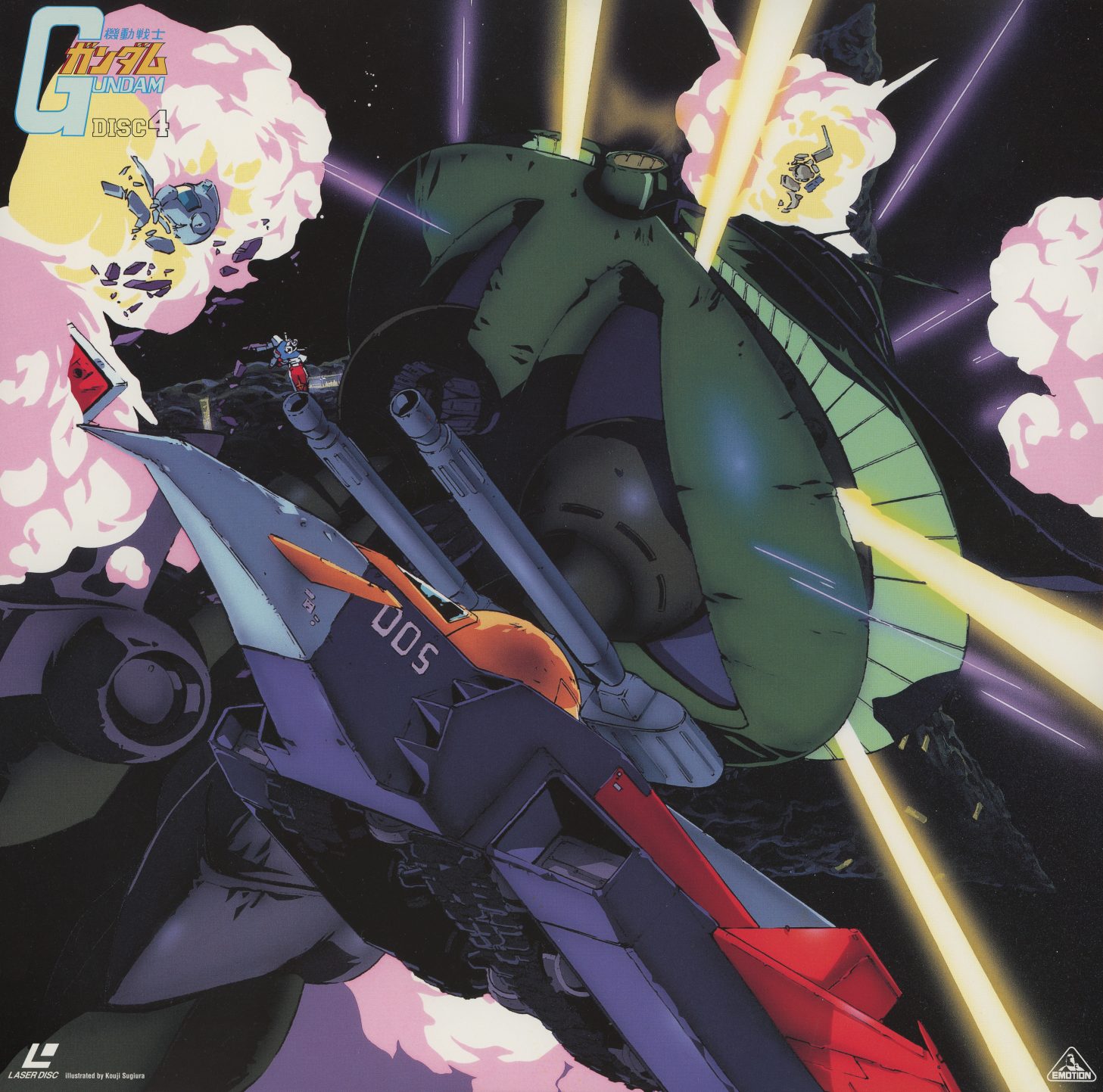 Part 2 Disc 4. Big Zam mobile armor and Core Booster in space battle, the scale of the war expanded to fortress-class weapons. Episodes 35-38.
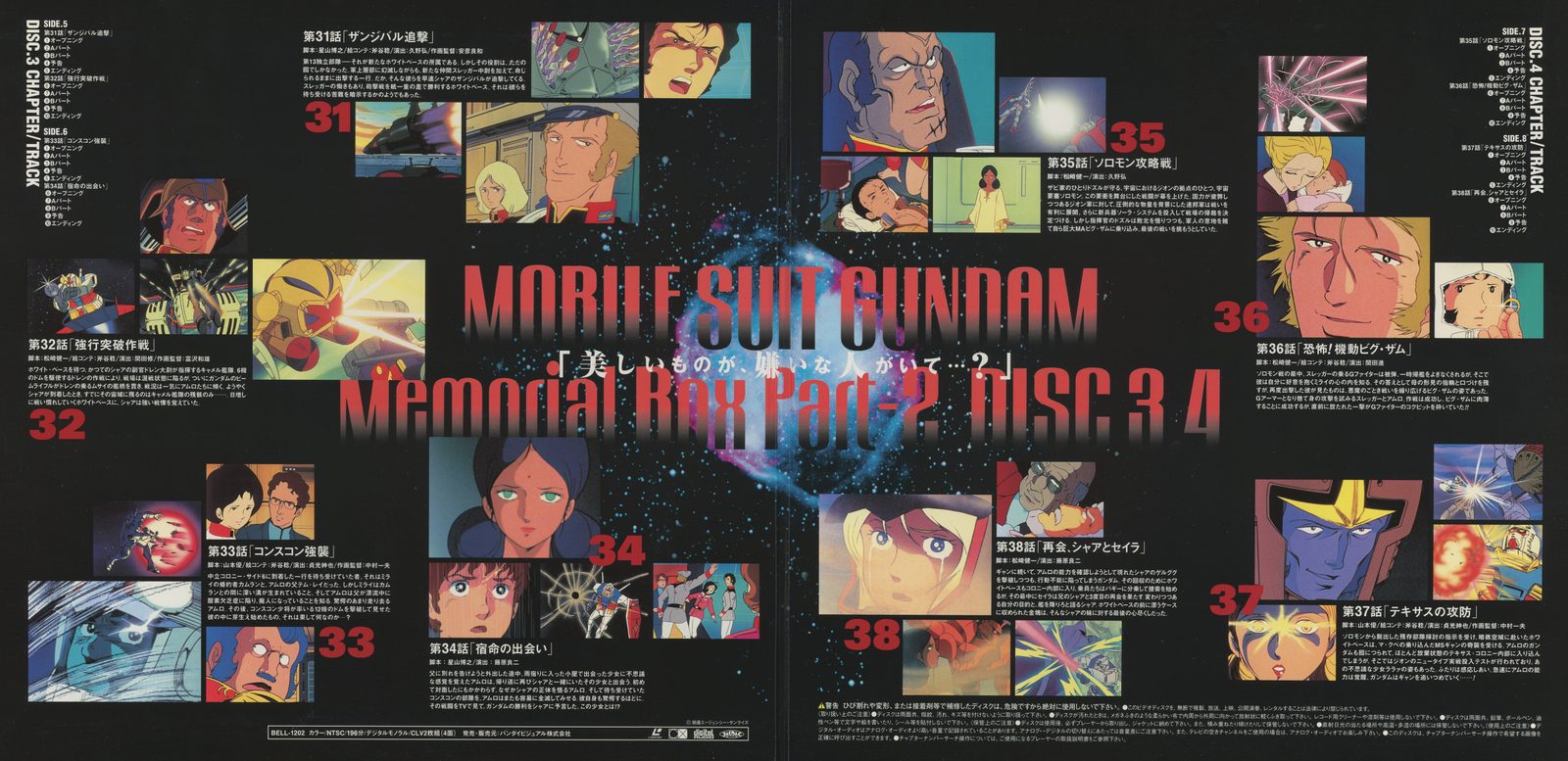 Part 2 Disc 3-4 gatefold back. Scene montage for episodes 31-38. The Solomon and A Baoa Qu arcs — the war's final escalation.
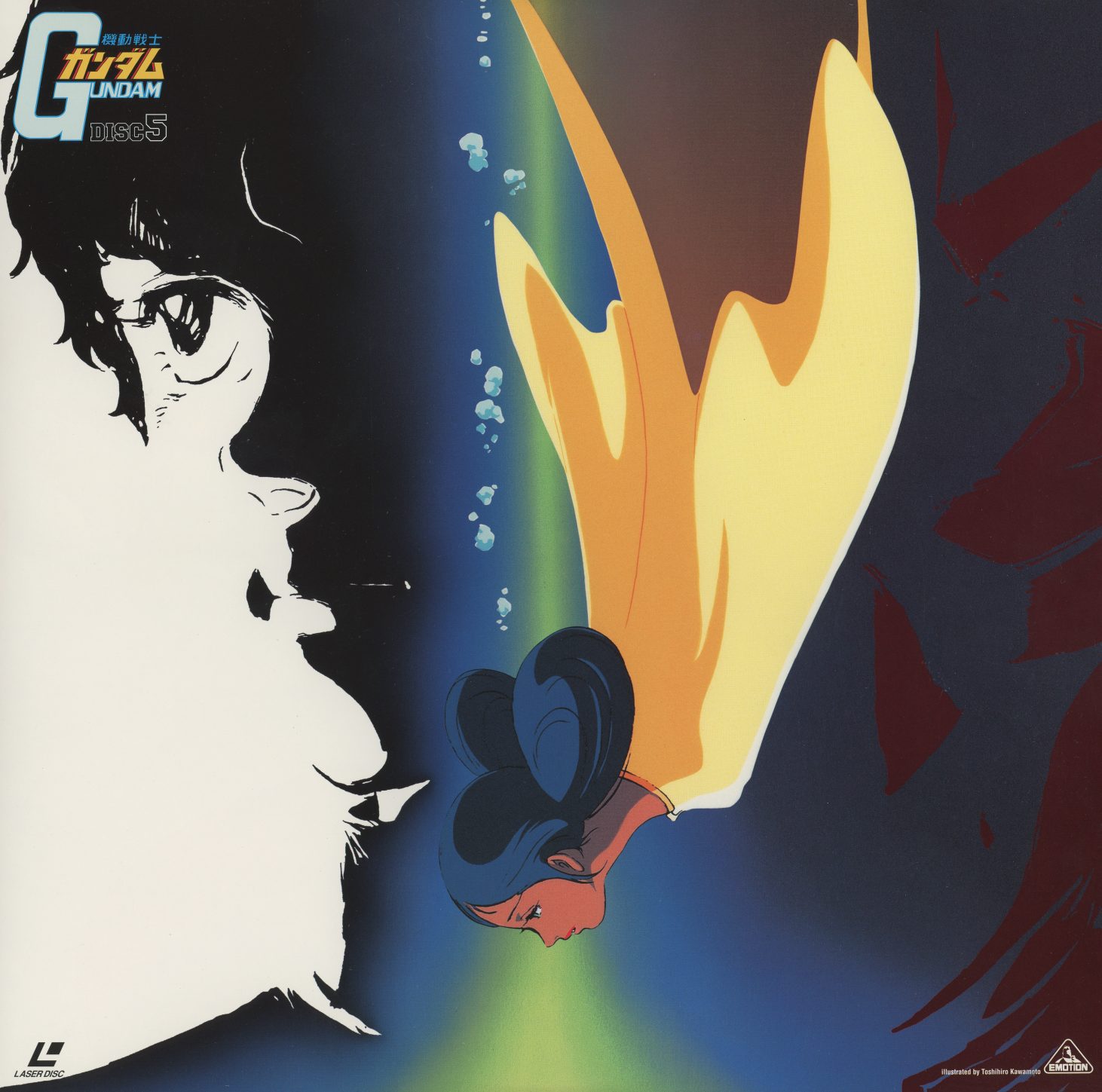 Part 2 Disc 5. Amuro and Lalah — the frame split in half. Left: Amuro in graphite monochrome, rendered as pencil drawing. Right: Lalah Sune burning in full color, ascending, the Elmeth behind her. The Newtype connection visualized as a rupture between two visual languages. The most striking single jacket in either box. Episodes 39-40.
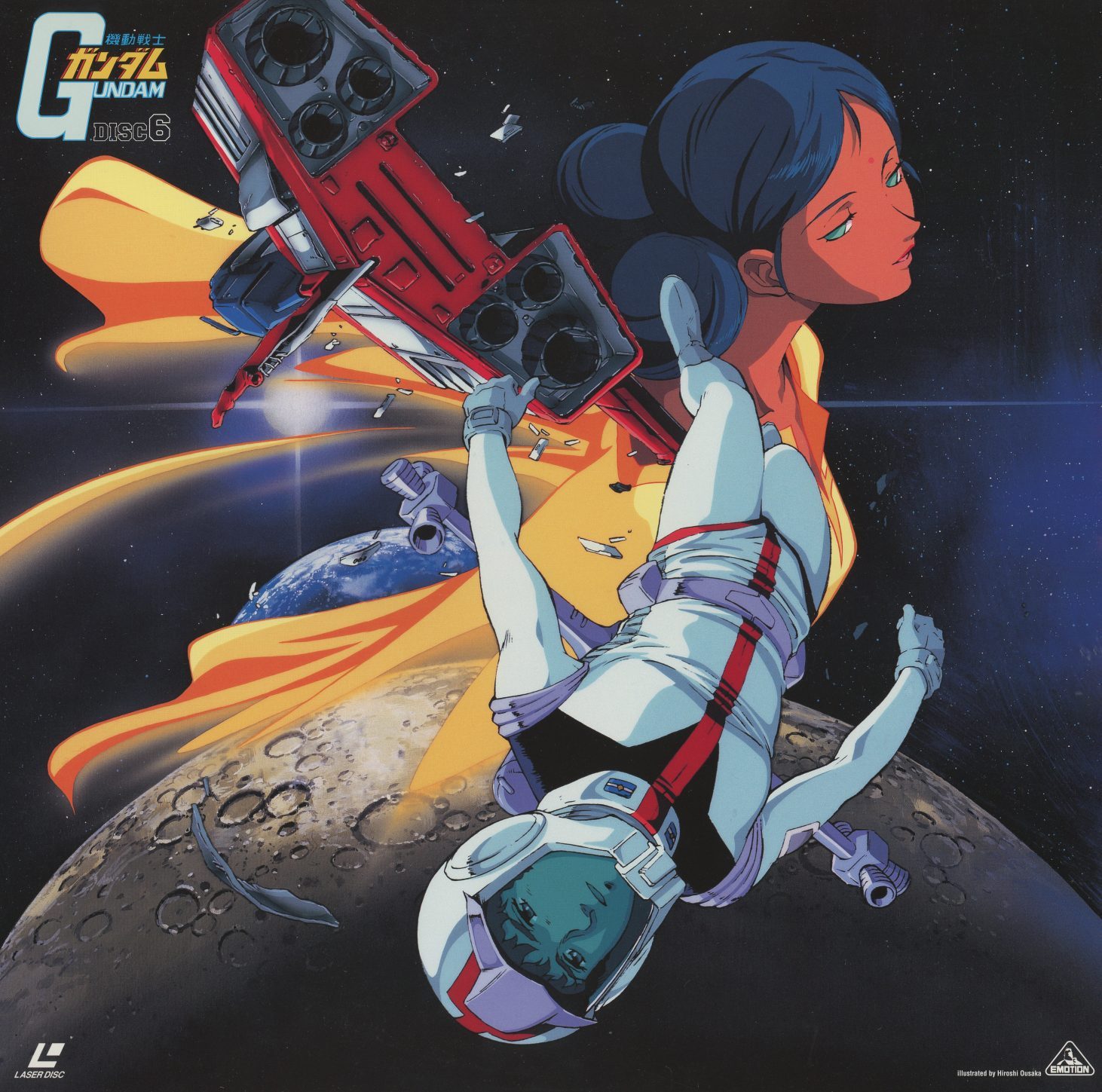 Part 2 Disc 6. Amuro floating in space with Lalah's spirit — Earth below, the destroyed Zeong above, the war ending in weightlessness. Illustrated by Hiroshi Sugino. Episodes 41-43.
The Final Gatefold
「僕にはまだ帰れる所がある…こんな嬉しい事は無い……!」
'I still have a place to return to... there is nothing that could make me happier...!'
— Amuro Ray, Episode 43
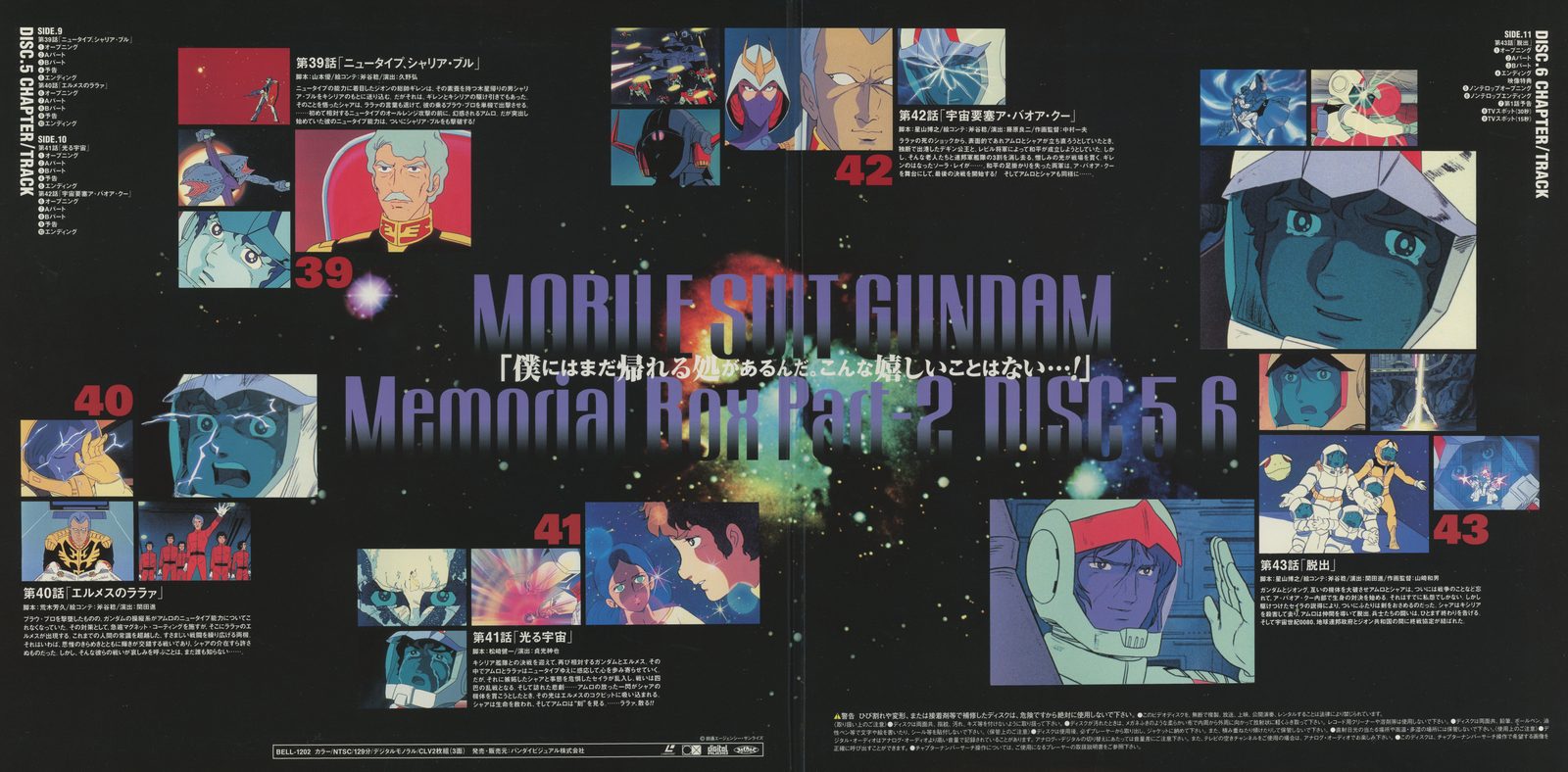 Part 2 Disc 5-6 gatefold back. Scene montage for episodes 39-43 — the final five episodes. Lalah's death, the Battle of A Baoa Qu, Char and Amuro's duel, the White Base crew's escape. The series ends.
The Booklet
BELL-1201. Not for sale. The companion booklet shipped with Part 1 and functions as a critical companion to both boxes. It opens with a Ryusuke Hikawa essay — '等身大でニュータイプなアニメ' ('A Life-Sized Newtype Anime') — illustrated with a thumbnail gallery of all twelve jacket paintings. The center section contains extended interviews with the three creators who defined the franchise: director Yoshiyuki Tomino, character designer Yoshikazu Yasuhiko, and mechanical designer Kunio Okawara. Each interview is accompanied by a portrait photograph, production stills, and — in Yasuhiko's and Okawara's cases — an ILLUSTRATION GALLERY of newly commissioned paintings. The booklet also reproduces the original 1979 planning documents — the concept flowchart and character design sheets that pitched the series to Sunrise and Clover (the original toy sponsor). These are pre-production documents. They show what Gundam was before it became Gundam.
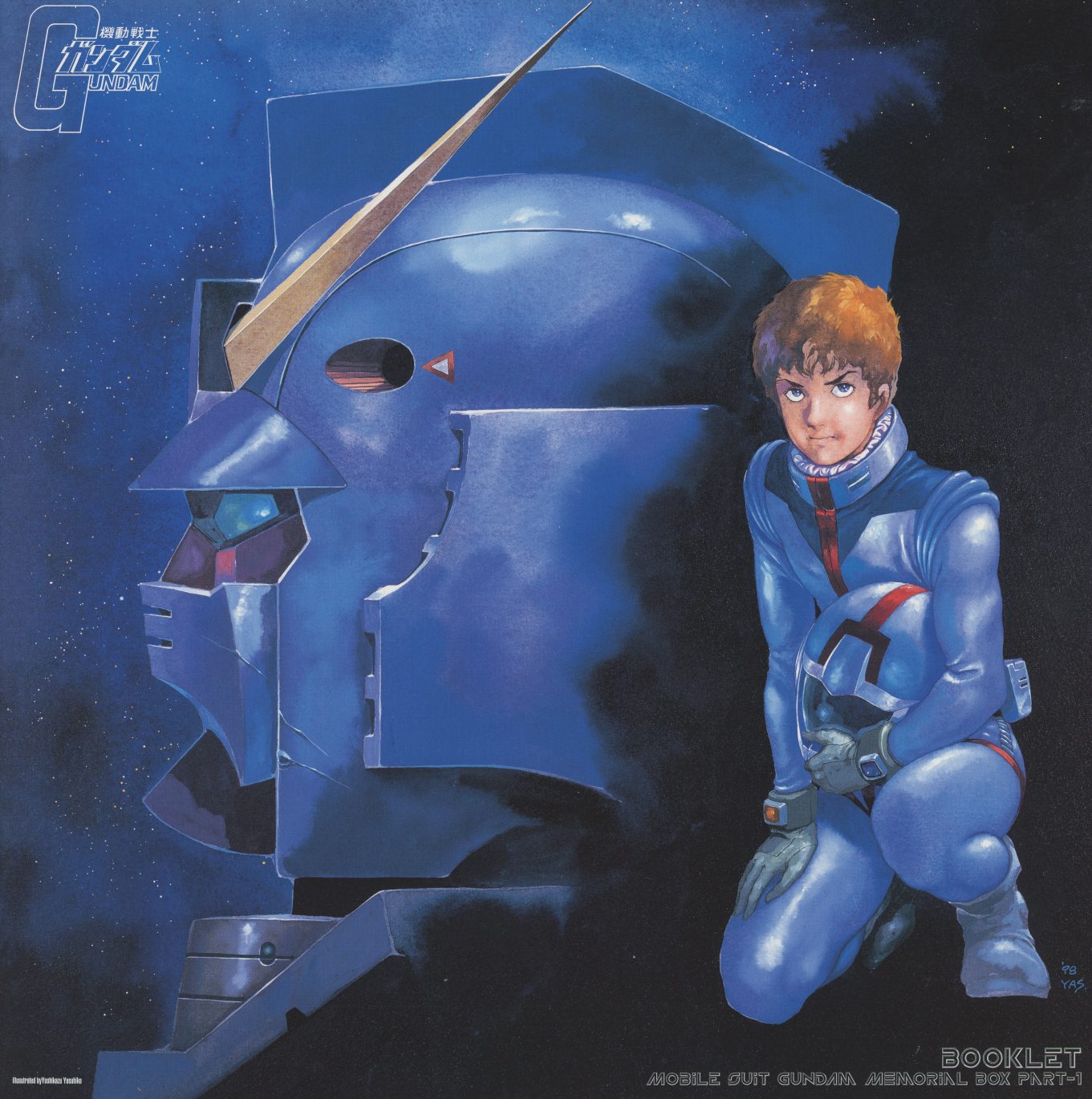 Booklet cover (BELL-1201). Amuro and RX-78-2 portrait — the same composition as the Part 1 inner lid, credited 'Illustrated by Yoshikazu Yasuhiko.' 'MOBILE SUIT GUNDAM MEMORIAL BOX PART-1 BOOKLET.'
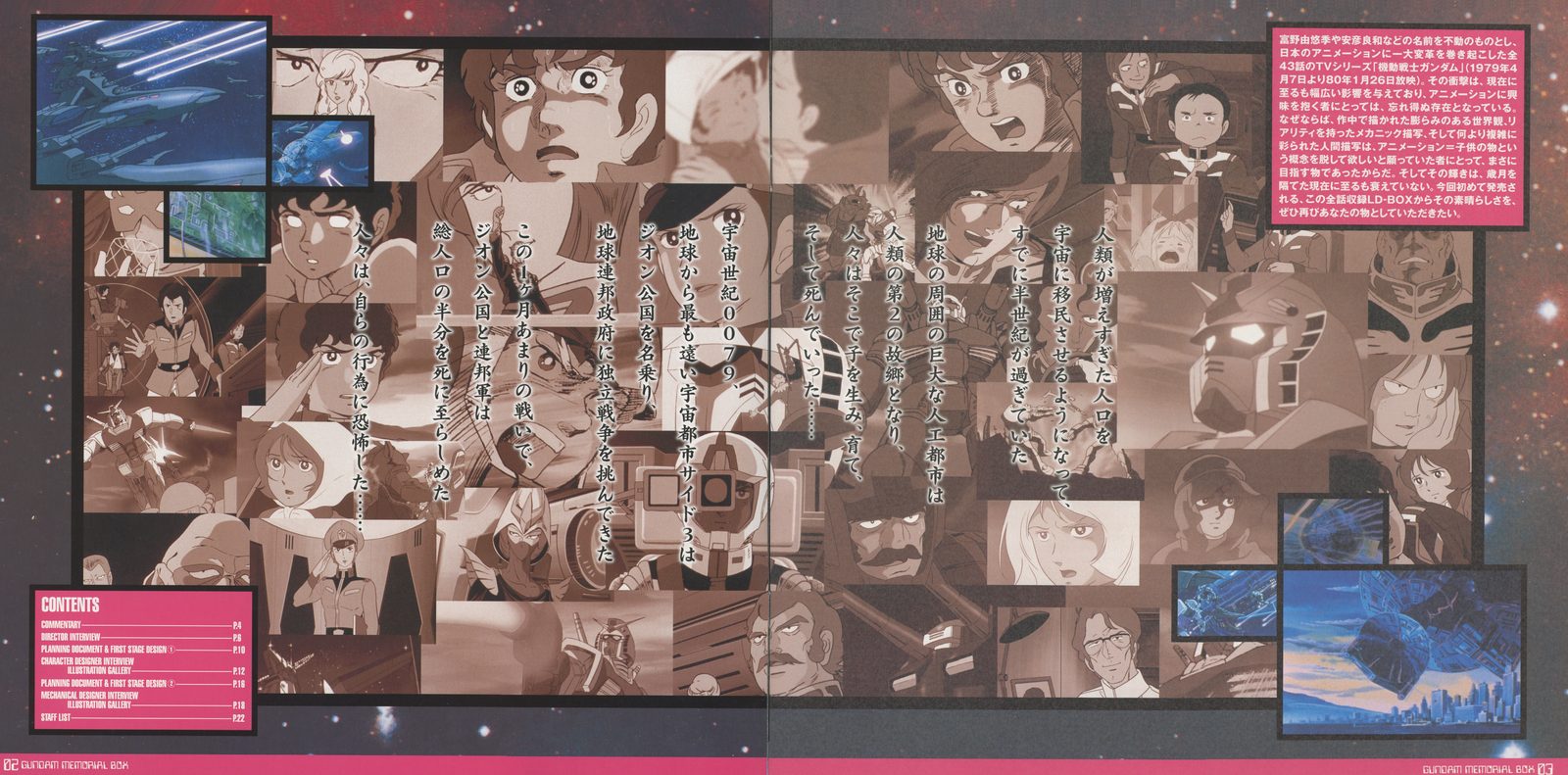 Booklet contents spread. Scene montage from all forty-three episodes in sepia tone with vertical Japanese text. CONTENTS listing at bottom left: interviews, illustration galleries, planning documents, staff list.
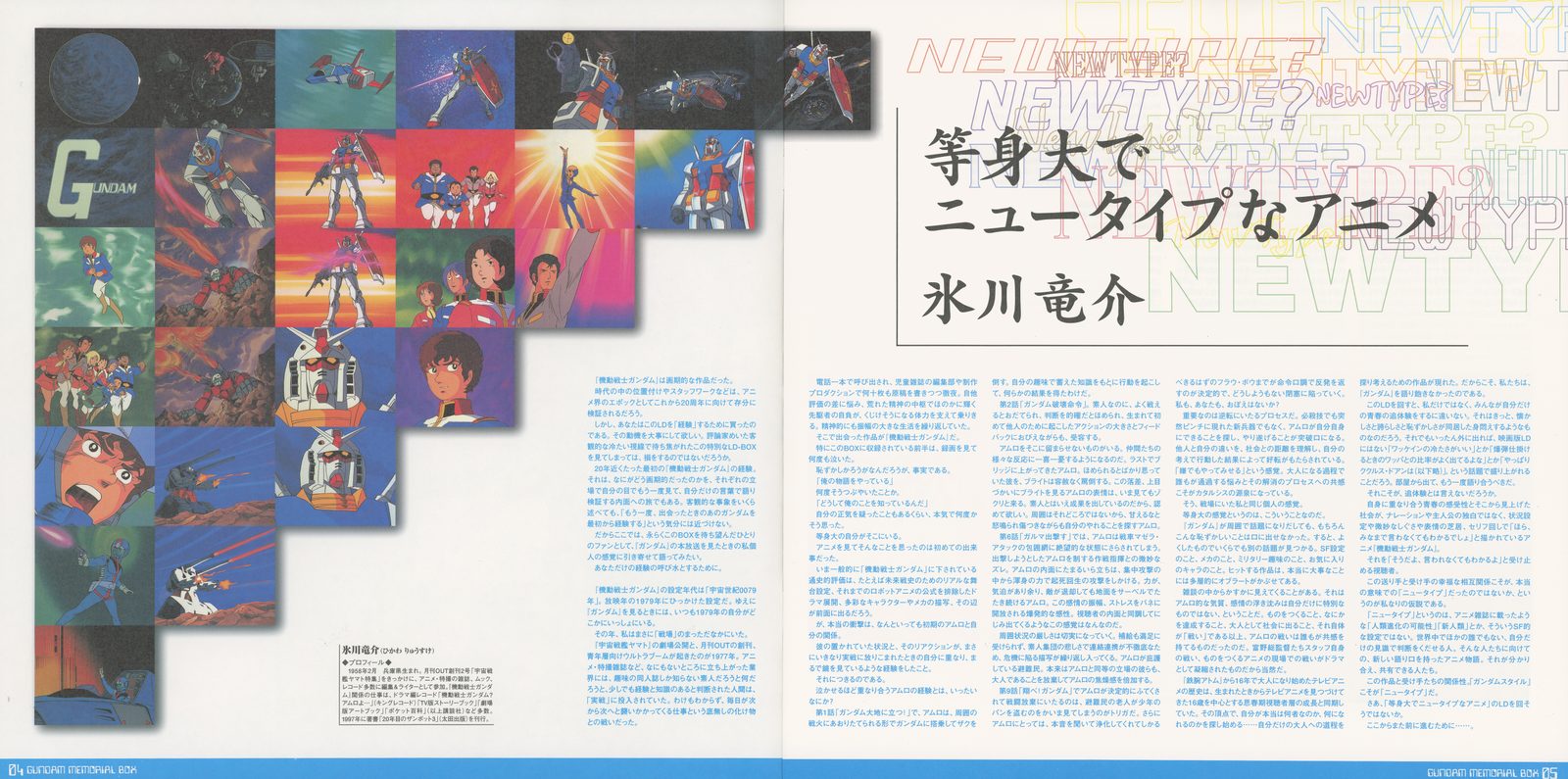 Ryusuke Hikawa essay: '等身大でニュータイプなアニメ' ('A Life-Sized Newtype Anime'). Thumbnail gallery of all twelve jacket paintings arrayed as a visual index. Hikawa — anime historian, critic, and Gundam scholar — places the series in its production and cultural context.
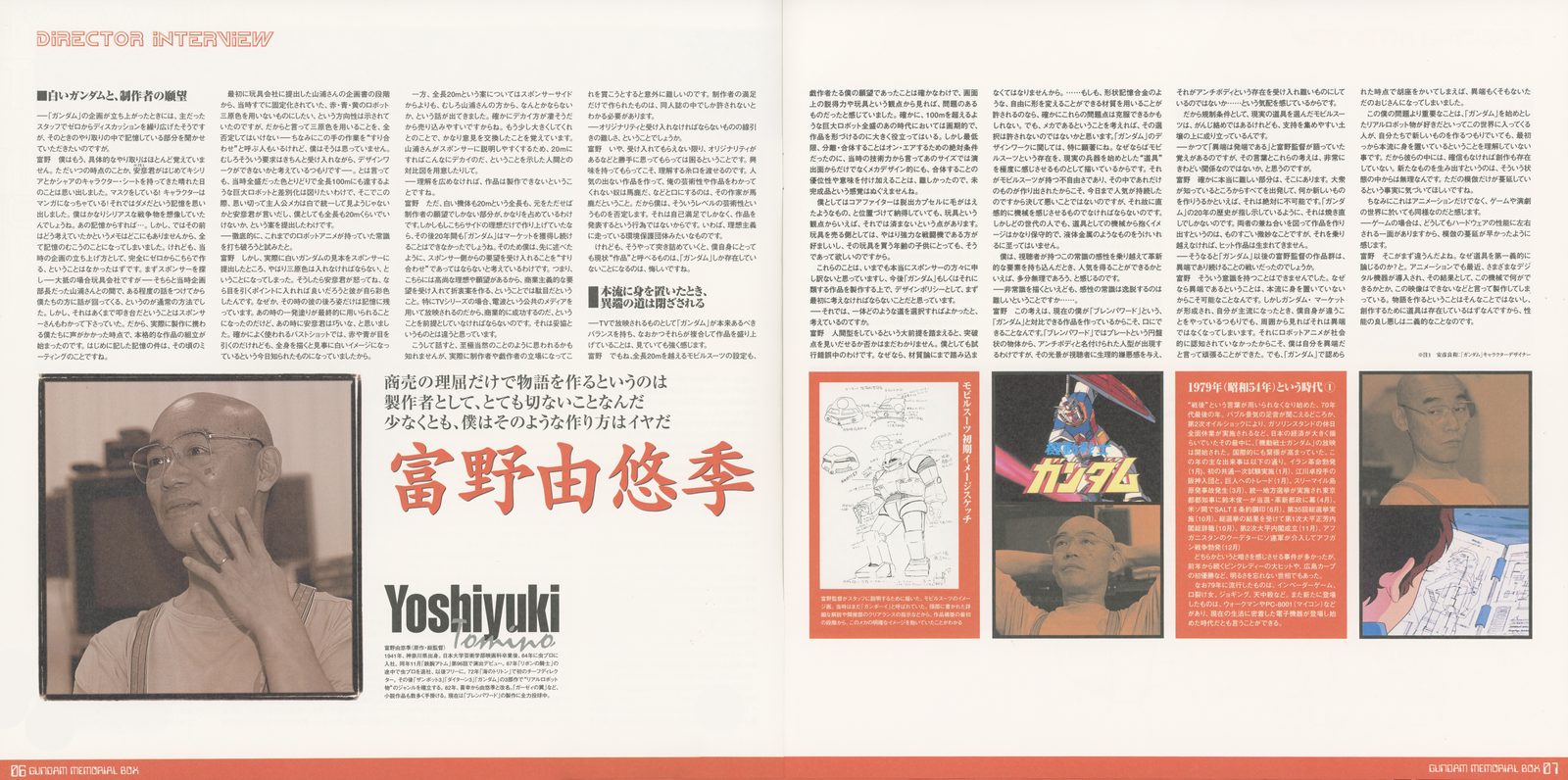 DIRECTOR INTERVIEW — 富野由悠季 Yoshiyuki Tomino. Portrait photograph, interview text, production stills. Tomino quote visible: '商売の理屈だけで物語を作るということは、制作していくことなくなるんです。やるとしたら、僕はそのような作り方はイヤだ' ('Creating stories based solely on commercial logic means ceasing to create. If I had to do it that way, I wouldn't want to').
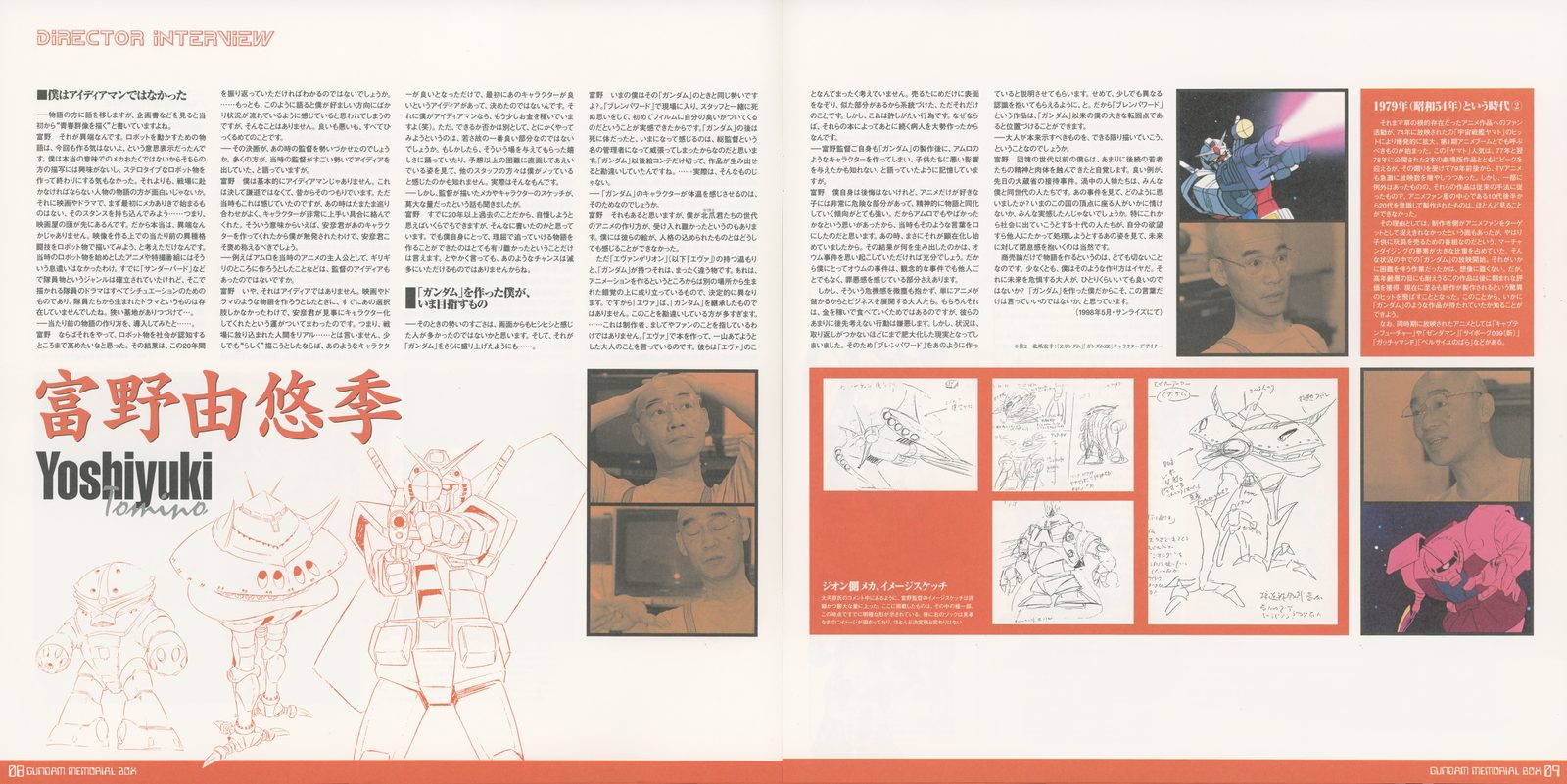 Tomino interview continued. Storyboard sketches, additional production stills, extended interview text. The director reflects on the series' creation, cancellation, and cultural afterlife — the gap between the show he wanted to make and the show that survived.
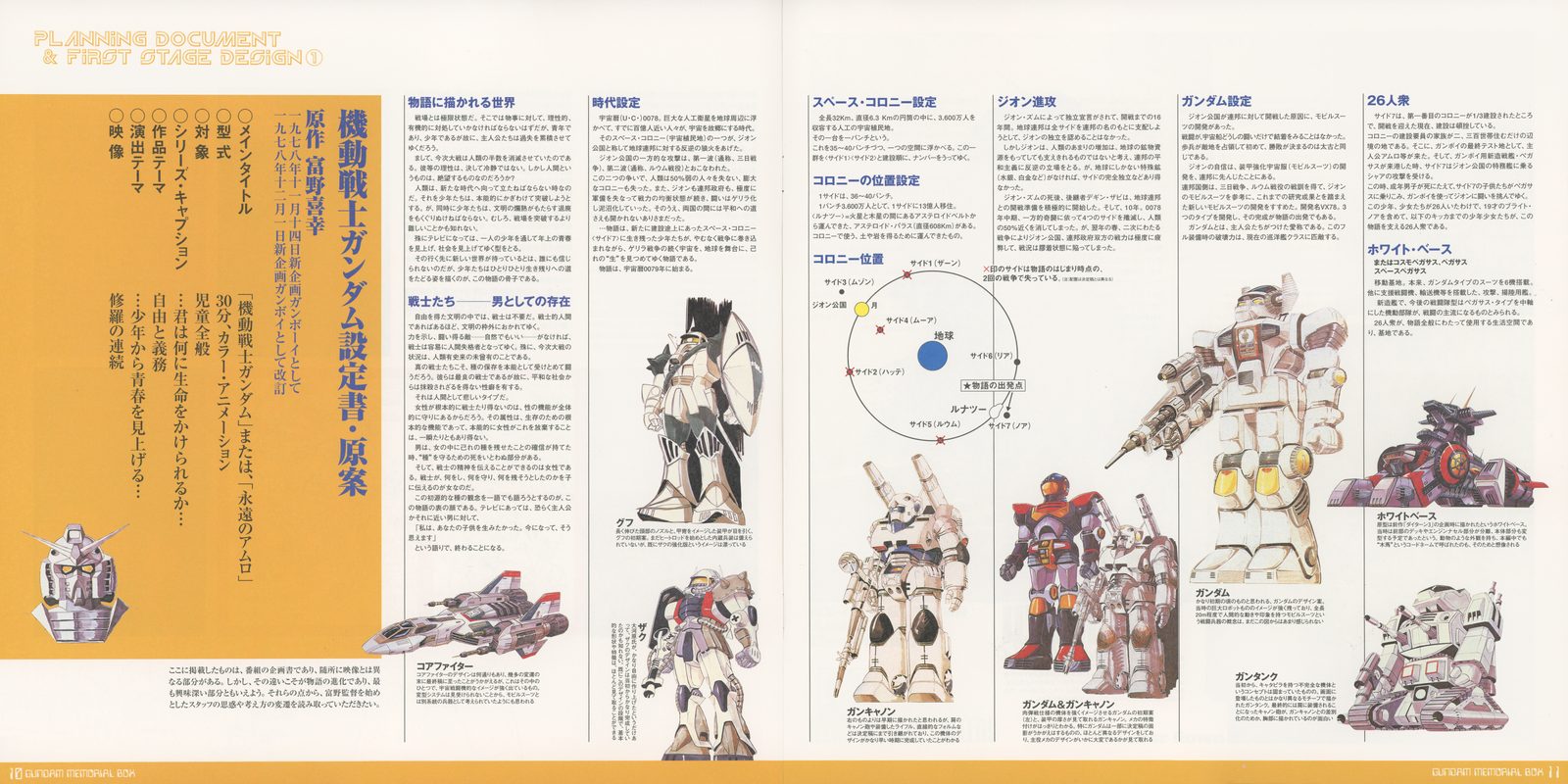 PLANNING DOCUMENT & FIRST STAGE DESIGN — 機動戦士ガンダム 設定書・原案. The original 1979 concept flowchart: 制作に纏わる全容 (complete production overview), space colonies, Zeon forces, Gundam design, 26 named characters, White Base. Pre-production design by Okawara. Yellow spread with handwritten annotations — the pitch document that started a forty-year franchise.
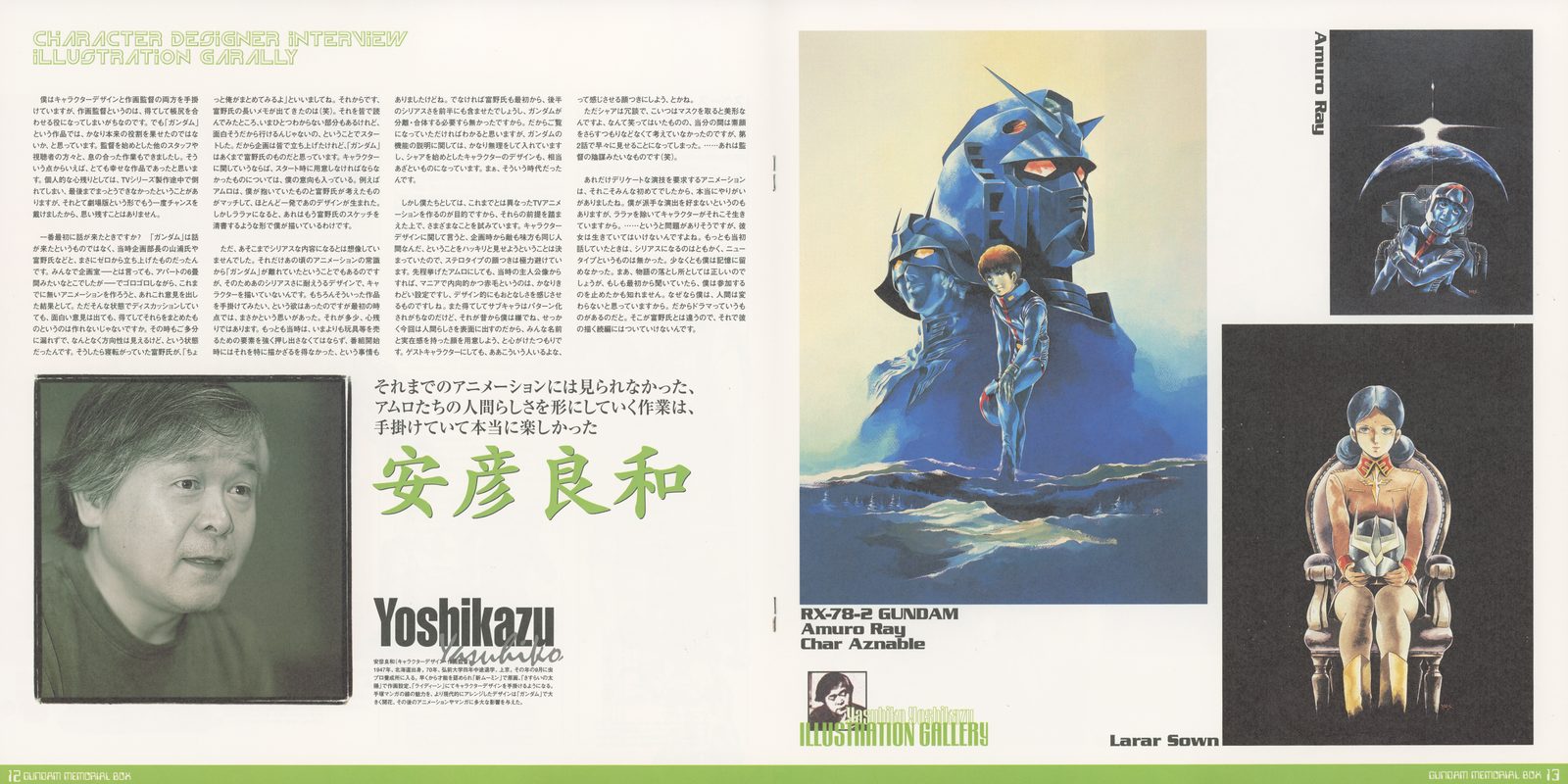 CHARACTER DESIGNER INTERVIEW / ILLUSTRATION GALLERY — 安彦良和 Yoshikazu Yasuhiko. Portrait photograph, interview text, and four Yasuhiko paintings: Char Aznable in dress uniform, Amuro/Char/Lalah trinity, Fraw Bow with Haro, Lalah Sune.
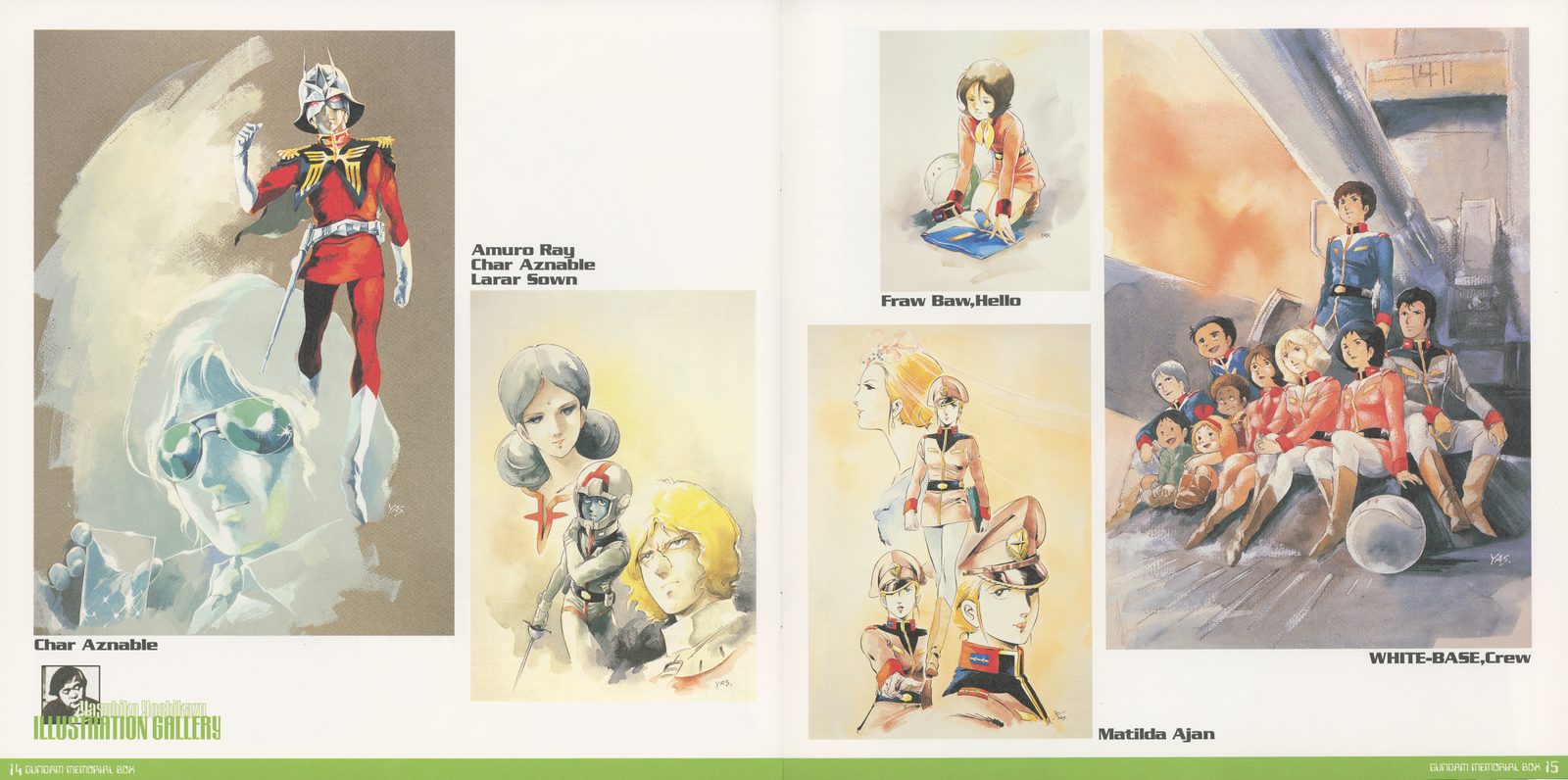 Yasuhiko ILLUSTRATION GALLERY continued. Six paintings: Char Aznable saluting, Amuro/Char/Lalah Newtype vision, Fraw Bow and Haro, Matilda Ajan, WHITE BASE Crew ensemble. Yasuhiko's watercolor painting style — the hand that drew every key frame of the original series, revisiting his characters twenty years later.
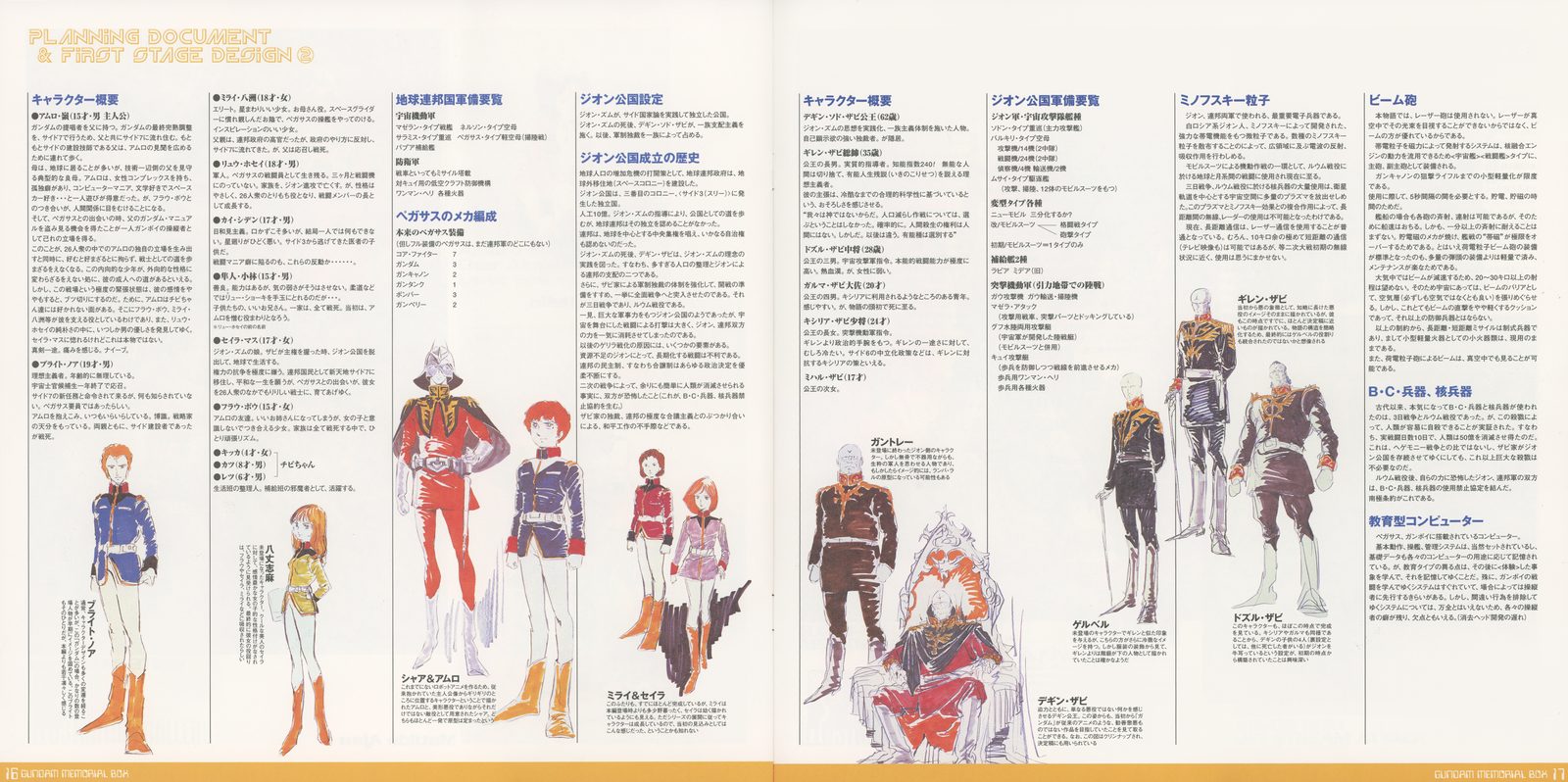 PLANNING DOCUMENT & FIRST STAGE DESIGN II. Full-body character lineup in original 1979 color designs — Federation military, Zeon officers, White Base civilians. Minovsky particle explanation diagram. Beam weapon technical specifications. The series bible that Tomino, Yasuhiko, and Okawara built before animation began.
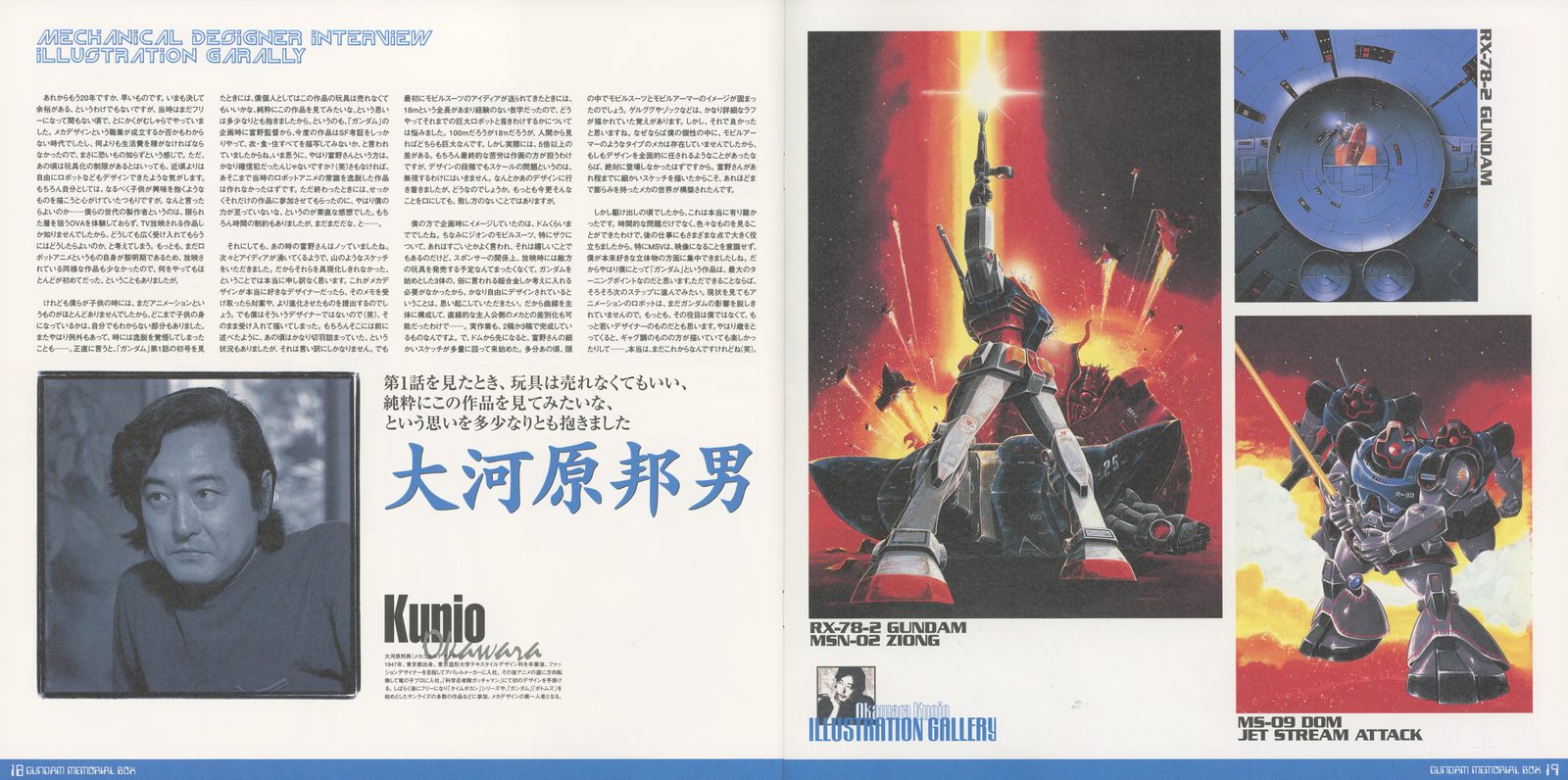 MECHANIC DESIGNER INTERVIEW / ILLUSTRATION GALLERY — 大河原邦男 Kunio Okawara. Portrait photograph, interview text. Quote: '第1話を見た時、玩具は売れなくていい、絶対にこの作品はなるものだと、という思いを少なからず抱きました' ('When I saw Episode 1, I felt — the toys don't need to sell, this work will absolutely become something'). Three paintings: RX-78-2 vs MS-06 Zeon, MS-09 Dom Jet Stream Attack.
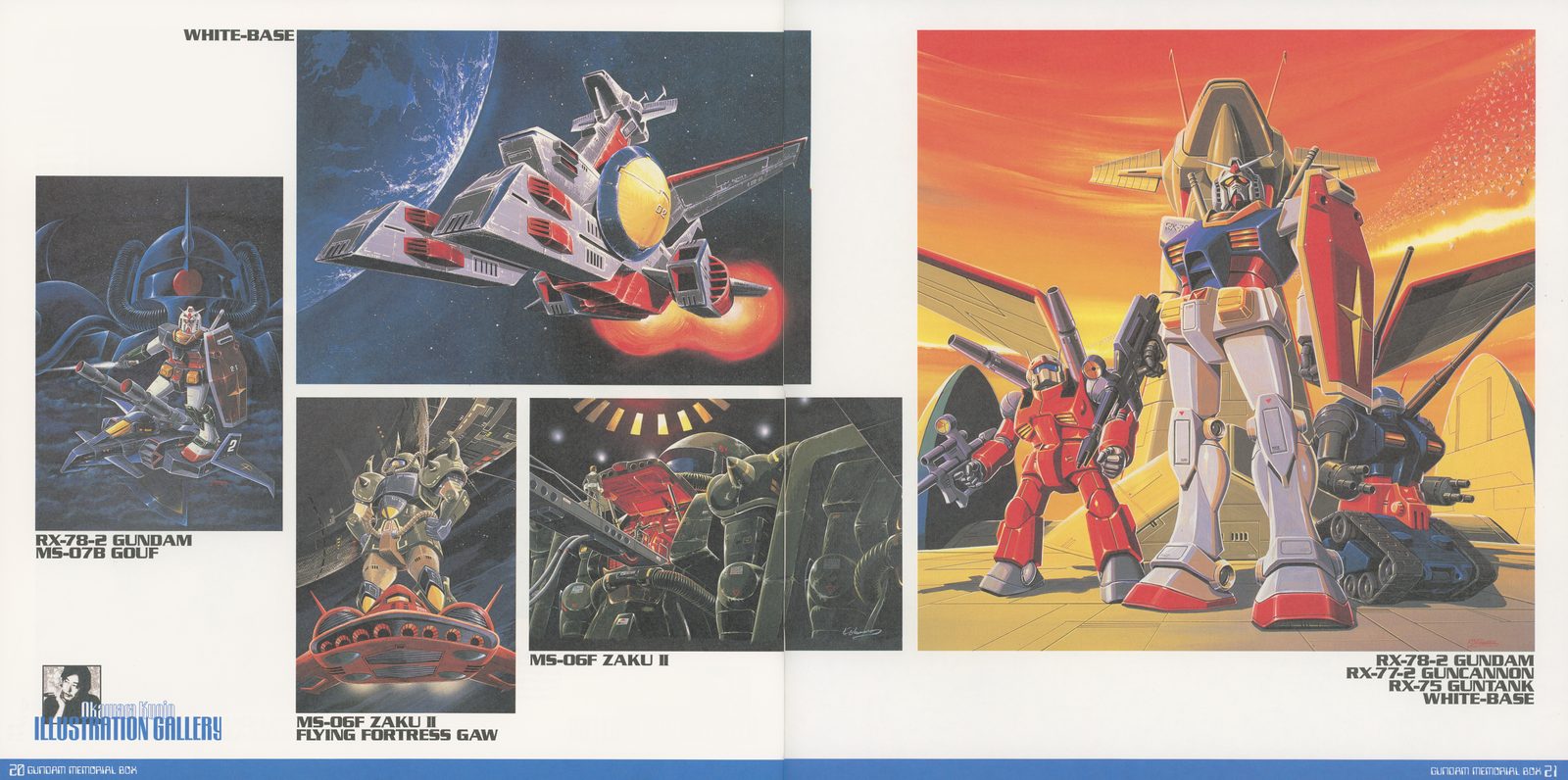 Okawara ILLUSTRATION GALLERY continued. Four paintings: White Base in atmospheric flight, RX-78-2 vs MS-07B Gouf, MS-06F Zaku II in orbital combat, and the full Federation mobile suit lineup — RX-78-2 Gundam, RX-77 Guncannon, RX-75 Guntank with White Base. The original mechanical designer painting his machines as gallery art.
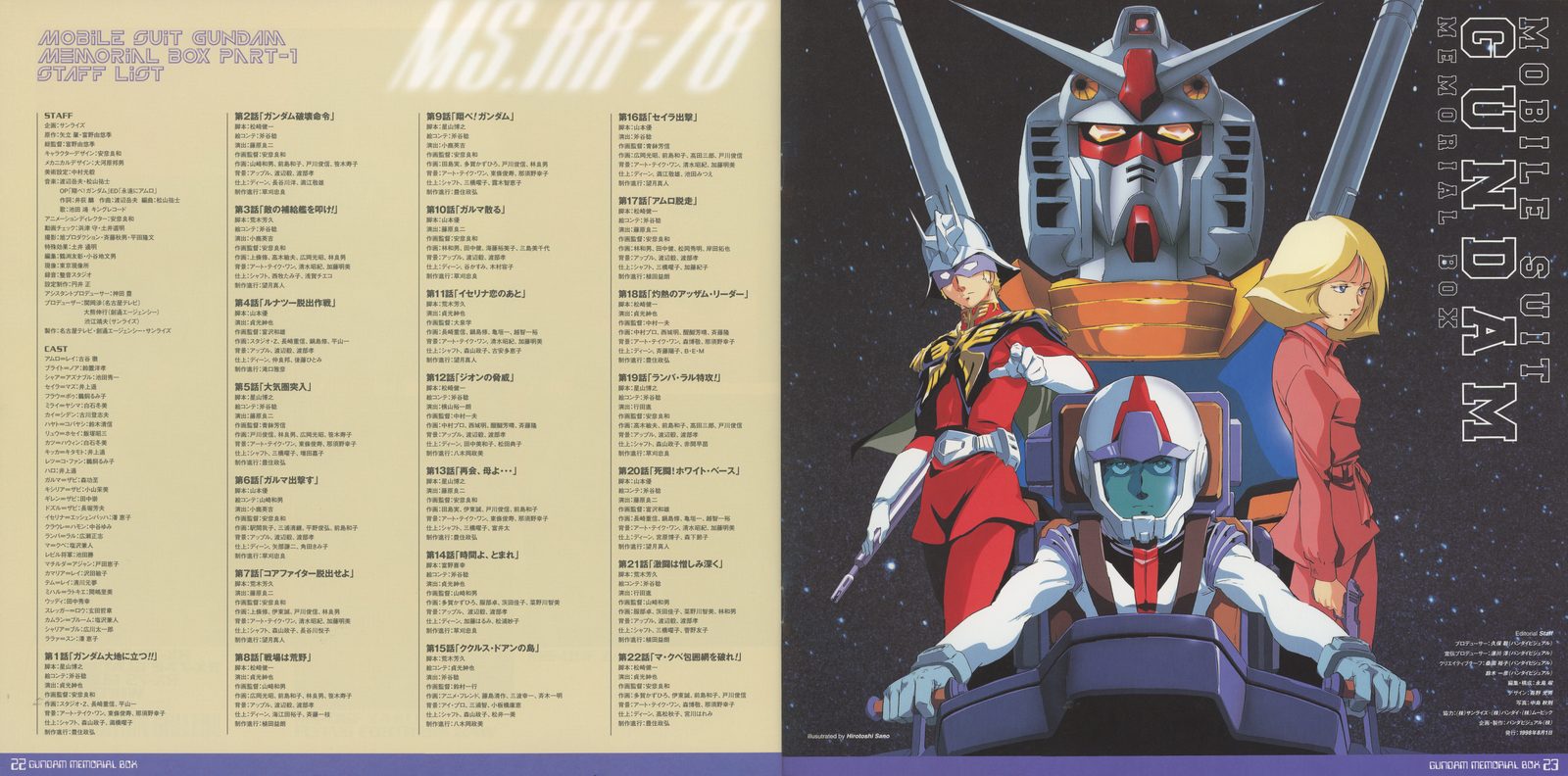 MOBILE SUIT GUNDAM MEMORIAL BOX PART-1 STAFF LIST. Complete episode-by-episode credits for all forty-three episodes. MS RX-78 header illustration. Amuro, Char, and Sayla group painting at right — the three characters who carry the series' dramatic weight, presented together one final time.
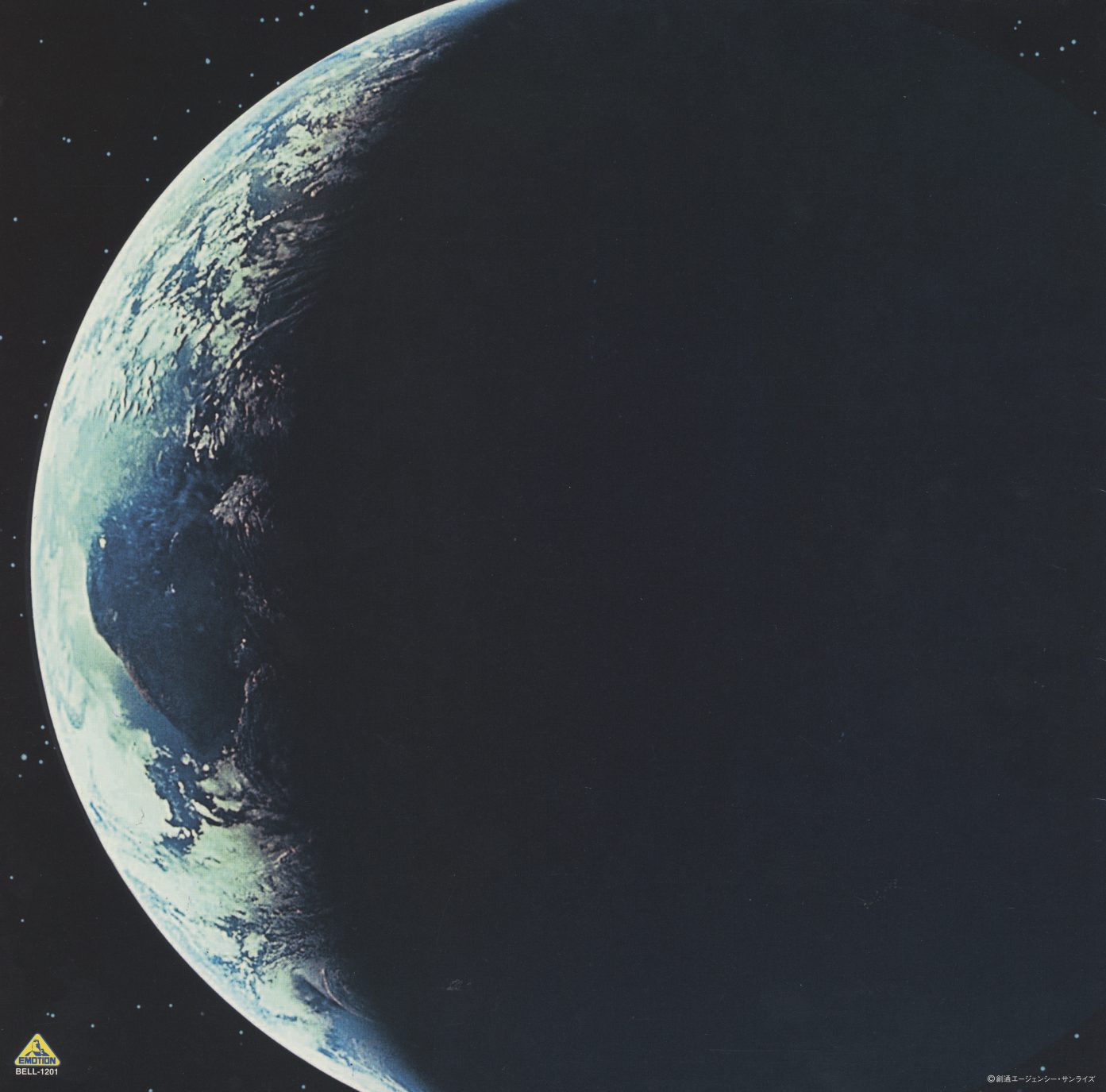 Booklet back. Earth from space — the same composition as the Part 1 inner panel. EMOTION triangle logo and BELL-1201 catalog number at bottom left. © Sotsu Agency / Sunrise.
The planning document is reproduced on a yellow spread in the center of the booklet. It shows the original concept flowchart — a hand-drawn diagram connecting space colonies to Zeon's independence movement to the Gundam's design specifications to twenty-six named characters to the White Base's mission. This is the pitch. The document that Tomino, Yasuhiko, and Okawara brought to Sunrise and Clover in 1979 to propose a toy-sponsored robot show that would also be a war story about the cost of national independence.
No DVD or Blu-ray release of the original series reproduces this document. The Memorial Box booklet is the only commercial release that treats the series' pre-production planning as part of the product — not as a historical curiosity in a retrospective, but as the first page of an archive that the twelve discs complete.
Loading...