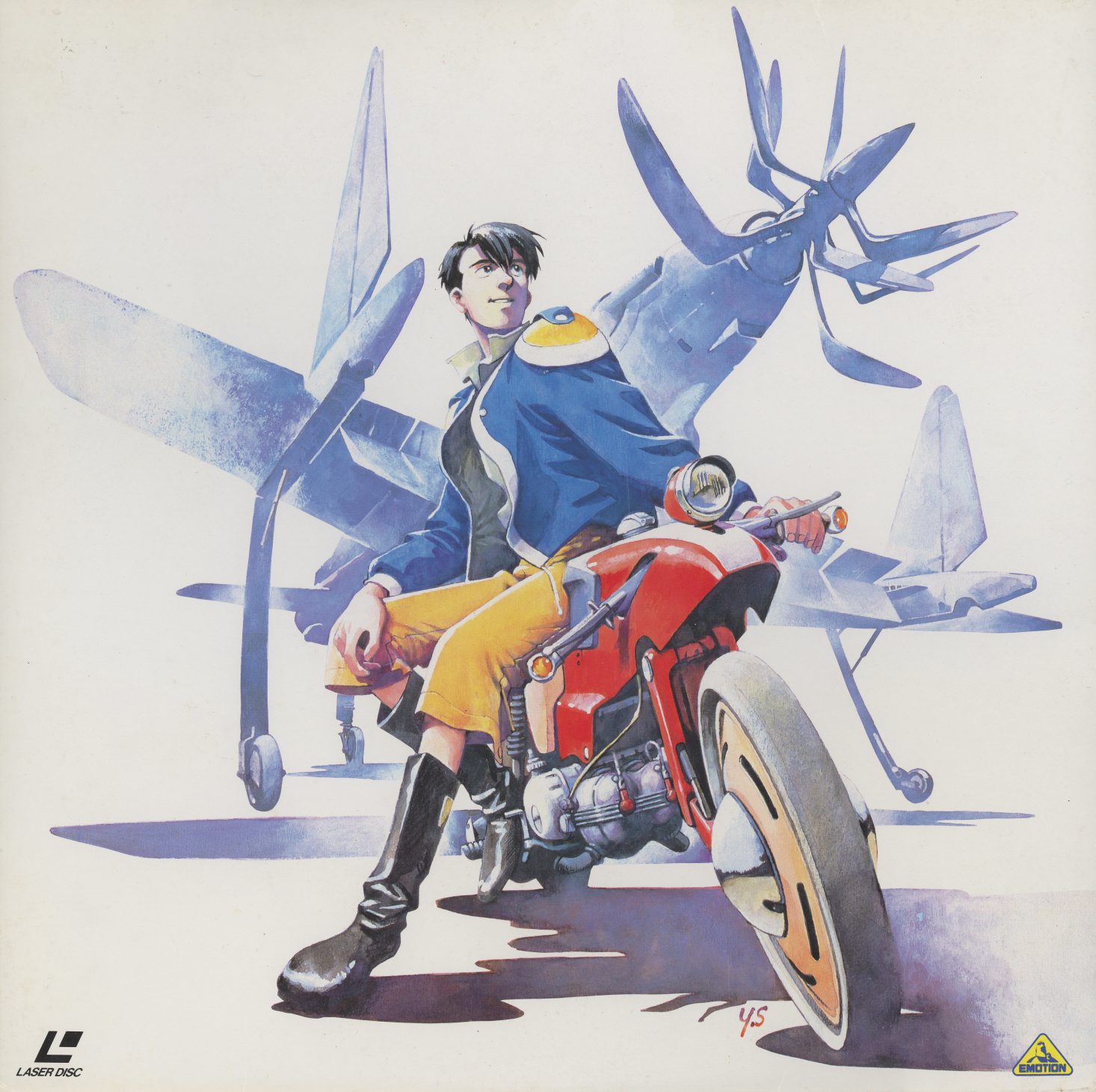
Two releases. The first: BELL-460, a single CLV disc at ¥5,800 — the 1987 theatrical film in pan-and-scan 4:3 with a critical essay insert. The second: BEAL-367, a three-disc LD-BOX at ¥14,800, on Bandai Visual's EMOTION label. The box contains the film across two CAV discs in its original Vista aspect ratio with Dolby Surround, the pilot film GAINAX produced in 1984 to pitch the project to Bandai, unreleased theatrical scenes on their own CAV side, Ryuichi Sakamoto's complete score including twelve tracks cut from the commercial Nippon Columbia soundtrack, and a booklet called the DATA FILE — a production design archive covering character art, background paintings, prop catalogues, storyboards, and the constructed writing system the staff invented for a world that doesn't correspond to any place on Earth.
Royal Space Force: Wings of Honneamise (王立宇宙軍 オネアミスの翼) was GAINAX's first production. Hiroyuki Yamaga directed it at twenty-four. Hideaki Anno was the special effects animation director. Yoshiyuki Sadamoto designed the characters. They pitched Bandai a feature-length anime set in an alternate world where a country's underfunded, ridiculed space program attempts its first manned launch while a war closes in around the launch site. The film cost roughly ¥800 million. It underperformed commercially. It established the studio that would go on to make Nadia, Evangelion, and FLCL.
The LD-BOX holds both the film and the document that brought it into existence. The pilot film on Disc 1 is the pitch that convinced Bandai to fund ¥800 million of hand-drawn world-building. The DATA FILE booklet is the evidence of where the money went.
The Standard Release
BELL-460 reached the market first. CLV, both sides, the film in pan-and-scan 4:3. The back cover carries a direct quote from the film in large type: 「ここでやめたらオレたち何だ。ただのバカじゃないか…今日の今日までやってきたことを、くだらないなんていうなよ!」— If we quit now, what are we? Just a bunch of idiots... Don't call what we've done up to this point worthless! Cover illustration by Sadamoto. The liner insert contains a critical essay and full production credits. For most buyers in 1987, this was the only available version of the film at home.
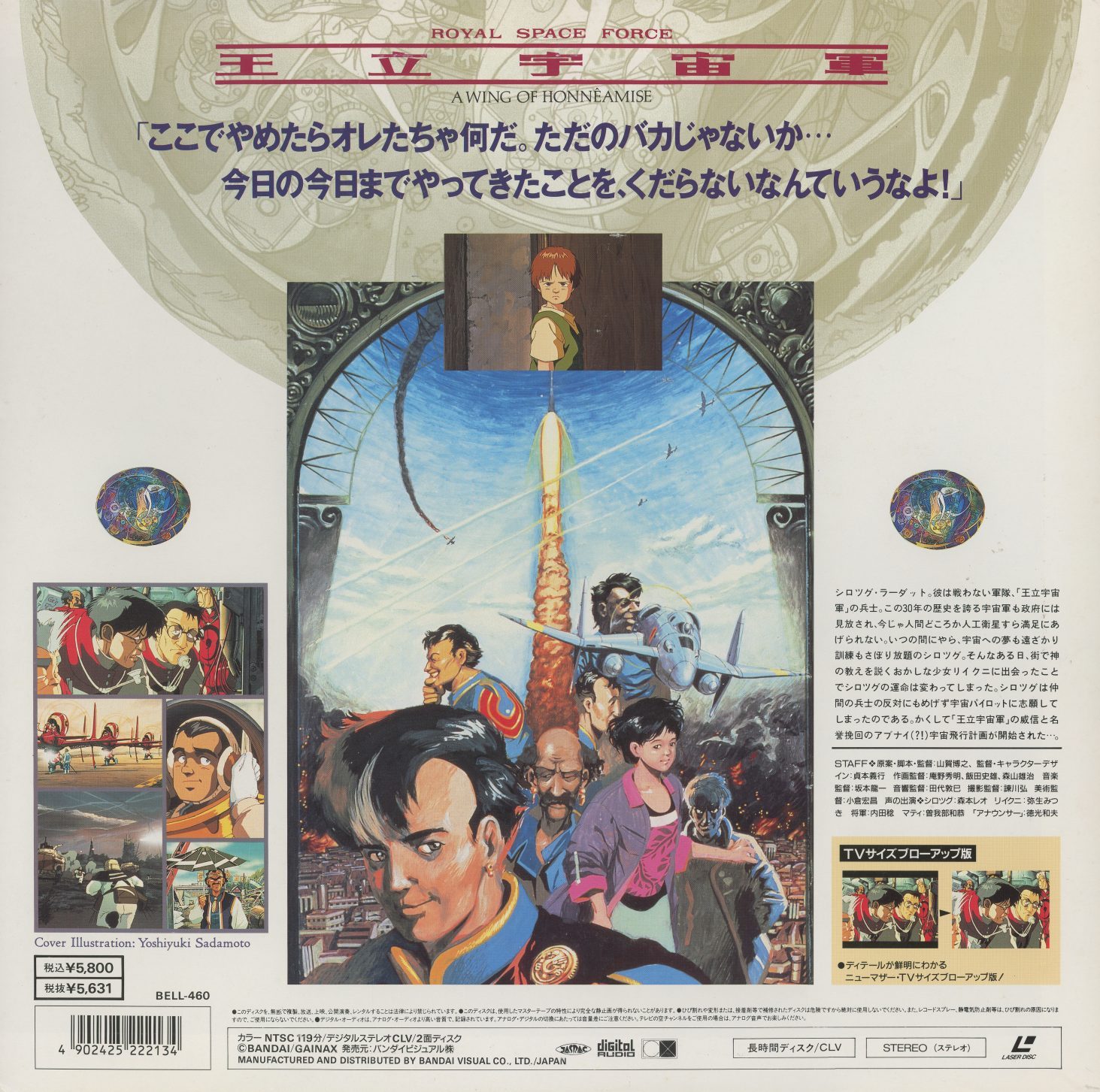 Standard edition back. BELL-460, CLV, ¥5,800 (¥5,631 without tax). 'TVサイズブローアップ版' — pan-and-scan reformatting from the original Vista theatrical ratio. Cover Illustration credited to Yoshiyuki Sadamoto. Bandai Visual / GAINAX copyright.
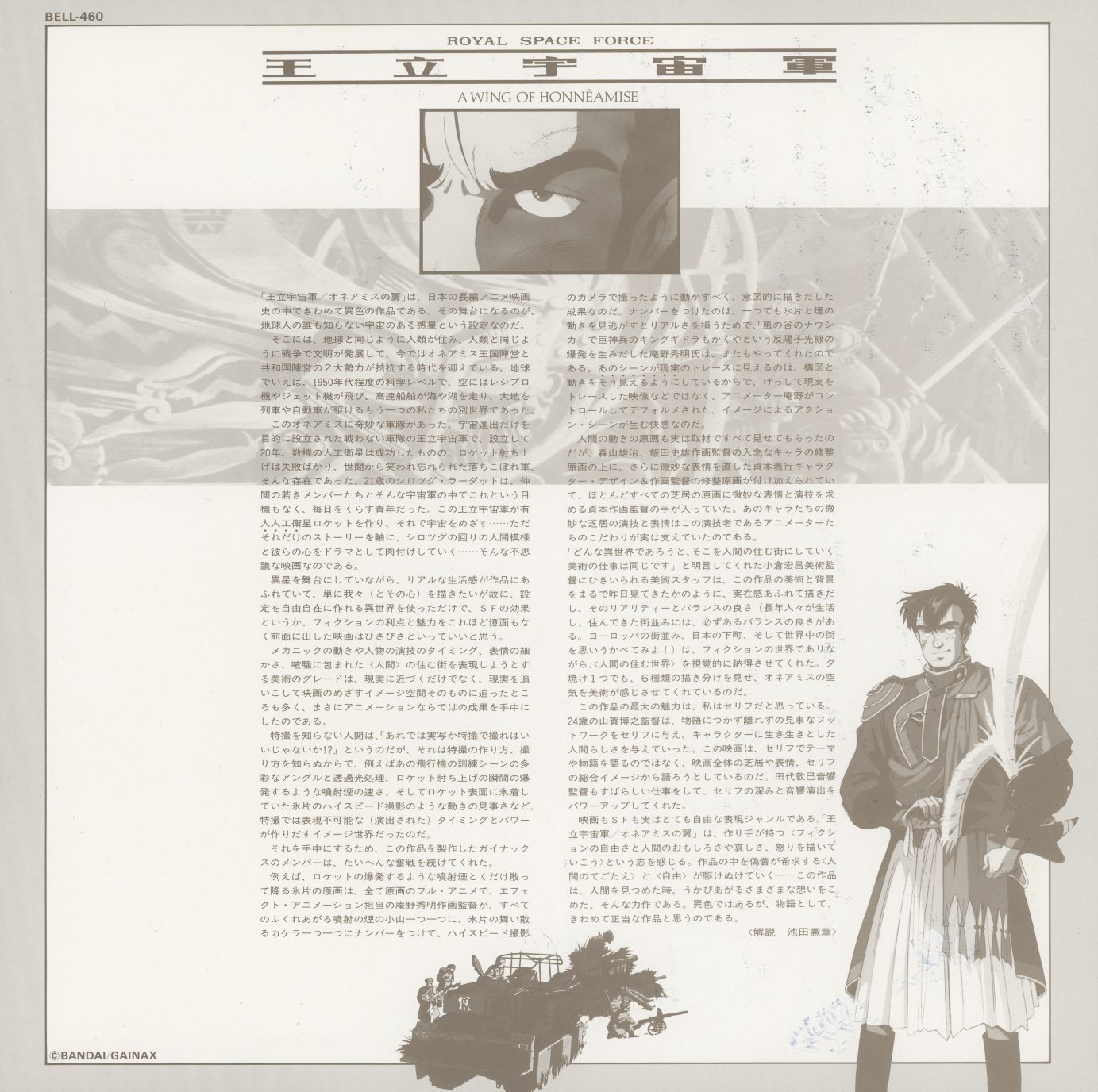 Standard edition liner insert — critical essay. Full-page analysis of the film over a greyscale image, with a Sadamoto character illustration bottom right. BELL-460, BEAL-367.
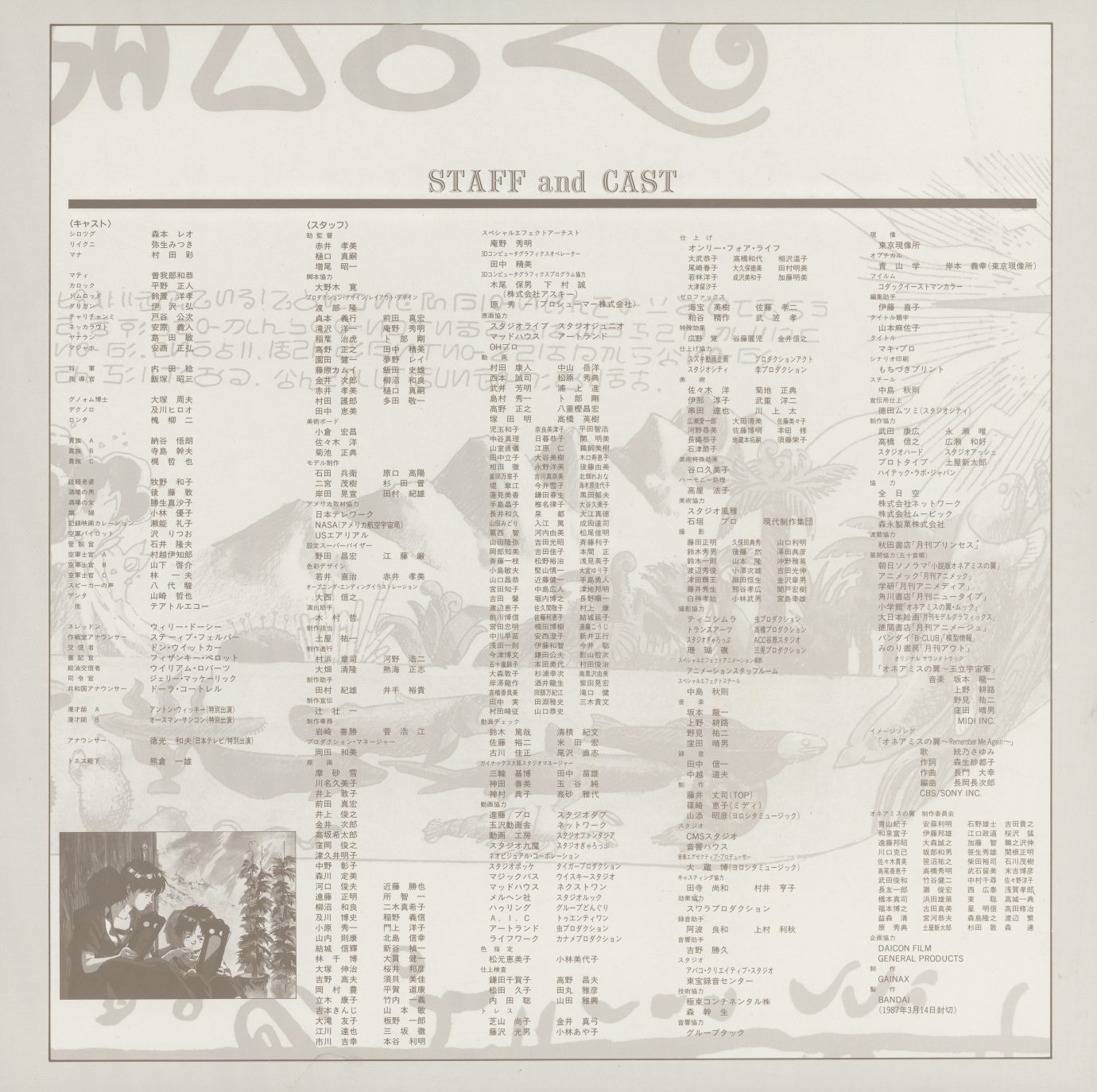 Standard edition liner insert — full Staff and Cast credits. The Honneamise alphabet runs across the top; cast and production credits fill the page over a ghosted landscape watercolor.
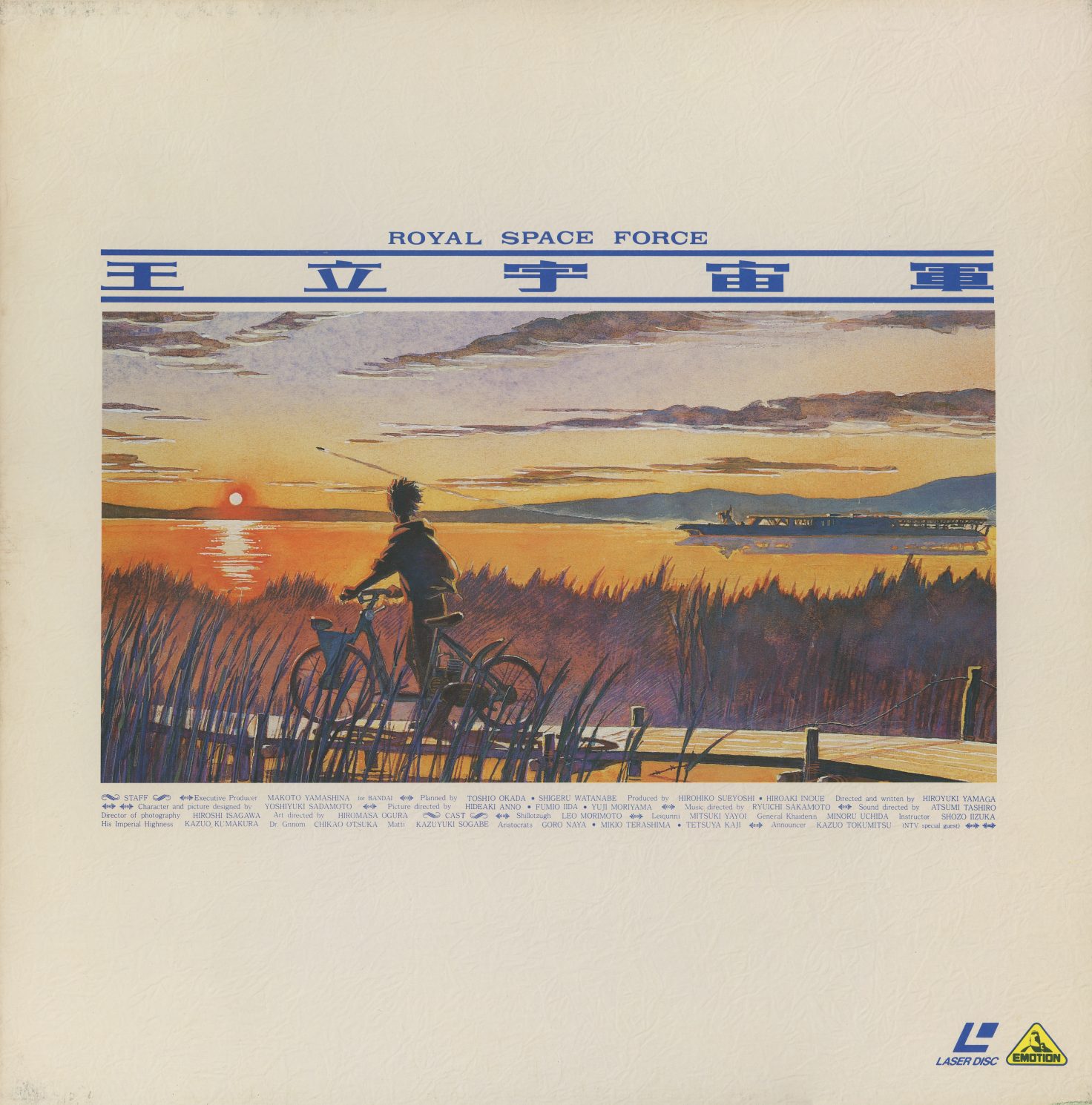 LD-BOX front. Sadamoto watercolor — Shirotsugh on a bicycle watching a sunset over a lake. A quieter image than the standard edition's motorcycle. BEAL-367, EMOTION label.
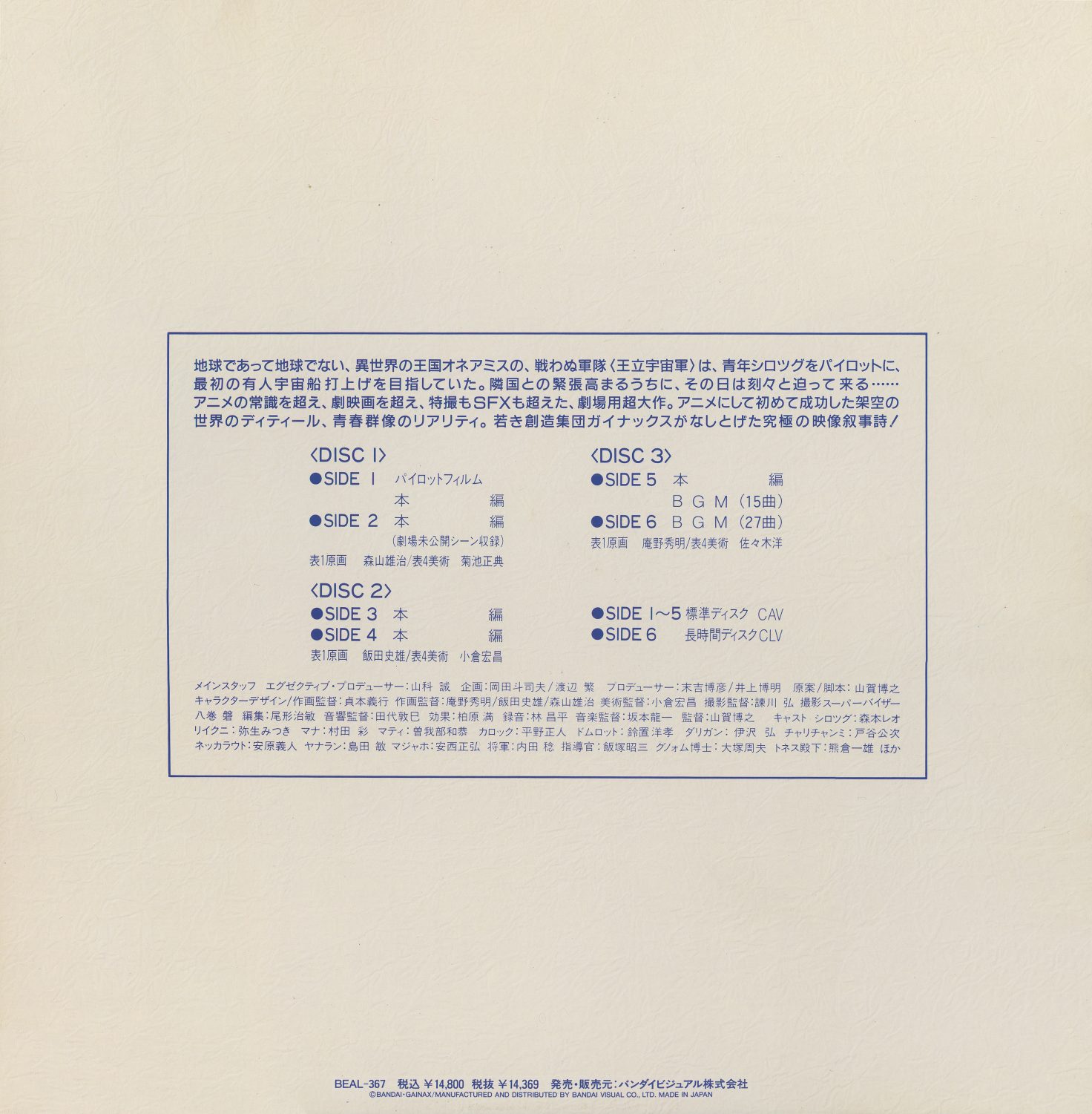 LD-BOX back. BEAL-367, ¥14,800. Three discs: Disc 1 (pilot film + unreleased scenes, CAV), Disc 2 (main feature, CAV), Disc 3 (feature continuation + complete BGM, CAV/CLV). Staff and production credits. 'Sides 1–5: standard disc, CAV. Side 6: long-play disc, CLV.'
The LD-BOX
BEAL-367. Three discs. ¥14,800. Disc 1 dedicates one CAV side to the pilot film — the 35mm presentation GAINAX produced in 1984 with a Wagner orchestral score to demonstrate the project's visual ambitions — and a second side to unreleased theatrical scenes. Discs 2 and 3 carry the film itself across three CAV sides in its original Vista ratio with Dolby Surround, followed by Sakamoto's complete background music on the final CLV side. The Nippon Columbia soundtrack CD had truncated twelve tracks; here they appear in full. Each disc jacket carries an original illustration by the production staff — not recycled promotional art, but new paintings of scenes and moments the artists chose to revisit.
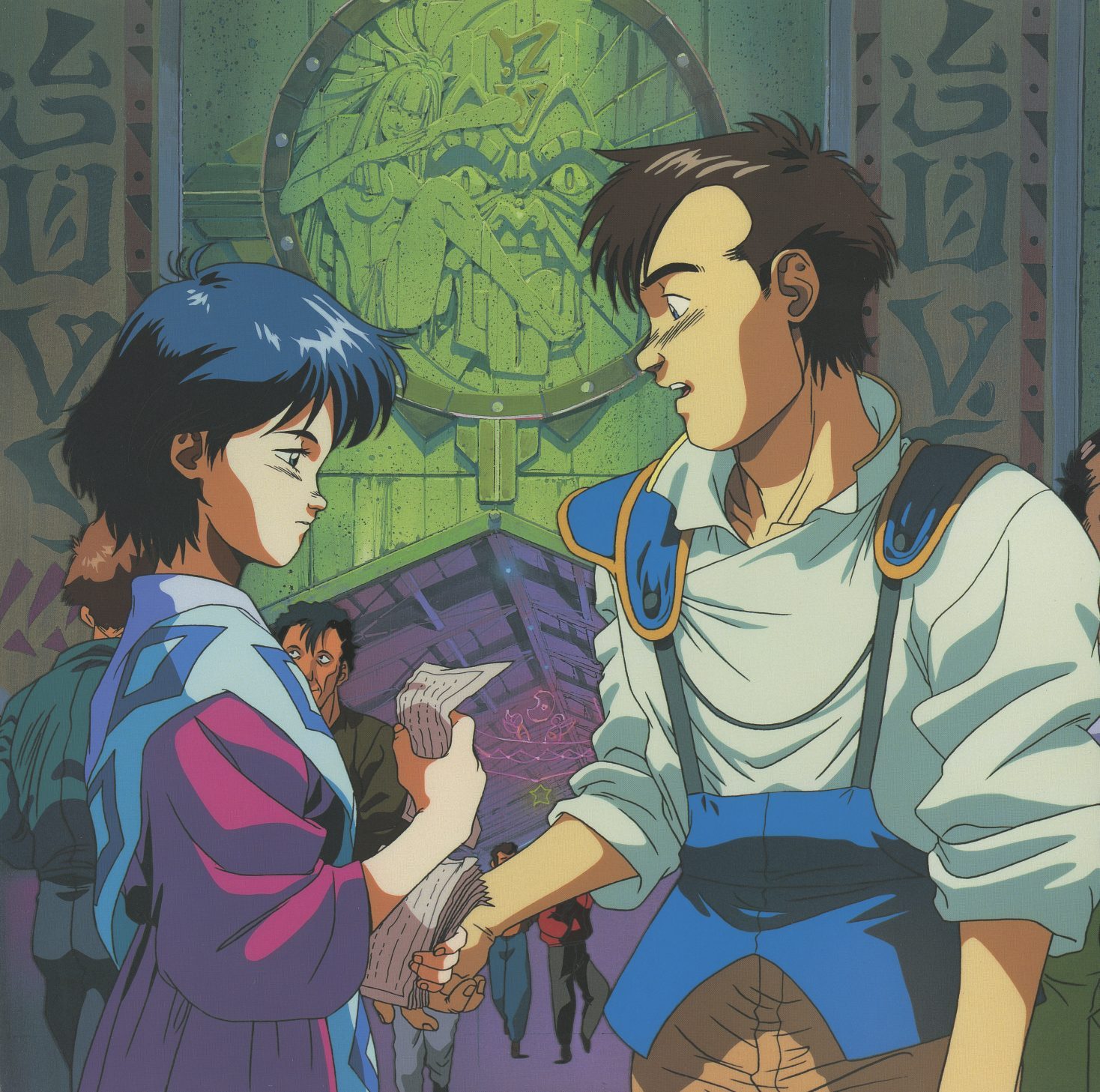 Disc 1 jacket. Shirotsugh and Riquinni meeting in a market, Honneamise script on the walls behind them. Original illustration by the production staff for the LD-BOX.
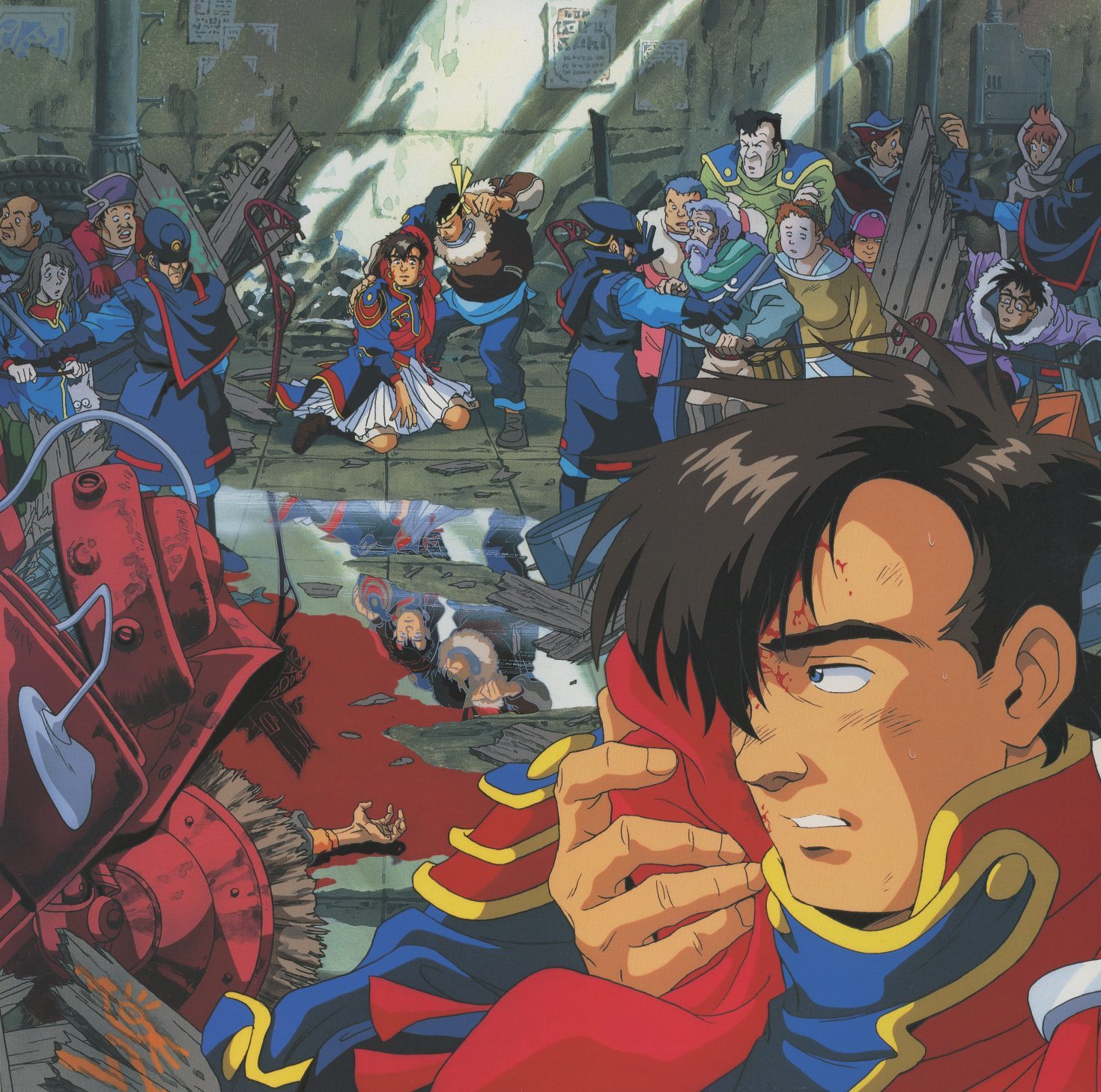 Disc 2 jacket. Shirotsugh in military uniform witnessing street violence — the political reality closing in on the space program. The palette shifts from the market scene's greens to blood and rubble.
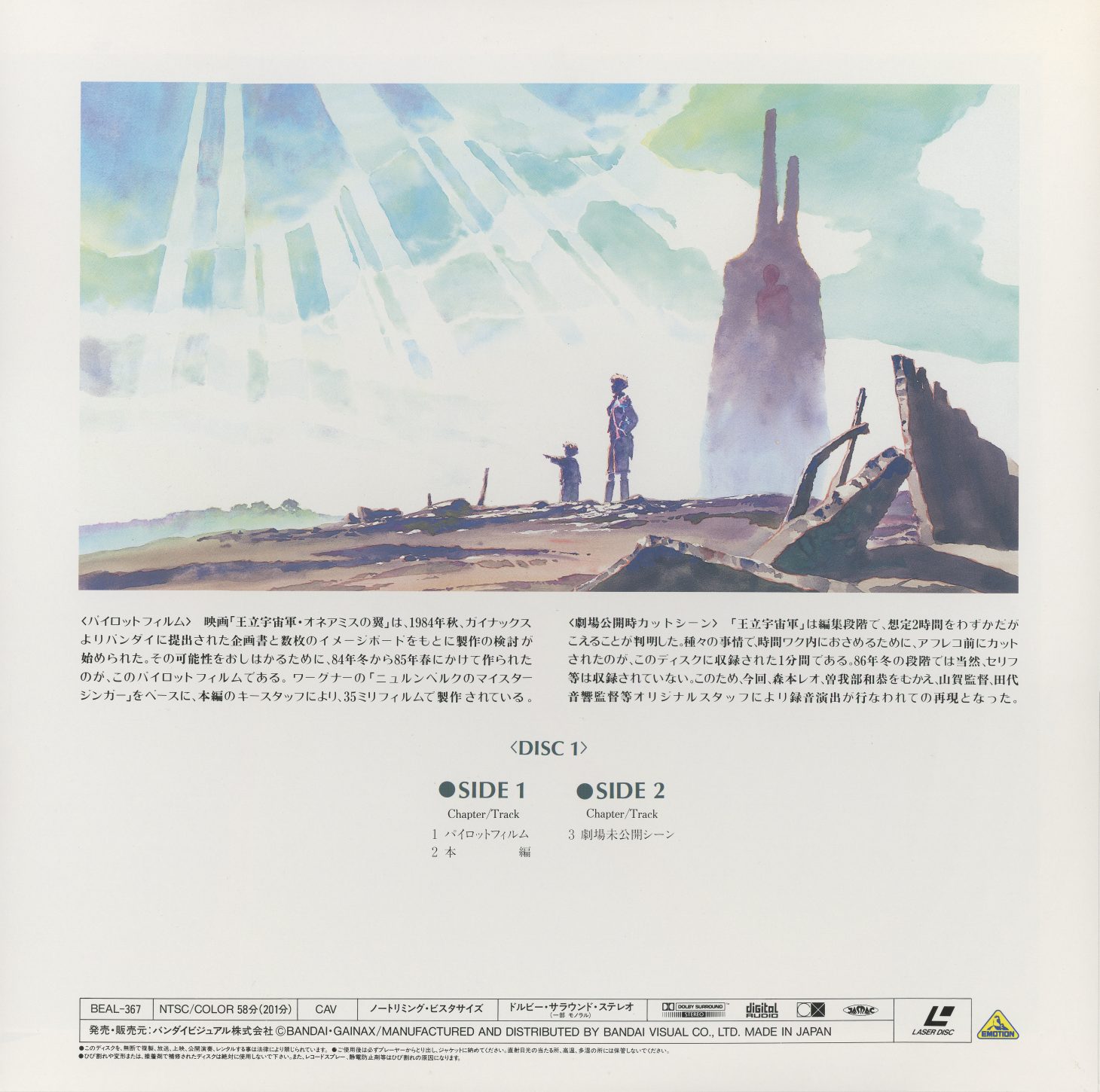 Disc 1 back. Watercolor of the wasteland landscape — two small figures against an empty horizon. BEAL-367, CAV, Dolby Surround. Side 1: pilot film. Side 2: unreleased theatrical scenes (劇場未公開シーン). The document that launched GAINAX, and the footage the theatrical release left behind.
The Pilot Film
In 1984, GAINAX — not yet formally incorporated — approached Bandai with a pilot film: a 35mm animation reel demonstrating the project's visual ambitions. The pilot used a Wagner orchestral score as placeholder music and showed enough of the alternate world's detail to justify the production budget Yamaga was requesting. It worked. Bandai funded the film. The pilot was not widely circulated afterward. It exists here on Disc 1, Side 1, in CAV — frame-by-frame access to the animation that started GAINAX.
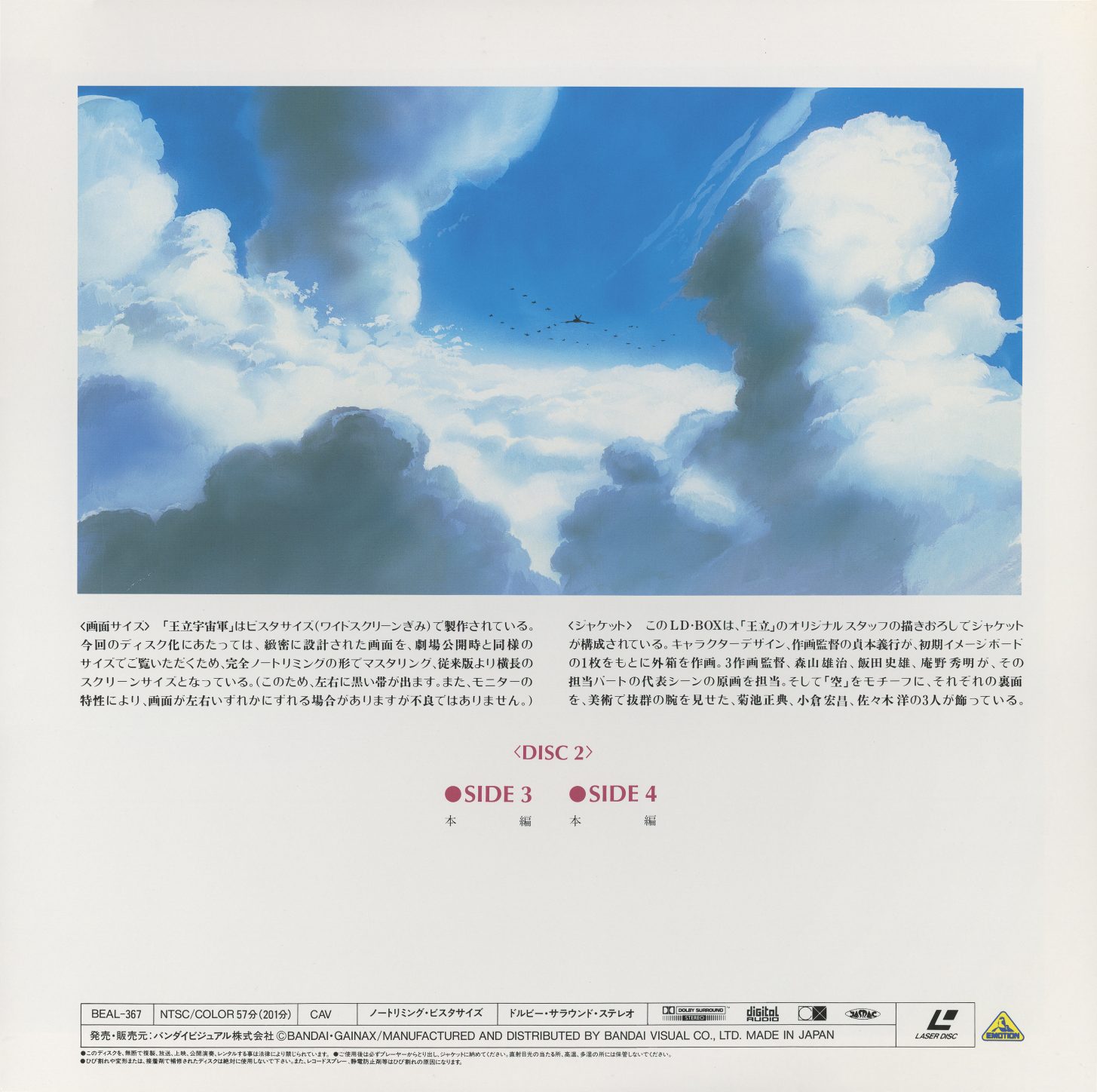 Disc 2 back. Clouds — a watercolor sky stretching across the full jacket. BEAL-367, CAV. Sides 3 and 4: the main feature in original Vista aspect ratio. Notes on the non-trimmed widescreen presentation and the original staff jacket illustrations.
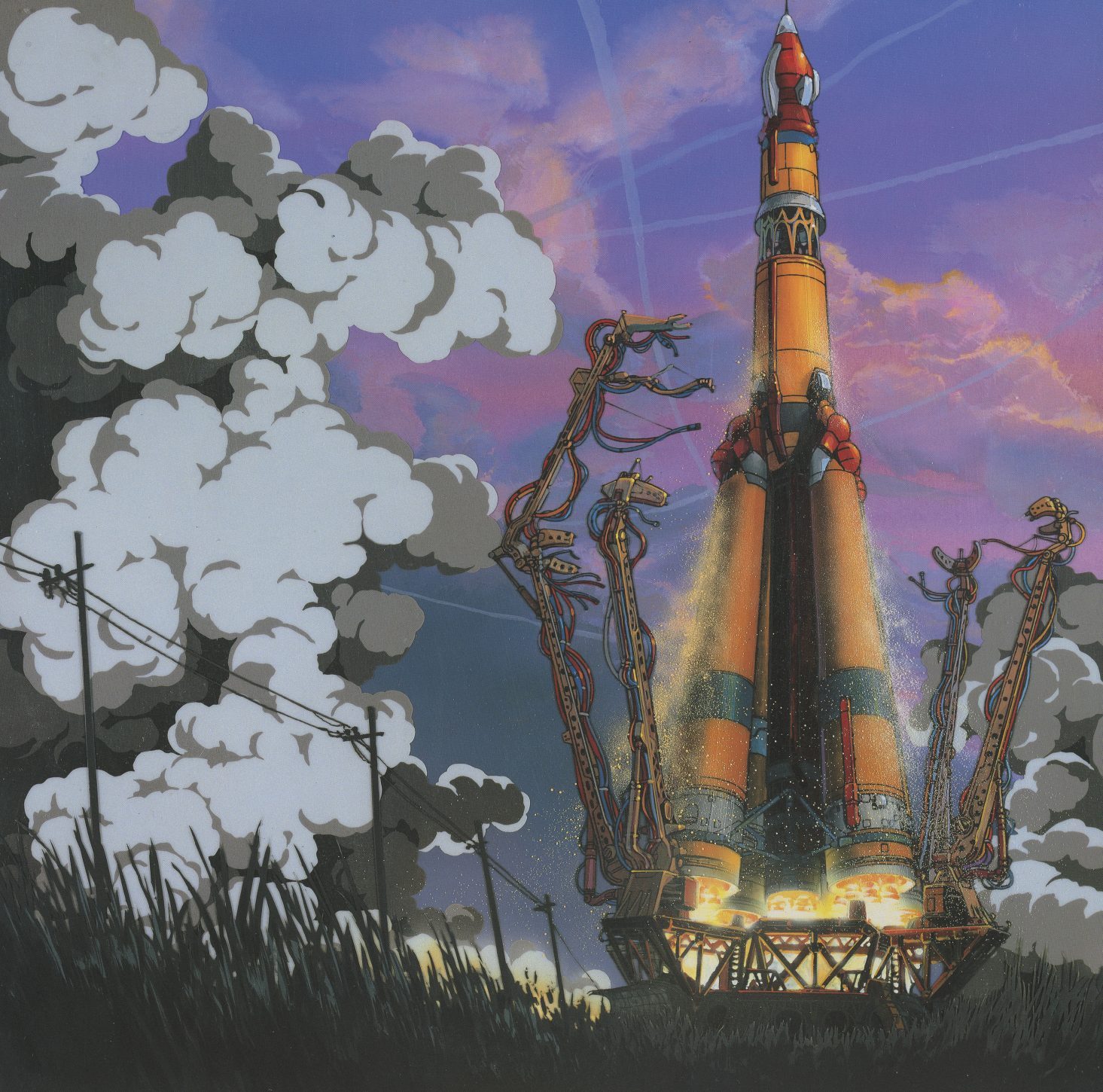 Disc 3 jacket. The launch — the rocket lifting off from the pad, smoke billowing through power lines and grass. The final disc jacket illustrates the film's climactic sequence.
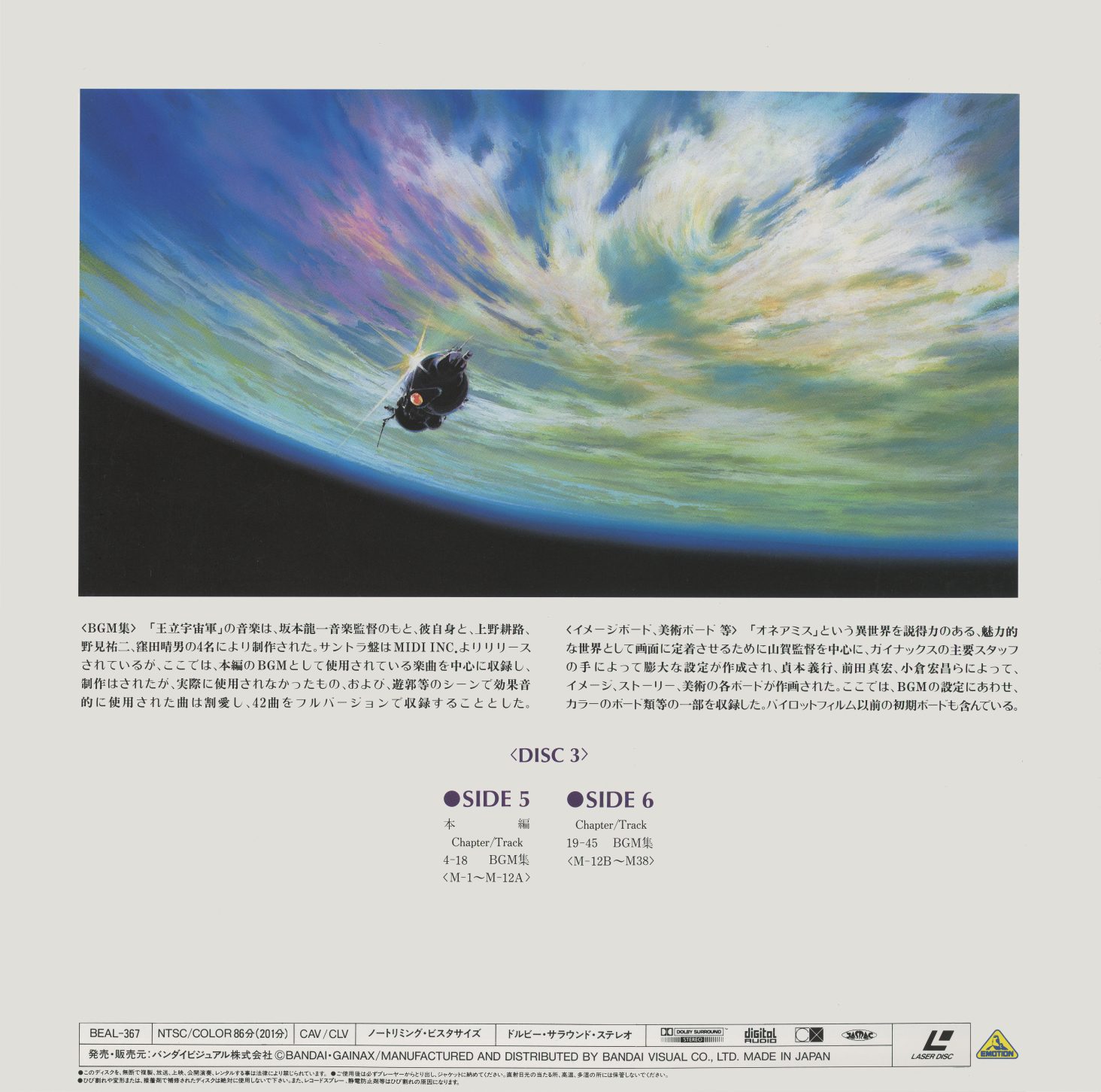 Disc 3 back. The capsule in orbit above Earth's atmosphere. BEAL-367, CAV/CLV. Side 5: feature continuation. Side 6: complete BGM collection (tracks M-1 through M-30) — including twelve full-length compositions cut from the commercial soundtrack release.
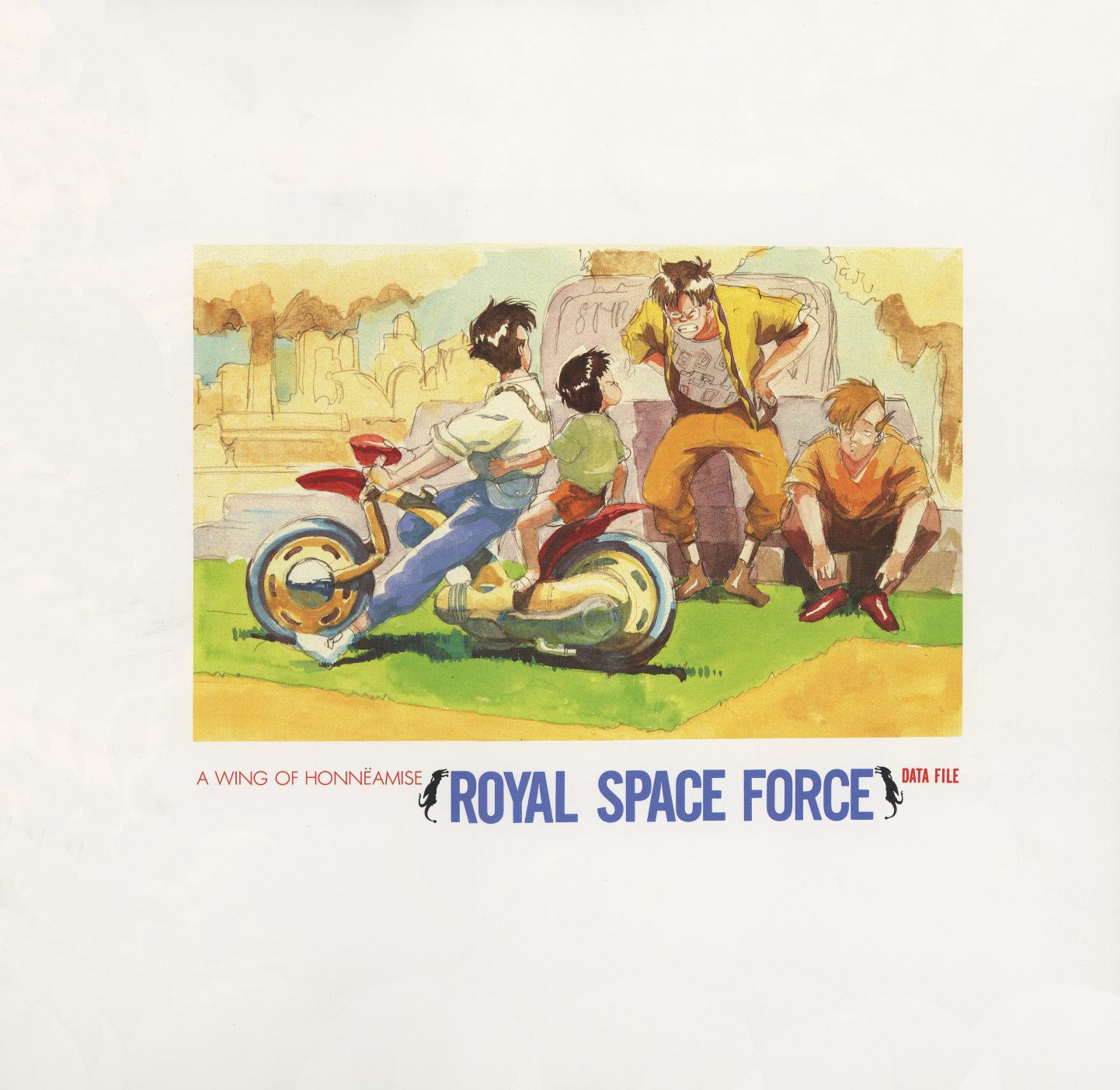 DATA FILE booklet cover. 'A Wing of Honneamise — Royal Space Force: DATA FILE.' Watercolor illustration of the young cast with motorcycles — Sadamoto's characteristic warmth applied to a world he helped build from nothing.
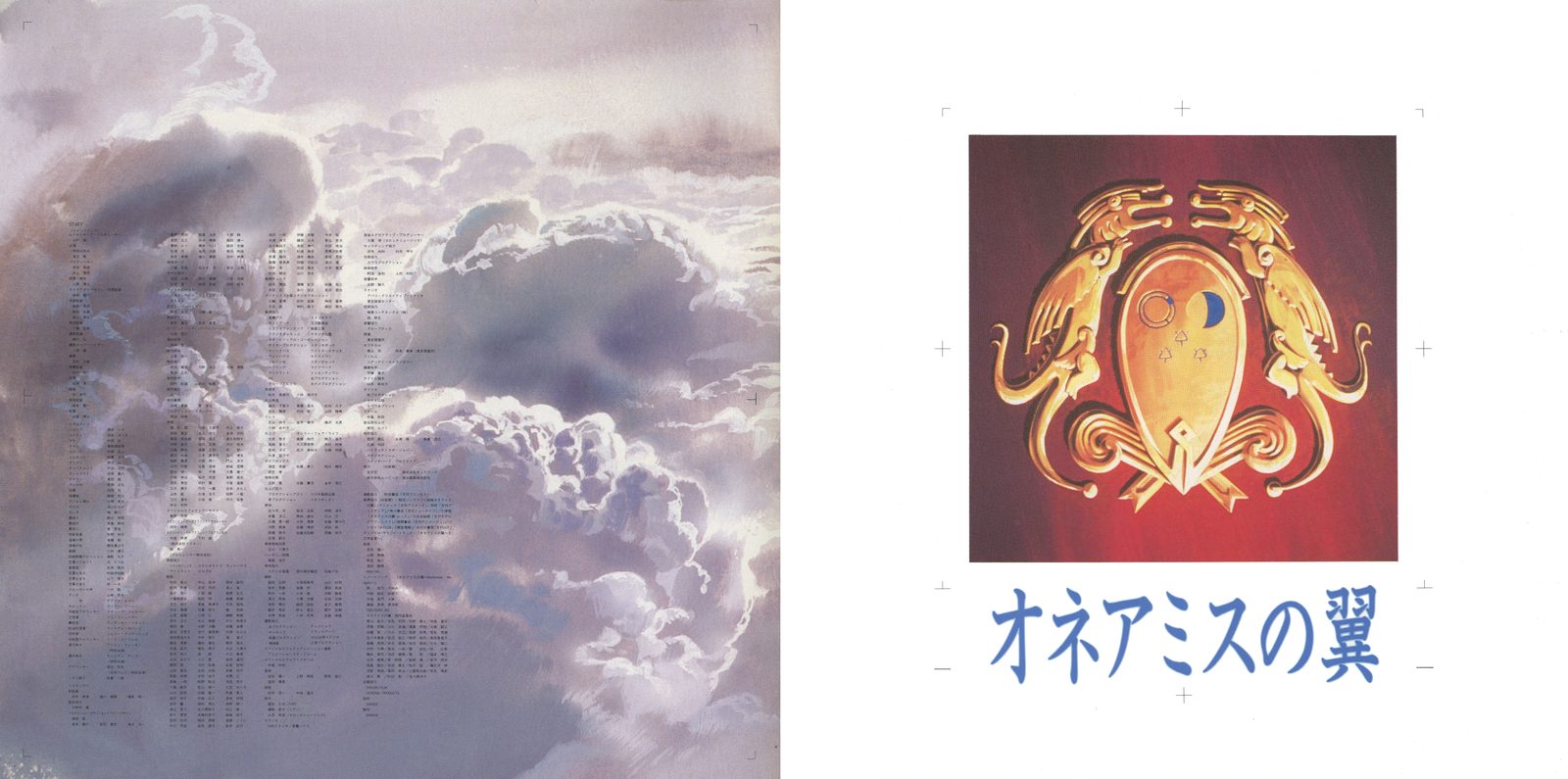 DATA FILE opening spread. Left: full production credits set against a watercolor cloud painting. Right: the Royal Space Force crest and the title — オネアミスの翼 — on white. The document's formal opening pages.
The DATA FILE
The booklet is not a promotional companion. It is a production document in presentation format. The staff illustrated new watercolor art for the booklet alongside reproductions of image boards, background paintings, and character studies. Every section covers one layer of the alternate world: the characters and their clothes, the cityscapes and their architecture, the vehicles and everyday objects, the military hardware, the landscape geography, and the constructed writing system. Nothing in Honneamise's world is borrowed from reality. Every bottle, bench, street sign, and aircraft was designed from scratch. The DATA FILE is the proof — and the only place where that design work is collected in one object.
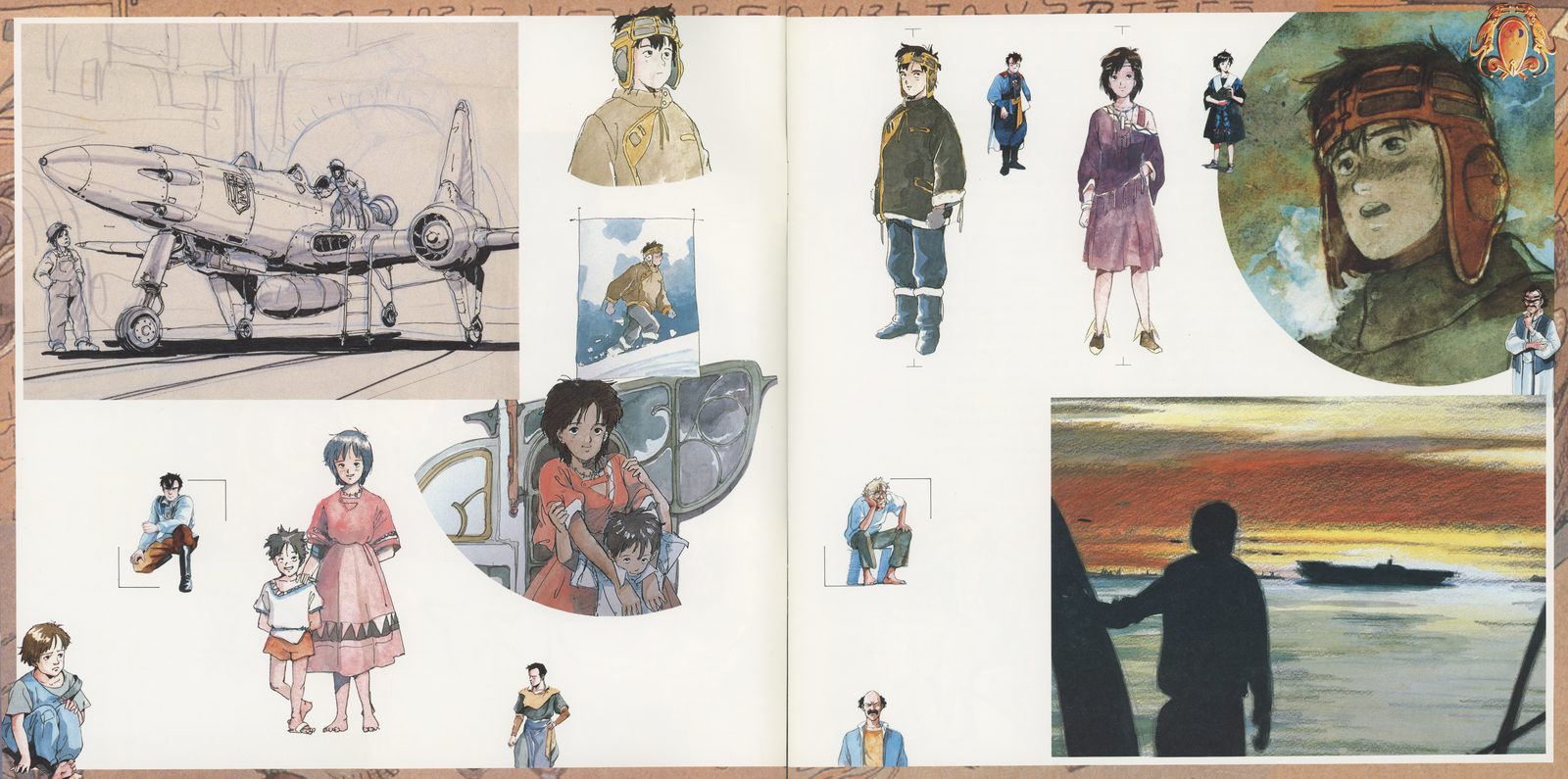 DATA FILE interior — character concept art collage. Watercolor character studies, aircraft renderings, costume designs, and a sunset harbor scene. Production image boards reproduced alongside new illustrations.
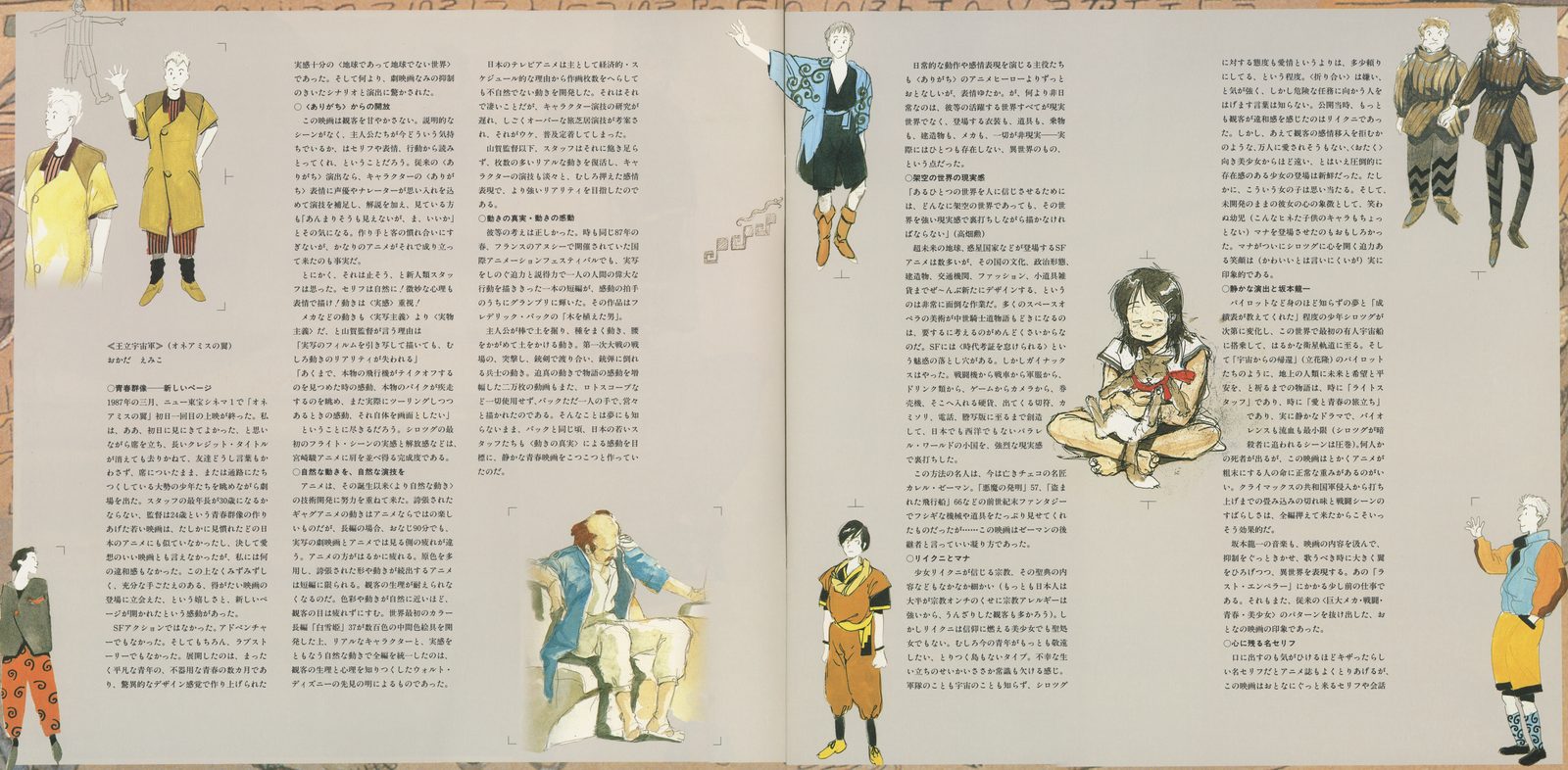 DATA FILE interior — character and costume essay spread. Full-page text on the civilian and military wardrobe of Honneamise, illustrated with watercolor character turnarounds — five figures across the margins, a seated Riquinni at center. The design logic for a world where nothing was borrowed.
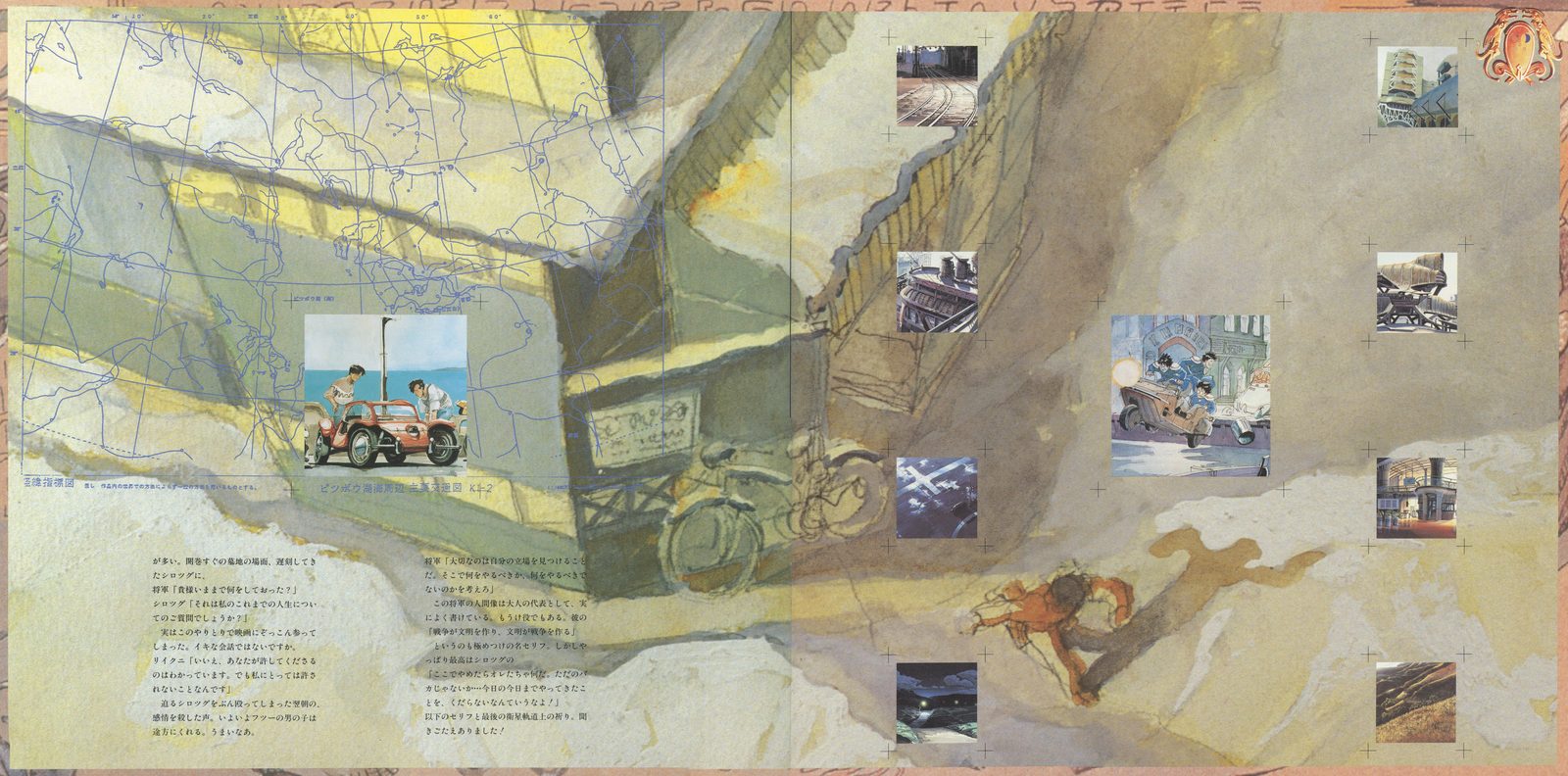 DATA FILE interior — transport and production art spread. Left: an overhead map overlay with film stills and vehicle studies — delivery trucks, motorcycles, a three-wheeled cab. Right: additional vehicle film stills in thumbnail format. Documents the ground-level infrastructure of Honneamise.
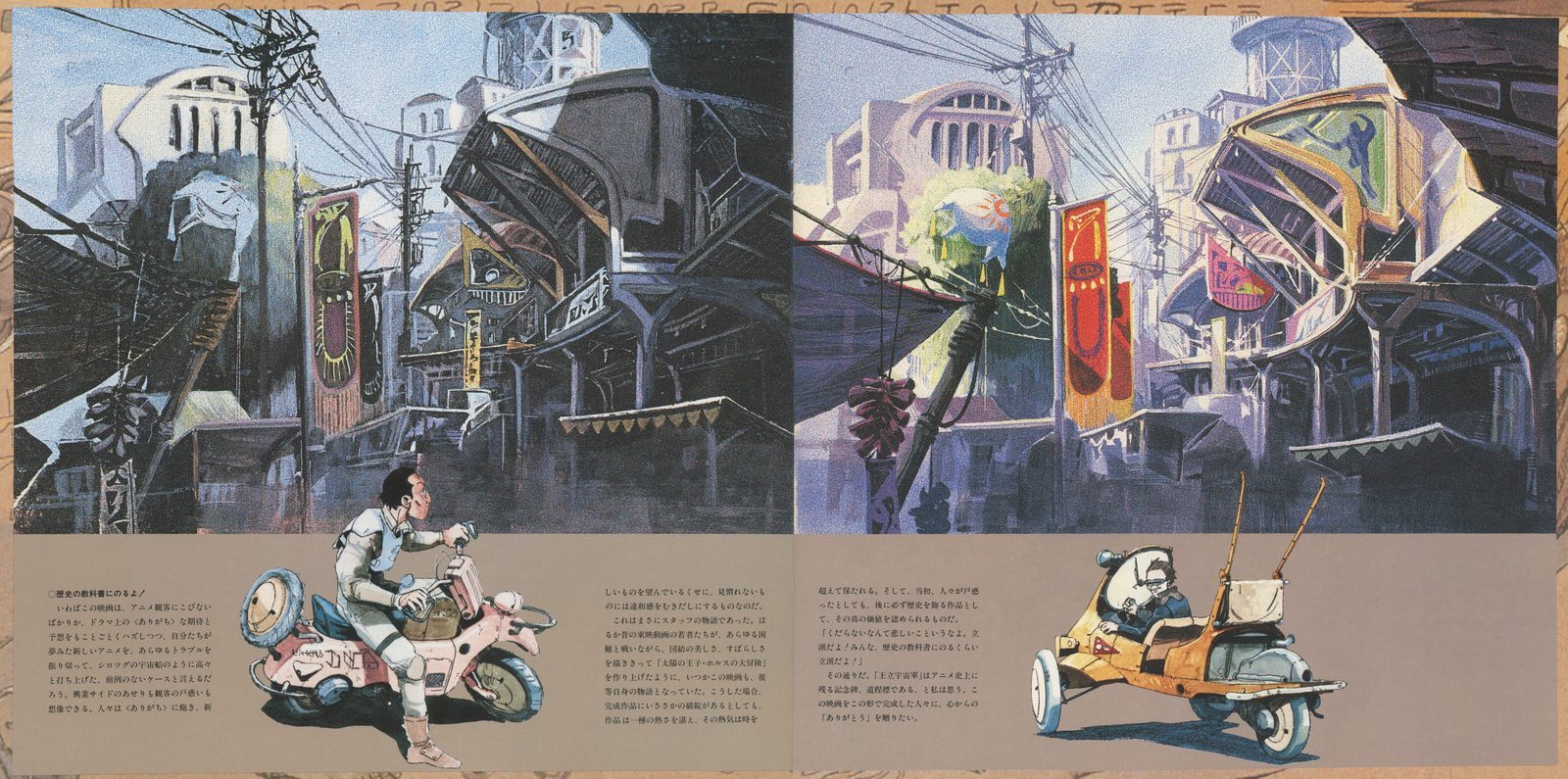 DATA FILE interior — cityscape paintings. Two full background art reproductions of the Honneamise urban environment: layered architecture, power lines, alien signage, vehicles designed for a world that runs on a different industrial logic. A motorcycle and a three-wheeled delivery vehicle in the foreground.
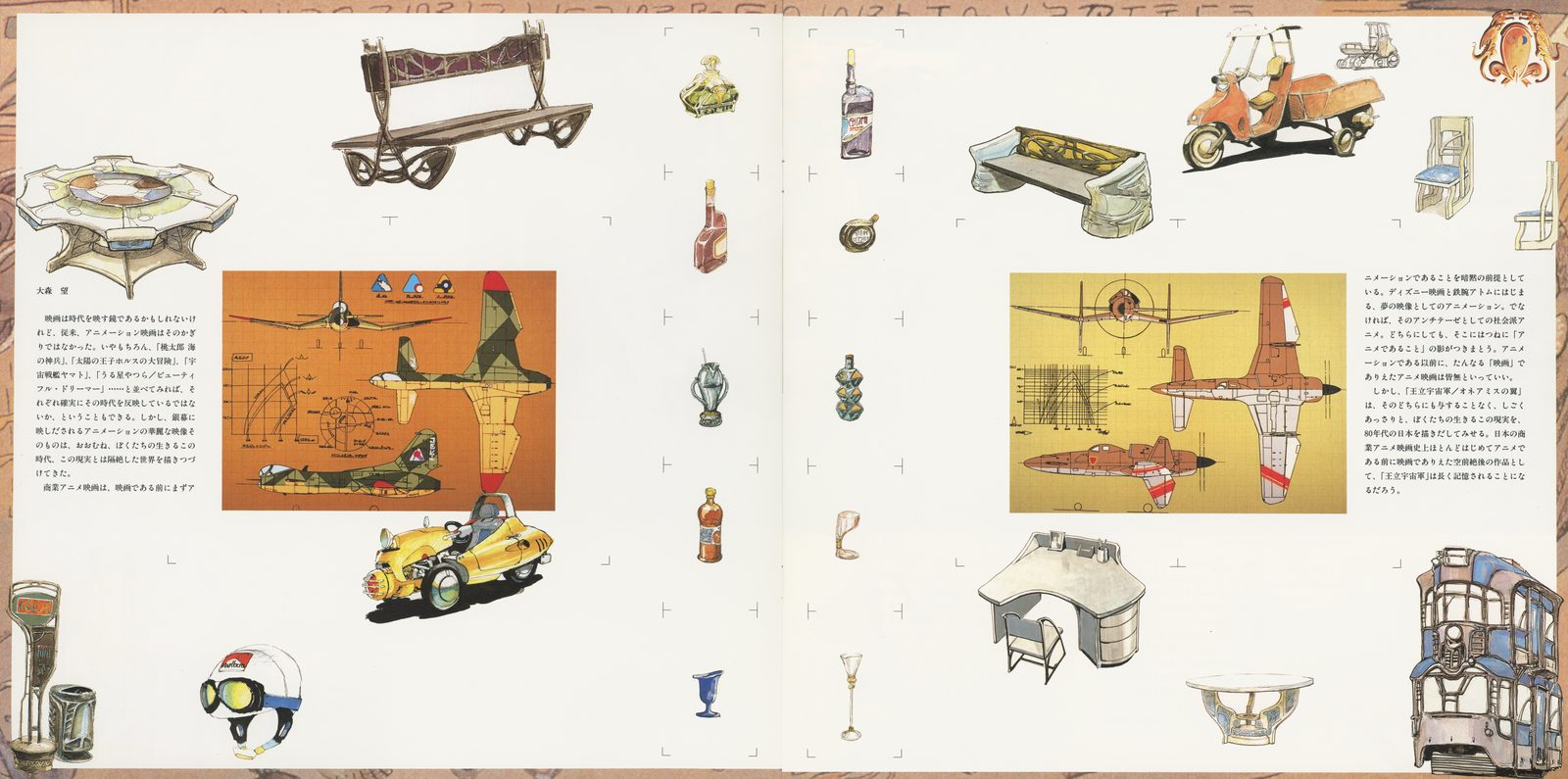 DATA FILE interior — the object catalogue. Vehicles, bottles, glassware, tools, helmets, furniture, aircraft — every prop in the film was designed. Nothing defaults to a real-world reference. This spread documents dozens of individual objects, each painted in watercolor.
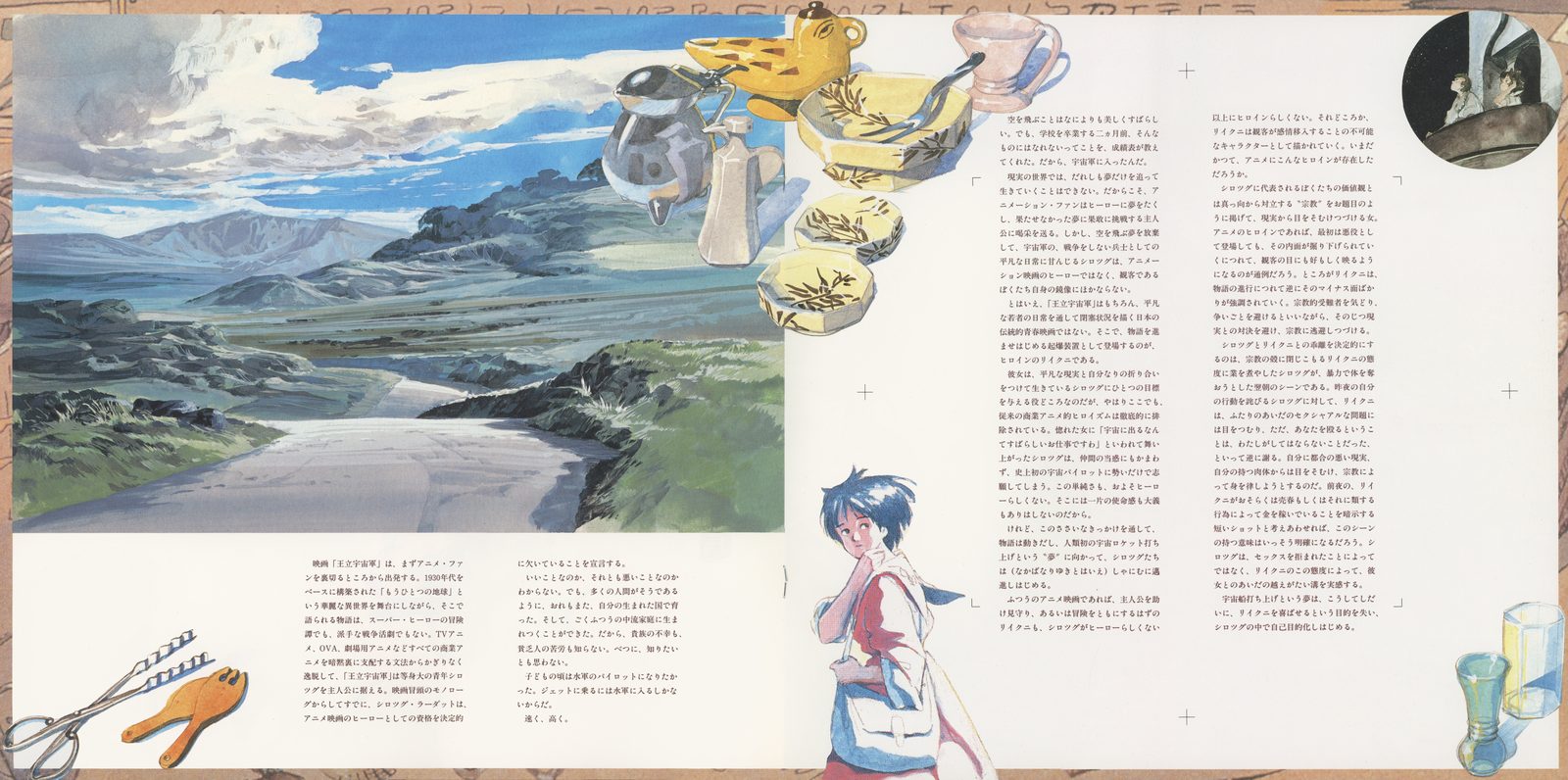 DATA FILE interior — landscape and world-building. A vast mountain valley rendered in watercolor, with small prop illustrations (food, utensils, instruments) floating in the margins. Riquinni illustrated at the bottom. The geography of a world that exists only in this film.
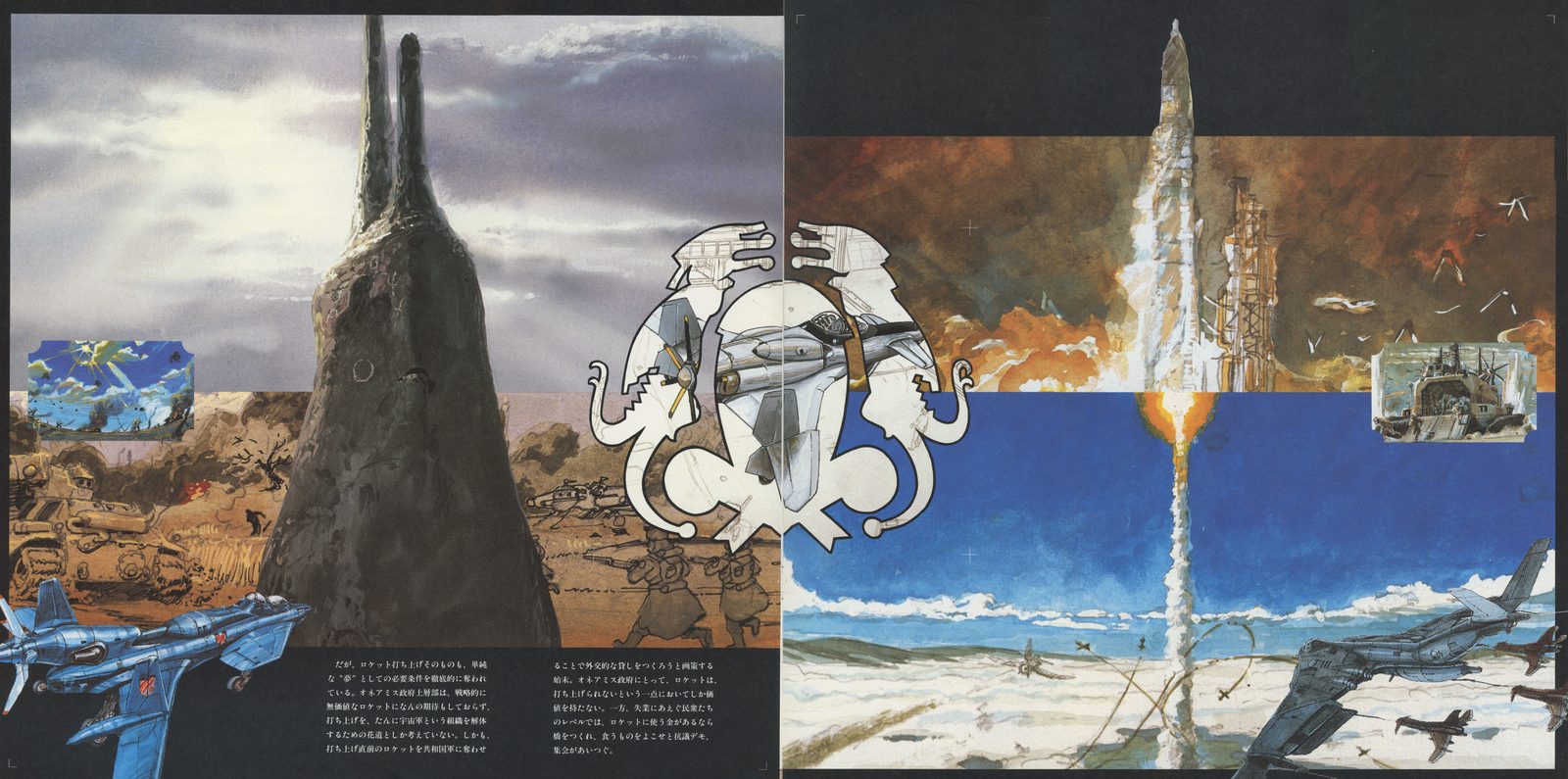 DATA FILE interior — military and launch sequences. Left: the wasteland launch site with its monolithic gantry structure and fighter jets. Center: the Royal Space Force crest. Right: the rocket launch in full atmospheric detail — smoke, debris, the ground crew's infrastructure.
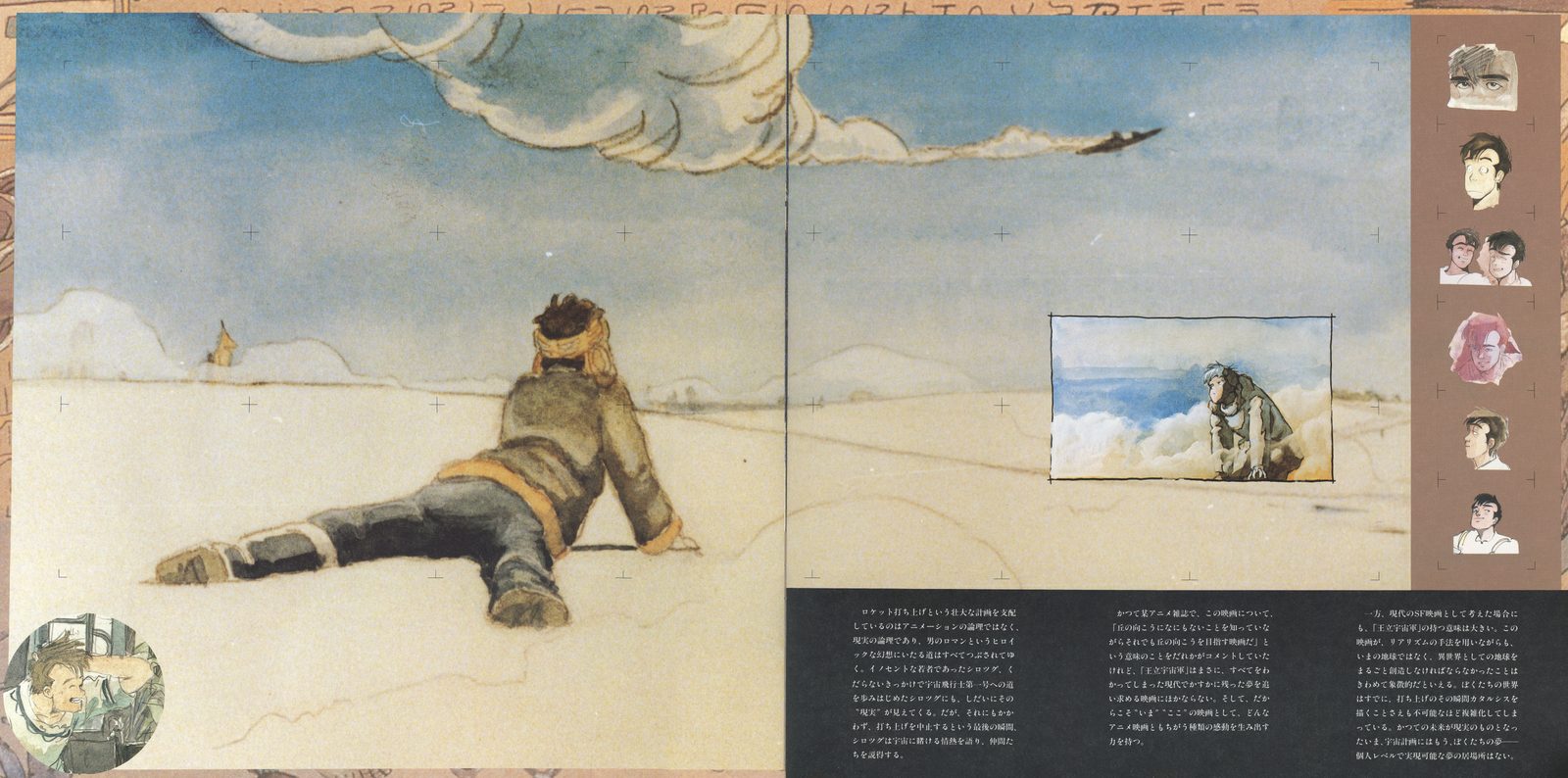 DATA FILE interior — wasteland essay spread. A watercolor of Shirotsugh lying face-down in the desert plain, viewed from behind; a smaller inset shows him seated with goggles in the same wasteland. Portrait strips of the supporting cast line the right margin. The film's emotional geography, not its action.
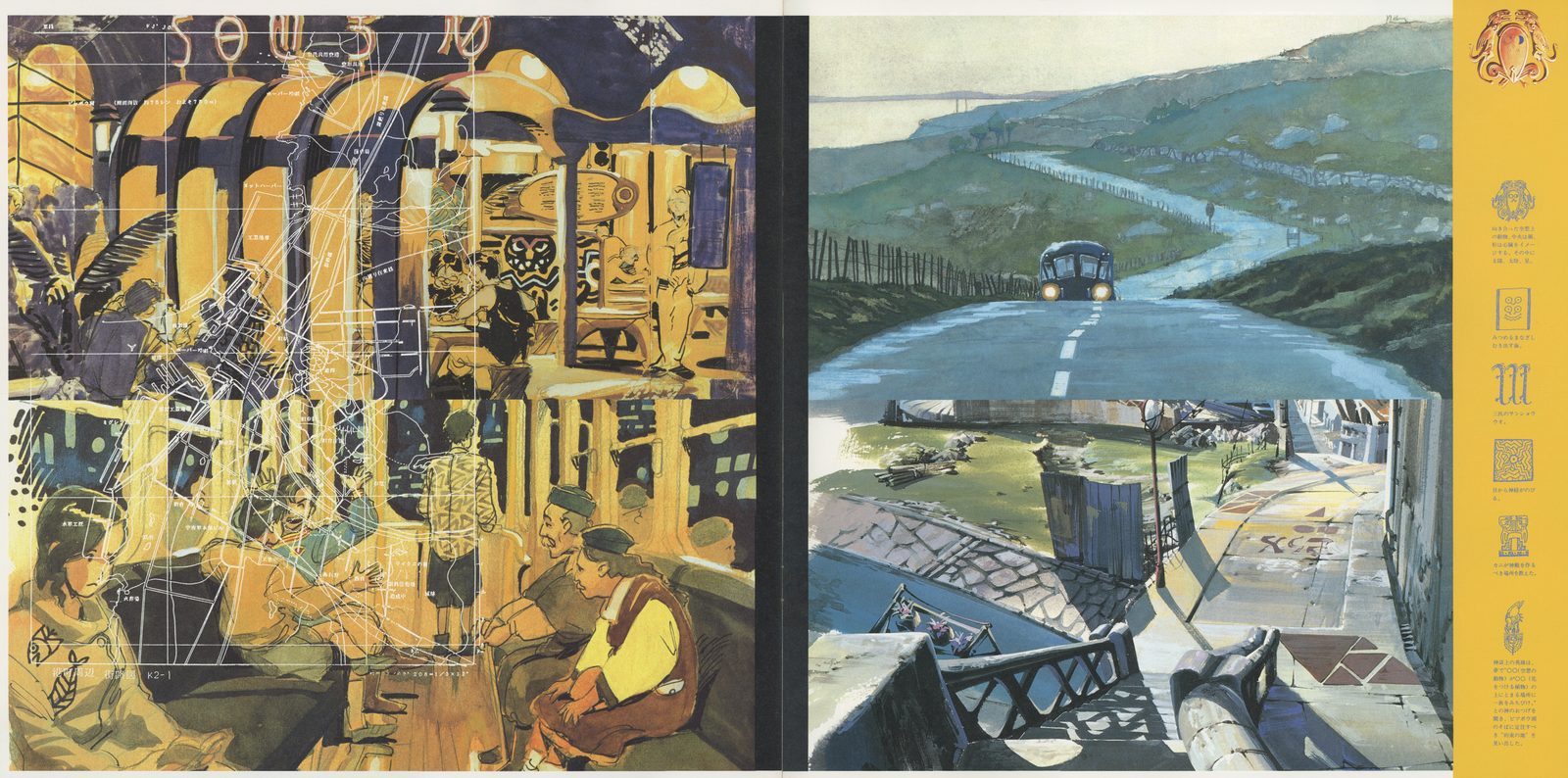 DATA FILE interior — background art showcase. Left: a golden-lit interior, possibly a social hall or officers' mess, with period-specific furniture and architecture. Right: a coastal road with a vehicle disappearing into the landscape. Two paintings that establish the world's lived-in quality.
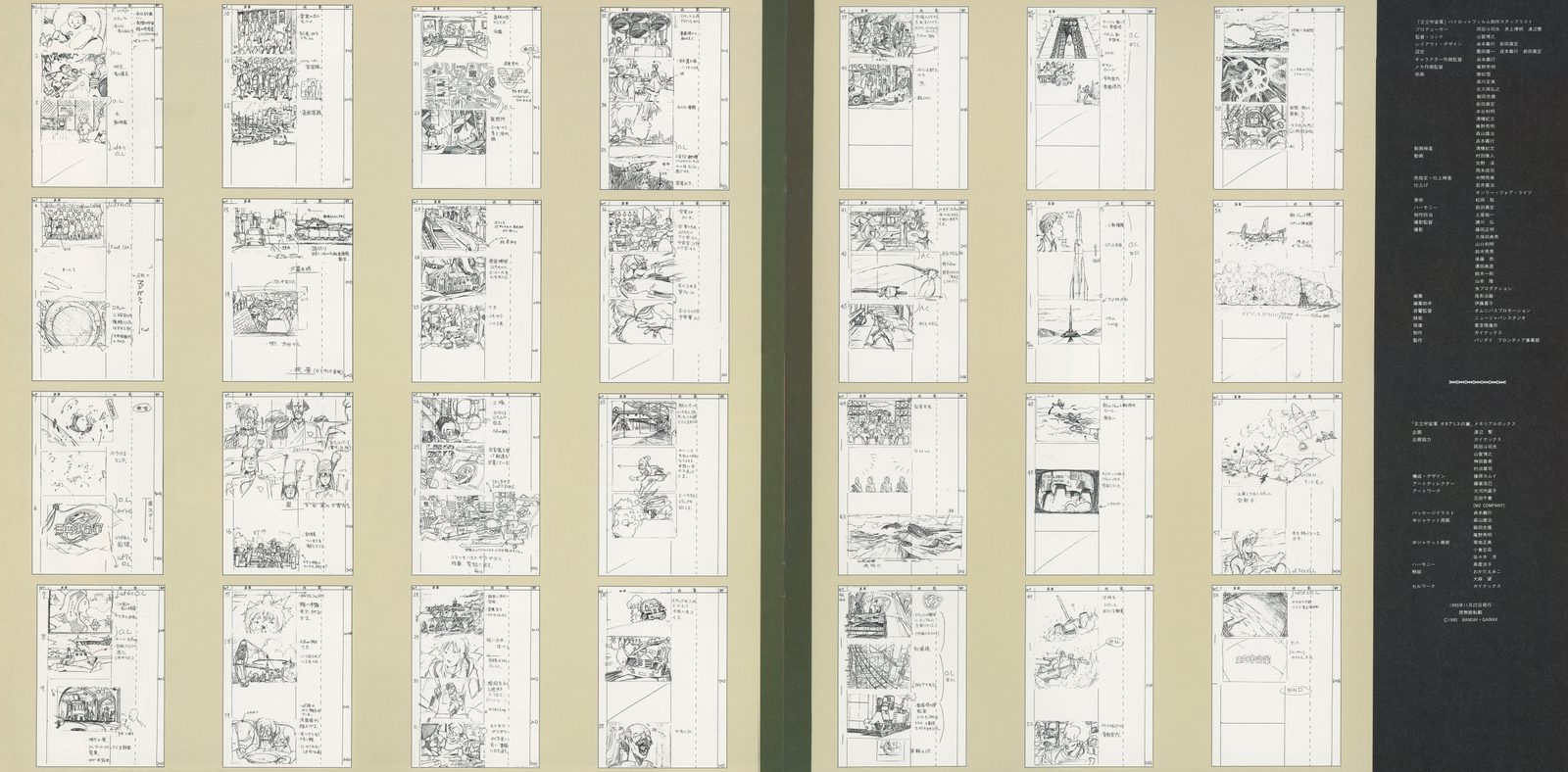 DATA FILE interior — storyboard pages. Yamaga's conte reproduced across both pages — the compositions that Anno and the animation team translated into the finished film. Production-grade documents treated as booklet content.
The World That Existed Once
Honneamise's world was never franchised. The planned sequel, Uru in Blue (蒼きウル), spent decades in development without reaching production. The vehicles, the architecture, the Honneamise script, the entire visual language of a civilization that built a space program from scraps — all of it was used once. The storyboard pages carry Yamaga's compositions for a launch sequence that Anno animated by hand. What follows them in the booklet is the Honneamise alphabet, arranged in a circle, with no translation key provided.
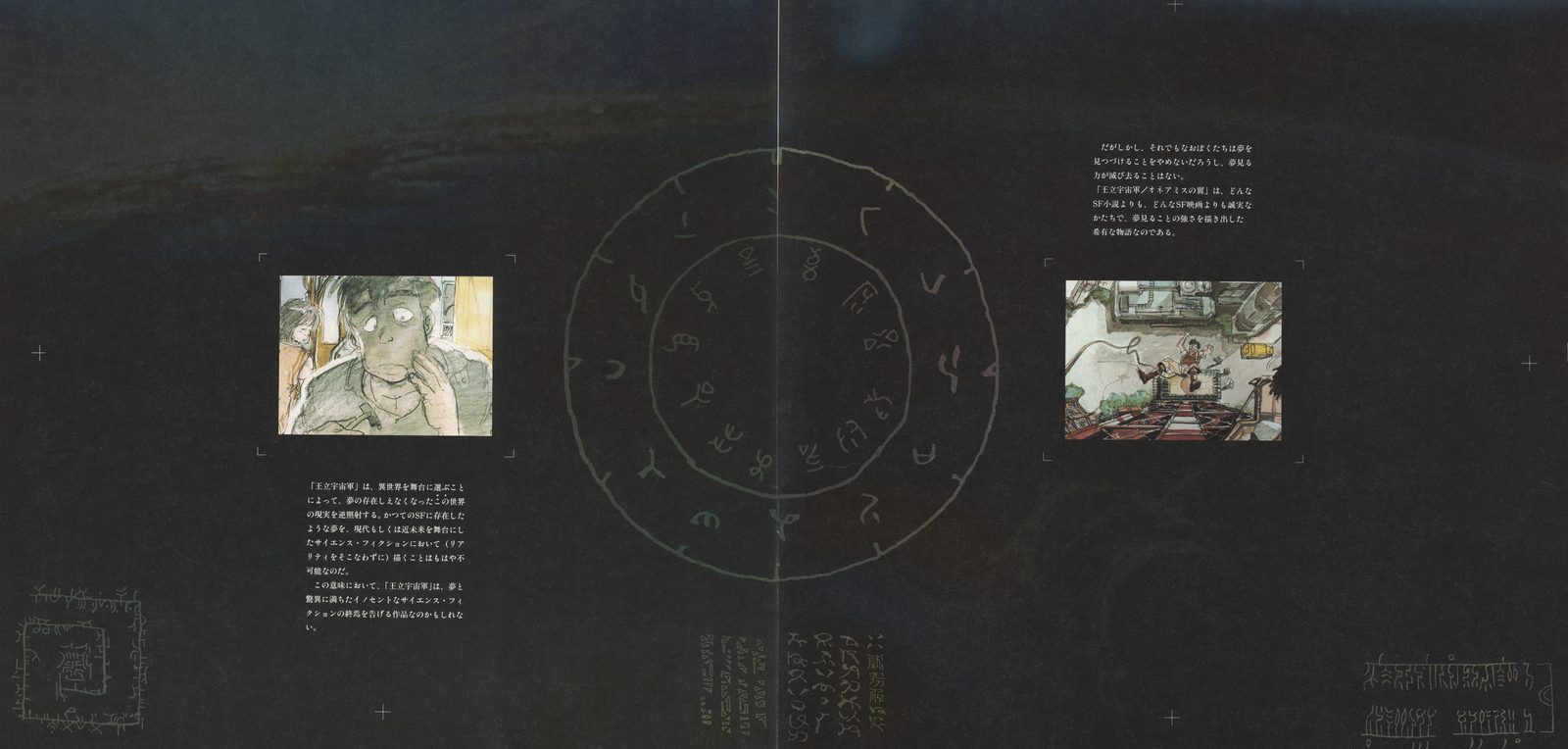 DATA FILE interior — the Honneamise writing system. The constructed alphabet arranged in a circle against a dark background, with two small scene illustrations. No translation key. The script was designed to be visible throughout the film but never decoded for the audience.
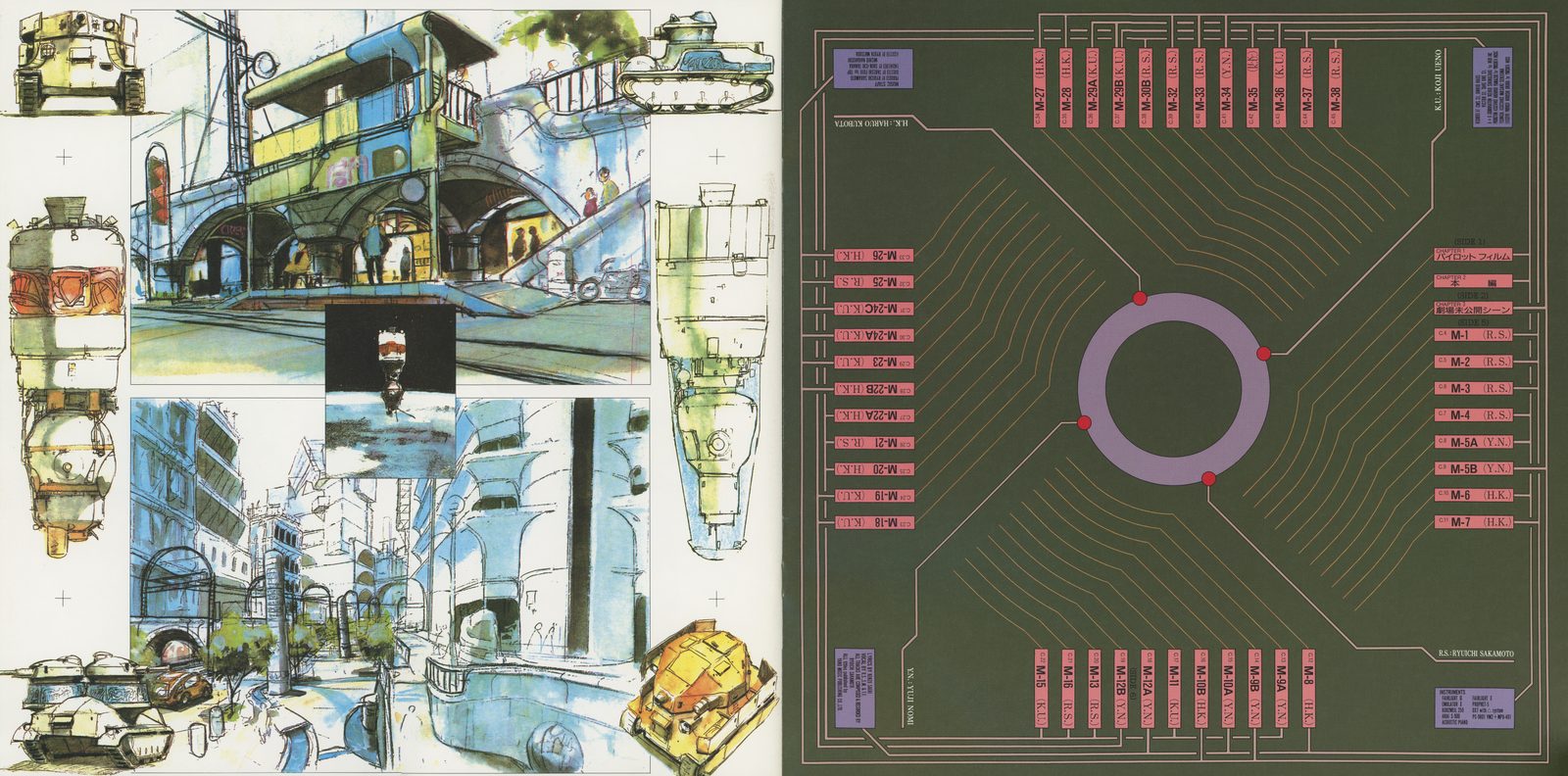 DATA FILE interior — architectural concept art and technical diagrams. Left: multi-level building cross-section with vehicles and infrastructure. Right: a launchpad layout diagram — the engineering documentation for a facility that exists only in animation.
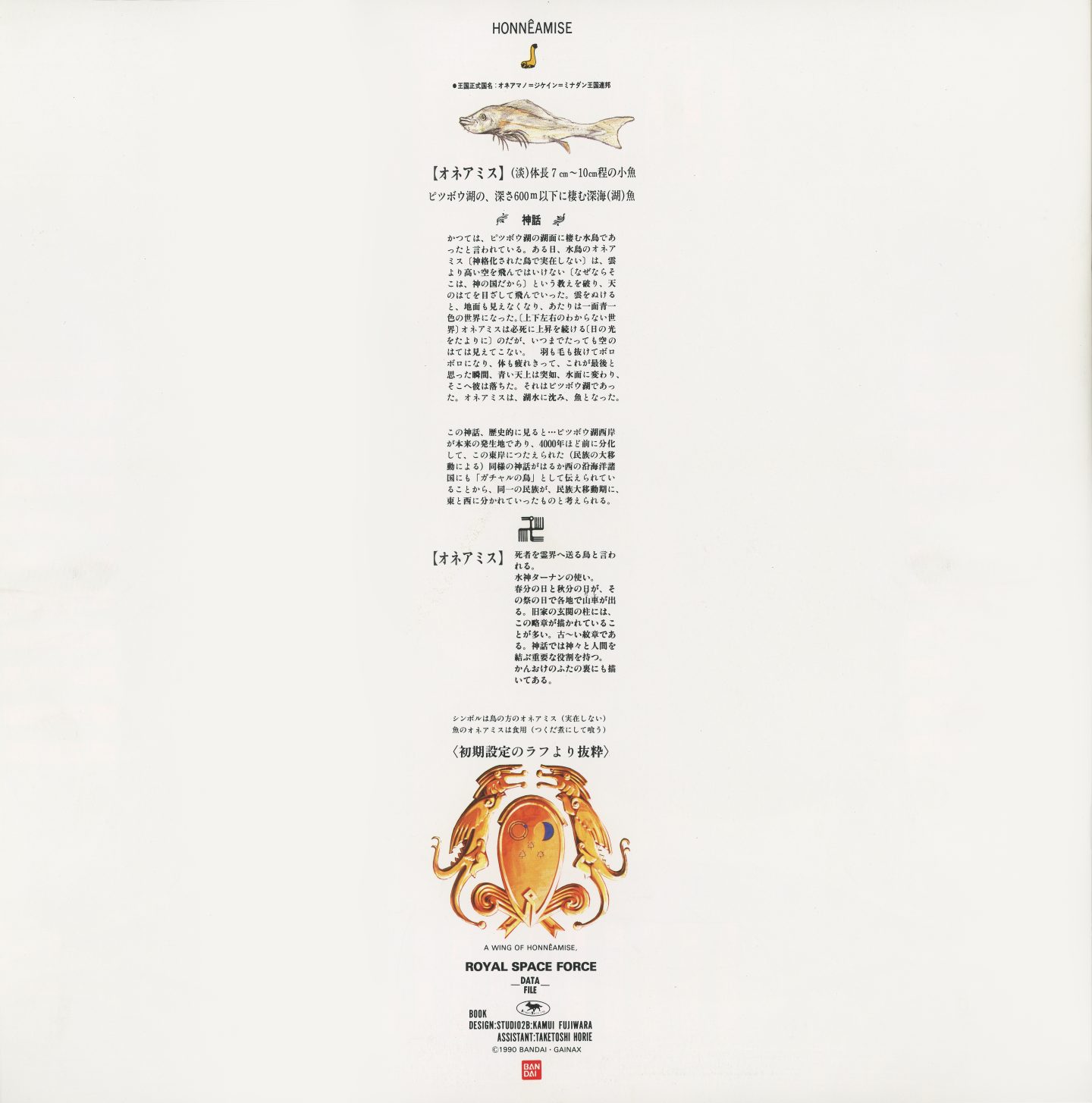 DATA FILE back matter — colophon and fauna reference. Two illustrated creatures from the Honneamise world at top, followed by production credits and a note on the constructed fauna. The Royal Space Force crest closes the booklet. The world is documented and complete — and exists nowhere else.
The Blu-ray presents the film at higher resolution with a cleaned-up transfer. It does not include the pilot film, the unreleased theatrical scenes, or Sakamoto's complete background music. It does not include the DATA FILE.
The Blu-ray is the better way to watch the film. The LD-BOX is the only release that holds the pilot film, the unreleased theatrical scenes, Sakamoto's complete background music, and the DATA FILE documenting how the production built an original world from scratch. GAINAX went on to make Nadia, Evangelion, and FLCL. Yamaga directed one more feature. Sadamoto became one of anime's most recognized character designers. The box set is from before any of that — the ¥800 million debut, the pilot that pitched it, the alphabet they invented for a country that only existed in this film.
Loading...