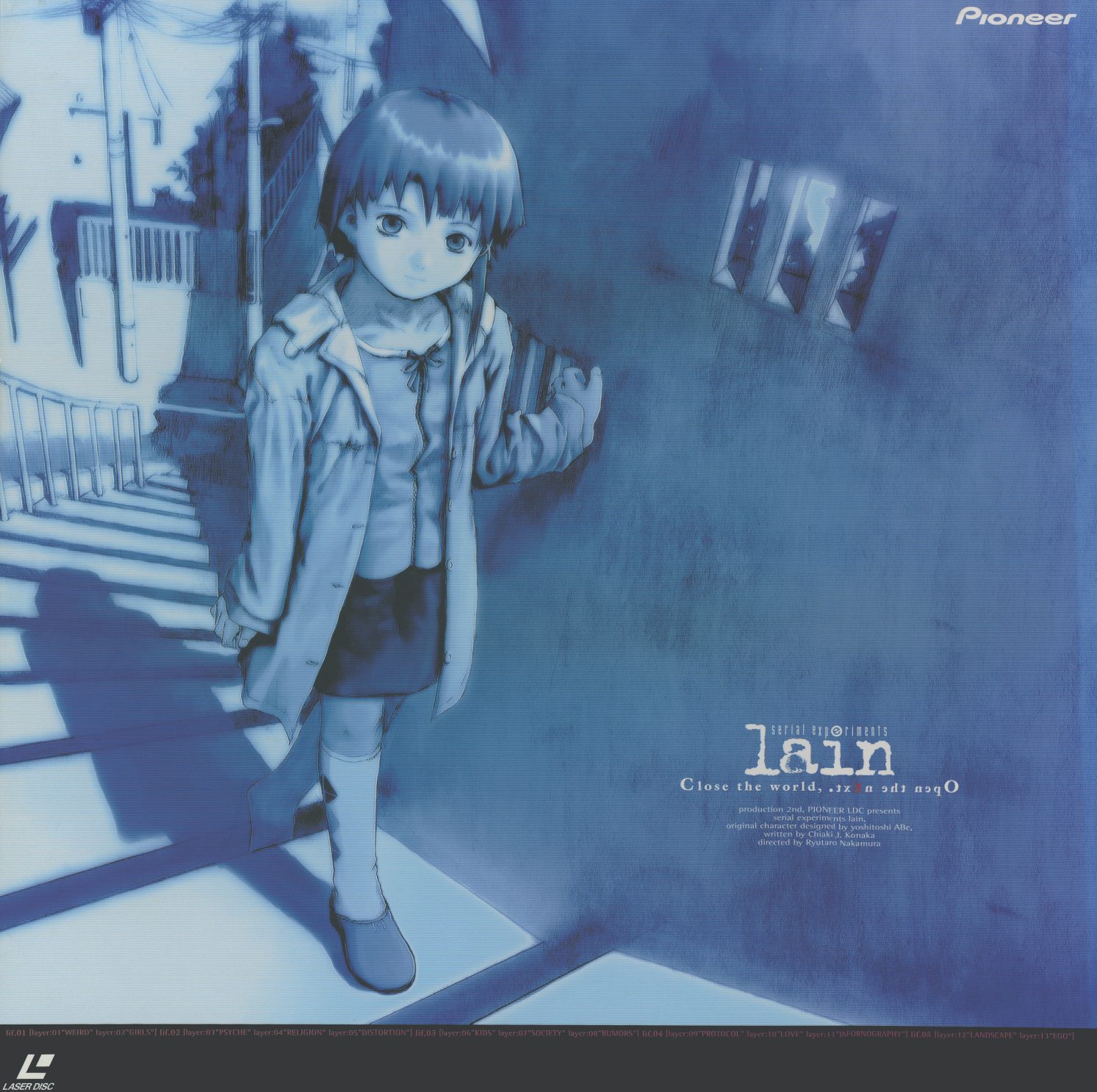
PILA-1501 through PILA-1505. Five single-disc CLV volumes. Pioneer LDC. Released between September 1998 and January 1999 — the first volume shipping while the series was still on air. Thirteen episodes across five sleeves: two layers per volume for the bookends, three for the middle three. Digital stereo. 4:3. ¥5,800 for the two-episode volumes, ¥6,600 for the three-episode volumes. A storage box shipped with lif:03, catalog number PILA-1500.
A thirteen-year-old girl named Lain Iwakura receives an email from a classmate who committed suicide. The message says the Wired — the show's internet — is not a network but a world, and Chisa is alive inside it. Lain, who barely knows how to use a computer, begins building increasingly powerful NAVI terminals in her bedroom. The boundary between the physical world and the Wired dissolves. Other versions of Lain appear in online spaces, acting with confidence and cruelty the real Lain doesn't recognize. The show asks whether identity requires a body, whether memory requires continuity, whether a girl can exist more fully as information than as flesh. In 1998 — before social media, before persistent online identity, before anyone had a second self living in a feed — director Ryutaro Nakamura, writer Chiaki J. Konaka, and character designer Yoshitoshi ABe built a thirteen-episode argument that the internet would not connect people but dissolve them.
Lain was not adapted from anything. The anime, a PlayStation game, and a manga were developed simultaneously as a single multimedia project — three media telling parallel stories in the same world, none of them the source. Pioneer LDC didn't license home video rights to someone else's franchise. They sat on the production committee. They funded the show, produced the game, and released the discs. The packaging investment — five original ABe jacket paintings, four gatefold illustrations commissioned in four different artistic media, five settei fold-outs — is a publisher documenting its own creation, not a distributor decorating a license.
Pioneer LDC released each volume not as a home video product but as a file — 'lif:01' through 'lif:05.' Episodes are 'layers,' not numbers. And every sleeve contains a fold-out production document titled 'the world of lain' — a settei reference sheet with architectural layouts, character model sheets, and hardware schematics for the NAVI terminals, formatted as if each volume ships with its own design bible. The packaging speaks the show's language and assumes you already speak it too.
The Volumes
Five sleeves, five color registers. ABe painted each jacket in a different palette — blue suburban morning, warm sepia domestic interior, violet night behind chain-link, amber classroom wreckage, pink stairwell between floors. Lain is alone in every image. The settings shift but the isolation is constant. Each jacket's right spine prints the volume's layer titles vertically — 'layer:01 WEIRD / layer:02 GIRLS' — and the 'lif' designation that replaces standard volume numbering. The packaging treats the show's vocabulary as its own filing system.
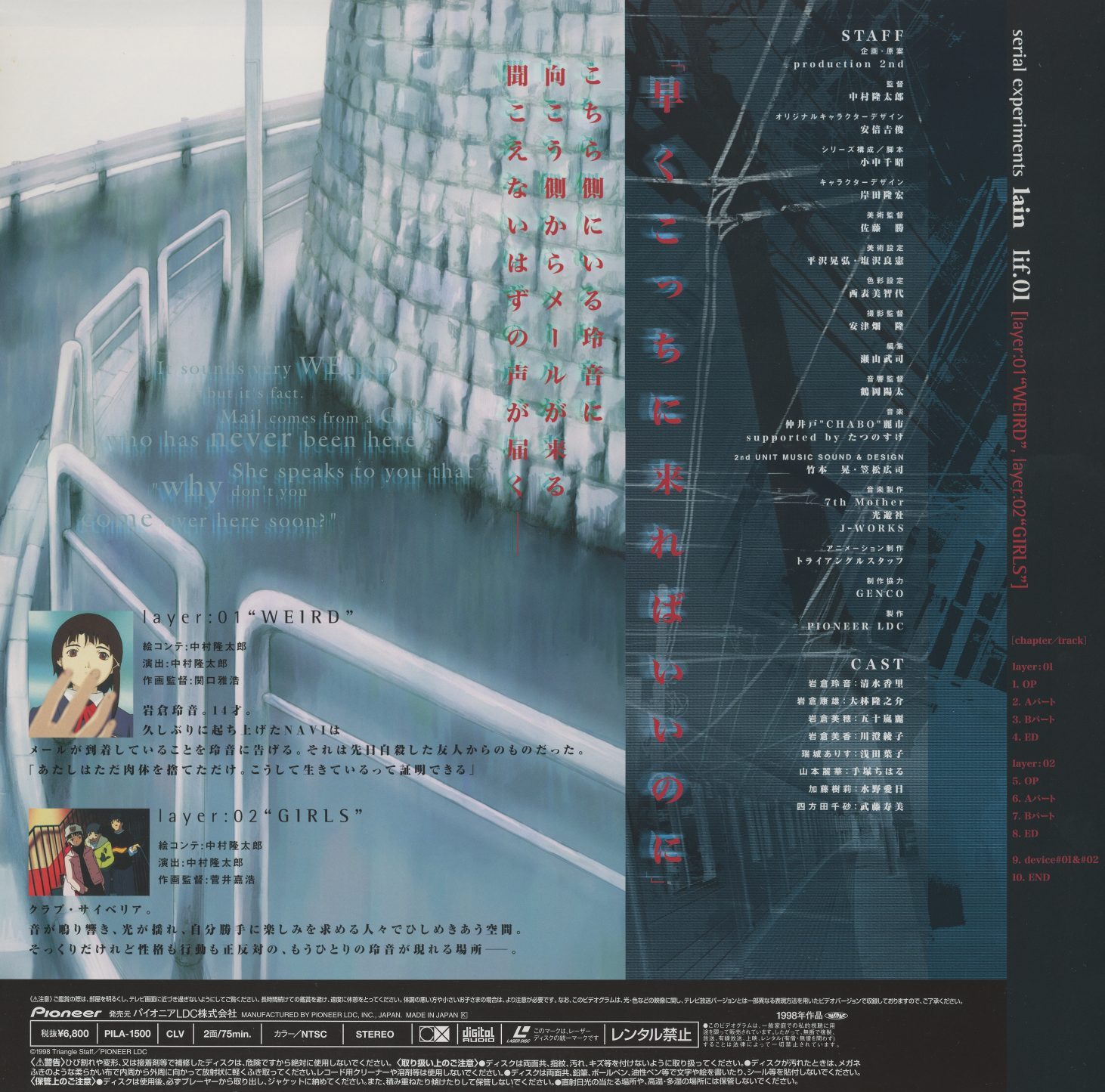 lif:01 jacket back. Episode synopses for layer:01 'WEIRD' and layer:02 'GIRLS.' Full staff credits — director: Ryutaro Nakamura, series composition/screenplay: Chiaki J. Konaka, original character design: Yoshitoshi ABe, music: Reiichi 'Chabo' Nakaido. CLV, digital stereo, NTSC. ¥5,800.
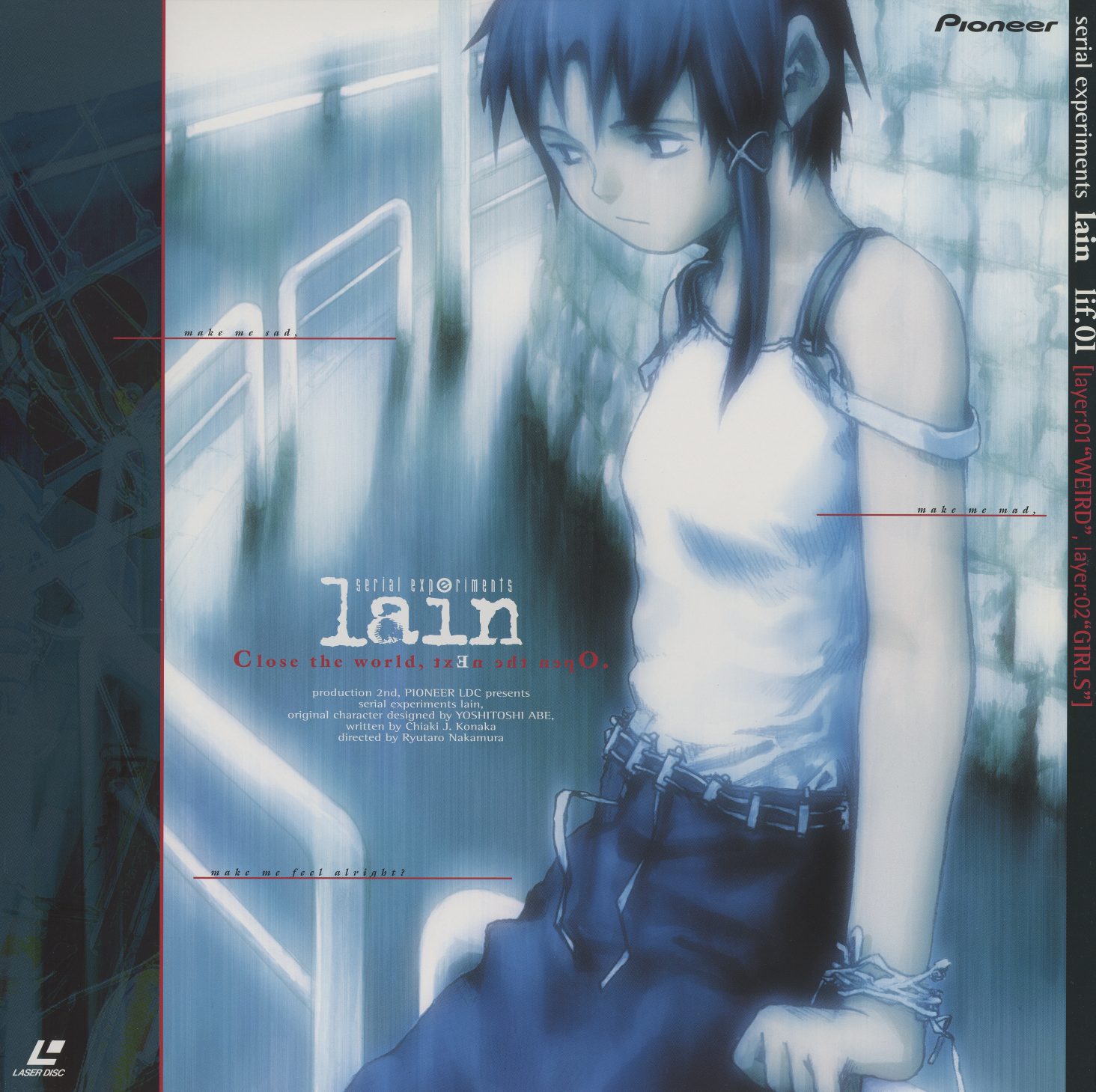 lif:01 inner jacket. A second register — darker Lain with data stream overlay, the same girl refracted through the Wired's visual language. Right spine lists layer titles. The jacket's two faces present two versions of the same character: the suburban schoolgirl on the front, the digital entity on the reverse.
Two Faces
Open the gatefold and the jacket reveals its second image. Where the front shows Lain in physical space — sunlight, pavement, utility poles — the interior shows her dissolving into data. The same character in the same school uniform, but the rendering shifts from naturalistic illustration to something closer to signal interference. The gatefold hinge is the boundary between the real world and the Wired, and ABe drew both sides.
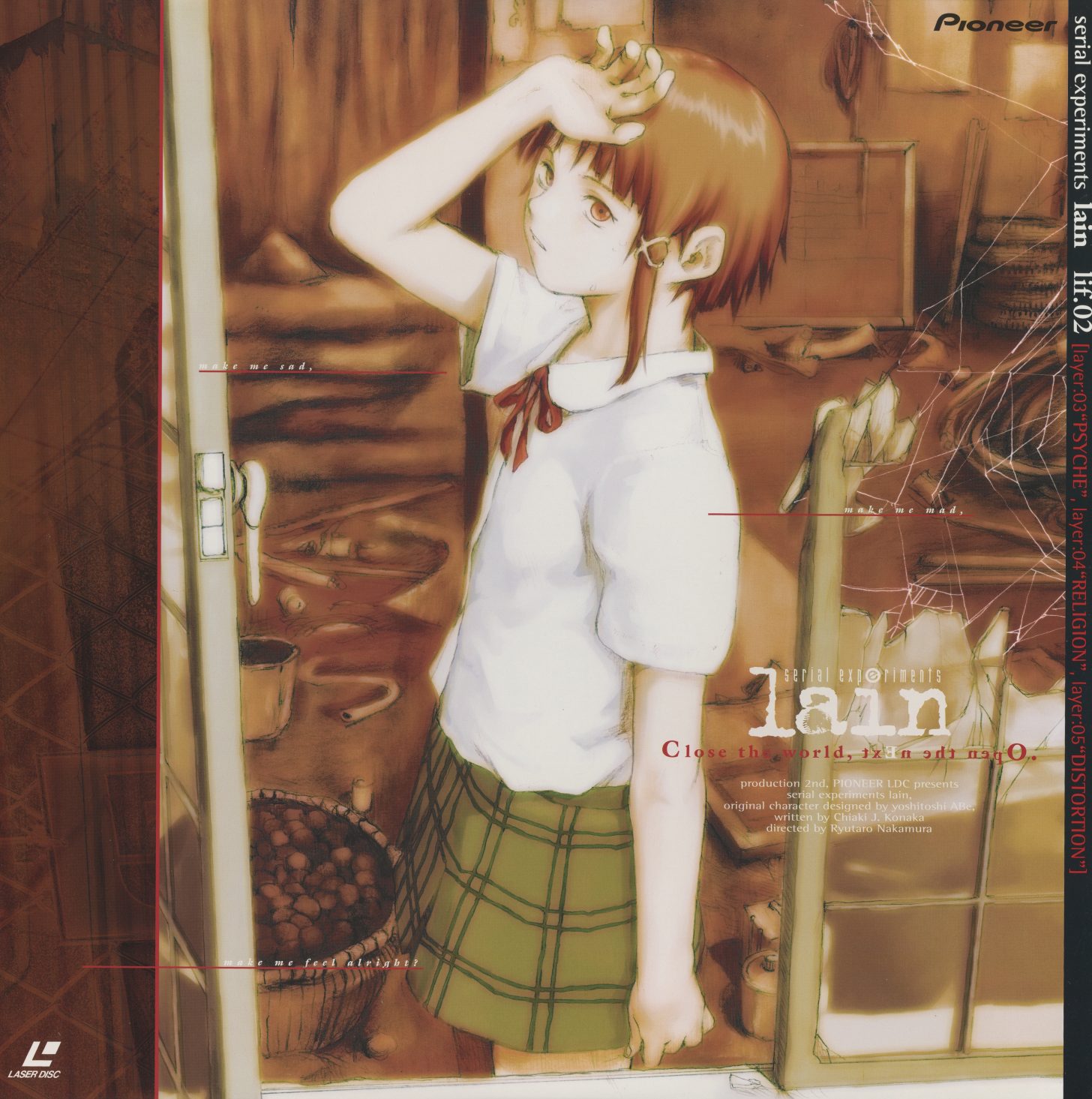 lif:02 jacket front. Sepia and amber — Lain in a warm domestic interior, raising her glasses, school uniform slightly disheveled. The kitchen behind her is rendered with the show's characteristic architectural precision. 'serial experiments lain lif:02.' PILA-1502. Layers 03-05: PSYCHE, RELIGION, DISTORTION.
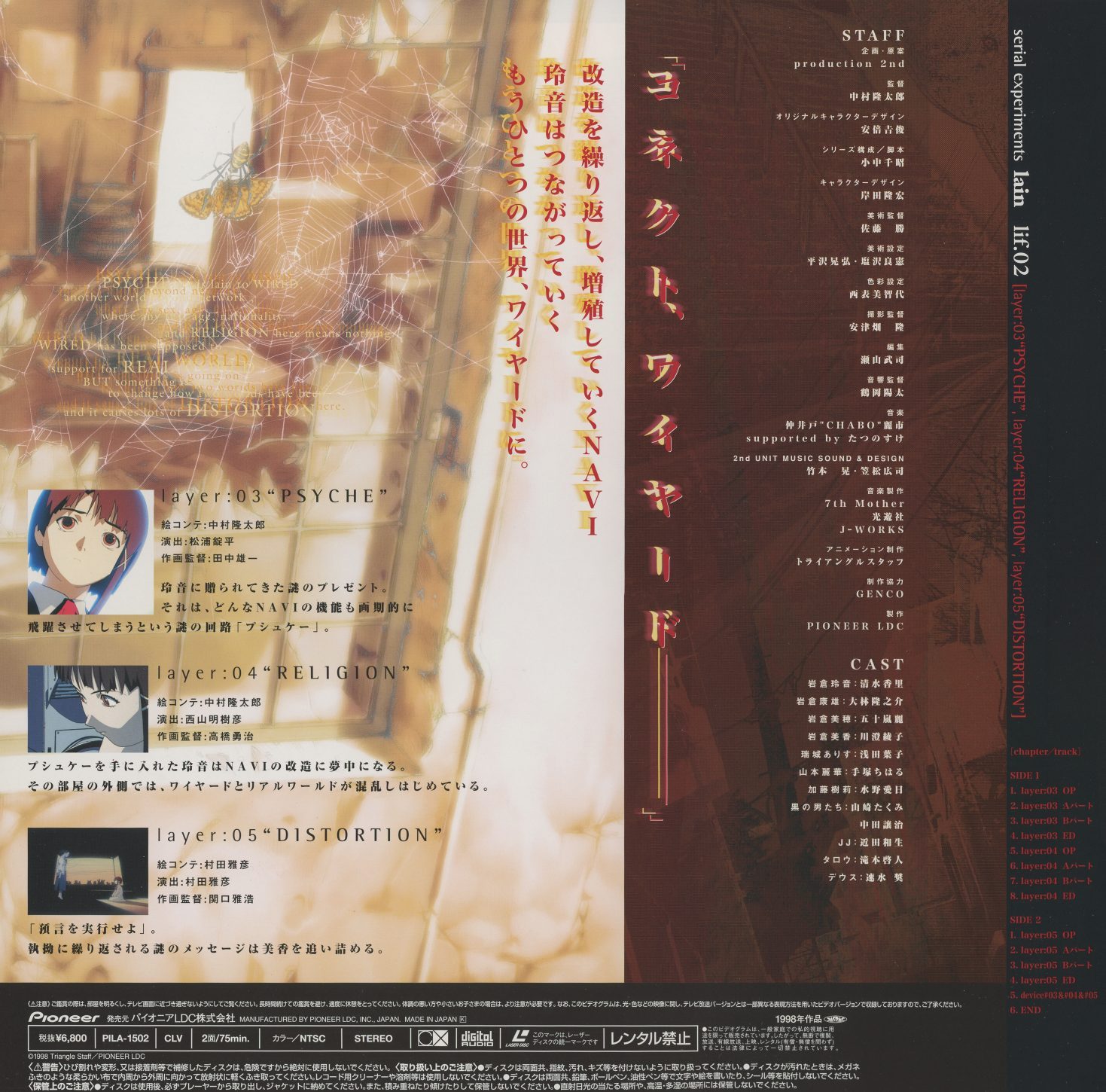 lif:02 jacket back. '改造を繰り返し、増殖していくNAVI — ひとりひとりになった玲音は、ワイヤードに。' (A NAVI that multiplies through repeated modification — each Lain returns to the Wired.) Layer descriptions for PSYCHE, RELIGION, and DISTORTION. Full staff and cast credits. CLV, digital stereo, NTSC. ¥6,600. PILA-1502.
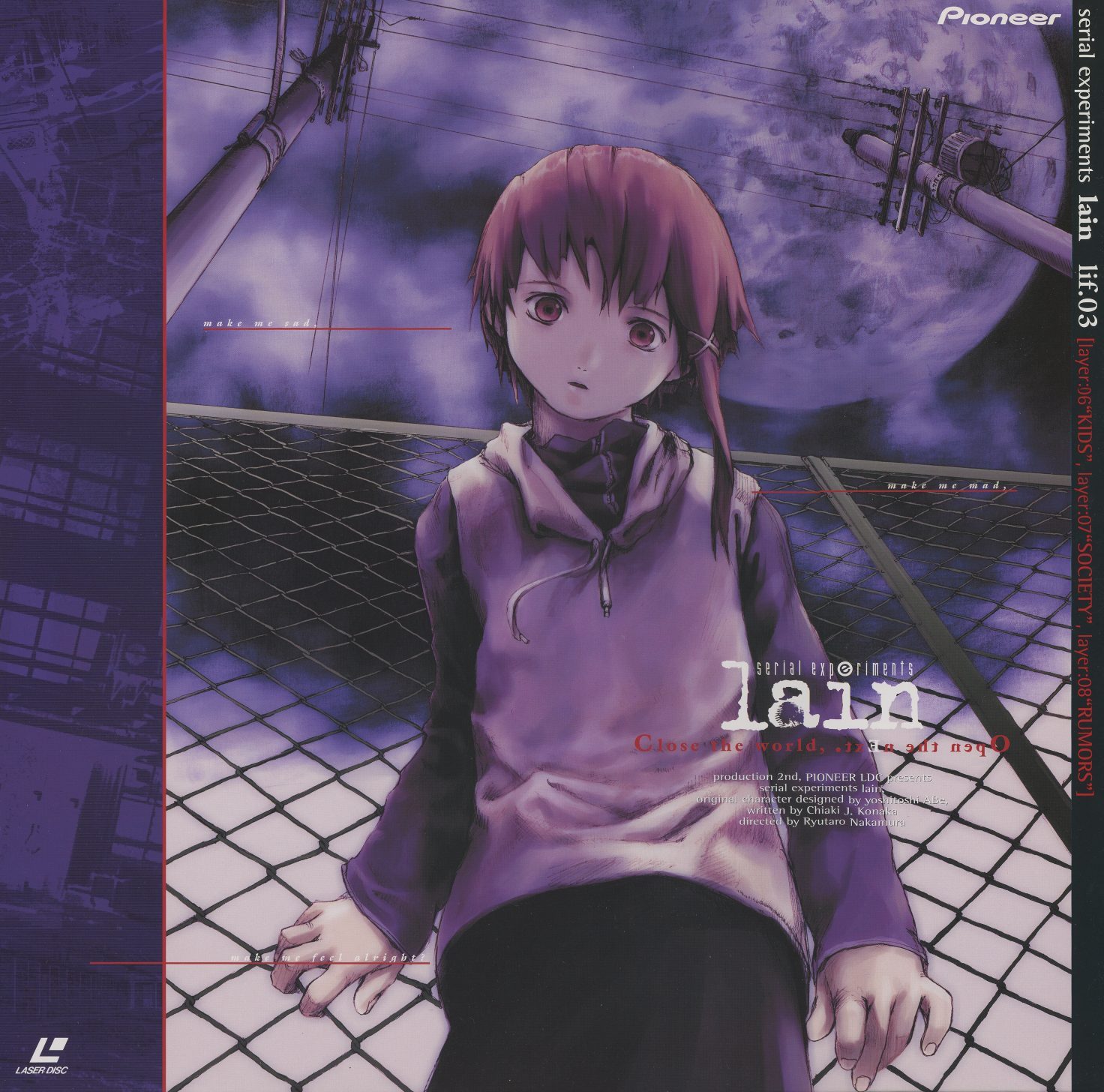 lif:03 jacket front. Violet and steel — Lain in a purple hoodie against chain-link fence, power lines cutting the sky. The utility infrastructure that the show treats as visual metaphor for the Wired's physical substrate. PILA-1503. Layers 06-08: KIDS, SOCIETY, RUMORS.
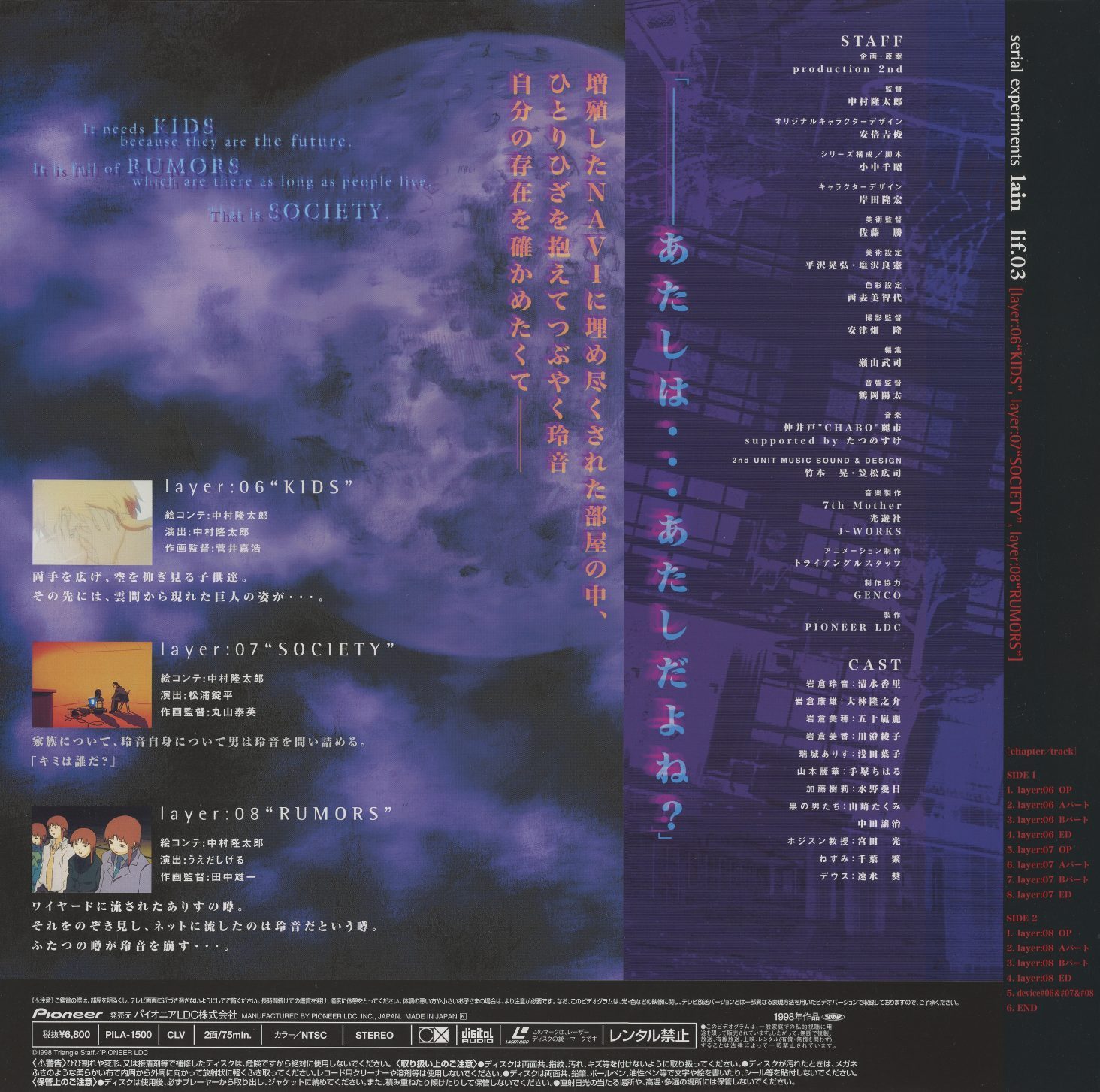 lif:03 jacket back. 'あたしは、あたしだよね?' (I am... me, right?) Layer descriptions for KIDS, SOCIETY, and RUMORS — the episodes where Lain encounters her double in the Wired and the fracture between her identities begins. Pioneer LDC, PILA-1503. CLV, ¥6,600.
Five Palettes
ABe's jacket sequence works as a chromatic argument. Blue to sepia to violet to amber to pink — each volume's dominant color shifts the emotional temperature without changing the compositional logic. Lain is always centered. Lain is always alone. The backgrounds grow more claustrophobic as the series progresses: open suburban street, then kitchen corridor, then fenced perimeter, then overturned classroom, then enclosed stairwell. The narrowing is the narrative. By lif:05 the physical world has contracted to a passage between floors — a space that exists only as a route to somewhere else.
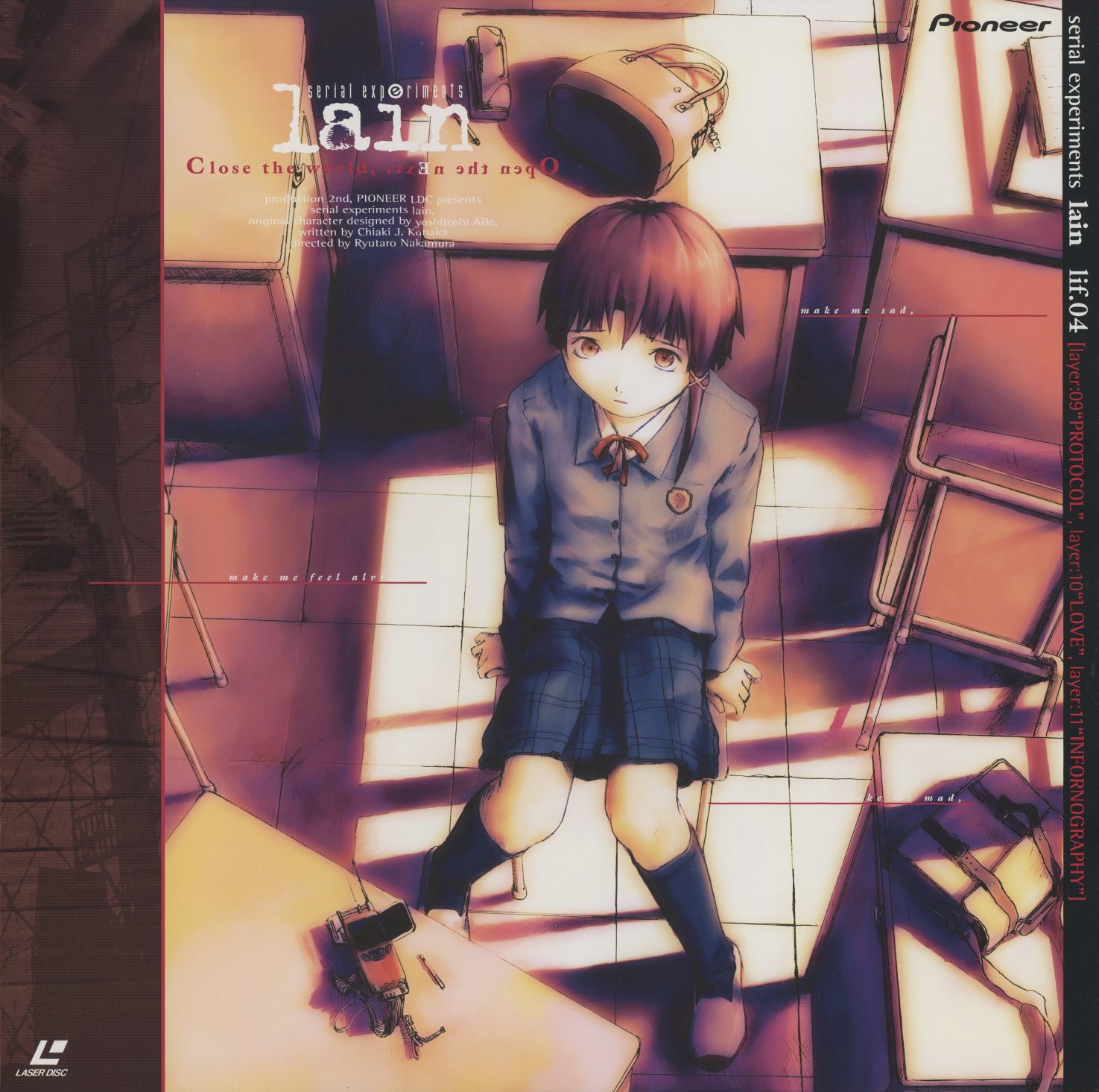 lif:04 jacket front. Amber and shadow — Lain in school uniform sitting on a classroom floor among overturned chairs. The institutional space has collapsed. 'make me sad... make me feel alive...' printed across the image as interface text. PILA-1504. Layers 09-11: PROTOCOL, LOVE, INFORNOGRAPHY.
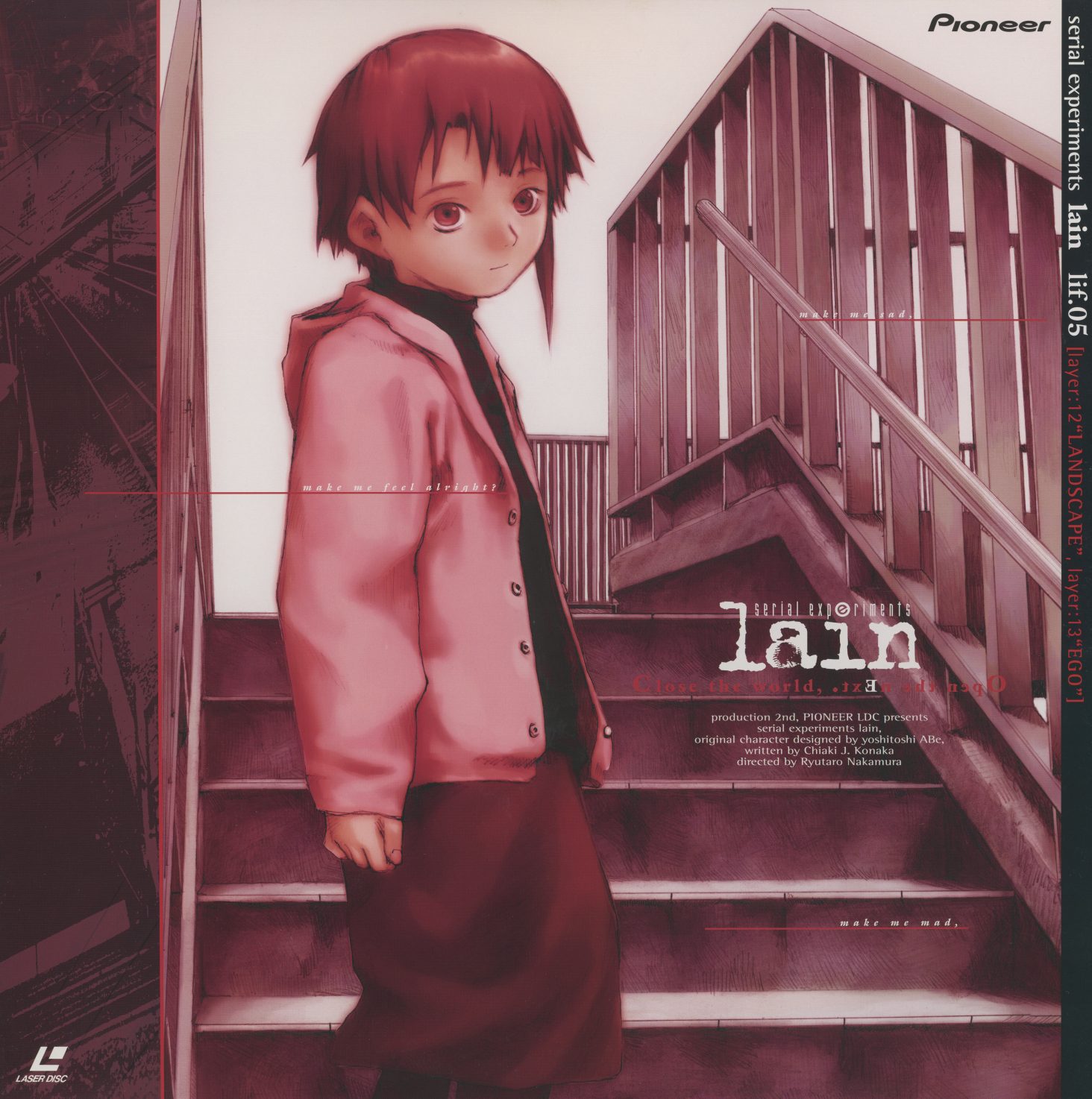 lif:05 jacket front. Pink and rust — Lain in a pink jacket on a stairway between floors. The final volume. The setting is transitional space — neither here nor there. PILA-1505. Layers 12-13: LANDSCAPE, EGO.
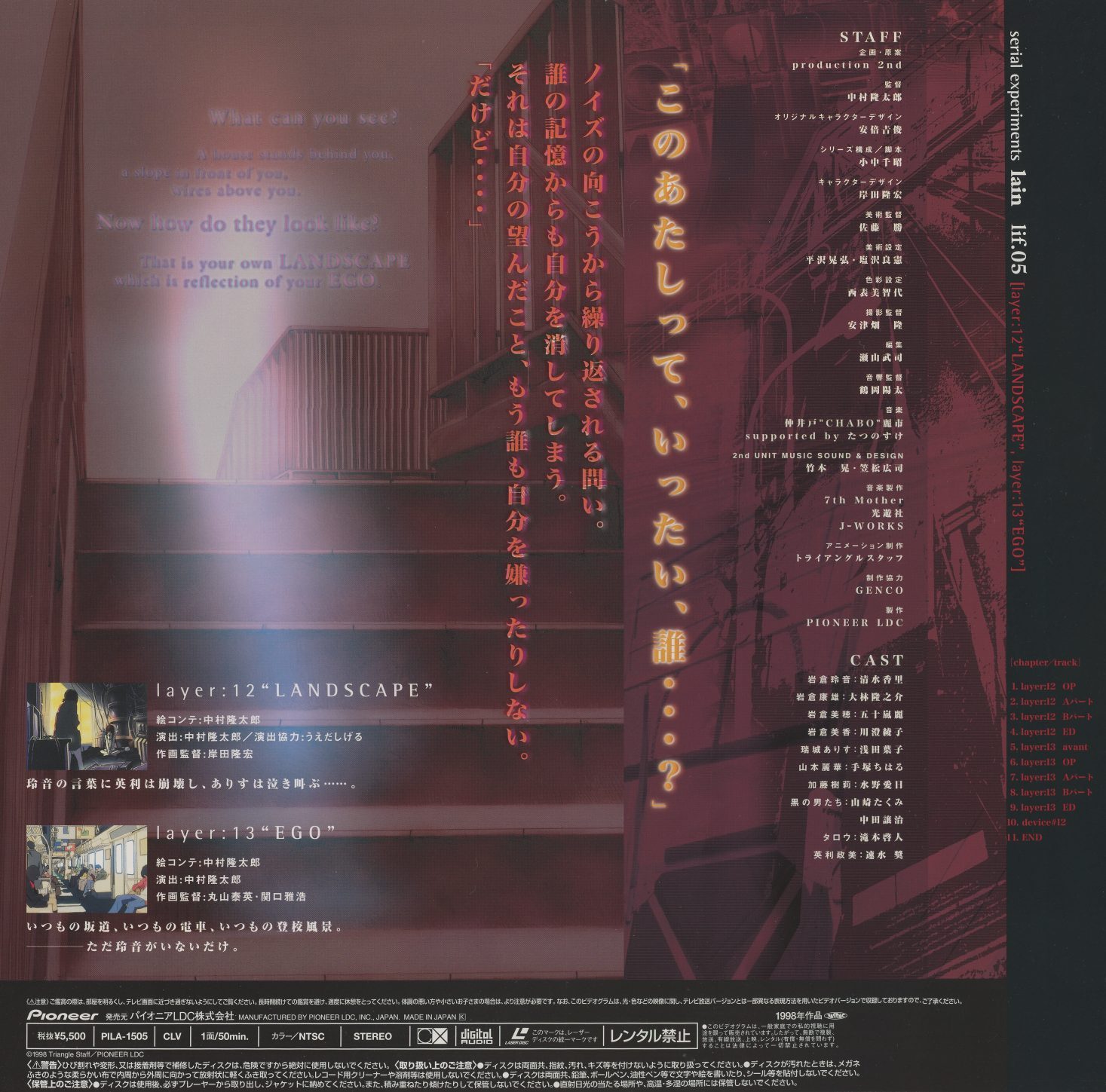 lif:05 jacket back. Layer:12 'LANDSCAPE' and layer:13 'EGO' — the final two episodes. 'このあたしって、いったい、誰・・・?' (This me — who, exactly, am I...?). The tagline is the show's last question. Staff credits, CLV, ¥5,800. The final volume returns to the two-episode structure of the first.
ABe's Jackets
Yoshitoshi ABe was not illustrating someone else's characters. He designed them. Lain's visual identity — the bear-ear hair clip, the oversized pajamas, the flat affect that shifts between innocence and something older — is ABe's invention, developed alongside Konaka's scripts and Nakamura's direction rather than derived from a pre-existing source. When ABe painted five jacket illustrations in five different emotional registers, he was interpreting his own creation. The jackets are not promotional art commissioned from a freelance illustrator working from reference sheets. They are the character designer revisiting his own character five times, each time finding a different version of her — which is, of course, what the show itself is about.
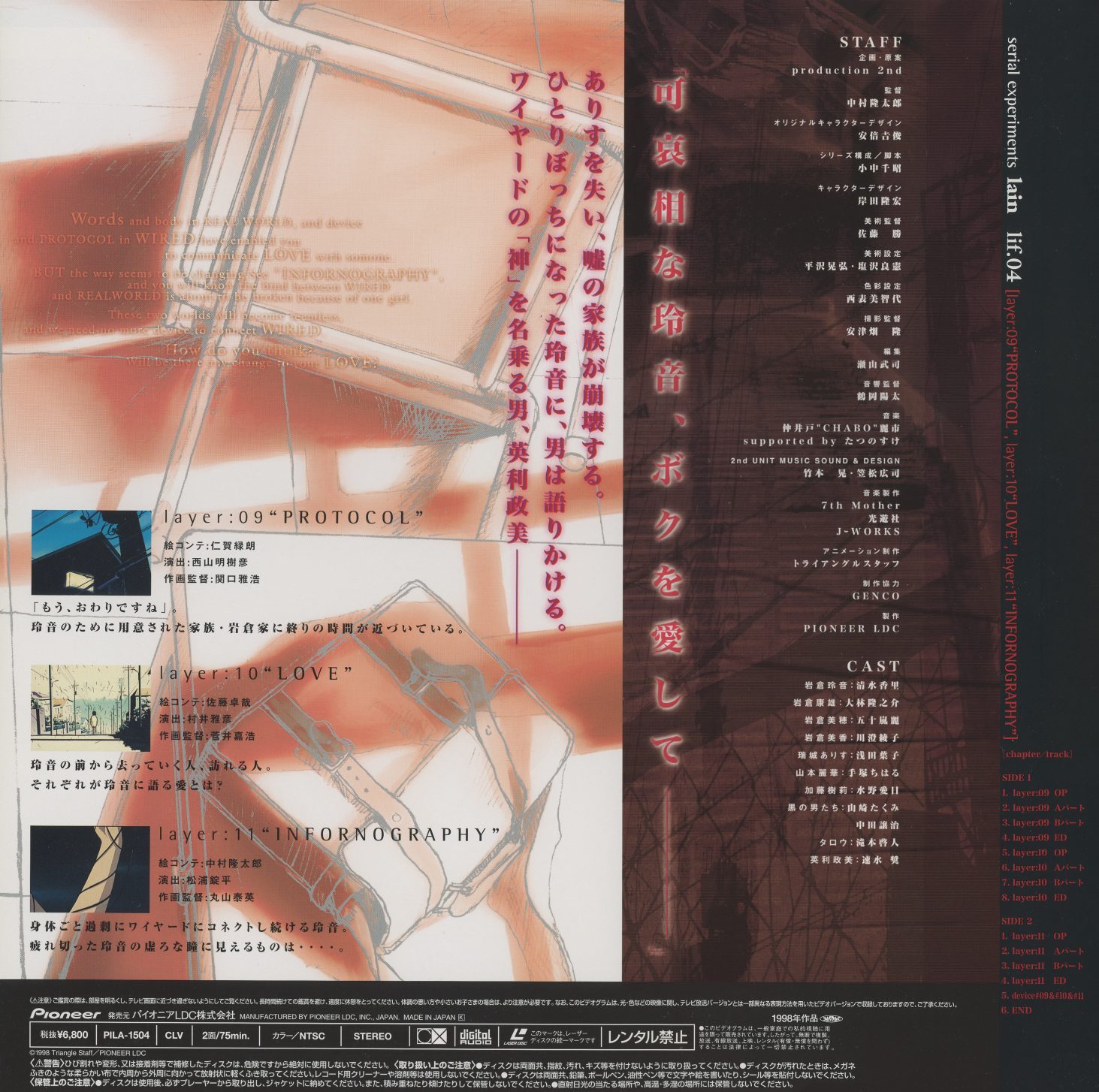 lif:04 jacket back. '可哀想な玲音、ボクを愛して' (Poor Lain, love me). Layer descriptions for PROTOCOL, LOVE, and INFORNOGRAPHY — the episodes where Lain's identity fractures and a figure called Eiri Masami claims to be God of the Wired. ABe's character, Konaka's mythology, Nakamura's pacing — the packaging credits all three. PILA-1504, CLV, ¥6,600.
Four Media
Each volume's gatefold opens to a full-panel illustration — and no two are executed in the same medium. lif:02: Lain in a blue-white watercolor wash, a figure dissolving at its edges into pigment and negative space. lif:03: a chibi Lain holding a teddy bear, rendered in wood-grain marquetry — the image built from the visual texture of actual wood surfaces, flat and tactile and deliberately primitive. lif:04: a three-dimensional miniature diorama photographed in real space — a small Lain figure standing on a model suburban street with real wire power lines, the anime world reconstructed as physical sculpture. lif:05: Lain and her three school friends in a suburban street, painted by Takahiro Kishida in a clean, bright illustrative register that the show itself never quite achieves. Four volumes, four media, four arguments about how to depict a girl who may not have a stable form.
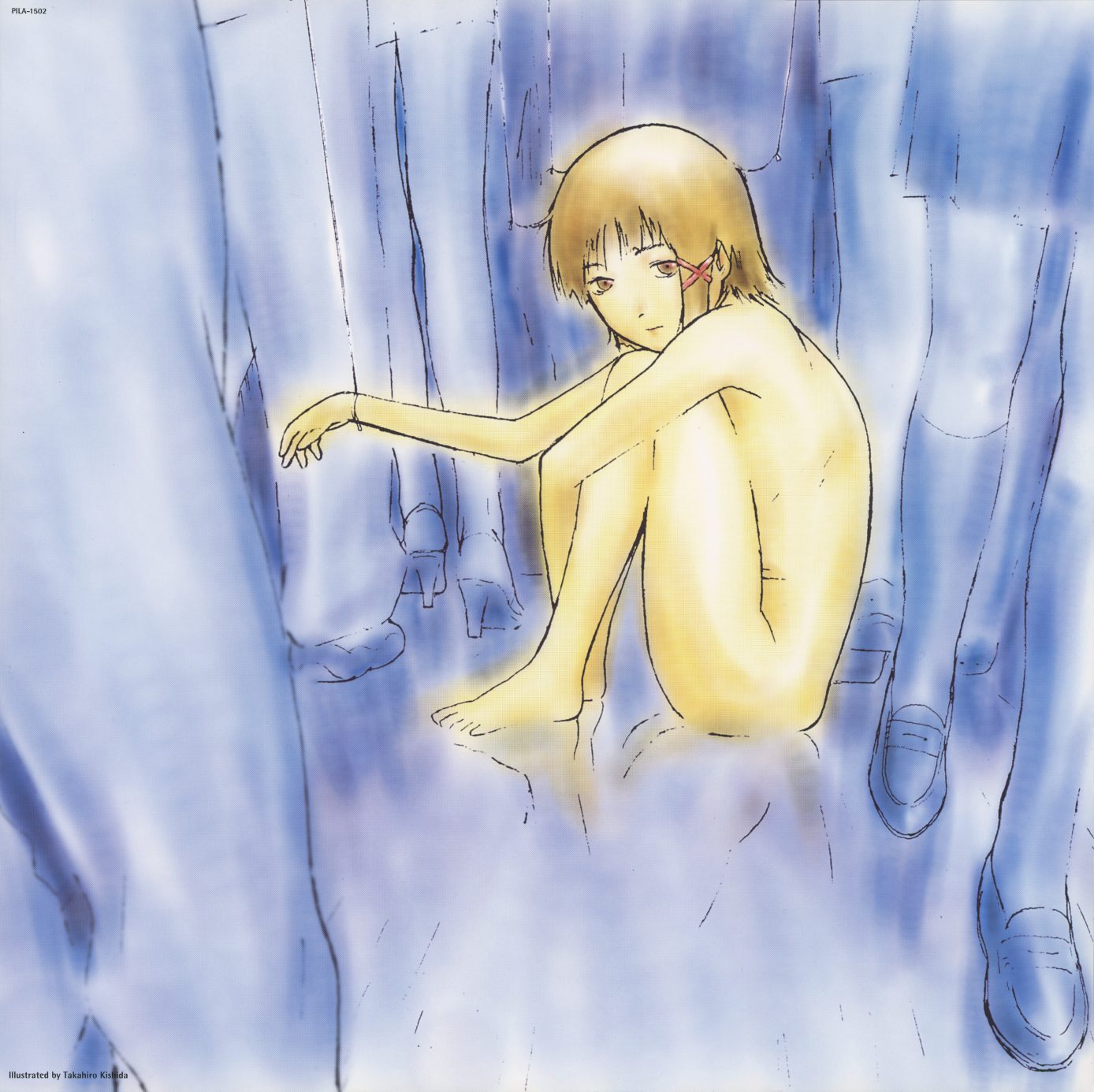 lif:02 gatefold interior. Lain in blue-white watercolor wash — the figure seated, reaching outward, the rendering dissolving into wet pigment at the edges. Illustrated by Takahiro Kishida. The medium itself performs the show's central question: where does the body end and the signal begin?
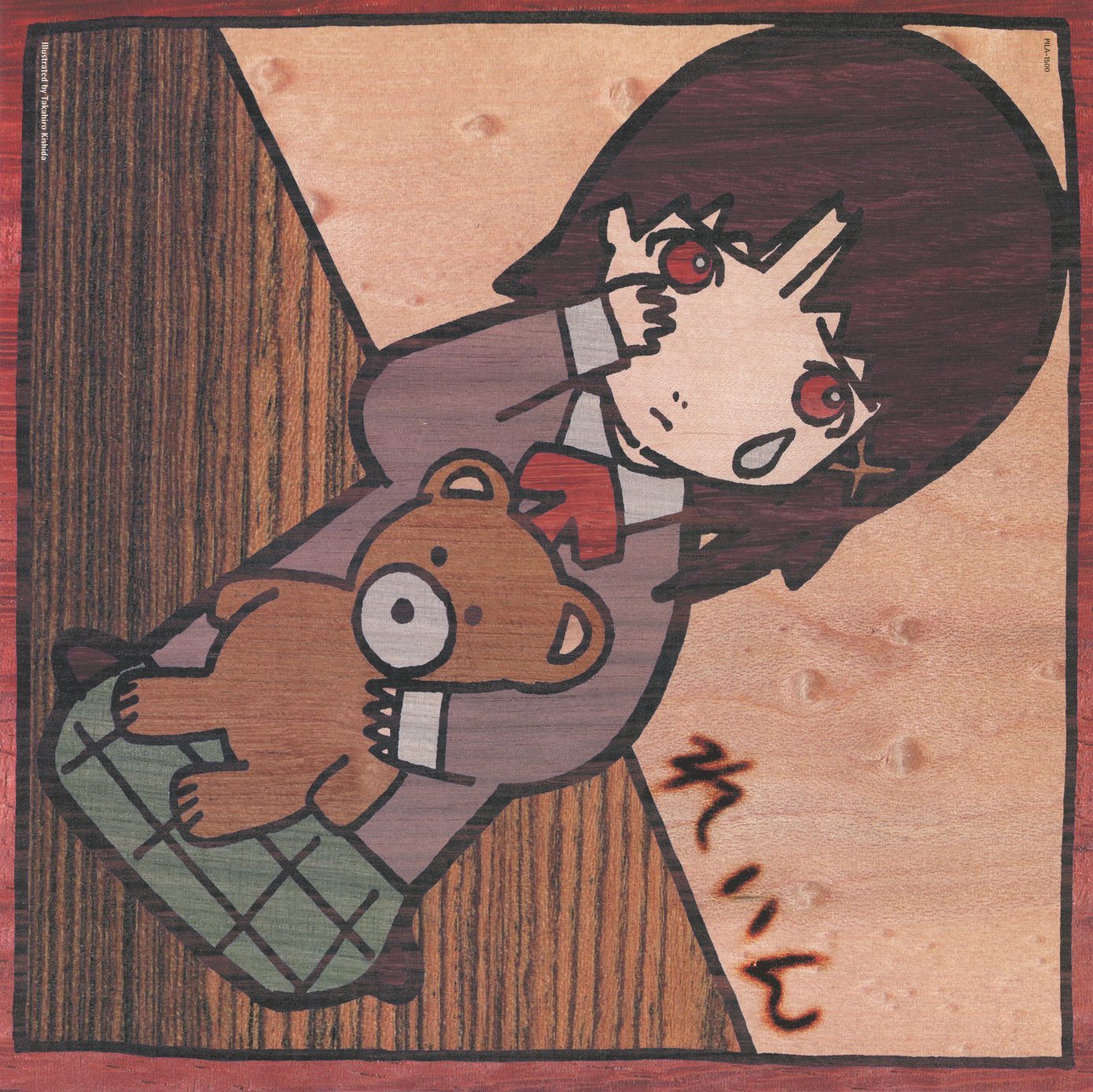 lif:03 gatefold interior. Chibi Lain clutching a teddy bear, rendered in wood-grain marquetry style — flat surfaces, visible grain texture, bold outlines. The visual language of folk craft applied to a cyberpunk character. Signed 'れいん' (Lain) in brushstroke.
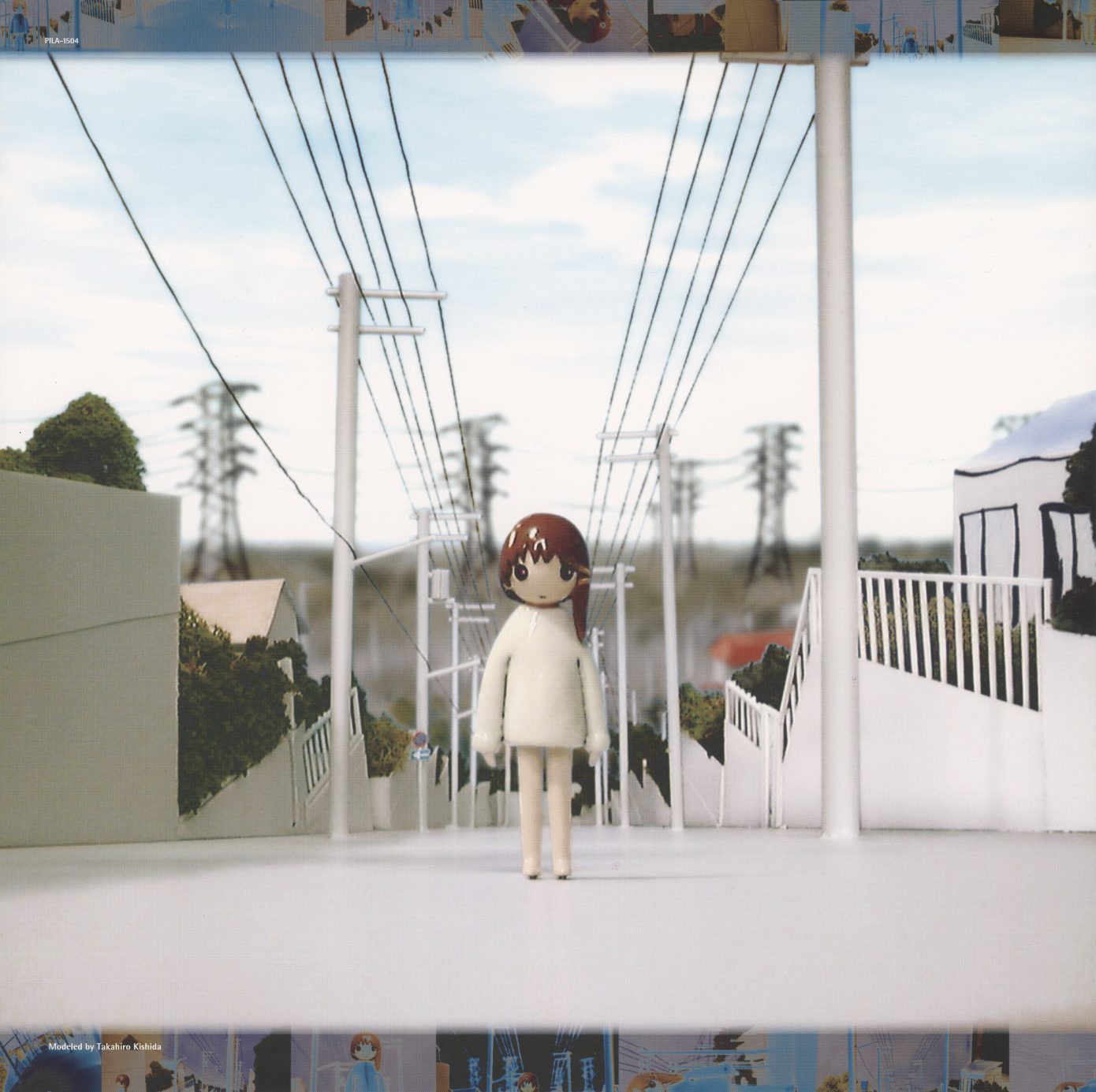 lif:04 gatefold interior. A three-dimensional miniature diorama — small Lain figure standing on a model suburban street with real wire power lines, buildings constructed from printed paper and cut materials. The anime reconstructed as physical sculpture. Photographed in real light. Credit: Takahiro Kishida.
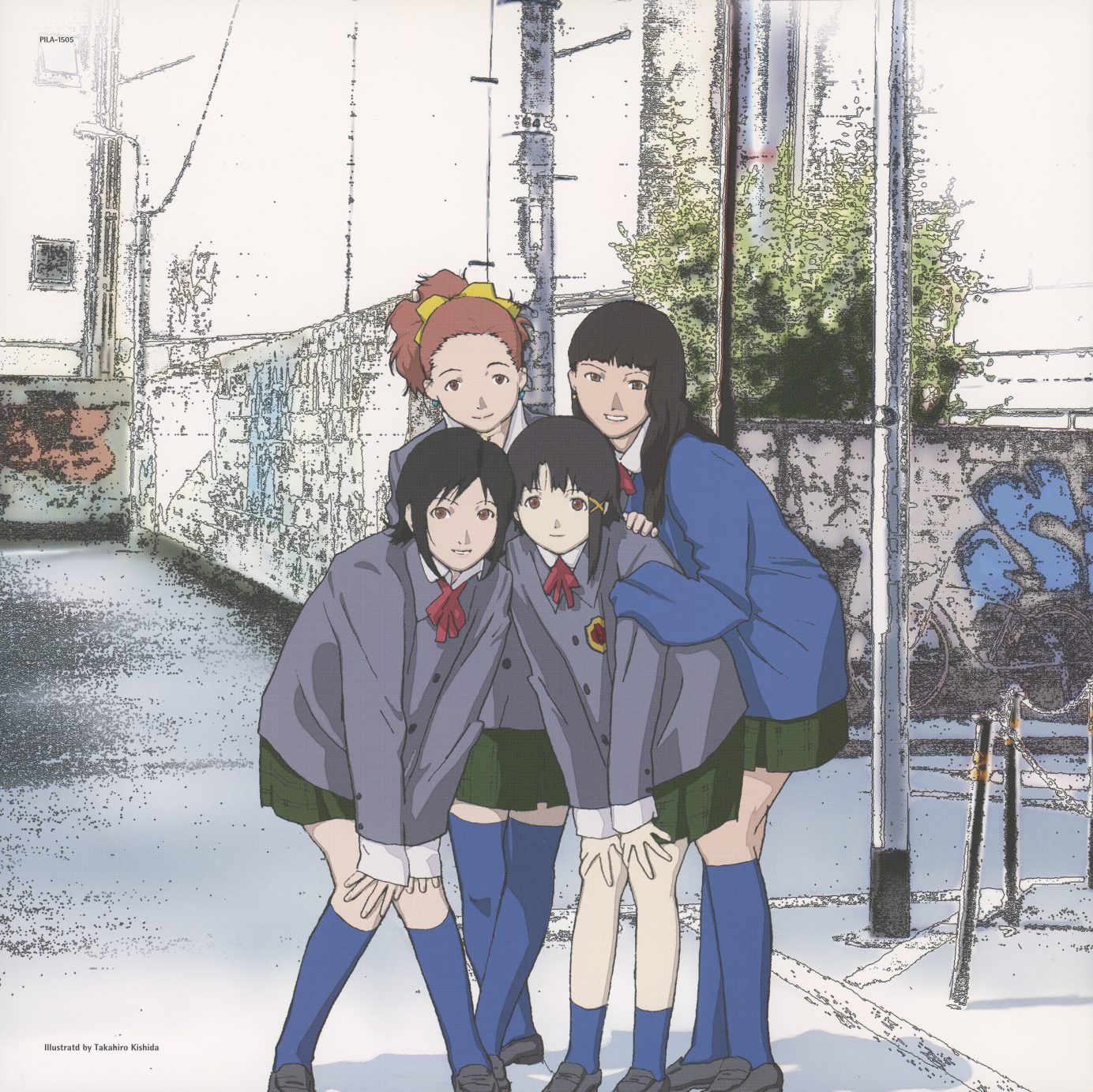 lif:05 gatefold interior. Lain and her three school friends — Arisu, Juri, Reika — standing together on a suburban street with graffiti walls and overgrown weeds. Illustrated by Takahiro Kishida. The only gatefold that shows Lain with other people. The final volume's image is the one the show takes away.
The World of Lain
Every volume includes a large fold-out sheet — 30×60cm when fully opened — titled 'the world of lain.' Each is organized into the same three sections: LOCATIONS, CHARACTERS, TOOLS. Locations reproduce the background art layouts and architectural plans for that volume's settings — Lain's house, the school, the Cyberia nightclub, the city infrastructure. Characters present model sheets and expression studies for the figures who appear in those layers. Tools document the hardware — the NAVI terminals, the cooling systems Lain installs in her bedroom, the psyche processor she builds. The fold-outs are settei — production reference materials — reformatted as consumer packaging. They are not extras. They are documentation shipped as standard.
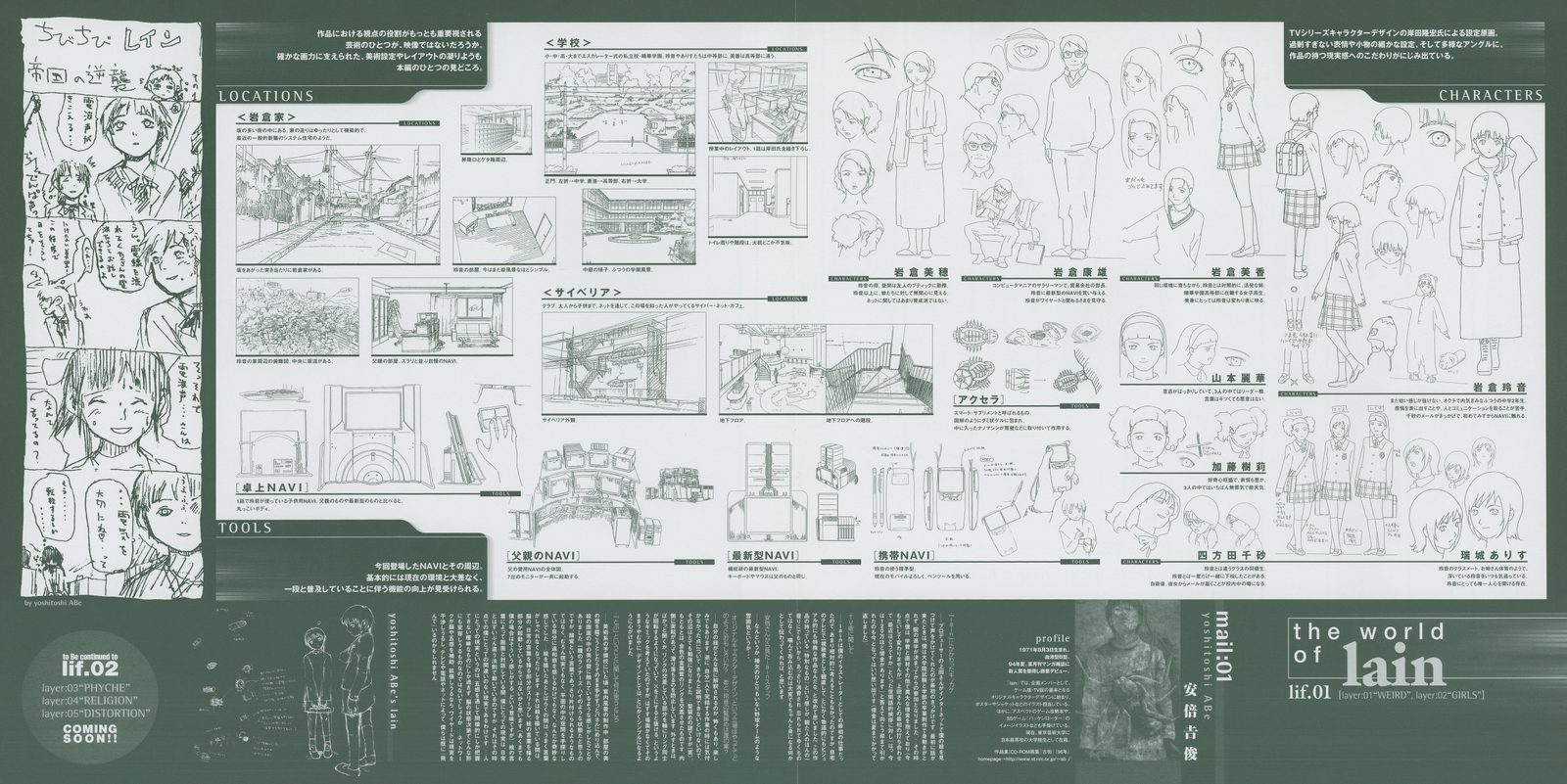 'the world of lain lif:01' — settei fold-out. Three sections: LOCATIONS (Lain's house exterior and interior, suburban streets, school), CHARACTERS (Lain, her family, classmates — full-body model sheets and expression reference), TOOLS (NAVI terminal designs, interface screens). Production design reference reformatted as a 30×60cm consumer insert.
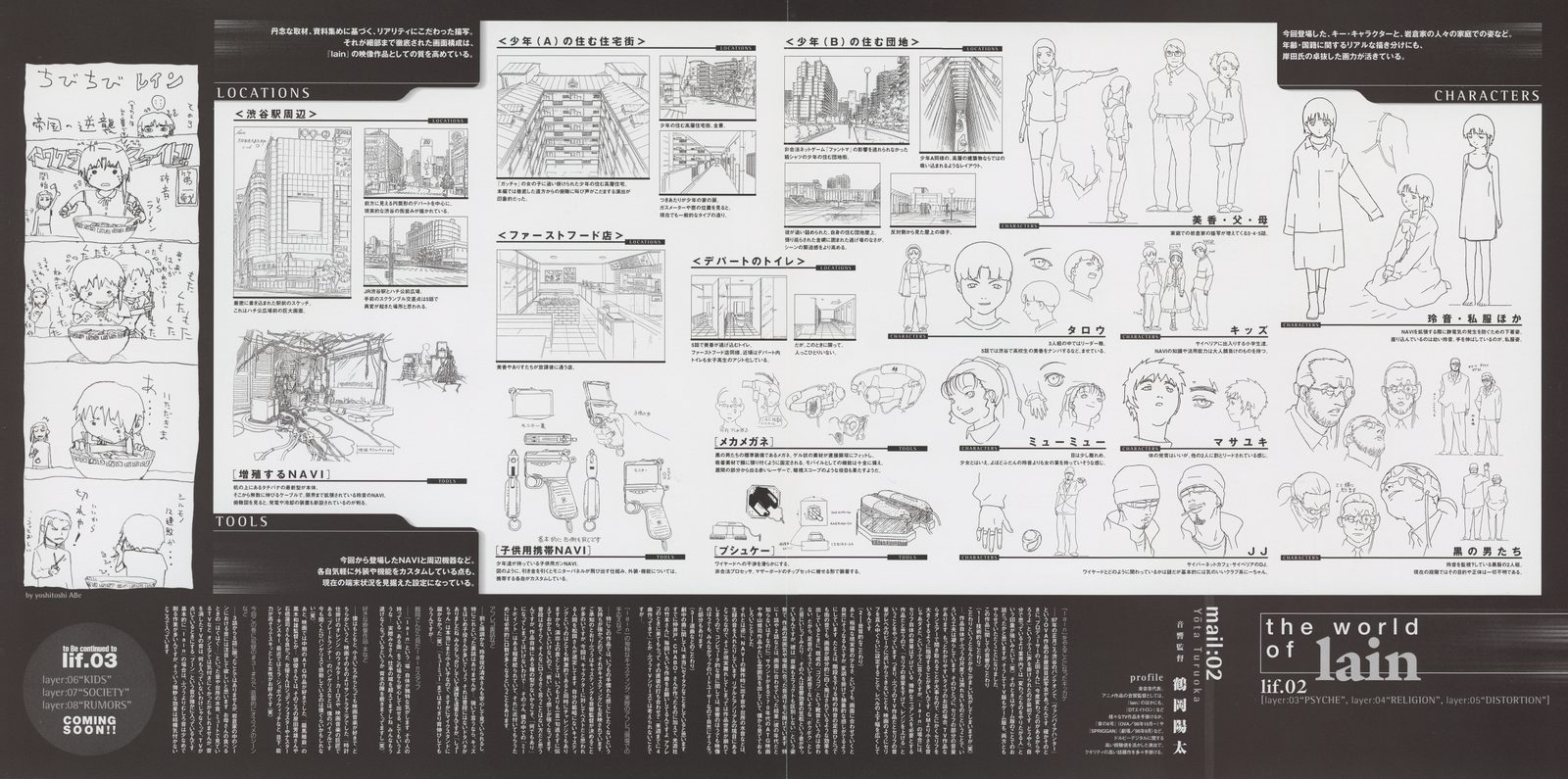 'the world of lain lif:02' — settei fold-out. LOCATIONS includes the school grounds and Cyberia club layouts; CHARACTERS adds Taro and KIDS-arc figures; TOOLS documents Lain's upgraded NAVI terminal and the Psyche chip. Printed in black on white. Advertises lif:03 'COMING SOON' along the bottom edge.
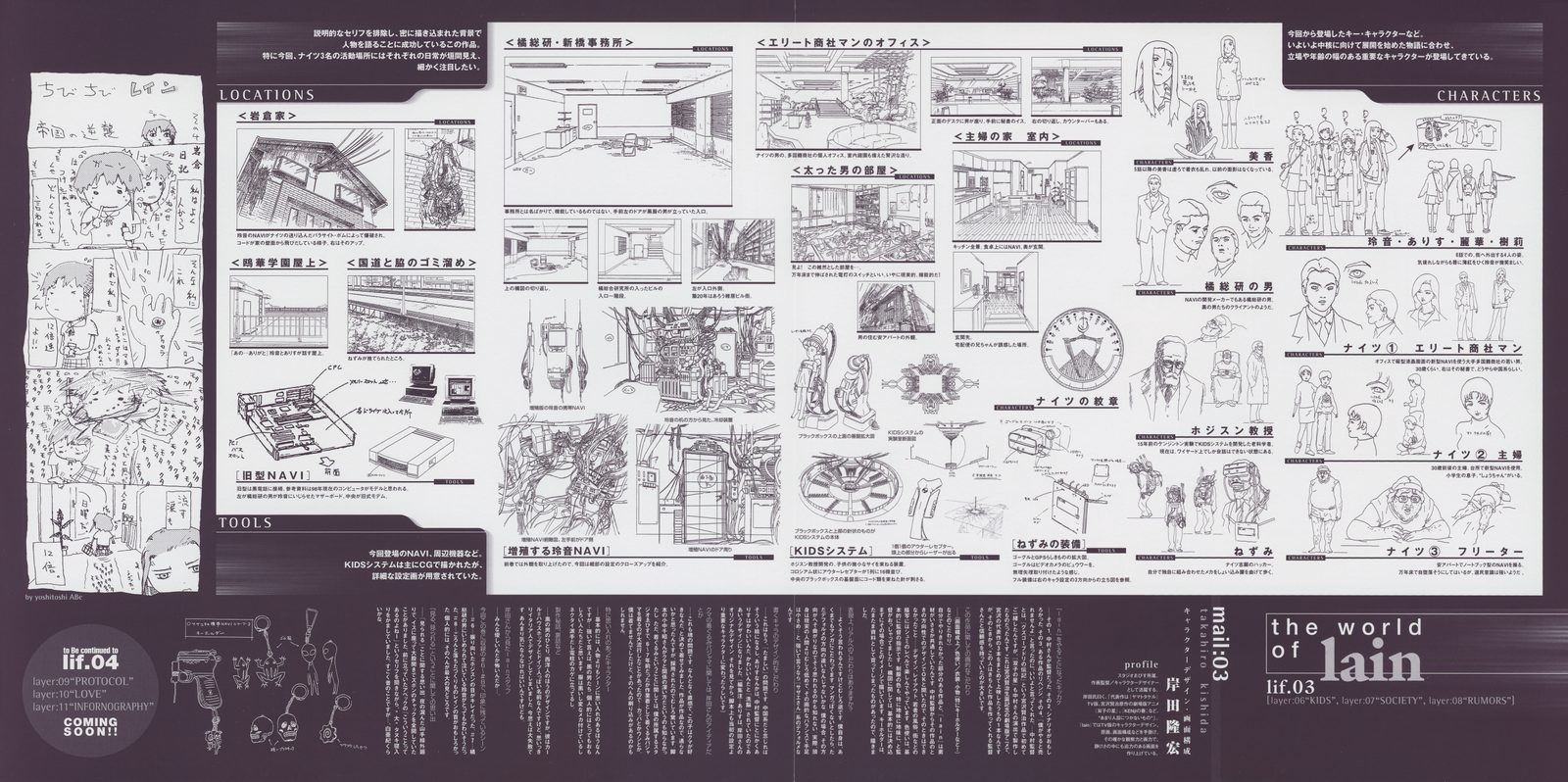 'the world of lain lif:03' — settei fold-out. LOCATIONS adds the Knights' access node architecture and expanded city infrastructure; CHARACTERS documents the Knights and the Eiri Masami avatar; TOOLS covers the Schumann Resonance NAVI modifications. Printed in indigo-violet tone, matching the lif:03 jacket palette.
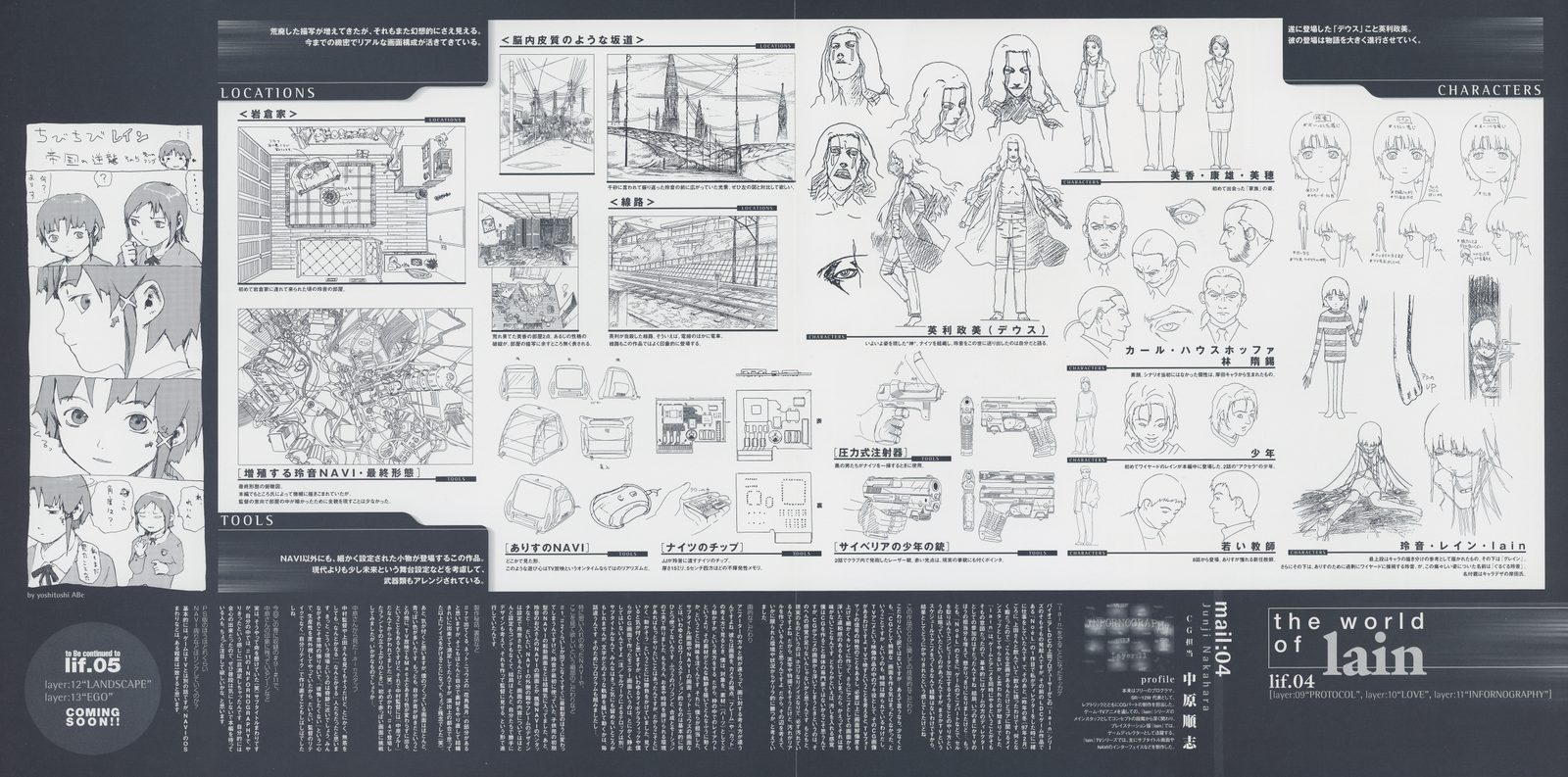 'the world of lain lif:04' — settei fold-out. LOCATIONS documents the interior of Eiri Masami's Wired architecture and Lain's final bedroom configuration; CHARACTERS expands to full model sheets for Arisu, Juri, and Reika; TOOLS covers the Psyche processor housing and cooling array. 'COMING SOON' advertisement for lif:05.
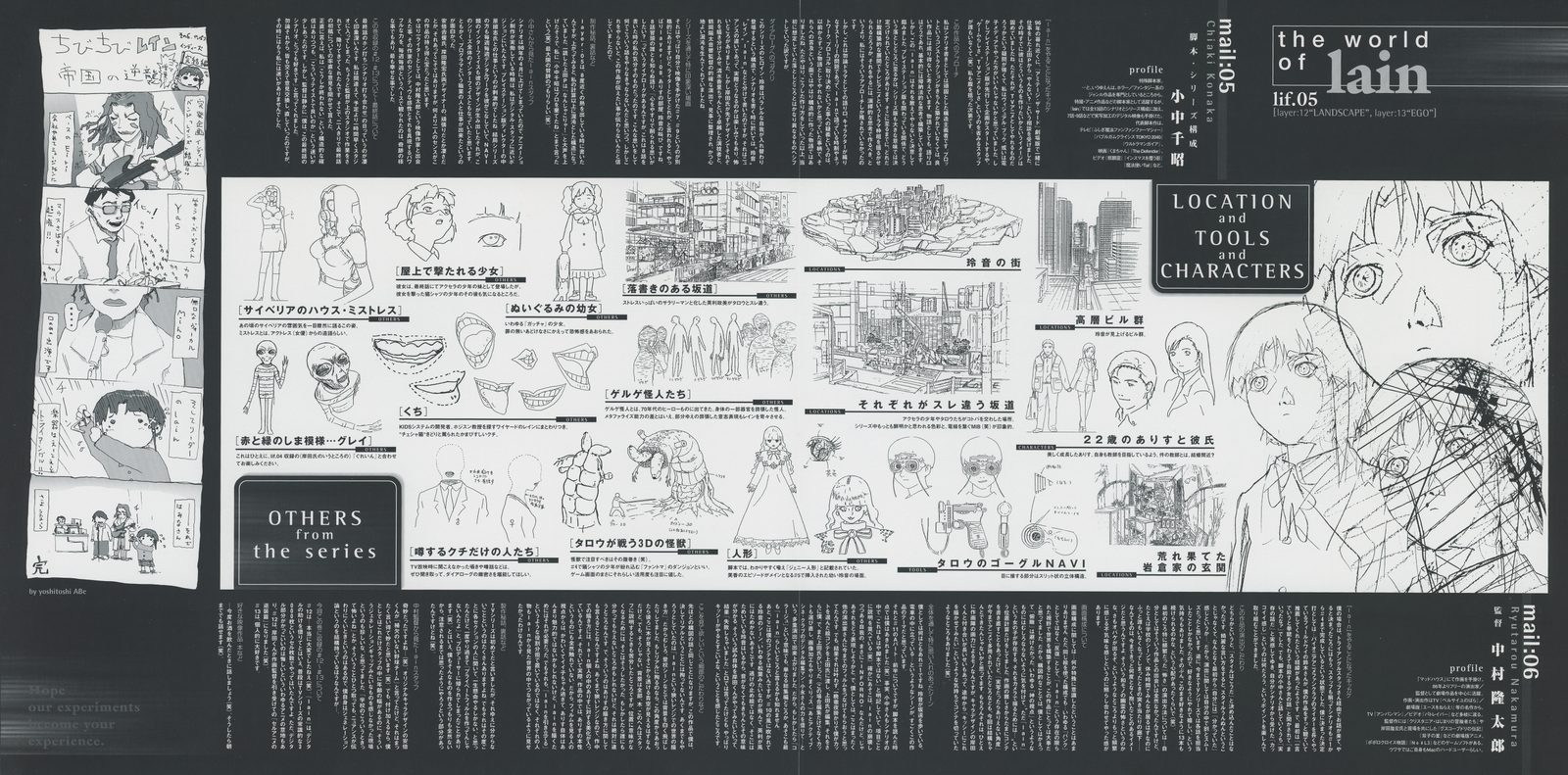 'the world of lain lif:05' — the final settei fold-out. LOCATIONS, TOOLS, and CHARACTERS sections plus a new 'OTHERS from the series' section documenting supporting characters and incidental designs from across all thirteen layers. The last fold-out attempts to index the entire show's visual world.
The Liner Spreads
Each volume's booklet reproduces storyboard panels alongside broadcast-frame captures for every layer on the disc. The storyboards are presented at readable scale with scene-level commentary in Japanese — production notes, not summaries. Adjacent pages carry painted Lain portraits in the Wired's visual language, each volume's portrait shifting in tone as the series progresses. The liner spreads build a parallel reading of the show: the storyboards show how each scene was planned, the frame captures show what aired, and the portraits show what the character was becoming.
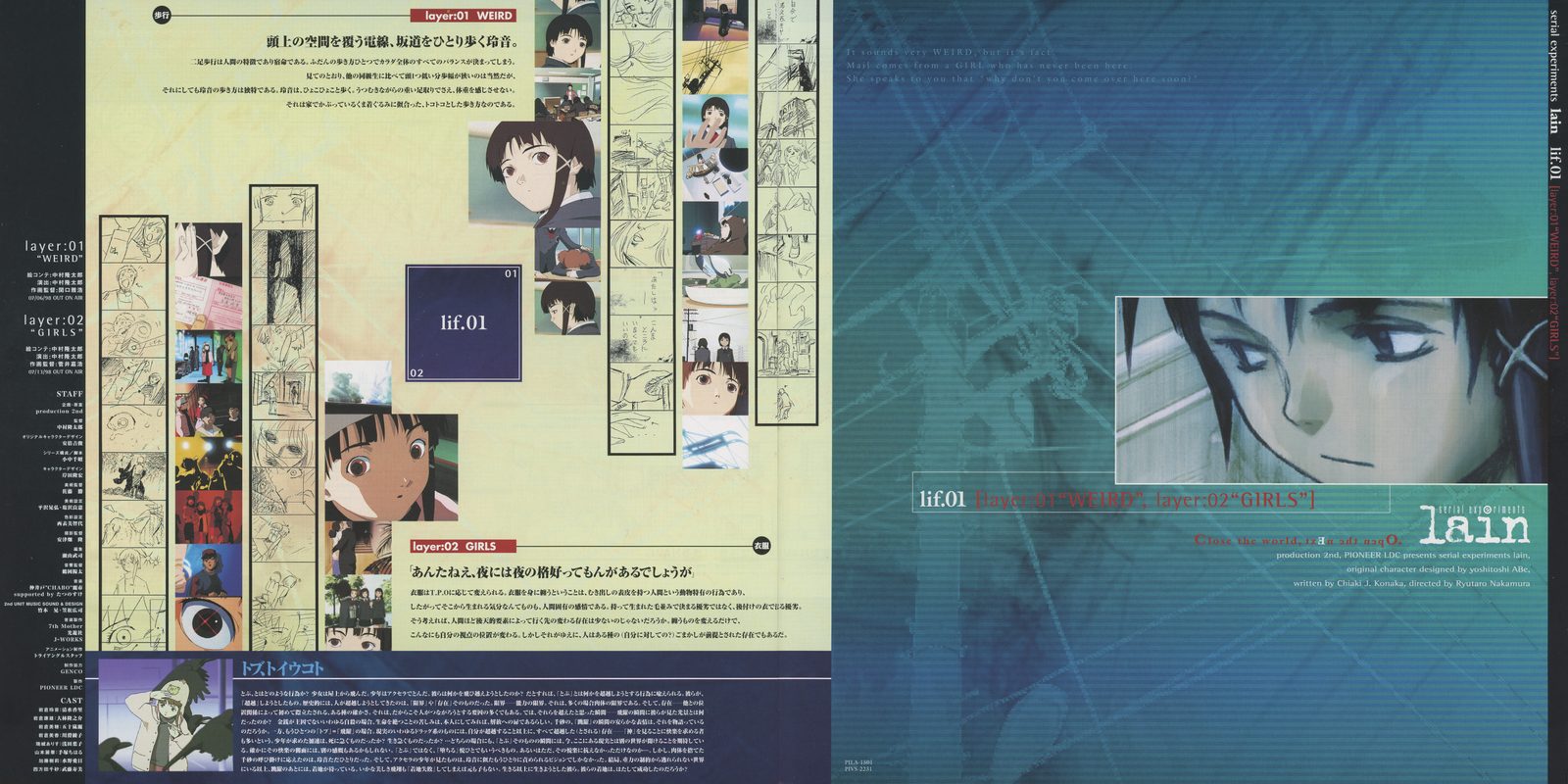 lif:01 liner spread interior. Left page: storyboard reproductions for layer:01 (WEIRD) and layer:02 (GIRLS) with scene captures and episode commentary — Chisa's email, Lain's first encounter with the Wired. Right page: close-up Lain portrait, the familiar face rendered in the Wired's data-wash. The first document in what will become a five-volume parallel history of the show.
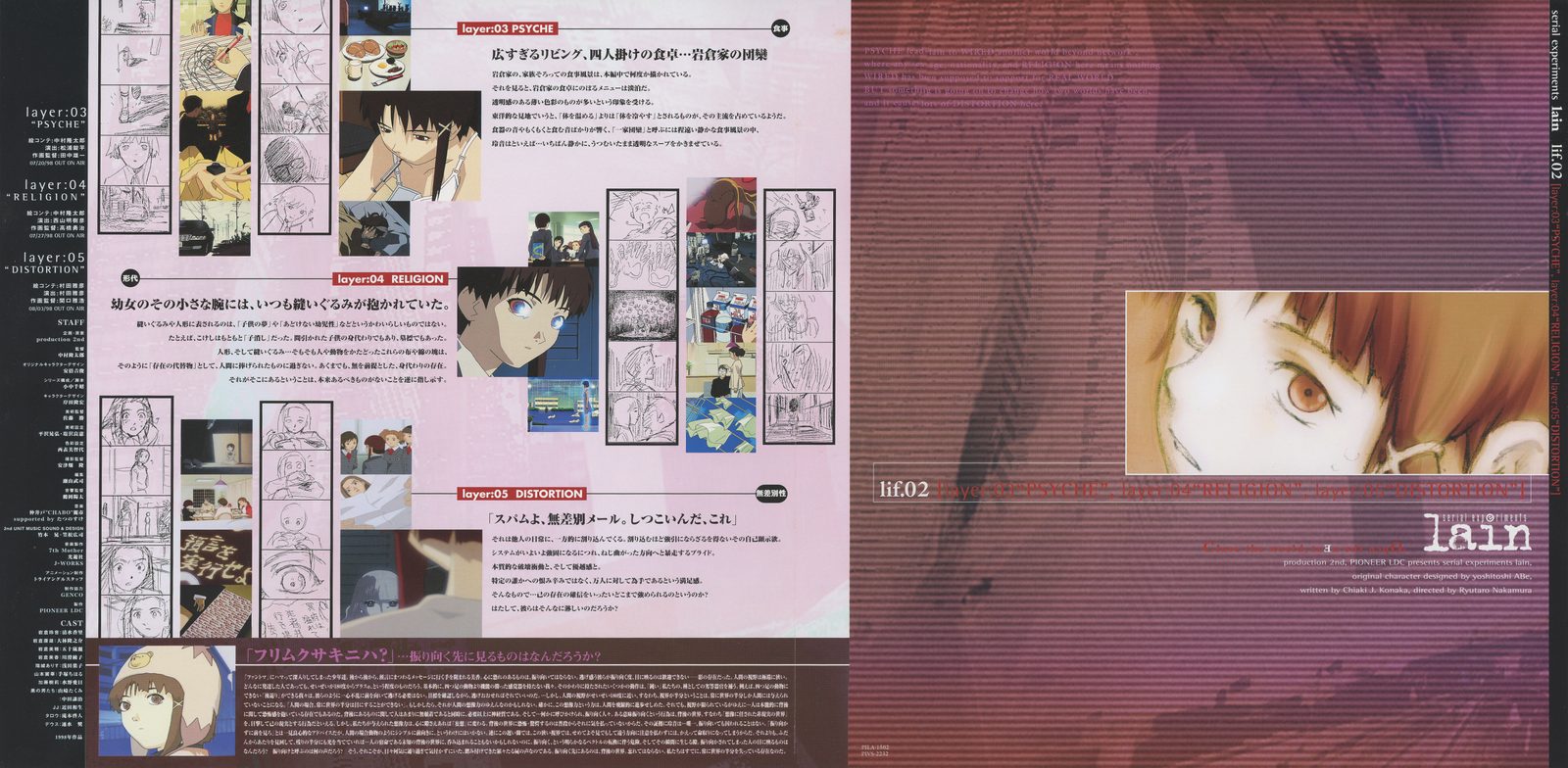 lif:02 liner spread interior. Left page: storyboard reproductions for layers 03 (PSYCHE), 04 (RELIGION), and 05 (DISTORTION) with scene captures and episode commentary. Right page: Lain portrait in the Wired's blue-data visual register, close-up with scan-line overlay. 'lif:02' designation.
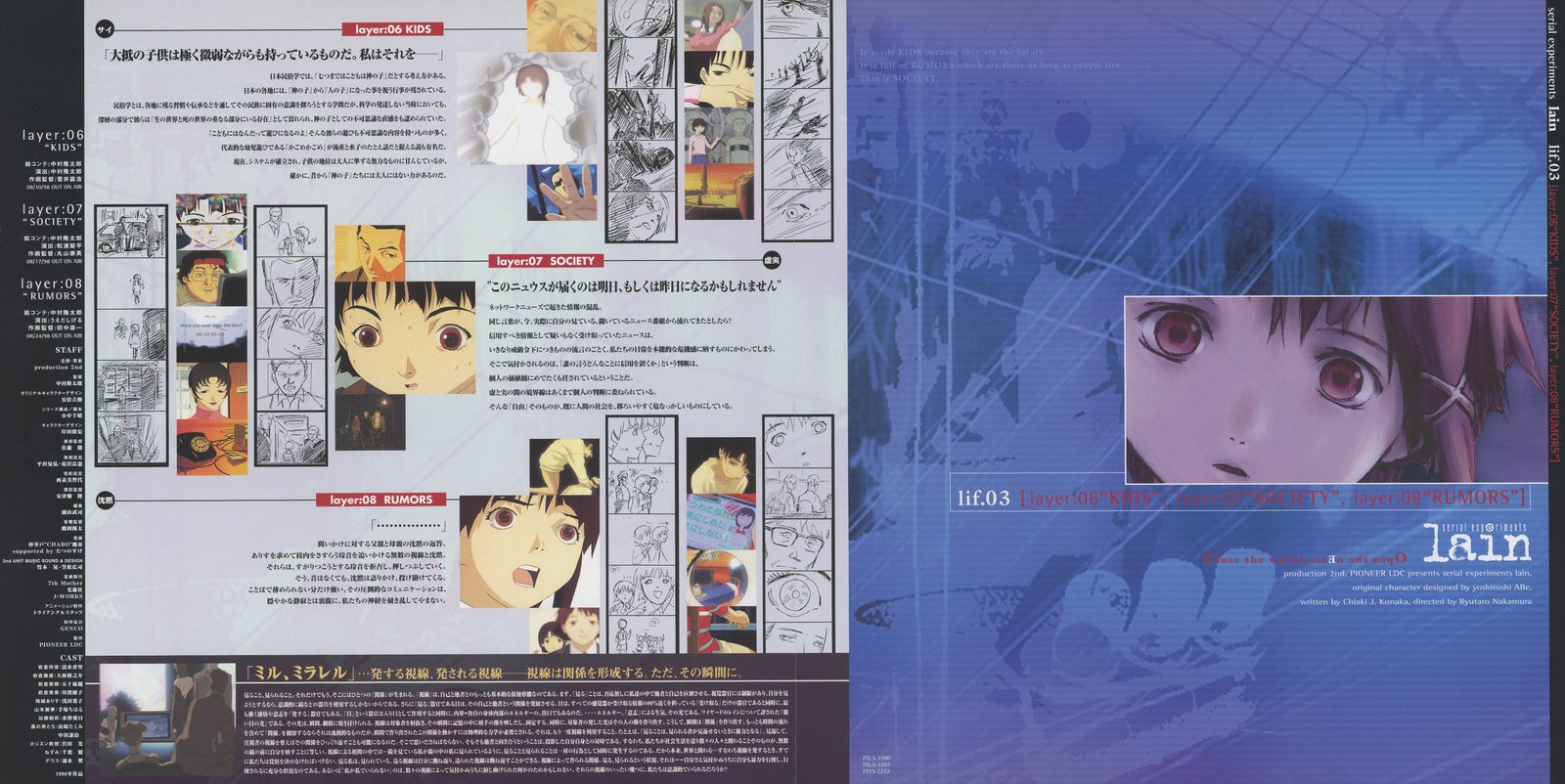 lif:03 liner spread interior. Left page: storyboard reproductions for layers 06 (KIDS), 07 (SOCIETY), and 08 (RUMORS) — the Wired-Lain emerges, the Knights are named, identity begins to split. Right page: Lain portrait in violet-blue tones, expression flattened, eyes unreadable. The portraits grow colder as the series progresses.
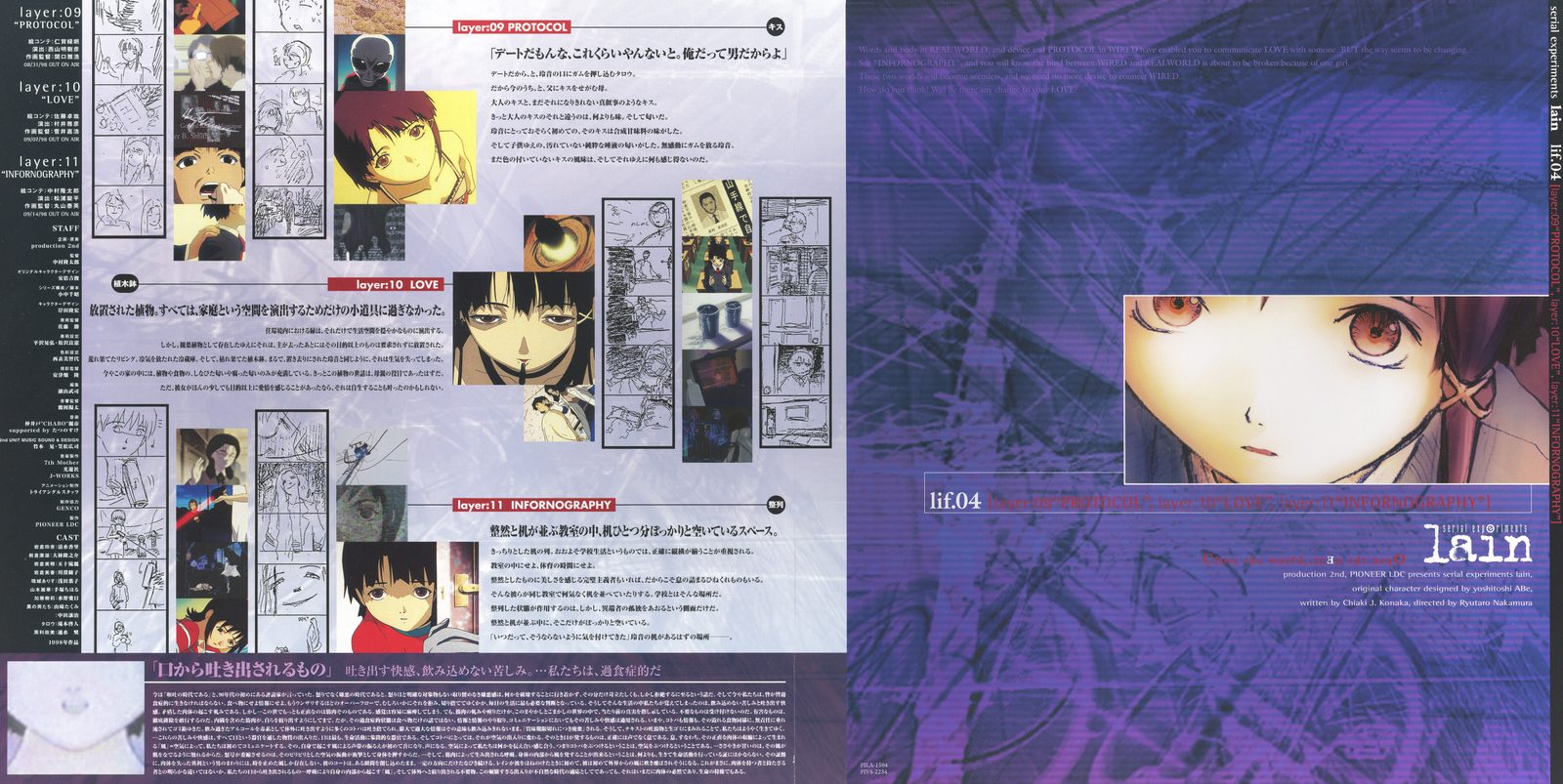 lif:04 liner spread. Storyboard reproductions for layers 09 (PROTOCOL), 10 (LOVE), and 11 (INFORNOGRAPHY). Right page: Lain portrait in amber-dark tones, close-up, the Wired's data overlay visible across her face. The liner portraits grow more intense as the series approaches its final layers.
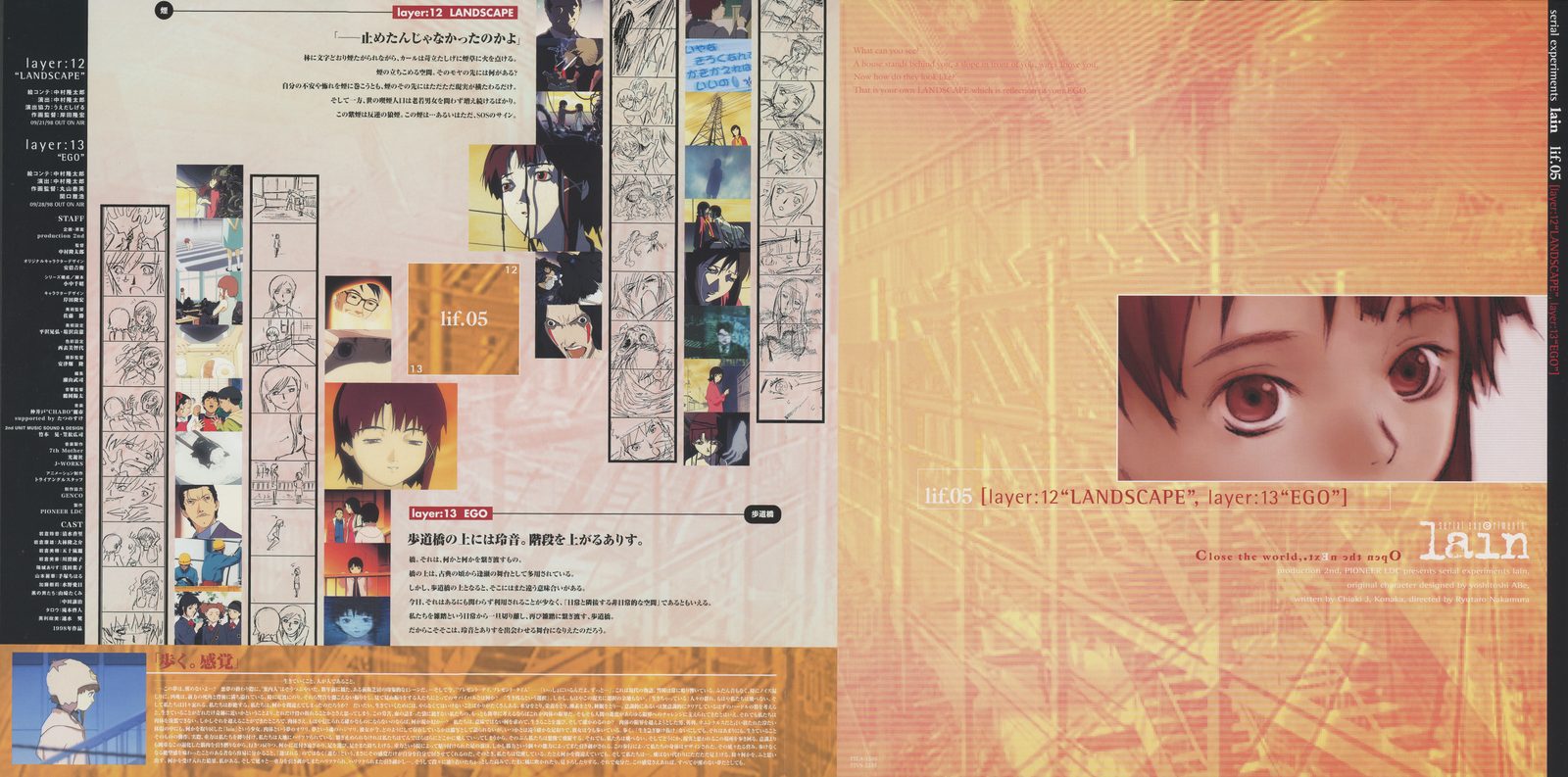 lif:05 liner spread. Storyboard reproductions for layers 12 (LANDSCAPE) and 13 (EGO) — the final two episodes. Right page: Lain portrait in warm gold-orange tones, the data overlay almost gone, the face returning to something closer to the suburban girl of the first volume. The last liner portrait reverses the drift.
The 2010 Blu-ray RESTORE box — GNXA-1001, six discs, ¥26,000 — is a genuine 1080p remaster. Not an upscale. CG sequences re-rendered, subtitles rebuilt from scratch. By every measurable standard, the superior way to watch the show.
It is one box. The five jacket paintings collapse into a single cover. The four gatefold illustrations in four different media do not appear. The five settei fold-outs documenting the show's world volume by volume, NAVI terminal by NAVI terminal, are replaced by a single booklet or nothing at all.
Pioneer LDC released five files. Each one arrived with its own architecture plan for a world still being built when the first disc shipped. The RESTORE has the episodes. It does not have five gatefold paintings in five different media, or the settei fold-outs that documented the Wired volume by volume.
Loading...