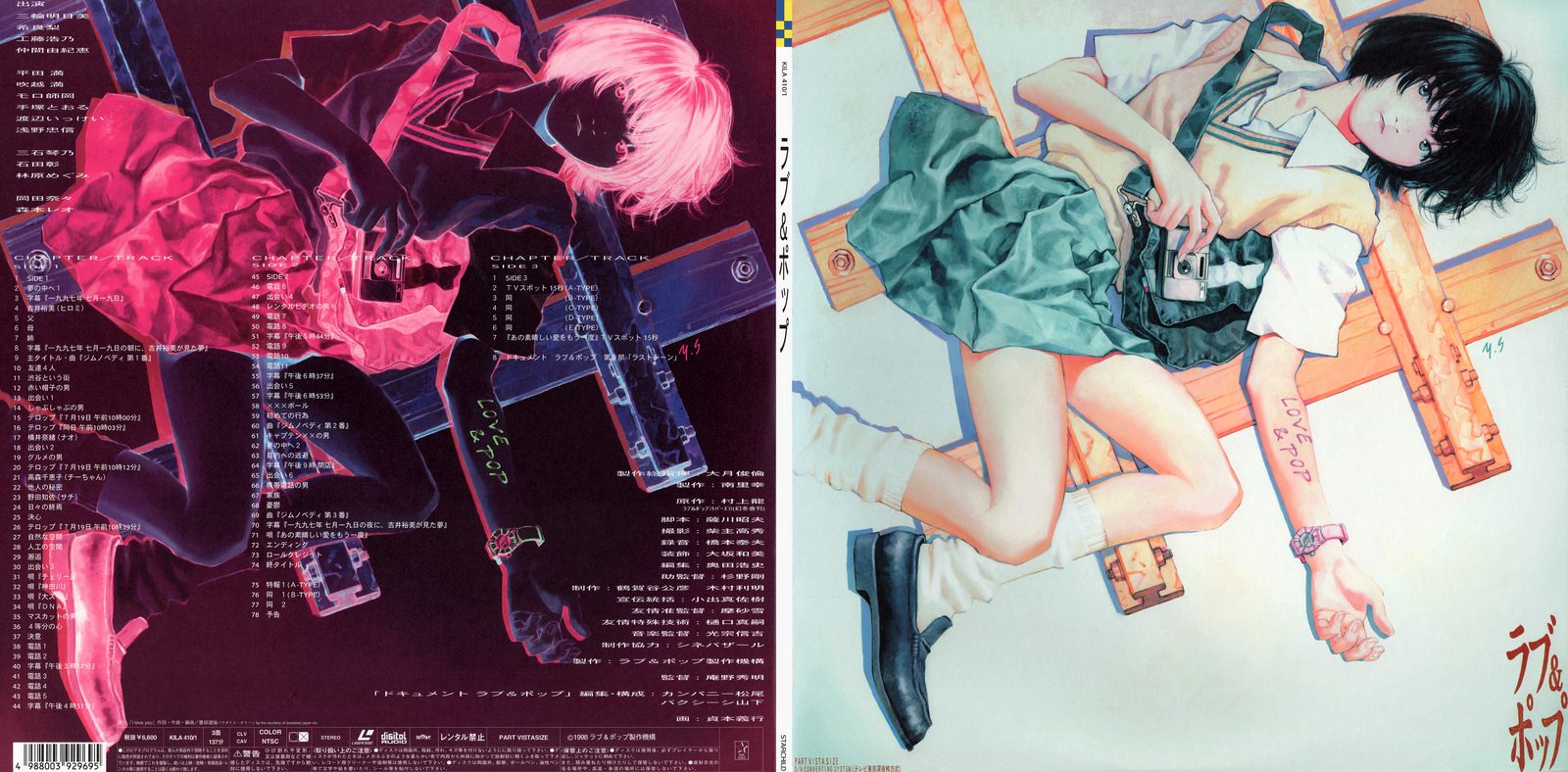
Love & Pop ( ラブ&ポップ , KILA 410~1) arrived on November 27, 1998 at a retail price of ¥6,600. Two discs, three sides: the 110-minute theatrical cut of Hideaki Anno’s first live-action film across sides one and two, supplemental content—TV spots, theatrical trailers, and a making-of featurette—on side three. King Records / Starchild. The same label, the same format, the same final months of LaserDisc manufacturing that would produce the Evangelion Movie Box four weeks later.
Adapted from Ryu Murakami’s novel Topaz II, Love & Pop follows sixteen-year-old Hiromi Yoshii across a single day—July 19, 1997—as she and three friends navigate enjo kosai (compensated dating) with older men in Shibuya to raise ¥128,000 for a topaz ring before a department store closes at 9 PM. The film does not moralize. It immerses.
The Gatefold
The gatefold opens to a layout that mirrors the film’s own split-screen aesthetic. The left interior panel carries production stills, chapter information, and credits—director Anno Hideaki, screenplay by Anno and Satsukawa Akio, cinematography by Shibanushi Takahide, music by Mitsumune Shinkichi. Executive producer Otsuki Toshimichi, the same Starchild executive who oversaw the Evangelion home video releases. The packaging assumes you know who these people are.
 Gatefold interior, left panel — production stills, chapter listing, and full staff credits. The layout mirrors the film's own layered visual composition.
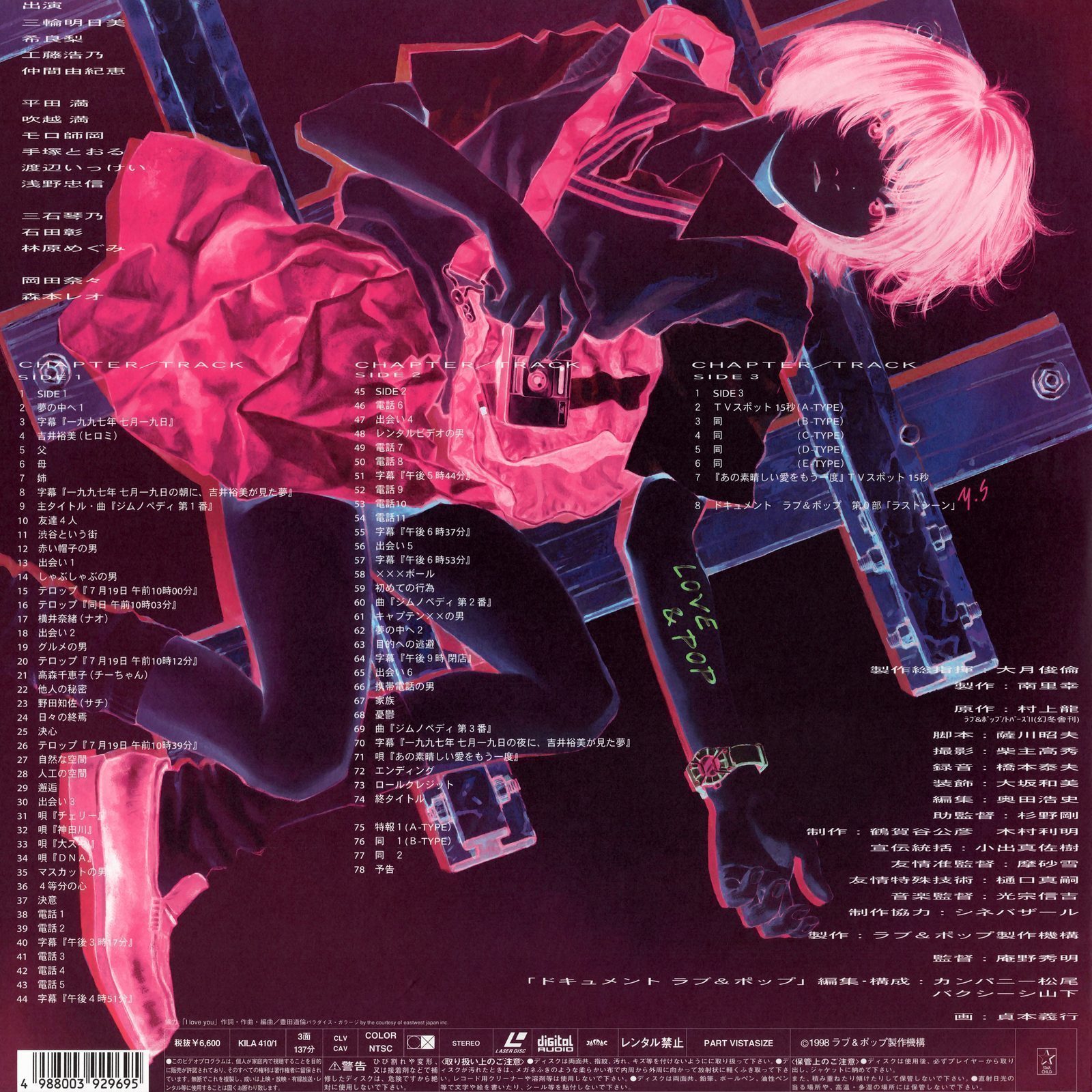 Gatefold interior, right panel — additional production photography and scene stills from the Shibuya location shoots. The still selection emphasizes the film's handheld DV texture rather than conventional promotional angles.
 Film still — Hiromi (Miwa Asumi) in Shibuya. Shot on Sony DCR-VX1000 at 60fps. The consumer DV grain, the shallow color palette, the handheld instability — this is what Anno wanted the image to feel like.
Five Sony Handycams
Anno shot Love & Pop the way he storyboarded Evangelion—with obsessive coverage from every conceivable angle, then carved the film in the edit. Five DCR-VX1000 cameras ran simultaneously for each scene. The consumer-grade CCD sensors produced a flat, grainy image with a 60fps frame rate that moved like video, not cinema. Cameras went inside microwaves, onto model train rigs, at ankle height on Shibuya sidewalks. Anything could have a point of view: a bowl of soup, a pair of chopsticks, the inside of a telephone receiver.
The cast included Evangelion voice actors in live-action cameos—Hayashibara Megumi (Rei), Mitsuishi Kotono (Misato), and Ishida Akira (Kaworu)—alongside Asano Tadanobu and Nakama Yukie in early career roles.
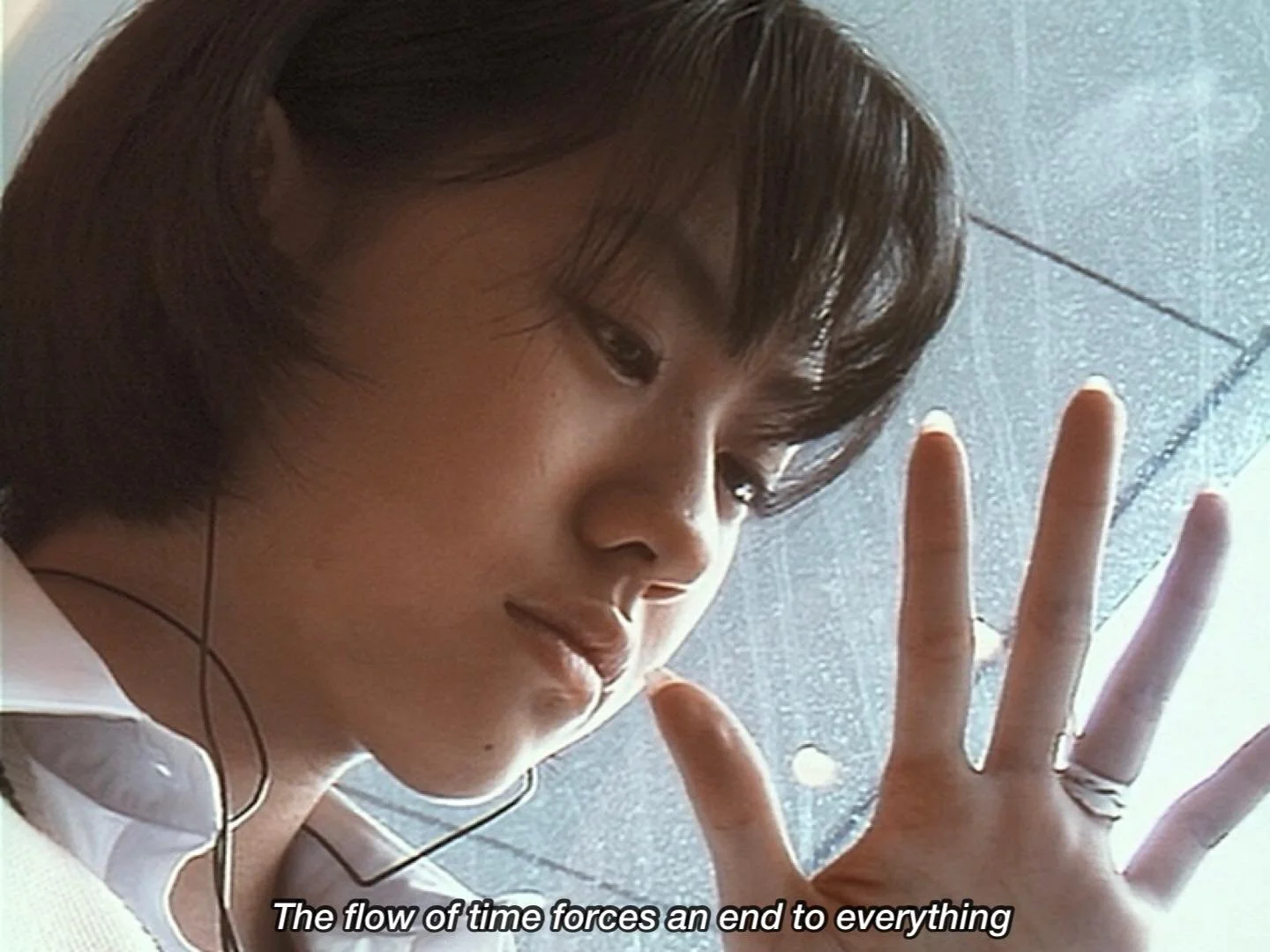 The DV aesthetic in practice — overlaid perspectives, consumer-grade color, handheld motion. Anno described the digital camera as letting him 'get closer to the actors than film ever allowed.' The LaserDisc preserves this texture through its analog output chain.
What Viewers See
“Anything can have a POV in Love & Pop: bicycle wheels, plates of food coming out of the microwave, karaoke TVs, and bathing suits in trendy stores.”
The film holds a 4.12/5 on Letterboxd from 31,000+ ratings. Critics describe it as “a lucid nightmare” and “a laboratory where Anno tests narrative and visual processes” that anticipated 2000s digital cinema. The Grimoire of Horror gave it 5/5, praising Anno’s refusal to moralize: “Anno doesn’t try to explain Hiromi. He wants us to listen to her.” In February 2025, GKIDS gave Love & Pop its first-ever North American theatrical release—a 2K restoration that sold out its Japan Society premiere.
The Obi Strip
The obi wraps the gatefold spine with the standard King Records Starchild trade dress: catalog number KILA 410~1, barcode (JAN 4988003929695), ¥6,600 retail price, and a brief promotional description. The spine reads “LOVE&POP” in the same typography as the cover. No English text beyond the title. No concessions to the export market. This is a domestic Japanese release from a label that expected its LaserDisc buyers to know exactly what they were purchasing.
 Obi strip, front face — KILA 410~1, King Records / Starchild, ¥6,600. The obi carries the catalog number, barcode, and promotional copy in Japanese. Standard late-era LD obi dimensions.
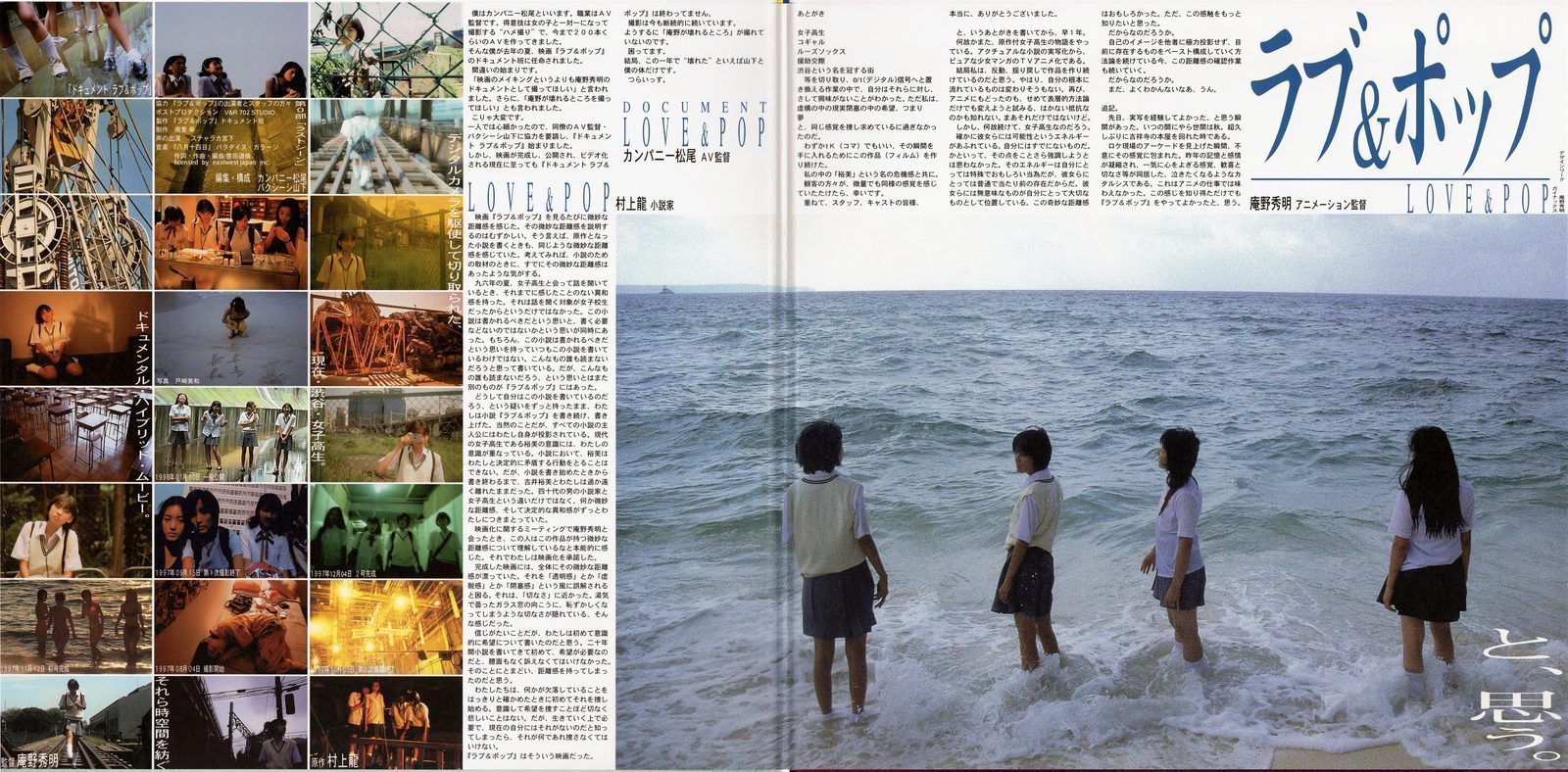 Gatefold back cover — full production credits, disc specifications, and copyright notices. ©1998 'LOVE & POP' Production Committee. The reverse side of a gatefold that King Records would repeat, at grander scale, four weeks later with the Evangelion Movie Box.
Love & Pop is the only LaserDisc in this feature that runs the signal chain backward. Every other title here preserves analog source material — hand-painted cels, photographed onto film, transferred to analog video — in an analog format. This one starts digital. Five consumer camcorders recording to MiniDV tape. The first Japanese feature with no film in the chain at all. Then King Records pressed it onto twelve-inch analog discs and sold it for ¥6,600.
The LD turns up at Yahoo Auctions Japan for ¥3,000–9,000 depending on condition and obi. Complete sets with obi sell within that range. It is not rare in the way the Evangelion Movie Box is rare. But King Records released it four weeks before the Evangelion Movie Box — the same label, the same format, the same month. Anno's first live-action feature and his final Evangelion package, pressed onto twelve-inch discs within a month of each other.
Loading...