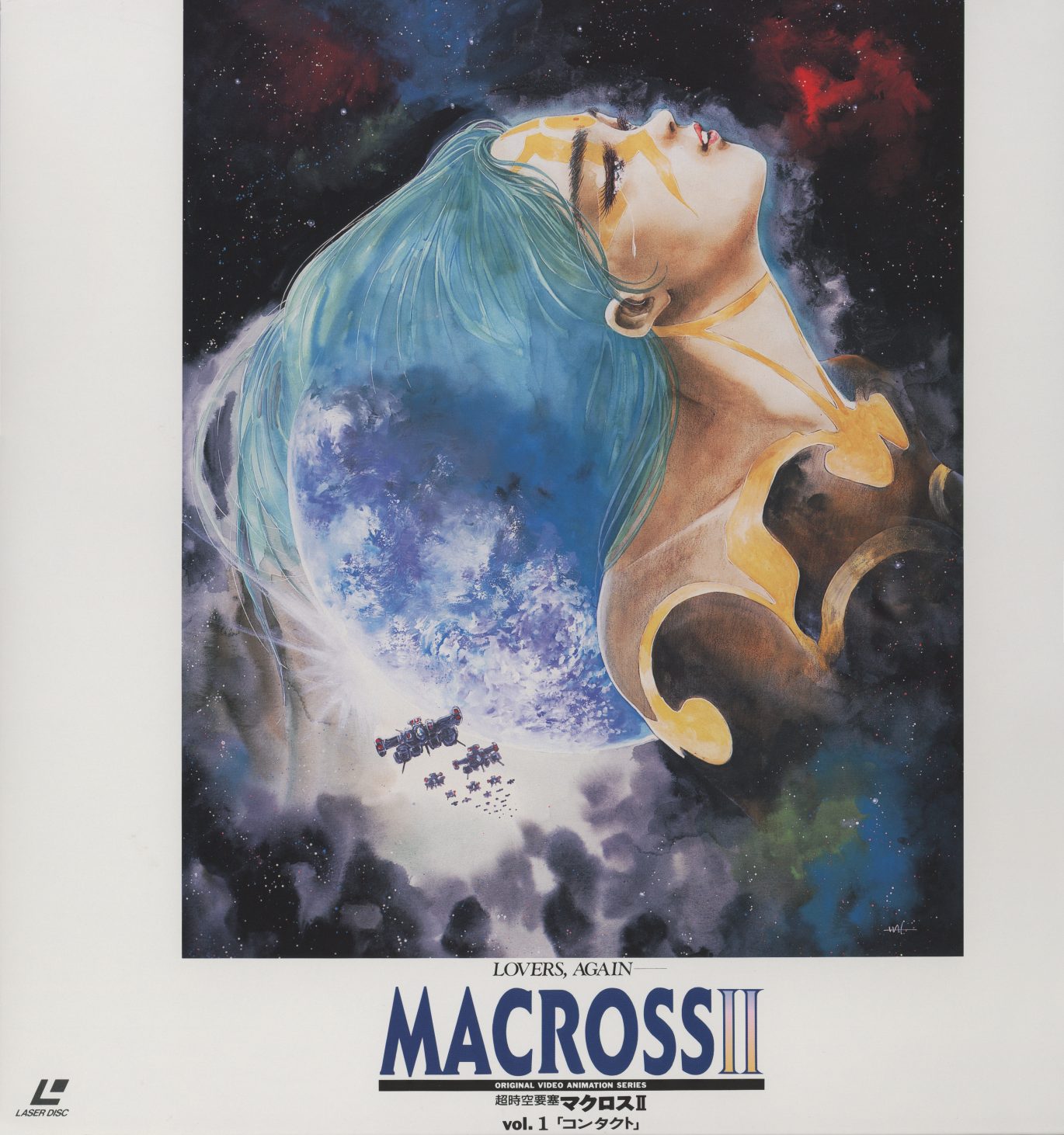
Six CAV discs. BEAL-404 through BEAL-409. 超時空要塞マクロスII —LOVERS, AGAIN— (Super Dimension Fortress Macross II: Lovers, Again), a six-episode OVA released across 1992 on Bandai Visual's EMOTION label, ¥4,800 per volume. Every jacket carries an original watercolor painting by Haruhiko Mikimoto — the character designer of the original 1982 Super Dimension Fortress Macross. Each volume includes a settei insert with character and mechanical design sheets printed in a per-volume monochrome color, and a registration postcard for a complete-purchase bonus: an exclusive CD single of 'もういちどLOVE YOU' sung in the Marduk alien language, with no commercial release planned.
This is the only Macross sequel not created by Shoji Kawamori. In the early 1990s, Kawamori was occupied with other projects — mechanical design work, early concept development for what would become The Vision of Escaflowne. Big West and AIC made a sequel without him. The OVA flipped the original Macross premise: where the 1982 series was about humanity using culture and music to reach aliens who had never encountered it, Macross II posits an alien civilization — the Marduk — who already use music as a tool of military control. Their singer Ishtar performs songs that psychologically dominate enemy fleets. The humans must break that system. The theme is not discovering culture's power but liberating it from weaponization.
When Kawamori returned to the franchise for Macross Plus (1994) and Macross 7 (1994), he built a new continuity that ignored Macross II entirely. The six discs below belong to a timeline the franchise abandoned. The packaging does not know this. It presents itself as the next chapter.
The Format
BEAL-404 opens the set. CAV, single side, approximately 30 minutes per disc. Six volumes, six episodes, ¥4,800 each — ¥28,800 for the complete series. Bandai Visual pressed every volume in CAV, the premium LaserDisc format, for an OVA with some of the most detailed mechanical animation of the early-1990s OVA era. The VF-2SS Valkyrie — designed by Kazumi Fujita, not Kawamori — has transformation sequences that exploit CAV's frame-stepping capability. The format and the animation were built for each other.
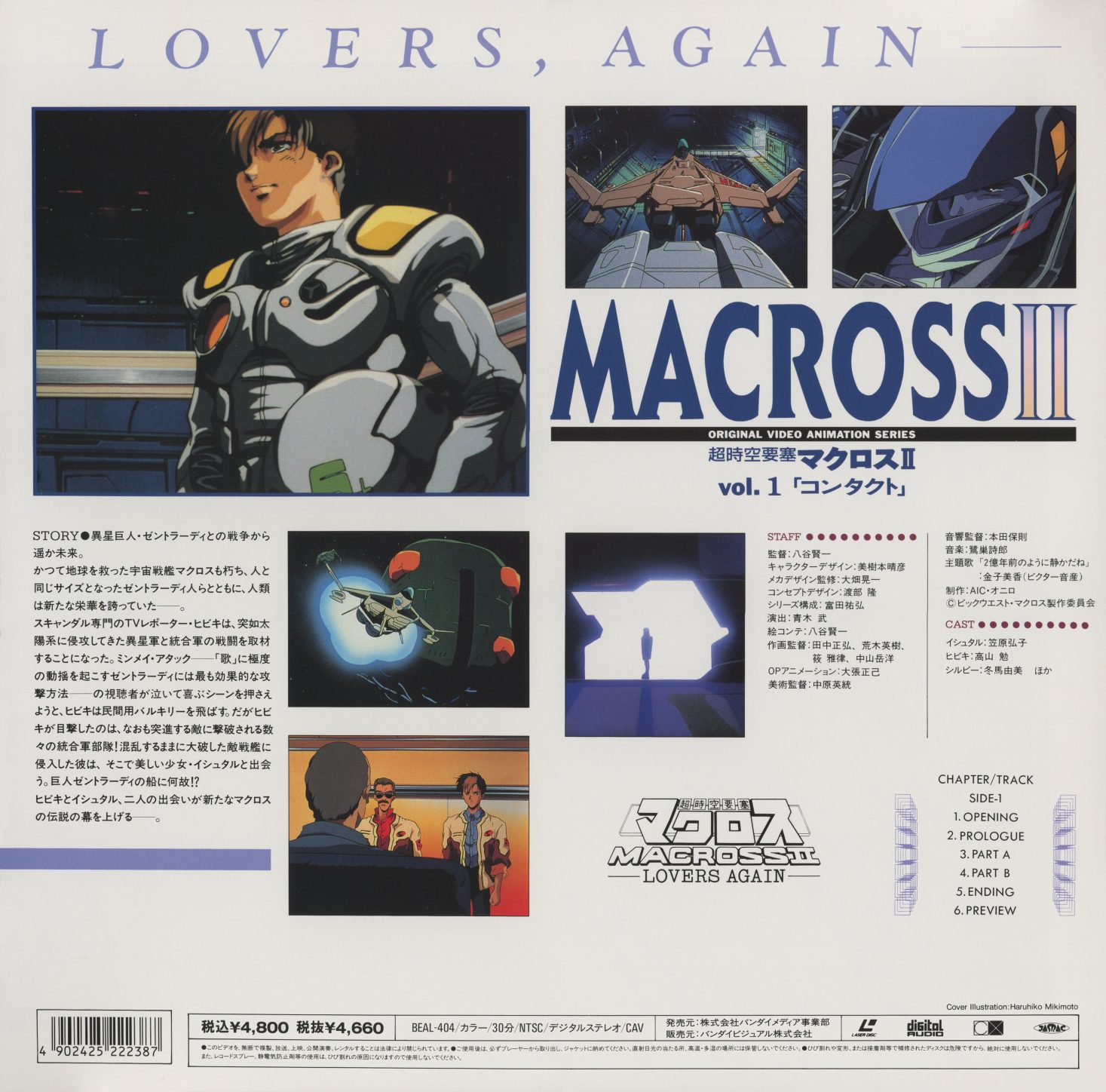 Volume 1 back. BEAL-404, CAV, digital stereo, ¥4,800. Staff credits, chapter listings, scene screenshots. Cover Illustration: Haruhiko Mikimoto. Bandai Visual / Big West.
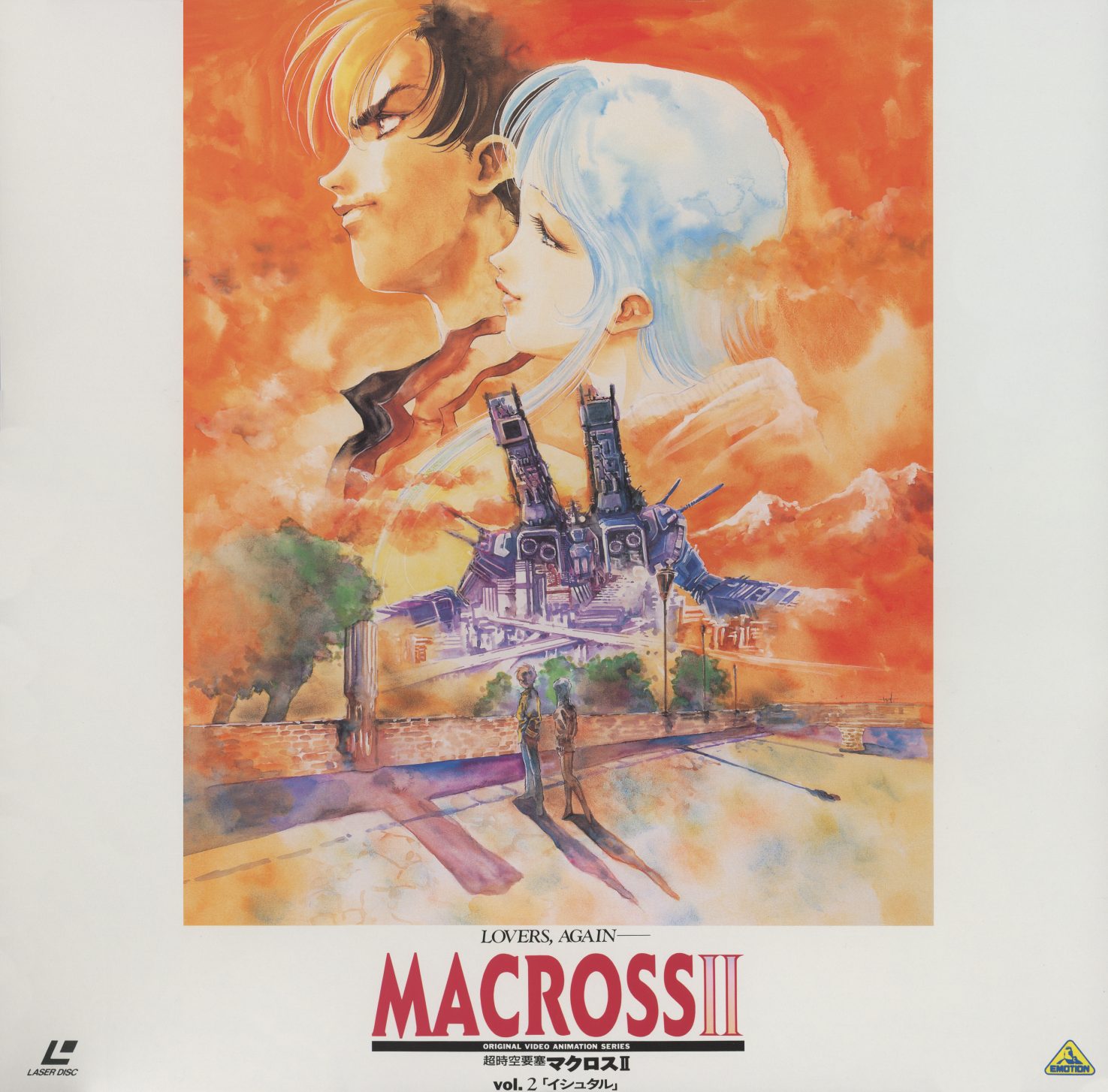 Volume 2 — 'Ishtar.' Mikimoto watercolor: Hibiki and Ishtar against a sunset, the Macross fortress behind them. The warmest palette in the series — the moment before the premise darkens. BEAL-405.
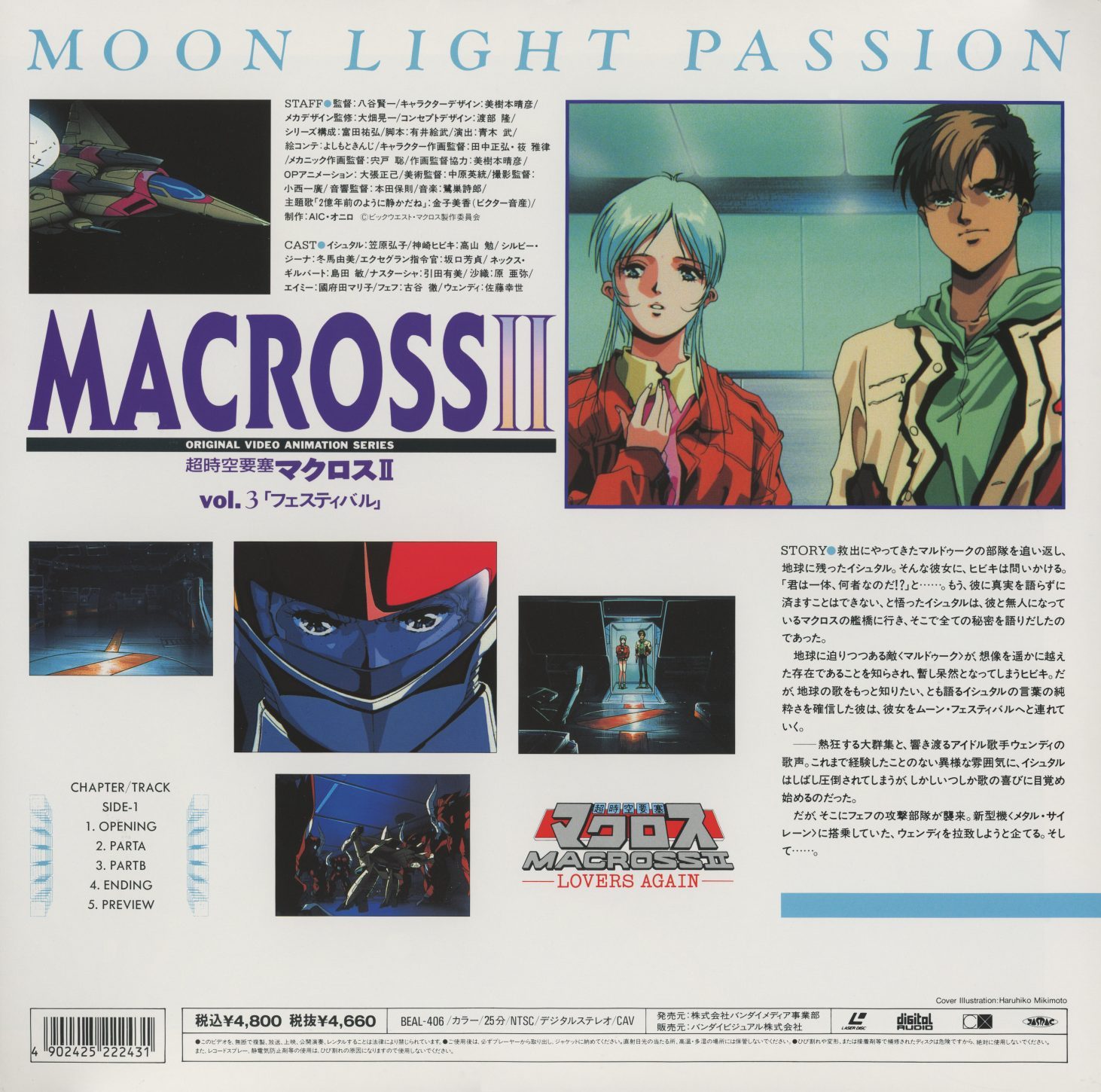 Volume 3 back — 'Moon Light Passion.' BEAL-406, CAV. Staff and chapter listings with scene stills; story synopsis in Japanese. The header slogan frames volume 3's Moon Festival episode.
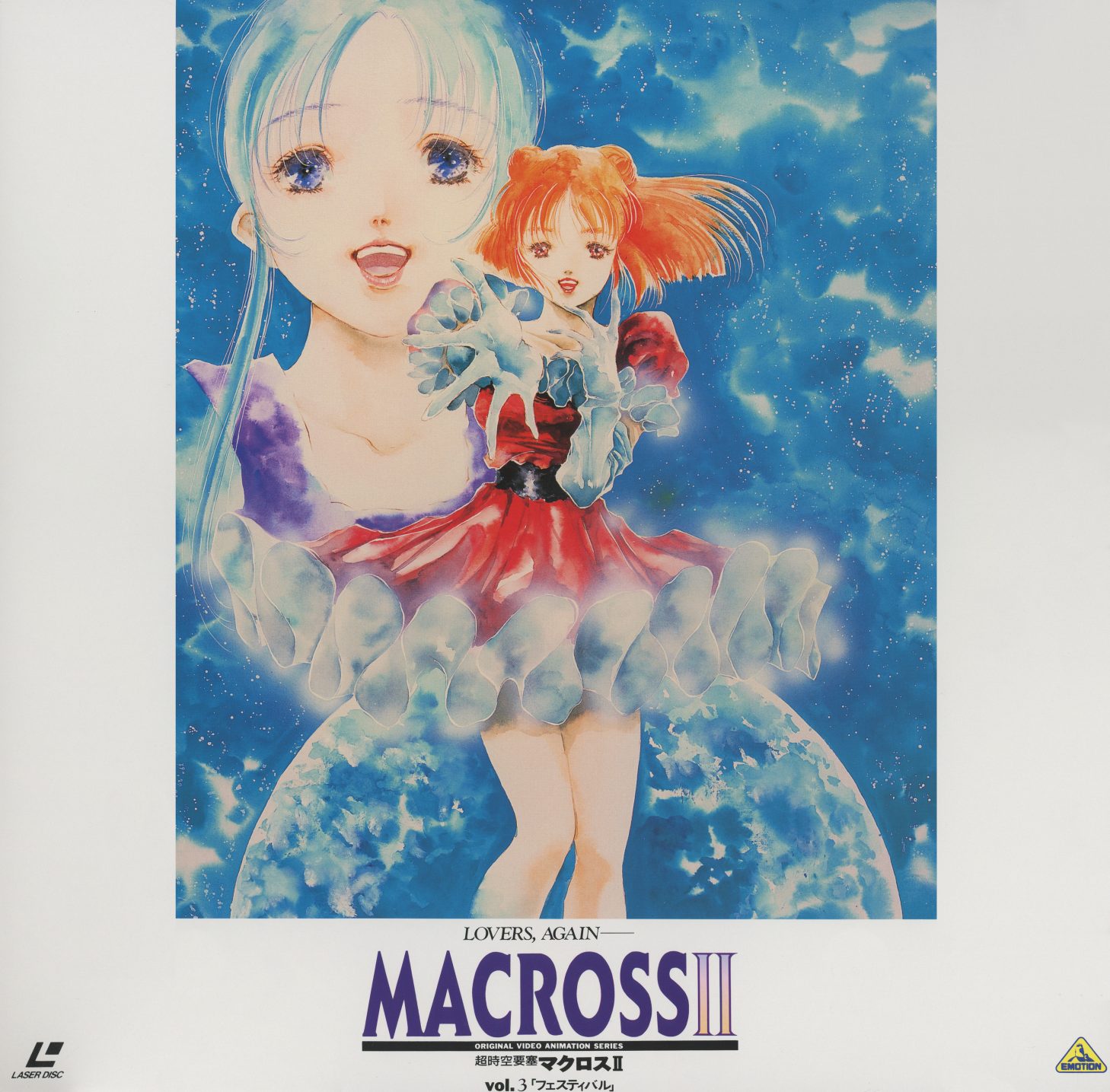 Volume 3 — 'Festival.' Ishtar and Silvie Gena against a blue starfield. The two female leads, painted by the character designer who defined the franchise's visual identity a decade earlier. BEAL-406.
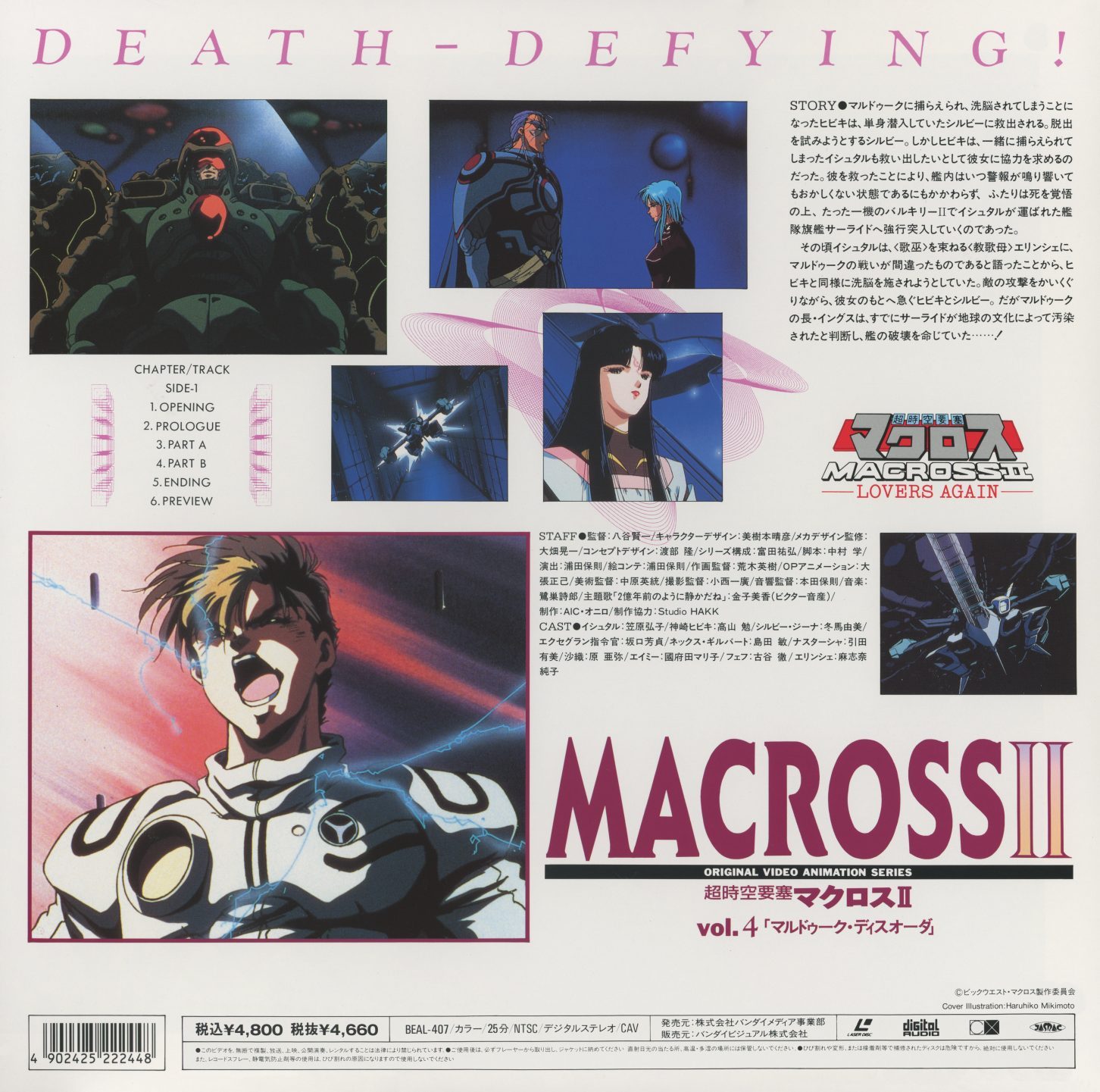 Volume 4 back — 'Death-Defying!' BEAL-407, CAV, ¥4,800. Staff credits with scene stills. The header acknowledges what vol. 4 actually delivers: the series' most brutal confrontation.
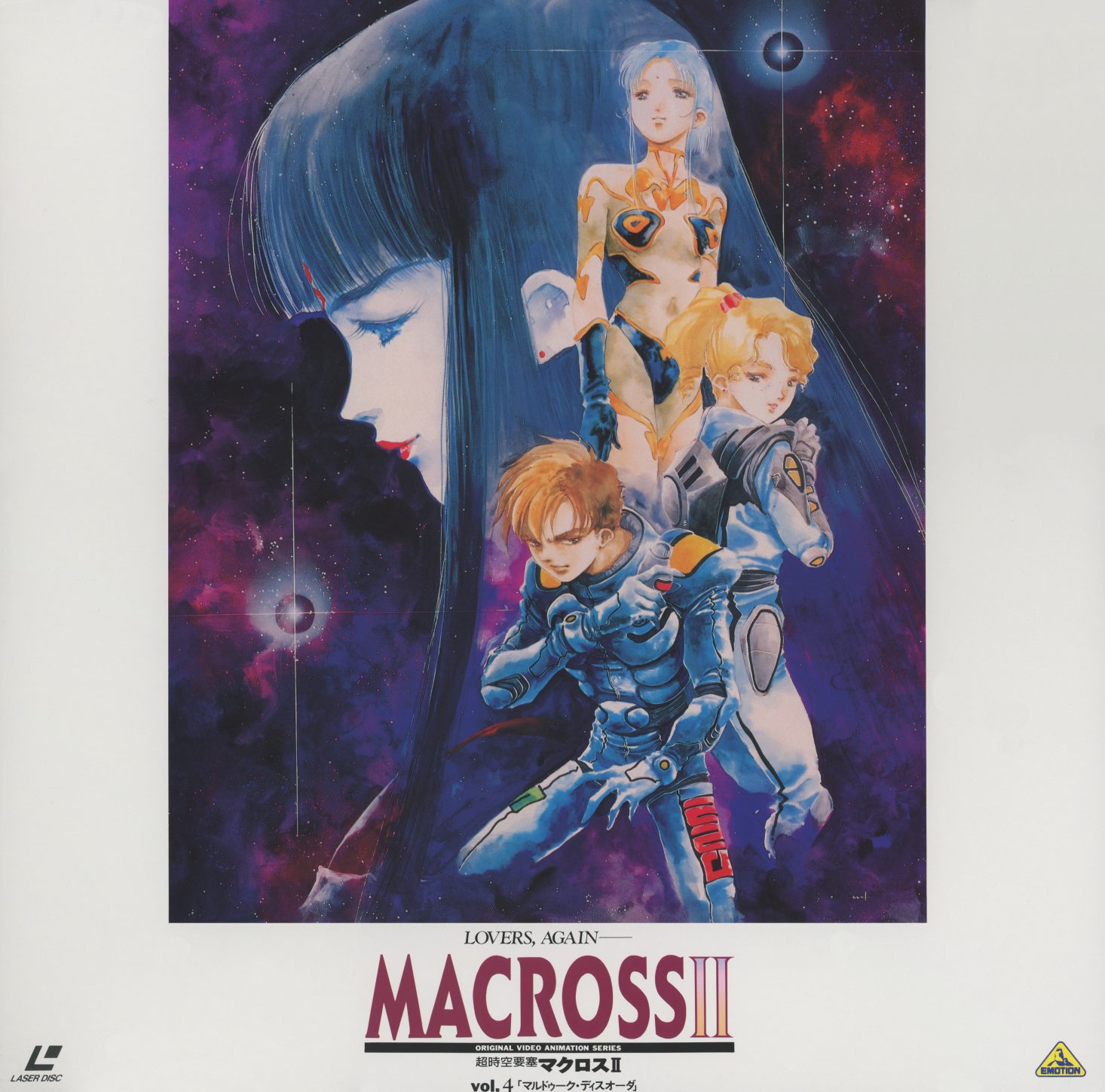 Volume 4 — 'Marduk Disorder.' The Marduk commander looms behind the main trio — Hibiki in pilot suit, Silvie armed, Ishtar between them. The palette shifts from watercolor warmth to deep purple. BEAL-407.
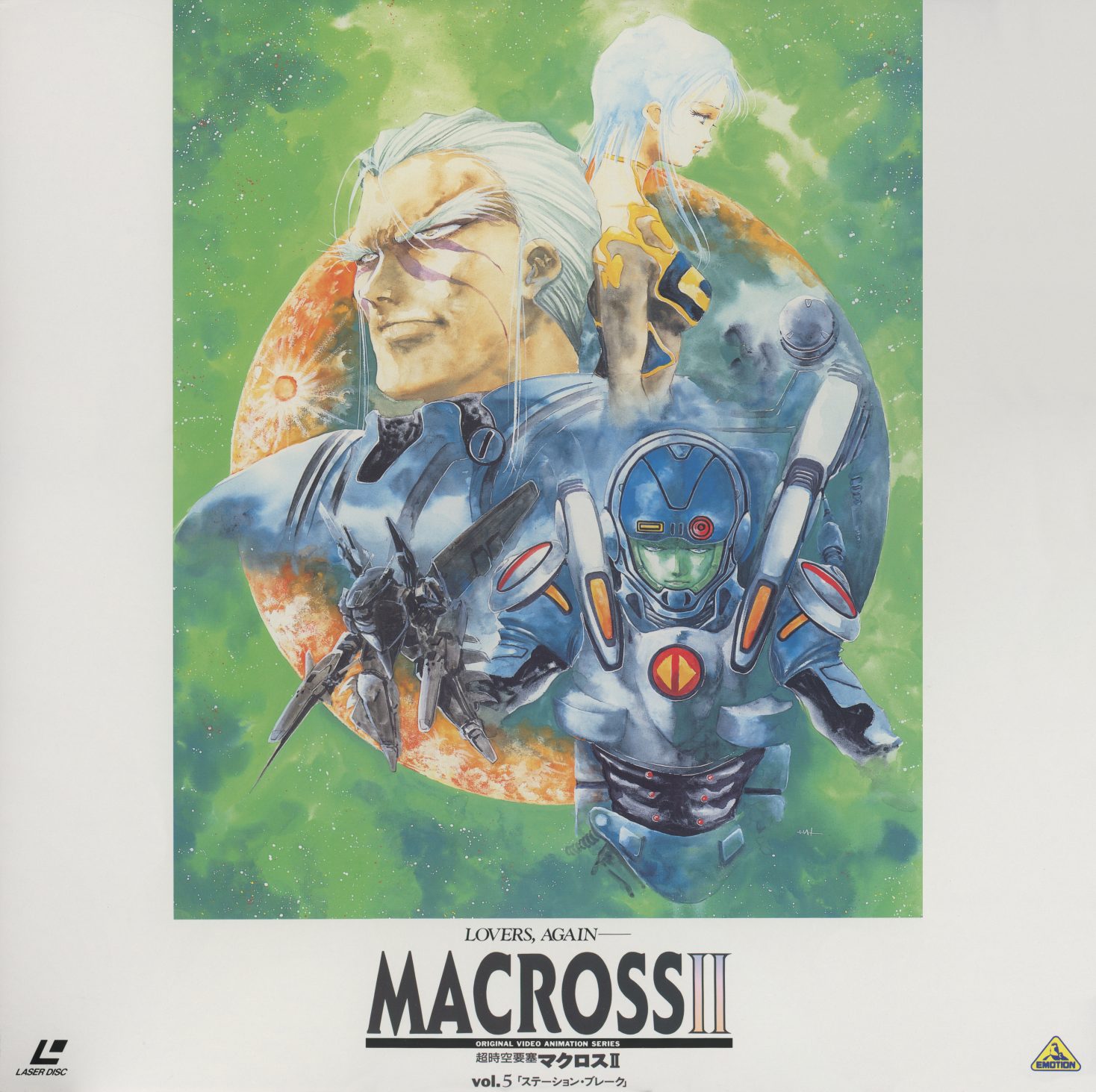 Volume 5 — 'Station Break.' The military commander and the VF-2SS Valkyrie against green atmosphere. The only jacket that gives the mecha equal billing with the characters. BEAL-408.
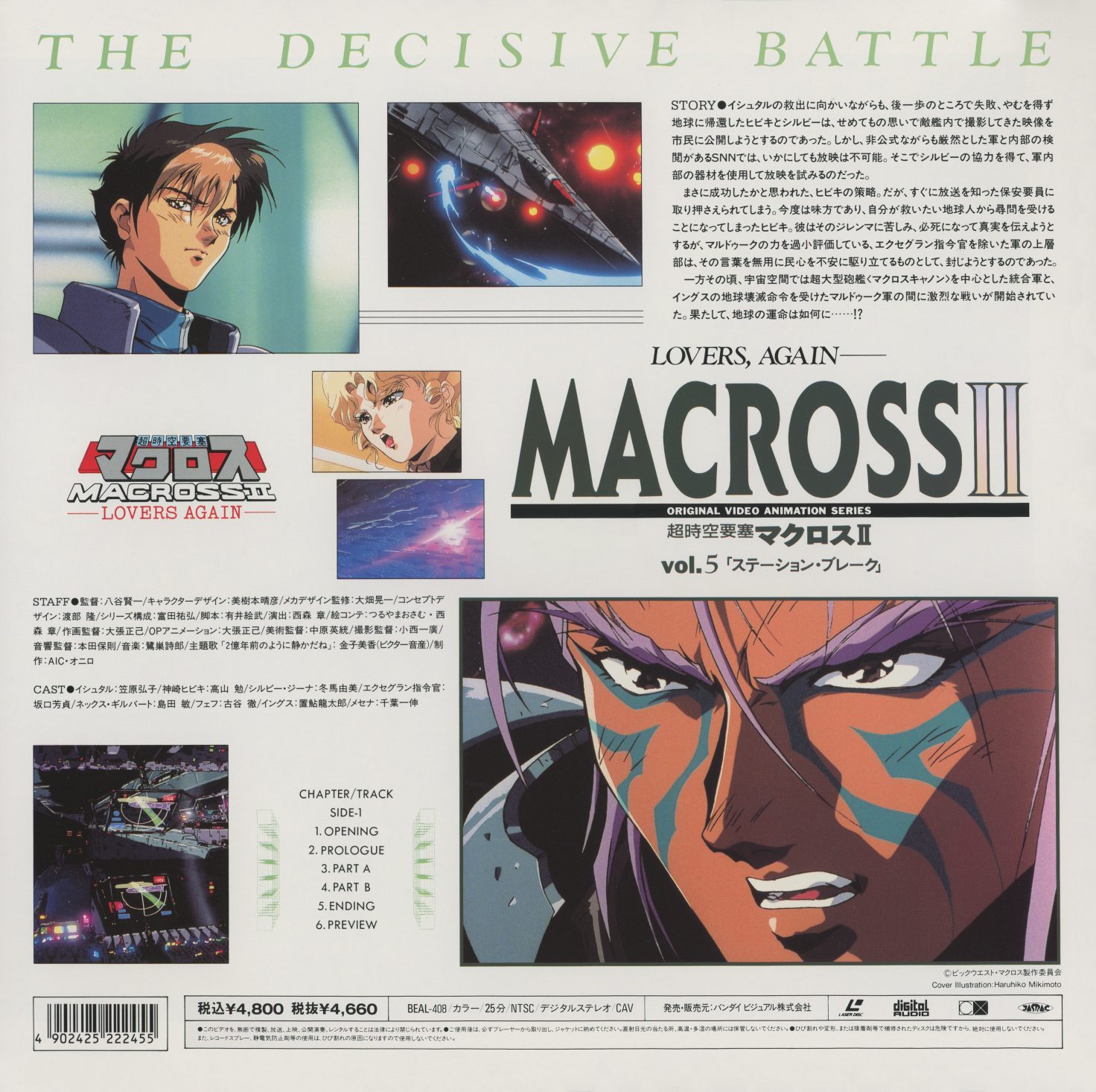 Volume 5 back — 'The Decisive Battle.' BEAL-408, CAV. Staff credits, chapter/track listing, scene stills. Story synopsis in Japanese. The penultimate disc; the series builds to its military climax.
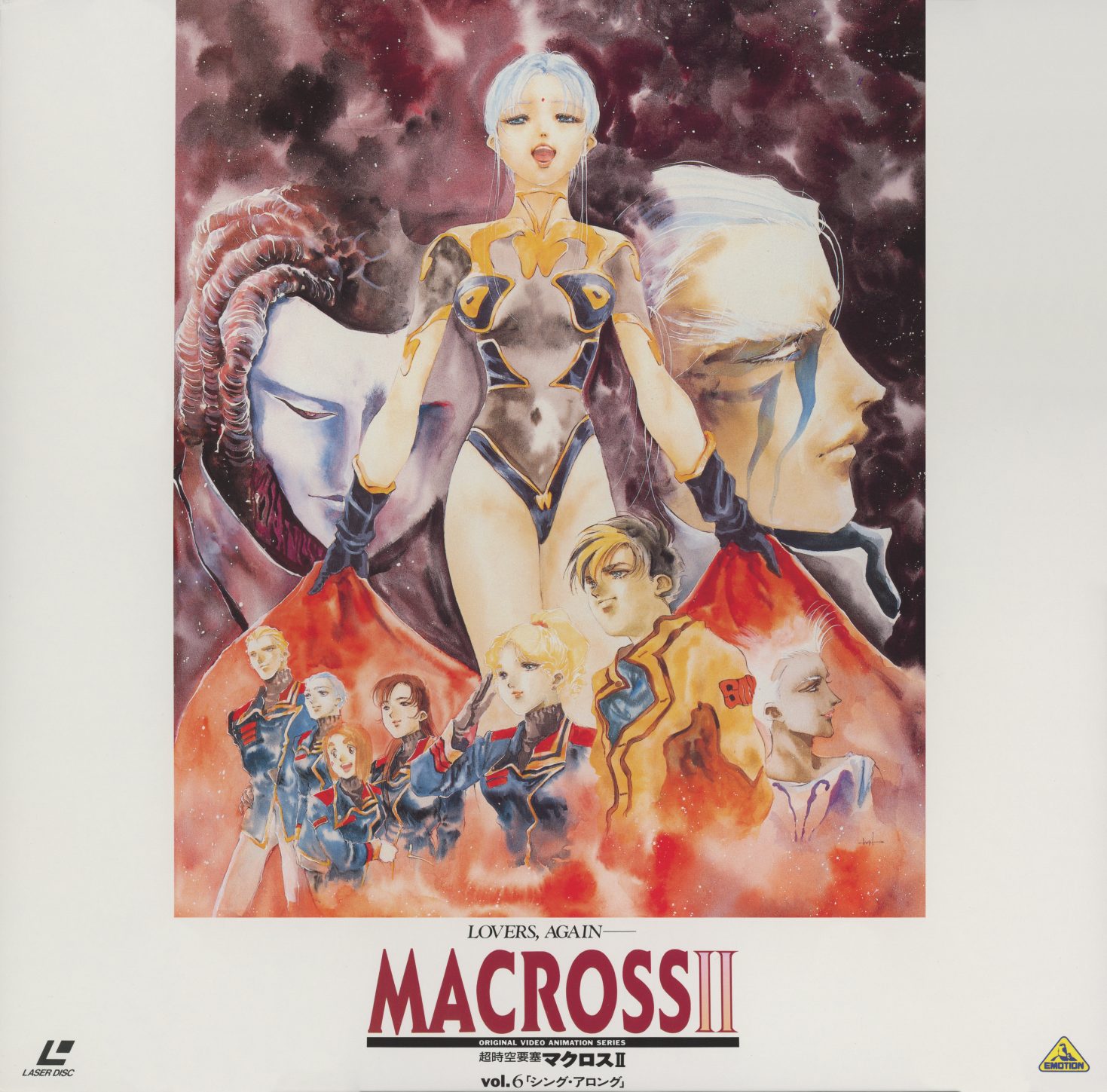 Volume 6 — 'Sing Along.' The final jacket: Ishtar in gold armor at center, the full cast assembled below in a composition that mirrors the original Macross ensemble paintings. Mikimoto's last illustration for a Macross timeline the franchise would not continue. BEAL-409.
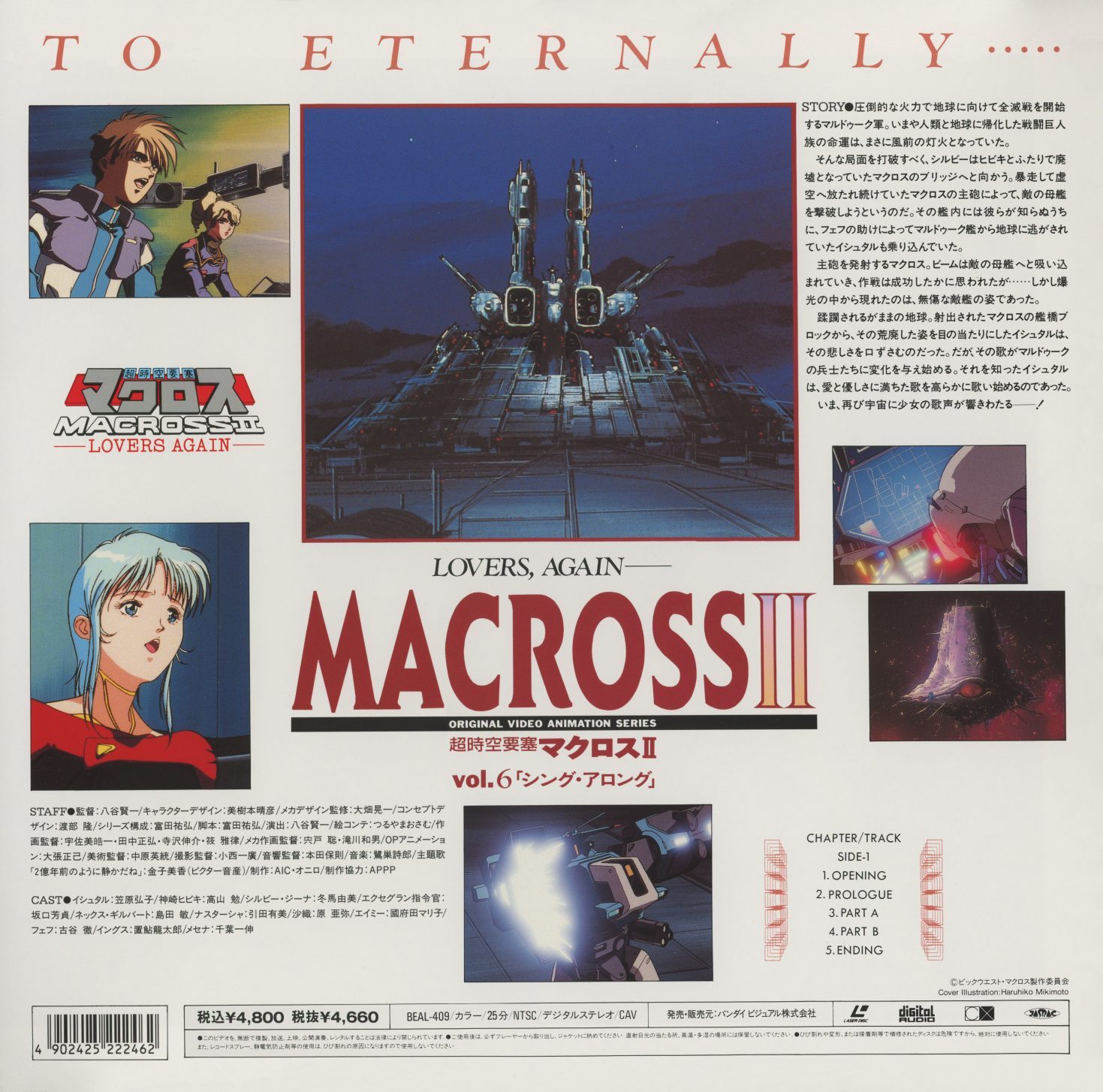 Volume 6 back — 'To Eternally...' BEAL-409, CAV. Final chapter listing; no preview track — the series ends. Staff credits, ¥4,800. The header reads as a valediction for a continuity that closed without knowing it was closing.
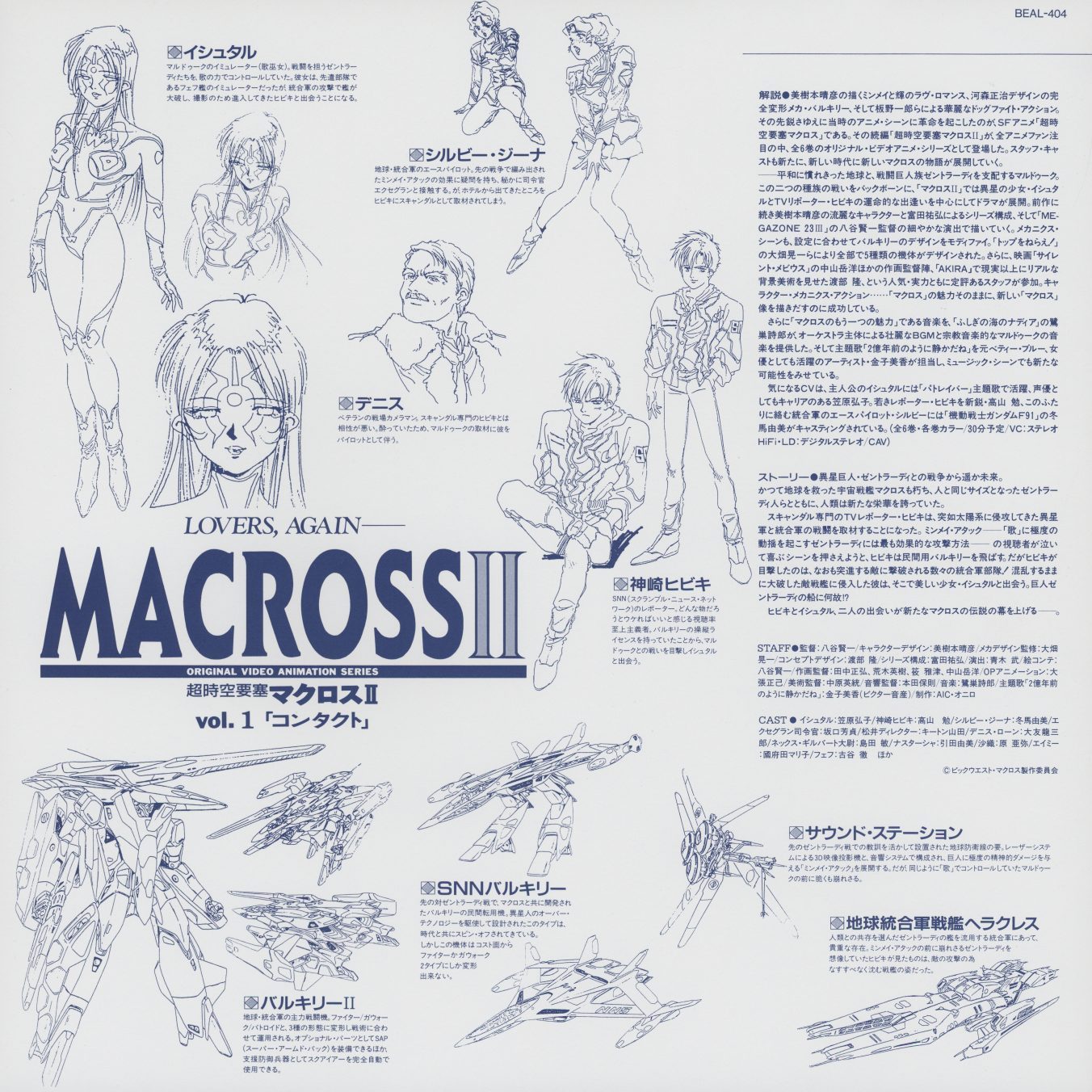 Volume 1 settei insert — blue monochrome. Character designs: Ishtar, Silvie Gena, Dennis, Kanzaki Hibiki. Mechanical designs: SNN Valkyrie, VF-2SS Valkyrie II, Sound Station, Earth Unified Forces battleship Heracles. Staff credits and story synopsis at right.
The Settei and the Premise
Each volume includes two inserts: a registration card for the complete-purchase CD bonus (colored line art, varies by volume) and a full settei sheet (character and mechanical design drawings in the same per-volume monochrome). Together they document the OVA's complete visual vocabulary: the VF-2SS Valkyrie II (the franchise's first variable fighter not designed by Kawamori), the Sound Station (a Zentradi-derived weapon that broadcasts weaponized song), and the Marduk fleet hierarchy. The original Macross argued that culture — specifically pop music — could reach across a species barrier. Macross II inverts that: the Marduk already understand music's power and have industrialized it. Ishtar's songs don't bridge a gap. They enforce compliance. The humans don't need to discover what music can do. They need to stop someone else from using it.
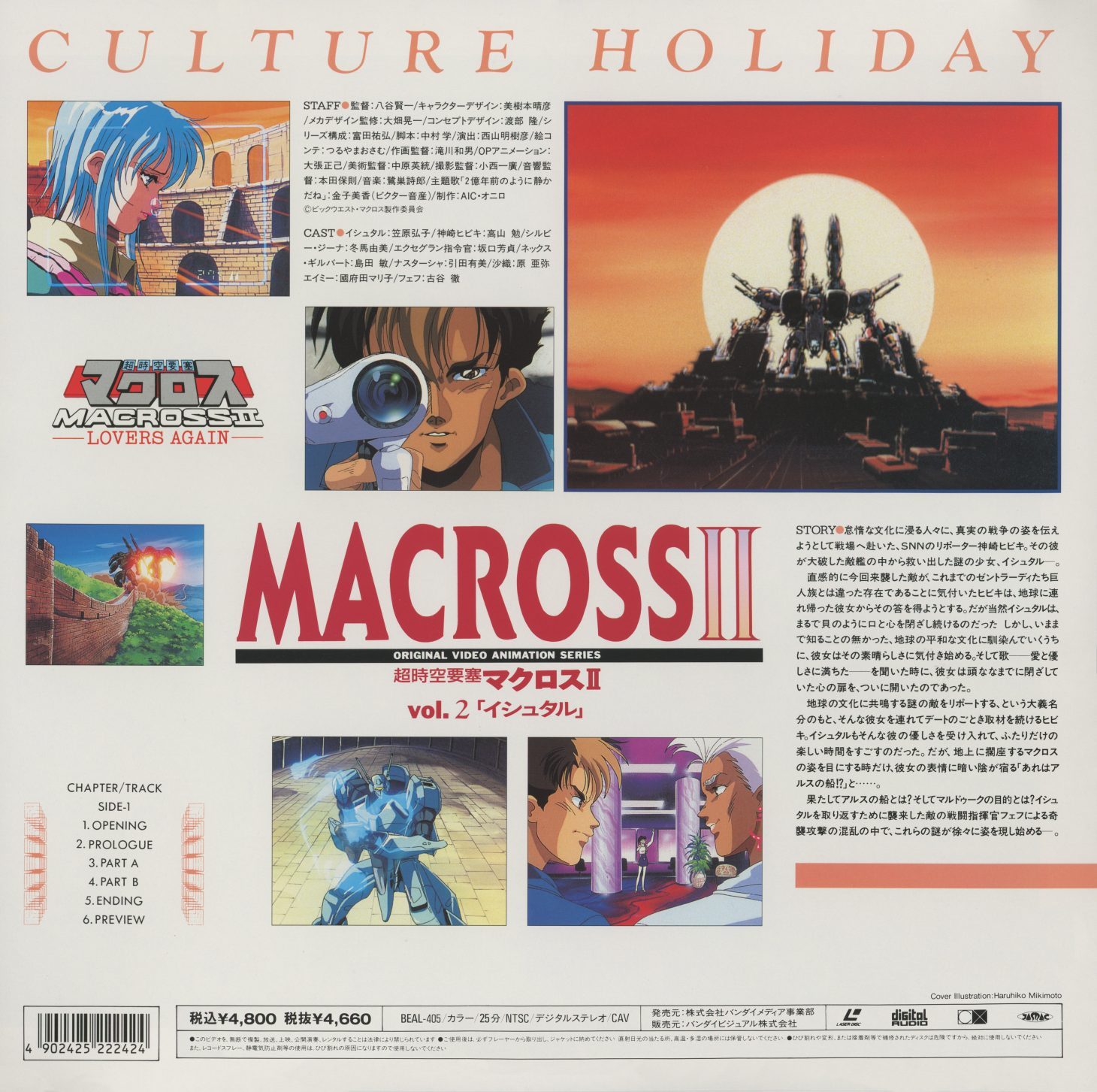 Volume 2 back. BEAL-405, CAV. 'CULTURE HOLIDAY' header. The episode subtitles — Contact, Ishtar, Festival, Marduk Disorder, Station Break, Sing Along — read as a six-word compression of the series' arc from first encounter to final concert.
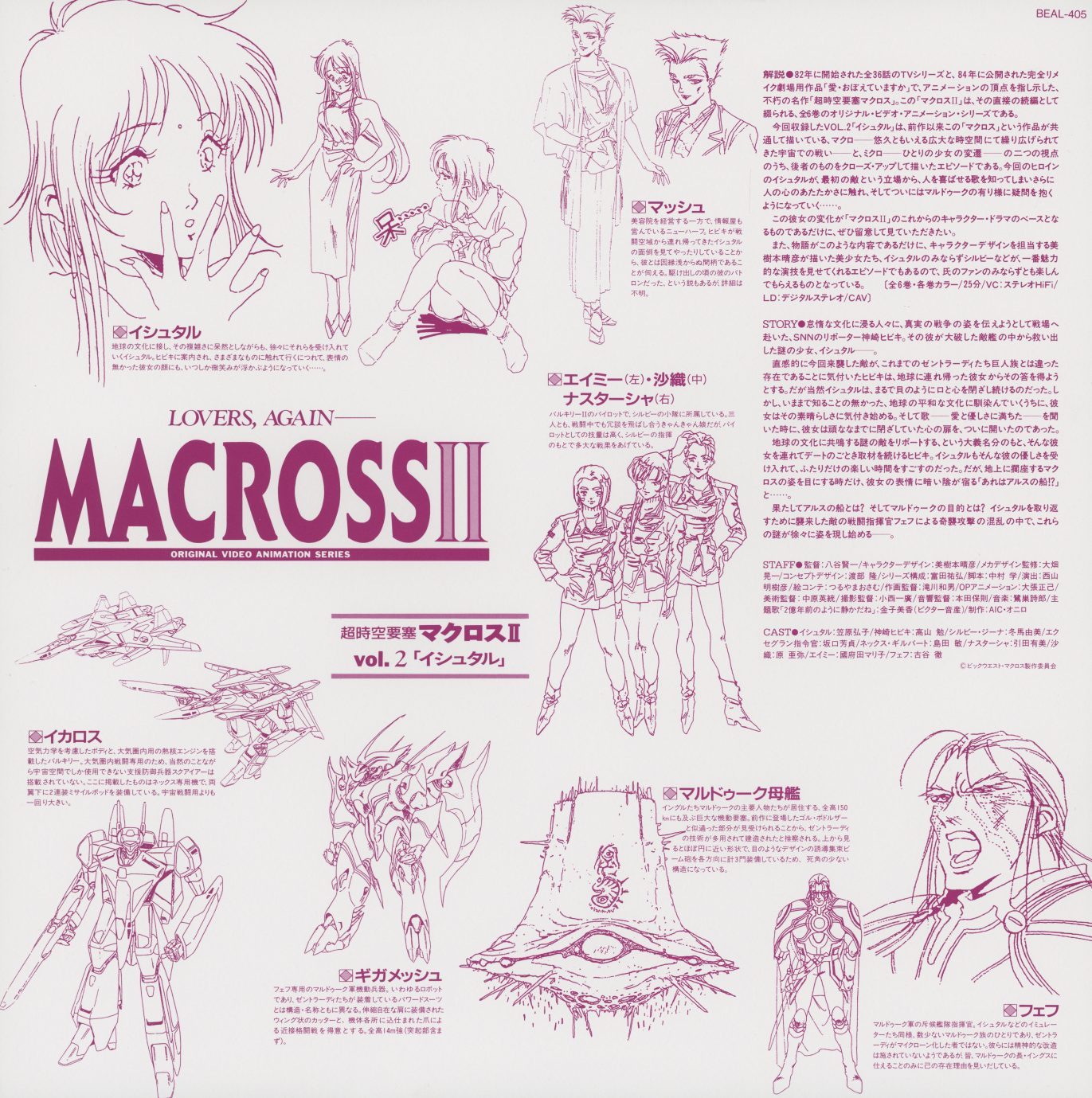 Volume 2 settei sheet — pink/magenta monochrome. BEAL-405. Characters: Ishtar, Mash, Amy and Nastasha, Ikarus. Mechanical designs: Gigamesh, Feff bio-form, Malduk battleship. The second-volume sheet introduces the enemy fleet hierarchy the series will spend its final three episodes unraveling.
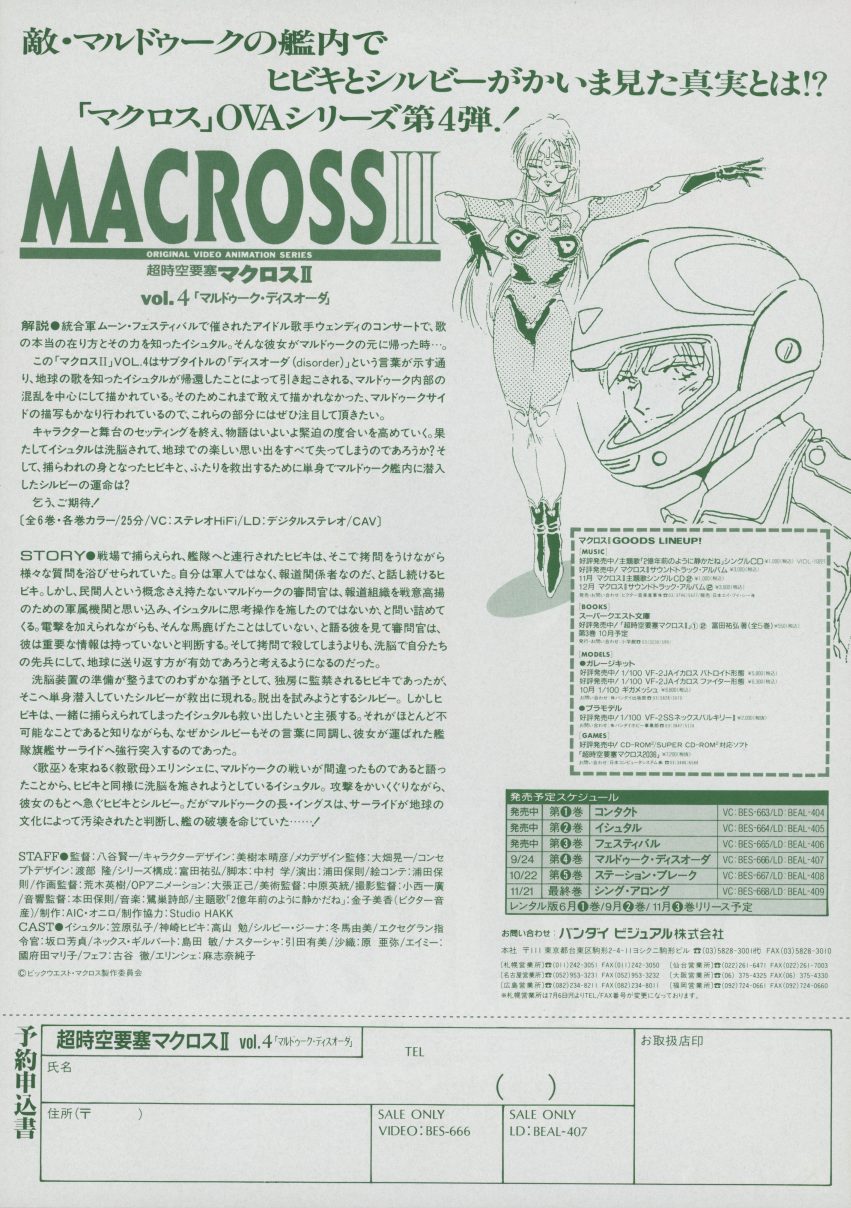 Volume 4 bonus insert — green monochrome. Silvie Gena and Hibiki character illustrations alongside the registration card for the complete-purchase bonus CD. Mailing address: Bandai Visual, Yoshikuni-Koma Building, Taito-ku, Tokyo.
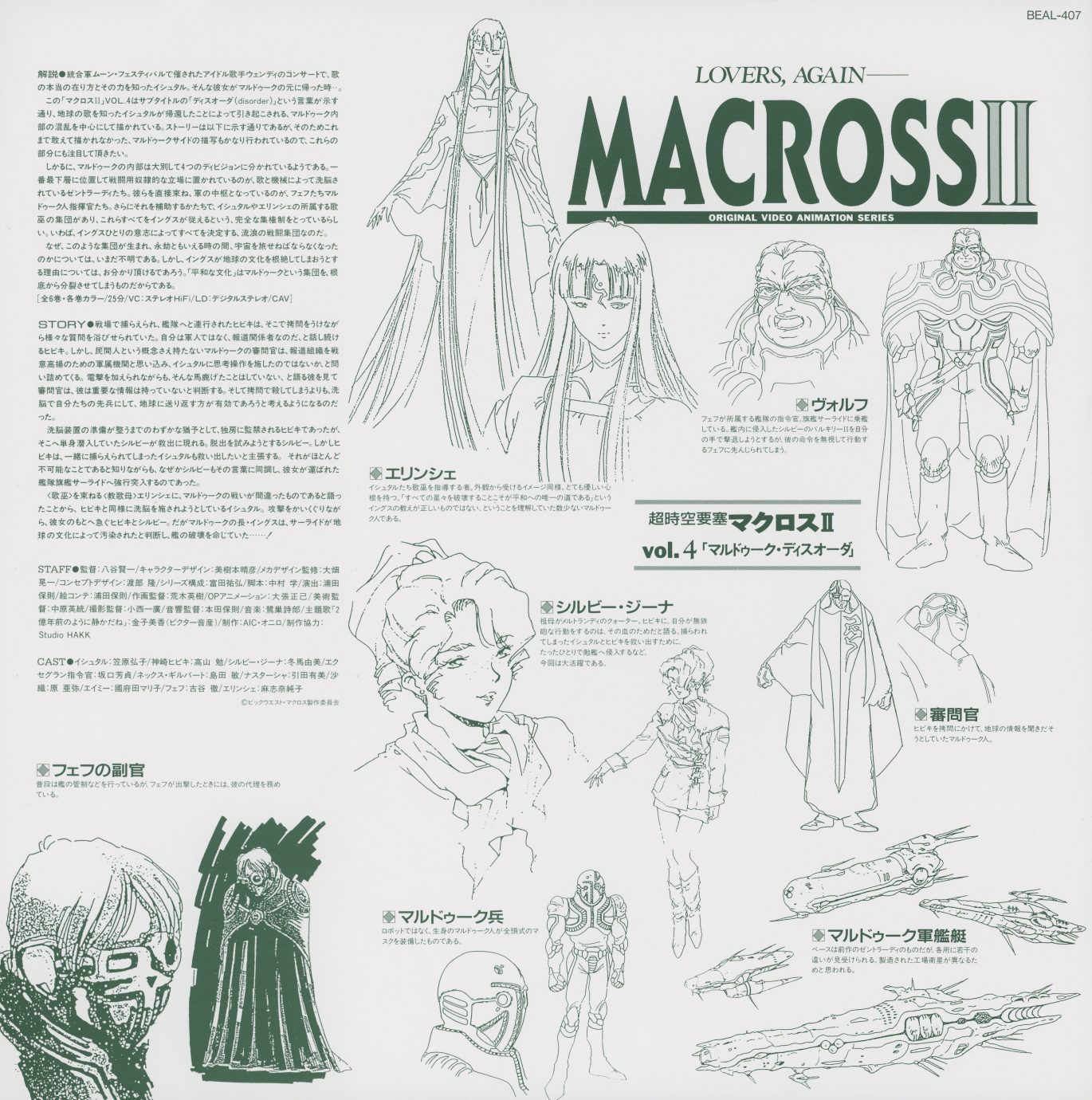 Volume 4 settei sheet — green monochrome. BEAL-407. Characters: Erinsha (Marduk high priest), Silvie Gena, Voluf (Marduk military commander), Feff adjutant. Mechanical designs: Marduk soldier, Marduk fleet warship. The sheet establishes the full Marduk hierarchy before the final confrontation.
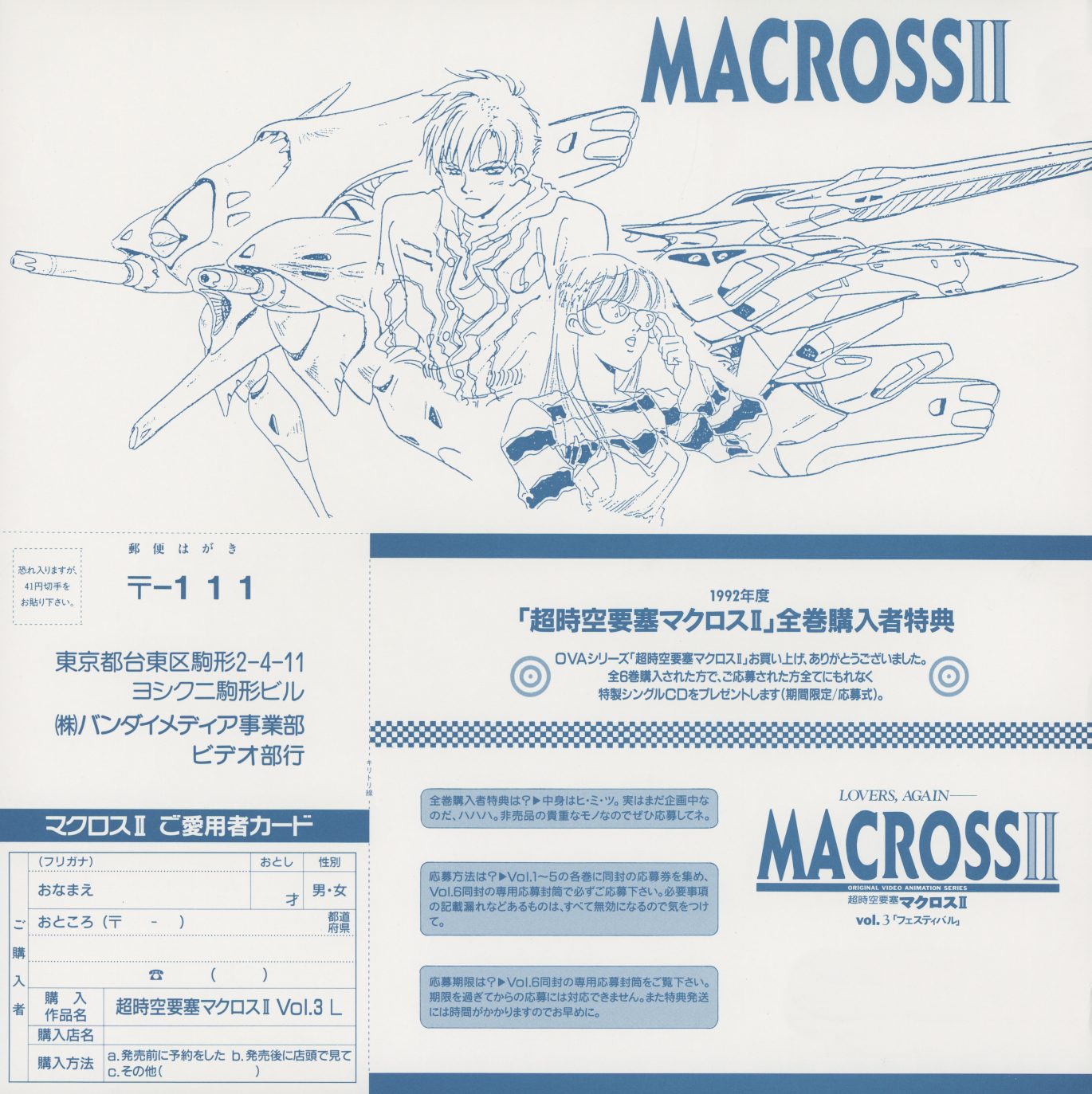 Volume 3 bonus insert — blue monochrome. Hibiki and Ishtar character illustrations alongside the registration card for the complete-purchase bonus CD. Mailing address: Bandai Visual, Komagata 2-4-11, Taito-ku, Tokyo.
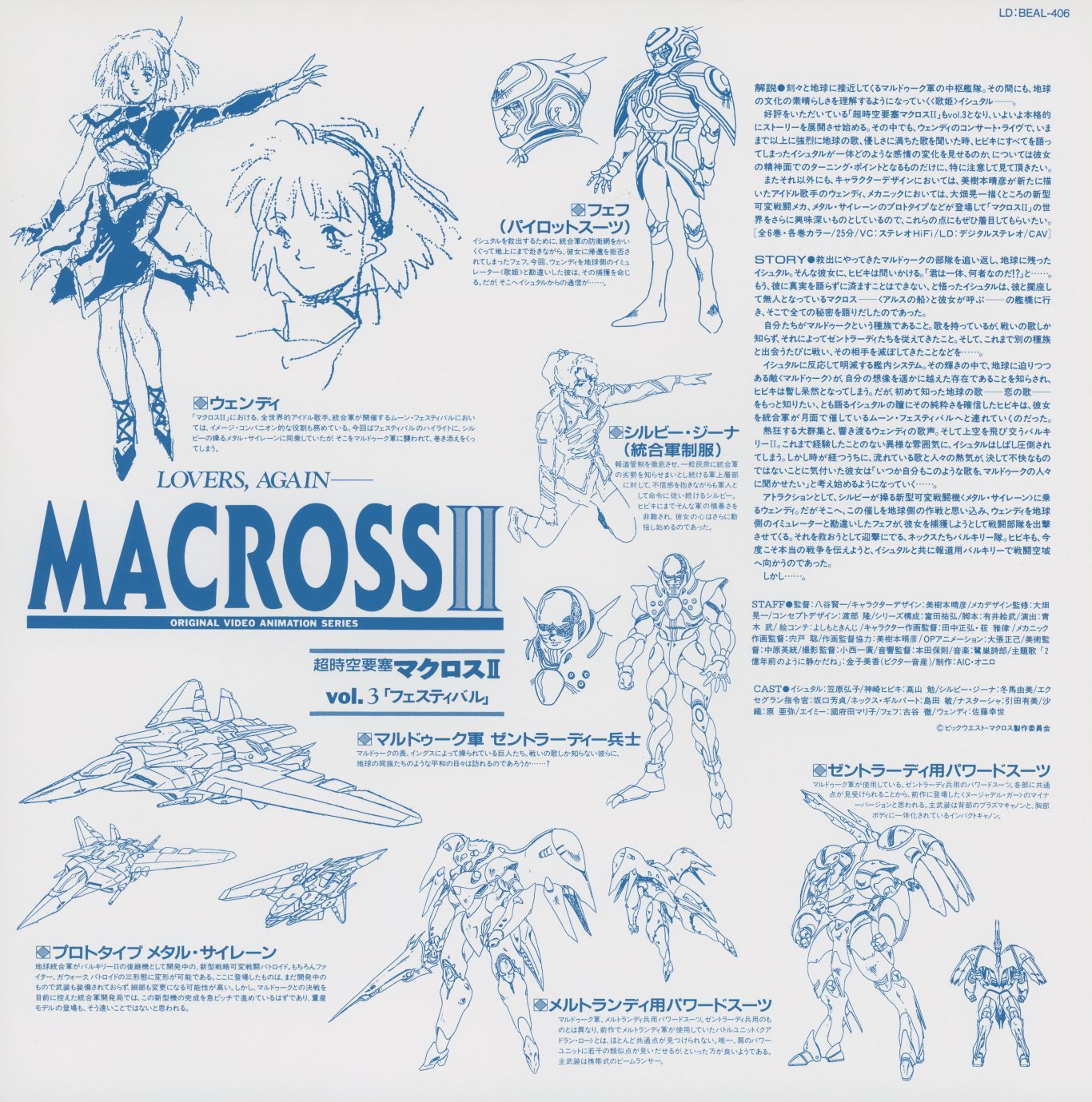 Volume 3 settei sheet — blue monochrome. BEAL-406. Characters: Wendy (Moon Festival idol singer), Feff (Marduk officer), Silvie Gena in unified forces uniform, Zentran lady soldier. Mechanical designs: Prototype Metal Siren, Meltran power suit, Zentran power suit. The third-volume sheet introduces the idol subplot that the series builds toward music as liberating rather than weaponizing.
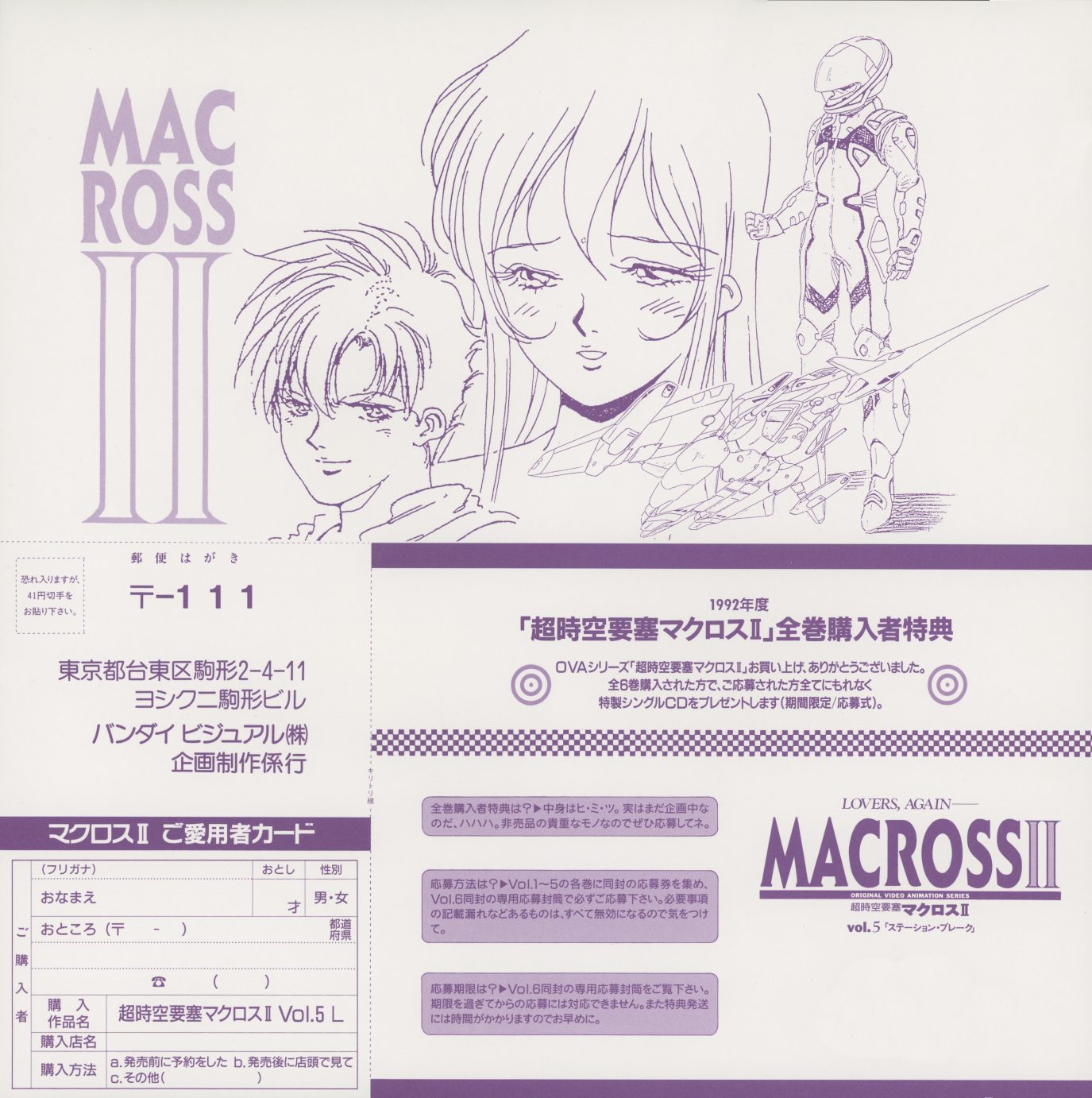 Volume 5 bonus insert — purple monochrome. Character illustrations of the main trio alongside the same registration card. Each volume varies the color and the featured drawings while repeating the same offer.
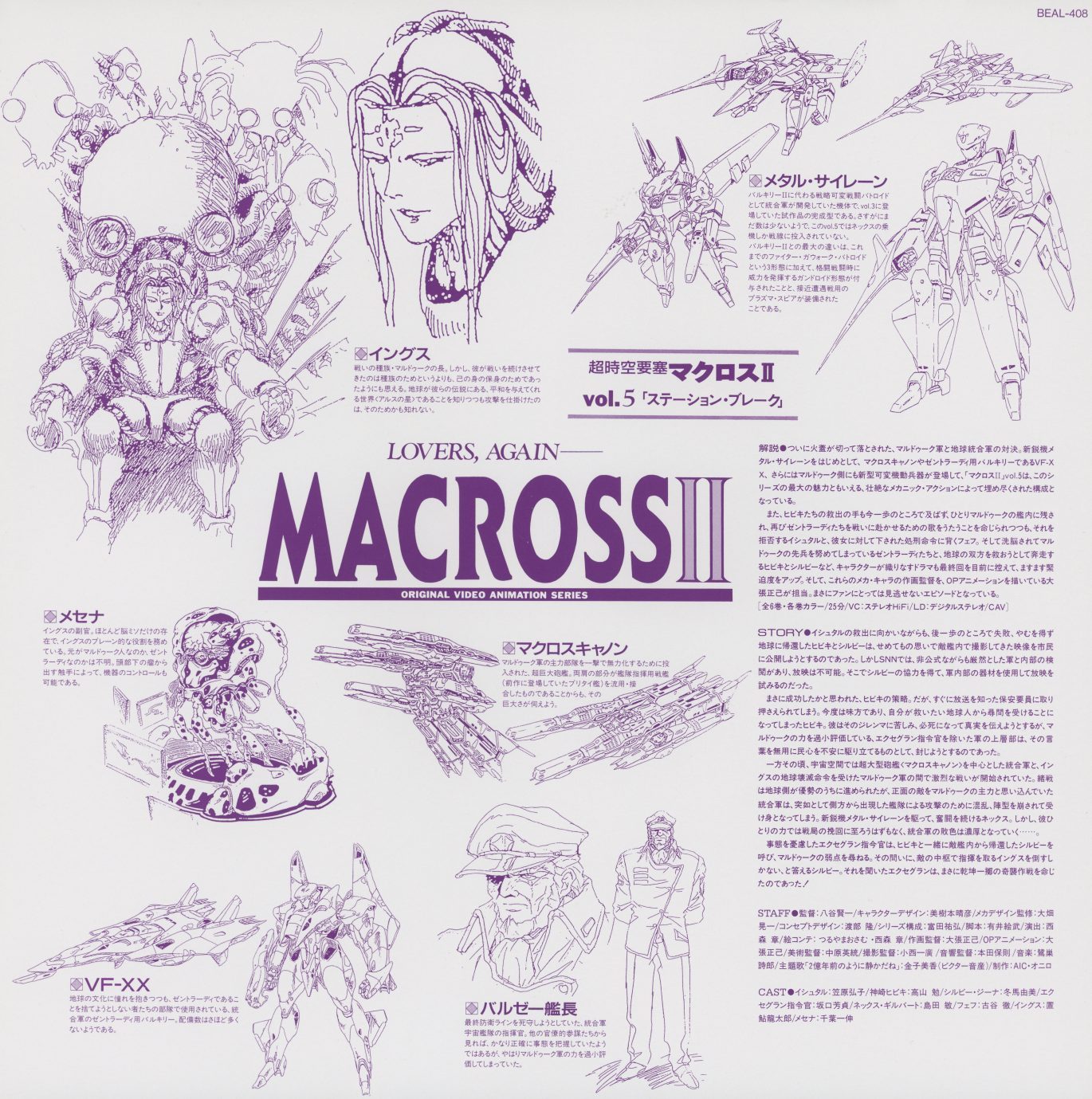 Volume 5 settei sheet — purple monochrome. BEAL-408. Characters: Ingus (resistance commander), Mesena. Mechanical designs: Metal Siren, Macross Cannon, VF-XX, Parsee captain, VF-2SS. The penultimate sheet introduces the anti-Marduk resistance hardware and the upgraded Valkyrie variants deployed for the final battle.
The Bonus and the Erasure
Buyers who collected all six registration postcards could claim an exclusive CD single: Kasahara Hiroko singing 'もういちどLOVE YOU' in a Marduk-language arrangement — a song performed in the alien tongue the OVA invented. '商品化の予定のない特別盤' — a special disc with no plans for commercial release. Two years later, Kawamori returned with Macross Plus and Macross 7, building a new canon that treated Macross II as a parallel universe. The idol-weapon concept Macross II introduced — music as literal military infrastructure — became a core element of Macross 7 and Macross Frontier. The ideas survived. The continuity did not. For Western fans in the early 1990s, Macross II was legally released on VHS and LaserDisc in North America before Macross Plus or any other post-original Macross title. For many, it was their first encounter with the franchise outside of Robotech.
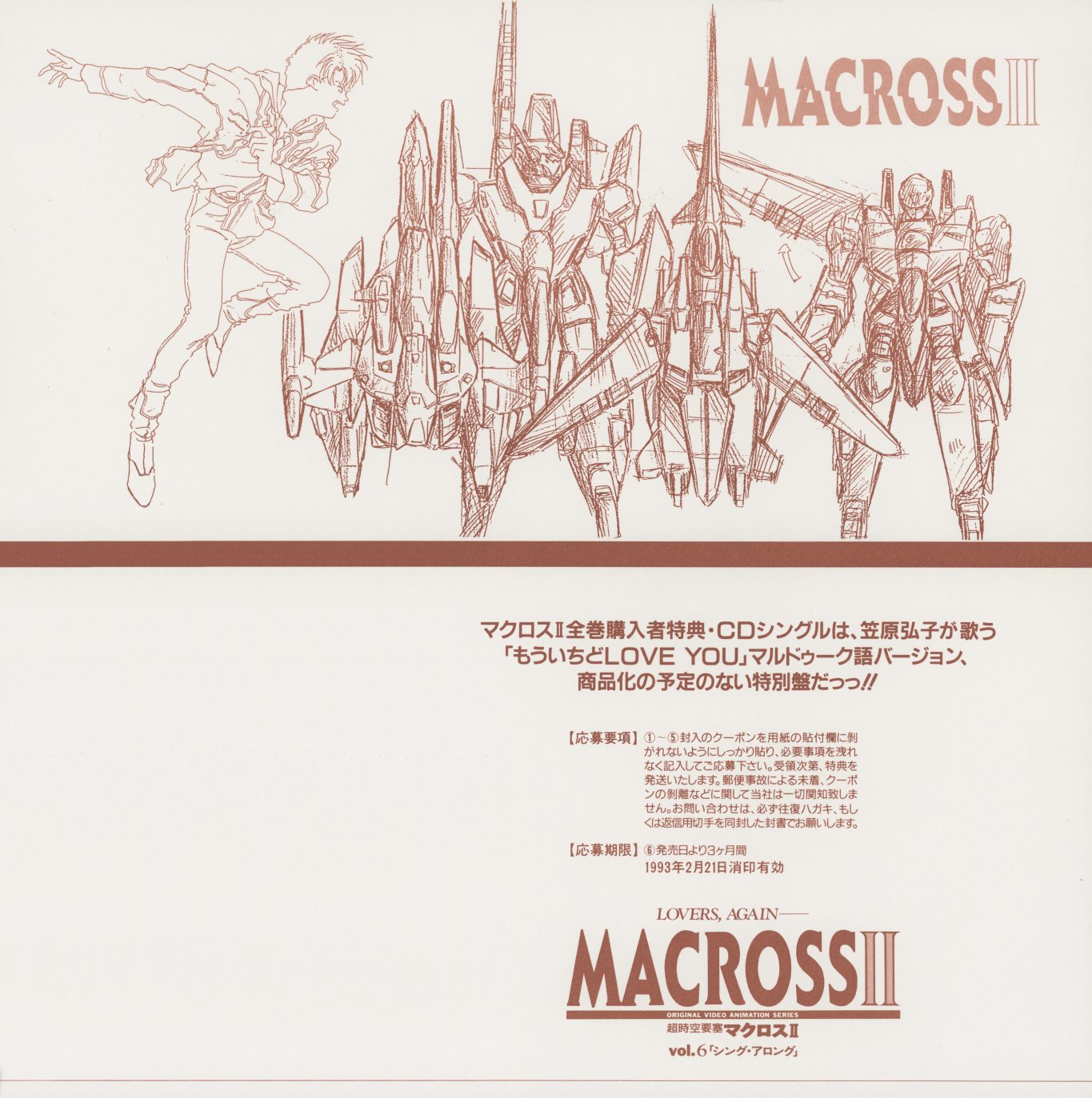 Volume 6 bonus insert — brown/sepia monochrome. VF-2SS Valkyrie lineup. Text confirms the complete-purchase CD: Kasahara Hiroko's 'もういちどLOVE YOU' Marduk-language version. Deadline: February 28, 1992. 'No plans for commercial release.'
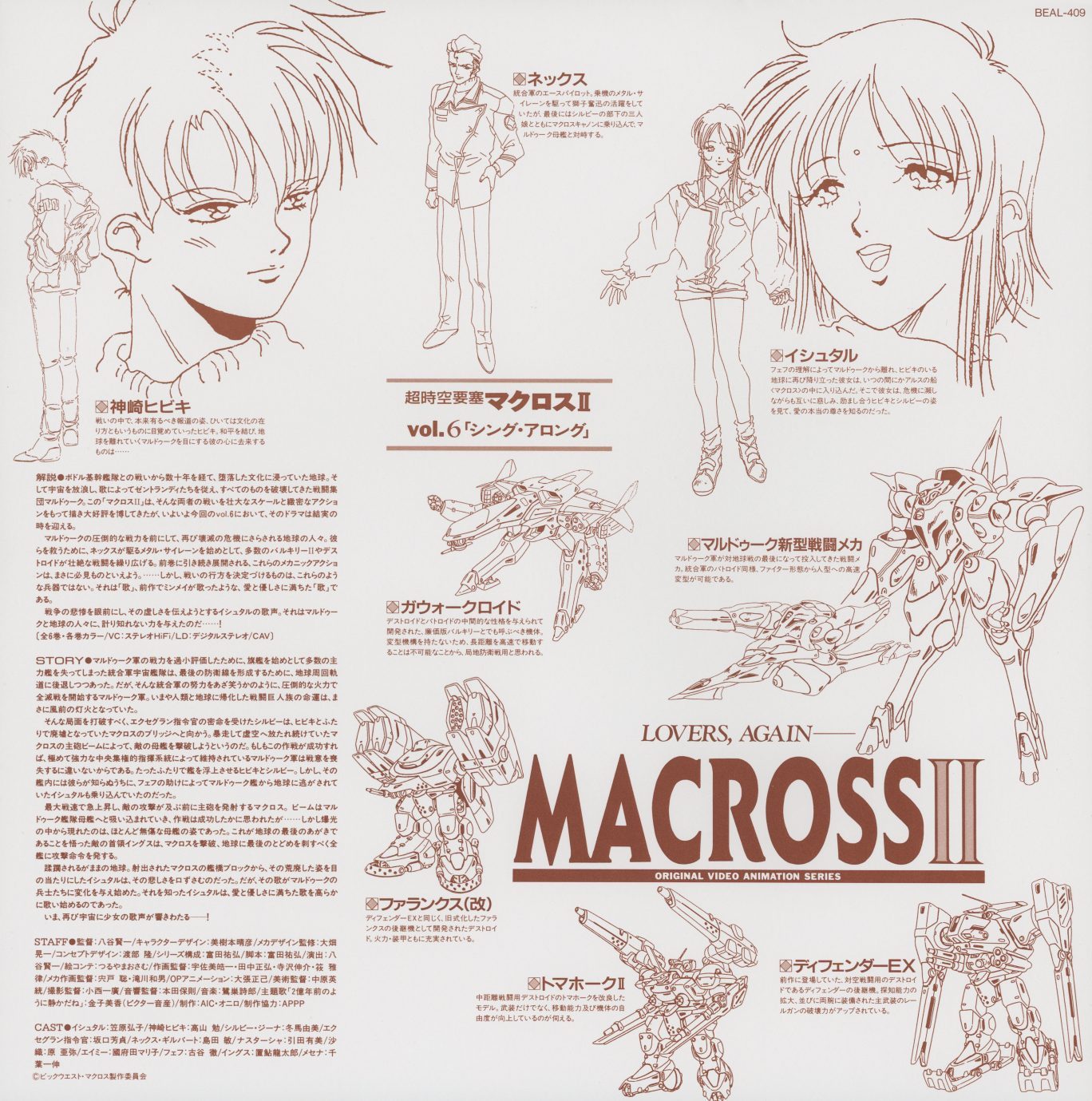 Volume 6 settei sheet — brown/sepia monochrome. BEAL-409. Characters: Kanzaki Hibiki, Ishtar. Mechanical designs: Gauwork (Marduk biological mech), Franks (Marduk fighter), VF-2SS Valkyrie II Tomahawk II variant, Defender EX. The final settei sheet. The series ends with Ishtar choosing Earth's culture over the Marduk military; these are the machines that contested that choice.
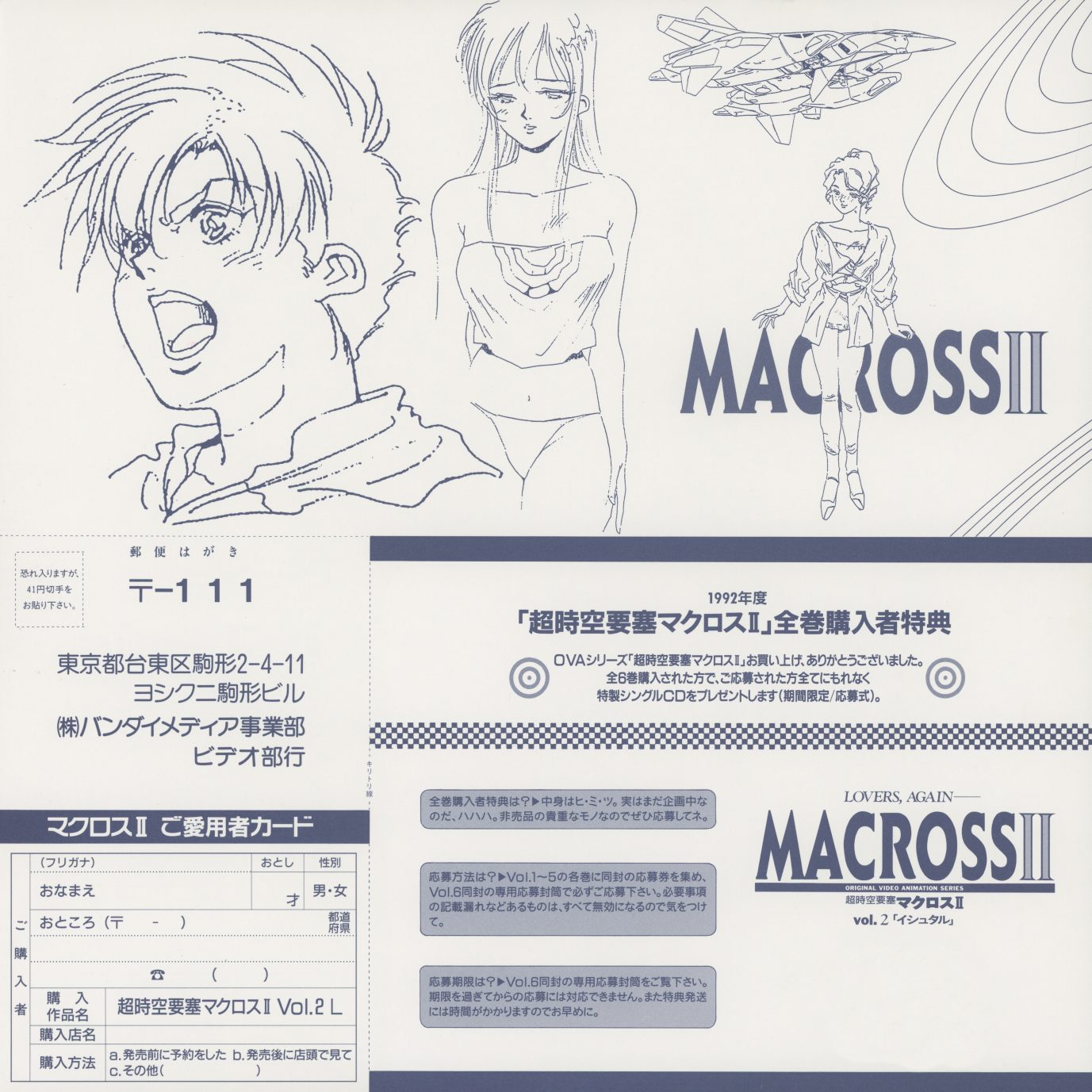 Volume 2 bonus insert. Registration card and postcard — the six-volume collection mechanism. Character sketches and the Bandai Visual production division mailing address. Each card confirms which volume the buyer purchased.
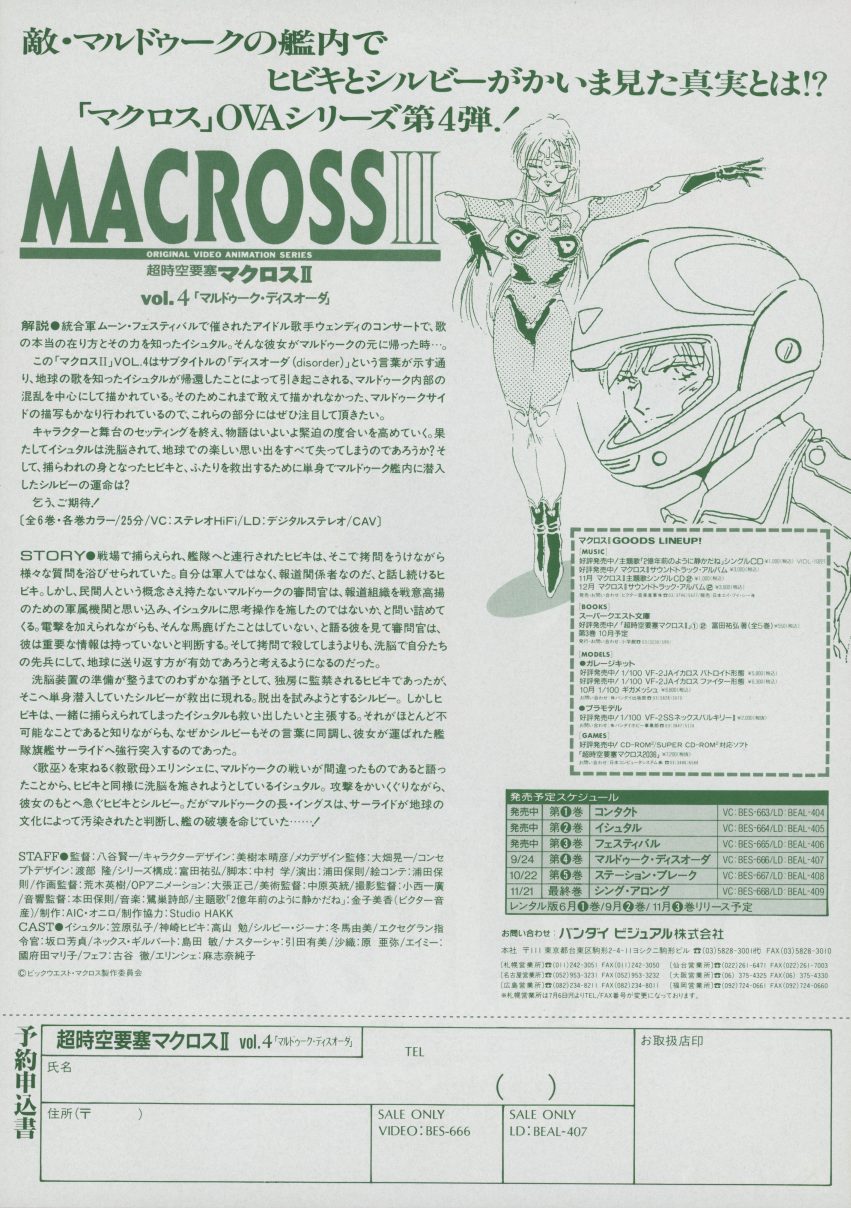 Advance promotional flyer for Volume 4 — 'Marduk Disorder.' September 24 release date. 'ビビとシルビーが敵・マルドゥークの艦内でいま見た真実とは!?' — 'What truth did Hibiki and Silvie see inside the enemy Marduk flagship?' The flyer announces the complete-purchase CD bonus alongside the volume release.
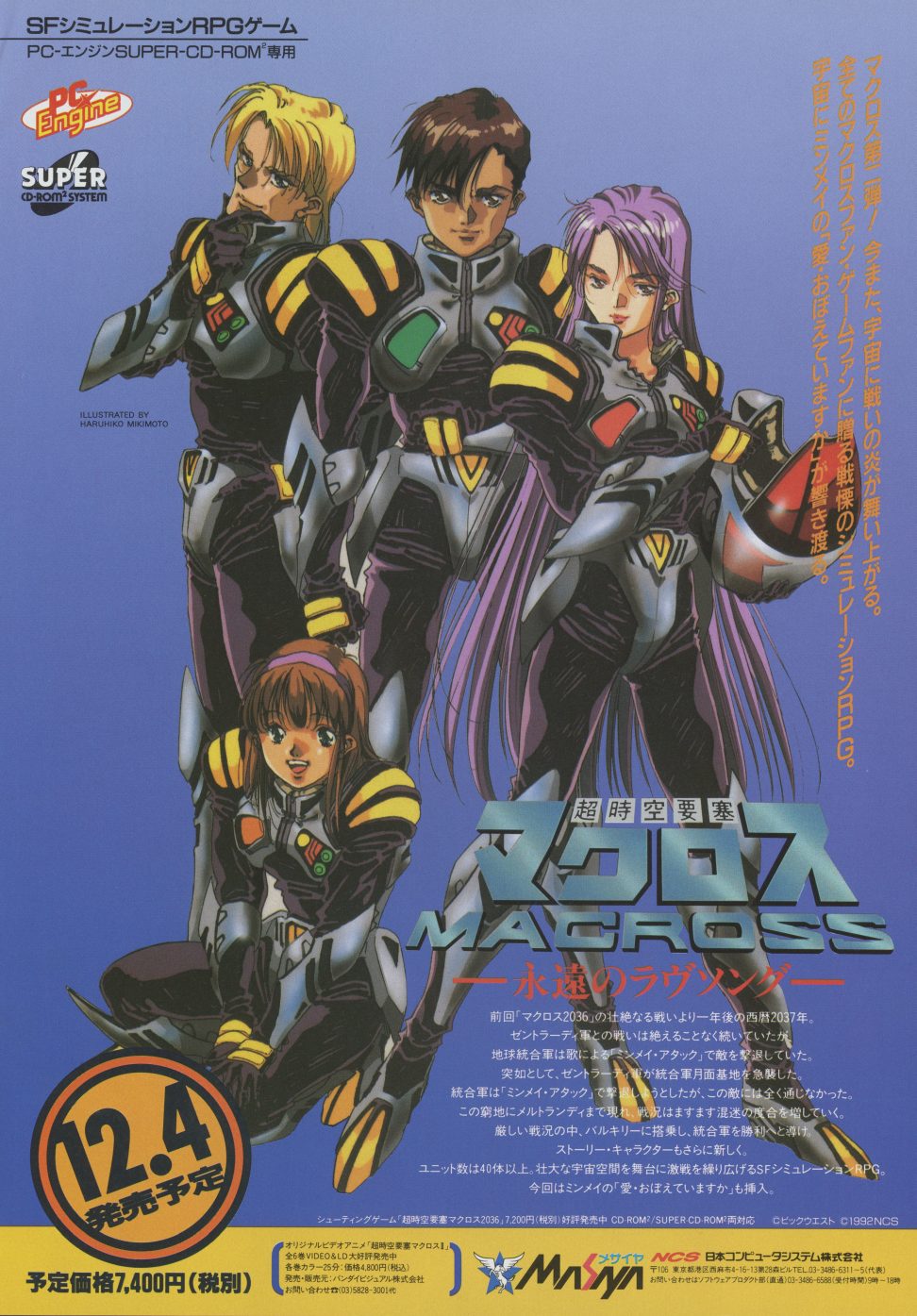 Inserted advertisement: 超時空要塞マクロス —永遠のラヴソング— (Macross: Eternal Love Song), an SF simulation RPG for PC Engine Super CD-ROM. Release date December 4, ¥7,400. Published by Masaya. The media ecosystem around Macross II included games, soundtracks, and model kits — infrastructure built for a continuity that would be abandoned within two years.
Mikimoto painted six watercolor jackets for this release. He was the original Macross character designer — the artist who defined the franchise's visual identity in 1982. A decade later, he illustrated the sequel that the franchise's creator did not make. Volume 6's jacket, "Sing Along," assembles the full cast in a composition that mirrors the original series' ensemble paintings. It is a closing image for a story Mikimoto treated as a continuation and that Kawamori would treat as a footnote.
The six CAV discs hold a beautifully animated OVA that predicted where Macross would go — music as literal weapon, idol as strategic asset — without being allowed to take it there. The franchise moved on without it. The six CAV discs, six Mikimoto paintings, six settei inserts, and the bonus CD in the Marduk alien language are from the version of Macross continuity that Kawamori later overrode with Macross Plus and Macross 7.
Loading...