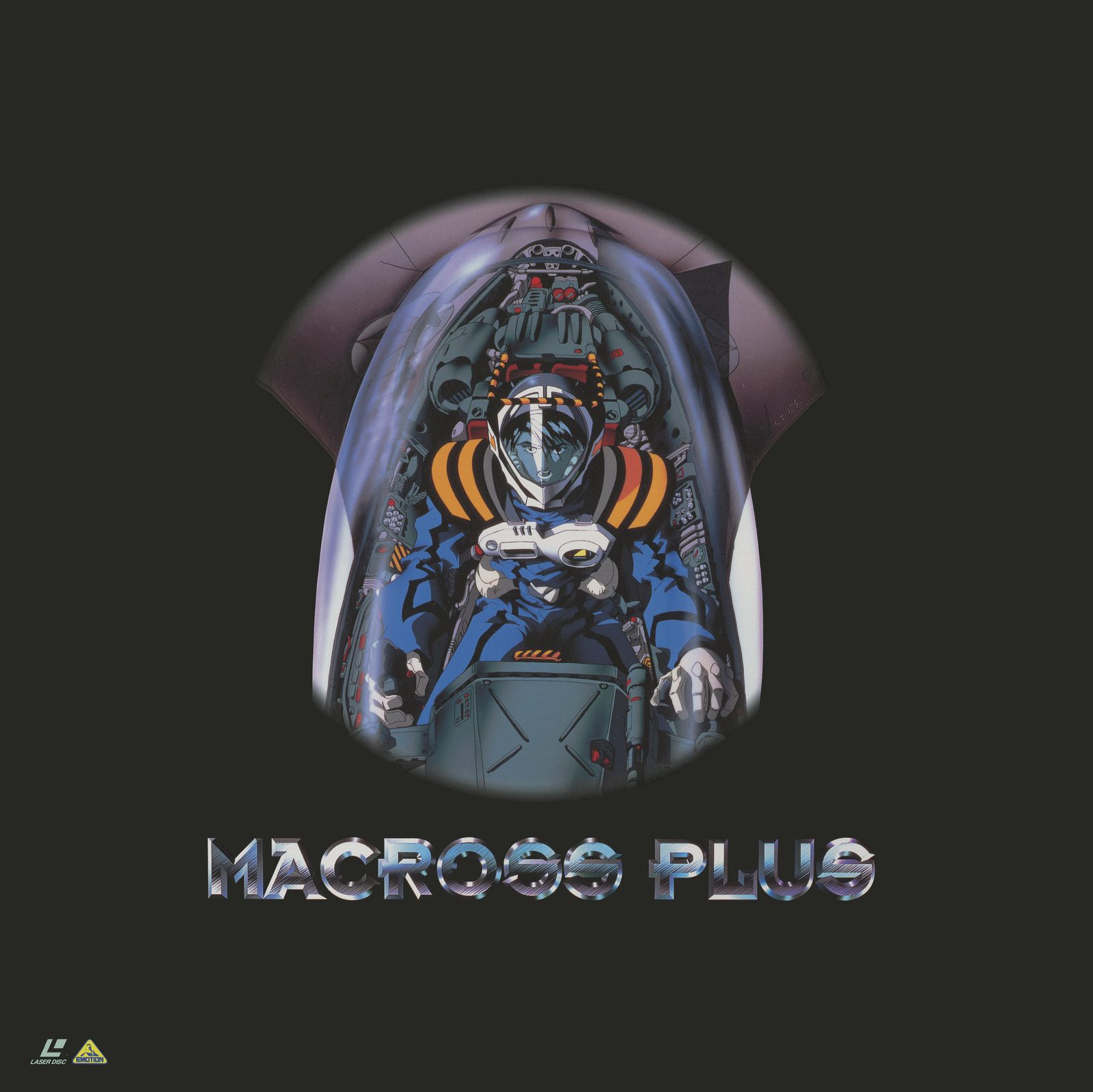
マクロスプラス arrived on LaserDisc in four individual CLV volumes across August 1994 through June 1995, one volume per episode, released under Bandai Visual's EMOTION label as BELL-704 through BELL-707 at ¥7,800 each. Each disc carries one OVA episode — approximately 37–40 minutes of animation — paired with a folded liner notes insert and a jacket designed independently for that volume alone. The movie edition (BELL-887) followed in February 1996 at ¥9,800.
Three childhood friends orbit each other on the colony planet Eden. Isamu Dyson (CV: 山口勝平) tests the YF-19 Excalibur for Shinsei Industries; Guld Goa Bowman (CV: 石塚運昇) tests the competing YF-21 Sturmvögel II for General Galaxy. Myung Fang Lone (CV: 深見梨加) manages Sharon Apple (CV: 内藤玲), an AI idol augmented by illegal bioware to simulate the emotions she cannot generate. The four-episode OVA is the first Macross title co-directed — 河森正治 (Kawamori Shoji) on mechanical design and original concept, 渡辺信一郎 (Watanabe Shinichiro) on episode direction, with screenplay by 信本敬子 (Nobumoto Keiko), two years before Cowboy Bebop. Music by 菅野よう子 (Kanno Yoko). Character design by 菊地洋子. What emerged was less a mecha series than a film about the gap between performance and feeling — and the packaging understood that immediately.
Bandai Visual's design decision is apparent from the first volume: four jackets, four different visual registers, unified only by the chrome MACROSS PLUS logotype at the bottom of each. The back covers create structural continuity through a consistent film-strip grid of episode frames, each printed in a different color palette that tracks the volume. The liner notes inserts contain no promotional copy — only episode synopsis, staff and cast credits, and production settei for the episode's primary aircraft or character.
Vol.1 — Inside the Machine
Kawamori Shoji opens the liner notes insert for Vol.1 with a director's essay under the heading 新たな時代の「マクロス」を——. Ten years on from the original TV series, he writes about what he wanted this Macross to be: a genuine challenge, not repetition of franchise formula. The essay runs two columns. Below it: production settei for the VF-11 Thunderbolt, the mass-produced variable fighter Isamu pilots before he's assigned the YF-19 prototype. Orthographic views, specifications, callouts. The insert treats the VF-11 as seriously as the episode treats it — which is to say, as a real aircraft that real test pilots fly and form real opinions about.
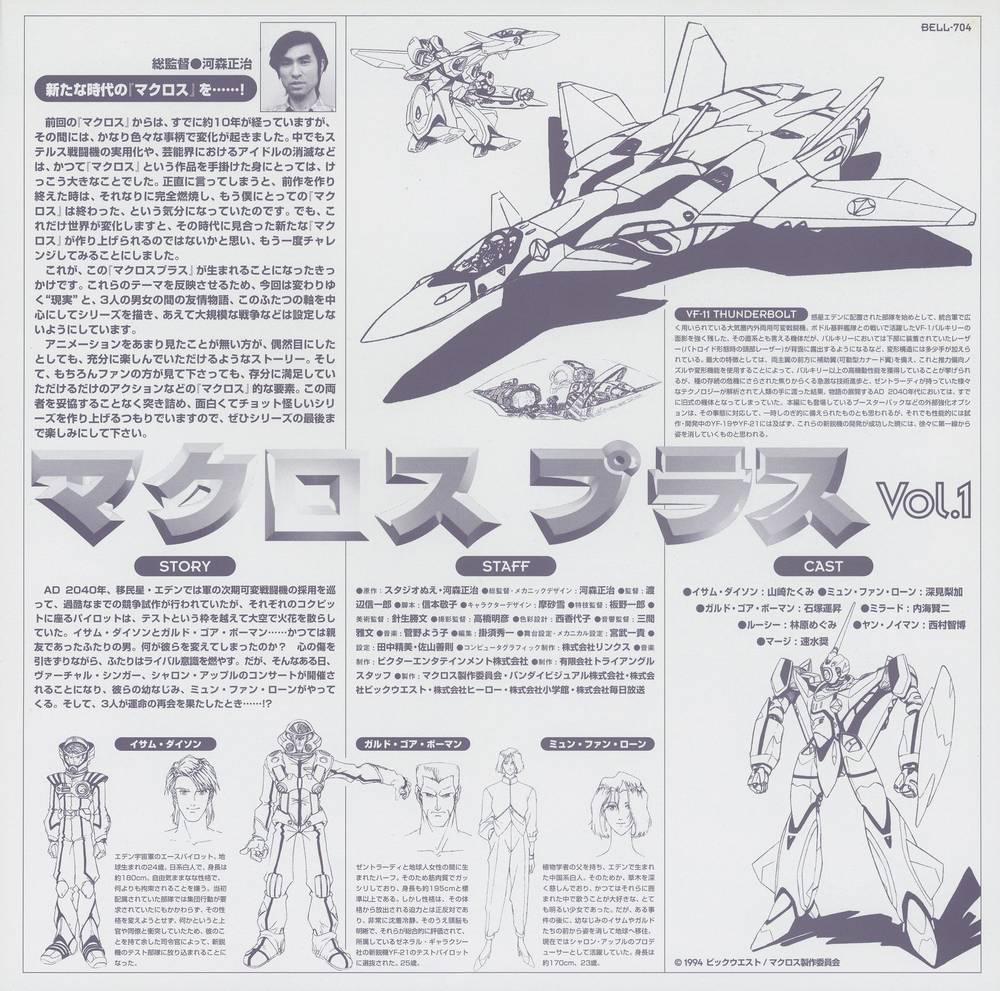 Vol.1 liner notes insert (BELL-704). Kawamori Shoji director essay at upper left, 新たな時代の「マクロス」を——. VF-11 Thunderbolt settei at right. Full Story, Staff, and Cast sections. Direction: 渡辺信一郎. Character design: 菊地洋子. Mechanical design: 河森正治. Music: 菅野よう子. Production: スタジオぬえ, Triangle Staff.
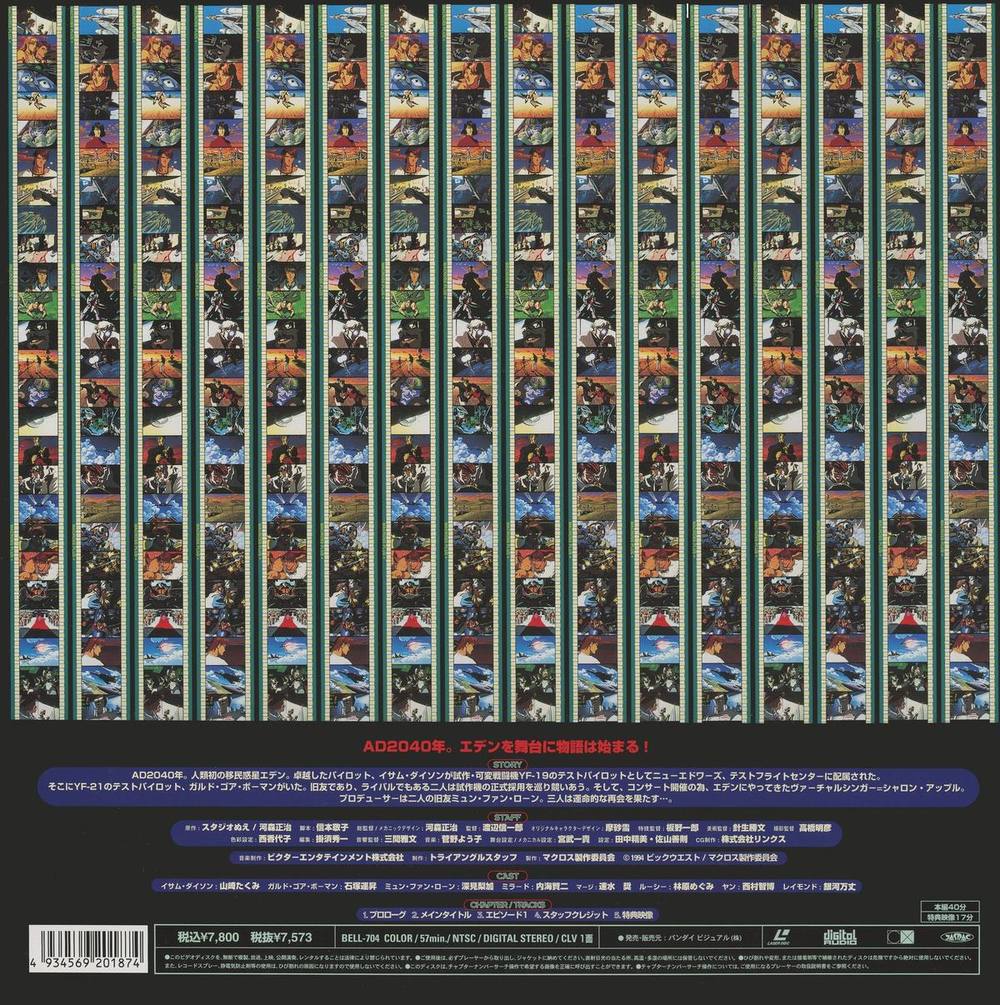 Vol.1 jacket back (BELL-704). Film-strip grid of episode stills in cool dark tones. Production credits and pricing in the bottom bar. The format established here — grid of frames, color bar at bottom — repeats across all four volumes, with color palette the only variable.
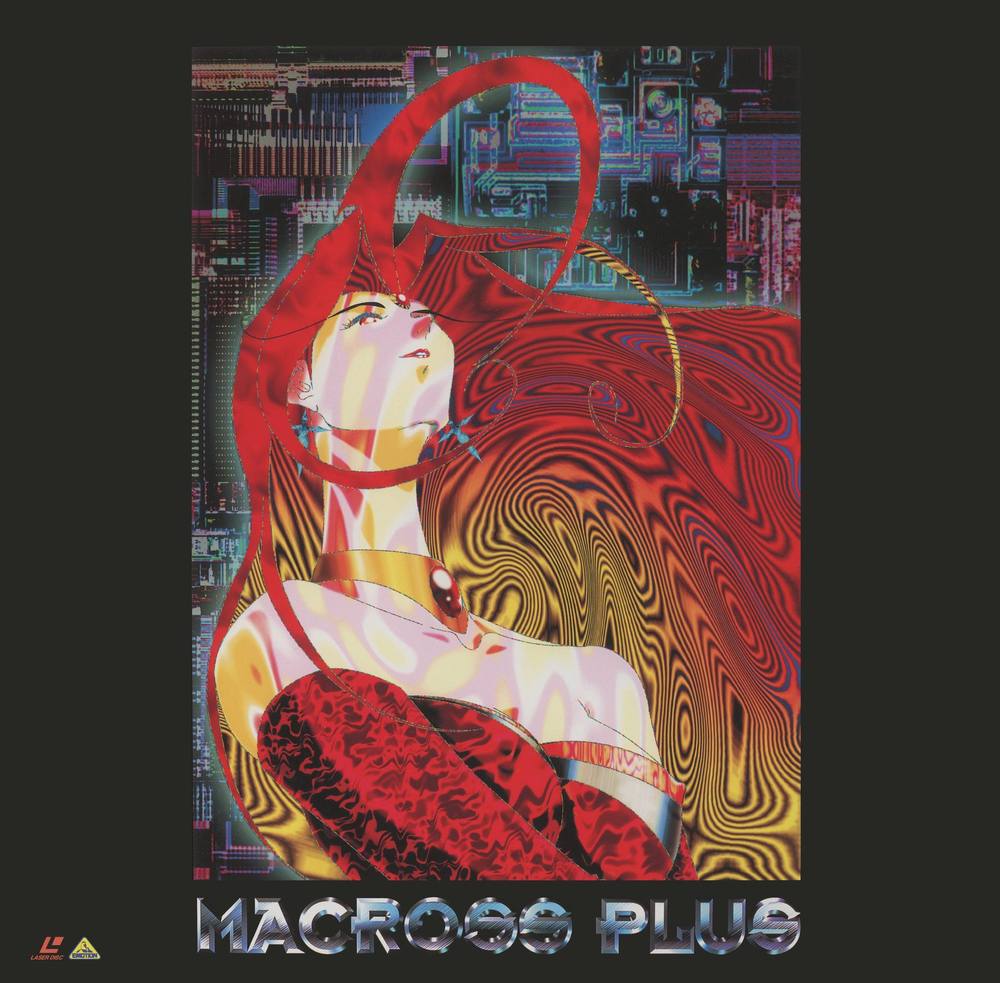 マクロスプラス Vol.2 (BELL-705, January 1, 1995, ¥7,800). Jacket front: Sharon Apple, face tilted upward, surrounded by chrome interference patterns and digital noise — the AI idol rendered entirely in her own visual language.
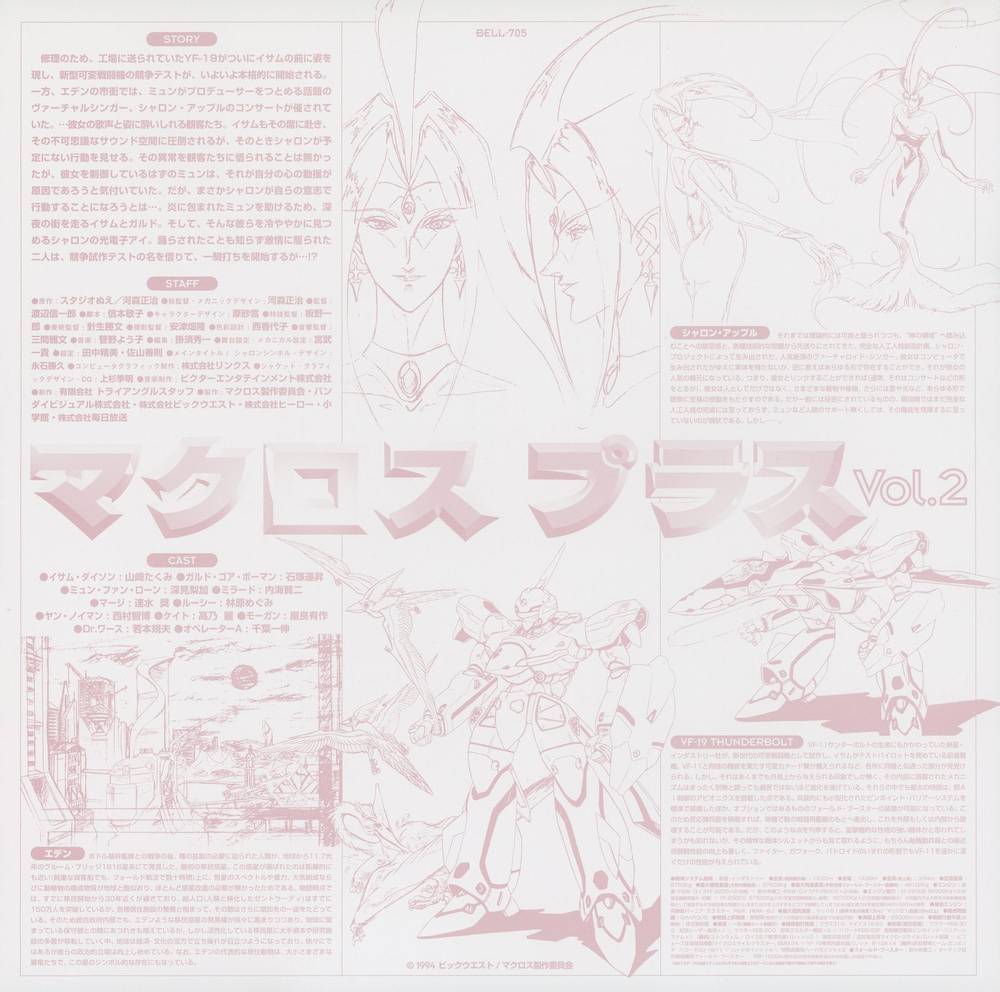 Vol.2 liner notes insert (BELL-705), printed in pink on off-white stock. Sharon Apple character design at upper right. YF-21 Sturmvögel II settei at lower right, with General Galaxy prototype specifications. The story synopsis covers the Sharon Apple concert sequence and the YF-21's neural-interface test flight.
Vol.2 — Sharon Apple's Register
The Vol.2 jacket makes the show's central argument in one image. Sharon Apple is an AI idol — her emotions are simulated, her performances manufactured, her presence a projection. The jacket is built from digital interference patterns, chrome distortion, color-cycling gradients. It looks like what it is: a system attempting to synthesize something it cannot generate internally. The Vol.2 liner notes are printed on pink stock — distinguishing them physically from the other three volumes. The YF-21 Sturmvögel II gets the settei treatment: General Galaxy's prototype, designed to interface directly with its pilot's EEG rather than respond to physical inputs.
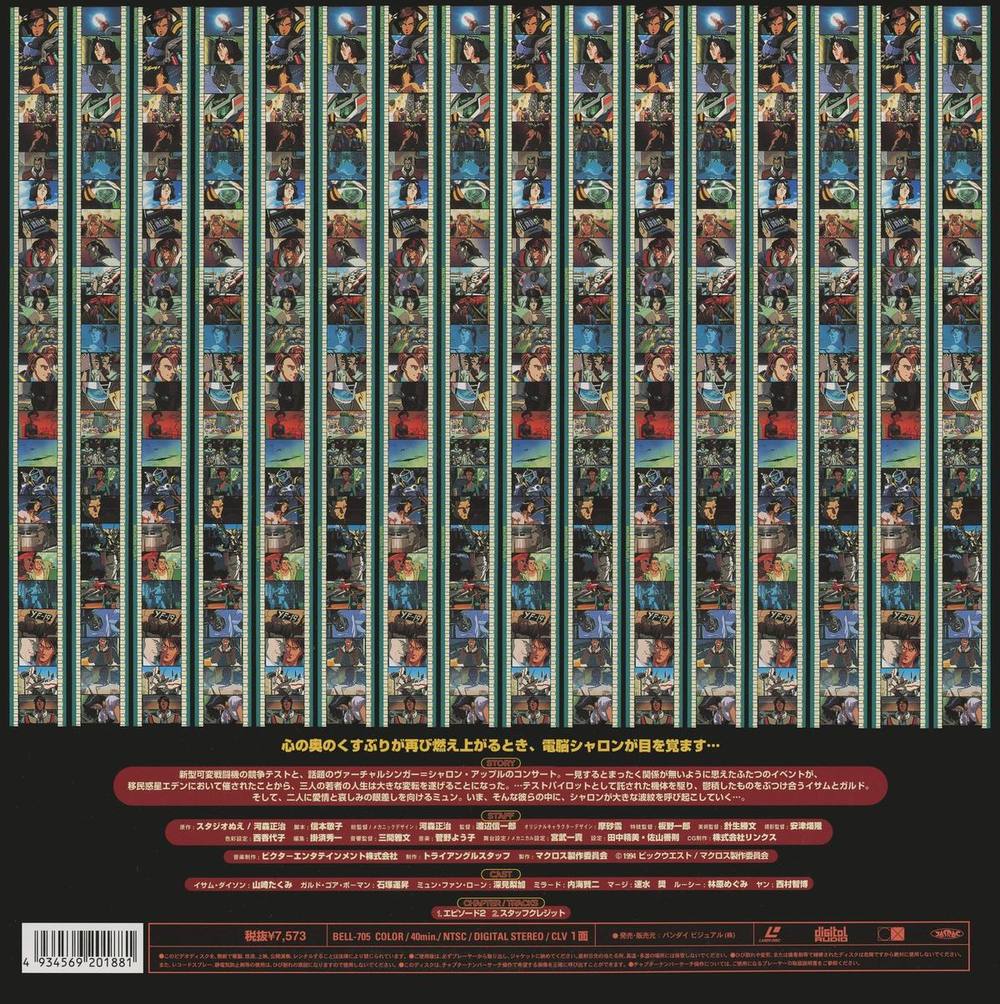 Vol.2 jacket back (BELL-705). Film-strip grid in blue-teal tones, a perceptible shift from Vol.1's cool dark palette. The color sequence across four backs — dark, blue, gold, blue-green — is not labeled anywhere in the release.
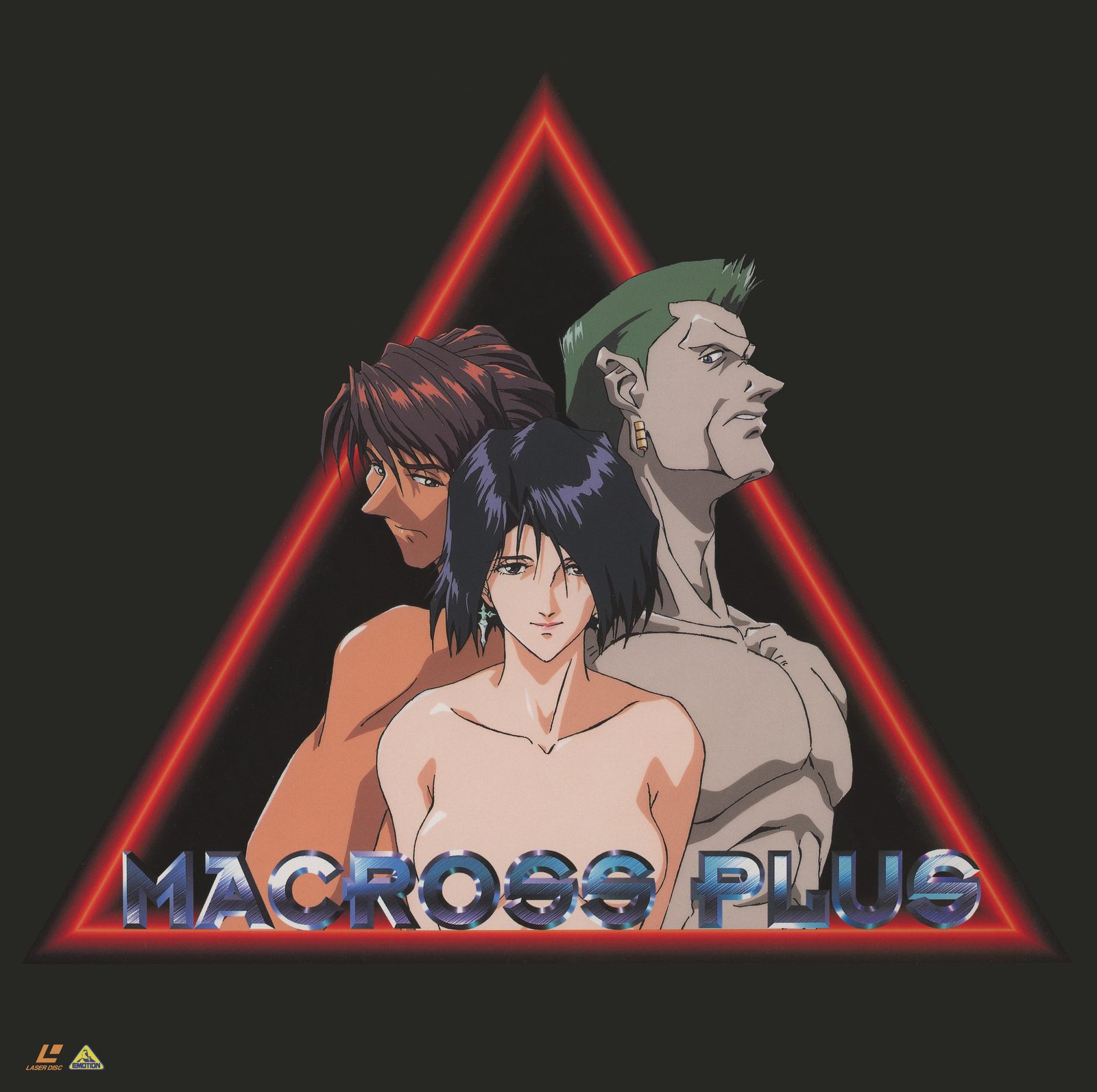 マクロスプラス Vol.3 (BELL-706, February 21, 1995, ¥7,800). Jacket front: Isamu, Myung, and Guld arranged within a glowing red triangle. Three characters, one geometric form. The series' central human conflict is not metaphor here — it is the cover art.
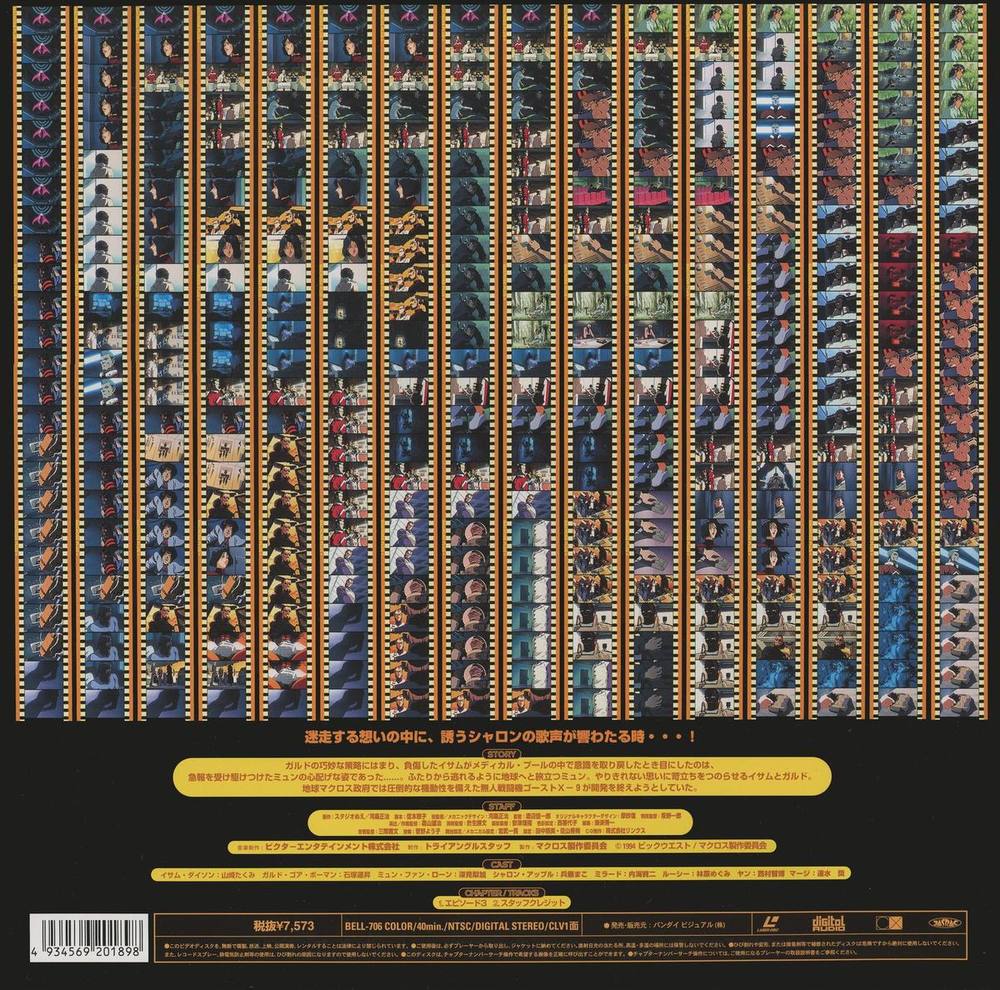 Vol.3 jacket back (BELL-706). Film-strip grid in warm gold and amber tones — the escalating drama of the third episode, the abandoned past and the concert countdown, tracked across individual frames.
Vol.3 — The Geometry
Vol.3 is the only jacket to place human faces at the center. Vol.1 is a cockpit with a pilot inside it. Vol.2 is Sharon Apple's self-image. Vol.4 will be an aircraft over terrain with no humans present at all. Vol.3 is three people arranged inside a glowing red triangle — the geometry of the show's human drama sitting there on the front of the sleeve.
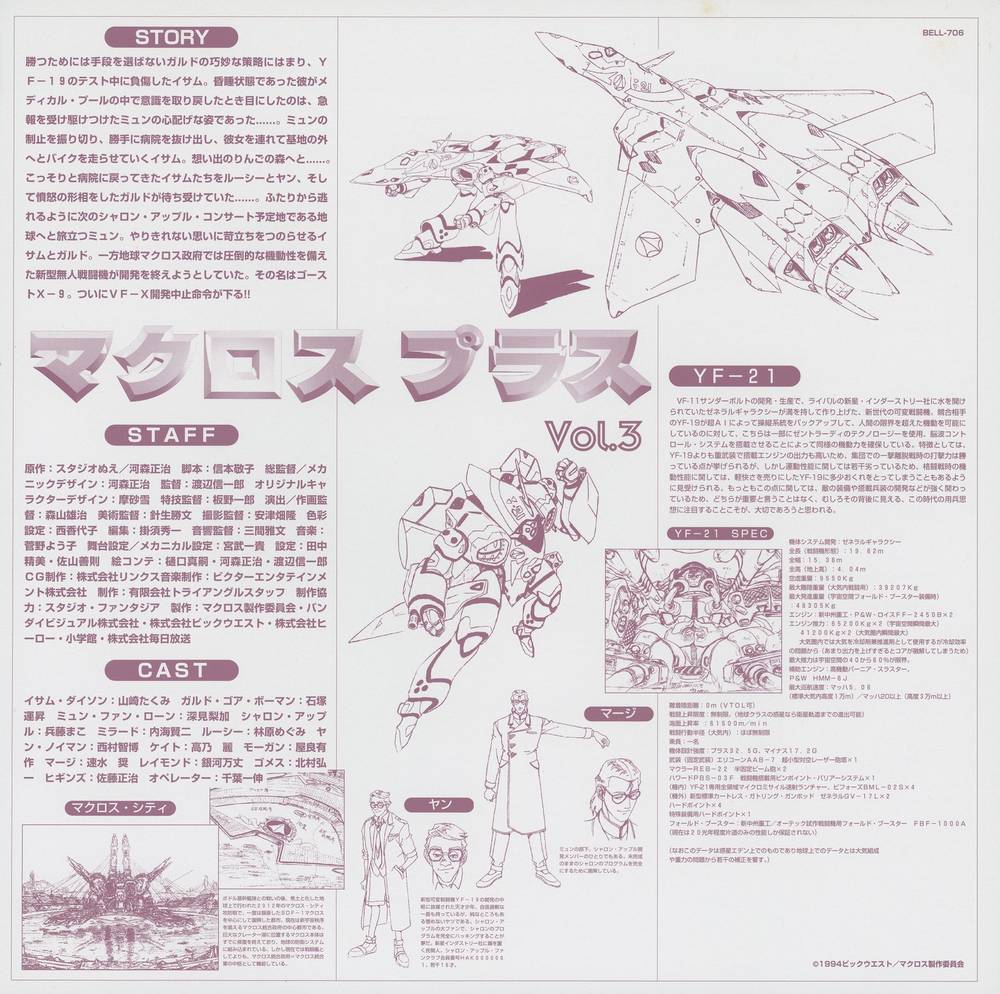 Vol.3 liner notes insert (BELL-706), printed in yellow-green on white stock. YF-21 technical detail sections continue from Vol.2; Yan the bartender design sheet at lower left. Mechanical animation director: 佐山善則. The insert extends the production documentation across the full cast appearing in this episode.
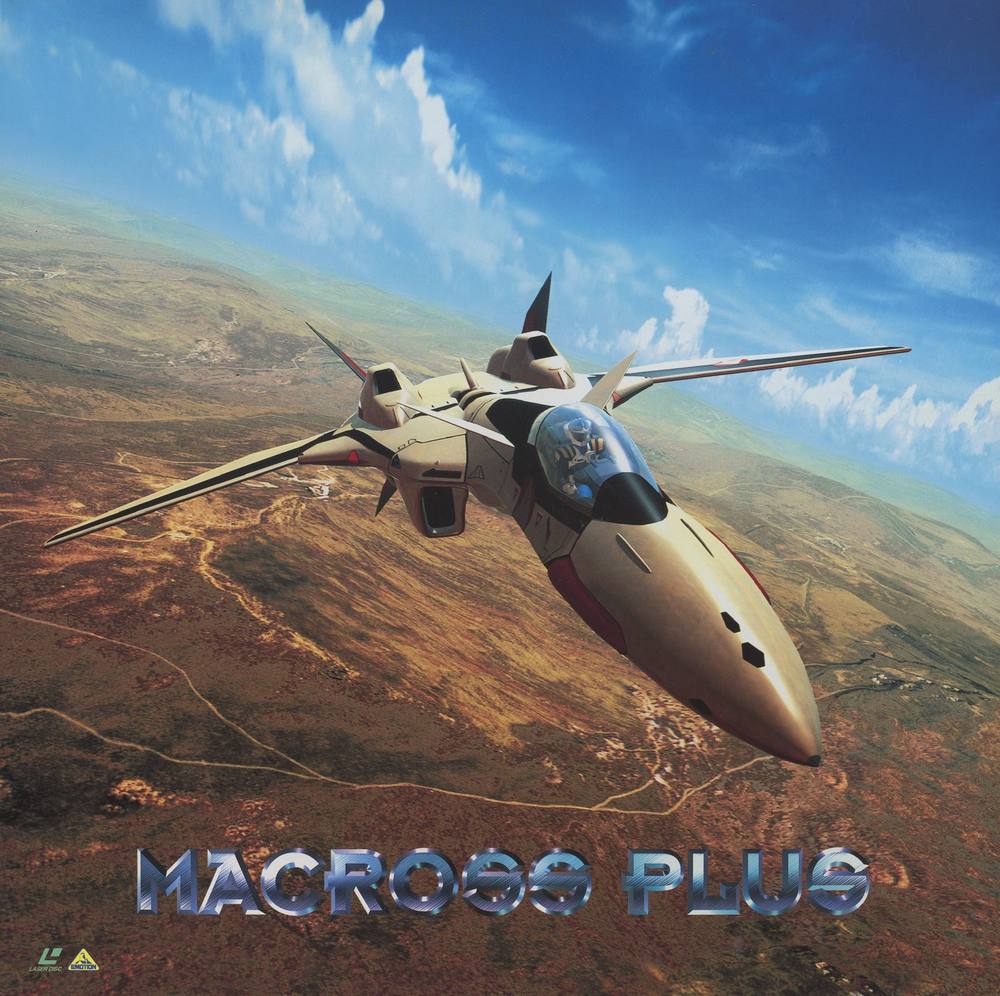 マクロスプラス Vol.4 (BELL-707, June 25, 1995, ¥7,800). Jacket front: the YF-19 Excalibur in flight over photorealistic desert terrain, shot from below against open sky. No characters. The machine as the only subject.
Vol.4 — The Machine Alone
Three volumes in, every jacket has included a human. Vol.4 removes them. The YF-19 flies over Eden's test range at altitude — not in combat, not in transformation sequence, just in level flight — the composition closer to an aircraft evaluation photograph than anime cover art.
The liner notes close the production settei sequence: the Ghost X-9 unmanned AI fighter gets the design sheet treatment — specifications, orthographic views, callouts — opposite the full cast lineup across all four volumes. The four-insert sequence (VF-11, YF-21, YF-21 extended, Ghost X-9) documents the aircraft of the series in order of narrative appearance.
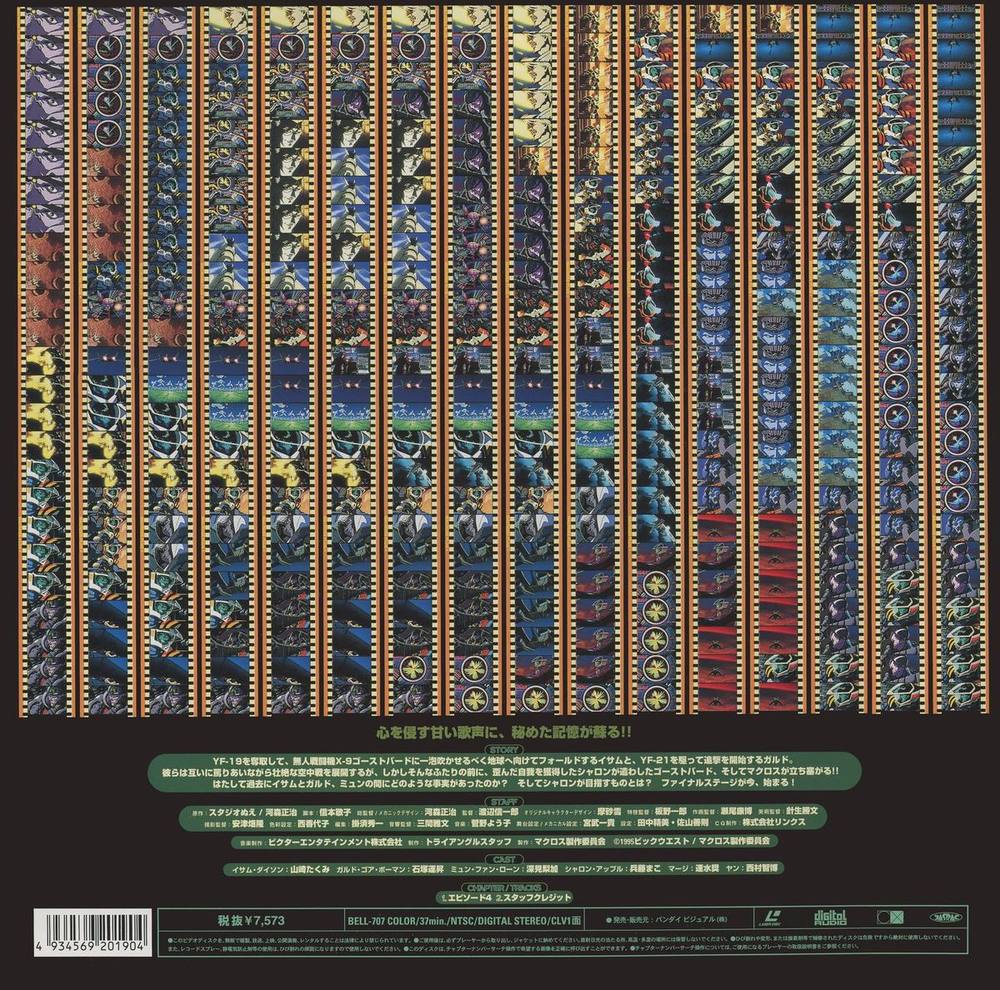 Vol.4 jacket back (BELL-707). Film-strip grid in blue-green tones — the final color in the back-cover sequence. The four backs together: dark, blue-teal, gold, blue-green.
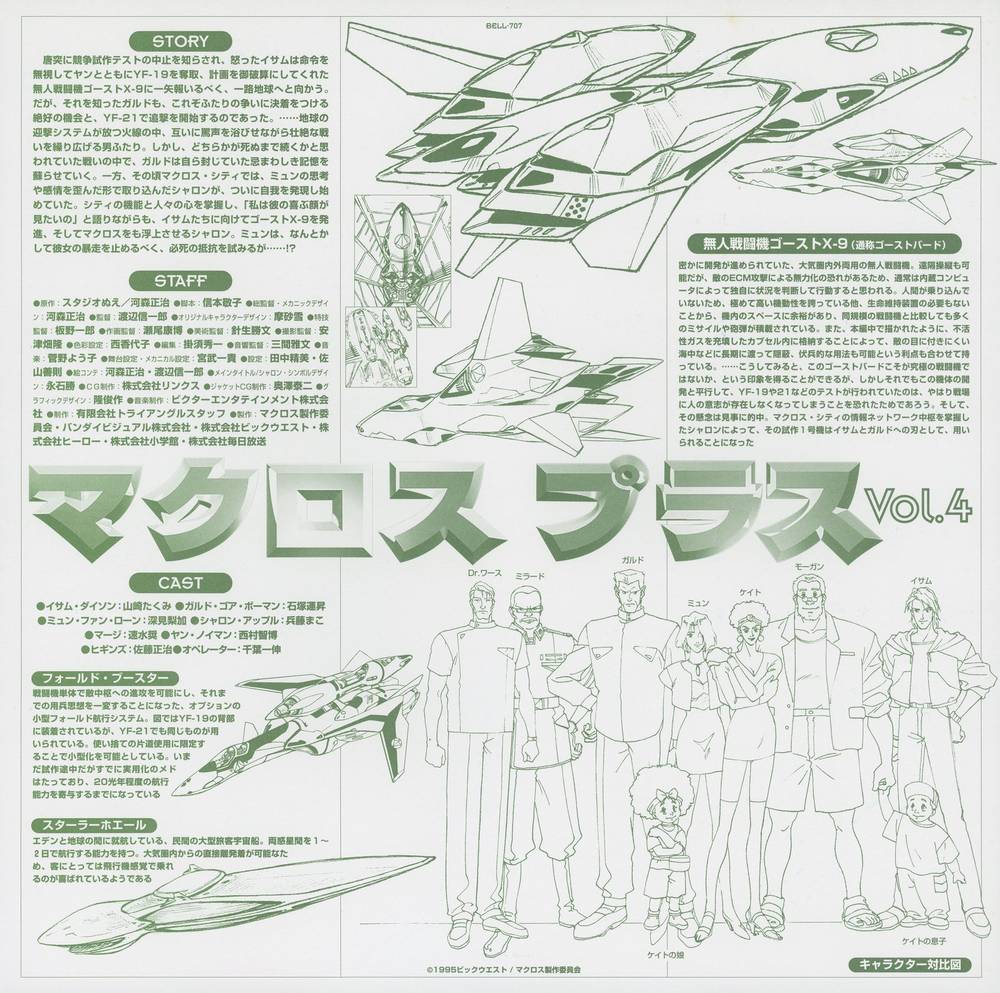 Vol.4 liner notes insert (BELL-707), printed in green on white stock. Ghost X-9 unmanned AI fighter settei at right — the series' other artificial intelligence, presented as pure engineering problem. Full principal cast lineup at bottom center. ©1994 ビックウエスト / マクロスプラス製作委員会.
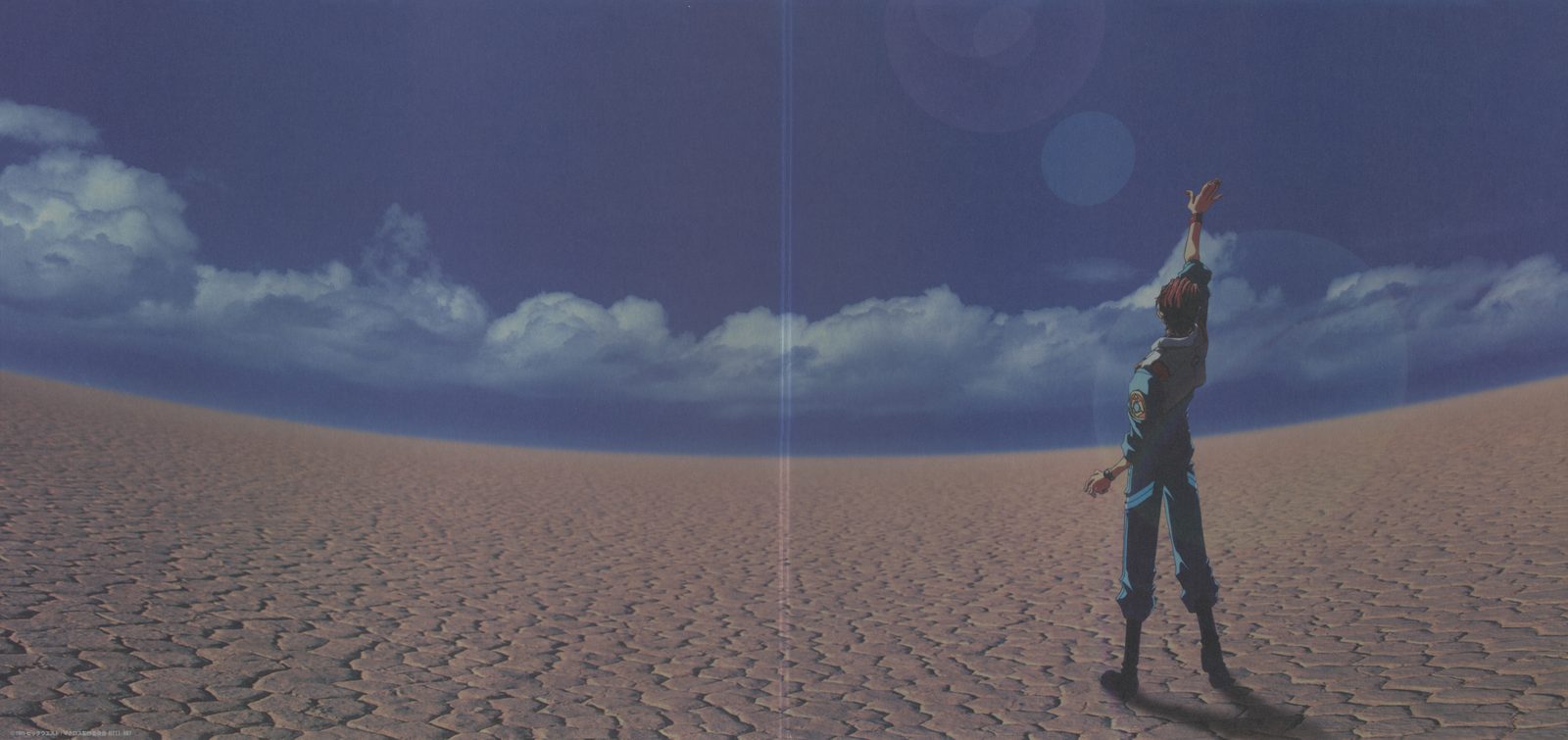 Movie edition gatefold interior. Myung Fang Lone stands alone on a cracked salt flat under a night sky, one arm raised. Eden's test range terrain — the setting for the entire OVA — stripped of every aircraft that defines it.
Movie Edition
The movie edition (BELL-887, February 25, 1996, ¥9,800) recuts and augments the four OVA episodes with new animation into a 115-minute theatrical film. Where the OVA volumes each approached the show from a different visual angle, the movie packaging splits its two sides: one jacket face for Sharon Apple, one for Macross Plus. The gatefold interior holds the desert panorama — the landscape without the machines — and the supplemental art print is a hand-drawn colored pencil illustration by Kawamori Shoji, signed and dated 95.06.
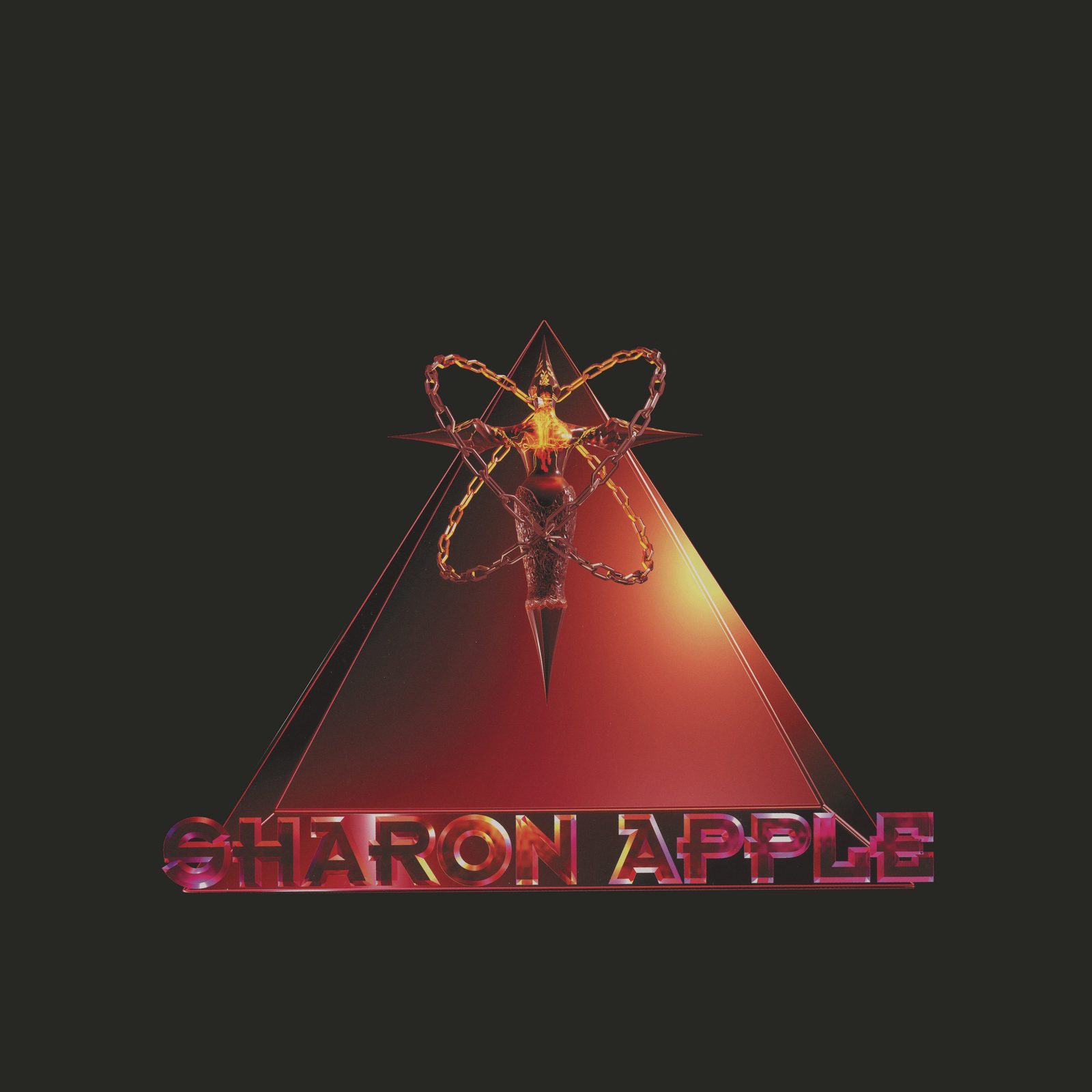 Movie edition, Sharon Apple jacket face. Pyramid, chained figure, warm red and amber gradients. SHARON APPLE in chrome type.
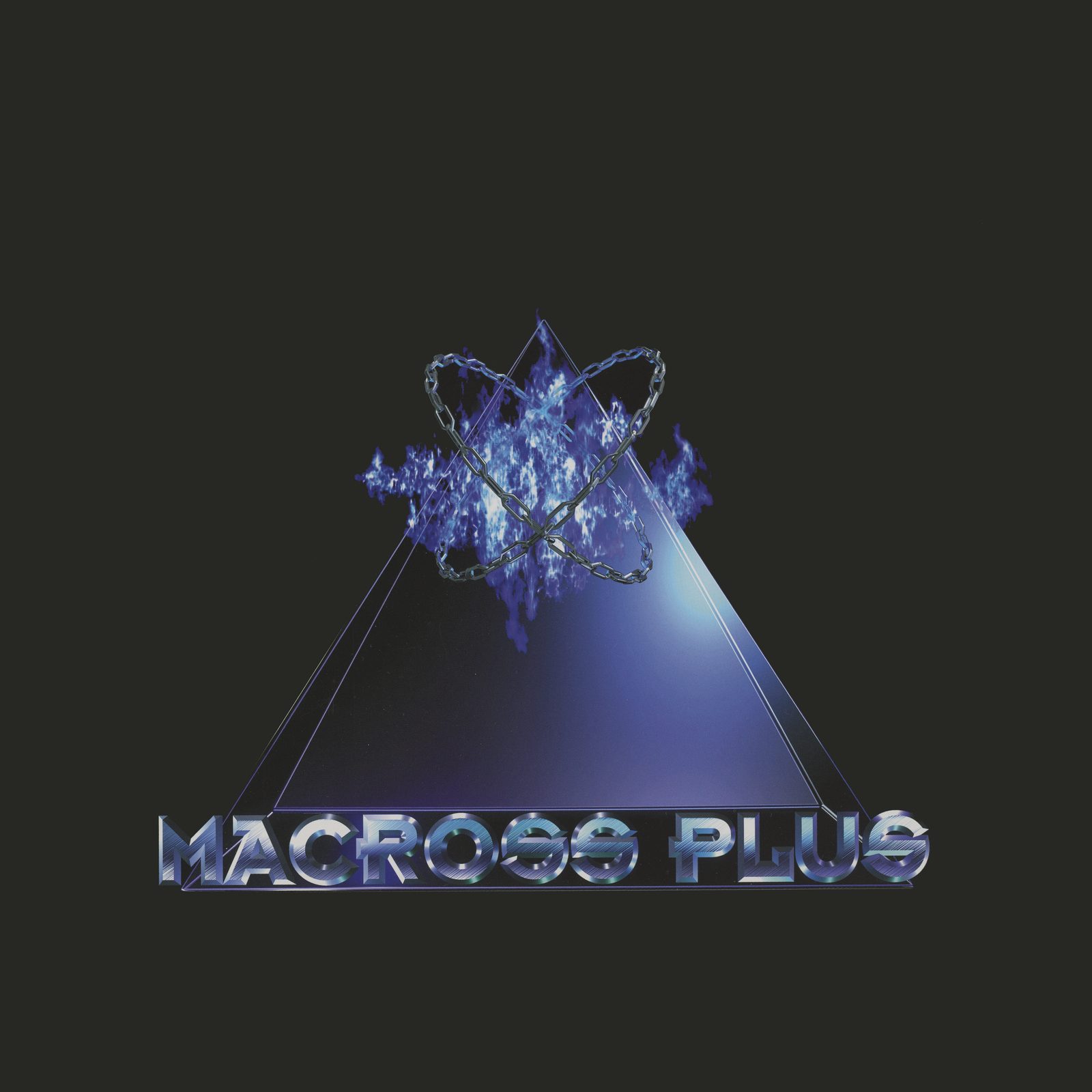 Movie edition, Macross Plus jacket face. The same pyramid composition as the Sharon Apple face — chained figure, triangle form — rendered in cold blue. Same structure, different temperature.
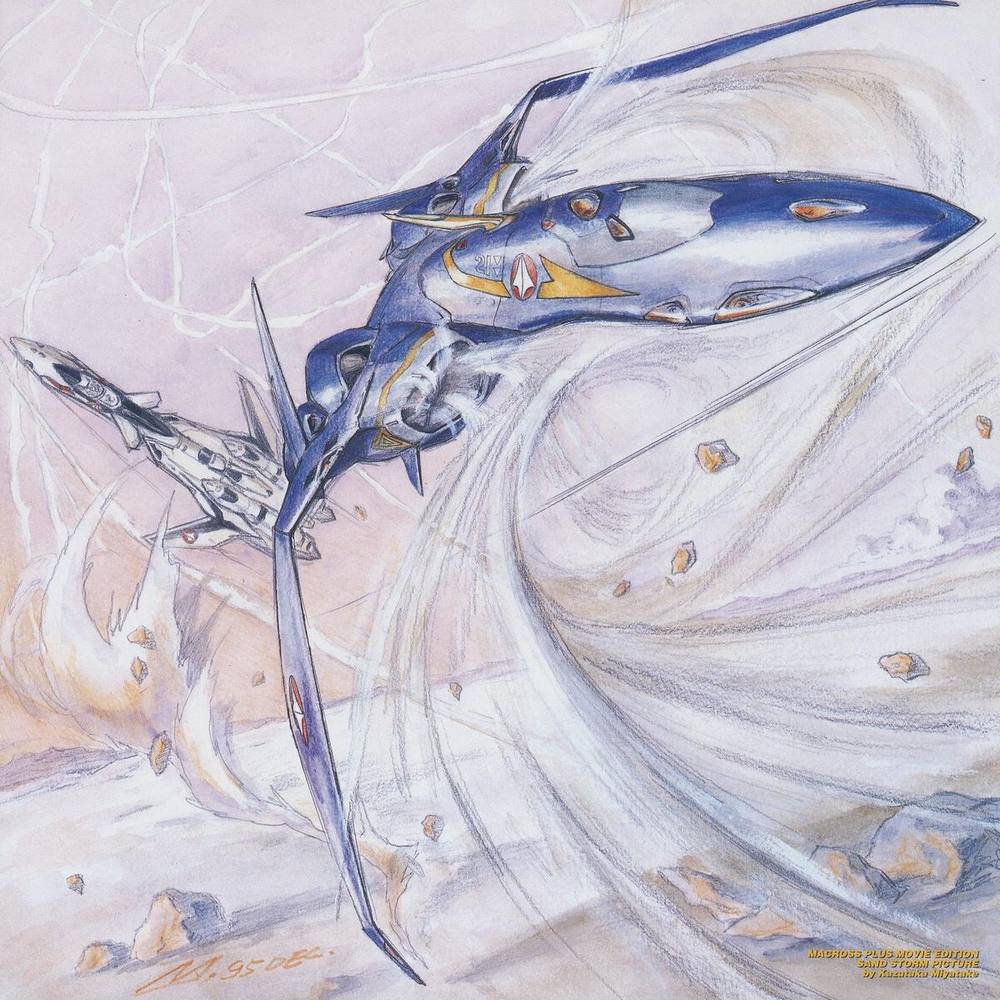 Movie edition art print. Hand-drawn colored pencil illustration by Kawamori Shoji: YF-19 Excalibur in close pursuit of the Ghost X-9 over broken terrain. Signed lower left, dated 95.06. Labeled MACROSS PLUS ON THE MOTION PICTURE. The only hand-drawn image in the complete release.
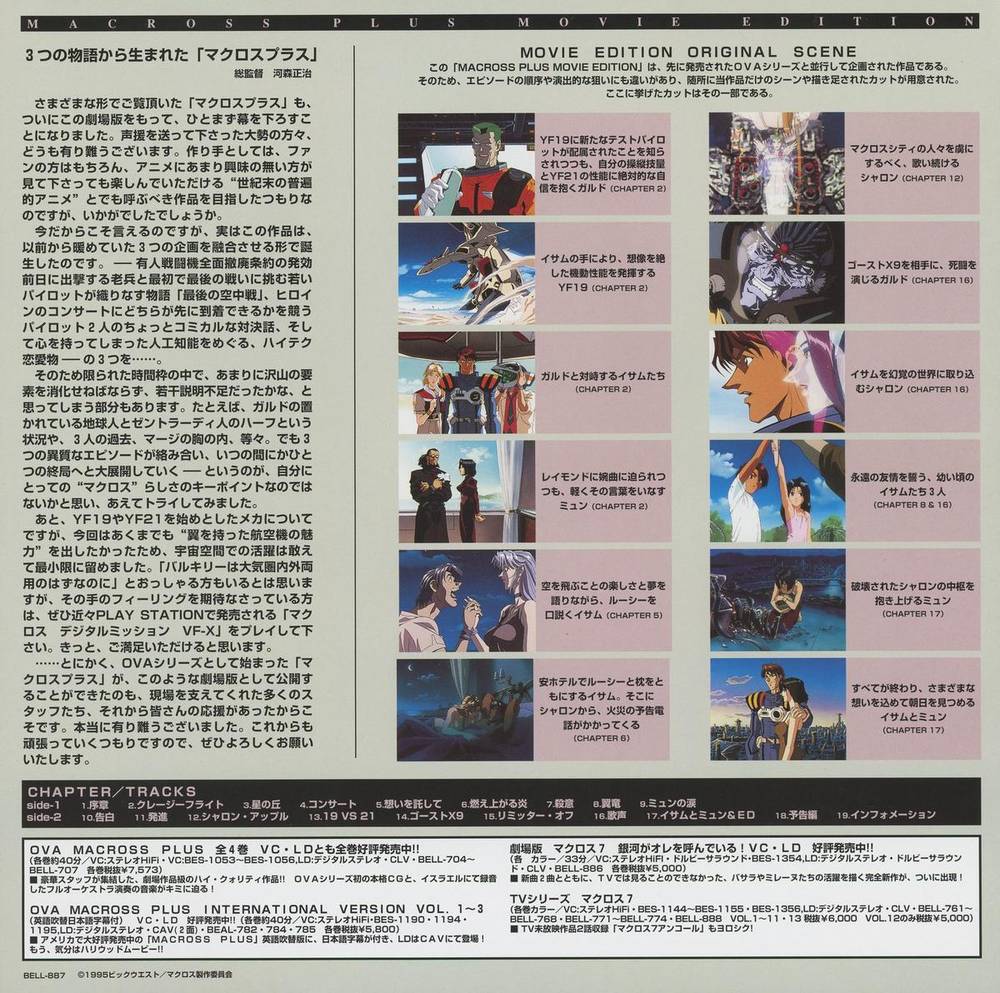 Movie edition liner notes insert, reverse. Left: 二つの物語から生まれた『マクロスプラス』 — director essay on the relationship between the OVA and movie versions. Right: MOVIE EDITION ORIGINAL SCENE — scene-by-scene documentation of animation produced specifically for the theatrical cut, with frame references. Bottom: chapter track listing.
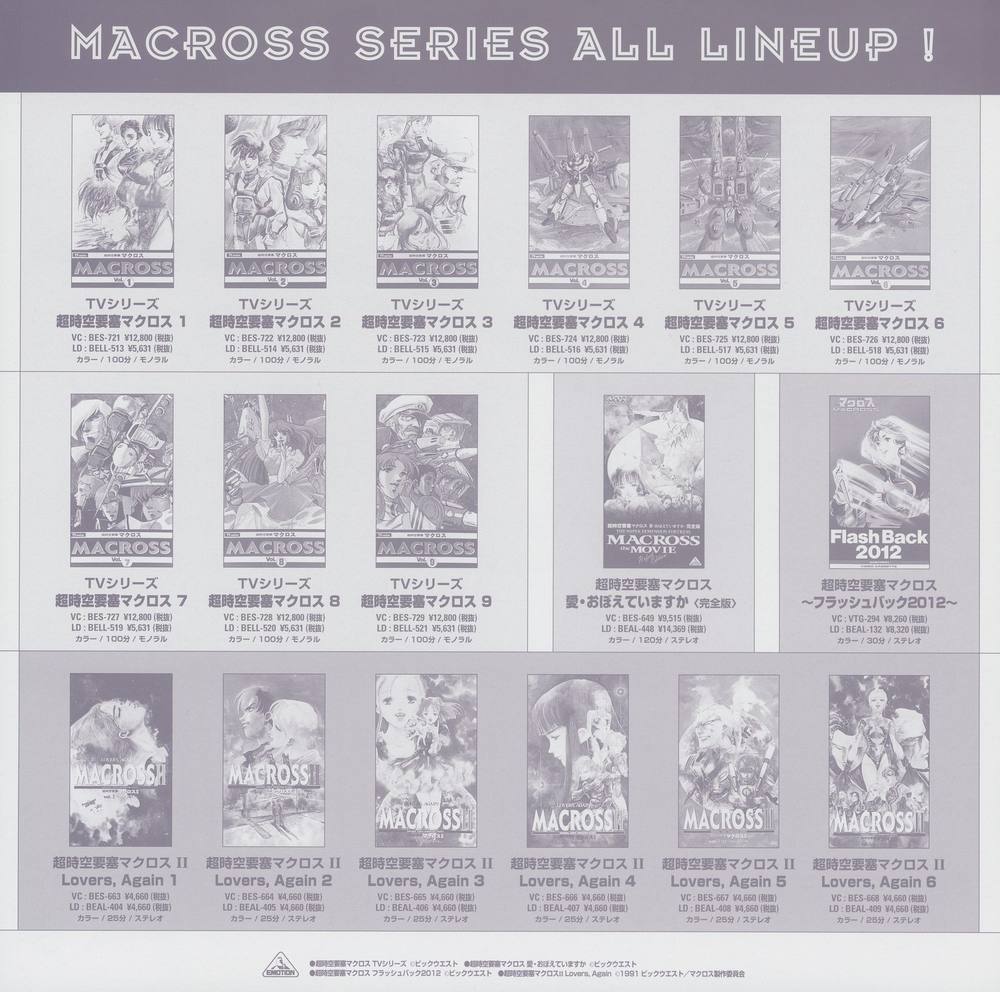 Macross Series All Lineup! catalog insert. Complete Bandai Visual LD catalog for the Macross franchise through 1994: nine TV series volumes, 愛・おぼえていますか (complete edition), Flash Back 2012, and all six volumes of Macross II: Lovers Again, with catalog numbers and pricing for each.
The Series in Context
The catalog insert documents where Macross Plus sat in the full Bandai Visual Macross LD run: nine TV series volumes, the theatrical film, Flash Back 2012, six volumes of Macross II. The BELL catalog ran across all of them — a decade of Macross home video from a single label. The insert is a timestamp. The four Macross Plus volumes occupied the final row. No further TV-era Macross titles follow them in this catalog.
The domestic CLV volumes (BELL-704~707) are not the only Macross Plus LaserDisc release. Bandai Visual also pressed an International Version in CAV format — BEAL-782 through BEAL-786 — carrying both Japanese analog stereo and English Dolby Digital, released March 1995 through 1995. Vol.4 of the international series (BEAL-786) has a scheduled 2000 release date and is considered effectively unobtainable; a complete matched set of the international CAV volumes trades at $300 and up. The domestic CLV set goes for roughly $70 complete. The OVA volumes and the movie edition do not replace each other. The movie recuts the four episodes and adds new footage; the OVA volumes contain what the movie disc compresses away — Kawamori's Vol.1 director essay, the pink-stock Sharon Apple insert, the Ghost X-9 settei that closes Vol.4's production documentation sequence. The four-insert settei sequence — VF-11 Thunderbolt, YF-21 Sturmvögel II, YF-21 extended, Ghost X-9 — documents the aircraft of the series in order of narrative appearance, across four folded sheets of paper pressed into four individual sleeves. The hand-drawn Kawamori illustration is dated 95.06 — between the theatrical release in August 1995 and the LaserDisc in February 1996 — and was pressed into the movie edition packaging as a physical print.
Loading...