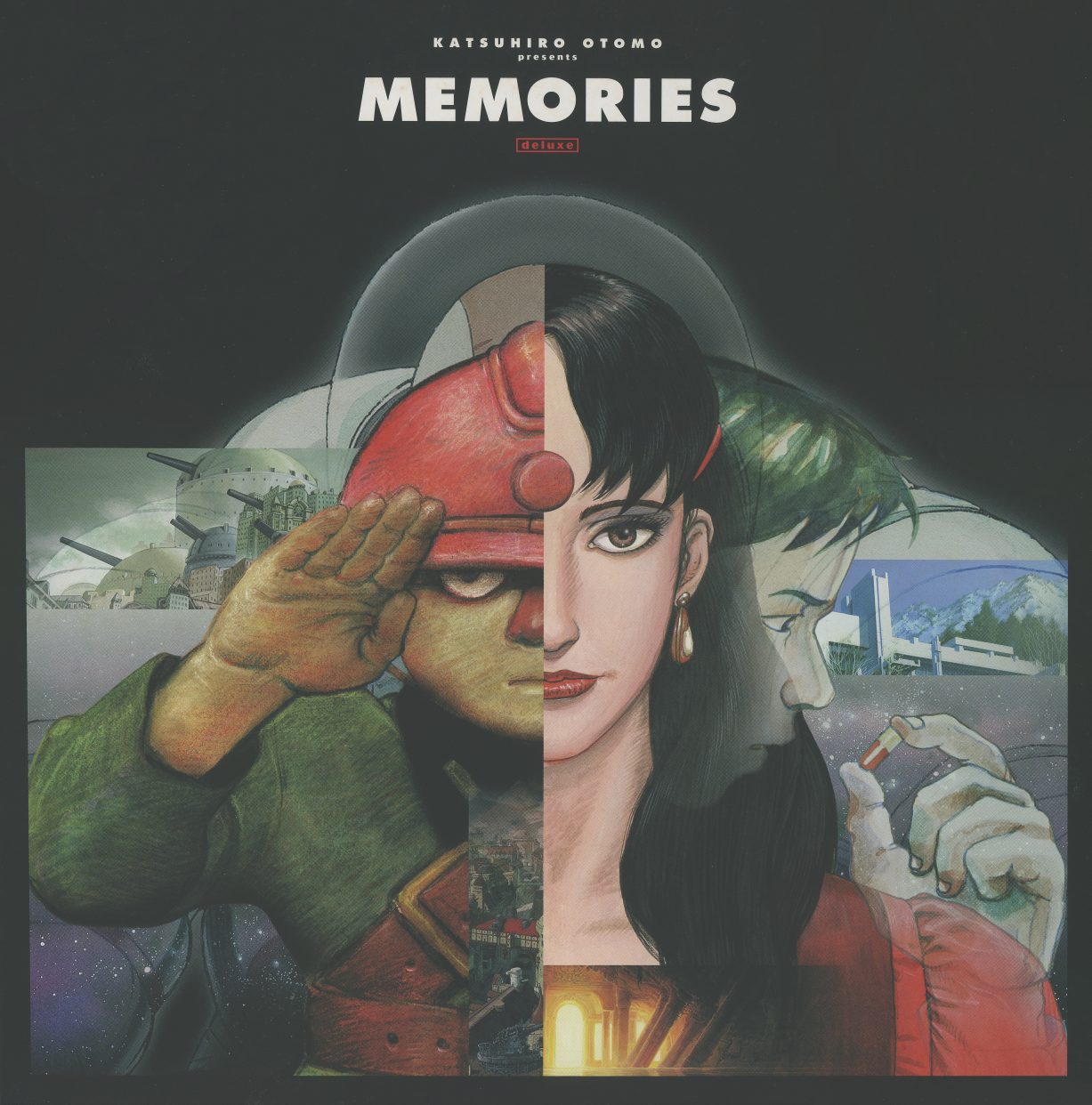
Memories (メモリーズ, 1995) is an anthology of three short films supervised by Katsuhiro Otomo, each directed by a different filmmaker: Koji Morimoto adapting Satoshi Kon's original manga story in Magnetic Rose (彼女の想いで); Tensai Okamura directing Stink Bomb (最臭兵器); and Otomo directing Cannon Fodder (大砲の街) himself. The three films are deliberately incoherent as a set — a romantic space opera set inside an abandoned opera singer's drifting mansion, a dark bureaucratic comedy about a government lab accident that accidentally weaponizes one man, and a 30-minute single-perspective war satire about a city that does nothing but manufacture and fire artillery. They share a producer, a release date, and a name above the title. Nothing else.
The Bandai Visual LaserDisc release (BVLL-539~541, November 1995) was the film's primary home format. It contains: three CLV discs, each carrying one episode in its own individually jacketed sleeve; an outer slipcase in black and a secondary slipcase in grey; and a multi-spread booklet documenting all three productions with production design material, episode credits, director and producer statements, and an Otomo career chronology. The box presents Memories as a chapter in a larger account, not a standalone release. The booklet is not supplemental. It is the fourth object in the anthology.
Seven Letters, One Stamp
The outer box carries no images, no episode titles, no synopsis. Seven characters in silver-white on deep charcoal: MEMORIES. Below them, a single red hanko stamp — the only color on the exterior panel. Bandai Visual released this in November 1995 as the film's primary home format; the theatrical run had just concluded. The outer packaging presupposes that the title, and the name above it — KATSUHIRO OTOMO presents — require no introduction.
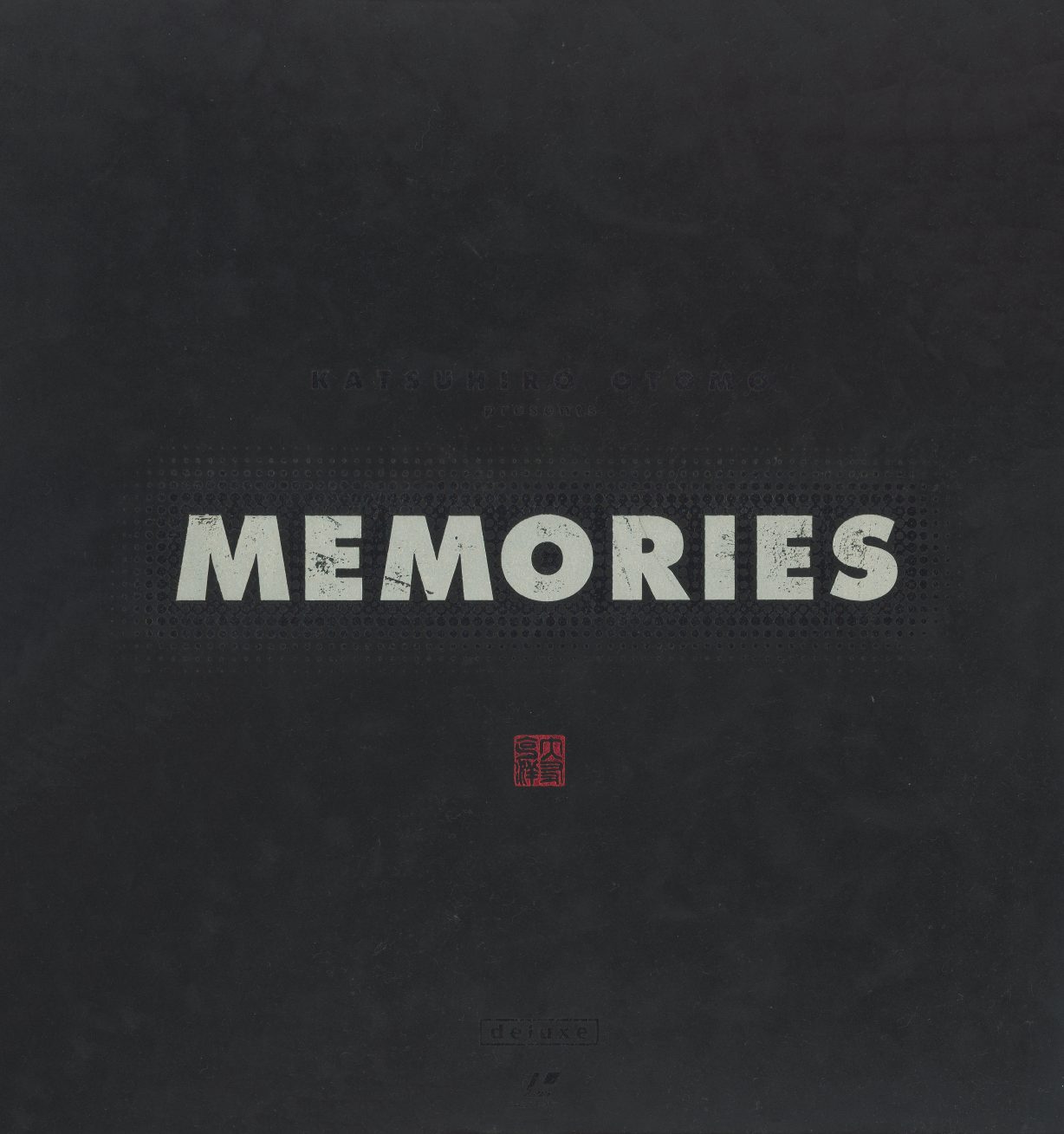 Outer box exterior — "MEMORIES" in silver-white letterforms on dark charcoal field. Red hanko stamp below. No episode titles, no synopsis, no key art. The entire exterior reduces to a title and a seal.
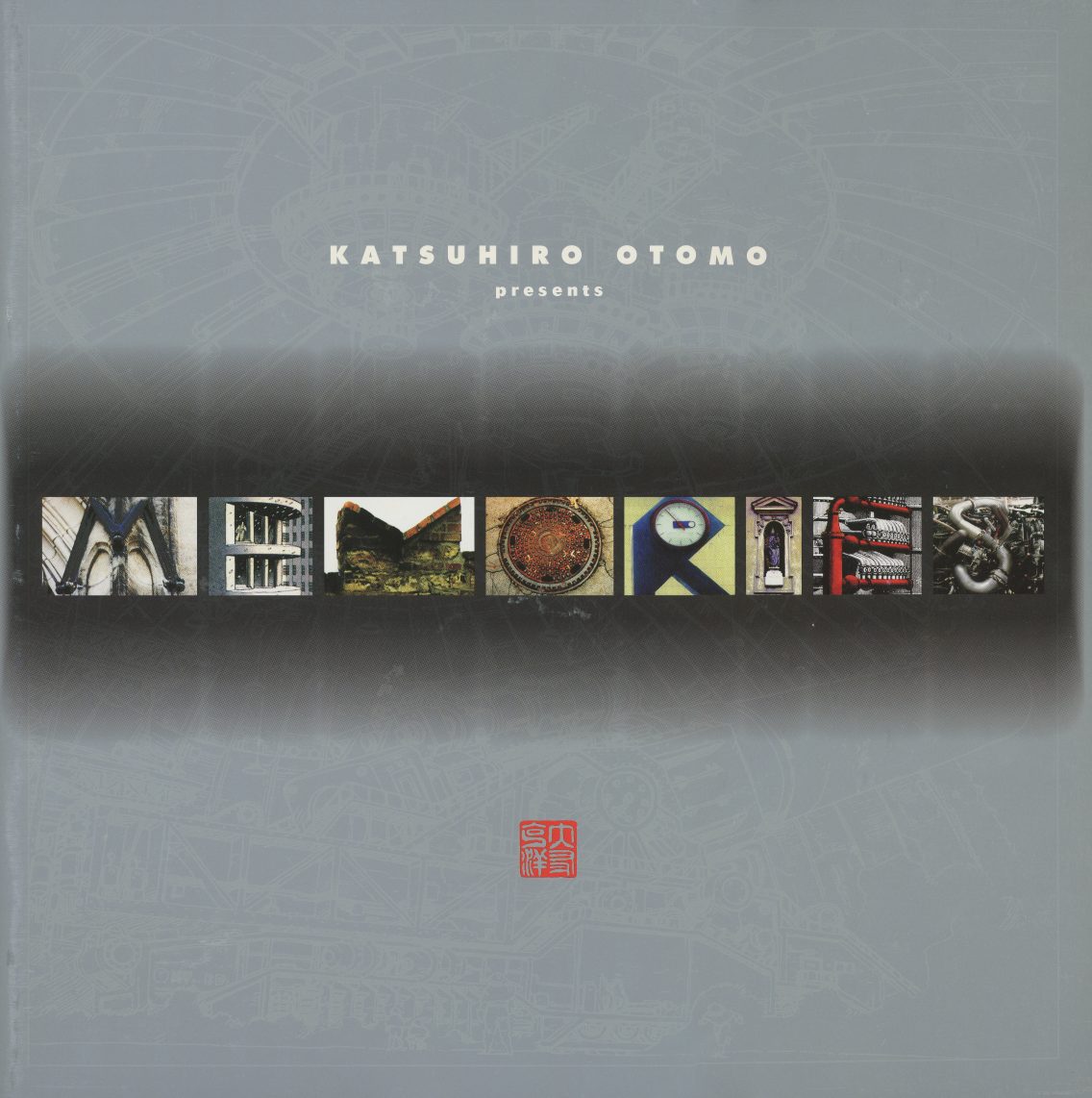 Inner slipcase front — grey field. "KATSUHIRO OTOMO presents MEMORIES" with the photo-letter logo: each letter of MEMORIES filled with a film still or location photograph. Same composition as the inner box, shifted from black ground to silver-grey.
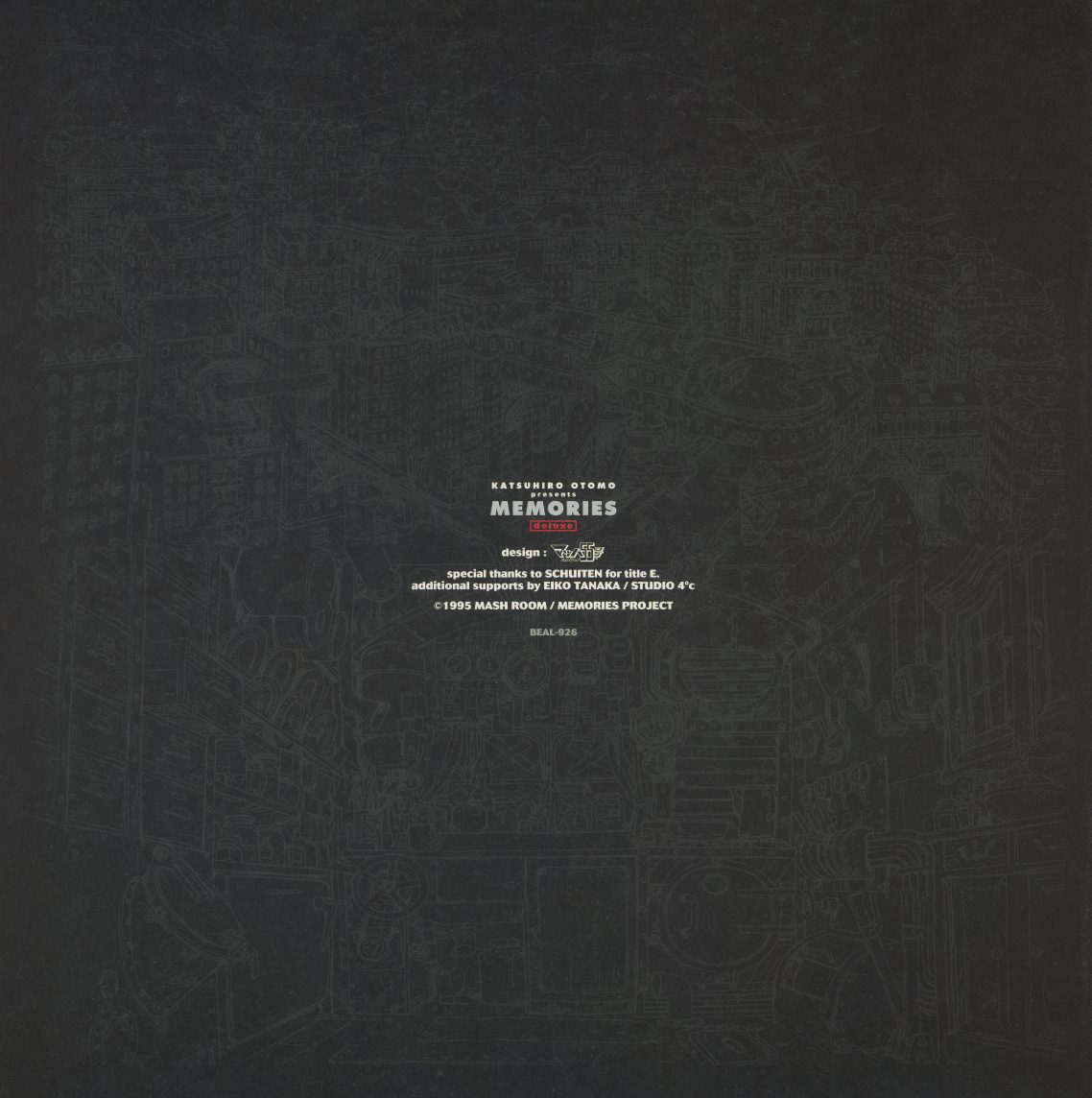 Outer box back panel — near-black field with centered micro-text listing production and distribution credits. No images. The back panel of the outer box is as restrained as the front.
 Inner slipcase back — grey field, "©1995 MASH ROOM / MEMORIES PROJECT" centered. MEMORIES logotype below. The production entity credit and copyright notice are the only text on the slipcase back.
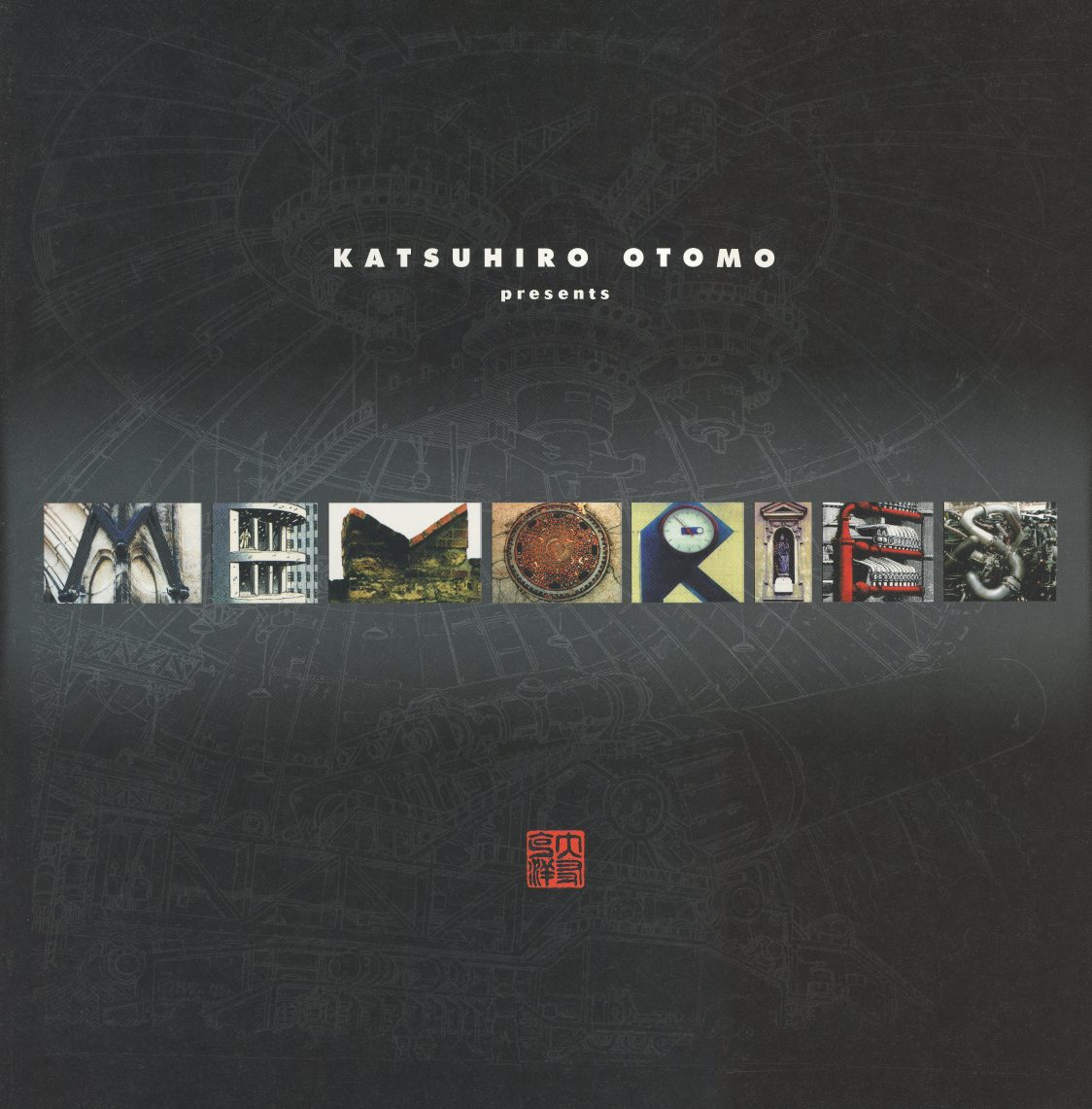 Inner box front — black field. "KATSUHIRO OTOMO presents MEMORIES" with the photo-letter logo at center: each letter in MEMORIES is filled with a film still from a different episode. The box-within-a-box structure holds the three jacketed discs and the booklet.
A Single Sentence
A dark panel inside the packaging carries the film's tagline in English only: "In the future, present or imaginary world, MEMORIES reveal themselves, like roses petals opening." No Japanese translation appears beside it. The line sits alone on its page, positioned as an epigraph before anything else. The anthology's thesis — that memory is not personal, not temporal, not bounded — is stated once and not argued further.
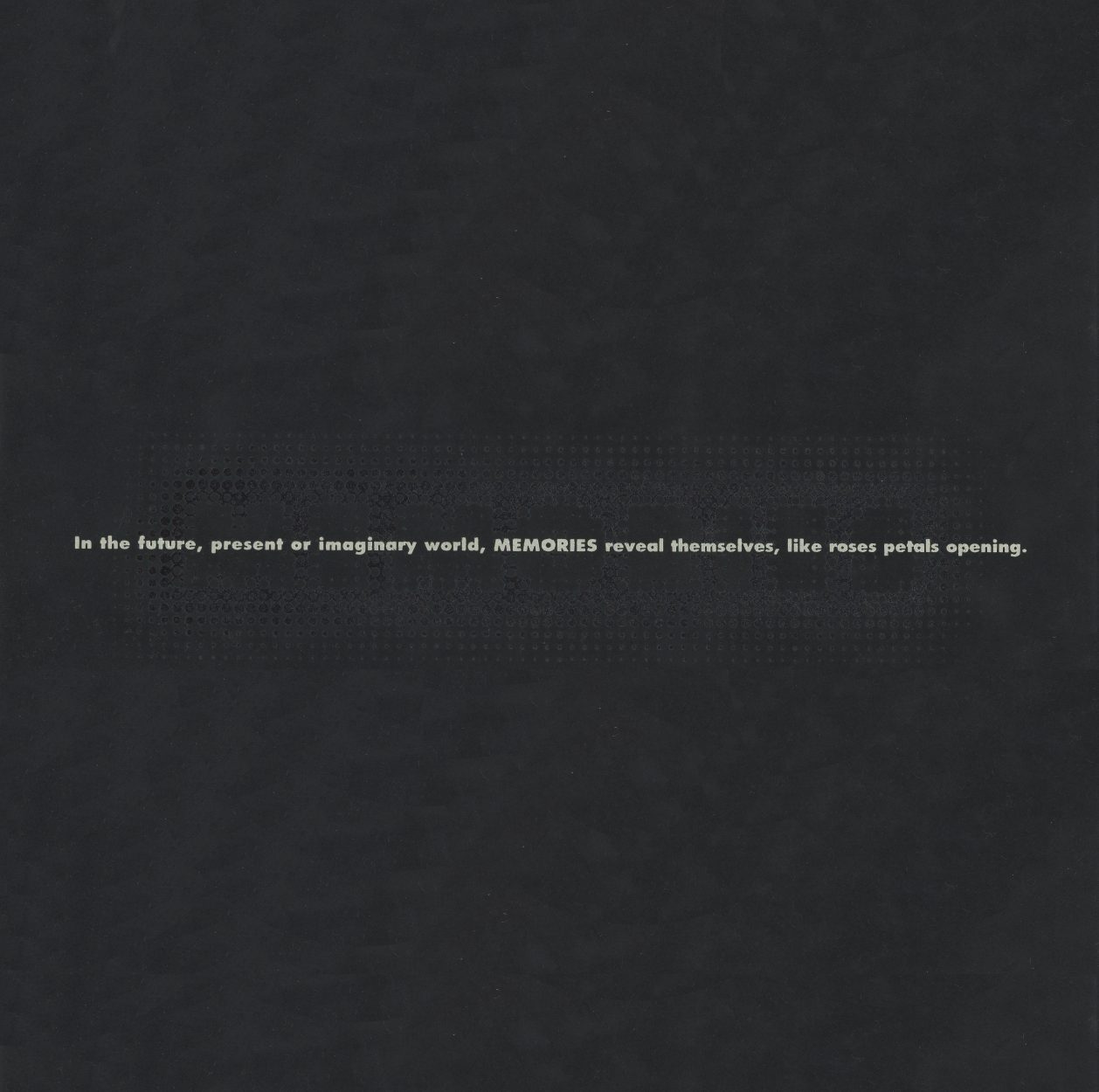 Tagline panel — "In the future, present or imaginary world, MEMORIES reveal themselves, like roses petals opening." English only, positioned as opening epigraph. The panel is otherwise dark and empty.
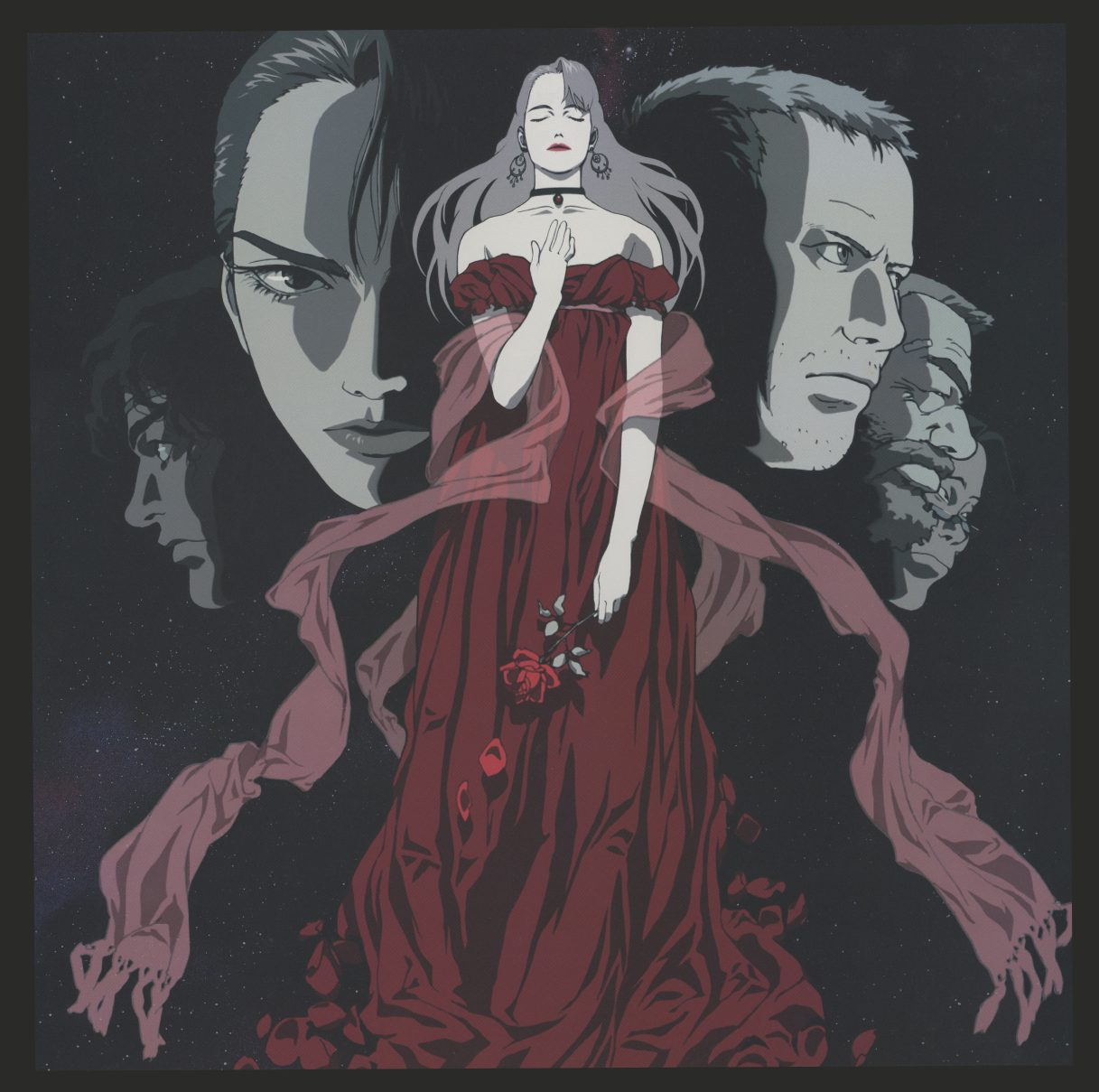 Disc 1 jacket — Magnetic Rose (彼女の想いで). Eva Friedel in red dress, center frame; male figures in grey portrait tone flank her. Painted, operatic, romantic. Director: Koji Morimoto. Script: Satoshi Kon, adapting his own manga story.
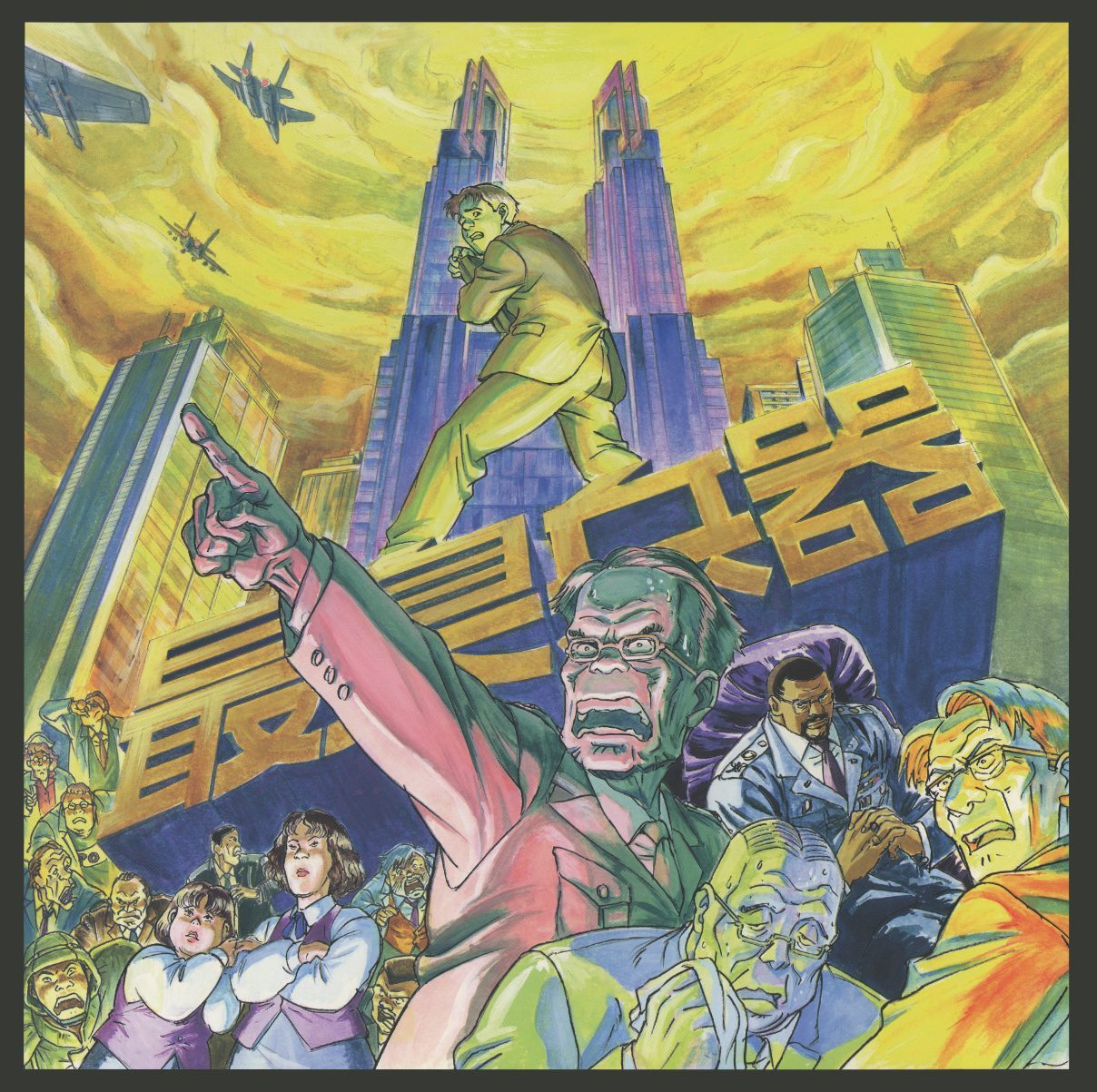 Disc 2 jacket — Stink Bomb (最臭兵器 — Most Lethal Weapon). Billboard-scale kanji against a yellow-green cityscape overwhelmed by a giant mutant figure. Pop-art vertigo. Director: Tensai Okamura.
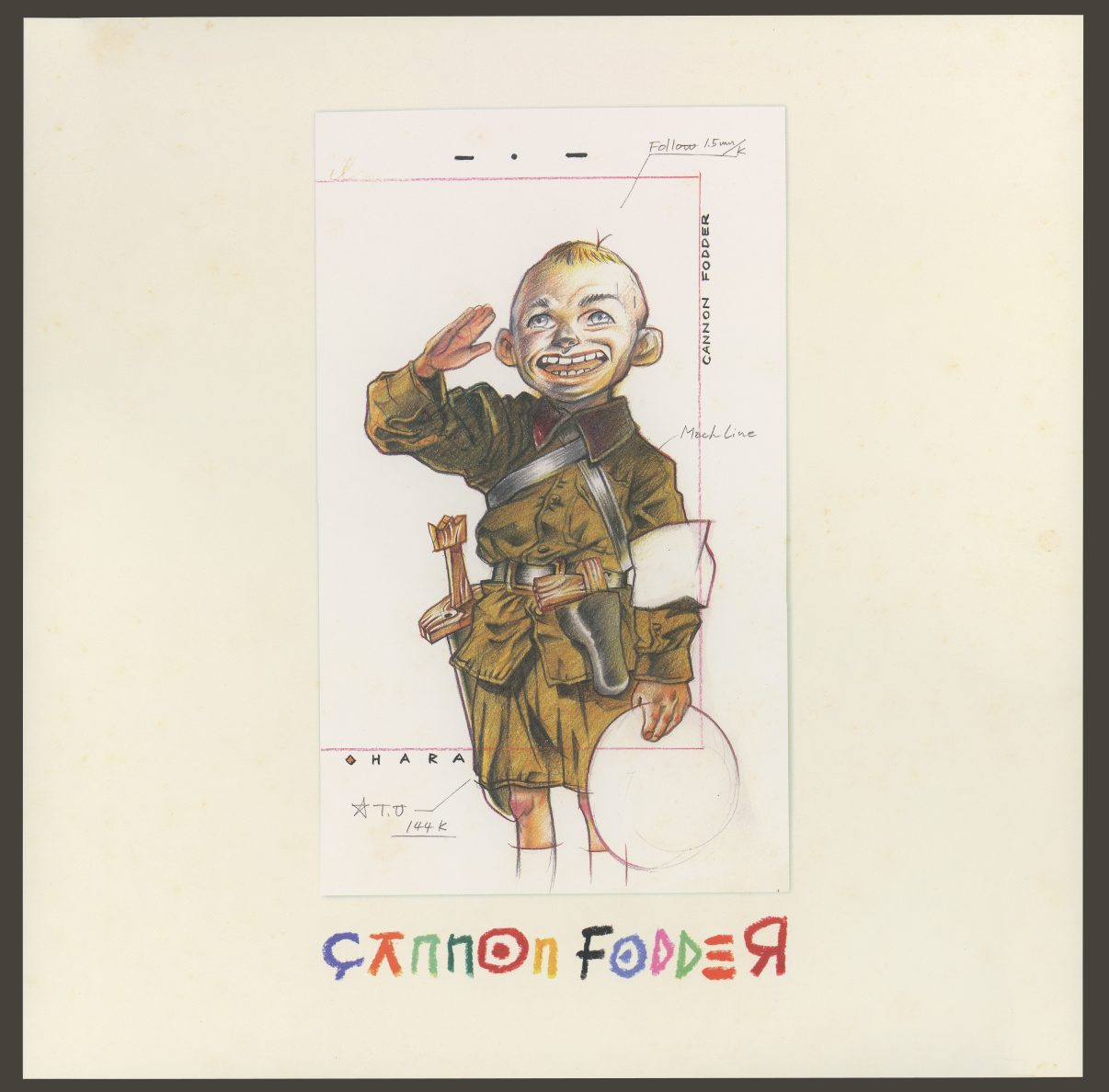 Disc 3 jacket — Cannon Fodder (大砲の街). The child soldier character in a character design illustration, production annotations visible, typeset "CANNON FODDER" below. Where the other two jackets commissioned key art, this one hands you the animator's reference document. Director and writer: Katsuhiro Otomo.
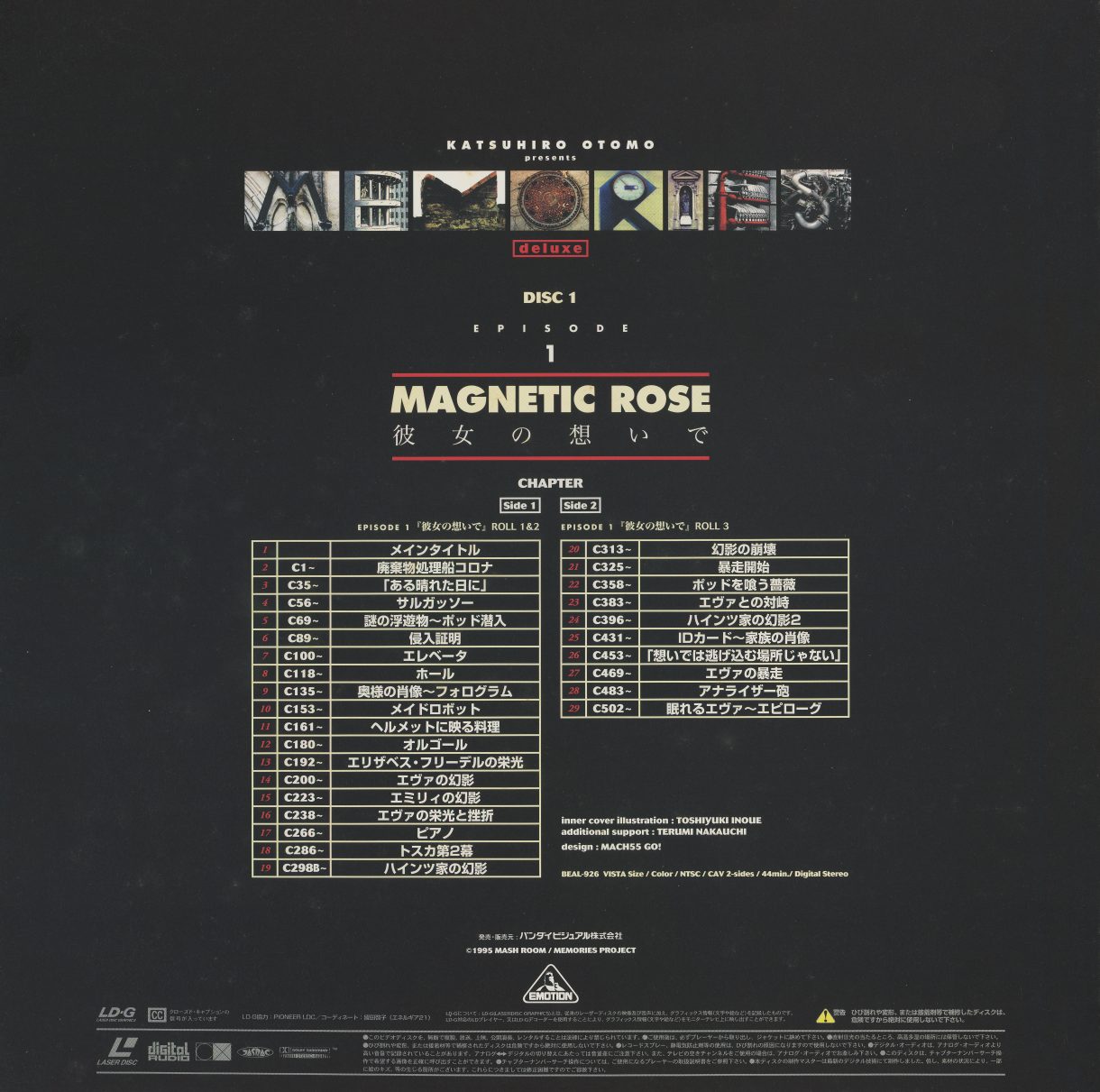 Disc 1 back — EPISODE 1 / MAGNETIC ROSE / 彼女の想いで. CLV chapter listing grid. Production and format information bottom. Bandai Visual, 1995.
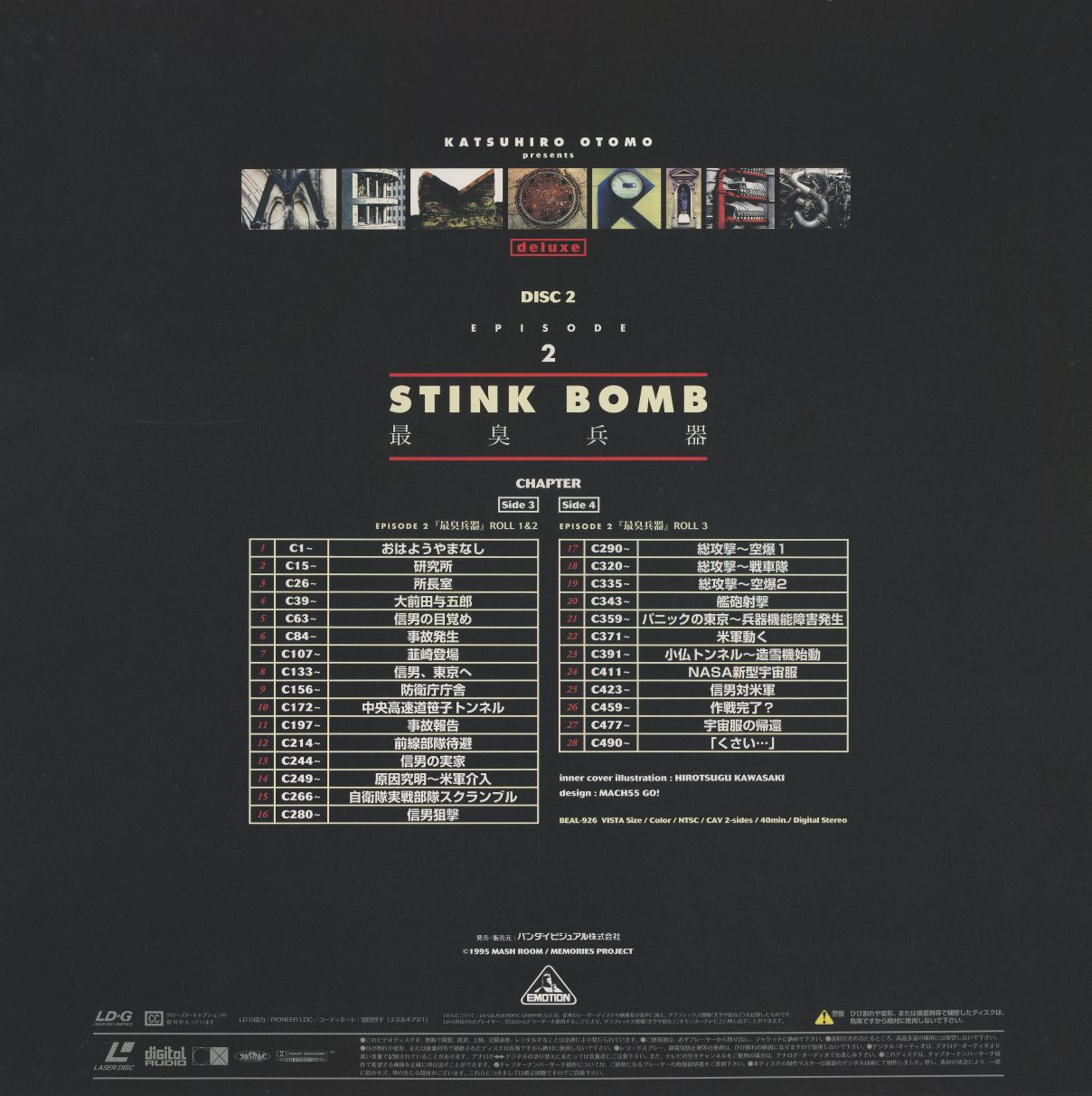 Disc 2 back — EPISODE 2 / STINK BOMB / 最臭兵器. CLV chapter listing grid. Full production credits below the chapter structure.
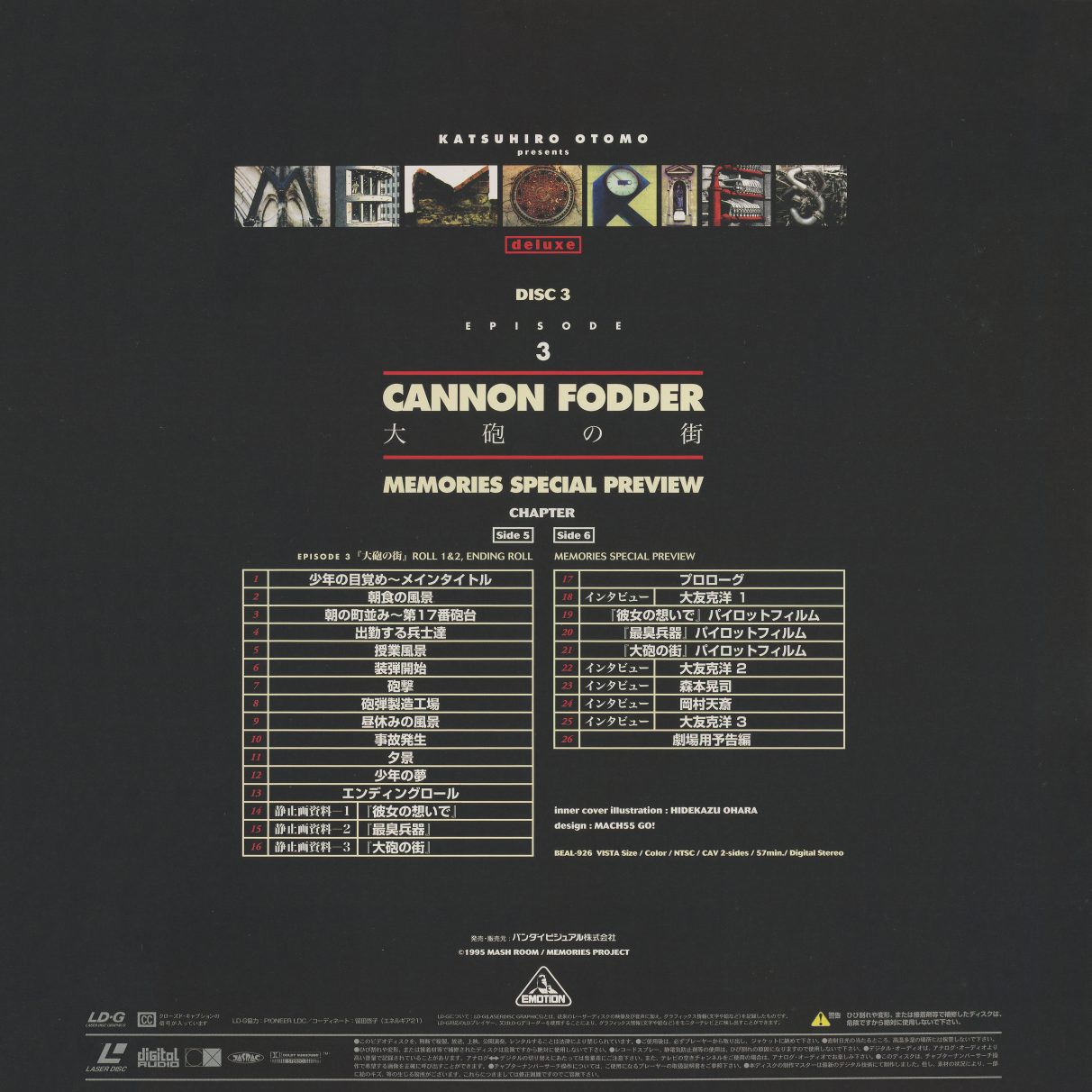 Disc 3 back — EPISODE 3 / CANNON FODDER / 大砲の街, plus MEMORIES SPECIAL PREVIEW. The third disc carries the final episode and a preview segment on the remaining playback time.
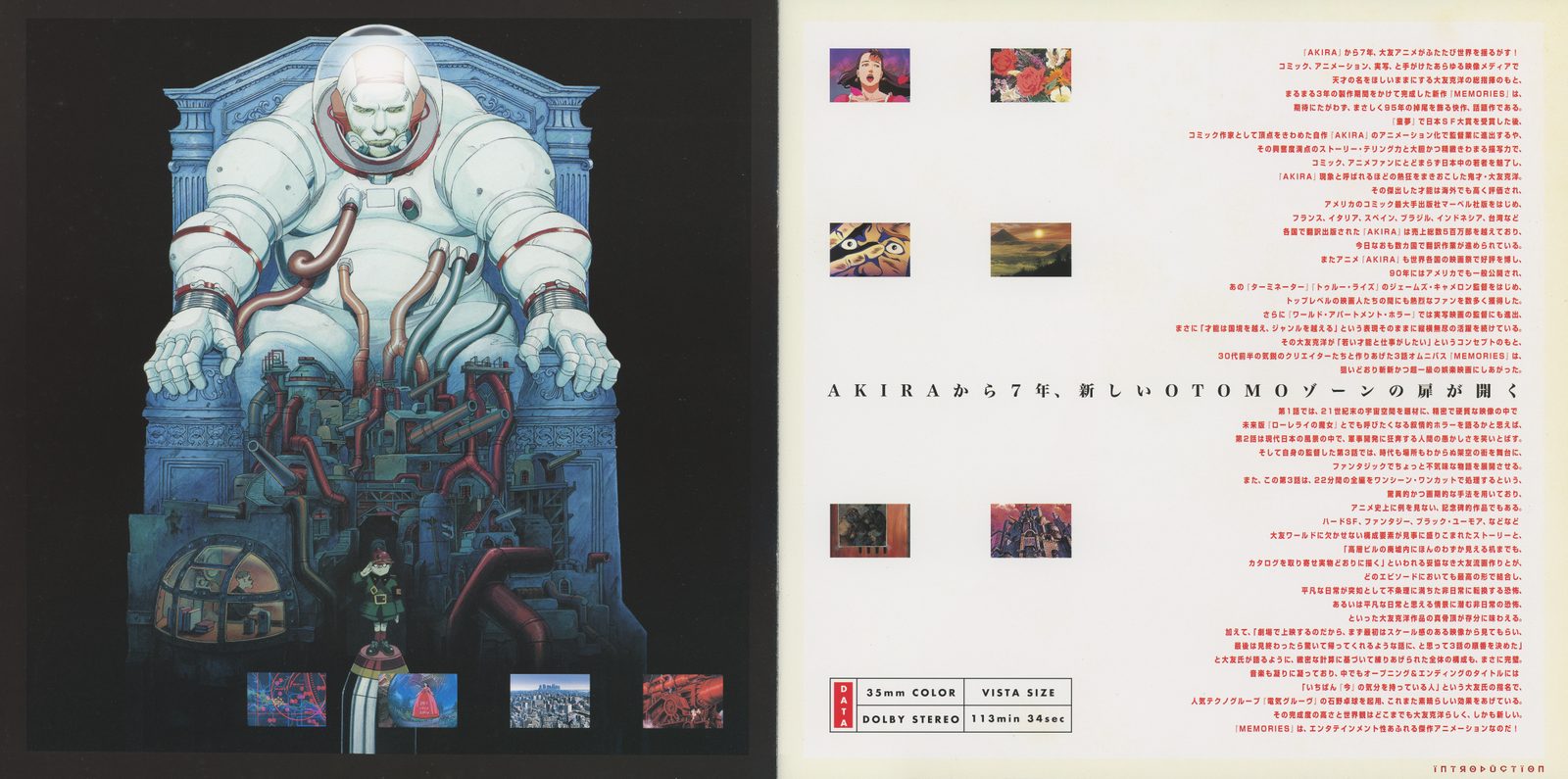 Booklet opening spread — left page: full-page illustration, biomechanical architectural structure with Eva as a figure navigating its scale. Right page: Japanese text column with small color film stills, headline "AKIRAから7年、新しいOTOMOゾーンの扉が開く" (Seven years from Akira, the door to a new Otomo zone opens). Technical specifications: 35mm COLOR / VISTA SIZE / DOLBY STEREO / 113min.35sec.
Three Episodes, Three Design Registers
The booklet allocates one double-page section to each episode, and each section was designed independently. Magnetic Rose gets its character art — Eva in the red dress, surrounded by painted portraits — set against a navy field, with director Koji Morimoto and scriptwriter Satoshi Kon credited in the same weight. Stink Bomb gets an olive-green field, the protagonist holding the canister. Cannon Fodder gets a dark maroon ground, the child soldier standing at attention. The three sections read as three separate publications that have been bound together. Which is accurate.
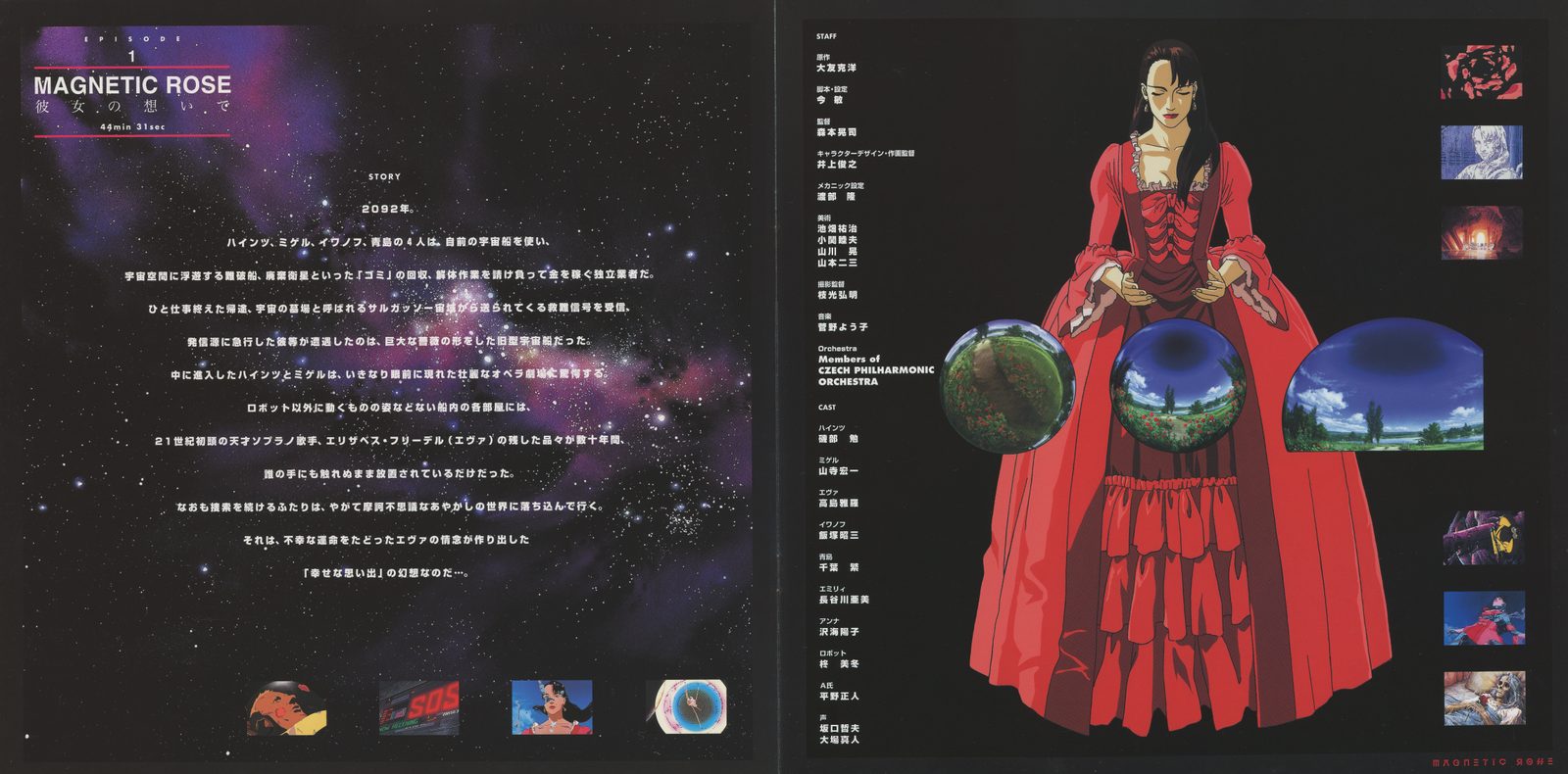 Booklet Episode 1 section — MAGNETIC ROSE / 彼女の想いで. Left: story synopsis and production credits in Japanese columns, with small color film stills at right margin. Right: Eva Friedel character art. Director: Koji Morimoto. Script: Satoshi Kon. Music: Czech Philharmonic Orchestra members.
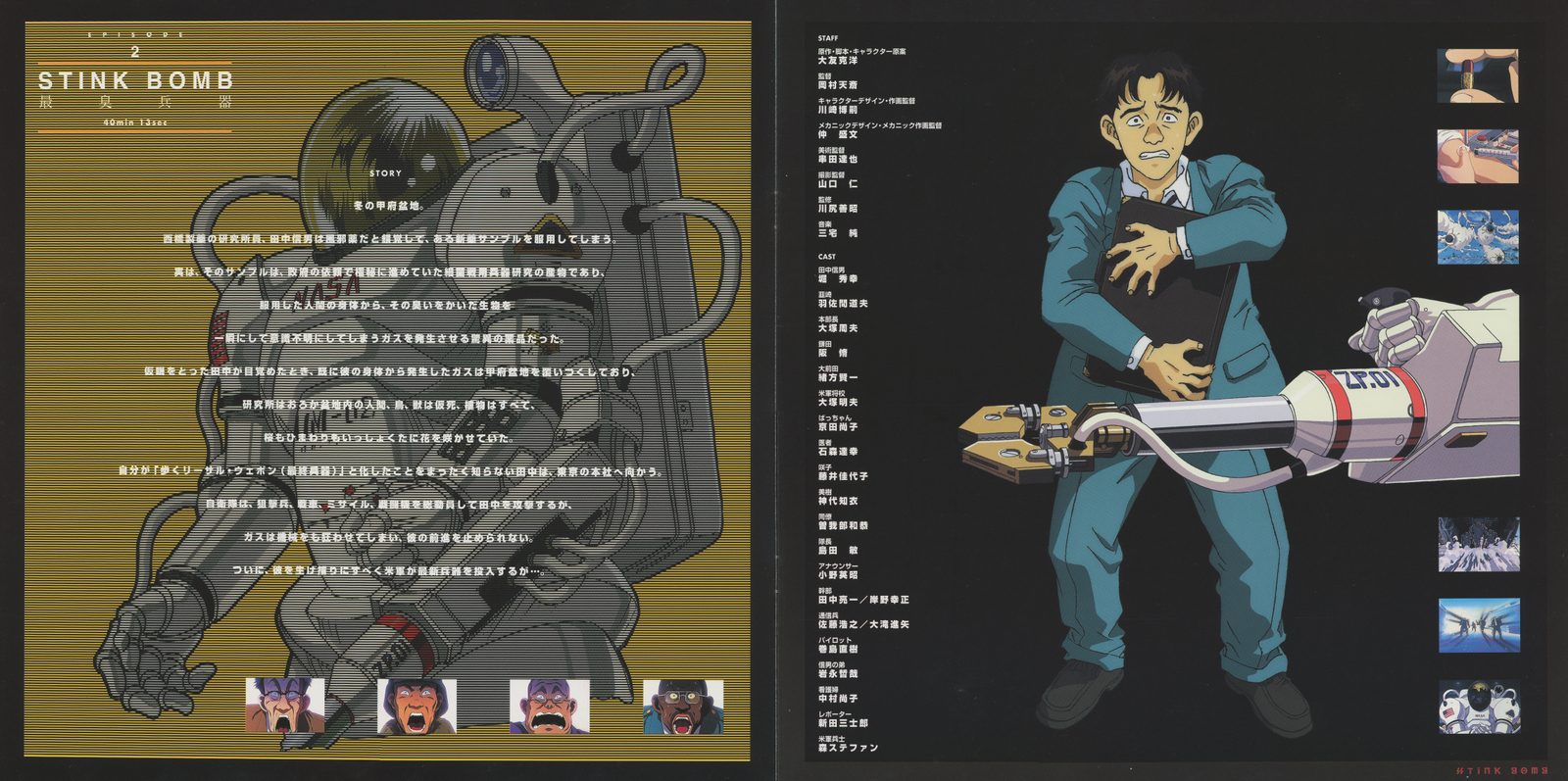 Booklet Episode 2 section — STINK BOMB / 最臭兵器. Olive-green background. Left: synopsis and production credits. Right: protagonist character art in blue jumpsuit, holding the biological weapon canister that triggers the plot. Director: Tensai Okamura.
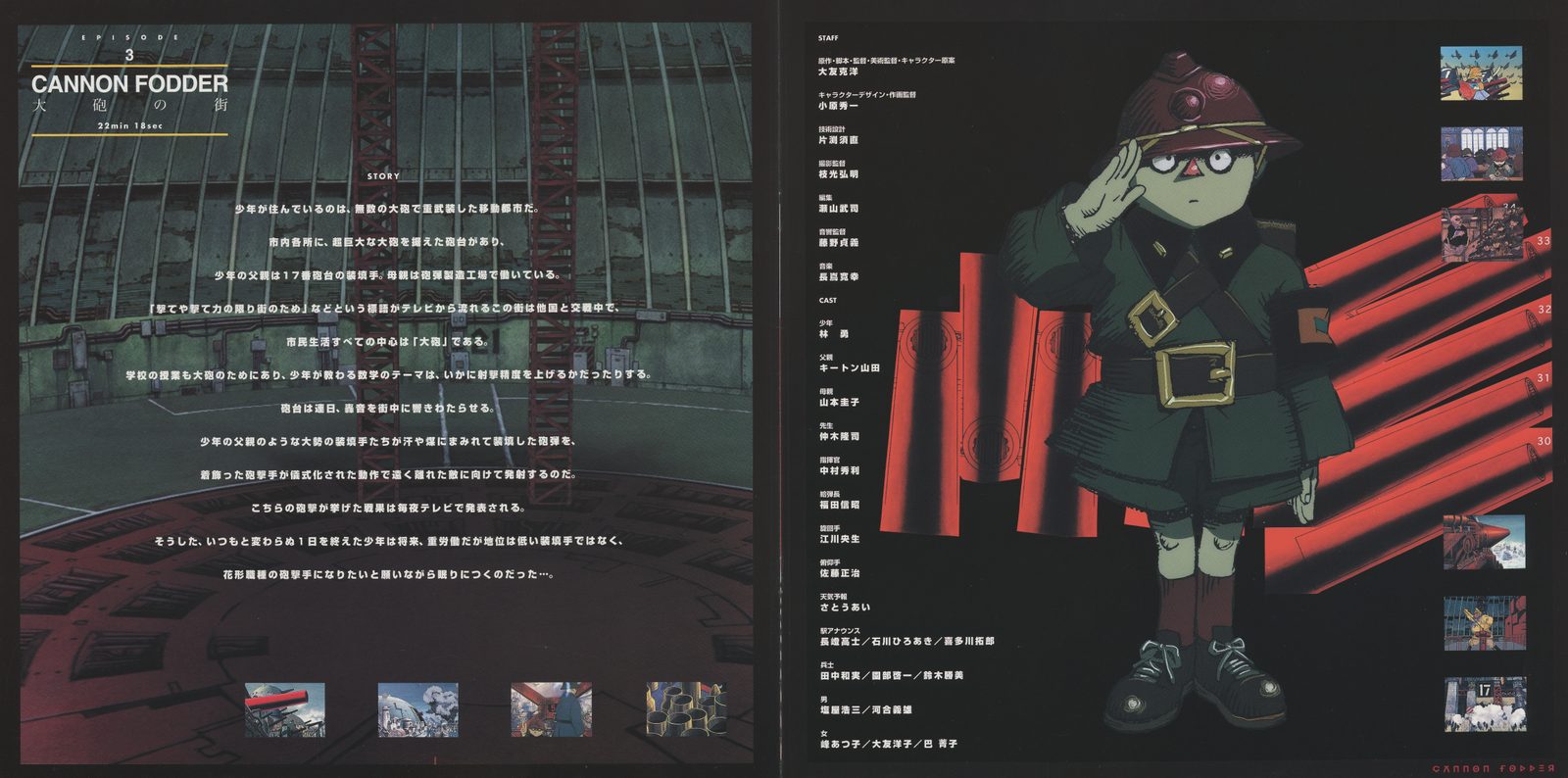 Booklet Episode 3 section — CANNON FODDER / 大砲の街. Deep maroon field. Left: synopsis and credits in Japanese columns. Right: child soldier character art with film stills at right margin. Director and writer: Katsuhiro Otomo.
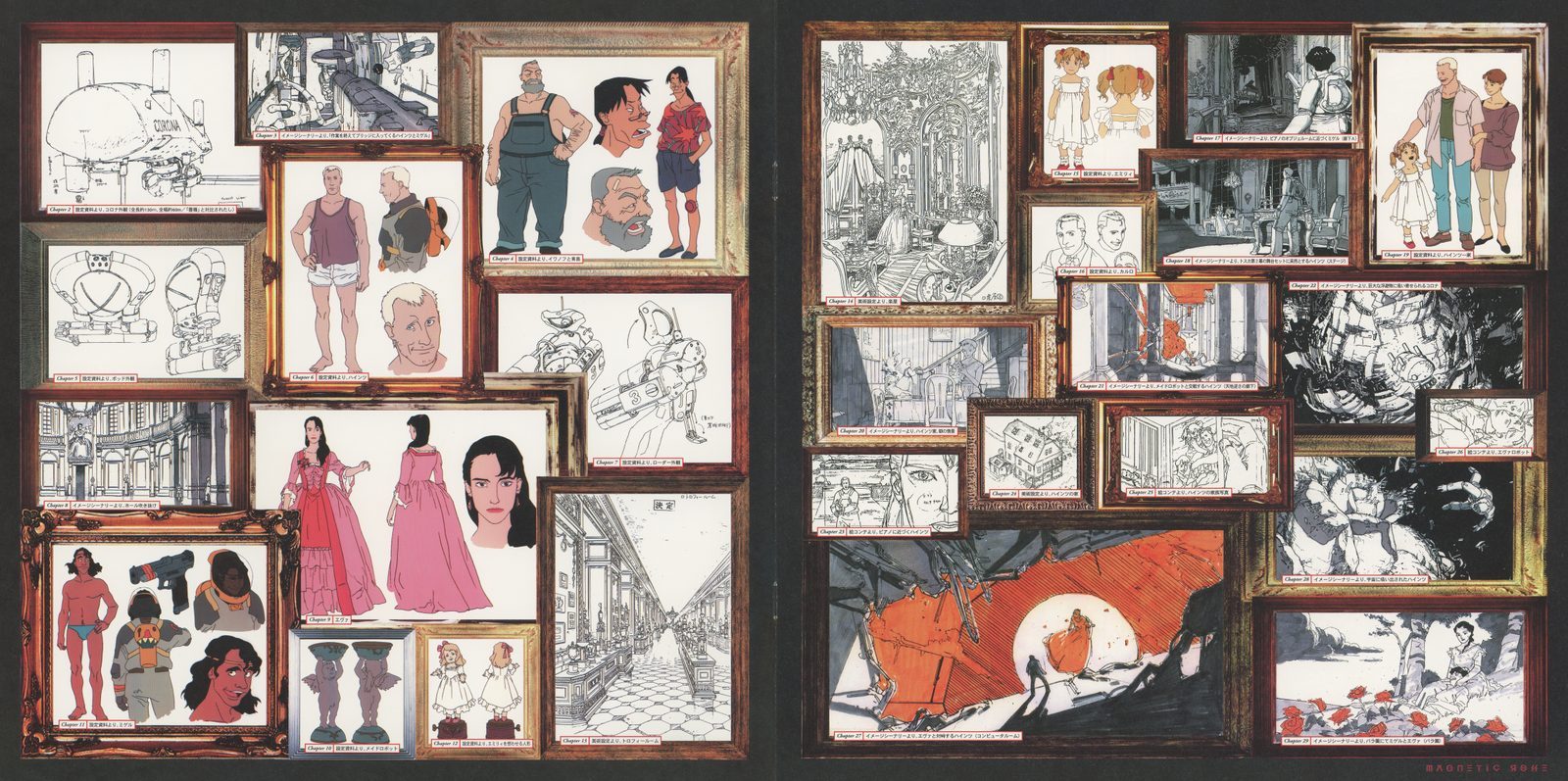 Booklet — Magnetic Rose production documentation spread. Character designs, storyboard frames, and background studies arranged inside gilded picture frames across both pages — the same frame-within-frame structure that the film uses for Eva's preserved memories inside the drifting mansion. The production drawings are displayed as if hung in the gallery the film inhabits.
The Prop Has Colonized the Record
The Stink Bomb production section is the one that stops you. Mechanical design sheets — vehicle cross-sections, environment layouts, robot schematics, the interior of the research facility — printed across the booklet pages in olive gold. Scattered across them: red capsule pills. The same capsule that causes the plot of Stink Bomb — a researcher accidentally swallows what he thinks is a cold medicine, activates a biological weapon, and becomes a walking disaster — has been photographed and overlaid onto the documentation of how the film was built. The prop has colonized the record of its own production. You are holding evidence of the thing the film describes.
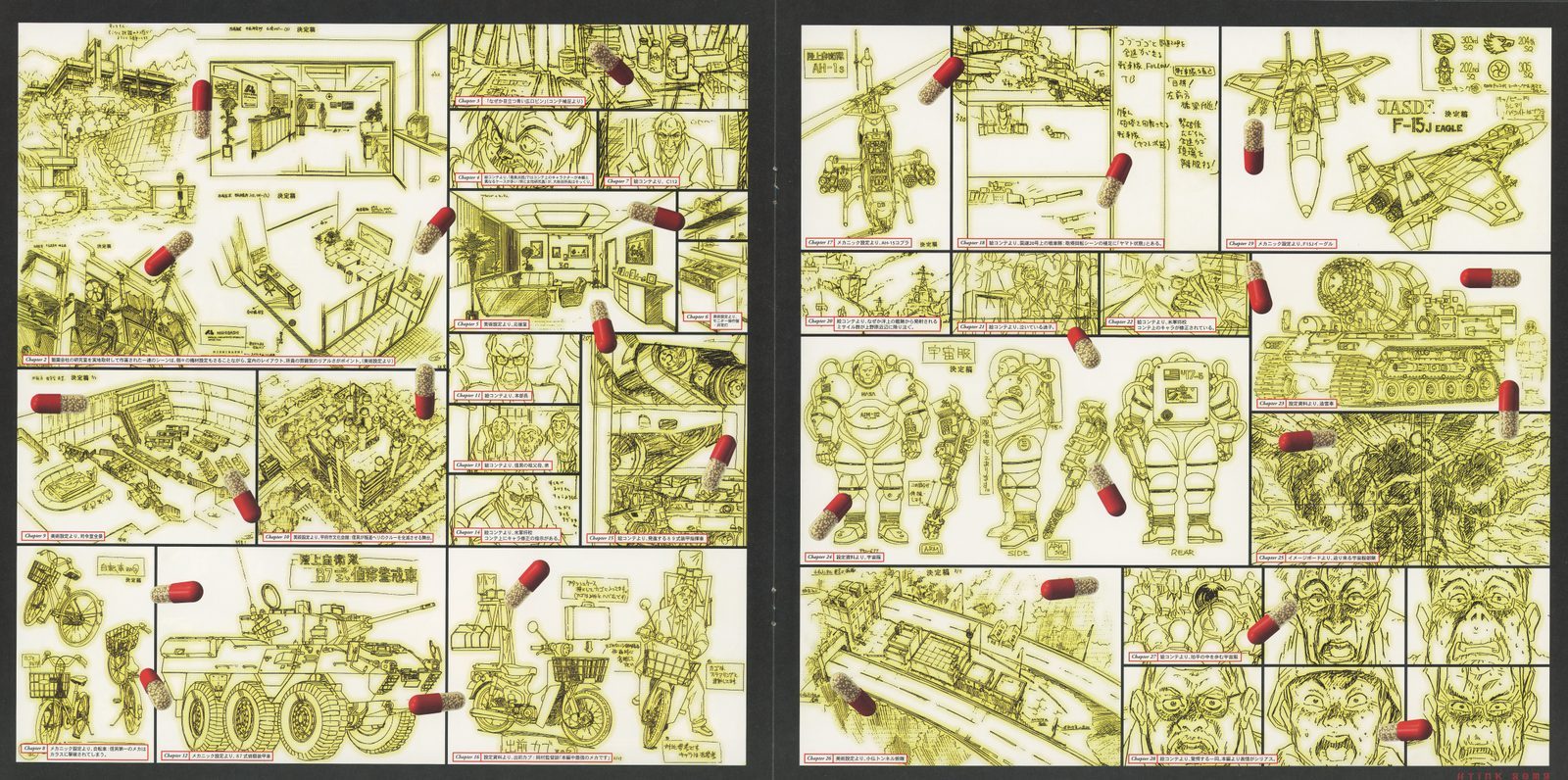 Booklet — Stink Bomb production design spread. Mechanical schematics, vehicle and environment designs, robot/suit references printed in olive gold across both pages. Physical red capsule pills scattered and overlaid across the design documentation — the biological weapon prop staged on its own production record.
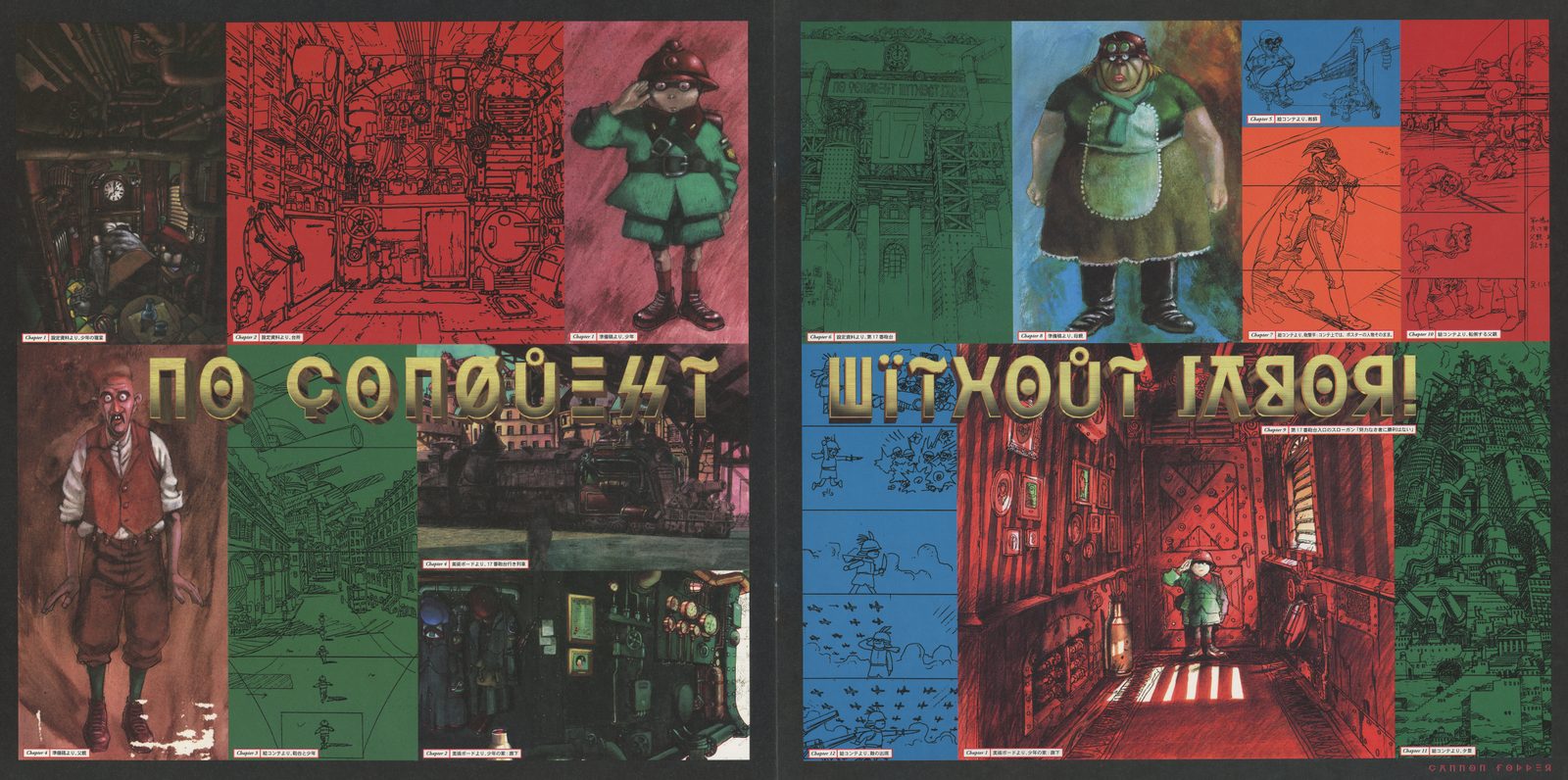 Booklet — Cannon Fodder production art spread. Character designs and background studies displayed in colored frames (green, red, blue). The section heading — "NO CONQUEST / WITHOUT LOSS!" — is typeset in mirror-reversed letters across the center gutter. Otomo's episode is about a city that exists only to manufacture and fire artillery; the booklet designers embedded that logic into the act of reading about it.
AKIRAから7年
The booklet's opening spread is explicit about where Memories sits in Otomo's career: "AKIRAから7年、新しいOTOMOゾーンの扉が開く" — seven years from Akira, the door to a new Otomo zone opens. The career chronology spread runs a timeline from 1973 through 1995, listing each project by year and medium, with portrait photographs of Otomo at intervals. Memories appears as the final entry. This is not fan material. It is the label contextualizing the anthology as a chapter in an ongoing account, with the buyer positioned as someone tracking that account.
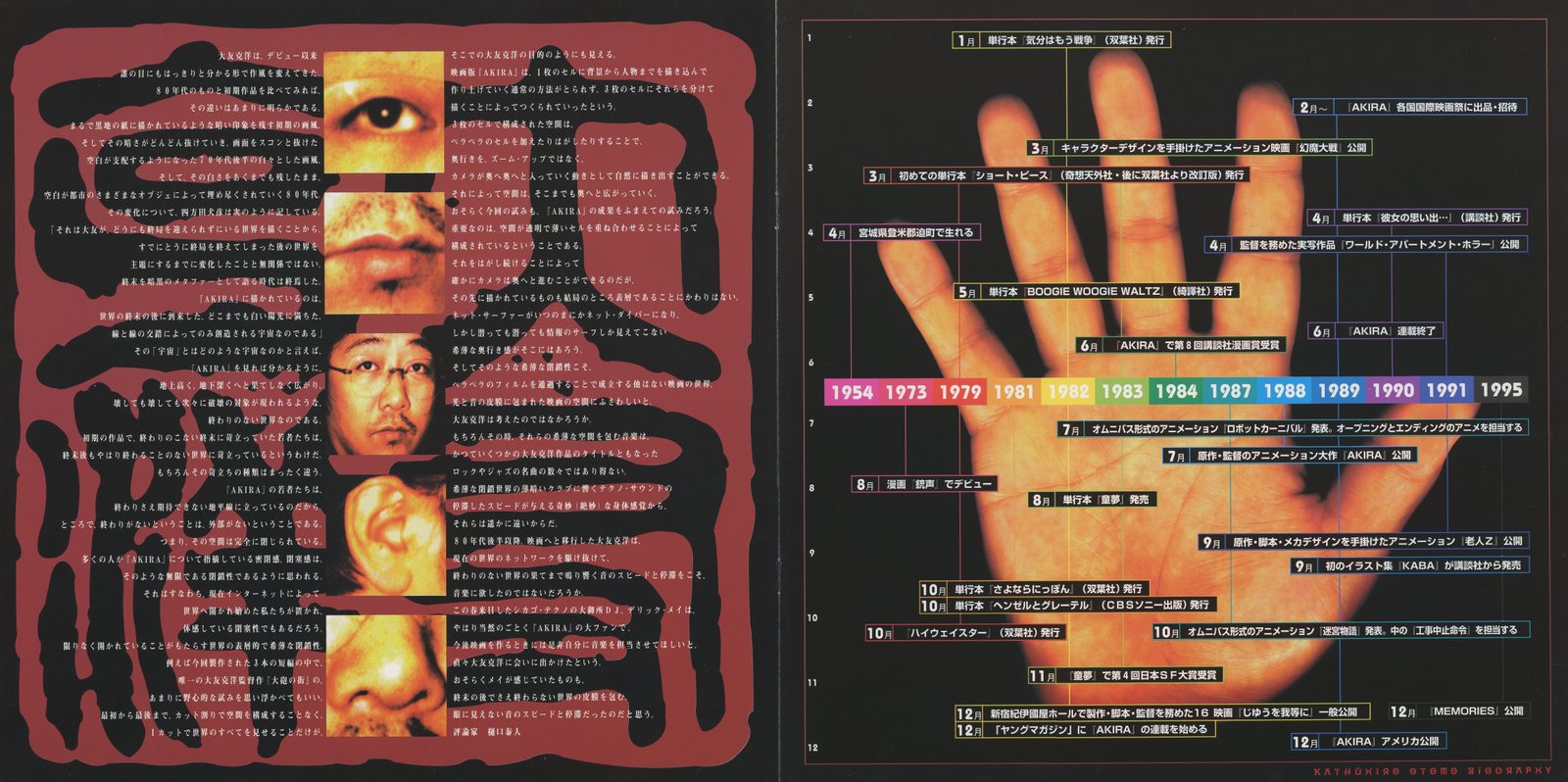 Booklet — Otomo career chronology spread. Timeline running 1954 (birth) through 1995, with numbered entries for each major work. Portrait photographs of Otomo at different career stages. Memories listed as the final entry. Both pages carry dense text columns documenting twenty-plus years of manga, film, and design work.
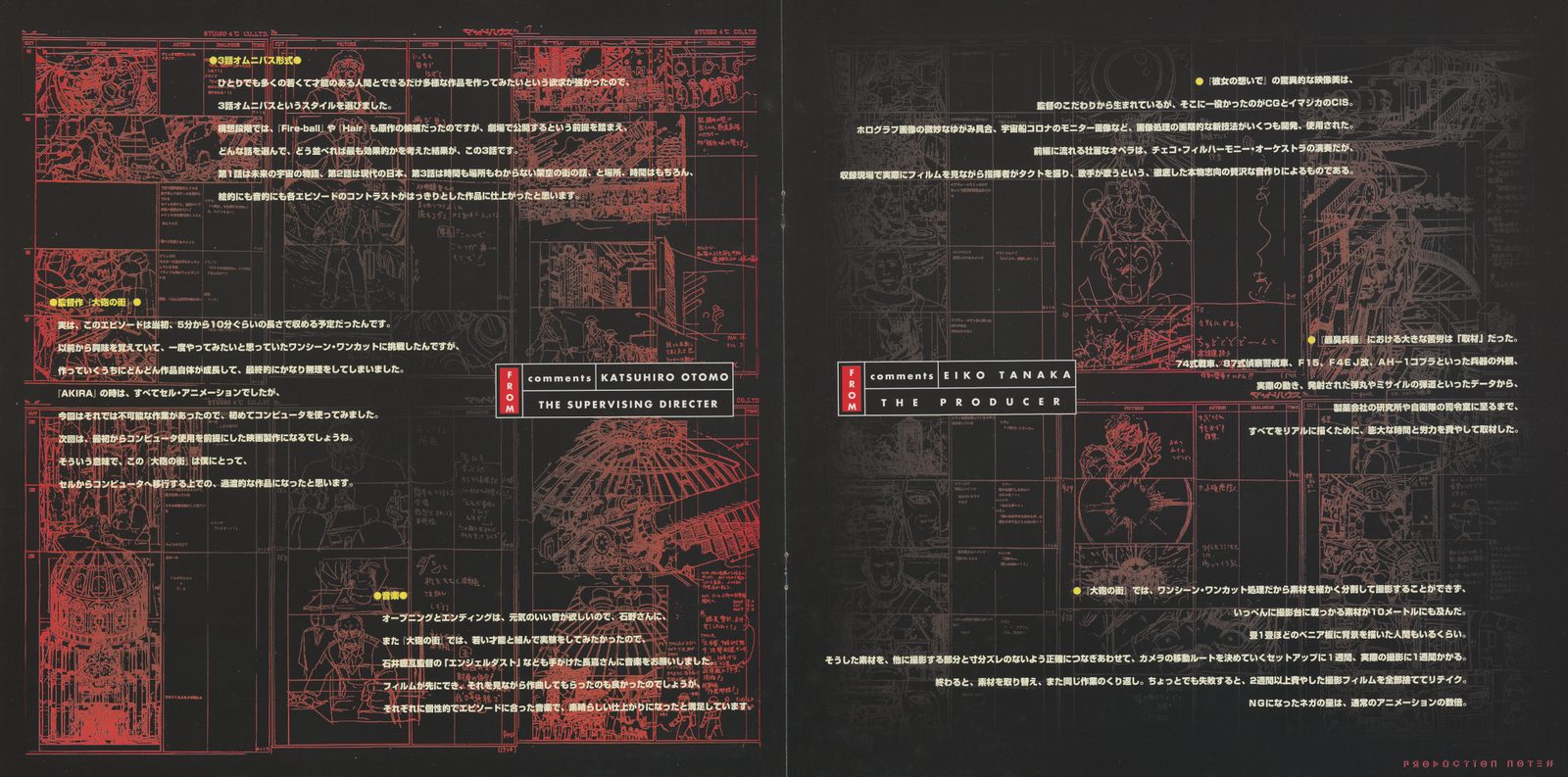 Booklet — Director and producer statements. Left half: Katsuhiro Otomo, THE SUPERVISING DIRECTOR. Right half: Eiko Tanaka, THE PRODUCER. Both statements printed over red mechanical blueprint drawings on black — architectural cross-sections overlaid with text. The visual language treats the production as a solved design problem.
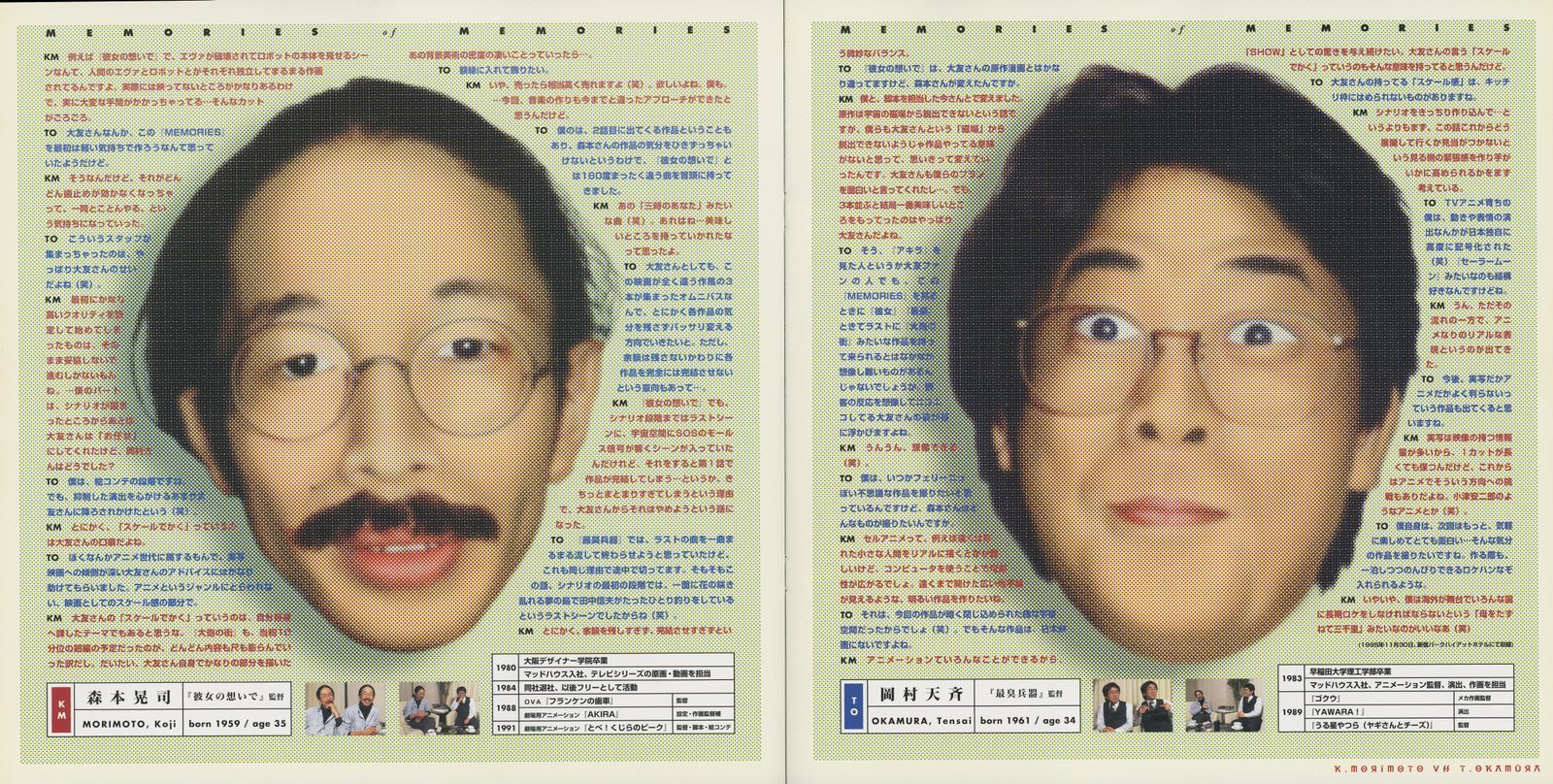 Booklet — Episode director interviews. Large portrait photographs of two directors with interview text in columns below each portrait. Production credits and format information at page bottom. The booklet treats the episode directors — Morimoto, Okamura — as primary authors alongside Otomo.
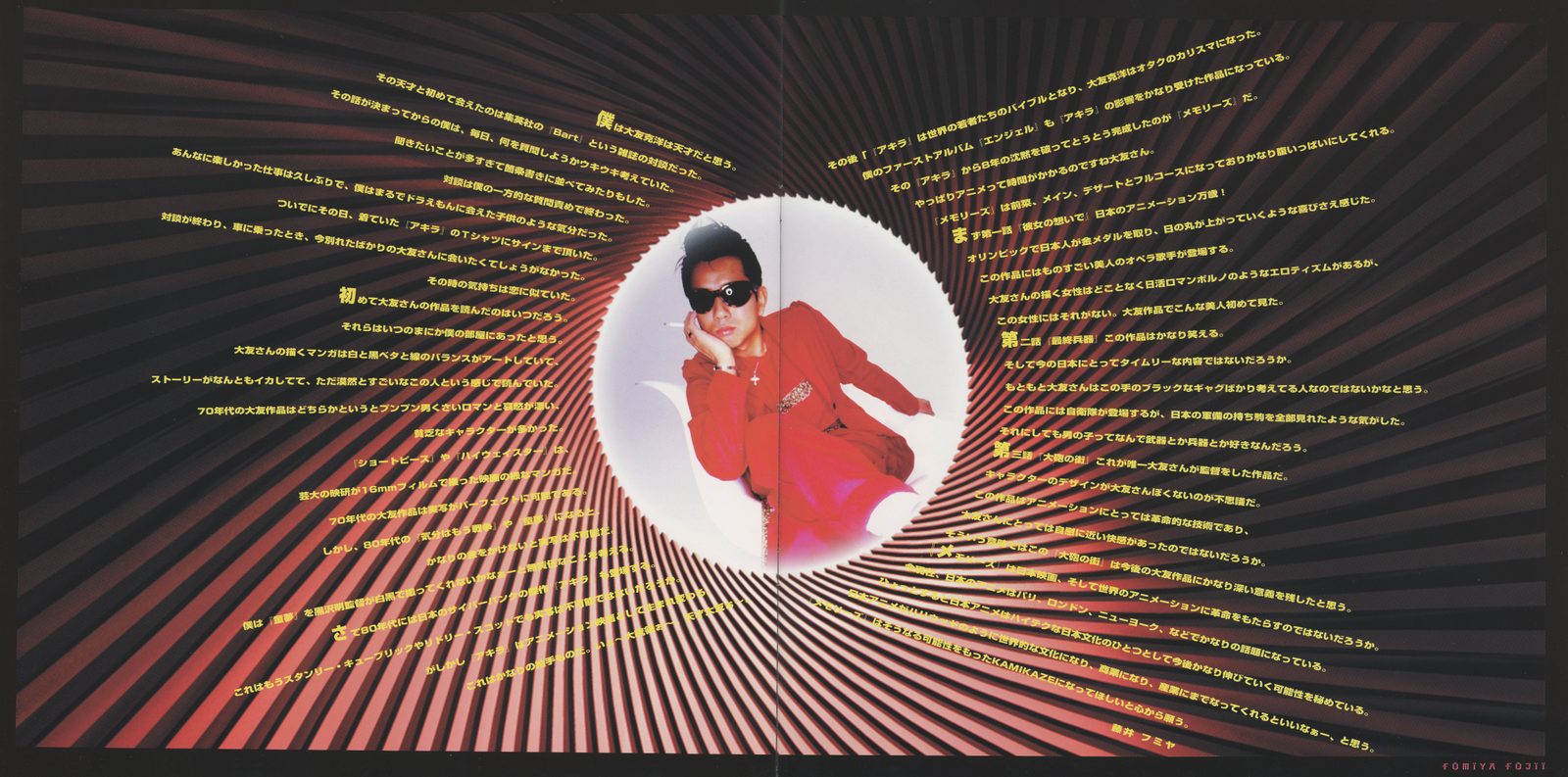 Booklet — Staff comment spread. Central portrait in a circular frame against a radiating spiral-stripe pattern — a visual register entirely distinct from the rest of the booklet. Text columns surround the portrait. The design change signals a different editorial register for this contributor.
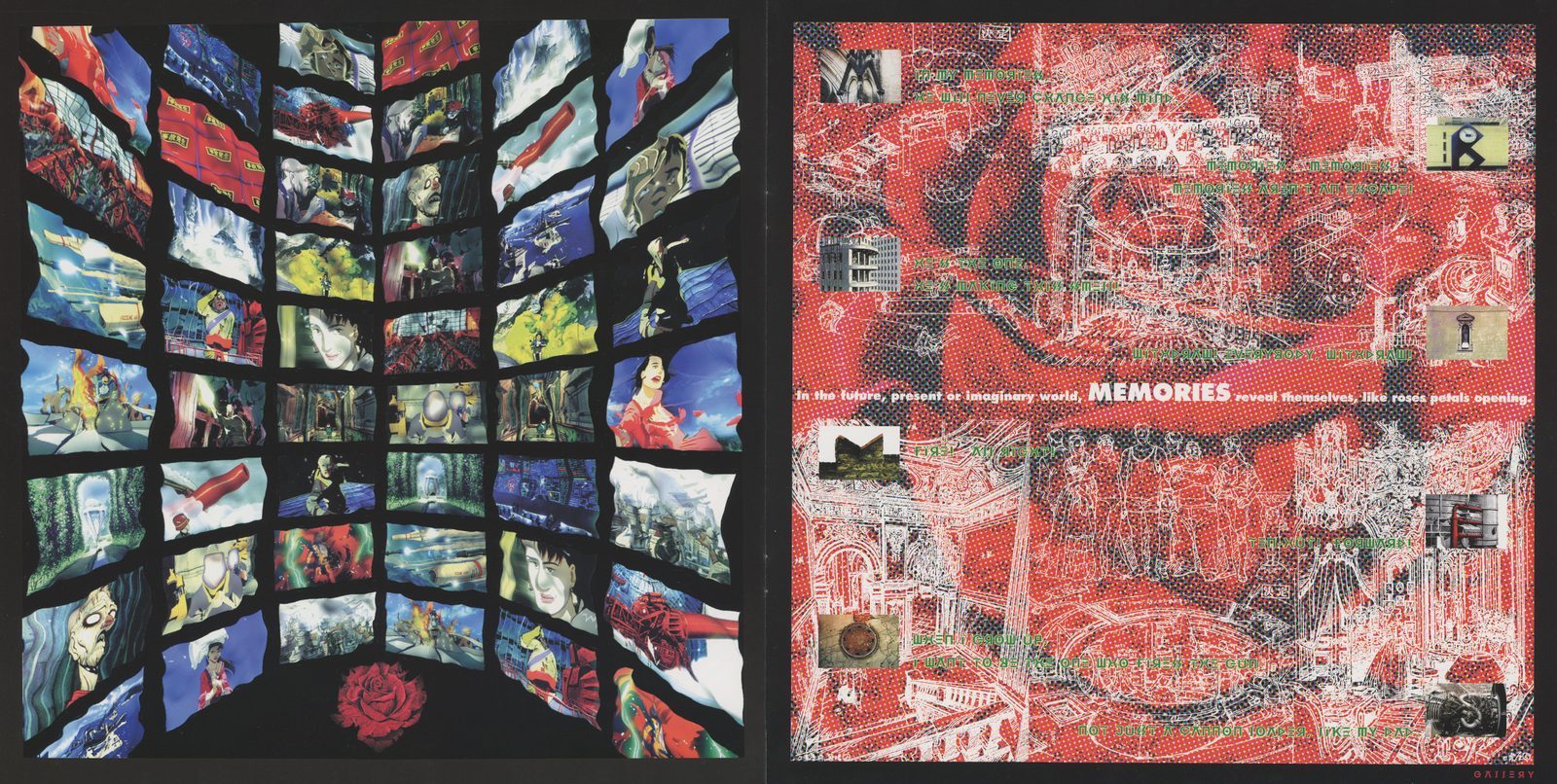 Booklet — Closing spread. Left page: film stills arranged in a curved perspective montage, like a private screening room's curved wall, with a red rose at the bottom. Right page: dense red textile-pattern ground with MEMORIES tagline text and small stills. The booklet ends by looking back at what it has documented.
The Four Rosters
The credits spread lists production staff by episode — MAGNETIC ROSE, STINK BOMB, CANNON FODDER — then the combined TOTAL STAFF in a fourth column. Each episode section carries its primary character art beside the credit block. The Czech Philharmonic Orchestra members appear in the Magnetic Rose credits, listed under music recording. Every name, every role, separated by episode, then unified. Exhaustive in the manner of a film program rather than a DVD insert.
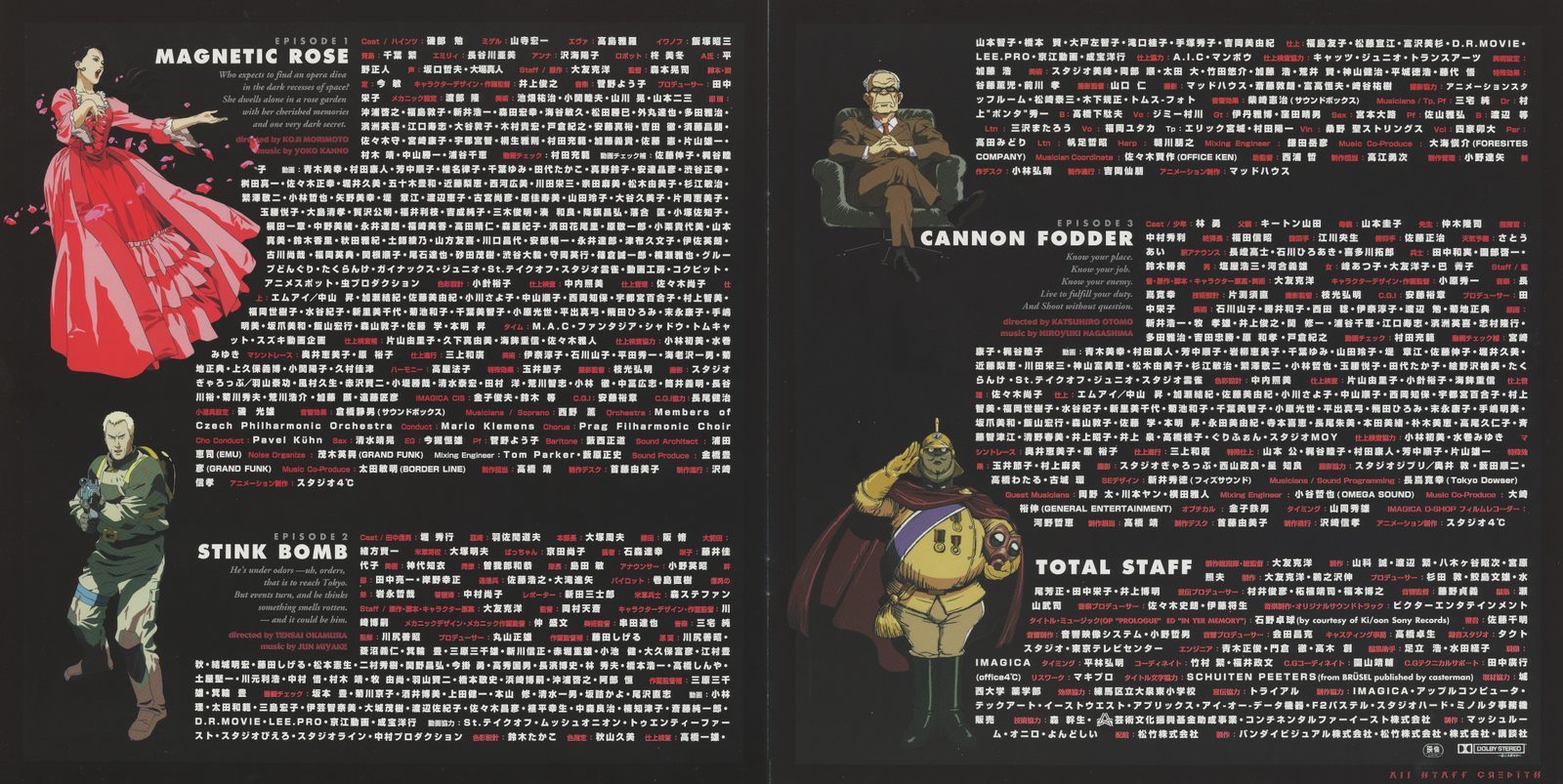 Booklet — Full production credits spread. Left page: Eva Friedel character art (Magnetic Rose) + MAGNETIC ROSE credits + STINK BOMB credits. Right page: child soldier character art (Cannon Fodder) + CANNON FODDER credits + TOTAL STAFF combined list. All four credit blocks, all three episode key figures, on one opening.
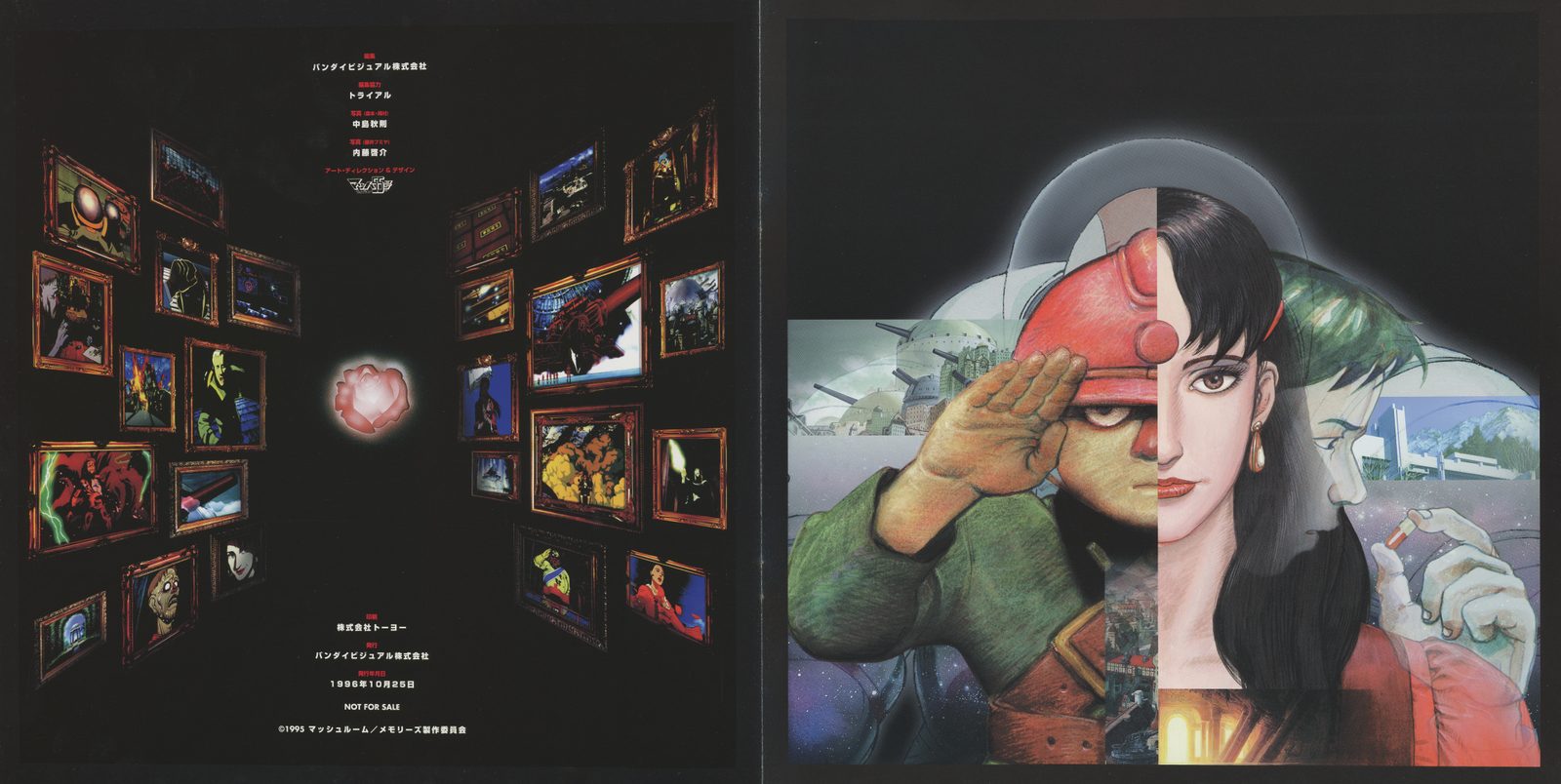 Inner box back — Left: film stills from all three episodes arranged in a curved montage, like a screening room's curved wall. Right: composite close-up of Eva Friedel's face split at the vertical center — the same half-face composition used on the main disc jacket, returned to at the end. The box closes by looking at the object it began with.
The booklet's opening spread carries a notation most readers pass over: the runtime, precise to the second. "113min.35sec." Streaming catalogs list it as approximately 113 minutes. The LD booklet gives you 113 minutes and 35 seconds. This is what production-era documentation looks like before anyone decided what level of specificity was appropriate for a consumer product.
The film has been on streaming platforms for years. The booklet — its drawings framed like paintings in the gallery the first film inhabits, its mechanical sheets scattered with the prop that causes the second film's plot, its section headings typeset in the mirror logic that the third film lives inside — has not traveled with it. The four objects in this box are the same four objects they were in November 1995. None of them have been replicated.
Loading...