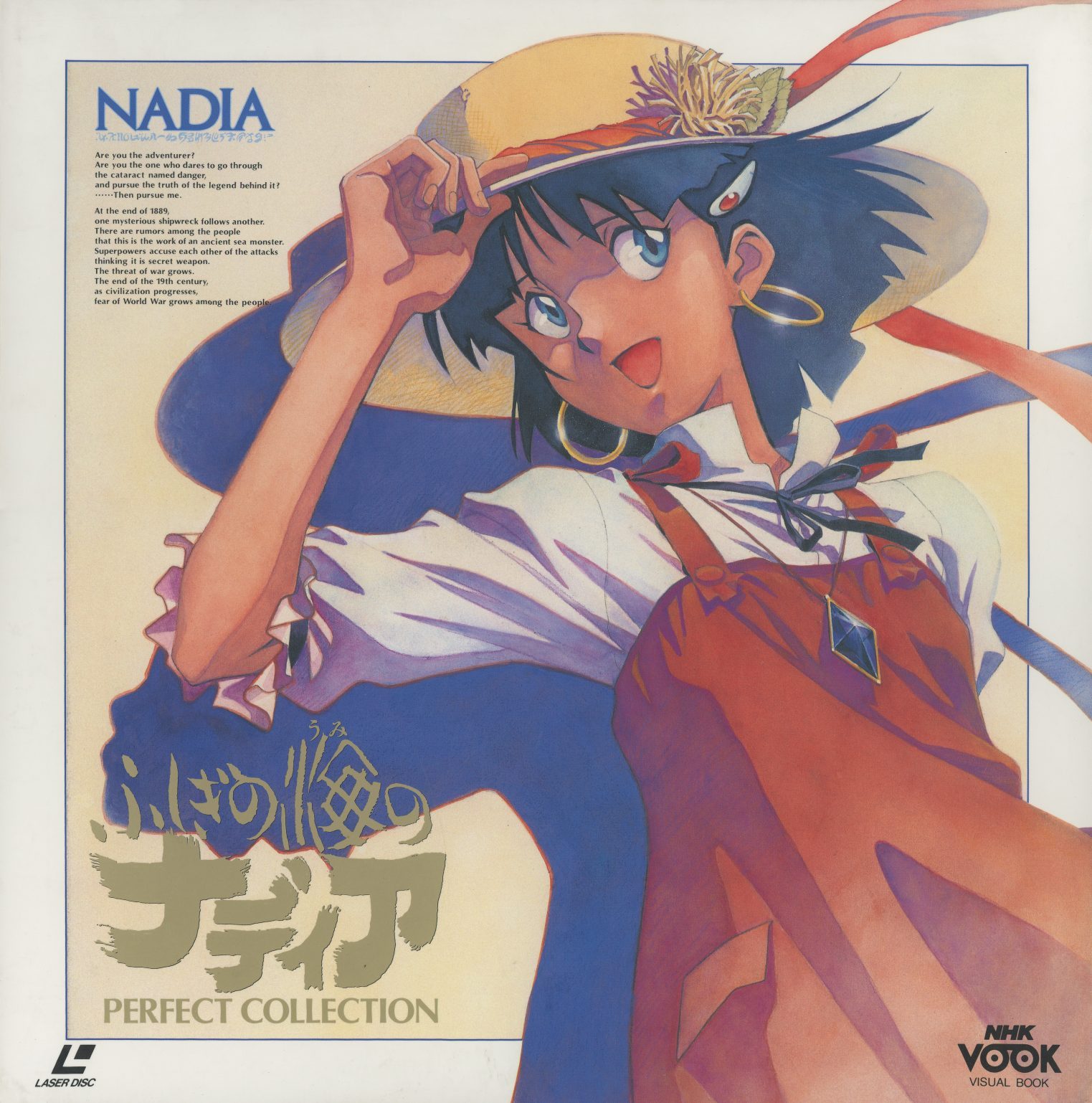
Ten CLV discs. JSLD-1004. ふしぎの海のナディア (Fushigi no Umi no Nadia — Nadia: The Secret of Blue Water) PERFECT COLLECTION, released on the NHK VOOK Visual Book label. All 39 episodes of the 1990–1991 NHK television series, plus a booklet containing Anno Hideaki's director interview, Sadamoto Yoshiyuki's character design sheets, deleted scene storyboards on Gainax production paper, background art reproductions, and a complete episode guide. The individual volumes — ten discs with unique jacket illustrations, each back cover featuring a character settei line drawing — were collected here as a single object. CLV format across all discs. The English tagline on the back cover: 'Are you the adventurer? Are you the one who dares to go through the cataract named danger, and pursue the truth of the legend behind it? ... Then pursue me.'
The series itself began as someone else's idea. In the late 1970s, Hayao Miyazaki developed a proposal called 'Around the World Under the Sea' — a Jules Verne-inflected adventure featuring a submarine captain inspired by Captain Nemo, a mysterious girl with a pendant, and a globe-spanning voyage. The project was never produced. Over a decade later, NHK commissioned Gainax — the studio behind Royal Space Force: The Wings of Honneamise and Gunbuster — to make a 39-episode television series. The Miyazaki concept became the foundation. Gainax assigned direction to Hideaki Anno, who was 29 years old and had never led a TV production. What followed was the most important failure in the studio's history.
Nadia is a fourteen-year-old circus acrobat in 1889 Paris who possesses the Blue Water — a mysterious pendant connected to the lost civilization of Atlantis. Jean is a young French inventor who becomes her companion. Together they're pursued across oceans by Gargoyle, a masked antagonist leading the Neo-Atlantean organization, who wants the pendant to resurrect ancient technology and conquer the world. Captain Nemo and the submarine Nautilus become their protectors. The first two-thirds of the series are extraordinary — a Victorian adventure that combines Verne's speculative fiction with Anno's instinct for complicated characters. Nadia isn't a passive heroine. She's stubborn, vegetarian, distrustful of adults, and frequently hostile to the people trying to help her. Jean isn't a hero. He's a gadget-obsessed kid who doesn't understand why the girl he likes keeps pushing him away. The dynamic prefigures Shinji and Asuka by five years.
Then the production collapsed. Around episode 23, Gainax ran out of budget and schedule. Several episodes were outsourced to Korean studios with minimal supervision. The infamous 'island arc' — episodes 23 through 34 — stretched the story with filler, dropped the animation quality, and broke the tonal consistency that made the first half work. Anno later described this period as one of the most frustrating experiences of his career. The burnout it caused shaped the psychological state he brought to Neon Genesis Evangelion four years later. But the final episodes — 35 through 39 — recover. Anno returned to direct the climax himself, and the ending is one of the most emotionally complete in television anime. The box set preserves all of it: the brilliance, the collapse, and the recovery.
The Individual Volumes
The ten individual discs were released between 1991 and 1992, CLV format, approximately four episodes per disc across two sides. Each jacket carries a unique illustration capturing a different facet of the series — from Nadia at the Eiffel Tower in Volume 1 to Gargoyle's mask looming over the Neo-Atlantean revelations in Volume 10. Every back cover pairs episode listings and scene screenshots with a full-body settei line drawing of a different character: Nadia, Jean, Electra, Nemo, Marie, Grandis, Sanson, Hanson, the Nautilus crew. The drawings are production reference sheets — turnarounds, expression guides, costume details — printed directly on the jacket as if the packaging itself were a settei collection distributed one character at a time.
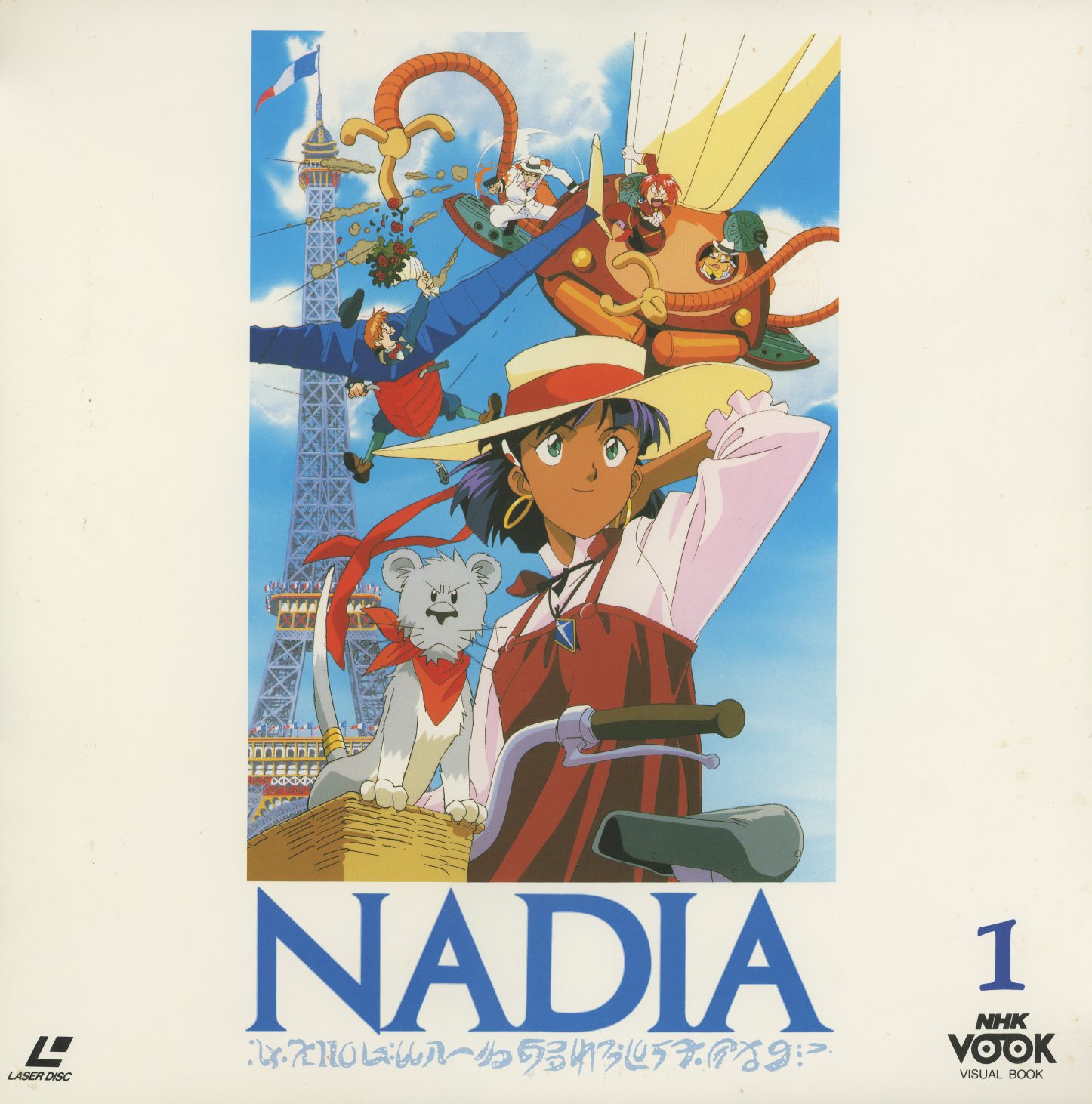 Volume 1 jacket front. Nadia and Jean at the Eiffel Tower — 1889 Paris, the World's Fair, the beginning of the adventure. Episodes 1–4: 'エッフェル塔の少女' (The Girl at the Eiffel Tower) through '万能潜水艦ノーチラス号' (The All-Purpose Submarine Nautilus).
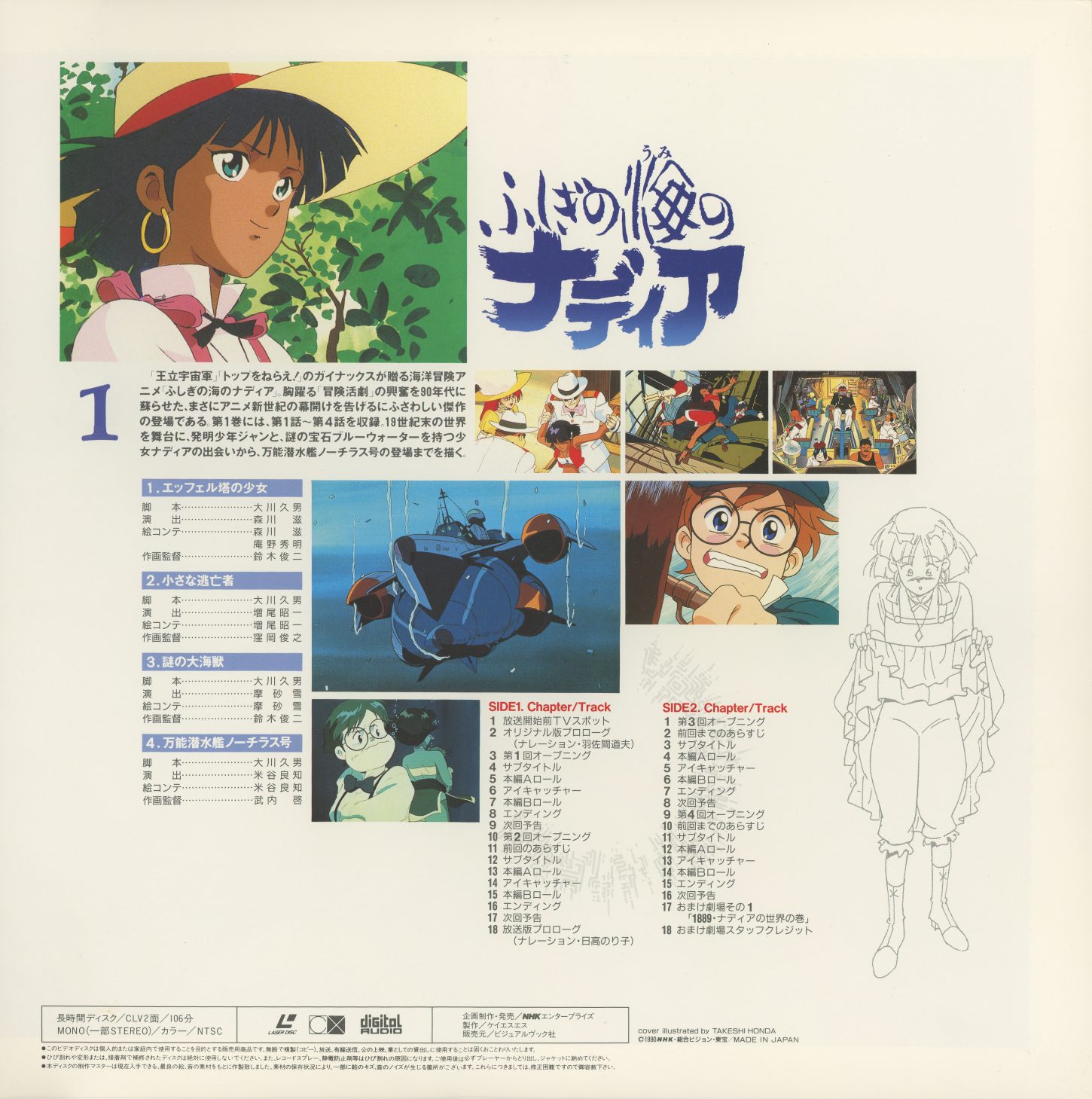 Volume 1 back. CLV, 2面, mono/stereo. Episode listings with per-episode staff credits — director, storyboard, animation director, art director named for each. Right side: Nadia settei line drawing by Sadamoto Yoshiyuki. Bottom: chapter/track listings for both sides. NHK VOOK Visual Book.
The Jackets Track the Arc
Ten jackets mapping Miyazaki's adventure concept as it darkens into Anno's psychological drama. Vol. 1: Nadia and Jean at the Eiffel Tower — 1889 Paris, the series at its most optimistic. Vol. 2: Gargoyle's warship looms over the ensemble — the antagonist arrives. Vol. 3: Electra and Nadia at the beach, Jean and Grandis behind — the first real respite, the cast fully assembled. Vol. 4: Nemo at the helm in a desert ruin under orange sky, the Neo-Atlantean obelisks visible — Red Noah approaches. Vol. 5: the Nautilus crew arrayed against the submarine schematic — the underwater era at its peak. Vol. 6: Nadia and Nemo wading through dark Antarctic water, Jean armed behind them — the production still controlled, the story closing in. Vol. 7: Jean, Nadia, and King running across the island — the illustration holds together what the outsourced episodes could not. Vol. 8: the full island ensemble with Marie, Hanson, Sanson, and the arc antagonist — the weakest stretch. Vol. 9: the New Nautilus in flight, no characters visible, just the machine — Anno has returned to direct. Vol. 10: Gargoyle's mask, Nemo and Electra flanking, Nadia transformed below. The darkest jacket. The ending Anno directed himself.
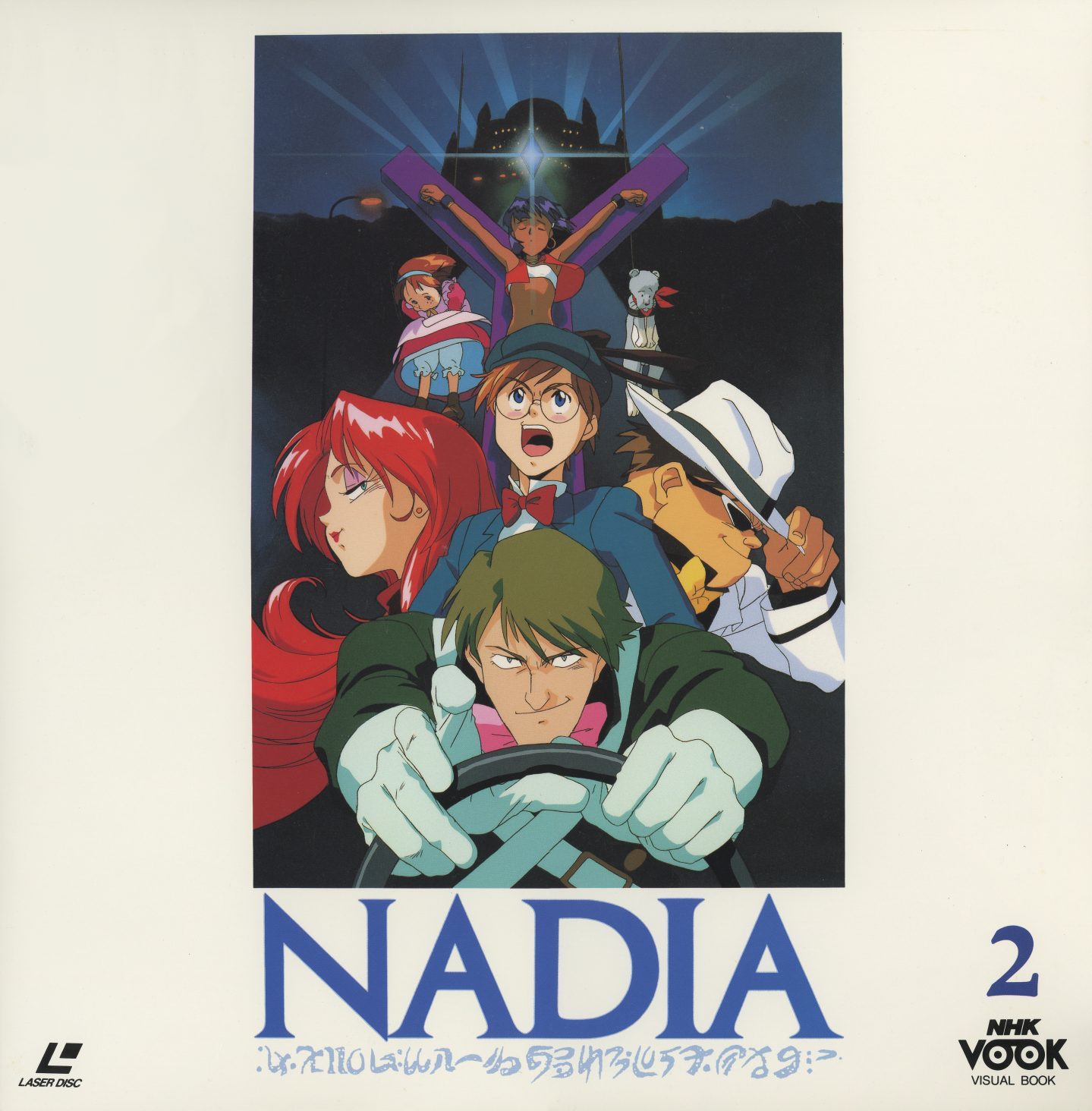 Vol. 2 — Grandis at the wheel, Nemo behind, Gargoyle's warship above. The antagonist arrives. Episodes 5–8.
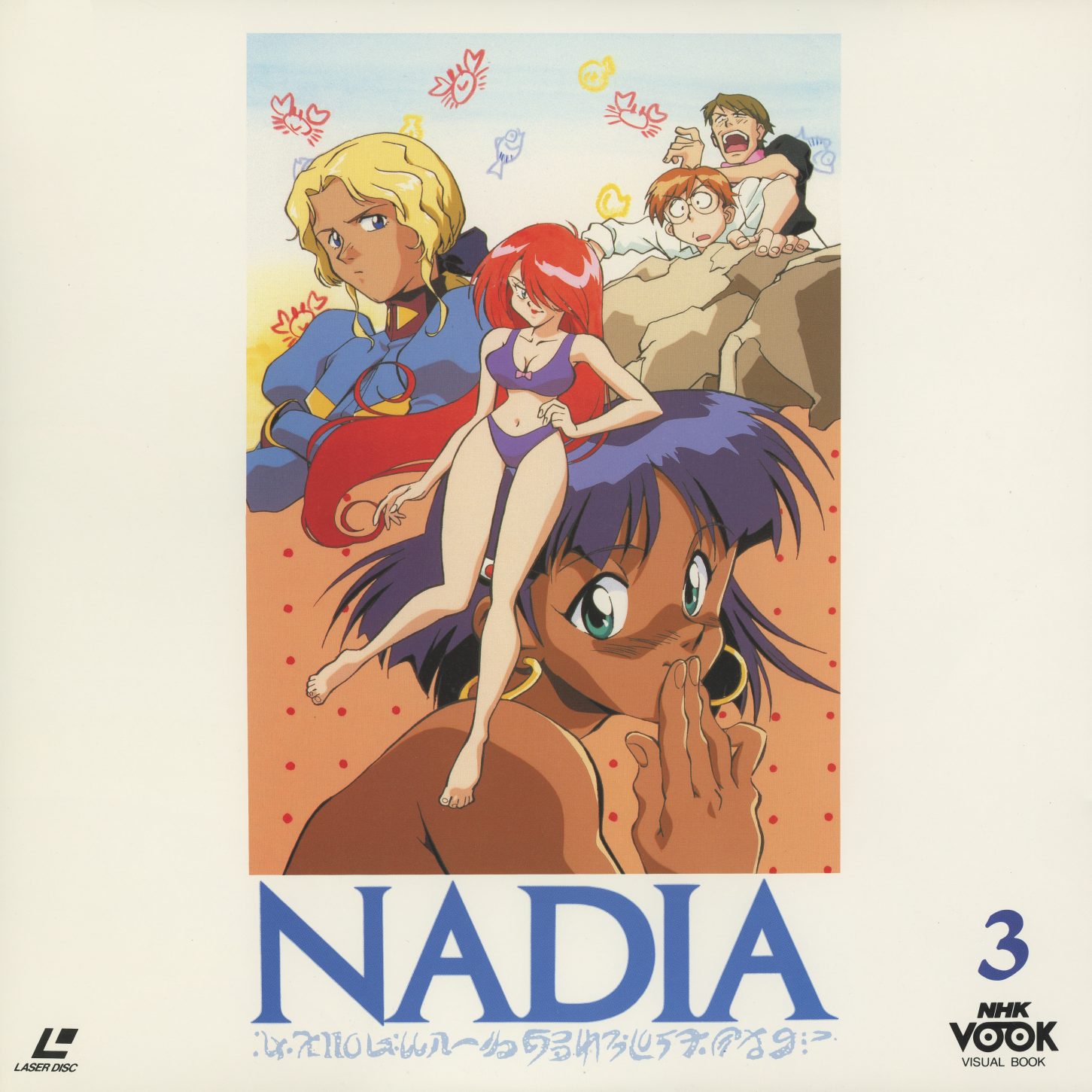 Vol. 3 — Electra in her blue combat suit, Nadia in swimsuit, Jean and Grandis above. The beach respite. Episodes 9–12.
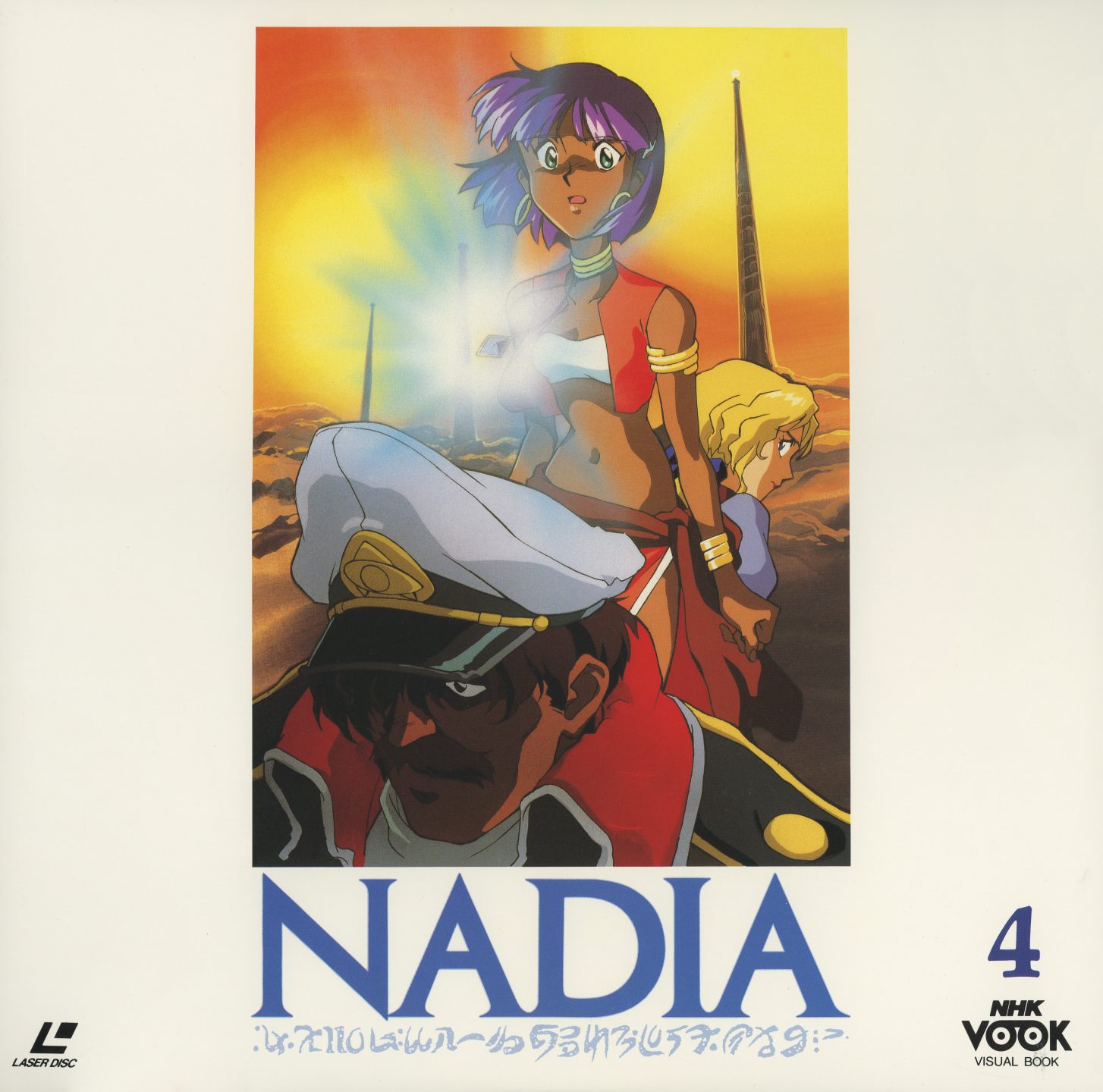 Vol. 4 — Nemo at the helm, Nadia above him, desert ruins and Neo-Atlantean obelisks under orange sky. Red Noah. Episodes 13–16.
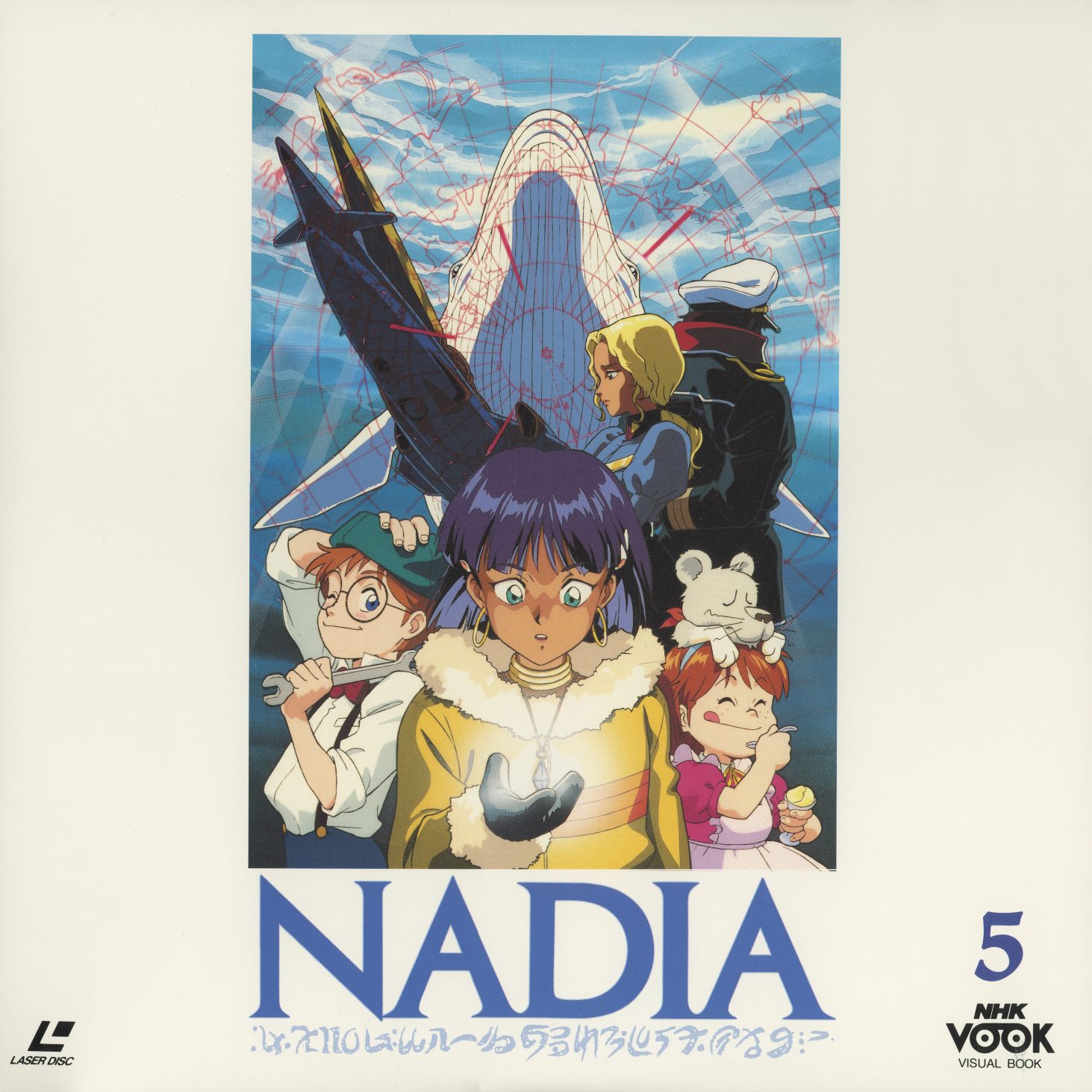 Vol. 5 — the Nautilus crew against the submarine schematic. Jean's new invention, Jean's failure. Episodes 17–20.
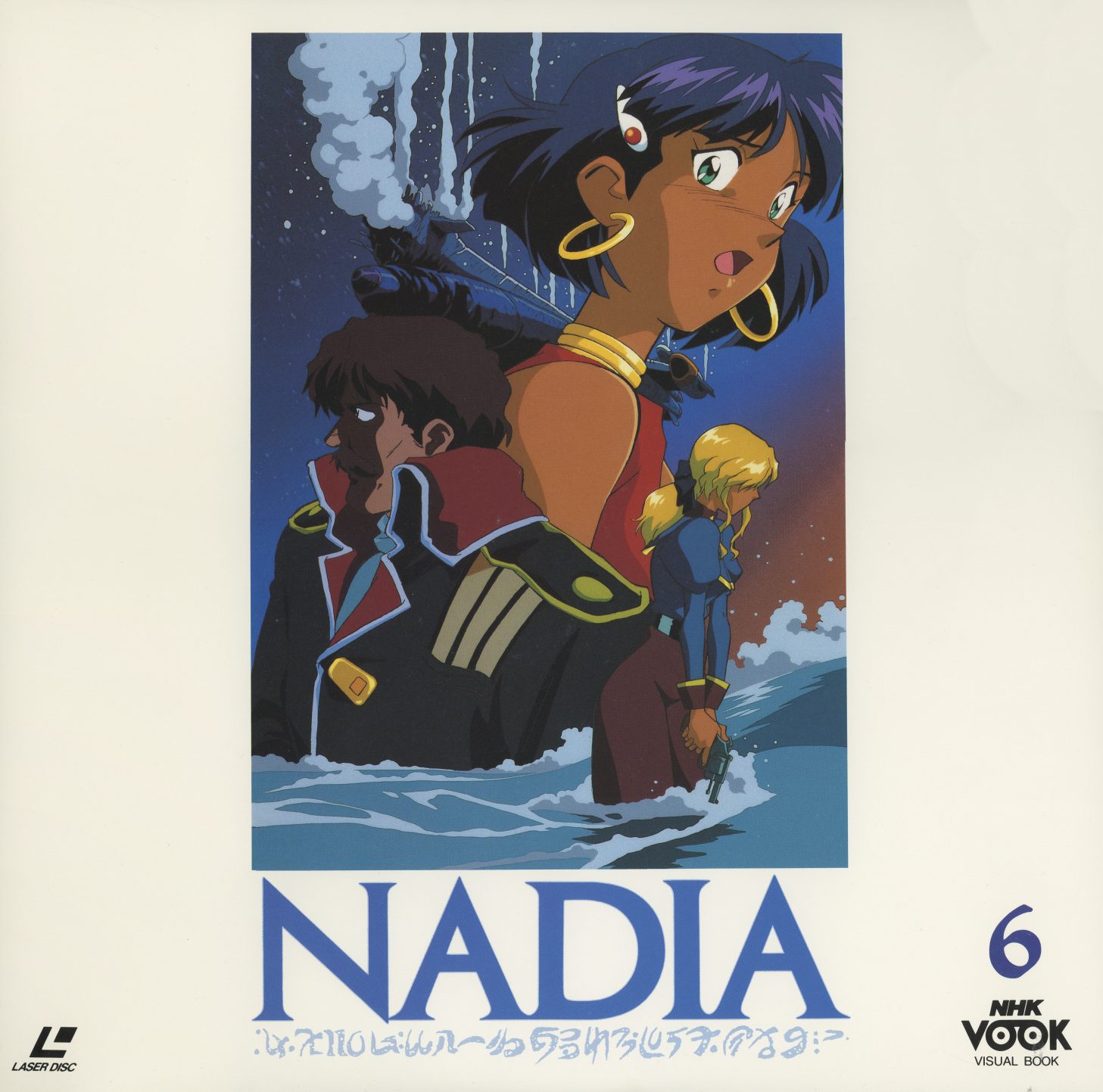 Vol. 6 — Nadia and Nemo wading through dark water, Jean armed in the background. Antarctic battles. Episodes 21–24.
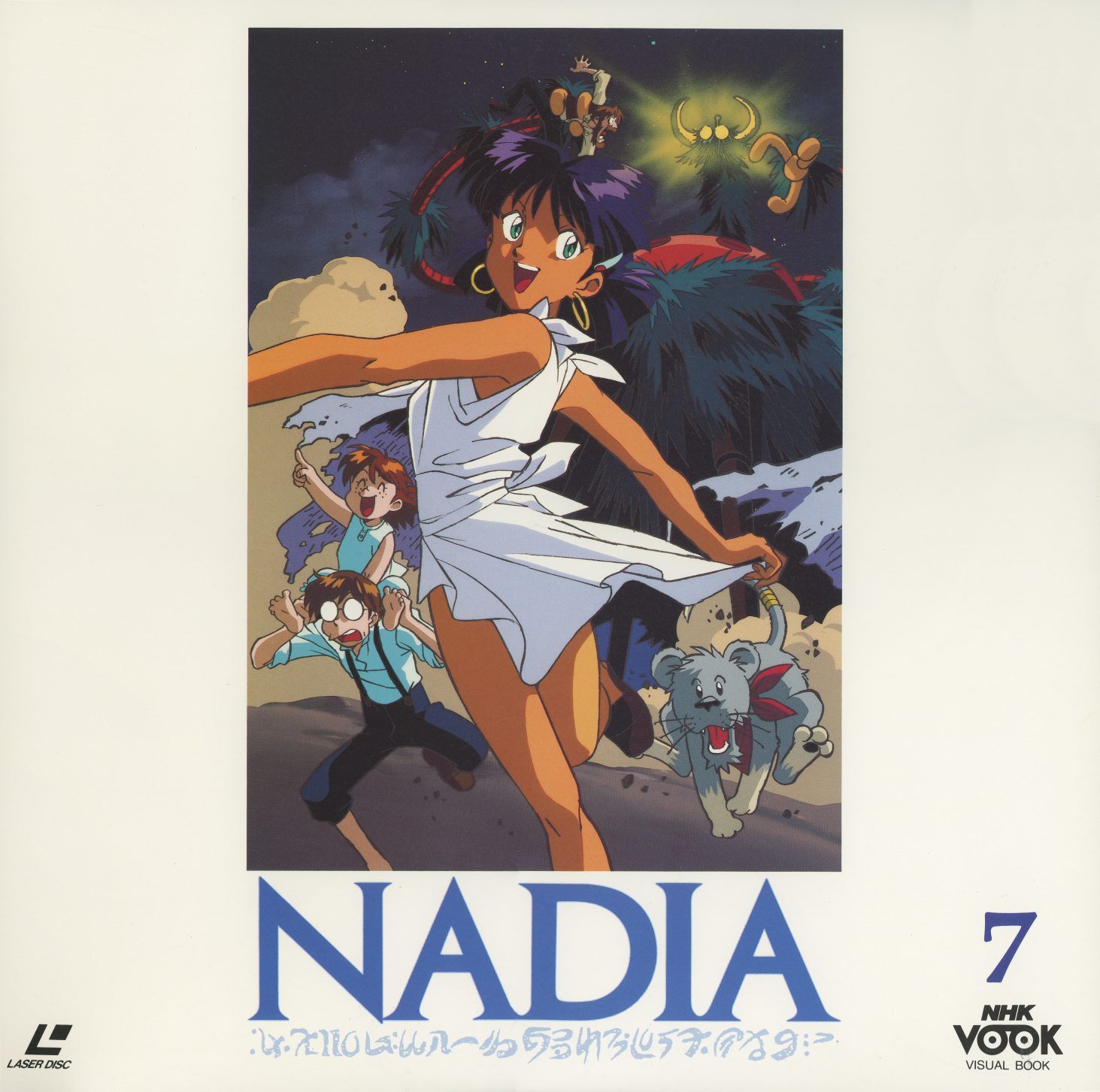 Vol. 7 — Jean, Nadia, King running on the island. The production has collapsed; the jacket holds what the episodes couldn't. Episodes 25–28.
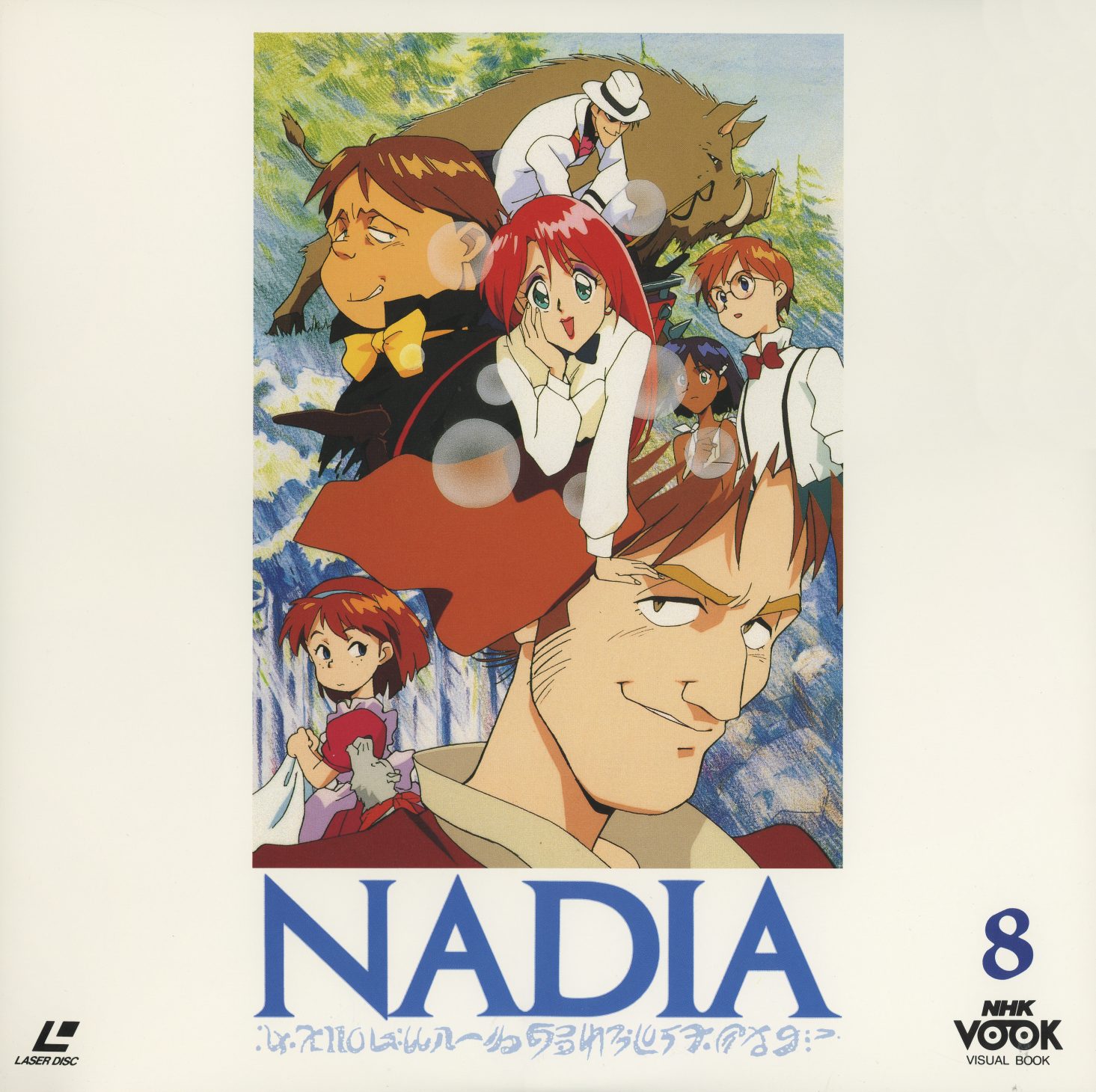 Vol. 8 — the full island arc ensemble: Hanson, Grandis, Marie, Nadia, Jean, Sanson, the arc antagonist. The weakest stretch. Episodes 29–32.
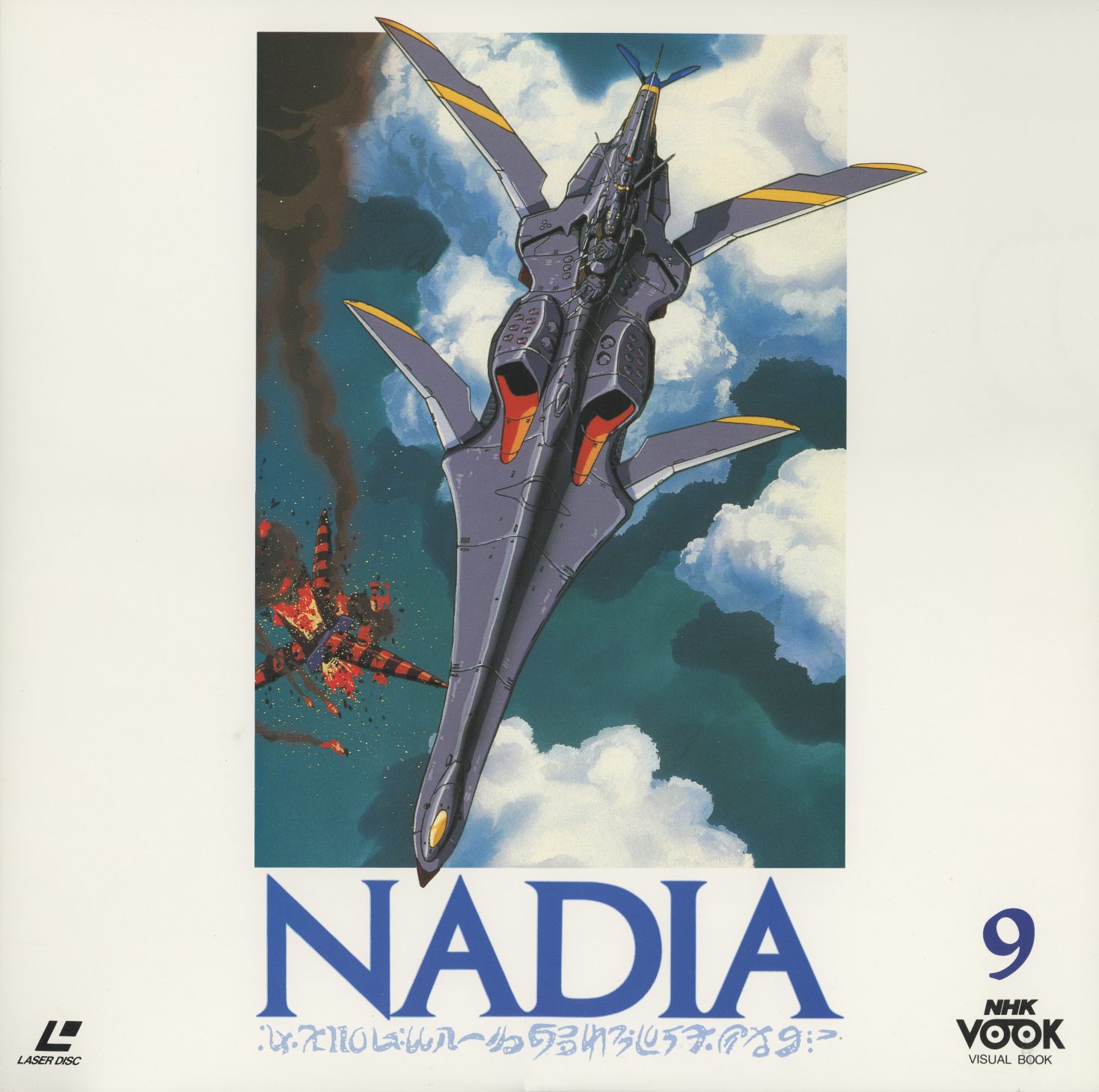 Vol. 9 — the New Nautilus in flight, no characters — just the machine. Anno returns to direct. Episodes 33–36.
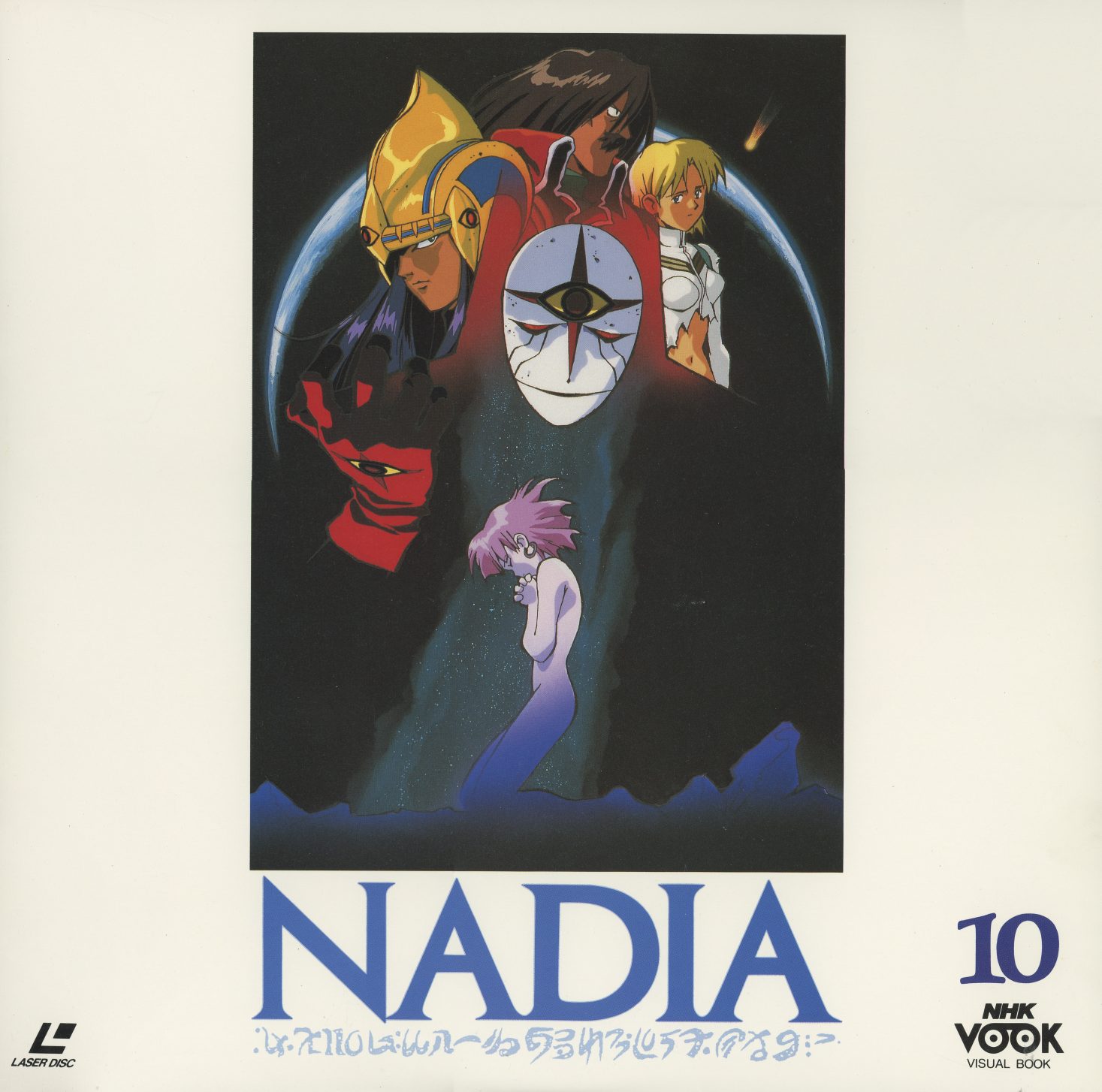 Vol. 10 — Gargoyle's mask, Nemo and Electra flanking, Nadia transformed below. The finale. The darkest jacket. Episodes 37–39.
The Backs: Ten Settei Characters
Every disc back pairs the episode listing and per-episode staff credits with a full-body settei line drawing — production character reference sheets printed directly on the jacket. Each back is signed by its illustrator: Isamu Makake on Vol. 2, Keisuke Fukuda on Vol. 5, Kazuya Tsurumaki on Vol. 10. The character rotates through the full cast as the volumes progress — the antagonist, the crew, the ensemble — distributed one per jacket as if the packaging were a settei collection released ten discs at a time. Vol. 10's credit to Tsurumaki is the only disc in the set attributed to him, a small fact that places the future Evangelion co-director inside the original production's physical artifact.
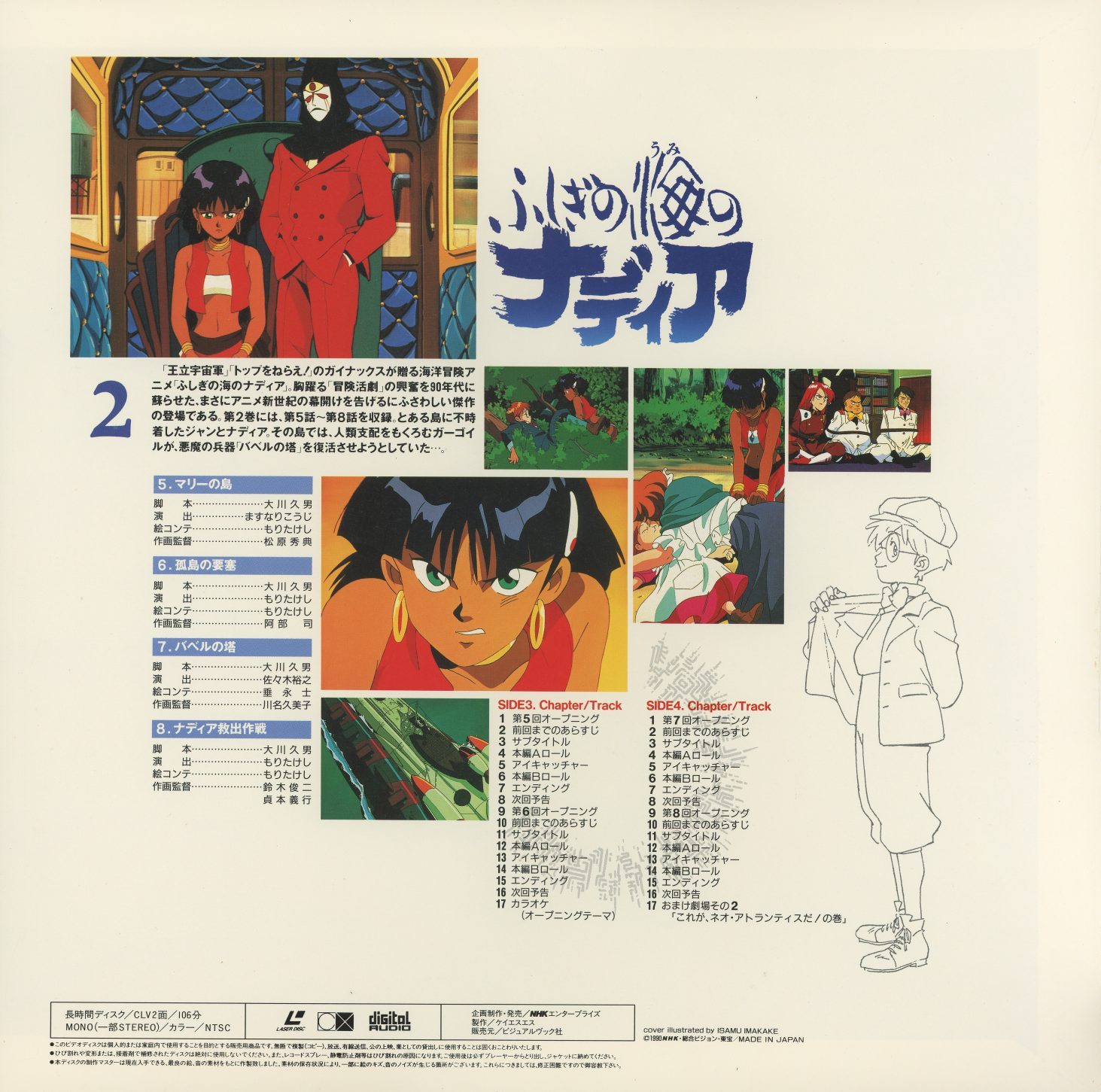 Vol. 2 back — character settei by Isamu Makake. Episodes 5–8 per-episode credits. Scene stills including Gargoyle's first full appearance.
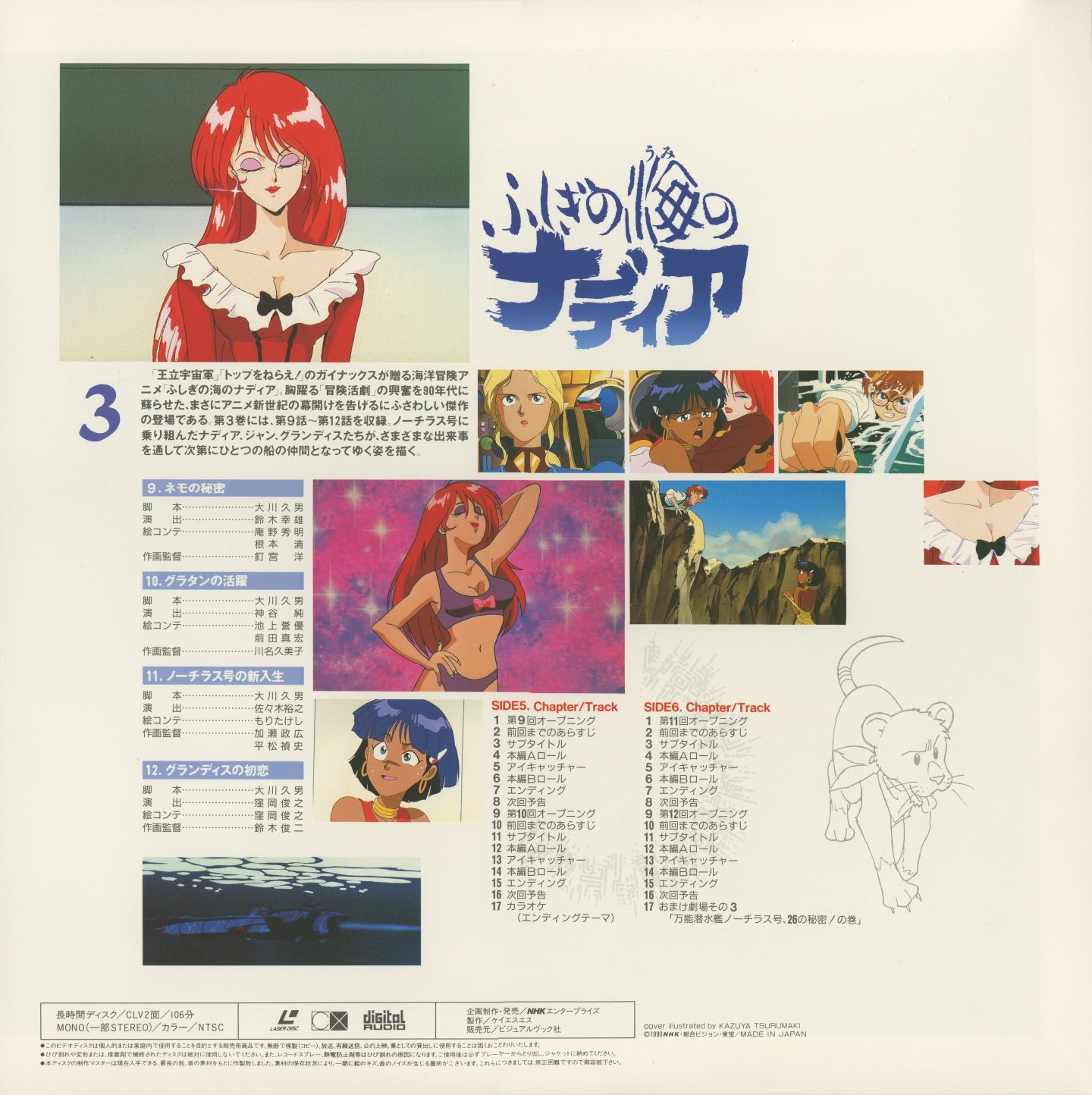 Vol. 3 back — character settei, episodes 9–12 credits.
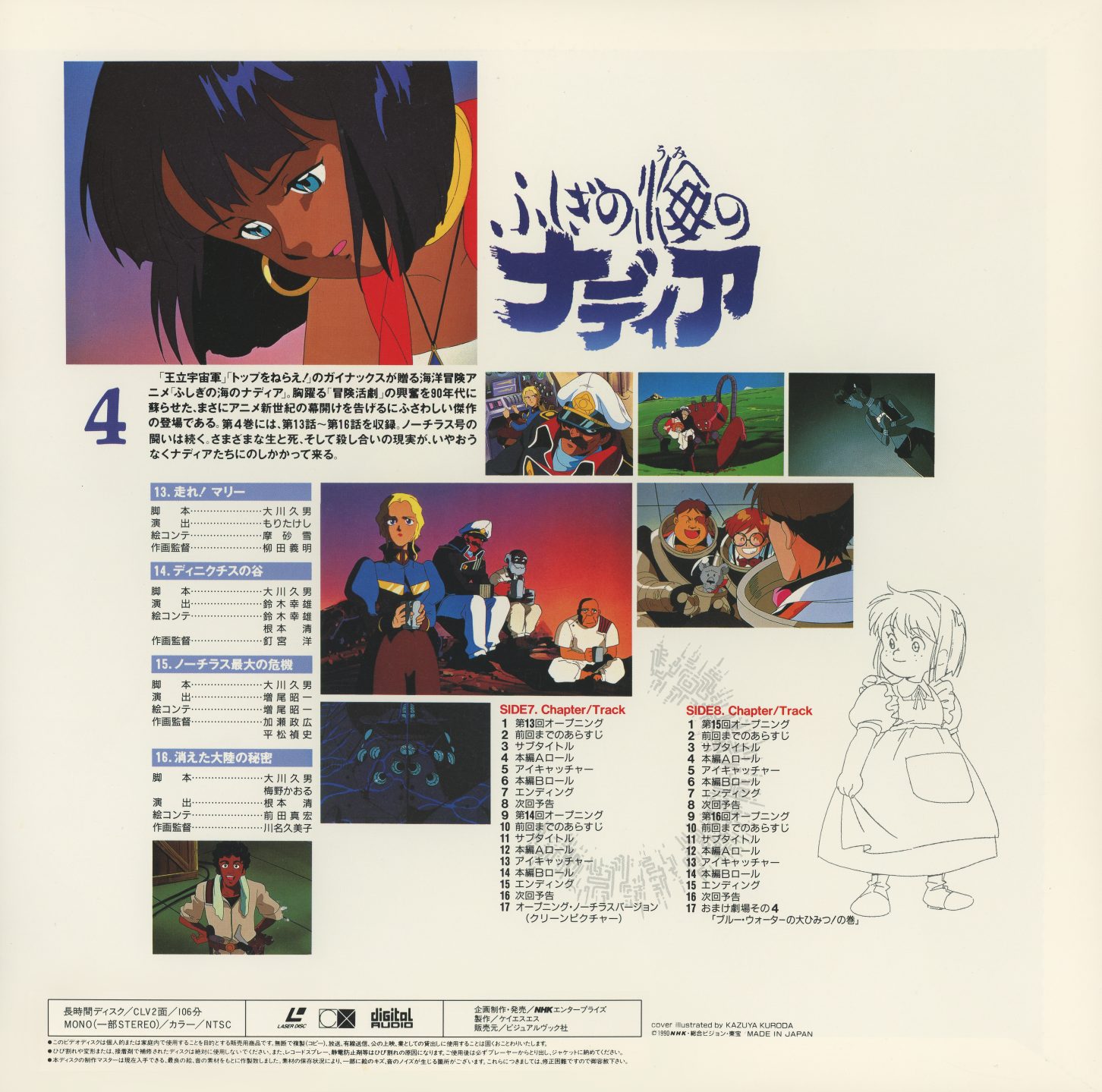 Vol. 4 back — character settei, episodes 13–16 credits.
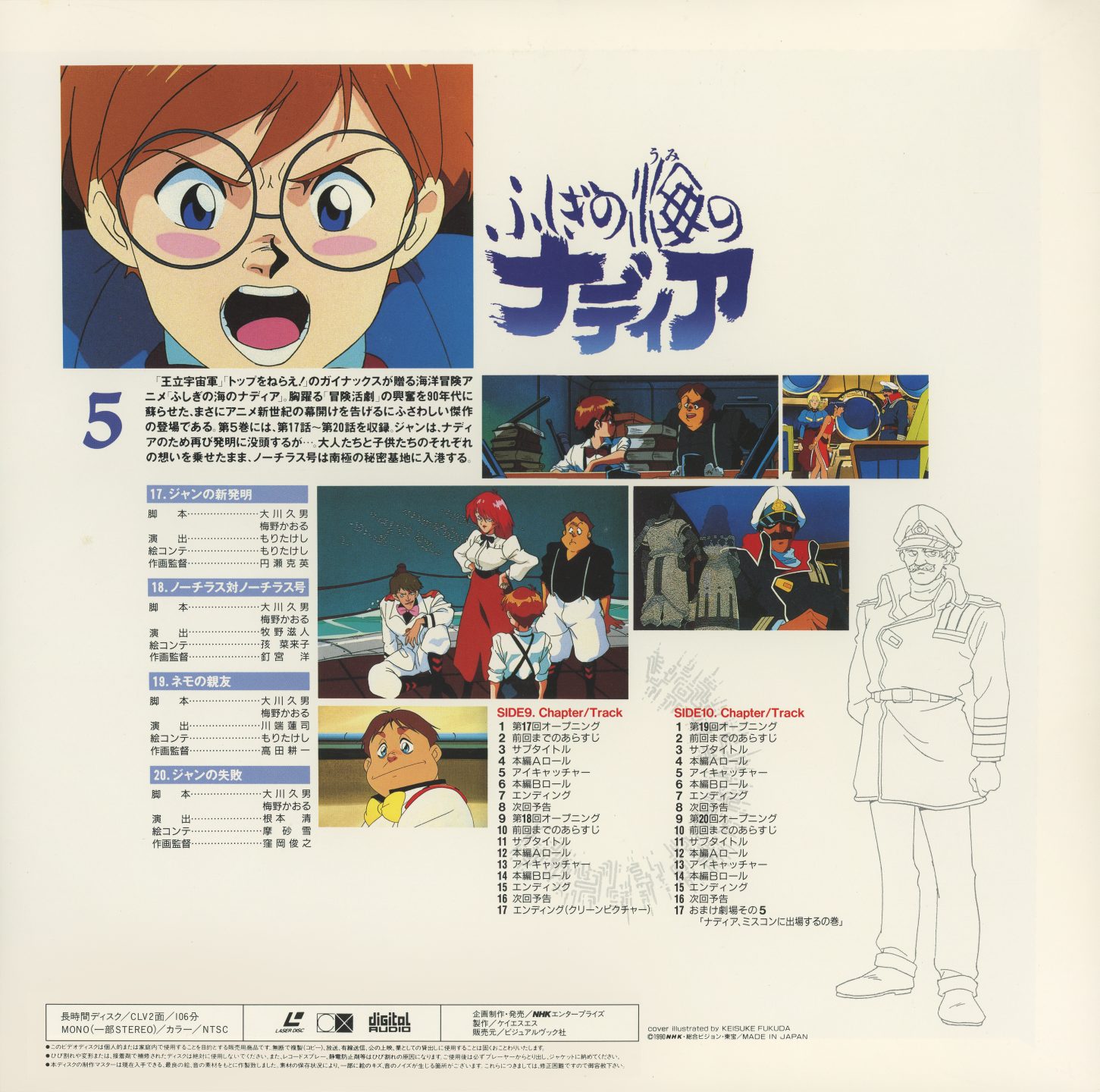 Vol. 5 back — Nautilus crew member in full naval uniform, settei by Keisuke Fukuda. Episodes 17–20 credits. Jean prominent in the scene stills.
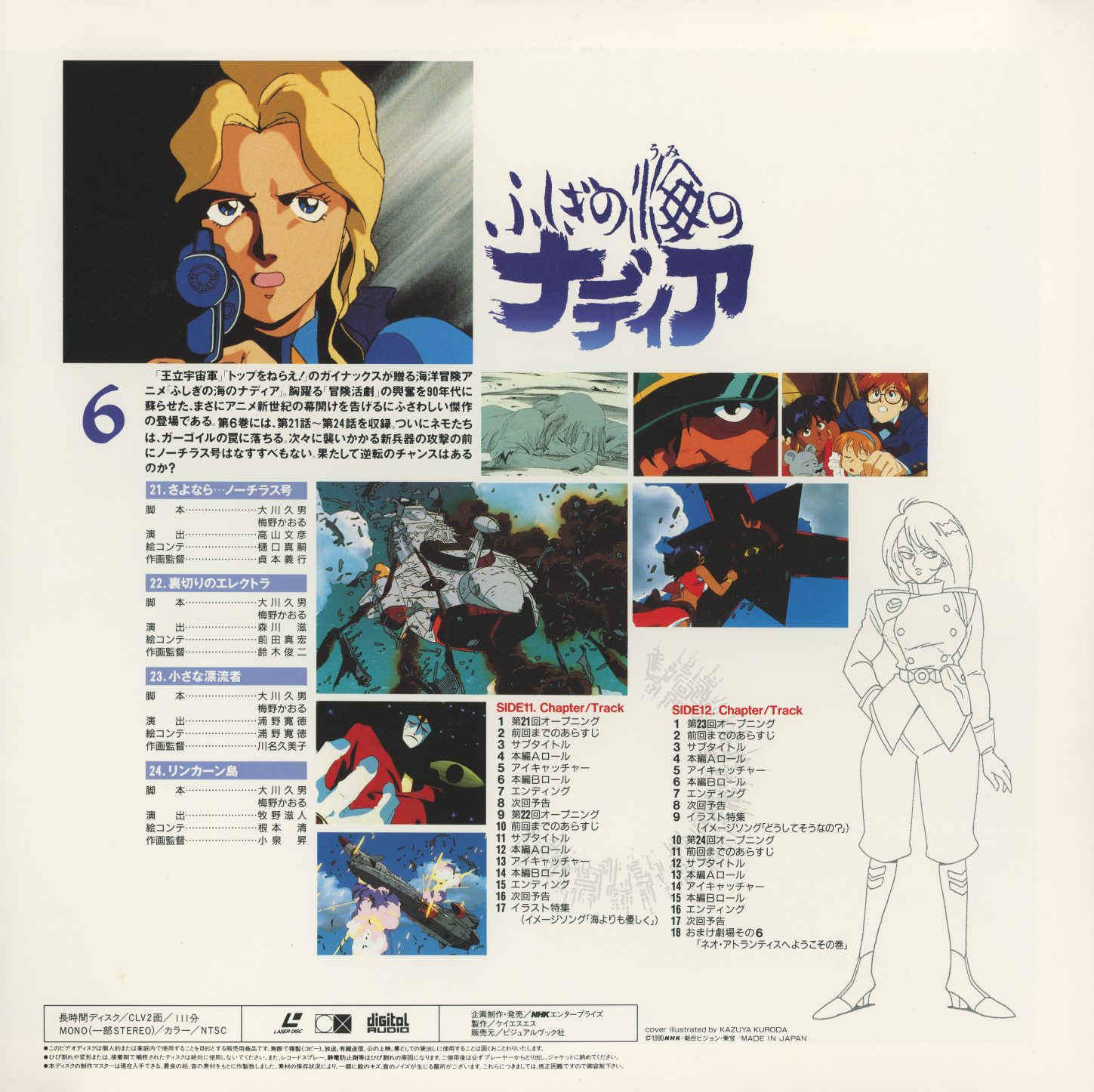 Vol. 6 back — character settei, episodes 21–24 credits.
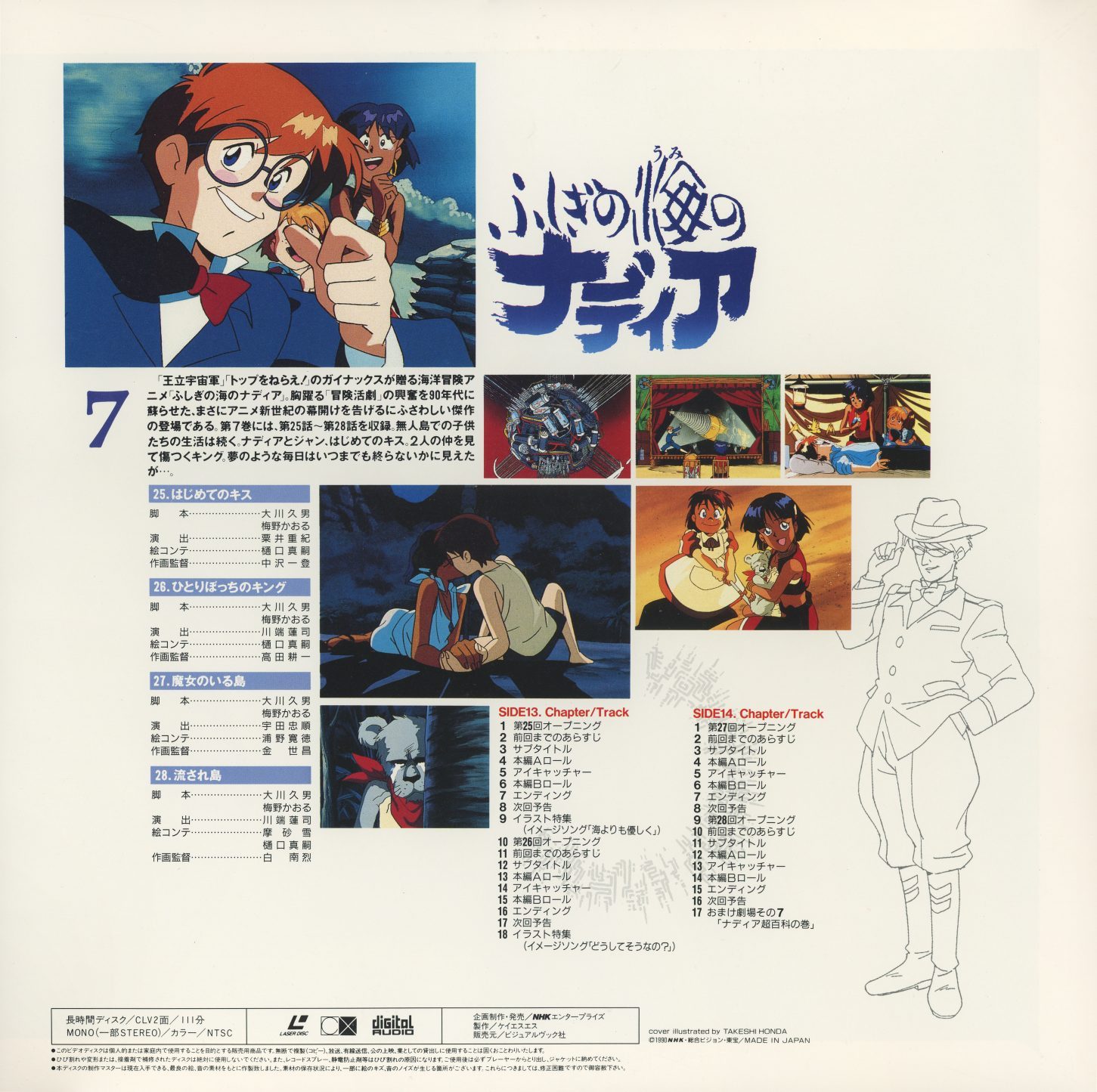 Vol. 7 back — character settei, episodes 25–28 credits.
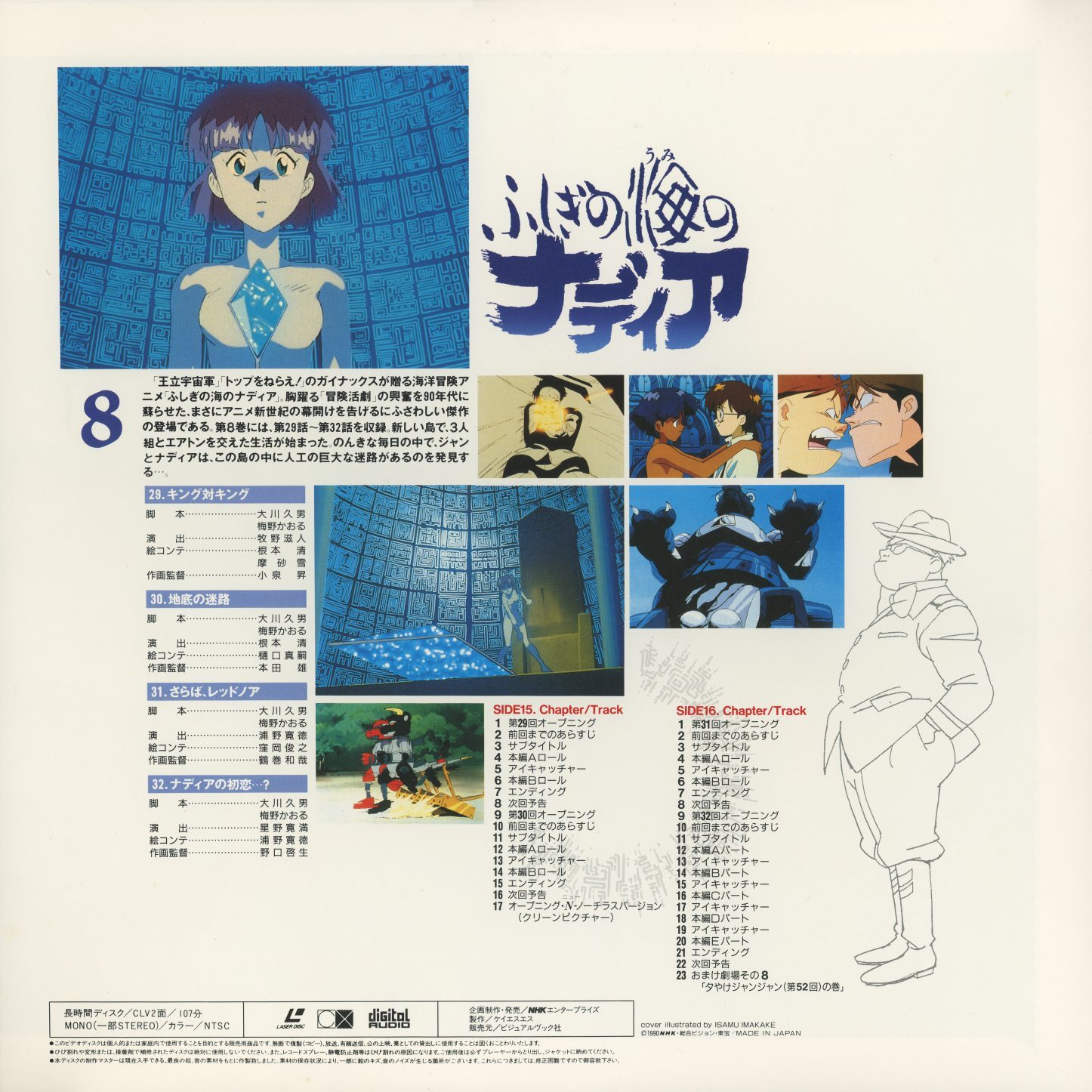 Vol. 8 back — character settei, episodes 29–32 credits.
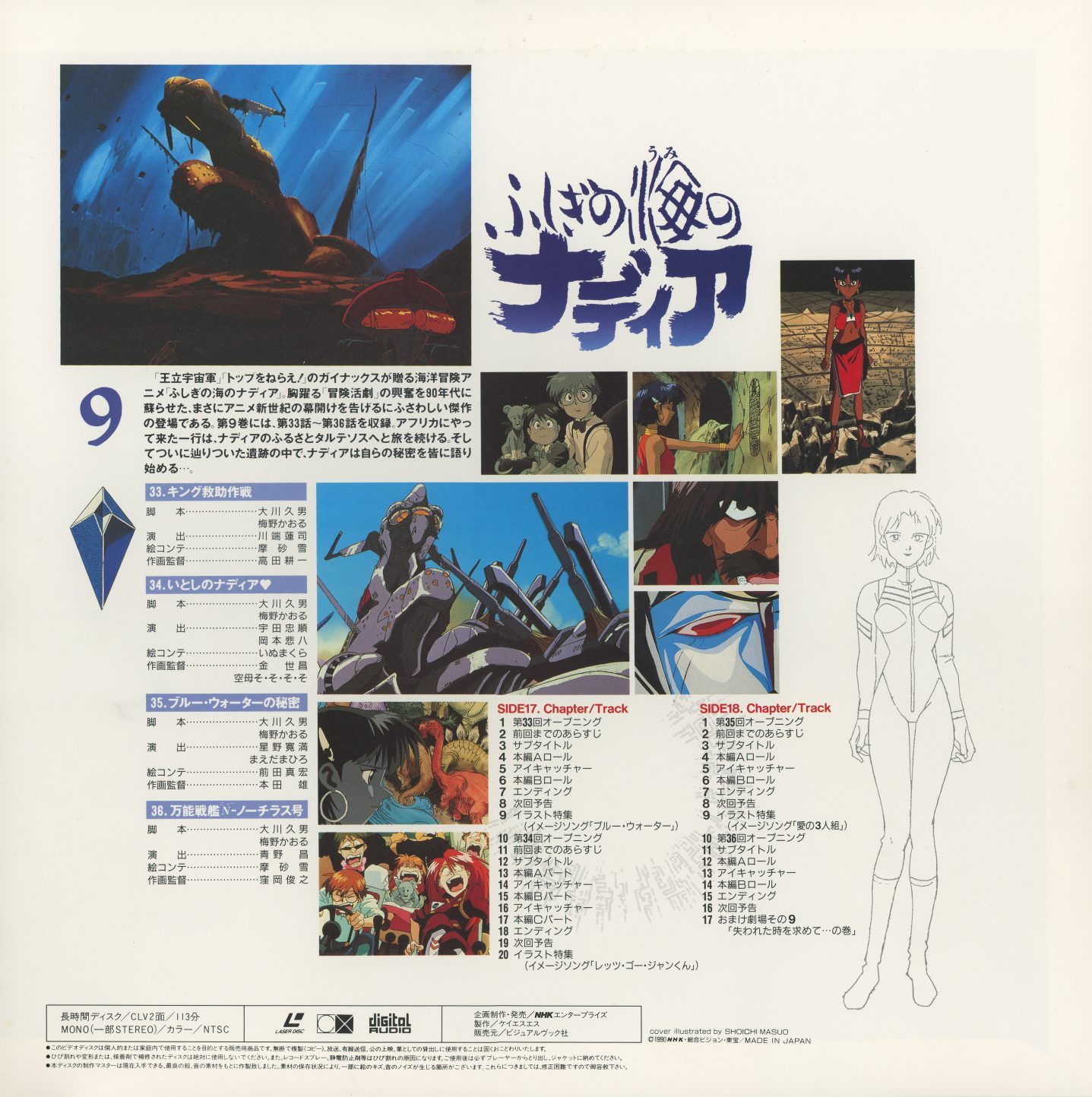 Vol. 9 back — character settei, episodes 33–36 credits.
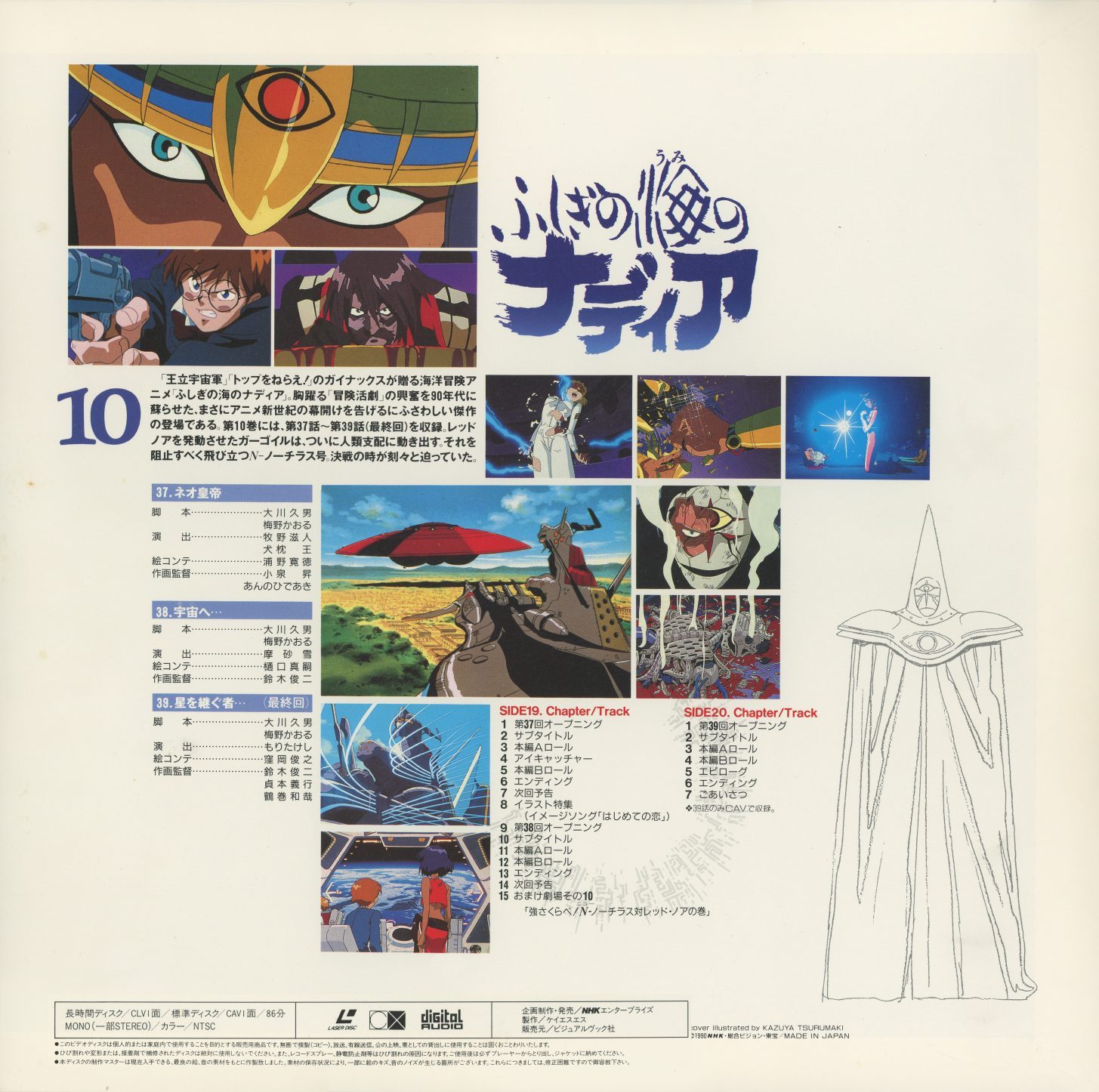 Vol. 10 back — Neo-Atlantean figure settei by Kazuya Tsurumaki. Episodes 37–39: the finale. The only disc back in the set credited to Tsurumaki.
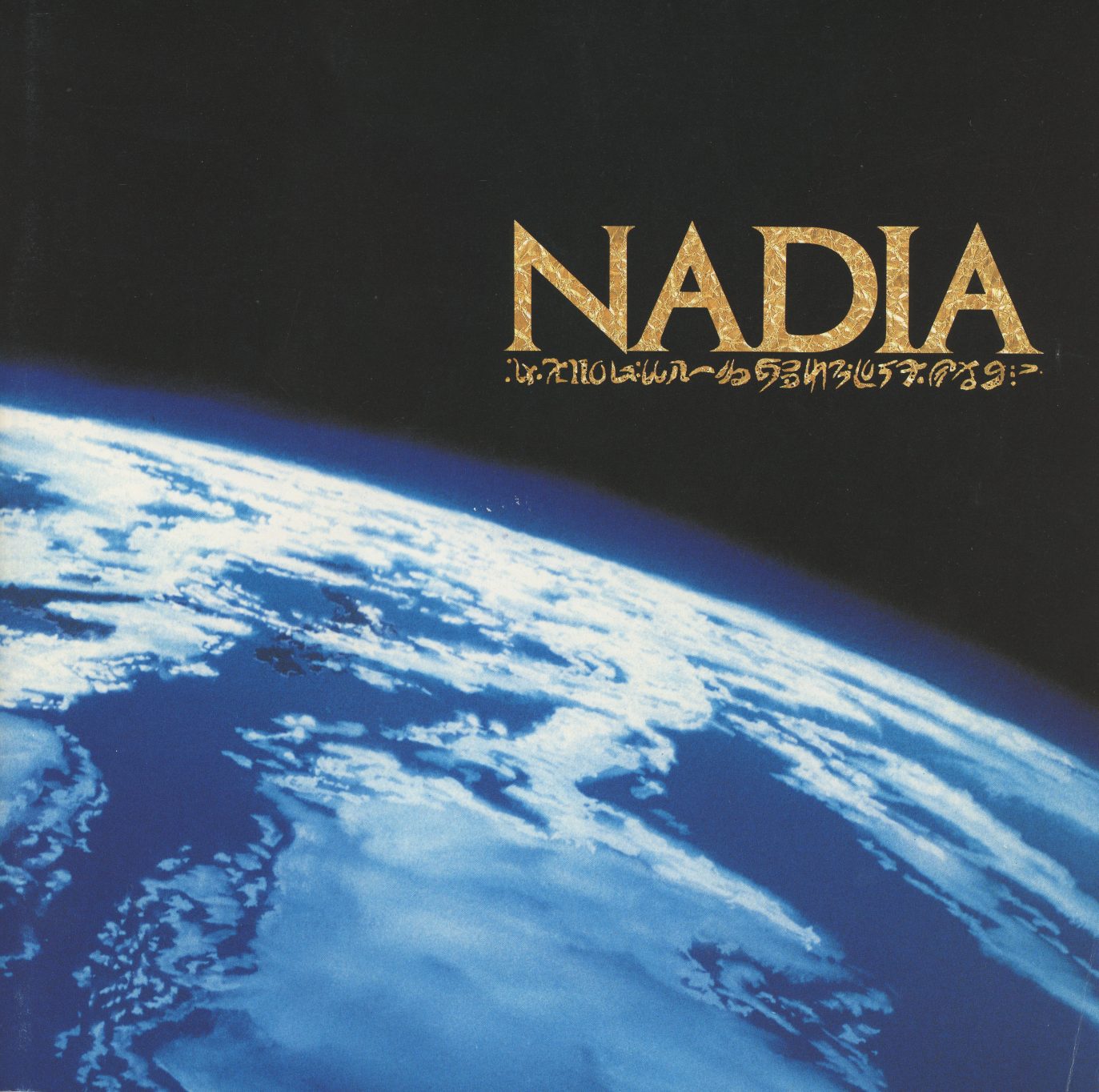 Perfect Collection booklet cover. Earth from orbit — the planet the Neo-Atlanteans want to reclaim. Gold NADIA title with the series' alien script subtitle. The booklet opens from the cosmic scale and narrows to production details.
The Booklet
The Perfect Collection booklet is the release's real weight. It opens with a world map spread situating the series' geography — the route from Paris across the Mediterranean, through the Atlantic, to the Antarctic — annotated with background art reproductions. Then: character profiles for every principal, each pairing Sadamoto Yoshiyuki's settei line drawings with scene screenshots and bilingual (Japanese/English) text describing the character's role. Nadia and Jean face each other across a spread. Grandis, Sanson, and Hanson share theirs. Marie and King get their own page. These are the production reference sheets that the animation team worked from — published here not as extras but as the primary visual language of the booklet.
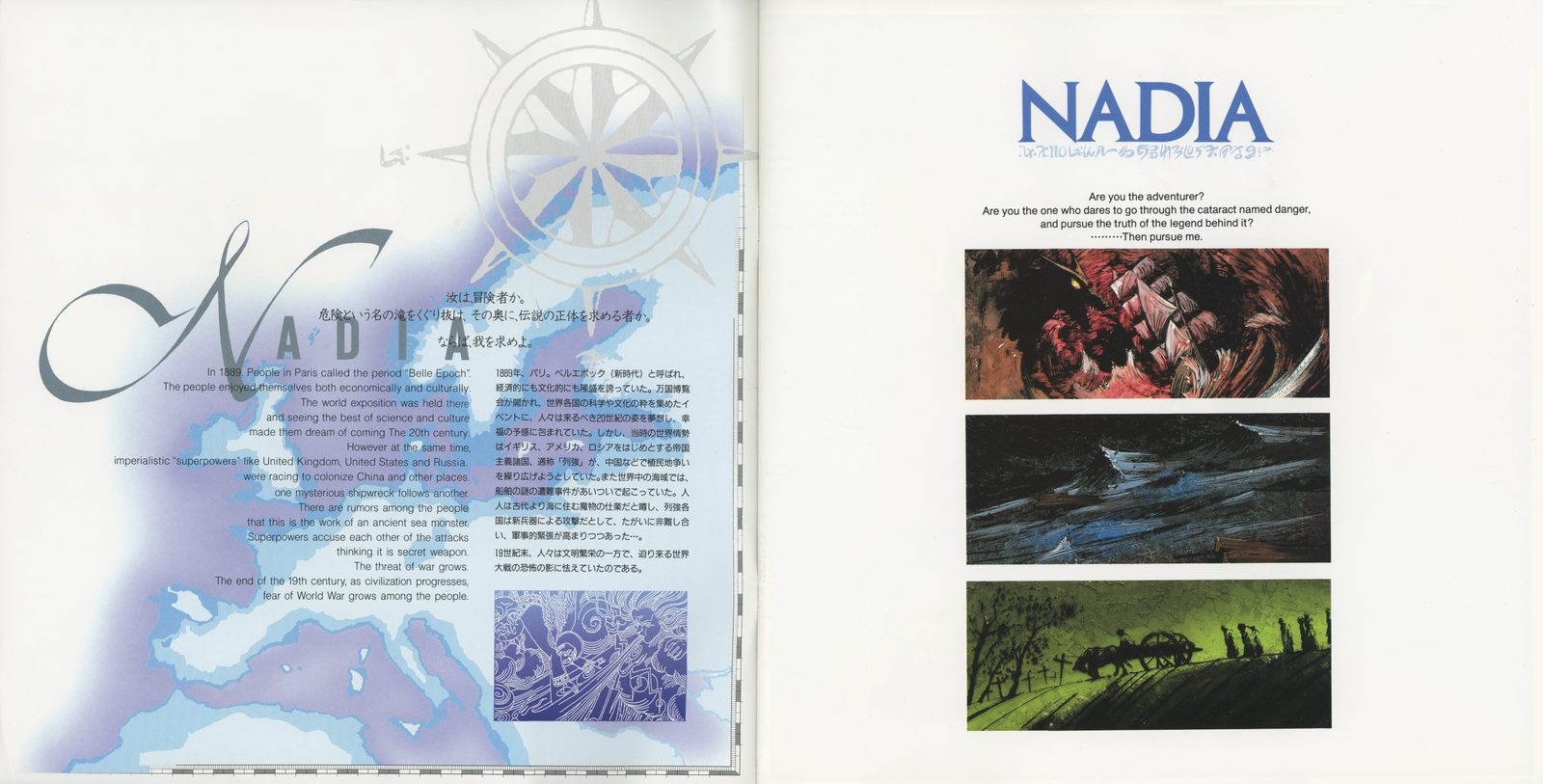 Opening spread. Left: world map with the series' geographic route annotated. Right: 'NADIA — The Secret of Blue Water' title page with three background art reproductions — the Victorian-era landscapes that ground the series' speculative fiction in real 19th-century geography.
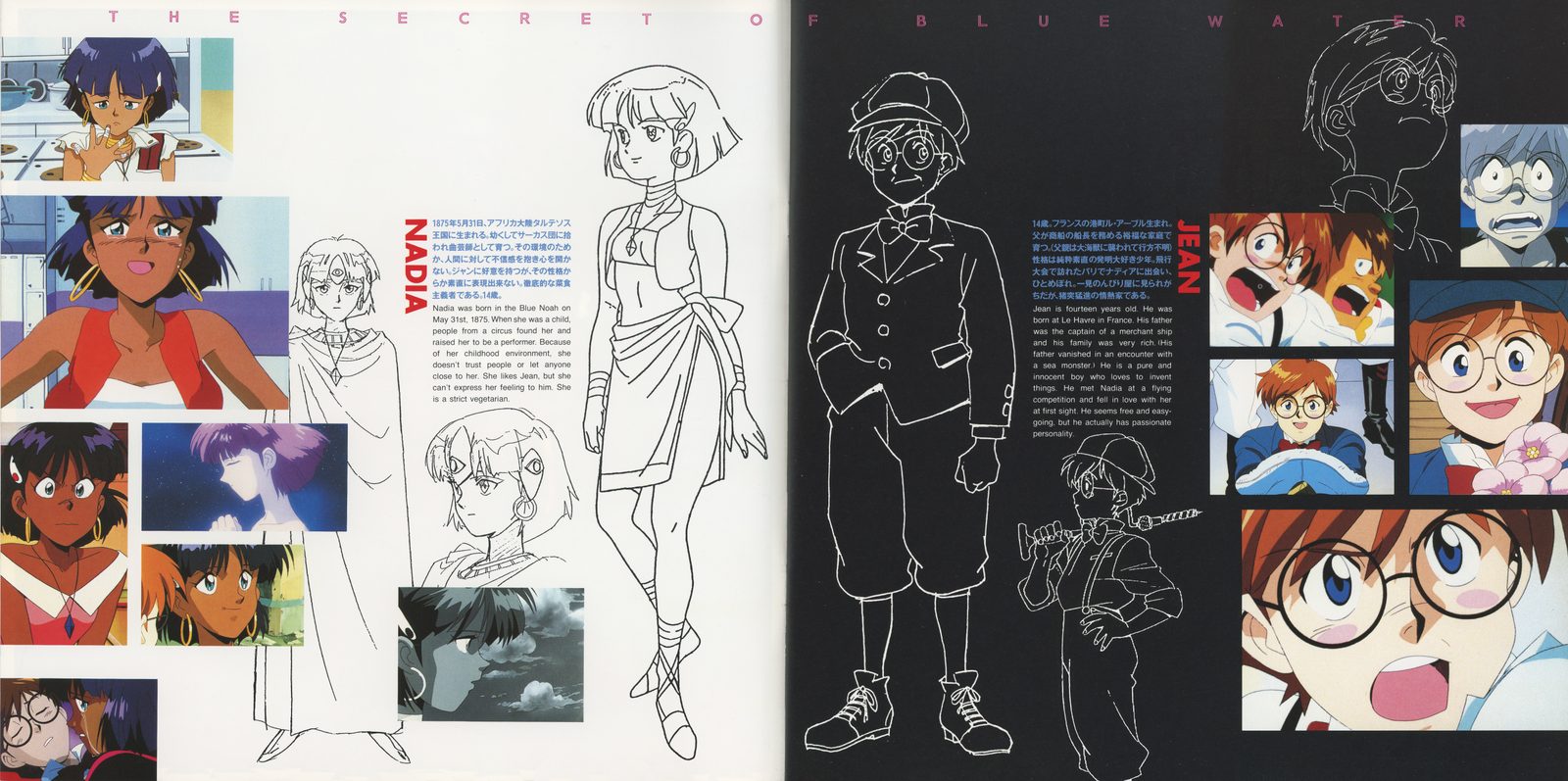 Nadia and Jean — facing settei spreads. Sadamoto Yoshiyuki's character design sheets: full-body turnarounds, expression guides, costume details. Scene screenshots flanking both sides. Bilingual character descriptions. The two protagonists who prefigure Asuka and Shinji — stubborn, emotionally guarded Nadia and earnest, oblivious Jean.
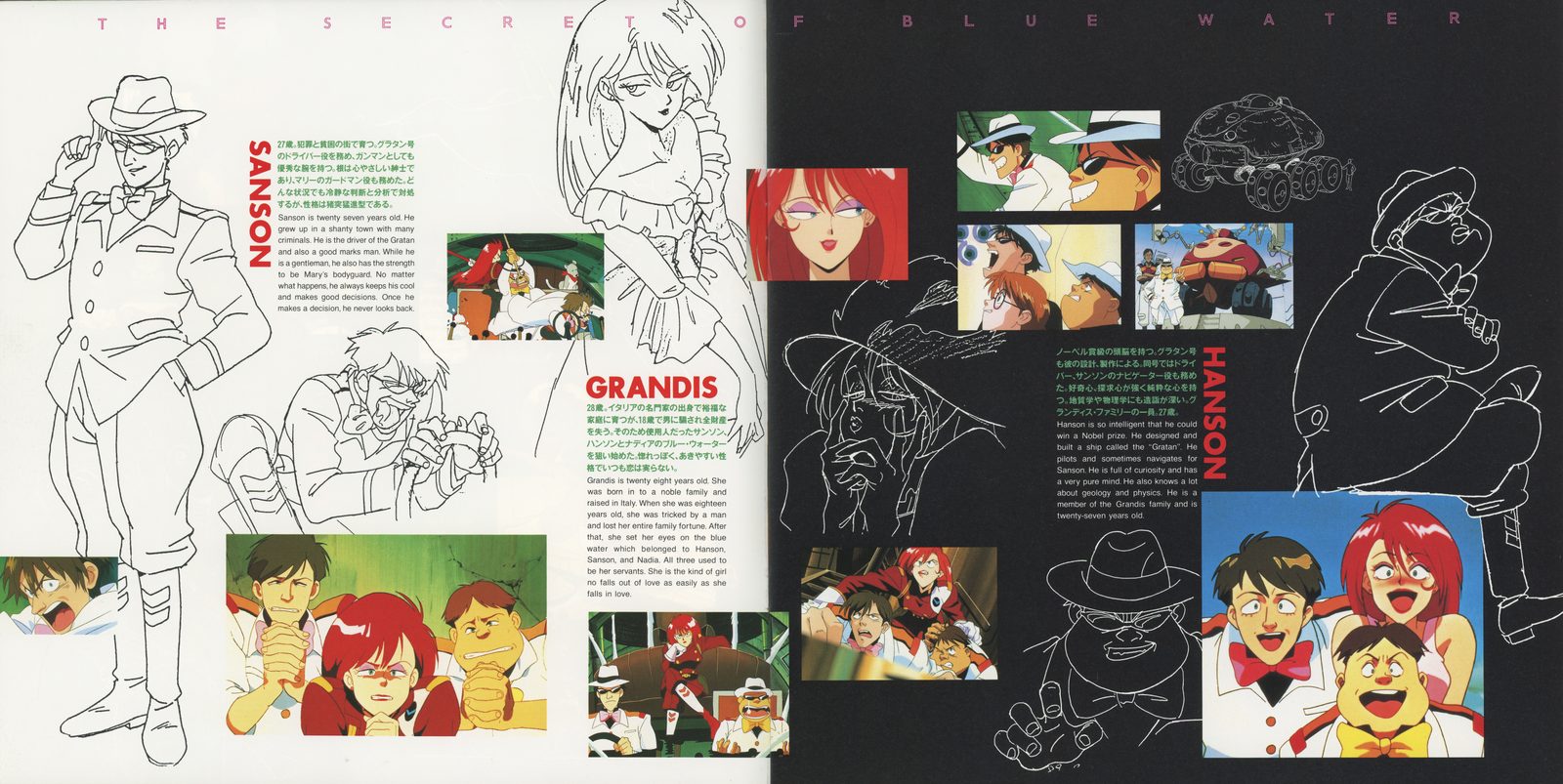 Sanson, Grandis, and Hanson — the comic relief trio who become genuinely heroic. Settei turnarounds showing Grandis's multiple costume changes. Scene screenshots capturing both the comedy register and the moments where the characters outgrow it.
Anno's Interview
'我々は何を作ってきたか' — 'What have we been making?' The booklet's centerpiece is a director interview with Anno Hideaki, credited as 総監督 (general director). The title alone signals the tone: not celebration but reflection. Anno was 29 when production began and 31 when it ended. Between those years, Gainax's scheduling collapsed, episodes were outsourced, the island arc stretched the series past its structural limits, and Anno experienced the burnout that would define his creative identity through the 1990s. The interview sits next to a full-page production still of Nadia — not the adventurous Nadia of the early episodes but the Nadia of the later arc, staring forward against the curvature of the Earth. The image chosen for this page is not the comedy. It is the exhaustion.
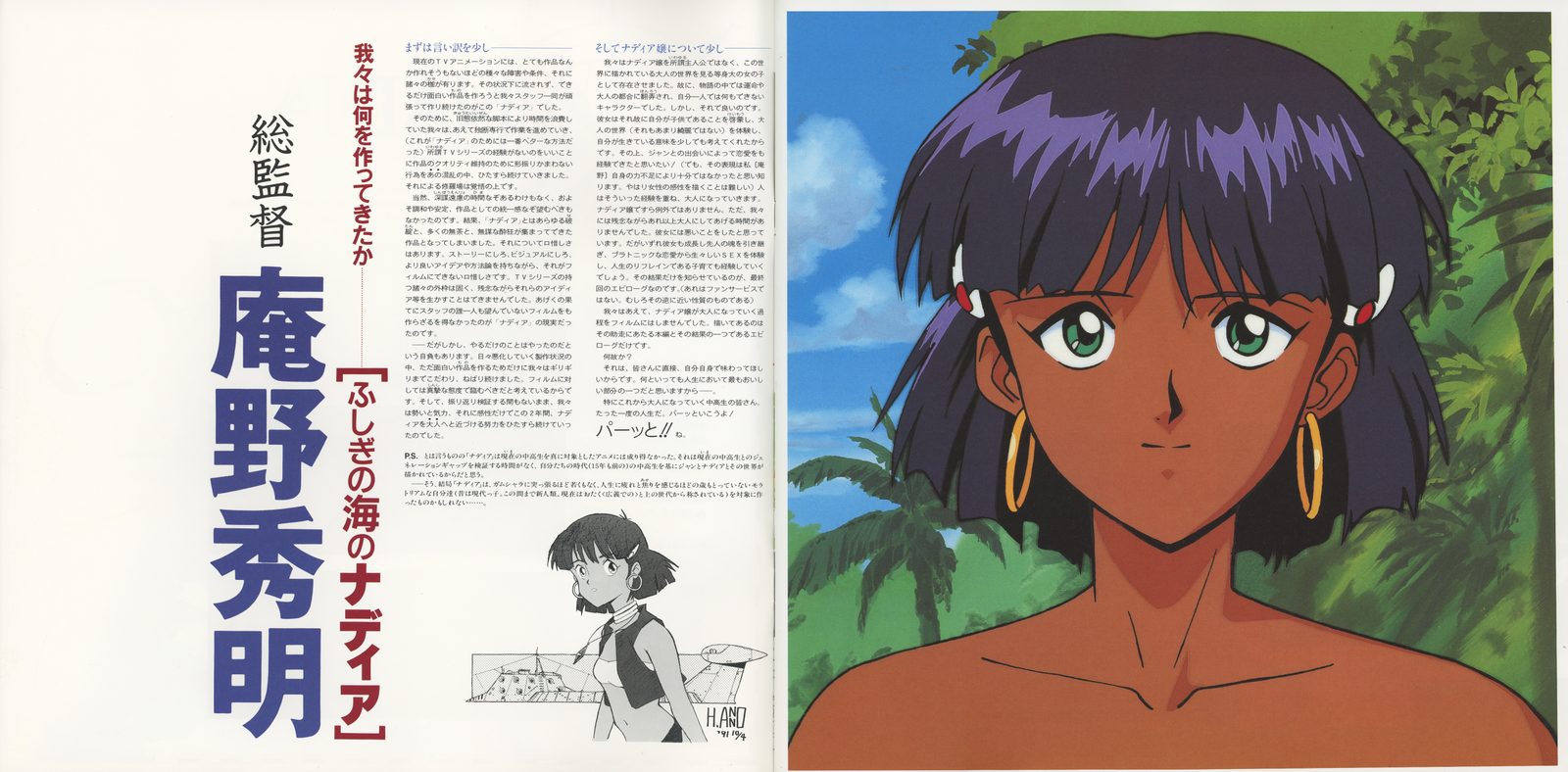 総監督 庵野秀明 — General Director Anno Hideaki. '我々は何を作ってきたか' (What have we been making?). Full-page interview alongside a production still of Nadia. Anno's first major retrospective statement about the series that nearly broke him — and the experience that shaped everything he made afterward.
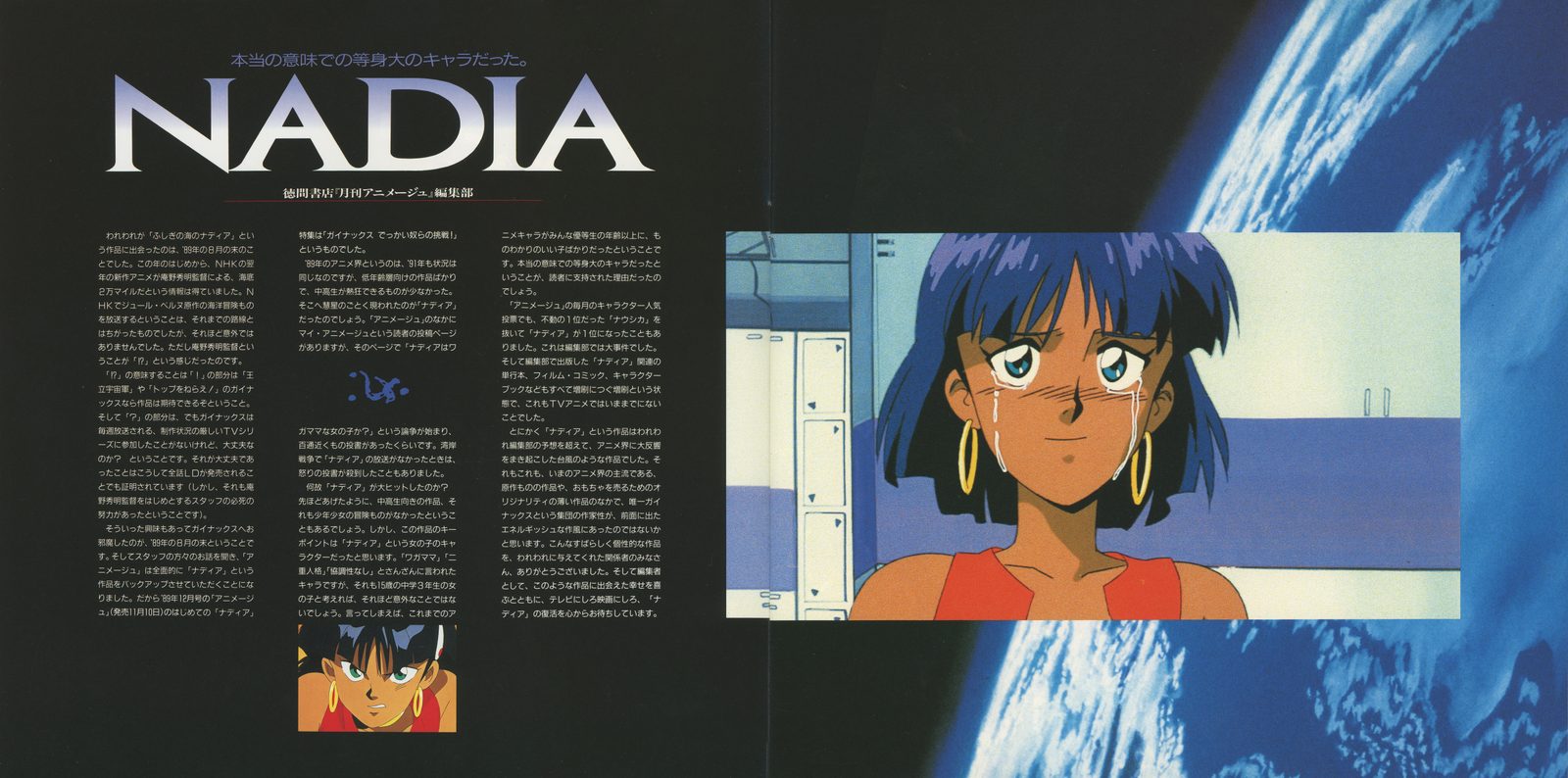 Editorial essay spread. Left: dense column of analysis. Right: Nadia in close-up, tears visible, framed against the Earth from orbit. The image selection mirrors the booklet's refusal to present the series as pure adventure — the essay confronts what the production cost.
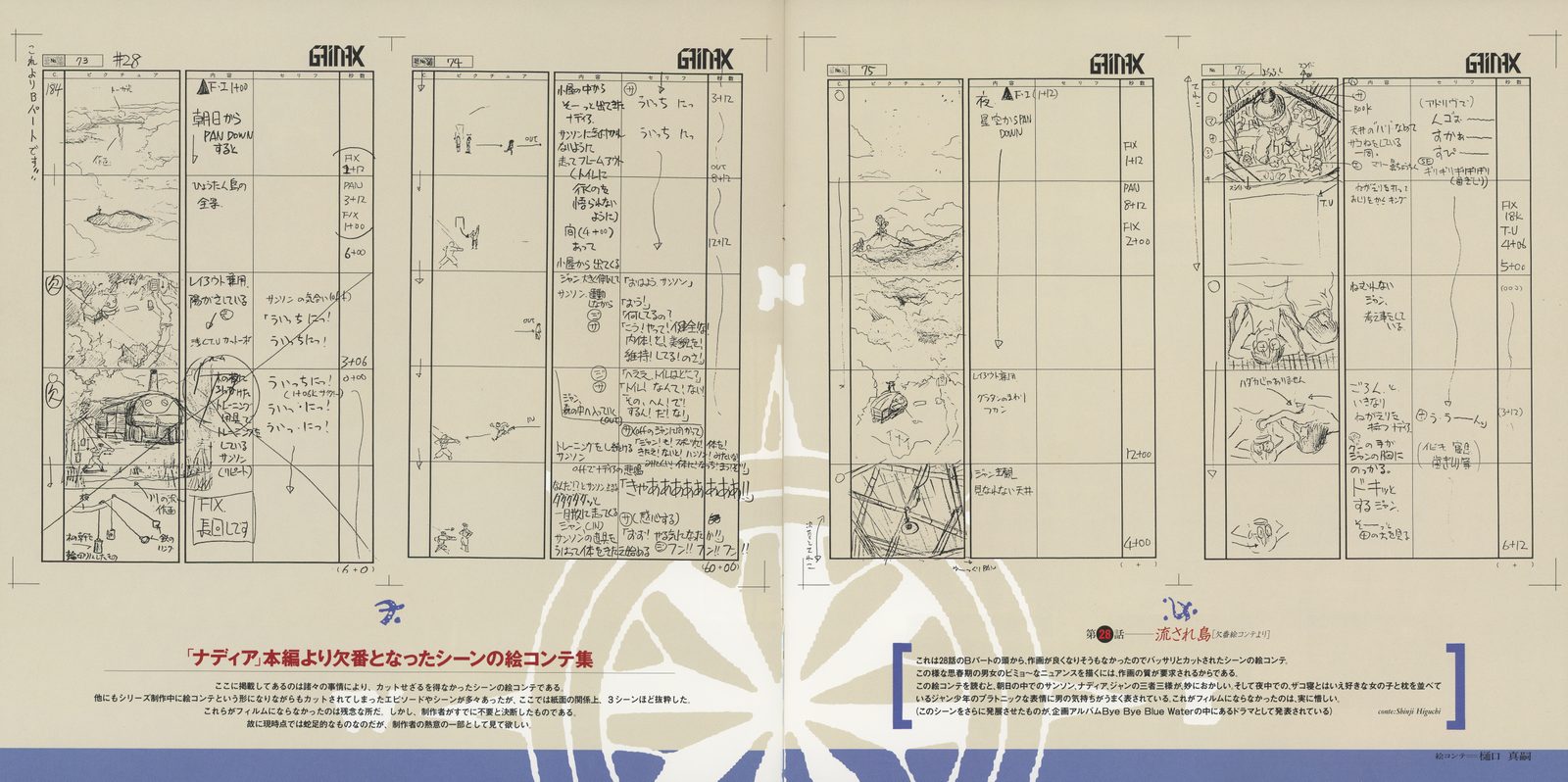 'ナディア本編より欠番となったシーンの絵コンテ集' — Storyboard collection of deleted scenes from Nadia. Production storyboards on Gainax paper, printed at readable scale. Scenes that were drawn, boarded, and cut — the production's ghost footage preserved only here.
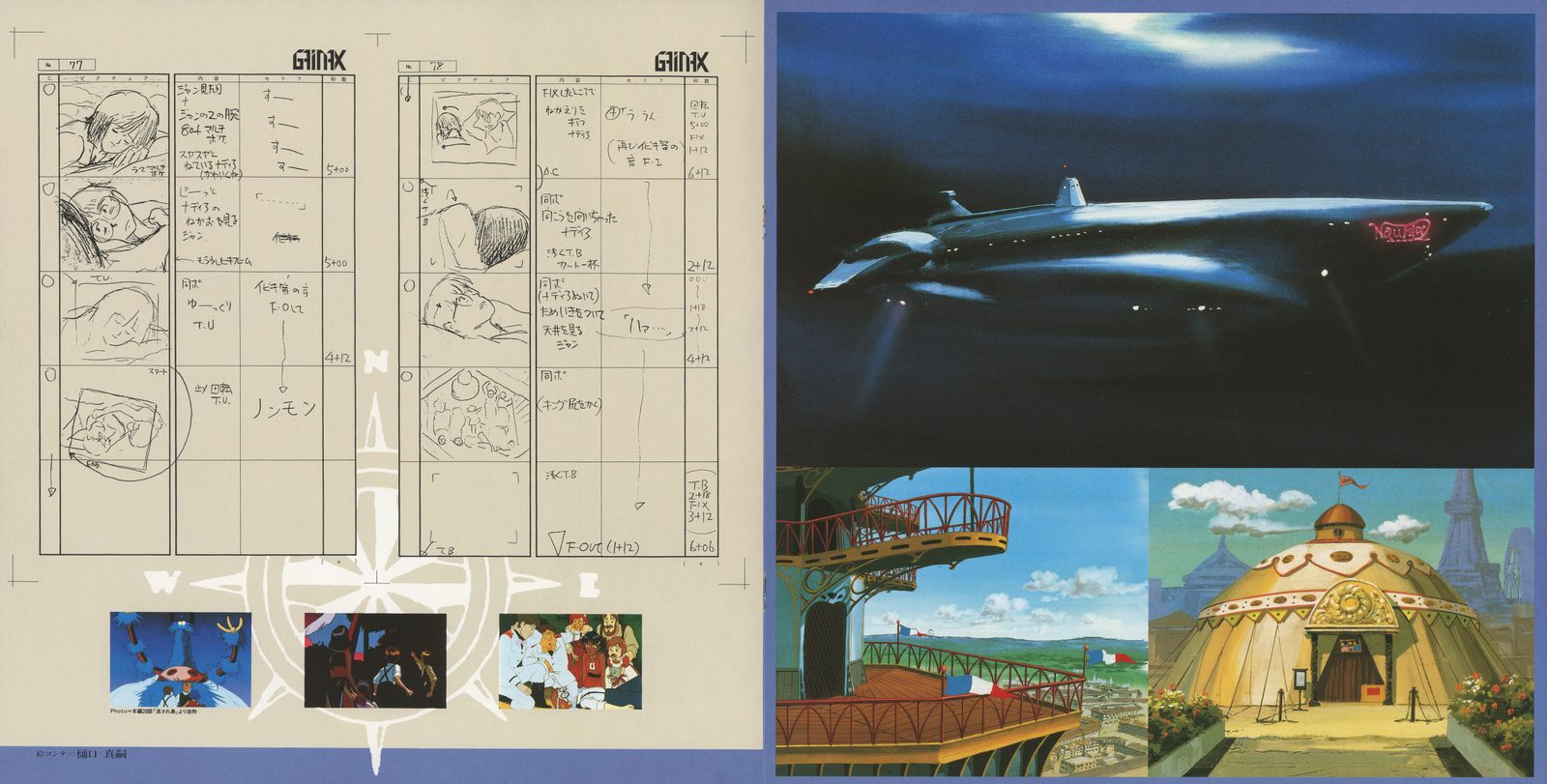 Storyboards (continued) and background art. Left: more deleted scene storyboards on Gainax paper. Right: the Nautilus at night — a background painting reproduced at full booklet scale. Below: Victorian architecture and the Gratan (Grandis's tank). The backgrounds that built the series' visual identity.
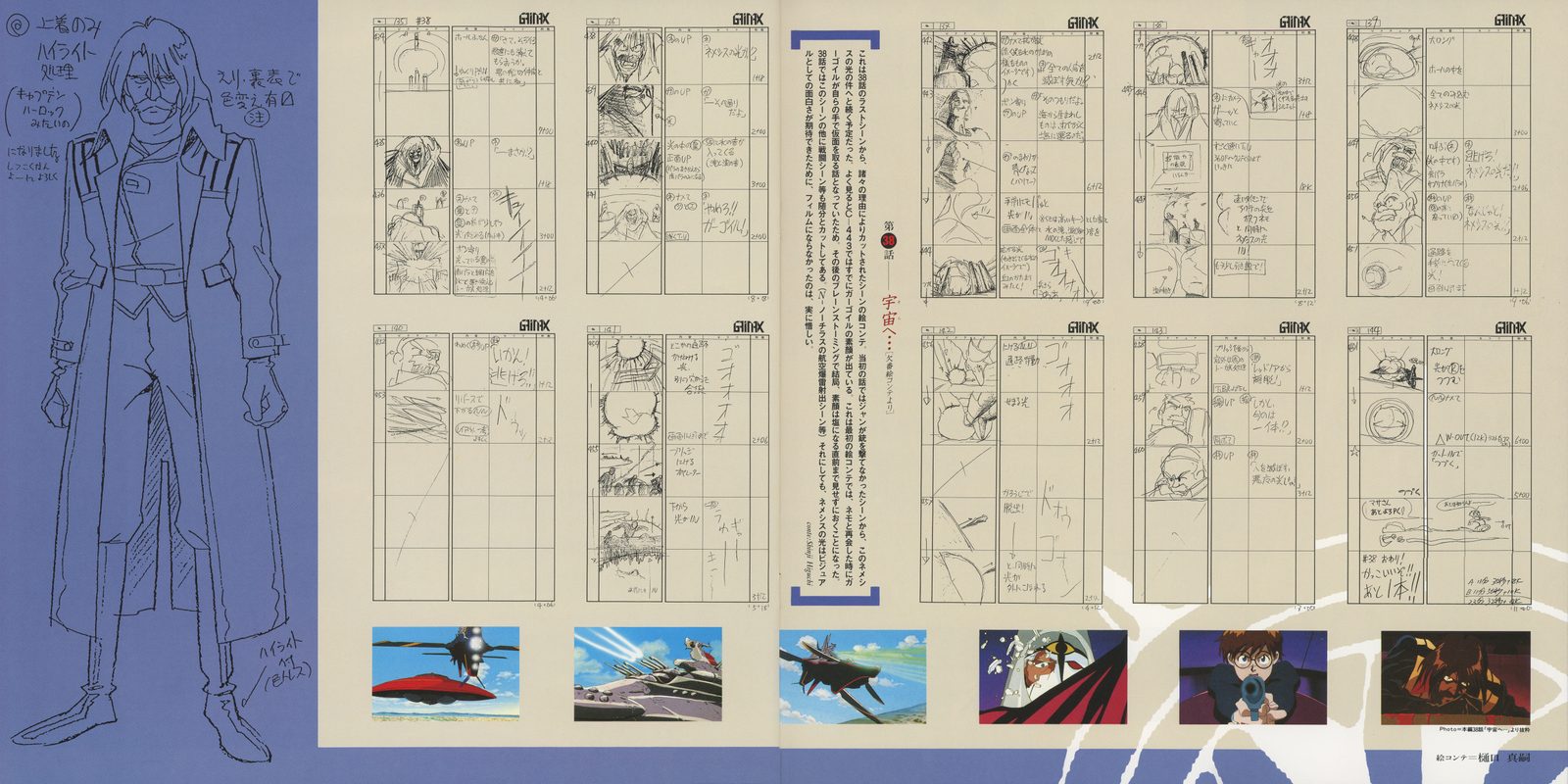 Captain Nemo settei and storyboards. Left: full-body character design sheet — Nemo in his captain's uniform, the character descended from Miyazaki's original 1970s submarine captain concept. Right: additional storyboard pages on Gainax production paper. Center column: production commentary.
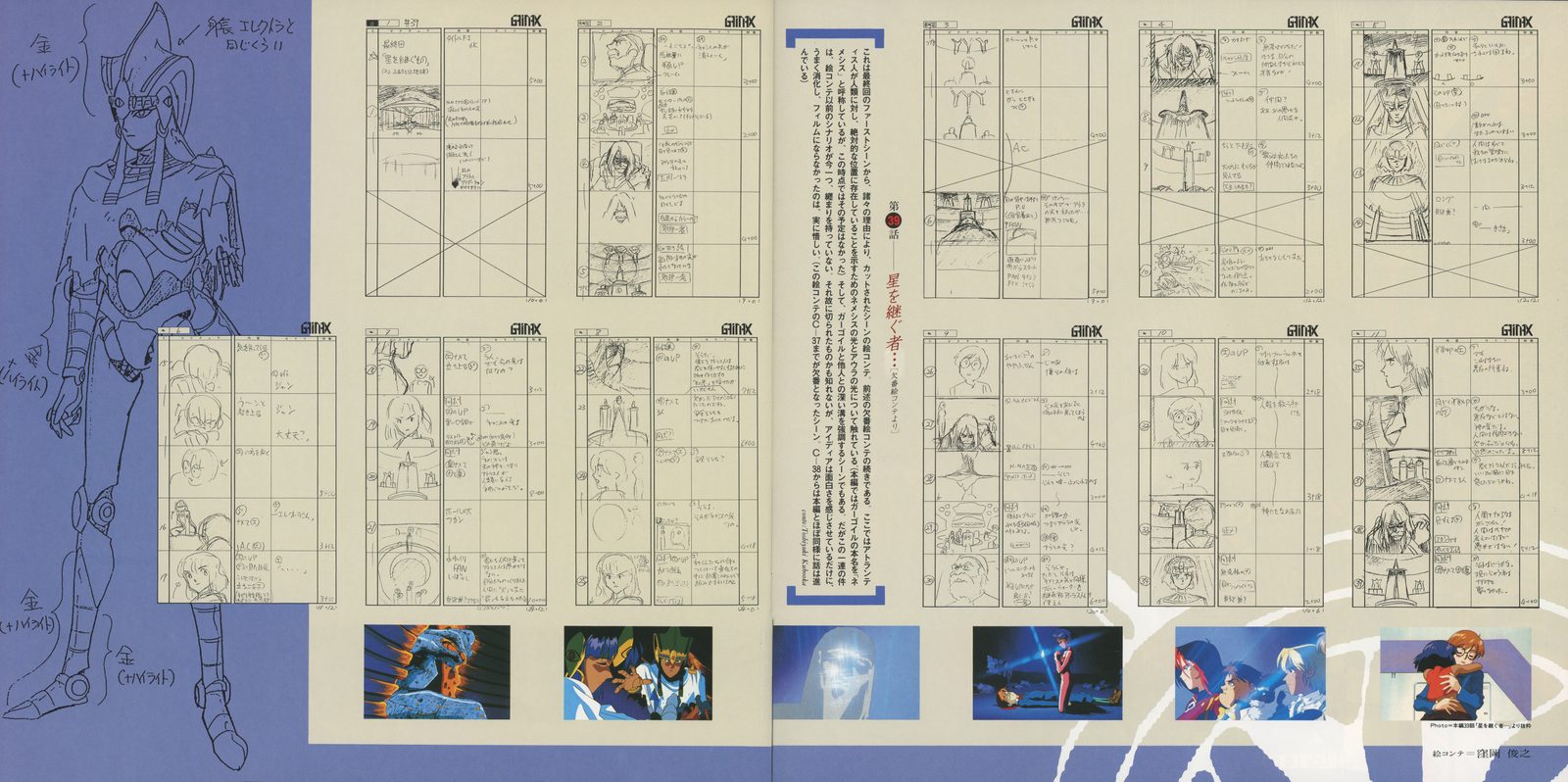 Mecha and technology settei. Neo-Atlantean armor and weapon designs on blue background — the alien technology that the series' Victorian world cannot comprehend. Storyboard pages showing the mechanical staging that Anno would refine into Evangelion's command bridge sequences.
Tsurumaki and the Chain
The booklet's 'おまけ映像' (bonus footage) section is introduced by Tsurumaki Kazuya — credited as a Gainax staff member providing commentary on bonus content included across the discs. Tsurumaki would become Anno's closest collaborator: assistant director on Evangelion, director of FLCL, co-director of the Rebuild of Evangelion films. His presence in a Nadia booklet in 1992 documents the creative chain at its earliest visible link. Miyazaki's unused submarine adventure became Anno's first TV series, which became the production that broke Anno, which became the psychological foundation of Evangelion, which Tsurumaki helped build. The booklet contains all of these people in the same object before any of them knew what would come next.
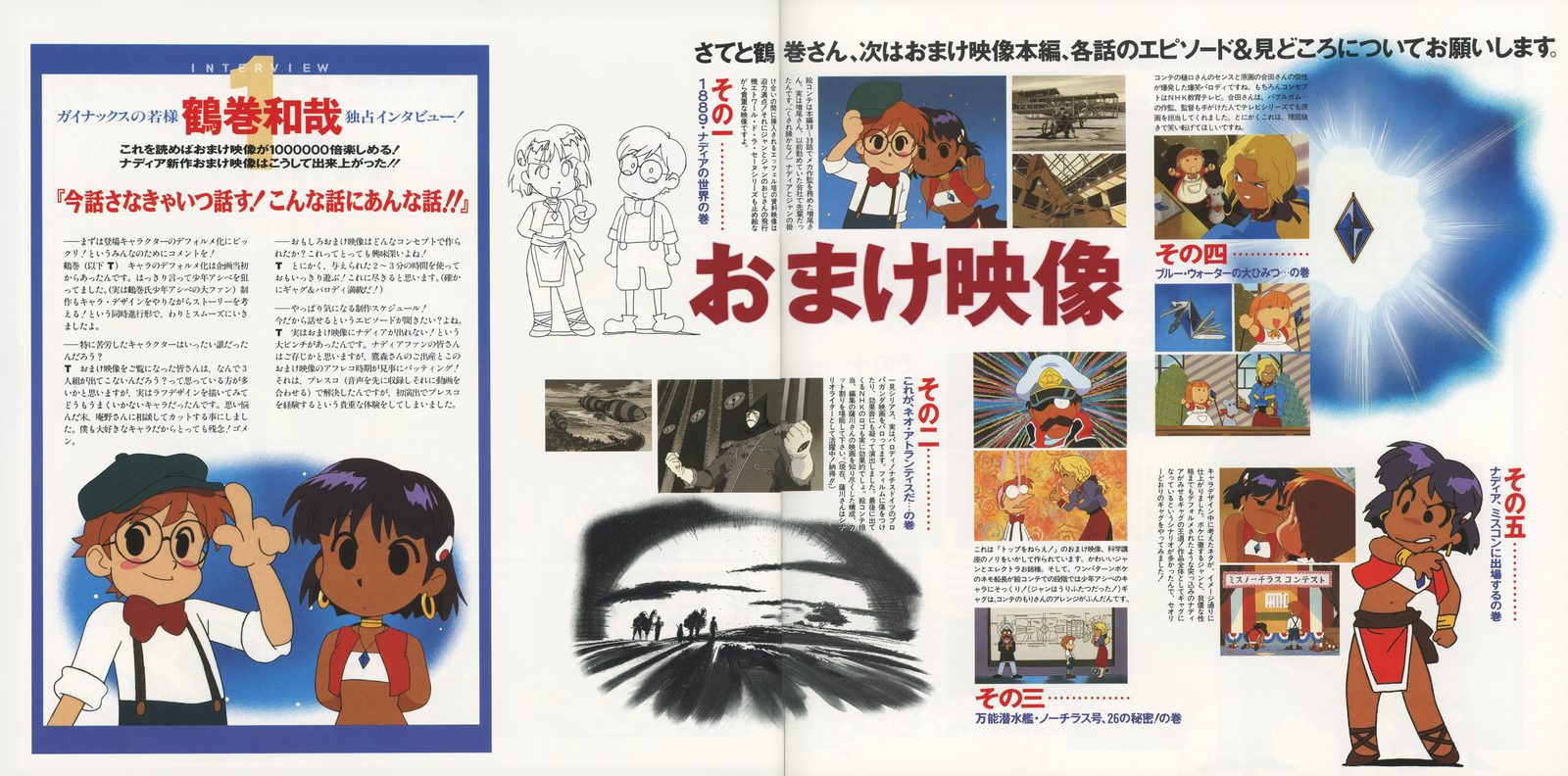 おまけ映像 (Bonus Footage) guide. Left: Tsurumaki Kazuya interview — 'ガイナックスの若手 鶴巻和哉 熱いインタビュー' (Gainax's young staff member Tsurumaki Kazuya, a passionate interview). Right: bonus content guide with numbered entries and scene stills. Tsurumaki before Evangelion, before FLCL, before the Rebuilds.
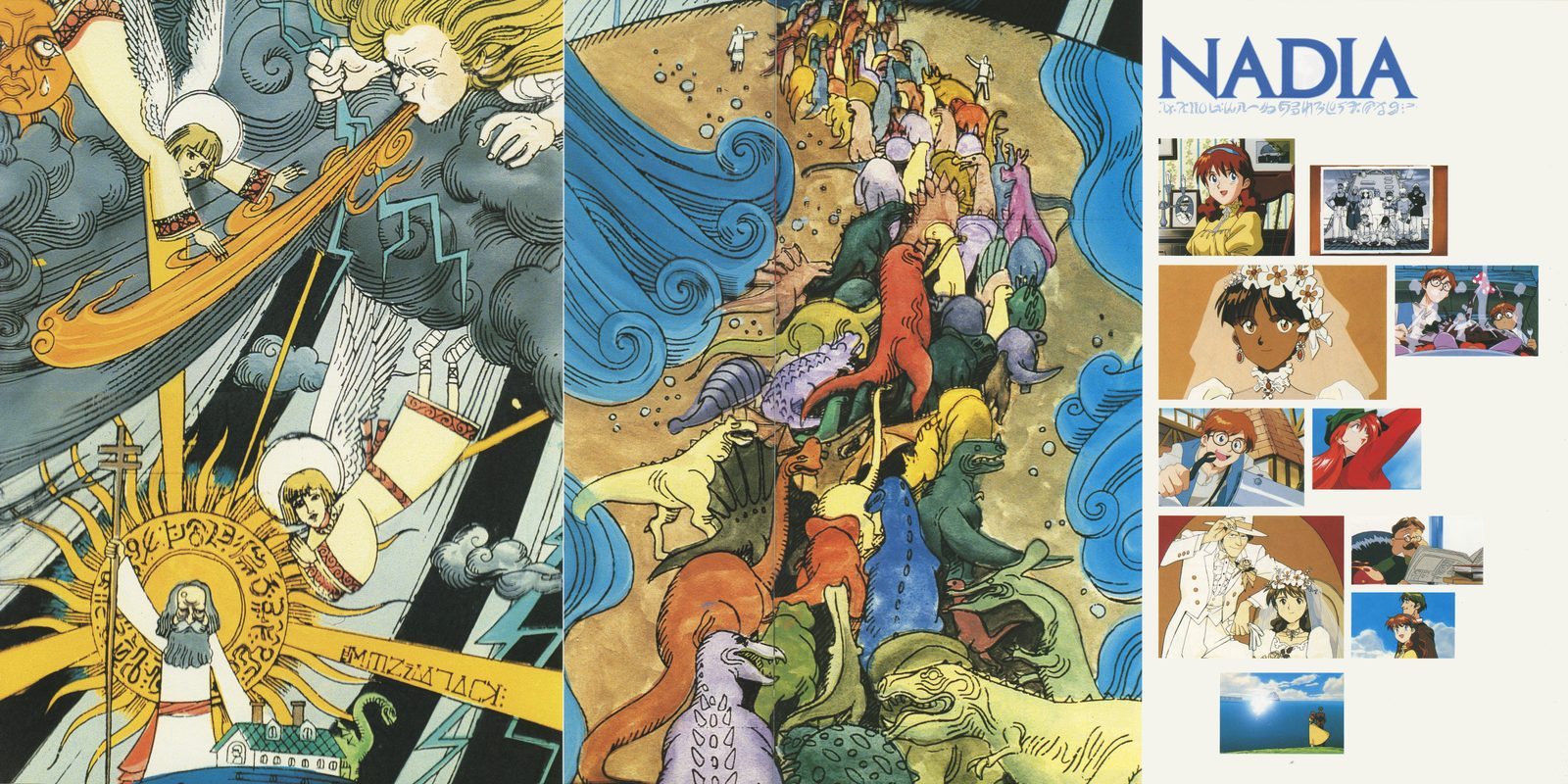 Closing booklet spread. Left: elaborate illustration in a mythological/biblical register — the Nadia cast rendered as figures in a classical frieze, waves and creatures surrounding them. Right: photo collage of production materials and scene stills. The series reframed as epic rather than adventure.
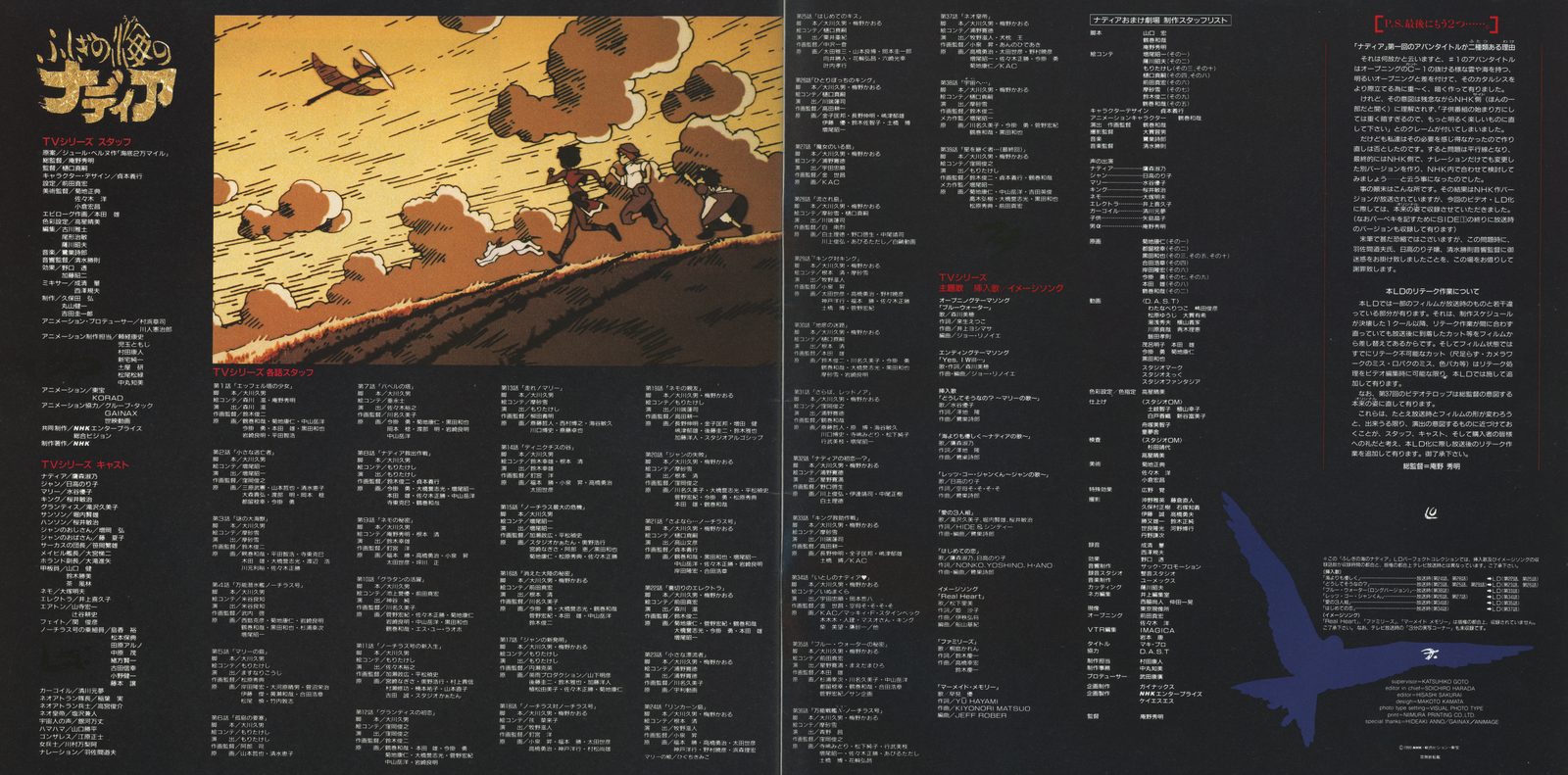 Complete episode guide spread. All 39 episodes with per-episode staff credits — director, storyboard, animation director, art director. Sunset illustration of Nadia, Jean, Marie, and King running along a hillside. The image is from the island arc — the weakest stretch of the series, presented here without apology or qualification.
The Complete Package
The Perfect Collection shipped in a kraft cardboard carton printed with a single blue line drawing of Nadia in her Atlantean dress — no color, no box art, just the character and the English tagline. The inner box contains the ten disc jackets and the booklet. Three additional items were included: a B2 fold-out poster (Sadamoto's illustration of Nadia in casual overalls, joyful — the most relaxed image in the entire package), a promo flyer for the companion release JSLD-1003 'The Nautilus Story' (a separate 3-disc CLV compilation of submarine battle sequences at ¥22,330, also including a B2 poster), and a customer survey card. The Nautilus Story flyer was inserted at purchase, cross-promoting the companion set to buyers of the Perfect Collection.
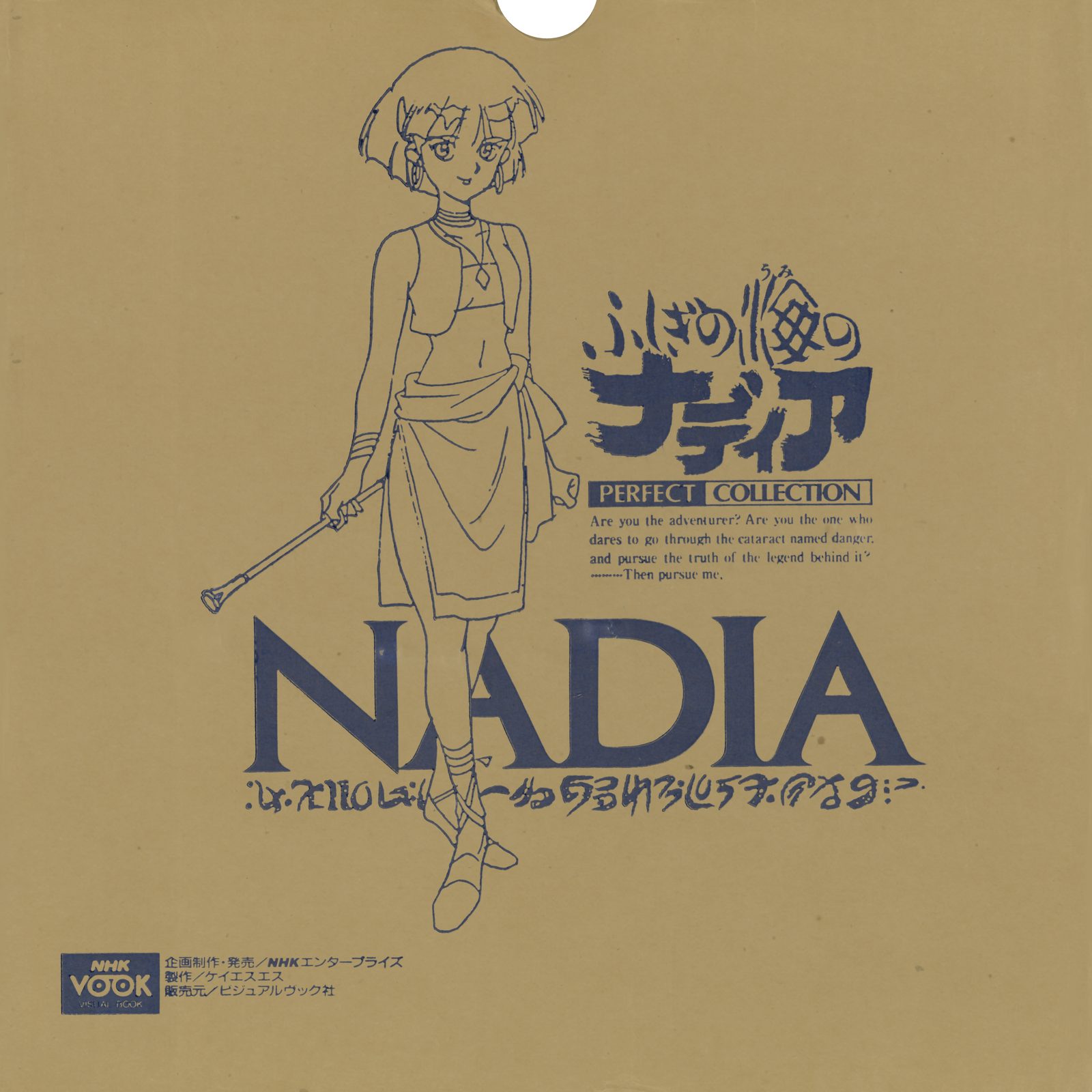 Shipper carton — kraft board, blue line art of Nadia in her Atlantean dress. The English tagline in full: 'Are you the adventurer? Are you the one who dares to go through the cataract named danger, and pursue the truth of the legend behind it? ... Then pursue me.' PERFECT COLLECTION. NADIA. NHK VOOK Visual Book.
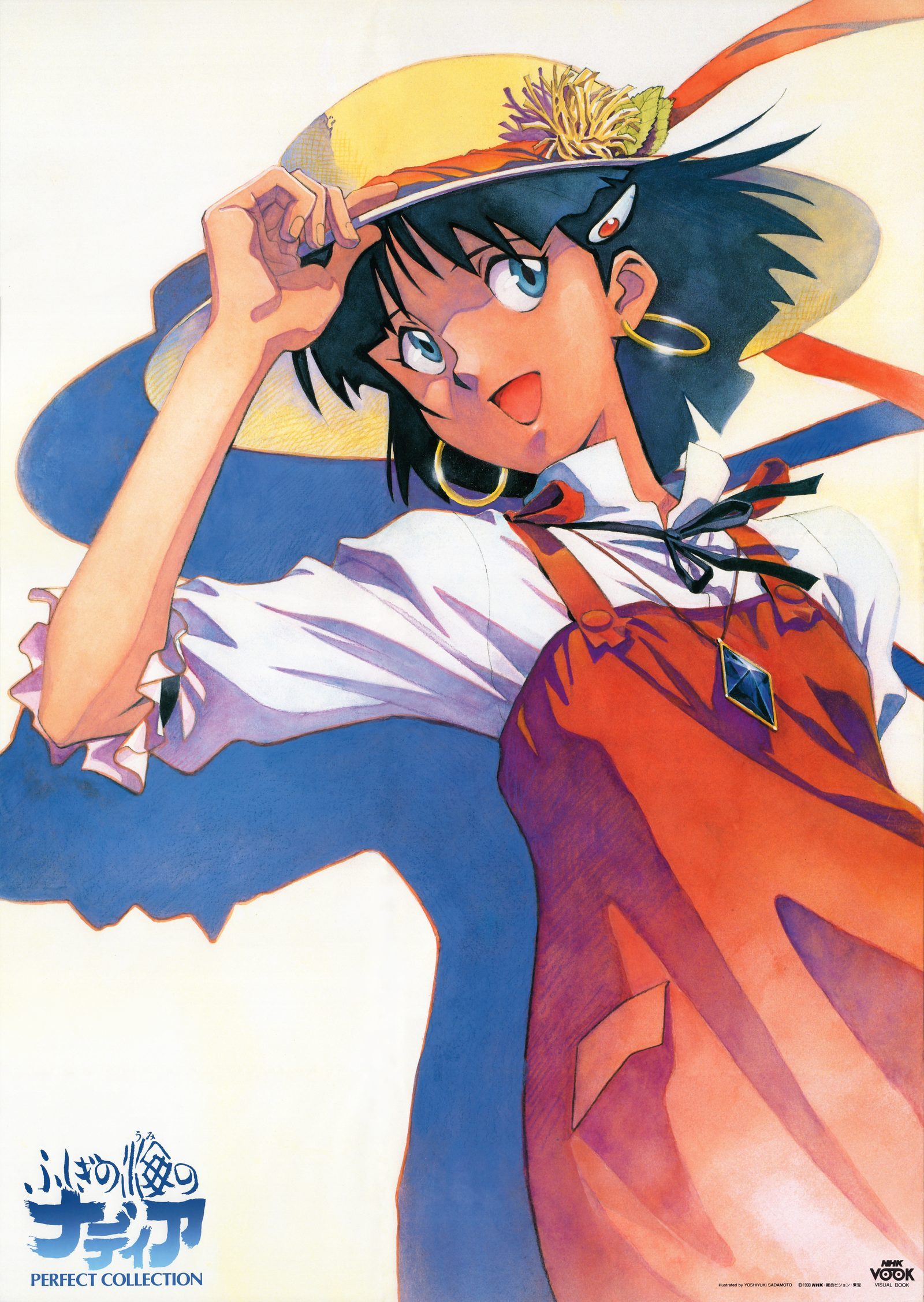 B2 fold-out poster — included with the Perfect Collection. Sadamoto Yoshiyuki illustration of Nadia in overalls and straw hat, arms raised. The most cheerful image in the package. B2 (515 × 728mm).
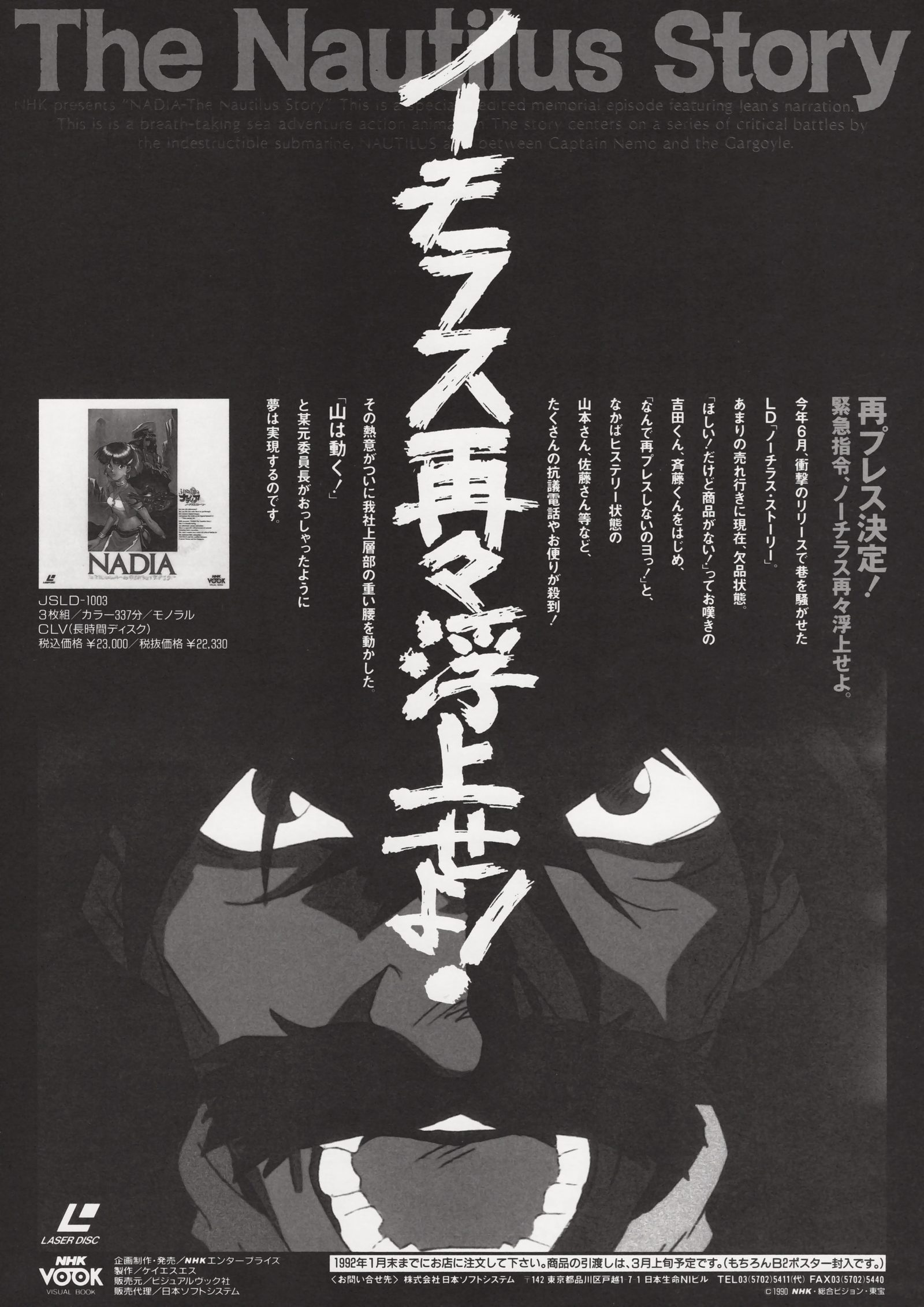 Enclosed flyer for JSLD-1003 'The Nautilus Story' — companion 3-disc CLV set, 337 minutes, mono, ¥22,330 (tax-exclusive). The emergency repress announcement: イラス再々浮上せよ! (Nautilus, surface again!). Gargoyle in darkness. Inserted into Perfect Collection boxes to cross-promote the companion release, which also included its own B2 poster.
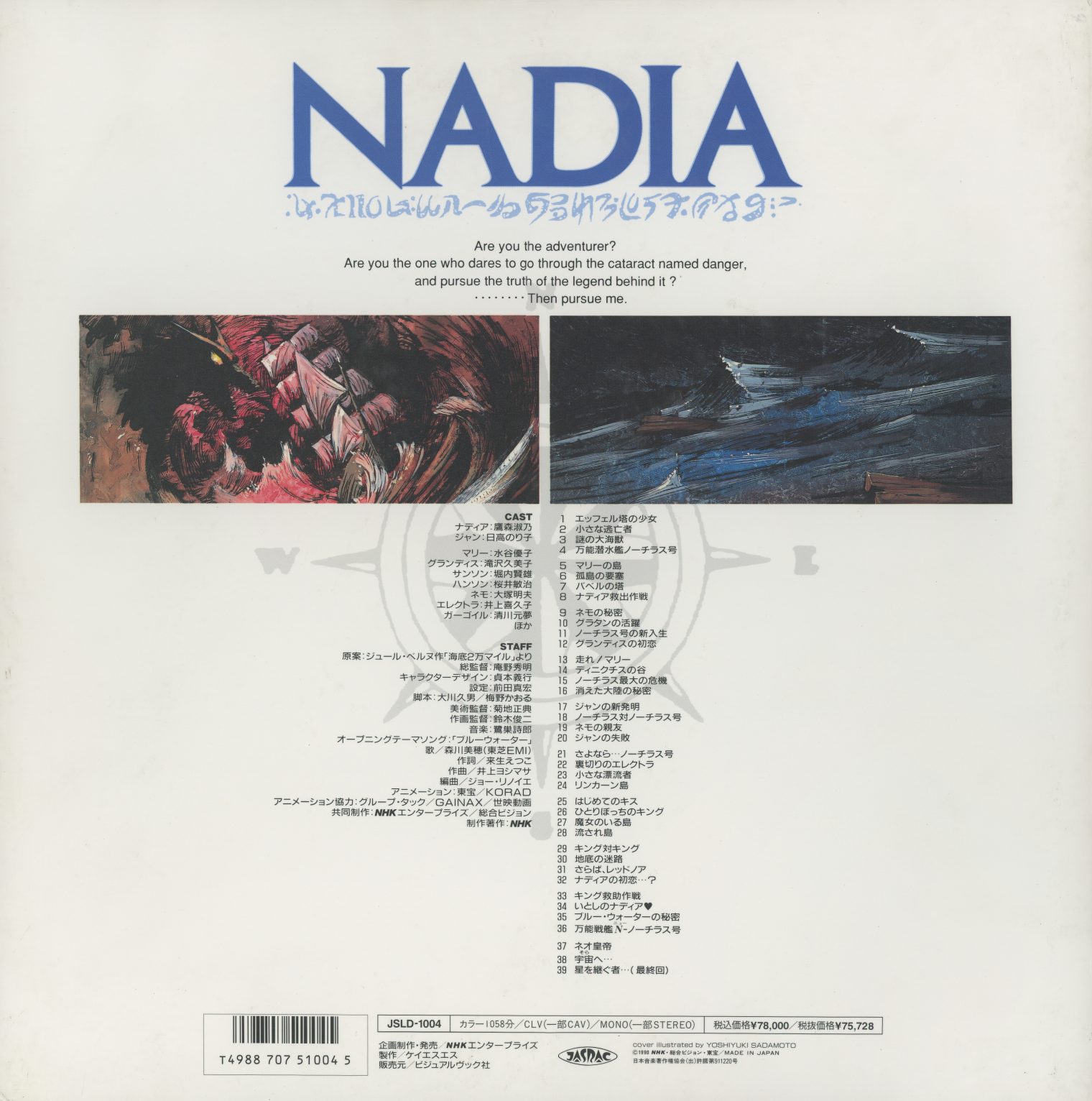 Perfect Collection back. JSLD-1004. Full episode listing across all 39 episodes. Background art reproductions of the ocean and landscape. Cast and staff credits. The English tagline: 'Are you the adventurer? ... Then pursue me.' CLV, color, mono/stereo. ¥78,000 (+ tax, ¥83,301 total). NHK VOOK Visual Book.
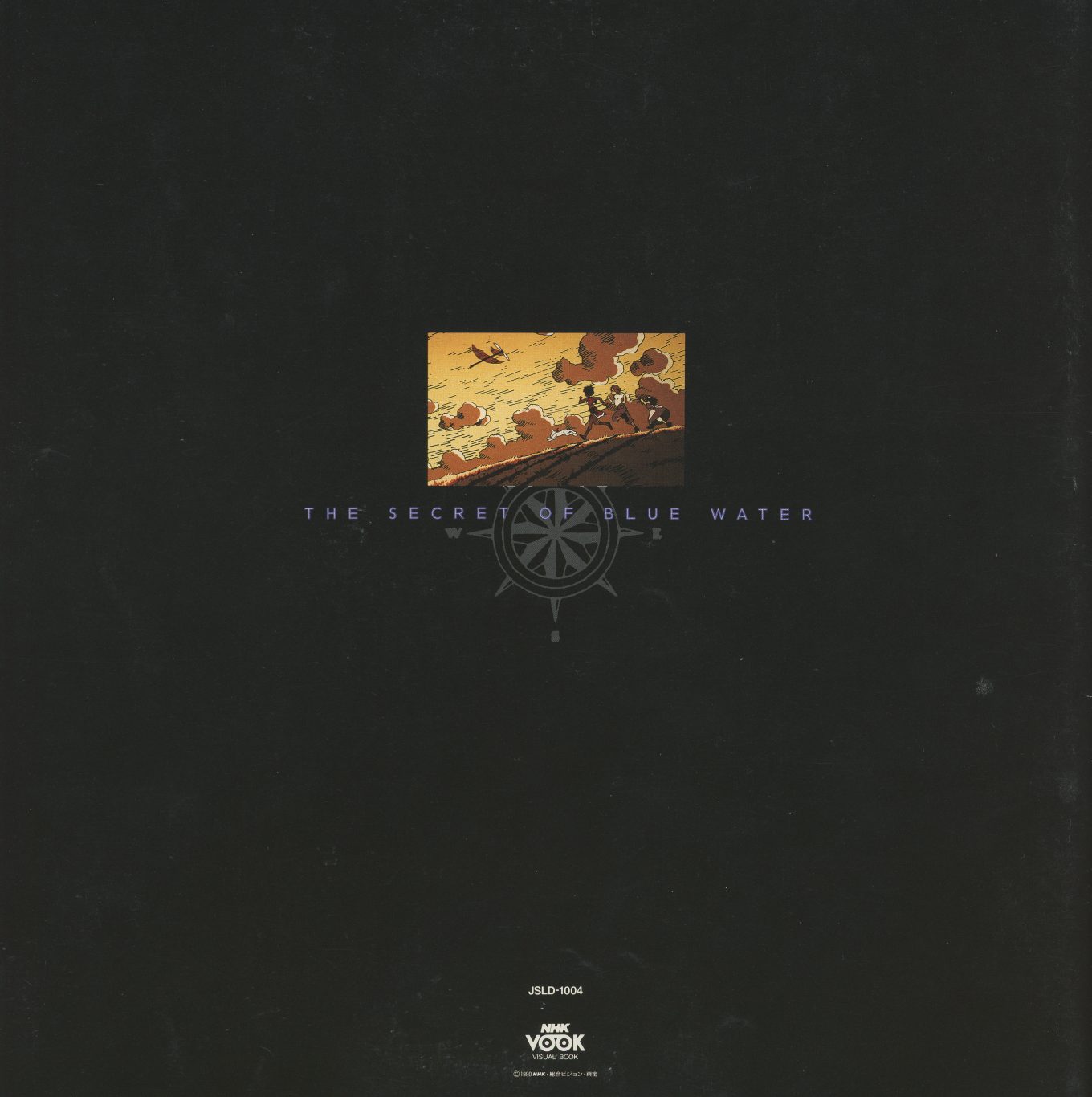 Box exterior back. 'THE SECRET OF BLUE WATER' in silver. JSLD-1004. NHK VOOK Visual Book compass logo. The sunset hillside illustration — small, centered — is the only image. The rest is black.
Nadia sits at the exact center of a creative chain that runs from Miyazaki to Evangelion. Miyazaki's unused 1970s submarine adventure became the foundation. Gainax built a 39-episode television series on it. Anno directed it, broke against it, and carried the damage into the project that would define him. Tsurumaki appears in the booklet as a young staffer — years before he would co-direct the Rebuild films. Sadamoto's character designs for Nadia and Jean contain the visual DNA of the Eva pilots he hadn't drawn yet.
The DVD release includes the episodes. It does not include the deleted scene storyboards on Gainax production paper, or Anno's interview about what he had been making, or Tsurumaki's commentary from when he was still a young staffer years away from co-directing the Rebuild films.
Loading...