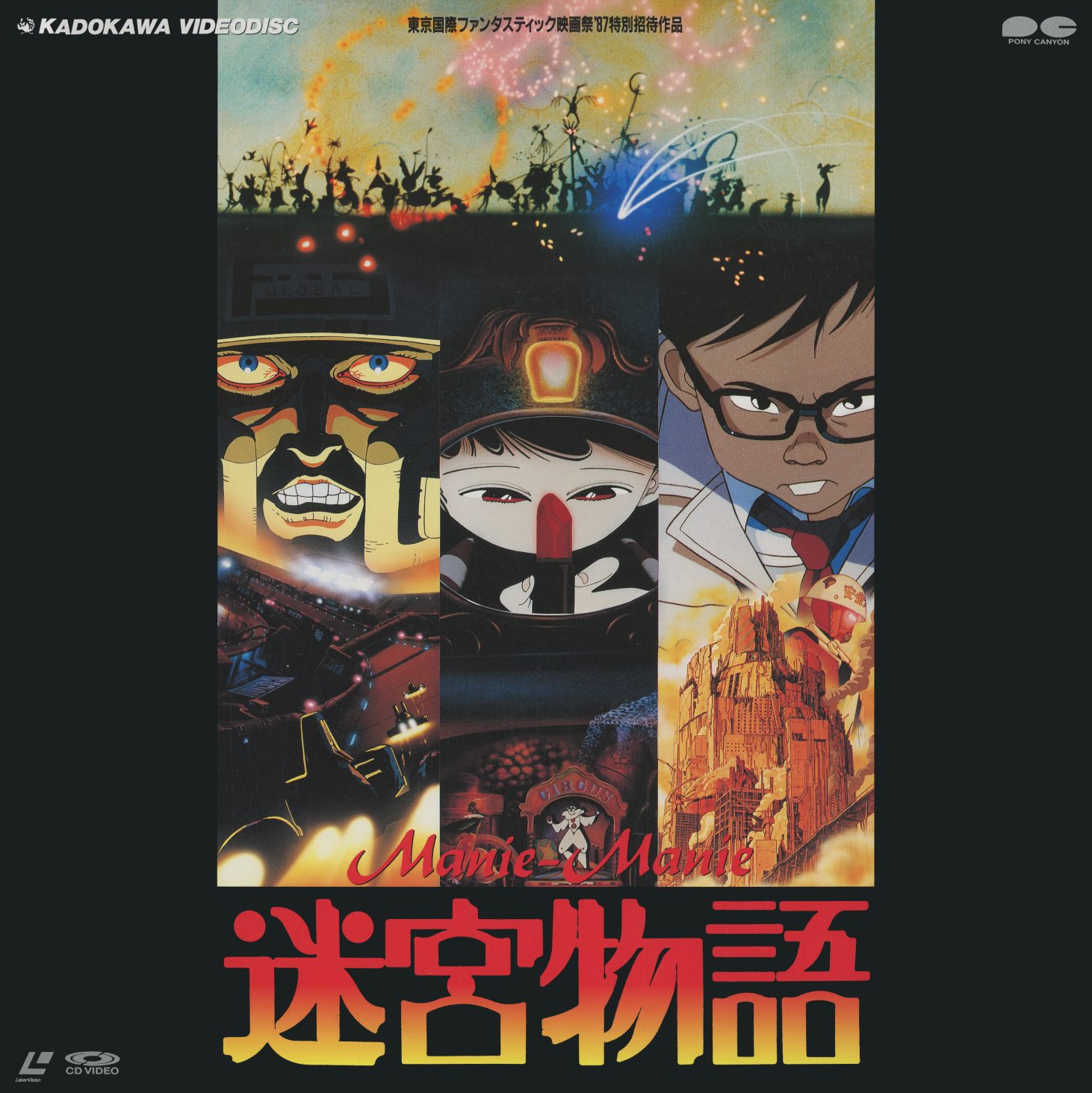
Catalog G88F5062. One CAV disc, two sides, 50 minutes. ¥8,800. 角川書店 — Kadokawa — released 迷宮物語 to LaserDisc in 1987 concurrent with the film's public premiere as a Special Invitation work at the Tokyo International Fantastic Film Festival on September 25. The disc holds three animated segments, each directed by a different filmmaker, each adapted from short fiction by the Japanese SF writer 眉村卓 (Mayumura Taku). Music by Micky Yoshino of Godiego. Produced by Rin Taro and Masao Maruyama. Studio: Project Team Arugus and Mad House. Executive Producer: Haruki Kadokawa.
The three directors were Rintaro, Yoshiaki Kawajiri, and Katsuhiro Otomo. Production ran from 1984 to 1985. When Haruki Kadokawa screened the completed film, he judged it マニアックすぎる — too niche — and shelved it. It sat unreleased for approximately two years before the Tokyo International Fantastic Film Festival invited it. The CAV format — constant angular velocity, frame-by-frame access — preserves every cel of all three segments at the resolution of the original analog transfer. The packaging includes a gatefold sleeve with per-segment still photography, a full production booklet with staff statements and synopses, and a 設定資料集 insert reproducing character designs from each segment. ©1986 Haruki Kadokawa Films Inc.
Three Segments, One Anthology, One Author
迷宮物語 — literally 'Labyrinth Story,' or 'Maze Narrative' — is a 50-minute anime anthology structured as three independent works. All three adapt short fiction by 眉村卓 (Mayumura Taku, 1934–2019), one of the central figures of postwar Japanese science fiction: a writer whose signature was bureaucratic estrangement, ordinary people adrift in systems they did not design and cannot exit. The anthology commissioned three anime directors to find their own visual register for that underlying logic.
ラビリンス*ラビリントス (Labyrinth Laburinthos) — Rintaro. A girl named Sachi and her cat Cicerone wander through corridors that lead to toy soldiers, carnival darkness, and spaces that refuse to cohere into a story. Character design: Atsuko Fukushima. No conflict, no resolution — just accumulation.
走る男 (Death Circus) — Yoshiaki Kawajiri. A racing driver named Zack Hugh has become invincible. His psychic ability is amplifying without his awareness, destroying competitors who get close. What the audience reads as triumph, the film reveals as isolation.
工事中止命令 (The Order to Stop the Construction) — Katsuhiro Otomo. A government demolition specialist arrives to shut down an automated construction complex that has stopped responding to human commands. The complex continues to build.
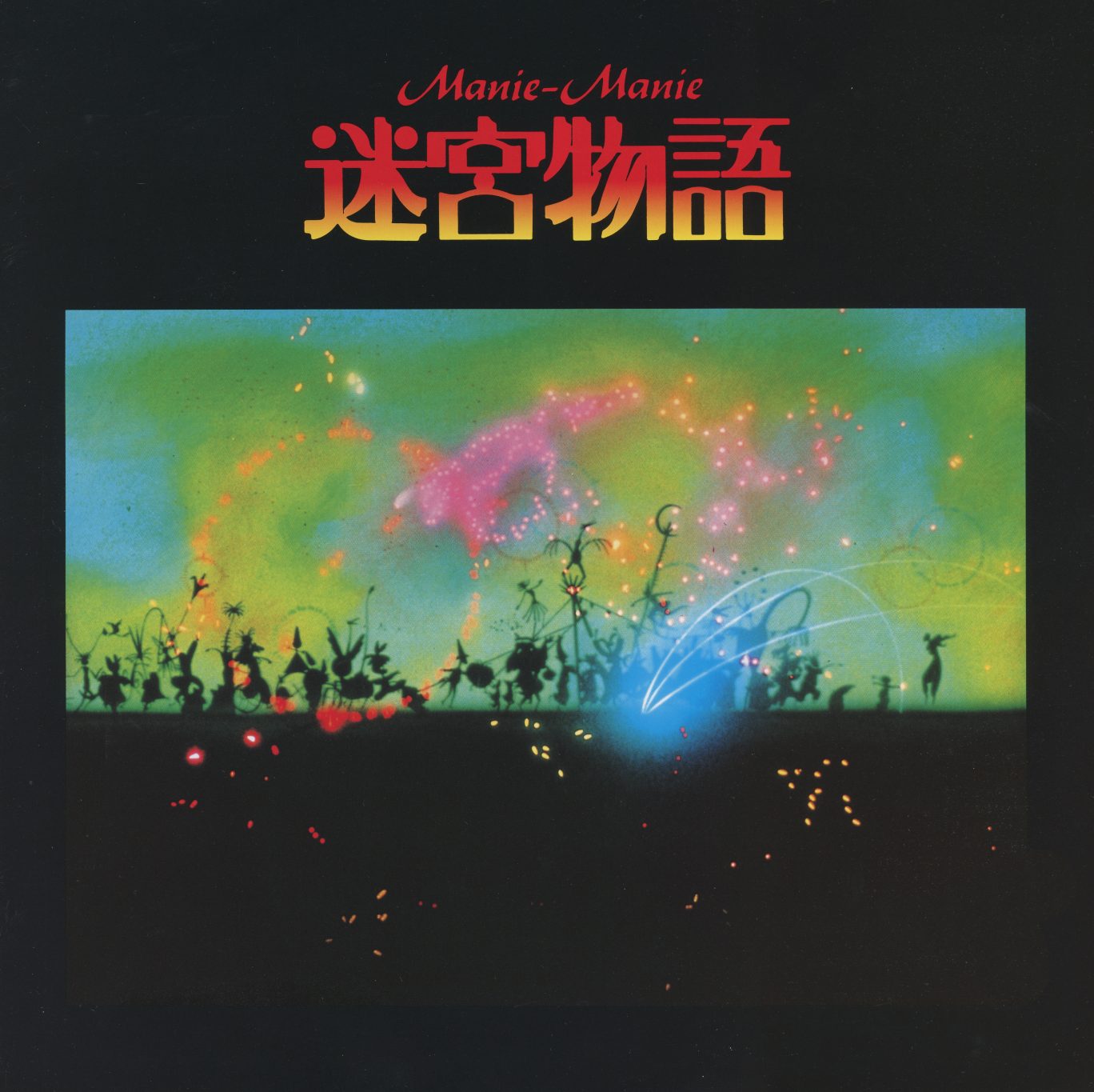 Inner panel — Manie-Manie 迷宮物語 title card with scene silhouettes against a saturated chromatic wash. The visual register: figures in blackout foreground, chromatic explosion behind, no single subject legible. Typical of Rintaro's Labyrinth segment's opening imagery.
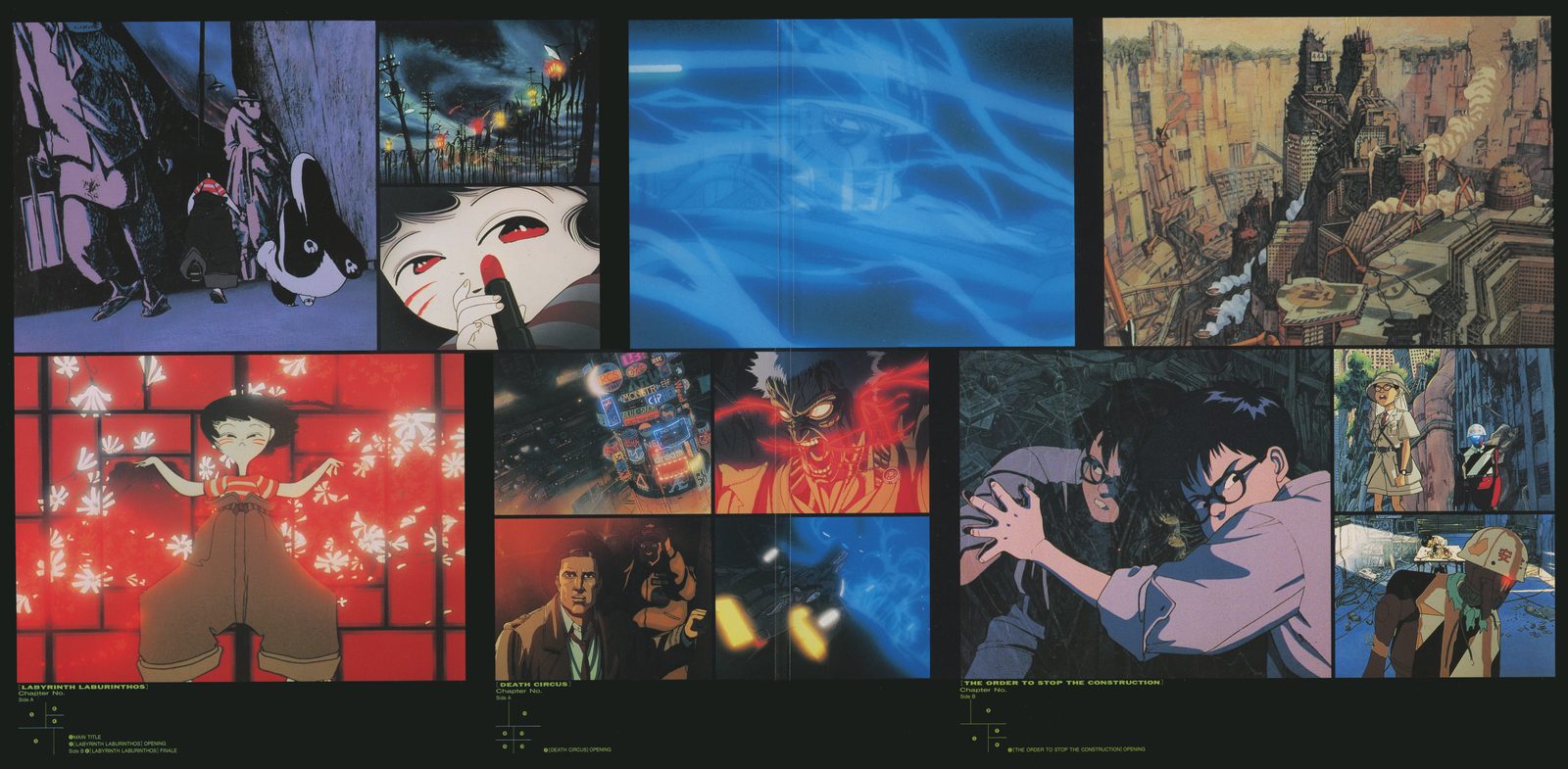 Gatefold interior spread, G88F5062. Three panels, organized per segment: Labyrinth (left, the girl Sachi in surreal environments), Death Circus (center, Zack Hugh and the race scenes), The Order to Stop the Construction (right, the bureaucrat and the autonomous complex). Segment titles in Japanese below each section.
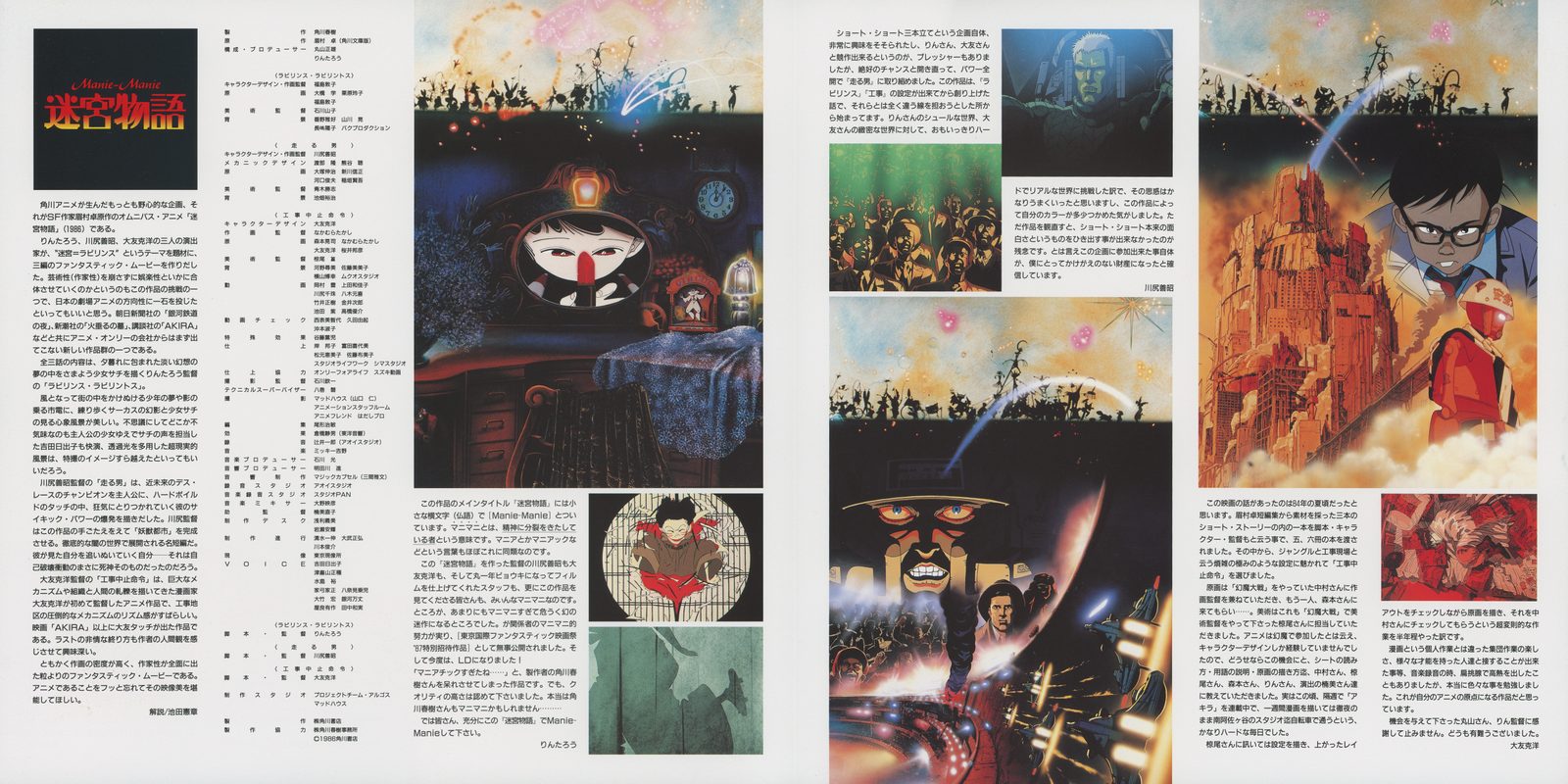 Booklet interior, G88F5062. Full production documentation per segment — synopsis in Japanese, still photography, production staff statements. Left column carries overall production notes and Kadokawa's framing of the anthology project. Three-column structure, one column per director.
The Year Before Akira
工事中止命令 was Katsuhiro Otomo's debut as an anime director — his first time in the director's chair, predating Akira by two years. He had been approached in summer 1984 and accepted immediately: a short commission about a bureaucrat sent to shut down an automated construction complex that had stopped listening. The theme of autonomous systems exceeding human oversight runs through everything Otomo made before and after. This is where he first directed it.
Yoshiaki Kawajiri was not originally scheduled to direct. Rintaro's second choice for the anthology slot was Mamoru Oshii, who declined. Kawajiri, already assigned as animation director, was promoted to fill the gap. His segment — the racing drama the disc labels DEATH CIRCUS — is, shot for shot, as technically precise as anything he produced before Ninja Scroll in 1993. He designed the characters himself.
Rintaro was already 47. He had directed Harlock, Galaxy Express 999, and Harmagedon. His segment here is the most formally experimental thing he had made for a commercial client. Atsuko Fukushima's character designs gave Sachi a visual neutrality — a face that records rather than expresses — that makes the surreal environments feel more unsettling, not less.
The Kadokawa disc gives each of them a panel of equal size on the front jacket. None is named above the title.
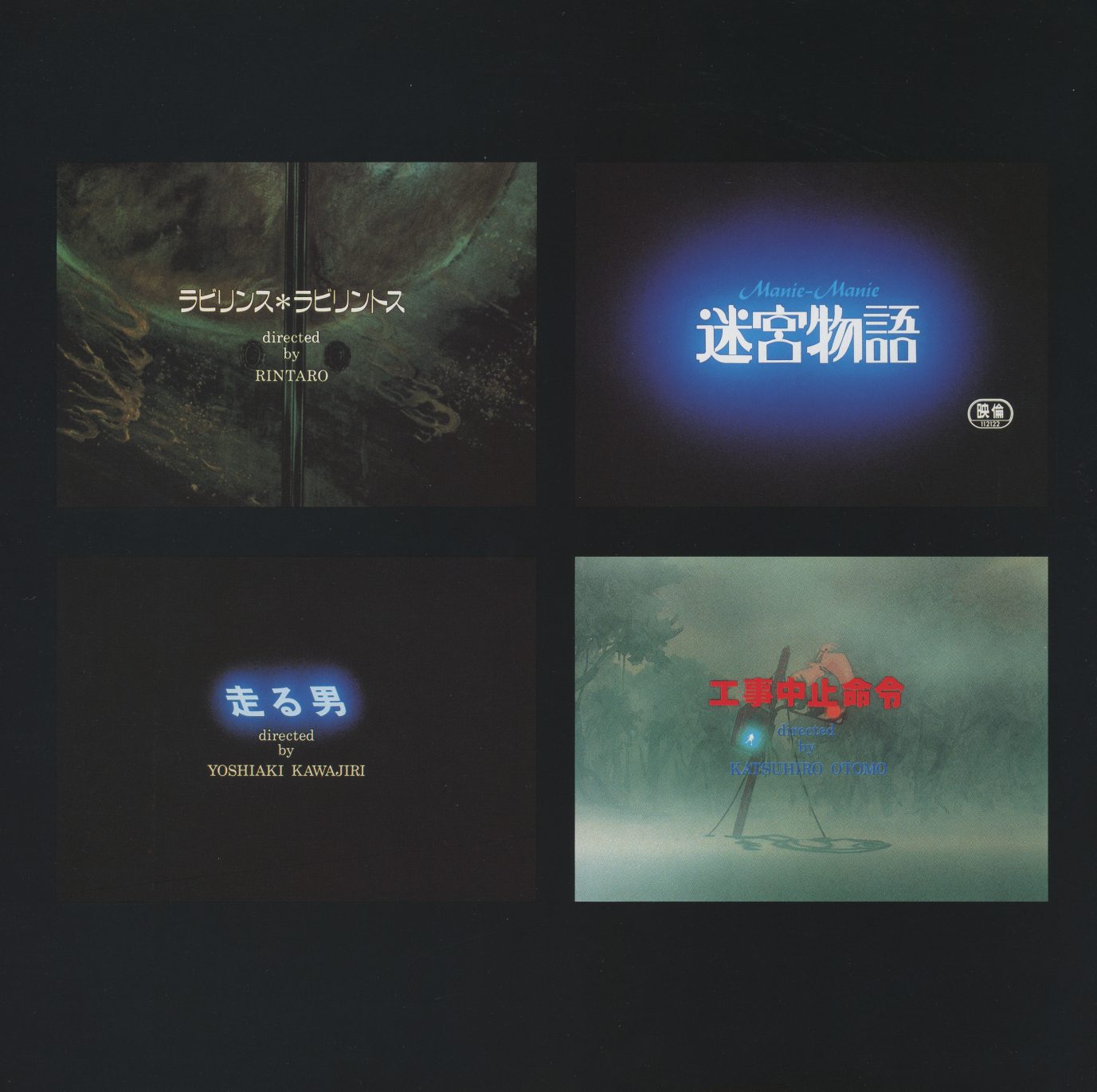 Title cards photographed from LaserDisc playback: overall title 'Manie-Manie 迷宮物語'; ラビリンス*ラビリントス directed by RINTARO; 走る男 directed by YOSHIAKI KAWAJIRI; 工事中止命令 directed by KATSUHIRO OTOMO. The segment title cards use different typographic registers — hand-lettered, digital glow, and atmospheric mist respectively.
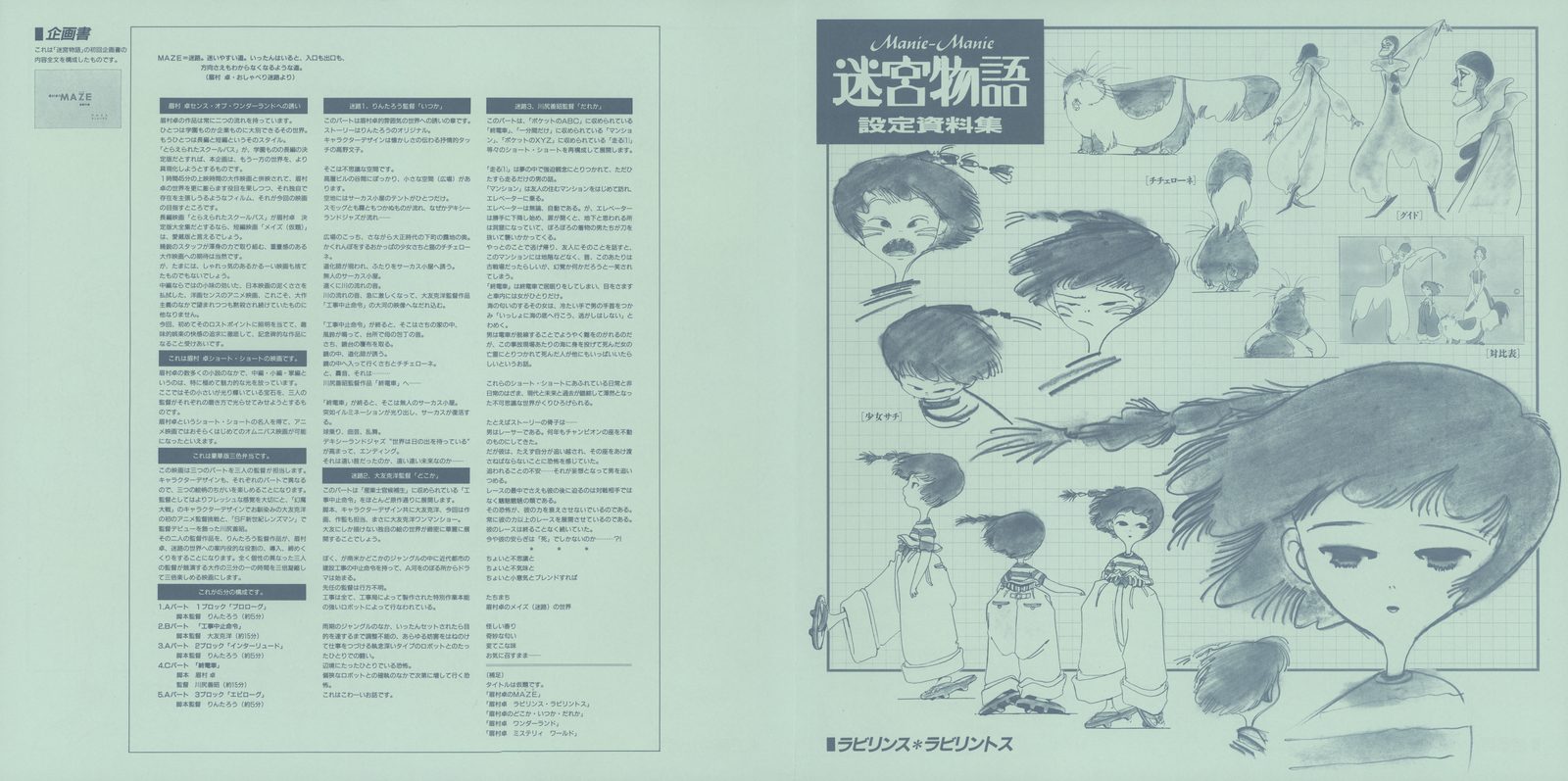 設定資料集 (Character Design/Reference Materials) insert, G88F5062. Left: production notes and staff/cast listings for all three segments. Right: Atsuko Fukushima's line-art character designs for the Labyrinth segment — Sachi, Cicerone the cat, and the puppet and automata figures she encounters. Labels identify each character by name.
The 設定資料集 and the Name Problem
The 設定資料集 insert — 'design materials reference' — reproduces Atsuko Fukushima's production line art for Rintaro's segment. Sachi, the girl who drifts through the labyrinth, rendered in pre-production pencil work: the proportions undecided, the expression neutral, the weight of a drawn figure before ink locks it in. These sheets exist on the disc because Kadokawa's packaging culture assumed that the buyer wanted to see how the animation was made, not just what it looked like.
The back jacket gives Kawajiri's segment its English title as DEATH CIRCUS. The Japanese title, 走る男, means simply 'The Running Man.' When Streamline Pictures licensed the anthology for the US market in 1992 and retitled it Neo Tokyo, they renamed Kawajiri's segment 'The Running Man' — inverting the Kadokawa translation entirely. The original disc says the segment is about a death circus. Streamline said it was about a running man. Both are correct descriptions of the same sequence. They are not the same argument about what matters in it.
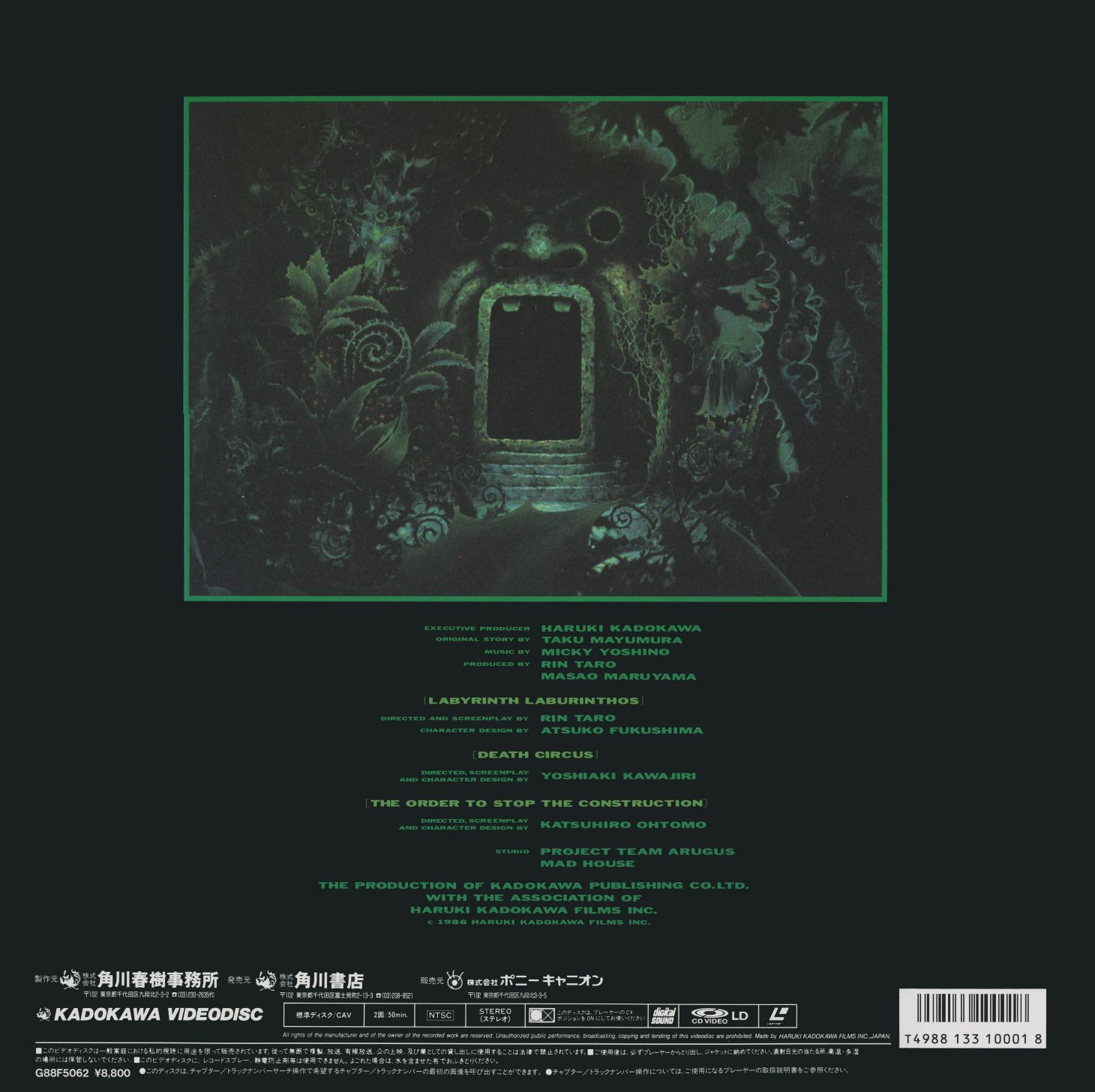 Back jacket, G88F5062. A single green-tinted illustration — dense foliage, vines, and a stone archway opening into darkness — occupies the upper two-thirds. Production credits in white below: Executive Producer Haruki Kadokawa; Original Story Taku Mayumura; Music Micky Yoshino; Produced by Rin Taro and Masao Maruyama. Three segment credits follow, each in their English translation. Format line: 標準ディスク CAV / 2面 50min / NTSC / STEREO / Digital Sound / CD Video compatible. ¥8,800. Distributed by ポニーキャニオン.
The back jacket's green-tinted archway illustration is not labeled. It doesn't belong to any of the three segments — it's Kadokawa's visual proposition for what the anthology, as a single object, feels like. A doorway into somewhere overgrown. By 1992, Streamline Pictures had renamed the disc Neo Tokyo, positioned it around the urban futurism of Kawajiri's segment, and sold it into the Western market that Akira had opened. The original title, 迷宮物語, named it for Rintaro's abstract opening: a labyrinth, not a city. An anthology disc with three segments and no obvious lead. The back jacket chose a doorway — overgrown, unlabeled, belonging to none of them.
Loading...