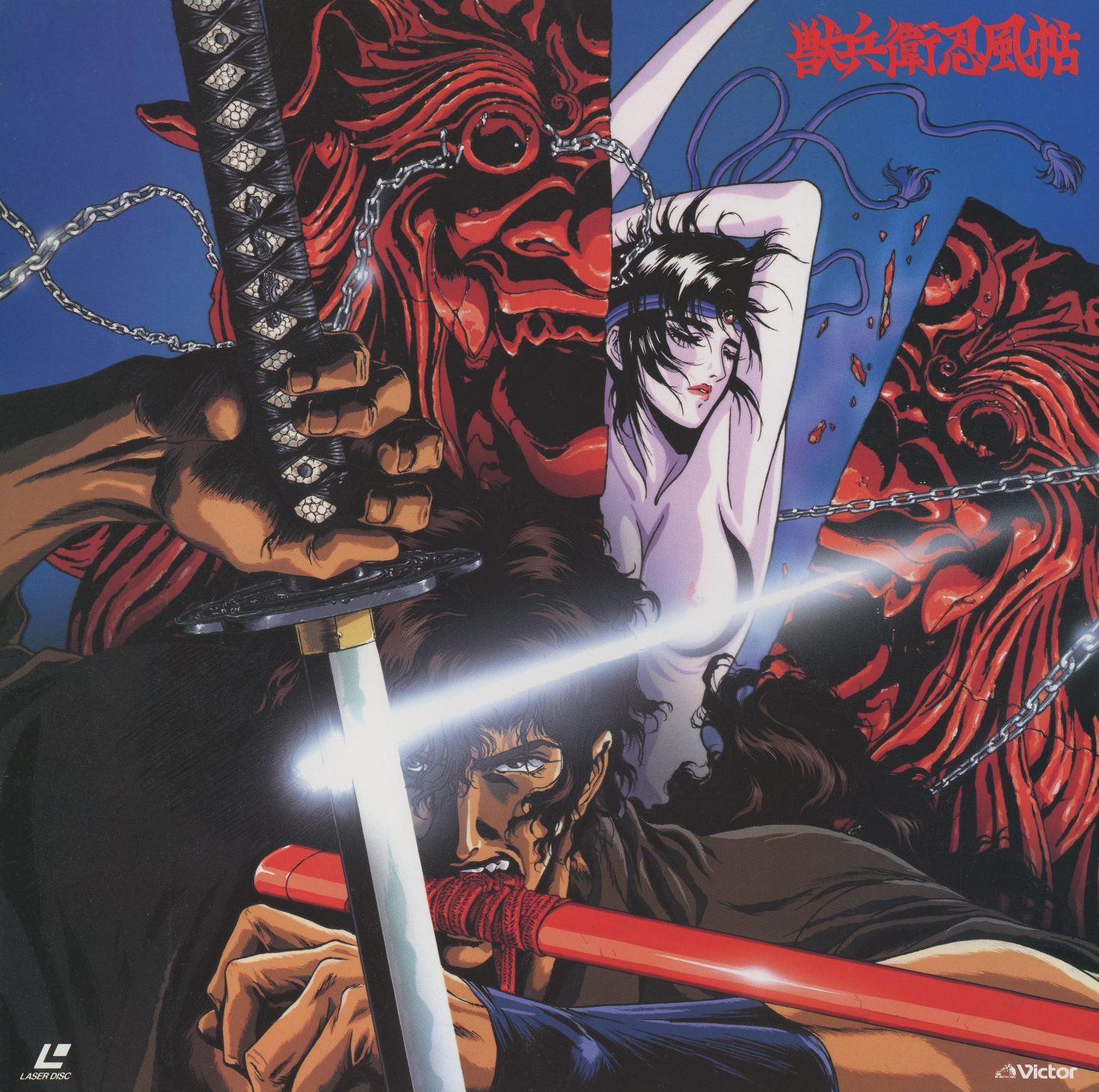
Catalog JVLF-98003. One disc, two sides, 95 minutes, CLV. Victor Entertainment, 1993. ¥9,800. The standard home video release of Yoshiaki Kawajiri's theatrical feature 獣兵衛忍風帖 — Jubei Ninpūchō — produced by Animate Film in co-production with JVC, Toho, and Movic, distributed theatrically in Japan by Tokyo Theatres, and released to LaserDisc by the same Victor label that co-financed its production. The disc includes a liner note insert. The insert is the most substantial printed document the film received in this format.
獣兵衛忍風帖 is a 1993 theatrical anime — Kawajiri's feature-length extension of the register he had been developing since Running Man (1987) and Wicked City (1987). A masterless ninja named Kibagami Jubei, moving through Tokugawa-era Japan, is bound by circumstance to fight the Eight Devils of Kimon: a supernatural assassination squad serving an underground power called the Shogun of the Dark. Chambara structure, OVA-era production values, choreographic violence animated at a precision level that cel animation's hand-painted cels and analog optical compositing made possible. The film runs 95 minutes. Madhouse animated it. Art direction by Hiromasa Ogura. Character design and animation direction by Toyoshi Minowa. Music: Kaoru Wada and Ryohei Yamanashi.
The Inner Sleeve
Inside the sleeve: a scene collage printed against a black ground, tiled with film stills across a grid that names no one and explains nothing. Jubei, Kagero, Dakuan, and six of the Eight Devils assembled in a layout that reads as a character index — each figure isolated enough to be recognizable, dense enough to imply scale. The title runs vertically in red at center. The copyright line at bottom: ©1993 川尻善昭・マッドハウス・日本ビクター・東宝・ムービック.
This is the film's violence presented as ensemble photography. No fight in progress, no single climax foregrounded — just the cast of a film about sequential confrontation, arranged for the buyer who already knows what each face means.
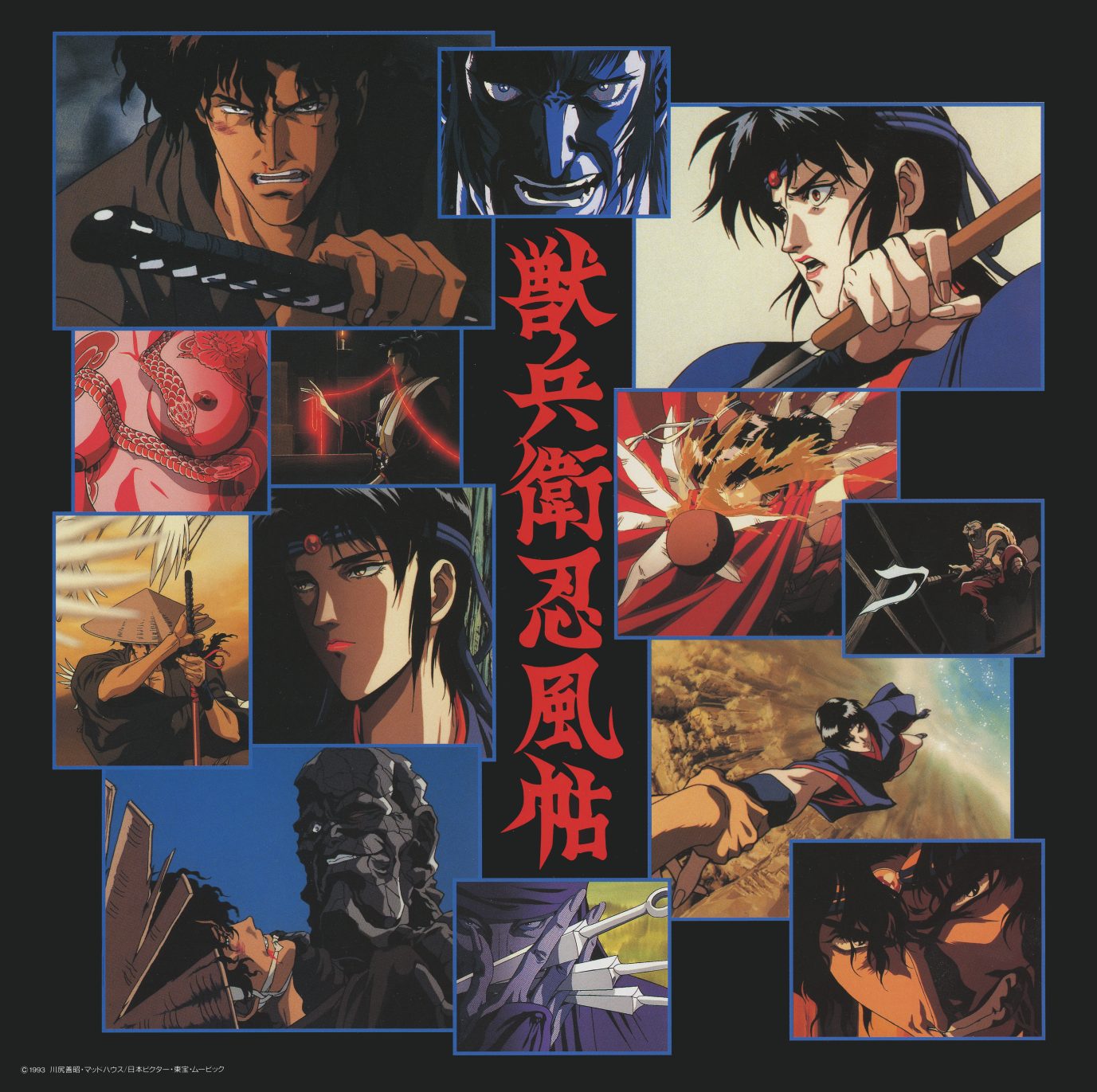 Inner sleeve, JVLF-98003. Scene collage across a black ground — Jubei, Kagero, Dakuan, and the Eight Devils of Kimon. 獣兵衛忍風帖 in red at center. ©1993 川尻善昭・マッドハウス・日本ビクター・東宝・ムービック.
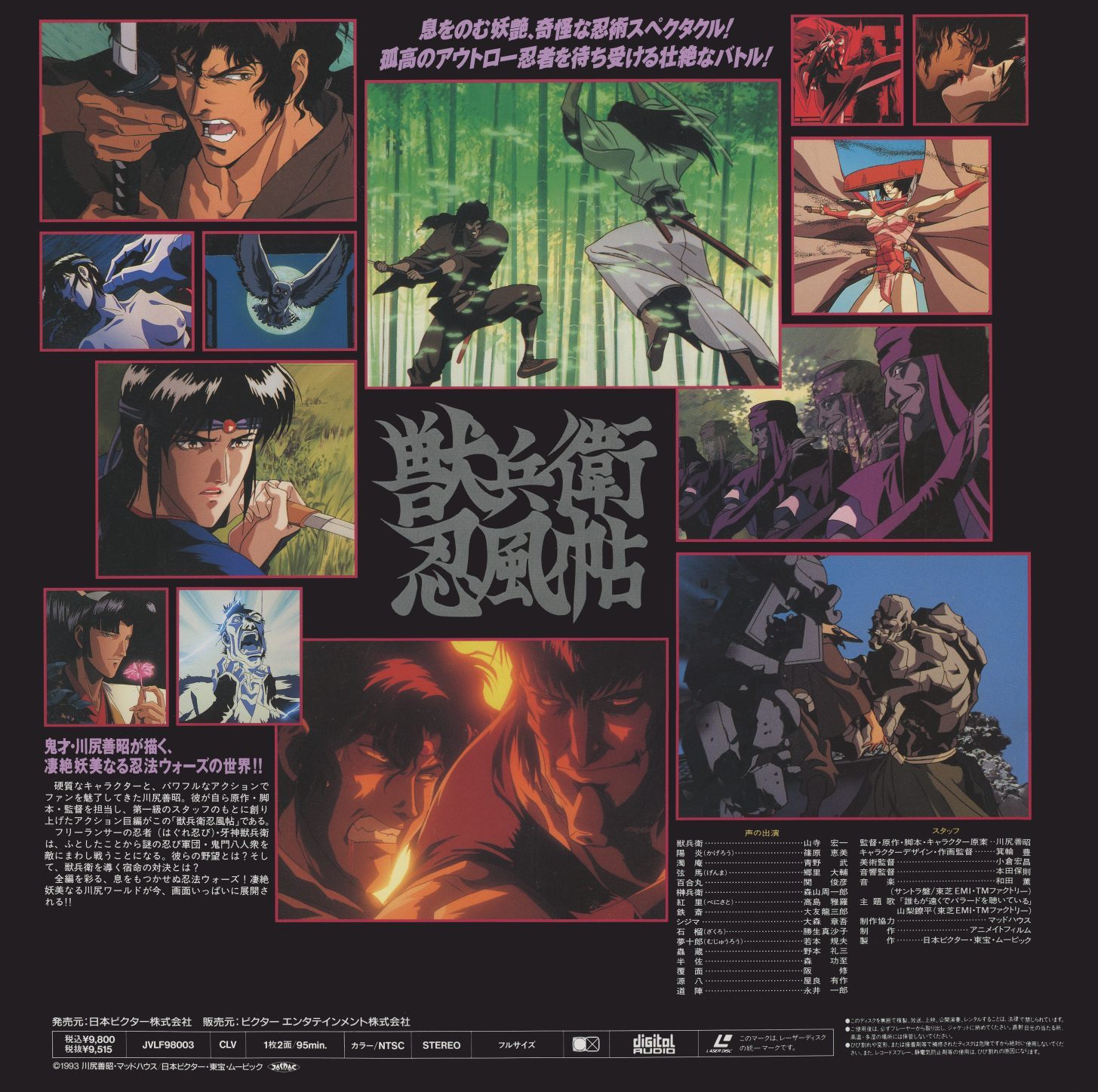 Back jacket, JVLF-98003. Eleven film stills in variable sizes on black; title in brushstroke kanji center-left; synopsis text and full staff/cast credits bottom. Format line: CLV / 1碟2面 / 95min / カラー NTSC / STEREO / フルサイズ / digital audio. Marketing copy: 「鬼才・川尻善昭が描く、凄絶妖美なる忍法ワールド!!」
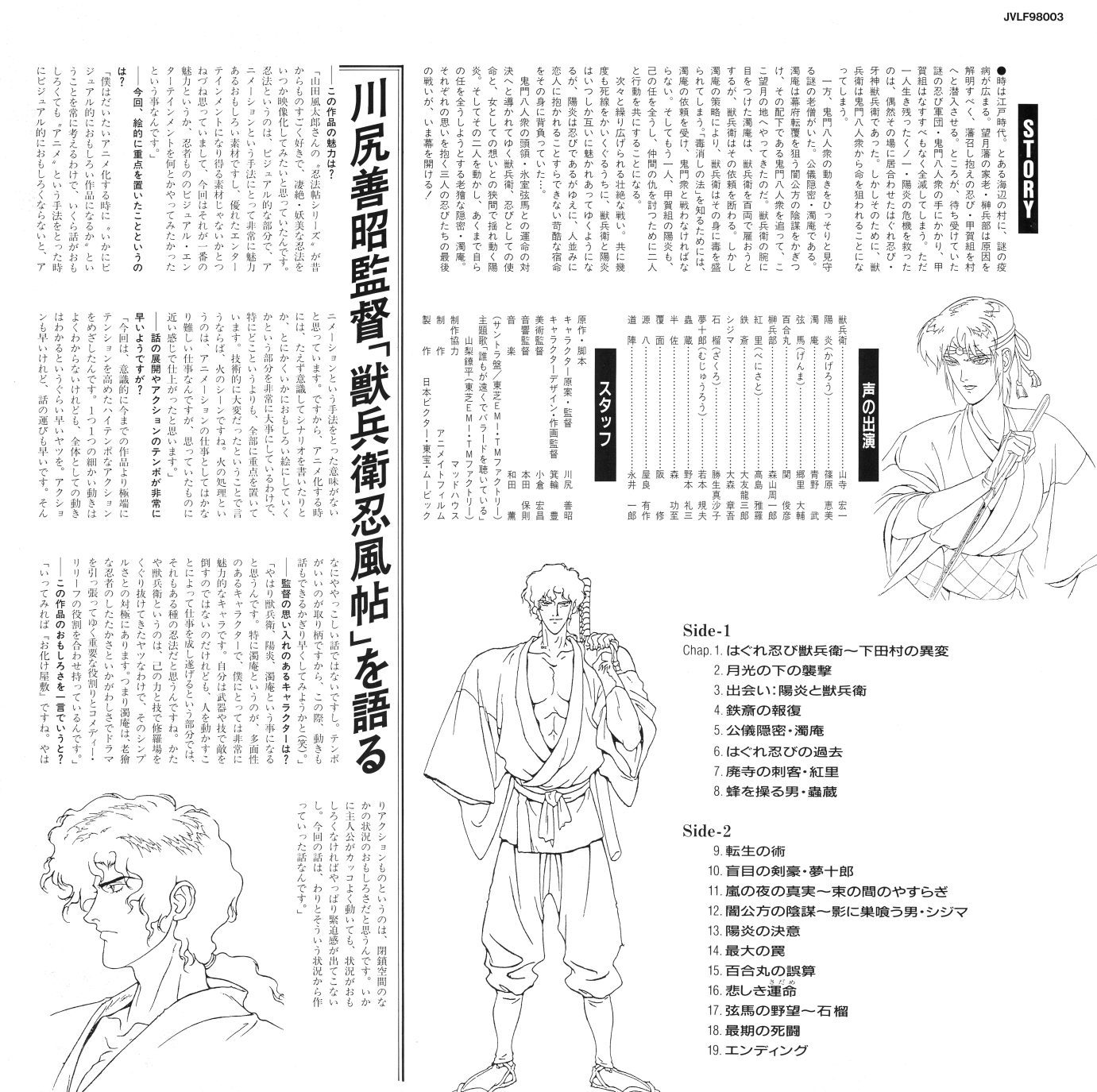 Liner note insert, JVLF-98003. Left column: director's essay 「川尻善昭監督『獣兵衛忍風帖』を語る」. Right column: STORY synopsis, staff and cast credits with line-art character portraits. Lower section: 19 chapter titles divided across Side-1 and Side-2.
The Liner Notes: A Director's Essay and Nineteen Chapter Titles
The insert opens with a heading that is slightly unusual for a standard CLV pressing: 「川尻善昭監督『獣兵衛忍風帖』を語る」 — 'Director Kawajiri Yoshiaki Speaks About Ninja Scroll.' Not a production note, not promotional text. A director's statement, positioned as the primary editorial content of the insert. Kawajiri speaks rarely — this is a document of him doing so about a specific film.
The insert also maps 19 chapter stops across Side-1 and Side-2. These titles are not index entries. They are prose fragments: 出会い、陽炎と獣兵衛 (Meeting: Kagero and Jubei) — Chapter 3. 龍の夜の真実 〜束の間のやすらぎ (Truth of the Dragon Night ~A Moment's Rest) — Chapter 11, the film's only extended quiet scene. 百合丸の誤算 (Yurimaru's Miscalculation) — Chapter 15, named for the antagonist who fails. 最期の死闘 (The Final Battle) — Chapter 18. Each title doubles as a one-line argument: here is what this sequence is, and whose story it tells.
The CLV format cannot step frame-by-frame. These nineteen verbal stills are the compensation.
Japan Didn't Make This Film Famous
「日本ではそれほどヒットしなかったという事実があるため。」
"Due to the fact that the original film was not a big hit in Japan." — Madhouse CEO Hiroyuki Okada, February 2014, explaining why a sequel could not be financed after 21 years.
獣兵衛忍風帖 was released in Japan through Tokyo Theatres — an arthouse and independent circuit, not a major studio distribution pipeline. It won the Citizens' Award at the 1993 Yubari International Fantastic Film Festival, a regional genre film event in Hokkaido. No mainstream industry prizes. No broad theatrical run. The production budget came from JVC's co-financing through Animate Film, supplemented by Toho and Movic. The film played at the margins of Japanese theatrical culture and was released to LaserDisc by its own co-producer within the same year.
In North America: Manga Entertainment licensed the film in 1995, produced an English dub, and released it to VHS and LaserDisc. Over 70,000 VHS copies sold in North America — Manga's best-selling title at the time, by a significant margin. Alongside Akira and Ghost in the Shell, 獣兵衛忍風帖 became one of the three films most credited with establishing the adult anime import market in the West during the 1990s. In 2024, Sentai Filmworks organized a 4K theatrical revival across the United States, opening at Anime Expo and running nationwide from September. No comparable Japanese domestic theatrical revival exists on record.
The Victor Entertainment LaserDisc was manufactured for a domestic market. The JVLF-98003 pressing is a document of the film's original context — a CLV standard release for a theatrical anime that Japan received modestly and the West made into a reference point for a generation of fans who encountered anime for the first time through a Manga Entertainment clamshell tape.
The 19 chapter titles on the liner note insert are the only prose Kawajiri contributed to this pressing that wasn't also on the film itself. They are precise, they name the right people, and they treat the film's narrative as a sequence of arguments rather than a sequence of events. On a CLV disc with no frame-by-frame access, they function as the navigation system. On the secondary market in 2026, the JVLF-98003 changes hands for ¥5,000–¥6,000. The liner note insert remains inside.
Loading...