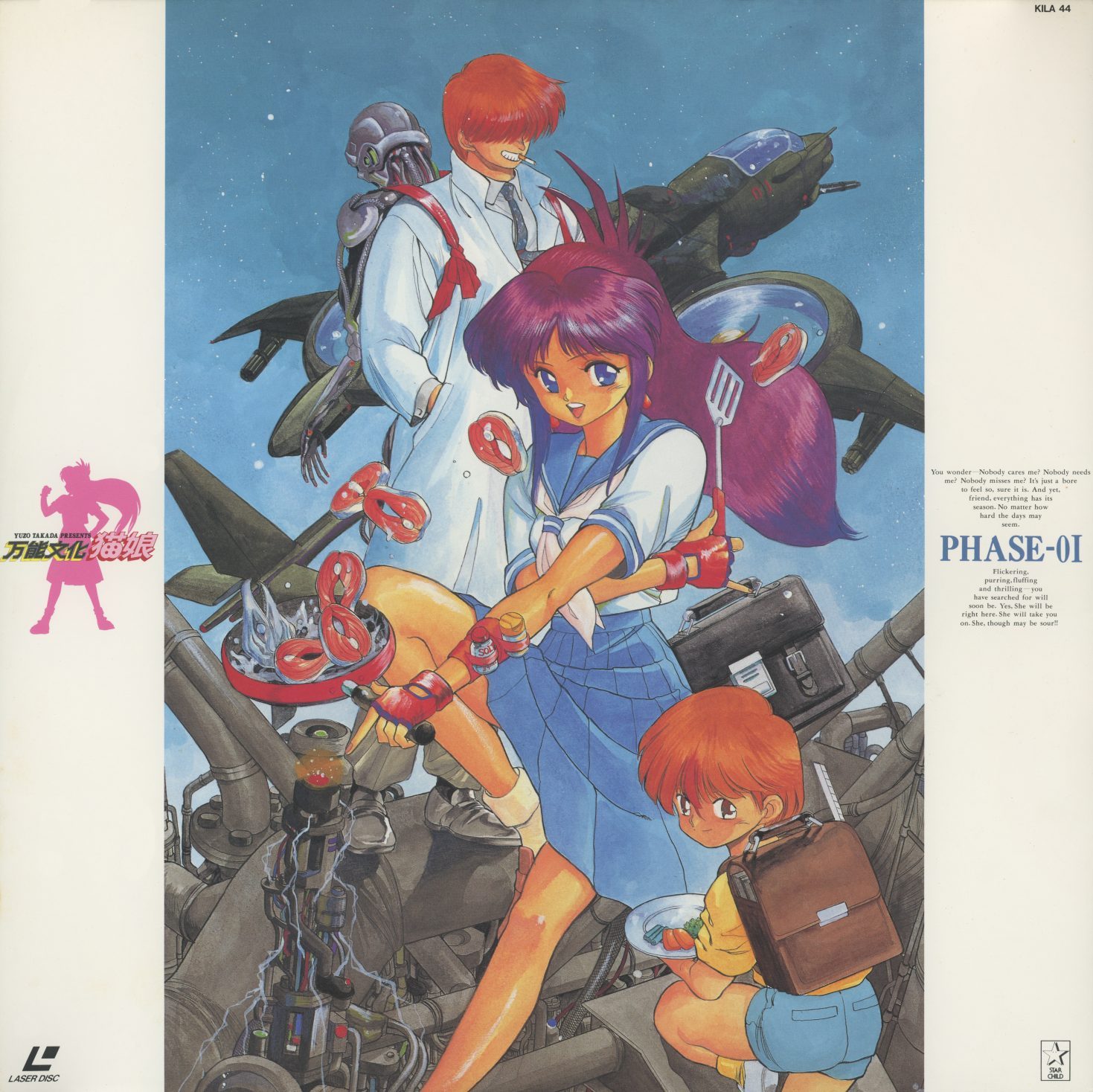
Six CAV discs. KILA-44 through KILA-46, then KILA-69, KILA-96, and KILA-97. 万能文化猫娘 (Bannou Bunka Neko Musume — All Purpose Cultural Cat Girl Nuku Nuku), a six-episode OVA released between 1992 and 1994 on King Records' Starchild label. The first three volumes at ¥5,300 each, the final three at ¥5,800. Every disc pressed in CAV. Every jacket carries an original illustration. Every volume includes a settei insert with Moriyama Yuji's character and mechanical design sheets in a per-volume monochrome color. Buyers who collected all six volumes could claim a complete-purchase bonus: an original Nuku Nuku UFO Catcher doll with no commercial retail release.
The premise is domestic absurdity played straight. Natsume Kyusaku — a rogue scientist — has transplanted the brain of a dying stray cat into a military-grade android body, creating Atsuko 'Nuku Nuku' Natsume: a girl who looks like a high schooler, thinks like a cat, and can punch through armored vehicles. Kyusaku is locked in a custody battle over his son Ryunosuke with his ex-wife Akiko, who happens to run the weapons division of Mishima Heavy Industries. Every episode follows the same escalation: Akiko deploys increasingly absurd military hardware — combat robots, orbital satellites, giant mecha — to reclaim Ryunosuke. Nuku Nuku destroys all of it. The joke never changes. The hardware does.
Yuzo Takada created the manga — the same artist behind 3×3 Eyes and Blue Seed. Moriyama Yuji handled character designs for the OVA adaptation, and his settei inserts across all six volumes document the characters and the Mishima mecha arsenal with the same diagrammatic seriousness King Records' Starchild label brought to its mecha properties. The packaging treats a slapstick comedy about a custody battle fought with tanks as if it were a military franchise. The settei inserts don't know they're funny.
The Format
KILA-44 opens the set. CAV, single side, approximately 30 minutes. Six volumes, six episodes — the first three at ¥5,300 (KILA-44 through KILA-46, released 1992–1993), the final three at ¥5,800 (KILA-69, KILA-96, KILA-97, released 1993–1994). All six pressed in CAV, the premium frame-steppable format, for an OVA whose action sequences — a cat-android tearing apart giant robots with her bare hands — reward the frame-by-frame access CAV provides. The catalog numbers jump: 44–46 are sequential, then 69, then 96–97. The gaps mark the two-year release window. King Records was pressing other Starchild titles between volumes. This was not a single production run — it was a sustained commitment across six individual release windows.
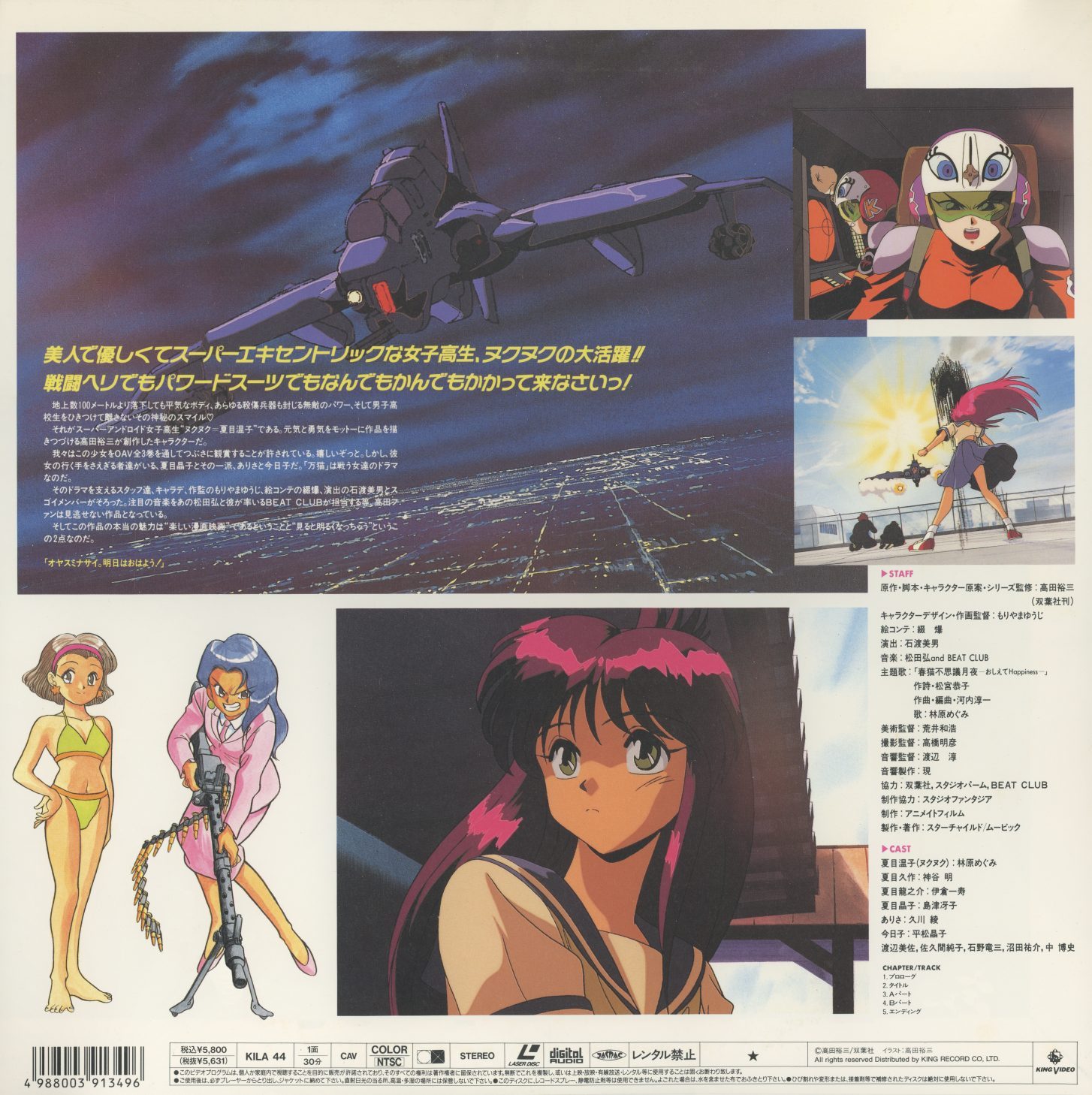 Phase-01 back. KILA-44, CAV, ¥5,300. Staff credits: series composition and direction by Takada Yuji, character design by Moriyama Yuji. Music by Kohei Tanaka. Opening theme: 'Happy Birthday' by Hayashibara Megumi. Scene screenshots showing Nuku Nuku's arrival and first combat. レンタル禁止 — rental prohibited.
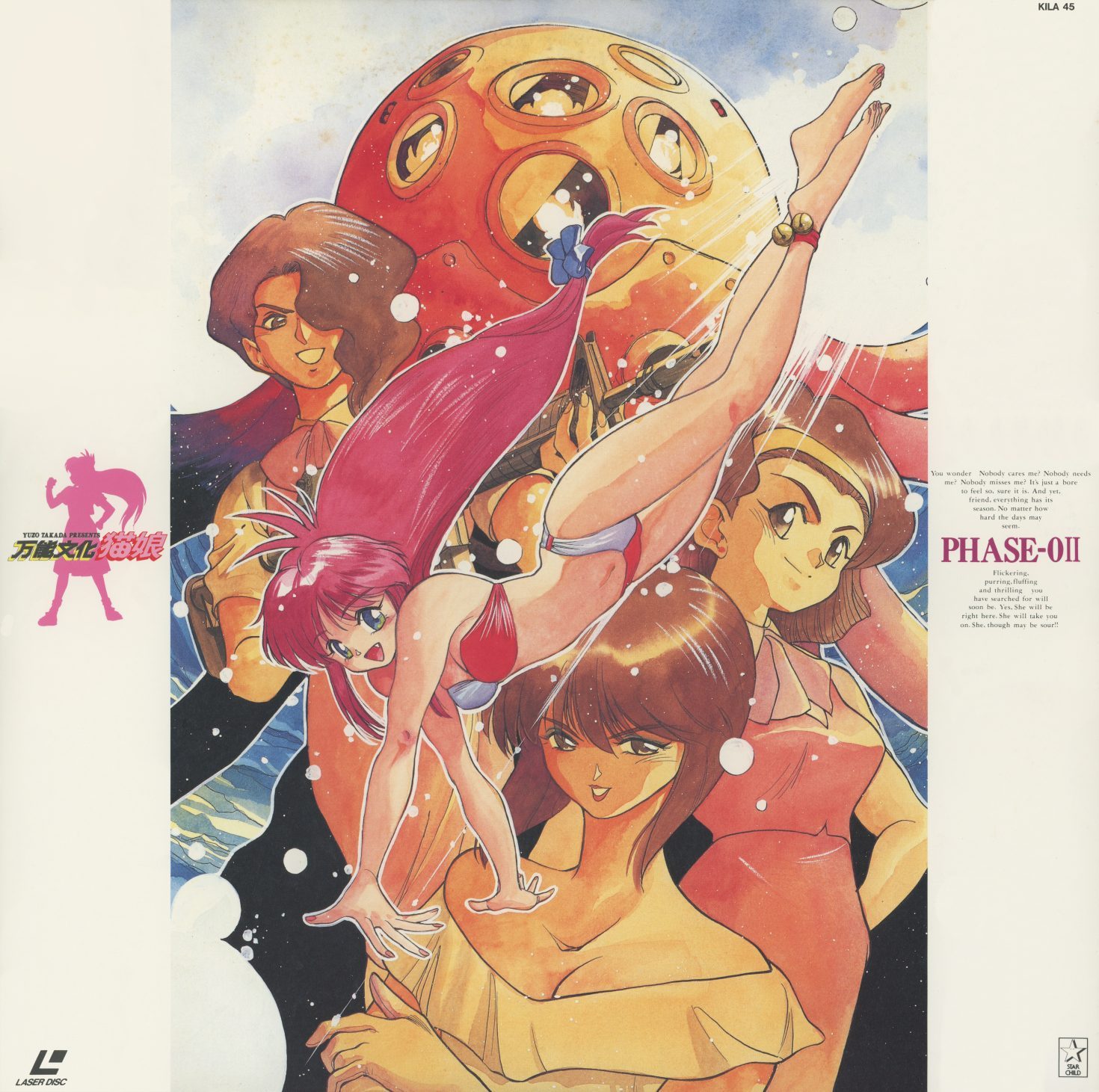 Phase-0II jacket front. The beach and pool episode — Nuku Nuku and the female cast in swimwear against a summer ocean backdrop, a giant octopus mecha looming above. English text at right describes the premise. KILA-45.
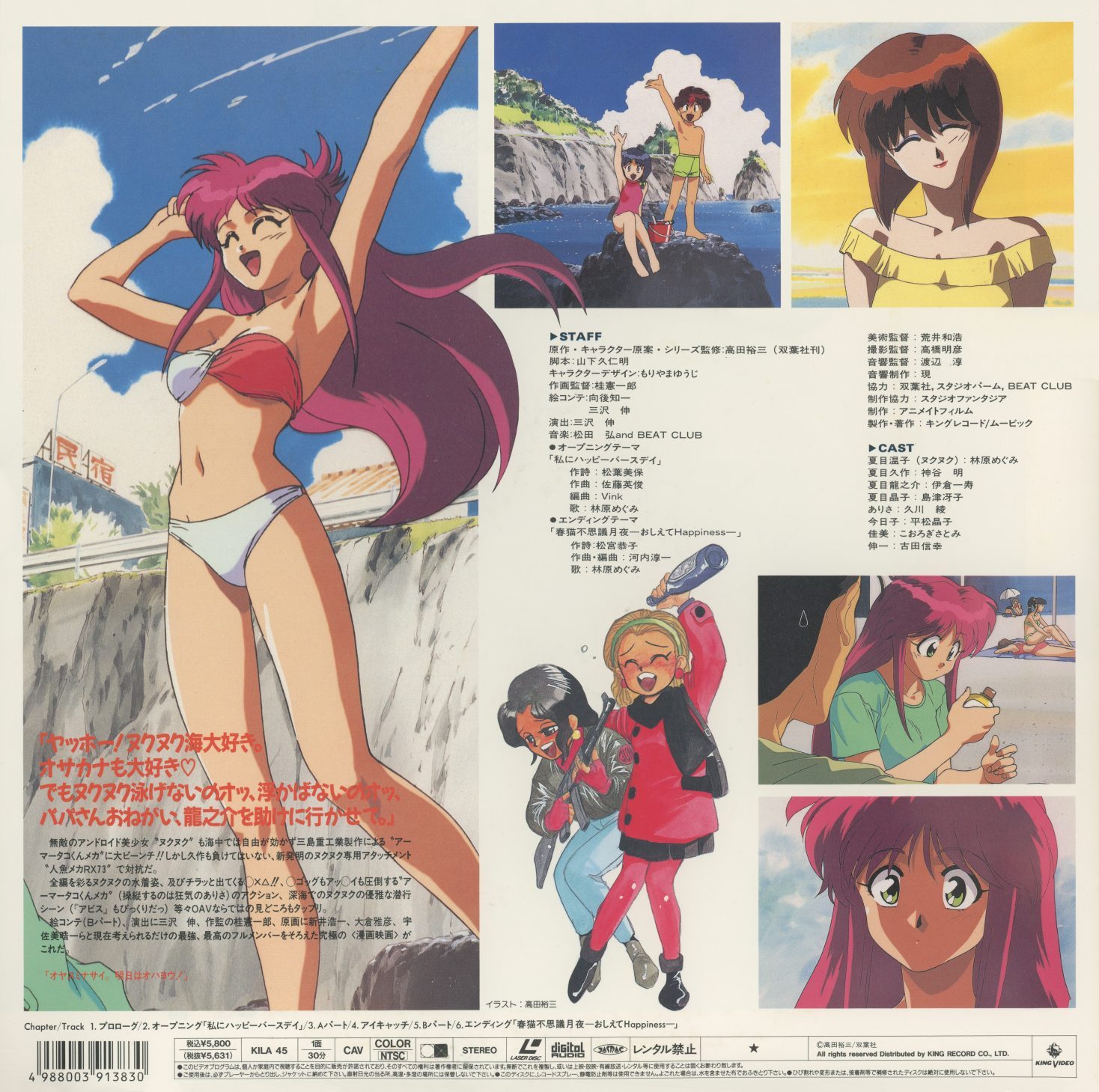 Phase-0II back. KILA-45, CAV, ¥5,300. Scene screenshots: Nuku Nuku in red bikini, Akiko in swimwear, the cast at an ocean resort. The summer episode. Staff and cast credits, opening theme 'Happy Birthday,' ending '〜しあわせHappiness〜.' King Records.
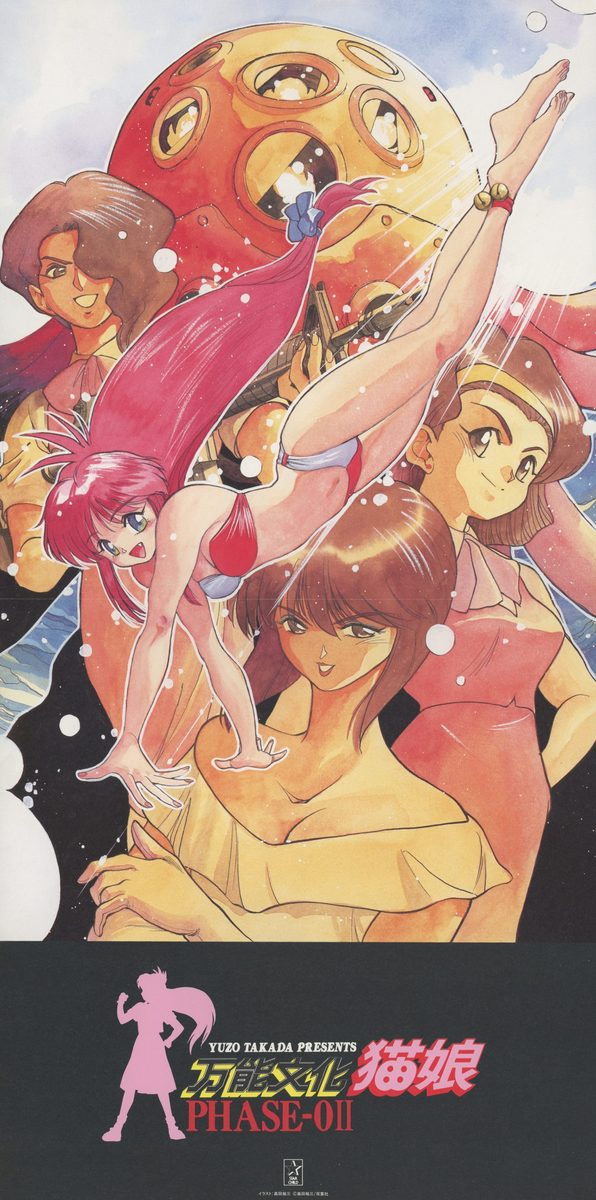 Phase-0II obi spine card. Tall narrow format with the Phase-0II jacket art — Nuku Nuku airborne in red swimwear over the octopus mecha, the female cast below. YUZO TAKADA PRESENTS 万能文化猫娘 PHASE-0II logo at base.
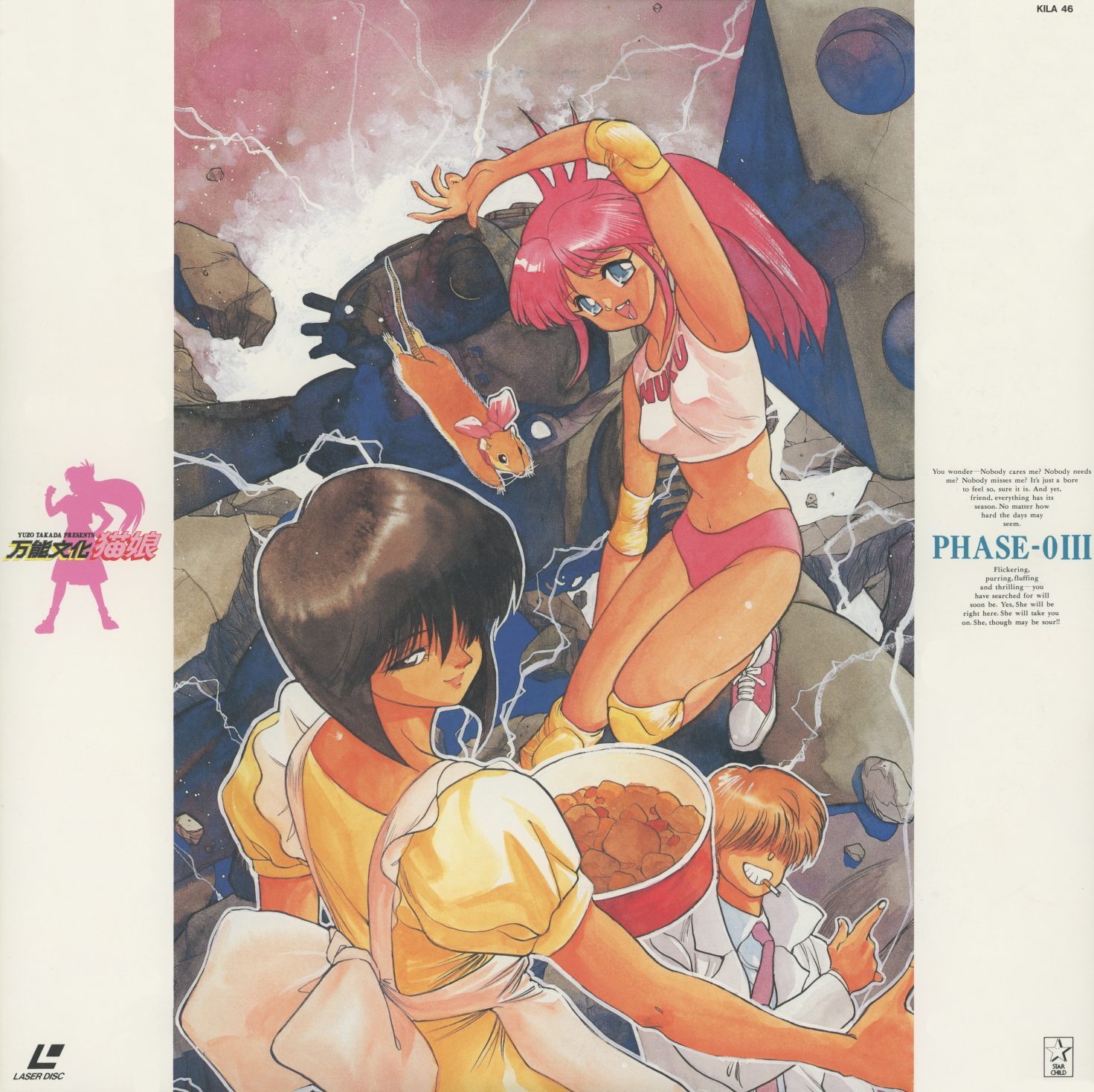 Phase-0III jacket front. Nuku Nuku in pigtails and school uniform, lightning crackling in the background, the stray cat that donated its brain perched on her shoulder. The android and the animal she used to be. KILA-46.
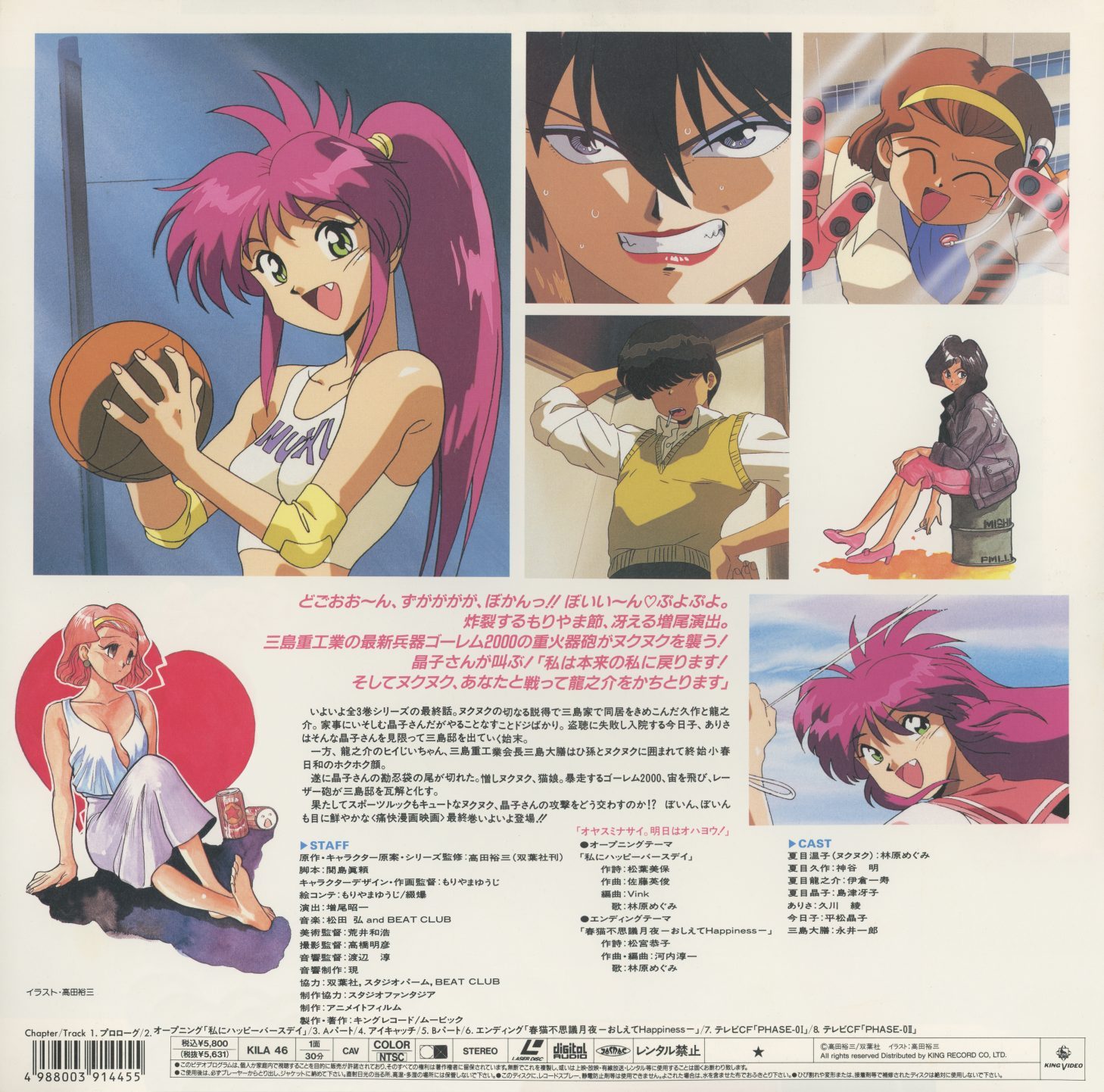 Phase-0III back. KILA-46, CAV, color, stereo. Scene screenshots showing Nuku Nuku in domestic and combat modes — the series' constant register shift between slice-of-life warmth and mecha destruction. Staff and cast credits at bottom.
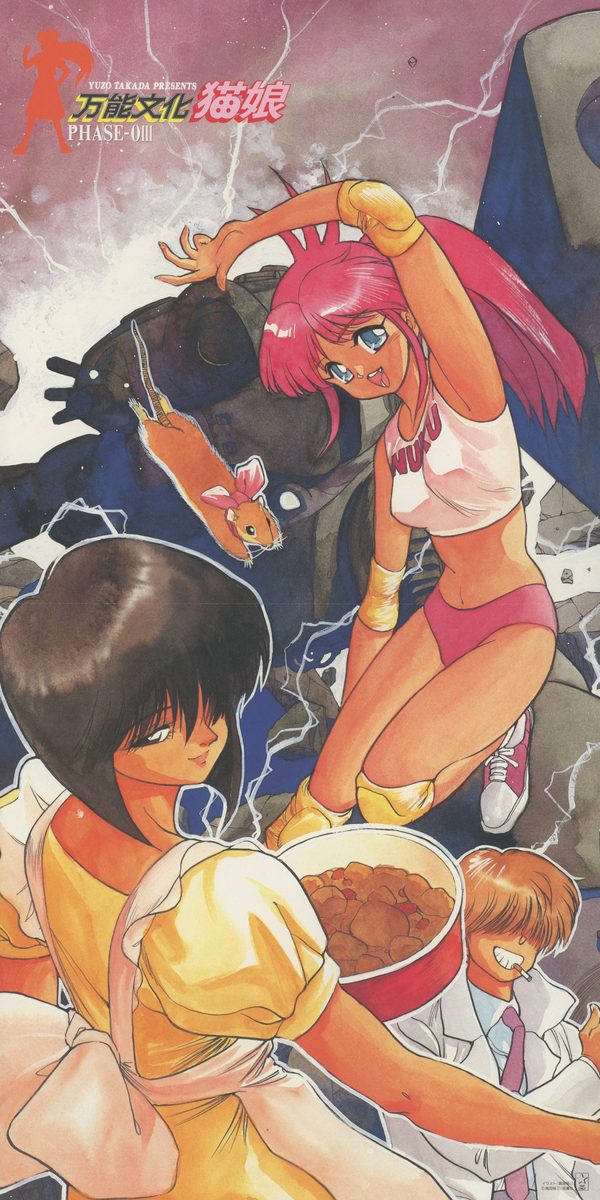 Phase-0III obi spine card. Tall narrow format — the Phase-0III jacket art: Nuku Nuku fighting the dark beast, Kyusaku below with a bowl of curry, lightning and rubble. YUZO TAKADA PRESENTS 万能文化猫娘 PHASE-0III logo at base.
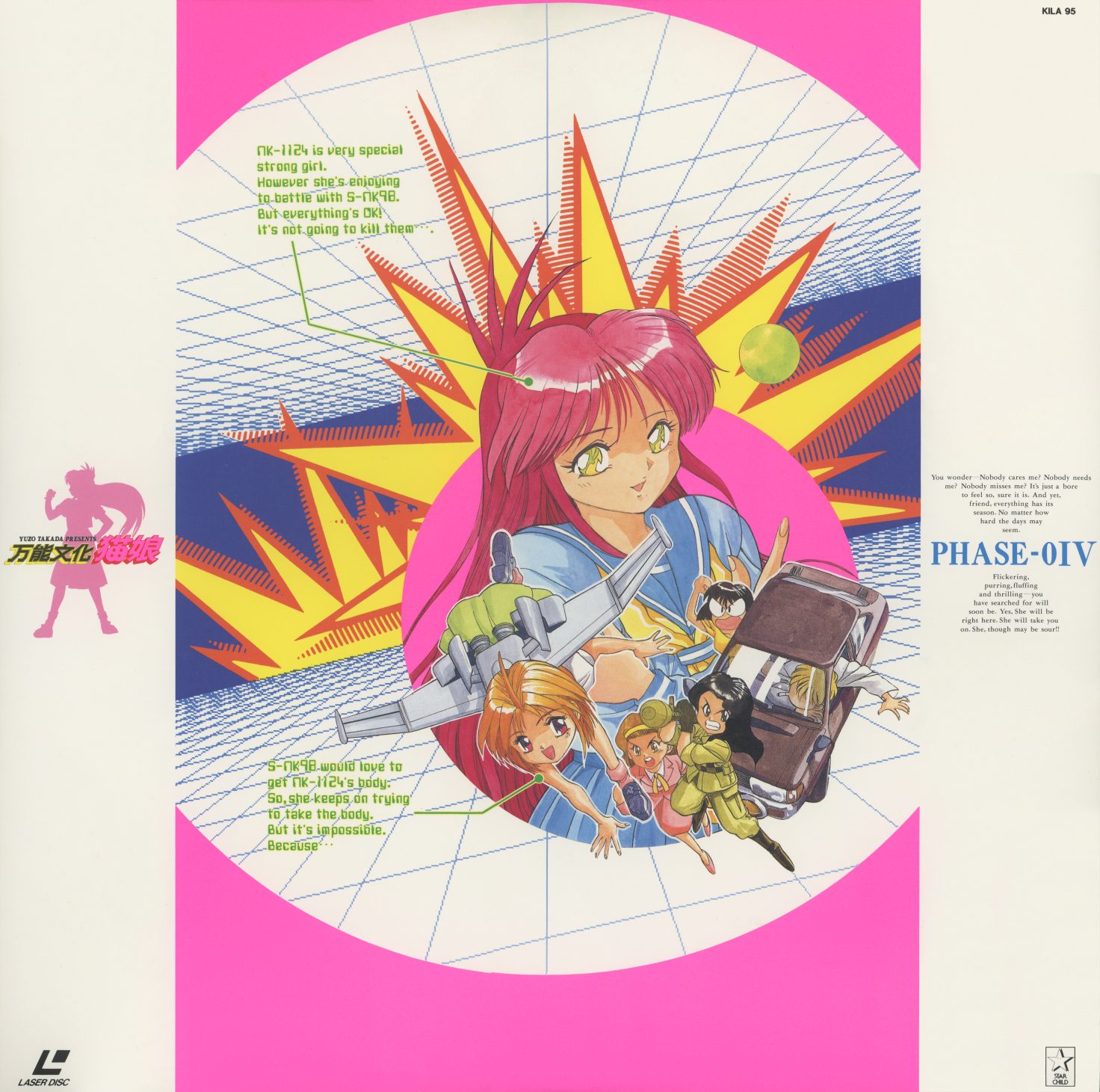 Phase-0IV jacket front. Hot pink background with a pop-art explosion — Nuku Nuku holding weapons and a car, Arisa and Kyoko fleeing below. The English text: 'NK-1124 is very special strong girl.' The art style has shifted toward manga-panel energy. KILA-69.
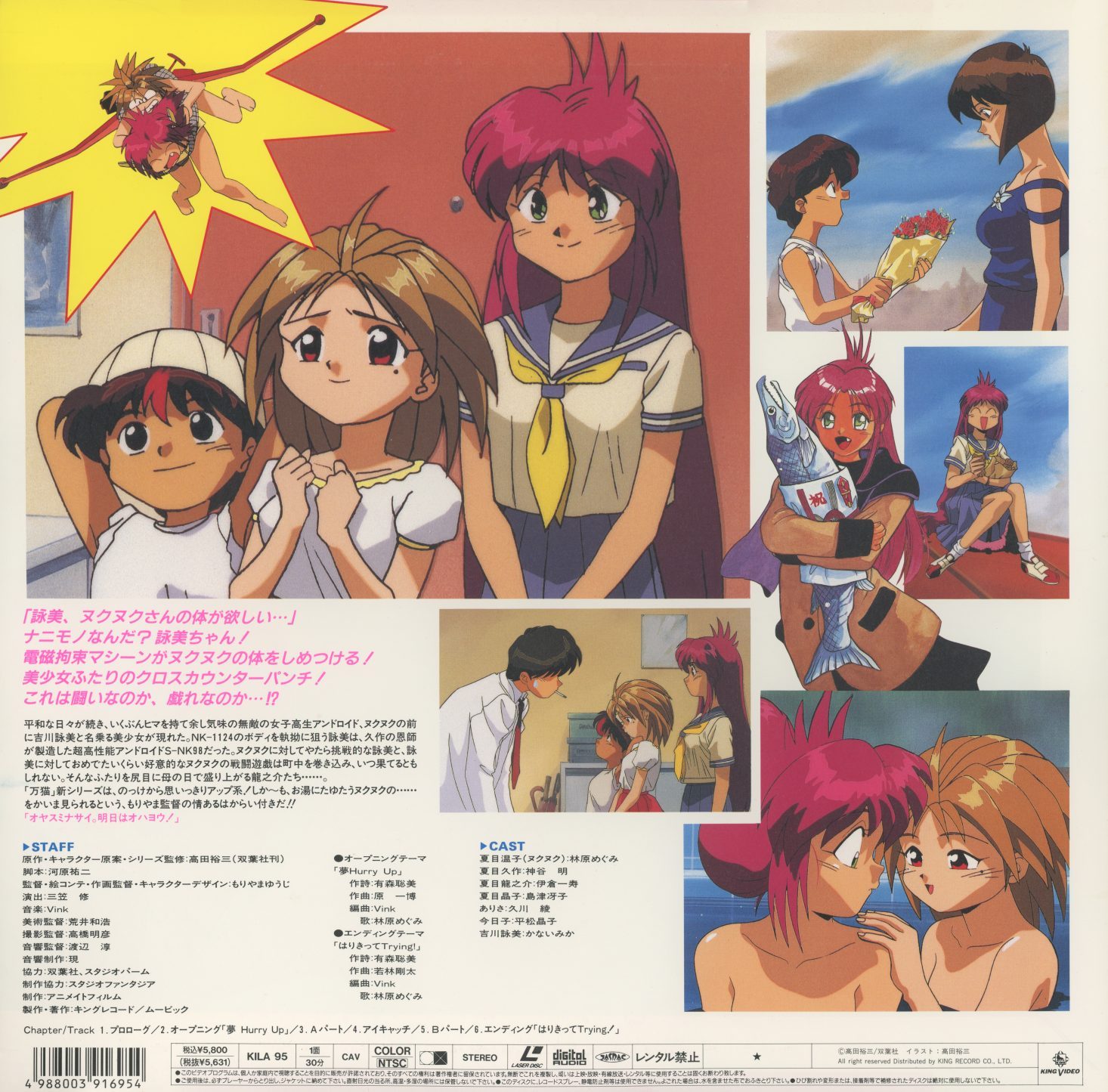 Phase-0IV back. KILA-69, CAV, ¥5,800. Scene screenshots: Nuku Nuku playing basketball, Ryunosuke in a classroom, the Mishima Golem 2000 mecha. Staff credits note Moriyama Yuji character design; opening theme 'Hurry Up.' The volume's back text cites the GOLEM 2000 and Natsume Akiko's escalating desperation.
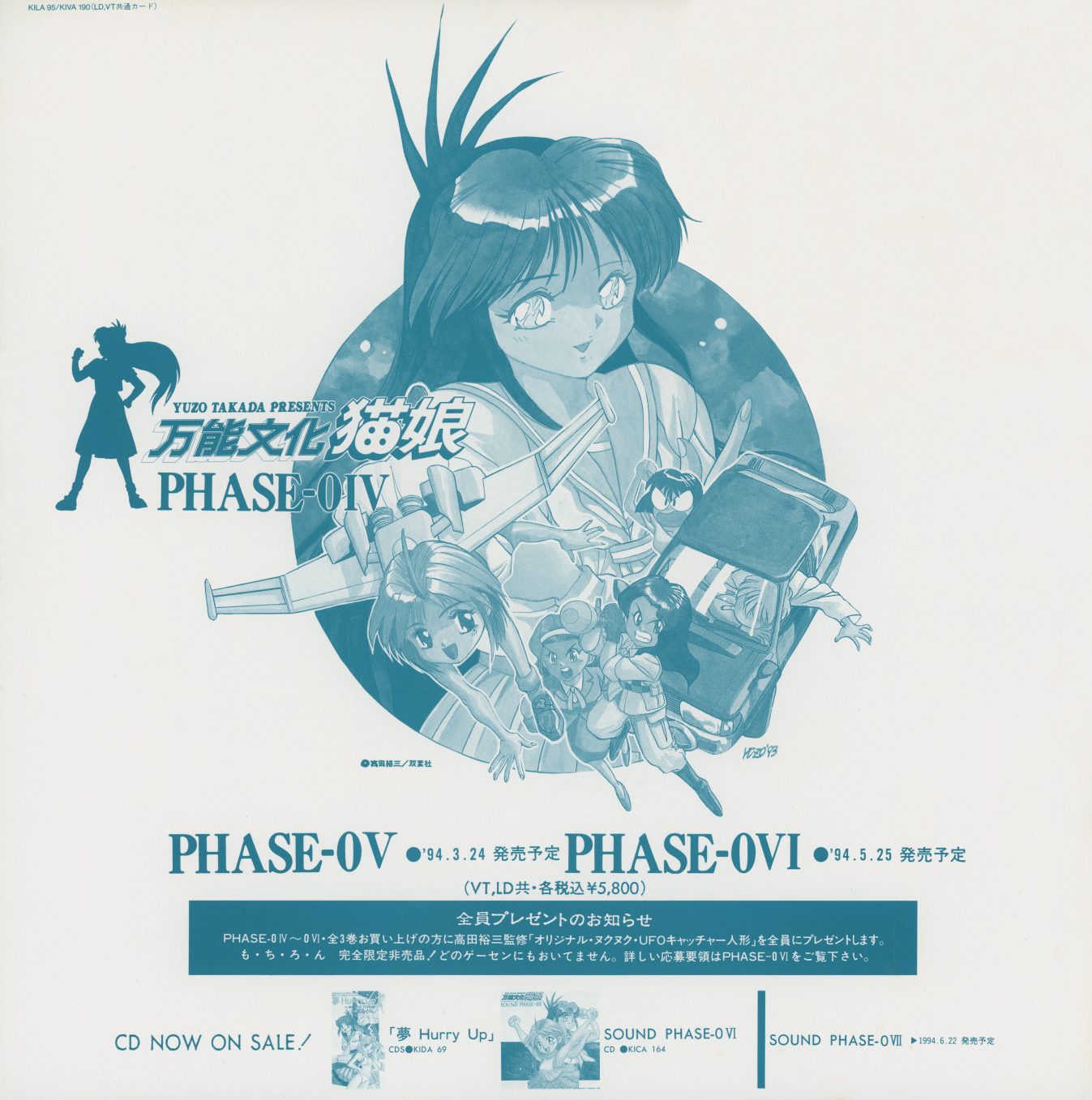 Phase-0IV promotional insert — teal/cyan monochrome. Phase-0IV key art (Nuku Nuku in circle, Arisa and Kyoko, the Mishima mecha). Below: PHASE-0V release date '94.3.24, PHASE-0VI release date '94.5.25, complete-purchase bonus details (UFO Catcher doll), and CD NOW ON SALE section for 夢 Hurry Up, SOUND PHASE-0VI, SOUND PHASE-0VII.
The Jacket Illustrations
Each volume's jacket carries an original illustration — not recycled promotional art, but new paintings reflecting the episode's tone. Phase-01 is ensemble. Phase-0II is summer fanservice. Phase-0III pairs the android with the cat whose brain she carries. Phase-0IV breaks into pop-art. Phase-0V puts the female cast in swimwear at a resort. Phase-0VI deploys mecha in space. The progression tracks the series' own escalation from domestic comedy to orbital-scale military operations. Each jacket also carries a block of English text — not a translation, but a parallel description written for the packaging, providing an English-language synopsis that reads like marketing copy drafted by someone genuinely enthusiastic about the premise.
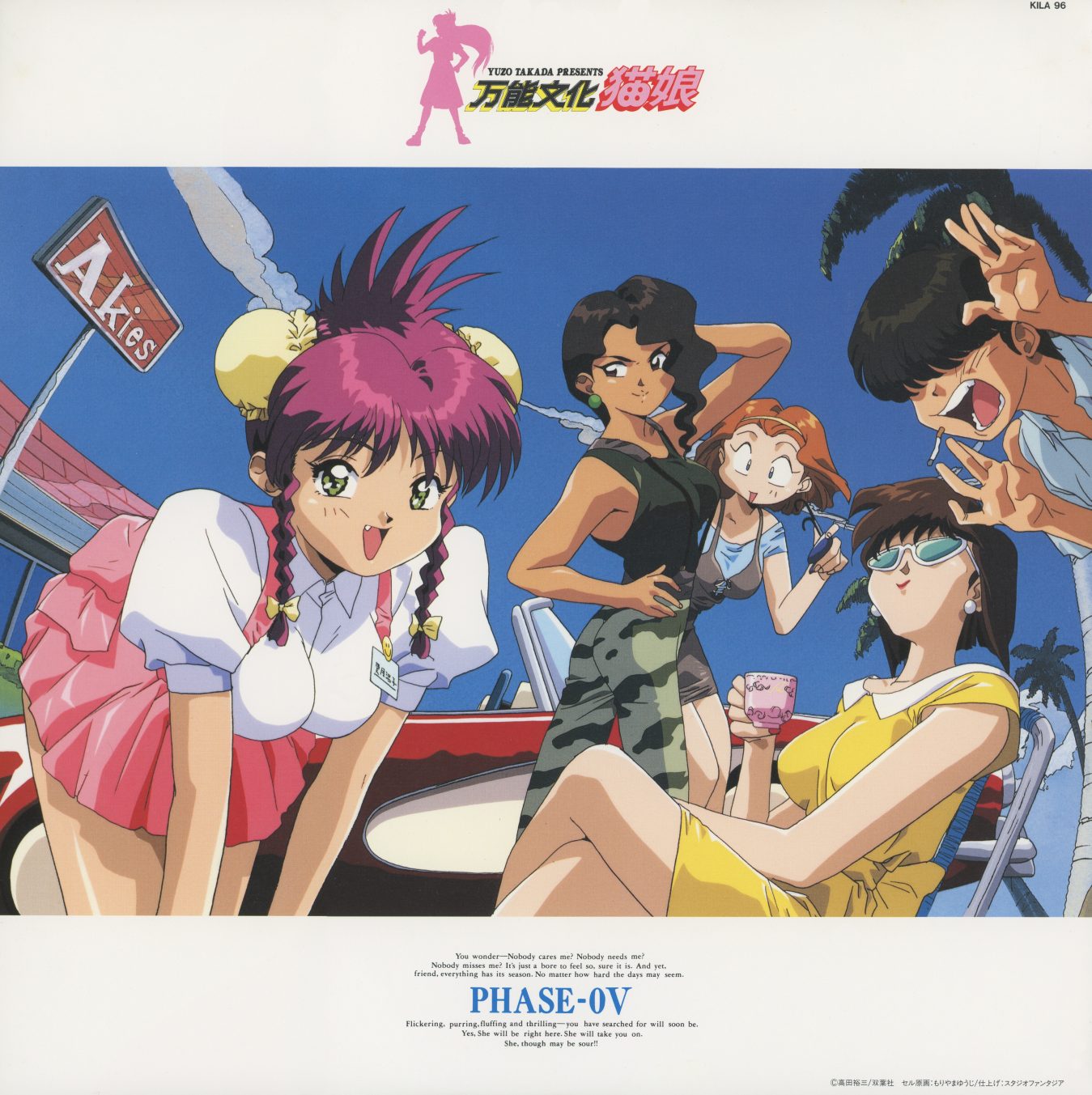 Phase-0V jacket front. Nuku Nuku leaning forward with tongue out, the female cast at a beachside restaurant — Arisa in camo, Kyoko in sunglasses and cocktail. 'Akies' sign in the background. KILA-96, ¥5,800.
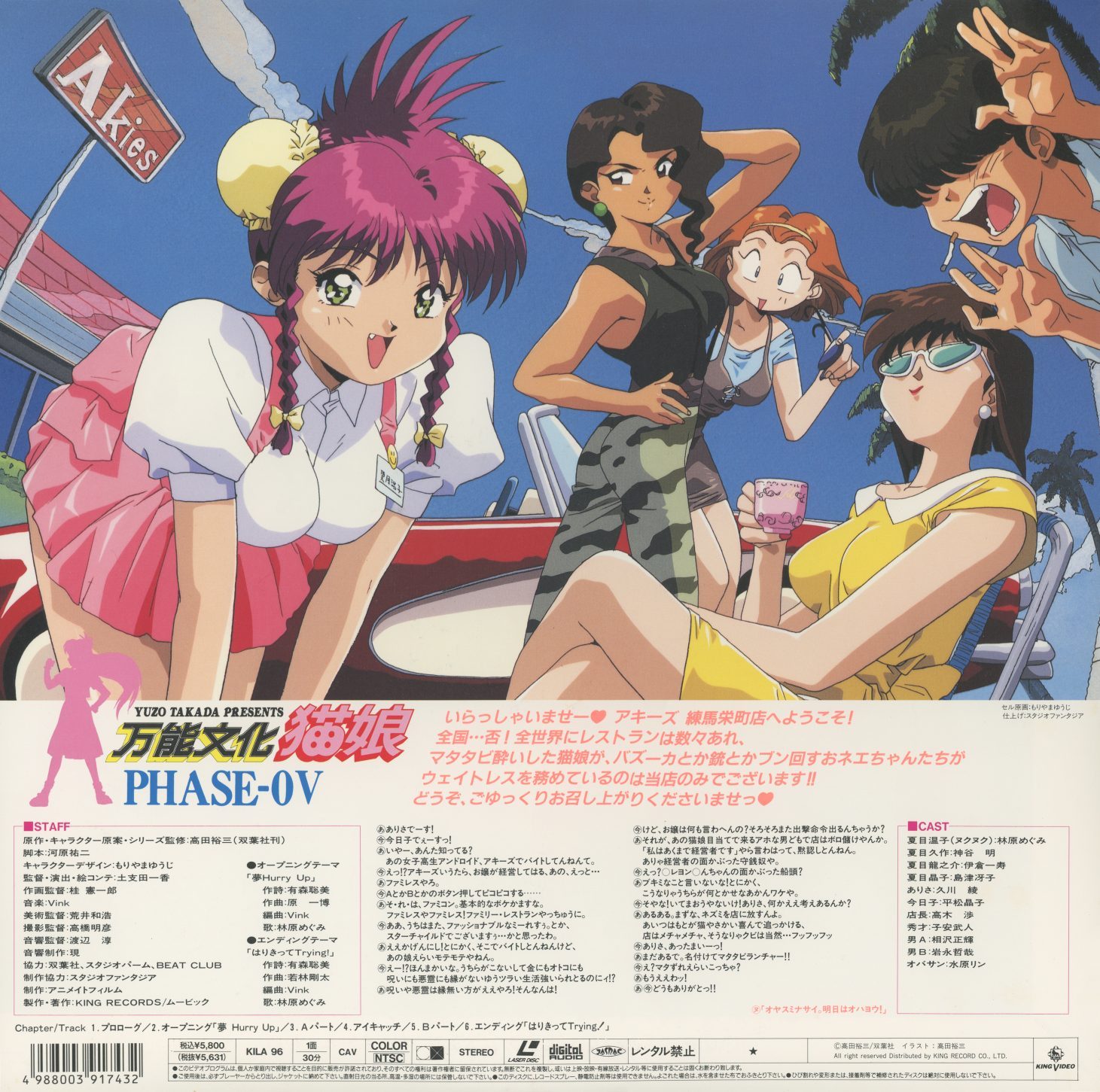 Phase-0V back. KILA-96, CAV, ¥5,800 (税込¥5,631). Scene screenshots: Nuku Nuku as waitress, the cast in various tropical scenarios. Opening: 'Hurry Up.' Staff credits confirm Moriyama Yuji character design, Kohei Tanaka music. King Records / Starchild.
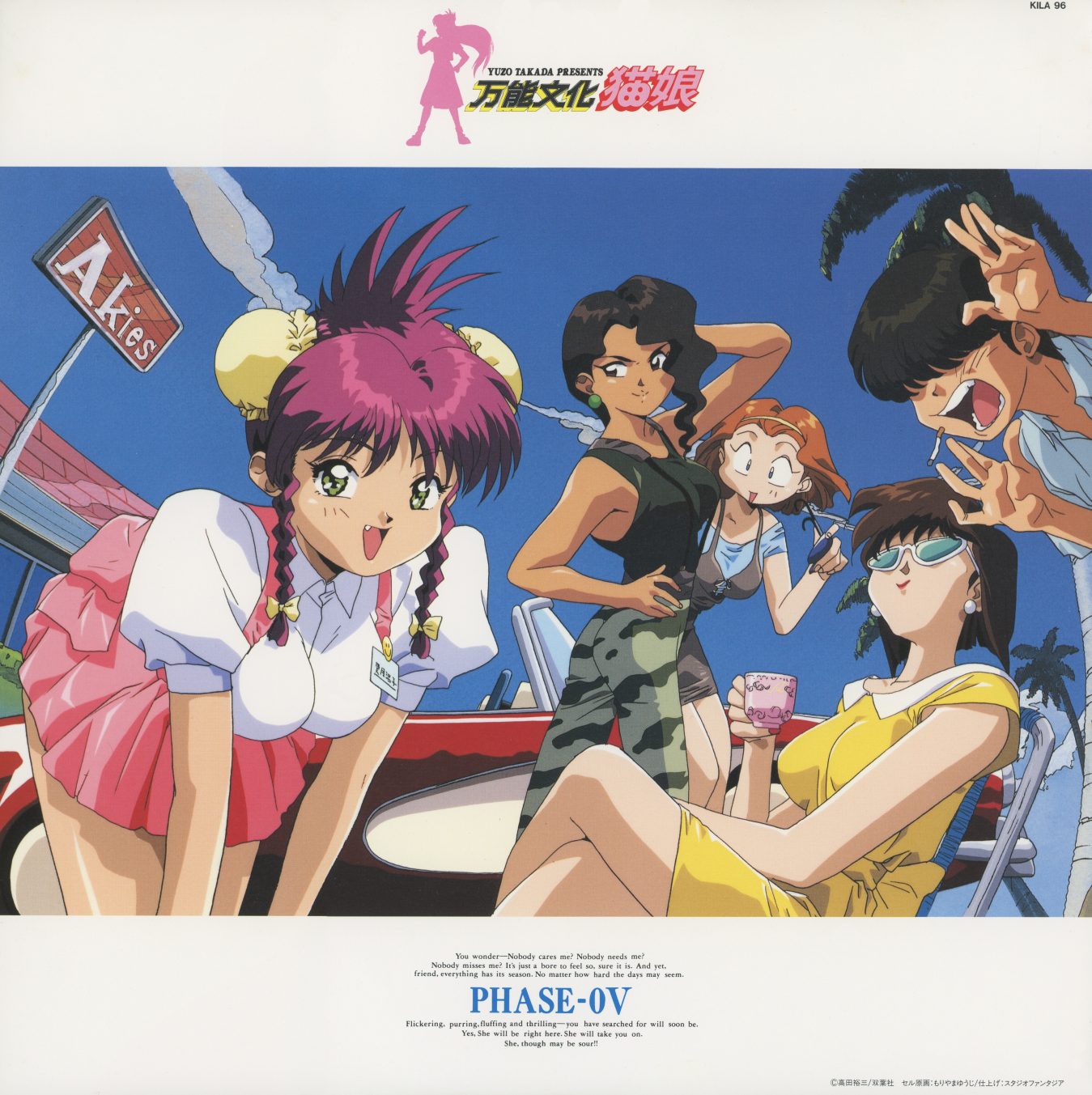 Phase-0V gatefold inner spread. Full-color illustration: Nuku Nuku in waitress uniform leaning forward, Arisa in camo, Kyoko in sunglasses, the full female cast at Akies restaurant. The same image used for the jacket front rendered at full gatefold width without text overlay. KILA-96.
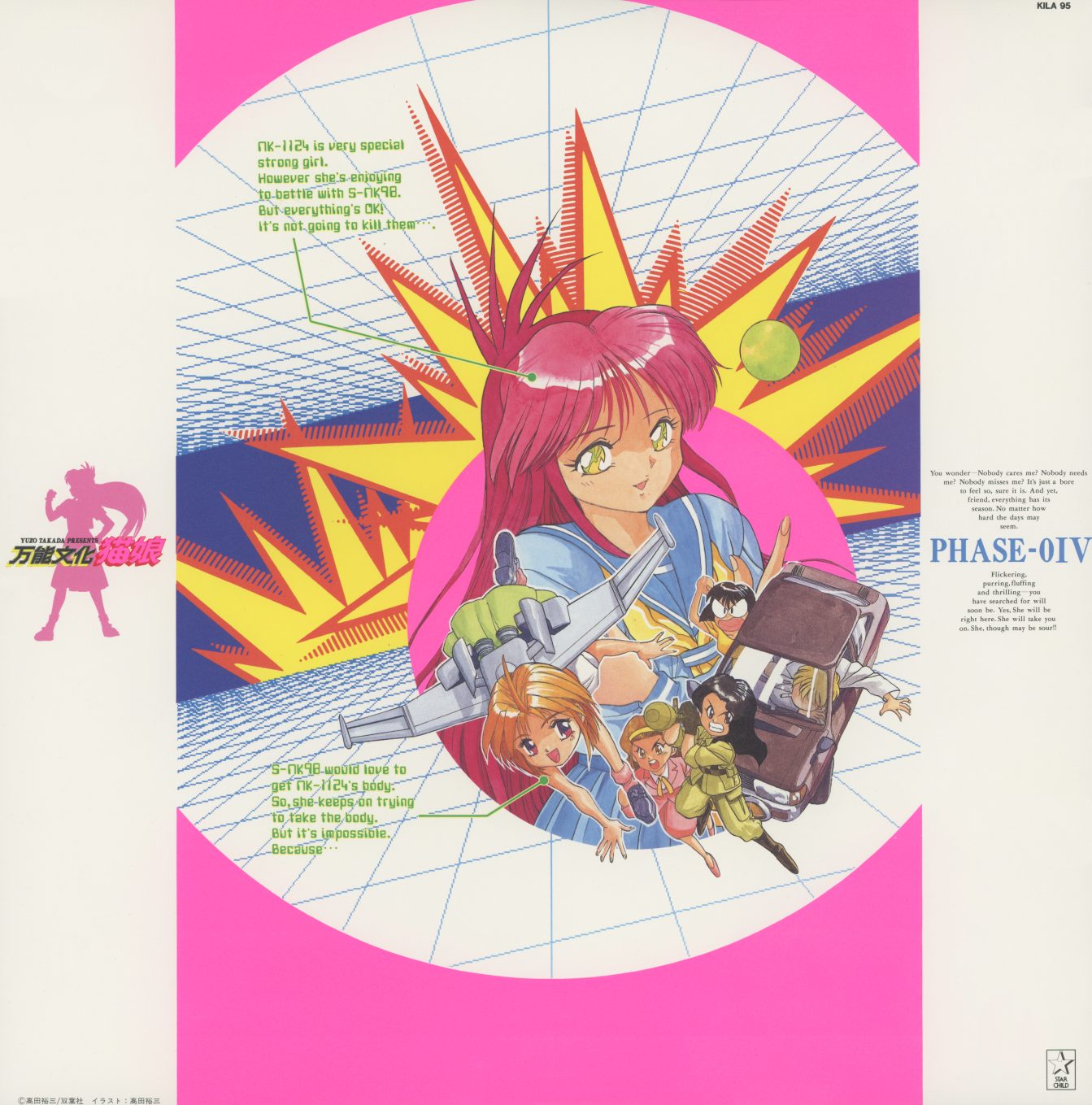 Phase-0V obi card. Standard jacket format — the Phase-0V illustration (Nuku Nuku as waitress, pop-art manga-panel background) with KILA-96 catalog number. The inner face of the Phase-0V obi.
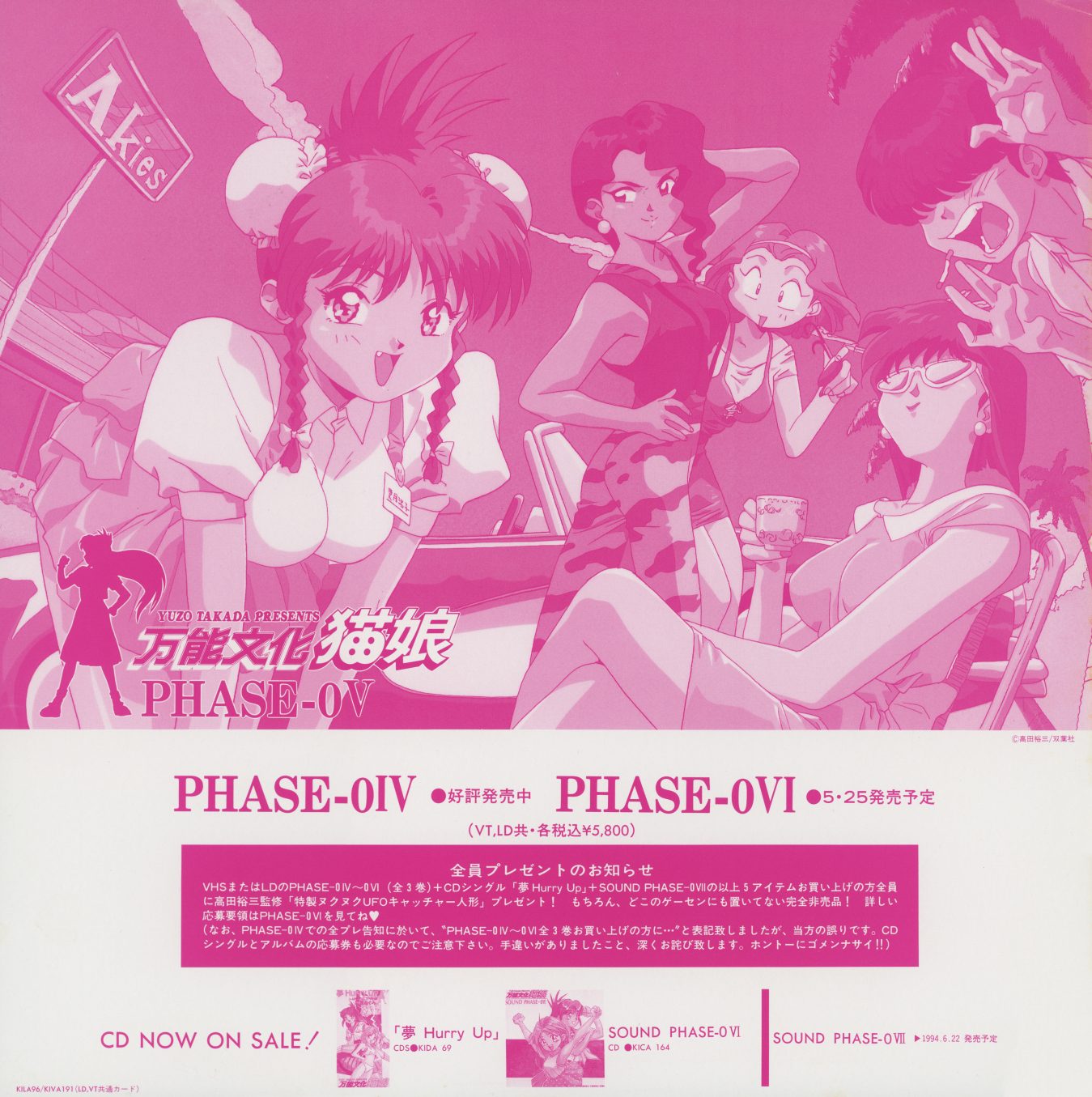 Phase-0V promotional insert — deep pink monochrome. Phase-0V Akies cast illustration. Below: PHASE-0IV (好評発売中) and PHASE-0VI (5.25発売予定), complete-purchase bonus notice (UFO Catcher doll, three items required), and CD NOW ON SALE for 夢 Hurry Up, SOUND PHASE-0VI, SOUND PHASE-0VII.
The Settei Inserts
Every volume includes a settei insert — Moriyama Yuji's production design sheets printed in a single monochrome color that changes per volume. Pink for the early character sheets: Natsume Atsuko (Nuku Nuku), Natsume Akiko, Natsume Ryunosuke, Natsume Kyusaku, Arisa and Kyoko, the マタタビランチャー (Matatabi Launcher — Nuku Nuku's catnip-based weapon), and Akiko's Corvette. Blue for the mecha archive: satellites, orbital weapons platforms, the SKY-DOG TYPE68030, and the 電磁拘束マシーン (electromagnetic restraint machine). Teal for a second character sheet introducing new designs and casual costume variants. The mechanical settei documents the Mishima arsenal with the same multi-view orthographic precision used for Gundam mobile suits. The mecha are jokes — weapons built to capture one android girl and failing every time — but the design sheets present them as engineering documents.
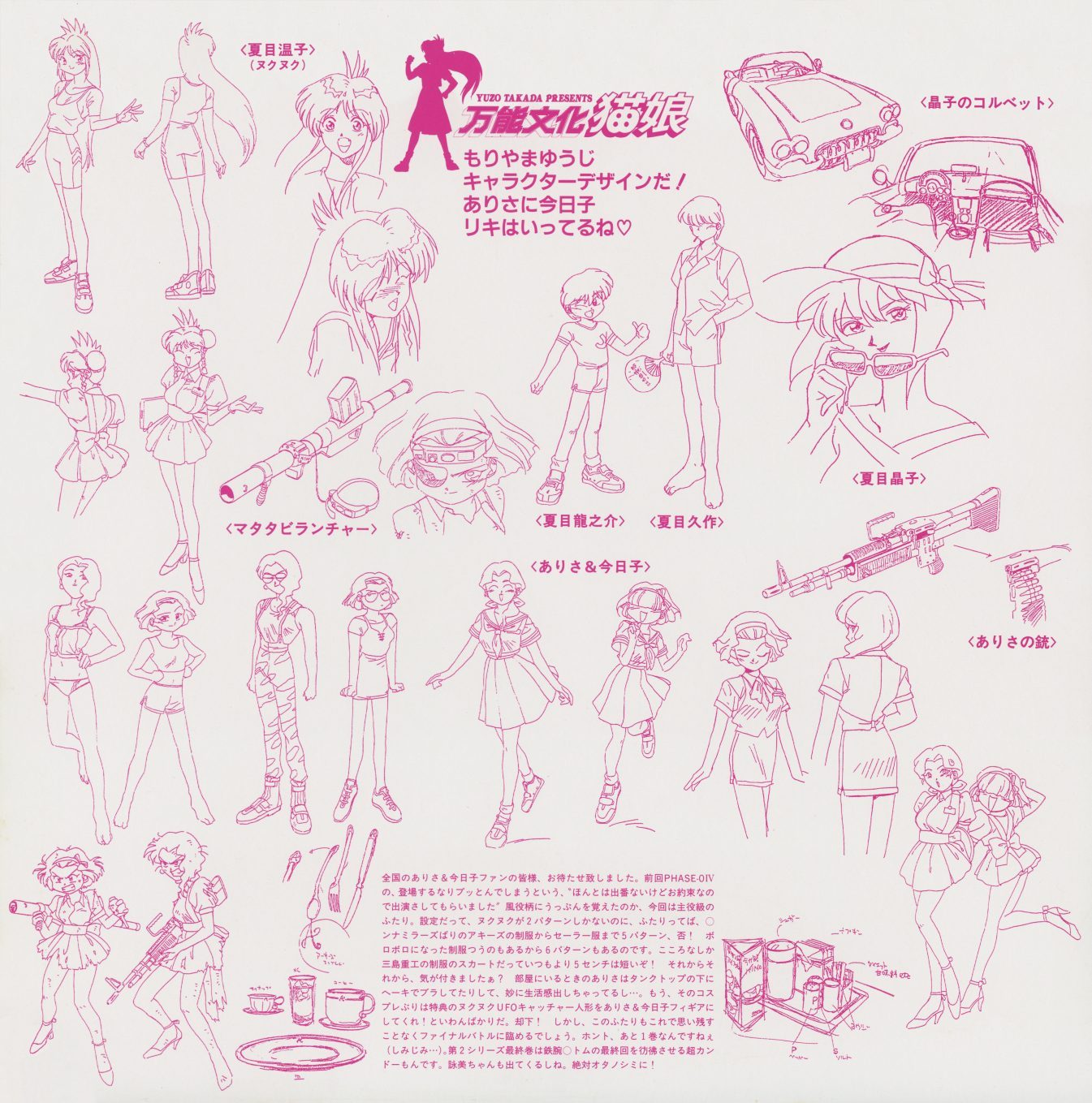 Settei insert — pink monochrome. Character designs by Moriyama Yuji: Natsume Atsuko (Nuku Nuku), Natsume Akiko, Natsume Kyusaku, Natsume Ryunosuke, Arisa & Kyoko, the Matatabi Launcher, and Akiko's Corvette. Full turnarounds and expression sheets.
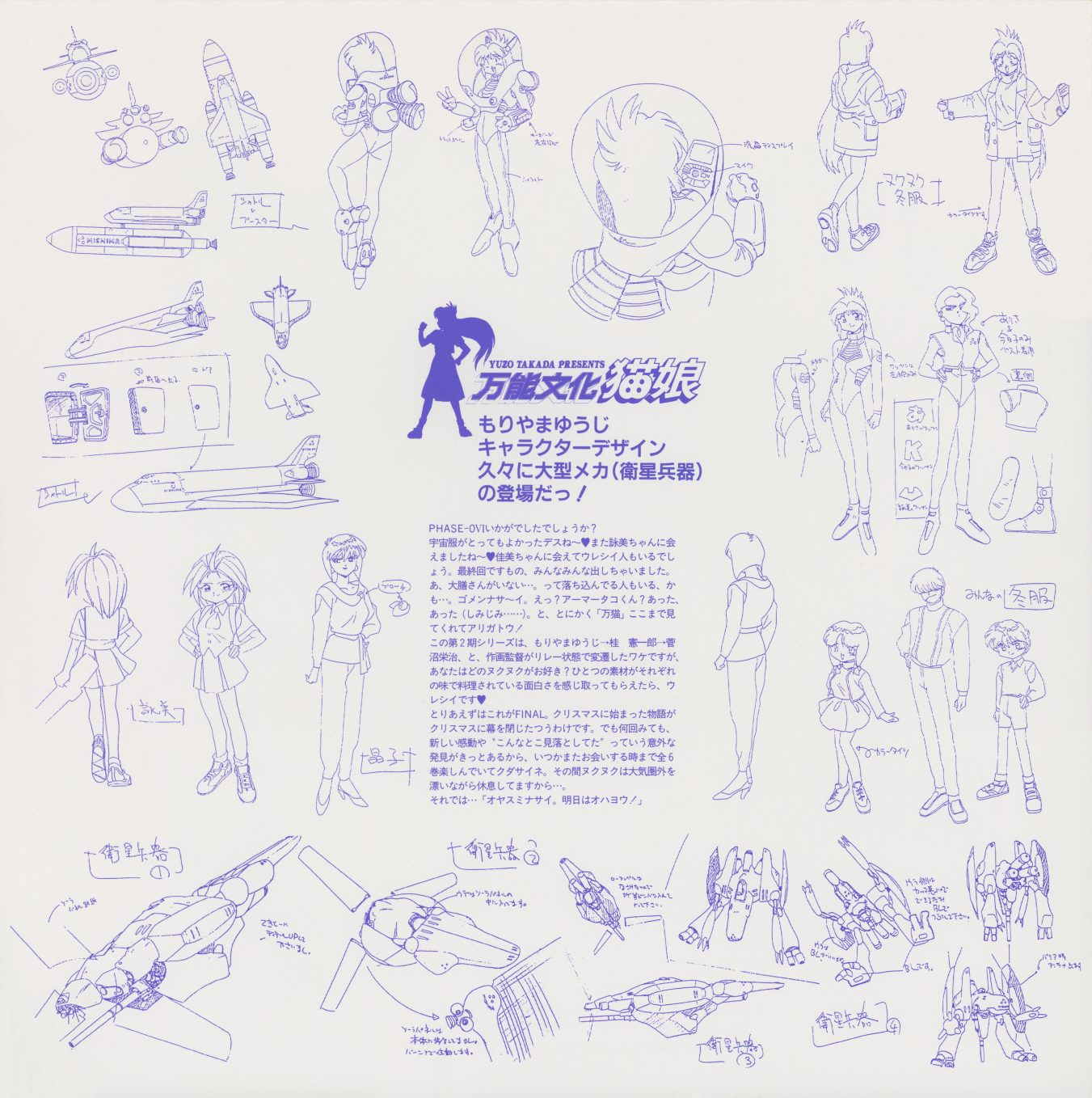 Settei insert — blue/purple monochrome. Mecha and weapon designs: large-scale mechanical designs including the SKY-DOG TYPE68030, orbital satellite weapons, the electromagnetic restraint machine, and character variants. The Mishima Heavy Industries arsenal documented as if it were a real military contractor's catalog.
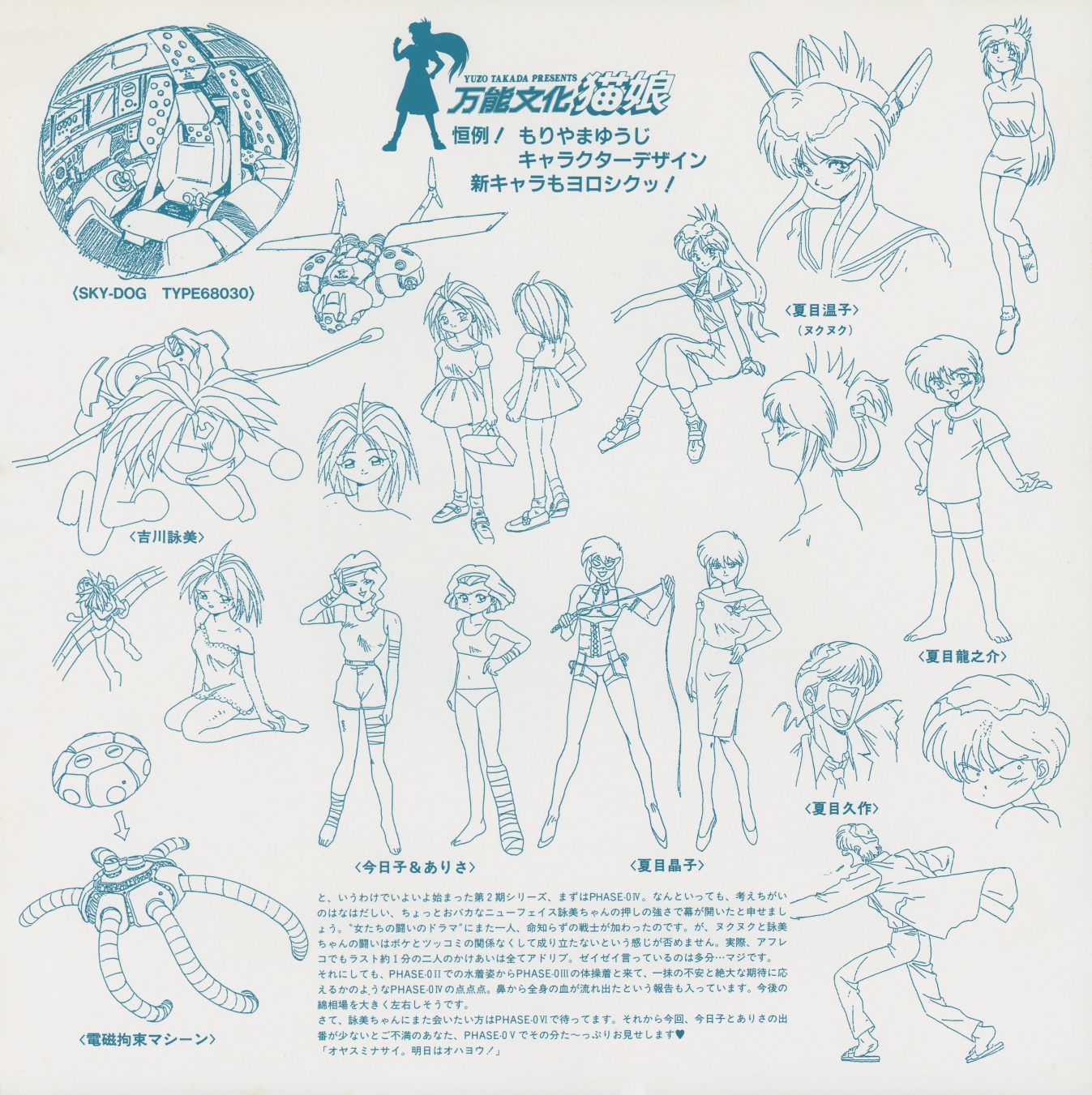 Settei insert — teal monochrome. Second character design sheet: Natsume Atsuko in new costumes, Yoshikawa Shinobu, Natsume Akiko, Natsume Ryunosuke, Kyoko & Arisa, Natsume Kyusaku. Header: '恒例!もりやまゆうじ キャラクターデザイン 新キャラもヨロシクッ!' — 'The usual! Moriyama Yuji character designs — please welcome the new characters!'
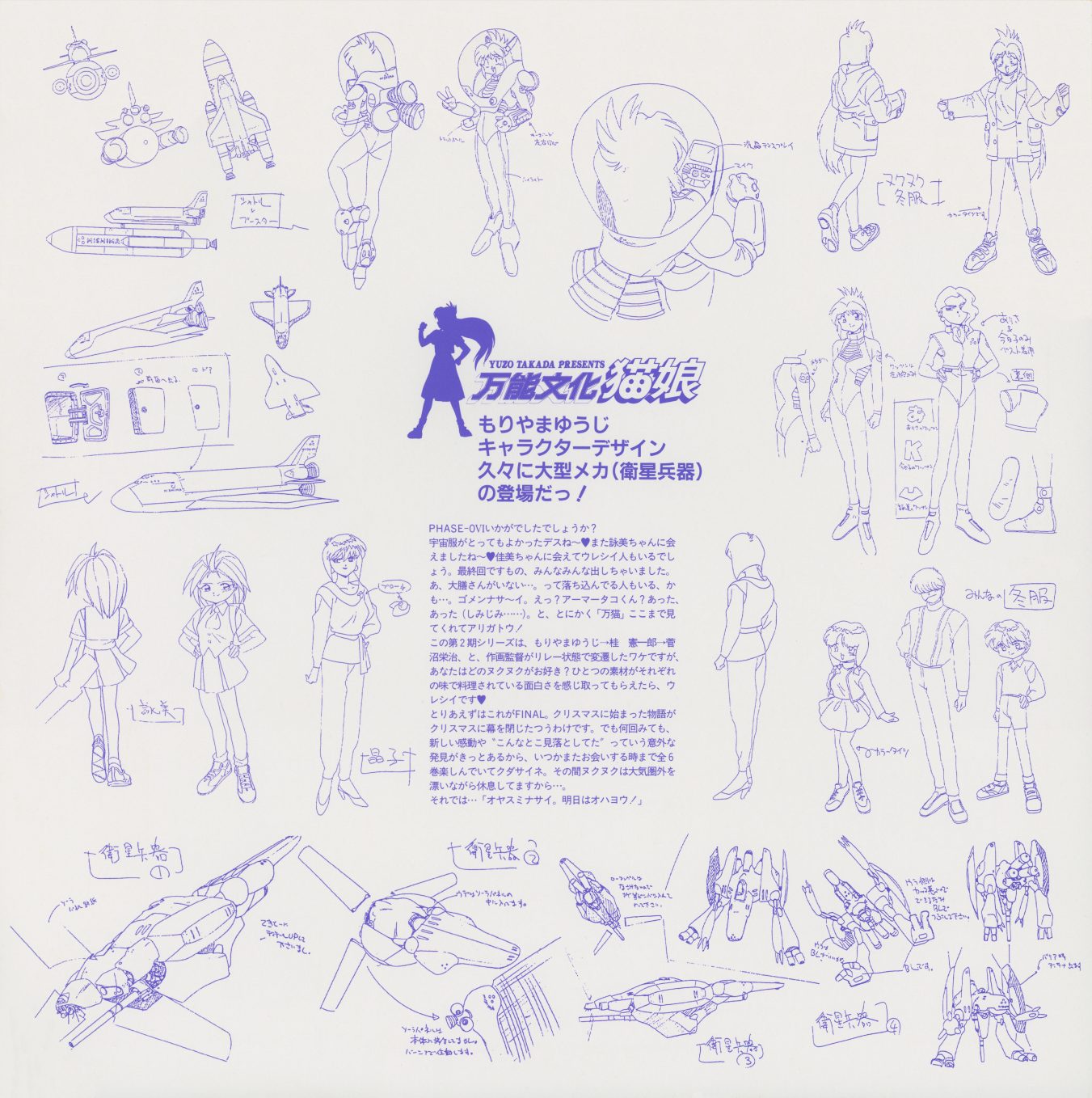 Settei insert — blue/indigo monochrome. Later-series character and mecha designs: SKY-DOG TYPE68030, 電磁拘束マシーン (electromagnetic restraint machine), orbital delivery vehicle variants, and updated character sketches for Natsume Atsuko, Yoshikawa Shinobu, Arisa, Kyoko. Moriyama Yuji's note mentions new large-scale mecha (衛星兵器) appearing for the first time. The set's fourth and final settei sheet — issued with the later volumes as the Mishima arsenal expanded into orbit.
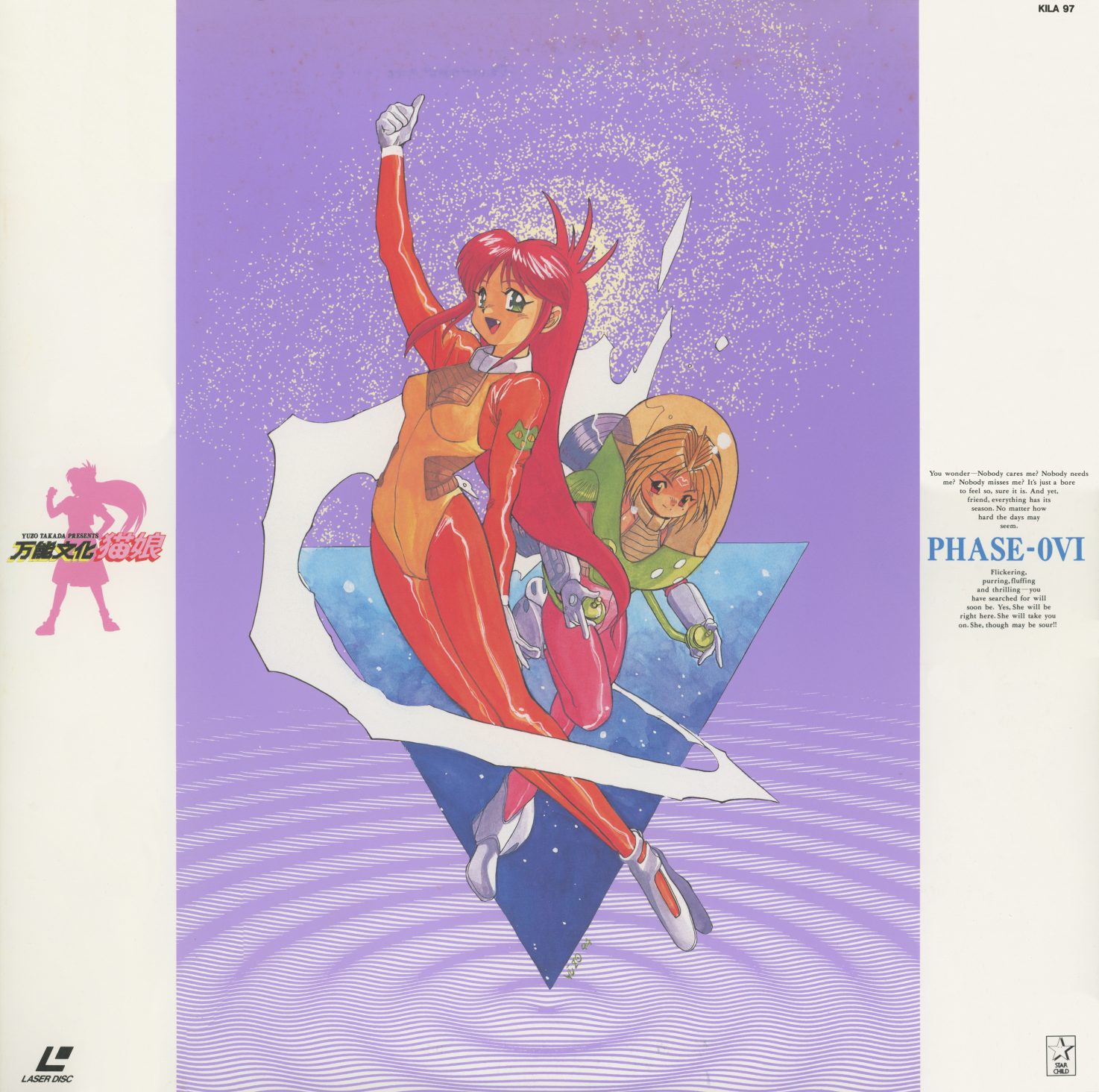 Phase-0VI jacket front. Nuku Nuku in a red spacesuit, fist raised, against a purple starfield with concentric rings. The final volume — the series ends in orbit. KILA-97.
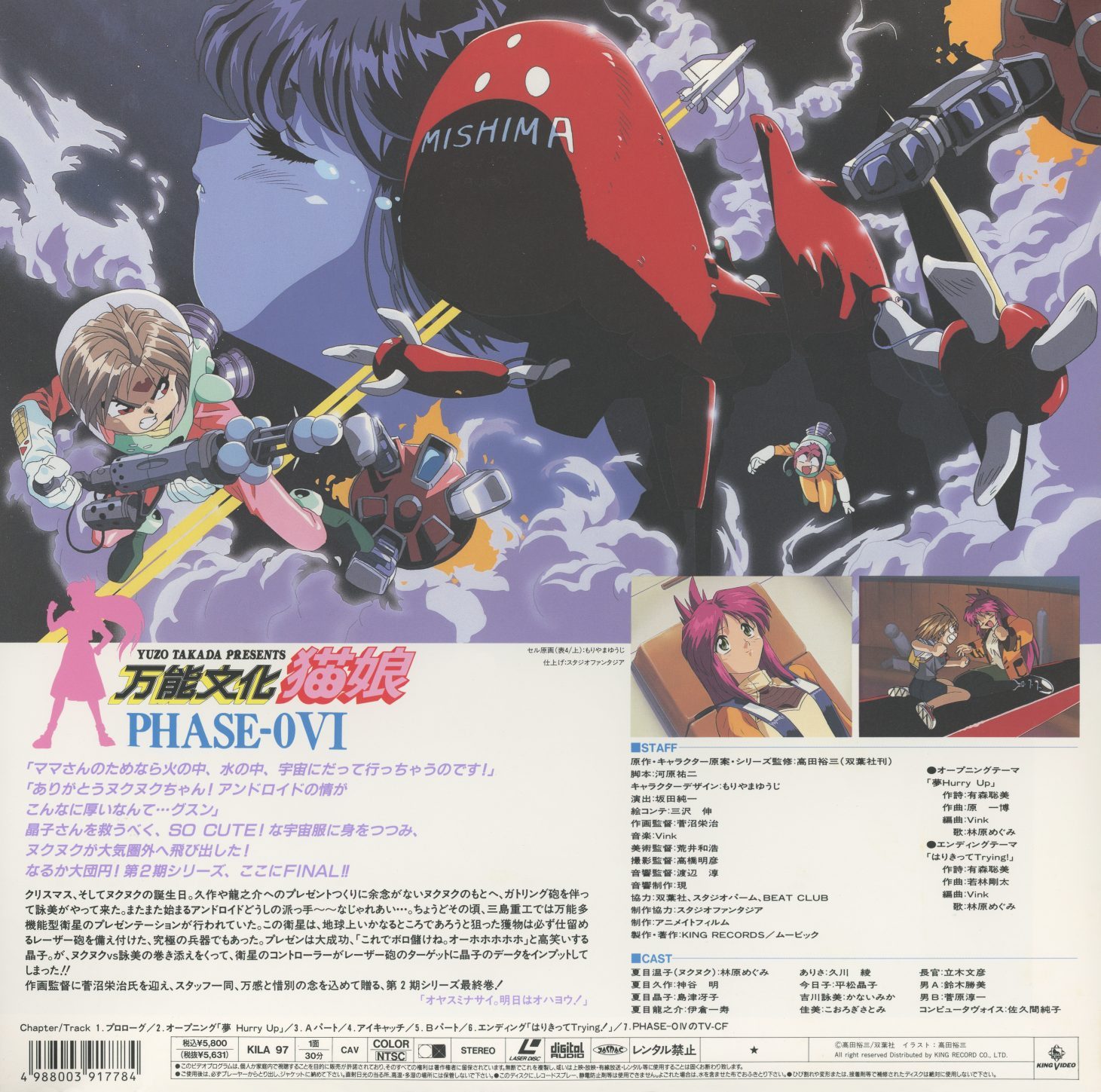 Phase-0VI back. KILA-97, CAV, ¥5,800. Scene screenshots showing the space battle finale — Nuku Nuku against a giant Mishima mecha marked 'MISHIMA.' Synopsis mentions Christmas, Ryunosuke's birthday, and the final confrontation. 'ここでFINAL!!' Cast and staff credits. King Records.
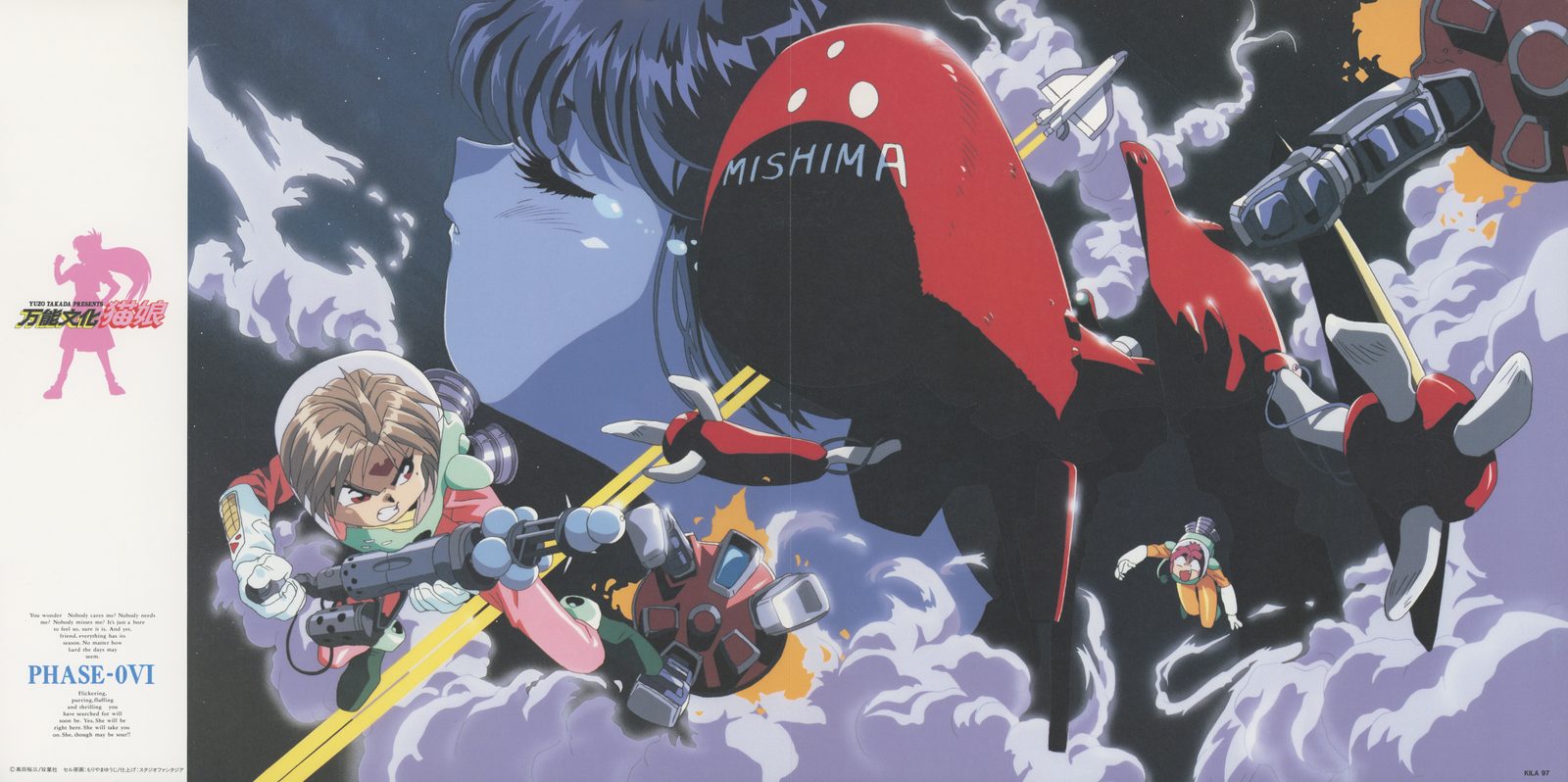 Phase-0VI gatefold spread. Full panoramic illustration: Nuku Nuku in spacesuit battling the Mishima orbital mecha, Kyusaku in the background, Akiko's face looming above. The final illustration in the set — the custody battle has gone to space.
The Complete-Purchase Bonus
The promotional inserts — printed in pink or purple monochrome versions of the current volume's jacket art — advertised the complete-purchase offer: VHS or LD buyers who collected all six volumes plus the CD single '夢 Hurry Up' plus the SOUND PHASE-0VI soundtrack could claim three items including '特製ヌクヌクUFOキャッチャー人形' — a custom Nuku Nuku UFO Catcher doll with no commercial release planned. The same inserts advertised the soundtrack CDs: SOUND PHASE-0IV through SOUND PHASE-0VII, priced separately. King Records built a media ecosystem around six thirty-minute OVA episodes — individual LaserDiscs, multiple soundtrack albums, and a physical doll accessible only through complete collection. For a slapstick comedy. The infrastructure is disproportionate to the premise, and the packaging never acknowledges the gap.
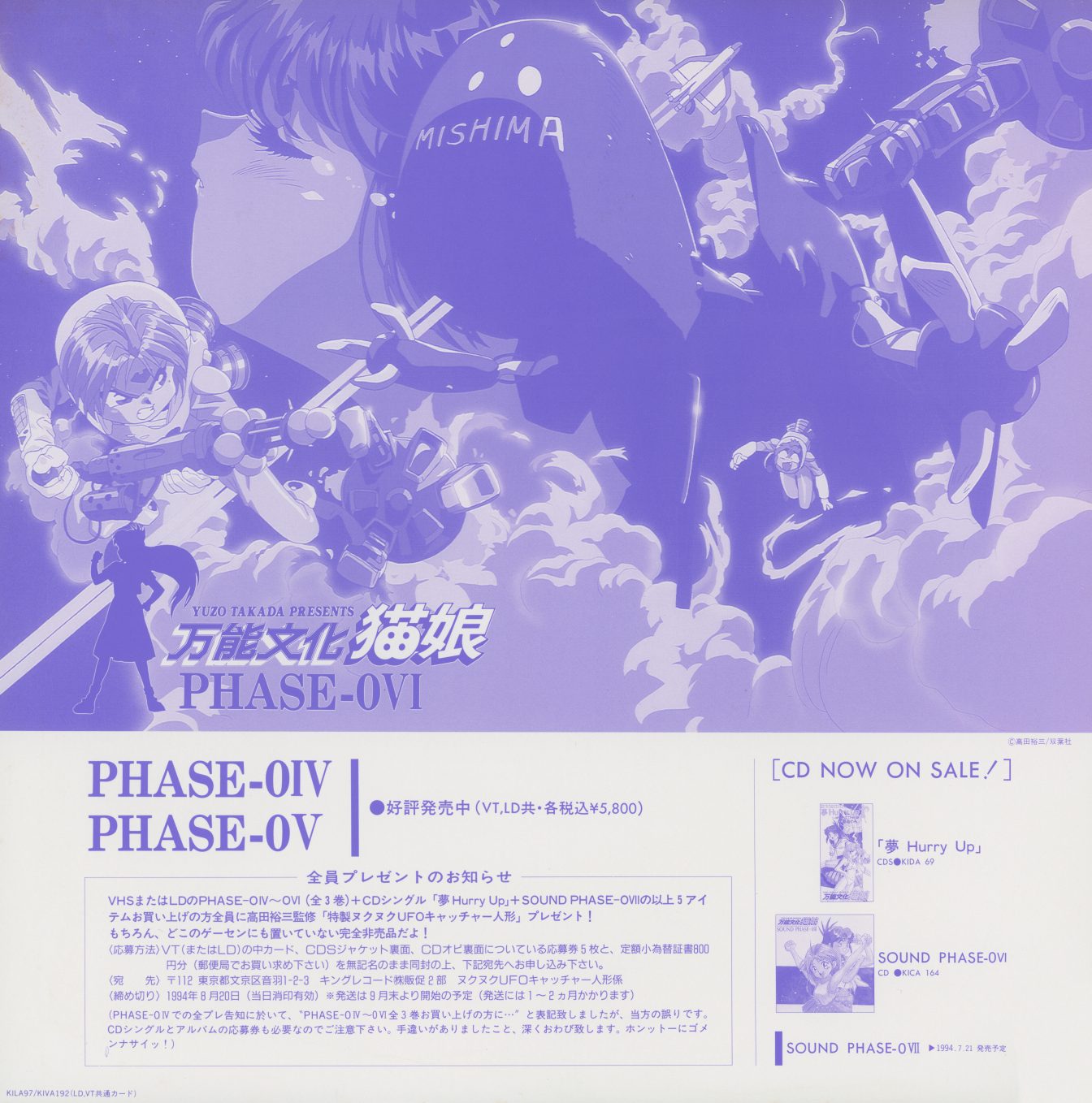 Promotional insert — purple monochrome. Phase-0VI key art with 'MISHIMA' mecha. Below: Phase-0IV and Phase-0V release status, Phase-0VI release date (5.25), complete-purchase bonus details, and CD NOW ON SALE section advertising '夢 Hurry Up,' SOUND PHASE-0VI, and SOUND PHASE-0VII soundtracks.
The two later Nuku Nuku series — the 1998 TV series and the DASH! OVA remake — both received DVD releases with clean digital transfers. Neither included settei inserts. Neither pressed in CAV. Neither offered a complete-purchase bonus requiring the buyer to collect six individual volumes over two years and mail proof of ownership to King Records' Komagata office.
These six discs hold the original OVA in the format that matches its production era — hand-painted cels, analog signal chain, frame-steppable action sequences where Moriyama Yuji's animation of a cat-android tearing apart military hardware can be examined one drawing at a time. The settei inserts document every mecha Mishima Heavy Industries deployed and every costume Nuku Nuku wore, with the same diagrammatic sobriety the mecha genre reserves for its most serious franchises. The series never stops being a comedy. The packaging never starts.
Loading...