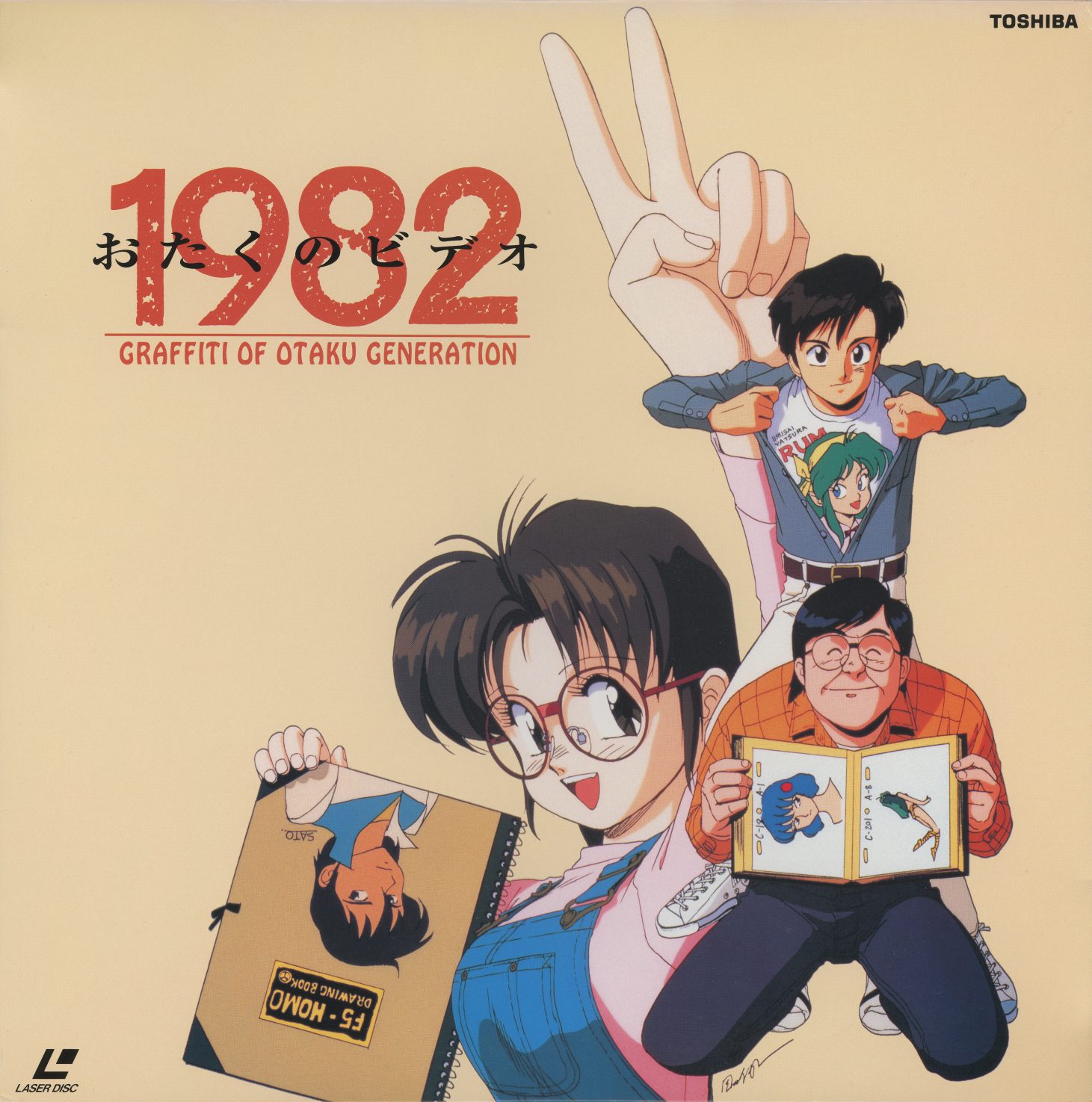
Two CLV discs. TYLA-5011 and TYLA-5012. おたくのビデオ 1982 and 続・おたくのビデオ 1985 (Otaku no Video 1982 and More Otaku no Video 1985), released in 1991 on Toshiba EMI, approximately 50 minutes each, ¥7,900 per disc. Jacket illustrations by Kenichi Sonoda. Each disc includes a double-sided liner insert: timeline and cast profiles on one face, character settei in monochrome on the other — red for 1982, blue for 1985.
GAINAX animated its own origin story. The animated portions follow Kubo, a college student in 1982 who abandons his tennis club and his trajectory toward a normal life after encountering a group of obsessive anime fans. By 1985, he's running a garage kit company in Osaka, funding an animation studio, and chasing ambitions the OVA literalizes by launching him into space. The arc mirrors GAINAX's actual history. Toshio Okada, Hideaki Anno, Hiroyuki Yamaga, and Yoshiyuki Sadamoto went from producing the legendary DAICON III and IV opening animations at the 1981 and 1983 Japan Sci-Fi Conventions — amateur films featuring a girl battling science fiction icons set to ELO's 'Twilight' — to founding a studio and making Wings of Honneamise. Kubo is Okada. The friends are the rest of the founding staff. The studio that animated the story is the studio the story is about.
Intercut with the animation are live-action mock-documentary segments called おたくの肖像 (Portrait of Otaku) — interviews with cosplayers, cel collectors, and model builders conducted in the style of serious television journalism. Some subjects are reportedly disguised GAINAX staff members. The segments are simultaneously affectionate and merciless. The question they refuse to settle — celebration or exposure? — is the point.
1982
The first disc covers the conversion. Kubo — voiced with earnest sincerity — meets Tanaka at university and is pulled from casual anime viewer into committed otaku. The GAINAX staff wrote from memory: the model kit runs, the all-night anime marathons, the moment a hobby becomes an identity. The back cover bills it as 青春グラフィティ (coming-of-age graffiti) and names the charge directly: 「戦え!おたキング!おたくの夢と希望をまもれ!」 — Fight! Otaking! Protect the dreams and hopes of otaku! The 'Otaking' title was Toshio Okada's own. He used it publicly. GAINAX put it on the packaging.
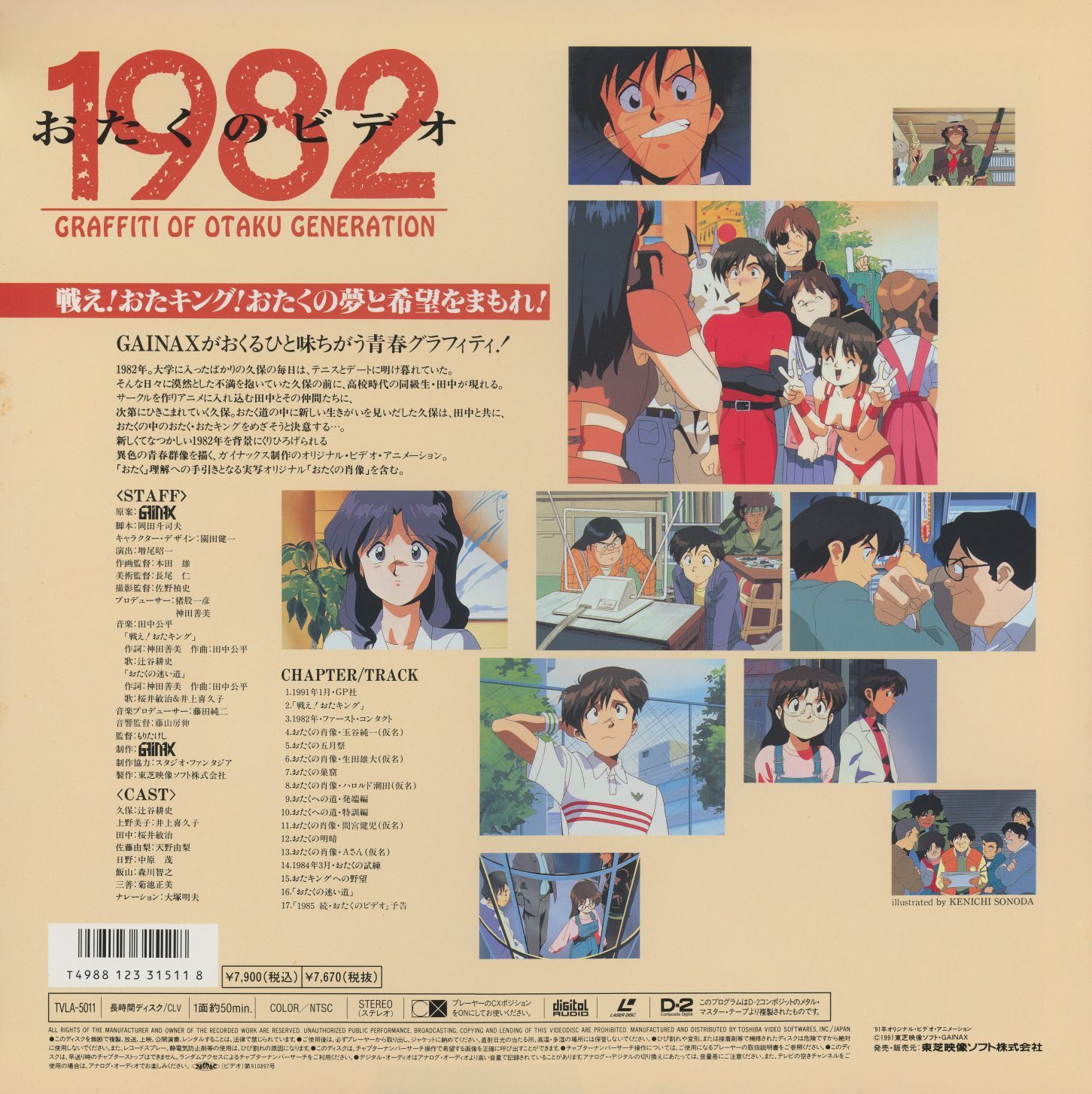 1982 back cover. TYLA-5011, CLV, one side, ~50 minutes, ¥7,900. 'GAINAXがおくるひと味ちがう青春グラフィティ!' (A coming-of-age graffiti with a different flavor, from GAINAX). Scene screenshots showing Kubo's transformation from tennis player to otaku. Illustrated by Kenichi Sonoda.
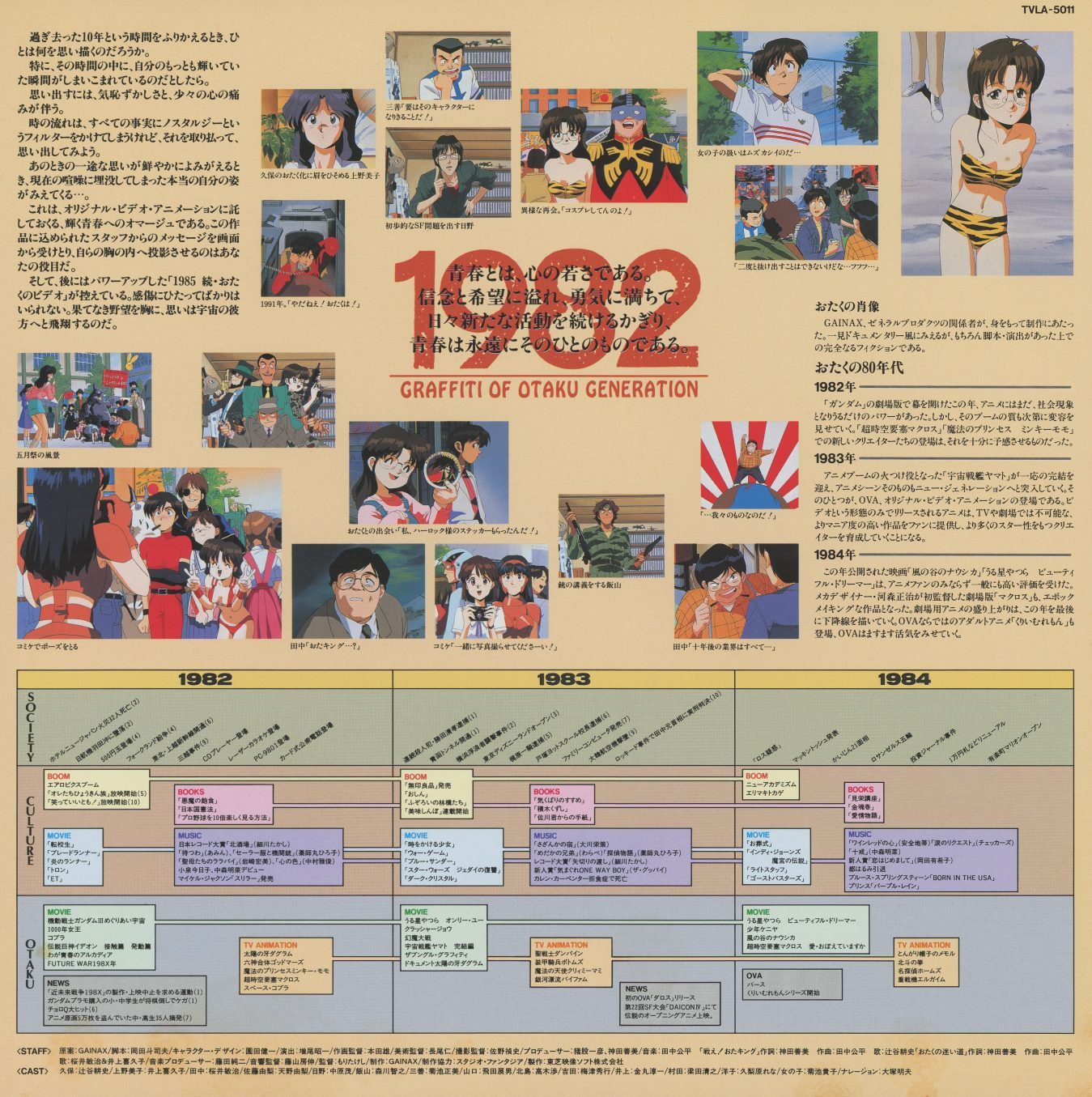 1982 liner insert — the timeline side. A year-by-year chronicle of otaku cultural milestones from 1982 through 1984: convention dates, anime releases, the garage kit market's emergence. Scene descriptions and character guide interspersed with the timeline at the bottom. TYLA-5011.
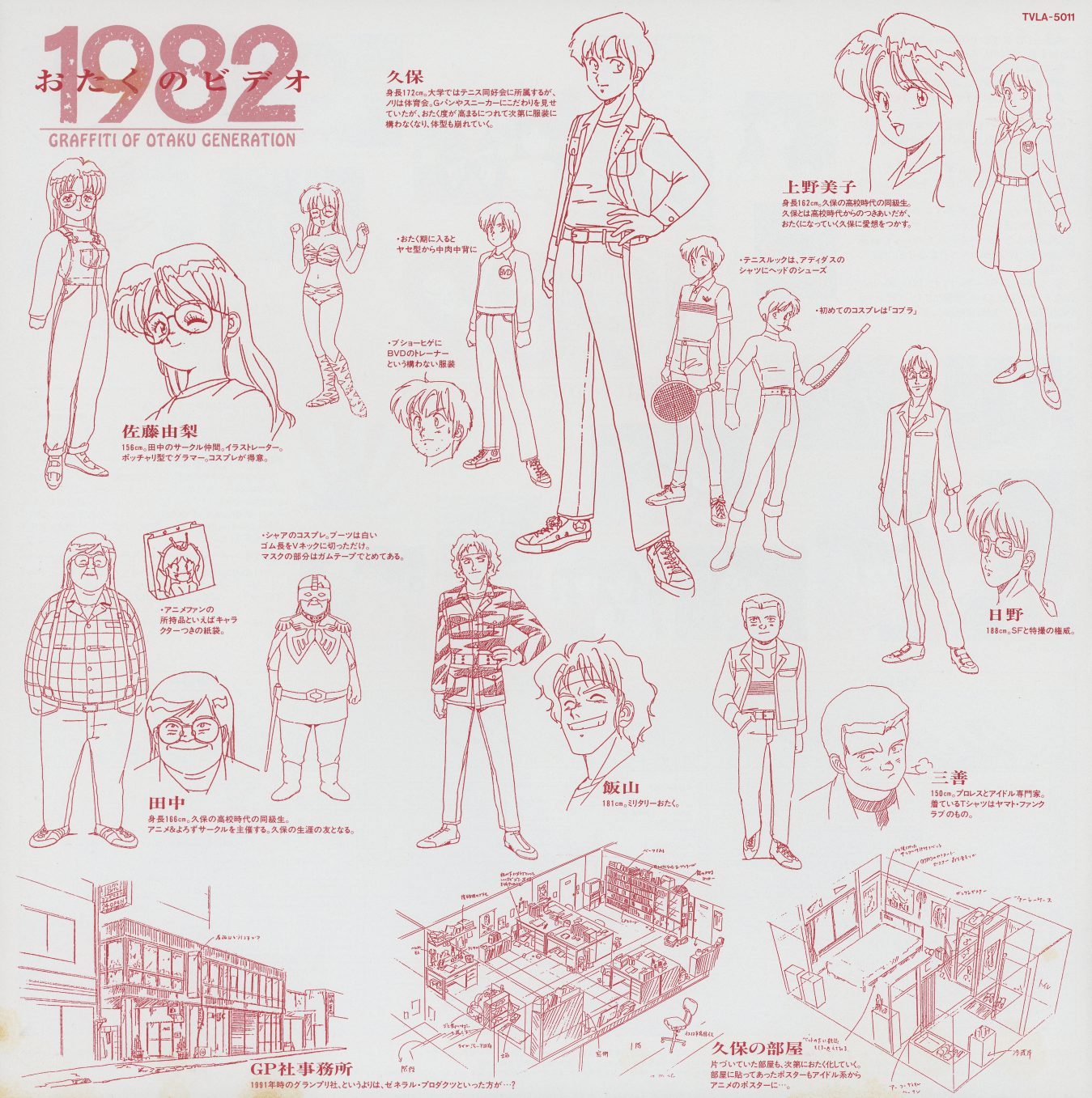 1982 liner insert — settei side, printed in red monochrome. Character design sheets for Kubo, Ueno Yoshiko, Sato Yuri, Tanaka, Iiyama, and Hino. Includes a room layout of Kubo's apartment and the GP company office floor plan. Production documents for characters modeled on real people.
The Settei and the Timeline
Each disc's liner insert carries character design sheets on one face — red monochrome for 1982, blue for 1985 — with model sheets, height comparisons, and room layouts. The reverse side of the 1982 insert documents the era the animation fictionalizes: a year-by-year timeline of conventions, anime releases, and the garage kit market from 1982 through 1984. It functions as both a companion guide and a primary source document for the period. The characters have names like Kubo and Tanaka. The real people behind them — Okada, Anno, Yamaga — are never credited as references. They don't need to be. The staff who drew the settei are the people the settei depicts.
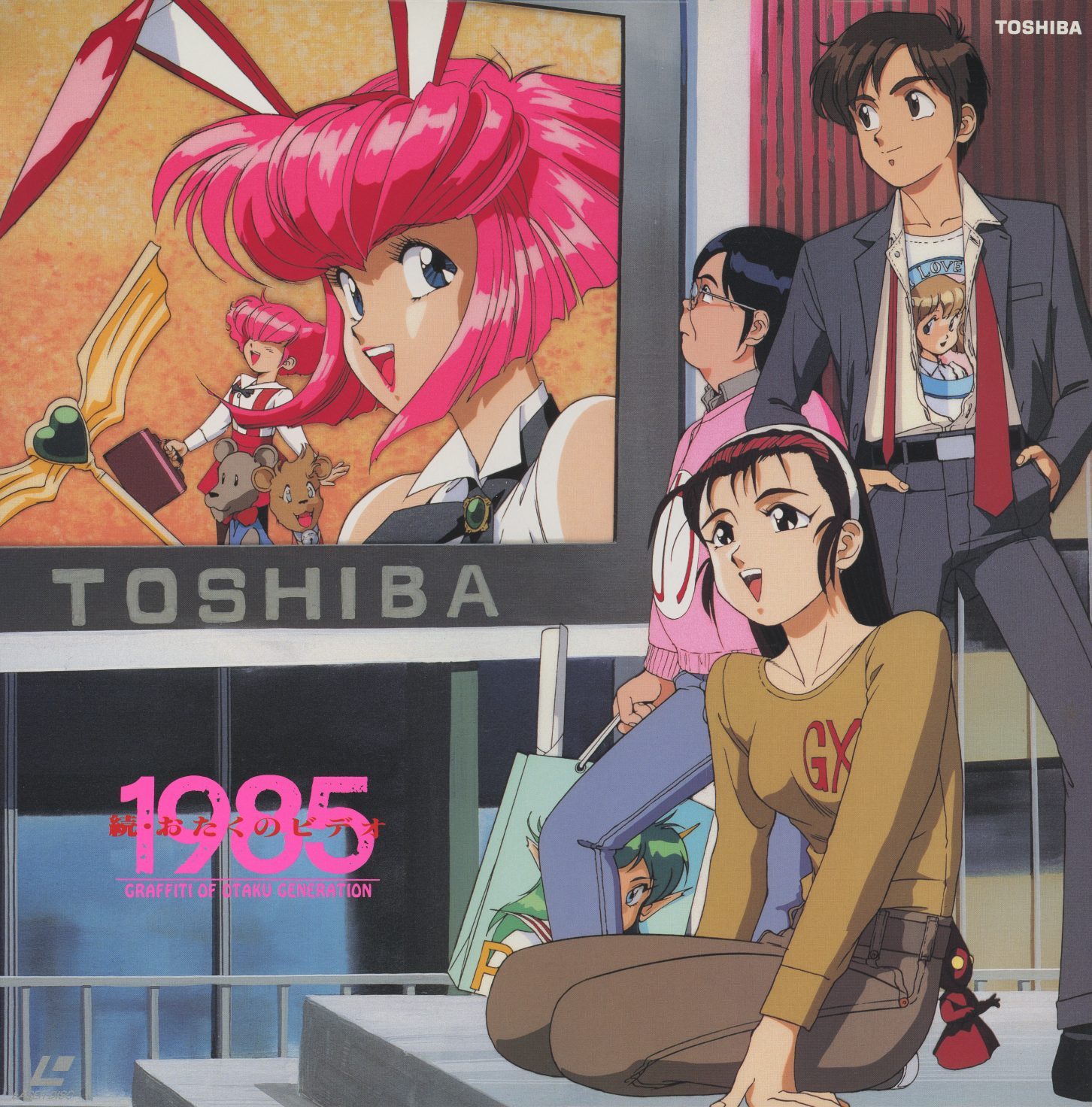 続・おたくのビデオ 1985 jacket front. Sonoda illustration — the characters three years older, now in Akihabara under a Toshiba billboard broadcasting anime. A girl in a 'GX' sweater in the foreground. The subculture has become a commercial landscape.
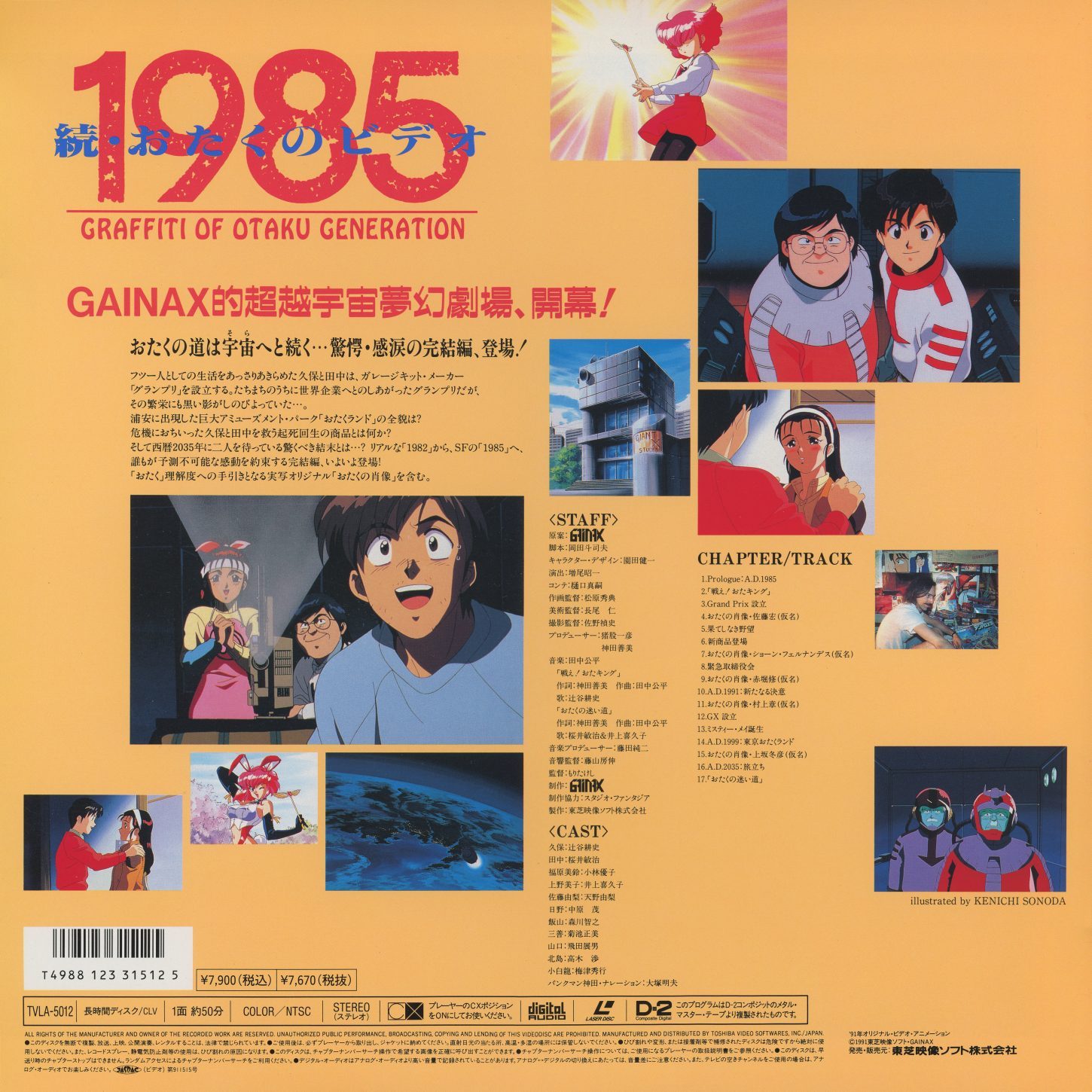 1985 back cover. TYLA-5012, CLV, ~50 minutes, ¥7,900. 'GAINAX的超越宇宙夢幻劇場、開幕!' (GAINAX-style transcendent space dream theater, curtain up!). 'おたくの道は宇宙へと続く' — the path of otaku continues to space.
1985
The second disc pushes the story past autobiography into myth. Kubo has moved to Osaka. He's making garage kits, then running a company, then founding an animation studio. The ambition escalates beyond realism: by the final act, Kubo declares himself Otaking and the OVA launches him into orbit. The arc compresses GAINAX's actual trajectory — from DAICON to Honneamise — into a fantasy the studio's own staff animated. The cast includes Inoue Kikuko and Otsuka Akio, both early in careers that would define voice acting for the next three decades. Sonoda's jacket places the characters in Akihabara under a broadcast billboard. The commercial infrastructure has caught up with the subculture. The otaku are no longer underground. Whether that's the victory or the loss is the question both discs circle without answering.
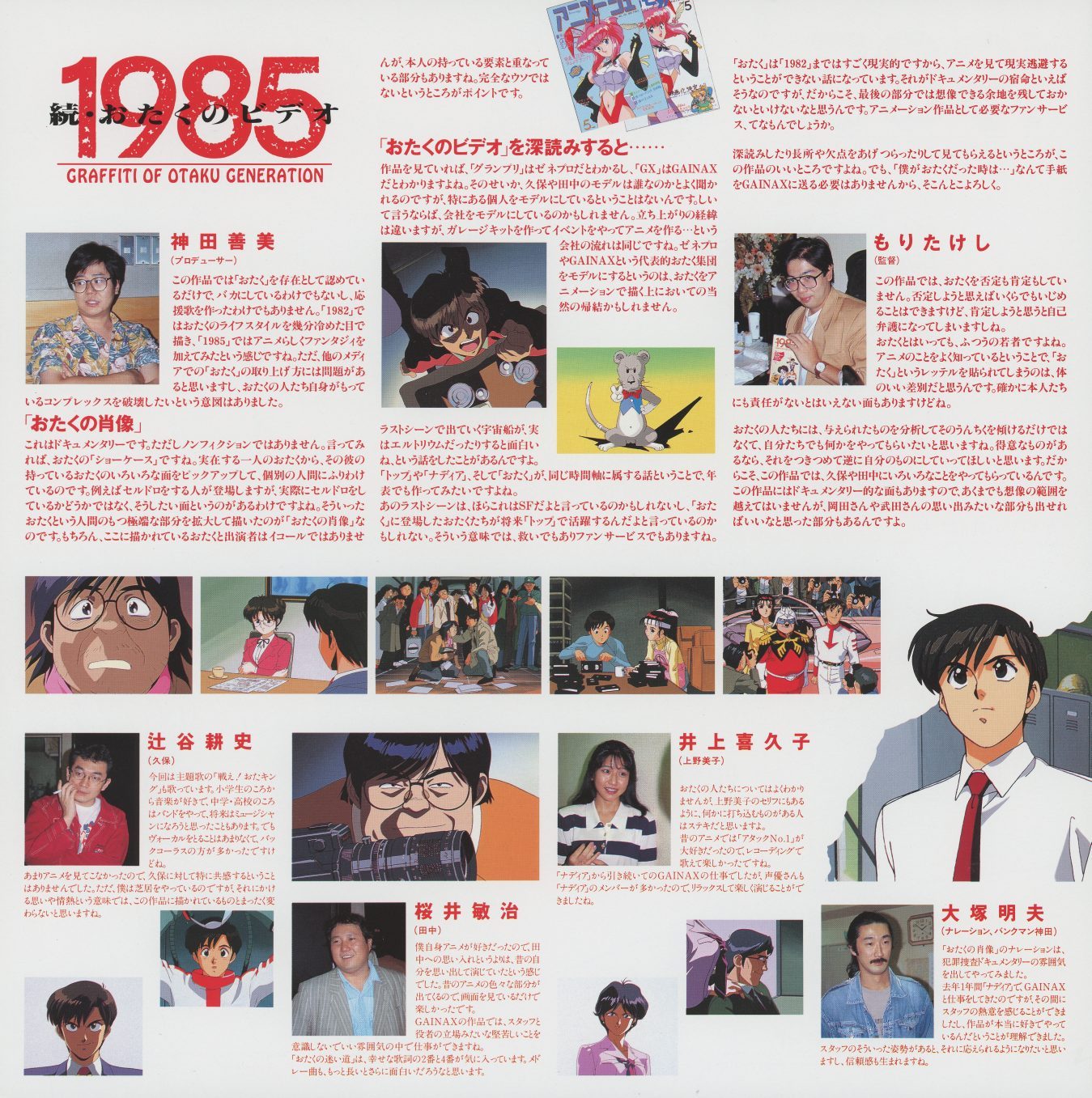 1985 liner insert — cast and staff profiles with photographs. Column titled 'おたくのビデオを漫読みすると……' (When you casually read through Otaku no Video...). Profiles for voice actors Inoue Kikuko, Otsuka Akio, Tsujitani Koji, and Sakurai Toshiharu. Discussion of the おたくの肖像 (Portrait of Otaku) live-action segments.
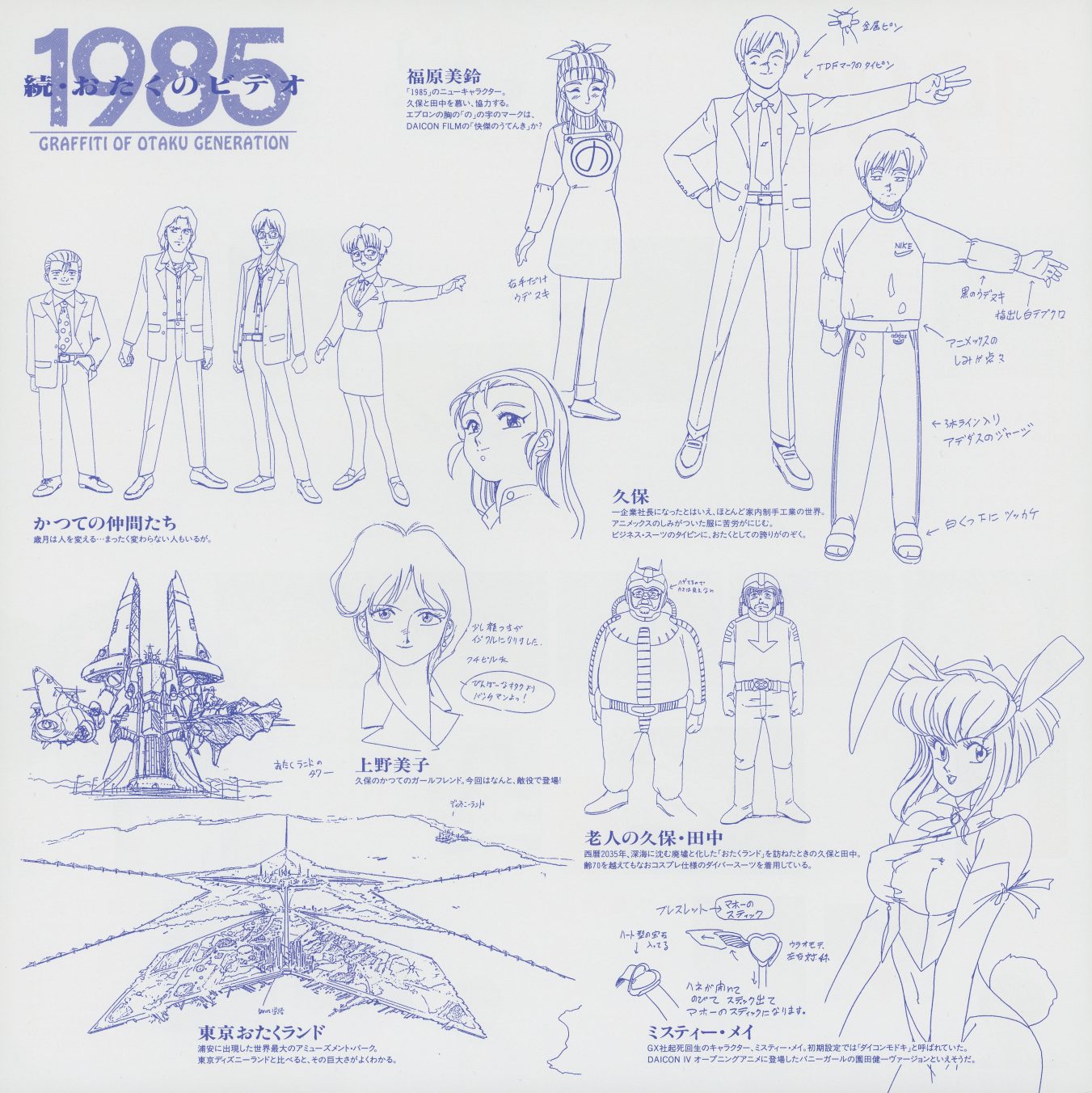 1985 liner insert — settei side, printed in blue monochrome. Older versions of Kubo and his friends. Fukuhara Misuzu. 'Tokyo Otakuland' — the fictional theme park Kubo builds. Misty May — the in-universe anime character. And at the bottom: the elderly Kubo and Tanaka, still together, still otaku.
GAINAX produced Otaku no Video between Nadia and Evangelion. The animated portions are a fictionalized version of the studio's own founding — hobbyists becoming professionals, obsession becoming an industry. The live-action Portrait of Otaku interview segments cut between the episodes, and the question of which interviewees are real otaku and which are GAINAX staff in costume has never been fully resolved. Thirty years of fan investigation, no definitive answer.
Two CLV discs. The liner inserts are color-coded — one red, one blue — separating the 1982 and 1985 halves.
Loading...