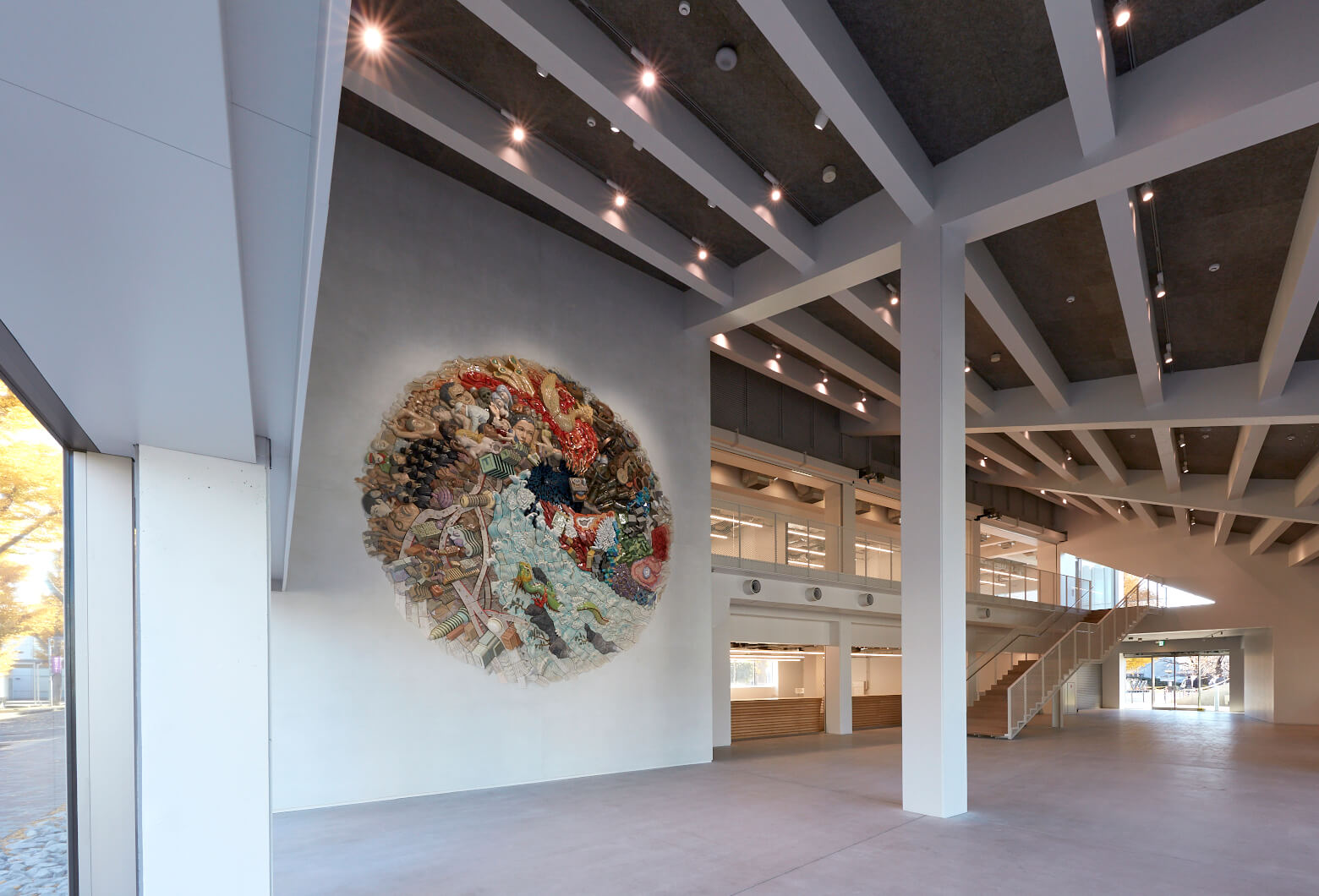
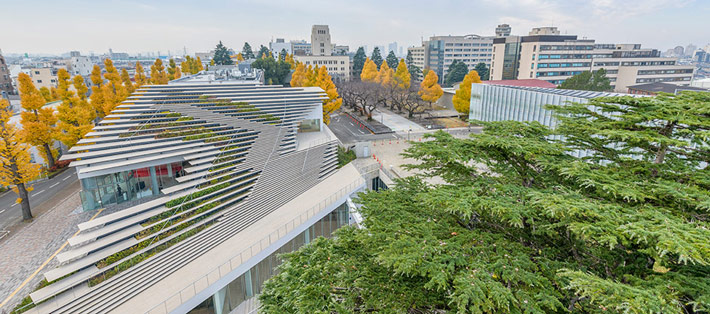
A circular ceramic relief by Katsuhiro Otomo occupies the entrance wall of Hisao & Hiroko Taki Plaza at the Institute of Science Tokyo's Ōokayama Campus. Five meters in diameter, the disc appears without interpretive framing — encountered by students moving between classrooms and the international exchange facility, mounted on the double-height concrete wall of Kengo Kuma's angular interior like a geological specimen embedded in rock.
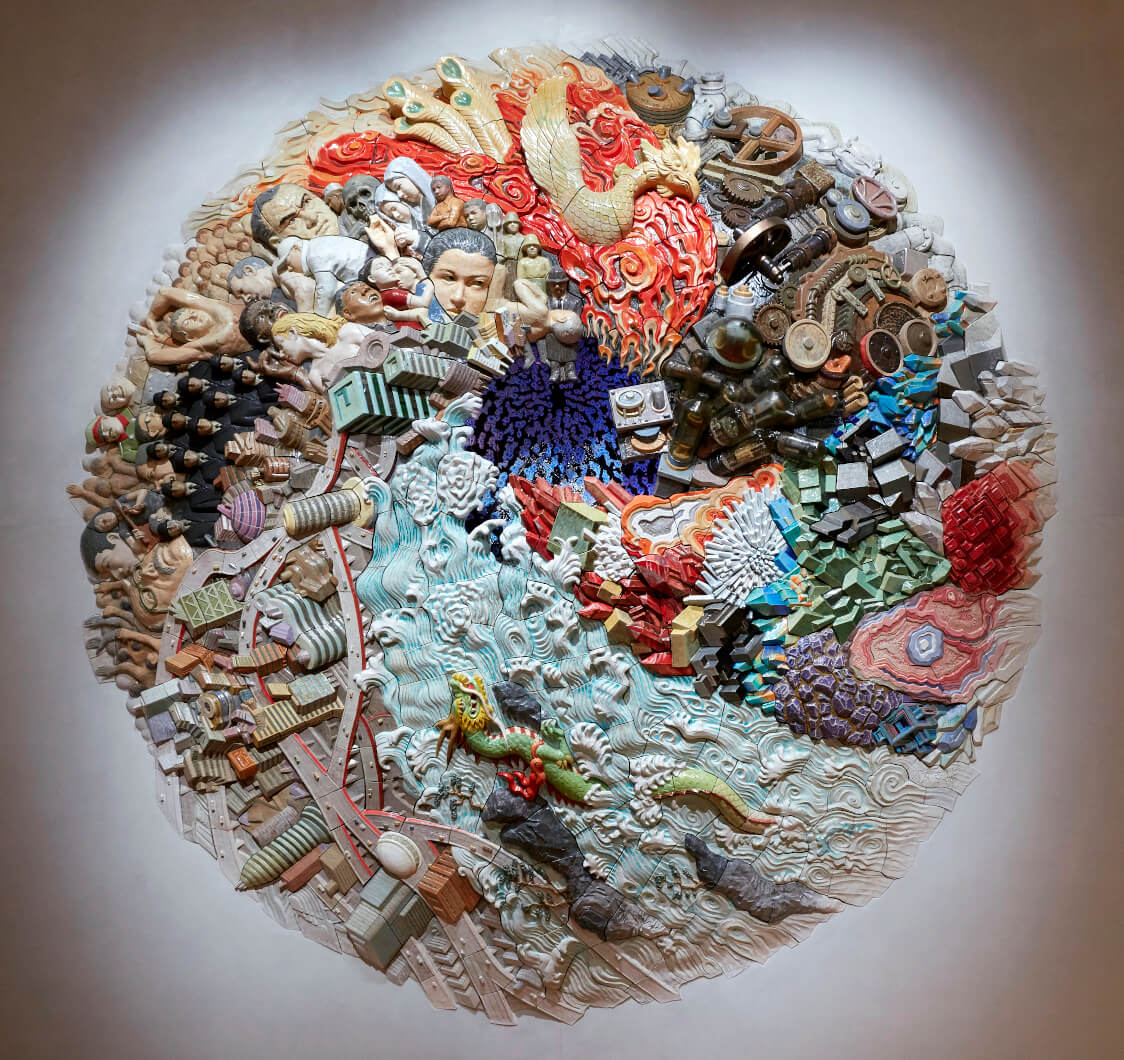 ELEMENTS OF FUTURE — 5 meters in diameter, 499 ceramic pieces on a spherical steel frame, unveiled December 12, 2020
Vortex, Not Display
Otomo organizes the composition as a spiraling vortex rather than a catalog. Six elements — fire, water, minerals and metals, machinery, cities and architecture, people — circle inward toward a dark blue center inspired by yōhen tenmoku tea bowls, the Song Dynasty ceramics of which only three complete examples survive, all in Japan, all National Treasures. The technique that produced their iridescent oil-spot glaze has been lost for eight centuries.
The center is simultaneously void and origin. Around it, 499 ceramic pieces pile inward — Tokyo Tower alongside vacuum tubes, a phoenix beside human faces, water waves flowing into gears — drawn toward a point of unknowable craft. The composition reads as centripetal: everything the future needs is already here, spiraling toward fusion.
The relief is mounted on a spherical steel frame — the first public ceramic work to use this support structure — giving the disc a slight convex dome that makes it project from the wall rather than lie flat. This dimensionality compounds the sculptural depth of the individual pieces: a phoenix wing, an astronaut figure, and overlapping wave crests extend outward at varying heights, creating shadows that shift with the building's angular lighting. The two-layer construction on curved steel solved a problem no previous public ceramic work had attempted.
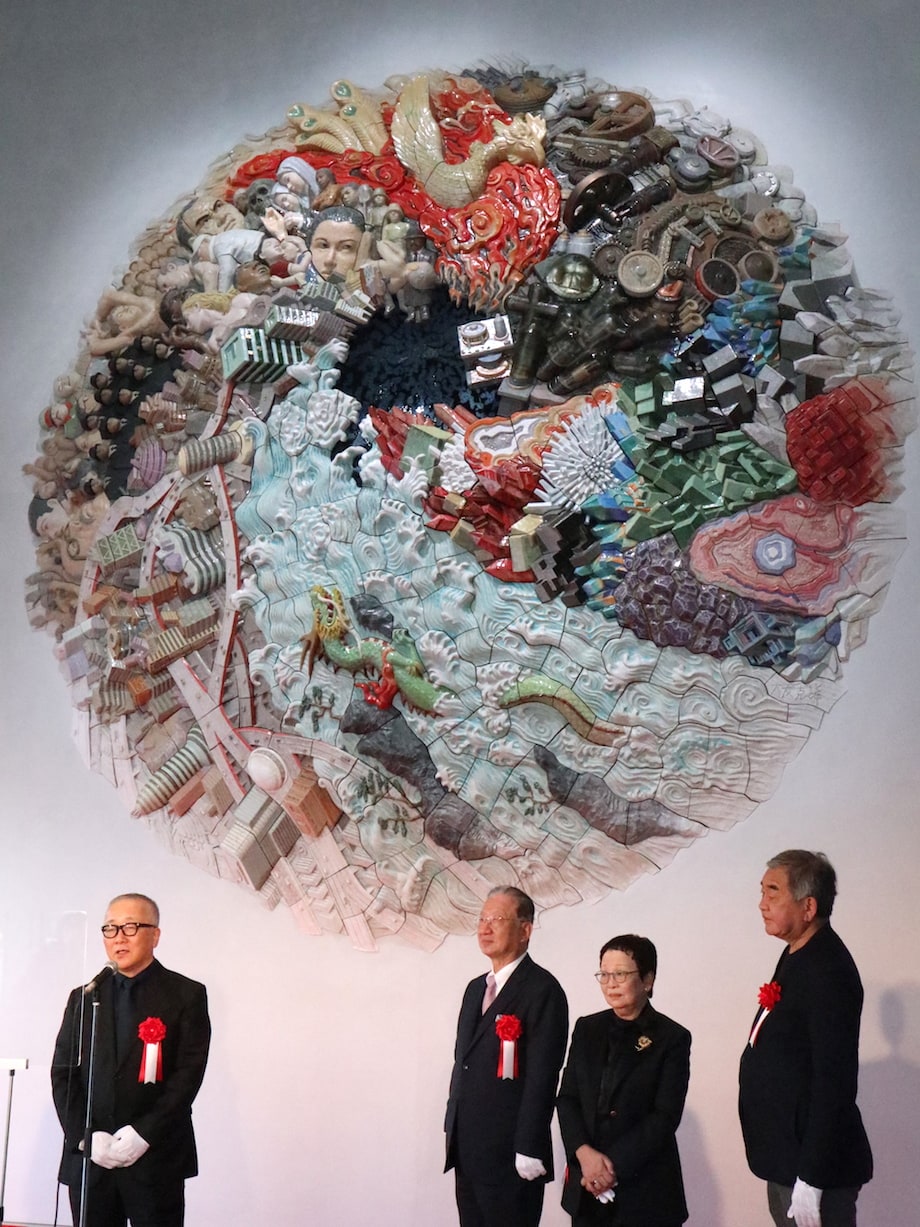 Otomo speaking at the December 12, 2020 unveiling — the relief fills the double-height entrance wall
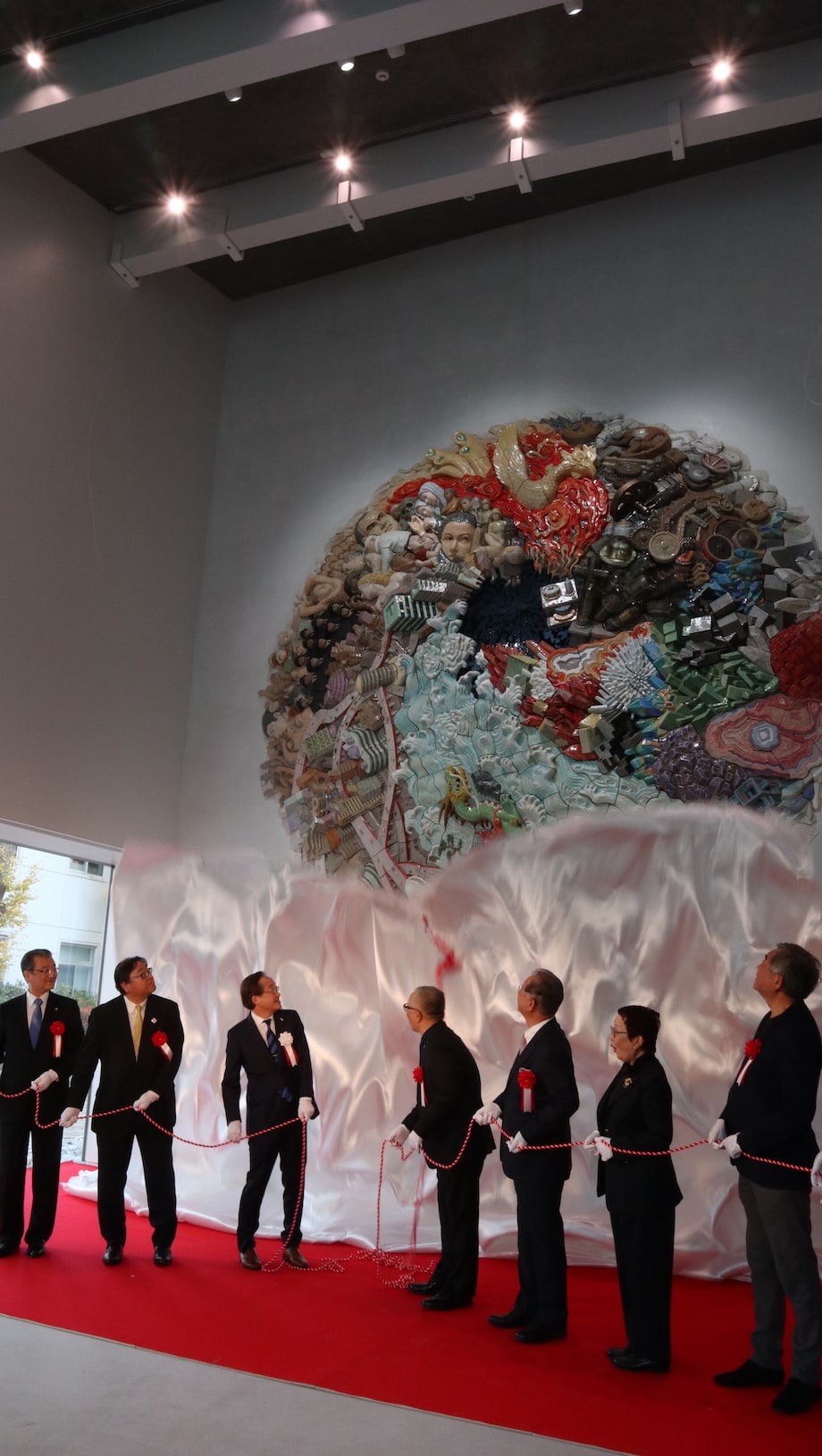 Officials and the artist at the unveiling ceremony — the silk drape pulled away to reveal the composition for the first time
“Art is not born from scratch. Rather, it is a collage of what we have seen until now. I created this work because I believe that human beings and cities will make the future, and that humans will continue to create an abundance of new science and culture. At times I feel that young people don't create new things or have adventures because they are afraid of failure. I want them to do just that — try new things and take more adventures.”
— Katsuhiro Otomo
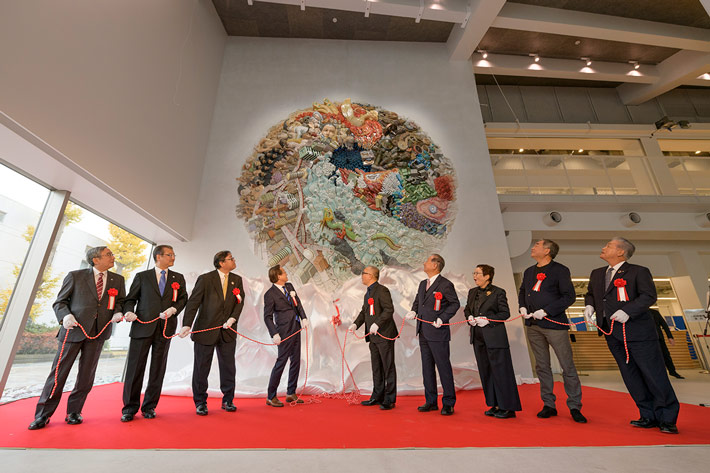 The formal unveiling at Taki Plaza — 2.5 years from commission to completion
CREARE Atami-Yugawara Studio translated Otomo's painting into ceramic over approximately 2.5 years — the same artisans who had produced Kinka Dōji for Sendai Airport five years earlier, and who would later realize Procession/Spin for Ginza Station. The 499 pieces were carved from a large clay master, sectioned, dried, glazed, and fired before reassembly on site. The work was donated by Hisao Taki, founder of Gurunāvi, and draws its six elements from exhibits Otomo encountered at the university's museum — the future imagined not from speculation but from what science has already made visible.
Students passing through Taki Plaza encounter the disc each morning without ceremony. The work addresses a university — a place where the unknown is approached systematically — by placing at its center a ceramic form whose method of creation has been lost. The vortex spirals inward toward what cannot yet be reproduced, and leaves the question of whether it can be to the people walking beneath it.
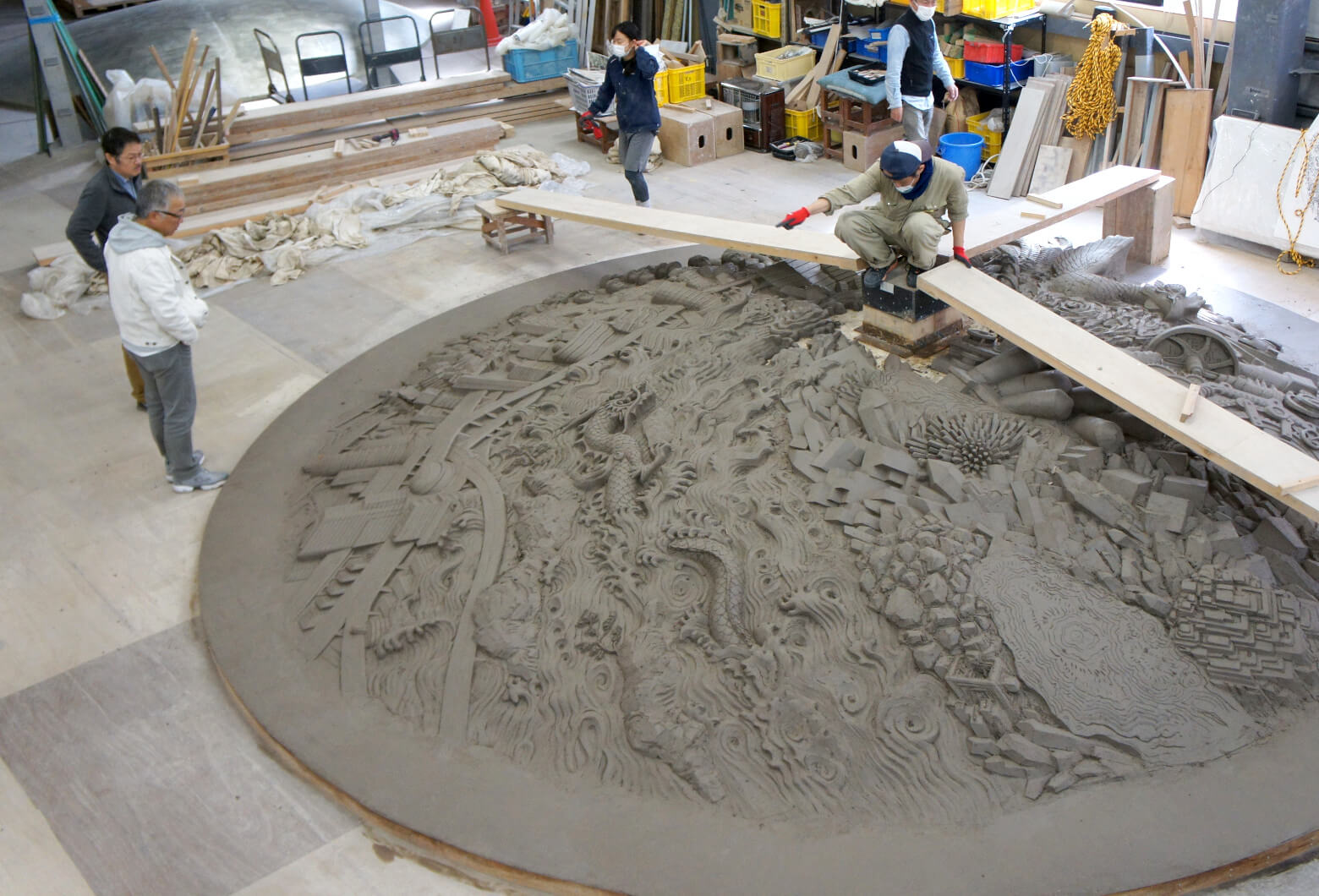 The full-size clay master on the CREARE studio floor — artisans sculpting the 5-meter disc by hand
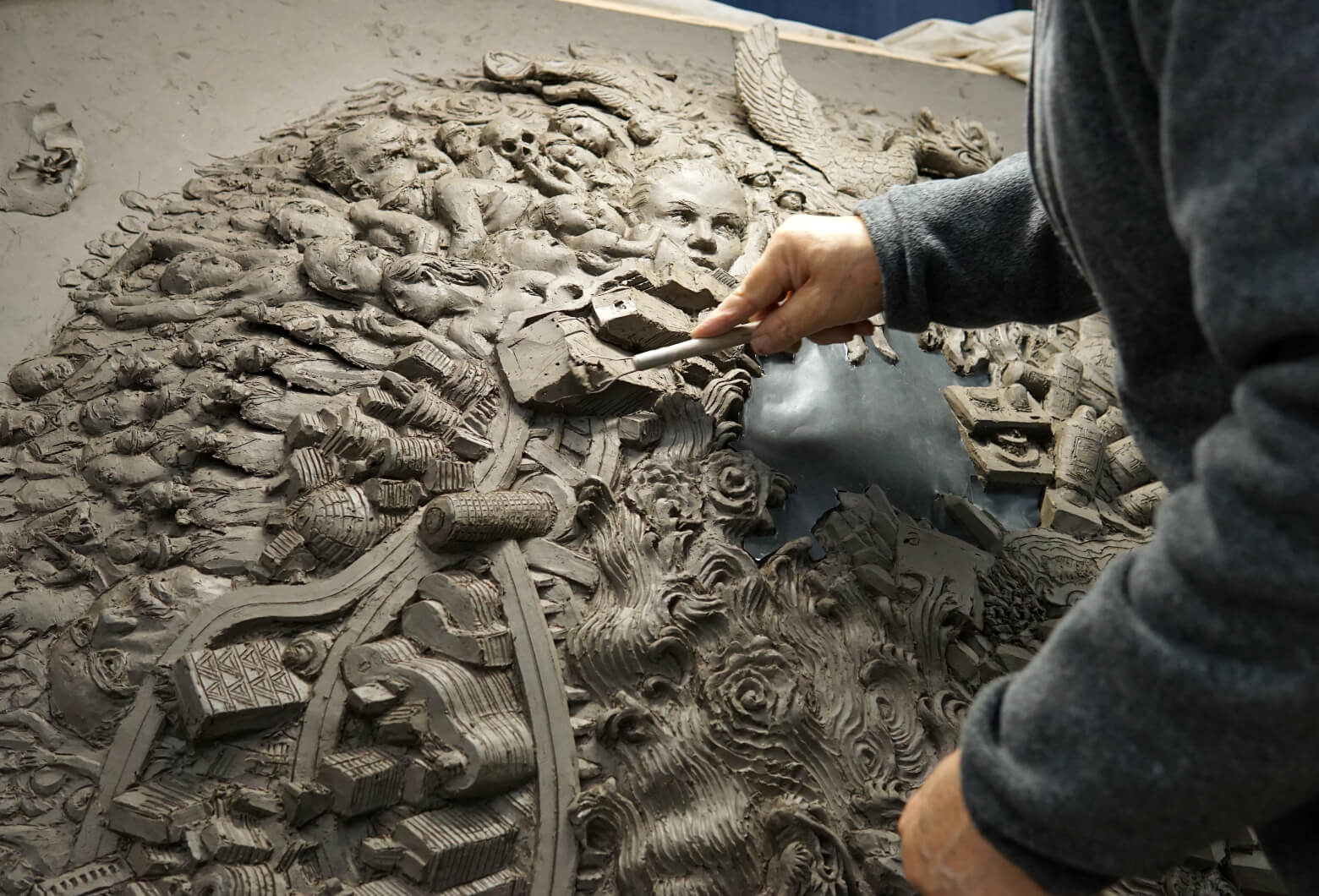 Hand-sculpting detail — building up the relief surface on the clay master
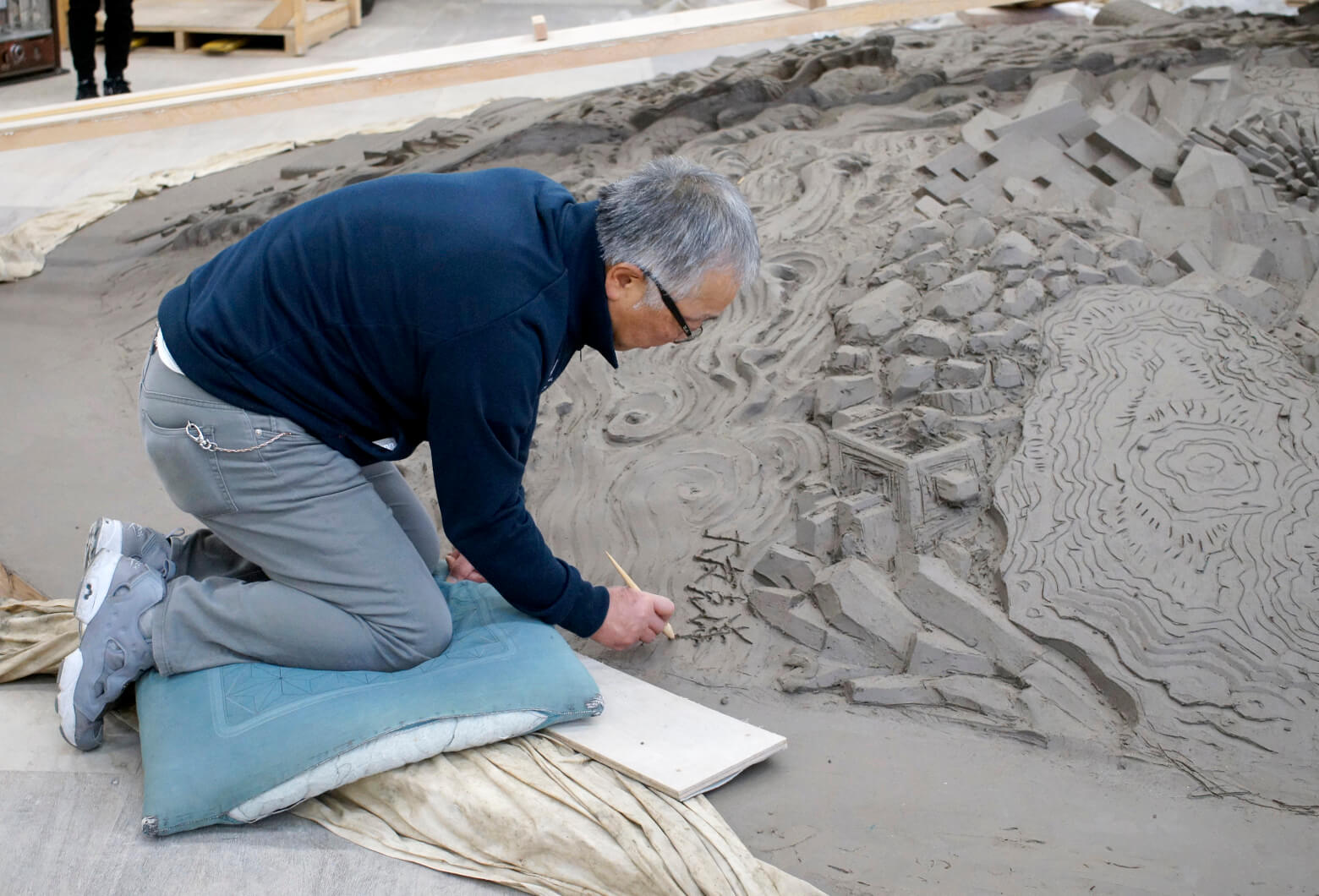 Otomo signing the clay master at CREARE Atami-Yugawara Studio
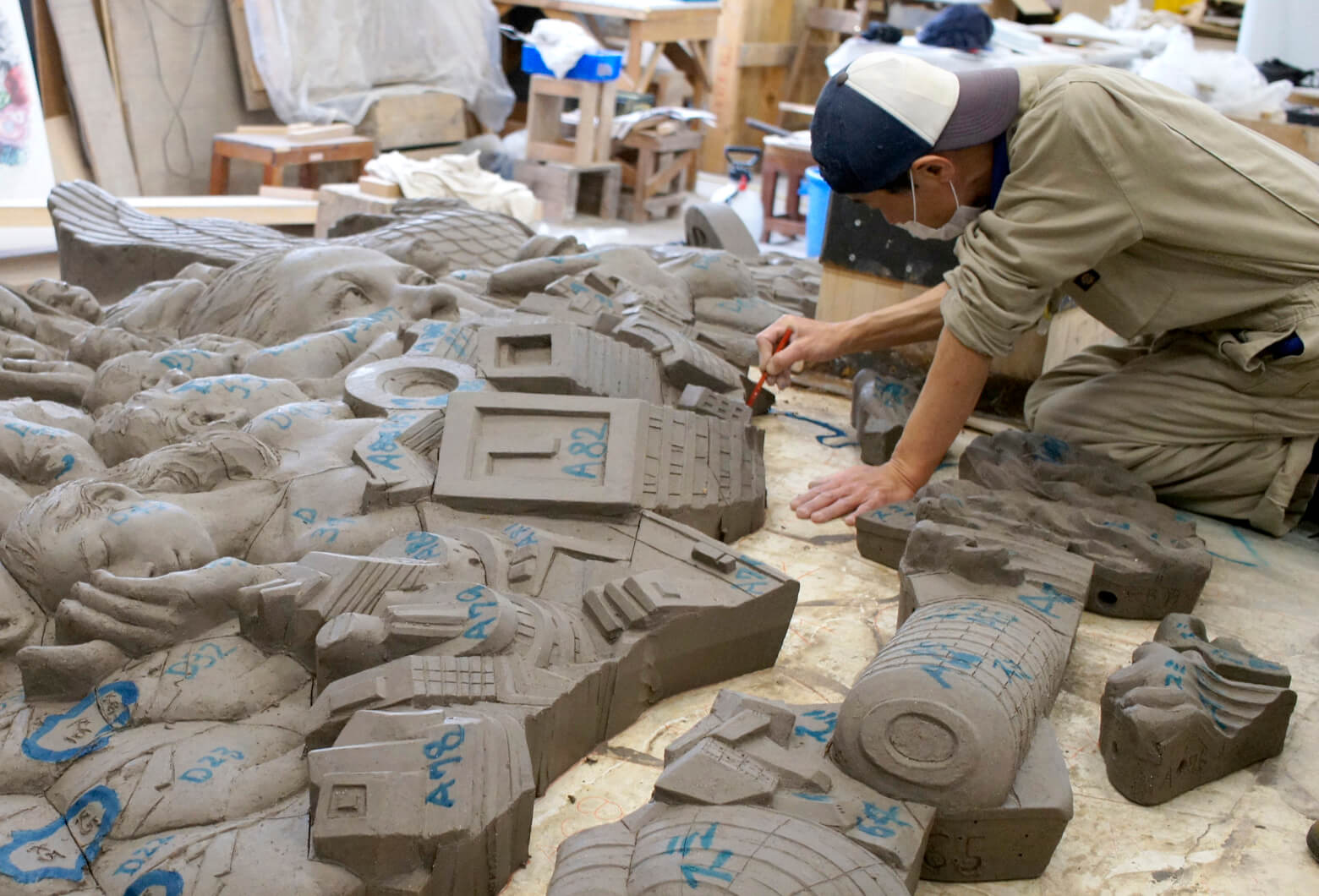 Cutting labeled sections from the clay master — grid positions A16, A82, D23 visible
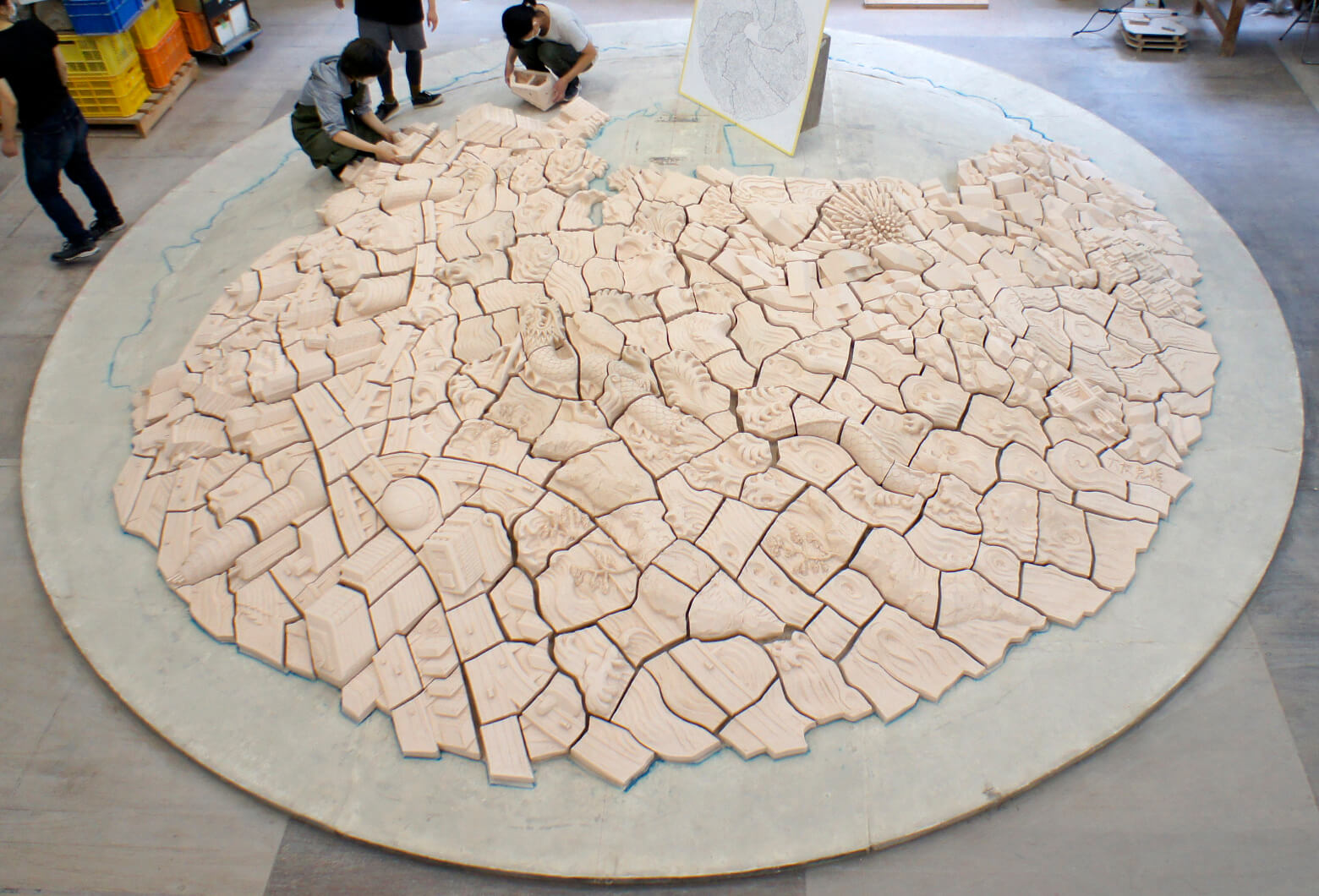 All ~499 unglazed pieces arranged in circular formation for verification before glazing
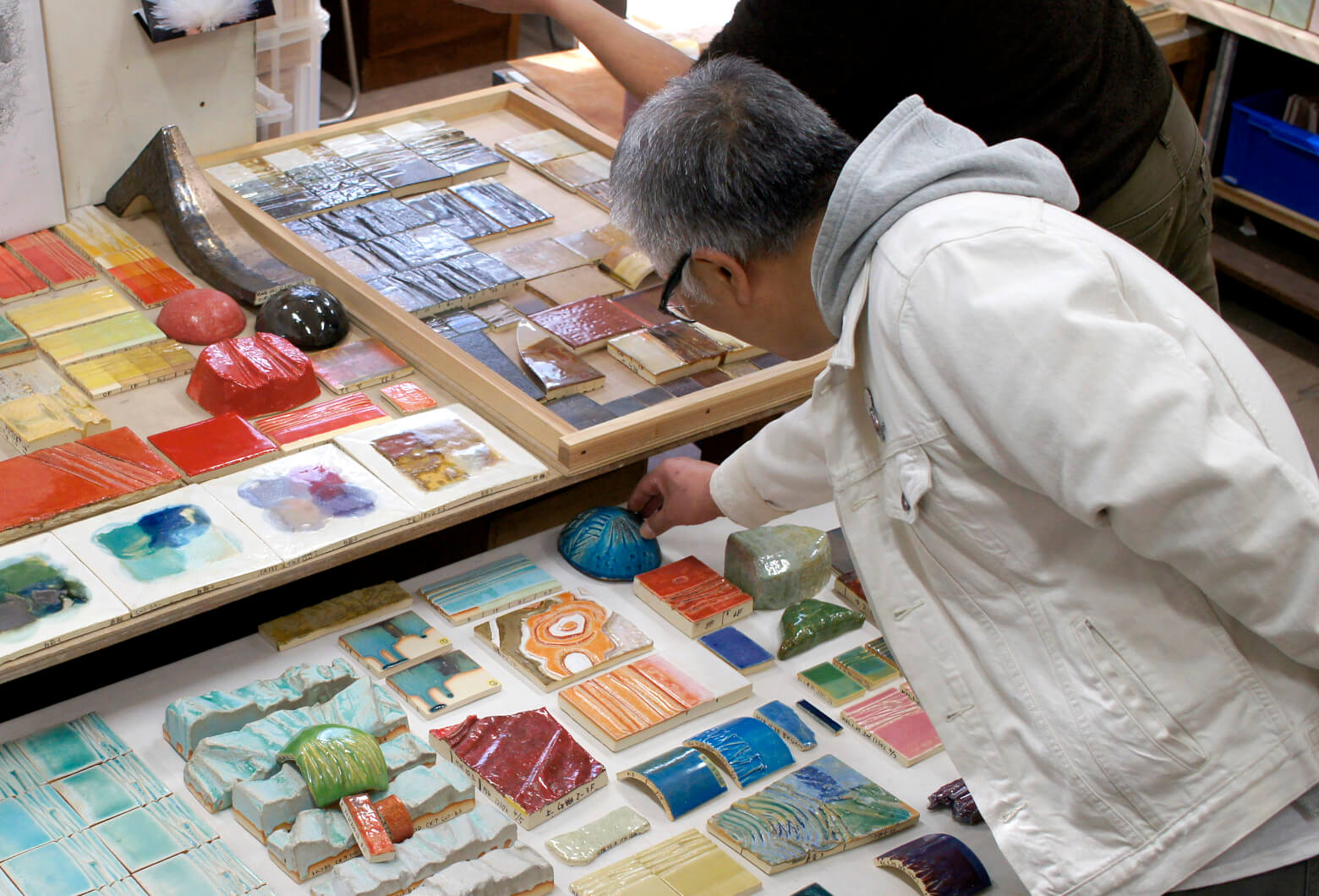 Otomo examining colored glaze test samples at CREARE
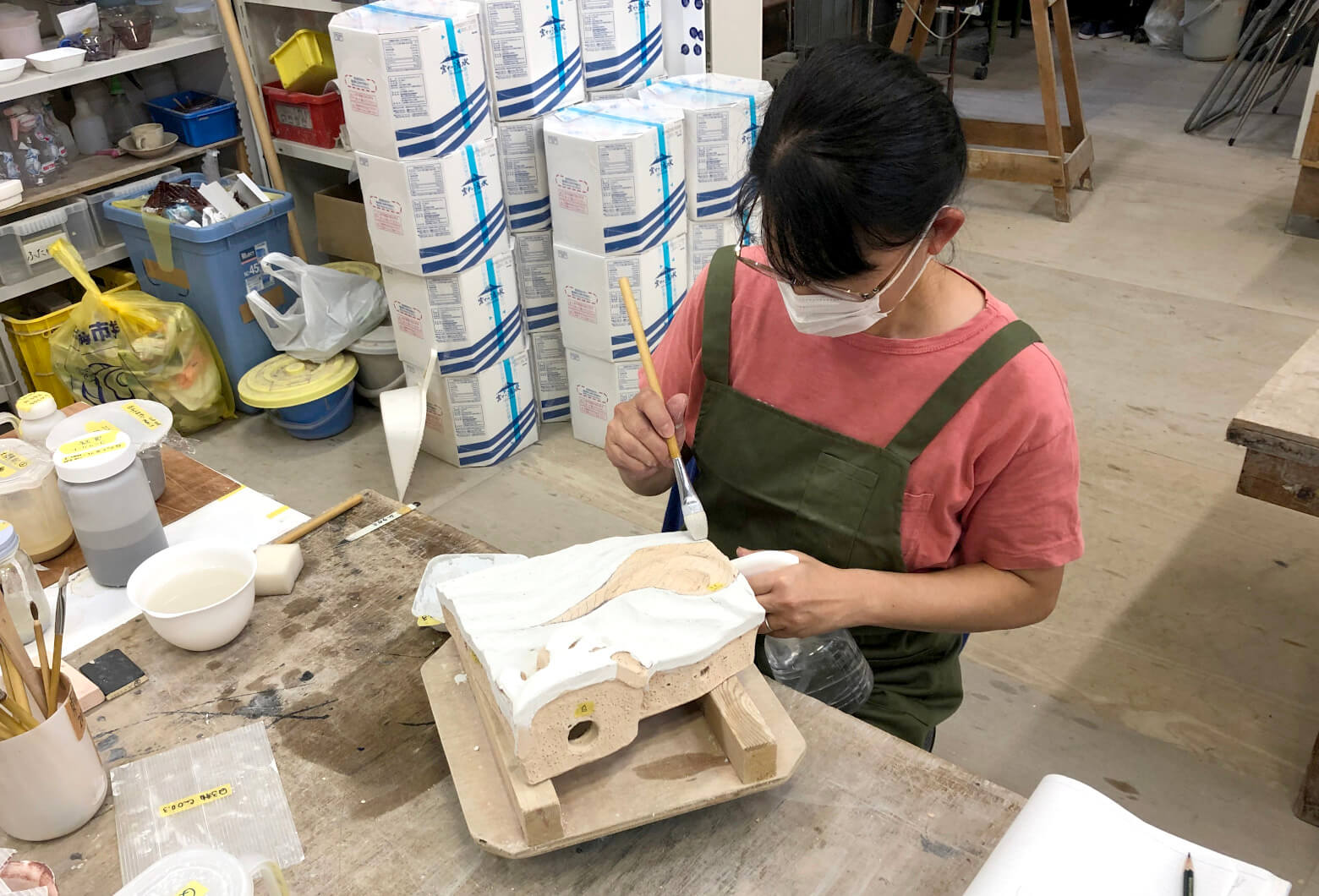 Artisan applying glaze to an individual ceramic piece — each of the 499 components glazed by hand
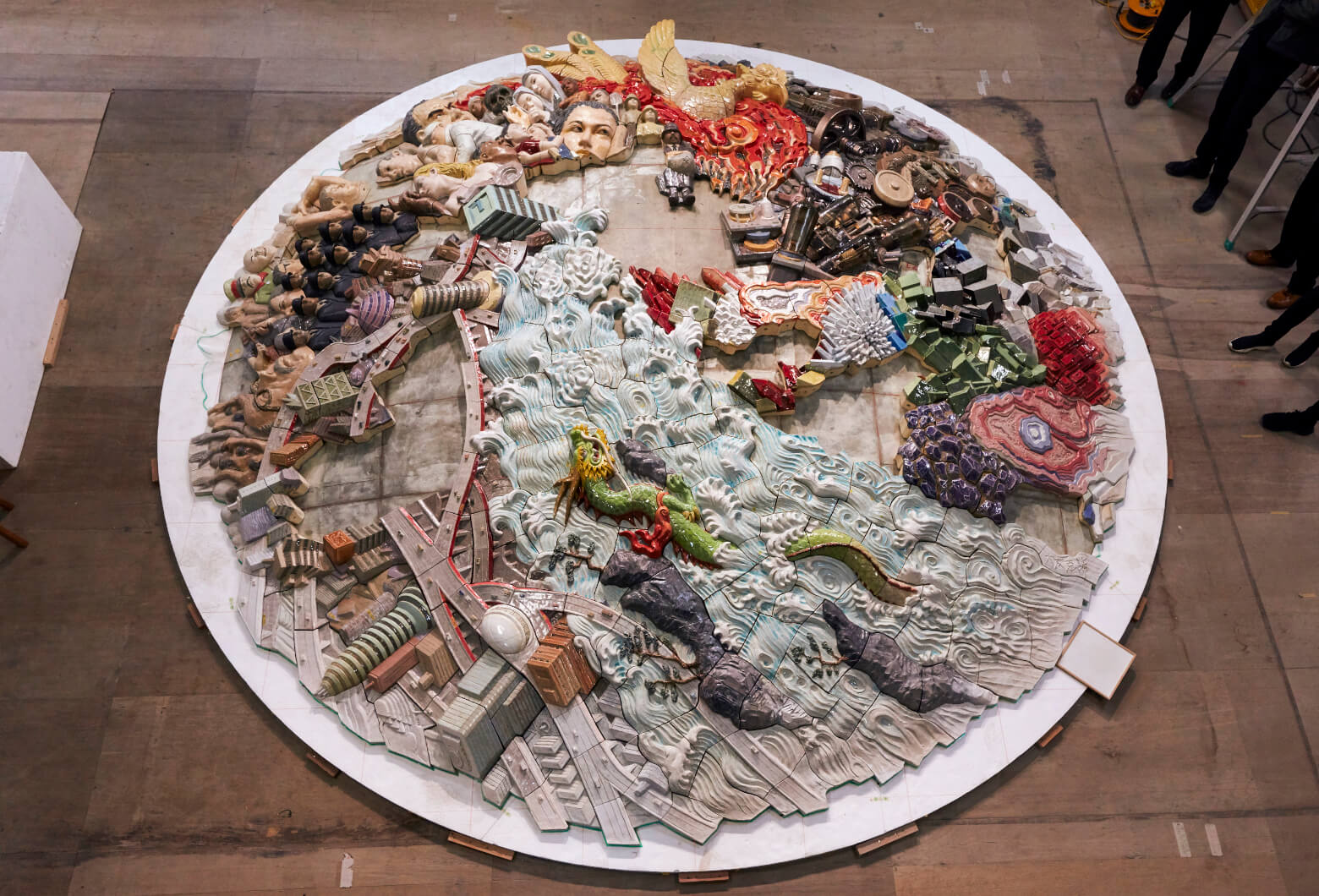 All 499 glazed and fired pieces assembled on the studio floor before mounting on the spherical steel frame
- Japan Traffic Culture Association — publicart546 T1
- JPTCA — Production Diary (8 steps) T1
- Tokyo Tech News — Hisao & Hiroko Taki Plaza T2
- TECTURE MAG — Taki Plaza Report T2
- NKB / CREARE Studio Announcement T2
- @press — Official Press Release T2
- ChronOtomo — ELEMENTS OF FUTURE T3
- Casa Brutus — Otomo Ceramic Art T3
- Nikkei — AKIRA's Otomo Supervises Giant Ceramic Mural T3
Loading...