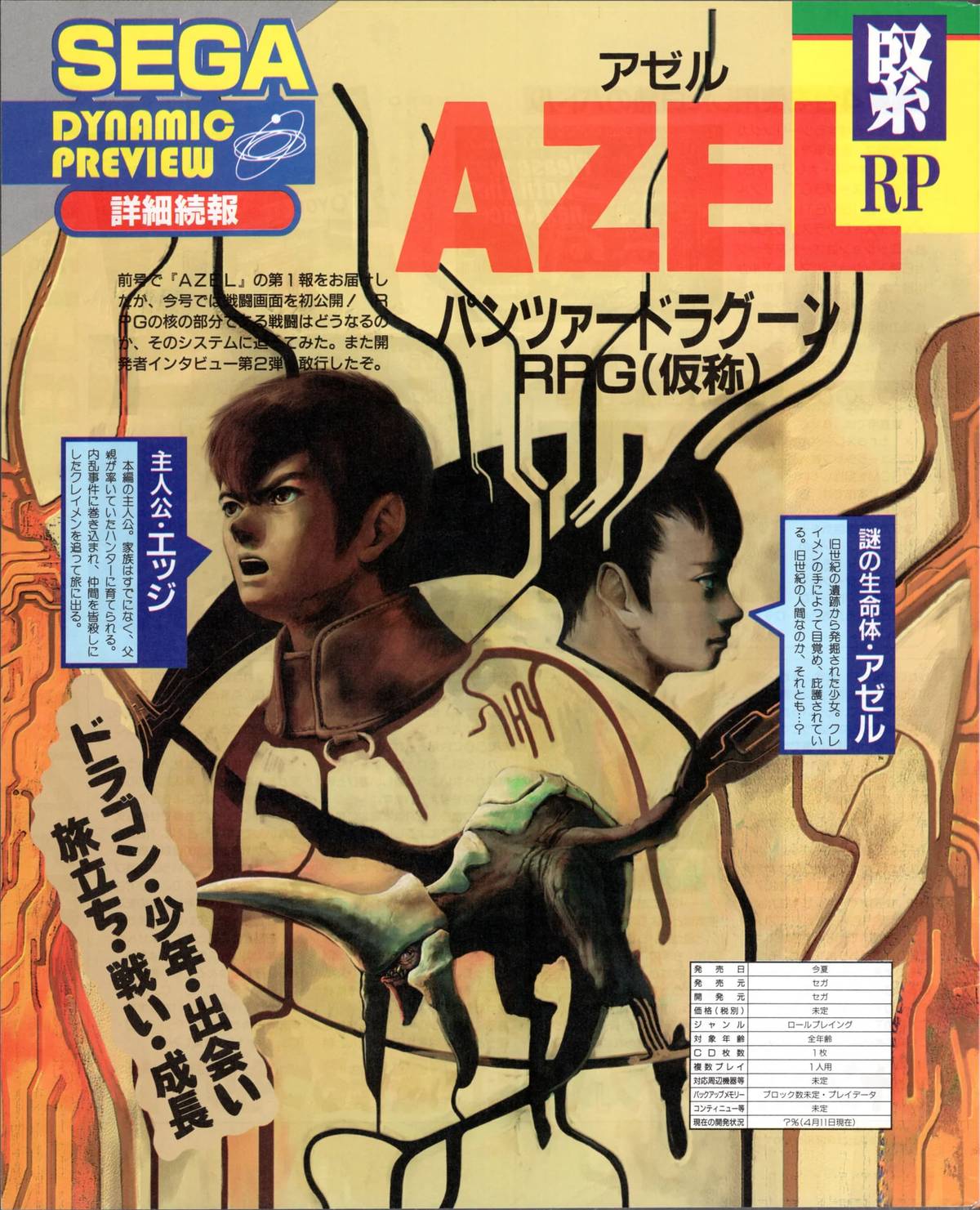
サターンファン No.8 · April 25, 1997 · pp. 16–19 · 徳間書店 · AZEL パンツァードラグーン RPG(仮称) · pre-release preview · SEGA DYNAMIC PREVIEW 詳細続報 · Team Andromeda / Sega CS3
Saturn Fan's eighth issue of 1997 came out April 25, the same week as the Tokyo Game Show Spring, which occupies the front of the same issue. The AZEL preview runs on pages 16 through 19 under the header 「SEGA DYNAMIC PREVIEW 詳細続報」: second detailed report. The first preview had appeared in No.7. This installment did what the first couldn't: it showed actual battle screens. Four pages: character profiles for Edge and the creature Azel, an annotated combat interface diagram, a two-page examination of the four battle actions and positioning mechanic, and a developer interview with series director 二木幸生 (Futatsugi Yukio) and programmer 竹下英敏.
Panzer Dragoon had been a 3D rail shooter twice. PD1 launched with the Saturn in November 1994; Zwei followed in March 1996. Both games placed the player on a dragon flying fixed routes through ruins, destroying formations and evading fire. The third game kept the visual vocabulary and changed what was underneath it. The coverage described the design problem directly: 「STGに見えてSTGではない」 (a shooting game in appearance, not in operation).
SEGA DYNAMIC PREVIEW
Panzer Dragoon had been a 3D rail shooter twice. PD1 launched with the Saturn in November 1994; Zwei followed in March 1996. Both games placed the player on a dragon flying fixed routes through alien ruins, destroying enemy formations while reading the threat field. The control scheme was identical across both: lock-on targeting, auto-flight, shoot and maneuver while the course advanced.
This opening page establishes what the third game carries forward and what it changes. 主人公エッジ is described as a wanderer without a fixed hometown, a rider rather than a soldier. 謎の生命体アゼル is described in the magazine's copy as an unknown lifeform with undisclosed origins and goals. Both are rendered in portrait style rather than action pose: two faces across from each other, no combat framing.
The (仮称) tag on the title confirmed active development. As of April 25, 1997, the game had not been given its final name.
![Battle screen anatomy, p.17. Header: 急速報第2弾 Gの核となる 戦闘画面を公開! (Second flash report — combat screen revealed). Section header: STGとRPGの融合が実現した もう一つの'パンツァー'ワールド. Annotated combat interface showing HP・BP bar (upper left), gauge, and radar. Labeled sub-sections: A) HP・BP — HP measures dragon health, Edge carries no HP value; B) ゲージ (gauge); C) レーダー (radar). Right column: comparison screenshots from Panzer Dragoon Zwei labeled ツヴァイ. Caption: 戦闘画面構成 & 各部解説. [SCREENSHOT / DIAGRAM]](/images/posts/saturn-fan-azel-panzer-dragoon-rpg-page-02.jpg) Battle screen anatomy, p.17. Header: 急速報第2弾 Gの核となる 戦闘画面を公開! (Second flash report — combat screen revealed). Section header: STGとRPGの融合が実現した もう一つの'パンツァー'ワールド. Annotated combat interface showing HP・BP bar (upper left), gauge, and radar. Labeled sub-sections: A) HP・BP — HP measures dragon health, Edge carries no HP value; B) ゲージ (gauge); C) レーダー (radar). Right column: comparison screenshots from Panzer Dragoon Zwei labeled ツヴァイ. Caption: 戦闘画面構成 & 各部解説. [SCREENSHOT / DIAGRAM]
Battle screen anatomy, p.17. Header: 急速報第2弾 Gの核となる 戦闘画面を公開! (Second flash report — combat screen revealed). Section header: STGとRPGの融合が実現した もう一つの'パンツァー'ワールド. Annotated combat interface showing HP・BP bar (upper left), gauge, and radar. Labeled sub-sections: A) HP・BP — HP measures dragon health, Edge carries no HP value; B) ゲージ (gauge); C) レーダー (radar). Right column: comparison screenshots from Panzer Dragoon Zwei labeled ツヴァイ. Caption: 戦闘画面構成 & 各部解説. [SCREENSHOT / DIAGRAM]
戦闘画面構成
Page 17 opens the battle screen for the first time. The magazine labels the interface anatomy — HP and BP (バーサーカーポイント, Berserker Points) in the upper left. The description is specific:
「戦闘で基本となる数値は、HPとBP(バーサーカーポイント)。このHPはドラゴンの体力量であり、主人公にはこの数値は存在しない。」
HP measures the dragon's health. Edge has no HP value of his own. If the dragon falls, the fight ends. The rider carries no separate survival meter. BP is a distinct pool, the resource spent on Berserker techniques, the system's special-attack tier.
The game flow the magazine describes has three layers: フィールド (town/field) for information and items; dragon-traversal dungeon segments that look like an STG; and the battle screen itself. The Zwei comparison screenshots on the right run through several labeled frames, placing the new interface beside the earlier game's.
![Battle system examination, p.18. Main headline: STGに見えてSTGではない 独特の戦闘システムを検証! (It looks like an STG but isn't — examining the unique battle system). Left column: 「戦闘の「行動」は4種類」 (four battle action types) with ホーミングレーザー (homing laser) highlighted. Center: 「戦闘を有利に進めるための「位置取り」」 (Positioning for advantageous combat). Bottom spread: 「パンツァーの伝統「巨大ボス」」 (The Panzer tradition: giant boss) with 水中から要塞出現 (fortress emerging from underwater) screenshot and 生死を賭けた戦い (a battle wagering life and death) caption. [SCREENSHOT / DIAGRAM]](/images/posts/saturn-fan-azel-panzer-dragoon-rpg-page-03.jpg) Battle system examination, p.18. Main headline: STGに見えてSTGではない 独特の戦闘システムを検証! (It looks like an STG but isn't — examining the unique battle system). Left column: 「戦闘の「行動」は4種類」 (four battle action types) with ホーミングレーザー (homing laser) highlighted. Center: 「戦闘を有利に進めるための「位置取り」」 (Positioning for advantageous combat). Bottom spread: 「パンツァーの伝統「巨大ボス」」 (The Panzer tradition: giant boss) with 水中から要塞出現 (fortress emerging from underwater) screenshot and 生死を賭けた戦い (a battle wagering life and death) caption. [SCREENSHOT / DIAGRAM]
Battle system examination, p.18. Main headline: STGに見えてSTGではない 独特の戦闘システムを検証! (It looks like an STG but isn't — examining the unique battle system). Left column: 「戦闘の「行動」は4種類」 (four battle action types) with ホーミングレーザー (homing laser) highlighted. Center: 「戦闘を有利に進めるための「位置取り」」 (Positioning for advantageous combat). Bottom spread: 「パンツァーの伝統「巨大ボス」」 (The Panzer tradition: giant boss) with 水中から要塞出現 (fortress emerging from underwater) screenshot and 生死を賭けた戦い (a battle wagering life and death) caption. [SCREENSHOT / DIAGRAM]
STGに見えてSTGではない
The four battle actions listed on page 18: homing laser (ホーミングレーザー), Berserker technique (バーサーカー技), item use, and the dragon's own action (竜の行動). The homing laser fires multiple tracking shots per activation; the lock-on system from PD1 and Zwei is still present. What the magazine identifies as new is the positioning layer beneath it.
「戦闘に突入すると、エネミーの周囲を移動しながら有利な位置を確保しなければならない。なぜなら攻撃がヒットすればダメージを与えられ、当たらない攻撃は意味がない……」
Moving the dragon around an enemy determines which attacks connect. The lock-on cursor tracks relative position; positioning changes the cursor geometry and therefore which of the four actions produces hits. In PD1 and Zwei, position determined whether the player was in the enemy's line of fire. Here it determines whether the player's attacks land.
The bottom of the page: 「パンツァーの伝統「巨大ボス」」. A fortress rises from water in one screenshot, labeled 水中から要塞出現. The scale encounters from the earlier games are here, but the encounter rules have changed.
![Developer interview, p.19. Left column header: 「AZEL」ですべて解明する!? シリーズで残された数々の謎 (Will AZEL resolve everything? The many mysteries left in the series). Sidebar: ラギちゃんの小部屋 (Ragi's Room) with character illustration of the series' recurring background figure. Main interview section: 制作者インタビュー第2弾 戦闘システムと残された謎に迫る (Second developer interview — probing the battle system and remaining mysteries). Interviewees: 企画 二木幸生 (Futatsugi Yukio, planner/director) left photo; プログラマー 竹下英敏 (Takeshita Hidetoshi, programmer) right photo. [DEVELOPER PHOTO / SCREENSHOT]](/images/posts/saturn-fan-azel-panzer-dragoon-rpg-page-04.jpg) Developer interview, p.19. Left column header: 「AZEL」ですべて解明する!? シリーズで残された数々の謎 (Will AZEL resolve everything? The many mysteries left in the series). Sidebar: ラギちゃんの小部屋 (Ragi's Room) with character illustration of the series' recurring background figure. Main interview section: 制作者インタビュー第2弾 戦闘システムと残された謎に迫る (Second developer interview — probing the battle system and remaining mysteries). Interviewees: 企画 二木幸生 (Futatsugi Yukio, planner/director) left photo; プログラマー 竹下英敏 (Takeshita Hidetoshi, programmer) right photo. [DEVELOPER PHOTO / SCREENSHOT]
Developer interview, p.19. Left column header: 「AZEL」ですべて解明する!? シリーズで残された数々の謎 (Will AZEL resolve everything? The many mysteries left in the series). Sidebar: ラギちゃんの小部屋 (Ragi's Room) with character illustration of the series' recurring background figure. Main interview section: 制作者インタビュー第2弾 戦闘システムと残された謎に迫る (Second developer interview — probing the battle system and remaining mysteries). Interviewees: 企画 二木幸生 (Futatsugi Yukio, planner/director) left photo; プログラマー 竹下英敏 (Takeshita Hidetoshi, programmer) right photo. [DEVELOPER PHOTO / SCREENSHOT]
制作者インタビュー第2弾
The second developer interview in the AZEL coverage focused on the battle system. 企画 二木幸生 (Futatsugi Yukio, who directed PD1 and Zwei and carried the series into its third installment) and programmer 竹下英敏 (Takeshita Hidetoshi) addressed the reader's central question: does the game play like a shooter?
二木 confirmed the visual vocabulary is inherited but the logic isn't. The バーサーカー name for the battle system's special-attack tier comes from a specific design concept: the system rewards committed positioning. 竹下 described the lock-on cursor as one operational layer among several, not the primary interface. The battle doesn't run on reflex; it runs on position management and resource allocation.
The left column runs alongside the interview: 「シリーズで残された数々の謎」, the many questions the first two games left open. The sidebar on ラギ (a recurring figure from the series' world, associated with the ancient technology and ruins) frames AZEL as the installment designed to answer what PD1 and Zwei never addressed: the origins of the empire, the nature of the ancient ruins, what the dragon lineage represents in-universe.
The (仮称) on the cover page resolved before the January 1998 Japanese release: the game shipped as Azel: Panzer Dragoon RPG. The North American release in April 1998 dropped Edge's name from the title entirely and arrived as Panzer Dragoon Saga. The battle system described in these four pages (HP on the dragon only, four action types, 位置取り determining which of them connect) is the system that shipped. Futatsugi's interview in the April 25 issue documented it while the press still called it a provisional name. The disc was produced in a print run small enough that the North American version now sells for several hundred dollars at auction, which means these four pages saw more readers than the game itself.
Loading...