宇宙の騎士テッカマン (Space Knight Tekkaman) aired on TV Tokyo from July to December 1975, 26 episodes, produced by Tatsunoko Production. The premise: humanity is reaching into space, constructing orbital platforms and early colony infrastructure. The alien empire Waldaster destroys a colonization mission and turns toward Earth. The Space Knights — an international defense team aboard the base ship Blue Earth — are Earth's first and only response. Their weapon is Joji Minami, who can interface with a transforming mech called Pegas to become Tekkaman: a suit of crystalline powered armor, faster than anything Waldaster has seen, armed with the electrified Tekka Lance. He fights alone in space. Nobody on Earth knows he exists.
The show was Tatsunoko's attempt at a harder science-fiction superhero series after the success of Gatchaman. Where Gatchaman was colorful and ensemble-driven, Tekkaman was solitary and melancholy — one man, one mech, fighting at the edge of the solar system while the world below stayed unaware. The show struggled in ratings and ran exactly its initial order of episodes. It was not renewed.
The Pioneer LDC release (PILA-G4865 box set, individual discs PILA-1245~1251) appeared in the early 1990s as part of the Tatsunoko Hyper Collection Series. It contains: 7 CLV discs, 13 sides, all 26 episodes, each disc jacket carrying a new commission from a different illustrator — Kunio Okawara on Disc 1, Yutaka Izubuchi on Disc 7 — and a booklet documenting the production in the manner of a series bible: mecha schematics, character profiles, cutaway ship diagrams, enemy faction reference, rough design history. Mono audio throughout. The original broadcast signal, unchanged.
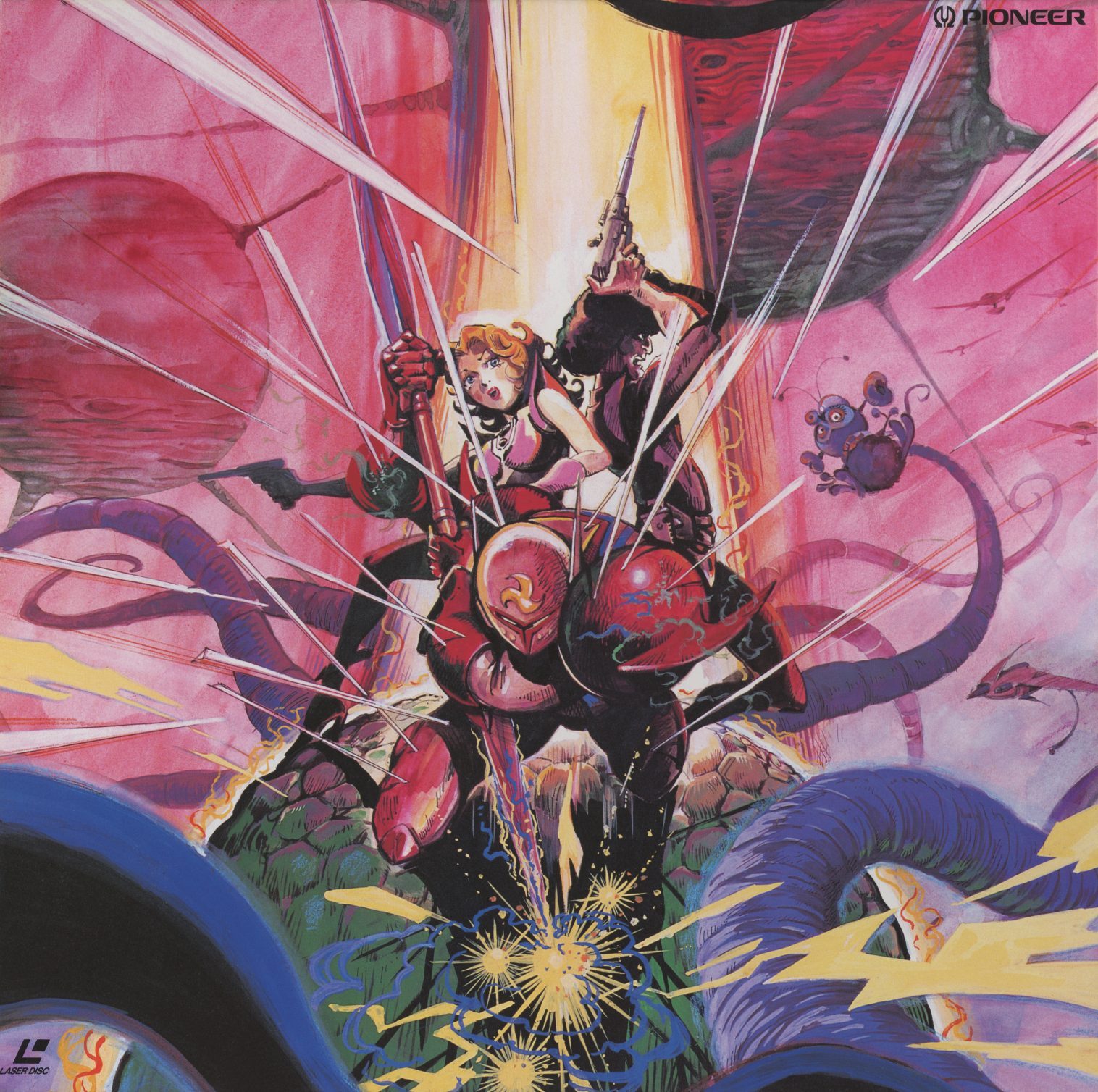 Box exterior — commissioned ensemble illustration. Tekkaman in battle alongside the female Space Knight, surrounded by alien tentacles and energy discharge. The packaging announces the whole set before any individual disc is opened. Pioneer LaserDisc logo top right, LaserVision mark bottom left.
Seven Discs, Seven Artists
Each disc in the set was given to a different illustrator for a new commission. The disc back credits the artist by name beneath the Tatsunoko Hyper Collection Series badge. Disc 1 reads: ILLUSTRATED BY KUNIO OHKAWARA. Okawara — whose mecha designs defined the Mobile Suit Gundam franchise and whose mechanical vocabulary became the template for an entire generation of robot anime — did not design the original 1975 Tekkaman. He was invited, in the early 1990s, to draw it anyway. His name on Disc 1 is a signal to anyone who recognizes it: this is a collector's document, not a reissue.
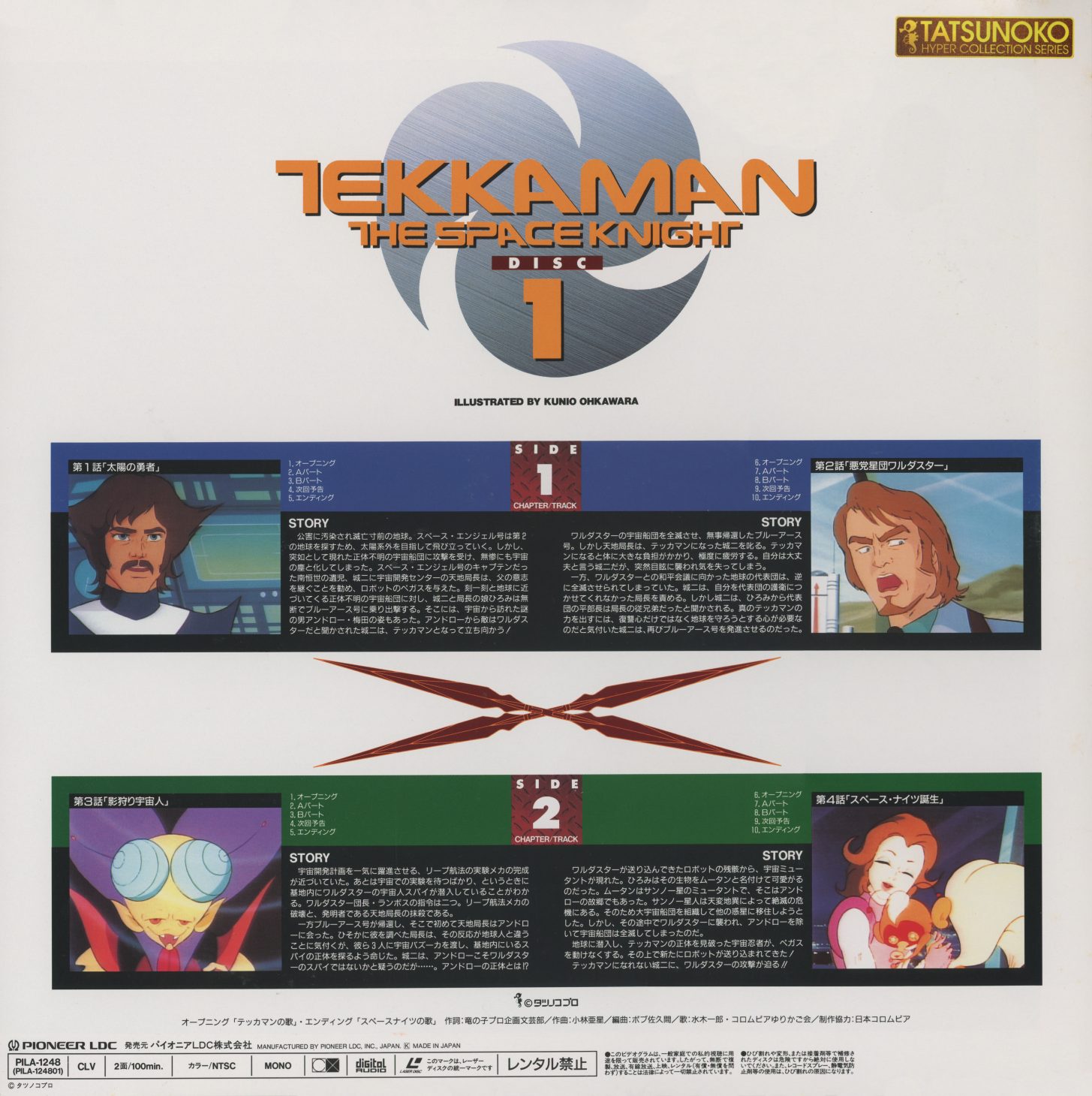 Disc 1 back — TEKKAMAN THE SPACE KNIGHT / DISC 1 / ILLUSTRATED BY KUNIO OHKAWARA. Tatsunoko Hyper Collection Series badge. SIDE 1: Episodes 1-2 with chapter track and story summaries. SIDE 2: Episodes 3-4. Format: Pioneer LDC, PILA-1245, CLV, 2B/100min, color NTSC, MONO. レンタル禁止.
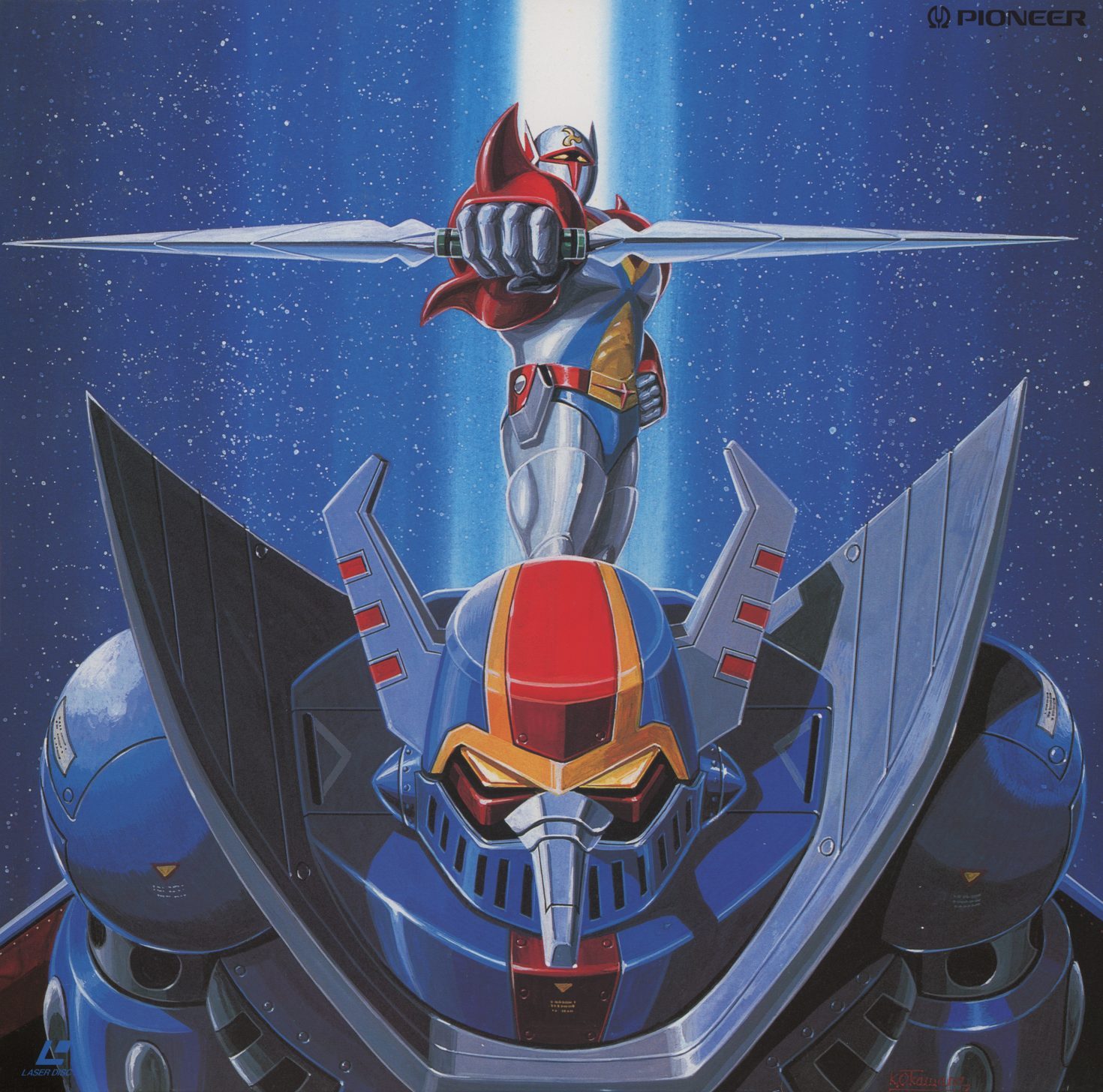 Disc 1 jacket — Kunio Okawara. Tekkaman standing atop Pegas against a starfield, lance extended, a beam of light rising behind him. Clean compositional geometry: the hero as the apex of his mech. Okawara's line is precise and aspirational — the illustration redraws the 1975 hero in the visual register of the Gundam era.
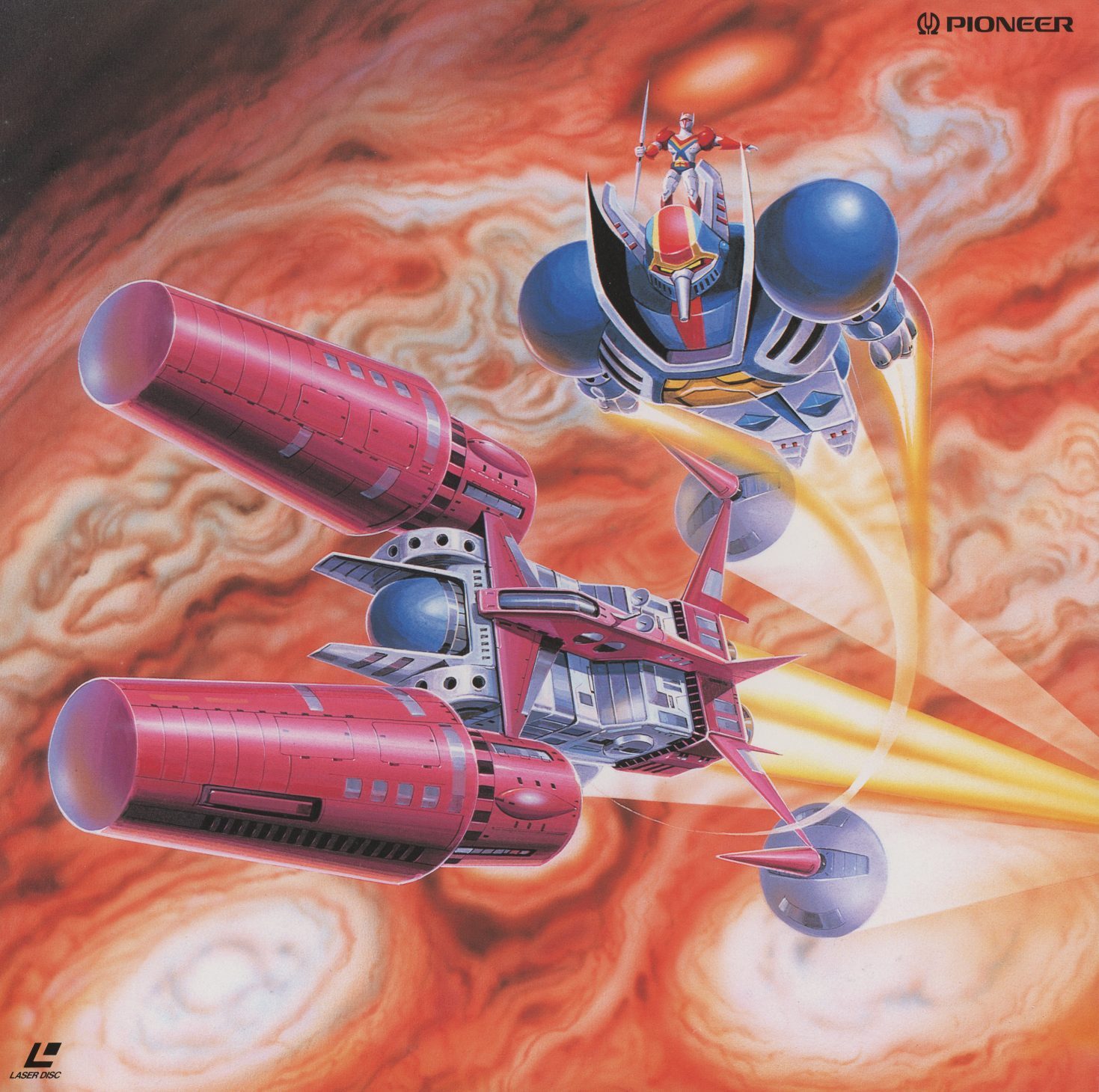 Disc 2 jacket — Mitsuki Nakamura. Pegas in spacecraft configuration launching against Jupiter's Great Red Spot, Tekkaman a small figure at the top of the frame. Space opera scale: the swirling red atmosphere fills the background, the ship and its rider a bright shape against the storm.
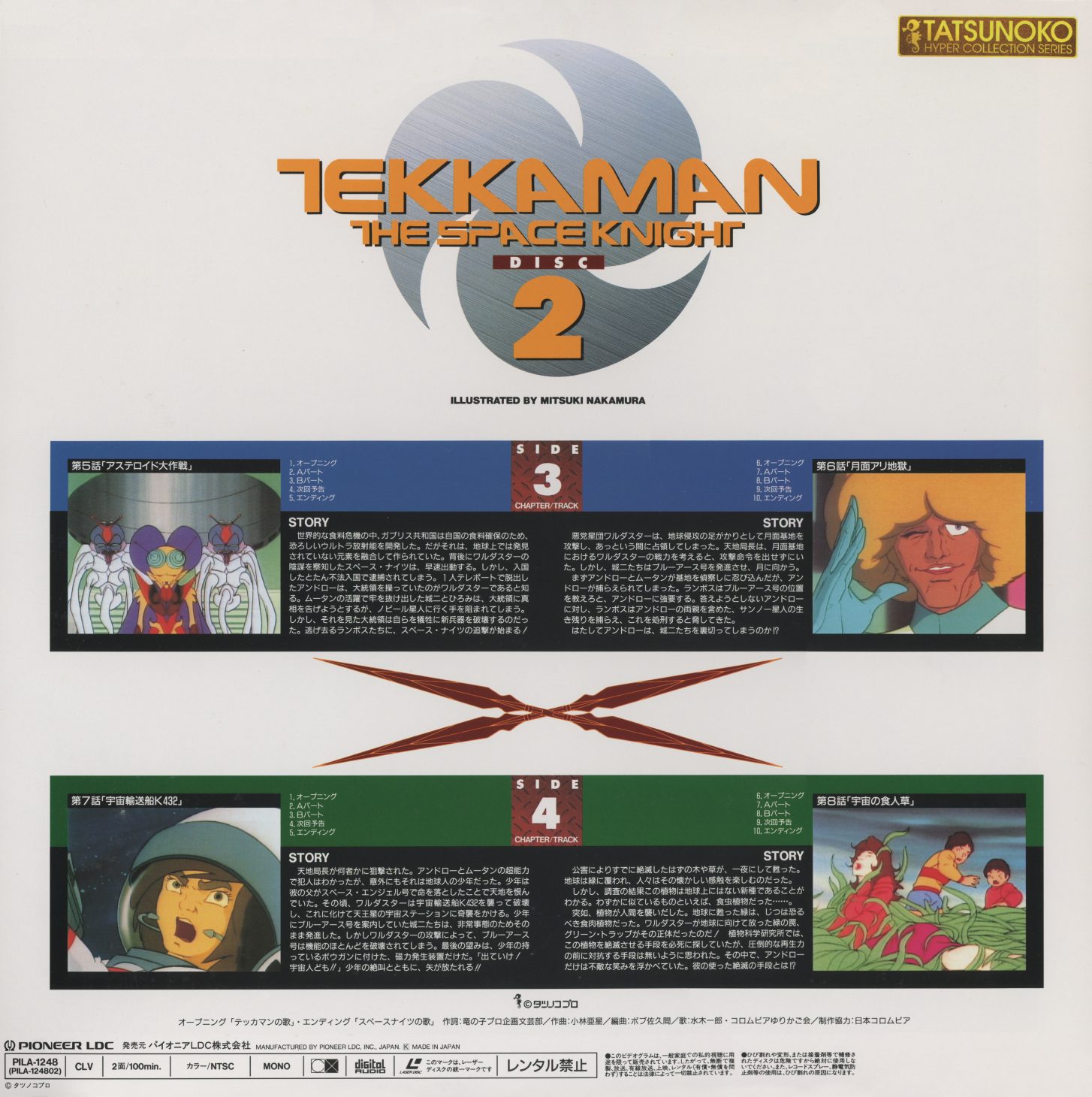 Disc 2 back — DISC 2 / ILLUSTRATED BY MITSUKI NAKAMURA. SIDE 3: Episodes 5-6. SIDE 4: Episodes 7-8. PILA-1246, CLV, 2B/100min, MONO.
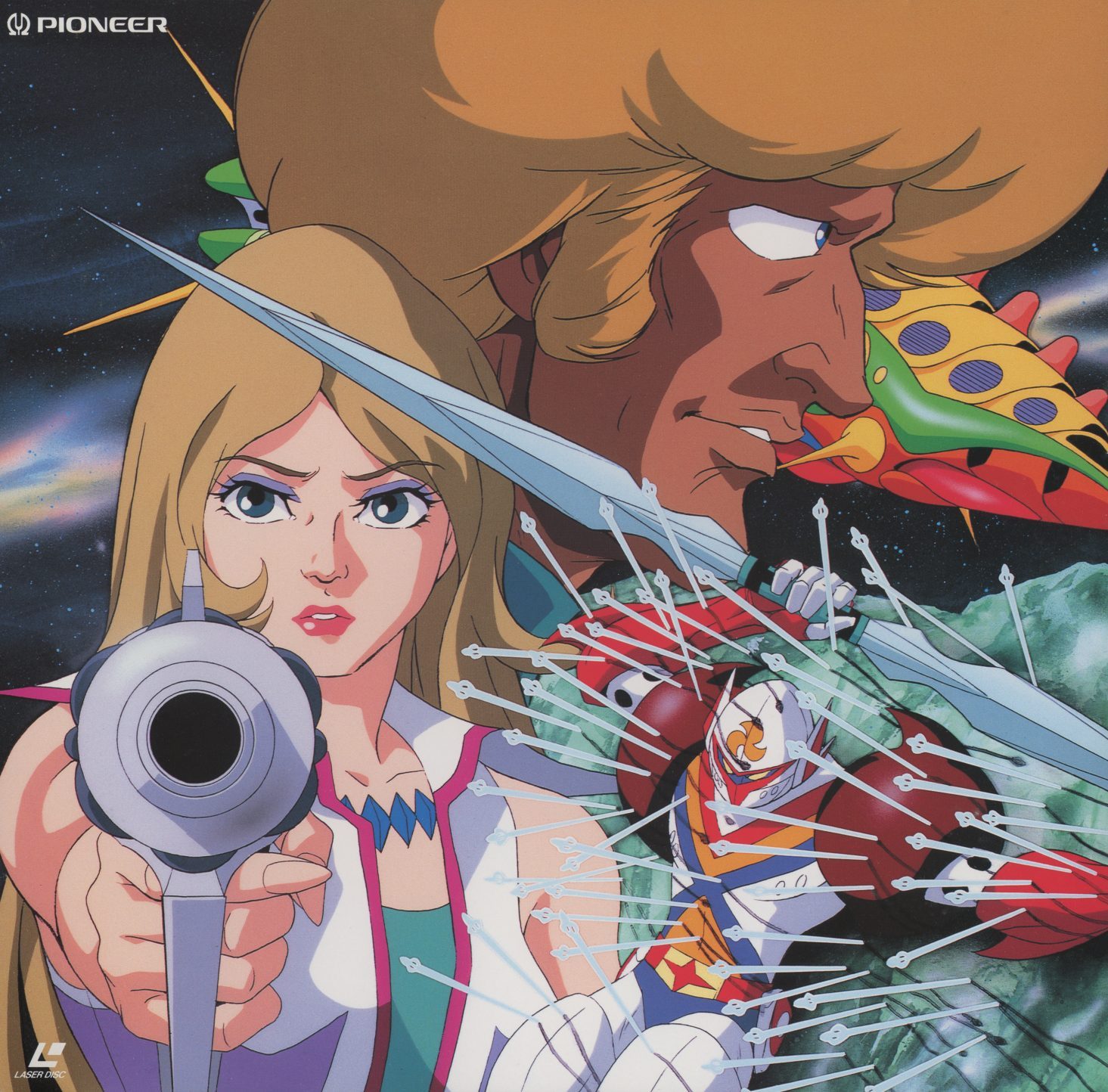 Disc 3 jacket — Suezen. Tight two-shot: a blonde woman in the foreground pointing a weapon directly at the viewer, a large-faced antagonist looming behind her, Tekkaman visible and under pressure in the deep background. The composition inverts the standard hero-forward layout — the supporting cast in front, Tekkaman in the distance.
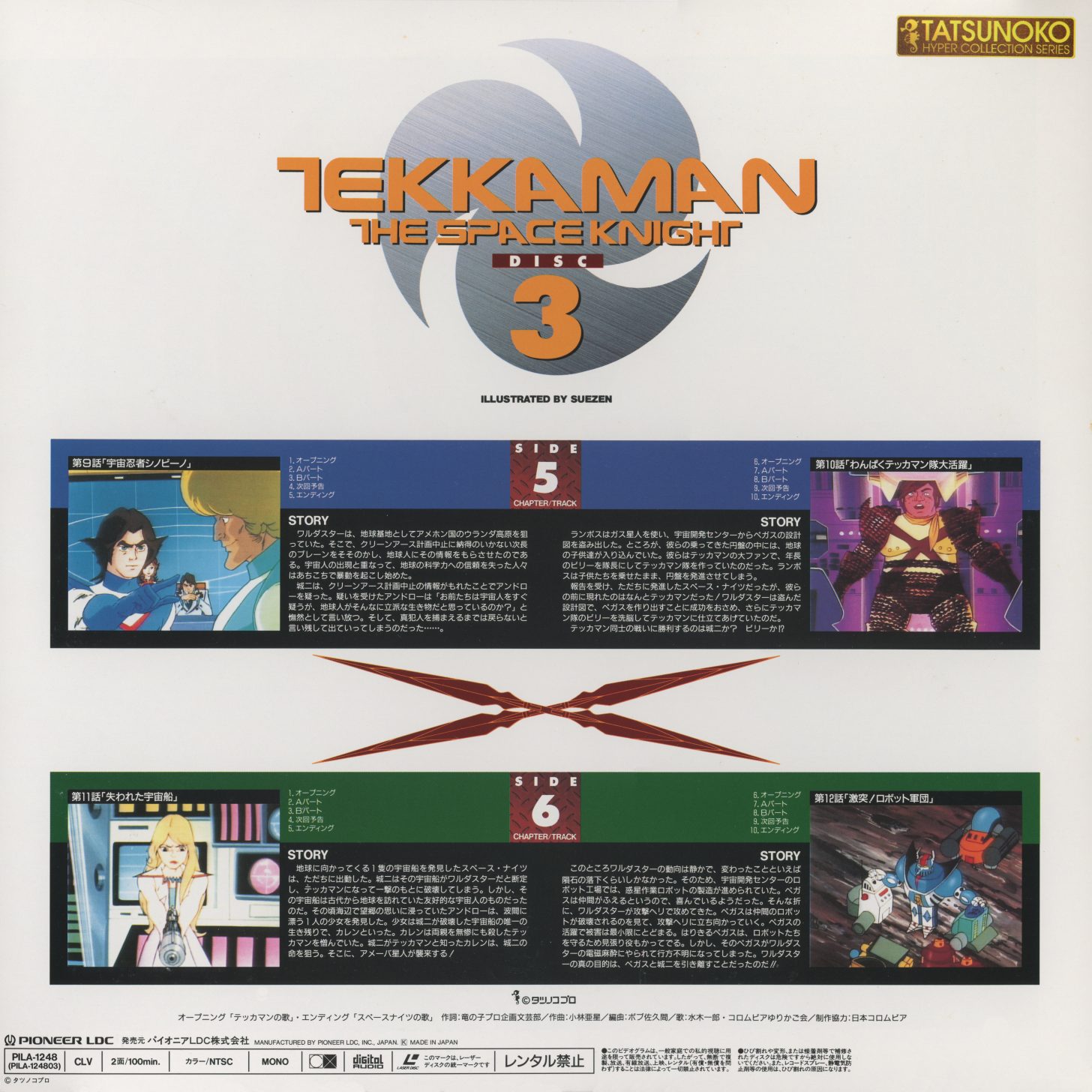 Disc 3 back — DISC 3 / ILLUSTRATED BY SUEZEN. SIDE 5: Episodes 9-10. SIDE 6: Episodes 11-12. PILA-1247, CLV, 2B/100min, MONO.
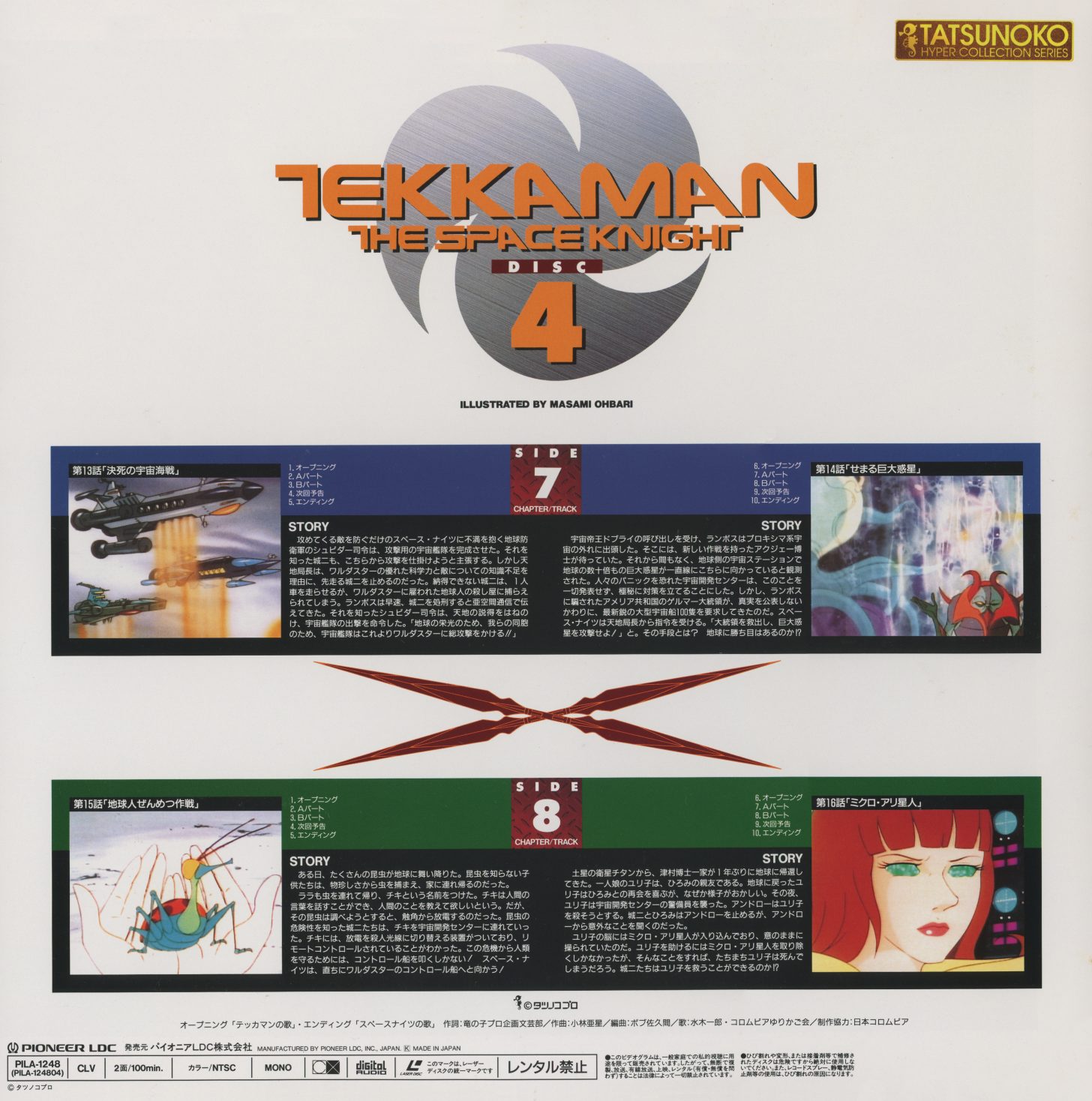 Disc 4 back — DISC 4 / ILLUSTRATED BY MASAMI OHBARI. SIDE 7: Episodes 13-14. SIDE 8: Episodes 15-16. PILA-1248, CLV, 2B/100min, MONO.
Ōbari's Register
Masami Ōbari's credit on Disc 4 is the most surprising name in the set. By the early 1990s Ōbari was the animator most associated with explosive, physically overwhelming mecha sequences — the man whose key animation work on Giant Robo and his directorial work on Voltage Fighter Gowcaizer defined what hot-blooded super robot action looked like in motion. His Tekkaman jacket is not that. It is a quiet portrait: the protagonist in civilian clothes, the armored form a small figure behind his shoulder. The man behind the armor, in miniature. Ōbari, given a 1975 mech show and a blank canvas, drew the person.
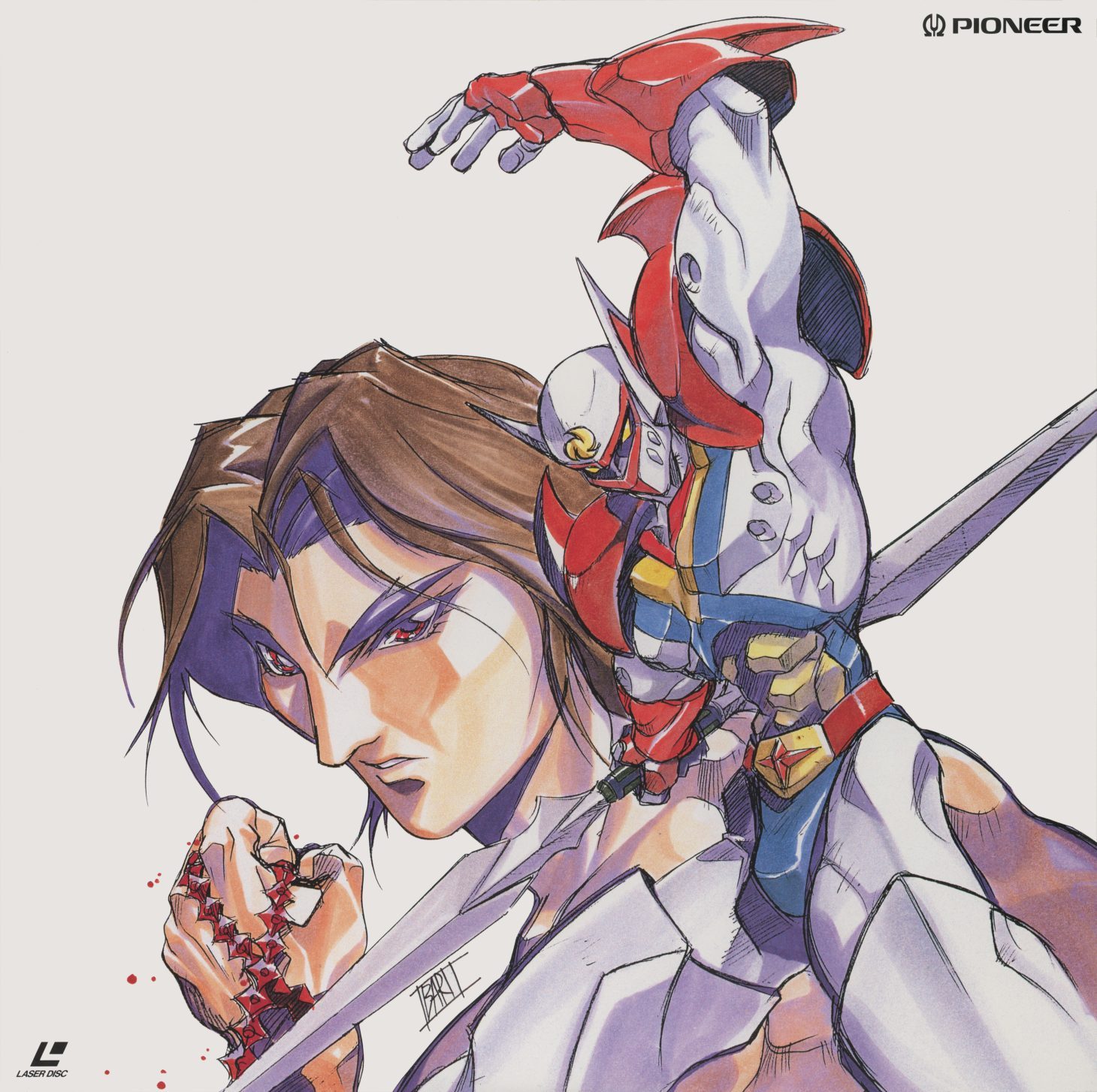 Disc 4 jacket — Masami Ōbari. The protagonist in his civilian identity, Tekkaman armor rendered as a small figure visible behind his shoulder. A character portrait rather than an action composition — the man and the armor held at a distance from each other. Signed at lower right.
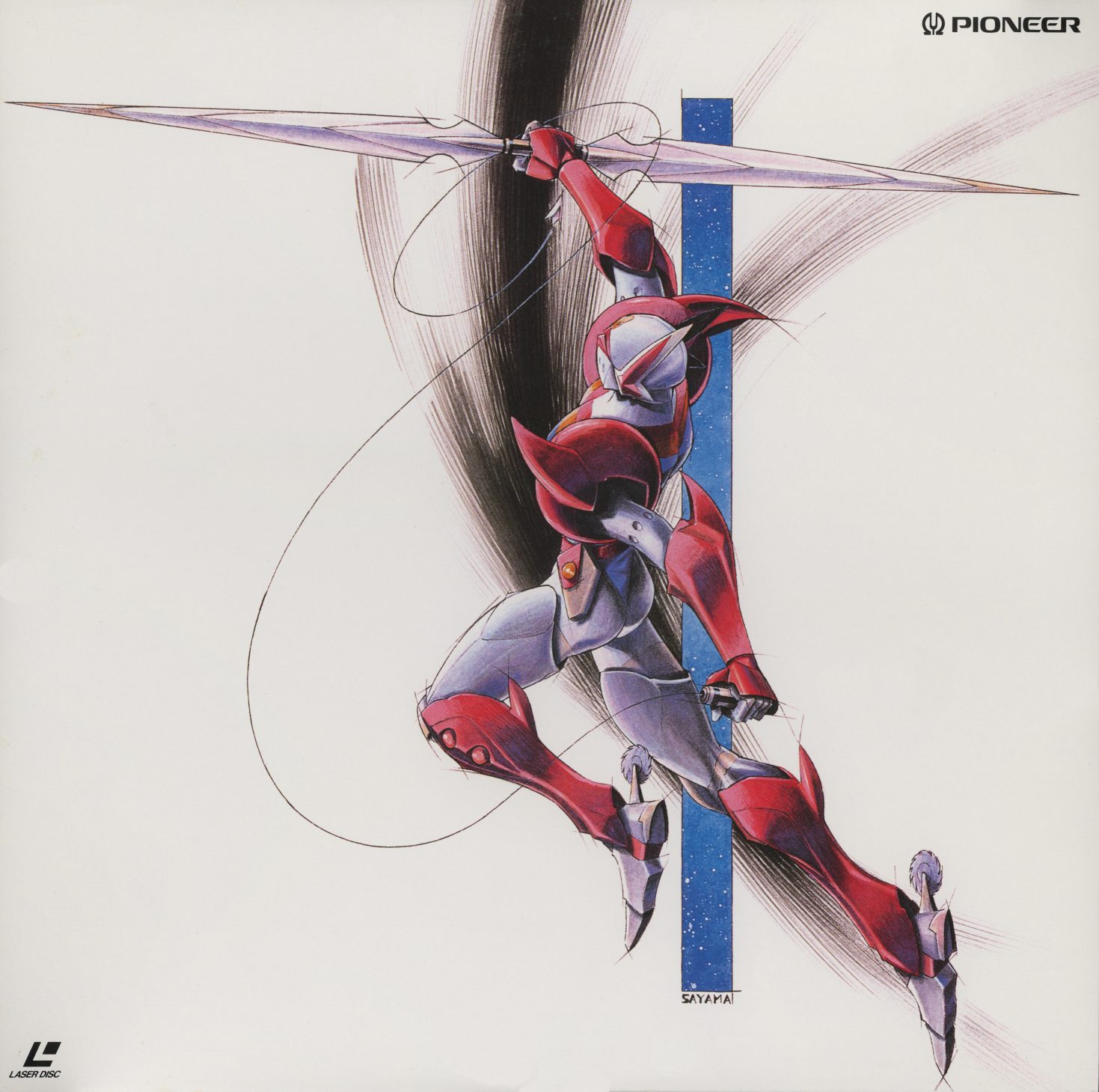 Disc 5 jacket — Yoshinori Sayama. Tekkaman in mid-flight diagonal against a white ground with a single vertical blue stripe — almost graphic design rather than illustration. The minimal ground gives the figure full weight. Signed "SAYAKA" lower right. The most formally restrained jacket in the set.
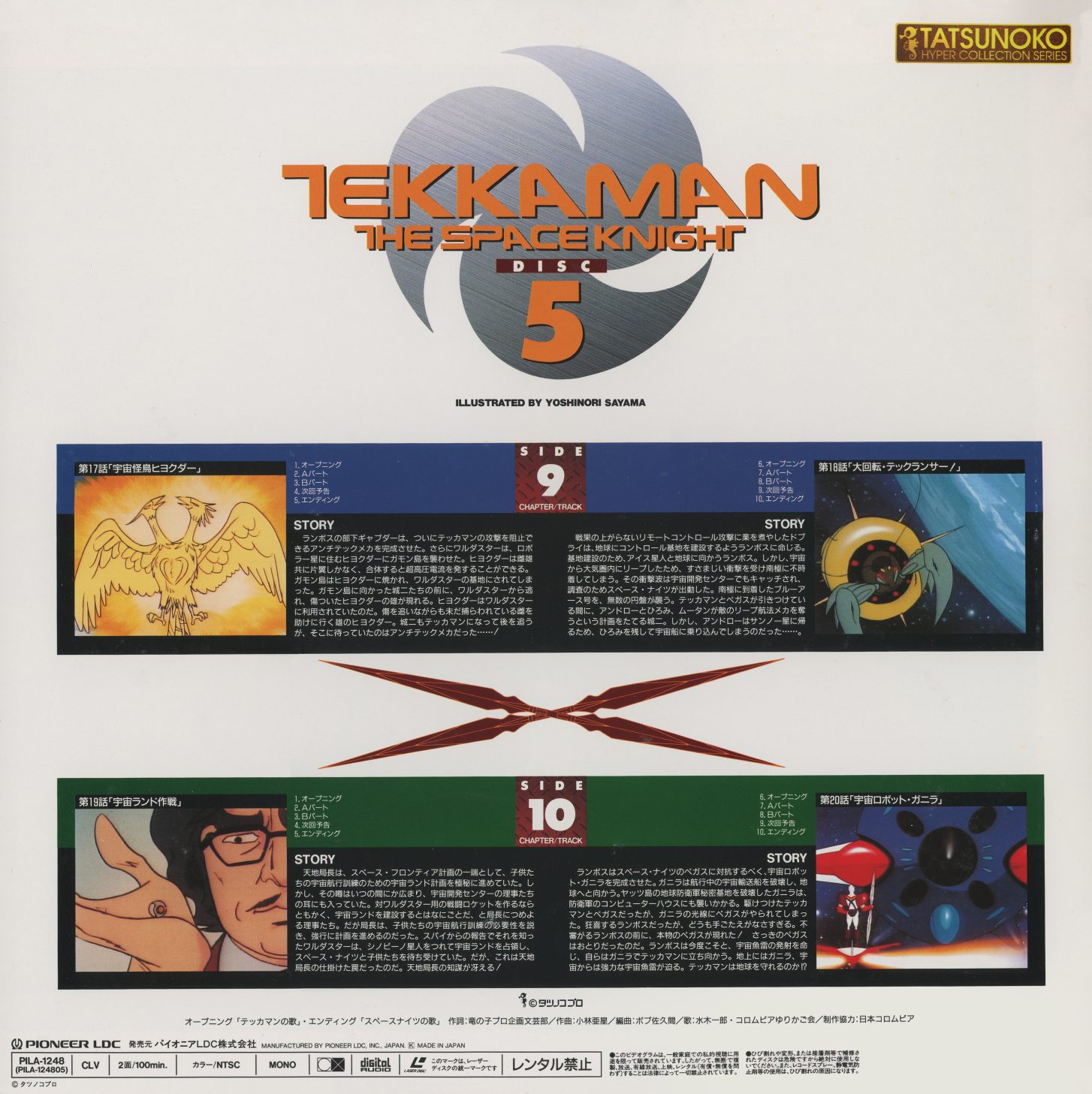 Disc 5 back — DISC 5 / ILLUSTRATED BY YOSHINORI SAYAMA. SIDE 9: Episodes 17-18. SIDE 10: Episodes 19-20. PILA-1249, CLV, 2B/100min, MONO. The Tatsunoko Hyper Collection Series badge appears on every disc back, positioning the set explicitly as collector documentation.
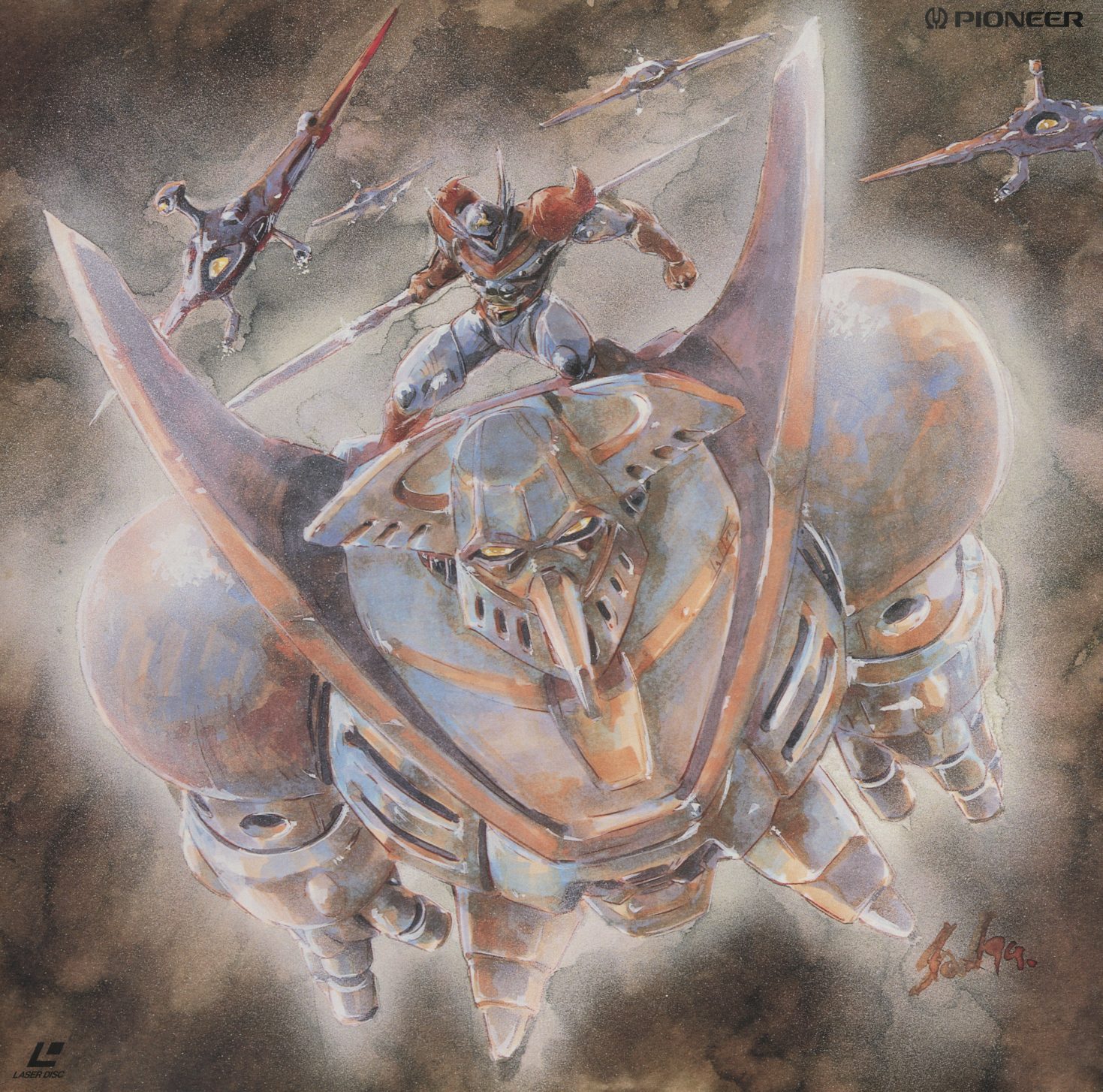 Disc 6 jacket — Hirotoshi Sano. Tekkaman and two smaller allied fighters attacking an enormous enemy mech rendered in bronze and shadow. Painterly atmospheric treatment — the enemy fills most of the frame, the heroes small against its scale. The most openly science-fiction illustration in the set.
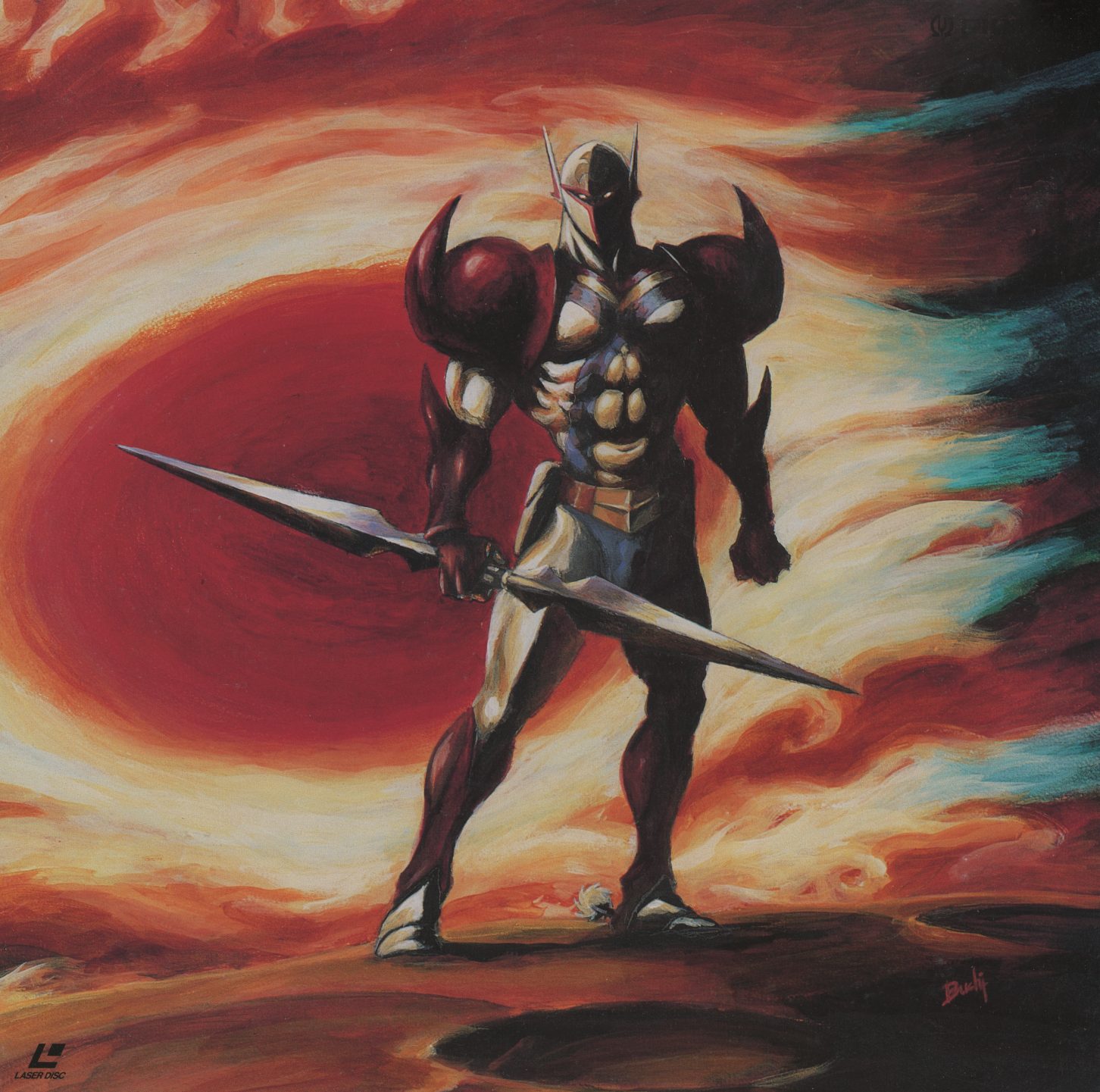
Disc 7 jacket — Yutaka Izubuchi. Tekkaman alone with his lance, standing against a swirling red-and-amber sky. Oil-painting surface. No action, no enemy, no motion lines. The final disc of the series gets the illustration that most directly addresses the show's emotional core: one figure, in armor, facing outward. Izubuchi — designer of Patlabor's Ingram — understood solitude as a design register.
Disc 6 jacket — Hirotoshi Sano. Tekkaman and two smaller allied fighters attacking an enormous enemy mech rendered in bronze and shadow. Painterly atmospheric treatment — the enemy fills most of the frame, the heroes small against its scale. The most openly science-fiction illustration in the set.
Disc 7 jacket — Yutaka Izubuchi. Tekkaman alone with his lance, standing against a swirling red-and-amber sky. Oil-painting surface. No action, no enemy, no motion lines. The final disc of the series gets the illustration that most directly addresses the show's emotional core: one figure, in armor, facing outward. Izubuchi — designer of Patlabor's Ingram — understood solitude as a design register.
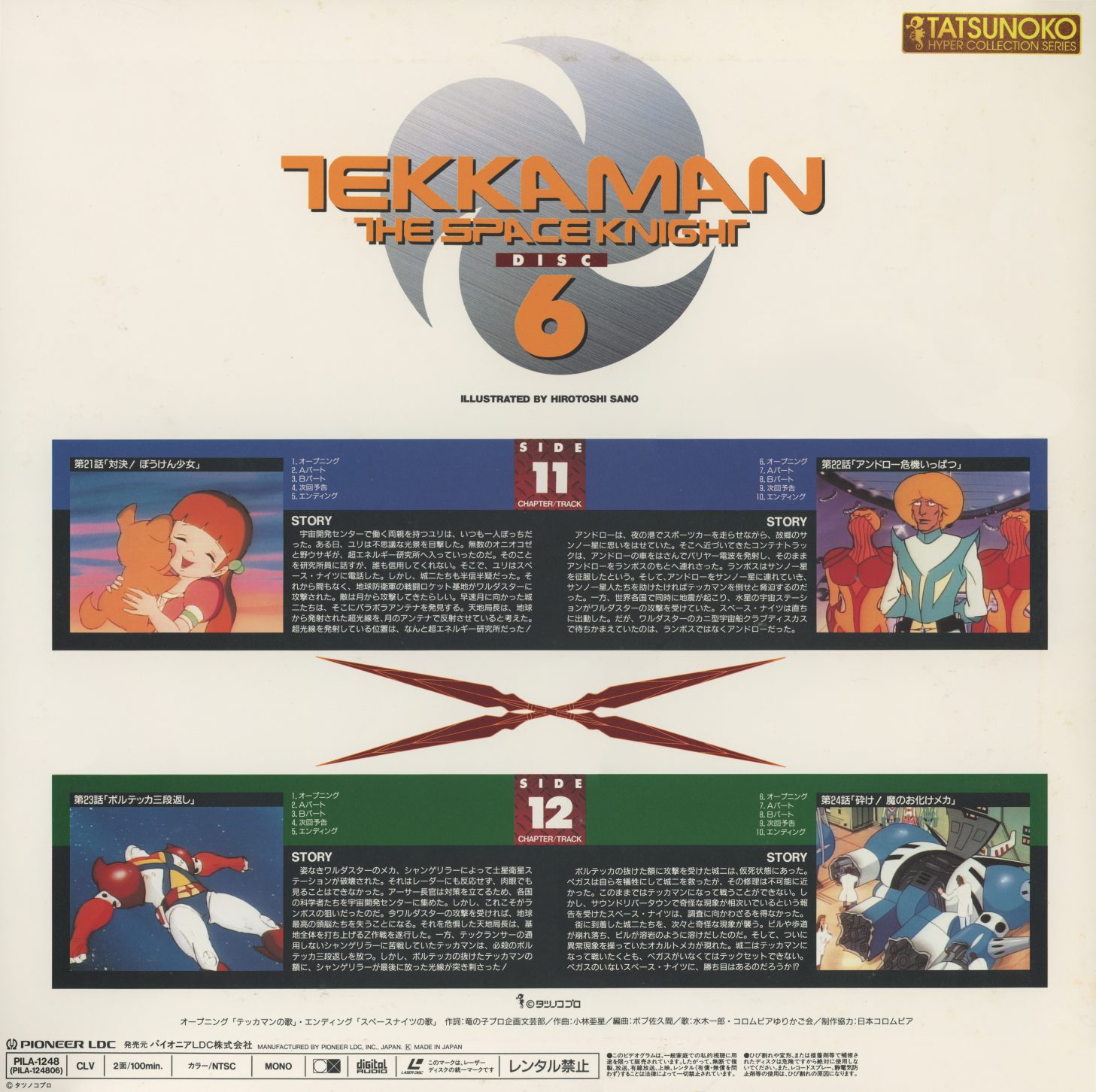 Disc 6 back — DISC 6 / ILLUSTRATED BY HIROTOSHI SANO. SIDE 11: Episodes 21-22. SIDE 12: Episodes 23-24. PILA-1250, CLV, 2B/100min, MONO.
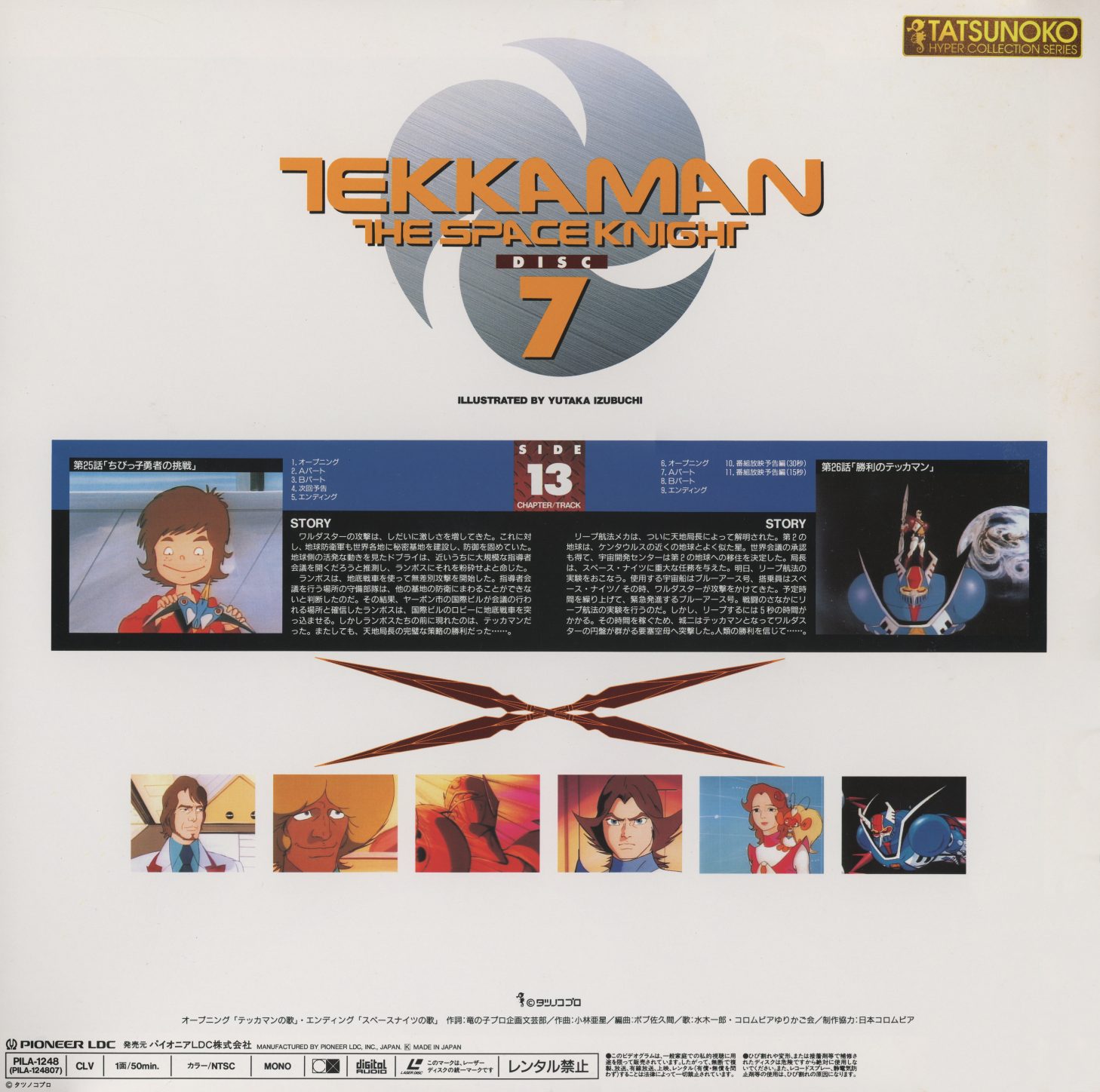 Disc 7 back — DISC 7 / ILLUSTRATED BY YUTAKA IZUBUCHI. SIDE 13: Episodes 25-26 only. Format: 1B/55min — single-sided disc. The final two episodes of the 26-episode run. A row of character stills beneath the story summaries. PILA-1251.
Thirteen Sides
The arithmetic of the set: 26 episodes, 2 per side, 2 sides per disc — except Disc 7, which is single-sided. Six full discs, one partial. The series ran exactly 26 episodes and stopped. The disc count follows the episode count precisely, and the last disc is half-full. Pioneer LDC didn't pad the final disc. The math shows.
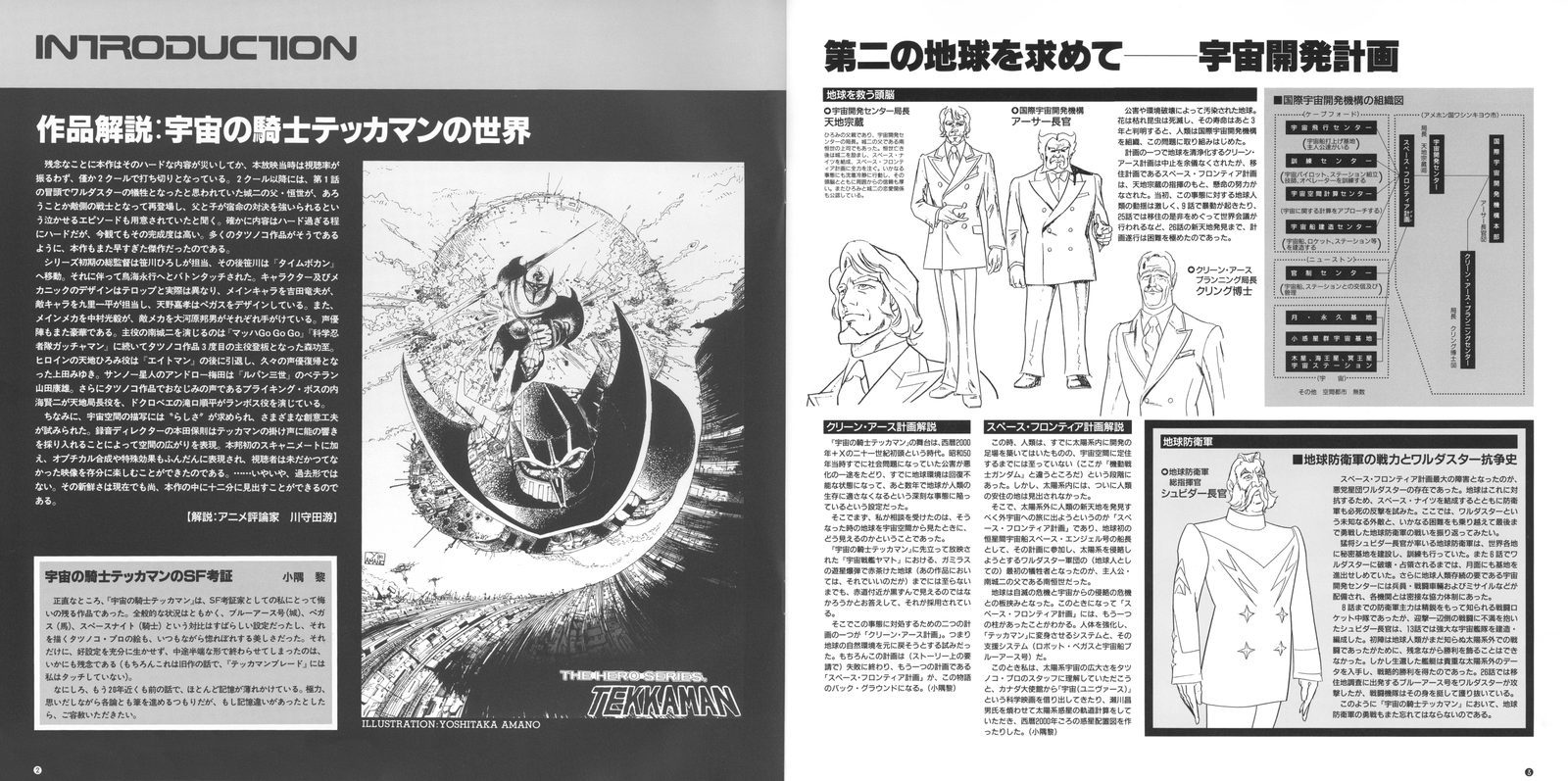 Booklet — INTRODUCTION spread. Left page: series overview (作品解説:宇宙の騎士テッカマンの世界) with a large line-art illustration of Tekkaman, text on the show's SF premise, and a production history note. Right page: 第二の地球を求めて — 宇宙開発計画 (In Search of a Second Earth — Space Development Plan), with character design sheets and a Space Knights organizational chart.
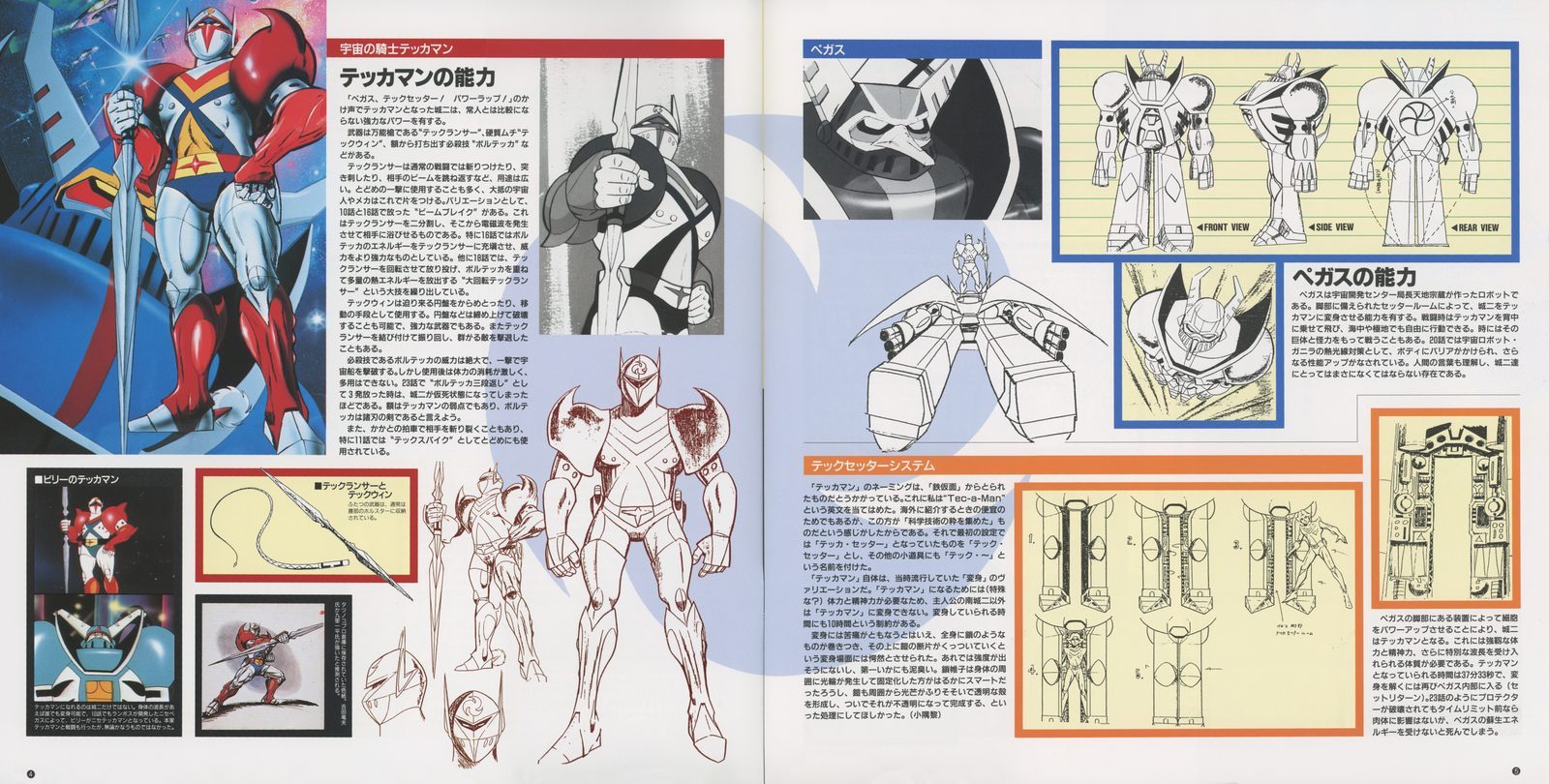 Booklet — テッカマンの能力 / ペガス (Tekkaman's Abilities / Pegas). Left page: Tekkaman suit documentation with front/back/side orthographic views, ability diagrams, and the テッカセット・プロセス (Tekkaman transformation sequence diagram). Right page: Pegas mecha from multiple angles with capability notes and interior schematic references. The documentation format treats the suit as engineering rather than mythology.
The Booklet
The booklet reads as a production bible assembled after the fact — the kind of document that should have existed in 1975 but didn't need to until the show became worth collecting. It covers the Space Knights organization, the Blue Earth mothership in cutaway, the Waldaster enemy faction with individual monster profiles, the rough design history with artist interviews. The booklet is building the show's world with more precision than the original broadcast required, for an audience that arrived twenty years late and wants to understand what they missed.
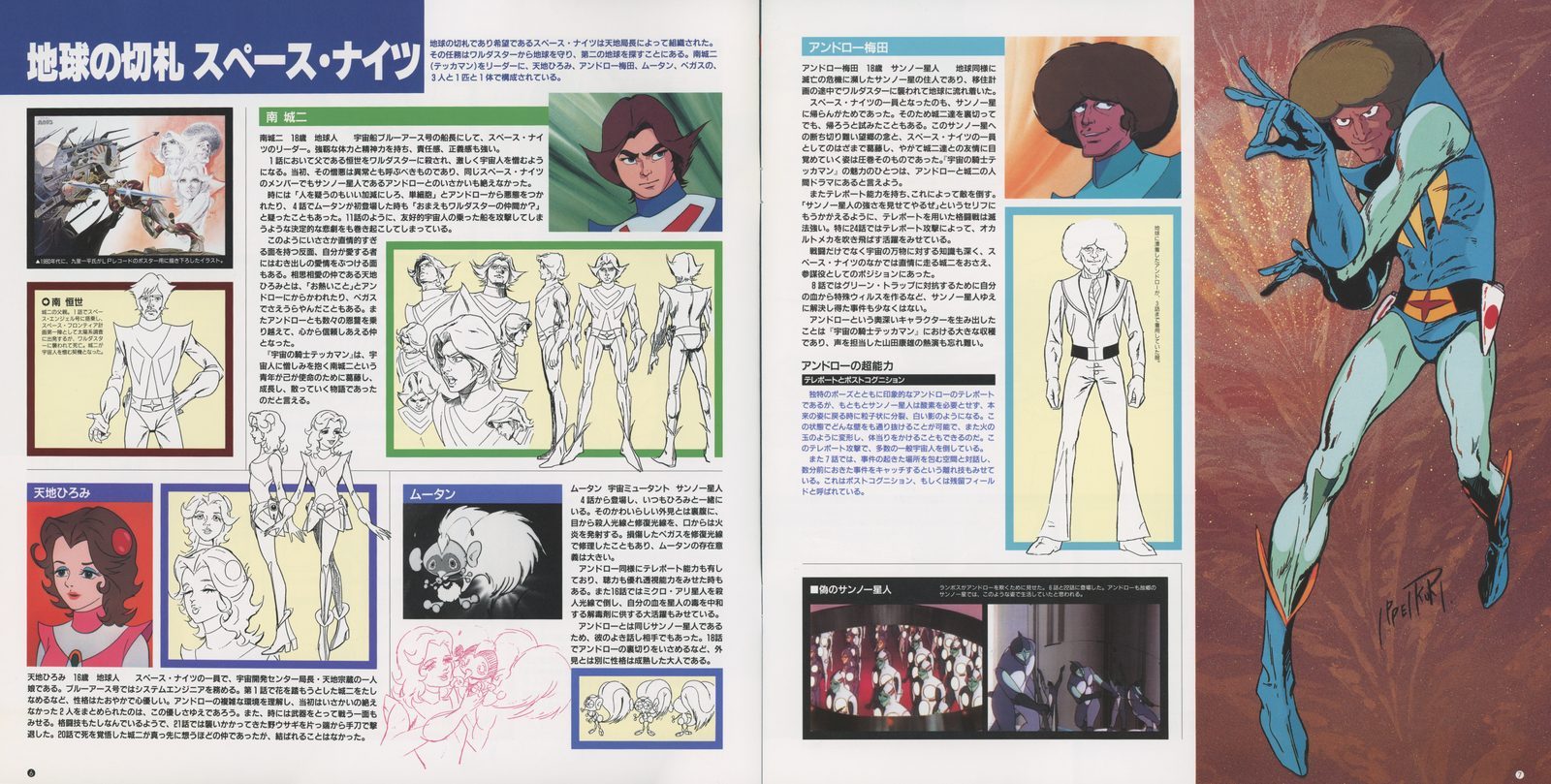 Booklet — 地球の初犯 スペース・ナイツ (Earth's First Defenders, the Space Knights). Left pages: character profile illustrations for the supporting cast with design sheets and biographical notes. Right page: a large color illustration of Android, the Space Knights' alien ally — full figure, rendered in teal and blue, with text notes on his abilities and origin.
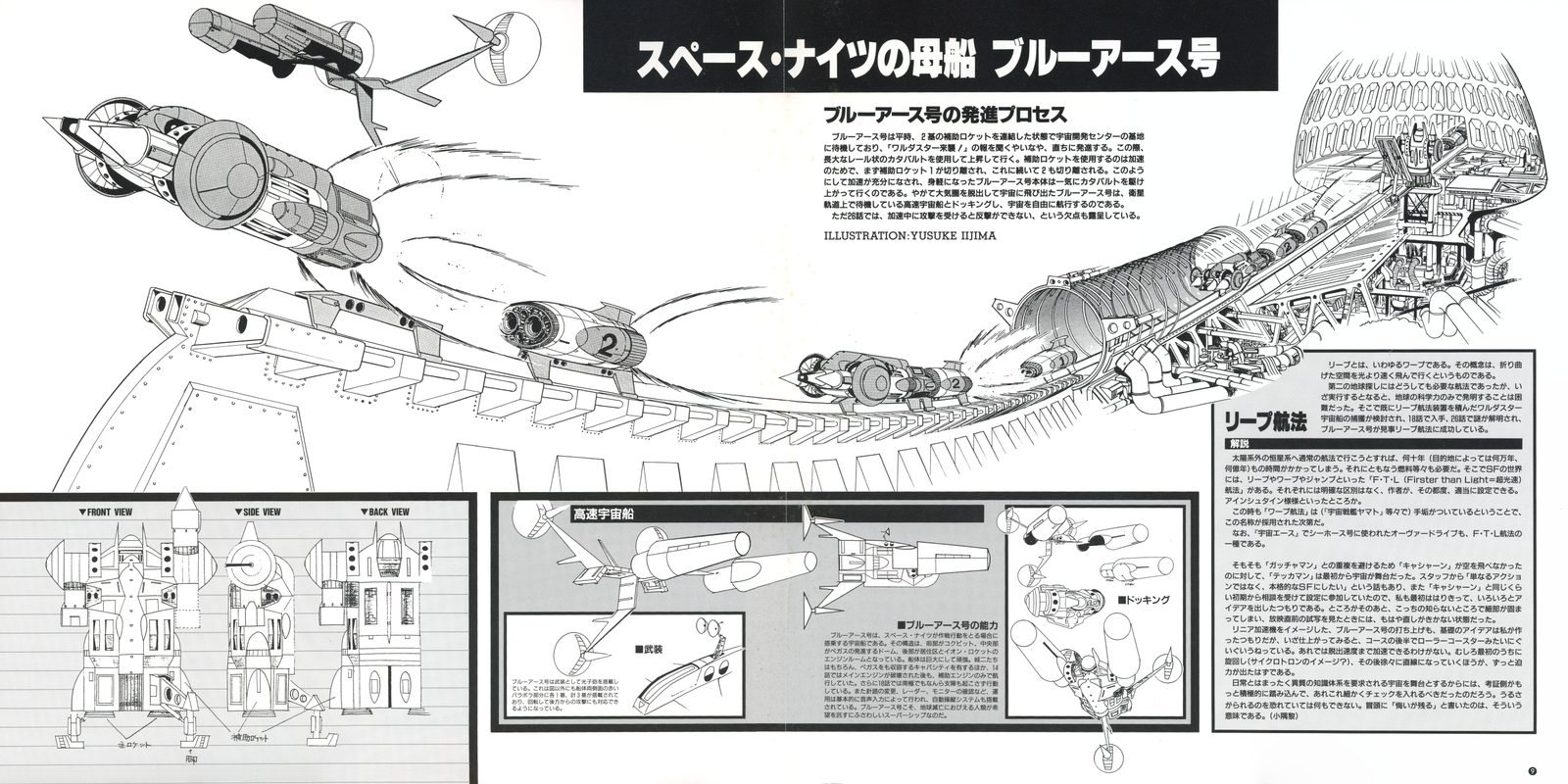 Booklet — スペース・ナイツの母船 ブルーアース号 (The Space Knights' Mothership, Blue Earth). A full-width cutaway diagram of the Blue Earth ship spanning both pages, with three smaller profile views below (Phase 1 / Phase 2 / Phase 3 configurations) and a リーフ基地 (Leaf Base) ground facility diagram. Illustration: Yosuke Ujima.
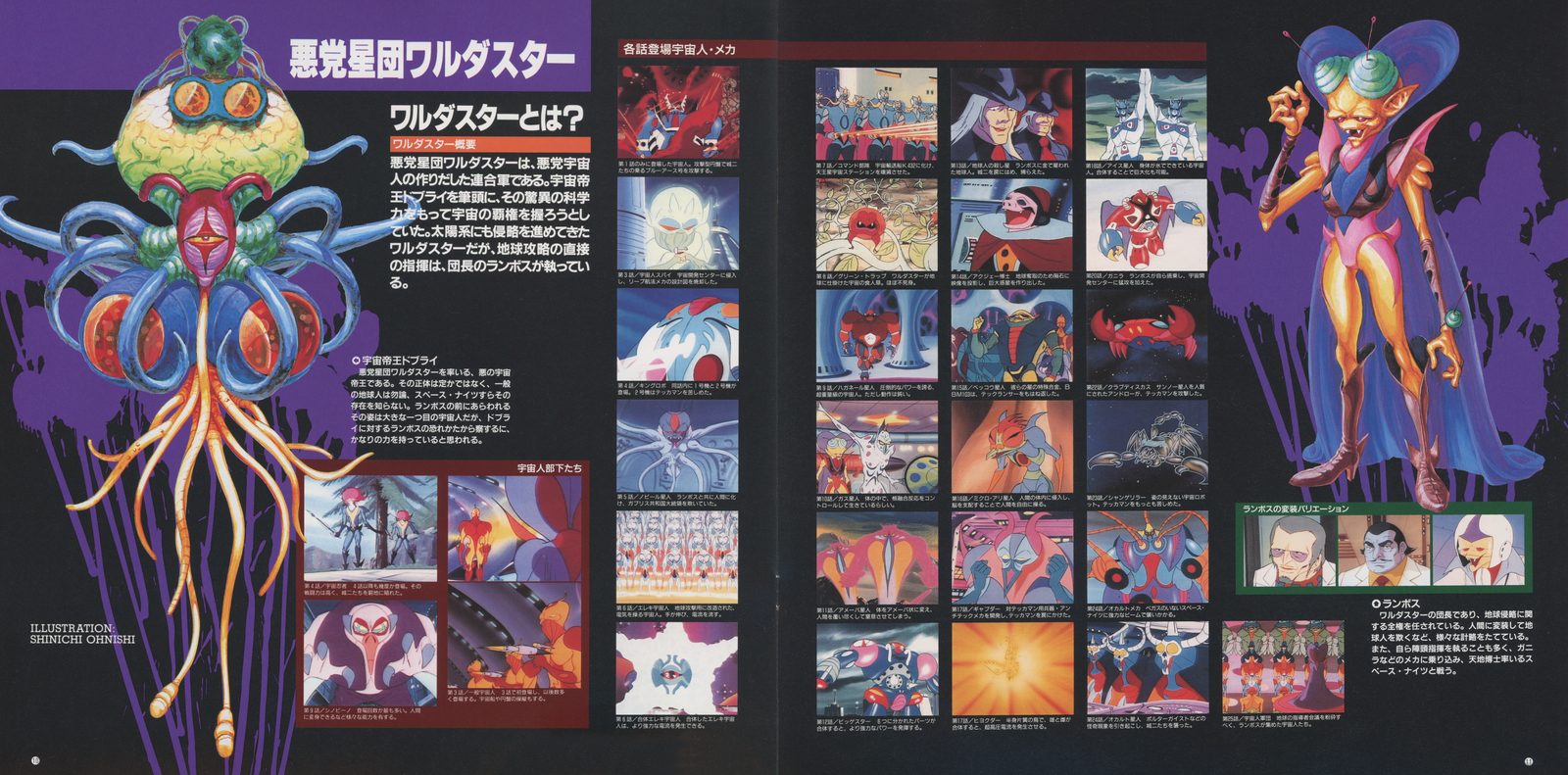 Booklet — 悪党星団ワルダスター (Villainous Star Cluster Waldaster). Left page: full-color illustration of the Waldaster entity — an enormous organic form, tentacled, rendered in violet and green — with a breakdown of the faction's structure and origin. Right page: a grid of film stills documenting each episode's Waldaster creature, plus a character illustration of the female agent Rans. Every enemy, catalogued.
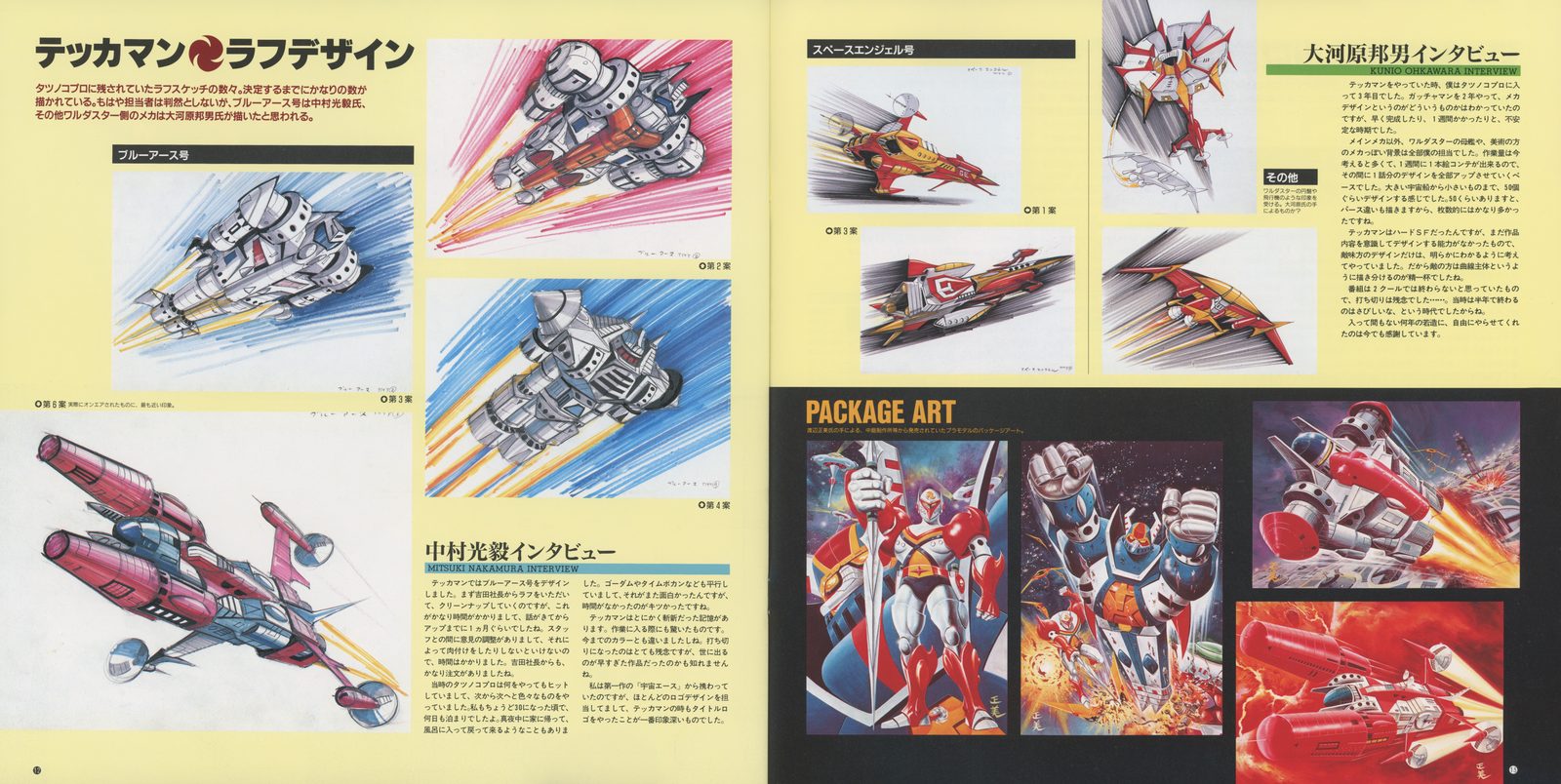 Booklet — テッカマン ラフデザイン / PACKAGE ART. Left page: rough design sketches for the Blue Earth ship and Space Shuttle variants in multiple color studies, plus 中村光毅インタビュー (Mitsuki Nakamura interview). Right page: more vehicle rough designs, 大河原邦男インタビュー (Kunio Okawara interview), and the PACKAGE ART grid — all seven commissioned jacket illustrations reproduced small, with artist credits. The booklet documents the packaging program that produced the jackets.
The Argument in the Grid
The PACKAGE ART section in the booklet reproduces all seven jacket illustrations in a single grid, with each artist named below their image. Seven different aesthetics, seven different relationships to the 1975 material, assembled into a single spread. The booklet is acknowledging what the packaging program actually was: not a home video release, but a curatorial act. An invitation to seven artists who grew up after Tekkaman to decide what it looked like to them.
The original 1975 broadcast was mono. The LaserDisc is mono. Pioneer LDC did not remix, upmix, or remaster the audio. Thirteen sides of 1975 television audio, preserved as it was recorded.
The seven jacket commissions revise the show's cultural placement in a way the audio transfer doesn't attempt. Okawara, Izubuchi, and Ōbari are names that post-Gundam, post-Macross audiences recognize — their jacket illustrations reframe a 1975 Tatsunoko TV series through 1995 mecha design sensibilities. The audio underneath is still the original mono broadcast mix, unaltered.
Loading...