Windaria (ウィンダリア, 1986) — full theatrical title 伝説の巨人, billed on the sleeve as Legend of Fabulous Battle — is an anime theatrical film directed by Kunihiko Yuyama (later the director of the Pokémon film series) and scripted by Keisuke Fujikawa, whose credits stretch across decades of tokusatsu and anime. The story is a fantasy war tragedy set between two feuding kingdoms. Isu, a young farmer from a neutral village, is seduced by promises of power centered on a mythological windmill called Windaria. He abandons his wife Marin, betrays his neighbors, and discovers the promises were hollow. Running alongside his story: a doomed romance between Jihl and Arunas, the heirs of the two warring nations. Both plots end in loss. The film is about what ambition costs the people who stay behind.
Character design and visual direction were by Mutsumi Inomata (いのまたむつみ), whose delicate fashion-forward illustration style defined the look of 1980s fantasy anime across dozens of games and productions. Her involvement here went beyond character sheets — she also supervised the film's visual image-boarding, an unusually integrated role. The film was released internationally as Once Upon a Time, with scenes reedited to soften the conclusion. It never found significant Western distribution and remains almost entirely undocumented in English.
The Lasero/Film House LaserDisc (SBLL-24) is the 特別篇 — Special Edition — and it includes something no later release has replicated: a pilot film on Side B.
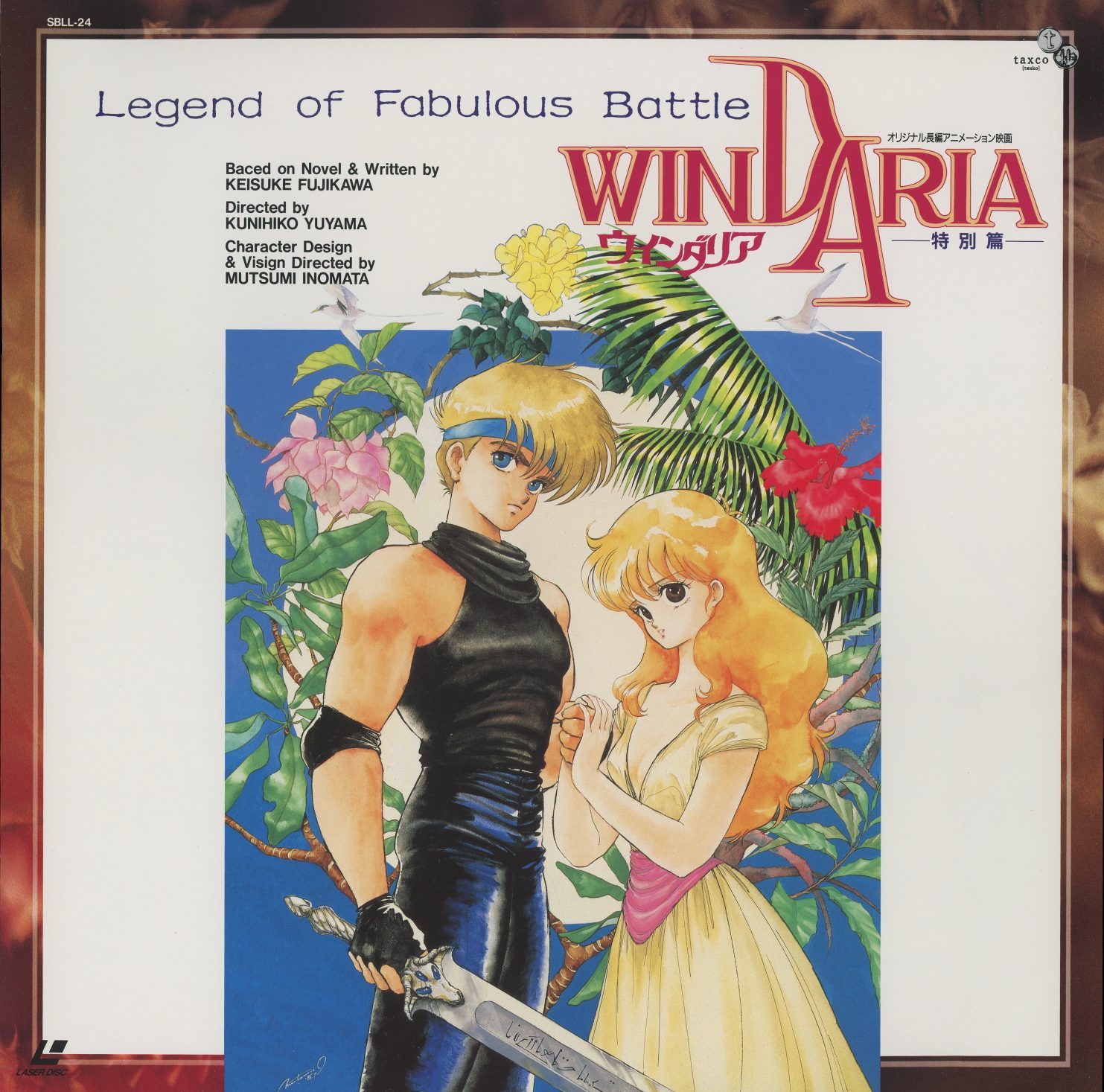 Front jacket — Windaria 特別篇 / Legend of Fabulous Battle. Isu (blonde warrior) and Marin (his wife) against a backdrop of tropical flowers. Credit block top left: Based on Novel & Written by Keisuke Fujikawa / Directed by Kunihiko Yuyama / Character Design & Vision Directed by Mutsumi Inomata. SBLL-24. Lasero.
Two Couples, Two Covers
The front jacket shows Isu and Marin — the story of betrayal and the person left behind. The disc back shows Jihl and Arunas — the story of sacrifice between enemy heirs. The packaging distributes both tragic threads across its own exterior, one couple per face. The film's international releases emphasized the fantasy setting. The LD leads with its people.
SBLL-24. Lasero/Film House. ¥5,000 retail. CLV, 2-sided, 113 minutes, Color NTSC, Stereo, Digital. 1986 theatrical film. The chapter listing on Side B reads: Chapter 1 — ウィンダリア 本編 (main film continued) / Chapter 2 — 劇場予告篇 (theatrical trailer) / Chapter 3 — パイロットフィルム.
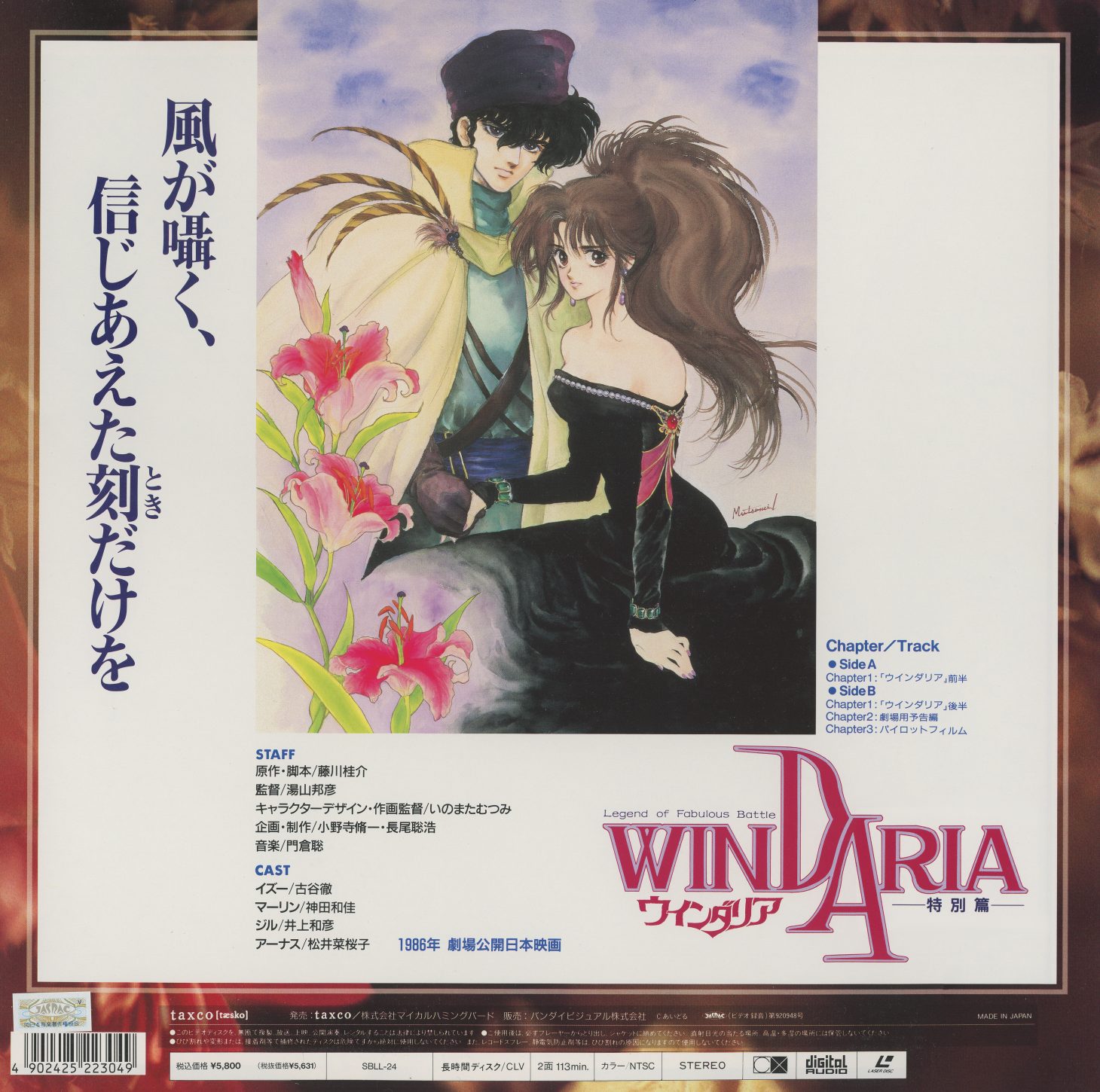 Disc back — Jihl and Arunas, the rival-kingdom lovers. Tagline: 風が囁く、信じあえた刻だけを (The wind whispers, only the moment we trusted each other). Chapter/Track listing for Side B includes the theatrical trailer and the pilot film. Staff, cast, and format specifications. ¥5,000, 1986.
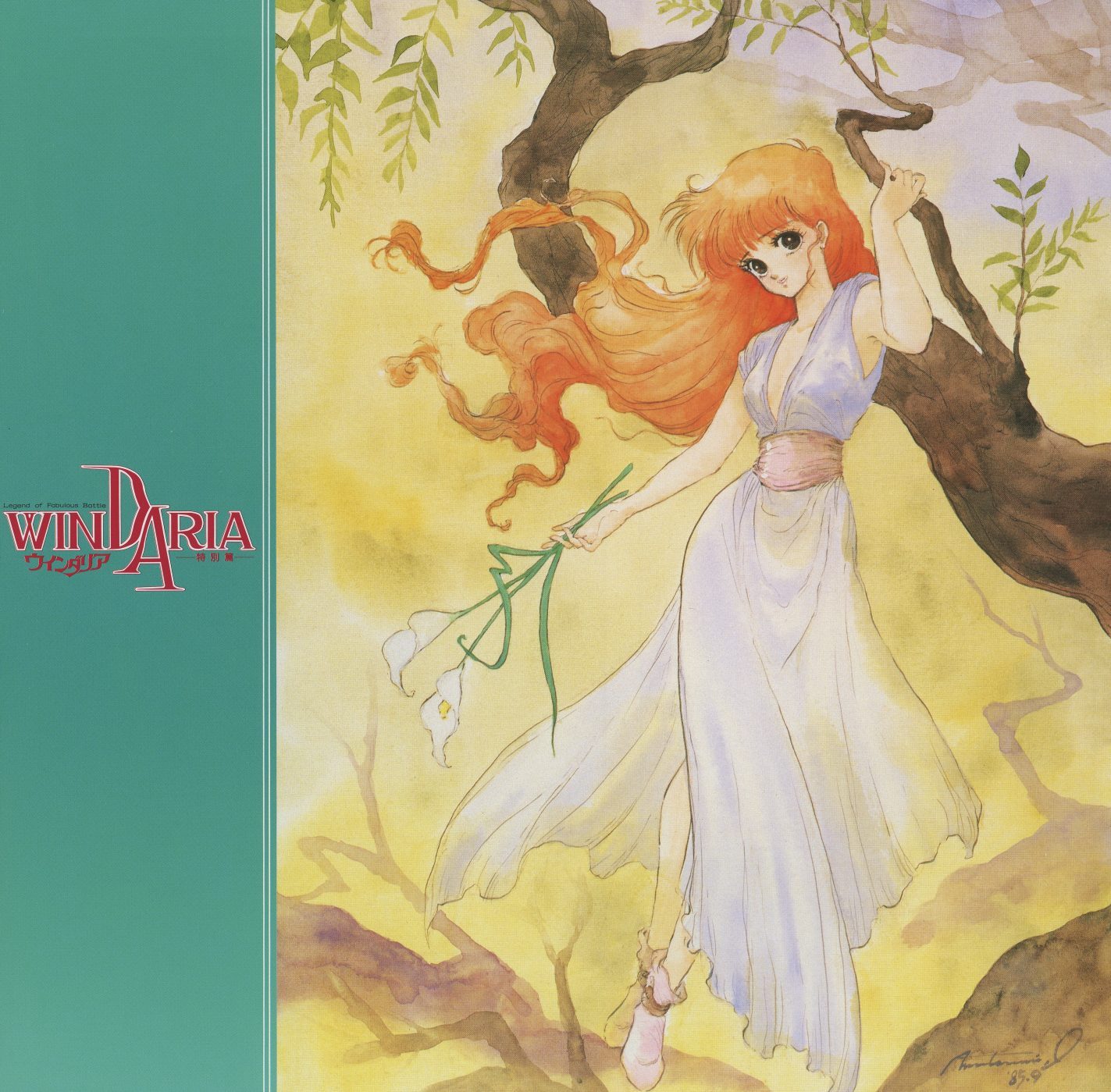
Gatefold interior, left panel — Mutsumi Inomata. Marin alone, standing by a weeping willow, white calla lilies in her hands, soft golden light. Watercolor register, no warrior, no war. Inomata painted the film's emotional center: what Isu left behind. Signed lower right.
Disc back — Jihl and Arunas, the rival-kingdom lovers. Tagline: 風が囁く、信じあえた刻だけを (The wind whispers, only the moment we trusted each other). Chapter/Track listing for Side B includes the theatrical trailer and the pilot film. Staff, cast, and format specifications. ¥5,000, 1986.
Gatefold interior, left panel — Mutsumi Inomata. Marin alone, standing by a weeping willow, white calla lilies in her hands, soft golden light. Watercolor register, no warrior, no war. Inomata painted the film's emotional center: what Isu left behind. Signed lower right.
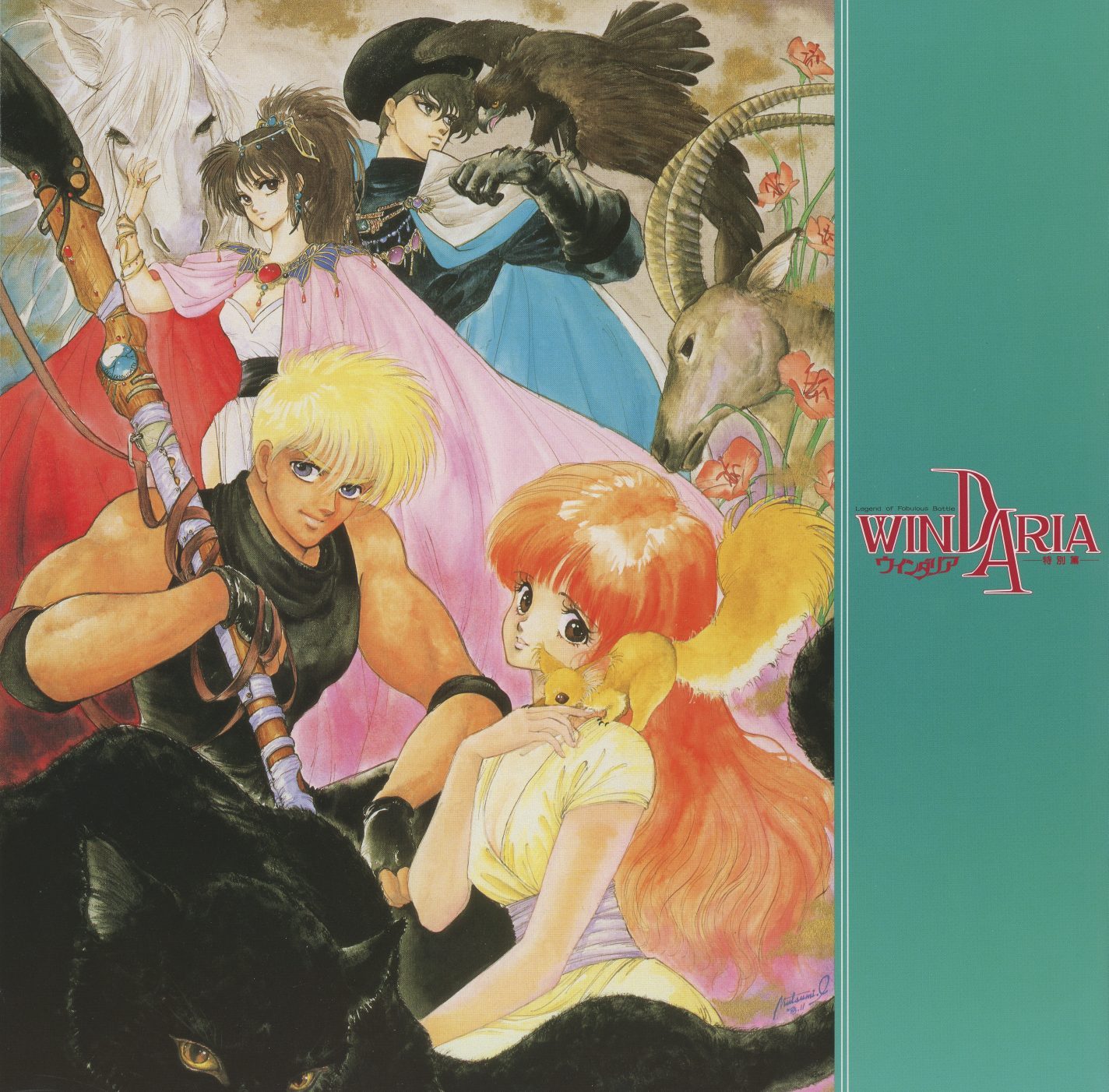 Gatefold interior, right panel — Mutsumi Inomata. Full cast ensemble: Isu and Marin in the foreground, Jihl and his companion with hawk and deer behind them, a black cat at the base. All four principal characters in one composition. The gatefold holds both panels as a diptych — solitude on the left, ensemble on the right.
The Pilot Film
The theatrical trailer is standard. The パイロットフィルム is not. Pilot films for theatrical anime features — pre-production animation produced to pitch and secure funding — rarely survive into home video releases. This one is on Side B of a single CLV disc from 1986. It predates the final character designs, predates the locked cut, predates whatever compromises a production makes between pitch and delivery. No subsequent commercial release of Windaria has included it. The 特別篇 designation earned its name.
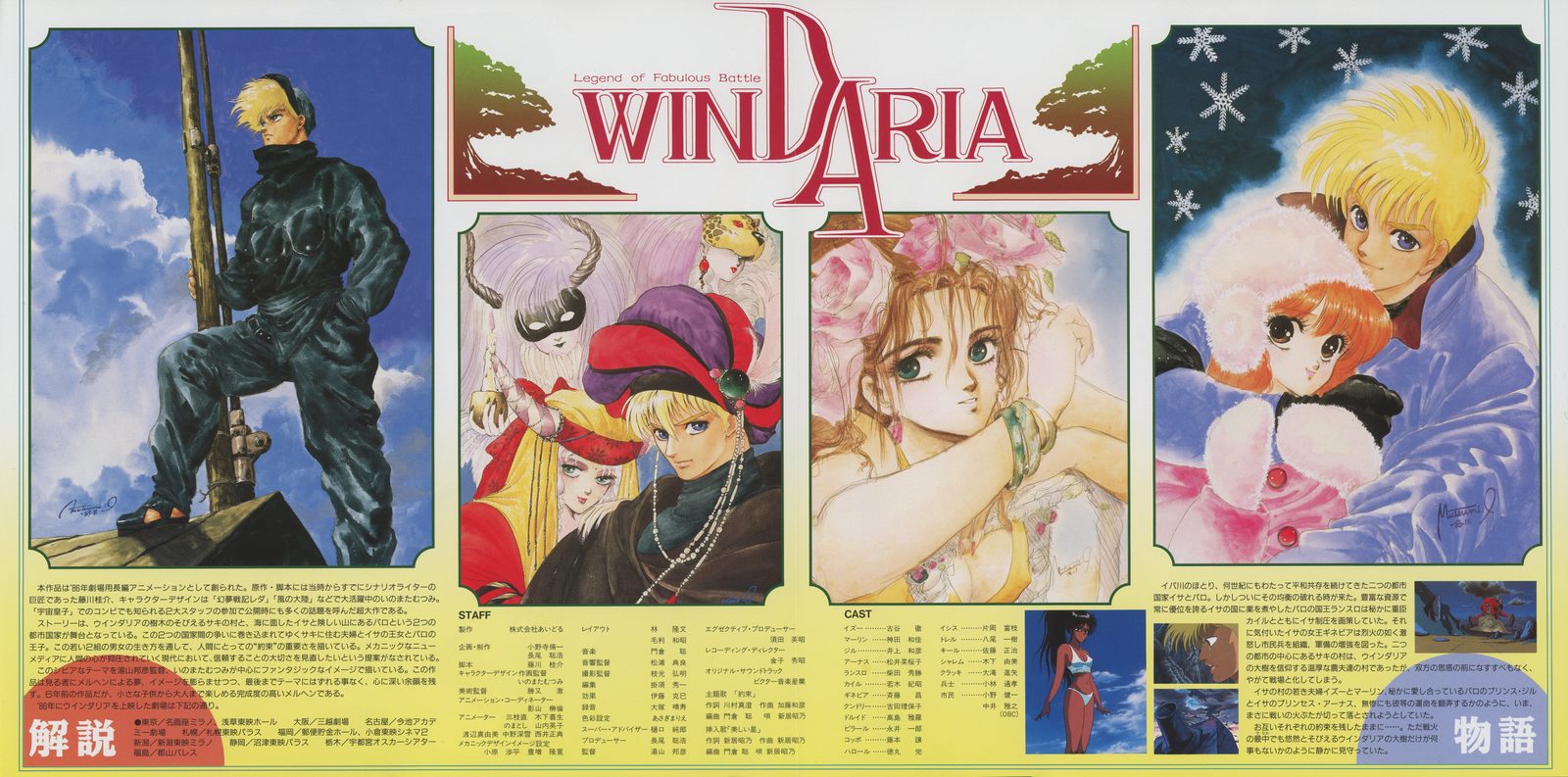 Liner spread — panoramic fold-out. Left: Isu in full warrior kit against a cloudy sky. Center: WINDARIA title with four character portrait illustrations (Isu, Jihl, Arunas, Marin and Isu embracing) and the full STAFF / CAST credit grid. Right: Isu and Marin in a winter night composition, snowflakes falling. 解説 (synopsis) and 物語 (story) sections at the bottom margin.
Mutsumi Inomata did not design Windaria's characters and then hand them off. She also supervised the image-boarding — the visual language of the film before a single frame was animated. Her gatefold illustrations are the most complete presentation of that investment in a physical object: not promotional art, not marketing, but the film's emotional argument held in two panels that open when you pick up the disc.
The pilot film on Side B is the version that preceded all of that. Earlier designs, different decisions, the pitch that became the film. It is on a CLV disc pressed in 1986 for ¥5,000, and it has not been officially available since.
Loading...