Four individual CAV LaserDiscs — BEAL-694~697, Bandai Visual / Emotion label, ¥5,500 per volume — released between September 1994 and early 1995 for the four-episode You're Under Arrest OVA (逮捕しちゃうぞ). Thirty minutes per disc. One episode per disc. Each volume in a gatefold sleeve with a printed booklet. Kōsuke Fujishima illustrations are on the jacket front. Also on the jacket back. Also in the gatefold interior. Eight total.
Miyuki Kobayakawa and Natsumi Tsujimoto are traffic patrol women at Bokuto Police Station in eastern Tokyo. Miyuki is the quiet one — a mechanical genius who maintains the patrol Honda Today herself, bored and turbocharged. Natsumi is the biker, arriving on her first day on a Honda Motocompo folding scooter that lives in the car's boot, immediately issued a traffic citation by Miyuki before they realize they're partners. Kōsuke Fujishima had been drawing the manga in Young Magazine since 1986; Oh My Goddess! launched in 1988. By 1994 his style was fully formed — clean line, warm palette, vehicles drawn from mechanical reference. Director Kazuhiro Furuhashi at Studio Deen, character design adapted by Atsuko Nakajima, who had spent the previous decade on Urusei Yatsura and Ranma ½. The OVA came two years before the TV series. What's on these discs are the original, unedited versions of all four episodes.
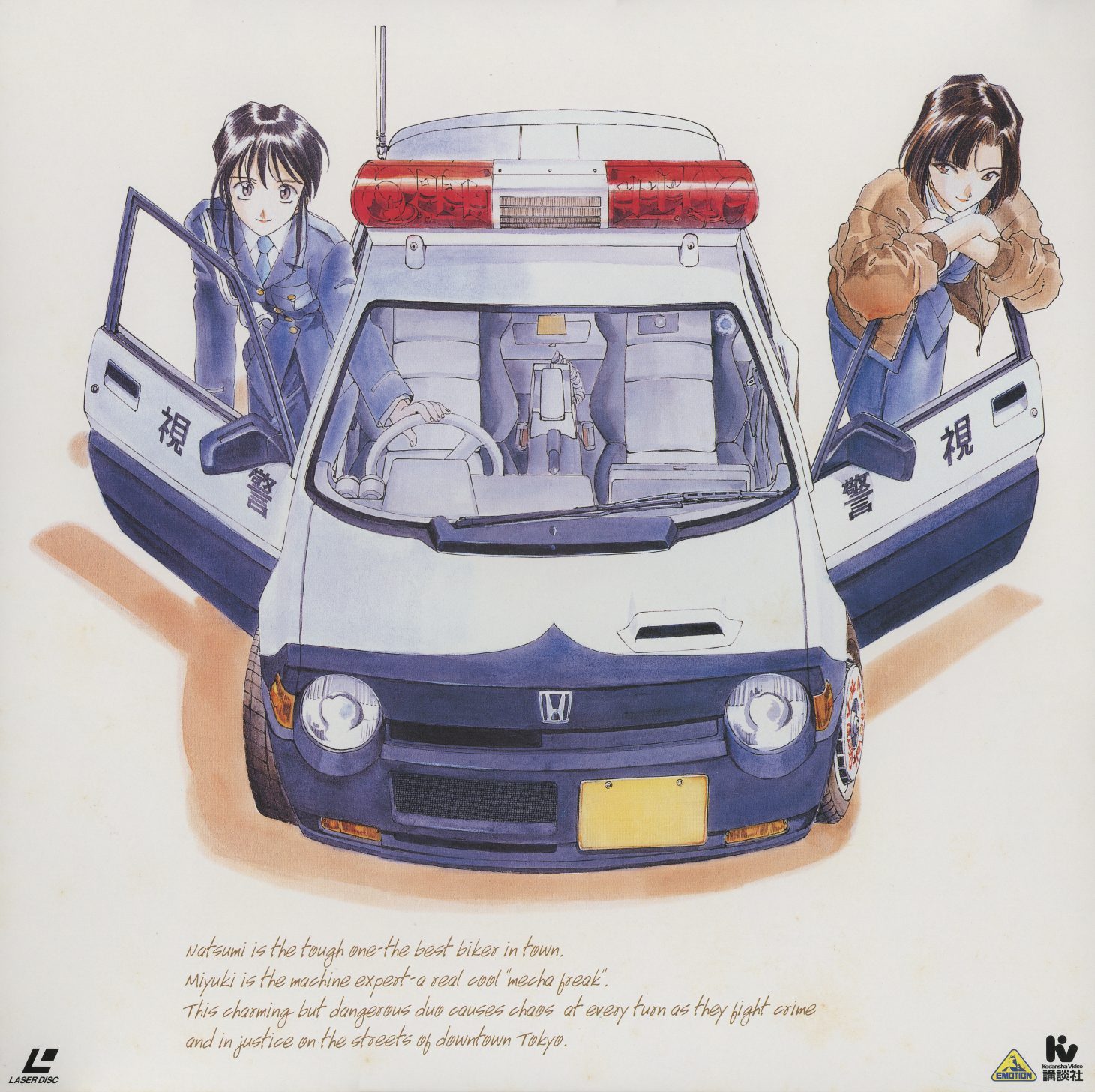
Bandai Visual treated the packaging as an extension of the illustration work. Every volume has two full Fujishima paintings — front jacket and outer back — plus a gatefold interior panel tracking the series' romantic subplot, plus a production booklet with MECHANICS vehicle reference spreads and INTERVIEW DESIGN WORKS documentation. File 1's front is a summer swimsuit illustration; its back is the Motocompo in watercolor. File 2's front is Miyuki and Natsumi beside a Toyota Sports 800. File 3 is a red-jacketed motorcycle illustration. File 4 is both women in full police uniform flanking their Honda Today. Every back jacket carries the same credit, in Fujishima's own handwriting: Based on the Manga by Kōsuke Fujishima.
Four Files, Four Canvases
Kōsuke Fujishima had been drawing You're Under Arrest since 1986. By 1994 his character style was fully settled — the slightly elongated proportions, the warm line weight, the vehicles drawn from reference rather than memory. Bandai Visual gave him not one cover but two per disc: a front jacket illustration and a full illustration on the outer back panel. Eight paintings across four volumes. Each one places the same characters in a completely different register. File 1's front — Miyuki and Natsumi in summer swimsuits on a small red car — shares no visual language with File 4's — both women in full uniform, in-service, standing either side of the Honda Today. Same artist. Same characters. Four years of the same ongoing manga. Four distinct emotional angles.
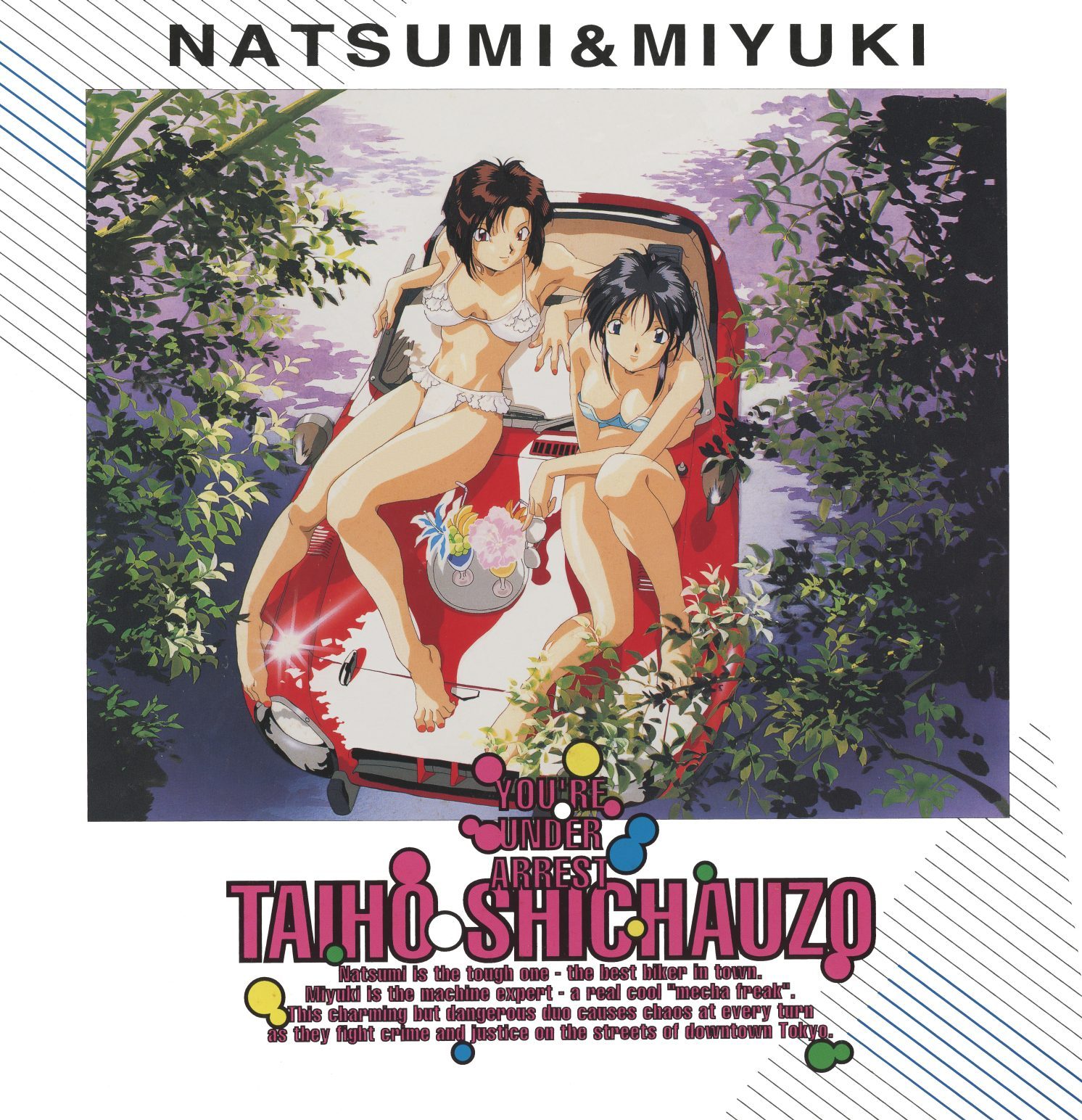 File 1 front jacket — Miyuki and Natsumi in summer civilian wear on a kei car. BEAL-694. September 1994. 'NATSUMI & MIYUKI' header. Illustration by Kōsuke Fujishima.
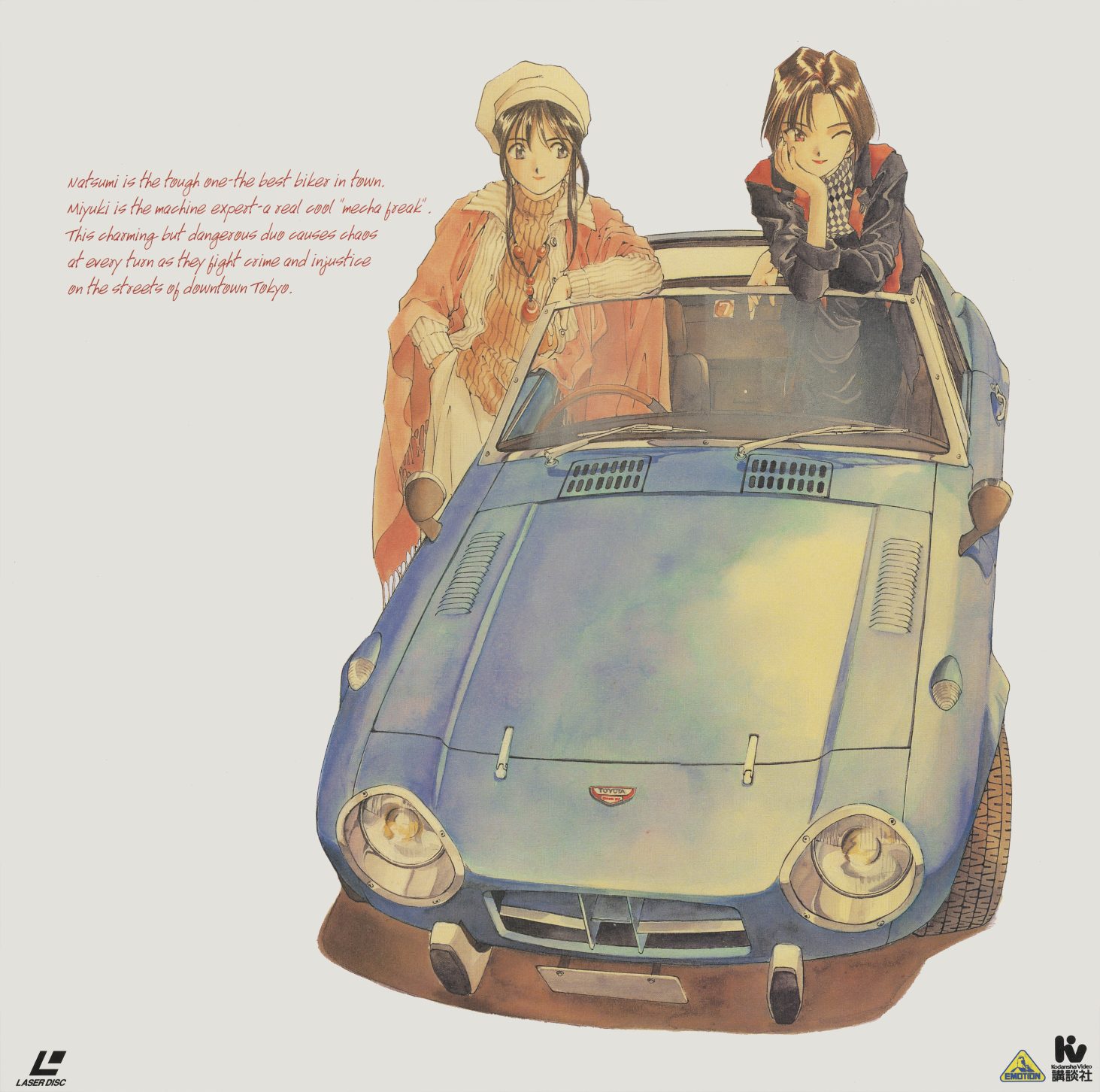 File 2 front jacket — Miyuki and Natsumi with a Toyota Sports 800, Miyuki's personal car. BEAL-695. Autumn civilian wear. File 2: 'Tokyo Typhoon Rally.'
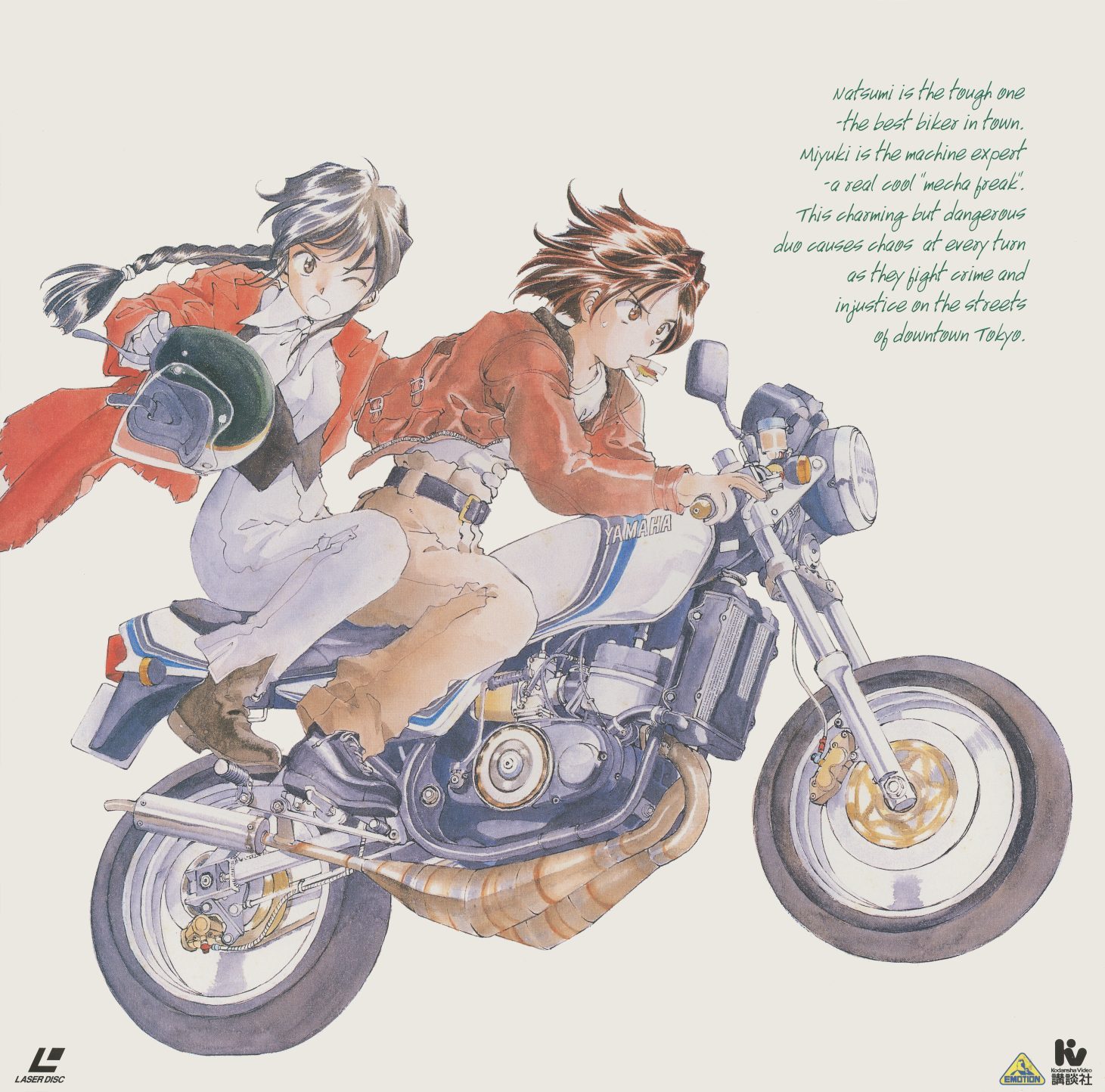 File 3 front jacket — Natsumi and Miyuki in matching red jackets on a large motorcycle. BEAL-696. File 3: 'Highway Star Romance.'
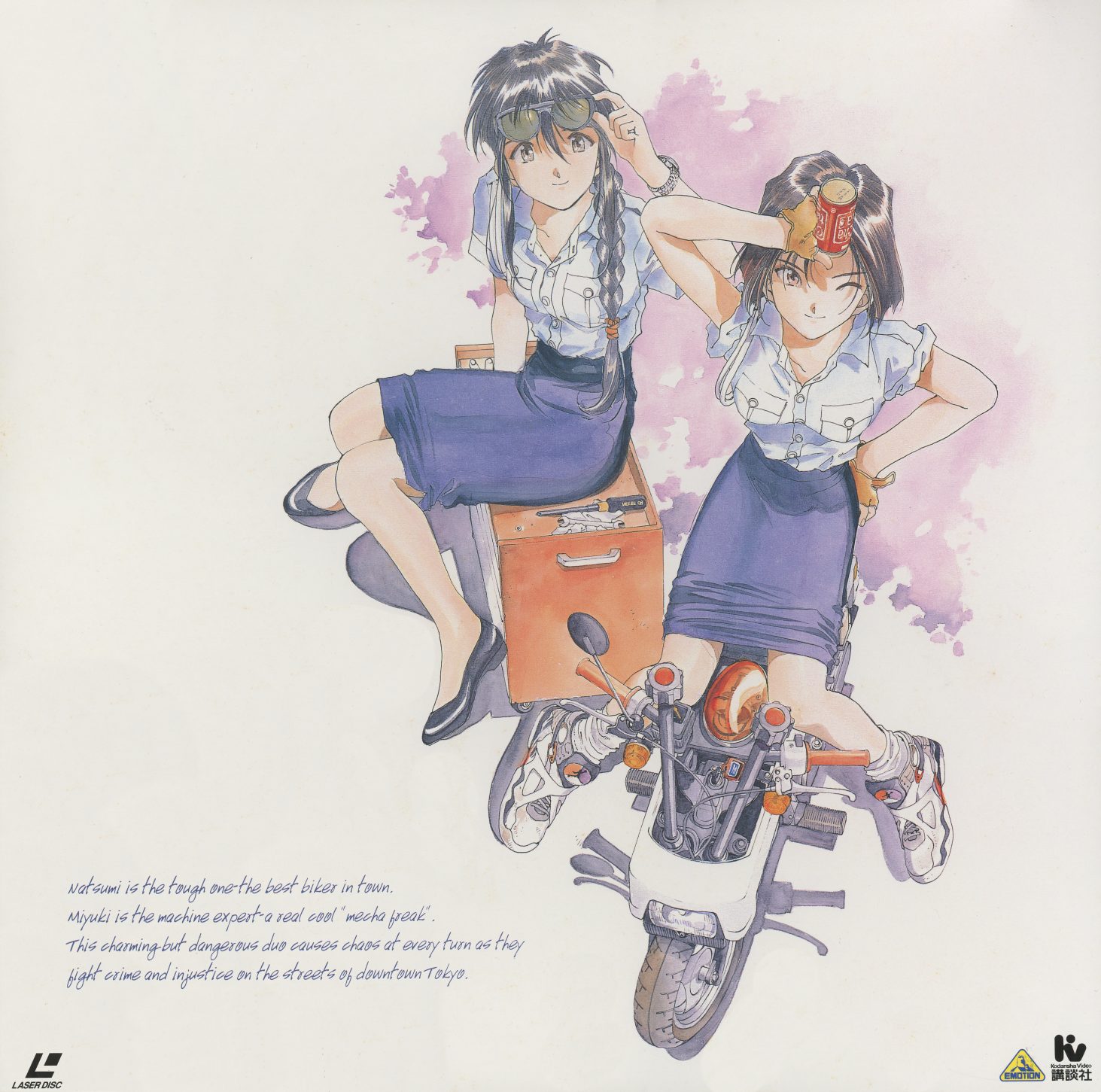 File 1 outer back jacket — Miyuki and Natsumi in police uniform on the Honda Motocompo folding scooter, watercolor on white. A full Fujishima illustration, not a promotional composite. Bandai Visual / Emotion / Kodansha logos.
The Alternate Panels
The outer back jacket of each disc is a full Fujishima painting in a different register from the front. File 1's back — Miyuki and Natsumi on the Honda Motocompo — is rendered in delicate watercolor wash against a white ground. No background. No title treatment. Just the illustration, the series logos, and the LaserDisc imprint. The wheels on the Motocompo are detailed correctly. The postures belong to people who know how to ride. Fujishima's line work in this period is precise and unhurried, and the packaging uses it with the same restraint — no marketing copy competes. File 2's back carries a warm autumn portrait of Natsumi and a third character looking outward. File 3's back is Miyuki and Ken in a quiet close-up, blue sky, no police context. File 4's back is the Honda Today with its roof lights on. The front shows who they are off-duty. The back shows something else.
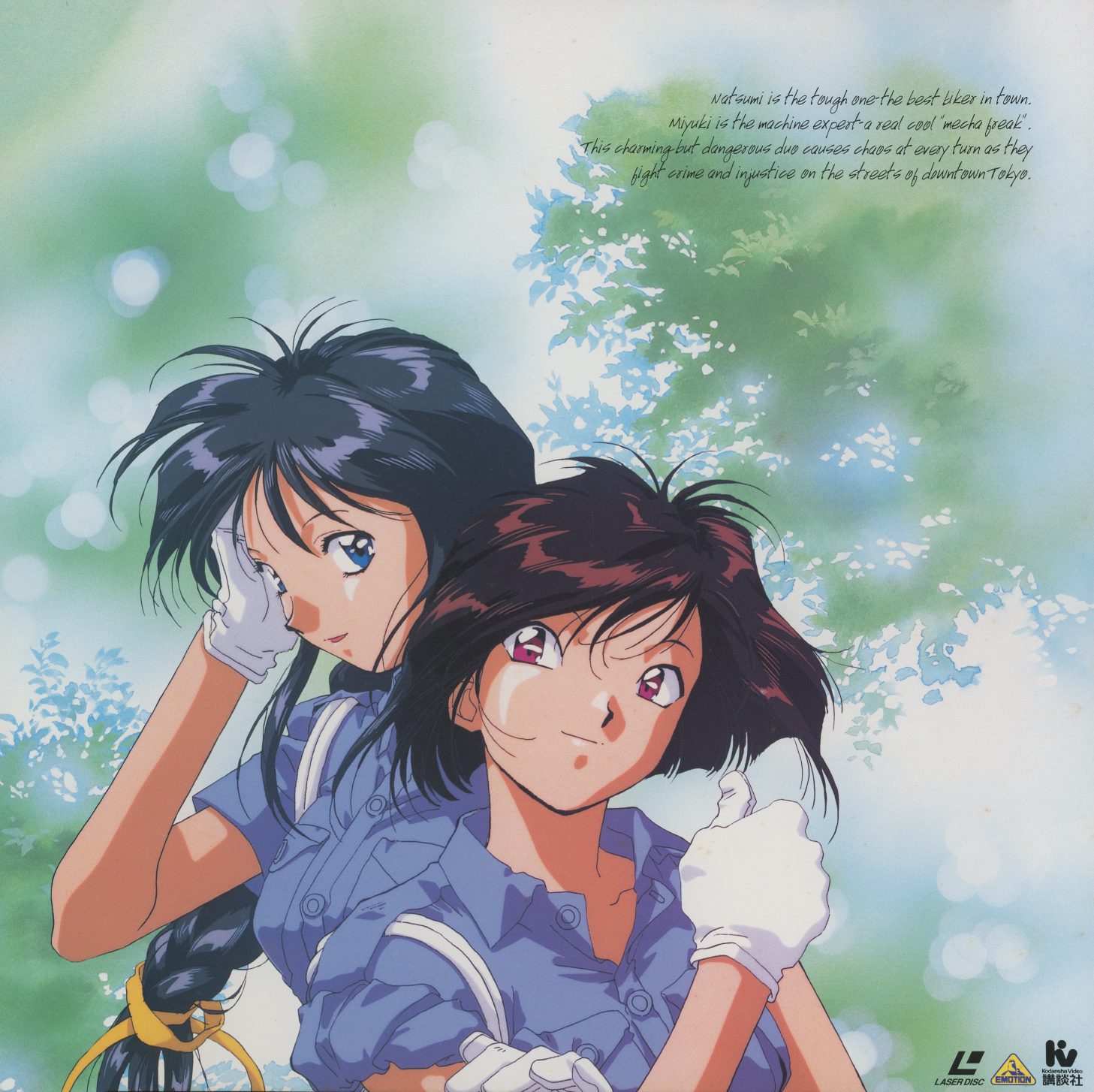 File 1 gatefold interior panel — Miyuki and Natsumi in police uniform, soft-focus green background. Full Fujishima illustration. One of two facing interior panels when the File 1 sleeve is opened.
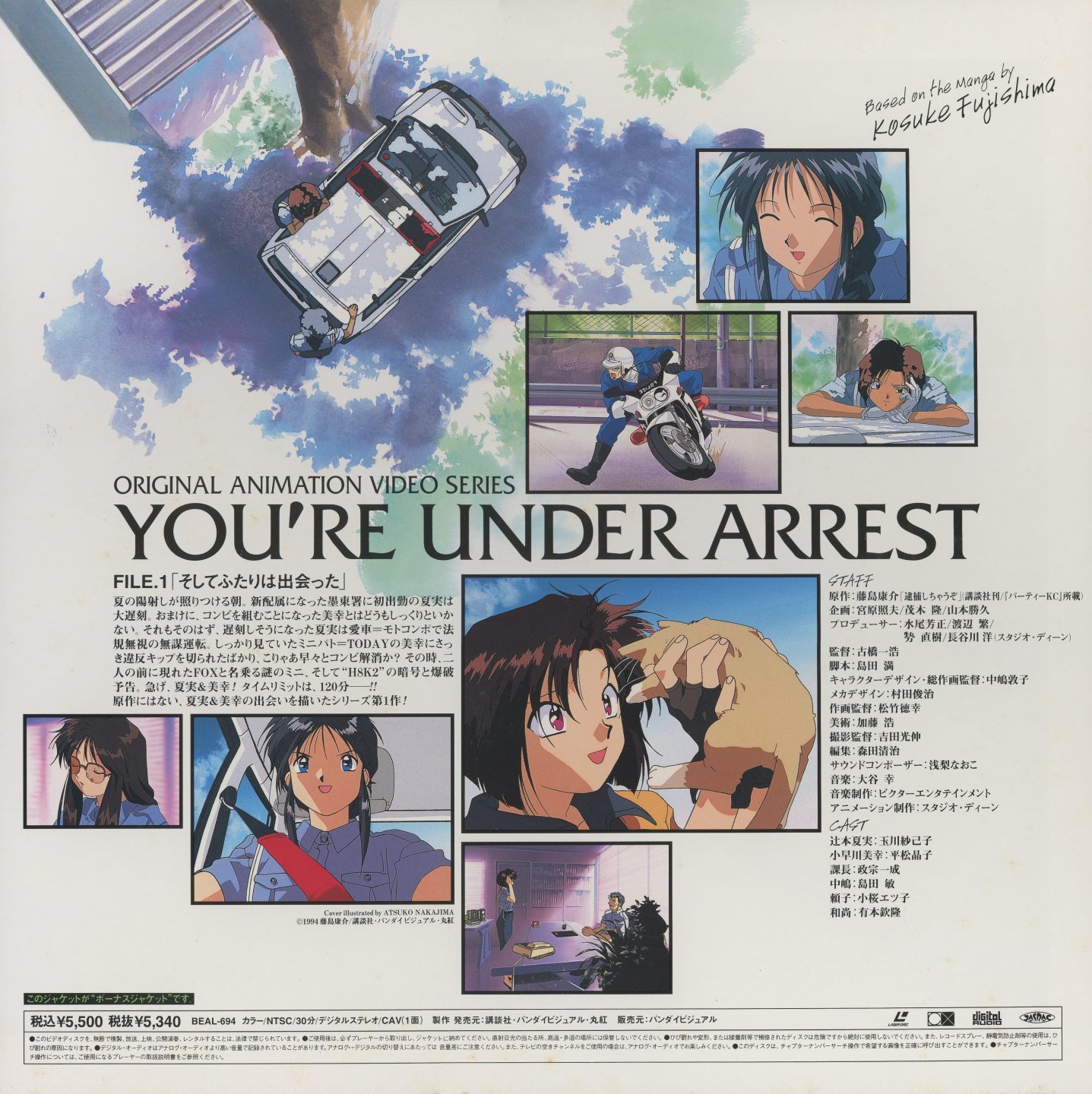 File 1 gatefold interior — episode stills collage with production text for 'そしてふたりは出会った' (And So They Met). The two interior panels face each other when the sleeve is opened: art on one side, production documentation on the other.
Based on the Manga
Every back jacket carries one line in Fujishima's own handwriting: Based on the Manga by Kōsuke Fujishima. Not a standard production credit placed in the spec block — a designed element, in the illustrator's personal script, positioned on each disc's back panel. The manga was still running in 1994; the OVA is mid-series, not a retrospective. Placing the authorship credit this visibly is a statement: these four discs belong to Fujishima's ongoing work, not to Bandai Visual's catalog. The source material is the artist, not the franchise. Every disc says so before you open the sleeve.
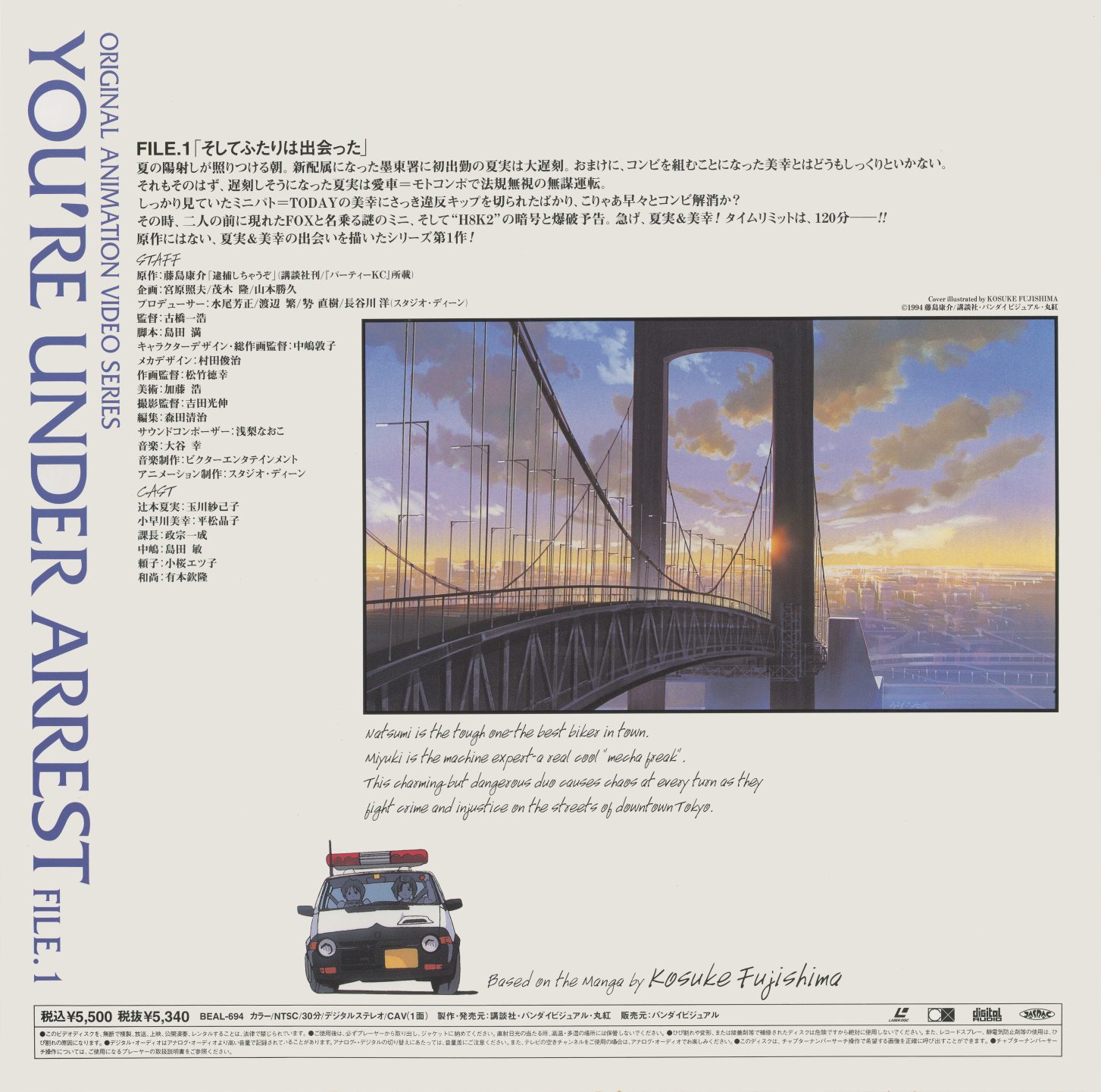 File 1 back jacket — BEAL-694, ¥5,500 / ¥5,340, CAV, 30 minutes, digital stereo. Episode stills from 'そしてふたりは出会った.' 'Based on the Manga by Kōsuke Fujishima' in Fujishima's handwriting. Tokyo bridge at sunset, background art from the episode.
The Mechanics Spread
Every file's booklet includes a MECHANICS spread — two pages formatted as a manufacturer's catalog. File 1 covers four vehicles: the Honda Today Type-G Police with Miyuki's modifications listed (turbocharged, retuned suspension, Volk Racing wheels), the Honda Moto Compo (fold and stowage diagrams), the Suzuki GSX-R750, and the Mini ERA Turbo (the episode antagonist's car). Multiple viewing angles, specification callouts, production notes on how each machine was used in the episode. Fujishima's manga is organized around this kind of research — the Today's engine modifications are mechanically coherent, the Motocompo stowage procedure is accurate. The MECHANICS booklet makes that research explicit as packaging. You're Under Arrest and Gunsmith Cats' Hard Shots spread were doing the same thing the same year, from the same impulse: the work was built on this knowledge, and the packaging should prove it.
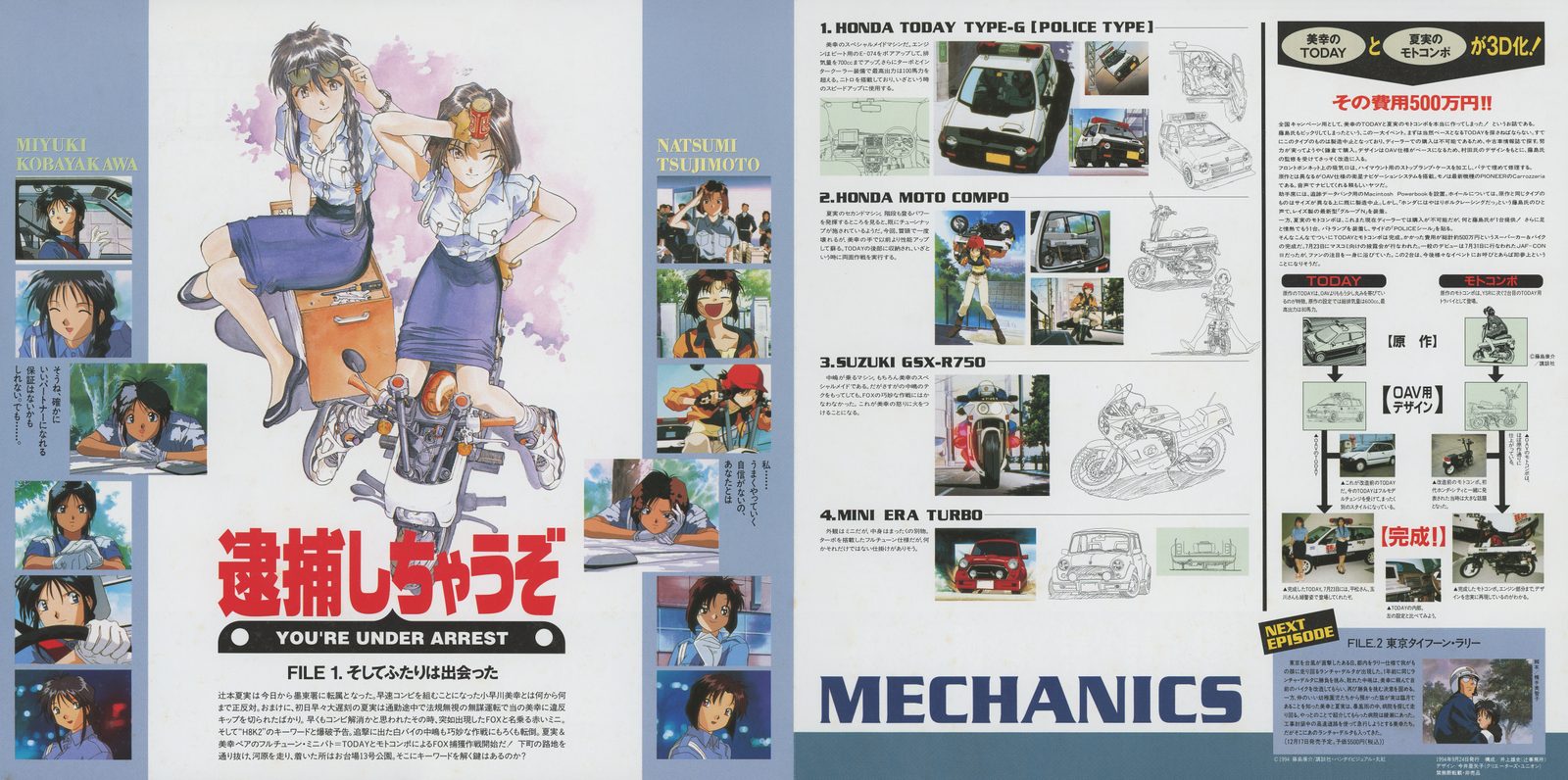 File 1 booklet — 'MECHANICS' spread. Four vehicles documented: Honda Today Type-G Police, Honda Moto Compo, Suzuki GSX-R750, Mini ERA Turbo. Multiple angles, spec notes, production callouts. Right side of a two-page booklet spread.
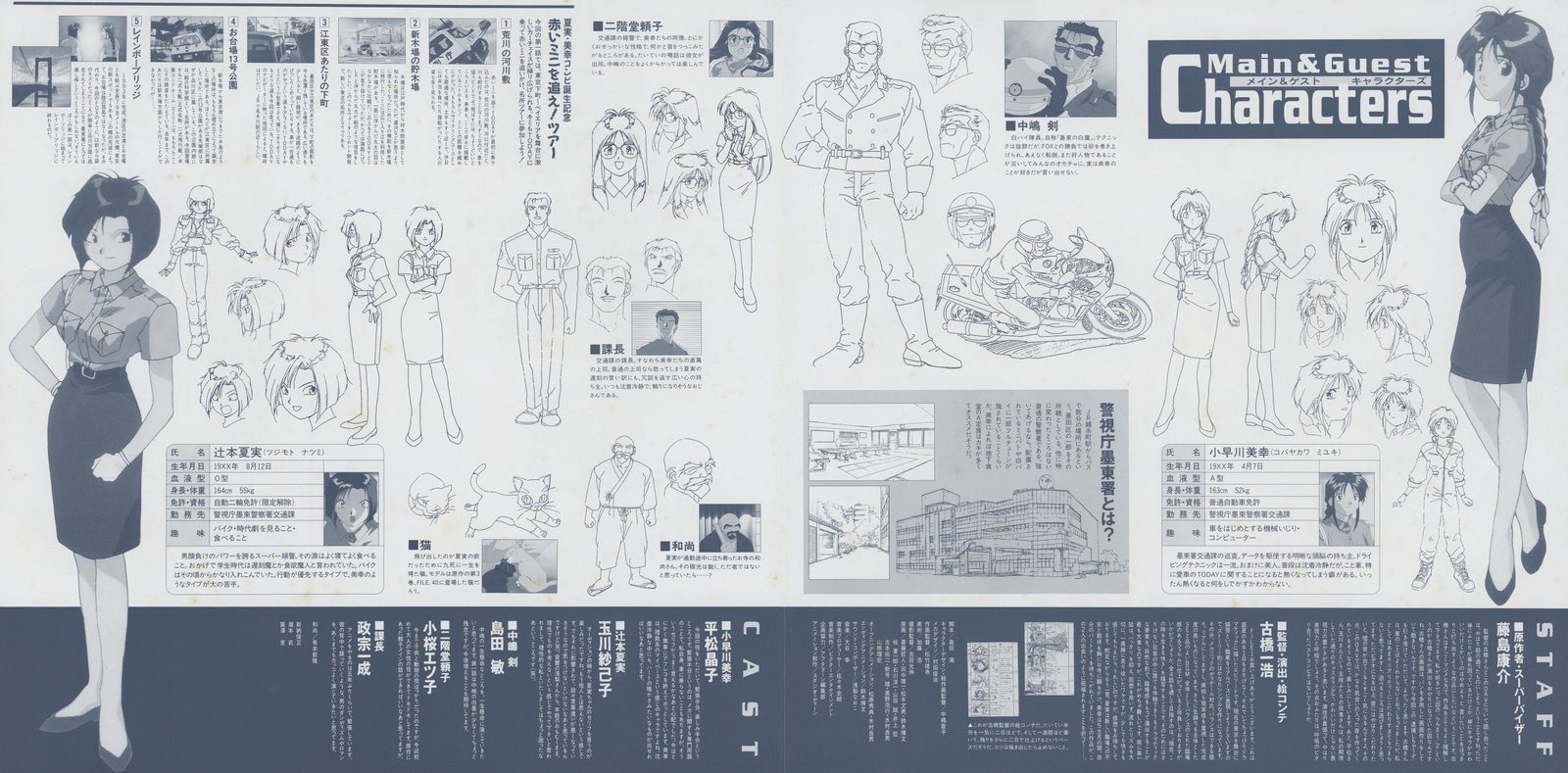 File 1 booklet — 'Main & Guest Characters' settei spread with Cast and Staff listing. Character design: Atsuko Nakajima. Director: Kazuhiro Furuhashi. Animation production: Studio Deen. Full episode guest character profiles and mechanical designs.
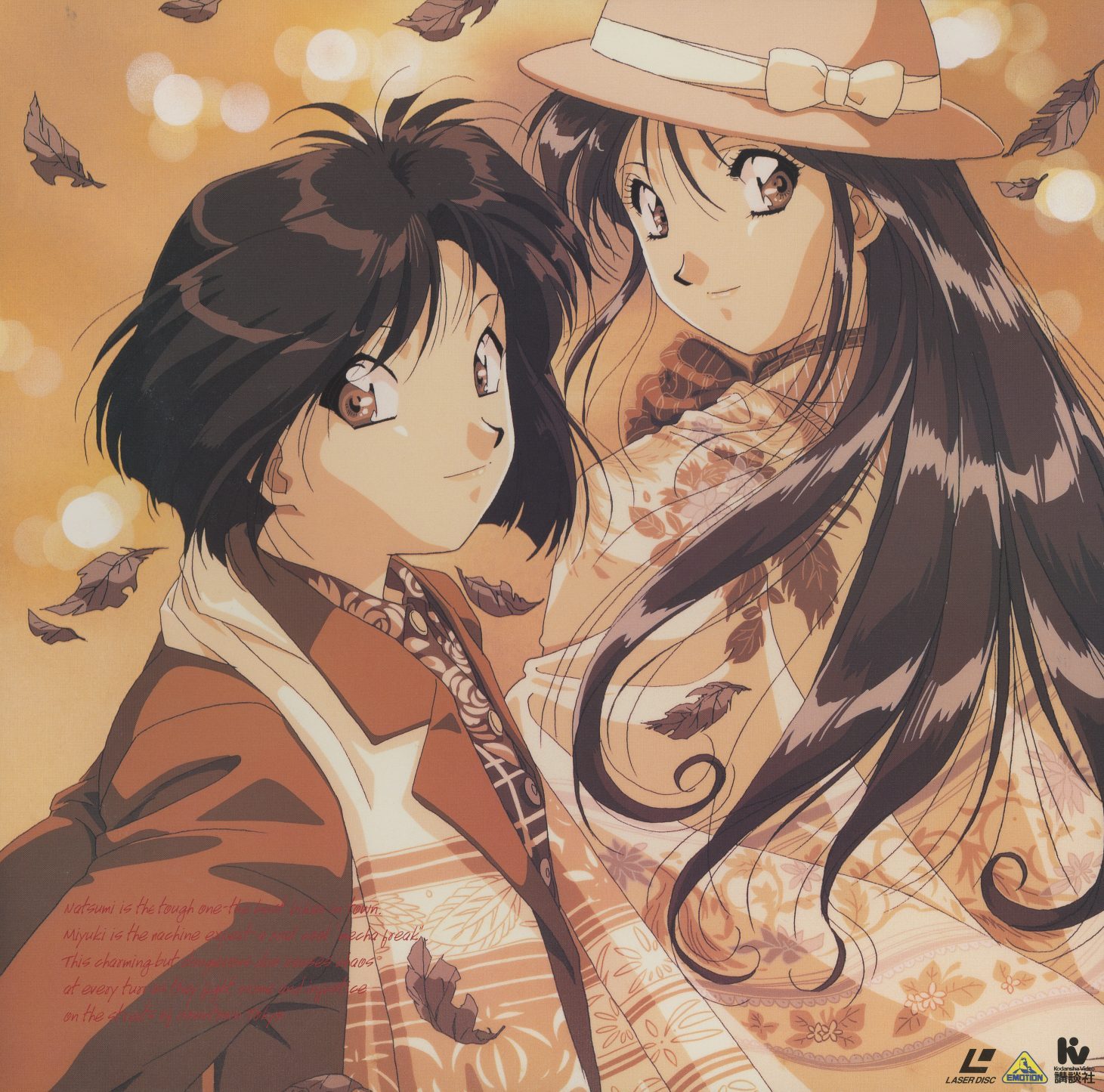 File 2 gatefold interior — Ken Nakajima and Natsumi in warm autumn portrait, falling leaves. Fujishima illustration. File 2 tracks the romantic subplot's development; the gatefold art runs parallel to the episode content.
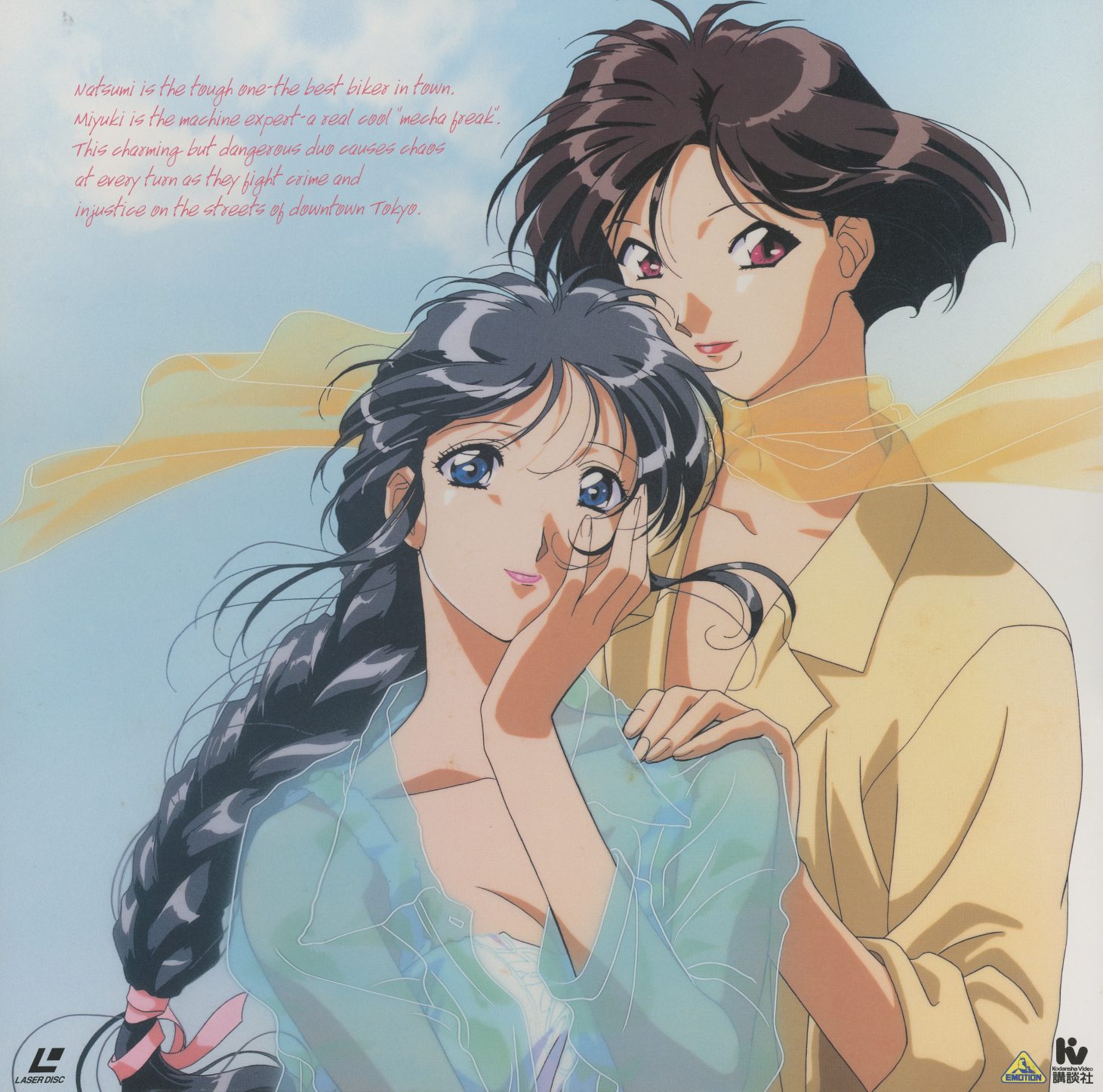 File 3 gatefold interior — Miyuki and Ken in close-up, blue sky, Ken's hand near her face. Fujishima illustration. Each disc's gatefold interior advances the romance plot one stage.
The Gatefold Arc
Each disc's gatefold interior carries two facing panels: production documentation on one side, a Fujishima illustration on the other. Across four volumes the illustrations form a continuous arc. File 1's interior: Miyuki and Natsumi in uniform against soft green — the partnership establishing itself. File 2's: Ken Nakajima and Natsumi in warm autumn colors, the romantic subplot entering the frame. File 3's: Miyuki and Ken in a quiet close-up, blue sky, no other characters. File 4's: the two lead characters rendered as a Polaroid photograph lying on a notebook page — archiving rather than illustrating. You have to open each sleeve to see this sequence. It runs the length of the series. The episode content is on the disc. The romance subplot is in the packaging.
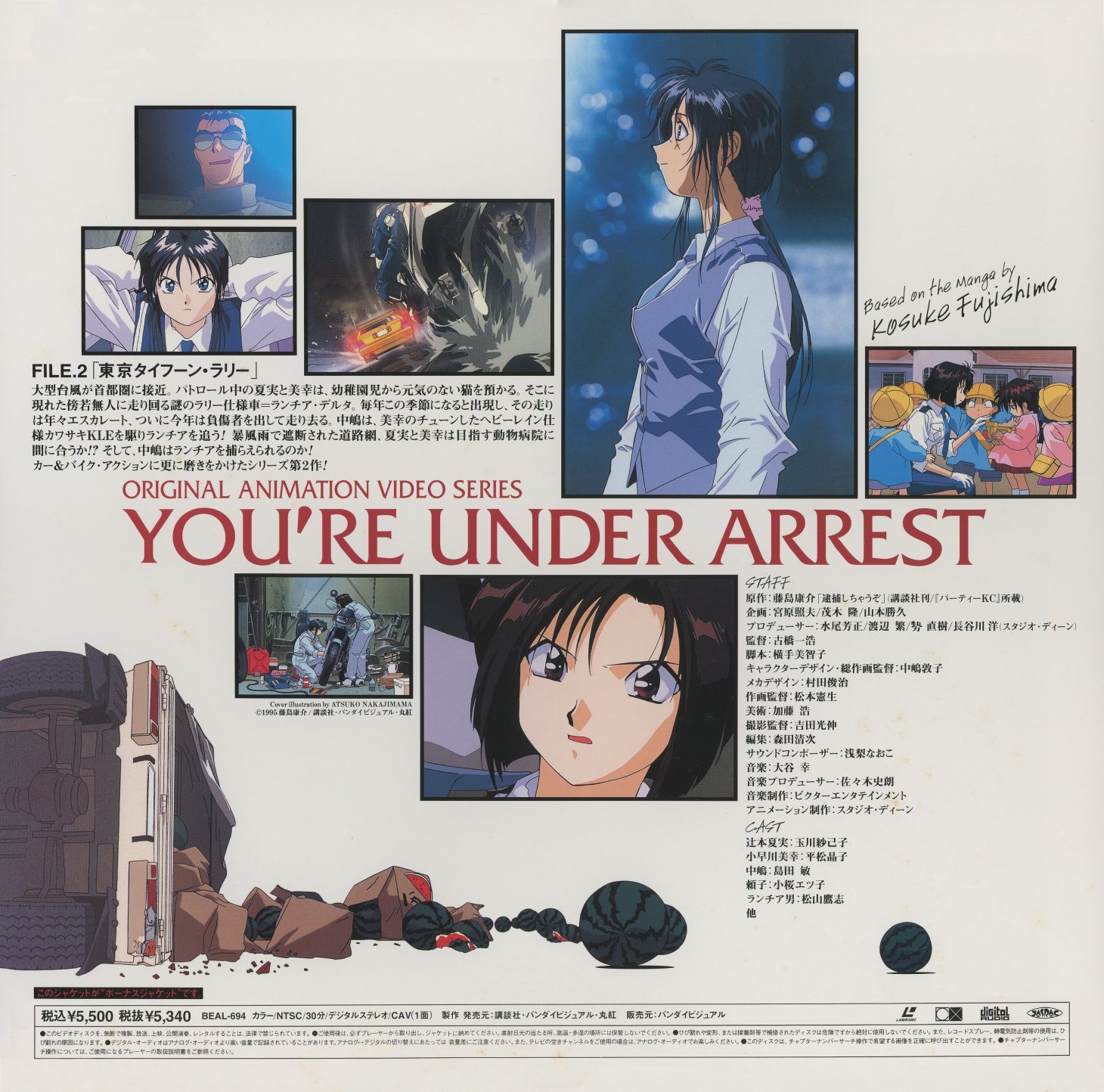 File 2 gatefold interior — Miyuki in dramatic blue-toned nighttime close-up with episode title text, 'YOU'RE UNDER ARREST FILE.2 東京タイフーン・ラリー.' The production documentation side of the File 2 gatefold.
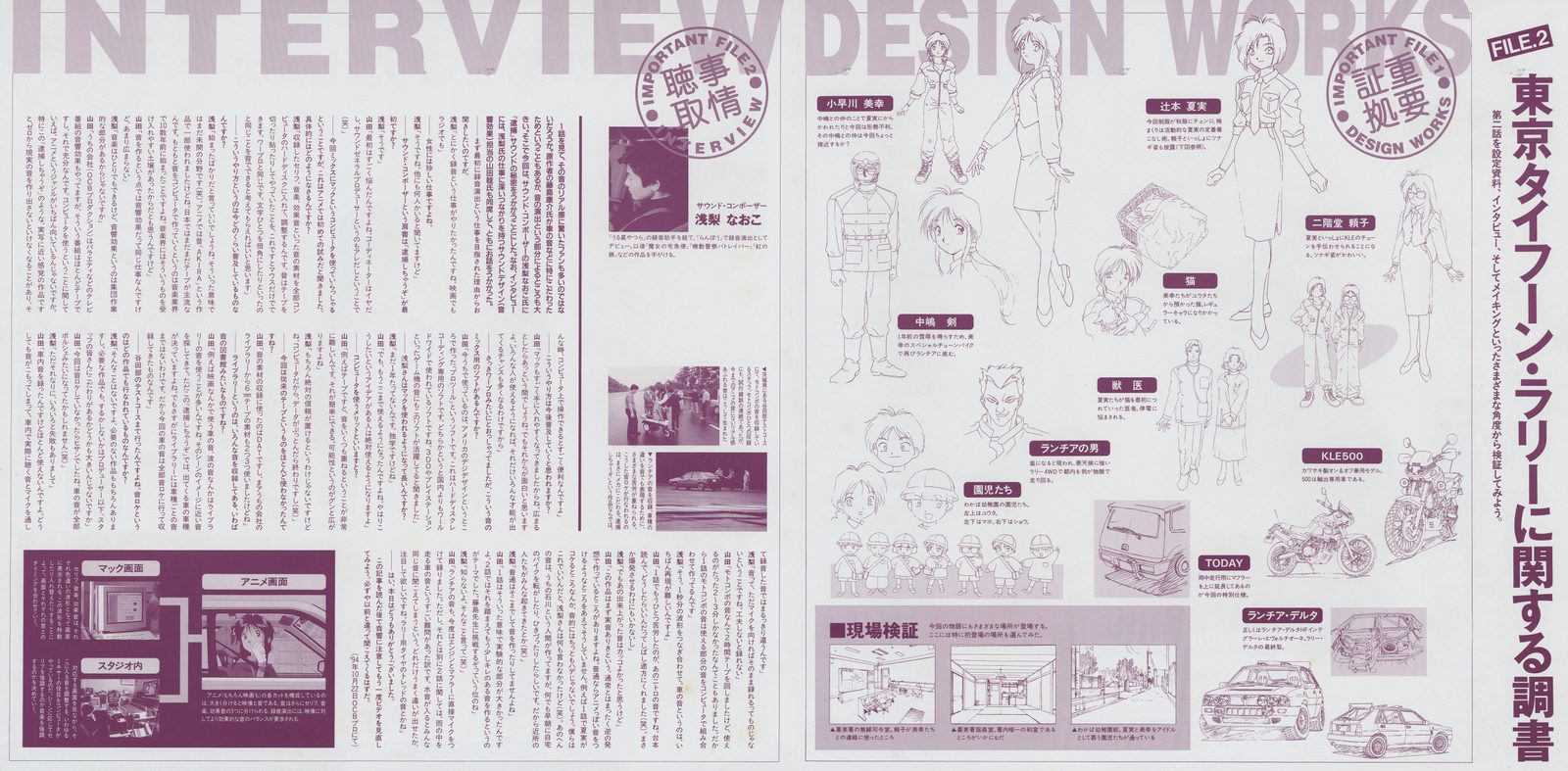 File 2 booklet — 'INTERVIEW DESIGN WORKS.' Character lineup settei for File 2 with vehicle diagrams. Right side: '東京タイフーン・ラリーに関する調書' (Report Concerning the Tokyo Typhoon Rally) — case-file framing for the episode's production documentation.
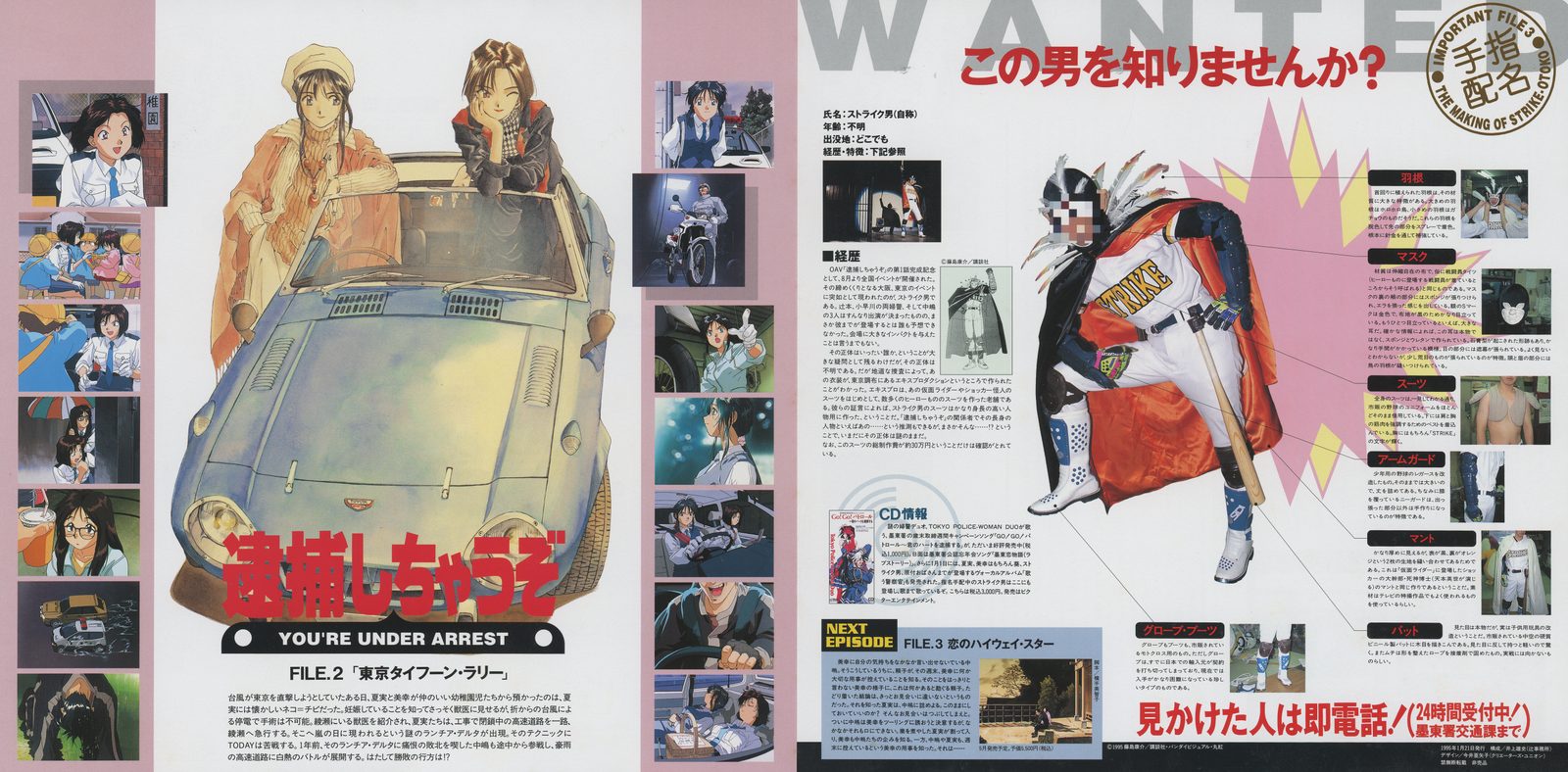 File 2 booklet — Left: episode summary with scene stills, CD information, series title treatment. Right: 'WANTED — この男を知りませんか?' (Do you know this man?) — episode antagonist presented as a wanted posting, with character design sheet formatted as a criminal record.
In-World Documentation
File 2's booklet commits to the police procedural frame. The episode summary is formatted as a case report under the heading '東京タイフーン・ラリーに関する調書' — Report Concerning the Tokyo Typhoon Rally. The antagonist is introduced via a WANTED poster: この男を知りませんか? — Do you know this man? — with his character design sheet formatted as a criminal record, vital statistics down the side. The production information — voice cast, episode staff, animation credits — is there, but packaged as dossier rather than liner note. The booklet stays inside the fiction. The settei sheets are evidence files. The cast list is the station roster.
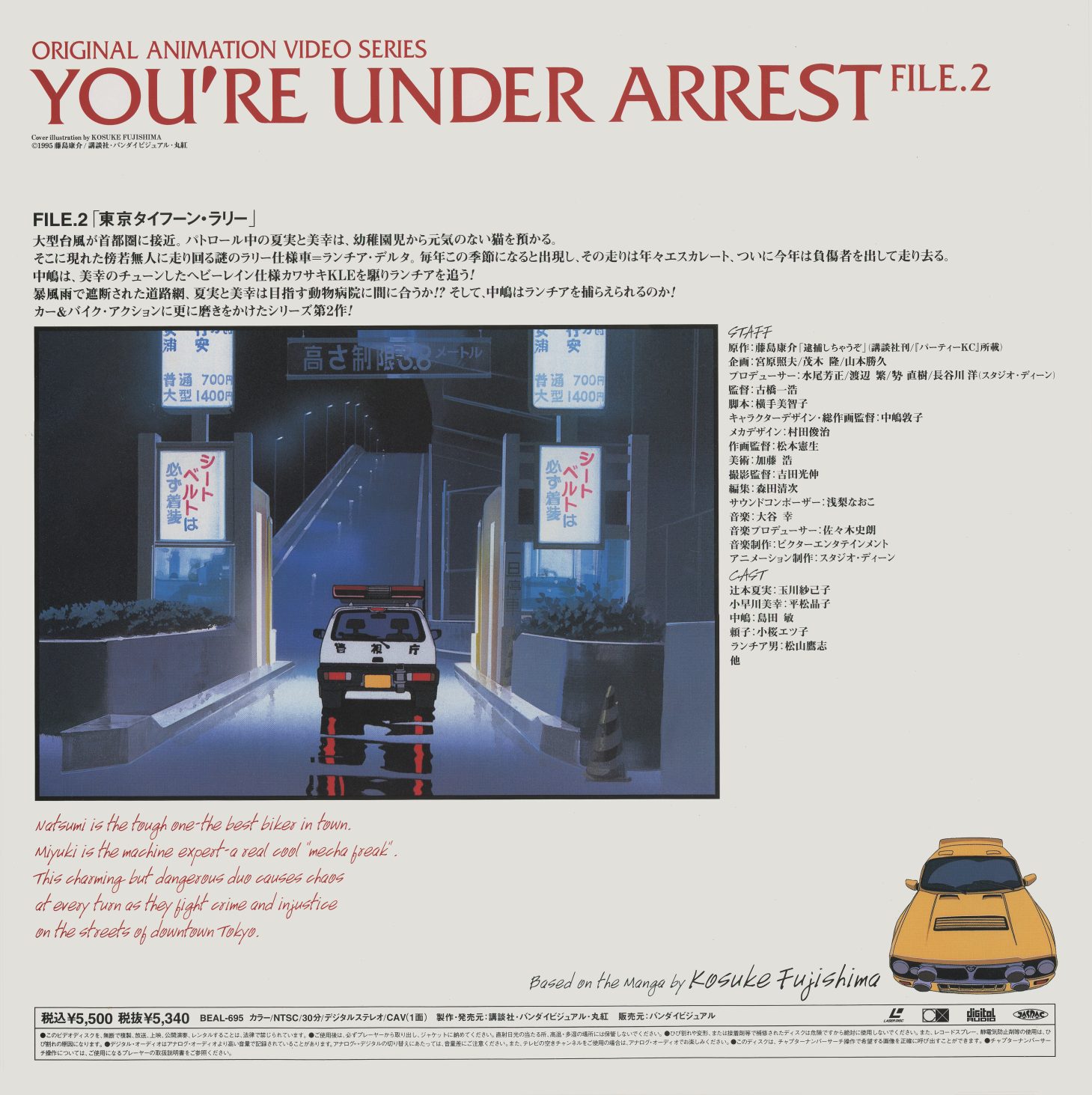 File 2 back jacket — BEAL-695, ¥5,500. Episode stills from 'Tokyo Typhoon Rally.' Yellow antagonist vehicle at bottom. 'Based on the Manga by Kōsuke Fujishima.'
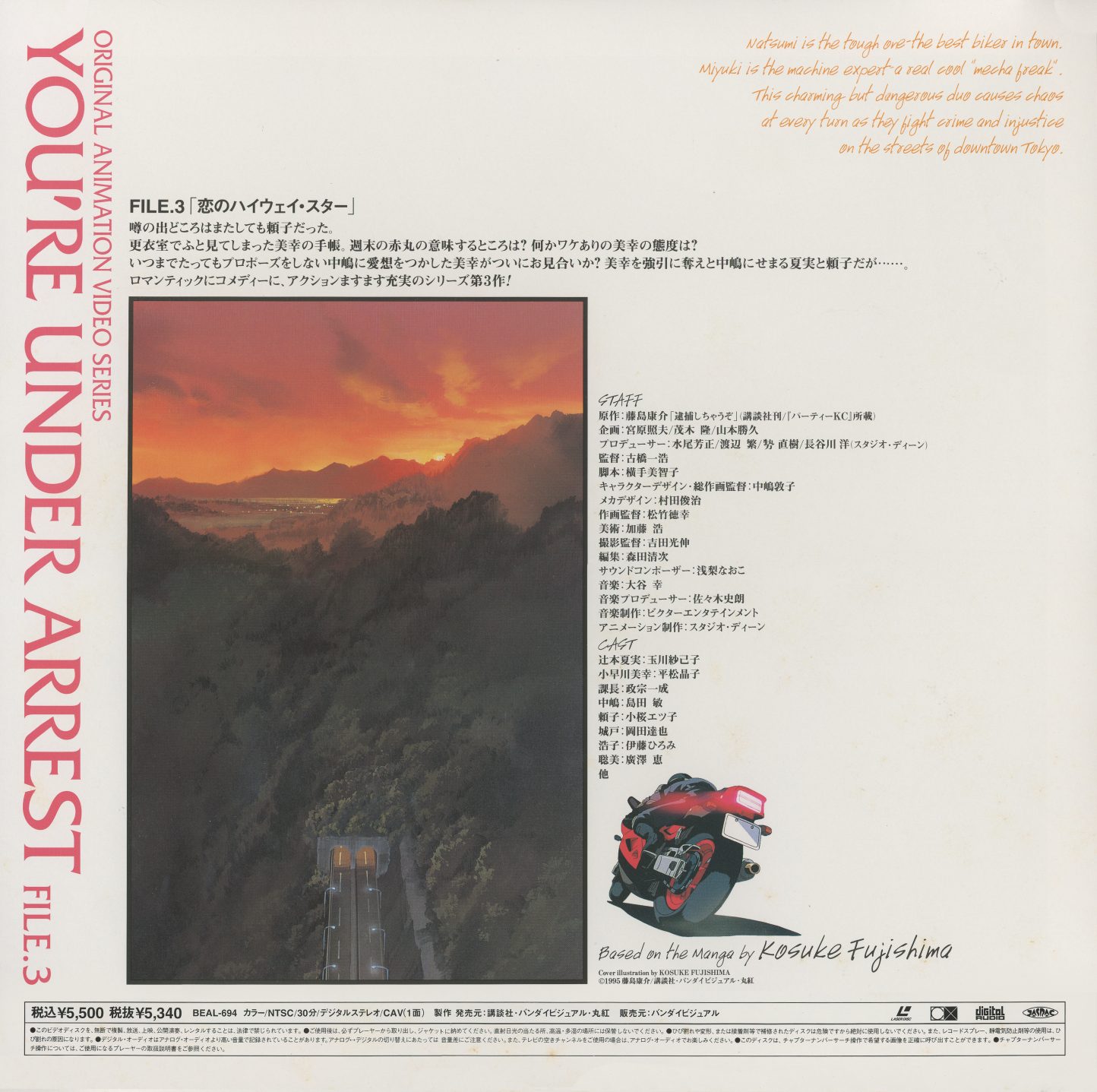 File 3 back jacket — BEAL-696. Episode stills from '恋のハイウェイ・スター' (Highway Star Romance). Motorcycle at mountain sunset, warm dusk light.
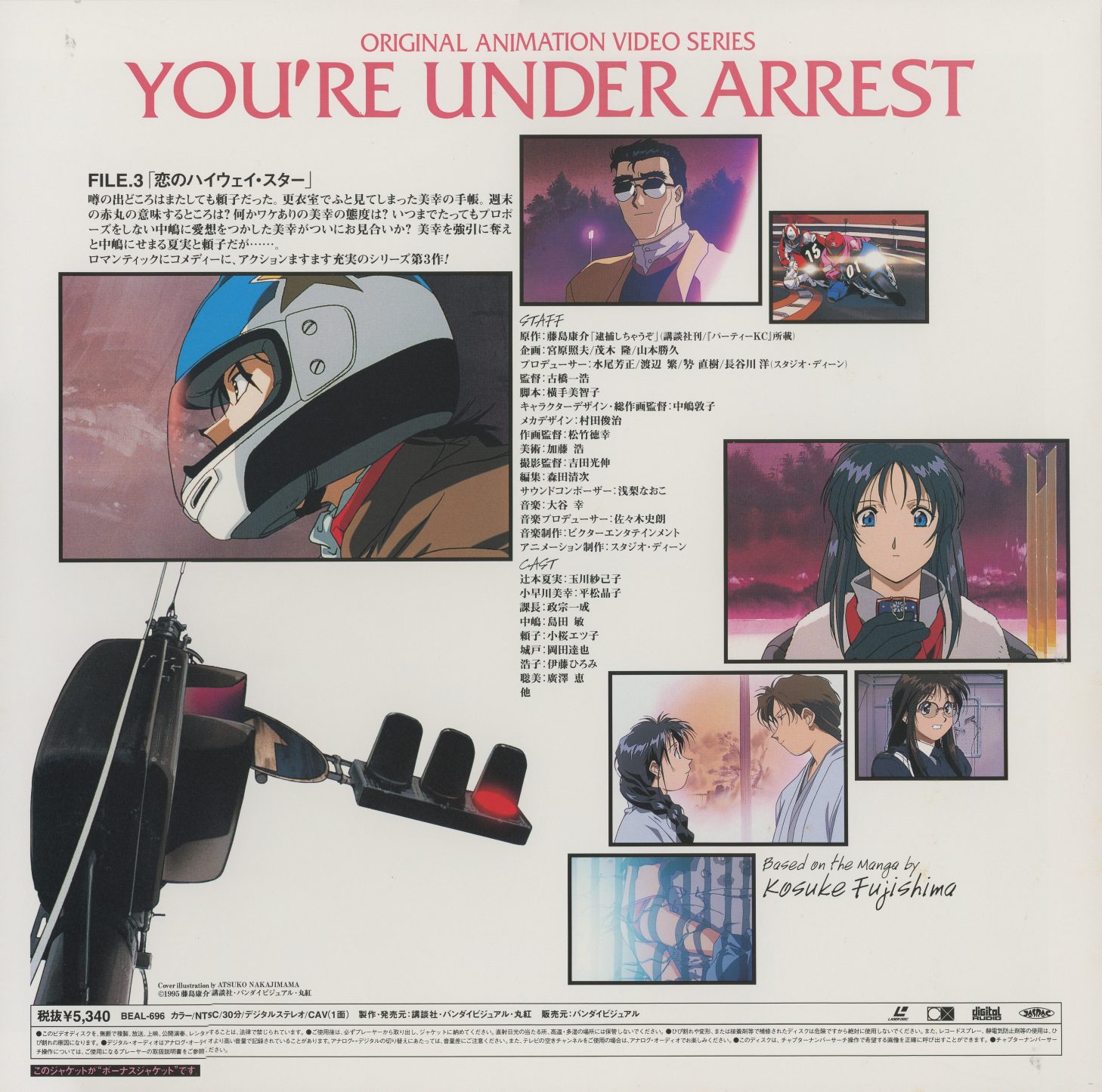 File 3 back jacket — 'FILE.3 恋のハイウェイ・スター.' BEAL-696, ¥5,340, CAV. Full staff and cast listing. Character design: Atsuko Nakajima. Direction: Kazuhiro Furuhashi. Studio Deen.
Furuhashi and Nakajima
File 3 — Highway Star Romance — is the romantic pivot of the series and the episode where the production team's precision is most visible. Director Kazuhiro Furuhashi came up through Urusei Yatsura and Ranma ½ at Studio Deen and would go on to direct Rurouni Kenshin (including Trust & Betrayal), Hunter × Hunter (1999), Gundam Unicorn, Dororo, and Spy × Family. Character designer Atsuko Nakajima had spent the previous decade adapting Rumiko Takahashi's designs for animation; she understood how to make warmth readable at the drawing stage. The OVA is not a landmark by the scale of what either career became. But four tight episodes, consistent character work, and Fujishima's vehicle research translated without compromise — the execution is clean. The staff spread on each disc's booklet lists everyone. It's a short list for a production this precise.
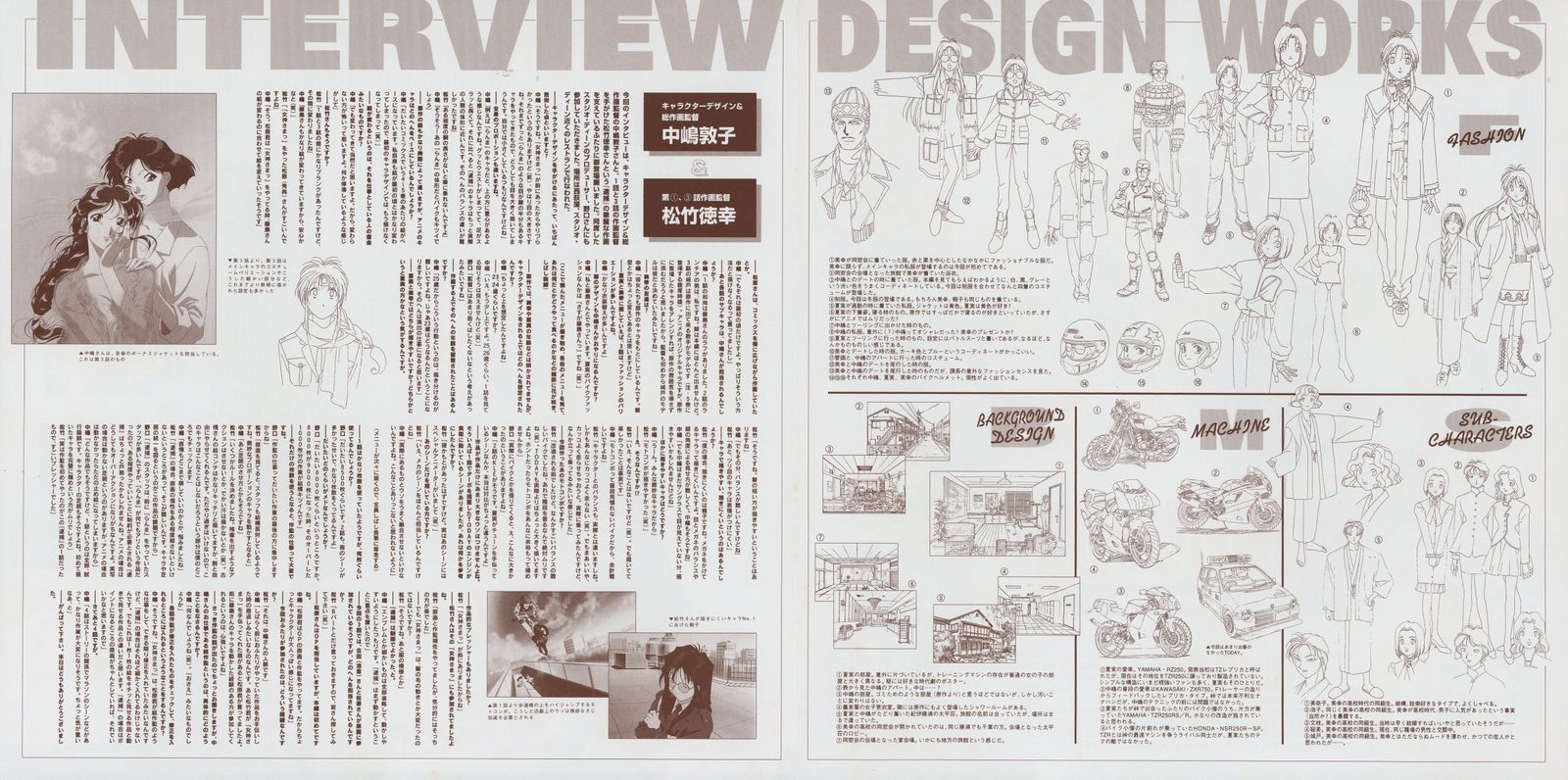 File 3 booklet — 'INTERVIEW DESIGN WORKS.' Atsuko Nakajima interview (left) with photograph. Full character settei lineup, background design reference, and machine diagrams for File 3 vehicles and locations.
File 3 to File 4
File 3's booklet spread runs a full episode guide with stills from 'Highway Star Romance' alongside a preview of File 4 and a section on the T.P.D. — the Tokyo Police Department's elite motorcycle unit, whose recruitment of Natsumi forms the dramatic spine of the final episode. The booklet's layout at this point is dense: two spreads per volume, each managing episode content, cast documentation, production interviews, and vehicle reference simultaneously. File 4's premise — will Natsumi leave Bokuto Station for the elite unit, breaking the partnership? — is already being set up in File 3's insert. The packaging thinks ahead.
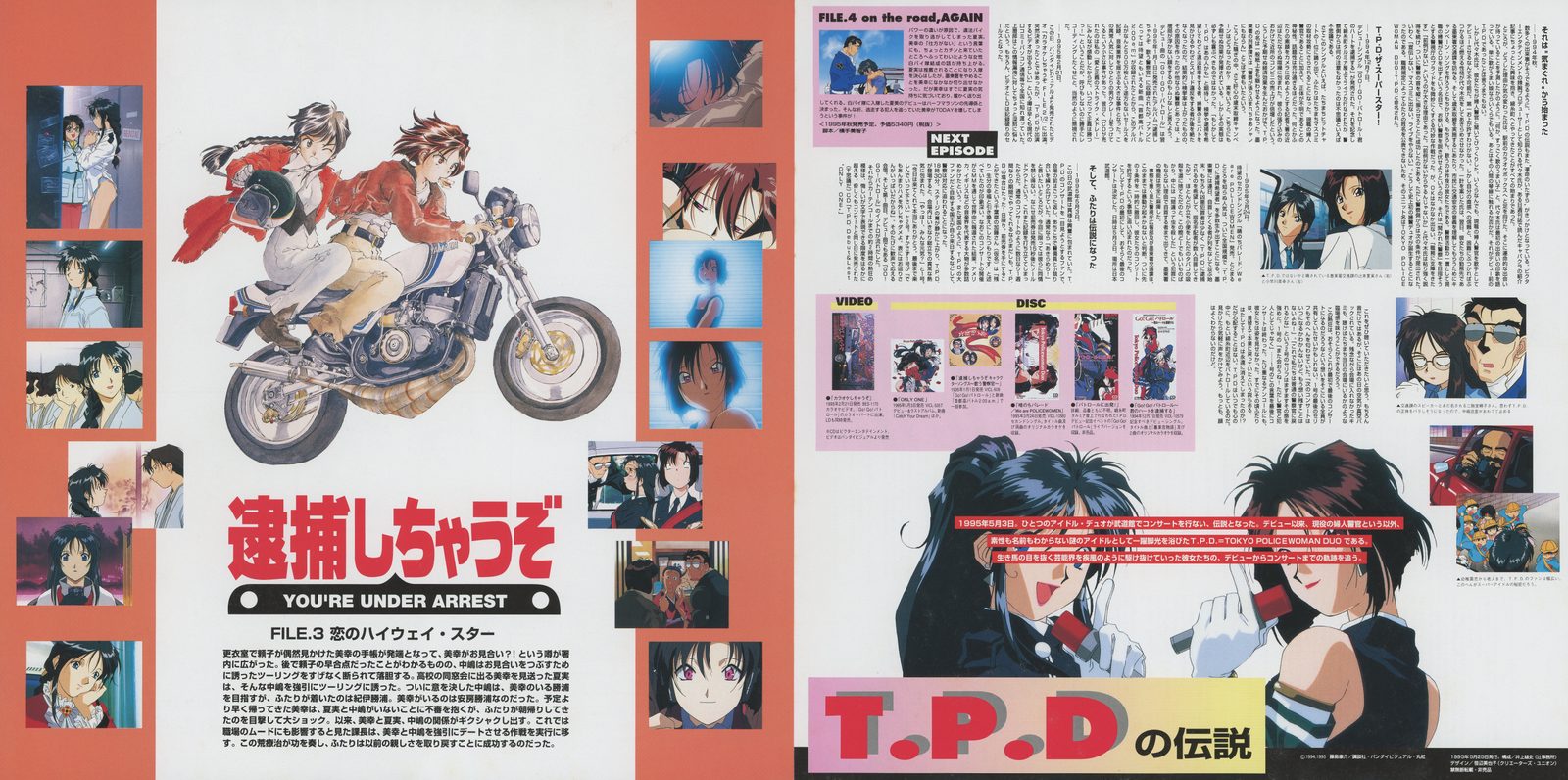 File 3 booklet — Episode spread for 'Highway Star Romance' with scene stills, File 4 preview, and T.P.D. feature. '逮捕しちゃうぞ YOU'RE UNDER ARREST FILE.3 恋のハイウェイ・スター.'
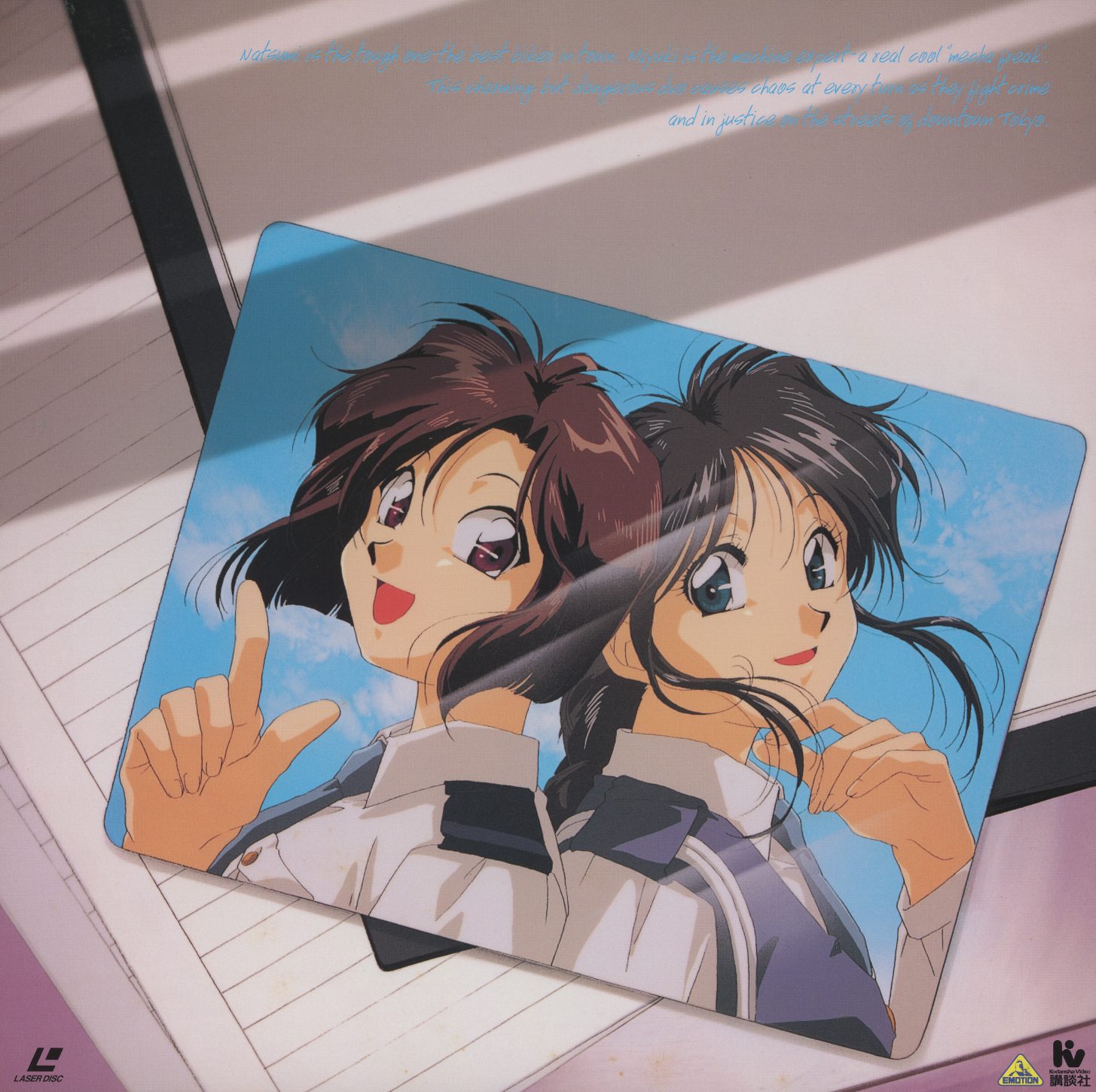 File 4 gatefold interior — Natsumi and Miyuki rendered as a Polaroid photograph lying on lined notebook paper, both pointing toward the viewer. Not a Fujishima painting but a photograph of a photograph — the final volume frames the characters as documentation rather than illustration.
The Last Gatefold
File 4's gatefold interior does something different from the previous three. Instead of a Fujishima painting, it presents the two characters as a Polaroid photograph — a print lying on a blue surface over notebook lines, both figures pointing toward the viewer. The fiction frames itself as a record. Files 1 through 3 offered illustrations: the artist's reading of who these people are. File 4 offers a photograph: evidence that they existed. The sleeve has spent three volumes as a window into the fiction. The fourth volume closes it from the other side.
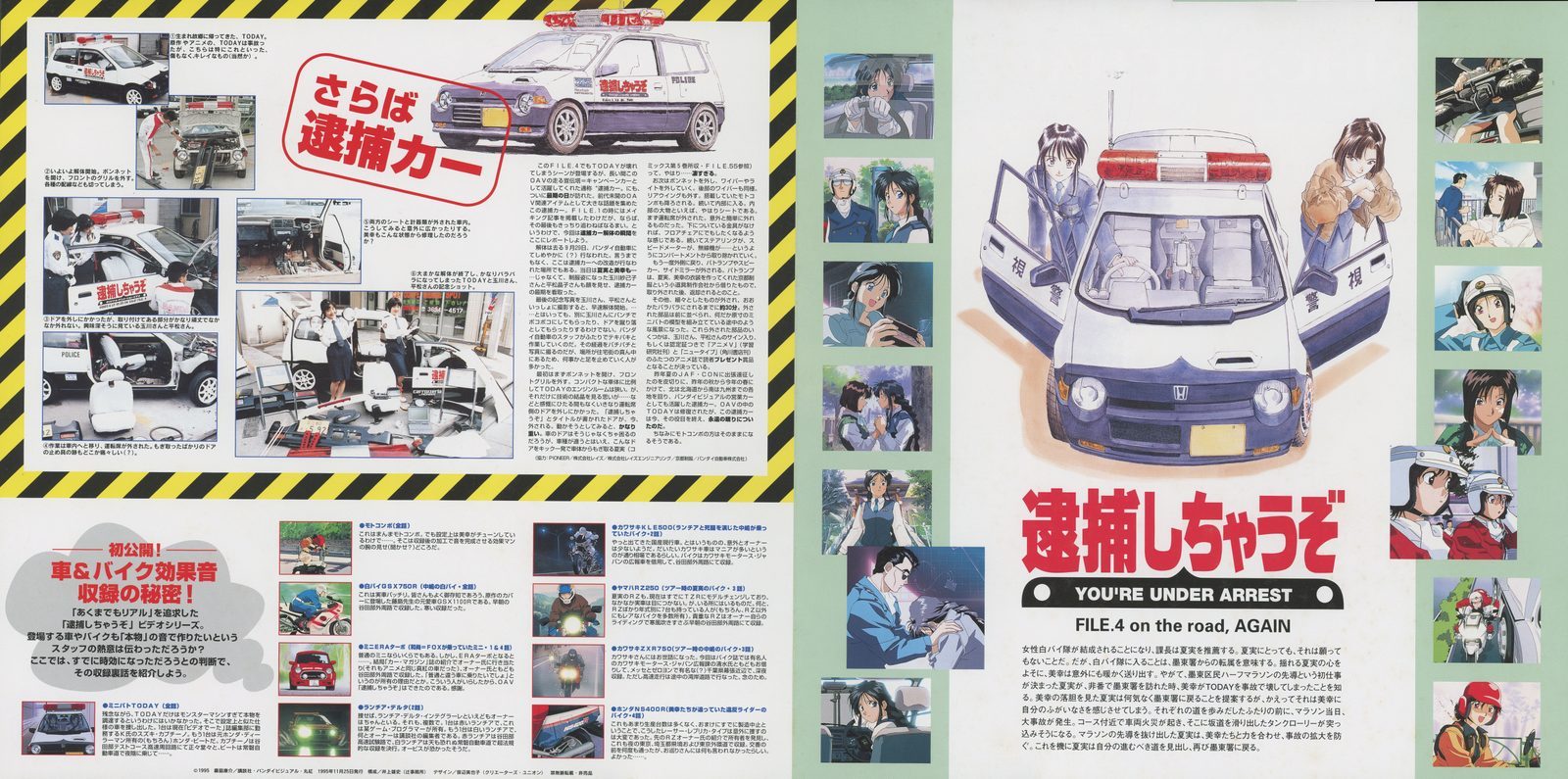 File 4 booklet — 'さらば逮捕カー' (Farewell Patrol Car). Real production photographs of the Honda Today patrol car — full police livery, working roof lights, photographed in a studio environment. Left spread: the car being worked on and maintained. Right spread: File 4 episode summary and character stills.
さらば逮捕カー
'さらば逮捕カー' — Farewell Patrol Car. File 4's booklet devotes its center spread to photographs of the actual Honda Today that was built for the production. Not a scale model, not a rendering — the real car, police livery applied, roof lights fitted, photographed in what appears to be a studio lot. The spread shows it being worked on, then completed. The final caption is the farewell. Treating the car as a cast member completing its run is consistent with how the series was built: Fujishima drew the Today's engine modifications as mechanical fact, the booklets documented every vehicle as a MECHANICS entry, the production built an actual car to reference. The car was the work's evidence. The farewell is for the evidence.
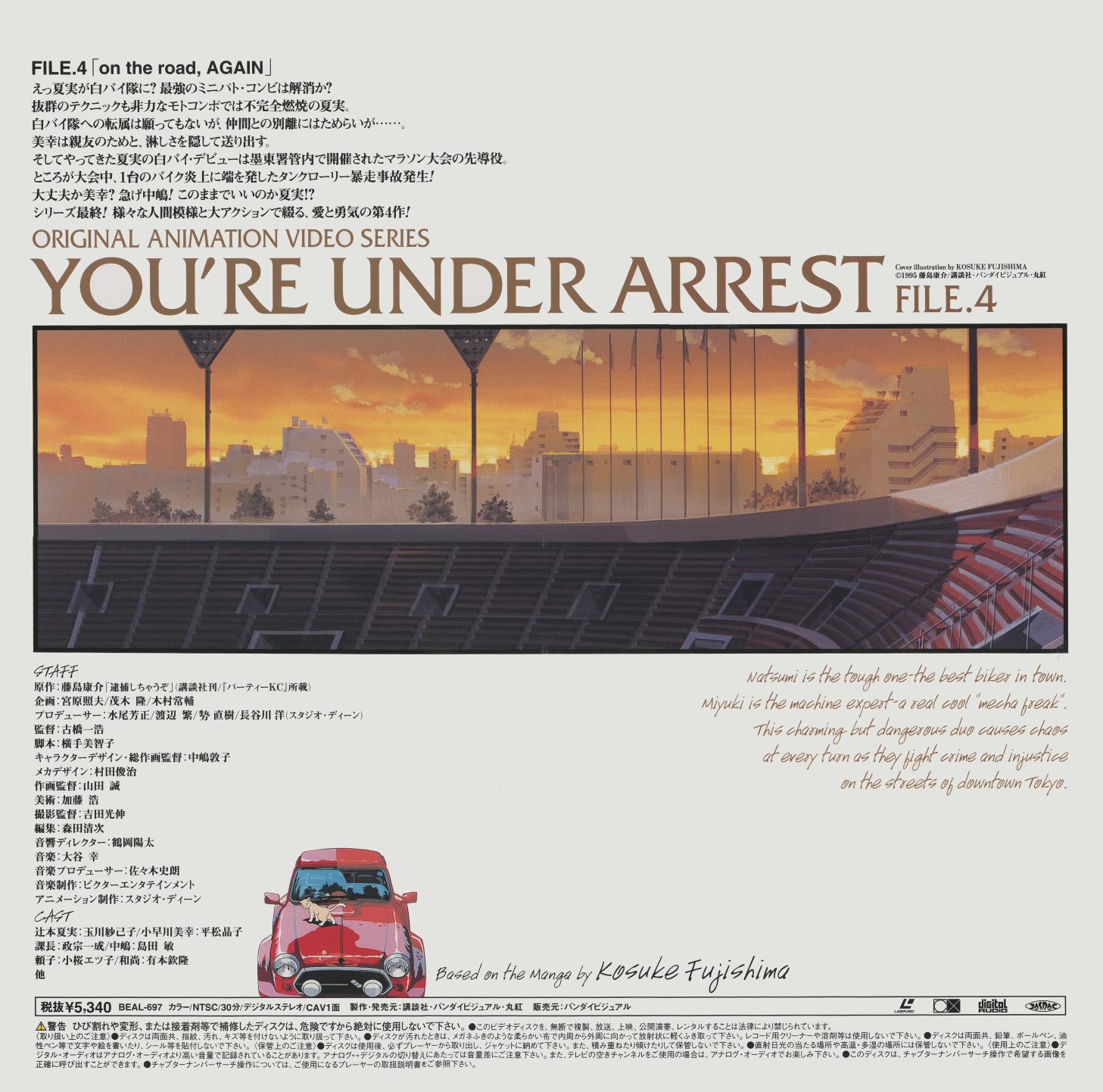 File 4 back jacket — BEAL-697, ¥5,340, CAV. Aerial view of the stadium at sunset — the location for File 4's climax. Small Honda Today visible in the forecourt. Episode summary for 'on the road, AGAIN.'
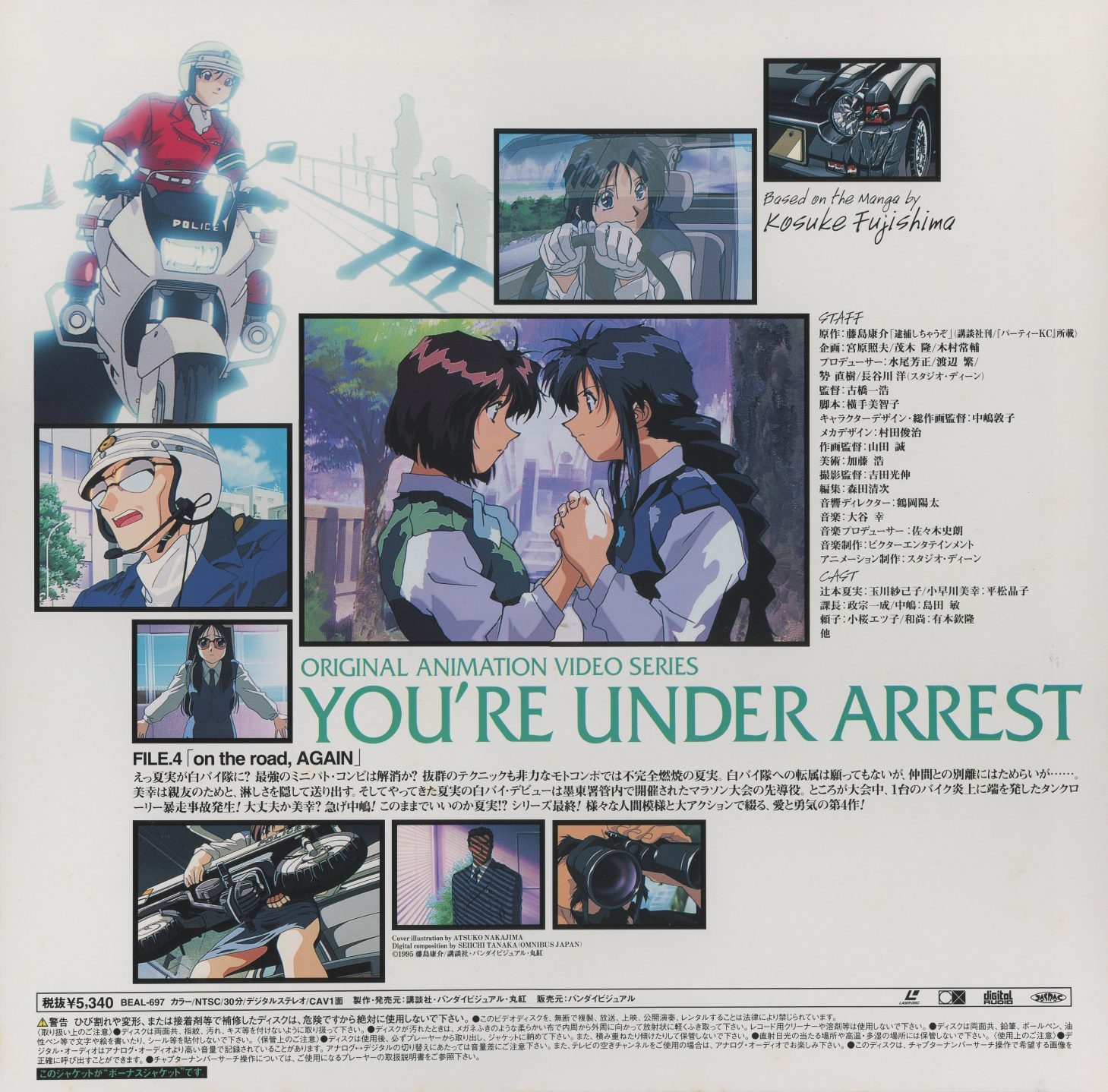 File 4 back jacket — full production text, Cast and Staff for File 4. Miyuki on a police motorcycle, episode stills. 'Based on the Manga by Kōsuke Fujishima.' BEAL-697.
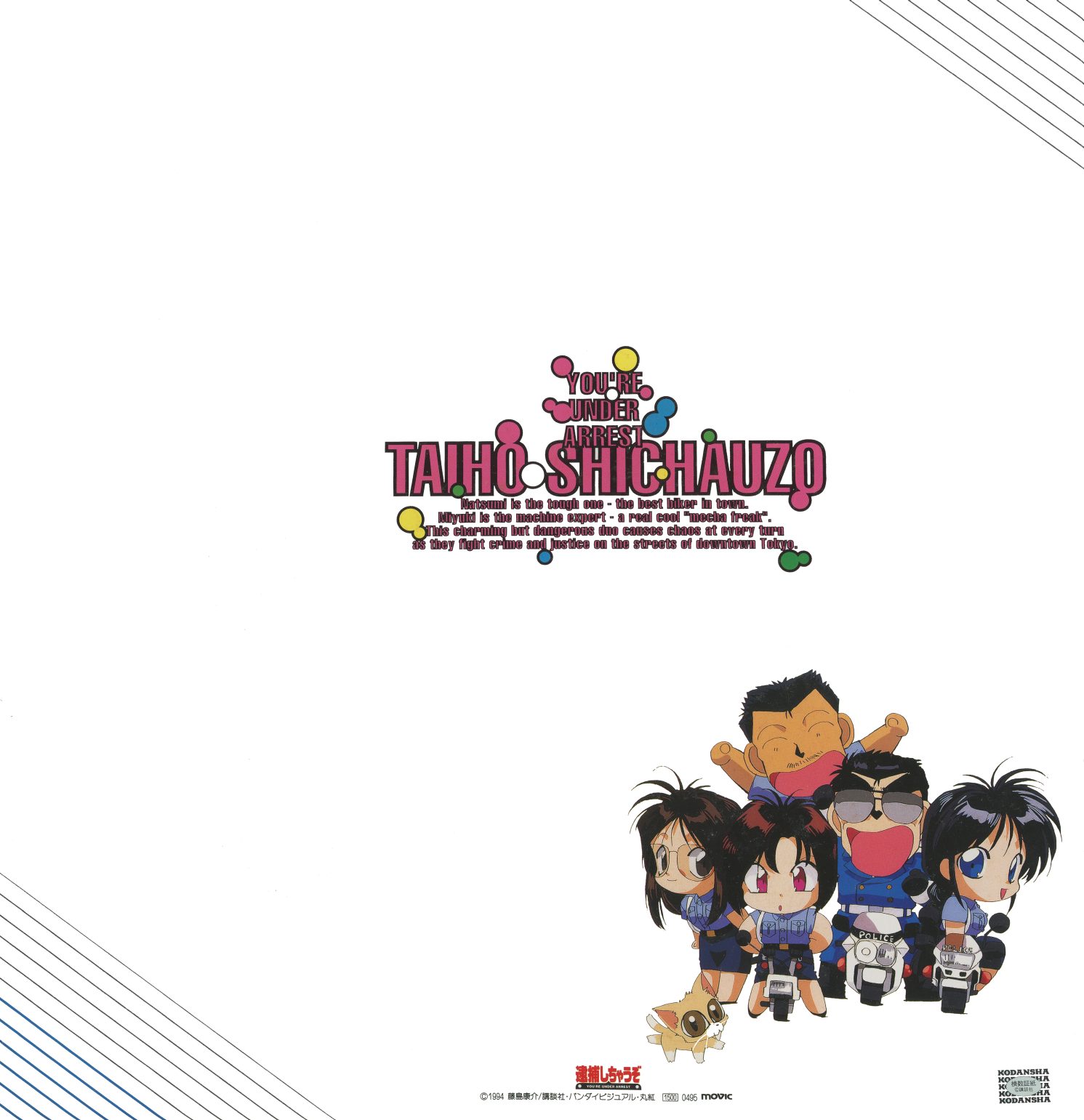 File 1 inner gatefold panel — chibi-style character art, series title treatment. The lightest piece of packaging across the four volumes: an internal panel, not the face the discs show the world.
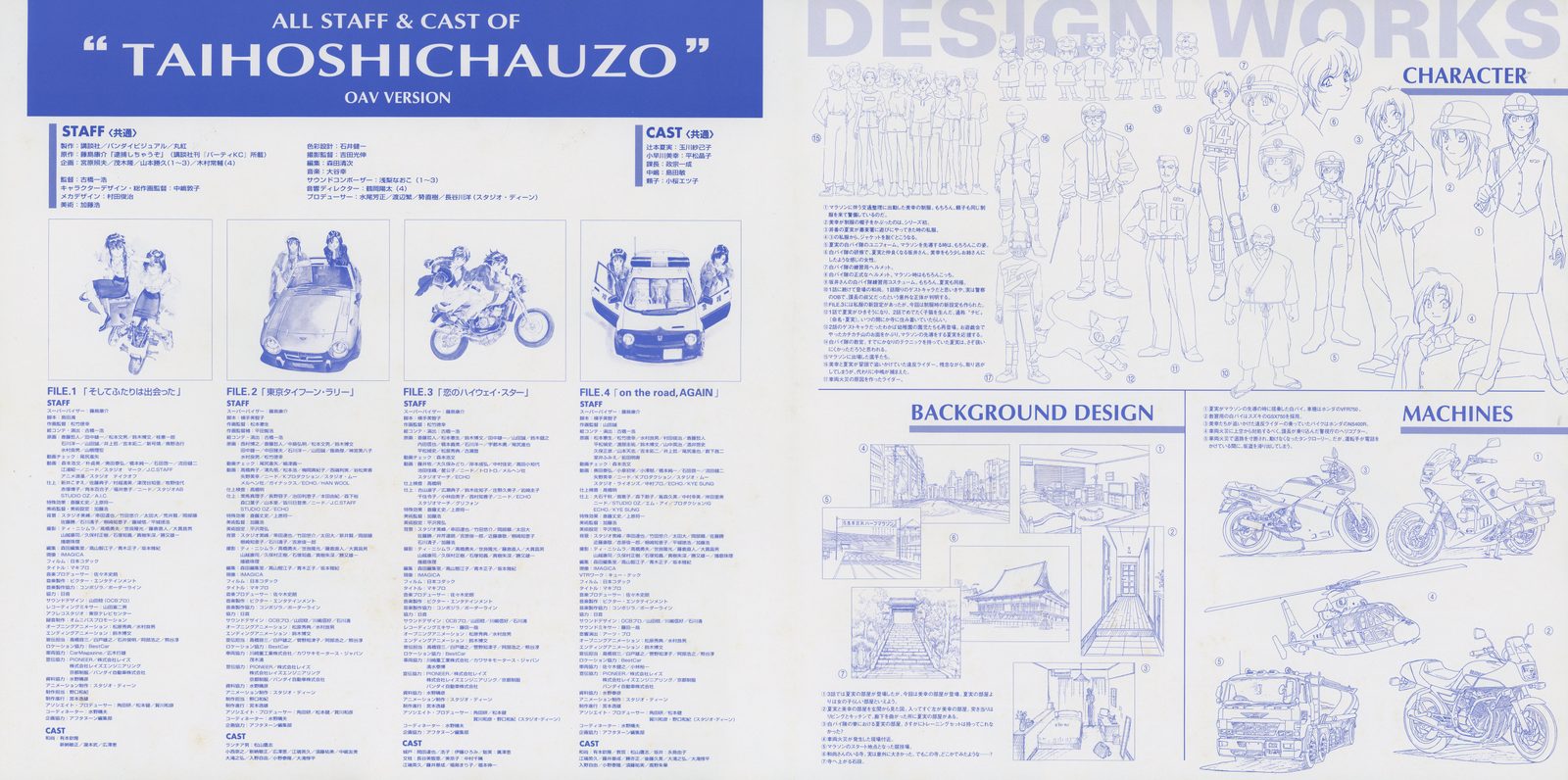 File 4 booklet — 'ALL STAFF & CAST OF TAIHOSHICHAUZO OAV VERSION' (left) with complete episode staff listings and character/vehicle thumbnails for all four files. Right: 'DESIGN WORKS' — full series character settei, background design reference, and machines, compiled as a complete production record.
The Blu-ray restoration BCXA-2006 — released January 2026, thirty years after the first episode — includes HDR color grading, an Atsuko Nakajima interview, and newly commissioned Fujishima cover art for the anniversary. It is the correct way to watch the OVA.
The eight jacket illustrations from 1994 and 1995 are not in it. The MECHANICS vehicle reference booklets are not in it. The WANTED poster booklet for File 2 is not in it. The farewell photographs of the Honda Today are not in it.
These existed for the domestic LD buyer at ¥5,500 per disc. That was their entire audience. That audience has dispersed.
Loading...