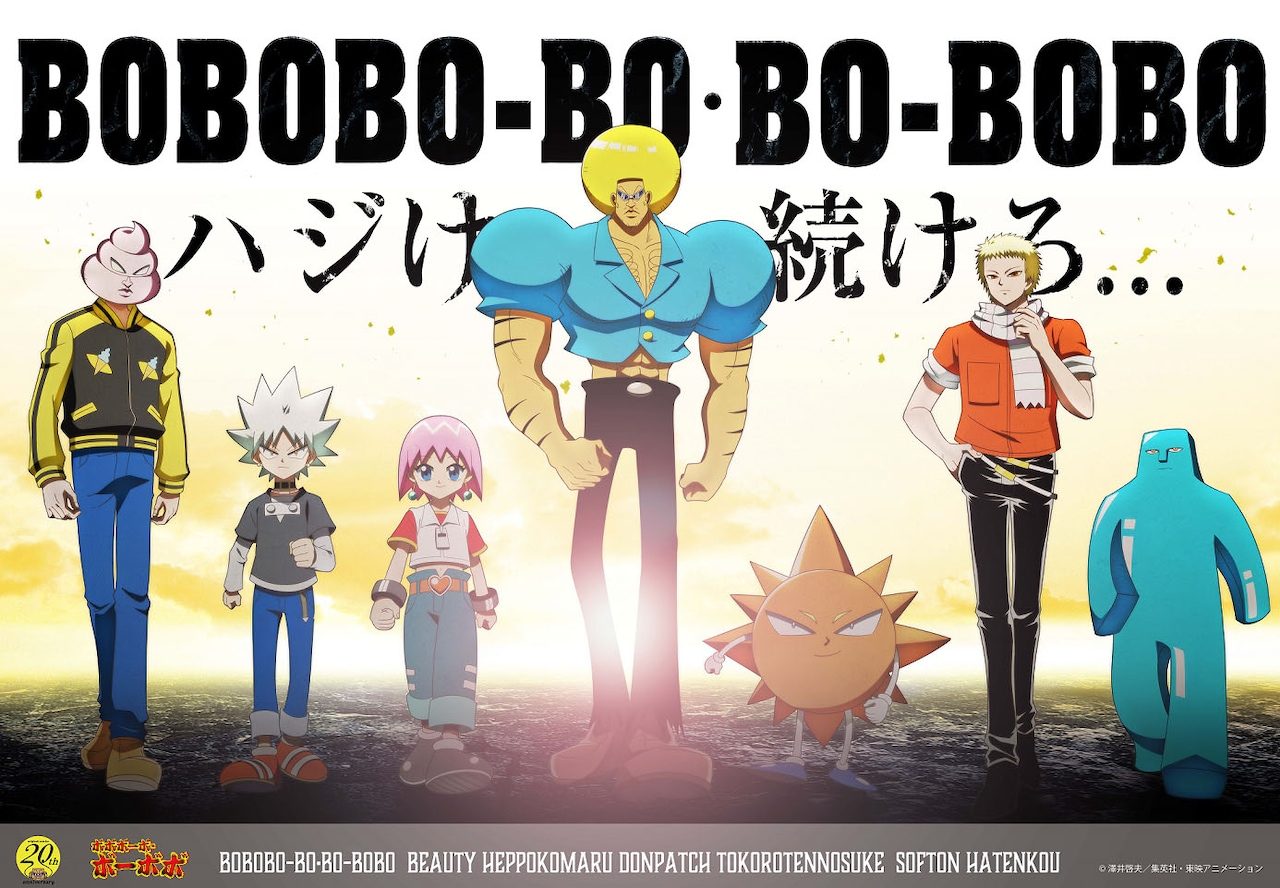
The Roster
Bobobo-bo Bo-bobo. Don Patch. Jelly Jiggler. Torpedo Girl. Softon, a warrior whose head is a coil of soft-serve ice cream. Hatenko, who fights by opening doors. The narrative does not connect these characters to a plot. They exist in a space where cause and effect are suggestions. Panels contradict each other within the same page. Characters break the fourth wall to complain about the manga they're in. This ran for 230 chapters.
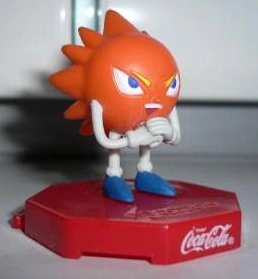 Don Patch Coca-Cola collaboration figure — a spiky orange sun with angry eyebrows, no consistent personality, no backstory. Recognisable on a figure base without any narrative context required
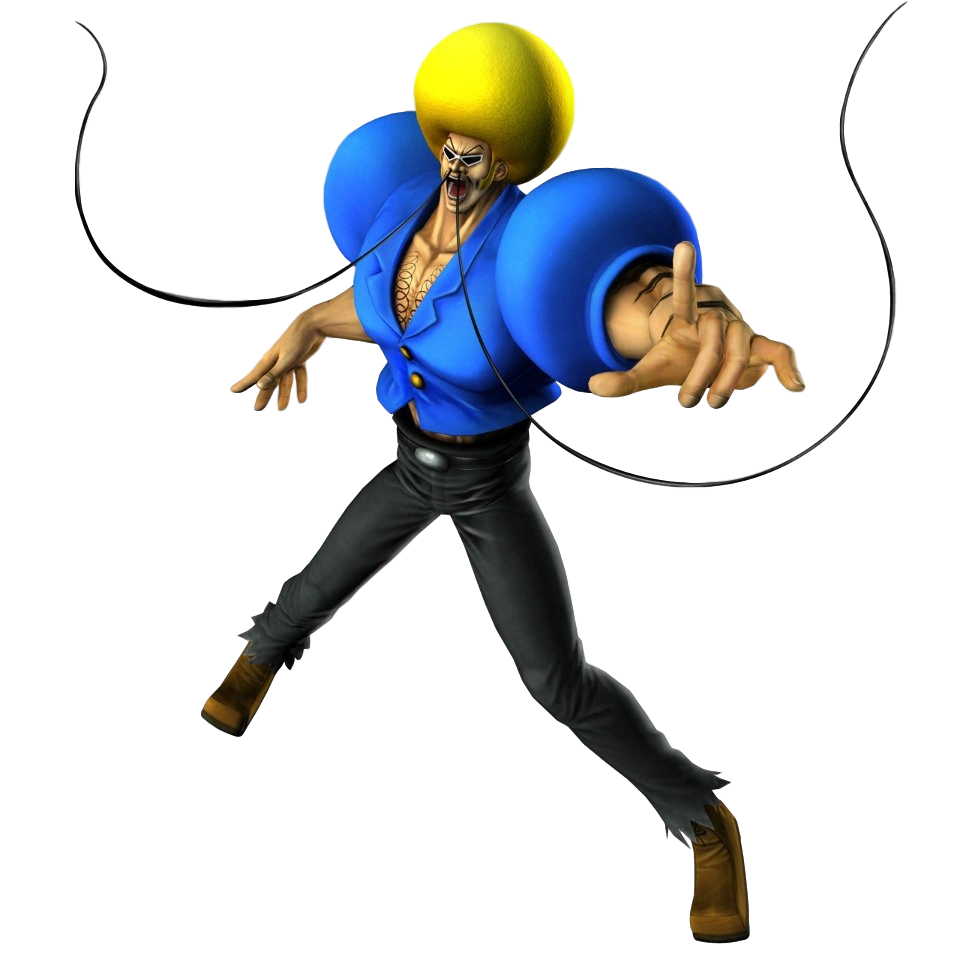 Bobobo-bo Bo-bobo rendered for J-Stars Victory Vs — nose hairs extending, afro blazing. The same commercial infrastructure that produces Goku and Luffy produced this
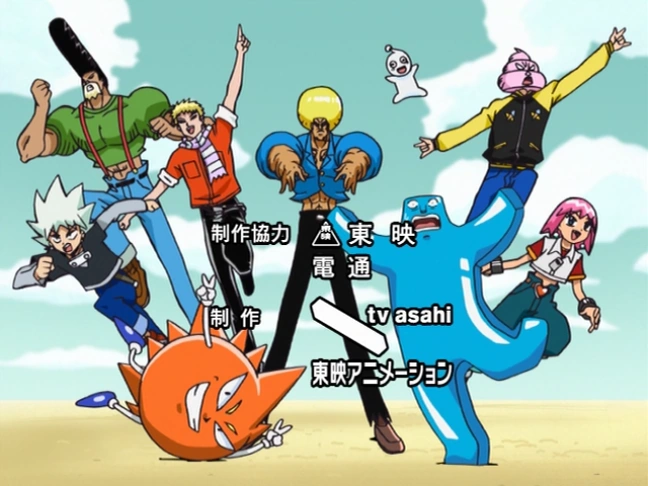 Bobobo-bo Bo-bobo anime ending credits — the full cast assembled with Toei Animation and TV Asahi production marks. Mainstream broadcast infrastructure for anti-logic entertainment
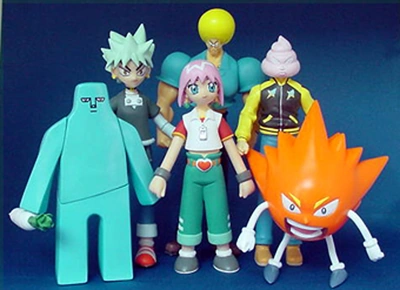 Bobobo vinyl figure set — Jelly Jiggler, Heppokomaru, Beauty, Bo-bobo, Softon, and Don Patch. A full product line for a property with zero narrative coherence
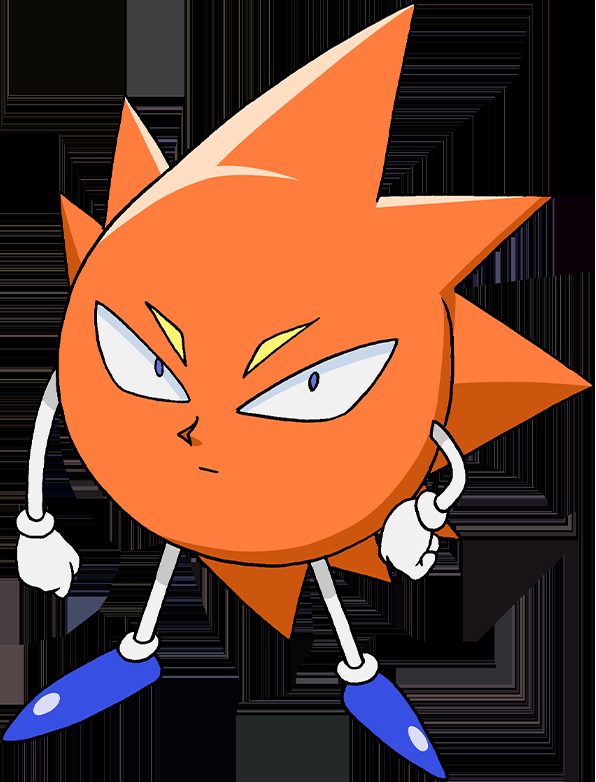 Bobobo-bo Bo-bobo official Toei Animation character design — the anime ran 76 episodes on TV Asahi in a prime weekend slot
Bobobo merchandise still surfaces in collaboration gashapon, anniversary events, and Jump crossover products — twenty years after the manga ended. The character's incoherence turns out to be a commercial asset: a recognisable wild card that fills a specific slot in product mixes.
Bobobo-bo Bo-bobo is a manga about a man who fights with his nose hair. His companions include a sentient piece of jelly, a warrior whose head is a coil of soft-serve ice cream, and a sun-shaped creature named Don Patch who has no consistent personality between panels. The plot does not advance. Panels contradict each other on the same page. Characters break the fourth wall to complain about the manga they're in. Other characters break the fourth wall to complain about the characters who are breaking the fourth wall.
This ran in Weekly Shonen Jump — the same magazine that published Dragon Ball, Naruto, and One Piece — for six years and 230 chapters. It received a 76-episode television adaptation on TV Asahi in a prime weekend slot. It generated a full merchandise line: figures, keychains, stationery, gashapon. It appeared in Jump crossover video games alongside Goku and Luffy.
Shonen Jump is a magazine that kills series for low reader rankings. Bobobo survived in it for six years. Alongside the most commercially successful manga franchises ever published. Same editorial meetings. Same readership surveys. Same commercial expectations.
Bobobo wasn't an accident that slipped through. It was a product of a system that has a specific, funded tolerance for chaos — and a readership that treats incoherence as a genre, not a defect.
The Gag Manga Slot
Weekly Shonen Jump has maintained dedicated comedy slots for its entire history. Not as filler. As structural policy.
The magazine's core product is escalation: power levels rising, stakes compounding, multi-year narrative arcs that demand the reader remember what happened 200 chapters ago. Dragon Ball. Naruto. One Piece. Bleach. My Hero Academia. The emotional and cognitive load is constant. Following three or four battle manga simultaneously across weekly installments requires sustained attention and investment.
Gag manga is the counterweight. Kochikame ran for 40 years — 1,960 chapters, 1976 to 2016 — as a comedy series with no continuous plot. Gintama mixed parody and action across 704 chapters. Bobobo occupied the same structural position: the page you turn to when you need the stakes to evaporate for eight pages.
The editorial logic is explicit. Jump's internal readership surveys track reader satisfaction across the full issue, not just individual series. A magazine that's 100% escalating battle manga is exhausting. A magazine that includes comedy slots that actively undermine narrative logic gives the reader a pressure release within the reading experience itself. Bobobo didn't exist despite its incoherence. It existed because of it.
Anti-Logic as Product
Bobobo's humor doesn't follow the structures of Western absurdist comedy. It's not surreal (Monty Python's internal logic). It's not satirical (parody requires a target). It's not random — randomness implies a baseline of order being disrupted.
Bobobo is anti-logical. The panels follow a sequence that actively resists comprehension. A character will establish a premise, and the next panel will behave as if that premise was never stated. A fight scene will interrupt itself with a cooking segment that has no connection to anything. Don Patch will appear in a different art style mid-page, referencing a different manga, and nobody will acknowledge it.
The reader's experience is specific: you stop trying to follow. You let the pages happen. The humor comes not from understanding jokes but from surrendering the expectation of understanding. That surrender — the conscious release of the need to track cause and effect — is the product Bobobo sells.
In a manga culture where readers pride themselves on tracking foreshadowing across hundreds of chapters, Bobobo offered the opposite: a space where nothing accumulated, nothing connected, and nothing mattered. For a teenage reader managing the cognitive overhead of three simultaneous battle manga, that space was valuable.
The Merch Paradox
Zero narrative coherence. Full merchandise line.
How? Because in Japan, characters are merchandisable independent of stories. Don Patch as a keychain doesn't require the buyer to know what Bobobo is about. The character design — a spiky orange sun with angry eyebrows — functions as a visual object. It's recognizable, reproducible, and distinctive enough to sit on a product grid alongside a hundred other character goods without disappearing.
Bobobo's cast was designed — consciously or not — as a set of visual icons first and narrative participants second. Bo-bobo himself: a towering man with a blond afro and sunglasses. Don Patch: an orange sun. Jelly Jiggler: a blue jelly. Softon: a man with soft-serve for a head. Each design is identifiable in silhouette. Each works at gashapon scale. The narrative incoherence that makes the manga incomprehensible as a story is irrelevant at the level of a product, because the product is the character's shape, not the character's arc.
This is the database logic at work. The elements — character designs, visual gags, catchphrases — circulate as fragments. Nobody consumes them in order. Nobody needs the full text. The fragments are the text.
Why Bobobo Keeps Appearing
The manga ended in 2007. The sequel, Shinsetsu Bobobo-bo Bo-bobo, ended in 2007. Sawai Yoshio has not serialized a new major work since.
And yet Bobobo continues to surface. Jump crossover games — Jump Force (2019), Jump Super Stars, Jump Ultimate Stars — include Bobobo alongside Goku, Luffy, and Ichigo. Anniversary gashapon lines feature Don Patch. Collaboration merchandise appears at irregular intervals.
The commercial system keeps deploying Bobobo because the IP occupies a niche that's specifically useful: recognizable absurdity. When a product collaboration needs variety — when a gashapon set needs a character that's visually distinct from the battle manga protagonists surrounding it — Bobobo fills that slot. A Don Patch figure next to a Luffy figure and a Naruto figure creates product-line contrast. The chaos property makes the serious properties look more serious, and the serious properties make the chaos property look funnier. Both benefit.
Bobobo's incoherence, which should have been a commercial liability, turned out to be a permanent commercial asset. A property that means nothing specific can mean anything a product line needs it to mean.
The Infrastructure
Bobobo is the clearest test case for a specific Japanese commercial principle: the system will fund whatever the system can use.
Shonen Jump needed a pressure valve. Bobobo was a pressure valve. TV Asahi needed weekend children's programming with low narrative overhead. Bobobo was low narrative overhead. Bandai needed character merchandise with strong silhouette recognition. Bobobo had strong silhouettes. Jump crossover products needed a wild card to break up the visual monotony of battle protagonist after battle protagonist. Bobobo was the wild card.
At no point did anyone need Bobobo to make sense. Sense was never the product. The product was the specific commercial utility of chaos — distributed across editorial slots, broadcast schedules, merchandise grids, and crossover rosters by a system that evaluated properties on function, not coherence.
Nearby Worlds
If Bobobo's permission structure makes sense — that incoherence is a funded genre with specific commercial utility — the same principle runs through adjacent properties.
Gintama, which maintained a comedy-action hybrid for 15 years by deliberately undermining its own narrative whenever the stakes got too high. POP TEAM EPIC, which turned anti-logic into a multimedia franchise across manga, anime, and merchandise with explicit awareness of its own absurdity as a product. Masuda Kousuke's Sexy Commando Gaiden, another Jump gag manga that proved the same pattern a decade before Bobobo: zero plot, strong character designs, commercial viability through visual identity alone.
And the gag manga tradition itself — a continuous presence in Shonen Jump from its founding to the present, as deliberate and structural as the battle manga that surrounds it. The most competitive manga magazine in the world has always, always kept a slot open for something that doesn't make sense.
Bobobo filled that slot. Something else will fill it next. The slot isn't going anywhere.
Loading...