Six Versions
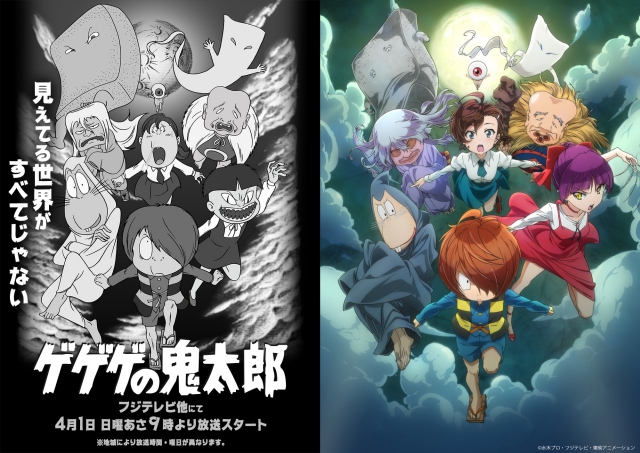
1968. 1971. 1985. 1996. 2007. 2018. Six television series across six decades, each redesigned from scratch — different art style, different tone, different target audience. Japan does not treat these as reboots. It treats them as the same show, still running. The character mutates completely every ten years. The function stays the same.
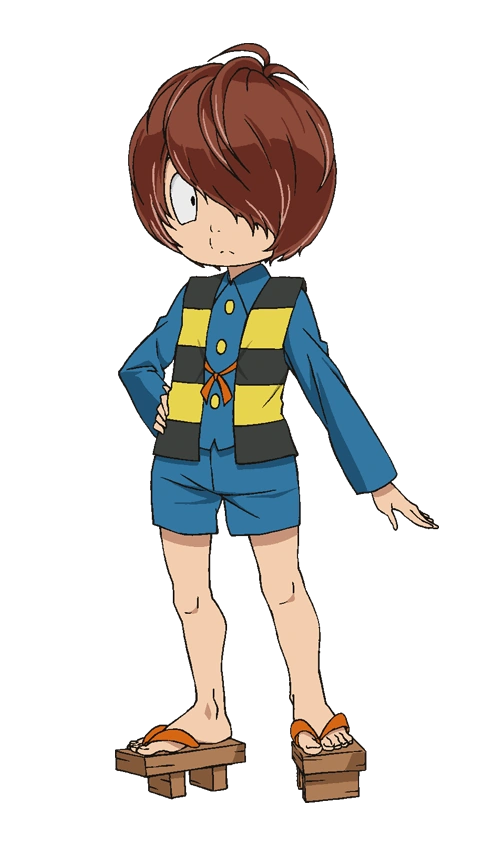 GeGeGe no Kitaro 2018 character design — the sixth iteration, sharp-featured and contemporary. Each decade's Kitaro is redesigned from scratch for a new generation
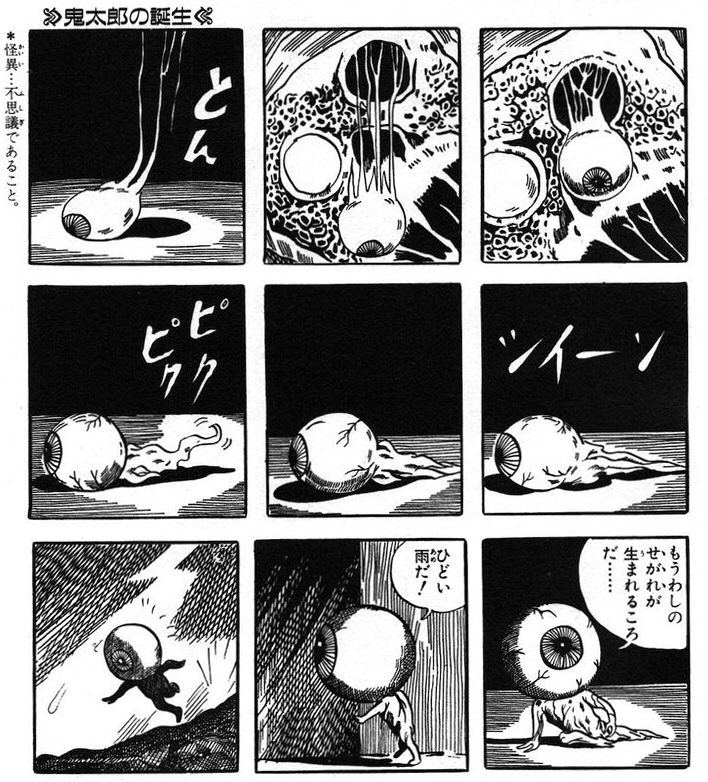 Mizuki Shigeru's original manga — the birth of Medama-oyaji. A dead man's remaining will animates a single eyeball that crawls from the grave. This became a children's show
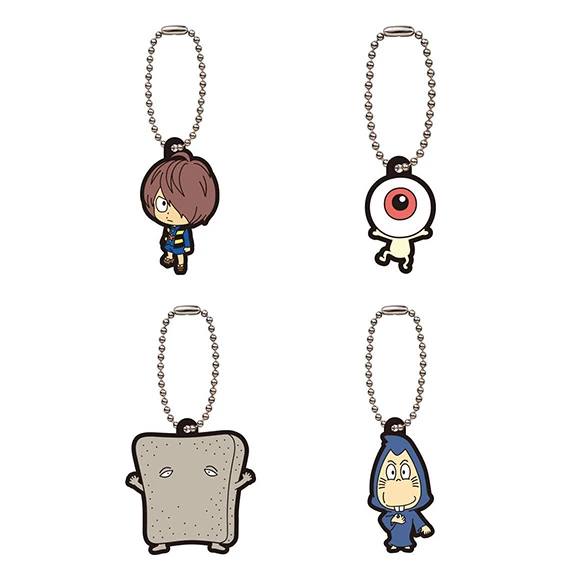 GeGeGe no Kitaro rubber mascot keychains — Kitaro, Medama-oyaji, Nurikabe, Nezumi-Otoko. Yokai as pocket-sized merchandise, dispensed without narrative context
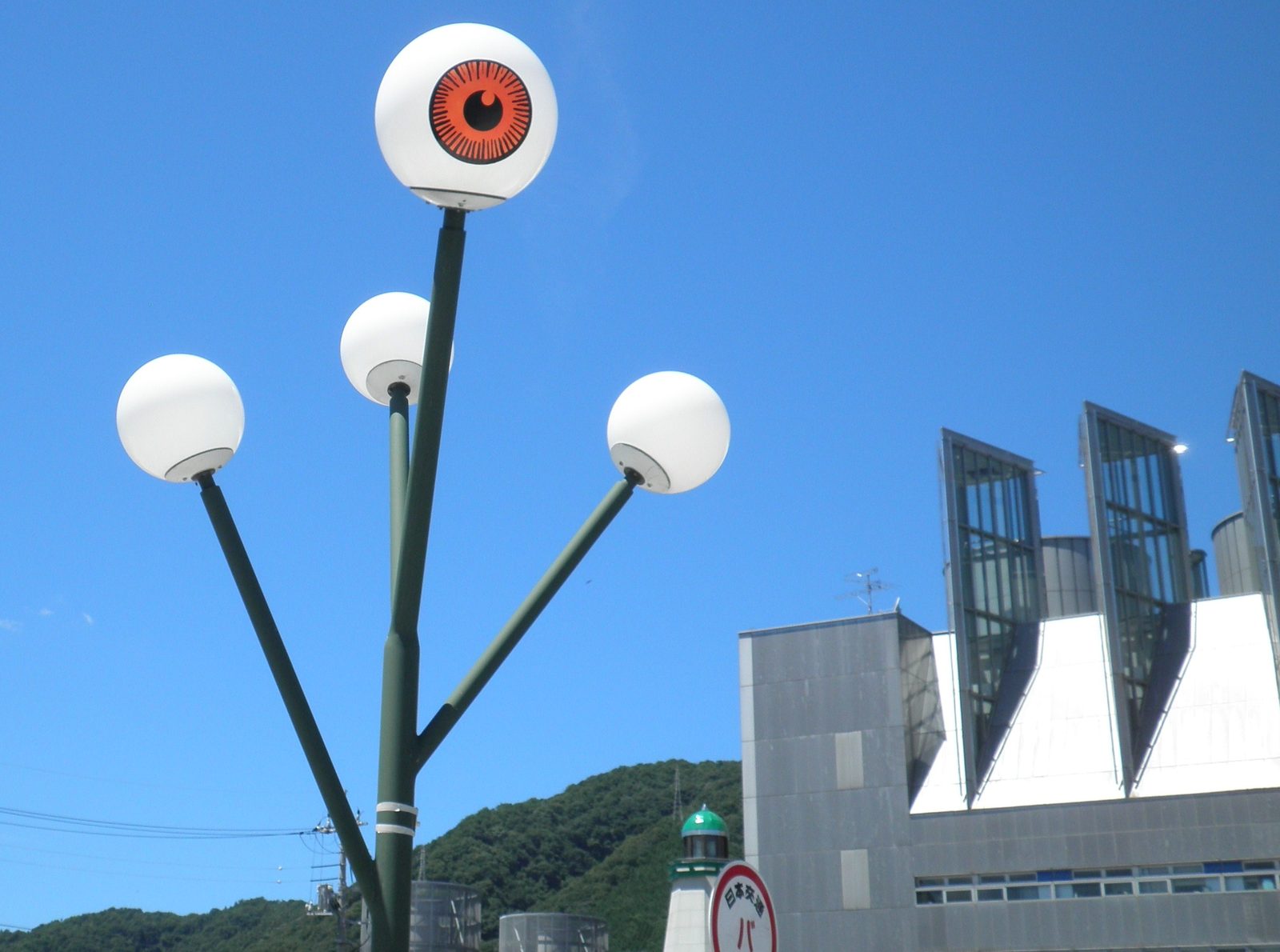 Sakaiminato — Medama-oyaji street lamps outside the Mizuki Shigeru Museum. A town of 33,000 that turned one man's folklore drawings into civic infrastructure. The eyeball watches the bus stop
 2018 Kitaro — yokai plotlines involving social media manipulation, algorithmic isolation, viral misinformation. The folklore updates. The monsters adapt
Kitaro merch spans nursery goods, adult figure lines, museum-grade art prints, regional tourism products, and gashapon yokai. The product range has no single target demographic because the IP has no single audience. Kids, adults, and collectors each have different entry points into the same folklore engine.
GeGeGe no Kitaro is a children's show about death. A boy born in a graveyard, raised by his dead father's reanimated eyeball — a sentient marble-sized organ that rides in the boy's hair and speaks in a high-pitched voice. The boy mediates between humans and yokai: spirits that eat people, deceive people, haunt people, and occasionally wear people's faces. Some yokai are sympathetic. Many are not. The show does not soften this.
This has aired on Japanese television six times. 1968. 1971. 1985. 1996. 2007. 2018. Six complete series across six decades, each redesigned from the ground up — different art style, different character designs, different tonal register, different target audience. The 1968 version is black-and-white horror. The 2018 version has plotlines about social media manipulation and algorithmic isolation. Japan does not treat these as reboots. It does not treat them as a franchise being milked. It treats them as the same show, still going.
Nobody has ever asked when it will be finished.
The Utility
Kitaro isn't an IP in the way that Dragon Ball or One Piece are IPs. Dragon Ball has a narrative. One Piece has a destination. Kitaro has a function: introduce Japanese children to yokai. That's it. Each generation gets its own version because the function doesn't change — only the interface does.
The yokai in each era's Kitaro reflect that era's anxieties. The 1968 series drew on postwar supernatural unease — spirits as stand-ins for things that couldn't be discussed directly. The 1985 series, in the middle of Japan's economic boom, turned yokai into adventure antagonists — threats to be overcome, not feared. The 2007 series introduced environmental themes. The 2018 series gave yokai smartphones and let them go viral.
The monsters adapt. The adaptation is the point.
The Mizuki Shigeru Root
Everything traces back to one man. Mizuki Shigeru (1922–2015) grew up in Sakaiminato, Tottori Prefecture, hearing yokai stories from a local woman named Nononba. He lost his left arm in World War II, survived malaria in New Guinea, returned to Japan, and spent years in poverty before finding success as a manga artist in the 1960s.
His yokai were never decorative. They carried the weight of a man who had seen death up close and needed a language for what he'd experienced. The early Kitaro manga — first serialized in 1960 as Hakaba Kitaro (Graveyard Kitaro) — is darker than anything that reached television. Kitaro's birth from a dead mother's corpse in a graveyard. His father, dying of illness, whose remaining will animates a single eyeball. The manga treated the supernatural as matter-of-fact: these things exist alongside you, they always have, and pretending otherwise is the real danger.
That emotional seriousness — yokai as something to be reckoned with, not just catalogued — never fully left the franchise. Even the brightest, most child-friendly versions of Kitaro retain a baseline strangeness that separates the show from standard monster-of-the-week children's anime. The yokai aren't defeated and forgotten. They're negotiated with. They remain.
No Canonical Version
There is no "real" Kitaro. Ask five Japanese people of different ages to describe the character and you'll get five different descriptions — different face shapes, different eye sizes, different clothing, different vibes. The 1985 Kitaro looks like a Shonen Jump action hero. The 2018 Kitaro looks like a modern anime protagonist with sharp features and detailed backgrounds. The 1968 Kitaro is barely more than Mizuki's original ink lines, animated on a budget.
Each version is "the real one" for whoever grew up with it. The franchise doesn't accumulate — it replaces itself. And because each replacement is designed for its specific era, none of them feel dated to the audience they were made for. A 2018 viewer doesn't need to watch the 1968 version to understand the 2018 version. The continuity is cultural, not narrative.
This is the Azuma logic made visible: there is no master text. There are fragments — six TV series, dozens of manga editions, hundreds of products — consumed in any order, with coherence supplied by the audience, not the franchise. The "story" of Kitaro is whatever version you encountered first.
Objects as Evidence
Walk through the Kitaro merchandise ecosystem and you see the same range that Kirby displays — but wider.
Baby goods. Medama-oyaji (the eyeball father) appears on infant bibs and toddler cups. A dead man's reanimated eyeball, on a product designed for a child too young to understand the concept of death. The design is simplified to a circle with a pupil — cute by reduction, unsettling if you know the source material.
Gashapon yokai figures. Bandai and Takara Tomy produce capsule toy lines of Kitaro yokai — Nurarihyon, Sunakake-Babaa, Ittan-Momen — rendered as collectible miniatures. Folklore dispensed from a vending machine at ¥300 per spirit. The figures have no narrative context on the packaging. You don't need to know the show to collect the yokai. The yokai preceded the show by centuries.
Sakaiminato. Mizuki Shigeru's hometown built its entire tourism economy around his work. Mizuki Shigeru Road runs from the train station to the museum: 177 bronze yokai statues lining both sides of the street, each with a plaque. The train is painted with Kitaro characters. The airport is named after him. The museum holds original manuscripts alongside immersive yokai installations. A city of 33,000 people receives over two million visitors annually because of one man's folklore drawings.
Adult figure lines. High-end yokai figures aimed at collectors — detailed sculpts of Mizuki's original designs, priced at ¥5,000–15,000, sold through hobby channels. The same yokai that appear on infant bibs, rendered for adults who grew up with one version of Kitaro and now want the source material.
The product range has no tonal center. It doesn't need one. Kitaro isn't one thing. It's a delivery system, and the delivery system serves whoever shows up.
Why This Isn't Nostalgia
Nostalgia requires a fixed original — a thing that existed once and is now remembered. Kitaro has no fixed original. There is no "classic" version that all others are compared to, because each version was designed to replace the last. The franchise's longevity doesn't come from people remembering it fondly. It comes from Japan deciding, every ten years, that children still need to meet yokai.
That decision — the deliberate re-introduction — is the thing that separates Kitaro from other long-running franchises. Doraemon continues. Sazae-san continues. But those shows maintain a single continuous run. Kitaro stops and restarts. Each restart is a conscious institutional choice: Toei Animation, Fuji Television (or its successors), and Kodansha or Shogakukan agree that the time has come for a new generation to encounter these spirits. The production committees change. The staff changes. The character designs change. The commitment to the function doesn't.
Japan keeps folklore alive without museums. Or rather — it keeps folklore alive through Sakaiminato's museum and through children's television and through gashapon machines and through regional tourism campaigns, simultaneously, across every possible audience segment. Kitaro is the vehicle. The folklore is the cargo. The vehicle gets rebuilt every decade. The cargo is centuries old and hasn't changed.
Nearby Worlds
If Kitaro's logic makes sense — a character that exists to keep something alive rather than to tell a story — the same logic runs through adjacent systems.
Anpanman, where moral instruction is delivered as character IP and the protagonist feeds his own body to hungry children, weekly, since 1988. Doraemon, where childhood anxiety is the permanent subject of a show that has no intention of letting its protagonist grow up. Yokai Watch, which attempted the same folklore-delivery function as Kitaro for a smartphone generation — and partially succeeded before its commercial cycle wound down.
And the yokai merchandise ecosystem itself: regional yokai tourism across rural Japan, yokai-themed gashapon from manufacturers who've never licensed Kitaro specifically, yokai as a perpetual category in Japanese product culture that predates any single franchise and will outlast all of them.
Kitaro doesn't explain yokai. Kitaro introduces you to yokai and lets the yokai do the rest. That's been the arrangement since 1968. It will be the arrangement again, whenever Toei decides it's time for version seven.
Loading...