
Cup no Fuchiko
An OL (office lady) in various acrobatic poses, designed to cling to the rim of your coffee cup. Created by manga artist Katsuki Tanaka in 2012. Sold over 20 million units — making it the best-selling gashapon series of all time. Spawned the entire Putitto sub-brand of cup-edge figures. The concept is instantly legible: you look at it, you understand it, you smile. That's the Kitan Club formula.
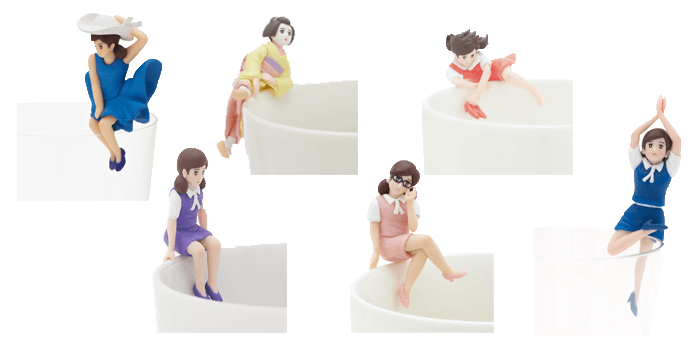 Cup no Fuchiko — multiple acrobatic poses clinging to cup rims. Over 20 million units sold. The character that proved gashapon could be art direction
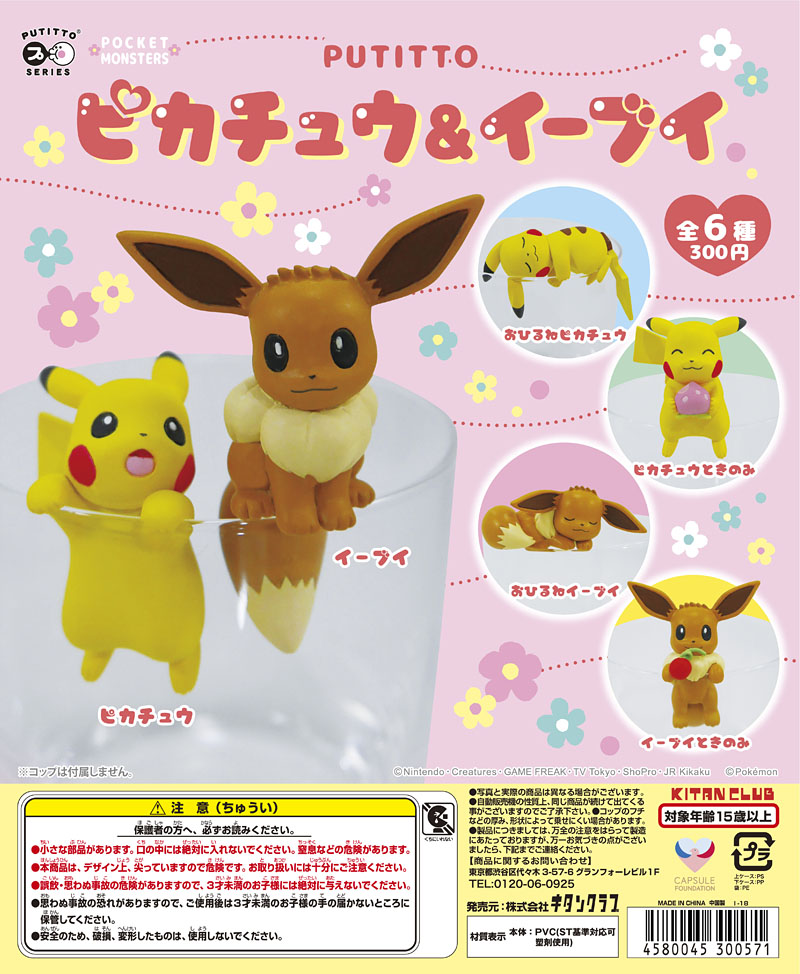 Putitto Pikachu — the Fuchiko-spawned sub-brand applied to Pokemon. Cup-edge figures became a format, not just a product
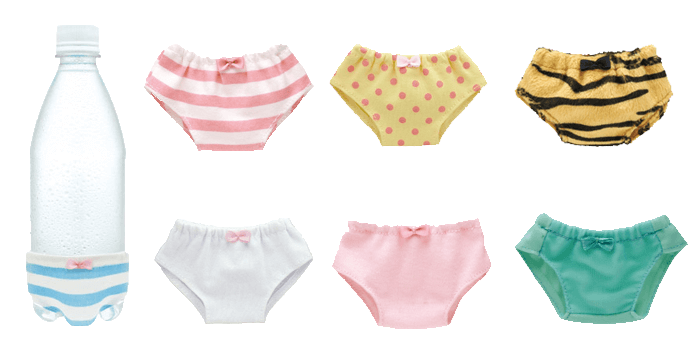 Bottle Panties — underwear for your water bottle. The kind of product that makes you question reality before buying three
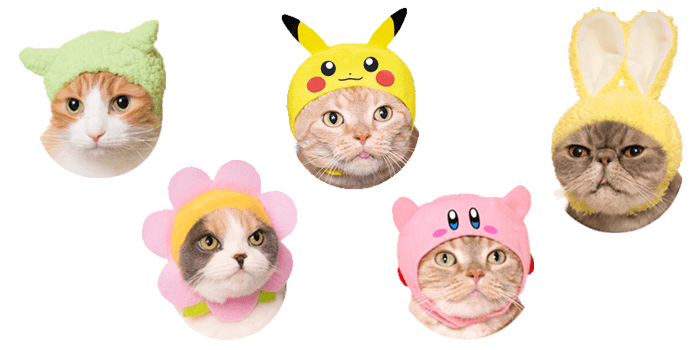 Neko no Kaburimono — cat headwear gashapon. 30+ releases. Kitan Club's second-longest-running series after Fuchiko
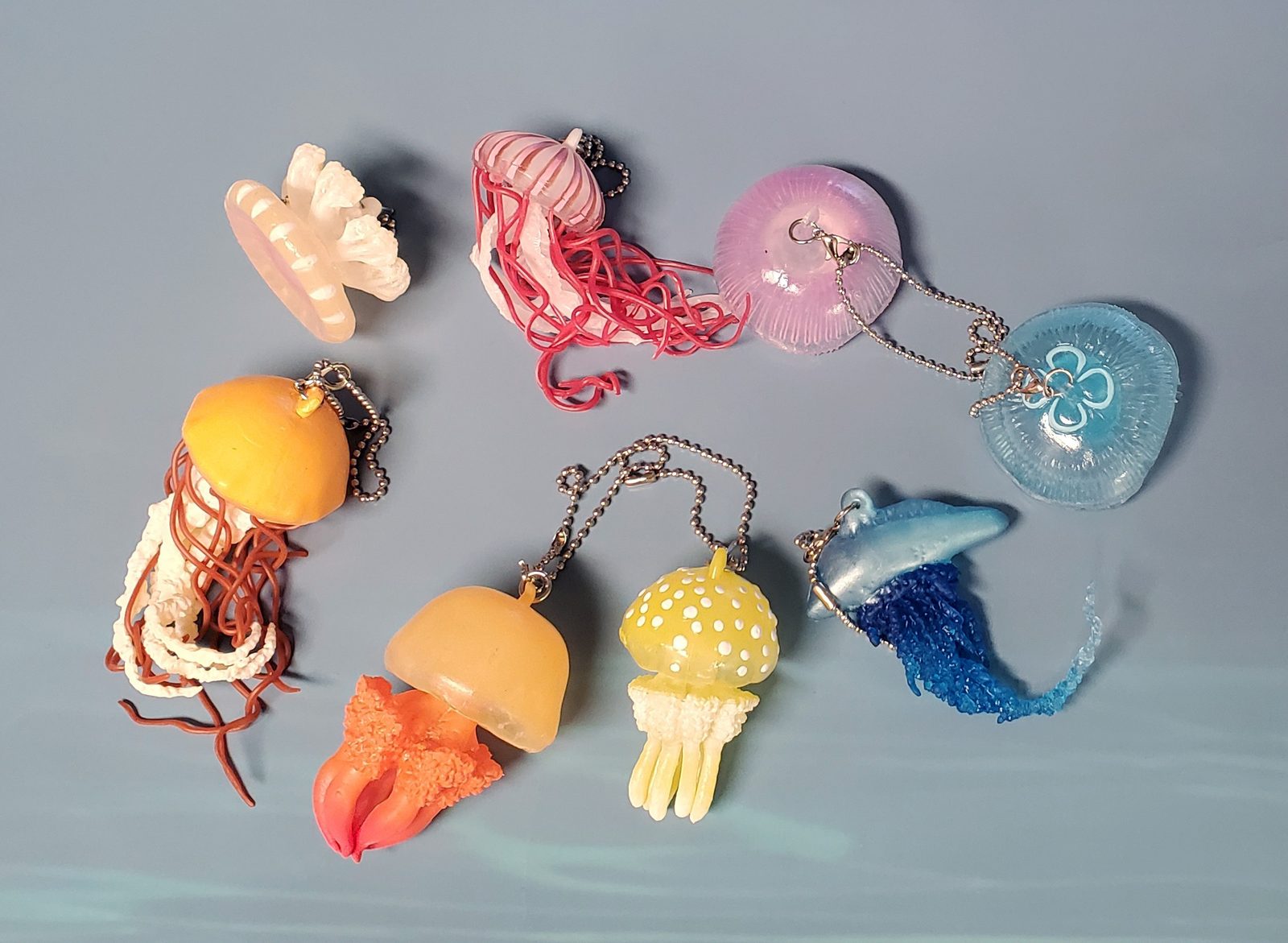 Nature Techni Colour jellyfish series — museum-quality scientific accuracy at capsule toy prices. The line that proved gashapon could be educational
Founded 2006 by ex-Yujin employees. 4-8 new varieties every month. Operating principle: if the concept makes you laugh before you understand it, ship it. Standard price: ¥200-500. International access: proxy services, eBay, and the occasional specialist importer.
Every gashapon company makes anime character figures. Every gashapon company makes miniature food replicas. Every gashapon company makes keychains shaped like things that are not keys. Kitan Club makes underwear for your water bottle.
Bottle Panties is a real product from a real company that has been in business since 2006. You put tiny underwear on your water bottle. There is no functional purpose. There is no ironic distance in the product design — the underwear is sincerely manufactured, sincerely packaged, and sincerely dispensed from a capsule machine for ¥300. And when you encounter it for the first time, standing in a gashapon aisle somewhere in Akihabara, the experience follows a predictable arc: confusion, amusement, the turn of a dial, and the possession of a small pair of underwear for a beverage container.
This is Kitan Club's entire operating philosophy: if the concept makes you laugh before you understand it, it's ready for production.
The Fuchiko Phenomenon
Kitan Club's defining product is Cup no Fuchiko (コップのふちこ) — created by manga artist Katsuki Tanaka in 2012 — a series of miniature OL (office lady) figures designed in acrobatic poses that cling to the rim of a coffee cup or glass. The character hangs, balances, straddles, and contorts herself on the edge of whatever vessel you place her on. The design is immediately legible: you see it, you understand what it does, and you want to put one on your cup.
Fuchiko sold over 20 million units, making it the best-selling gashapon series in history. For a capsule toy at ¥200-300 per unit, that number is staggering — it means Fuchiko generated roughly ¥5 billion ($33 million) from a single character sitting on cup rims. The character's appeal operates on multiple levels: the physical comedy of the poses, the tiny-human-in-a-giant-world scale play, and the participatory element of choosing which cup or glass to display her on. Every Fuchiko owner curates their own miniature scene. The figure's context is your kitchen.
The success spawned Putitto — a sub-brand that applies the cup-edge format to licensed characters. Pikachu perching on your mug. Kirby balancing on your glass. Gudetama draped over the rim of your teacup. The format Tanaka invented for Fuchiko became a platform that Kitan Club licenses across dozens of IPs, turning a single clever idea into a product category.
The Nature Line
Before Kitan Club's founding team split in 2014 (with key members leaving to establish Ikimon Co. Ltd.), the company produced Nature Techni Colour — a gashapon line of scientifically accurate miniature animal figures that had no business being as good as they were. Frogs of Japan. Turtles of Japan. Clear Rivers of Japan. Antarctic species. Savanna megafauna. Each set contained 8-10 models sculpted with museum-gift-shop accuracy and painted with a specificity that collectors of both toys and natural history found genuinely useful.
The Nature Techni Colour line proved something unexpected about the gashapon format: the randomness could serve education. A child turning a gashapon machine labelled "Frogs of Japan" and receiving a perfectly sculpted Japanese tree frog is learning something — not from text, but from an object small enough to fit in their palm. The line attracted collectors who would never identify as "gashapon collectors" but who recognised the quality of the sculpts and the seriousness of the naturalism.
The brand now operates under Ikimon, but Kitan Club's DNA is visible in the concept: take a subject seriously, render it at capsule toy scale, and trust that the audience for quality exists even at ¥300.
The Full Catalogue of Absurdity
Beyond Fuchiko and nature figures, Kitan Club's product roster is a monument to creative freedom unencumbered by market research:
- Neko no Kaburimono: Hats for cats. 30+ releases. The longest-running Kitan Club series after Fuchiko.
- Smartphone Futon: A tiny bedding set for your phone. Tuck your iPhone in at night.
- Onigirings: Rings shaped like rice balls.
- Bread Mascots: Squishy bread figures.
- Art in the Pocket: Miniature replicas of Japanese artworks including woodcarving cats and goldfish.
Each product follows the same logic: the concept is the pitch. If you can explain it in one sentence and the sentence makes someone laugh, it ships. The execution is always better than the concept suggests — the sculpting is clean, the paint is precise, the packaging is thoughtful. Kitan Club products look disposable from a distance and feel considered up close. The gap between expectation and reality is where the charm lives.
Why Kitan Club Matters
In a gashapon market dominated by Bandai's volume and licensed character figures, Kitan Club occupies the novelty niche — but "novelty" undersells what they do. Their products aren't random weirdness. They're designed objects with a clear point of view: everyday life is full of small absurdities, and the correct response is to manufacture them at ¥300 per unit and put them in vending machines.
The international collector community treats Kitan Club as the discovery brand. You don't go looking for Kitan Club products — you encounter them, in a gashapon aisle or on a friend's desk, and the encounter is the conversion moment. The company's distribution is primarily Japan-domestic via gashapon machines, with international access through proxy services (FROM JAPAN, Buyee) and reseller channels (eBay, Etsy). No direct international storefront exists, which means every Kitan Club item in a Western collection required either a trip to Japan or a proxy purchase — adding a layer of acquisition effort that transforms a ¥300 capsule toy into a minor trophy.
The gashapon format's greatest virtue is its democracy: everything is small, everything is cheap, and the machine doesn't care who you are. Kitan Club's greatest virtue is understanding that democracy works best when some of the options are completely ridiculous.
Loading...