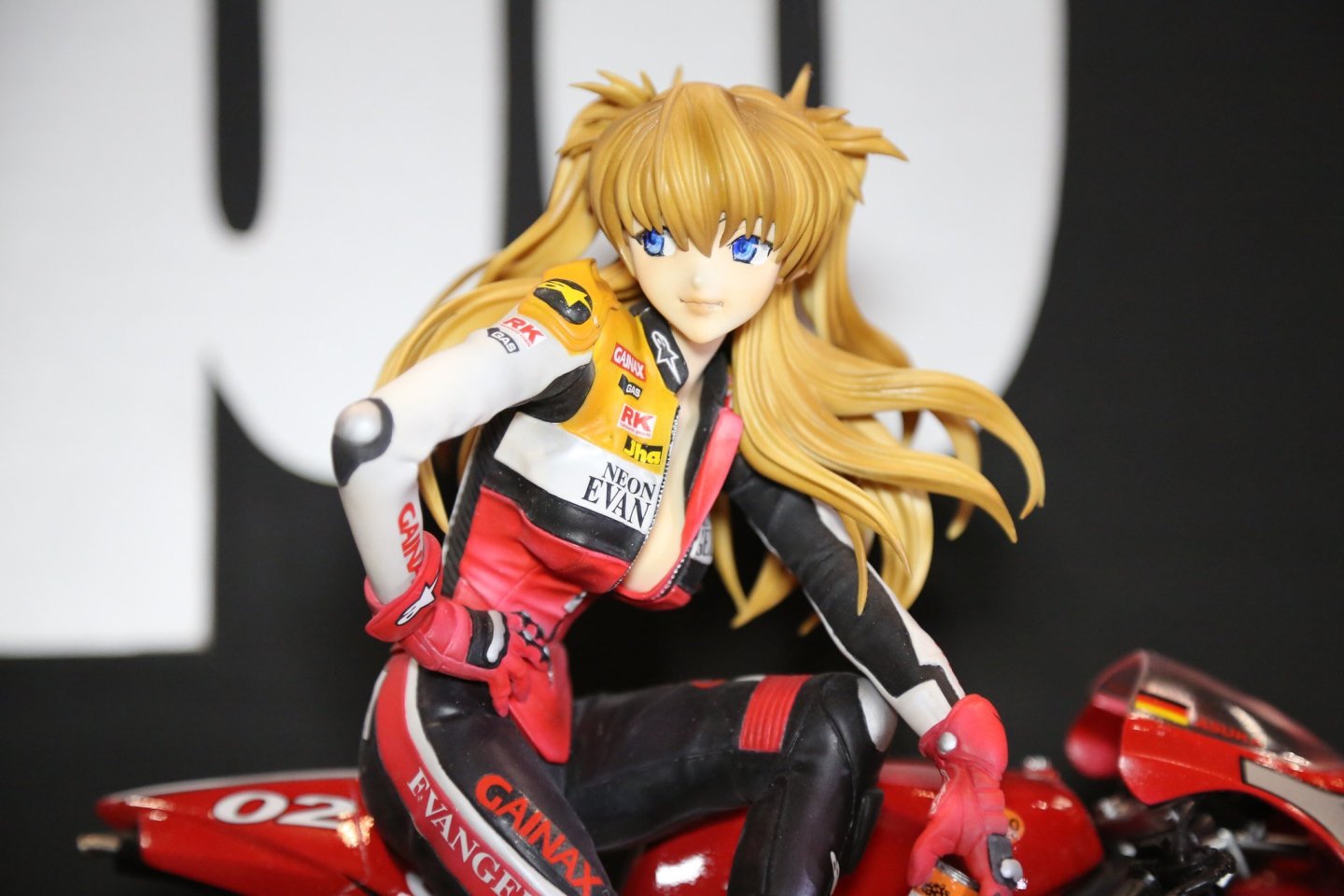
The One-Day License
Here is how it works: a sculptor creates a figure of a copyrighted character — say, Asuka from Evangelion. Normally, selling that figure would be copyright infringement. But at Wonder Festival, the sculptor applies to Kaiyodo for a When Day (当日版権) license. If approved, they can produce and sell that figure at the event only, on that day only. Midnight hits and the license expires. The figure can never legally be sold again. This legal framework has existed since 1992 and has no equivalent anywhere else in the world.
 Wonder Festival 2026 Winter dealer hall — 2,264 tables, each one an independent sculptor or small circle selling original and licensed garage kits for one day only
 A typical WonFes dealer table — resin kits displayed unpainted (left) alongside painted reference builds (right). Prices range from ¥3,000 to ¥15,000+
 Morning queue at Makuhari Messe — serious collectors arrive hours early to reach specific dealer tables before limited runs sell out. Some kits are gone in minutes
 Dealer showcase display — painted reference builds demonstrate what the raw resin kit can become. These painted versions are not for sale; they exist to sell the unpainted kit
 The split floor — corporate booths (Good Smile, Bandai, Kotobukiya) on one side, independent dealer tables on the other. The event serves both industries simultaneously
The one-day license isn't charity. Each application requires a fee (typically ¥500-2,000 per character), and not every application is approved. Rights holders can reject any request. But the approval rate is high enough that thousands of sculptors participate each cycle, and the system has become the primary talent pipeline for Japan's commercial figure industry.
 Resin kit detail from a dealer table — the sculpting quality at WonFes dealer tables often rivals or exceeds commercial releases. These are individual artists, not factories
 Sold-out signs appear within the first hour for popular sculptors. Limited runs of 20-50 copies are standard. The scarcity is structural, not manufactured
Every six months, independent sculptors set up folding tables in Makuhari Messe, a convention centre east of Tokyo, and sell figures of copyrighted characters that they have legal permission to sell for exactly one day. WonFes 2026 Winter — February 8, 2026 — is the largest edition in the event's 41-year history: 2,264 general dealer tables plus 79 corporate booths, filling Halls 1-8. At midnight, the permission expires. The figures cannot be sold again. The moulds go into storage. The sculptor waits six months and does it again.
This is the When Day license (当日版権) system, and it is the legal infrastructure that makes Wonder Festival possible. The event was founded in 1985 by General Products — the company that would later become Gainax — as a market for small-time garage kit makers who lacked the resources to license commercially. In 1992, Kaiyodo took over management when General Products pivoted to animation, and they've run it since. Today, WonFes is chaired by Shuichi Miyawaki, Kaiyodo's Managing Director and owner of a personal collection exceeding 40,000 figures. Organised by Kaiyodo since 1992 and running twice yearly (Winter and Summer), WonFes is simultaneously a corporate showcase for companies like Good Smile, Bandai, and Kotobukiya, and a massive independent market where individual artists sell hand-cast resin kits of characters they love but don't own. The one-day license is what keeps the second half legal.
No other country has anything like it. The system is uniquely Japanese — a pragmatic solution to a copyright problem that, in any other market, would simply result in cease-and-desist letters and convention bans. Japan's rights holders instead chose to formalise the fan production ecosystem, regulate it, monetise it slightly (through per-character licensing fees), and let it flourish. The result is the most important talent development pipeline in the global figure industry.
How the License Works
A sculptor wants to sell a resin kit of a character from, say, Jujutsu Kaisen. They submit an application to the Wonder Festival organisers, who coordinate with the rights holders (in this case, Shueisha and MAPPA). The application includes photos of the sculpt, the intended production quantity, and the per-unit price. A licensing fee — typically ¥500-2,000 per character, per event — is paid by the sculptor.
If approved, the sculptor receives a When Day permit authorising production and sale at that specific Wonder Festival only. They can produce as many copies as they specified in the application — usually 20 to 50, limited by the economics of hand-casting resin. The figures are sold at the event. When the event ends, the licence expires. Leftover stock cannot legally be sold afterward, though the reality is more complex than the rule.
The approval rate is high. Rights holders generally approve applications because the system benefits them: it creates buzz around their properties, identifies talented sculptors they might want to hire, and generates a small licensing revenue stream. Rejections typically occur for quality concerns, inappropriate depictions, or properties with strict licensing policies.
The Dealer Table Economy
Wonder Festival 2026 Winter featured 2,264 dealer tables — each one an independent sculptor or small circle (the Japanese term for a hobbyist production group). The tables are the heart of the event. The corporate booths along the perimeter get the press coverage — prototype reveals from Good Smile, new announcements from Bandai Spirits — but the dealer hall is where the culture lives.
A typical dealer table displays raw resin kits alongside painted reference builds. The painted version shows what the kit can look like in skilled hands. The thing you buy is the bag of grey parts. Prices range from ¥3,000 for simple single-piece figures to ¥15,000+ for complex multi-part kits with detailed sculpting. Payment is cash. The transaction takes thirty seconds. The sculptor hands you a ziplock bag and a photocopied instruction sheet and you're holding something that was made by one person, exists in maybe 30 copies, and will never be produced again.
The scarcity is structural, not manufactured. Hand-casting resin is slow. Each copy requires pouring catalysed resin into a silicone mould, waiting for it to cure, demoulding, trimming flash, checking for defects, and repeating. A productive caster can make perhaps 5-10 copies per day. A run of 30 units represents a week of evenings spent casting. This isn't Bandai limiting production to create hype. This is one person with a mould and a bucket of resin doing what their schedule allows.
The result: popular sculptors sell out within the first hour. Buyers who want specific tables arrive at Makuhari Messe at dawn. The queue stretches around the building. When the doors open, there's a directed sprint — not quite running, but the fastest walking the venue staff will tolerate — toward target tables. Miss your window and the kit is gone. The secondary market price will be double. Maybe triple.
The Talent Pipeline
Here is the part that makes the one-day license system matter beyond the hobby: Wonder Festival dealer tables are how Japan's commercial figure industry finds its sculptors.
The progression is documented and repeatable. A sculptor starts at WonFes as a hobbyist — table in the back of the dealer hall, modest production run, first-time nerves. Their work gets photographed and shared on social media and MyFigureCollection. If the sculpts are good, they attract attention — both from collectors and from commercial figure companies scouting for talent.
Good Smile Company, Max Factory, Alter, Kotobukiya, and other major figure manufacturers all recruit from the WonFes dealer pool. The logic is obvious: a sculptor who can produce a professional-quality figure independently — sculpting, moulding, casting, painting the reference build — has already demonstrated every skill the commercial pipeline requires. The transition from independent dealer to commercial sculptor is less a career change than a scale change: same skills, bigger production runs, better materials, and a salary.
Notable examples are numerous. Many of the sculptors credited on the most popular commercial scale figures started at WonFes dealer tables. The event functions as both a marketplace and an audition. Every kit displayed is a portfolio piece visible to the entire industry.
The Split Identity
Wonder Festival is two events sharing one venue. The corporate half — Good Smile, Bandai, Kotobukiya, Aniplex — uses the event for prototype reveals, product announcements, and marketing spectacle. These booths have professional displays, lighting rigs, and queues for photo opportunities. Coverage from this half dominates hobby news sites.
The dealer half is scrappier, denser, and more interesting. Folding tables. Printed tablecloths. Hand-written price signs. Sculptors standing behind their work, answering questions, watching someone examine their figure up close. The energy is different from the corporate side — it's the difference between a product launch and an art show. Both are valid. Both happen in the same building. The coexistence is what makes WonFes unique.
The tension between these two halves is productive. Corporate exhibitors benefit from the event's grassroots credibility — WonFes isn't just a trade show, it's a community gathering. Independent dealers benefit from the traffic that corporate announcements generate — collectors who come for the Good Smile reveals walk through the dealer hall on the way out and discover sculptors they'd never have encountered online.
The Preservation Problem
The one-day license creates a preservation paradox. The system produces thousands of unique figure designs every year, most in runs of 20-50 copies, legally available for a single day. Once sold, these kits enter private collections. Some are built and painted. Many sit in storage, unbuilt. None can be officially reproduced.
The photographic record — event coverage, social media posts, dealer catalogs — preserves images of what was made. MyFigureCollection and Japanese hobby blogs maintain extensive archives. But the physical objects are functionally ephemeral. A figure sculpted for WonFes 2015 by a talented independent artist, produced in 25 copies, sold in 40 minutes, and never replicated — that figure exists in maybe 20 complete collections worldwide. The sculptor has moved on. The mould has degraded. The moment is gone.
This ephemerality is, for collectors, part of the appeal. A WonFes garage kit isn't a product. It's an artefact of a specific day, a specific event, a specific artist's ambition at that moment. The bag of resin parts carries temporal weight that a mass-produced figure doesn't. You weren't just buying a kit. You were there.
The Global Influence
Wonder Festival's one-day license system has no direct international equivalent, but its influence is visible everywhere in the global figure scene. DesignerCon in the US, Thailand Toy Expo, and other international designer toy events operate on similar principles — independent artists selling limited-run original works — but without the copyright licensing framework that makes WonFes uniquely able to accommodate fan-made versions of commercial characters.
The closest international parallel is the convention artist alley, where illustrators sell prints of copyrighted characters in a legal grey zone. But artist alley operates on tolerance, not licence. WonFes operates on explicit, temporary permission. The distinction matters: it means the work is legitimate, the sculptor can display it proudly, and the rights holder has acknowledged its existence.
WonFes Goes International
In October 2025, Kaiyodo announced something unprecedented: Wonder Festival US 2026, scheduled for May 21-24, 2026 at the Georgia World Congress Center in Atlanta, held inside MomoCon. A dedicated Wonder Festival Pavilion (approximately 4,600-9,300 m²) will host international figure manufacturers, independent garage kit makers, and artisan toy designers. "Creator Zone Tables" are designated for independent sculptors.
Whether the one-day license system will be replicated in the US remains the open question. The Japanese system requires months of coordination with rights holders — arranging equivalent permissions under American copyright law, with American IP holders, at an American convention is a significantly different legal challenge. If it works, it opens the garage kit ecosystem to an international audience that has only ever accessed it through proxies and resale. If it doesn't, WonFes US becomes a showcase rather than a marketplace, and the one-day licence remains Japan's unique contribution to copyright pragmatism.
Either way, the announcement signals that Kaiyodo sees the garage kit scene as exportable — that the combination of independent craft, limited production, and event-exclusive culture has an audience beyond the people who can get to Makuhari Messe twice a year.
WonFes 2026 Summer will take place later this year at Makuhari Messe. WonFes US at MomoCon in May. The one-day licenses will be issued. The grey resin will change hands. And by midnight — in whichever timezone — the legal window will close again.
Wonder Festival takes place twice yearly at Makuhari Messe, Chiba. Dealer table admission: ¥2,000. WonFes US 2026: May 21-24, Atlanta, admission included with MomoCon pass.
Loading...