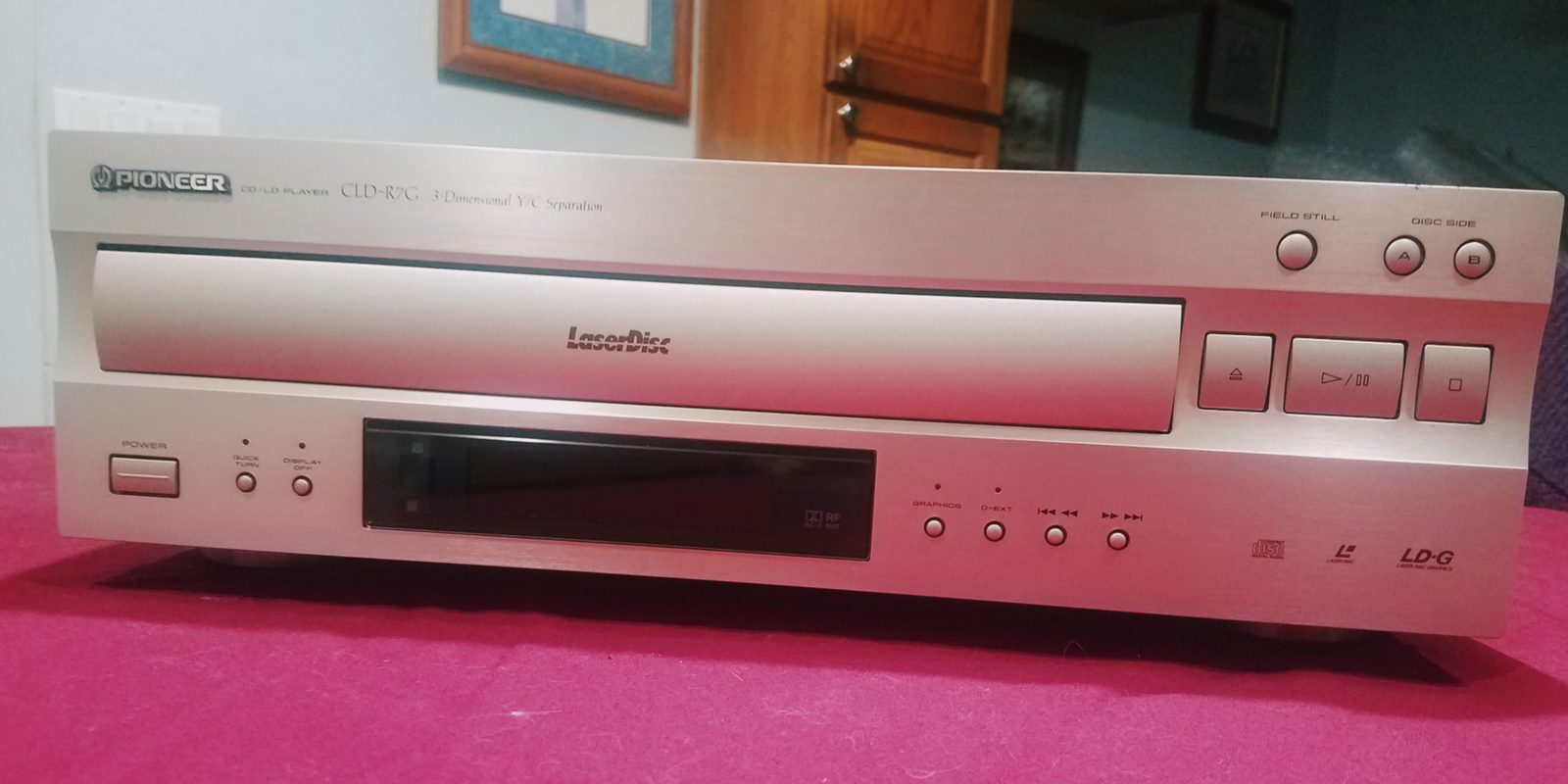
The final engineering statement from the format's creator, designed for an audience that still believed in LaserDisc.
The Final Machine
The CLD-R7G carries 51 dB of video signal-to-noise ratio and 115 dB of audio signal-to-noise ratio across hardware that weighs 6.9 kg and sits in a footprint smaller than most contemporary component receivers. The 3D Y/C separation comb filter processing analog video in real time, frame by frame. The rose-gold body paired with a silver faceplate—industrial design that acknowledges its own obsolescence without capitulating to it.
Pioneer did not manufacture this player for the American market. The domestic Japanese LD audience in the late 1990s remained committed enough to justify final-generation hardware engineered without compromise. No feature corners cut. No cost reduction. The CLD-R7G was built as if LaserDisc would persist indefinitely.
This is the critical paradox: the CLD-R7G is an object designed for repeated use, yet using it accelerates irreversible decline. Laser tubes degrade after twenty-five years. They cannot be replaced. Third-party solutions do not exist. Every hour of playback brings the machine measurably closer to functional death. The CLD-R7G is a player and a countdown simultaneously.
Pioneer's position was unique in LaserDisc history. As the format's inventor, Pioneer manufactured the hardware. As a major anime publisher (Pioneer LDC, later Geneon), Pioneer pressed the discs and distributed the content. As a brand, Pioneer engineered the ecosystem for themselves. The CLD-R7G represents the endpoint of that vertically integrated vision—a machine built by the format's creator for an audience that understood they were preserving something irreplaceable.
It cost approximately $3,000 USD equivalent when new. Current secondary market prices range $400–600 depending on condition—a measure not of depreciation, but of scarcity accelerating as units fail beyond repair.
- Pioneer's dual role as LaserDisc hardware manufacturer and anime content publisher (Pioneer LDC/Geneon)
- Japanese domestic electronics market as distinct quality tier from export consumer goods
- The CRT monitor as mandatory companion—analog signal chain preservation as editorial choice
- Hardware failure as preservation crisis—laser tubes degrade irreversibly, cannot be sourced

Loading...