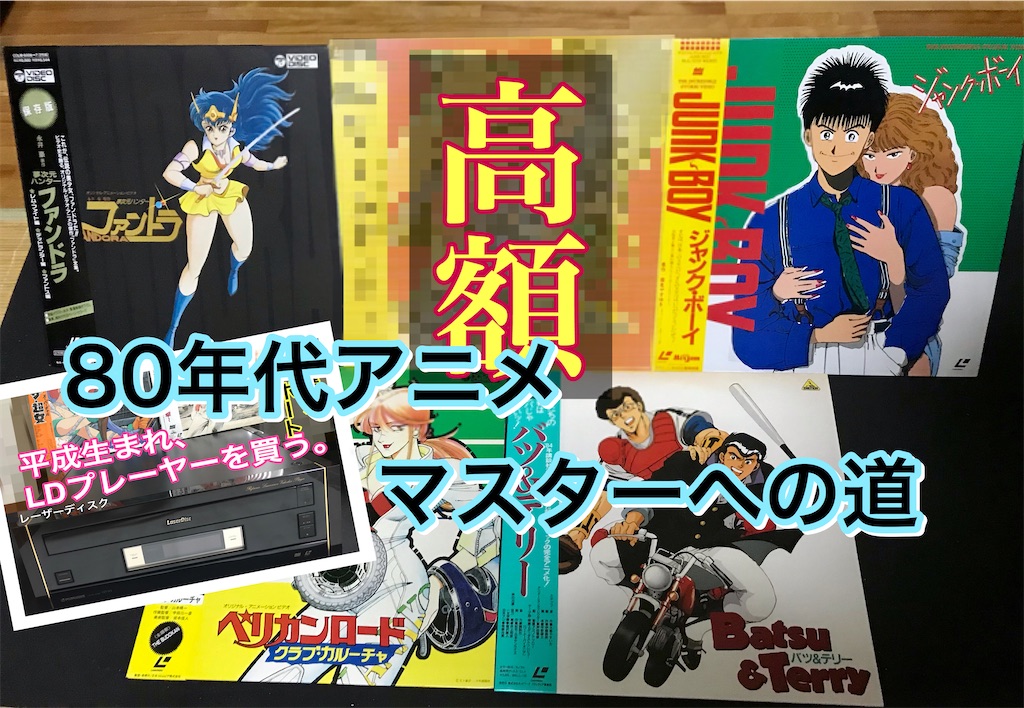
Why would anyone still watch anime on a format that lost?
At first glance, a LaserDisc looks like a vinyl record that plays video.
That comparison isn't wrong. It's just insufficient. Because what's easy to miss — what most people who dismissed the format never stopped to notice — is how much of what we now expect from home video was invented here. Director's commentaries. Letterboxed aspect ratios. Chapter selection. Supplementary booklets with production art and essays. The entire idea that a film at home should be presented, not just played.
LaserDisc introduced all of it. Then DVD arrived, standardized the interface, and erased the precedent.
What Gets Lost in Translation
When anime made with hand-painted cels was mastered for LaserDisc, the signal chain was entirely analog. Pigment on acetate, photographed onto film, transferred to analog video, pressed onto a disc read by a laser. No compression. No encoding decisions. No algorithms choosing which details to keep and which to discard.
When those same titles were remastered for DVD in the early 2000s, the signal chain changed. MPEG-2 compression introduced artifacts — macroblocking in fast motion, banding in gradients, a slight flattening of the image that most viewers accepted because the convenience was overwhelming. Color timing was adjusted by engineers working decades after the original production, often without access to the original masters. What arrived on DVD was a version. What existed on LaserDisc was the recording.
For most anime, this distinction doesn't matter. The DVD is fine. The Blu-ray is better. But for a specific category of titles — hand-drawn, cel-animated works from the 1980s and 1990s — the LaserDisc preserves something that no digital release has replicated: the original production-era color, contrast, and texture as they existed at the time of creation.
Why Japan Kept It Alive
LaserDisc penetration in Japan reached roughly 10% of households by the late 1990s. In the United States, it never exceeded 2%. The difference wasn't technological preference. It was infrastructure.
Japan's karaoke industry adopted LaserDisc as its standard playback format in 1982. Bars, studios, and home systems all required LD hardware. This installed base — sustained by entertainment infrastructure rather than home video enthusiasm alone — kept the format commercially viable a full decade longer than anywhere else. The last LaserDisc ever pressed was a karaoke title, released in March 2007.
That extended lifespan meant Japan's anime industry had a premium distribution channel for OVAs, box sets, and collector editions throughout the 1990s. And the packaging culture that developed around anime LaserDisc — gatefold sleeves, liner notes, production art inserts, obi strips — became the template for everything that followed: limited edition DVDs, Blu-ray collector sets, and the physical media culture this site covers every week.
Private Screening Rooms
LaserDisc collections don't feel like libraries. They feel like private screening rooms frozen in time.
The discs are twelve inches across — the size of a vinyl record. The box sets weigh five to ten pounds. You don't casually accumulate them. You commit. And the versions they hold — original color timing on Akira, frame-by-frame CAV access on Evangelion, 110 episodes of hand-drawn Legend of the Galactic Heroes that collectors swear looks better than the digital remaster — exist nowhere else.
The hardware is failing. Pioneer stopped manufacturing players in 1999. Laser tubes weaken after 25 years and cannot be replaced. The collector cohort that built these libraries in the 1980s and 1990s is aging. The preservation window is closing.
What follows are eight cards about specific objects, systems, and decisions that made anime LaserDisc what it was — and what it still is, for the people who kept the players running.
Loading...